ANTIOXIDATIVE AND ANTIRADICAL SEASONAL
DISTINCTIVES OF SEA BUCKTHORN SPROUTS
Inara Nokalna,
[a]*Alise Silova,
[b]Ilona Vanaga,
[c,d]Imants Kalnins
[e]and
Andrejs Skesters
[b]Keywords: sea buckthorn, antioxidants, antiradicals.
More than 40 volatile compounds with pharmacological effects (including antioxidant, anti-inflammatory, anticancer, radioprotective activity and improvement of cardiovascular risk factors, etc) are detected in the sea buckthorn. The most thoroughly investigated parts of sea buckthorn are berries – their juice and oil, but less is known about the bioactives of the other plant parts. This study aims to determine antioxidative (AO) and antiradical (AR) properties of sea buckthorn sprouts. The study results show differences between spring and autumn sprouts’ collection as well as water and 70% ethanol extracts. Further, in vivo research needs to be done to provide a full understanding of sea buckthorn sprouts’ AO and AR effects.
* Corresponding Authors Fax:
E-Mail: [email protected]
[a] Dept. of Physiology and Biochemistry of Riga Stradinš University, Riga, Latvia
[b] Laboratory of Biochemistry of Riga Stradinš University, Riga, Latvia
[c] SilvEXPO, Nature, Driven, Technologies, Ltd. [d] Faculty of Medicine, University of Latvia, Riga, Latvia [e] Department of Physics of Riga Stradinš University, Riga,
Latvia
Introduction
Studies on the effects of natural polyphenols, which are also present in sea buckthorns (Hippophae rhamnoides L, have evolved significantly over the last 15 to 20 years and have proven thereof role in the prevention of cardiovascular, cancer, degenerative and other diseases.
These polyphenolic compounds are a major group of phytochemicals that have antioxidative activity by inducing body’s antioxidative systems – hydrophilic and lipophilic, both of these systems show antibacterial, antiviral, antitumor and anti-inflammatory properties and play a significant role in protection against oxidative stress (OS).1 OS essentially is an imbalance between the production of free radicals (FR), reactive oxygen species (ROS), and/or reactive nitrogen species (RNS), and the body’s possibility to detoxify or counteract FR and/or ROS harmful effects on cells membranes and other organism systems through the neutralization via antioxidants (AO). ROS can damage any components of the cell membrane, such as the DNAproteins and lipids, and give rise to different pre-pathological and pathophysiological conditions.2 Thus, OS plays direct and indirect role in pathophysiology of several diseases such as neurodegenerative (Parkinson’s Disease, Alzheimer’s Disease, Multiple sclerosis), cancer, Diabetes Mellitus, cardio-vascular diseases and others.3 Chemical content of various parts of sea buckthorn (mainly berries) and its products have been studied, but there is not a lot of data regarding separate components that describe antioxidative
and/or antiradical activity of this plant. There has never been a complex approach to antioxidants as their possible potential to regulate active forms of oxygen and nitrogen free radicals, thus stopping development of oxidative and/or nitrosative stress in vitro. Herbal remedies made of sea buckthorn are most frequently used for the treatment of-cancer therapy side effects, cardiovascular diseases, gastric ulcers, liver cirrhosis, skin diseases, such as damaging effects of sun, therapeutic radiation treatment and cosmetic laser surgery, and some other pathological conditions.4 However, until now, little evidence has been obtained to indicate, whether biologically active compounds are consistently present throughout the plant growth stages or whether the compounds are affected by the seasonal changes. Also, the significant differences in chemical composition and biological activity of sea buckthorn leaves, shoots, berries, and buds indicate a need for detailed studies of their extracts, specific fractions and compounds during a whole vegetative season.
This study aimed to characterize the sea buckthorn sprouts, which were harvested in spring and autumn seasons, and their aqueous and 70 % ethanol extracts according to their antioxidative and antiradical properties in vitro.
Materials and methods
Extracts preparing
For this study, the extraction and determination of antioxidants present in sea buckthorn sprouts which were collected in spring (April) and autumn (October) season were determined via two different solvent systems: 70 % ethanol (ethanol solution in water) and water.
flask was put in the water bath, and kept there for 3 hours while stirring. The temperature in the bath was about 60 °C. After the extraction, the solution was filtered in order to obtain a particle-free solution and then evaporated. Two types of extracts were obtained – water (aqueous) extract (extracted with distilled water) and ethanol extract (extracted with 70 % ethanol). The solvent and sea buckthorn ratio was 10:1, e.g., 50 g of air-dried sea buckthorn doused with 500 g of solvent.
Nitric Oxide Scavenging Assay
The nitric oxide scavenging ability was determined by Griess reaction adapted from Santiago and Valerio.5 A hundred microliters of each sample were added with 400 μL 10 mM sodium nitroprusside and 100 μl phosphate buffered saline (PBS), pH 7.4. The solutions were incubated for 150 min at 25 °C. After which, 100 μL of each solution was transferred to a new tube and 200 μL 0.33 % sulfanilamide was added. The resulting solutions were incubated for 5 min at 25 °C.
Then, 200 μL 0.1 % naphthyl ethylenediamine was added. Again, they were incubated for 30 min at 25 °C. One hundred fifty microliters of the resulting mixture was transferred to a 96-well microplate in six replicates and was read at 540 nm using absorbance reader SunriseTM (TECAN).
An “empty” sample without the active compound is prepared at the same time. Inhibition is calculated by the following equation: % (inhibition) = 100*(A0 – A1)/A0. where, A0 – average absorption for the “empty” sample (contains solvent), A1 – average absorption for the real sample.
Radical cation ABTS+ scavenging activity
On the basis of the modified method by Re R. (1999), a mixture of 7 mM ABTS•+ (2,2’-azinobis(3-ethylbenzothiazoline-6-sulfonic acid)) and 2.45 mM potassium persulfate was kept in the dark for 16 hours at room temperature.6 Before the measurement, it was essential to dilute the ABTS•+ solution with methanol in order to obtain the absorption of 0.700 ± 0.025 at 734 nm. The measurement (A0) of 2970 μL of ABTS•+ solution was taken, then 30 µl of the sample was added. The mixture was incubated at 37 °C and a second absorbance (A1) after 6 min was taken. Using the difference between the two absorptions A0 and A1, the concentration of the sample was calculated. The result was expressed in millimoles of Trolox equivalent (TE mmol L-1) of the sample solution.
Total Antioxidant Status
Total antioxidant status (TAS) in samples was measured using Randox Total Antioxidant status kit (Randox Laboratories Ltd.) adapted to the RX Daytona automated chemistry analyzer (Randox Laboratories Ltd).7
ABTS® [2,2'-azino-bis(3-ethylbenzothiazoline-6-sulphonic acid)] incubated with H2O2 and peroxidase (metmyoglobin), generated the ABTS® radical cation. It has a relatively stable color of green and blue, which absorbs at 600 nm. The antioxidants present in the sample prevent the formation of the cation, therefore the color is proportional to its concentration. The result was expressed in millimoles of Trolox equivalent (TE mmol L-1) of the sample solution.
Total polyphenol
An aliquot of 500 µl of an extract was mixed with 2.5 ml of Folin-Ciocalteu phenol reagent (10x dilution) and allowed to react for 5 min. Then 2 ml of 7.5 % Na2CO3 solution was added and allowed to stand for 1 h before the absorbance of the reaction mixture was read at 765 nm. All tests were performed six times. The total polyphenol contents of the extract was evaluated from gallic acid standard curve and expressed as mg of gallic acid (GAE) per gram of plant material.8
Ferrum reducing antioxidant potential ( FRAP ) activity
Fe(III) ion reduction to Fe(II) ion in the presence of 2,4,6-tri(2-pyridyl)-s-triazine (TPTZ) gives intense blue color with maximum absorption at 593 nm. The ability to reduce ferric ions was measured using a modified version of the method described by Benzie and Strain (1996).9,10 An aliquot (100 μl) of an extract (with appropriate dilution, if necessary) was added to 3 ml of FRAP reagent (10 parts of 300 mM sodium acetate buffer at pH 3.6, 1 part of 10 mM TPTZ – HCl (40 mM) solution and 1 part of 20 mM FeCl3.6H2O solution). The reaction was monitored up to 5 min at 593 nm, at 37 °C. FRAP reagent was used as a blank. The aqueous solution of a known amount of Fe(II) was used for calibration.
The antioxidant capacity based on the ability to reduce ferric ions of the extract was expressed as FRAP value in mmol Fe (II) per liter of the sample solution.
DPPH free radical scavenging activity
DPPH is a stable organic radical. In a chemical reaction, it functions as a radical and it is a scavenger of antioxidants. DPPH solution is violet with a maximum absorption at 515 nm, while its reduced form is yellow.11,12 Therefore, the decreased level of absorption at 515 nm when adding extracts, was proportional to the natural substance antioxidant activity.
The calibration curve was obtained with TROLOX/methanol. The free radical scavenging activity for the sample was calculated after the Trolox equivalent and expressed in millimoles of Trolox equivalent (TE mmol L-1) of the sample solution.
Statistical analysis
The results were expressed as the mean ± standard deviation (SD), and experiments were carried out in six replicates. The results corresponded to a normal distribution and were processed with a two-sample T Test assuming Equal Variance in MS Office Excel 2013.
All statistical calculations and image creation were carried out using IBM SPSS 20.0 and MS Excel.
Results and Discussion
Sea buckthorn is a dioecious plant, e.g., it has distinct male and individual female organisms with quite different biologically active species. This study aimed to characterize the antioxidative and antiradical properties of sea buckthorn sprouts which were collected in spring and autumn season and extracted in water and 70 % ethanol. In order to characterize the activity of natural antioxidant substances, several approved standard methods were applied. Each method allowed to detect some of the antioxidative system parameters, as there is no universal method to give an entire system overview. Some of the indicators helped to assess the general water-soluble antioxidants, without assessing the lipid-soluble ones.13 Some methods require a low pH level, which actually stems the antioxidant activity. Also in the case of bioflavonoids low water solubility should be taken into account, and thus organic solvents acquired from plants – like ethanol – are preferable.14
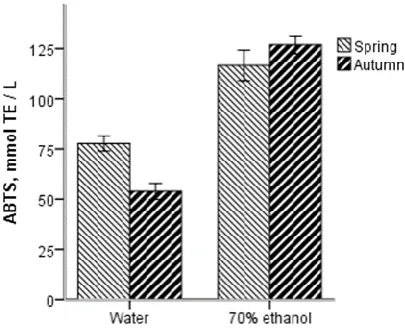
The ABTS method was applied in order to determine radical scavenging activity of hydrogen contributors and chain disintegrating antioxidants in many plant extracts.
Figure 1. Anti-oxidant activity of sea buckthorn sprouts in 70% ethanol extract by ABTS method
As seen in Figure 1, all samples showed a higher value for ABTS when extracted with 70% ethanol, especially in the autumn sample, followed by water. It was detected, that autumn samples extracted with 70 % ethanol recorded a 126.71 ± 1.88 TE mmol L-1 followed by spring sample 116.50 ± 1.75 TE mmol L-1 (p < 0.001). Contradictory data was obtained in aqueous extracts of the samples. The radical cation ABTS+ scavenging activity in spring samples of the aqueous extract was significantly higher, compared to autumn samples, respectively, 77.97 ± 1.75 and 52.99 ± 14.06 TE mmol L-1 (p < 0.001). Similar changes were found in the samples, determining their radical scavenging activity using the total antioxidant status kit (Randox Laboratories Ltd).
As seen in Figure 2, the amount of TAS in spring samples of water extract was significantly higher, compared to autumn samples, i.e. 155.00±1.58 and 149.00±1.52 TE mmol L-1 (p < 0.001), respectively. The amount of TAS was significantly (p < 0.001) increased in 70 % ethanolic of autumn sample, i.e. 282.00 ± 3.50 compared with spring sample, i.e. 264.00±2.98 TE mmol L-1.
Figure 2.Anti-oxidant activity of sea buckthorn sprouts in 70 % ethanol and water extracts by TAS method
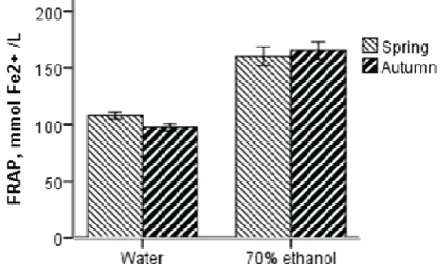
The FRAP assay is used in order to measure the potency of the chemical compounds present in the extract to challenge ferrozine for the ferrous ion. FRAP method is based on Fe(III) ion reduction to Fe(II) ion in the presence of TPTZ when a deep blue color forms with an absorption maximum of 593 nm. The absorption rate falls due to the added antioxidant extracts and is directly proportional to the antioxidative capacity. The higher the FRAP value, the greater its antioxidant activity. The given method shows the amount of low molecular weight antioxidants but does not include any compounds with thiol groups.15
Figure 3. Anti-oxidant activity of sea buckthorn sprouts extracts in 70 % ethanol and water extract by FRAP method
The Folin-Ciocalteau method was used as it is a rapid, easy and relatively simple method to identify total phenolic content in natural samples. A close interdependence between the composition of phenolic compounds and antioxidant activity is expected as phenolic compounds are potent antioxidants and free radical scavengers.16
Polyphenols as antioxidants can neutralize active oxygen species and thereby regulate the oxidative stress. Polyphenols do not have only the direct antiradical activity, but they are also able to link metals of variable valence to form chelate complexes, thereby stopping the emission of free radicals.17,18 All tests were carried out in six replicates, and the results were expressed as mg gallic acid equivalent (GAE) g-1 extract.
Table 1. Total phenolic content of the sea buckthorn (Hippophae rhamnoides L.) sprouts in 70% ethanol and water extracts
Samples Solvent mg of GAE g-1
Autumn
70 % ethanol 4.89 ± 0.06*
Spring 4.73 ± 0.08
Autumn
water 2.92 ± 0.13
Spring 2.92 ± 0.06
*p = 0.001 vs spring 70 % ethanolic extract sample
As seen in Table 1, the most effective solvent for extracting polyphenols is ethanol and it has proven to be more effective, respectively, 67 % for autumn samples and 63 % for spring samples, compared to water. It was found that 70 % ethanolic extracts yielded the highest total polyphenol content in autumn samples compared to the spring samples (p = 0.001).
No significant differences between autumn and spring samples were found for the water extracts. DPPH radical scavenging method is widely used as it is an easy, fast and convenient method for determining radical scavenging activity of many samples without being dependant on sample polarity.19 DPPH method is widely used to determine the antiradical activity of an analyte. •DPPH is a stable organic radical that gets scavenged by an antioxidant “trap”20
Nitric oxide is formed in normal physiological processes and sustains a metabolic pace. During pathophysiological situations its production increase. As a result, it enables the generation of a much more active oxidant – peroxynitrite.21,22
Scores for DPPH and NO anti-oxidative activity were calculated by IC50 %, e.g., a concentration of antioxidant (mg/ml) at which 50 % inhibition of the radical takes place and the lower the given value is, the greater the anti-oxidative capacity. The lower IC50 value indicates a higher antioxidant activity.
Table 2. The IC50 values of sea buckthorn (Hippophae
rhamnoides L.) sprouts in 70 % ethanol and aqueous extract by DPPH radical scavenging and nitric oxide free radical scavenging method
Samples Solvent DPPH radical NO radical IC50, mg mL-1
Autumn
70 % ethanol
0.39 ± 0.002 * 1.36 ± 0.026
Spring 0.48 ± 0.002 0.60 ± 0.01 ** Autumn
water 0.74 ± 0.002 2.47 ± 0.021 Spring 0.63 ± 0.01+ 1.59 ± 0.011+
*p < 0.001 vs spring extract sample in 70% ethanolic solution; **p< 0.001 vs spring extract sample in 70% ethanolic solution; +p
< 0.001 vs autumn extract sample in water
Table 3. DPPH radical scavenging activity compared with standard Trolox (vitamin E analog)
Samples Solvent DPPH µmol Trolox L-1 (100 g L-1)
Autumn
Spring 70 % ethanol
156.2 ± 0,40 *
125.9 ± 0,70 Autumn
Spring water
83.1 ± 0,53 95.9 ± 1,45+
*p < 0.001 vs spring extract sample in 70% ethanolic; +p < 0.001 vs
autumn extract sample in water.
The ethanol extracts showed the highest capacity to neutralize DPPH radical. In this study, DPPH radical scavenging activity of the tested samples in decreasing order was: autumn 70 % ethanol > spring 70 % ethanol > spring water extract > autumn water extract (Table 2, Table 3)
This antiradical activity could be due to the phenolic compounds. In fact, it has been found that antioxidant molecules such as polyphenols, flavonoids, and tannins reduce and discolor DPPH due to their hydrogen donating ability.23
Conclusion
70 % Ethanol extracts of the Sea buckthorn sprout samples collected in autumn had the highest total phenolic content and thereby higher anti-oxidant and anti-radical activities, except for NO radical scavenging activity.
Therefore, the use of sea buckthorn sprouts could be relevant in the prevention and treatment of such diseases, whose pathogenesis implicates oxidative stress, as well as in the food industry as a good preservative owing to its anti-oxidative potential.
Declaration
Authors report that they do not have competing interests.
References
1Gornaš, P., Šne, E., Siger, A., Seglina, D. Ind. Crops Prod., 2014,
60, 1-7. https://doi.org/10.1016/j.indcrop.2014.05.053 2Lobo, V., Patil, A., Phatak, A., Chandra, N., Pharmacogn. Rev.,
2010, 4(8), 118-126. https://doi.org/10.4103/0973-7847.70902
3Uttara, B., Singh, A. V., Zamboni, P., Mahajan, R. T., Curr
Neuropharmacol., 2009, 7(1), 65–74.
https://doi.org/10.2174/157015909787602823
4Zeb, A., J. Biol. Sci., 2004, 4(5), 687-693. https://doi.org/10.3923/jbs.2004.687.693
5Santiago, L. A., Valerio, V. L. M., Int. J. Pharm. Front. Res.,
2013, 3(1), 15-25.
6Re, R., N., Pellegrini, A., Proteggente, A. P., Yanh, M.,
Rice-Evans, C., Free Radicals Biol. Med., 1999, 26(9-10), 1231-1237. https://doi.org/10.1016/S0891-5849(98)00315-3 7Miller, N. J., Rice-Evans C., Davies, M. J., Clin. Sci., 1993, 84,
407−412. https://doi.org/10.1042/cs0840407
8International Standard ISO 14502-1:2005 (E). Determination of
substances characteristic of green and black tea – Part 1: Content of total polyphenols in tea – a Colorimetric method using Folin-Ciocalteu reagent.
9Benzie, F. F., Strain, J. J., Methods in Enzymology, 1999, 299,
15-23. https://doi.org/10.1016/S0076-6879(99)99005-5
10Lado, C., Then, M., Varga, I., Szoke, E., Szentmihaly, K., Z.
Naturforsch., 2004, 59c, 354-358.
11Brand – Williams, W., Cuvelier, M. E., Berset C., J. Agric. Food
Chem., 2007, 55 (1), 165–169.
12Rebiai, A., Lanez, T., Belfar, M. L., Int. J. Pharm. Pharmac. Sci.,
2014, 6(1), 395-400.
13Terashima, M., Nakatani, I., Harima, A., Nakamura, S., Shiiba,
M., J. Agric. Food Chem., 2007, 55 (1), 165–169.
https://doi.org/10.1021/jf062700e
14Zhijun, L., Endocrin. Metab. Immune Disorder Drug Targets,
2008, 8(2), 112–121.
https://doi.org/10.2174/187153008784534358
15Rubio, C. P., Hemandez - Ruiz, J., Martine-Subiela, S.,
Tvarijonaviciute, A., Ceron, J. J., BMC Vet. Res.,2016,12, 166. https://doi.org/10.1186/s12917-016-0792-7
16Kumar S., Kumar D., Manjusha, Saroha K., Singh N., Vashishta
B. Acta Pharm,2008,58(2),215-20.
17Perron, N. R., Brumaghim, J. L., Cell Biochem Biophys,
2009, 53, 75–100. https://doi.org/10.1007/s12013-009-9043-x
18Antioxidant Enzyme Edited by Mohammed Amr El-Missiry.
InTech: Biochemistry, Genetics and Molecular Biology, 2012, October 03. https://doi.org/10.5772/2895
19Koleva, I. I, Teris, A. B., Jozef, P. H., Linssen, A. G., Luyba, N.
E., Phytochem Anal., 2002, 13, 8 -17.
https://doi.org/10.1002/pca.611
20Behrendorff, J., Vickers, C. E., Chrysanthopoulus, P., Nielsen, L.
K., Microbial. Cell Fact., 2013; 12, 76.
https://doi.org/10.1186/1475-2859-12-76
21Pacher, P., Beckman, J., Liaudet, L., Physiol. Rev.,2007, 87(1),
315-424. https://doi.org/10.1152/physrev.00029.2006 22Hogg, N., Kalyanaraman, B., Biochim. Biophys. Acta –
Bioenergetics, 1999, 2/3, 378-384.
23Kumaran, A., Karunakaran, R. J., Food Sci. Technol. 2007, 40,
344–352.