
CRYSTAL STRUCTURE OF
1,8-BIS(4-FLUOROBENZOYL)NAPHTHALENE-2,7-DIYL DIBENZOATE:
ROLE OF (SP
2)C–H…F HYDROGEN BONDING AS DISTINCTLY
STRONG INTERACTION AMONG NON-CLASSICAL
HYDROGEN BONDS CONTRIBUTING STABILITY OF THE CRYSTAL
Genta Takahara,
[a]Rei Sakamoto,
[a]Kazuki Ogata,
[a]Shinji Ohisa,
[a]Takahiro Mido,
[a]Takeshi
Yokoyama,
[a]Noriyuki Yonezawa,
[a]and Akiko Okamoto
[a]*Keywords: non-coplanarly accumulated aromatic rings; non-classical hydrogen bonds; C–H···F hydrogen bonds; C–H···O=C hydrogen
bonds.
In crystal of 1,8-bis(4-fluorobenzoyl)naphthalene-2,7-diyl dibenzoate, C38H22O6F2, the phenyl rings of benzoyloxy groups and the
naphthalene ring demonstrate largely disproportionate interplanar angles [38.97(7)° and 52.62(6)°] different from those between 4-fluorobenzoyl group and the naphthalene ring core [71.24(5)° and 78.85(6)°]. One of two benzoyloxy groups has three effective
intramolecular interactions [(benzoyloxy)C–H(o-)···O(benzoyloxy), (naphthalene)C–H(6-)···O=C(benzoyloxy), and (benzoyloxy)C–H(o -)···π(4-fluorobenzoyl) hydrogen bonds] and the other has no intramolecular interactions. In crystal, the molecules of identical enantiomeric
isomer are unidirectionarly arranged along the b axis through (4-fluorobenzoyl)C–H(m-)···O=C(4-fluorobenzoyl) hydrogen bonding
interactions forming columnar structure. Moreover, a column is connected with the mirror imaged column composed of the opposite enantiomeric isomers into centrosymmetric dimer aggregates by three types of complementary interactions, i.e., (benzoyloxy)C–H(m-)···F,
(4-fluorobenzoyl)C–H(m-)···π(4-fluorobenzoyl), and (4-fluorobenzoyl)C–H(m-)···π(benzoyloxy) hydrogen bondings. The tubular structures
thus formed are stacked parallel to the ac plane via (benzoyloxy)C–H(p-)…F, (benzoyloxy)C–H(m-)…(benzoyloxy), (naphthalene)C–H (6-)…O=C(4-fluorobenzoyl), and (4-fluorobenzoyl)C–H(o-)…O=C(benzoyloxy) hydrogen bonds. In homologous compound, a fluoro
group-free derivative for title compound, the enantiomeric isomer and the opposite enantiomeric counterpart isomer are alternately arranged in a head-to-tail fashion through (benzoyl)C–H(p-)…O=C(benzoyl) hydrogen bonds along b-axis. The zigzagged columns are aligned along a
-axis with inversion center to form a sheet structure. However, there are no effective non-covalent bonding interactions between the zigzagged columns. In other words, the molecular packing structure of the homologous compound is governed by solely one strong (benzoyl)C–H(p-)…O=C(benzoyl) hydrogen bonds, contrary to the organization of supramolecular architecture in title compound ascribed
to cooperative unidirectional (4-fluorobenzoyl)C–H(m-)…O=C(4-fluorobenzoyl) hydrogen bonds and bidirectional (benzoyloxy)C–H(m-/p -)…F hydrogen bonds.
* Corresponding Authors Fax: +81-42-388-7291
E-Mail: [email protected]
[a] Department of Organic and Polymer Materials Chemistry, Tokyo University of Agriculture and Technology, 2-24-16 Naka-machi, Koganei, Tokyo 184–8588, Japan
Introduction
Supramolecular architecture1-3 along with supramolecular chemistry4-9 has become of interest in recent years from the viewpoint of green chemistry and novel phase of functional device material development. Various building blocks bearing unique functions might be tailored to supramolecular structure exhibiting desired chemical and physical properties without formation of covalent bonds. The research primarily relies on knowledge of the characteristics of non-covalent bonding interactions including atomic geometrical and molecular orientation features.10-13 Attempts of formation of tough hydrogen bonds involving CONR2 group and OH group, and COOH group and NH2 group were undertaken both experimentally
and theoretically.14-16 These have been successfully employed for the preparation of numerous molecular assemblies. However, to grasp nature of weak hydrogen bonds including “non-classical” hydrogen bonds where C–H group acts as hydrogen donor, for example, has scarcely achieved probably because they are often hidden by strong hydrogen bonds. The authors have reported single molecular structure and the structural features of the molecular packing for roughly eighty compounds having
1,8-diaroylated naphthalene skeleton or the
of frequency. The features can be interpreted that the non-coplanarly accumulated aromatic rings structure disturbs formation of strong π…π stacking interactions. Therefore, the authors planned to elucidate systematically non-classical hydrogen bonds, weak hydrogen bonds between C–H group and electron rich atom/group, by the aid of structure analysis of 1,8-diaroylated naphthalene compounds. Herein, crystal structure of 1,8-bis(4-fluorobenzoyl)naphthalene-2,7-diyl dibenzoate23 is demonstrated. The compound has characteristic molecular structure of four aromatic ring containing groups located at one long edge of naphthalene ring in serial order (1,2,7,8-positions) with other positions of another long edge free of substituent. The crystal structure is discussed from the standpoint of clarification of the correlation among single molecular structure, non-covalent bonding interactions, and molecular packing structure through comparison with the fluoro group-free homologous compound, 1,8-dibenzoylnaphthalene-2,7-diyl dibenzoate.24
Experimental
Materials and methods
All reagents were of commercial quality and were used as received. Solvents were dried and purified using standard procedures.25 Synthetic methods and spectral data for the precursor, 2,7-diethoxy-1,8-bis(4-fluorobenzoyl)naphtha-lene, have been reported in literature.26
Measurements
1H NMR spectra were recorded on a JEOL JNM-AL300
spectrometer (300 MHz) and a JEOL ECX400 spectrometer (400 MHz). Chemical shifts are expressed in ppm relative to internal standard of Me4Si (δ 0.00). 13C NMR spectra were recorded on a JEOL JNM-AL300 spectrometer (75 MHz) and a JEOL ECX400 spectrometer (100 MHz). Chemical shifts are expressed in ppm relative to internal standard of CDCl3 (δ 77.0). IR spectra were recorded on a JASCO FT/IR-4100 spectrometer (KBr tablet). High-resolution FAB mass spectra were recorded on a JEOL MStation (MS700) ion trap mass spectrometer in positive ion mode.
X-ray crystallography
For the crystal structure determination, the single-crystal of title compound was used for data collection on a four-circle Rigaku RAXIS RAPID diffractometer (equipped with a two-dimensional area IP detector). The graphite-mono-chromated Cu Kα radiation (λ = 1.54187 Å) was used for data collection. The lattice parameters were determined by the least-squares methods on the basis of all reflections with F2>2σ (F2).
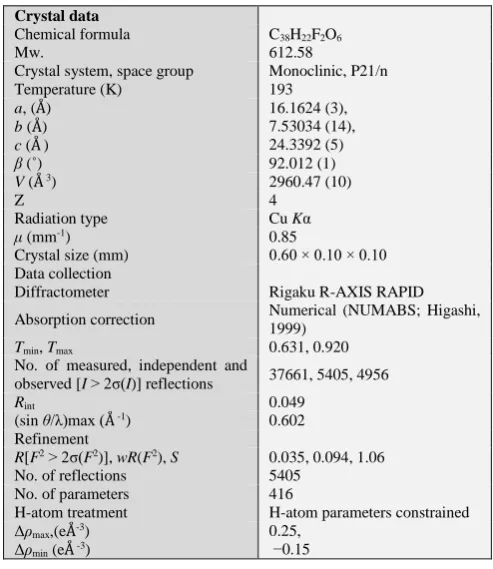
Crystal data, data collection and structure refinement details are summarized in Table 1. All H atoms could be located in difference Fourier maps, but were subsequently refined in optimized positions as riding atoms, with C–H = 0.95 (aromatic) and 0.98 (methyl) and with Uiso(H) = 1.2
Ueq(C). For data collection: PROCESS-AUTO27; cell
refinement: PROCESS-AUTO;27 data reduction:
CrystalStructure,28 program(s) used to solve structure:
SIR2004,29 program(s) used to refine structure:
SHELXL97,30 molecular graphics: ORTEPIII.31 The hydrogen bond geometries of title compound are listed in Table 2.
Synthetic procedures
Synthesis of 1,8-bis(4-fluorobenzoyl)-2,7-dihydroxynaphtha-lene
To a 100 mL flask, 1,8-bis(4-fluorobenzoyl)-2,7-diethoxynaphthalene (5.0 mmol, 2.3 g) and toluene (40 mL) were placed and stirred at 90 °C. To the reaction mixture thus obtained, AlCl3 (30.0 mmol, 3.9 g) was added. After the reaction mixture was stirred at 90 °C for 1 h, it was poured into 2M aqueous HCl and the mixture was extracted with CHCl3. The combined extracts were washed with brine. The organic layers thus obtained were dried over anhydrous MgSO4. The solvent was removed under reduced pressure to give cake. The crude product was purified by recrystallization from AcOEt (62 % isolated yield).
1H NMR δ (400 MHz, DMSO-d6) :7.02 (2H, d, J = 9.1
Hz), 7.18 (4H, t, J = 8.7 Hz), 7.59 (4H, t, J = 8.5, 5.5 Hz), 7.88 (2H, d, J = 9.1 Hz), 10.04 (2H, s) ppm; 13C NMR δ (100 MHz, DMSO-d6) : 114.87, 115.00 (d, 2JC-F = 22.0 Hz), 117.35, 123.21, 130.48, 131.62 (d, 3JC-F = 9.5 Hz), 131.99, 135.20 (d, 4JC-F = 2.8 Hz), 154.28, 164.62 (d, 1JC-F = 250.1 Hz) 195.41 ppm; IR (KBr) : 1642 (C=O), 1588, 1510, 1487 (Ar, naphthalene) cm-1. HRMS (m/z): [M+H]+ calcd for C36H23F2O4, 405.0938 found, 405.0986. m.p. = 298 ̊C.
Synthesis of 1,8-bis(4-fluorobenzoyl)naphthalene-2,7-diyl dibenzoate
The title compound was prepared by reaction of 1,8-bis(4-fluorobenzoyl)-2,7-dihydroxynaphthalene (0.2 mmol, 80.9 mg) obtained via ethyl ether cleavage reaction of 1,8-bis(4-fluorobenzoyl)-2,7-diethoxynaphthalene, benzoyl chloride (0.4 mmol, 56.2 mg), and triethylamine (0.2 mmol, 20.2 mg) in dichloromethane (0.5 mL). After the reaction mixture was stirred at room temperature for 3 h, it was poured into water (30 mL) and the mixture was extracted with CHCl3 (10 mL × 3). The combined extracts were washed with brine. The organic layers thus obtained were dried over anhydrous MgSO4. The solvent was removed under reduced pressure to give the crude product followed by recrystallization purification from ethyl acetate–hexane affording colourless block single crystals suitable for X-ray diffraction measurement (isolated yield 72%).
1H NMR δ (400 MHz, CDCl3); 6.93 (4H, t, J = 8.8 Hz),
7.28 (4H, t, J = 8.0 Hz), 7.49 (2H, t, J = 7.6 Hz), 7.53 (2H, d,
Table 1. Crystallographic data and structure refinement parameters of title compound.
Computer programs: PROCESS-AUTO (Rigaku, 1998), PROCESS-AUTO (Rigaku, 1998, CrystalStructure (Rigaku, 2007), SIR2004
(Burla et al., 2007), SHELXL97 (Sheldrick, 2008), ORTEPIII (Burnett & Johnson, 1996).
Table 2. Hydrogen-bond geometry (Å, ˚)
D―H…A D-H H…A D..A D-H..A
C23―H23…O2i 0.95 2.22 3.1552(15) 169
C34―H34…O4 0.95 2.36 2.6943(17) 100 C7―H7…O2ii 0.95 2.46 3.3012(16) 147
C7―H7…O6 0.95 2.48 2.8739(16) 105 C28―H28…F2iii 0.95 2.48 3.3026(16) 145
C24―H24…O6ii 0.95 2.52 3.4514(16) 166
C29―H29…F2iv 0.95 2.67 3.2914(17) 113
C14―H14…Cg1iii 0.95 2.80 3.5679(16) 139
C35―H35…Cg2iv 0.95 2.81 3.528(2) 133
C21―H21…Cg2iii 0.95 2.86 3.7592(14) 157
C34―H34…Cg1 0.95 2.88 3.8050(16) 164 Symmetry codes: (i) x, y, z; (ii) 1/2-x, 1/2+y, 1/2-z; (iii) -x, -y, -z; (iv) 1/2+x, 1/2-y, 1/2+z. Cg1 and Cg2 are the centroids of the C19―C24 and C26―C31 rings, respectively.
Results and discussion
Single molecular structure of title compound is illustrated in Figure 1. The benzene rings of 4-fluorobenzoyl groups and those of benzoyloxy groups are situated out of the plane of the naphthalene ring core. The two benzene rings of 4-fluorobenzoyl groups at the 1,8-positions of the naphthalene ring are leant symmetrically, whereas the two benzene rings of the benzoyloxy groups at the 2,7-positions of the naphthalene ring are tilted unsymmetrically. The two interplanar angles between the benzene rings of the 4-fluorobenzoyl groups (C12―C17 and C19―C24) and the
naphthalene ring system are 71.24 (5)°
[C10―C1―C11―O1 torsion angle = 61.37 (17) °] and 78.85 (6)° [C10―C9―C18―O2 torsion angle = 71.43 (15) °], respectively. The interplanar angle between the two benzene rings of the 4-fluorobenzoyl groups is 45.02 (7)°. The two interplanar angles between the benzene rings of the benzoyloxy groups and the naphthalene ring are 38.97 (7)° and 52.62 (6)°, respectively. The benzene rings and the carbonyloxy moieties situate almost coplanarly [O6―C32―C33―C38 torsion angle = 0.0 (2)° and O5―C25―C26―C31 torsion angle = -5.5 (2)°]. One of two benzoyloxy groups forms three kinds of effective
intramolecular hydrogen bonding interactions, (benzoyloxy)C–H(o-)···O (benzoyloxy)hydrogen bond (C34–
H34···O4 = 2.36 Å),
(naphthalene)C–H(6-)···O=C(benzoyloxy) hydrogen bond (C17–H17···O6 = 2.48 Å), and (benzoyloxy)C–H(o-)···π(4-fluorobenzoyl) hydrogen
bond (C34–H34···Cg4 = 2.88 Å). Contrarily, the other benzoyloxy group has no intramolecular hydrogen bonds.
Figure 1. Molecular structure of 1,8-bis(4-fluorobenzoyl)-naphthalene-2,7-diyl dibenzoate, with the atom-labeling scheme and displacement ellipsoids drawn at the 50% probability level.
Observed non-covalent bonding interactions are listed in the order of distance in Table 2. In the molecular packing, (4-fluorobenzoyl)C–H(m-)···O=C(4-fluorobenzoyl) hydrogen
bonds link the molecules unidirectionarly along the b axis forming a column structure (Figure 2).
Figure 2. (4-Fluorobenzoyl)C―H(m-)···O=C(4-fluorobenzoyl)
hydrogen bonds link the molecules unidirectionarly along the b
axis is shown as black broken lines. [Symmetry codes: (i) x, y, z.]
Crystal data
Chemical formula C38H22F2O6
Mw. 612.58
Crystal system, space group Monoclinic, P21/n
Temperature (K) 193
a, (Å) b (Å) c (Å)
16.1624 (3), 7.53034 (14), 24.3392 (5)
β (˚) 92.012 (1)
V (Å3) 2960.47 (10)
Z 4
Radiation type Cu Kα
μ (mm-1) 0.85
Crystal size (mm) 0.60 × 0.10 × 0.10
Data collection
Diffractometer Rigaku R-AXIS RAPID
Absorption correction Numerical (NUMABS; Higashi, 1999)
Tmin, Tmax 0.631, 0.920
No. of measured, independent and
observed [I > 2σ(I)] reflections 37661, 5405, 4956
Rint 0.049
(sin θ/λ)max (Å-1) 0.602
Refinement
R[F2 > 2σ(F2)], wR(F2), S 0.035, 0.094, 1.06
No. of reflections 5405
No. of parameters 416
H-atom treatment H-atom parameters constrained
Δρmax,(eÅ-3) Δρmin (eÅ-3)
The columns are connected by three types of complementary intermolecular interactions between 4-fluorobenzoyl groups and between 4-4-fluorobenzoyl group and benzoyloxy group forming face-to-face type dimeric aggregates, i.e., (benzoyloxy)C–H(m-)···F hydrogen bonds
(2.48 Å), (4-fluorobenzoyl)C–H(m-)···π(4-fluorobenzoyl)
hydrogen bonds (2.80 Å), and (4-fluorobenzoyl)C–H(m -)···π(benzoyloxy) hydrogen bonds (2.86 Å) (Figure 3).
Figure 3. The columns are connected by three types of complementary intermolecular interactions. [Symmetry code: (iii) -x, -y, -z.]
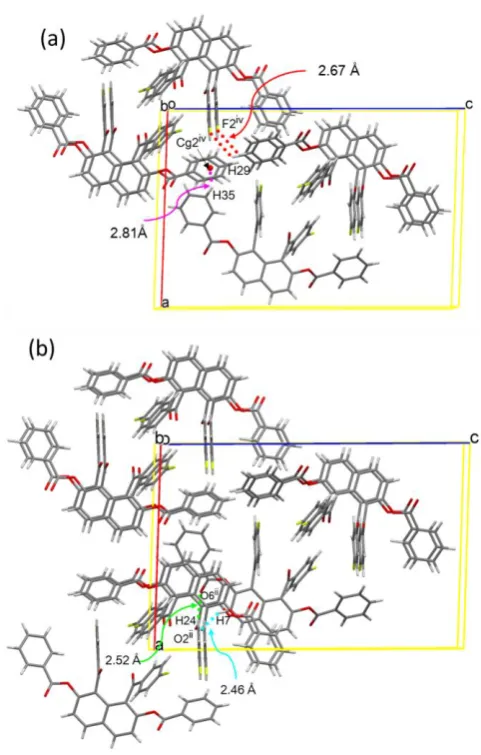
The tubular structures thus formed are connected to each other through four kinds of hydrogen bonds. In this aggregation, disproportional contribution of two benzoyloxy groups is also observed. That is, three of four kinds of hydrogen bonds (benzoyloxy)C–H(p-)…F hydrogen bonds
(2.67 Å), (benzoyloxy)C–H(m-)…(benzoyloxy) hydrogen
bonds (2.81 Å), and (4-fluorobenzoyl)C–H(o
-)…O=C(benzoyloxy) hydrogen bonds (2.52 Å)] are concerned with just the benzoyloxy group that makes three
intramolecular hydrogen bonds described above and the remaining hydrogen bond is (naphthalene)C–H(6-)…O=C(4-fluorobenzoyl) hydrogen bonds (2.46 Å) located between the 4-fluorobenzoyl group, which also acts a role of
intramolecular hydrogen bond acceptors, and the naphthalene ring (Figure 4).
The authors’ group has reported crystal structure of homologous compound, 1,8-dibenzoylnaphthalene-2,7-diyl dibenzoate.24 The molecular structure of the homologous compound corresponds to fluoro group-free derivative for the title compound. Single molecular structure of the homologue is shown in Figure 5. Four benzene rings are situated out of the plane of the naphthalene ring core as well as title compound. However, correlation between kinds of benzene rings and the symmetric nature is inverse to title compound, i.e., the two benzene rings of the benzoyloxy groups at 2,7-positions of the naphthalene ring are tilted symmetrically, whereas the two benzene rings of benzoyl groups at 1,8-positions of the naphthalene ring lean unsymmetrically. The interplanar angles between the benzene rings of benzoyl groups and the naphthalene ring system are 67.12 (5)° and 85.15 (5)°, respectively. The two interplanar angles between the best planes of the benzoyloxy groups and the naphthalene ring are 71.47 (5)° and 76.41
(5)°, respectively. The interplanar angle between the two benzene rings of the benzoyl groups is 59.81 (6)°.
Furthermore, the homologous molecule has no
intramolecular hydrogen bondings differently from the title compound. In the crystal packing, (benzoyl)C–H(p -)…O=C(benzoyl) hydrogen bonds (2.41 Å) and two types of (benzoyloxy)C–H(m-/o-)…(naphthalene) hydrogen bonds
(2.65 Å and 2.96 Å) link the homologous molecules in face-to-back fashion forming a zigzagged column structure along
b-axis (Figure 6). The zigzagged columns are aligned with inversion center into a sheet structure along a-axis. However, there are no effective non-covalent bonding interactions between the zigzagged columns. (benzoyl)C– H(p-)…(benzoyl) Hydrogen bonds are also observed along
c-axis (2.94 Å) (Figure 7).
Figure 4. The tubular structures are connected to each other through four kinds of hydrogen bonds. (a) (benzoyloxy)C–H(p-)…F
hydrogen bonds and (benzoyloxy)C–H(m-)…(benzoyloxy)
hydrogen bonds; (b) (4-fluorobenzoyl)C–H(o-)…O=C(benzoyloxy)
hydrogen bonds and (naphthalene)C–H(6-)…O=C(4-fluorobenzoyl)
hydrogen bonds. [Symmetry codes: (ii) 1/2-x, 1/2+y, 1/2-z, (iv) 1/2+x, 1/2-y, 1/2+z.]
Figure 5. Single molecular structure of homologous compound.
Figure 6. (benzoyl)C–H(p-)…O=C(benzoyl) hydrogen bonds and
two types of (benzoyloxy)C–H(m-/o-)…(naphthalene) hydrogen
bonds link the homologous molecules into zigzagged column structure along b-axis. [Symmetry codes: (v) 1/2-x, -1/2+y, z.]
Table 3 summarizes correlation between absolute configuration of molecule and non-covalent bonding hydrogen bonds in title compound and the homologous compound. As a common feature about non-covalent bonding interactions, both of title compound and the homologous one have (aroyl)C–H(p- or m-)…O=C(aroyl)
hydrogen bonds. However, they are observed between R,R- and S,S-enantiomeric isomers in the molecules of the homologous compound (2.41 Å), whereas those interactions are found between identically enantiomeric isomers in title compound (2.22 Å). In the homologous compound, two kinds of (benzoyloxy)C–H(m-/o-)… hydrogen bonds are also
formed effectively between opposite enantiomeric isomers (2.65 Å and 2.96 Å). In title compound, (4-fluorobenzoyl/benzoyloxy)C–H(m-)… hydrogen bonds are
observed between opposite enantiomeric isomers as well as homologous compound (2.80 Å, 2.81 Å, and 2.86 Å). Non-classical hydrogen bonds involving fluoro groups link opposite enantiomeric isomers (2.48 Å and 2.67 Å). These observation can be explained as follows: (aroyl)C–H(m- or
p-)…O=C(aroyl) hydrogen bonds potentially connect either
of opposite enantiomeric isomers or identical enantiomers.
However, the role of (aroyl)C–H(p-)…O=C(aroyl)
hydrogen bonds in the homologous compound for connection of identical enantiomers is severely hidden.
Figure 7. (benzoyl)C–H(p-)…(benzoyl) Hydrogen bonds are also
observed along c-axis. [Symmetry codes: (vi) -x, 1/2+y, 1/2-z.]
Table 3. Non-covalent bonding interactions in title compound and the homologous compound (Å).
Red characters = non-covalent bonding distances between same
enantiomeric molecules; blue characters = non-covalent bonding distances between opposite enantiomeric molecules.
Title compound
Homologue
intramolecular hydrogen bondings
C34―H34…O4 2.36
C7―H7…O6 2.48
C34―H34…Cg1 2.88
intermolecular hydrogen bondings
(4-fluorobenzoyl)C23―H23…O2(4-fluorobenzoyl) 2.22i
(benzoyl)C15―H15…O1(benzoyl) 2.41v
(naphthalene)C7―H7…O2(benzoyloxy) 2.46ii
(benzoyloxy)C28―H28…F2 2.48iii
(4-fluorobenzoyl)C24―H24…O6(benzoyloxy) 2.52ii
(benzoyloxy)C28―H28…Cg2(naphthalene) 2.65v
(benzoyloxy)C29―H29…F2 2.67iv
(4-fluorobenzoyl)C14―H14…Cg1(4-fluorobenzoyl) 2.80iii
(benzoyloxy)C35―H35…Cg2(benzoyloxy) 2.81iv
(4-fluorobenzoyl)C21―H21…Cg2(benzoyloxy) 2.86iii
(benzoyl)C22―H22…Cg3(benzoyl) 2.94vi
By formation of fluoro group concerning hydrogen bonds, (aroyl)C–H(m-)…O=C(aroyl) hydrogen bonds cannot play
the role for linking opposite enantiomeric isomers, viz., (aroyl)C–H(m-)…O=C(aroyl) hydrogen bonds can connect
solely identically enantiomeric molecules. This can be restated that (aroyl)C–H(m-)…O=C(aroyl) non-classical
hydrogen bonds between identical enatiomers and (benzoyloxy)C–H(m-/p-)…F non-classical hydrogen bonds
between opposite enantiomeric isomers work cooperatively to organization of supramolecular structure.
Conclusively, crystal structure of 1,8-bis(4-fluorobenzoyl)naphthalene-2,7-diyl dibenzoate was determined and the structural features of single molecule and molecular aggregation are discussed by comparison with the fluoro group-free homologue.
Generally, C2 symmetrical molecules in crystal are considered to be best stabilized by formation of pairs of identical effective intermolecular interactions on condition that satisfactory room is present for conformation perturbation free from specific regulations. To realize such crystalline structure, the molecules in crystal should take either complimentary face-to-face interactions or unidirectional stacking by a face-to-back mode. Presumably, the mode of face-to-face or face-to-back is determined according to the stabilization energy afforded in respective aggregation modes. As the interactions that perform the largest stabilization energy are considered to be aligned with a higher symmetric feature, the nearly identical spatial structure should be constructed as face-to-face mode for dimer formation or face-to-back mode for unidirectional alignment. The secondly or less effective interactions should be arranged to obtain totally the largest stabilization energy.
In title compound, the strong (benzoyloxy)C–H(m-/p-)…F
non-classical hydrogen-bonding interaction between opposite enantiomers is considered to predominate possible interactions between identical enantiomers. This brings about the restriction of the formation of comparatively effective non-covalent bonding interactions at the backside position of the molecules. For the compensation of rather poor effect of intermolecular interaction stabilization, the larger intramolecular stabilization is achieved along with reinforcement of the disproportionation of molecular spatial organization. Furthermore, the stabilization should be best achieved when strongest interactions functions complementally, i.e., these interactions require a highly symmetric spatial arrangement. To consistent rather contracted molecular structural requisites, one pair of the aroyl groups showing stronger intermolecular interaction take the positions in a highly symmetrical manner and the other pairs of aroyl groups arrange themselves dissymmetrically to attain the largest intramolecular stabilization. In this consequence, the characteristic disproportionation of spatial organization bearing highly symmetric alignment part for such molecule of symmetric molecular structure is generated. Under such characteristic structural regulation, the spatial organization of molecules should be performed to maximize the total stabilization by various weak interaction.
On the other hand, absence of superior intermolecular interaction in the crystal of the homologous compound presumably performs the largest stabilization when largest
number of moderate and weak non-covalent bonding interactions among neighbouring molecules contributes effectively. To realize such spatial circumstance, disproportion of single molecular spatial alignment should affect unfavourably. Then, the accumulation of molecules with rather isotropic spatial alignment is advantageous.
On the basis of above interpretation, presence or absence of (benzoyloxy)C–H(m-/p-)…F non-classical hydrogen bond is
strongly suggested to determine both the molecular proportional properties and stabilization fashion between enantiomeric isomers or between identically configurated molecules of apparently C2 symmetrical molecules in crystal.
Acknowledgements
The authors would express their gratitude to Professor Keiichi Noguchi, Instrumentation Analysis Center, Tokyo University of Agriculture and Technology, for his technical advice. This work was partially supported by the Ogasawara Foundation for the Promotion of Science & Engineering, Tokyo, Japan.
References
1Janczak, J. Cryst. Growth Des., 2015, 15(10), 5097. https://doi.org/10.1021/acs.cgd.5b01049
2Macháček, V., Bertolasi, V., Šimůnek, P., Svobodová, M.,
Svoboda, J. and černošková, E. Cryst. Growth Des., 2010,
10(1), 85. https://doi.org/10.1021/cg900295n
3Shimpi, M. R., SeethaLekshmi, N.and Pedireddi, V. R. Cryst. Growth Des., 2007, 7(10), 1958.
https://doi.org/10.1021/cg060863p
4Lehn, J.-M. Supramolecular Chemistry: Concepts and Perspectives; VCH: New York, 1995.
https://doi.org/10.1002/3527607439
5Atwood, J. L., Davies, J. E. D., MacNicol, D. D. and Vogtle, F., In Comprehensive Supramolecular Chemistry; Pergamon, Oxford, UK, 1996; Vols. 1-11.
6Jeffrey, G. A. and Saenger, W. Hydrogen Bonding in Biological Structures; Springer: Berlin, 1991.
https://doi.org/10.1007/978-3-642-85135-3
7Desiraju, G. R. Crystal Engineering: The Design of Organic Solids; Elsevier: Amsterdam, 1989.
8MacDonald, J. C.; Whitesides, G. M. Chem. Rev. 1994, 94,
2383-2420. https://doi.org/10.1021/cr00032a007
9Desiraju, G. R., Vittal, J. J. and Ramanan, A. Crystal Engineering. A Textbook, World Scientific Publishing, Singapore, 2011.
https://doi.org/10.1142/8060
10Steiner, T. and Desiraju, G. R. Chem. Commun.,1998, 891−892. https://doi.org/10.1039/a708099i
11Desiraju, G. R. Acc. Chem. Res. 2002, 35, 565−573. https://doi.org/10.1021/ar010054t
12Bernstein, J., Davis, R. E., Shimoni, L. and Chang, N.-L. Angew. Chem., Int. Ed. 1995, 34, 1555-1573.
https://doi.org/10.1002/anie.199515551
13Biradha, K. and Mahata, G. Cryst. Growth Des., 2005, 5, 61-63. https://doi.org/10.1021/cg049761u
14Price, S. L. CrystEngComm 2004, 6, 344-353.
15Hubbard, T. A., Brown, A. J., Bell, I. A. W. and Cockroft, S. L. J. Am. Chem. Soc., 2016, 138, 15114.
https://doi.org/10.1021/jacs.6b09130
16Tanabe, J., Taura, D., Yamada, H., Furusho, Y. and Yashima, E. Chem. Sci., 2013, 4, 2960.
https://doi.org/10.1039/c3sc50833a
17Narushima, S., Mohri, S., Yonezawa, N. and Okamoto, A. Acta Cryst., 2014, E70, 170. doi: 10.1107/S1600536814019758
18Siqingaowa, Tsumuki, T., Ogata, K., Yonezawa, N. and Okamoto,
A. Acta Cryst. 2016, E72, 1819. Acta Cryst. (2016). E72,
1819-1823
https://doi.org/10.1107/S2056989016018077
19Okamoto, A. and Yonezawa, N. J. Synth. Org. Chem. Jpn. 2015,
73(4), 339.
https://doi.org/10.5059/yukigoseikyokaishi.73.339
20Hijikata, D., Takada, T., Nagasawa, A., Okamoto, A. and
Yonezawa, N., Acta Cryst., 2010, E66, o2902–o2903. doi: 10.1107/S1600536810042170
21Mitsui, R., Nagasawa, A., Noguchi, K., Okamoto, A. and
Yonezawa, N., Acta Cryst., 2010, E66, o1790. Acta Cryst.
(2010). E66, o1790
doi: 10.1107/S1600536810024074
22Sasagawa, K., Takeuchi, R., Kusakabe, T., Yonezawa, N. and
Okamoto, A. Acta Cryst., 2013, E69, o444. doi:
10.1107/S1600536813004959
23CCDC-1526510 contains the supplementary crystallographic data
for this paper. These data can be obtained free of charge from The Cambridge Crystallographic Data Centre via www.ccdc.cam.ac.uk/data_request/cif
24Sakamoto, R., Sasagawa, K., Hijikata, D., Okamoto, A. and
Yonezawa, N. Acta Cryst., 2012, E68, o2454. doi:
10.1107/S1600536812030991
25Armarego, W. L. F.; Chai, C. L. L. Purification of Laboratory Chemicals,Seventh edition, 2013, Elsevier Inc., Oxford.
26Mouri, S., Hijikata, D., Isozaki, K., Yonezawa, N., Okamoto, A., Acta Cryst., 2013, E69, o637.
doi:10.1107/S1600536813008295
27Rigaku (1998). PROCESS-AUTO. Rigaku Corporation, Tokyo,
Japan.
28Rigaku (2010). CrystalStructure. Rigaku Corporation, Tokyo,
Japan.
29Burla, M. C., Caliandro, R., Camalli, M., Carrozzini, B.,
Cascarano, G. L., De Caro, L., Giacovazzo, C., Polidori, G., Siliqi, D. and Spagna, R. J. Appl. Cryst.2007, 40, 609–613.
https://doi.org/10.1107/S0021889807010941
30Sheldrick, G. M. Acta Cryst. 2008, A64, 112–122. https://doi.org/10.1107/S0108767307043930
31Burnett, M. N. and Johnson, C. K. (1996). ORTEPIII. Report
ORNL-6895. Oak Ridge National Laboratory, Tennessee, USA.
![Figure 7. (benzoyl)C–H(p-)…(benzoyl) Hydrogen bonds are also observed along c-axis. [Symmetry codes: (vi) -x, 1/2+y, 1/2-z.]](https://thumb-us.123doks.com/thumbv2/123dok_us/7828903.2088802/5.595.302.546.105.324/figure-benzoyl-benzoyl-hydrogen-bonds-observed-symmetry-codes.webp)
