
271
Webinterpret Submission to the
WMT2019 Shared Task on Parallel Corpus Filtering
Jes ´us Gonz´alez-Rubio
WebInterpret Inc.
Abstract
This document describes the participation of Webinterpret in the shared task on parallel cor-pus filtering at the Fourth Conference on Ma-chine Translation (WMT 2019). Here, we de-scribe the main characteristics of our approach and discuss the results obtained on the data sets published for the shared task.
1 Task Description
Parallel corpus filtering task at WMT19 tackles the problem of cleaning noisy parallel corpora. Given a noisy parallel corpus (crawled from the web), participants develop methods to filter it to a smaller size of high quality sentence pairs.
In comparison to the German-English task last year, the organizers now pose the problem under more challenging low-resource conditions includ-ing Nepali and Sinhala languages. The organiz-ers provide very noisy40.6million-word (English token count) Nepali-English and a 59.6 million-word Sinhala-English corpora. Both raw cor-pora were crawled from the web as part of the Paracrawl project1. Participants are asked to se-lect a subset of sentence pairs that amount to (a) 5 million, and (b) 1million English words. The quality of the resulting subsets is determined by the quality of a statistical and a neural Machine Translation (MT) systems trained on the selected data. The quality of the translation systems is mea-sured on a held-out test set of Wikipedia transla-tions. Despite the known origin of the test set, the organizers make explicit that the task addresses the challenge of data quality and not domain-relatedness of the data for a particular use case.
For our submission, we propose a variation of coverage augmentation ranking (Haffari et al.,
2009;Gasc´o et al.,2012;Gonz´alez-Rubio,2014). The main idea underlying our approach is to min-imize the amount of unseen events for the model. In MT, these unseen events are words or sequences thereof. These unseen events result in a loss
1https://paracrawl.eu/
of model coverage and, ultimately, of translation quality. The main difference of our submission respect to previous approaches is that we do not rely on an in-domain corpus to identify underrep-resented events. Instead, we look for the subset of sentences that provide the most coherent cov-erage among themselves. One of the advantages of this approach is that it does not rely on pre-trained models requiring additional data to train. This characteristic fits perfectly with the focus on low-resource languages of this year’s task.
The rest of this document is organized as fol-lows. First, we describe the details of our ap-proach. Next, we present the results of our sub-mission. Finally, we close with the conclusions and some ideas for future developments.
2 Sentence Pairs Ranking
Our goal is to rank the sentence pairs in the raw corpora such that the pairs in the top of the rank-ing are better candidates for trainrank-ing data. As pre-processing, we only apply tokenization via the TokTok tokenizer in the NLTK python package.
First, we filtered out some of the pairs (x,y) in the raw corpus according to several heuristic rules (Section2.1). Then, for the remaining pairs, we computed a ranking valuer(x,y)for each of them. This ranking, was the result of the combina-tion of several different ranking funccombina-tions aiming at capturing the ”value” of the sentence pair ac-cording to different criteria (Section2.2 and Sec-tion 2.3). Finally, we used the final ranking of each pair to compute its corresponding score as required for the shared task (Section2.4).
2.1 Initial Rule-based Filtering
We start by describing the set of filtering rules im-plemented to reduce the amount of candidates to be ranked by the more sophisticated methods Sec-tions 2.2, and 2.3. These rules have been pre-viously proposed and successfully implemented in the literature, for instance (Junczys-Dowmunt,
Nepali-English(2.2M) Sinhala-English(3.4M)
Method Sent. pairs Ratio Sent. pairs Ratio
Language Identification 1.65M 74.0% 2.27M 67.7%
Length Ratio 0.86M 38.6% 1.13M 33.8%
Max. Sentence Length 0.24M 10.9% 0.27M 8.1%
[image:2.595.123.476.62.146.2]Combined 2.11M 94.4% 2.92M 86.8%
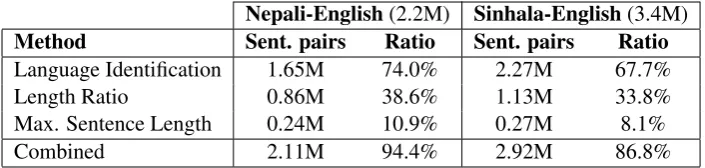
Table 1: Amount of sentence pairs (in Millions) filtered out by each filtering method. ”Combined” denotes the final amount of sentence pairs filtered out after applying the three methods in sequence.
The filtering rules we implemented for our sub-mission are not language specific, and moreover, they only place very mild assumption on what con-stitutes a ”good” sentence pair. In particular, maxi-mum sentence lengthis a technical restrictions im-plemented by many MT systems. Given that the translation system is most probably going to ig-nore them in any case, it makes no sense for us to even rank them. Table 1 displays the amount of sentences pairs filtered out by each method.
Language Identification
We implemented a very straightforward language identification using the Python LangID package. Specifically, we filtered out all those pairs not belonging to the desired pair of languages. For example, each pair (x,y) in the Nepali-English corpus should satisfy: LangID(x) = ”ne” and LangID(y) =”en”, otherwise the sentence pair is filtered out. For Sinhala-English, we require Sin-hala as source language: LangID(x) =”si”.
Length Ratio
As our second heuristic filtering, we chose the ra-tio between the number of tokens ofxandy. This is a very simple criterion, but efficient to identify mispaired sentences. We limited this ratio to be under1.7and smoothed the counts by adding1to them. That is, we rejected the sentence pair if:
|x|+ 1
|y|+ 1 or
|y|+ 1
|x|+ 1
where |x|and|y|are the number of tokens ofx
andyrespectively.
Maximum Sentence Length
Most translation systems have an upper bound for the sentence length. These sentences will be ig-nored in any case during training so we decided to filter them out directly. If either the source (x) or destination (y) sentence in a pair was over50 tokens, we filtered out the pair.
2.2 Coverage Ranking
Sparse data problems are ubiquitous in MT (Zipf,
1935). In a learning scenario, this means that some rare events will be missing completely from a training set, even when it is very large. Miss-ing events result in a loss of coverage, a situa-tion where the structure of the model is not rich enough to cover all types of input. An extreme case of this are out-of-vocabulary words for which the MT system will have no information on how to translate them. Therefore, words (or sequences thereof) that do not appear in the training set can-not be adequately translated (Haddow and Koehn,
2012;Sennrich et al.,2016).
According to these considerations, we propose to explicitly measure how well represented are the different words on a potential training corpusT as a proxy of the actual ”value” of such corpus. We define this corpus ”value”,V(T), as:
V(T) = X
s∈tokens(T)
min(N, c(s,T))
N (1)
where function tokens(T) returns the set of to-kens that appear in T, c(s,T) counts how many times a token s appears in T, and N denotes a count above which we consider a token to be ad-equately represented. After some initial experi-ments, we usedN= 50in our submission.
In order to rank the different sentences in the raw corpora, we implemented a greedy algorithm to create a training corpusT by iteratively adding sentences to it taken from a given pool. At start,
T =∅and the pool is equal to the sentences that
pool. In Section 3, we describe how we modify this algorithm for the final submission in order to improve its time performance.
In our submission, we considered as tokens n-grams of sizes from one up to four, and com-puted them for both the source and destination sentences. This resulted in a total of eight ranks per sentence pair. We denote each of them as rc(s, n)wheres∈ {x,y}, and1≤n≤4.
The main shortcoming of this ranking scheme is that it ignores how the source and destination sentences in a pair relate to each other. Long sen-tences with multiple tokens will most surely rank high even when the other sentence in the pair carry completely different meaning. In order to counter-balance these undesired effects, we implement a secondary adequacy ranking to measure such cor-respondence between the sentences on each pair.
2.3 Adequacy Ranking
This ranking function measures how much of the original meaning is expressed in the translation and vice versa. Specifically, we estimate to which extent the words in the original and translated sen-tences correspond to each other.
We compute this ranking from a simple (but fast) word-to-word translation model (Brown et al., 1993). Given a sentence pair (x,y), we compute asource-given-targetscore according to the geometric average probability over the words for the IBM model 1 formulation:
PM1(x,y) = |x|
v u u t
Q|x| i=1
P|y|
j=0P(xi |yj)
(|y|+ 1)|x| (2)
where P(xi |yj) is the lexical probability of the
ithsource word in xgiven thejth target word in
y. For the target-given-source direction, source and target sentences swap their roles. We denote these two rankings asrM1a (x,y)andraM1(y,x).
Additionally, we compute another two rankings based on aViterbiimplementation of Equation2:
PMv(x,y) = |x|
v u u t
Q|x| i=1max
|y|
j=0P(xi |yj)
(|y|+ 1)|x| (3)
where we replace the summation (P|y|j=0) in Equa-tion 2 by a maximization. Again, we calculate both source-given-target and target-given-source directions:rMva (x,y)andrMva (y,x)respectively.
2.4 Ranking Aggregation
Finally, we combined the different rankings de-scribed in previous sections to obtain the final ranking of our submission.
Aggregation of Coverage Rankings
We start combining the eight coverage rankings described in Section 2.2. First, we average the four rankings for x into a source coverage rank-ing. Then, we repeat the process for the four des-tination rankings. Finally, we got the final cover-age ranking rC(x,y) as the average between the source and destination coverage rankings:
rc(x,y) = 4
X
n=1
rc(x, n)
4 +
4
X
n=1
rc(y, n)
4
2 (4)
whererc(x, n)denotes the ranking of sentencex using n-grams of sizenas tokens.
Aggregation of Adequacy Rankings
First, we averaged the two (source-to-destination and destination-to-source) rankings computed with Equation 2. Then, we repeated the process for the two rankings computed with Equation 3. The final adequacy rankingra(x,y)was then ob-tained as the average of these two rankings:
ra(x,y) =
rM1a (x,y) +rM1a (y,x)
2 +
raMv(x,y) +raMv(y,x) 2
/2 (5)
Final Submission Scores
Once we had computed for each sentence pair (x,y) its coverage (rc(x,y)) and adequacy (ra(x,y)) rankings, we averaged these two to ob-tain the final rankingr(x,y)of the pair:
r(x,y) = rc(x,y) +ra(x,y)
2 (6)
For the final submission however, the organiz-ers ask to provide a score for each pair. Scores do not have to be meaningful, except that higher scores indicate better quality. To do this, we take the simple solution of computing the scores(x,y) as the number of sentences in the raw corpus (R)2 divided by the final ranking of the sentence pair.
2R= 2235512for Nepali-English, andR= 3357018for
Additionally, in order to break potential ties, and to provide a smoothing score for filtered out sen-tences (see Section 2.1), we added to the score the average word probability as described in Equa-tion2. The final scores in our submission were:
s(x,y) = R
r(x,y) +PM1(x,y) (7)
Note that filtered pairs were considered to have an ”infinite” ranking which results in r(x,yR ) = 0; for unfiltered pairs the value of this fraction is as-sured to be greater than one.
3 Submission
We submitted three different score files to the shared task. All employ the same score function Equation7but use different ranking functions:
• PRIMARY: computed using as ranking func-tion the combinafunc-tion of coverage and ade-quacy rankings in Equation6.
• SECONDARYCOV: computed using only the aggregated coverage ranking in Equation4.
• SECONDARYADE: computed using only the aggregated adequacy ranking in Equation5.
3.1 Coverage Rankings Computation
As described in Section 2.2, we implemented a greedy algorithm to compute coverage ranking. At each step, the algorithm selects the sentences that provide a largest increase of ”value” (Equation1) to a iteratively increasing training corpus.
The computational cost of this approach is
O(R2)whereRis the number of sentences under consideration. The initial filtering partially allevi-ates this cost by drastically reducing the amount of sentences to rank. However, it is still a slow process that took about one second per iteration with our Python implementation3. To further re-duce the computational time of the algorithm, we implemented a batch approach where at each step we selected not a single sentence but a batch of the most ”valuable” ones. After some experiments, we chose to select1000sentences at each step as a good compromise; running time was reduced by a factor of1000while the ”value” of the selected training corpus was barely affected.
3After filtering about 176k pairs remained for
Nepali-English, and442k pairs remained for Sinhala-English.
Ne–En Si–En
1M 5M 1M 5M
PRIMARY 3.43.1 3.32.6 3.72.1 4.11.7
SECONDARYCOV 2.90.5 4.22.4 2.60.1 4.01.2
[image:4.595.309.532.62.114.2]SECONDARYADE 3.53.6 4.32.4 3.92.9 4.11.4
Table 2: Results of our submissions, in BLEU [%]. SMT figures are inblue while NMT is in red. Best results are in bold.
3.2 Adequacy Rankings Computation
The cornerstone of the adequacy ranking de-scribed in Section2.3is the probabilistic lexicons in Equations2and3. In our submissions, we used the probabilistic lexicons that can be obtained as a sub-product of the training of full statistical MT models. For this end, we used Moses (Koehn et al.,
2007) with its default configuration and the paral-lel data provided by the organizers as training data.
3.3 Evaluation and Results
Participants in the shared task were asked to sub-mit a file with quality scores, one per line, cor-responding to the sentence pairs on the Nepali-English and Sinhala-Nepali-English corpora. The per-formance of the submissions is evaluated by sub-sampling 1 million and 5 million word corpora based on these scores, training statistical (Koehn et al.,2007) and neural 4 MT systems with these corpora, and assessing translation quality on blind tests using BLEU (Papineni et al.,2002).
Table 2 shows the scores of our three submis-sions for each language pair and condition. Of the three, the one based on coverage rankings (SECONDARYCOV) showed a lower performance consistently being outperformed, particularly in the1million condition, by both our PRIMARYand SECONDARYADEsubmissions.
We were surprised by the ”poor” performance of coverage ranking. Previous works (Haffari et al., 2009; Gasc´o et al., 2012) showed quite promised results. However, in contrast to our case, all these assume the availability of a sample of the domain to be translated. We hypothesize that the lack of this in-domain data in conjunction with the eclectic domains of the data to be filtered are the causes of the poor results of this approach. More-over, the greedy selection implemented may ag-gravate this issue by taking not-optimal initial de-cisions from which the algorithm cannot recover.
Another interesting observation is the
Figure 1: Best results for each team in the competition. We display the participants by increasing sum of BLEU scores for neural and statistical MT models.
itive results for NMT. While SMT results tend to go up as more data is selected, results for NMT tend to show the opposite trend. A fact to consider is that actual BLEU figures are quite low so the actual relevance of these trends are not clear. Ad-ditionally, given that this observation is valid other submissions as we will see next, we think this is an issue worthy of further investigation.
After discussing the performance of our sub-missions, we will compare our best submission on each condition to the rest of participants. Figure1
summarizes the results of the shared task as re-ported by the organizers of the task (Bojar et al.,
2019). Each sub-figure displays the best submis-sion of each individual participant institution for a particular task and condition. Plots in the up-per row show results for Nepalese-English while the bottom row does the same for Sinhala-English. Plots in the left column are for the1million con-dition while results for the5million condition are shown in the right column. Stacked bars displayed in the plots denote the BLEU scores for the statis-tical (blue) and neural (red) systems. We sort them in increasing order according to each system’s sum of SMT and NMT scores.
The organizers do not provide confidence in-tervals for the reported scores so compare results is somehow difficult. Still, as we mention previ-ously, it is surprising the degradation in transla-tion quality for NMT when comparing the5 mil-lion condition to the 1 million condition. Usu-ally, a larger amount of data correlates with an in-crease in translation quality. In this case, however, scores for SMT barely changed while NMT results went down. This seems to indicate that our meth-ods were not sophisticated enough to find adequate data, or that the really adequate data in the noise corpora amount for less than5million words.
4 Conclusions
We have presented our submission to the WMT19 shared task on parallel corpus filtering. We have mostly explored the application of coverage aug-mentation ranking techniques with the aim at se-lecting the subset of sentence pairs that provide the best coherent coverage for the raw sentences.
Results have shown that our proposed coverage approach is not well suited for this particular task. Our secondary submission based on lexical scor-ing works better in all conditions, and even outper-forms our primary submission that combines both coverage and lexical rankings.
One interesting effect seen in the results of the task is the reduced performance on NMT in the presence of more data that can be observed for all participants. Given this, we think that exploring methods able to decide when adding more data will be harmful for performance it is a good re-search direction to explore.
Acknowledgments
We want to thank the reviewers of the paper for their valuable comments and suggestions. Work funded by WebInterpret Inc.
References
Ondˇrej Bojar, Christian Federmann, Mark Fishel, Yvette Graham, Barry Haddow, Matthias Huck, Philipp Koehn, Christof Monz, Mathias M¨uller, and Matt Post. 2019. Findings of the 2019 conference on machine translation (wmt19). InProceedings of the Fourth Conference on Machine Translation, Volume 2: Shared Task Papers.
Peter F. Brown, Vincent J. Della Pietra, Stephen A. Della Pietra, and Robert L. Mercer. 1993. The mathematics of statistical machine translation: pa-rameter estimation. Computational Linguistics, 19:263–311.
Guillem Gasc´o, Martha-Alicia Rocha, Germ´an Sanchis-Trilles, Jes´us Andr´es-Ferrer, and Francisco Casacuberta. 2012. Does more data always yield better translations? InProceedings of the 13th Con-ference of the European Chapter of the Association for Computational Linguistics, pages 152–161.
Jes´us Gonz´alez-Rubio. 2014. On the Effective De-ployment of Currrent Machine Translation Technol-ogy. Ph.D. thesis, DSIC, U. Polit`ecnica de Val`encia. Supervised by Dr. Daniel Ortiz-Mart´ınez and Prof. Francisco Casacuberta.
Barry Haddow and Philipp Koehn. 2012. Analysing the effect of out-of-domain data on smt systems. In
Proceedings of the Workshop on Statistical Machine Translation, pages 422–432, Montreal, Canada. As-sociation for Computational Linguistics.
Gholamreza Haffari, Maxim Roy, and Anoop Sarkar. 2009. Active learning for statistical phrase-based machine translation. InProceedings of Human Lan-guage Technologies: The 2009 Annual Conference of the North American Chapter of the Association for Computational Linguistics, pages 415–423.
Marcin Junczys-Dowmunt. 2018. Dual conditional cross-entropy filtering of noisy parallel corpora. In
Proceedings of the Third Conference on Machine Translation, Volume 2: Shared Task Papers, pages 901–908, Belgium, Brussels. Association for Com-putational Linguistics.
Philipp Koehn, Hieu Hoang, Alexandra Birch, Chris Callison-Burch, Marcello Federico, Nicola Bertoldi, Brooke Cowan, Wade Shen, Christine Moran, Richard Zens, Chris Dyer, Ondrej Bojar, Alexandra Constantin, and Evan Herbst. 2007. Moses: Open Source Toolkit for Statistical Machine Translation. In Proceedings of ACL 2007, System Demonstra-tions.
Kishore Papineni, Salim Roukos, Todd Ward, and Wei-Jing Zhu. 2002. Bleu: a method for automatic eval-uation of machine translation. InProceedings of the 40th Annual Meeting of the Association for Compu-tational Linguistics, pages 311–318.
Nick Rossenbach, Jan Rosendahl, Yunsu Kim, Miguel Graa, Aman Gokrani, and Hermann Ney. 2018. The rwth aachen university filtering system for the wmt 2018 parallel corpus filtering task. InProceedings of the Third Conference on Machine Translation, Vol-ume 2: Shared Task Papers, pages 959–967, Bel-gium, Brussels. Association for Computational Lin-guistics.
Rico Sennrich, Barry Haddow, and Alexandra Birch. 2016. Neural machine translation of rare words with subword units. InProceedings of the 54th An-nual Meeting of the Association for Computational Linguistics (Volume 1: Long Papers), pages 1715– 1725.
![Table 2: Results of our submissions, in BLEU [%].SMT figures are in blue while NMT is in red](https://thumb-us.123doks.com/thumbv2/123dok_us/180852.515298/4.595.309.532.62.114/table-results-submissions-bleu-smt-gures-blue-nmt.webp)

