Research on the Phenomenon of “Chinese
Culture Aphasia” among the College Students in
China—Based on a Survey Study of Heilongjiang
Bayi Agricultural University
*
Yan Wu
College of Humanities and Social Sciences, Heilongjiang Bayi Agricultural University, Daqing, China
Abstract—In an era of globalization, our societies have become increasingly multicultural. And along with the deepening reform of college English teaching in China, cultural teaching plays a more important role in the cultivation of students’ humanistic qualities. A questionnaire and a cultural test paper were conducted to investigate the phenomenon of the “Chinese Culture Aphasia” of college English teaching in Heilongjiang Bayi Agricultural University. According to analyses of the research, English teachers of our university have tried to study its causes and explore the ways to integrate Chinese culture into English teaching to fully promote students’ humanistic qualities. In the process of teaching, the language skills teaching and the humanistic education will be united to cultivate students’ cultural critical thinking, to develop their international cultural horizons, to realize the curriculum ideology of the “whole-person education” in English teaching.
Index Terms—Chinese culture aphasia, College English teaching, teaching model, intercultural
communication
I. INTRODUCTION
The inextricable relationship between language and culture determines their inseparability in language teaching. Compared with cultural teaching with humanistic nature, college English teaching in China has long paid more attention to the instrumental nature of language, such as, grammar teaching and communicative function training. As a result, the humanistic function and cultural transmission of language teaching are in the ignore state. In recent years, the cultural teaching in college English teaching has been greatly improved. English teachers process to strengthen the cultural input in teaching, to a great extent, which promote the language teaching and enhance the interesting and practices of teaching. But in some ways, it only pays attention to spread the target-language culture, the native culture, especially Chinese traditional culture has not been well integrated into the college English teaching in China. The result is that students lack of communicative abilities to express Chinese culture in English. There is a serious culturally literacy gap between Chinese and western cultures in teaching which leads to the phenomenon of “Chinese Culture Aphasia”.
Professor Cong (Cong Cong, 2000) from Nanjing University firstly proposed the existence of “Chinese Culture Aphasia” in English education in his article “‘Chinese Culture Aphasia’: Defects of English Teaching in China” published in Guangming Daily on October 19th 2000. He mentioned that many young Chinese scholars with a considerable degree of English had always failed to show the profound cultural literacy and lacked independent cultural personality in their communication with foreigners. He also found that some doctoral students with high levels of basic English language skills and Chinese cultural knowledge who once entered the English communication context, they immediately presented “Chinese Culture Aphasia” which referred to the shortage of Chinese cultural knowledge, especially traditional Chinese culture and the inability to express Chinese culture in English. Through his research, professor Cong believed that the phenomenon of “Chinese Cultural Aphasia” was closely related to the ability to English expressions of Chinese culture.
The fourth nationwide high-level forum on the Reform and Development of Foreign Language Education was held in March 2019. Professor Wang (Shouren Wang, 2019) presented some problems in the cultivation of intercultural competence in foreign language education in China, that are: attaching more importance to foreign cultures while neglecting Chinese culture; emphasizing on language micro skills instead of mode of discourse; focusing on knowledge accumulation rather than critical thinking education. Nowadays, students are expected to be ambassadors of cultural exchanges who can introduce Chinese culture with thousands of years of civilization to foreigners who are interested in to have a comprehensive and in-depth understanding of the Chinese nation.
A research was conducted to study the non-English majors’ abilities to express Chinese culture in English and their degree of Chinese Culture Aphasia in Heilongjiang Bayi Agricultural University. The study intents to improve students’
intercultural awareness and competence with both target culture and native culture through integrating Chinese culture in college English teaching.
II. METHODOLOGY
The survey aims at investigating the existence and the extent of Chinese Culture Aphasia in college English teaching of Heilongjiang Bayi Agricultural University, at testing students’ intercultural communication abilities and English learning interest in integrating Chinese culture in the college English courses. And then, in accordance with the research analyses, teachers will try to find out the suggestive solutions to improve the cultural teaching in College English Teaching.
A. Objectives
In order to obtain a comprehensive understanding of the students’ cultural accomplishments and their abilities to express Chinese culture in English, a questionnaire survey and a test paper were conducted in May, 2019.
B. Subjective
210 non-English majors from different schools of Heilongjiang Bayi Agricultural University were involved in the survey. They major in different disciplines, including Accounting, Computer Science, Marketing, Economics, Sociology, Mathematics, Biology, Mechanical Engineering, Electrical Engineering, Civil Engineering. They are sophomores and are still taking the English course.
C. Instruments
There is one questionnaire and a cultural test paper for research. 1. Questionnaire
In order to get the first-hand information, the questionnaire was conducted. Its purposes are to investigate the participants’ attitude towards Chinese culture, to understand students’ abilities to express Chinese culture in English, to learn their needs and suggestions on the improvement of their abilities to express Chinese culture in English, etc. It consists of 10 questions and are anonymously collected. From the first to the ninth question, only one answer can be chosen. The last one question has more than one answer to be chosen. The Likert scale was adopted in some questions in the form of “strongly disagree, somewhat disagree, uncertain, somewhat agree and strongly agree” respectively, so as to show students’ attitude towards the content of the survey more objectively. 210 papers were all collected. The recovery rate is 100%.
2. Test
The author designed a paper for testing the students’ abilities to express some specific items of Chinese culture in English. It includes three parts. The first part is translating 30 representative Chinese cultural-specific words into English which refer to Chinese festivals, food, history, politics, geography and so on. Two points can be got if one term is translated correctly. The second part is short answer which requires students to briefly introduce “Chinese Peking Opera, four treasures of study, four famous embroideries and four famous grottoes” in English. 2.5 points can be got if one term is partly translated and 5 points corresponds to the perfect answer. The third part introduces Chinese scenic spots and historical sites. The total score of the test paper is 100 points. The test lasted within 45 minutes. The students are not allowed to look up dictionary to examine their actual ability to express Chinese culture in English.
III. RESEARCH RESULTS AND MAIN FINDINGS
The data and results of the questionnaire and tests are analyzed in order to put forward several suggestions for inputting Chinese culture in college English teaching.
A. Findings and Discussions of the Questionnaire
10 questions were listed in the questionnaire to survey the students’ attitudes to Chinese culture in English in Heilongjiang Bayi Agricultural University. The Likert Five Scales was used in the multiple choices. The subjects were asked to tickle one of the five degrees of agreement.
1. Students’ recognition and attitudes to learn Chinese culture in English Course
Question 1,2,3,8 and 9 are classified as students’ recognition and attitudes to learn Chinese culture in English. The results of the questions of the questionnaire have been presented below.
TABLE 2. RESULTS OF Q2
TABLE 3. RESULTS OF Q3
TABLE 4. RESULTS OF Q8
TABLE 5. RESULTS OF Q9
According to the above data (Table 1), 47.14% of the students somewhat agreed and 14.76% of them strongly agreed that they knew a lot about Chinese culture. As shown in the question 2 (Table 2), 87.14% of the students (50.95% strongly agree and 36.19% somewhat agree) held positive attitudes on introducing Chinese culture to foreigners in communicating. Most of the students (43.33% strongly agree) (Table 3) believed that it was necessary to learn how to express Chinese culture in English in class. In question 8 (Table 4), only 9.52% of the students satisfied greatly with the content of Chinese culture in English courses and 46.67% of them were uncertain. The majority students’ attitudes (42.86% strongly agree, 40.95% somewhat agree) (Table 5) to the integration of Chinese culture in the English courses are positive. All in all, most of the students have a positive attitude towards learning Chinese culture in English and they are likely to be cultural ambassadors who bring Chinese culture to the people from other countries.
2. Students’ practical skills of learning Chinese culture in English
Question 4 and 5 investigated students’ abilities to introduce Chinese culture in English and the difficulties they met in learning.
TABLE 6. RESULTS OF Q4
From the results of question 4 (Table 6), it clearly shows that 93.81% of students had difficulties in introducing Chinese culture in English. 46.67% of them thought it was difficult and 47.14% of them was very difficult. When asked the main difficulties they met in expressing Chinese culture in English (Table 7), 64.76% of students indicated that they had deficiency in language skills.
3. The sources of learning Chinese culture in English
Textbooks are the important materials in college English teaching and also the main source of students’ English input.
TABLE 8. RESULTS OF Q6
It can be seen from the figures of the Question 6 (Table 8), just 12.86% of students strongly agreed that the textbooks containing a lot of information of Chinese culture.
TABLE 9. RESULTS OF Q7
There are various opinions concerning the main sources of learning to express Chinese culture in English. 19.52% of students (Table 9) expressed that they learned the English version of Chinese culture from textbook and 40% of students thought that teacher’s lectures were the main sources of learning. 15.24% of the students chose extracurricular reading materials as the source of learning and choice of internet websites took 20.95%. The figures reflect their diversity of learning and also indicate that Chinese culture teaching is inadequate and insufficient in college English teaching.
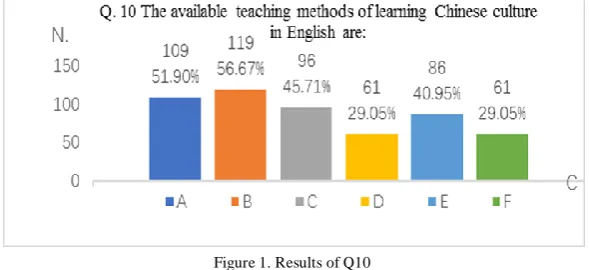
Figure 1. Results of Q10
As for the answers of Question 10 (Figure 1): the available teaching methods of learning Chinese culture in English, most of the students expressed their expectations on some useful ways to improve their learning skills. The bar graph above shows that 51.90% (109 of the subjective) of students chose answer A (lectures on cultural vocabulary). And answer B that is cultural topics (accounting for 56.67%). 45.71% (96 students) of them liked to learn it in situation dialogue. 29.05% (61 of them) of students wanted to have group discussion and 40.95% (86 students) of them would like to learn it through cultural contrast and comparison between English and Chinese. In addition, answer F that is to practice listening, speaking, reading, writing and translating took 29.05% (61 students).
According to the analyses of the results, it can be drawn a conclusion that most of the students have certain interest in learning Chinese culture in English and hold positive attitudes to it.
B. Findings and Discussions of the Test Paper
The first part of the test paper was used to analyze students’ abilities to express the Chinese culture-specific items in English. The words and phrases cover Chinese ideology, literature, idioms, food and festivals, and so on.
Figure 2. Total Score of the First Part
The results of the first part of the test (Figure 2) indicate that 30 common words can be translated into English with an average accuracy of 13.61%, dominated by 11-15 points, accounting for 38.10%, with the highest score of no more than 40 points (the total score is 60 points) and the lowest score of 5 points. The worst three translated words were “the terracotta warriors” (2.24% getting correct), “sustainable development” (The accuracy is 4.81%.) and “filial piety” (5.31% being correct). The best three translated words were “the Great Wall” (88.81% is correct), chopsticks (54.41% getting correct) and Peking Opera (90.18% is correct.). The three most unanswered words were “the terracotta warriors” (89.16%), “the National People’s Congress” (84.81%) and “cupping” (85.42%).
According to the data, students’ abilities to express Chinese culture in English is not optimistic. Some words or phrases they can accurately translate is probably because that students usually read and use these words in daily life and they learned the English version of these Chinese vocabularies in high school English textbooks. This also shows the importance of introducing English expressions of native culture in teaching. That means only understanding Chinese culture cannot solve the “one-way” in cross-cultural communication, students also need to have the abilities to express their native culture in English.
2. Analysis of the second part of the test paper
For the second part of the test paper, students were required to translate four Chinese proper items in English and paraphrase them in some simple words or phrases with their own opinion. The second part mainly examines the students’ basic knowledge of Chinese culture and whether they can give a brief introduction in English. The total score is 20 points. However, the students’ answers are not satisfactory.
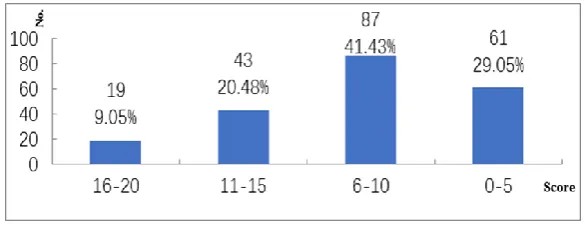
Figure 3. Total Score of the Second Part
As can be seen from the bar graph above (Figure 3), almost the half of students (87 of them, accounting for 41.43%) got 6-10 points and 29.05% of them (61 students) had the very low points (only less than 5 points) in the second part. As for “four treasures of study”, “four categories of Peking Opera”, “four famous embroideries” and “four famous grottoes”, most of the students wrote the corresponding contents in Chinese. While as for the simple introduction in English, only few students could give a comprehensive answer. However, there were still some students who were unable to answer them in Chinese, which indicated that the students were short of their native cultural knowledge. The results indicate that they do not know Chinese culture deeply and let alone using them to have conversations with foreigners correctly.
3. Analysis of the third part of the test paper
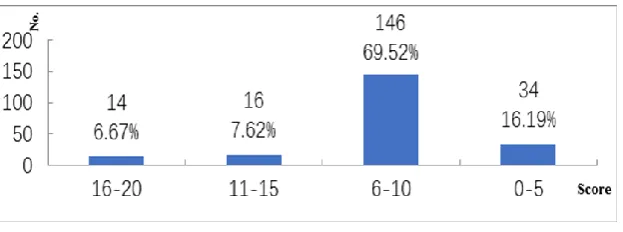
Figure 4. Total Score of the Third Part
According to the bar graph (Figure 4), the score illustrates that most of the students have no idea about the English expression of Chinese culture. Some of them translated it literally, some interpreted it freely, and most of them did not know what to do. The causes of this problem probably because that most of the students cannot see or hear the English expressions of these Chinese culture in the process of learning English for many years. And this is an inevitable result.
In general, most students lost many points in the cultural test paper. The results show that the majority of the students grasp little about some relevant English expressions of Chinese culture. Even if they have a certain understanding of some Chinese culture, they have poor performance in expressing typical Chinese culture in English. The inadequate input of Chinese culture in college English teaching directly causes the Chinese Culture Aphasia.
IV. SUGGESTIONS FOR INTEGRATING CHINESE CULTURE IN COLLEGE ENGLISH TEACHING
Many people may hold a view that as Chinese college students, there is no difficulty in acquiring Chinese culture. However, the results of the questionnaire and the test paper have proved that there is a considerable number of students in China who have an inadequate understanding of Chinese Culture and have poor performance in translating it in English.
The research results of the questionnaire and the test paper indicate that students’ abilities to express Chinese culture in English cannot be acquired naturally in the process of learning English and they need guidance from teachers in and after class. The situation of Chinese Culture Aphasia among students in Heilongjiang Bayi Agricultural University is worrying. Chinese Culture Aphasia has a direct relationship with the neglection of native culture in many aspects, such as, society, curriculum, teachers and students themselves, etc. Therefore, some various efficient and effective methods need to be used to input Chinese culture in college English teaching in China.
A. To Reform the Current Curriculum of College English
In terms of higher education, the curriculum setting is very important. It should not only meet the needs of society to cultivate the technical talents, but also meet the needs of the long-term development --- the cultivation of humanity and morality.
When facing the phenomenon of Chinese Culture Aphasia, on the one hand English teachers in China should reflect the relationship between the teaching goals and the teaching content of College English and research on students’ learning aims and their needs in cross-cultural communication, and on the other hand, they can make more scientific training plan and increase the proportion of Chinese culture in the teaching content to change the existing phenomenon of Chinese Culture Aphasia.
According to the principle of “connecting disciplines”, the curriculum of college English courses should be optimized. In order to change the phenomenon of separation between English courses and other disciplines, especially history and culture, etc., so some culturally relevant instructions can be offered to break the barriers between courses. In college English curriculum development, teachers should emphasize the significance of Chinese culture in the compulsory courses, and besides, some optional courses concerning Chinese culture can be set, such as, Chinese philosophy, Chinese traditional custom, Chinese history, cross-cultural communication, and so on. Thematic teaching or lectures and discussions are conducted according to the principle of relevance, practicability and comparability, so as to deepen students’ understandings of Chinese culture and improve their abilities to accurately express Chinese culture in English.
B. To Adjust the Teaching Content
We live and work in an increasingly multicultural world in which we will need increasingly sophisticated cultural skills. Classroom teaching is the major channel for college students to learn English, so English teachers should not only develop students’ basic language skills, but open their minds about all kinds of cultures.
similarities and differences between cultures can be given so that students could have deeper and better understanding of the text.
On the other hand, the content of Chinese culture should be increased in all kinds of teaching materials to completely reverse the phenomenon of Chinese Culture Aphasia. Some learning materials which can reflect and represent Chinese culture are used in teaching. And the choices of the related materials should be systematic and representative to introduce the most typical part of Chinese civilization. And at the same time, the content which contains the fundamental elements of Chinese culture should be close to students’ daily life and can arouse their interests and easy to understand for most of the college students. For instance, from the texts related to Classic of the Way and Virtue, The Book of Changes, Tai Chi, Cuju and other activities, we can see that the Chinese people not only have the talents of invention and creation, but also have a kind of wisdom of life that to live in harmony with nature. From those of Sunzi’s Art of War --- an ancient classic on war, Zheng He’s seven voyages to the Western Seas which aim to make friends with and spread peace to other countries near and far, we can learn that the Chinese people’s eternal prayer for a peaceful life. The Chinese arts, such as pure porcelain, free-flowing calligraphy, colorful Peking Opera reveal the inner world of the Chinese people and represent their unique sense of aesthetics. In this way, it is bound to strengthen students’ memories and optimize the effect of cultural communication. Learning Chinese culture in English expression is an interesting process that brings a valuable understanding of Chinese culture.
C. To Create a Research-based Learning Classroom
Intercultural communication is a two-way communication. Shaped by different cultural backgrounds, people understand and judge things in different ways. What we consider normal in one culture can be entirely not in another. So, misunderstandings always occur when I use my meanings to make sense of your reality. That’s to say, people should not only learn foreign cultures, but also spread their own culture. In this way, people can come to realize that there are many cultural differences and step outside of their own culture and be open and respectful to others to understand each other better.
The teacher is expected to be a guide and helper rather than an expert in cultural teaching. Teachers should change their teaching ideologies and insist on the combination of language teaching and culture teaching. Flexible teaching methods are adopted and various modern teaching means are used to create a research-based learning classroom in our university. In order to cultivate students’ abilities to intercultural communication, the integration of Chinese culture into college English teaching should be concerned from the perspective of cultural teaching. The contrast and comparison approach can develop students’ awareness of cultural differences between two languages. In the process of comparison, learners are required to have a view of cultural relativity, that is we can neither say one culture is superior or inferior to another culture. They can objectively understand Chinese and foreign cultures and have an open and flexible thinking mode. In teaching process, teachers guide students to realize that all kinds of cultures are equal and encourage them to think independently to develop their critical thinking skills. It can enhance students’ rational understanding of human cultures. Chinese culture and other cultures have apparent differences. No major cultural systems are perfect. They have their own merits and shortcoming. We need to respect others, understand others, and learn from others.
V. CONCLUSION
Many teachers and students have misunderstandings of learning English that should mainly focus on improving language skills, therefore cultural teaching has been overlooked for a long time. This does great harm to cultivate students’ intercultural communicative competence.
Nowadays, cultural teaching has been a hot topic in English teaching. It will be doomed to failure or decline if you only know your own culture and ignore other cultures. Those with genuine respect and love for their own culture will certainly respect and love excellent parts of others. In today’s multicultural world, it is very important when we have to interact with people from other cultures. The educated can have a high degree of national cultural identities in learning. And it is necessary for each student in China to learn how to introduce Chinese culture in English to foreigners. Students, especially college students should shoulder the responsibility of introducing Chinese culture to foreigners and keep an open heart toward friends and cultures from others countries.
REFERENCES
[1] Cong Cong. (2000). Chinese Culture Aphasia: The Shortcomings of Foreign Language Teaching in China. Guangming Daily. 2, 13-14. Print.
[2] Fei Shao. (2015). A Survey of the Phenomenon of Chinese Culture Aphasia in College English Teaching from the Perspective of Intercultural Communication. MA. dissertation, Changchun University of Technology.
[3] Liwen Li. (2017). College English and Intercultural Competence Research and Practice. Beijing: Foreign Language Teaching and Research Press.
[4] Linell Davis. (2013). Doing Culture Cross-cultural Communication in Action. Beijing: Foreign Language Teaching and Research Press.
[5] Qi Feng. (2011). Studies in Language and Culture. Shanghai: Shanghai University Press.
[7] Shanshan Lu. (2015). A Study on the Phenomenon of Chinese Culture Aphasia among Students of College English Course. MA. dissertation, Guangxi University.
[8] Shouren Wang. (2019). To Cultivate Cross-cultural Competence of High-quality Foreign Language Talents. http://heep.unipus.cn/news/detail.php?NewsID=4847 (accessed 25/3/2019).