Research Article
a
September
2017
Computer Science and Software Engineering
ISSN: 2277-128X (Volume-7, Issue-9)
IOT and Industry 4.0 – Gateway towards improving Energy
Efficiency
Jait Purohit*
Computer Science & California State University, Sacramento, United States
Abstract— Energy efficiency (EE) has become an important benchmark in manufacturing industry due the increasing concerns about climate change and tightening of environmental regulations. However, most manufacturing and production industries today are only able to monitor aggregated energy consumption and lack the real-time visibility of EE on the shop floors. The ability to access energy information and effectively analyse such real-time data to extract key indicators is a crucial factor for successful energy management. While enabling real-time online monitoring of Energy Efficiency, it also applies data gathering analysis to detect abnormal energy consumption patterns and quantify energy efficiency gaps. Through a case study of a microfluidic device manufacturing line, we demonstrate how the application can assist energy managers in embedding best energy management practices in their day-to-day operations and improve Energy Efficiency by eliminating possible energy wastages on manufacturing shop floors.
Keywords— IoT, IIoT, Energy Efficiency, Industry 4.0, Machine Learning, Real-Time Monitoring
I. INTRODUCTION
IoT is a concept that spans nearly every area of the economy. It is about the connectivity of devices, data, and personalization of technology. IoT is an influential concept when considering energy management and operational efficiency in smaller facilities because it is a pathway to cost-effective technology deployment. An IoT platform entails sensors, gateways, and wireless communications to deliver better data to the analytics engine that in turn presents better insights and actions to customers. The significant reductions in cost from this technology approach—as compared to traditional controls and automation—make the benefits of developing intelligent buildings attainable for smaller facilities.
II. IOT ENABLED SOFTWARE APPLICATION FOR REAL-TIME ENERGY EFFICIENCY MONITORING
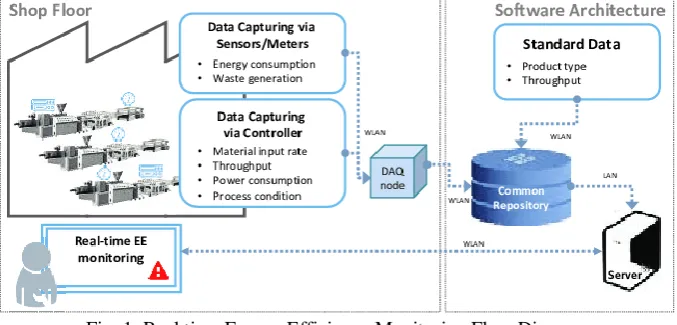
The proposed IoT enabled software application helps energy managers in achieving better Energy Efficiency by understanding both the energy consumption patterns and production data while eliminating possible energy wastages in the manufacturing operation. It works in a simple manner as shown in fig. 1. The application users, e.g. Energy manager, monitor the energy performance for each machine at each level using tablet while data such as power consumption and process operating parameters, viz. Temperature, pressure, etc. Are captured via sensor or controller. Production data are provided by existing software such as manufacturing execution system, work order tracking system, etc. The server stores the data as well as the energy performance status and respective analysis results in the common repository. The three components, i.e. Data acquisition, server and energy manager, interact with each other via wireless network.
ISSN(E): 2277-128X, ISSN(P): 2277-6451, pp. 58-64 III. SOFTWARE APPLICATION ARCHITECTURE
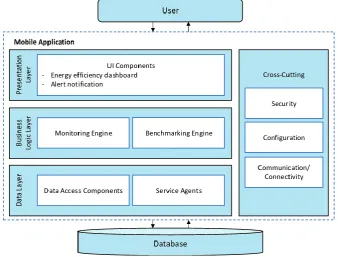
A software application is developed and structured as a multi-layered application consisting of user experience, business logic and data layers. As Fig. 2 illustrates, it consists of
(1) Presentation layer
This layer contains the components that implement and display the user interface and manage user interaction. A set of user interface components such as the dashboard, notification pages and reports are design to provide a way for users to interact with the application. User interface can make use of controllers to communicate with the back-end and to navigate or process the interface components.
Fig. 2 Software application structure for real-time Energy Efficiency monitoring
(2) Business-logic-layer
This is the layer where all the engines in the application reside. It contains all the processing logic to make the application possible. The application consists of two parts, i.e. a) monitoring algorithm and b) benchmarking engine.
(3) Data-layer
This layer contains the functionality for creating, transforming, updating and deleting items into the database. The data access components abstract the logic necessary to access the underlying data stores.
(4) Cross-cutting-functionality
Besides the major three layers, the cross-cutting functionality (i.e. security, configuration and communication) are required to support the application. Security consists primarily of data protection. Configuration considers how to handle device resets while device communication includes wireless communication and wired communication with a host computer.
IV. REAL TIME ENERGY EFFICIENCY MONITORING DASHBOARD
ISSN(E): 2277-128X, ISSN(P): 2277-6451, pp. 58-64
Fig. 3Real-time EE monitoring dashboard
V. REAL TIME ENERGY PERFORMANCE MONITORING
By looking at the details of any process, the real-time energy performance monitoring is illustrated as Fig. 4. The performance indicators monitored include total energy consumption, total production and energy cost involved with respect to different periods, i.e. hourly, daily, weekly and monthly.
Fig. 4 showing the hourly energy performance monitored for the plastic injection molding machine (PIM-1). With the selected time frame, i.e. 15:00 – 16:00, the total energy consumption is 19.34 kWh to produce 27 pieces of product (14 covers and 13 bases). The total energy cost, i.e. 5.80 SGD/hour is being spent for value added production (55%) and non-value-added production such as idling (45%). Besides, specific energy consumption is provided to understand how effectively energy is consumed. Hourly EE performances throughout the day were monitored and the abnormal EE patterns were detected to provide the level of awareness. For example, energy performances from midnight 12 am until morning 9 am were alerted as the machine was idling without any production. This can bring to the next level of investigation.
ISSN(E): 2277-128X, ISSN(P): 2277-6451, pp. 58-64 VI. REPORT GENERATION
In 2013, Singapore National Environment Agency introduced the mandatory energy management requirement under Energy Conservation Act [11]. This requires energy intensive companies that annually consume more than 15 GWH of electricity to submit a periodic reporting of energy use. The information required in the annual report includes a) days with abnormal EE occurrences together with the reasons affecting the anomaly, b) breakdown of total energy consumption of each machine, c) breakdown of total energy cost of each machine and d) specific energy consumption for different products.
VII. THE INTERNET OF THINGS AND THE ENERGY INDUSTRY
He Internet of Things (IoT) represents a new reality. The insight derived from data collected from new Internet-connected devices can be used to develop new services, enhance productivity and efficiency, improve real-time decision making, solve critical problems, and create new and innovative experiences. However, as more devices connect, companies face increased fragmentation, interoperability, and security challenges. To address this, Intel, along with McAfee and Wind River, is delivering integrated, scalable hardware and software solutions specifically designed to meet diverse market needs that seamlessly integrate into existing energy infrastructure to enhance security, reliability, and efficiency.
The combined capabilities and expertise of Wind River, Intel, and McAfee make possible the true end-to-end security that IoT requires: Intel provides the scalable architecture to host the deeply embedded OSs and applications from Wind River, and McAfee’s solutions leverage more than 30 years of securing the most demanding digital environments, which Wind River then augments for IoT applications.
Together, the companies deliver interoperable, end-to-end solutions that bridge the intersections between information technology and devices, while drawing on decades of innovation and control expertise. They are also developing pretested, pre-validated IoT products and solutions, like intelligent gateways, to provide fundamental building blocks that streamline integration, lower development costs, and accelerate time to market. From the device to the data center, these solutions will include capabilities that support a wide range of vertical markets, like industrial control and energy where devices operate in domains with extreme temperature and safety requirements.
For energy companies, this means greater flexibility to accommodate new energy sources, better management of assets and operations, greater reliability, enhanced security, better customer service, and enablement of new business models and services.
VIII. HOW EFFECTIVE IOT STRATEGIES CAN SAVE ENERGY
IoT essentially is the networking of smart devices, buildings and other items with electronics, which enable the collection and exchange of data. IoT has been shown to provide energy efficiency when utilized correctly. Examples of energy efficient IoT are abundant: Things may be simple sensors (e.g. temperature sensor in a room), more complex sensors (e.g. electrical power measuring device), actuators (e.g. HVAC room controller, motor), or complex devices (e.g. industrial circuit-breaker, PLC providing home, building or industrial automation). The IoT application may range from a simple monitoring application such as gauging the temperature in a building, to a complex application such as providing complete energy automation of a campus.
It was recently announced that NASA is engaging with IoT for energy efficiency. NASA’s LEED Platinum building, called Sustainability Base, is acting as a beta tester for an IoT energy monitoring system. Manufactured by Verdigris Technologies, the system uses clamp-on current sensors to detect individual devices turning on and off, and a sophisticated signal processing algorithm that identifies the device and analyzes its electrical ―signature‖ to detect potential faults, according to engineering.com.
Once installed, the system is taught which device is linked to each signal. It is then able to track which units are turning on or off at any given time. This information is transmitted to the Sustainability Base building automation system for energy analysis. The facility manager will then have a more detailed picture of what is using energy, and when.
But there’s more to IoT playing a role in energy efficiency than just clamping on a few sensors. According to cio.com, to have an effective IoT strategy in place, there are five important pieces of advice to follow.
Businesses must appoint an IoT leader, whether it’s the chief IT officer or an individual from a different department, as long as it’s someone who can guide a cohesive IoT strategy. Additionally, there must be a distinct IoT team or organization within the business as a whole.
ISSN(E): 2277-128X, ISSN(P): 2277-6451, pp. 58-64
Companies must also build a culture of secure IoT and leverage IoT experience from the outside. With IoT still new for many industries and companies, seeking outside expertise in the beginning stages of a company’s IoT initiative.
IX. NODE LEVEL ENERGY EFFICIENCY PROTOCOL FOR IOT
Node Level Energy Efficiency Algorithm considers residual energy of its one hop neighbour nodes and the average value of residual energy of all nodes in the network. For this we need to consider two factors first: assumed that each node knows the average value of residual energy of all nodes in network calculated by network controller using periodically receiving info about residual energy from each node. Second, each node knows the residual energy of its one hop neighbour nodes from the hello packets which are periodically broadcasted by each node in order to indicate the existence and hop location of the node with respect to source and destination.
This helps us to forward packets using minimum number of hops between source and destination. As each intermediate node consumes considerable amount of energy while forwarding a packet. This approach ensures low energy consumption at node level. Fig.4is an example of NLEE. When source node needs a routing path for forwarding the packets, it broadcasts the route request (RREQ) packet at its 1-hop neighbourhood to compute the hops from source to destination. Then, when a forwarder node receives the RREQ packet that calculates forwarding probability using its residual energy and expected transmission count value in the NLEE algorithm.
Fig. 5 Example of NLEE Algorithm
However, the node compares the average value of residual energy of all the nodes with the predetermined residual energy threshold. If an average energy of the node is higher than node’s threshold energy, the node regards that the network is in a better energy condition. Hence, it is not required to set the forwarding probability greater. Thus, a node computes the forwarding probability. If an average energy is shorter than threshold energy of node. As, a result, network is referred as lower energy network. In this situation, forwarding probability is made higher by executing our proposed algorithm.
X. SMART ENERGY MARKET MODEL
ISSN(E): 2277-128X, ISSN(P): 2277-6451, pp. 58-64
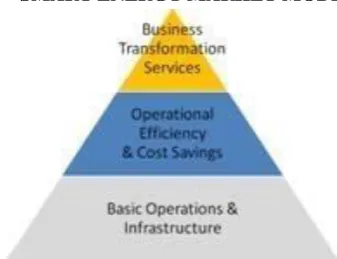
As an illustrative example to help explain the pyramid above, let’s examine the utility industry within the smart energy market in the United States. There is no lack of change in today’s energy landscape and no surprise that this puts the US energy industry at a crossroads – one of challenge, but also opportunity. Utilities are at the heart of this transformation.
(A) Level 1: Modernizing infrastructure and improving operations
It may be easy to overlook the importance of modernizing existing power infrastructure, but the bottom line is that we cannot rebuild our power grid from scratch. We have to rely on intelligent technologies to improve the systems we have in place to improve power quality and security, and continue to deliver safe, affordable, reliable energy to consumers. Utilities are transforming while still performing. For example, a large percentage of BC Hydro’s smart meter
programmer’s benefits are realized in revenue protection/assurance application. IoT-connected devices with tighter security have the ability to give utilities unprecedented levels of control over their operations through both improved hardware and digital technologies and fulfil this most fundamental need. Just as with Maslow’s theory, this most basic level of need must be met before the individual ―thing‖ can focus upon the secondary or higher-level needs.
(B) Level 2: Enhancing efficiency and cost savings
Maslow also coined the term ―met-motivation‖ to describe the motivation of people who go beyond the scope of the basic needs and strive for constant betterment.
Similarly, focusing on digital technology drives efficiencies across a utility’s business by increasing the opportunity to integrate new renewable generation and distributed energies into their system to help go beyond the scope of basic infrastructure and operations.
Utilities are improving total uptime and reducing overall maintenance costs by deploying predictive maintenance analytics that increase the quantity and quality of maintenance schedules. For example, PPL Electric has reported a 38% improvement in service reliability enabled in part by the deployment of sophisticated analytical capabilities.
(C) Level 3: Business transformation services for more value-added services to consumers
In the final level, the value to a utility goes far beyond basic operational enhancements or efficiency, ultimately leading to major change to the business value for the utility, typically reflected in the form of new products and services that are outside of the traditional utility model and offering more value-added services to consumers.
The smart grid enables utilities to offer new services at both the wholesale and retail/consumer level by providing deeper insights on capacity demand, issue identification, pricing options and more. Oklahoma Gas & Electric, in a bid to substantially shed load by 2020, is using customer analytics to gain visibility on individual customers’ responses to price signals. This is allowing them to identify the best customers to target with specific marketing campaigns.
To address the challenges described above and realize the full potential of a true IoT for smart energy, we need to modernize utilities’ infrastructure, improve operations and enhance efficiencies first, but the ultimate goal is to transform into a customer-centric company that can offer more value-added services to the end-consumers.
XI. CONCLUSIONS
ISSN(E): 2277-128X, ISSN(P): 2277-6451, pp. 58-64 REFERENCES
[1] P. Sarwesh,N. Shekar V. Shet, K. Chandrasekaran,Energy-Efficient Network Architecture for IoT Applications.
[2] Jordi Mongay Batalla, George Mastorakis, Constandinos X. Mavromoustakis, Evangelos Pallis,Beyond the Internet of Things.
[3] Waleed Ejaz, Muhammad Naeem, Adnan Shahid, IEEE Communications Magazine (Volume: 55, Issue: 1, January 2017).
[4] Lorenzo Bottaccioli, Alessandro Aliberti, Francesca Ugliotti, Building Energy Modelling and Monitoring by Integration of IoT Devices and Building Information Models.
[5] Alessandro Burgio, Andrea Giordano, Andrea Angelo Manno, An IoT approach for Smart Energy districts. [6] Francois Jammes, Ubiquity, Volume 2016, Number February (2016), Pages 1-8, Internet of Things in Energy
Efficiency
[7] Chunsheng Zhu, Victor C. M. Leung, Lei Shu, Green Internet of Things for Smart World