Kollmann
Drain Cleaning
Machines
OPERATOR’S
MANUAL
K-1500A/B
K-1500SP
WARNING!
Read this Operator’s Manual carefully before using this tool. Failure to understand and follow the contents of this manual may result in electrical shock, fire and/or99 Washington Street Melrose, MA 02176 Phone 781-665-1400 Toll Free 1-800-517-8431
Table of Contents
Recording Form for Machine Model and Serial Number...1
General Safety Work Area Safety ...2
Electrical Safety...2
Personal Safety ...2
Tool Use and Care ...3
Service ...3
Specific Safety Information Drain Cleaner Safety ...3
Description, Specifications and Standard Equipment Description ...4
Specifications ...4
Standard Equipment...4
Machine Inspection ...5
Machine Set-Up...6
Operating Instructions ...7
Special Procedures Reverse Operation ...8
Cable Applications...8
Storing and Transporting Cable (“A” Frame Models) ...9
Accessories Cable Selection ...9
Accessories and Tools Available For Cables ...10
Maintenance Instructions Lubrication ...11
Cables ...11
Clutch Jaws Replacement...11
Removing Clutch End Play...11
V-Belt Adjustment...12
Machine Storage ...12
Service and Repair ...12 Wiring Diagram ...13-14 Lifetime Warranty...Back Cover
ii
K-75A/B, K-1500A/B, & K-1500SP Drain Cleaning Machines
Kollmann
Test Equipment Depot - 800.517.8431 - 99 Washington Street Melrose, MA 02176 TestEquipmentDepot.com
Drain Cleaning Machines
Record Serial Number below and retain product serial number which is located on nameplate. Serial
No.
K-75A/B, K-1500A/B &
K-1500SP
Kollmann
K-75A/B, K-1500A/B, & K-1500SP Drain Cleaning Machines2
General Safety Information
WARNING! Read and understand all instructions. Failure to follow all instructions listed below may result in electric shock, fire, and/or serious personal injury.
SAVE THESE INSTRUCTIONS!
Work Area Safety
• Keep your work area clean and well lit. Cluttered benches and dark areas invite accidents.
• Do not operate tools in explosive atmospheres, such as in the presence of flammable liquids, gases, or dust. Tools create sparks which may ignite the dust or fumes.
• Keep bystanders, children, and visitors away while operating a tool. Distractions can cause you to lose control.
Electrical Safety
• Grounded tools must be plugged into an outlet, properly installed and grounded in accordance with all codes and ordinances. Never remove the grounding prong or modify the plug in any way. Do not use any adapter plugs. Check with a qual-ified electrician if you are in doubt as to whether the outlet is properly grounded. If the tools should electrically malfunction or break down, grounding pro-vides a low resistance path to carry electricity away from the user.
• Avoid body contact with grounded surfaces such as pipes, radiators, ranges and refrigerators. There is an increased risk of electrical shock if your body is grounded.
• Don’t expose electrical tools to rain or wet condi-tions. Water entering a power tool will increase the risk of electrical shock.
• Do not abuse cord. Never use the cord to carry the tools or pull the plug from an outlet. Keep cord away from heat, oil, sharp edges or moving parts. Replace damaged cords immediately. Damaged cords increase the risk of electrical shock.
• When operating a power tool outside, use an out-door extension cord marked “W-A” or “W”. These cords are rated for outdoor use and reduce the risk of electrical shock.
• Use only three-wire extension cords which have three-prong grounding plugs and three-pole re-ceptacles which accept the machine’s plug. Use of other extension cords will not ground the tool and in-crease the risk of electrical shock.
• Use proper extension cords. (See chart.) Insufficient conductor size will cause excessive voltage drop and loss of power.
• Before using, test the Ground Fault Circuit Inter-rupter (GFCI) provided with the power cord to insure it is operating correctly. GFCI reduces the risk of electrical shock.
• Extension cords are not recommended unless they are plugged into a Ground Fault Circuit Inter-rupter (GFCI) found in circuit boxes or receptacles. The GFCI on the machine power cord will not pre-vent electrical shock from the extension cords. • Keep all electrical connections dry and off the
ground. Do not touch plug with wet hands. Reduces the risk of electrical shock.
Personal Safety
• Stay alert, watch what you are doing and use com-mon sense when operating a power tool. Do not use tool while tired or under the influence of drugs, alcohol, or medications. A moment of inattention while operating power tools may result in serious per-sonal injury.
• Dress properly. Do not wear loose clothing or jewelry. Contain long hair. Keep your hair, cloth-ing, and gloves away from moving parts. Loose clothes, jewelry, or long hair can be caught in moving parts.
• Avoid accidental starting. Be sure switch is OFF be-fore plugging in. Carrying tools with your finger on the switch or plugging tools in that have the switch ON in-vites accidents.
Grounding prong
Cover of grounded outlet box
Grounding prong
Minimum Wire Gauge for Extension Cord Nameplate
Amps Total Length (in feet)
0 – 25 26 – 50 51 – 100 0 – 6 18 AWG 16 AWG 16 AWG 6 – 10 18 AWG 16 AWG 14 AWG 10 – 12 16 AWG 16 AWG 14 AWG 12 – 16 14 AWG 12 AWG NOT RECOMMENDED
Test Equipment Depot - 800.517.8431 - 99 Washington Street Melrose, MA 02176 TestEquipmentDepot.com
• Remove adjusting keys or wrenches before turning the tool ON. A wrench or a key that is left attached to a rotating part of the tool may result in personal injury. • Do not over-reach. Keep proper footing and bal-ance at all times. Proper footing and balbal-ance enables better control of the tool in unexpected situations. • Use safety equipment. Always wear eye
protec-tion. Dust mask, non-skid safety shoes, hard hat, or hearing protection must be used for appropriate conditions.
Tool Use and Care
• Use clamp or other practical way to secure and support the workpiece to a stable platform. Holding the work by hand or against your body is unstable and may lead to loss of control.
• Do not force tool. Use the correct tool for your application. The correct tool will do the job better and safer at the rate for which it is designed.
• Do not use tool if switch does not turn it ON or OFF. Any tool that cannot be controlled with the switch is dangerous and must be repaired.
• Disconnect the plug from the power source before making any adjustments, changing accessories, or storing the tool. Such preventive safety measures re-duce the risk of starting the tool accidentally.
• Store idle tools out of the reach of children and other untrained persons. Tools are dangerous in the hands of untrained users.
• Maintain tools with care. Keep cutting tools sharp and clean. Properly maintained tools with sharp cutting edges are less likely to bind and are easier to control. • Check for misalignment or binding of moving parts, breakage of parts, and any other condition that may affect the tool's operation. If damaged, have the tool serviced before using. Many acci-dents are caused by poorly maintained tools.
• Use only accessories that are recommended by the manufacturer for your model. Accessories that may be suitable for one tool may become hazardous when used on another tool.
• Keep handles dry and clean; free from oil and grease. Allows for better control of the tool.
Service
• Tool service must be performed only by qualified repair personnel. Service or maintenance performed by unqualified repair personnel could result in injury.
• When servicing a tool, use only identical replace-ment parts. Follow instructions in the Maintenance Section of this manual. Use of unauthorized parts or failure to follow maintenance instructions may create a risk of electrical shock or injury.
Specific Safety Information
WARNING
Read this operator’s manual carefully before using the K-75/K-1500 Drain Cleaners. Failure to under-stand and follow the contents of this manual may result in electrical shock, fire and/or serious per-sonal injury.
Call the Ridge Tool Company, Technical Service Depart-ment at (800) 519-3456 if you have any questions.
Drain Cleaner Safety
• Wear leather mitt provided with the machine. Never grasp a rotating cable with a rag or loose fitting cloth glove. It could get wrapped around the cable and cause serious injury.
• Do not overstress cables. Keep one hand on the cable for control when the machine is running. Overstressing cables because of obstruction may cause twisting or kinking or breaking of the cable and result in serious injury.
• Position machine within two feet of inlet. Use Front End Guide Hose when it is difficult to locate the machine near the access or clean out. Greater dis-tances can result in cable twisting or kinking.
• Do not operate machine in (REV) reverse. Operating machine in reverse can result in cable damage and is used only to back tool out of an obstruction.
• Operate machine from the side with the FOR/OFF/-REV Switch. Allows for better control of the machine. • Use Rear Guide Hose. Prevents cable from
whip-ping and picking up debris.
• Never operate machine with belt guard removed. Fingers can be caught between the belt and pulley. • Be careful when cleaning drains where cleaning
compounds have been used. Avoid direct contact with skin and eyes. Serious burns can result from some drain cleaning compounds.
• Do not operate machine if operator or machine is standing in water. Will increase the risk of electrical shock.
Kollmann
K-75A/B, K-1500A/B, & K-1500SP Drain Cleaning MachinesRidge Tool Company
4
Specifications
Line Capacity ...Depends on choice of cable. Refer to the chart for recom-mendations
Motor: K-75A/B
Type...115V/60Hz, Reversible Rating ...1/
2HP Amps...7.2 K-1500A/B
Type ...115V/60Hz, Reversible, 230V-240V/50Hz Versions Available Upon Request
Rating ...3/ 4HP Amps...10.4 K-1500A/B-SP
Type...115V/240V/50-60Hz, Rev-ersible, Total Enclosed Fan Cooled
Rating ...1 HP Amps...15 Frame:
A Style...2 Wheels In Rear w/Upright Handle On Frame Assembly and Cable Storage Capacity B Style ...2 Wheels In Front On Frame
Assembly.
See the RIDGID RT Catalog for machine model options and accessories. Every machine model includes as stan-dard equipment:
• A-1 Operator’s Mitt • A-12 Pin Key
• A-34-12 Rear Guide Hose • Wear safety glasses and rubber soled, non-slip
shoes. Use of this safety equipment may prevent se-rious injury.
• Only use the K-75 to clean drain lines up to 4″in di-ameter and the K-1500 machine up to 10″ in di-ameter. Follow instructions on the use of the ma-chine. Other uses or modifying the drain cleaner for other applications may increase the risk of injury.
Description, Specifications and
Standard Equipment
Description
The RIDGID/Kollmann K-75A/B, K-1500A/B & K-1500SP Drain Cleaning Machines are for cleaning 11/
4″through 10″ lines. These machines are driven by induction motors that have a grounded electrical system. An integral Ground Fault Interrupter (GFCI) is built into the line cord. A tog-gle or rotary switch provides FORWARD/OFF/REVERSE control of the motor.
Machines are designed to use sectional-type cable that has a quick coupling system for disconnecting tools. The cable is manually fed in and out of the machine and rotates at a cable speed of 600 to 700 RPM. The ro-tation of the cable is controlled by a clutch handle. The cable stops instantly when the clutch handle is released. K-75 machines come equipped to run 7/
8″cable to clean 2″– 4″lines through 175′. They can be adapted to use 5/
8″cable to clean 11/4″to 3″lines.
K-1500 machines come equipped to run 11/
4″ cable to clean 3″– 10″lines through 200′– the 1500SP through 300′. They can be easily adapted to use 7/
8″ cable to clean 2″– 4″lines.
Model Frame Cable Capacity Overall Machine No. Style Size Line Reach Horsepower Height Width Length Wt. Lbs. K-75A
A 5/
8″ 11/4″- 3″ 125′ 1/
2HP at 640 RPM
411/
2″ 203/4″ 16″ 88
K-75A-SE K-75B
B 7/
8″ 2″- 4″ 175′ 273/4″ 203/4″ 405/8″ 76
K-75B-SE K-1500A
A 7/
8″ 2″- 4″ 175′ 3/
4HP at 710 RPM
411/
2″ 203/4″ 16″ 92
K-1500A-SE K-1500B
B 11/
4″ 3″- 10″ 200′ 273/4″ 203/4″ 405/8″ 80
K-1500B-SE
K-1500SP B 7/
8″ 2″- 4″ 175′ 1HP at 600 RPM 273/4″ 203/4″ 405/8″ 110
K-1500SPA A 11/
4″ 3″- 10″ 300′ 411/2″ 203/4″ 16″ 138
Chart 1
or or
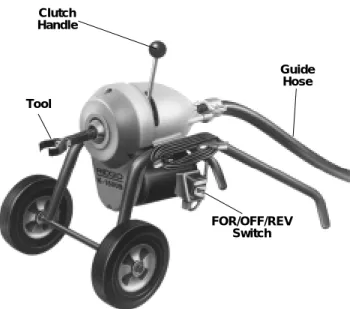
Figure 1 – K-75A, K-1500A and K-1500SPA Drain Cleaners
Machine Inspection
WARNING
To prevent serious injury, inspect your Drain Cleaning Machine. The following inspection pro-cedures should be performed before each use.
1. Make sure the Drain Cleaning Machine is unplugged and the directional switch is set to the OFF position (Figures 1 and 2).
2. Inspect the power cord, Ground Fault Circuit Inte-rrupter (GFCI) and plug for damage. If the plug has been modified, is missing the grounding prong or if the cord is damaged, do not use the Drain Cleaning Machine until the cord has been replaced.
3. Inspect the Drain Cleaning Machine for any broken, missing, misaligned or binding parts as well as any other conditions which may affect the safe and normal operation of the machine. If any of these conditions
are present, do not use the Drain Cleaning Machine until any problem has been repaired.
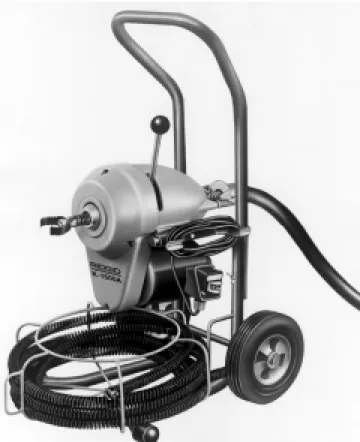
Figure 2 – K-75B, K-1500B and K-1500SP Drain Cleaning Machines
4. Lubricate the Drain Cleaning Machine, if necessary, according to the Maintenance Instructions.
5. Use tools and accessories that are designed for your drain cleaner and meet the needs of your application. The correct tools and accessories allow you to do the job successfully and safely. Accessories suitable for use with other equipment may be hazardous when used with this drain cleaner.
6. Clean any oil, grease or dirt from all equipment han-dles and controls. This reduces the risk of injury due to a tool or control slipping from your grip.
7. Inspect the cutting edges of your tools. If necessary, have them sharpened or replaced prior to using the Drain Cleaning Machine. Dull or damaged cutting tools can lead to binding and cable breakage. 8. Inspect cables and couplings for wear and damage.
Cables should be replaced when they become se-verely worn or corroded. A worn cable can be iden-tified when the outside coils become flat.
Worn or damaged cables can break caus-ing serious injury.
Clutch Handle
Tool
FOR/OFF/REV Switch
Guide Hose
Clutch Handle
Guide Hose
FOR/OFF/REV Switch Tool
K-75A/B, K-1500A/B, & K-1500SP Drain Cleaning Machines
Kollmann
6
Machine Set-Up
WARNING
Do not place machine in water. Water entering the motor can result in electrical shock.
To prevent serious injury, proper set-up of the ma-chine and work area is required. The following procedures should be followed to set-up the ma-chine:
1. Check work area for: • Adequate lighting
• Grounded electrical outlet
• Clear path to the electrical outlet that does not contain any sources of heat or oil, sharp edges or moving parts that may damage electrical cord. • Dry place for machine and operator. Do not place
the machine in water.
• Flammable liquids, vapors or dust that may ignite. 2. Position the Drain Cleaning Machine within 2′ of sewer inlet. Greater distance can result in cable twist-ing or kinktwist-ing.
3. Make sure FOR/OFF/REV switch is in the OFF po-sition.
Figure 3 – Rear Guide Hose Attachment
4. Attach the rear guide hose by sliding guide hose adapter onto the guide hose pins (Figure 3).
Do not use machine without rear guide hose attached. Prevents cable whipping, possible en-tanglement and a cleaner jobsite.
5. Insert first cable into front of machine (female end first) and push through guide hose until approximately one foot remains out the front of the machine (Figure 4).
Figure 4 – Inserting Cable Into Front Of Machine
Never couple more than one cable at a time. Cable will extend behind rear guide tube.
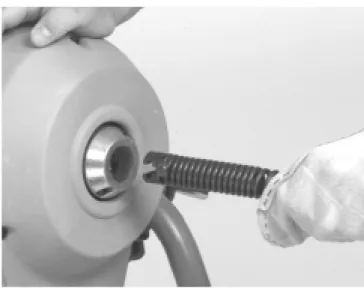
6. Select and install the proper tool to the end of the cable. The T-Slot Coupler allows the tool to be snap-ped into the cable coupler (Figure 5). To remove tool, use the pin key to depress the plunger and slide the coupling apart.
Figure 5 – Coupling and Uncoupling Tools NOTE! Proper Tool Selection
A good rule of thumb is to use a tool at least 1″ smaller than the line to be cleaned. The style of the tool is determined by the nature of the job and is left up to the operator.
7. Plug the Drain Cleaning Machine into the electrical outlet, making sure to position the power cord along the clear path selected earlier. If the power cord does not reach the outlet, use an extension cord in good condition.
To avoid electric shock and electrical fires, never use an extension cord that is damaged or does not meet the following requirements:
• The cord has a three-prong plug similar to shown in Electrical Safety section.
WARNING
To Couple Cable and Tools
Snap Together Insert Pin Slide Apart To Uncouple Cable and Tools
WARNING
WARNING
Test Equipment Depot - 800.517.8431 - 99 Washington Street Melrose, MA 02176 TestEquipmentDepot.com
• The cord is rated as “W” or “W-A” if being used out-doors.
• The cord has sufficient wire thickness (14 AWG - 50′). If the wire thickness is too small, the cord may overheat, melting the cord’s insulation or causing nearby objects to ignite.
To reduce risk of electrical shock, keep all electrical connections dry and off the ground. Do not touch plug with wet hands. Test the Ground Fault Circuit Interrupter (GFCI) provided with the electric cord to insure it is operating correctly. When test button is pushed in, the indicator light should go off. Reactivate by pushing the reset button in. If indicator light goes on, the machine is ready to use. If the GFCI does not function correctly, do not use the machine.
Operating Instructions
WARNING
Wear mitts with rivets provided with machine. Never grasp a rotating cable with a rag, loose fit-ting cloth or leather glove that may become wrapped around the cable causing serious injury. Always wear eye protection to protect your eyes against dirt and other foreign objects. Wear rubber soled, non-slip shoes.
Be very careful when cleaning drains where clean-ing compounds have been used. Wear gloves when handling cable and avoid direct contact to the skin and especially the eyes and facial area as se-rious burns can result.
Do not operate if clutch handle is damaged or does not function properly. Clutch is a safety fea-ture designed to stop rotation of cable when released.
It is important to know approximate distance from inlet to main sewer or septic tank. Over-running cable too far into main sewer or septic tank can cause ca-bles to knot up and prevent their return through small lines. If main is 12 inches or larger and standard 11/
4″ cable is being used, do not allow more than 10 to 15 feet of overrun. When working into a septic tank do not allow more than 3 to 5 feet overrun.
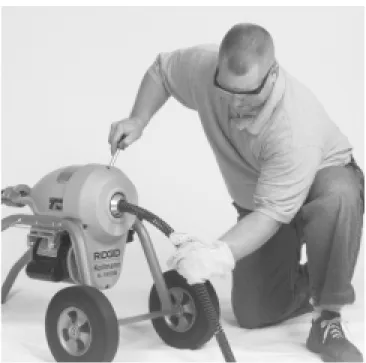
1. Assume the correct operating posture in order to maintain proper balance (Figure 6).
Should an unexpected situation arise, this posture provides you with the opportunity to safely keep control of the machine and cable.
• Be sure you can quickly release the clutch handle.
• Hand must be on the cable to control its twisting action when it hits an obstruction.
• Must have access to FOR/OFF/REVERSE switch.
Figure 6 – Proper Operating Position
2. Pull sufficient cable out of the machine to start tool and cable into the sewer inlet. Push cable into inlet as far as it will go.
3. Pull enough extra cable through machine to form al-most a half circle between machine and line opening. 4. Hold cable loosely in mitted hand. Put
FOR/OFF/RE-VERSE/ switch in FOR (forward) position. NOTE! The motor will start but cable will not rotate.
5. With mitted hand on cable, push down on clutch han-dle with opposite hand to engage cable. Push down on top of the cable loop with a definite snap to ad-vance the cable.
NOTE! A slow or gradual engaging of the clutch handle causes excessive wear of the jaw set. The clutch is instant-acting and returning clutch handle to its original position frees cable instantly.
6. As soon as excess cable has gone into line, release clutch handle and pull six to ten inches of cable out of machine with mitted hand.
7. Continue to feed the cable into the line until resistance or obstruction is encountered. This will become ap-parent to operator as it will be difficult to feed additional cable into line and/or the cable will have a tendency to twist sideways in operator’s hands.
WARNING
WARNING CAUTION
K-75A/B, K-1500A/B, & K-1500SP Drain Cleaning Machines
Kollmann
Ridge Tool Company
8
8. If cable loads down in the obstruction, relieve load by pulling back on cable with short, quick jerks to free cutter. Slowly advance cable back into the obstruction. Repeat this process until the obstruction is clear. Remember, make sure the cutter is rotating at all times and never force the cable. At this point, pro-gress depends upon the sharpness of the tool and nature of the obstruction.
WARNING
Do not allow tension to build up in the cable. This will happen if the cutting tool hits a snag and stops turning, but the motor and cable continue to ro-tate. Torque builds until the cable suddenly twists, potentially wrapping around your hand or arm. This can happen quickly and without warning, so proceed slowly and carefully as you feed the cable into the drain. Releasing clutch handle will stop the cable ro-tating and releases the torque. If tool gets hung up in an obstruction, refer to Reverse Operating Instructions in the “Special Procedures” section.
9. Once obstruction is cleared, it is recommended that operator flush debris from line with running water. Repeat Step 8 several times if necessary for thorough cleaning job and then work cable through additional stoppages as required.
10. To add cable, the following procedure should be fol-lowed:
• After reaching the end of each cable section, turn the machine OFF.
• Secure the cable by looping it in the line (Figure 7). This procedure is especially useful when cleaning a line with a steep grade.
Figure 7 – Looping Cable In Line
• With line secured, insert another section of cable in through the front of the machine (female end first) until approximately one foot remains out the front of the machine.
• Attach cable to cable in line and resume operation. 11. To retrieve cable from drain line, the following
proce-dure should be followed:
• Leave FOR/OFF/REV switch in FOR (forward) po-sition.
• Push down on clutch handle to engage cable. With mitted hand pull cable out of line (if possible) or hold cable against edge of inlet to thread the cable out until loop forms in front of the machine. NOTE! By holding the cable against the edge of the inlet, the rotation will rapidly “thread” the cable out of the line.
• When loop forms, release clutch handle and push excess cable back through machine. Disconnect one section at a time.
When disconnecting sections, remem-ber to turn unit off and secure cable in line.
• Once section of cable is removed, insert the se-cured cable in through the front of the machine and continue removing sections until tool on last section of cable is just inside sewer inlet.
HINT! When placing removed cables back into cable carrier, reconnect all cables. This assures easy removal at next job.
Never retract tool from sewer inlet while cable is rotating. Tool can whip causing serious injury. 12. Turn FOR/OFF/REV Switch to OFF position. 13. Pull remaining cable and tool from sewer. 14. Unplug power cord and remove guide hose.
After using, thoroughly flush and drain ca-bles, couplings and tools with water due to damaging effects of some drain cleaning compounds.
Special Procedures
Reverse Operation
Running machine in reverse will cause premature fail-ure of cable. Use reverse only to free a tool or cable caught in an obstruction. If this should occur, immedi-ately release clutch handle and place FOR/OFF/REV switch to OFF position. After motor comes to a complete stop, place FOR/OFF/REV switch in the REV (reverse) di-rection. Engage clutch handle only until cable or tool is free of obstruction. Once it is free, release clutch handle im-mediately. Turn unit OFF. Run unit in FOR (forward) direction and follow normal operating procedure.
Never operate this machine in REV (re-verse) for any other purpose. Operating in reverse can damage a cable and cause serious injury.
Cable Applications
Standard Cable Standard 7/
8″ or 11/4″ cable can be used in straight lines from 3″through 6″and through fit-tings. (Figure 8)
WARNING
WARNING
WARNING CAUTION
Figure 11 – Storing Cables On “A” Frame Models
Accessories
Only the following RIDGID/Kollmann prod-ucts have been designed to function with the Sectional Drain Cleaning Machines. Other accessories suitable for use with other tools may become hazardous when used on the machines. To prevent serious injury, use only the recommended accessories.
K-75A/B Machines
Figure 8 – Standard Cable Application
Heavy-Duty Cable Where conditions allow, heavy-duty 11/
4inch cable, such as C-14, should be used for faster results and longer cable life. The heavy-duty cables work effectively in 4″through 8″straight lines. (Figure 9) NOTE! This type cable should not be used in areas where 4″“P” traps or 4″running traps are cur-rently in use.
Figure 9 – Heavy Duty Cable Application
Faster Cleaning Obstructions of grease or fats can be cleaned faster and more effectively by bending the cable some 6″or 8″behind the cutter. (Figure 10)
Figure 10 – Bending Cable for Faster Cleaning
Storing And Transporting Cable
(“A” Frame Models Only)
Cables can be stored and transported on “A” frame models as shown in Figure 11.
4″and 6″Tees 3″, 4″and 6″Y’s 3″, 4″and 6″Ells
6″to 8″
Running Traps 4″to 8″Ells
4″to 8″ Cleanouts
Bent Cable
WARNING
Catalog Model
No. No. Description
62275 C-10 15′All-Purpose Wind (4.6m) 30007 T-127 7/
8″Trap Leader
Catalog Model
No. No. Description
51317 C-9 10′Heavy-Duty (3m) 62270 C-8 71/
2′All-Purpose Wind (2.3m)
62265 C-7 71/
2′ Tight-Wind (2.3m)
Cables and Leaders
5/
K-75A/B, K-1500A/B, & K-1500SP Drain Cleaning Machines
Kollmann
10
K-1500A/B Machines
Catalog Model
No. No. Description
62840 T-1 Straight Auger
61800 T-2 Heavy-Duty Straight Auger 63105 T-3 Funnel Auger
61790 T-4 Heavy-Duty Funnel Auger 63190 T-5 Straight Retrieving Auger 63195 T-6 Funnel Retrieving Auger 63200 T-7 Hook Auger
63205 T-8 Grease Cutter, 21/ 2″
63210 T-9 Grease Cutter, 31/ 2″
62845 T-10 Grease Cutter, 41/ 2″
59480 T-11 “H” Cutter, 21/ 2″
59485 T-12 “H” Cutter, 31/2″
61970 T-13 Sawtooth Cutter, 21/2″
61975 T-14 Sawtooth Cutter, 31/ 2″
61770 T-15A Expanding Cutter, 4″- 6″ 61825 T-15B Expanding Cutter, 6″- 8″ 61960 T-16 Spiral Bar Cutter, 4″ 61850 T-17 Spiral Bar Cutter, 6″ 61855 T-18 Spiral Bar Cutter, 8″ 59625 T-21 Spiral Sawtooth Cutter, 31/
2″
63075 T-22 Spiral Sawtooth Cutter, 3″ 63085 T-23 Spiral Sawtooth Cutter, 4″ 59765 T-24 4-Blade Cutter, 21/
2″
59770 T-25 4-Blade Cutter, 31/ 2″
59775 T-26 4-Blade Cutter, 41/ 2″
59780 T-26A 4-Blade Cutter, 51/ 2″
98030 T-50 Three Blade, 3″ − 4″− 5″ 98035 T-50-1 Sharktooth Cutter, 3″ 98040 T-50-2 Sharktooth Cutter, 4″ 98045 T-50-3 Sharktooth Cutter, 6″ 63110 T-31 Chain Knocker, 3″ − 4″ Pipe 63115 T-32 Chain Knocker, 6″ Pipe 63120 T-33 Chain Knocker, 8″ Pipe 63145 T-38 Flue Brush, 11/
2″
63150 T-39 Flue Brush, 2″ 63155 T-40 Flue Brush, 21/ 2″
63160 T-41 Flue Brush, 3″ 63165 T-42 Flue Brush, 31/ 2″
63170 T-43 Flue Brush, 4″ 63175 T-44 Flue Brush, 41/ 2″
63240 T-45 Flue Brush, 5″ 63180 T-46 Flue Brush, 51/ 2″
63185 T-47 Flue Brush, 6
Catalog Model
No. No. Description
59360 A-3 Tool Box 59205 A-1 Left-Hand Mitt 59295 A-2 Right-Hand Mitt 59225 A-12 Pin Key, 7/
8″Cable
59230 A-13 Pin Key, 5/ 8″Cable
59470 A-8 Cable Carrier (Five Sections/C-10) 59210 A-10 Cable Carrier (Three Sections/C-10) 59425 A-36 Cable Caddy
59330 A-376X Jawset Adapts K-75 to 5/ 8″Cable
59325 A-368X 7/
8″Replacement Jawset
84315 A-34-8 8′Rear Guide Hose 59415 A-34-10 10′Rear Guide Hose 59395 A-34-12 12′Rear Guide Hose
Accessories
Tools for C-11, C-12, C-14 and C-15 Cables 11/ 4″
Catalog Model Replacement
No. No. Description Blade(s)
62850 T-101 Straight Auger — 62855 T-102 Funnel Auger — 27642 T-125 Retrieving Auger — 62860 T-103 Sawtooth Cutter, 21/
2″ 98070
62865 T-104 “H” Cutter, 21/
2″ 97800
62870 T-105 Grease Cutter, 21/
2″ 97920
62875 T-106 Grease Cutter, 31/
2″ 97925
62880 T-107 Spade Cutter, 13/
4″ 92850
62915 T-109 Spiral Sawtooth Cutter, 13/4″ 97930
62920 T-110 Spiral Sawtooth Cutter, 21/
4″ 97935
62925 T-111 Spiral Sawtooth Cutter, 3″ 92890 62930 T-112 4-Blade Cutter, 13/
4″ 97915
62935 T-113 4-Blade Cutter, 3″ 97940 98050 T-150 Sharktooth Cutter, 3″and 4″ See Below 98055 T-150-1 Sharktooth Cutter, 3″ Blade 98005 98060 T-150-2 Sharktooth Cutter, 4″ Blade 98010 62940 T-114 Chain Knocker 97985
Tools for C-10 Cable - 7/ 8″
Catalog Model
No. No. Description
92280 C-11 15′Standard All-Purpose Wind, 3/ 8″Pitch.
Good for 4″Traps, 3″- 8″Lines. 62285 C-12 15′Extra-Heavy-Duty Wind, 3/
8″Pitch.
4″- 10″Long Runs, No 4″Traps. 62295 C-14 15′Heavy-Duty Wind, 1/
2″Pitch. 3″- 10″Lines
Through Cleanout, No 4″Traps. 62300 C-15 15′Extra-Flexible Wind, 1/
2″Pitch. 3″- 6″Lines
Good for Traps. 63090 T-27 11/
4″x 25′Leader
62275 C-10 15′Standard All-Purpose Wind, Requires A-368X Jawset 7/
8″Tools
Cables and Leaders
Catalog Model
No. No. Description
59470 A-8 Cable Carrier, 60′Capacity (11/ 4″)
59210 A-10 Cable Carrier, 150′Capacity (11/ 4″)
59415 A-34-10 10′Rear Guide Hose 59395 A-34-12 12′Rear Guide Hose 59400 A-34-16 16′Rear Guide Hose 59300 A-20 8′Front Guide Hose Assembly 59205 A-1 Left-Hand Mitt
59295 A-2 Right-Hand Mitt 59360 A-3 Tool Box 59225 A-12 Coupling Pin Key 59440 A-4 Trap Spoon (30″) 59240 A-17 Manhole Guide Pipe 59320 A-369X 11/
4″Replacement Jawset
Accessories
NOTE! See Ridge Tool Catalog for complete list of tools and accessories.
Test Equipment Depot - 800.517.8431 - 99 Washington Street Melrose, MA 02176 TestEquipmentDepot.com
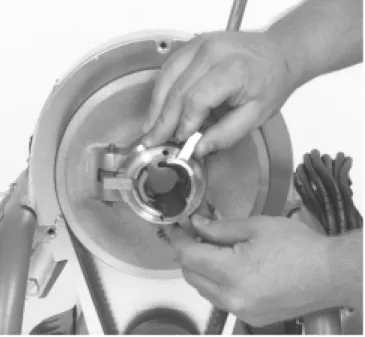
3. Slide out clutch driver jaws and replace with desired size jaws.
Figure 13 – Replacing Clutch Jaws
4. Replace nose piece assembly, screws and guard. Never operate machine with belt guard removed. Fingers can be caught between the belt and pulley.
Removing Clutch End Play
1. To remove end play from clutch, loosen screw in Adjusting Nut. (Figure 14).
2. Turn lock and adjusting nut clockwise until snug against housing, then back off one half turn.
3. Tighten screw in lock and adjusting nut.
Figure 14 – Removing Clutch End Play
Maintenance Instructions
WARNING
Make sure machine is unplugged from power source before performing maintenance or making any adjustment.
Moving Parts Lubrication
Grease all exposed moving parts such as rocker arms and main bearing approximately every three months. Make sure to grease main bearing thru grease fitting in-side clutch handle slot.
Clutch Jaws Lubrication
Clean and lubricate clutch driver jaws with oil after each use.
Cables
Cables should be thoroughly flushed with water to pre-vent damaging effects of sediment and drain cleaning compounds. Periodically lubricate cables and couplings with RIDGID/Kollmann Cable Rust Inhibitor.
When not in use, store cables indoors to prevent dete-rioration by the elements.
Cables should be replaced when they become severely corroded or worn. A worn cable can be identified when outside coils of cable become flat.
Clutch Jaws Replacement
1. Remove four screws holding the front guard to the housing.
2. Remove screws from the nose piece assembly (Figure 12).
Figure 12 – Replacing Clutch Jaws
Service and Repair
WARNING
The “Maintenance Instructions” will take care of most of the service needs of this machine. Any problems not ad-dressed by this section should only be handled by an authorized RIDGID service technician.
Tool should be taken to a RIDGID Independent Auth-orized Service Center or returned to the factory. All repairs made by Ridge service facilities are warranted against de-fects in material and workmanship.
When servicing this machine, only iden-tical replacement parts should be used. Failure to follow these instructions may create a risk of electrical shock or other serious injury.
K-75A/B, K-1500A/B, & K-1500SP Drain Cleaning Machines
Kollmann
Ridge Tool Company
12
V-Belt Adjustment
Check V-Belt periodically for loosening. V-Belt should be kept tight at all times.
1. To tighten V-Belt remove Guard.
2. Loosen locknut, turn adjusting bolt slowly until V-Belt stiffens, tighten locknut. (Figure 15).
Figure 15 – Adjusting V-Belt Tension
Machine Storage
Motor-driven equipment must be kept indoors or well covered in rainy weather. Store the ma-chine in a locked area that is out of reach of children and people unfamiliar with drain cleaners. This machine can cause serious injury in the hands of untrained users. If machine has been exposed to freezing weather, unit must be run for ten (10) to twenty (20) minutes without load to warm up. Failing to do this will result in frozen bearings. If machine is exposed to weather for a period of time, moisture will form across motor windings caus-ing motor to burn out.
WARNING
WARNING
K-75A/B & K-1500A/B Wiring Diagram
115V
Green Blue Red Black Yellow Motor
Switch
Service Cord Green
White Black
K-75A/B, K-1500A/B, & K-1500SP Drain Cleaning Machines
Kollmann
14
K-1500SP Wiring Diagram
120V/60 Hz
K-1500SP Wiring Diagram
220-240V/50 Hz
Switch
Bk
Switch Service Cord
W O
Y R
Y W
W
Bl
Ground Screw in Switchbox
For Rev
L2 L1 Bk U1 U2
Bl
Green
L2 White L1 Black
Rev Bk
For
Z1 1 R
Green
Black
White Line cord Modification:
Cut off existing terminals Strip Wire Ends .25 in.
Y L2 L1 Bl
Green-Yellow L2 Brown L1 Blue
Rev
Bk
For
Green-Yellow
Brown
Line cord Modification: Strip Wire Ends .25 in.
Blue
For Rev
Bl Br
Ground Screw in Switchbox
Bk
W O
Y R
Bl
NOTE: Switch modified using provided jumper terminals.
Test Equipment Depot - 800.517.8431 - 99 Washington Street Melrose, MA 02176 TestEquipmentDepot.com