OPERATIONS RESEARCH CENTER
Working Paper
MASSACHUSETTS INSTITUTE
OF TECHNOLOGY
by
A Geometric Analysis of Renegar’s Condition Number, and its
interplay with Conic Curvature
OR 382-07
Alexandre Belloni
Robert M. Freund
A Geometric Analysis of Renegar’s Condition Number, and its
interplay with Conic Curvature
Alexandre Belloni
∗and Robert M. Freund
†April 4, 2007
Abstract
For a conic linear system of the formAx∈K,Ka convex cone, several condition measures have been extensively studied in the last dozen years. Among these, Renegar’s condition numberC(A) is arguably the most prominent for its relation to data perturbation, error bounds, problem geome-try, and computational complexity of algorithms. Nonetheless,C(A) is a representation-dependent measure which is usually difficult to interpret and may lead to overly-conservative bounds of com-putational complexity and/or geometric quantities associated with the set of feasible solutions.
Herein we show that Renegar’s condition number is bounded from above and below by certain purely geometric quantities associated withAandK, and highlights the role of the singular values of A and their relationship with the condition number. Moreover, by using the notion of conic curvature, we show how Renegar’s condition number can be used to provide both lower and upper bounds on the width of the set of feasible solutions. This complements the literature where only lower bounds have heretofore been developed.
1
Introduction
We consider the problem of computing a solution of the following conic linear system:
Ax ∈ intK
x ∈ X (1)
where X and Y are n- and m-dimensional Euclidean subspaces, respectively, A : X → Y is a linear operator and K ⊂ Y is a regular closed convex cone. It is still an open question whether there exists a strongly-polynomial-time algorithm to solve (1) even for the case when K = IRm+. Indeed, computational complexity analysis of (1) always relies on some condition measure associated with the set of feasible solutions, the linear operatorA, and/or the coneK, or combinations thereof.
Herein we focus on the data-perturbation condition number C(A) of Renegar, see [8]. It is well-known that ln(C(A)) is tied to the complexity of interior-point methods, the ellipsoid method, and re-scaled perceptron algorithms for computing a feasible solution of (1), see respectively [9], [3], and [1]. Nonetheless, Renegar’s condition number depends on the particular norms being used and on the particular choice of A. As such, C(A) is not an intrinsic geometric measure associated with the feasible solution set of (1), and can provide misleading information about certain geometric aspects of the feasible solution set. Herein we show that C(A) is bounded from below and above by certain purely geometric quantities, which enable us to see better howC(A) behaves relative to the underlying problem geometry.
∗IBM T. J. Watson Research Center and MIT, 32-221, 1101 Kitchawan Road, Yorktown Heights, New York 10598,
email: [email protected]
†MIT Sloan School of Management, 50 Memorial Drive, Cambridge, MA 02142, USA, email: [email protected]
A geometric condition measure associated with (1) is thewidthτF of the cone of feasible solutions
of (1). It is well understood that Renegar’s condition number - combined with the width ofK itself -can be used to bound the width of the feasible set from below. However, there is no reverse relation in general: C(A) by itself carries no upper bound information on the widthτF in general. In fact, one can observe this shortcoming ofC(A) even for the linear inequality case, i.e., when K= IRm+.
By introducing a simple notion of conic curvature, we develop upper-bound information on the width of the feasible solution set as a function of the condition number C(A) and the conic curvature of the fixed coneK (or the components ofK ifKis a cartesian product of basic cones). These bounds pertain only to the case when K or its components have strictly positive conic curvature, and so are relevant when K is the cartesian product of second-order cones Qki (whose conic curvature is 1) and products of IR2+× · · · ×IR2+(whose component conic curvature is also 1), but does not include the case whenK is the cone of symmetric positive semi-definite matrices.
The paper is organized as follows. After preliminaries and notation in Section 2, in Section 3 we develop an analysis of Renegar’s condition number in terms of purely geometric quantities that bound
C(A) from above and below. In Section 4 we present a lower bound on the width of the feasible solution set of (1) in terms of C(A). In Section 5 we introduce the concept ofconic curvature, and we present upper bounds on the width of the feasible solution set usingC(A) and the conic curvatureK. Section 6 contains comments about three themes underlying conic linear systems (1): conditioning, geometry, and complexity, and relations between these themes.
2
Preliminaries
LetC⊂Y denote a convex cone andC∗:={w∈Y∗:w, v ≥0, for allv∈C}denote the dual cone associated withC, whereY∗ is the dual space of Y. C is said to be regular if it is a pointed cone (it contains no lines) and has non-empty interior. Moreover, thewidthofCis defined as
τC:= max
r,x {r:x ≤1, B(x, r)⊂C}
whereB(x, r) denotes a Euclidean ball centered atxwith radiusr. xis thecenterofC ifx= 1 and
B(x, τC)⊂C. Let∂C denote the boundary ofCand∂B(0,1) =Sm−1denote the (m−1)-dimensional
unit sphere.
The cone of feasible solutions of (1) is denoted by F :={x∈X :Ax ∈ K} and its width is τF.
Considering (1) as a system with fixed coneKand fixed spacesX andY, letMdenote those operators
A:X →Y for which (1) has a solution. For A∈ M, let ρ(A) denote thedistance to infeasibility for (1), namely:
ρ(A) := min
ΔA {ΔA:A+ ΔA /∈ M},
where for a linear operatorM,M denotes the operator norm,M:= max{M x:x ≤1}. ρ(A) is the smallest perturbation of our given operator A which would render the system (1) infeasible. LetC(A) :=A/ρ(A) denote Renegar’scondition number, which is a scale-invariant reciprocal of the distance to infeasibility.
LetA∗:Y →X denote the adjoint operator associated with A, and let PL denote the orthogonal
projection on the subspaceL:=span(A). It follows from basic linear algebra thatA∗w=A∗PLw, and
dist(w, L⊥) =PLw for anyw∈Y. Let λmin(A), λmax(A) denote the smallest and largest singular
values ofA, and note thatλmax(A) =A=A∗. Furthermore,λmin(A)w ≤ A∗w ≤λmax(A)w for allw∈L.
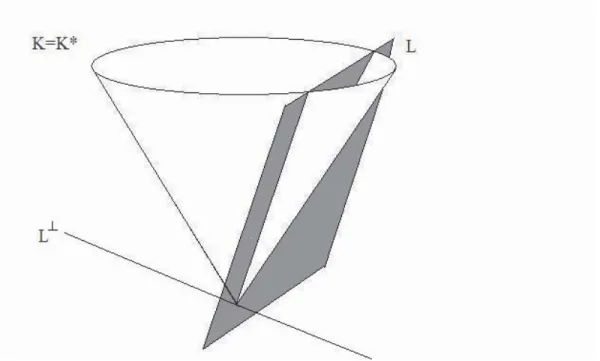
Figure 1: When K =K∗ and the original system is feasible, L := span(A) must have a nontrivial intersection with K. Equivalently, K∗ can only intersect L⊥ at the origin. This illustrates a conic theorem of the alternative.
3
Some Intrinsic Geometry related to Renegar’s Condition
Number
Our motivating geometry is Figure 1 which presumes for visualization thatKis self-dual, i.e.,K=K∗. Under the assumption that (1) is feasible, we have
K∩L={0} and K∗∩L⊥={0}. (2) Although equivalent to (1), relation (2) is a geometric statement about the intersection of cones and subspaces. The dependence of the representation ofA is embedded intoL⊥, the null space of the operatorA∗.
The goal of this section is to relate Renegar’s condition number to another (more geometric) quantity inspired by (2). In order to properly “quantify” the relations in (2), consider the following defined quantities:
μA:= minw A∗w and μL= minw PLw = minw dist(w, L⊥)
w= 1 w= 1 w= 1
w∈K∗ w∈K∗ w∈K∗ .
(3) Whereas μA turns out to be the distance to infeasibility ρ(A) (see Lemma 3.2), μL is a simpler
object whose dependence on the dataAis only through L=span(A). By its definition,μL captures
important aspects of the underlying geometry of (1). The next theorem, which is the main result of this subsection, shows how the condition number is related toμL.
Theorem 3.1 If (1) is feasible, then
1
μL ≤ C
(A)≤λmax(A)
λmin(A) 1
μL.
Proof. The proof follows directly from Lemmas 3.1 and 3.2 below.
The following elementary lemma illustrates the “gap” between working with the particular repre-sentation ofA and working with the subspaceL.
Lemma 3.1 If (1) is feasible, then
λmin(A∗)μL≤μA≤λmax(A∗)μL .
Proof. This follows sinceA∗w=A∗PLw ≤λmax(A)PLwandA∗w=A∗PLw ≥λmin(A)PLw.
It turns out that the distance to infeasibility ρ(A) is exactly the quantity μA. A version of this
statement was initially proved as Theorem 2 of [4] using a more general non-homogeneous framework and arbitrary norms. For the sake of completeness we include a simple proof specialized to our problem setting.
Lemma 3.2 If (1) is feasible, then ρ(A) =μA.
Proof. Let ΔA denote any perturbation for which the system (A+ ΔA)x∈intK is not feasible. By a theorem of the alternative, there existsw∈K∗, w= 1 satisfying (A+ ΔA)∗w= 0. Thus we have
ΔA=ΔA∗ ≥ ΔA∗w=A∗w ≥μA.
Taking the infimum on the left-hand side over all such ΔAwe obtainρ(A)≥μA.
On the other hand, let ˆwbe the point inK∗,wˆ= 1, such thatμA=A∗wˆ. Consider the linear
operator ΔAwˆ(·) := −wˆw, Aˆ (·), whereby ΔAw∗ˆwˆ =−A∗wˆ. Therefore (A+ ΔAwˆ)∗wˆ = 0 which in
turn implies thatρ(A)≤ ΔAwˆ =A∗wˆ=μA.
The following example illustrates these concepts in the case of a small system of linear inequalities. This same example will be revisited in Sections 4 and 5.
Example 3.1 Given ε ∈ (0,1/4), define Aε := ⎡
⎣ 21ε −01
1 1
⎤
⎦ and let K := IR3+. Since the columns of Aε are orthogonal, it is easy to verify that L⊥ε = {t(1,−ε,−ε)T : t ∈ IR}. Note that μL =
dist(L⊥ε, K∗∩S2) = √
2ε/√1 + 2ε2,λmax(Aε) =Aε= √
2 + 4ε2 andλmin(Aε) = √
2. Therefore, we have √1
2ε ≤
√
1+2ε2 √
2ε = 1/μL ≤ C(Aε)≤
λmax(A)
λmin(A)μ1L = 1+2√ε2
2ε . In this example1/μL is a relatively tight
bound on C(A)forε small, sinceλmax(A)/λmin(A) =√1 + 2ε2≈1 forεsmall.
4
Lower Bounds on the Width of the Cone of Feasible
Solu-tions based on the Condition Number
The cone of feasible solutions of (1) is denoted byF :={x∈X :Ax∈K}and its width isτF:
τF = maxx,r {r:x ≤1, AB(x, r)⊂K} .
The following theorem presents lower bounds on τF based on the condition number and/or on
more geometric quantityμL. This is of interest from a computational complexity perspective since the
iteration complexity of many algorithms for (1) involve 1/τF either polynomially (conditional gradient,
perceptron) or logarithmically (interior-point methods, ellipsoid method, re-scaled perceptron). In conjunction with Theorem 4.1,C(A) andμLcan be used to upper bound the computational complexity
of these methods directly.
Theorem 4.1 If (1) is feasible, then τF≥τK
1
C(A)
≥τK
μLλλmaxmin((AA))
.
The middle quantity in Theorem 4.1 bounds the width of the feasible cone from below using the width ofKand the condition numberC(A), whereas the right-most quantity in the theorem bounds the width using quantities that each have a purely geometric interpretation. A version of the first inequality of the theorem was proved in slightly weaker form for non-homogeneous systems and arbitrary norms as Theorem 19 of [4]. Before proving the theorem we illustrate it in the continuation of Example 3.1.
Example 4.1 (Continuation Example 3.1) Let Fε:={x∈IR2:Aεx∈K}where K= IR3+. Then
Fε={x∈IR2:x1≥x2, x1≥ −x2}, and τFε = 1/2≥
√1
3 √
2ε
√
1+2ε2 =τKμL ≥τK/C(Aε). Note that this
bound is very weak whenεis close to zero.
The proof of Theorem 4.1 is based on the following elementary proposition and corollary, and a technical lemma, Lemma 4.1, whose results will be used here as well as in Section 5.
Proposition 4.1 Let C be closed convex cone. Then B(y, r)⊆C if and only ifd, y ≥rd for all
d∈C∗.
Proof. SupposeB(y, r)⊂C. Letd∈C∗. Then,y−rdd ∈C and sinced∈C∗,
d, y−rdd
≥0. Thus,d, y ≥rd,dd =rd. Conversely, supposed, y ≥rdfor everyd∈C∗. Letvsatisfyv ≤r. Assume y+v /∈C, then there existsd∈C∗,d, y+v<0. Therefored, y<− d, v ≤rd, which contradictsd, y ≥rd.
Corollary 4.1 Let C be closed convex cone. Then for y ∈ C we have maxr{r : B(y, r) ⊆ C} = mind{d, y:d∈C∗, d= 1}.
The last ingredient of the proof of Theorem 4.1 is Lemma 4.1 below, which is based on the following definition.
Definition 4.1 Let K⊂Y be a fixed convex cone, A:X →Y be a linear operator, and M ⊂Y be a subspace. Define the deepness of A(in K) with respect toM as
ρ(A, M) := maxx,r r
s.t. Ax+
B(0, r)∩M
⊂K
x ≤1 .
Definition 4.1 is a geometric counterpart/generalization of concepts developed in [9] and [4] for
M =Y. The following technical lemma shows some ways that this deepness measure is related to the distance to infeasibilityρ(A).
Lemma 4.1 Let L=span(A) andK be a pointed convex cone. Then:
(i)ρ(A, L)≤ A;
(ii)ρ(A)≥ρ(A, Y)≥τKρ(A);
(iii)ρ(A, Y)≥2√1
2min{ρ(A, L), ρ(A, L⊥)}.
Proof. (i) Ifx, r is feasible for the problem defining ρ(A, L) and r >A, thenAx+B(0, r)∩L
contains a neighborhood of the origin restricted to the subspace L. If this neighborhood is contained in K, then K contains L and is not pointed, thus proving (i) by contradiction.The proof of the first inequality of (ii) is a straightforward consequence of minimax weak duality:
ρ(A) = minw A∗w
s.t. w∈K∗
w= 1
= minw maxx A∗w, x
w∈K∗ x ≤1
w= 1 5
≥ maxx minw w, Ax x ≤1 w∈K∗
w= 1
= maxx,r r =ρ(A, Y)
s.t. B(Ax, r)⊂K
x ≤1.
Here the first equality is from Lemma 3.2, the inequality is from the observation that minimax
≥ maximin, and the second-to-last equality above follows from Corollary 4.1. To prove the second inequality of (ii), let z be the center of K, wherebyz= 1 andB(z, τK)⊂K. It then follows from
Proposition 4.1 thatτKw ≤ z, w ≤ w for anyw∈K. We have:
ρ(A) = minw A∗w
s.t. w∈K∗
w ≥1
≤ minw A∗w
s.t. w∈K∗
z, w= 1
= minw maxx A∗w, x
w∈K∗ s.t. x ≤1
z, w= 1 = maxx minw Ax, w
x ≤1 s.t. w∈K∗
z, w= 1
≤ maxx minw (1/τK)Ax, w x ≤1 s.t. w∈K∗
w ≥1 = (1/τK) maxx,r r =ρ(A, Y)/τK .
s.t. B(Ax, r)⊂K
x ≤1
Here the first equality is from Lemma 3.2 and the third equality follows from a standard minimax theorem, see Bertsekas [2] Proposition 5.4.4, for example. The second-to-last inequality usesτKw ≤ z, wfor anyw∈K from Proposition 4.1, and the second-to-last equality follows from Corollary 4.1. To prove (iii), let xL andxL⊥ ∈K be points that achieve respectively ρ(A, L) and ρ(A, L⊥). By convexity ofK, forw:=A
xL+xL⊥
2
, we have
w+B
0,1
2ρ(A, L)
∩L⊂K and w+B
0,1
2ρ(A, L
⊥)∩L⊥ ⊂K .
This implies thatB
w,2√1
2min{ρ(A, L), ρ(A, L⊥)}
⊂K, whereby
ρ(A, Y)≥ 1
2√2min{ρ(A, L), ρ(A, L
⊥)}.
Proof of Theorem 4.1: From Definition 4.1 and Lemma 4.1 there exists xsatisfyingx ≤1 and
Ax+B(0, τKρ(A)) ⊂ Ax+B(0, ρ(A, Y)) ⊂ K, which implies that AB(x, τKρ(A)/A) ⊂ K, from
which it follows thatτF≥τK
1
C(A)
. The second inequality follows directly from Theorem 3.1.
5
Upper Bounds on the Width of the Cone of Feasible
Solu-tions based on the Condition Number and Conic Curvature
As illustrated in Example 4.1 when ε is small, the condition number C(A) by itself might contain no upper-bound information on the width of the feasibility cone. Herein we show that if one has information about the conic curvature of the coneK, then such upper-bound information is available. Furthermore, as we will see, for standard cross-products of cones such conic curvature information is knowna priori.
5.1
Conic Curvature
The term “conic” in conic curvature is intended to contrast our concept with other notions of curvature that can be found in the literature. The origins of this concept can be traced to the notion of strongly convex sets which was first defined by Levitin and Poljak in [6]. A systematic study of such sets can be found in [7, 10, 11].
Definition 5.1 A setS is strongly convex with parameterδ≥0 ifS is bounded, and for every pair of pointsx, y∈S, and everyλ∈[0,1], it holds that
λx+ (1−λ)y+B
0, δ
2λ(1−λ)x−y
2⊂S .
According to Definition 5.1, even if we relax the boundedness assumption, no convex cone (other than IRn or {0}) is strongly convex withδ > 0. To obtain a meaningful concept of strong convexity and curvature for cones, we simply limit attention to points with unit norm:
Definition 5.2 A cone C has conic curvature δ if δ is the largest nonnegative scalar such that for every pair of points x, y∈C satisfyingx=y= 1, and everyλ∈[0,1], it holds that
λx+ (1−λ)y+B
0, δ
2λ(1−λ)x−y 2
⊂C .
Although technically valid, this definition is meaningless for dimension n= 1, since in this case all regular cones are half-lines and trivially have infinite curvature.
Example 5.1 (IR2+) The nonnegative orthant inIR2 has curvatureδ= 1. To see this lete1 ande2 be
the extreme rays ofIR2+ with unit length, in particulare1−e22= 2. Moreover, for λ∈[0,1]we have
dist(λe1+ (1−λ)e2, ∂IR2+) = min{λ,1−λ}. The curvature δis the largest scalar that satisfies min{λ,(1−λ)} ≥δλ(1−λ)
2 e1−e2
2=δλ(1−λ),
which implies that δ= 1.
The nonnegative orthant IRn+ forn≥3 and the cone of positive semi-definite symmetric matrices
Sn
+ forn≥3 have zero conic curvature. On the other hand, the second-order cone has conic curvature
δ= 1 forn≥2 as shown in the next lemma.
Lemma 5.1 For n ≥ 2, the second-order cone Qn := {(x, t) ∈ IRn : x ≤ t} has conic curvature
δ= 1.
Proof. Let (x, t),(y, s)∈∂Qn,(x, t) =(y, s) = 1. Therefore we have x2+t2 = 1, x =t = 1/√2, likewise we havey=s= 1/√2.
For λ ∈ [0,1] let (z, u) = λ(x, t) + (1−λ)(y, s) = (λx+ (1−λ)y,1/√2) ∈ Qn. Define r such
that r+z = 1/√2. Note that dist((z, u), ∂Qn) = √r
2 and the result follows if we show that
r≥ √1
2λ(1−λ)x−y2, and that equality holds in the limit for some values ofλ,x, andy.
By the Pythagorean Theorem noting thatz= (1/2)(x+y)+(λ−1/2)(x−y) and (x+y)T(x−y) = 0,
we have
z2=x+y 2
2+
1 2 −λ
2
x−y2.
Using the definition ofrin the relation above we have
r = √1
2−
x+y
2 2+
1
2−λ
2
x−y2= √1
2−
1
2−λ(1−λ)x−y2
≥ √1
2λ(1−λ)x−y2
where we usedx+2y2+x−2y2= 12 and √1
2 −
1
2−a≥ √12afora∈[0,1/2]. Equality follows by considering the case ofλ= 1/2, andxarbitrary close toy.
Finally, it follows from the definition that the conic curvature of the intersection of two convex cones is at least the minimum of the conic curvature of the two cones. Moreover, except for the case of IR2+ considered as the the cartesian product IR2+= IR+×IR+, the cartesian product of two cones must have zero conic curvature. This last comment notwithstanding, we show in Corollary 5.1 how to construct useful upper bounds whenKis the cartesian product of simpler cones.
5.2
Using Conic Curvature to Upper-Bound the Width of the Feasibility
Cone
We will prove the following theorem which bounds the width of the feasible region of (1) from above usingC(A) in conjunction with the conic curvature ofK.
Theorem 5.1 Let K be a regular convex cone with conic curvature δ, and letA be a linear operator satisfyingrankA≥2. If (1) is feasible, then
τF≤ 1
C(A)
4 √ 8 √ δ
λmax(A)
λmin(A)
≤√μL
4 √ 8 √ δ
λmax(A)
λmin(A)
.
Similar to Theorem 4.1, the middle quantity in Theorem 5.1 bounds the width of the feasible cone from above using geometric quantities and the condition numberC(A), whereas the right-most quantity in the theorem bounds the width using quantities that each have a purely geometric interpretation.
Before proving Theorem 5.1, we present a corollary that pertains to the case whenKis the cartesian product of basic cones., and the system (1) has the form
Aix∈intKi, fori= 1, . . . , r , (4)
whereK=K1×K2× · · · ×Kr⊂Y1×Y2× · · · ×Yr=Y. Letρ(Ai) andC(Ai) denote the distance to
infeasibility and the condition number of the systemAix∈Ki fori= 1, . . . , r. Although in this case
the conic curvature of K is zero under Definition 5.2 (except for the special case when K = IR2+), it is sufficient to look at the curvaturesδi of the basic conesKi, i= 1, . . . , r, as the following corollary
demonstrates.
Corollary 5.1 Consider the system (4), letδi be the conic curvature ofKi,i= 1, . . . , r, and suppose
that rankAi≥2 fori= 1, . . . , r. Then
τF≤√48 min
i √
τKi
√
δi
λmax(Ai)
λmin(Ai)
,
τF≤√48 min
i 1 √ δi 1
C(Ai)
λmax(Ai)
λmin(Ai)
,
and
τF ≤ 4
√
8
C(A)maxi
1
√
δi
λmax(Ai)
λmin(Ai)
λmax(A)
λmax(Ai)
.
Remark 5.1 The requirement thatrankAi≥2 cannot be relaxed. To see this, supposeK= IRm+ and
we consider K as the cartesian product of m half-linesIR+, in which case rankAi = 1, i= 1, . . . , m.
In this caseδi=∞, i= 1, . . . , m, and the resulting upper bound onτF would (falsely) be zero.
Remark 5.2 Although the conic curvature of IRm+ is zero for m ≥ 3, the conic curvature of IR2+ is equal to one. By adding one redundant inequality if necessary to ensure thatmis even, without loss of generality we can write a linear inequality systemAx∈IRm+ as
Aix∈IR2, i= 1, . . . , m/2 ,
and through Corollary 5.1 with δi = 1, i = 1, . . . , m/2, we obtain upper bounds on the width of the
feasible region in terms of the condition number C(A). Notice from the last bound in Corollary 5.1 that the more natural quantityλmin(A)is missing in the bound, and cannot in general be inserted since
λmin(A)≥mini=1,...,m{λmin(Ai)}.
A close inspection of the second bound in Corollary 5.1 leads us to conclude that if the original problem has good geometry (τF is large) but has a badly conditioned subsystem (C(Ai) is large for
somei), the ratio between the largest and smallest singular value ofAi must be large to accommodate
the discrepancy. Put another way, for instances in which the ratio between the largest and smallest singular values ofAi is small, Renegar’s condition number yields relevant upper bounds on the width
of the feasible region in the presence of finite conic curvature.
We now proceed to prove Theorem 5.1 and Corollary 5.1. We first prove two intermediary results.
Proposition 5.1 ρ(A, L)≥λmin(A)τF.
Proof. By definition there exists z ∈ IRn, z = 1, for which B(z, τF) ⊂ F, i.e., AB(z, τF) ⊂ K.
ThereforeAz+B(0, λmin(A)τF)∩L⊂K, which implies thatρ(A, L)≥λmin(A)τF.
Lemma 5.2 Let K be a regular convex cone with conic curvatureδ, and suppose that rankA≥2 and (1) is feasible. Thenρ(A)≥ δ
2√2
λ2min(A)τF2
λmax(A) .
Proof. From Definition 4.1, there exists xL satisfyingxL ≤ 1 and AxL+B(0, ρ(A, L))∩L⊂ K.
Since L has dimension at least two, there exists v ∈ L,v = 1,v, AxL = 0, such that u± :=
AxL±ρ(A, L)v ∈ K. Therefore we have u± = AxL2+ρ(A, L)2 and u+−u− = 2ρ(A, L).
SinceK has conic curvatureδ, usingλ= 1/2 we have
B
AxL
AxL2+ρ(A, L)2,
δ
2 1 4
4ρ(A, L)2
AxL2+ρ(A, L)2
⊂K.
After re-normalizing and applying Lemma 4.1 and Proposition 5.1, we obtain
ρ(A)≥ρ(A, Y)≥ δ 2
ρ(A, L)2
AxL2+ρ(A, L)2 ≥
δ
2√2
λ2min(A)τF2 λmax(A) .
Proof of Theorem 5.1: The first inequality follows directly from Lemma 5.2, and the second inequality follows from Theorem 3.1.
Proof of Corollary 5.1: By definition, there exist ¯x, x¯ = 1, such that AiB(¯x, τF) ⊂ Ki for
i= 1, . . . , r. Using a similar construction to that used in the proofs of Proposition 5.1 and Lemma 5.2, for each basic coneKi we obtain
B
Aix,¯ δi
2√2
λ2min(Ai)τF2
λmax(Ai)
⊂Ki . (5)
From this it follows thatτKi≥
δiτF2λ2min(Ai)
2√2λ2
max(Ai) and rearranging yields the first inequality of the corollary.
Applying Lemma 4.1 to the systemAix∈Kiand using (5) we obtainρ(Ai)≥ρ(Ai, Yi)≥δiτ
2
Fλ2min(Ai)
2√2λmax(Ai),
and rearranging yields the second inequality of the corollary. Note that (5) also implies
B
Ax,¯ τ 2
F
2√2i=1min,...,r
δiλ2min(Ai)
λmax(Ai)
⊂K
and applying Lemma 4.1 to this inclusion yields ρ(A) ≥ ρ(A, Y) ≥ τF2
2√2mini=1,...,r δiλ
2 min(Ai)
λmax(Ai) , and rearranging yields the third inequality of the corollary.
6
Conditioning, Geometry, and Complexity
Renegar’s condition numberC(A) is a data-perturbation condition measure that aims to capture how close the data instance A of (1) is to the set of infeasible instances of (1), where A is replaced by
A+ ΔA and K is kept fixed. One can easily conjure up other ways to define perturbations of ho-mogeneous or non-hoho-mogeneous conic linear systems (perturbingK, perturbingspan(A), introducing non-homogeneity, etc.) and other metrics of closeness to infeasible instances. Nevertheless, C(A) is sufficiently robust a measure to be connected to two other important themes underlying conic linear systems (1), namely (i) the geometry of the set of feasible solutions (as measured canonically with the widthτF of the set of feasible solutions), and (ii) the worst-casecomplexityof efficient algorithms
(such as interior-point methods and the ellipsoid method). Indeed, C(A) yields lower bounds on the width τF (Theorem 4.1) and upper bounds on the complexity of interior-point methods [9] and the
ellipsoid method [3], thus implying in vernacular that “good conditioning implies good geometry and good complexity.” Concerning other implications among these three notions, results from [3] and [5] show that “good geometry implies good complexity,” for example. And the contribution of Theorem 5.1 here is that under positive conic curvature ofK or its components, that “good geometry implies good conditioning.” However, the plausible statement “good complexity implies good conditioning and/or good geometry” lacks a formal mathematical argument. Furthermore, we believe that the truthfulness of this statement seems reasonably important to ascertain.
Acknowledgement. We are grateful to Santosh Vempala for research discussions leading to the work contained herein.
References
[1] A. Belloni, R. M. Freund, and S. Vempala, An efficient re-scaled perceptron algorithm for conic systems, MIT Operations Research Center Working Paper (2006), no. OR-379-06.
[2] D. Bertsekas,Nonlinear programming, Athena Scientific, 1999.
[3] R. M. Freund and J. R. Vera, Condition-based complexity of convex optimization in conic linear form via the ellipsoid algorithm, SIAM Journal on Optimization10(1999), no. 1, 155–176. [4] ,Some characterizations and properties of the “distance to ill-posedness” and the condition
measure of a conic linear system, Mathematical Programming86(1999), no. 2, 225–260.
[5] Robert M. Freund,Complexity of convex optimization using geometry-based measures and a refer-ence point, Mathematical Programming99(2004), 197–221.
[6] E. Levitin and B. J. Poljak, Constrained minimization methods, U.S.S.R. Computational Math. and Math Phys.6(1963), 787–823.
[7] B. J. Poljak, Existence theorems and convergence of minimizing sequences in extremum problems with restrictions, Soviet Math. 7(1966), 72–75.
[8] J. Renegar, Some perturbation theory for linear programming, Mathematical Programming 65
(1994), no. 1, 73–91.
[9] ,Linear programming, complexity theory, and elementary functional analysis, Mathematical Programming70(1995), no. 3, 279–351.
[10] J.-P. Vial, Strong convexity of sets and functions, Journal of Mathematical Economics 9(1982), 187–205.
[11] , Strong and weak convexity of sets and functions, Mathematics of Operaitons Research8
(1983), no. 2, 231–259.