Journal of Hospitality Financial Management
Journal of Hospitality Financial Management
The Professional Refereed Journal of the International Association of Hospitality Financial The Professional Refereed Journal of the International Association of Hospitality Financial Management Educators
Management Educators
Volume 5 Issue 1 Article 5
1997
Internal Control Practices in Casino Gaming
Internal Control Practices in Casino Gaming
Agnes DeFranco
University of Houston
James Worhnan
University of Houston
Follow this and additional works at: https://scholarworks.umass.edu/jhfm
Recommended Citation Recommended Citation
DeFranco, Agnes and Worhnan, James (1997) "Internal Control Practices in Casino Gaming," Journal of Hospitality Financial Management: Vol. 5 : Iss. 1 , Article 5.
Available at: https://scholarworks.umass.edu/jhfm/vol5/iss1/5
This Refereed Article is brought to you for free and open access by ScholarWorks@UMass Amherst. It has been accepted for inclusion in Journal of Hospitality Financial Management by an authorized editor of
The lournal of Hospitality Financial Management. Volume 5, Number 1.1997
INTERNAL CONTROL PRACTICES IN CASINO GAMING
Agnes L. DeFranco and
James F. Wortman
ABSTRACT
Gaming has become one of the fastest-growing segments of the hospitality in- dustry. In addition, an enormous amount of cash changes hands in the daily opera- tion of a casino. Therefore, internal control practices, especially those concerning cash revenue flows, are important. Through literature searches, gaming control boards and commissions' regulations, manuals of various casino operations, and personal industry experience, this conceptual piece is written to address the regula- tions set by gaming authorities and discuss some of the minimum standards for in-
ternal control. It will then review the accounting functions of a casino, the principal revenue flow, the importance of cashiering, and the control practices used in the opening and closing procedures for table games.
Introduction
Gaming is a big business, the product of which is money. Since money is legal tender, once it is stolen, misdirected or embezzled, it may be easily used for a variety of purposes, both legal and illegal. As of 1995, if one includes pari-mutuel wagering and lotteries, gam- ing is the tenth-largest industry in the United States. Gaming is legal in 48 states and casino gaming is now an active form of entertainment in 28 states (Fahrenkoph,l997).
In 1995, Atlantic City's 12 casinos had a total gross win of $3.65 billion, which equaled that of Nevada's top 20 casinos or its remaining 400 plus casinos. This amount is larger than the national annual budget of some third-world countries. States such as Nevada and New Jersey tax the casinos based upon a percentage of the gross win. In order to protect the state's share of the revenue, protect the consumers and the casinos, assure public percep- tion of propriety, and eliminate the criminal element, regulations have been developed to establish strict accounting procedures.
The casino segment of the hospitality industry has been the fastest-growing seg- ment in the United Statesin the past decade. Some will even propose that the casino seg- ment is an industry of its own, and these people do have solid reasons for such a claim. The acquisition of Caesars World by ITT Sheraton, the spin-off of Harrahfs from Pro- mus, the merger of Hilton and Bally, the continuing expansion of Mirage Resorts and Circus Circus are all examples that hotel companies realize the profit margin they can achieve in casinos.
34
Purvose of the Studu
The Journal of Hospitality Financial Management
cash changes hands, internal control in casinos is of utmost significance. For industry
1
thus the profitability of the operation. ~dditionally, for hospitality educators whose1
~on~rolsvstemsneedsto be emphasized so that students canbecomeeffectivemana~ers1
One of the authors (Wortman1 has vears of casino gaming experience and has devel-
I
tario Casino Project, Louisiana ~conomic Development and ~ a &Corporation, New ~~ o n k e a l Police, and New Jersey State Police. He has also developed many seminars for a number of Native American tribes/casinos. Thus, through literature searches, gaming control boards and commissions' regulations, manuals of various casino operations, and personal industry experience, this conceptual piece is written to address the regulations set wfd then &ew the accounting functions of a casino, the principal revenue flow, and the
I
closing of a table game and discuss the internal control measures practiced, -Regulations Set by Gaming Control Boards
Legalized casino gaming was limited to the state of Nevada until 1976 when New lity.
h
the 1990s, many other states have passed referenda that establish casino gaming as a legal business. Many Native American tribes also have their own casino operations. The more established states such as Nevada and New Jersey have gaming control boards or commissions which regulate the daily casino operations. Professional associations, such asnancial data can be achieved (Cabot, 19961. -
vresent a svstem of internal control. This includes the organizational structure. accounting
I
Internal Control Practices in Casino Gaming 35
subsequent changes to the approved MICS will also need approvals. These regulatory agencies will then perform audits according to the MICS on the licensed casinos to deter- mine the degree of compliance. If the MICS are not followed, the license can be revoked (Goodwin, 1985; Lionel Sawyer & C o k s , 1995).
Minimum Internal Control Standards (MICS)
A number of issues are addressed in the MICS. First, the licensee must dearly identify the functions and responsibilities within the organization and how they are segregated (Stutts, 1995). This can be achieved through an organizational chart. Once these positions are in place, a detailed description of the duties and responsibilities for each position must be included. The licensee also has to identrfy the sensitive areas such as cage, pit podium, surveillance, hard/ soft count, and credit information. In addition, the positions or individ- uals who have signatory authority on various matters need to be included. Such matters are very similar to a regular hotel operation as in complimentary granting privileges. Oth- ers, more unique to casino operations, include approval of credit for customers to play, check-cashing approvals, credit and fills for the games, and jackpots of and over a certain ceiling amount.
Moreover, the licensee has to identify the administrative and accounting procedures that it will follow. These procedures range from opening and dosing a table, table invento- ries, fills and credits, transportation of chips and tokens to and from gaming tables, shift change, and drop box collection to the control of coupon redemption and other compli- mentary distribution programs for federal cash-reporting purposes. The MICS spells out everything so that chances of theft, collusion, and other illegal activities by employees and guests can be reduced to a minimum, if not eliminated (Stutts, 1995).
Accounting Control
Once a company has obtained a license from the proper authorities, then the games can begin. In casino controls, the organization of the accounting department is crucial, espe- cially in the general accounting and casino revenue audit areas. Table 1 summarizes some terminology of gaming. These terms in gaming are similar to terms such as "ADR" or
"REVPARJJ in hotel accounting in that it is through these terms that profits are measured and the accounting functions are performed.
Terms Definitions
Win The winnings of the casino, not that of the players. It is the net intake of the casino after all winning wagers of the players have been paid.
Win = Drop - Payouts
Drop Drop is best defined as all of the monies or credit that is exchanged for chips at the tables. Although the term drop
might mean the total wager in some cases, some casinos use
drop to mean the amount of money, foreign chips and other
documents placed in the table drop box. Others may also use drop to mean just the "money" that is in the drop box.
Therefore, note the use of this term in different casinos to ensure correct interpretations before mistakes are made. In slot machines, however, drop is the amount of coins in the collection or overflow bucket at the bottom of the machine. Handle The total wager in a slot machine is known as the handle.
In the case of modem technology where a card is swiped to record the wager and no coins are used, the handle is measured by an electronic meter.
Hold Hold is win, expressed as a percentage, to measure the performance of the various games. Thus if the total drop is
$10, the casino pays out $8 and retains $2, then 20% is the hold percentage.
Hold percentage = Win/ Drop
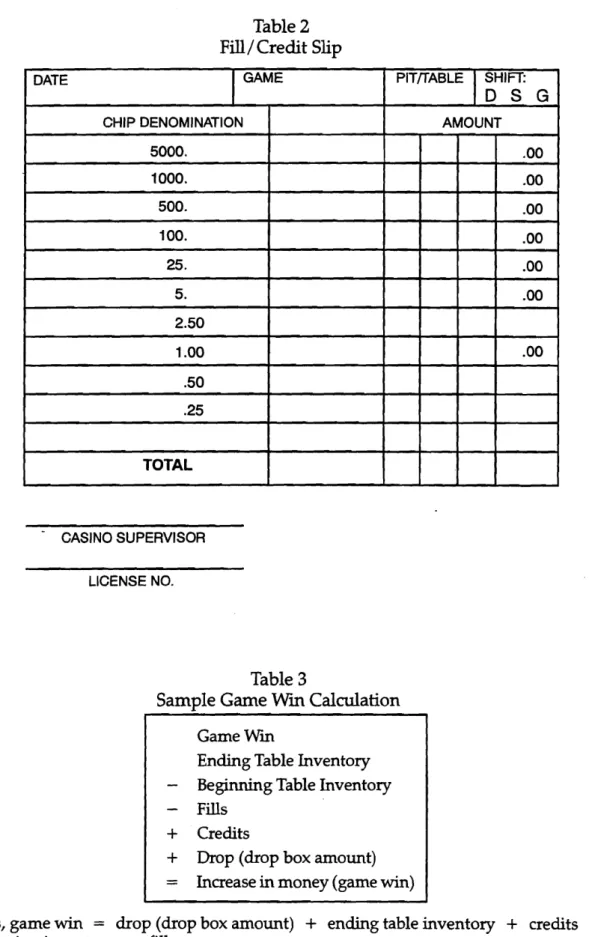
Fill/ Credit A fill is an addition to the table inventory and a credit is a withdrawal from the inventory.
Internal Control Practices in Casino Gaming
Table 2
Fill/ Credit Slip
DATE GAME PITnABLE SHIFT:
D S G
CHIP DENOMINATION AMOUNT
5000. .OO
1000. -00
500. .OO
100. .oo
25. .OO
5. .oo
2.50
1 .oo .oo
.50 .25
TOTAL
- CASINO SUPERVISOR LICENSE NO.
Table 3
Sample Game Win Calculation Game Win
Ending Table Inventory - Beginning Table Inventory
-
Fills+
Credits+
Drop (drop box amount) = Increase in money (game win)Thus, game win = drop (drop box amount)
+
ending table inventory+
credits-
The Journal of Hospitality Financial Managemot t
38
Organization
A typical accounting department of a casino hotel operation is very similar to that of a conventional hotel. The chief financial officer, also known as the controller or comptroller, presides over all the accounting personnel (Gray, 1996). Under the controller are the maior
and general accounting that consists of payables, receivables, and cashiers. The one main
1
charge of the slot count (hard count-
coins and tokens), the pit game count (soft count -1
thus the fills and credits. Some casino hotels establish an internal audit function either be-I
General Accounting
As mentioned, the general accounting function includes the ordinary duties of pay- able~, receivables, and cashiering - except that in casino hotel cashiering, this function also includes the cashiers in the cage and other cashiers on the floor. The cashiering func- time-consuming that the amount of time players can spend on the games is hindered. The
1
wise, the operating results will be very distorted. Since there are a lot of details in this func-1
Accounts receivables in casino hotels also perform slightly different functions than those of a conventional hotel. Some accounts receivables managers have the authoritv to
check; a player signs for it, denoting the amount of credit that he or she receives from the
guests is a pertinent element in the operation and marketing strategy of a casino hotel. The
1
spend. f i e impohant decision is to grant credit to the right players so that the casino canas banks would use in issuing an "unsecured personal loan."
1
any given time. That person would be responsible for the accohGg and supe&sion of credit debt. If some of these duties-needs to be delegated. thev should onlv be those dutiei
1
Internal Control Practices in Casino Gaming 39
Casino Revenue Audit
The main concern in the organizational structure of casino accounting is to divide the responsibilities of the department to the extent that it will minimize collusion and fraud. Casino revenue accounting can be divided into three major areas, from the time the money comes into the casino through the front doors to when it ends up in the back office vault: cage operations, casino operations, and count rooms.
In cage-operations, the cage cashiers and the credit cashiers who approve the players from the pit to buy chips and tokens once credit is approved are the main personnel. These cashiers will change the chips back to cash and will apply the winnings against credit is- sued. In casino operations, the dealers at the various games, the pit clerks who record the game transactions and process credit issuance requests, and the drop teams who collect the drop boxes are the people who wiU take in the coins, tokens and money from the players for the casino. Finally in the count rooms, the hard- and soft-count personnel will count and venfy the values of all coins, chips, tokens, and bills,
all
according to the procedures set out in the MKS, and record the revenues for the casino (Greenlees, 1988).Principal Revenue Flows and Cashiering *
Money flows into a casino through the cashier cage and the play of games. In most casi- nos, players buy their chips at the tables, hence the drop. In a few casinos, mainly outside of the United States, the main cashier cage takes in money from players in exchange for chips, and
all
casinos cash the remaining chips or winnings of the players at the end of their stay. The cage also takes care of fills and credits. As for games, there are primarily six categories: table games, poker, keno, bingo, sports and race book, and slots (Greenlees, 1988). The money that comes from the cage wiU go directlyback to vault for deposits or replenishment and accounting records will be sent to the comptroller's office. The money from games will go through the drop and count procedures in the count room and finally to the vault while the accounting records again will be sent to the comptroller's office.Main Cashiering and the Cage
Especially for smaller casino operations, the cage is where the main cashiering func- tions take place. It is the focal point of
all
cash activities whereby players can exchange their currency into chips or vice versa, and table games and slots can carry out their fills and credits. It is also a communication point between the vault and the floor, so that if chips are running out at a game or there is an excess accumulation of money in the cage, the money and/or chips are transferred to the vault. In this case, the vault will not need to be opened many times during the day. This, again, is a control measure. Besides preparing fills and credits for the games on the floor, the cage also takes care of the credit that is extended to the customers by receiving their counter check request and giving the pit clerk the okay for table issuance. There is another senice that the casino cage supplies. When a customer is carrying a large amount of cash, he or she may put it on deposit in the cage. The customer then may draw against that amount by filling out paperwork similar to a credit request. This is called a cash deposit withdrawal or CDW.Internal Control Practices in Casino Gaming 4 1
(Stutts, 1995). This is done at the cage most of the time. There are times that the pit will re- quire the same procedure. The cage cashier will first obtain the name, address, and Social Security Number of the player for verification. Then, a photo of the player will be taken to be signed by the cashier, with the player's name noted and attached to the report. The re- port has to be signed by the cashier and filed within fifteen days following the date of trans- action (New Jersey Casino Control Commission, Chapter 19:45-47). When the individual has a rating with the casino or has been granted credit, this is accomplished with computer information, thereby eliminating the need to bother the player.
Table Games
Cashiering for table games takes place between the player and the dealer where the player gives the dealer money, markers, or CDW in exchange for the gaming chips. The money, markers and other documents will be placed in the drop box and chips exchanged are normally added to the table inventory of chips to be counted.
Poker
Poker and other card games may take place off the floor in a separate room. Because of this, the cashiering function is sigruficant. Chips can be bought and sold at the table just as they can in the games of blackjack or craps. In some casinos, you may also find a separate cashier cage outside the Poker room. This cage exists for the obvious reason of being more convenient for the players. Also, Poker rooms typically operate on a commission basis. The house is not involved monetarily in the outcome of each hand. Therefore, it is wise from a control stand point to have the cashier activities taken care of by a cashier rather than the dealer at the table.
Keno, Bingo, Sports and Race Book
There is not a lot of cashiering activity involved in keno because a player buys a keno ticket, which activity resembles a regular sales transaction rather than casino cashiering, unless the player is a winner. The only cashiering involved is when the player pays with a larger bill and change is needed. Bingo is very much the same as keno. The player buys the bingo cards and collects from the casino when he or she wins. Sports and race books are the same. A player buys a simple bet ticket and waits for the results, and they distribute the payouts. Cashiering in this category is not as complicated as the table games.
Slots-E lectronic Gaming Devices
In slots, there are no dealers to make change. It also does not take as long to play a hand in slots. Thus, a continuous flow of change is needed. Usually, besides the main cashier cage, there are a number of booths dedicated to slots, located very strategically in or near the slot area, for the ease of making change. Most slots also take bills in exchange for play credits. Technology today also allows the use of a magnetic-striped card that records the amount of plays made and thus the amount of cash used. Such cards are similar to debit cards.
Larger slot operations have change personnel known as carousel cashiers, runway personnel, or carnival cashiers. They provide players with easy access to change. They may
Internal Control Pracfices in Casino Gaming
filled out by the dealer. The top original copy, the doser, will be given to the casino supervi- sor while the duplicate copy, the opener, is deposited in the chip rack and locked under a clear lid. The closer will go in the drop box.
At the beginning of the next gaming day, the casino supervisor will unlock the table rack so that the dealer can count the table chip inventory and venfy its accuracy against that of the duplicate slip (opener) from the previous day. The opener has the table number and sometimes the shift number, dearly marked, so that investigation can be carried out with a trail to follow when the inventory is not correct. When all are in order, the dealer and super- visor sign the opener and drop it in the drop box and the game can begin (Stutts, 1995).
Table 4
Table Inventory Slip
I
CHIP DENOMINATIONI
I
AMOUNTI
-
TOTAL
I
I
I
DATE
OUTGOING CASINO SUPERVISOR OUTGOING DEALER/BOX PERSON
LICENSE NO.
GAME
INCOMING CASINO SUPERVISOR
LICENSE NO. PlTfrABLE
INCOMING DEALERJBOX PERSON CLOSER FOR
(SH1Fl-I
In temal Con fro1 Practices in Casino Gaming
Surveillance cameras are used for these fills and credits so that all procedures will be monitored and theft will be deterred.
Closing a Game
When a game or a shift is finished, the dealer will count the chips on the table, fill out a two-part inventory slip, and have the amount verified by the casino supervisor. They will both sign the form, deposit the original copy (closer) in the drop box and place the copy (opener) in the c h p rack The table will now have chips with an inventory sheet ready and waiting for the next shift to start. The pit boss will then consolidate all inventory sheets and compile a Pit Tables Inventory Sheet (See Table 5).
Table 5
Pit Tables Inventory Sheet
CCC# PIT NO. SHIFT: D S G DAY OF WEEK-.
5 5
2.50 2.50
1 .oo 1 .oo
.50 .50
-25 .25
TOTAL TOTAL
I
5 5
2.50 2.50
1 .oo
*
1 .oo.50 -50
-25 .25
TOTAL TOTAL
I
LIC. NO. OPENER-PIT TOTALINCOMING PIT BOSS
lntemal Control Practices in Casino Gaming 47
because of the amount of cash that is involved. It is not unusual for a million dollars to be transacted in a single day, most of which is not in large denominations.
Many jurisdictions realizing their share (taxes) in gaming operations, have imposed strict regulatory guidelines which are constantly monitored to ensure compliance. Whmstrict reg- ulatory guidelines have not been imposed, many reputable gaming companies have realized it is sound business practice to adhere to a detailed, comprehensive set of internal controls. These conmls are based on audit/paper trail and oversight by several individuals.
AD
in-compatible functions are eliminated and many different departments are involved in transac- tions. Surveillance and internal audit departments, which report to an authority outside of the casino, eensw strict compliance with all internal control procedures.
As the hospitality industry continues to grow and evolve, and the plain fad that a large amount of cash changes hands, internal control in casinos is of utmost si@cance to both industry practitioners and hospitality educators. For practitioners, having the appropriate control system to ensure accountability without sacrificing the satisfaction of the guest can enhance operation effectiveness, goodwill, and profitability. Additionally, for hospitality programs that are offering courses in gaming, the topic of intemal control systems is one that students do need to master in order to become effective managers in the casino environment.
References
Cabot, A. N. (1996). Casinogaming: Policy, economics and regulation. Nevada: UNLV Interna- tional Gaming Institute.
Fahrenkoph,
F.
(1997). Keynote address at the 1997 Southern Gaming Summit. Biloxi, Mis- sissippi.Foxwoods High Stakes Bingo and Casino Policy and Procedure Manual. (1993).
Goodwin, J. R. (1985). Gaming control law
-
the Nevada model: Principles, statutes and cases.Ohio: Publishing Horizons, Inc.
Gray, W. S. (1996). Hospitality accounting. New Jersey: Prentice-Hall, Inc.
Greenlees, M. E. (1988). Casino accounting and financial management. Reno and Las Vegas: University of Nevada Press. N
Lionel Sawyer & Collins. (1995) Nevada gaming Law. (2nd ed.).
Las
Vegas, Nevada. Author. New Jersey Casino Control Commission. Chapter 19:45 Accounting and Internal Controls. (1980).New Jersey Casino Control Commission. Chapter 19:46 Gaming and Equipment. (1980). New Jersey Casino Control Commission. Chapter 19:47 Rules of the Game. (1980).
48 The Journal of Hospitality Financial M a n a p e n t
Stutts, A. T. (1995). Internal controls in gaming - An overview. Houston: Gaming Education and Research Institute.
Tropicana Hotel/Casinos Policy and Procedure Manual. (1984). Playboy Hotel/ Casinos Policy and Procedure Manual. (1983).
T m p Castle Hotel and Casino Policy and Procedure Manual. (1990). Wddhorse Gaming Resort Policy and Procedure Manual. (1994).
Agnes L. DeFranco, Ed.D.,