www.ijte.net
Challenges and Benefits of Blended
Learning in Higher Education
Gulnara Namyssova, Gulmira Tussupbekova, Janet Helmer, Kathy Malone, Mir Afzal, Dilrabo Jonbekova Nazarbayev University, Kazakhstan
To cite this article:
Namyssova, G., Tussupbekova, G., Helmer, J., Malone, K., Afzal, M., & Jonbekova. D.
(2019). Challenges and benefits of blended learning in higher education.
International Journal
of Technology in Education (IJTE), 2
(1), 22-31.
International Journal of Technology in Education
Volume 2, Issue 1, Fall 2019
ISSN: 2689-2758
Challenges and Benefits of Blended Learning in Higher Education
Gulnara Namyssova, Gulmira Tussupbekova, Janet Helmer, Kathy Malone, Mir Afzal, Dilrabo Jonbekova
Article Info
Abstract
Article History
Received: 17 June 2019
This exploratory study researched the effectiveness of a graduate level blended learning course on the development of teachers, and educational leaders in Kazakhstan studying a Master‟s of Science in Educational Leadership at Nazarbayev University Graduate School of Education (NUGSE). All of the student participants in this course were invited to participate in a survey and an interview. The findings include an analysis of the pedagogical practices which promote educational leadership skills among students via blended learning courses as well as the challenges both faculty and students faced during this course. Finally, the paper makes recommendations for policy and practice in relation to enhancing effectiveness of blended learning courses in higher education. It may be of particular interest to schools in the early stages of implementing blended learning.
Accepted: 25 September 2019
Keywords
Educational leadership Blended learning Higher education
Introduction
The Transformative Potential of Blended Learning
There have been diverse perceptions and concepts centered around delivering courses via Blended Learning (BL), meaning there is no specific common definition (Heinze, 2008, p. 8). As Glazer (2012) noted, blended learning is an inseparable part of our modern world, where human beings learn “partially virtually, partially tangible” (p. 1). For instance, Singh (2003) states BL provides opportunities to use both synchronous (such as Skype, group chats and web conferences) and asynchronous tools (such as blogs and social networking sites, email and discussion boards). According to Garrison and Vaughan (2008), BL is essential in improving the students‟ experience of the learning process. Blended learning is an efficient approach for teaching that combines the best practices of face-to-face and online learning in a relatively cost-effective way, (Vaughan & Garrison, 2006; Albrecht & Piranit, 2007; Garrison & Vaughan, 2008; Pallof and Pratt, 2005; Linder, 2017). Similarly, Garrison and Vaughan (2008) postulate that blended learning offers the possibility to meet twenty-first-century requirements by offering a combination of the best sites, which consist of online and face-to-face learning. While the above-mentioned theoretical insights about BL are very useful, this study‟s description of blended learning mostly aligns with Picciano‟s (2009) definition, stating that BL is a “course that integrates online with traditional face-to-face class activities in a planned, pedagogically valuable manner” (p. 8). At NUGSE, the graduate level courses are offered in BL mode involving intensive face-to-face classroom teaching and online learning using both synchronous and asynchronous tools.
Benefits of Blended Learning
Various contemporary research studies have been conducted specifically outlining the implementation of the BL approach in different contexts, its advantages, and disadvantages, including the assessment of BL and its design. Blended learning has been shown in multiple contexts to be more effective than face-to-face or online instruction (e,g, Bernard, Borokhovski, Schmid, Tamim, & Abrami, 2014; Brodersen & Melluzzo, 2017; Means, Toyama, Murphy & Baki, 2013; Stockwell, Stockwel, Cennamo, & Jiang, 2015). With regard to the greater effectiveness of BL, several researchers have disclosed that students enrolled in blended learning courses obtained better outcomes compared to traditional face-to-face or online courses (Means et al., 2010; Smith & Hill, 2019). Students experience the possibility to be both independent and autonomous in their learning, giving them the opportunity to study at their own pace (Caulfield, 2011; Glazer, 2012; Linder, 2017).
courses (Martinez-Caro & Campuzano-Bolarin, 2011). One of the reasons for BL mode being more preferable and effective is assumed to be the requirement to involve students in active learning through diverse learning approaches that include active peer communication, processing the information gained by constant self-reflection and “checking their understanding, organizing their knowledge, and making connections with what they already know” (Glazer, 2012, p. 3). Importantly, blended learning is assumed to restructure the pedagogic practices, with the potential to “recapture the ideals of higher education” (Garrison & Vaughan, 2008; p. x). The key features of blended learning pedagogy are interaction, flexibility, and suitable forms of assessment (Smith & Hill, 2019). There are many organizational levels and categories, in which blended learning takes place: institutions, program-courses or activities (Graham, 2006). Blended learning class designs could include many options such as the following:
● Thoughtfully integrating face-to-face and online learning
● Fundamentally rethinking the course design to organize student engagement
● Restructuring and replacing traditional class contact hours (Garrison & Vaughans, 2008, p. 6).
As Deng and Tavers (2013) emphasized, student satisfaction and engagement in the course greatly depends on the design of the online learning environment. It is also considered beneficial in terms of providing more opportunities to enroll a high number of students without the need for new classroom space (Dziuban et al., 2011). That is to say, it increases the study flexibility for both staff and students, which is also relatively cost-efficient.
Challenges of Blended Learning
The lack of suitable infrastructure and access to technology can cause some constraints for the successful integration of BL. Tshabalala, Ndeya-Ndereya, and Merwe (2014) have constructed a list of challenges that add to the constraints in the implementation of blended learning: “lack of policy, lack of faculty support, lack of technological and computer skills, large class sizes, and inadequate technological resources” (p. 108). In the same vein, Smith and Hill (2019) identified a range of drawbacks, such as the necessity for clear goals and objectives of blended learning (p. 389). Furthermore, Mirriahi, Alonzo, and Fox (2015) indicated that a lack of institutional definition of blended learning causes some challenges, as well as the lack of staff capacity to engage with BL, increases the probability of misinterpreting the BL principles and practices. As an example, the case study conducted by Tshabalaha et al. (2014) in South Africa investigated academic staff‟s perception of blended learning to allow for the identification of challenges encountered. It was determined that “the absence of a policy on blended learning; inadequate training for staff; limited access to the computer laboratory for students” were problematic to the success of BL (Tshabalaha et al., 2014, p. 107). Moreover, as a result of their study, Smith, and Hill (2019) postulate that additional teacher training should be conducted for the staff prior to the implementation of blended instruction. This could be done through the appropriate governance and strategic leadership within an institution.
Evidence from Practice
Namyssova, Tussupbekova, Helmer, Malone, Afzal & Jonbekova
24
However, in a meta-analysis, Means et al (2013) discovered that the majority of the 45 blended learning research reports used in their analysis were in the area of medical sciences and very few were in teacher education. In addition, none of the research reports utilized by Means et al. (2013) were in the area of educational leadership. Articles focusing on blended learning and teacher education have targeted language learning skills (Motteram, 2006) and teaching methods for pre and in-service teachers (El-Deghaidy & Nouby, 2007; Lowry, 2007; King, 2002; Peterson & Bond, 2004; Unwin, 2005). This is a missed opportunity since BL could allow students to connect theory to practice to a greater extent than a face-to-face traditional course. The importance of working on the development of real-life projects was discovered by Mungal and Cloete (2016). They found that graduate students need to be engaged in solving real problems in their workplace through integrated project work that can help them translate their learned theoretical knowledge into practice. This kind of integrated project work will better equip graduate students to adjust and excel in the work environment by applying their theoretical learning in the workplace in order to develop leadership skills. The development of leadership skills seems to require a shift in HE from traditional learning environments to ones that allow for interactive methods of learning in order to bridge this theory to practice gap (e.g., Darling-Hammond, LaPointe, Meyerson, & Orr, 2009; Malone, Helmer & Polat, 2019; Spanjaard, Hall, & Stegemann, 2018). In fact, Means, Bakia & Murphy (2014) have asserted based on their extensive review of the blended learning literature that there is a need for research on effective online pedagogy in different contexts. This research study makes a small step towards filling this gap in the literature by determining student perspectives on developing and applying educational leadership via a blended learning course.
Methodology
Purpose of the Study
The purpose of the current study is twofold. Firstly, it was to investigate how students‟ “interest towards the course” and “confidence to conduct work-based projects” changed as a result of a blended learning course focused on research to practice. Secondly, it aimed to determine the benefits and challenges associated with the blended learning approach from the students‟ perspectives within the context of the Graduate School of Education‟s (GSE) Master of Science programme.
Context of the Study
Kazakhstan is a young and dynamically developing country which is trying to improve the education system so that it becomes a driving force for economic development. Improving the quality of higher education is one of the priorities set by the government. Nazarbayev University (NU) is a flagship university established in 2010 in the country with an English medium of instruction and is a pioneer in developing and implementing new programs. The university has an international outlook with faculty from over 55 countries and programs developed in partnership with University of Pennsylvania and the University of Cambridge.
The Graduate School of Education (GSE) of NU, in turn, develops and offers different courses taking into account the best international practices. One of those courses is the “Project-based Course” offered through blended learning for developing students‟ leadership skills. The course was designed to allow students to develop a deep understanding of the way ideas explored in their MSc Program can be applied in their workplace to make their learning more relevant. It was hoped that this would allow them to bridge theory and practice in terms of educational projects while developing educational leadership skills. The course consisted of two types of students: work-based students, those students who had jobs in schools or other educational setting and they worked throughout the course, and internship students, those students who did not have jobs and were given internships in educational settings. The course is blended such that it combined intensive face-to-face learning on-campus with online learning before and after the intensive session. The face-to-face learning occurred over the course of two six-hour days. The rest of the course occurred online. Also, 6-8 students are assigned to one faculty as their supervisor to facilitate their learning in all phases of the course. In addition, students also get a site supervisor at their workplace–someone who can assist the students in identifying a project topic negotiating with the management of their workplace and developing a project plan.
The course contained four phases:
on-site inquiry experience. This phase consisted of online group meetings, self-study, reflection assignments and at times one to one online sessions with the instructor when needed. The project plan was completed individually by each student since they were located in different areas of the country.
2nd phase: On-campus intensive sessions; during Phase II the students reflected on Phase 1 learning, finalized their Project Plan, and planned for project implementation. This phase consisted of a peer review of all project plans as well as project plan reviews with the instructor.
3rd phase: On-site inquiry; online learning with the class and instructor occurred in this phase. The online session included possible peer review of implementation issues. Students then engaged in 3 weeks of on-site inquiry and implementation of their projects.
4th phase: Completing and submitting the Project Report; the individual final report included an evaluation of their project implementation and its outcomes. This phase included minimal online meetings as the students submitted individual project reports.
Research Design and Participants
The mixed methods study used a sequential explanatory design. According to Creswell (2009), this type of research design consists of two different but connected phases. The first phase is characterized by quantitative data collection and analysis; the second phase is characterized by qualitative data collection and analysis “that builds on the results of the initial quantitative results” (p. 211). A convenience sampling strategy was used to recruit students as the survey was targeted at MSc students, who were enrolled in the blended learning project course. A total of 27 students (i.e., 40% of the MSc cohort) voluntarily participated in the survey. Three students agreed to participate in individual Skype interviews, which lasted for 30-40 minutes each.
Instrumentation
The instrumentation in this study included a survey as well as semi-structured interviews. The survey consisted of Likert-scale, slider, and open-ended questions. The survey was developed by the project team to compare how students‟ “interest”, and “confidence” changed over the duration of the course. Students were asked questions such as: “To what extent were you interested in the course during the final weeks?” It also aimed at identifying the benefits and challenges associated with instruction delivered via blended learning via open-ended questions. Follow up interviews were informed by the quantitative data and included semi-structured questions such as: “Do you prefer learning in a blended, face-to-face or online environment? And Why?” and “Did this course produce any particular challenges that you would like to share?”
Data Analysis
Quantitative and qualitative data were analyzed separately. For the quantitative data, descriptive data analysis was completed using the Excel programme. Interviews were transcribed and common themes were identified by the research team. The themes were identified individually by two members of the team using grounded theory (Glaser & Horton, 2004) who then reached consensus across all interviews.
Findings
Quantitative Results
This section details the survey results within the context of student interest in the course, project leadership confidence, and leadership skills.
Namyssova, Tussupbekova, Helmer, Malone, Afzal & Jonbekova
26
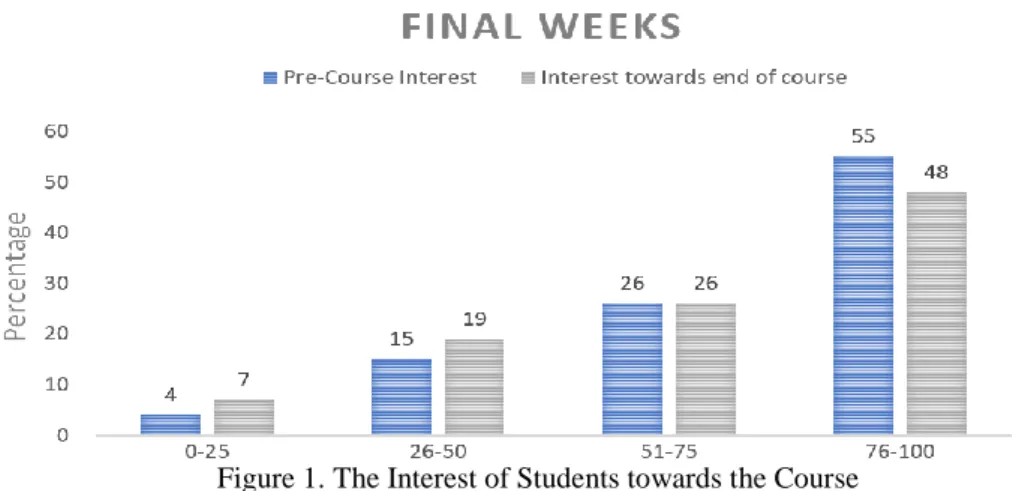
with sliders from 51% to 75% were considered to be indicating moderately high interest while sliders above 76 were considered to demonstrate a high interest in the course. The results are illustrated in Figure 1. In general, at the beginning of the course, 4% of the survey participants demonstrated a low interest in the course and towards the end of the course, this percentage increased to 7%. There was a similar decrease in interest among those who initially had a high interest in the course or moderately low interest in the course. For example, 51% of the participants had high interest (76-100) in the course at the beginning, whereas towards the end this percentage decreased to 48%. However, those who had moderately high interest remained stable from the beginning to the end of the course.
Figure 1. The Interest of Students towards the Course
After rating their interest in the course before and towards the end of the course, students were asked to answer open-ended questions specifically asking them what they believed caused their change in interest. Students who demonstrated a positive shift considered the following to be the main factors associated with the increase in interest: improved leadership skills and knowledge, their work-based project (the content of course) and the autonomy associated with it, obtaining new skills necessary at their work place and being in tune with the learning environment. Whereas the timing, duration of the course, and difficulty of prioritizing tasks were discussed as some of the main factors for the majority of the students demonstrating a negative shift in interest.
Confidence in conducting the work-based project. Unlike interest, students‟ confidence in conducting educational projects increased overall towards the end of the course based on additional slider survey questions. The students were asked to describe their confidence before the face to face session vs after the face to face session. The number of those who had high confidence (76-100) increased from 38.1% prior to the intensive classes to 65.2% after the intensive course sessions. Additionally, the number of those who had low confidence (0-25) and moderately low (26-50) confidence also increased after the face to face portion of the course. These results can be seen in Figure 2.
Leadership skills. Questions about leadership skills associated with the blended learning course were presented in the survey as open-ended questions, which allowed the participants to elaborate and provide their own perspectives. Within the context of these open-ended questions, the majority of participants highlighted blended learning to be a helpful tool for time management and developing leadership skills in projects. In particular, it had a positive impact on students‟ confidence in expressing their thoughts and speaking persuasively in public. In addition, half of the study participants mentioned that blended learning teaches students to be responsible and flexible. Moreover, some of the students mentioned that the blended learning course had increased their independence, decision-making, and reflective thinking skills.
Qualitative Results
Three MSc students voluntarily participated in an interview. In general, the aim of the interviews was to explore further the benefits and challenges associated with the blended learning course. General information about the interviewees is contained in Table 1.
Table 1. Interviewee Demographics Participant Gender Teaching experience
Participant 1 Male More than 10 years
Participant 2 Female More than 10 years of experience (education administration)
Participant 3 Female More than 3 years
In order to analyze the collected data, we used some of the procedures recommended by (Rossman & Rallis, 2012). The collected data were transcribed, organized or cleaned up and themes were generated. The themes that emerged from the data analysis included theoretical knowledge informs practical skills as well as benefits and challenges. In this section, we will discuss four themes generated as a result of the thorough data analysis.
Theoretical knowledge informs practical skills. Discussing face-to-face and work-based phase of the courses, all students emphasized that they were able to apply their theoretical knowledge to practical educational projects. Readings of the course and lectures provided by the instructors were valuable for obtaining new knowledge during the intensive course specifically those needed to manage projects. But more importantly, during the work-based phase, they had a chance to apply everything they learned throughout the MSc program. For instance, reflecting on the theoretical and practical knowledge he obtained, Participant 1 mentioned that during the intensive course he learned how to do presentations, and this gave him the confidence to deliver a presentation during his internship:
When we did our intensive course, instructors told us how to make presentations, how to use different skills. We did different things, how to speak up, how to talk etc. This was very helpful
Whereas Participant 2 reflecting on the course mentioned that during the intensive course she learned how to conduct an organization needs analysis, which she practiced during the internship:
What this course taught me is how to do a needs assessment and how to look at the needs of the organizations and try to solve their problems. So, [during the work-based phase] I‟ve gained a little bit of experience to do that kind of analysis and try to understand what dimensions to take when solving such problems
Participant 3, on the other hand, highlighted strategies taught by the course that helped to identify the problems of the organizations. She utilized this knowledge during her internship in order to develop her project plan. She said:
We took a problem we have in our department; we used these strategies to identify problems [during work-based phase]
On-line and face-to-face: a good mix. Both phases (online and face-to-face) were equally valued by the participants and each taught something new. However, Participant 2 emphasized that the online work-based phase allowed her to obtain certain knowledge which she would not be able to get any other way.
And the very valuable insight that you cannot read anywhere in the books and newspapers.
Namyssova, Tussupbekova, Helmer, Malone, Afzal & Jonbekova
28
Advantages of face to face and online learning. When asked about what mode of learning the participant prefers most, blended or face to face, all participants mentioned that both face to face and online learning had advantages. Participant 1 reflects on these approaches of learning and thinks that online learning is beneficial for self-development. Whereas face to face learning has such benefits as contact with the instructors, on time feedback from instructors and communication with peers.
I am in favor of both, if you are learning by yourself, online learning is truly beneficial. But it is for yourself only. However, we need to have context, we need to contact our instructors. We need to see that person and if you want to develop professionally, improve public speaking speech, collaboration among peers, get the feedback from instructors on the time it is good to have blended course.
Similarly, Participant 2 acknowledges the benefits of both types of learning. Even though she admitted given the opportunity and having the luxury of more time, she would prefer face to face.
If I had the opportunity, I would prefer face to face, but our life is complicated, and we cannot afford it all the time. We need to compromise and combine them”
Challenges. When asked about the challenges associated with the course, all the participants mentioned final assignments and the timing of them. As an example, Participant 1 experienced challenges in completing the assignments successfully.
I think it was our final project. When you try to write the final report. After analysis, it is very important to have a general idea, how to write a report. We did not know how to do it. Eventually, we were given kind of template, it was good. Though we did not understand how to do a reflection. There were many questions. We try to contact instructors and ask these questions and afterward we made it.
Whereas, Participant 2 mentioned that the assignment was individual, and peers could not help each other, as each of them was analyzing different problems.
We did not have any problems. Only individual project. I had to do individually. I could not share my problems with other peers, because each one had their own work.
Participant 3 added communication with the hosting organization as a challenge for her. A lack of proper communication prior to the internship caused her to change all of her plans.
The challenge was that lack of communication. It was hard to communicate with the organization. And the reality was different from the time when we do needs analysis. [when you go to the organization] you understand there are so much more, so many problems. And they are all complex. So, you need to evaluate your time, evaluate your resources before trying to solve any problems.
Recommendation
Based on the results of the study we can recommend developing partnerships between NUGSE and students‟ workplaces / schools so that the school management better facilitates students‟ projects – encouraging project-based learning and use of BL in schools and HE institutions in KZ in order to bridge the gap between theory and practice.
Discussion and Conclusion
This research discusses the benefits and challenges associated with blended learning. However, it is generally believed that blended learning is an effective method of learning as it consists of the best features of both traditional face-to-face and online learning. The course studied in this paper was the first course which used a high level of the blended learning approach in Nur-Sultan, Kazakhstan in order to help students to develop the ability to design and lead educational projects. Thus, this study was conducted to learn about students‟ perspectives on the offered course within the context of the Graduate School of Education‟s (GSE) Master of Science programme.
could complete their project increased by 71%! Thus, demonstrating that the power of blended learning is the ability for students to be able to experience both modes. Without the face to face sessions, many students would not have been confident of their abilities prior to implementing their projects. Thus, students valued equally both components of the course and learned new things from each of them.
However, one of the participants admitted that the real experience in an education setting gives a knowledge which none of the books, courses or articles can give. In terms of the advantages of the online learning and face-to-face learning, the findings of the study confirm the findings discussed in the literature review, that each of portion of the course is valuable and has its own advantages. Traditional face-to-face learning implies contact with instructors and communication with peers. Whereas, online learning saves students‟ time and is an important tool for self-development (Glazer, 2012).
The main challenges associated with the course were related to the timing of the final assignment as it had to be submitted soon after the project implementation not allowing time for much reflection. This challenge was beyond the control of the instructors due to the timing of the semester schedule thus difficult to surmount. In addition, during online sessions students did not have a chance to discuss the projects with their peers, in other words, there was “isolation” of students from peers during this important component of the course. The students felt that methods need to be developed that would allow for more online peer interaction during project plan development and implementation. In response to the student's plans for greater interactivity of online sessions are being developed.
In the future, the efficacy of face to face educational leadership project-based courses should be assessed in relation to that of blended courses similar to the one discussed in this paper. In addition, to further develop this course there is a need to determine more closely why there was a drop in interest in the course overall in order to develop methods to maintain student interest throughout the course. However, even with the slight percentage drop in high interest in the course of 12% the students still seemed to have been able to achieve the main goals of the course which were to build their confidence and their abilities to apply theory to practice in educational settings. Overall, this study demonstrated that online blended learning can allow emerging educational leaders to practice and develop their leadership skills while applying their growing theoretical knowledge base through the development and implementation of educational projects. This should allow these students to know that they have developed the abilities and skills needed to apply their theoretical knowledge in the future.
References
Albrecht, R. & Piranit, J. (2007). Blended learning: Complexity in corporate and higher education. Blended Learning: Research Perspectives, 247-262.
Arabasz, P., & Baker, M. B. (2003). Evolving campus support models for e-learning courses. Educause Center for Applied Research Bulletin, 1-9. http://net.educause.edu/ir/library/pdf/EKF/ekf0303.pdf
Bernard, R., M., Borokhovski, E., Schmid, R. F., Tamim, R. M., & Abrami, P. C. (2014). A meta-analysis of blended learning and technology use in higher education: From the general to the applied. Journal of Computing in Higher Education. 26(1). 87-122.
Brodersen, R. M., & Melluzzo, D. (2017). Summary of Research on Online and Blended Learning Programs That Offer Differentiated Learning Options. REL 2017-228. Regional Educational Laboratory Central. Caulfield, J. (2011). How to design and teach a hybrid course. Sterling, VA: Stylus.
Chen, C., C., & Jones, K., T. (2007). Blended learning vs. traditional classroom settings: Assessing effectiveness and student perceptions in an MBA accounting course. The Journal of Education Online, 4(1), 1-15.
Condie, R., & Livingston, K. (2007). Blended online learning with traditional approaches: Changing practices. British Journal of Educational Technology, 38(2), 337-348.
Creswell, J. W. (2009). Research Design: Qualitative, Quantitative, and Mixed Methods Approaches (3rd ed.). Thousand Oaks, CA: Sage Publications.
Darling-Hammond, L., LaPointe, M., Meyerson, D., & Orr, M. (2009). Preparing principals for a changing world: Lessons from effective school leadership programs. London, England: Wiley. doi:10.1002/9781118269329
Deng, L., & Tavers, N., J. (2013). From Moodle to Facebook: Exploring students‟ motivation and experiences in online communities. Computers & Education, 68, 167-176.
Namyssova, Tussupbekova, Helmer, Malone, Afzal & Jonbekova
30
Du, C. (2011). A comparison of traditional and blended learning in introductory principles of accounting course. American Journal of Business Education, 4(9), 1-10.
Glazer, F., S. (2012). Blended learning: Across the disciplines, across the academy. Sterling, VA: Stylus. Garrison, D. R., & Vaughan, N. D. (2008). Blended learning in higher education. San Francisco: Jossey-Bass. Glaser, B. G., & Holton, J. (2004, May). Remodeling grounded theory. Forum: Qualitative Social Research, 5
(2). DOI: http://dx.doi.org/10.17169/fqs-5.2.607.
Graham, C.R. (2006). Blended learning systems. In C. Bonk (Ed.), The handbook of blended learning. Global perspectives and local designs. San Francisco: Pfeiffer.
Heinze, P. (2008). Blended learning: An interpretive action research study, (Unpublished Ph.D. thesis) University of Salford.
Lack, K., A. (2013). Current status of research on online learning in postsecondary education. Retrieved from https://sr.ithaka.org/wp-content/uploads/2015/08/ithaka-sr-online-learning-postsecondary-education-may2012.pdf
Liaw, S.S. (2008). Investigating students' perceived satisfaction, behavioral intention, and effectiveness of e-learning: A case study of the Blackboard system. Computers & Education, 51(2), 864–873.
Linder, K., E. (2017). The blended course design workbook: a practical guide. Sterling, Virginia: Stylus Publishing, LLC.
Major, C., H. (2015). Teaching online: A guide to theory, research, and practice. Baltimore, MD: John Hopkins University Press.
Malone, K. L., Helmer, J., & Polat, F. (2019). Student-Authored Case Studies: The Case of an Educational Leadership Course in Kazakhstan. In Case Study Methodology in Higher Education (pp. 133-159). Hershey, PA: IGI Global.
Martínez-Caro, E. & Campuzano-Bolarín, F., (2011). Factors affecting students‟ satisfaction in engineering disciplines: traditional vs. blended approaches. European Journal of Engineering Education, 36(5), 473-483.
Marx, G. (2006). Sixteen trends: Their profound impact on our future. Alexandria, Virginia: Education Research Service.
McNamara, J., M., Swalm, R., L., Stearne, D., J., & Covassin, T., M. (2008). Online weight training. Journal of Strength and Conditioning Research, 22(4), 1164-1168.
Means, B., Toyama, Y., Murphy, R., Bakia, M. & Jones, K. (2010). Evaluation of evidence-based practices in online learning: A meta-analysis and review of online learning studies. DC: Washington: U.S. Department of Education Available online from: http://www2ed.gov/rschstat/eval/tech/evidence-based-practices/finalreport.pdf
Means, B., Toyama, Y., Murphy, R., & Baki, M. (2013). The effectiveness of online and blended learning: A meta-analysis of the empirical literature. Teachers College Record, 115(3), 1-47.
Means, B., Bakia, M., & Murphy, R. (2014). Learning online: What research tells us about whether, when and how. New York: Routledge.
Motteram, G. (2006). „Blended‟ education and the transformation of teachers: A long-term case study in postgraduate UK Higher Education. British Journal of Educational Technology, 37(1), 17-30.
Mungal, A., & Cloete, M. (2016). Preparing underprepared students for higher education and beyond: The development and implementation of an integrated project. Accounting Education, 25(3), 203-222. Mirriahi, N., Alonzo, D., & Fox, B. (2015). A blended learning framework for curriculum design and
professional development. Research in Learning Technology, 23(1), 28451.
Mungal, A. & Cloete, M. (2016). Preparing underprepared students for higher education and beyond the development and implementation of an integrated project. Accounting Education, 25(3), 203-222
Oliver, J. (2011). Accommodating and promoting multilingualism through blended learning, (Unpublished Ph.D. thesis) North-West University, Vanderbijlpark.
Palloff, R. & Pratt, K., (2005). Online learning communities revisited. Paper presented at the 21st Annual Conference on Distance Teaching and Learning. Madison, WI.
Picciano, A., G. (2009). Blending with purpose: The multimodal model. Journal of Asynchronous Learning Networks, 13(1), 7-18.
Riffel, S., & Sibly, D. (2005). Using web-based instruction to improve large undergraduate biology course: An evaluation of a hybrid course format. Computers & Education, 44(3), 217-235.
Rossman, G.B., & Rallis, S.F. (2012). Learning in the field: An introduction to qualitative research (3rd ed). Los Angeles: Sage.
Scoville, S., A., & Buskirk, T., D. (2007). Traditional and virtual microscopy compared experimentally in a classroom setting. Clinical Anatomy, 20(5), 35-44.
Singh, H. (2003). Building effective blended learning programs, Educational Technology, 5(3), 14-23.
Spanjaard, D., Hall, T., & Stegemann, N. (2018). Experiential learning: Helping students to become „career-ready.‟ Australasian Marketing Journal, 26(2), 163–171. doi:10.1016/j.ausmj.2018.04.003
Author Information
Gulnara Namyssova
Nazarbayev University Kazakhstan
Contact e-mail: [email protected]
Gulmira Tussupbekova
Nazarbayev University Kazakhstan
Janet Helmer Nazarbayev University Kazakhstan
Kathy Malone Nazarbayev University Kazakhstan
Mir Afzal
Nazarbayev University Kazakhstan