Missing Data Correction in Still Images
Using Multi-Resolution Analysis
Blerim Mustafa
1, Vladimir Trajkovik
2and Danco Davcev
21Makedonski Telekomunikacii, Skopje, Macedonia 2Faculty of Electrical Engineering, Skopje, Macedonia
This paper proposes an improvement to the texture generation-based image in-painting algorithm, using multi-resolution analysis. Instead of optimizing the size of the neighborhood window of the synthesized pixel and the size of the test image, the approach described in this paper applies the same(minimal)window and test image size to different sub-bands of the discrete wavelet transformed (DWT) image. This way the execution complexity is kept lowest possible, while still obtaining the same visual quality as by applying the optimal parameters in the spatial domain.
Keywords: image processing, restoration, constrained synthesis, non-parametric and non-stationary Markovian models, multi-resolution, discrete wavelet transform.
1. Introduction
Image in-painting or missing data correction in still images(as well as in video sequences) is an interesting new point in a multitude of appli-cations since defects are common in large non-electronic archives. Another interesting appli-cation of the automatic in-painting would be the concealment of selected objects in retouching of images or other special effects.
Several approaches in automatic in-painting are distinguishable:
• Correction using reshaping the Fourier spec-trum of the region of interest according to a reference spectrum(HIRANI et al. 1996)
• Correction using Partial Differential Equa-tions(BERTALMI et al. 2000)
• Correction using multilevel median filters
(KOKARAM et al. 1995)
• Correction by texture generation( non-para-metric sampling) (ASHIKHMIN 2001, EFROS et al. 2001, EFROS et al. 1999,
BORNARD et al. 2003, IGEHY et al. 1997)
The last category is the one that inspired our work. The next Section describes the basics of this approach and the Section 3 describes how it can be improved using multi-resolution anal-ysis. Section 4 gives an overview of the results, using the improvement we propose in Section 3.
2. Correction Using Texture Generation
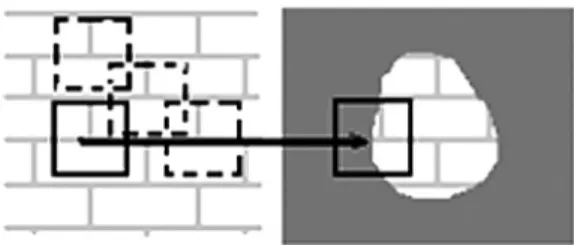
The algorithm developed inEFROS et al. 1999 “grows” texture, pixel by pixel, outwards from an initial seed. A single pixel p is chosen as unit of synthesis so that the model can capture as much high frequency information as pos-sible. All previously synthesized pixels in a square window around p (weighted to empha-size local structure)are used as the context. To precede with synthesis, the probability tables for the distribution of p are required, given all possible contexts. However, constructing them explicitly is out of the question. Instead, for each new context, the sample image is queried and the distribution ofpis constructed as a his-togram of all possible values that have occurred in the sample image as shown in Figure 1. The non-parametric sampling technique, although simple, is very powerful at capturing statisti-cal processes for which a good model hasn’t been found.
Fig. 1.Given a sample texture image(left), a new image is being synthesized, one pixel at a time(right). To
synthesize a pixel, the algorithm first finds all neighborhoods in the sample image(boxes on the left)
that are similar to the pixel’s neighborhood(box on the right)and then chooses one neighborhood and takes its
center to be the newly synthesized pixel.
neighborhood is independent from the rest of the image. The neighborhood of a pixel is mod-eled as a square window around that pixel. The size of the window and the size of the sam-ple image are free parameters that specify how stochastic the user believes the texture to be. More specifically, if the texture is presumed to be mainly regular at high spatial frequencies and mainly stochastic at low spatial frequencies, the size of the window should be on the scale of the smallest regular feature, and the size of the test image should be on the scale of the largest regular feature.
Let I be an image that is being synthesized from a texture sample imageIsmp ⊂Irealwhere
Ireal is the real infinite texture. Let p ∈ I be
a pixel and let ω(p) ⊂ I be a square image patch of widthω centered atp. Letd(ω1,ω2) denote some perceptual distance between two patches. If all the pixels in I except for p are known, p can be synthesized using the condi-tional probability distribution P(p|ω(p)) and then sample from it. A modification of the nearest neighbor is used: the closest match
ωbest(s) = arg minω(s)d(ω(p),ω(s)) is taken
for synthesizing. The distancedis usually cal-culated as a sum of the squared differences met-ric, weighted by a Gaussian kernel:
d(ω(p),ω(s))=
i,j∈ω
li,j(p)−li,j(p)2Gi,jbi,j(p)
i,j∈ωGi,jbi,j(p)
,
where Gi,j is the Gaussian mask, bi,j(p) is a
Boolean mask indicating whether the pixel(i,j)
nance of the pixel(i,j).
BORNARD et al. 2003 used this scheme for
missing data correction in still images. The dif-ference between the texture generation and the natural pictures correction is that the blotches may occur in less-stationary texture or contour segments. The neighborhood of the synthesized pixel is used as a sample image. BORNARD et
al. 2003 also add adaptive sample image (the
sample image grows as we go “deeper” into the blotch) and partial similarity computation to speed up the execution.
However, the size of the window and the size of the sample image are still left for the user to choose. Further, cases exist where these param-eters need to be set high, which adds up to the execution time proportionally. The next chap-ter shows how using multi-resolution analysis helps us overcome the problem of the estima-tion of these free parameters, in fact, helps us to keep them low, and therefore shortens the execution time of the algorithm.
3. Correction Using Multi-Resolution
As stated in the previous section, the size of the window and the size of the sample image are free parameters that specify how stochastic the user believes the texture to be. The estimation of these parameters can be done using frequency feature extraction(using FFT, Wavelet or some other transform), or it can be done using tex-ture classification, segmentation and
compari-son(UNSER 1995, HAVLICEK et al. 2001).
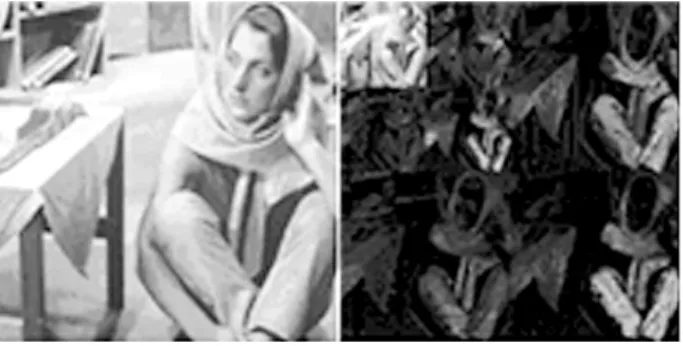
Fig. 2.The original image(left)and the 2-level wavelet transformed image(right).
5 are sufficient for corrections. The next three bands contain the variations occurring in 4 to 8 pixels, but are decimated by 4, so windows of size 3 and sample images of size 5 are sufficient for corrections here, too. The same goes for all the remaining sub-bands. The lowest sub-band contains only the contours of the image, so the same low parameters can be applied.
So, instead of estimating the parameters, we apply the smallest possible ones(and therefore “cheapest” from the execution point of view)to the wavelet-transformed image. The blotch is spatially distributed through the sub-bands( Fig-ure 3), so we practically have the same number of blotch-pixels for corrections, but the correc-tion is done using the smallest window and sam-ple image sizes.
Fig. 3.The original blotch mask(left)and the spatially distributed one(right)for correcting 2-level
wavelet-transformed images.
Figure 4 shows the schematic diagram of the proposed approach. Instead of estimating the parameters(visually or automatically), the im-age is wavelet-transformed and the blotch mask is spatially distributed according to the level of the transform. Then the transformed image is in-painted using small window and test image size, and the resulting image is inverse trans-formed.
Fig. 4.Left – schematic block diagram of image in-painting by texture generation and right – block
diagram
of our multi-resolution approach.
4. Results and Demonstration
The algorithm presented inEFROS et al. 1999
and BORNARD et al. 2003 has the
computa-tional complexity of:
CC =
n
i=1 w2is2i,
wherewi is the size of the window around the
pixel i, si is the size of the test image for the
pixeliandnis the number of blotch-pixels. For optimal correction the free parameters wi and
si should vary depending on the spatial
distri-bution of frequency features around the pixeli. So, the CPU load for an optimal correction de-pends on the number of blotched pixels and on the frequency features surrounding those pixels. The approach in image in-painting presented in this paper does not optimize the in-painting parameters based on the spatial distribution of frequency features in the image, but instead, applies the same (minimal)parameters on dif-ferent frequency bands. So, the computational complexity would be:
CCmr =nw2mins2min
Fig. 5.Top-images with blotch masks, bottom – restored images.
Figure 5 shows three examples of the approach presented. The first and the last ones contain a large blotch going through different texture and contour regions. The second one is a randomly vandalized image, with blotches in almost all the regions. Using the same window and sam-ple image size, the image is recovered in all the regions, despite the differences in the frequency features.
5. Conclusion
In this paper, an improved texture-generation-based image in-painting algorithm has been pro-posed in order to obtain a scheme for overcom-ing the problem of estimatovercom-ing free parameters (the size of the window and the size of the test image), using multi-resolution.
The visual results achieved by this multi-reso-lution approach where minimal parameters are used (lowest CPU Load) are practically the same as those achieved by the conventional spa-tial domain approach, i.e. using adjusted param-eters.
References
[1] A. A. EFROS, T. K. LEUNG, Texture Synthesis by Non-Parametric Sampling. Presented in the Pro-ceedings of the 1999 IEEE International Conference on Computer Vision(1999), pp. 1033–1038. Corfu, Greece.
[2] A. A. EFROS, W. T. FREEMAN, Image Quilting for Texture Synthesis and Transfer. Presented in the Proceedings of ACM SIGGRAPH(2001), pp. 341– 346. Los Angeles, USA.
[3] A. C. KOKARAM, R. D. MORRIS, W. J. FITZGER -ALD, P. J. RAYNER, Interpolation of Missing Data in Image Sequences.IEEE Transactions on Image Processing4(1995), pp. 1509–1519.
[4] A. N. HIRANI, T. TOTSUKA, Combining Frequency and Spatial Domain Information for Fast Interactive Image Noise Removal. Presented in the Proceed-ings of ACM SIGGRAPH(1996), pp. 269–276. New Orleans, USA.
[5] G. STRANG, T. NGUYEN,Wavelets and Filter Banks. Wellesley-Cambridge Press, Wellesley, 1996.
[7] J. P. HAVLICEK, P. C. TAY, Determination of the Number of Texture Segments Using Wavelets. 16th Conference on Applied Mathematics, Univ. of Cen-tral Oklahoma. Electronic Journal of Differential Equations(2001), pp. 61–70.
[8] M. ASHIKHMIN, Synthesizing Natural Textures. Pre-sented in the Proceedings of the 2001 ACM Sym-posium on Interactive 3D (2001), pp. 217–226. Research Triangle Park, USA.
[9] M. BERTALMIO, G. SAPIRO, V. CASELLES, C. BALLESTER, Image In-painting. Presented in the Proceedings of ACM SIGGRAPH(2000), pp. 417– 424. New Orleans, USA.
[10] M. UNSER, Texture Classification Using Wavelet Frames.IEEE Transactions on Image Processing4
(1995), pp. 1549–1560.
[11] R. BORNARD, E. LECAN, L. LABORELLI, J. H. CHENOT, Missing Data Correction in Still Images and Image Sequences. Presented in the Proceed-ings of ACM Multimedia (2003), pp. 355–361. Juan-les-Pins, France.
Received:April, 2005 Accepted:December, 2006
Contact addresses: Blerim Mustafa Makedonski Telekomunikacii Orce Nikolov bb Skopje Macedonia e-mail:[email protected]
Vladimir Trajkovik Faculty of Electrical Engineering Karpos II bb 1000 Skopje, Macedonia e-mail:[email protected]
Danco Davcev Faculty of Electrical Engineering Karpos II bb 1000 Skopje, Macedonia e-mail:[email protected]
BLERIMMUSTAFAis a PhD student at the Department of Computer Science of the Faculty of Electrical Engineering and Information Tech-nologies in Skopje. His major fields of interest are signal, image, video and 3D data processing, as well as various fields of Artificial Intelli-gence.
DR. VLADIMIRTRAJKOVIKis an assistant professor at the Department of Computer Science, of the Faculty of Electrical Engineering and Infor-mation Technologies, “Sts. Cyril and Methodius” University in Skopje, Republic of Macedonia. He is author of over 40 papers published at international conferences. He teaches Algorithms and Data Structures, Distributed Computer Sciences, and Expert Systems. His research interests are: Web-based Systems, Intelligent Systems and Distance Education Systems.