Magyar Agrárinformatikai Szövetség
Hungarian Association of Agricultural Informatics Agrárinformatika Folyóirat. 2011. 2. évfolyam 1. szám Journal of Agricultural Informatics. 2011 Vol. 2, No. 1
High resolution vegetation assessment with beta-diversity – a moving window
approach
Sándor Bartha1
,
ZitaZimmermann2,
András Horváth1,
Szilárd Szentes2,
Zsuzsanna Sutyinszki2,
GáborSzabó2
,
Judit Házi2,
Cecília Komoly1,
Károly Penksza2I N F O
Received 25 Sep. 2011 Accepted 26 Oct. 2011 Available on-line 28 Nov. 2011 Responsible Editor: K. Rajkai
Keywords:
grasslands, local statistics, monitoring, neighbourhood diversity, spatial scaling.
A B S T R A C T
Monitoring designs are often suffering from the inherent non-stationarity of the monitored systems. To overcome this limitation, we propose a sampling design based on high resolution mapping and spatial analyses with double spatial scaling process. Applying to vegetation, we record the presence of plant species along 26 m or 52 m long belt transects of 520 (or 1040) units of 0.5 cm × 0.5 cm contiguous microquadrats. Beta diversity (represented as the diversity of species combinations) is estimated by subsequent computerised samplings from the baseline transect data sets. Beta diversity is scaled with changing resolutions across a range of scales from 5 cm × 5 cm to 5 cm × 500 cm., and it is also scaled using moving window technique. Local maximum of beta diversity is repeatedly calculated in 5 m extent observational windows shifted along the transect with 1 m lag, and the spatial variability of vegetation is visualized by the related beta-diversity profile. Using a field example, we demonstrate that beta diversity, when applied with our methodology, is a sensitive indicator, and it can reveal more information than alpha or gamma diversity.
I N F O
Beérkezés 2011 Szept. 25. Elfogadás 2011 Okt. 26. On-line elérés 2011 Nov. 28. Felelős szerkesztő: Rajkai K
Kulcsszavak:
gyepek, lokális statisztikák, szomszédsági diverzitás, természetvédelmi hatásmonitorozás, térbeli skálázá
Ö S S Z E F O G L A L Ó
Komplex rendszerek monitorozásánál tipikus nehézség a stacionaritás hiánya. A monitorozás tervezésekor gyakran megjósolhatatlanok a rendszer jövőbeni tulajdonságai és viselkedése. A probléma megoldására – a növényzet estében – nagy felbontású, egyed-alapú térképezést javasolunk, majd az így nyert adatok többlépcsős, térsorozatokon alapuló számítógépes feldolgozását. A felvételezés során növényfajok jelenlétét rögzítjük mikrokvadrátokban. A részletes mintavétel 26 m vagy 52 m hosszú transszektek mentén történik, amelyek 5 × 5 cm-es mikrokvadrátok összefüggő sorozatából állnak (520 vagy 1040 db). A számítógépes feldolgozás során egy 5 m-es mintavételi ablak segítségével előbb elkülönítünk egy részmintát majd ezt növekvő mintavételi egységekkel megvizsgáljuk, és egy ún. lokális statisztikával (jelen esetben egyfajta béta-diverzitással) jellemezzük. A mintavételi ablakkal a transszektet az elejétől a végéig “letapogatva” egy diverzitási profilt nyerünk, amely bonyolult, nehezen kezelhető esetekben is (amikor a stacionaritási feltételek nem teljesülnek) jól jellemzi a növényzet állapotát. A módszer használatát egy terepi példa segítségével illusztráljuk, megmutatva, hogy a béta diverzitás más (alfa- és gamma-) diverzitásmértékeknél jobb indikátora a vegetáció változásainak.
1. Introduction
Permanent grasslands covering more than 9% of Hungary’s surface are important sources of farmland biodiversity and provide important ecological services. The area of permanent grasslands declined considerably during the last 150 years and grasslands are threatened by various factors including intensification and abandonement (Horváth and Szitár, 2007). The National Agri-environmental Programme of Hungary (Ángyán et al., 1999, Haraszthy et al., 2004) introducing ecologically oriented agricultural strategy provides a basis for combining agricultural production with nature conservation targets. The horizontal scheme for grassland management offers farm-level support with environmentally friendly farming prescriptions. Besides protecting and improving
important natural resources, the grassland management program helps to preserve local rural communities and their cultural heritage.
Although sustainable agriculture and rural development become a central concern in modern societies, the benefits of agri-environmental schemes are not easy to recognize, and the effectiveness of some programmes has been questioned (Kleijn et al., 2001; Kleijn and Sutherland, 2003; Whittingham, 2007). We propose that understanding benefits of agri-environmental schemes needs appropriate monitoring system, and the quality of monitoring is a key issue in the evaluation of environmental impact of schemes. Monitoring should result in feed-backs on the design of financial support system. Therefore, monitoring is a key element of agri-environmental schemes for testing whether the management decisions were successful in conserving biodiversity. The cost and quality of monitoring can influence substantially the success of these programs (Horváth, 2007; Keith et al., 2011). Many long-term monitoring programs suffer from the problem that sampling designs are optimized to the initial conditions and become ineffective as the system change over time (Lindenmayer and Likens, 2009). There is an urgent need to develop adaptive monitoring methods that are able to deal with complex non-stationary patterns and are able to accommodate to changing conditions.
Biodiversity measures are routinely used and generally accepted indicators of ecosystem health and naturalness (Vida, 1999). Biodiversity is linked to ecosystem processes (Tilman, 1999; Loreau et al., 2002; Hooper et al., 2005), therefore biodiversity indicators can be used as surrogates for assessing quality of ecosystem functioning. Increasing number of studies demonstrated the importance of spatial heterogeneity in key ecosystem processes (McNaughton, 1988; Tilman and Kareiva, 1997; Csillag et al., 2001). Accordingly, increasing attention is paid to beta diversity measures that are able to reflect these aspects (Anderson et al., 2010). Beta diversity reflects compositional variability, turnover and related to nestedness (Podani and Schmera, 2011). Beta diversity offers more information about vegetation structure than traditional alpha and gamma diversities. Recently Bartha et al. (2011) suggested that beta diversity can be expressed by the number and diversity of species combinations (components of the information theory models developed by Juhász-Nagy; cf. Juhász-Nagy, 1980, 1993). Beta diversity depends on spatial scale and on the abundance of species. The advantage of using Juhász-Nagy’s models is the sigma additivity of models and the advanced methodology dealing with various aspects of scale dependence (Juhász-Nagy, 1980; Juhász-Nagy and Podani, 1983).
Plants are sessile organisms characterized by local interactions and limited dispersal capacity. Local dynamics are rarely synchronized, and vegetation often appears as non-stationary mosaic with diffuse patches of different degree of organization and different dynamical states. The lack of stationarity is typical in transitional vegetation undergoing succession or degradation. High resolution vegetation studies (referred also as microcoenology; Fekete, 1995) are effective to represent these changing non-equilibrium communities (Bartha, 2004; Bartha et al., 2004). Application of local measures is also suggested in these systems (Boots, 2002; Brunsdon and Charlton, 2006). Local statistics are often used in spatial ecology for window-based smoothing or for detecting boundary structures (Ludwig and Cornelius, 1987; Körmöczi and Balogh, 1990; Mészáros, 1990; Mile et al., 2001; Zalatnai and Körmöczi, 2004). Here we apply the same concept but for assessing (mapping) the spatial variability of local statistics. During application, first we define a sub-interval (by an observation window) within the baseline sampled transect data. Local maximum of beta diversity is estimated within this window (by appropriate spatial scaling), then the window is moved along the transect, and the local beta diversity is repeatedly calculated. By depicting local beta diversity as a function of window-position, we get a beta-diversity profile that is useful visualizing spatial variability of vegetation.
approach used in spatial statistics (Boots, 2002). In this paper we present this methodology with simple descriptive statistics applied to vegetation assessment.
2. Methods
2.1. Standardized Sampling Protocol
The patterns of species combinations are sampled with long transects in the field (Bartha and Horváth, 1987; Bartha et al., 2004). In each stand, the presence of plant species are recorded along 26 m (or 52 m) long belt transect of 520 (or 1040) units of 0.05 m x 0.05 m contiguous microquadrats. This sampling protocol has been tested and applied successfully in many grasslands and forest ecosystems (Bartha et al., 2004, 2008; Bartha, 2008b; Campetella et al., 1999, 2004; Gosz et al., 2000; Virágh et al., 2008). The large number and small size of microquadrats ensure the precise estimation of frequency and spatial patterns of species and species combinations. Comparing with other sampling designs (e.g. recording two-dimensional spatial coordinates of individuals or presences in high-resolution grids), transect sampling is much faster and less destructive. Therefore it can be applied in large-scale vegetation surveys and long-term monitoring as well (Bartha et al., 2004, Bartha, 2008b; Virágh et al., 2008).
2.2. Data Processing
We applied an established methodology of spatial scaling and analyses (Juhász-Nagy, 1980, Podani et al., 1993, Bartha et al., 1998). For representing beta diversity, we used Compositional Diversity (Juhász-Nagy, 1993; Podani, 2006), an entropy measure based on the calculation of the Shannon-diversity of the frequency distribution of species combinations at increasing plot sizes: Hj = Σ fkj log2
fkj, where fkj is the frequency of the kth species combinations detected at plot size j. Because
Compositional Diversity refers to all the realized species combinations (as structural modules) in the community, it presents a very detailed, high resolution picture about the spatial variability and complexity of within-stand coexistence relationships. Compositional Diversity was calculated across a range of scales from 5 cm x 5 cm to 5 cm x 500 cm by merging two, then three, then four, …etc. consecutive microquadrats by subsequent computerised samplings from the baseline transect data sets (spatial series analysis; Podani, 1987, 1992). This computerized sampling and the calculation of Compositional Diversity was performed by the PRIMPRO program (Bartha et al., 1998). Local maximum of beta diversity was then repeatedly calculated using 5 m extent observational windows shifted along the transect with 1 m lag, and the spatial variability of vegetation was visualized by the related beta-diversity profile.
Alpha diversity (based on species density) was also calculated from the baseline transect data using 25-25 randomly positioned microquadrats. Alpha diversity data was analysed with Welch t test by the R-statistical program (R Development Core Team, 2009).
2.3. Field example
3. Results
The total number of species found along the transects (gamma diversity) and the related species density in microquadrats (alpha diversity) were similar between sites (gamma diversity S=27, alpha diversity s=2.68 in Hungarian Grey cattle pasture; and gamma diversity S=30, alpha diversity s=2.84 in Holstein-Friesian cattle pasture), with no statistical differences in alpha diversities between sites (t=0.6644, DF=47, p=0.5097).
0 2 4 6 8
Compositional Diversity (bits)
0.01 0.10 1.00 10.00 100.00
Length of sampling units (m)
Hungarian Grey cattle pasture Holstein-Friesian cattle pasture
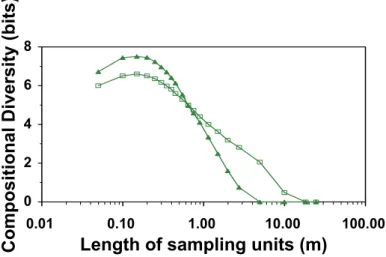
Figure 1. Beta diversity (measured by Compositional Diversity, i.e. by the diversity of realized species
combinations) as a function of sampling scale (resolution). We used the maximum of this function for further comparisons in this study.
To avoid potential hidden influences of gamma diversity, beta diversity was calculated with constant gamma diversity (S=10, only the 10 most abundant species were included in the analyses at each sites). Beta diversity (measured by Compositional Diversity) changed considerably with resolution. The beta diversity relationships between pastures changed also with resolution. Beta diversity was smaller in Holstein-Friesian cattle pasture than in Hungarian Grey cattle pasture at finer scales (between 0.5 cm and 0.55 cm). The relationship turned to the opposite direction at larger plot sizes (Figure 1), i.e., beta diversity became larger in the Holstein-Friesian cattle pasture. Note, that at both sites, maximum beta diversity appeared at the same resolution (ca. 0.15 cm), but the maximum was larger on the pasture grazed by Hungarian Grey cattle. Contrary, minimum beta diversity (beta=0, no compositional variability, i.e., all plots have the same species combination) appeared at finer scale in the Hungarian Grey cattle pasture.
a, b,
0 2 4 6 8 10 max.Co mp o sitio nal Diversity (b
its)
0 5 10 15 20 25
starting positions of windows (m)
Hungarian Grey cattle pasture Holstein-Friesian cattle pasture
maximum minimum local diversity local diversity s=10 constant 0 2 4 6 8 10 max. Composi ti onal Di versi ty (bi ts)
0 5 10 15 20 25
starting positions of windows (m)
Hungarian Grey cattle pasture Holstein-Friesian cattle pasture
maximum
minimum local diversity
local diversity s=7 constant
Figure 2.Beta diversity profile showing spatial variability of local beta diversity along sample transects in two grasslands grazed by Hungarian Grey cattle and Holstein-Friesian cattle respectively. Beta diversity is measured
by the maximum of Compositional Diversity.
4. Discussion
Field experiments are often constrained by various factors (only slight differences between treatments, spatial heterogeneity or short-temporal extent) that might result in ambiguous patterns. Our approach, due to high-resolution sampling and the various scaling procesess, is sensitive enough to reveal slight and only locally appearing differences. Field example demonstrates that beta diversity (i.e. the related within-stand vegetation patterns) can differ when the overall alpha and gamma diversities are similar. Consequently, an assessment or monitoring with beta diversity is able to reveal patterns that would remain hidden if only alpha or gamma diversity were used. The hidden dependence between beta and alpha diversity (Wilson and Shmida, 1984; Jost, 2007, 2010) can lead to misinterpretations when beta diversity values are compared between areas with different alpha diversity (Jost, 2007). In our field example, alpha diversities did not differ between sites. Furthermore, we chose a general and very simple solution to this problem using constant number of species in the analyses. Subsequent analyses with the original species richness gave the same results (not shown here).
Our result suggests that grazing by Hungarian Grey cattle could increase beta diversity at fine-scale while at larger scales beta diversity decreases. This trend is consistent with findings of previous studies (Juhász-Nagy and Podani, 1983; Bartha, 1991; Tóthmérész, 1994; Bartha, 2001) and suggests a general pattern typical in regeneration process (Bartha, 2001, 2004), while the opposite trend is found in degradation (Bartha, 2001, 2004). Based on these results, beta diversity is an appropriate indicator for detecting recovery (assembly) or degradation (disassembly) in vegetation. The methodology we suggested is complex, however, sampling in transects in the field is simple and not time-consuming, and the subsequent detailed analyses are performed routinely by computer programs (cf. Bartha et al., 1998).
Choosing appropriate state-variables and scaling parameters are crucial for successful assessments and monitoring. With our methodology, we collect high resolution data at the level of species providing baseline data for subsequent rescaling operations. For example, species level data can be transformed to functional groups or to state-variables of economical interest (e.g. feeding values). Selecting new scaling parameters (e.g. plot sizes, window sizes and lags) during the processes of secondary sampling offers various ways to adopt the analyses to the nature of changing vegetation structures (Podani, 1992). Therefore, the methodology we propose here fulfill the criteria raised for adaptive monitoring (Lindenmayer and Likens, 2009).
In this paper, a simple example for pilot explorative purposes were presented with emphasis put on simplicity and the visualization of patterns. However, applying null-models based on Monte Carlo randomizations (Gotelli and Graves, 1996; Gotelli, 2001) or mechanistic simulation models (Bartha et al., 1998; Bartha, 2008a) extend this approach for developing spatial statistics dealing with complex non-stationer patterns.
Since agri-environment payments come from EU budget, the related impact assessment is obligatory. As part of the Hungarian rural development policy, considerable efforts were paid to develop a monitoring system for the purpose of National Agri-environmental Programme and also for Natura 2000 sites (Podmaniczky, 2007; Horváth and Szitár, 2007). Principles, methodology and monitoring protocols were built between 2005 and 2010 (Horváth and Szitár, 2007; Horváth et al., 2007, 2009ab). Detailed field monitoring has been started on Natura 2000 sites, however, similar data collections on farm-lands supported by agri-environmental programmes are still missing. According to present planning, the related systematic field monitoring will start from 2012. The analyses presented here fit to the general methodological framework of vegetation monitoring (cf. Horváth and Szitár, 2007), and it can be implemented easily using existing protocols (Horváth et al., 2007, 2009a).
5. Conclusions
Assessing the success of agri-environmental schemes needs appropriate monitoring. Most seminatural grasslands are specific non-equilibrium systems. Monitoring vegetation changes induced by specific grassland management schemes requires specific methodology. The transect-based analysis of beta diversity, we proposed in this paper, is relatively simple and not time-consuming. We demonstrated that incorporating fine-scale spatial sampling and analyses into routine monitoring protocols is useful and able to detect patterns that would remain hidden with traditional quadrat sampling. We use transect sampling that is much faster than other sampling methods, therefore, it is effective also at landscape-scale surveys and for long-term monitoring with tolerable sampling disturbance.
Acknowledgements
We acknowledge the general support of the Balaton Uplands National Park. The research was supported by the Hungarian National Science Foundation (OTKA K 72561).
References
Anderson MJ, Crist TO, Chase JM, Vellend M, Inouye BD, Freestone AL, Sanders NJ, Cornell HV, Comita LS, Davies KF, Harrison SP, Nathan JB, Kraft NJB, James C, Stegen JC, Swenson NG. Navigating the multiple meanings of diversity: a roadmap for the practicing ecologist. Ecol. Letters 2011;14: 19-28.
Ángyán J, Fésűs I, Podmaniczky L, Tar F, Madarassy A. Nemzeti Agrár-környezetvédelmi Program. Ministry of Agriculture and Rural Development, Budapest, Hungary. 1999.
Bartha S. Diversity processes during revegetation on dumps from strip coal-mining. Monograph Symposium "Biological Diversity, Madrid, 1991:180-181.
Bartha S. Életre keltett mintázatok. A JNP modellekről. In: Oborny B. editor. Teremtő sokféleség. Emlékezések Juhász-Nagy Pálra. Budapest: Academic Press, 2001;61-95.
Bartha S. Beyond trivial relationships: on the hidden aspects of biodiversity. Folia Geobot. 2008a; 43: 371-382. Bartha S. Mikrocönológiai módszerek a táji vegetáció állapotának vizsgálatára. Tájökol. Lapok 2008b;6: 229-245.
Bartha S, Horváth F. Application of long transects and information theoretical functions to pattern detection. I. Transects versus isodiametric sampling units. Abstr. Bot. 1987;11: 9-26.
Bartha S, Campatella G, Canullo R, Bódis J, Mucina L. On the importance of fine-scale spatial complexity in vegetation restoration. Int. J. Ecol. Environ. Sci. 2004;30: 101-116.
Bartha S, Czárán T, Podani J. Exploring plant community dynamics in abstract coenostate spaces. Abstr. Bot. 1998;22: 49-66.
Bartha S, Campetella G, Ruprecht E, Kun A, Házi J, Horváth A, Virágh K, Molnár, Zs. Will inter-annual variability in sand grassland communities increase with climate change? Community Ecology 2008;9 (Suppl): 13-21.
Bartha S, Campetella G, Kertész M, Hahn I, Kröel-Dulay Gy, Rédei T, Kun A, Virágh K, Fekete G, Kovács-Láng E. Beta diversity and community differentiation in dry perennial sand grasslands. Annali di Botanica 2011;1: 9-18.
Boots B, Local measures of spatial association. Ecosience 2002;9: 168-176. Borhidi A. Magyarország növénytársulásai. Budapest: Akadémiai Kiadó, 2003.
Brunsdon C, Charlton M. Local trend statistics for directional data – a mowing window approach. Comp., Env. and Urb. Syst. 2006;30: 130-142.
Campetella G, Canullo R, Bartha S. Fine-scale spatial pattern analysis of the herb layer of woodland vegetation using information theory. Plant Biosyst. 1999;133: 277-288.
Campetella G, Canullo R, Bartha S. Coenostate descriptors and spatial dependence in vegetation – derived variables in monitoring forest dynamics and assembly rules. Community Ecology 2004;5: 105-114.
Csillag F, Kertész M, Davidson A, Mitchell S. On the measurement of diversity-productivity relationships in a northern mixed grass prairie (Grassland National Park, Saskatchewan, Canada). Community Ecology 2001;2: 145-159.
Fekete G. Tudományterületi áttekintések. Fitocönológia és vegetációtan: hazai aspektusok. Bot. Közlem. 1995;82: 107-127.
Gotelli NJ. Research frontiers in null model analysis. Global Ecol. Biogeogr. 2001;10: 337-343. Gotelli NJ, Graves GR. Null models in ecology. Washington: Smithsonian Institution Press, 1996.
Gosz J, Peters D, Kertész M, Kovács-Láng E, Kröel-Dulay Gy, Bartha S. Organization of grasslands along ecological gradients: US-Hungarian LTER Grassland cooperation. In: Lajtha K, Vanderbilt K. editors. Cooperation in Long term Ecological Research in central and eastern Europe. Proceedings of the ILTER Regional Workshop, 1999 Jun 22-25; Budapest, Hungary. Oregon State University. 2000.
Gunderson LH, Pritchard Jr. L. editors. Resilience and the behaviour of large-scale systems. Island Press, Washington, 2002.
Haraszthy L, Ángyán J, Podmaniczky L, Vajnáné MA. Nemzeti Vidékfejlesztési Terv Érzékeny Természeti Területek Programja 2004, Tájékoztató gazdálkodóknak. 2004.
Herben T, Krahulec F, Hadincová F, Kovárová M. Small- scale variability as a mechanism for large-scale stability in mountain grasslands. J. Veg. Sci. 1993;4: 163-170.
Hooper DU, Chapin FS, Ewel JJ, Hector A, Inchausti P, Lavorel S, Lawton LH, Lodge DM, Loreau M, Naeem S, Schmid B, Setala H, Symstad AJ, Vandermeer J, Wardle DA. Effect of biodiversity on ecosystem functioning: a consequences of current knowledge. Ecol. Monogr. 2005;75: 3-35.
Horváth A. Miért kell „mindenáron” monitoroznunk? In: Horváth A, Szitár K. editors. Agrártájak növényzetének monitorozása. A hatás-monitorozás elméleti alapjai és gyakorlati lehetőségei. Vácrátót: MTA ÖBKI 2007: 12-13.
Horváth A, Bartha S, Botta-Dukát Z, Kröel-Dulay Gy, Virágh K. AIR Biodiverzitás Monitorozás. Botanikai indikátorváltozók vizsgálatának részletes leírása. – Kutatási jelentés, Vácrátót: MTA ÖBKI, 2007.
Horváth A, Bartha S, Bölöni J. Natura 2000 élőhely-monitorozás. Struktúra és funkció protokoll. Tanulmány a Környezetvédelmi és Vízügyi Minisztérium számára. Kézirat, Vácrátót: MTA ÖBKI, 2009a.
Horváth A, Bartha S, Virágh K, Somodi I, Szitár K, Molnár Zs, Bölöni J, Biró M, Kovács-Láng E, Török K. Monitorozási protokollok kialakítása a természetvédelem és az agrár-környezetgazdálkodás országos programjai számára. In: Török K, Kiss KT, Kertész M. editors. Válogatás az MTA Ökológiai és Botanikai Kutatóintézet kutatási eredményeiből 2009. ÖBKI Műhelyfüzetek 2. Vácrátót: MTA ÖBKI, 2009b: 37-44.
Jost L. Partitioning diversity into independent alpha and beta components. Ecology 2007;88: 2427-2439. Jost L. Independence of alpha and beta diversities. Ecology 2010.;91: 1969-1974.
Juhász-Nagy P. A cönológia koegzisztenciális szerkezeteinek modellezése. Akadémiai Doktori Értekezés, Budapest. (Kézirat) 1980.
Juhász-Nagy P. Notes on compositional diversity. Hidrobiologia 1993;249: 173-182.
Juhász-Nagy P, Podani J. Information theory methods for the study of spatial processes and succession. Vegetatio 1983;51: 129-140.
Kleijn D, Sutherland WJ. How effective are European agri-environment schemes in conserving and promoting biodiversity? J. Appl. Ecol. 2003;40: 947-969.
Kleijn D, Berendse F, Smit R, Gilisen N. Agri-environment schemes do not effectively protect biodiversity in Dutch agricultural landscapes. Nature 2001;413: 723-725.
Keith DA, Martin TG, McDonald-Madden E, Walters C. Uncertainty and adaptive management for biodiversity conservation. Biol. Conserv. 2011;144: 1175-1178.
Körmöczi L, Balogh A. The analysis of pattern change in a Hungarian sandy grassland. In: Krahulec F, Agnew ADQ, Agnew S, Willems JH. editors. Spatial processes in plant communities. Praha: Academia, 1990: 49-58. Lindenmayer DB, Likens GE. Adaptive monitoring: a new paradigm for long-term research and monitoring. TREE 2009;24: 482-486.
Loreau M, Naeem S, Inchausti P. editors. Biodiversity and Ecosystem Functioning. Synthesis and Perspectives. Oxford: Oxford Univ. Press, 2002.
Ludwig JA, Cornelius JM. Locating discontinuities along ecological gradients. Ecology 1987;68: 448-450. McNaughton SJ. Diversity and stability. Nature 1988;333: 204-205.
Mészáros I. Spatial changes in herb layer in a beech forest/clear cut area ecotone from northern Hungary. In: Krahulec F, Agnew ADQ, Agnew S, Willems JH. editors. Spatial processes in plant communities. Praha: Academia, 1990: 59-71.
Mile O, Mészáros I, Lakatos Gy, Veres Sz. A talaj térbeli változatossága és a növényzet közötti összefüggés vizsgálata kiskunsági szikes területen. Agrokémia és Talajtan 2001;50: 427-438.
Podani J. Computerized sampling in vegetation studies. Coenoses 1987;2: 9-18.
Podani J. Space series analysis of vegetation processes reconsidered. Abstr. Bot. 1992;17: 37-51. Podani J. With a machete through the jungle: some thoughts on community diversity. Acta Biotheoretica 2006;54: 125-131.
Podani J, Schmera D. A new conceptual and methodological framework for exploring and explaining pattern in presence-absence data. Oikos 2011;120: 1625-1638.
Podmaniczky, L. editor. Az AIR monitoring funkcióinak fejlesztése, monitoring adatszolgáltatás I. Javaslat az AIR terepi monitoring rendszerének mintavételi helyeire és indikátoraira. Tanulmány a Mezőgazdasági Szakigazgatási Hivatal Központ számára. 2007.
R Development Core Team 2009. R: A language and environment for statistical computing. R Foundation for Statistical Computing, Vienna. Available from: http://www.R-project.org.
Tilman D, Kareiva P. editors. Spatial Ecology. Princeton, New Jersey: Princeton University Press, 1997. Tóthmérész B. Statistical analysis of spatial pattern in plant communities. Coenoses 1994;9: 33-41.
Tuba Z, Csintalan Zs, Nagy Z, Szente K, Kemény G, Takács Z, Koch J, Badacsonyi A, Murakeözy P, Palicz G, Kóbor Sz, Ötvös E, Bartha S. Synphysiology: theoretical foundation and explorative field studies to a new discipline. In: Fekete G. editor. A közösségi ökológia frontvonalai. Budapest: Scientia Kiadó, 1998:171-196. Vida G. Helyünk a bioszférában. Budapest: Typotex, 2001.
Virágh K, Horváth A, Bartha S, Somodi I. A multiscale methodological approach novel in monitoring the effectiveness of grassland management. Community Ecology 2008;9: 237-246.
Wilson MV, Shmida A. Measuring beta diversity with presence-absence data. J. Ecol. 1984;72: 1055-1064. Whittingham MJ. Will agri-environment schemes deliver substantial biodiversity gain, and if not why not? J. Appl. Ecol. 2007;40: 947-969.