Magyar Agrárinformatikai Szövetség
Hungarian Association of Agricultural Informatics
Agrárinformatika Folyóirat. 2010. 1. évfolyam 2. szám Journal of Agricultural Informatics. 2010 Vol. 1, No. 2
Online educational repositories for promoting agricultural knowledge
C.I. Costopoulou1, M.S. Ntaliani2, M.T. Maliappis3, R. Georgiades4, A.B. Sideridis5
I N F O
Received 19 Oct. 2010 Accepted 24 Nov. 2010 Available on-line 30 Nov. 2010 Responsible Editor: K. Rajkai
Keywords:
agricultural education, institutional repositories, open access archives, open source software.
A B S T R A C T
Towards promoting sustainable agriculture and economic growth, the development of the agricultural workforce and set up of innovative agricultural systems are required. Agricultural educational repositories are systems used for storing, reusing and sharing agricultural learning resources. They contribute to agricultural education at different educational levels and target groups. Thus, this paper firstly provides an overview of Institutional Repositories (IRs) and Open Access Archives (OAAs) in Greece and agricultural repositories worldwide. Also, it describes the agricultural repositories that provide access to educational content in Greek and presents experiences from the establishment of Agricultural University of Athens’ (AUA) repository.
1. Introduction
Nowadays, the educational process for tutors and pupils has been greatly facilitated by giving access to learning resources through educational repositories. Online learning repositories are Web based repositories used for storing, reusing and sharing learning resources. An Institutional Repository (IR) is a digital collection of the intellectual output of an institution, accessible to users both within and outside of the institution (i.e. universities, research organizations, NGOs, government agencies and private institutions. Also, Open Access Archives (OAAs) are digital learning repositories of submitted material that the authors or their institutes wish to make publicly available without financial or technical barriers. The major difference between IRs and OAAs is that IRs can be closed access, while OAAs are always open to outside users.
In European Union, there is a great variety of learning/educational repositories. Although, the majority of them include digital content and a brief description (metadata), there are also repositories that are only catalogues of learning resources. Educational repositories include any type of resource from „traditional‟ texts books to digital materials. Nonetheless, the trend is in favour of the latter type for promoting
1 C.I. Costopoulou
Informatics Laboratory, Agricultural Univeristy of Athens, 75 Iera Odos, 118 51 Athens, Greece [email protected]
2 M.S. Ntaliani
Informatics Laboratory, Agricultural Univeristy of Athens, 75 Iera Odos, 118 51 Athens, Greece [email protected]
3 M.T. Maliappis
Informatics Laboratory, Agricultural Univeristy of Athens, 75 Iera Odos, 118 51 Athens, Greece [email protected]
4 R. Georgiades
American Farm School, P.O. Box 23, 551 02, Thessaloniki, Greece [email protected]
5 A.B. Sideridis
teachers‟ uptake of innovative materials and learning style and making resources available and visible to the users (EDRENE, 2009).
Towards promoting sustainable agriculture and economic growth, the development of the agricultural workforce and set up of innovative agricultural systems are required. Concerning agricultural repositories, they focus on agricultural education and training. Either providing elementary, vocational, college or general education, they should address particular target groups, namely farmer communities, agricultural policy makers, agri-business and industry communities, public communities, research and development communities and agricultural education communities.
Thus, the aim of this paper is to present a new initiative for establishing an agricultural educational repository by the Agricultural University of Athens (AUA). During a century of operation, AUA has produced a great amount of information and knowledge, and now possesses an enormous collection of rare books, magazines, photographs and other educational material. The main objectives for developing an IR in AUA are to preserve the cultural and scientific heritage of the university, provide open access to grey literature, and promote scientific research and education.
The structure of the paper is the following: in the next section IRs and OAAs in agriculture and those providing Greek content, as well as the current status of IRs and OAAs in Greece are presented. Section 3 presents DSpace, a widely known mechanism, upon which many IRs have been built. Section 4 describes lessons learnt from establishing the AUA repository. Section 5 introduces the Metaschool project, regarding the training of tutors in agricultural repositories. Finally, some conclusions and discussion on further work are given.
2. Background
2.1 Agricultural IRs and OAAs
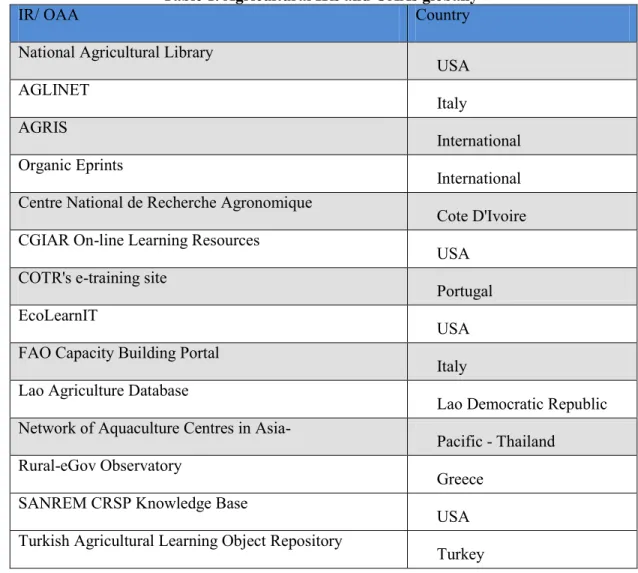
A number of initiatives have been established for the development of online educational repositories related to agriculture using semantic technologies, envisioning a one stop shop for all kinds of information related to agriculture. Such initiatives include the following: the National Agricultural Library of the United States housing one of the world' s largest and most accessible agricultural information collections; AGLINET, which is a voluntary association of large agricultural libraries in Italy; AGRIS (International System for Agricultural Science and Technology) referring to a global public domain Database with 2.6 millions structured bibliographic resources; and Organic E-prints regarding an international open access archive for papers related to research in organic agriculture. Table 1 analytically shows good examples per country.
Table 1. Agricultural IRs and OAAs globally
IR/ OAA Country
National Agricultural Library
USA AGLINET
Italy AGRIS
International Organic Eprints
International Centre National de Recherche Agronomique
Cote D'Ivoire CGIAR On-line Learning Resources
USA COTR's e-training site
Portugal EcoLearnIT
USA FAO Capacity Building Portal
Italy Lao Agriculture Database
Lao Democratic Republic Network of Aquaculture Centres in Asia-
Pacific - Thailand Rural-eGov Observatory
Greece SANREM CRSP Knowledge Base
USA Turkish Agricultural Learning Object Repository
Turkey
2.2 IRs and OAAs in Greece
According to recent surveys, there is a rapid growth of academic IRs, showing that 15 out of 33 institutions run their own repositories. Although authors are sceptical about releasing their work to the eyes of the wider public, mainly due to copyright infringement, open access is gaining ground and fans all over Greece (Chantavaridou, 2009). Also, academic IRs or smaller ones at department level are growing. Dissertations and undergraduate theses, reports, conference papers, and post prints comprise the core material. For a small country like Greece the problem of knowledge dissemination has been resolved via HEAL-link (www.heal-link.gr). The use of open source software for creating IRs in Greece has facilitated the operation of “openarchives.gr”, a private initiative for searching across Greek IRs. Currently, it is the only search engine that searches simultaneously across a collection of Greek IRs via OAI-PMH protocol. Moreover, IRs have been developed mainly using open source software, such as Dspace
(http://www.dspace.org), Greenstone (http://www.greenstone.org), Dienst
3. DSpace platform
DSpace is an open source software platform that enables organizations to capture, describe and preserve digital assets. It is designed to support the long-term preservation of the digital material stored in the repository. Provides support for a variety of digital formats and content types including text, images, audio, and video and distributes it over the web. DSpace allows contributors to limit access to items in DSpace - at the collection and the individual item level. DSpace provides long-term physical storage and management of digital items in a secure, professionally managed repository including standard operating procedures such as backup, mirroring, refreshing media, and disaster recovery. It is typically used as an institutional repository. It has three main roles regarding facilitating: (a) capture and ingest of materials, including metadata about the materials; (b) easy access to the materials, both by listing and searching; and (c) the long term preservation of the materials.
The DSpace submission process allows for the description of each item using a qualified version of the Dublin Core metadata schema. Digital items are made up of a bundle of digital files and the system allows for the creation, indexing, and searching of associated metadata to locate and retrieve the items and provides distributed access to these items through a search and retrieval subsystem. DSpace repository uses Apache Lucene as search engine. Lucene is an open source search engine and is used by DSpace to implement indexing and searching facilities. Lucene provides stop word removal, stemming, and the ability to incrementally add new indexed content without regenerating the entire index. The two software products are based on Java language and are highly extendible. Summarizing, DSpace includes the following features:
(a) User Interface
Provides a Web based mechanism for submission by end-user and System Administrators Supports search and retrieval of items by browsing or searching the metadata
(b) Workflow
Enables differing submission workflows for communities
(c) Open Archives Initiative (OAI)
Is OAI-PMH 2.0 compatible and uses the OCLC OAICat
(d) Persistent Identifiers (Handles)
Implements CNRI handles as the persistent identifier associated with each item
(e) Access Control
Allows contributors to limit access to items at both the collection and the individual item level.
(f) Metadata Schema
Utilizes qualified Dublin Core (DCMI, 2008).
4. AUA repository
The committee initially decided to adopt the creation of an IR as a means to accomplish its task. There are several software tools that can be used to develop and run an IR. The appropriate tool should fulfil several criteria set by the committee. Among these criteria are the easiness of access, support of several storage formats, handling of copyrights, enhanced storage and search capabilities, extendibility and flexibility and support of metadata harvesting standards, such as OAI-PMH.
The investigation process considered mainly open source software and checked as serious candidates DSpace, Greenstone, Dienst, and Fedora. Finally, the committee selected DSpace as the most appropriate tool, since it fulfils the main selection criteria and provides easiness of installation and low maintenance cost and has the ability to define a work-flow for material submission.
In the first stage of its operation the IR includes electronic theses and dissertations. Its access is realized through the AUA library or the link: http://dspace.aua.gr/. In order to fulfil the liabilities for their degree in agricultural sciences, students have to elaborate a dissertation. The same applies to the post graduate and doctoral students. Each year almost 500 new theses and dissertations are produced. In the future, it is scheduled to incorporate a collection of rare books and agricultural magazines that exist in the archives of the university. Long term plans include the incorporation of the majority of grey literature produced at the university, with emphasis on the research papers and reports.
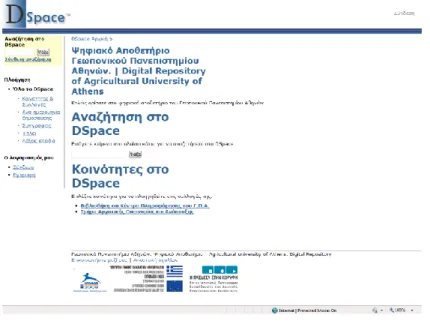
At the present stage of development (Fig. 1), the content of the IR can be searched through its metadata. It is harvested using OAI-PMH protocol by “openarchives.gr” and is indexed in Directory of Open Access Repositories (DOAR), the Registry of Open Access Repositories (ROAR) and the Greek Digital Resources Index. In the future, the activation of the full-text searching capability of DSpace and the connection of IR with a federated searching mechanism to all heterogeneous resources available at AUA (Digital Library collections, OPAC, IR, etc.) is planned.
Some representative metadata elements used in AUA‟ s repository are the following: author name, university department, editor name, student id, date of copyright, date or date range that the item became available to the public, date of publication or distribution, recommend for theses/dissertations, abstract or summary, degree title, number of pages.
5. Metaschool project
Since the majority of Greek authors are still sceptical about providing their work to the wide public due to copyrights, AUA is making efforts to promote open access to learning repositories. In this direction, an initiative has been launched from October 2008. Metaschool is a European project aiming at improving in-service training of tutors and school Information and Communication Technology (ICT) staff through the effective use of digital content. Metaschool focuses on organization, sharing, use and re-use of digital learning resources that can be accessed through online learning repositories. Analytically, the main objectives of the project are the following: (a) adaptation, development, testing, implementation and dissemination of a training framework regarding metadata, learning resources, and learning repositories; (b) development and implementation of strategies/ best practices for organizing favourite/useful learning resources into personal portfolios of digital resources and setting up learning repositories at school or regional level; (c) proposal and testing of teaching methodologies/ pedagogical strategies regarding the use of digital learning resources in the context of the educational process for the subjects of Science and Agriculture; and (d) organization of pilot training and validation activities for teachers/ ICT staff to develop methods/ strategies for taking advantage from organizing learning resources into personal portfolios/ learning repositories and exchanging resources with teachers around Europe.
As far as agriculture is concerned, the particular project can support it in many ways. As mentioned above, environmental/agricultural education is one of its thematic areas (Costopoulou et al., 2010). The particular area has been chosen because from one side numerous agricultural content and resources are available on the Internet allowing for a variety of instructional approaches, and from the other side environmental/agricultural education has not been fully incorporated in the school curricula despite its significance to sustainable development.
Regarding the Metaschool tutors‟ training, it is distinguished into three levels. The first level refers to digital learning resources and repositories and involves training on integrating online content to core academic content in lesson plans. The second level concerns educational metadata and training on accurate tagging and adding metadata to resources that tutors have used/created. The third level regards social metadata and folksonomies and involves training in developing skills on combining the advantages of traditional metadata with state-of-the-art folksonomy approaches.
The training has been designed mainly on technical and technical aspects. Analytically, the non-technical dimension concerns issues such as evincing the value of sharing educational material, using social networks in education, informing on Intellectual Property Rights protection and Creative Commons Licence. The technical dimension concerns issues such as interconnecting repositories, localisation of concrete learning resources, using the Internet in educational activities, introducing learning repositories, objects/resources and communities. It must be mentioned that the training will also include broader issues regarding the lack of teachers‟ time and ensuring the high quality of educational material. According to the aforementioned requirements, a framework comprised of 21 self-contained modules has been designed. The modules are distinguished into three types: (a) teaching and learning; (b) ICTs in teaching and learning; and (c) technical training.
For promoting the effort of open access to learning repositories, a training session for agricultural tutors in Greece took place at the premises of the American Farm School on March 2010. The aim of this session was to provide advanced training in using learning repositories and metadata. Eleven persons participated in the session, representing academic administration, in-service teachers, and library and computer resource staff. Although the audience was of different background and interests, the session was very well received, the faculty was quite engaged and enthusiastic and the level of commitment was pretty high.
outstanding part considers that the session can improve much or very much their future instructions and most that it will enrich them. Also, the smashing majority is willing to attend another session. Participants have no doubt that the session could be beneficial and all agree that it is an important activity. More than half believe that the session was average to very good and. the majority seems to have enjoyed it. Most of them believe that the knowledge presented was averagely known by them and they did not have much difficulty in using the tools/techniques shown. Also, they feel more competent in metadata and the use of online resources.
The participants estimate that their teaching practice will change averagely after the session. The motivation of the majority regarding using educational portal in teaching is higher than before attending the session and their motivation for using techniques and tools is much higher. The session has succeeded in adding very much to the motivation of participants in uploading learning objects or scenarios to an educational portal. Overall, the session has fulfilled the participants‟ expectations and more than half have increased their digital competence.
6. Conclusions
Agricultural education, can undoubtedly contribute to the improvement of quality of life by helping farmers to increase production, conserve natural resources, and provide nutritious food. In Greece open access to agricultural knowledge is gaining ground every day. In this context, AUA supports the knowledge dissemination through its evolving repository. In parallel, it participates in an even greater effort that has been started towards the development and cooperation of IRs for all Greek universities. The initiative is funded by European Union and Greek Government in the context of the National Strategic Reference Framework (NSRF) 2007-2013. The main purpose of this effort is to digitise a major part of the material held by the libraries and the archives of the universities in order to preserve this cultural and scientific heritage, providing open access to grey literature, and promoting scientific research and education. The material is consisted of rare books, magazines, photographs, research papers, theses, dissertations and other educational material. Moreover, AUA is contributing to the promotion of open access to learning repositories and the effective use of digital content via in-service training of tutors and school ICT staff in the context of the Metaschool project. Future work will concern the study of interoperability issues of agricultural repositories with Greek content, supported by academic institutions and related organizations, in order to build a national harvesting service.
Acknowledgment
The authors wish to acknowledge that part of this work has been funded by the European Union through the Comenius Programme.
References
Chantavaridou, E. 2009. Open access and institutional repositories in Greece: progress so far. OCLC Systems & Services. 25(1): 47-59.
Costopoulou, C., Manouselis, N., Ntaliani, M., and Tzikopoulos, A. 2010. Training agricultural tutors in digital learning repositories. In Proc. 3rd International Congress on Information and Communication Technologies in Agriculture, Food, Forestry and Environment, 15-21. Samsun, Turkey.
DCMI. 2008. Dublin Core Metadata Element Set, Version 1.1. DCMI Recommendation. Available from: http://dublicore.org.