Original Research Article
Prevalence and pattern of thyroid malignancy in thyroid nodule in
Aseer Central Hospital in KSA
Jibril Yahya Hudise
1*, Khalid Ali Alshehri
1, Saad Nasser Alqarni
1, Yara Assiri
2,
Ashwaq Asiri
2, Bayan Aljobran
2, Atheer Alshehri
2, Fatimah Asiri
2INTRODUCTION
Thyroid nodules are common in the general population, especially in women.1 Non palpable nodules are often found when patients undergo diagnostic imaging such as ultrasonography and computed tomography of the chest and neck.2 Thyroid nodules can be palpated in 4% to 7% of adults.3 However, they are found incidentally in up to
40% of patients who undergo ultrasonography of the neck.4 Some studies estimate that 20% to 76% of the pop-ulation has at least one thyroid nodule.5 Factors associated with increased risk of thyroid cancer include history of radiation to the head or neck, especially in childhood.6 The rate of malignancy for a palpable nodule in a previously irradiated thyroid is 20% to 50%.7
ABSTRACT
Background: Thyroid nodules are common in the general population, especially in women. Non palpable nodules are often found when patients undergo diagnostic imaging such as ultrasonography and computed tomography of the chest and neck. This retrospective study to assess the Prevalence of thyroid malignancy in thyroid nodule related to gender, age, and pathology, in Aseer Central Hospital KSA.
Methods: During a 5-year period (2011–2016), the medical records of 319 patients with thyroid nodules were collected from the department of pathology at Aseer Central Hospital KSA. The cases were reviewed for data on gender, age, and the pathological result. All patients underwent hemi or total thyroidectomy. Comparisons between genders, age groups, and tissue origins were performed. All statistical tests were performed with SPSS software. Results: Over a period of 5 years, a total of 319 patients: male 17.2% and female 82.8% Underwent for hemi or total thyroidectomy. The age of presentation was ranging from 14 to 80 years. Among the 319 cases of thyroid nodules 73.7% were benign nodules and 26.3% malignant nodules. Papillary thyroid carcinoma in 72.6%, follicular thyroid carcinoma 10.6%, Hurthle cell carcinoma 4.8%, anaplastic carcinoma 4.8%, thyroid lymphoma 4.8% and medullary thyroid carcinoma in 2.4%.
Conclusions: Thyroid nodule is a common clinical problem and the proportion of such nodules that prove to be malignant is not small, investigations are of immense help to corroborate with the clinical and morphological finding. Papillary thyroid carcinoma most common malignant thyroid carcinoma followed by follicular thyroid carcinoma, hurthel cell carcinoma, anaplastic thyroid carcinoma, lymphoma and finally medullary thyroid Carcinoma. No significant different between male and female as risk factors for malignancy.
Keywords: Thyroid nodules, Thyroid carcinoma, Prevalence
1
Department of ORLHNS, Aseer Central Hospital, Abha, KSA
2Medical Student, KKU, Abha, KSA
Received: 01 September 2017 Revised: 18 September 2017 Accepted: 19 September 2017
*Correspondence: Dr. Jibril Yahya Hudise, E-mail: [email protected]
Copyright: © the author(s), publisher and licensee Medip Academy. This is an open-access article distributed under the terms of the Creative Commons Attribution Non-Commercial License, which permits unrestricted non-commercial use, distribution, and reproduction in any medium, provided the original work is properly cited.
Objectives
This retrospective study to assess the Prevalence of thyroid malignancy in thyroid nodule related to gender, age, and pathology, in Aseer Central Hospital KSA.
METHODS
During a 5-year period (2011–2016), the medical records of 319 patients with thyroid nodules were collected from the department of pathology at Aseer Central Hospital, KSA.The cases were reviewed for data on gender, age, and the pathological result. All patients underwent hemi or total thyroidectomy. Comparisons between genders, age groups, and tissue origins were performed. Age group subdivided to less than 10 years, 10 to 20, 21 to 40, 41 to 60, and more than 61 years. All statistical tests were performed with SPSS software.
RESULTS
Over a period of 5 years, a total of 319 patients thyroid nodules, underwent for hemi or total thyroidectomy.
Age distribution of the patients
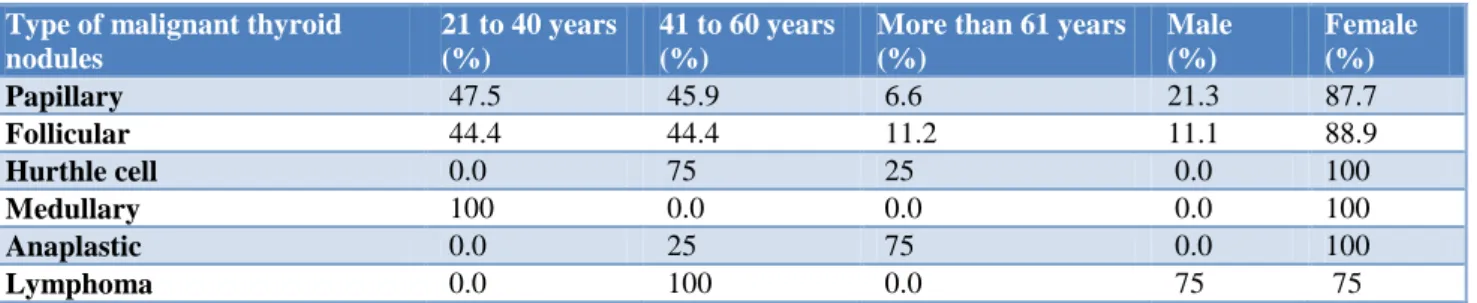
The age of presentation in thyroid nodules range from 14 to 80 years. The most common age at presentation was in thyroid nodules from 21 to 40 years 51.8% (Table 1). The most common age at presentation in PTC from 21 to 40 years 29 cases 47.5%, in follicular thyroid carcinoma (FTC) most of cases from 21 to 40 and 41 to 60 years, in Hurthle cell carcinoma most of cases from 41 to 60 years 3 cases 75%, in medullary thyroid carcinoma (MTC) all cases from 21 to 40 years, in anaplastic thyroid carcinoma most of cases more than 61 years cases 75% and in lymphoma 4 cases all from 41 to 60 years (Table 2).
Sex distribution of the patients
In total thyroid nodules 319 patients, 55 male 17.2% and 264 female 82.8%. In benign thyroid nodule male 17% and female 83%.In malignant thyroid nodules male 17.9% and female 82.1% (Table 2 and 3).
Table 1: Age distribution among the patients enrolled into study.
Age in years Count Percentage (%)
Less than 10 0 0.0
11 to 20 18 5.6
21 to 40 165 51.8
41 to 60 121 37.9
More than 61 15 4.7
Total 319 100
Table 2: The relation between each type of malignant thyroid nodules, age and sex.
Type of malignant thyroid nodules
21 to 40 years (%)
41 to 60 years (%)
More than 61 years (%)
Male (%)
Female (%) Papillary 47.5 45.9 6.6 21.3 87.7 Follicular 44.4 44.4 11.2 11.1 88.9
Hurthle cell 0.0 75 25 0.0 100
Medullary 100 0.0 0.0 0.0 100
Anaplastic 0.0 25 75 0.0 100
Lymphoma 0.0 100 0.0 75 75
Table 3: Sex distribution in malignant thyroid nodules.
Count Percentage (%)
Male 15 17.9
Female 69 82.1
Total 48 100
Pathological distribution of thyroid nodules
Most of cases were benign nodule 73.7% and malignant nodules in 84 cases 26.3%. The most common benign nodules nodular hyperplasia 160 cases 50.2% in total
Table 4: Tissue diagnosis of patients with thyroid nodules.
Count Percentage (%)
Nodular hyperplasia 160 50.2
Hashimotos thyroditis 49 15.4
Follicular adenoma 26 8.2
Papillary thyroid carcinoma 61 19.2 Follicular thyroid carcinoma 9 2.8
Hurthle cell carcinoma 4 1.2
Medullary thyroid carcinoma 2 0.6 Anaplastic thyroid carcinoma 4 1.2
Lymphoma 4 1.2
Total 319 100
Table 5: The pattern of thyroid carcinoma among patients with thyroid nodules.
Type of thyroid carcinoma Count Percentage (%)
Papillary 61 72.6
Follicular 9 10.6
Hurthle cell 4 4.8
Medullary 2 2.4
Anaplastic 4 4.8
Lymphoma 4 4.8
Total 84 100
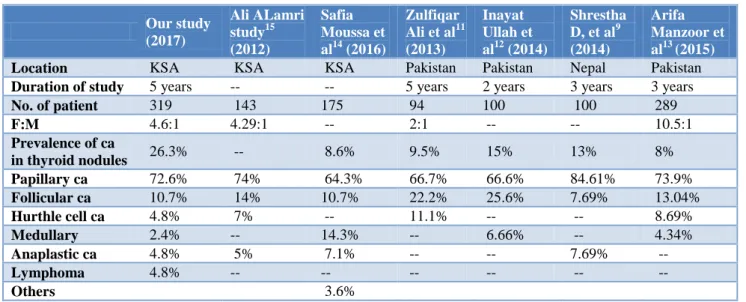
Table 6: Comparison between our study and other local and international study in pattern of thyroid malignancy.
Our study (2017)
Ali ALamri study15 (2012)
Safia Moussa et al14 (2016)
Zulfiqar Ali et al11 (2013)
Inayat Ullah et al12 (2014)
Shrestha D, et al9 (2014)
Arifa Manzoor et al13 (2015) Location KSA KSA KSA Pakistan Pakistan Nepal Pakistan Duration of study 5 years -- -- 5 years 2 years 3 years 3 years No. of patient 319 143 175 94 100 100 289 F:M 4.6:1 4.29:1 -- 2:1 -- -- 10.5:1 Prevalence of ca
in thyroid nodules 26.3% -- 8.6% 9.5% 15% 13% 8% Papillary ca 72.6% 74% 64.3% 66.7% 66.6% 84.61% 73.9% Follicular ca 10.7% 14% 10.7% 22.2% 25.6% 7.69% 13.04% Hurthle cell ca 4.8% 7% -- 11.1% -- -- 8.69% Medullary 2.4% -- 14.3% -- 6.66% -- 4.34% Anaplastic ca 4.8% 5% 7.1% -- -- 7.69% -- Lymphoma 4.8% -- -- -- -- -- --
Others 3.6%
DISCUSSION
Thyroid carcinoma is the most common endocrine carcinoma, as it accounts for almost 90% of all endocrine malignancies.6 Refeidi et al studied pattern of thyroid cancer in thyroid nodules in southwestern KSA it show 17.8% was malignant.8 Shrestha et al studied the incidence of thyroid carcinoma in multinodular goiter in Nepal which show malignant thyroid lesion in 13%.9 In our study the incidence of thyroid malignancy 26.3% in total thyroid nodules. Alzahrani et al studied thyroid cancer in Saudi Arabia at King Faisal hospital which
and showed as 11-20 years 4%, 21-40 years 68%, 41-60 years 24% and more than 60 years 4%.9 In our study: in papillary thyroid carcinoma most common age presentation from 21 to 40 year followed by age from 41 to 60 years 47.5% and 45.9% consecutively. In follicular Thyroid carcinoma most common age presentation from 21 to 40 year followed by age from 41 to 60 years 44.4% and 44.4% consecutively, in Hurthle cell carcinoma most common age presentation from 41 to 60 years 75%. In anaplastic thyroid carcinoma most common age presentation more than 60 years 75%. In lymphoma all cases presented from 41 to 60 years. And in medullary thyroid carcinoma all cases presented from 21 to 40 years. Regarding histopathological distribution of thyroid carcinoma, Ali et al study show papillary carcinoma 66.7%, follicular carcinoma 22.2% and anaplastic 11.1%.11 In Ullah et al study papillary carcinoma 66.6%, follicular carcinoma 25.6% and medullary carcinoma 6.66%.12 In Manzoor et al study papillary carcinoma 73.9%, follicular carcinoma 13.04%, Hurthle cell carcinoma 4.34% and medullary carcinoma 8.69%.13 Shrestha et al studied papillary carcinoma 84.61%, follicular carcinoma 7.69% and anaplastic 7.69%.9 Moussa et al studied the pattern of thyroid carcinoma among patients in King Khalid Hospital, Hail region, papillary carcinoma 64.3%, medullary 14.3%, follicular 10.7%, anaaplastic 7.1% and metastatic 3.6%.14 ALamri studied the pattern of thyroid cancer in eastern province of Saudi Arabia which show papillary carcinoma 74%, follicular carcinoma 14%, Hurthle cell carcinoma 7%, and anaplastic carcinoma 5%.15 In our study papillary carcinoma 72.6%, follicular carcinoma 10.6%, Hurthle cell carcinoma 4.8%, anaplastic carcinoma 4.8%, lymphoma 4.8% and medullary carcinoma 2.4% (Table 6).
CONCLUSION
Since the finding of a thyroid nodule is a common clinical problem and the proportion of such nodule that prove to be malignant is not small, investigations are of immense help to corroborate with the clinical and morphological finding, Fine needle aspiration and biopsy has been shown to establish a correct diagnosis in a substantial number of cases before resorting to surgery. Papillary thyroid carcinoma most common malignant thyroid carcinoma followed by follicular thyroid carcinoma, Hurthle cell carcinoma, anaplastic thyroid carcinoma, lymphoma and finally medullary thyroid carcinoma. No significant different between male and female as risk factors for malignancy.
Limitation
It is a retrospective cohort study based on quality of records keeping in hospital, also our study based only in one center.
ACKNOWLEDGEMENTS
We would like to thank all doctors and nurses working in histopathology department in Aseer central hospital.
Funding: No funding sources Conflict of interest: None declared
Ethical approval: The study was approved by the Institutional Ethics Committee
REFERENCES
1. Cooper DS, Doherty GM, Haugen BR, Kloos RT, Lee SL, Mandel SJ, et al. Revised American Thyroid Association management guidelines for patients with thyroid nodules and differentiated thyroid cancer: the American Thyroid Association (ATA) guidelines taskforce on thyroid nodules and differentiated thyroid cancer.
2. Tunbridge WMG, Evered DC, Hall R, Appleton D, Brewis M, Clark F, et al. The spectrum of thyroid disease in a community: the Whickham survey. Clin Endocrinol. 1977;7(6):481-
3. Stang MT, Carty SE. Recent developments in predicting thyroid malignancy. Curr opi Oncol. 2009;21(1):11-
4. Yoon DY, Chang SK, Choi CS, Yun EJ, Seo YL, Nam ES, et al. The prevalence and significance of incidental thyroid nodules identified on computed tomography. J Computer Assisted Tomography. 2008;32(5):810-
5. Mandel SJ. A 64-year-old woman with a thyroid nodule. J Am Med Associate.
6. Kilfoy BA, Zheng T, Holford TR, Han X, Ward MH, Sjodin A, et al. International patterns and trends in thyroid cancer incidence, 2009; 1973– 2002. Cancer Causes Control. 2009;20(5):525- 7. Yeung MJ, Serpell JW. Management of the solitary
thyroid nodule. Oncologist. 2008;13(2):105- 8. Refeidi AA, Al-Shehri GY, Al-Ahmary AM,
Tahtouh MI, Alsareii SA, Al-Ghamdi AG, et al. Patterns of thyroid cancer in Southwestern Saudi Arabia. Saudi Med J. 2010;31(11):1238-41.
9. Shrestha D, Shrestha S. The incidence of thyroid carcinoma in Multinodular goiter: A retrospective study. J Coll Med Sci-Nepal. 2015;10(4): - 10. Alzahrani AS, Alomar H, Alzahrani N. Thyroid
Cancer in Saudi Arabia: A Histopathological and Outcome Study. Int J Endocrinol. 2017;8423147:7 11. Ali BZ, Phulpoto JA, Shaikh NA. Multinodular
goiter; frequency of malignancy. Professional Med J 2013;20(6):1035-41.
12. Ullah I, Hafeez M, Ahmad N, Muahammad G, Gandapur S. Incidence of thyroid malignancy in multinodular goiter. Cell. 2014;92: - 13. Manzoor A, Khan F, Jamal S. Frequency of
Care Hospital Experience. J Islamabad Med Dental Coll. 2015;4(2):64-
14. Moussa S, Alshammari A, Alshammari G, Alshammar K, Alanzi M, Alanzi N, et al. Pattern of Thyroid Disease in Hail Region, Saudi Arabia. Int J Sci Res. 2014;5(2):276-82.
15. Al-Amri, Ali M. Pattern of Thyroid Cancer in the Eastern Province of Saudi Arabia: University
Hospital Experience. J Cancer Therap. 2012;3(3):187.