Indifferentiable Authenticated Encryption
Manuel Barbosa1 and Pooya Farshim2,3
1
INESC TEC and FC University of Porto, Porto, Portugal
DI/ENS, CNRS, PSL University, Paris, France
3
Inria, Paris, France
Abstract. We study Authenticated Encryption with Associated Data (AEAD) from the viewpoint of composition in arbitrary (single-stage) environments. We use the indifferentiability framework to formalize the intuition that a “good” AEAD scheme should have random ciphertexts subject to de-cryptability. Within this framework, we can then apply the indifferentiability composition theorem to show that such schemes offer extra safeguards wherever the relevant security properties are not known, or cannot be predicted in advance, as in general-purpose crypto libraries and standards.
We show, on the negative side, that generic composition (in many of its configurations) and well-known classical and recent schemes fail to achieve indifferentiability. On the positive side, we give a provably indifferentiable Feistel-based construction, which reduces the round complexity from at least 6, needed for blockciphers, to only 3 for encryption. This result is not too far off the theoretical optimum as we give a lower bound that rules out the indifferentiability ofanyconstruction with less than 2 rounds.
Table of Contents
1 Introduction. . . 3
1.1 Background on Indifferentiability. . . 3
1.2 Motivation . . . 4
1.3 Contributions . . . 6
1.4 Limitations and future work. . . 10
2 Basic Definitions . . . 11
2.1 Games. . . 11
2.2 Offline reference objects. . . 11
2.3 Authenticated-Encryption with Associated-Data . . . 12
3 AEAD Indifferentiability . . . 14
3.1 Definition . . . 14
3.2 Consequences. . . 15
4 Differentiators . . . 16
4.1 Generic composition. . . 17
4.2 A glimpse of CAESAR . . . 21
4.3 Interpretations. . . 21
5 Ideal Offline AEAD . . . 22
5.1 Indifferentiability of Encode-then-Encipher . . . 22
5.2 Indifferentiability of 3-round Feistel . . . 25
5.3 Removing restrictions and simplifications . . . 34
6 Efficiency Lower Bounds . . . 37
7 Ideal Online AEAD . . . 41
7.1 Online primitives and reference objects . . . 41
7.2 The HashCHAIN construction . . . 45
A Generically Composed Schemes . . . 51
B Schematic Diagram for AEZ. . . 51
C RIV Is Differentiable . . . 52
D Proof of Lemma 2: Hybrid over Keys . . . 52
E Missing Details for Online AEADs. . . 53
E.1 Associated offline scheme . . . 53
E.2 ORAE security . . . 54
1 Introduction
Authenticated-Encryption with Associated-Data (AEAD) [Rog02, BN00] is a fundamental build-ing block in cryptographic protocols, notably those enablbuild-ing secure communication over untrusted networks. The syntax, security, and constructions of AEAD have been studied in numerous works. Recent, ongoing standardization processes, such as the CAESAR competition [Ber14] and TLS 1.3, have revived interest in this direction. Security notions such as misuse-resilience [PS16, GL15,
HRRV15, RS06], robustness [ADL17, AFL+16, HKR15], multi-user security [BT16],
reforgeabil-ity [FLLW17], and unverified plaintext release [ABL+14], as well as syntactic variants such as online
operation [HRRV15] and variable stretch [HKR15,RVV16] have been studied in recent works. Building on these developments, and using the indifferentiability framework of Maurer, Renner, and Holenstein [MRH04], we propose new definitions that bring a new perspective to the design of AEAD schemes. In place of focusing on specific property-based definitions, we formalize when an AEAD behaves like arandom one. A central property of indifferentiable schemes is that they offer security with respect to a wide class of games. This class includes all the games above plus many others, including new unforeseen ones. Indifferentiability has been used to study the security of hash functions [CDMP05,BDPV08] and blockciphers [CPS08,HKT11,ABD+13,DSSL16], where
constructions have been shown to behave like random oracles or ideal ciphers respectively. We inves-tigate this question for authenticated encryption and ask if, and how efficiently, can indifferentiable AEAD schemes be built. Our contributions are as follows.
Definitions: We define ideal authenticated-encryption as one that is indifferentiable from arandom keyed injection. This definition gives rise to a new model that is intermediate between the random-oracle and the ideal-cipher models. Accordingly, the random-injection model offers new efficiency and security trade-offs when compared to the ideal-cipher model. Along the way, we also recall the composition theorem and give an extension that includes game-based properties with multiple adversaries.
Constructions: We study a number of AEAD schemes from the view of indifferentiability. We obtain both positive and negative results. For most well-known constructions our results are negative. However, our main positive result is a Feistel construction that reduces the number of rounds from eight for ideal ciphers to only three for ideal keyed injections. This result improves the concrete parameters involved as well. We also give a transformation from offline to online ideal AEADs.
Efficiency lower bounds: Three rounds of Feistel are necessary to build injections. However, we prove a stronger result that lower bounds the number of primitive queries as a function of message blocks inany construction. This, in turn, shows that therate of our construction is not too far off the optimal solution. For this result we combine two lower bound techniques, one for collision resistance and the other for pseudorandomness, which may be of independent interest.
The central motivation for the study of indifferentiable encryption is the composition theorem. We give a brief overview of indifferentiability before discussing their implications for our work.
1.1 Background on Indifferentiability
a more complex scheme, such as a blockcipher or a variable-length hash function. The provable-security of such constructions has been analyzed mainly through two approaches. One is to formulate specific game-based properties, and then show that the construction satisfies them if its underlying primitives are secure. This methodology has been successfully applied to AEAD schemes. (See works cited in the opening paragraph of the paper.) Following this approach, higher-level protocols need to choose from a catalog of explicit properties offered by various AEAD schemes. For example, one would use an MRAE scheme whenever nonce-reuse cannot be excluded [PS16,GL15,HRRV15,
RS06] or a key-dependent message (KDM) secure one when the scheme is required to securely encrypt its own keys [BK11,BRS03].
The seminal work of Maurer, Renner, and Holenstein (MRH) on the indifferentiability of random systems [MRH04] provides an alternative path to study the security of symmetric schemes. In this framework, a public primitive f is available. The goal is to build another primitive F from f via a constructionCf. Indifferentiability formalizes a set of necessary and sufficient conditions for the
construction Cf to securely replace its ideal counterpartF in a wide range of environments: there
exists a simulator S, such that the systems (Cf, f) and (F, SF) are indistinguishable, even when
the distinguisher has access to f. Indeed, the composition theorem proved by MRH states that, if Cf is indifferentiable fromF, thenCf can securely replaceF inarbitrary (single-stage) contexts.4 Thus, proving that a construction C is indifferentiable from an ideal objectF amounts to proving thatCf retains essentially all security properties implicit inF. This approach has been successfully
applied to the analysis of many symmetric cryptographic constructions in various ideal-primitive models; see, e.g., [CDMP05,BDPV08,HKT11,DSSL16,DSST17]. Our work is motivated by this composition property.
1.2 Motivation
Maurer, Renner, and Holenstein proposed indifferentiability as an alternative to the Universal Com-posability (UC) framework [Can01] for compositional reasoning in idealized models of computation such as the random-oracle (RO) and the ideal-cipher (IC) models. Indifferentiability permits finding constructions that can safely replace ideal primitives (e.g., the random oracle) in various schemes. The UC framework provides another general composition theorem, which has motivated the study of many UC-secure cryptographic protocols. K¨usters and Tuengerthal [KT09] considered UC-secure symmetric encryption and defined an ideal functionality on par with standard notions of symmetric encryption security. This, however, resulted in an intricate functionality definition that adds complexity to the analysis of higher-level protocols.
By adopting the indifferentiability framework for the study of AEADs, we follow an approach that has been successfully applied to the study of other symmetric primitives. As random oracles formalize the intuition that well-designed hash functions have random-looking outputs, ideal en-cryption formalizes random-looking ciphertexts subject to decryptability. This results in a simple and easy-to-use definition. We discuss the benefits of this approach next and give limitations and open problems at the end of the section.
4
We recall this theorem and its proof. Consider a game G that allows an adversaryA to attackCf with direct oracle access tof. Game Gcontrols the attack surface viaGCf,Af. Viewing the composition of the gameGand the adversaryAas an indifferentiability attacker, we may use the indifferentiability ofCf to show that the analysis
Once a primitive is standardized for general and widespread use, it is hard to predict in which environments it will be deployed, and which security properties may be intuitively expected from it. For example, consider a setting where a protocol designer follows the intuition that an AEAD scheme “essentially behaves randomly” and, while not knowing that AE security does not cover key-dependent message attacks [BK11,HK07,BRS03] (KDM), uses a standardized general-purpose scheme for disk encryption. A similar problem could occur in a cloud storage scenario when dedupli-cation schemes [BKR13,ABM+13] are used. In other settings, a designer might create correlations
among keys (as in 3GPP confidentiality and authenticity mechanisms) or allow an adversary to
tamper parts of the key (e.g., set them to zero), expecting the underlying scheme to offer security against related-key attacks [IK04, BK03] (RKAs). There are also chosen-key settings where the adversary is allowed to entirely choose the keys. For example, certain MPC protocols [CO15] rely on AE schemes that need to be committing against malicious adversaries, which can choose all inputs and thus also the keys. This has lead to the formalizations of committing [GLR17] and key-robust [FOR17] authenticated encryption. When there is leakage, parts of the key and/or ran-domness might be revealed [PSV15, BMOS17]. All of these lie beyond standard notions of AE security, so the question is how should one deal with such a multitude of security properties.
One approach would be to formulate a new “super” notion that encompasses all features of the models above. This is clearly not practical. The model (and analyses using it) will be error-prone and, moreover, properties that have not yet been formalized will not be accounted for. Instead, and as mentioned above, we consider the following approach: a good AEAD scheme should behave like a random oracle, except that its ciphertexts are invertible. We formulate this in the language of indifferentiability, which results in a simple, unified, and easy to use definition. In indifferentiability the adversarial interfaces are not restricted to uniformly or independently chosen keys. All inputs are under the control of the adversary. This means that the security guarantees offered extend to notions that allow for tampering with keys or creation of dependencies among the inputs. Once indifferentiability is proved, security with respect to all these games, combinations thereof, and new yet unforeseen notions simultaneously follows as a corollary of the composition theorem.
Therefore one use-case for indifferentiable schemes would be to provision additional safeguards againstprimitive misuse in various deployment scenarios, such as general-purpose crypto libraries or standards, where the relevant security properties for target applications are complex or not known. We discussed some of these in the paragraph above. Protocol designers can rely on the intuition given by an ideal view of AEADs when integrating schemes into higher-level protocols, keeping game-based formulations implicit. Other applications include symbolic protocol analysis, where such idealizations are intrinsic [MW04] and security models where proof techniques such as programmability may be required [Unr12].
A concrete example. In Facebook’s message-franking protocol, an adversary attempts to com-pute a ciphertext that it can later open in two ways by revealing different keys, messages and header information. (Facebook sees one (harmless) message, whereas the receiver gets another (possibly abusive) message.) Grubbs, Lu, and Ristenpart [GLR17] formalize the security of such protocols and show that a standard AEAD can be used here, provided that it satisfies an additional security property called r-BIND [GLR17, Fig. 17 (left)].
scheme (a keyed random injection) indeed satisfies r-BIND and this is what, intuitively, the protocol designers seem to have assumed: that ciphertextslook random and thus collisions are hard to find, even if keys are adversarially chosen.
Indifferentiable AEADs therefore allow designers to rely on the above (arguably pragmatic) random-behavior intuition much in the same way as they do when using hash functions as random oracles. As the practicality of random oracles stems from their random output behavior (beyond PRF security or collision resistance) indifferentiable AEAD offers similar benefits: instead of fo-cusing on a specific game-based property, it considers a fairly wide class of games for which the random behavior provably holds. Thus an indifferentiable AE can be used as a safety net to ensure any existing or future single-stage assumptions one may later need is satisfied (with the caveat of possibly weaker bounds). However, we note that for RO indifferentiability there is the additional motivation that a fair number of security proofs involving hash functions rely on modeling the hash as RO. Our work also unlocks the possibility to use thefull power of random injections in a similar way (see [KPS13] and footnote 5).
To summarize, in the context of Facebook’s protocol, if an indifferentiable scheme was used from the start, it would have automatically met the required binding property. The same holds for RKA security (in 3GPP), KDM security (in disk encryption), and other single-stage AEAD applications.
1.3 Contributions
Definitions.The MRH framework has been formulated with respect to a general class of random systems. We make this definition explicit for AEAD schemes by formulating an adequate ideal reference object. This object has been gradually emerging through the notion of a pseudorandom injection (PRI) in a number of works [RS06,HKR15,HRRV15, BMM+15], and has been used to
study the security of offline and online AEADs [HKR15, HRRV15]. (We refer the reader to the work of Hoang, Reyhanitabar, Rogaway, and Viz´ar [HRRV15] for a review of the rich body of work in this area.) We lift these notions to the indifferentiability setting by introducing offline and online
random injections, which may be also keyed or tweaked. As a result, we obtain a new idealized model of computation: the ideal-encryption (or ideal-injection) model, which is intermediate between the RO and IC models.
Analysis of known schemes.We examine generic and specific constructions of AEADs that ap-pear in the literature in light of our new definition. Since indifferentiability implies security in the presence of nonce-misuse (MRAE) as well as its recent strengthening to variable ciphertext stretch, RAE security,5 we rule out the indifferentiability of a number of (classical) schemes that do not achieve these levels of security. This includes OCB [RBBK01], CCM, GCM, and EAX [BRW04], and all but two of the third-round CAESAR candidates [Ber14]. The remaining two candidates, AEZ [HKR17] and DEOXYS-II [JNPS16], are also ruled out, but only using specific indifferentia-bility attacks.
We then turn our attention to generic composition [BN00,NRS14]. We study the well-known Encrypt-then-MAC and MAC-then-Encrypt constructions via the favored (A1–A8) and modified
5
(B1–B8) composition patterns of Namprempre, Rogaway and Shrimpton [NRS14]. These include Synthetic Initialization Vector (SIV) [RS06] as A4 and EAX [BRW04] as B1. To simplify and generalize the analysis, we start by presenting a template for generic composition, consisting of a preprocessing and a post-processing phase, that encompasses a number of schemes that we have found in the literature. We show that if there is an insufficient flow of information in a scheme—a notion that we formalize—differentiating attacks exist. Our attacks render all of these construc-tions except A8 differentiable. We also identify key reuse as a mechanism to foil some of these attacks, leaving the modifications of A2, A6, and A8 with key reuse as potential indifferentiability candidates.
In short, contrarily to our expectations based on known results for hash functions and per-mutations, we could not find a well-known AEAD construction that meets the stronger notion of indifferentiability. We stress that these findings donotcontradict existing security claims. However, an indifferentiability attack can guide the search to find environments in which the scheme will not offer the expected levels of security. For example, the lack of a successful simulator for some of our differentiators stems from the fact that ciphertexts do not depend on all keying material, giving way to related-key attacks. In others, the attacks target intermediate values in a computation, and are reminiscent of padding oracles [Vau02]. Indeed, a scheme might be vulnerable to different types of differentiating attacks, leading to different “bad” environments. On the other hand, proving indif-ferentiability sets a lower bound for the complexity of any attack in any (single-stage) environment. For these reasons, and even though our results do not single out any of the CAESAR candidates as being better or worse than the others, we pose that our results are aligned with the fundamental goal of CAESAR and prior competitions such as AES and SHA-3, to “boost to the cryptographic research community’s understanding” of the primitive [Ber14].
Building injections.Looking for a simple and provably indifferentiable AEAD scheme, we revisit the classical Encode-then-Encipher (EtE) transform [BR00]. Given expansionτ, which indicates the required level of authenticity, EtE pads the input message with 0τ and enciphers it with a
variable-input-length (VIL) blockcipher. Decryption checks the consistency of the padding after recovering the message. We show that EtE is indifferentiable from a random injection in the VIL ideal-cipher model for any (possibly small) value of τ. The ideal cipher underlying EtE can be instantiated via the Feistel construction [CHK+16] in the random-oracle model or via the confusion-diffusion
construction [DSSL16] in the random-permutation model. In a series of works, the number of rounds needed for indifferentiability of Feistel has been gradually reduced from 14 [HKT11, CHK+16]
to 10 [DS15, DKT16] and recently to 8 [DS16]. Due to the existence of differentiators [CPS08,
CHK+16], the number of rounds must be at least 6. For confusion-diffusion, 7 rounds are needed
for good security bounds [DSSL16]. This renders the above approach to the design of random injections somewhat suboptimal in terms of the number of queries per message block to their underlying ideal primitives (i.e., theirrate).
To simplify the analyses and focus on fundamental problem of constructing random injections, we first prove indifferentiability for a restricted class of differentiators that are bound to fixed (but arbitrary) key, nonce, associated data and expansion values. We then show how to extend these results to adversarially controlled values. We do this by proving a slightly more general result that identifies a set of sufficient conditions on the construction, a simulator, and the ideal objects that guarantee independence of executions, allowing a hybrid argument to go through. Along the way, we also formalize a folklore result on key extension via random oracles for constructions and reference objects that are structured.
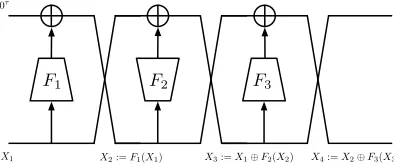
The simulator. Our main construction is an unbalanced 3-round Feistel network Φ3 with
inde-pendent round functions where an inputX1 is encoded with redundancy as (0τ, X1) (see Figure1).
The main task of our indifferentiability simulator is to consistently respond to round-function oracle queries that correspond to those that the construction makes for some (possibly unknown) inputX1. We show that with overwhelming probability the simulator can detect when consistency
with the construction must be enforced; the remaining isolated queries can be simulated using random and independent values.
X1 0⌧
X3:=X1 F2(X2)
X2:=F1(X1) X4:=X2 F3(X3)
F1 F2 F3
Fig. 1.Random injection from 3-round Feistel.
Take, for example, a differentiator that computes (X0
3, X40) := Φ3(X1) for some random X1, then
com-putes the corresponding round-function outputsX2 :=
F1(X1), Y2 := F2(X2), Y3 := F3(X1 ⊕Y2), and finally
checks if (X0
3, X40) = (X1⊕Y2, X2⊕Y3).
Note that these queries need not arrive in this par-ticular order. Indeed, querying F1(X1) first gives the
simulator an advantage as it can preemptively complete this chain of queries and use its ideal injection to give
consistent responses. A better (and essentially the only) alternative for the differentiator would be to check the consistency of outputs by going through the construction in the backward direction. We show, however, that whatever query strategy is adopted by the differentiator, the distribution of such chained queries in the real world takes the form
(X1, X2) (X2, Y2) (X1⊕Y2, Y3) (X1,(X1⊕Y2, X2⊕Y3))
∆corresponding, respectively, to F1, F2, F3 and the construction. In the ideal world, the last
component is fixed by the random injection. However, the simulator can still match the above by a change of variables, simulating them as
(X1, Y3⊕X4) (Y3⊕X4, X1⊕X3) (X3, Y3) (X1,(X3, X4))
for a random Y3, and (X3, X4) taken from the output of the random injection. For instance, in an
inverse attack, once the F2 and F3 queries arrive, (X3, X4) is fixed, and the simulator can use the
inverse construction oracle to work out the corresponding X1 and provide consistent answers.
real world. From the simulator’s perspective, such collisions would create ambiguity and prevent it from being able to check when consistency with the ideal object must be enforced. We show that for large τ the attacker would have no hope of finding collisions on the internal wires for distinct inputs in either direction.
As corollaries of our results (and the composition theorem) we obtain efficient and (simul-taneously) RKA and KDM-secure offline (and, as we shall see, online) AEAD schemes in the random-permutation model under natural, yet practically relevant restrictions on these security models. For example, if the ideal AEADAE is secure under encryptions ofφAE(K) for some oracle machineφAE, then so is an indifferentiable constructionCπ in presence of encryptions of φCπ
(K), the restriction being thatφdoes not directly accessπ.
Bounds.Security bounds, including simulator query complexity, are important considerations for practice. Our bound for the Encode-then-Encipher construction is essentially tight. Our simulator for the 3-round Feistel construction has a quadratic query complexity and overall bounds are birthday-type. Improving these bounds, or proving lower bounds for them [DRST12], remain open for subsequent work.
Our construction of an ideal encryption scheme from a non-keyed ideal injection introduces an additional multiplicative factor related to the number of different ideal injection keys queried by the differentiator, resulting from a hybrid argument over keys. Furthermore, the number of ideal injection keys used in the construction is bound to the number of encryption and decryption operations that are carried out. This means that the overall bound for our authenticated encryption construction includes a multiplicative factor of q3 (see Section5.3).
We note that the concrete constructions that we analyze may satisfy (R)AE, RKA or KDM security with improved bounds (via game-specific security analyses), while remaining compatible with the single proof and bound that we present for all single-stage games.
Online AEADs. We give simple solutions to the problem of constructing an indifferentiable
segment-oriented online AEAD scheme from an offline AEAD.
Following [HRRV15], we define ideal online AEAD scheme via initialization, next-segment en-cryption/decryption, and last-segment encryption/decryption procedures. The difference between next-segment and last-segment operations is that the former propagates state values, whereas the latter does not. Since a differentiator typically has access to all interfaces of a system, the state values become under its control/view. For this we restrict the state size of the ideal object to be finite and hence definitionally deviate from [HRRV15] in this aspect. Therefore our constructions have the extra security property that the state value hides all information about past segments.
The most natural way to construct an ideal online AEAD would be to chain encryptions of the segments by tweaking the underlying encryption primitive with the input history so far. This would ensure independence across segments for different keys, nonces and prefixes, which is also the intuition underlying the CHAIN transform of HRRV [HRRV15, Figure 8]. We show, how-ever, that standard XOR-based tweaking techniques [HRRV15, BMM+15] are not sound in the
indifferentiability setting and, in particular, we present a differentiating attack onCHAIN. In building an indifferentiable online AEAD scheme, we put use to the parallel composition properties enjoyed by indifferentiable constructions [MRH04,DGHM13]. By decomposing the ideal
object for online AEAD into simpler ones, we obtain a construction similar to CHAINessentially for free, where a random oracle is used to prepare the state for the next segment. This hashing operation, however, comes at an extra cost proportional to the total size of key, nonce, associated data, and message. By unwrapping the underlying key computation for the offline AEAD, we can reduce the overhead to one that is proportional to the length of the message only. We call the resulting schemeHashCHAIN. Via optimizations specific to 3-round Feistel, we are able to reduce the overheads further to aconstant number of hashes per segment. (We note, however, that other constructions might also be amenable to benefit from this technique.) Furthermore, our construction can also be optimized using a parallel and indifferentiable tree mode such as MD6 [DRRS09]. Lower bounds. The indifferentiability of Sponge [BDPV08] allows us to instantiate the round functions in 3-round Feistel with this construction and derive a random injection in the random-permutation model.7 This construction requires roughly 3w calls to its underlying (one-block) permutation, where w is the total number of input blocks. This is slightly higher than 2.5w for AEZ (which shares some of its design principles with us, but does not offer indifferentiability). This leads us to ask whether or not an indifferentiable construction with rate less than 3 is achievable. Our second main result is a lower bound showing the impossibility of any such construction with rate (strictly) less than 2. To prove this lower bound, we combine negative results for constructions of collision-resistant hash functions [Sta08,BCS05] and pseudorandom number generators by Gennaro and Trevisan [GT00], and put critical use to the existence of an indifferentiability simulator. To the best of our knowledge, this is the first impossibility result that exploits indifferentiability.
Roughly speaking, we prove the lower bound as follows. Take any indifferentiable random func-tion Cπ :{0,1}wn −→ {0,1}wn from a permutationπ :{0,1}n−→ {0,1}n inq queries. We “slice”
the construction intoqcomponents that process incoming inputs (from the previous stage), make a singleπ-query, and return an output. Since the input space of Cπ is of size 2wn, we can iteratively
and in asmall number ofπ-queries find a subset of inputs of size at least 2nsuch that the firstw−1
slicesalways queryπ at a fixed set of points on these inputs. This means that the firstw−1 queries toπare essentially made redundant for inputs that are restricted to this subset. Let us now consider the rest of the slices consisting of q−(w−1) further queries to π. By viewing the corresponding π-responses as parts of a seed, we can show that this truncated construction is a secure PRG that makes no π calls and has a seed length that is shorter than its output length. However, no such PRG can information-theoretically exist. This means we must have thatn+ (q−(w−1))n≥wn, which translates toq≥2w−2. To make this argument precise, we have to ensure that hardwiring of various values does not result in PRG insecurity. For this, we rely on the indifferentiability of the construction. Our lower bound immediately extends to random injections as we can indifferen-tiably reduce a random function to a random injection in asingle query by simply chopping off a sufficiently large number of bits from the outputs of the injection. We do not have constructions or lower bounds for indifferentiable schemes with a rate r ∈[2,3). We leave bridging this gap for future work.
1.4 Limitations and future work
As clarified by Ristenpart, Shacham, and Shrimpton [RSS11], the indifferentiability composition theorem has limitations. It does not necessarily apply to multi-stage games where multiple ad-7The round-function for the intermediate round can actually be fully parallelized to cost a single parallel call to the
versaries cannot be collapsed into a single central adversary. Such games do exist, for example when an adversary’s outputs are constrained in their format/lengths. Accordingly, indifferentiable AEAD schemes come with similar limitations. Moreover, other types of attacks, such as side-channel analysis, algorithm substitution, backdoors, etc. lie outside the model.
Indifferentiability typically operates in an ideal model of computation. Although this methodol-ogy has been successful in the analysis of practical schemes, it leaves open the question of standard-model security. However, it does not exclude a “best of the two worlds” construction, which is both indifferentiable and, for example, is RAE secure under a standard-model assumption. For example, chop-Merkle–Damg˚ard [CDMP05] can be proven both indifferentiable from a random oracle and
collision resistant in the standard model under standard assumptions. We leave exploring this for future work.
2 Basic Definitions
We let N denote the set of non-negative integers, including zero, and {0,1}∗ denote the set of
all finite-length bit strings, including the empty string ε. (Note that {0,1}0 = {ε}.) For two bit
strings X and Y, X|Y denotes string concatenation and (X, Y) denotes a uniquely decodable encoding ofX andY. The length of a stringX is denoted by|X|.
2.1 Games
Ann-adversary gameGis a Turing machineGΣ,A1,...,An where Σ is a system (or functionality) and
Ai are adversarial procedures that can keep full local state but may only communicate with each
other through G. We say an n-adversary game Gn is reducible to an m-adversary game if there
is a Gm such that for any (A1, . . . ,An) there are (A10, . . . ,Am0) such that for all Σ we have that
GΣ,A1,...,An
n =GΣ,A
0
1,...,A
0
m
m . Two games are equivalent if they are reducible in both directions. An
n-adversary game is called n-stage [RSS11] if it is not equivalent to any m-adversary game with m < n. Any single-stage gameGΣ,A can be also written as A¯GΣ for some oracle machineG and
a class of adversarial procedures ¯A compatible with a modified syntax in which the game is called as an oracle.
2.2 Offline reference objects
Underlying the security definition for a cryptographic primitive there often lies anideal primitive that is used as areference object to formalize security. For instance, the security of PRFs is defined with respect to a random oracle, PRPs with respect to an ideal cipher, and as mentioned above, AEADs with respect to a random injection. Given the syntax and the correctness condition of a cryptographic primitive, we will define its ideal counterpart as the uniform distribution over the set of all functions that meet these syntactic and correctness requirements (but without any efficiency requirements). We start by formalizing a general class of ideal functions—that may be keyed, admit auxiliary data (such as nonces or authenticated data), or allow for variable-length outputs—and derive distributions of interest to us by imposing structural restrictions over the class of considered functions. This definitional approach has also been used, for example, in [BBT16, Section 6]. Ideal functions.A variable-output-length (VOL) functionF with auxiliary input has signature
whereA is the auxiliary-input space,M is the message space, X ⊆Nis the expansion space, and
R is the range. We let Fun[A×M×X −→ R] be the set of all such functions satisfying ∀(A, M, τ)∈A×M×X :|F(A, M, τ)|=τ .
We endow the above set with the uniform distribution and denote the action of sampling a uniform function F via F←←Fun[A×M×X −→ R]. To ease notation, given a function F, we define Fun[F] to be the set of all functions with signature identical to that of F. Granting oracle access toF to all parties (honest or otherwise) results in an ideal model of computation.
Injections. We define Inj[A×M×X −→ R] to be the set of all expanding functions that are injective on M:
∀(A, M, τ),(A, M0, τ)∈A×M×X :M =6 M0 =⇒ F(A, M, τ)6=F(A, M0, τ) , and satisfy the length restriction
∀(A, M, τ)∈A×M×X :|F(A, M, τ)|=|M|+τ .
Each injective function defines a unique inverse functionF− that maps (A, C, τ) to either a unique M if and only ifCis within the range ofF(A,·, τ), or to⊥otherwise. (Such functions are therefore
tidy in the sense of [NRS14].) This gives rise to astrong induced model for injections where oracle access is extended to include F−, which we always assume to be the case when working with injections.
Observe that when k = 0 the key space contains the single ε key and we recover unkeyed functions. For the sake of compactness we use the following abbreviations:
Fun[n, m] := Fun[{0,1}0× {0,1}n× {m} −→ {0,1}m],
Perm[n] := Inj[{0,1}0× {0,1}n× {0} −→ {0,1}n].
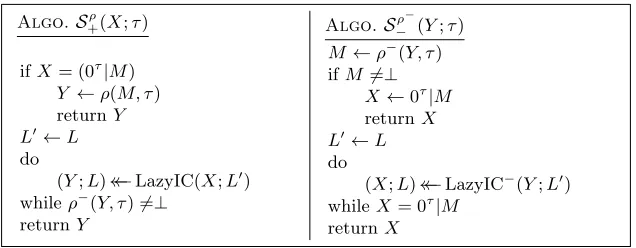
Lazy samplers. Various ideal objects (such as random oracles) often appear as algorithmic pro-cedures that lazily sample function values at each point. For instance, it is well known that lazy samplers for random functions and permutations with arbitrary domain and range exist. These procedures can be extended to admit auxiliary data and respect either of our length-expansion requirements above. Furthermore, given a listL of input-output pairs, these samplers can be mod-ified to sample a function that is also consistent with the points defined in L (i.e., the condi-tional distribution givenL is also samplable). We denote the lazy sampler for random oracles with (Y;L)←←LazyRO(A, X, τ;L) and that for ideal ciphers with (Y;L)←←LazyIC±(A, X;L). The case of random injection is less well known, but such a procedure appears in [RS06, Figure 6]. We denote this sampler with (Y;L)←←LazyRI±(A, X, τ;L).
2.3 Authenticated-Encryption with Associated-Data
We follow [HRRV15] in formalizing the syntax of (offline) AEAD schemes.8 We allow for arbitrary plaintexts and associated data, and also include an explicit expansion parameter τ specifying the level of authenticity that is required. Associated data may contain information that may be needed
8
in the clear by a higher-level protocol (such as routing information) that nevertheless should be authentic. We also only allow for public nonces as the benefits of the AE5 syntax with a private nonce are unclear [NRS13].
Syntax and correctness.An AEAD scheme is a triple of algorithms Π := (K,AE,AD) where: (1) K is the randomized key-generation algorithm which returns a keyK. This algorithm defines a non-empty set, the support ofK, and an associated distribution on it. Slightly abusing notation, we denote all these by K. (2) AE is the deterministic encryption algorithm with signature AE : K×N ×H× {0,1}∗ ×X −→ {0,1}∗. Here N ⊆ {0,1}∗ is the nonce space, H ⊆ {0,1}∗ is the
associated data space, and X ⊆ N is the set of allowed expansion values. We typically have that
K={0,1}k,N ={0,1}nfork, n∈
N,H={0,1}∗, and the expansion space contains a single value.
(3)ADis the deterministic decryption algorithm with signatureAD :K×N×H×{0,1}∗×X −→
{0,1}∗∪{⊥}. As usual we demand that
AD(K, N, A,AE(K, N, A, M, τ), τ) =M for all inputs from the appropriate spaces. We also impose the ciphertext expansion restriction that for all inputs from the appropriate spaces |AE(K, N, A, M, τ)| − |M|=τ.
Ideal AEAD. An ideal AEAD is an injection with signature (K×N ×H)×M×X −→C and satisfying the ciphertext-expansion restriction. Therefore an ideal AEAD is a random injection in Inj[(K×N ×H)×M×X −→ C]. Given a concrete AEAD scheme Π with signature K×N × H×M×X −→ C we associate the space AE[Π] := Inj[(K×N ×H)×M×X −→C] to it.9 Naming conventions.When referring to AEAD schemes we use (AE,AD) instead of (F,F−). When the associated-data space is empty, we use (E,D) for (encryption without associated data), when the nonce space is also empty we use (F,F−) (for keyed injection), when τ = 0 as well we use (E,E−) (for blockcipher), and if these are also unkeyed we use (ρ, ρ−) and (π, π−) respectively. For a random function (without inverse) we use H.
RAE security.Robust AE (RAE) security [HKR15,HRRV15,BMM+15] requires that an AEAD scheme behaves indistinguishably from an ideal AEAD under a random key. Formally, for scheme Π = (K,AE,AD) and adversary A we define
AdvraeΠ (A) := PrhRAE-RealΠAi−PrhRAE-IdealAΠi ,
where games RAE-RealAΠ and RAE-IdealAΠ are defined in Figure 2. Informally, we say Π is RAE secure ifAdvraeΠ (A) is “small” for any “reasonable” A. Misuse-resilient AE (MRAE) secu-rity [RS06] weakens RAE security by constraining the adversary to a fixed and sufficiently large value of expansionτ. AE security [Rog02] weakens MRAE security and requires that the adversary does not repeat nonces in its queries to either oracle. These definitions lift to idealized models of computation where, for example, access to an ideal injection in both the forward and backward directions is provided.
The following proposition formalizes the intuition that the ideal AEAD, that is the trivial AEAD scheme in the ideal AEAD model, is indeed RAE secure. This fact will be used when studying the relation between indifferentiability and RAE security.
Proposition 1 (Ideal AEAD is RAE secure). For any q-query adversary A attacking the trivial ideal AEADΠ in the ideal AEAD model we have thatAdvraeΠ (A)≤q/2k.
9
GameRAE-RealAΠ K←←K
b←←AEnc,Dec
returnb
Proc. Enc(N, A, M, τ) returnAE(K, N, A, M, τ)
Proc. Dec(N, A, C, τ) returnAD(K, N, A, C, τ)
GameRAE-IdealAΠ
(AE0
,AD0
)←←AE[Π]
K←←K b←←AEnc,Dec
returnb
Proc. Enc(N, A, M, τ) returnAE0(K, N, A, M, τ)
Proc. Dec(N, A, C, τ) returnAD0(K, N, A, C, τ)
Fig. 2.Games defining RAE security. The adversary queries its oracles on inputs that belong to appropriate spaces.
Proof. The adversary in the real and ideal worlds has, respectively, access to
(AE(· · ·),AD(· · ·),AE(K,· · ·),AD(K,· · ·)) and (AE(· · ·),AD(· · ·),AE0(K,· · ·),AD0(K,· · ·)). Here (AE,AD) and (AE0,AD0) are both ideal. These worlds are identical untilA queries the second set of oracles with the keyK. However, the probability of this event in the second environment over itsqqueries is at mostq/2kas the two oracles are independent and (AE0
,AD0) can be implemented
independently of K. ut
3 AEAD Indifferentiability
The indifferentiability framework of Maurer, Renner, and Holenstein (MRH) [MRH04] formalizes a set of necessary and sufficient conditions for one system to securely replace another in a wide class of environments. This framework has been successfully used to justify the structural sound-ness of a number of cryptographic constructions, including hash functions [CDMP05, DRS09], blockciphers [ABD+13, CHK+16, DSSL16], and domain extenders for them [CDMS10]. The
in-differentiability framework is formulated with respect to general systems. When the ideal AEAD object defined in Section 2.3is used, a notion of indifferentiability for AEAD schemes emerges. In this section, we recall indifferentiability of systems and make it explicit for AEAD schemes. We will then discuss some of its implications that motivate our work.
3.1 Definition
A random system or functionality Σ := (Σ.hon,Σ.adv) is accessible via two interfaces Σ.hon and Σ.adv. Here, Σ.hon provides a public interface through which the system can be accessed. Σ.adv corresponds to a (possibly extended) interface that models adversarial access to the inner workings of the system, which may be exploited during an attack on constructions. A system typically implements some ideal object F, or it is itself a construction CF0 relying on some underlying (lower-level) ideal object F0.
Indifferentiability [MRH04]. Let Σ1 and Σ2 be two systems and S be an algorithm called
the simulator. The (strong) indifferentiability advantage of a (possibly unbounded) differentiator
D against (Σ1,Σ2) with respect toS is
AdvindiffΣ1,Σ2,S(D) := PrhDiff-RealΣD1i−PrhDiff-IdealDΣ2,Si ,
where games Diff-RealDΣ1 and Diff-IdealDΣ2,S are defined in Figure 3. Informally, we call Σ1
in-differentiable from Σ2 if, for an “efficient” S, the advantage above is “small” for all “reasonable”
GameDiff-RealDΣ1 b←←DConst,Prim
returnb
Proc. Const(X)
return Σ1.hon(X)
Proc. Prim(X)
return Σ1.adv(X)
GameDiff-IdealDΣ2,S b←←DConst,Prim
returnb
Proc. Const(X) return Σ2.hon(X)
Proc. Prim(X)
returnSΣ2.adv(X)
Fig. 3.Games defining the indifferentiability of two systems.
In the rest of the paper we consider a specific application of this definition to two systems with interfaces
(Σ1.hon(X),Σ1.adv(x)) := (CF1(X),F1(x)) and (Σ2.hon(X),Σ2.adv(x)) := (F2(X),F2(x)),
where F1 and F2 are two ideal cryptographic objects sampled from their associated distributions
and CF1 is a construction of F
2 from F1. To ease notation, we denote the advantage function by
AdvindiffC,S (D) whenF1 and F2 are clear from context. TypicallyF2 will be an ideal AEAD andF1
a random oracle or an ideal cipher.
3.2 Consequences
MRH [MRH04] prove the following composition theorem for indifferentiable systems. Here we state a game-based formulation from [RSS11].
Theorem 1 (Indifferentiability composition). Let Σ1 := (CF1,F1) andΣ2:= (F2,F2) be two indifferentiable systems with simulator S. Let G be a single-stage game. Then for any adversary
A there exist an adversaryB and a differentiator D such that
PrhGCF1,AF1i≤PrhGF2,BF2i+Advindiff
C,S (D) .
Proof. The proof is simple enough to be presented here: PrhGCF1,AF1
i
≈Pr
GF2,ASF2
= PrhGF2,BF2
i
,
where the first transition follows from indifferentiability by viewing the composition of G and A as a differentiatorD, and the second from absorption of S intoA as adversary B. ut
As discussed in [RSS11], the above composition does not necessarily extend to multi-stage games since the simulator often needs to keeplocal state in order to guarantee consistency. However, some (seemingly) multi-stage games can be written as equivalent single-stage games (see Section 2 for a definition of game equivalence). Indeed, any n-adversary game where only one adversary can call the primitive directly and the rest call it indirectly via the construction can be written as a single-stage game as the game itself has access to the construction. We summarize this observation in the following theorem, which generalizes a result for related-key security in [FP15].
Theorem 2. Let Σ1:= (CF1,F1) andΣ2 := (F2,F2) be two indifferentiable systems with simula-tor S. Let G be an n-adversary game and A := (A1, . . . ,An) be an n-tuple of adversaries where
A1 can access F1 but Ai for i > 1 can only access CF1. Then there is an n-adversary B and a differentiator D such that
Pr
GCF1,AF1,A2CF1,...,AC
F1
n
≤PrhGF2,B1F2,B
F2 2 ,...,B
F2
n i
Remark 1.There is a strong practical motivation for the restriction imposed on the class of games above. Consider, for example, security against related-key attacks (RKAs) where the related-key deriving (RKD) function φF1 may depend on the ideal primitive [AFPW11]. The RKA game is
not known to be equivalent to a single-stage game. The authors in [FP15] consider a restricted form of this game where dependence of φ on the ideal primitive F1 is constrained to be through
the construction CF1 only. In other words, an RKD function takes the form φCF1
rather than φF1. When comparing the RKA security of a construction CF1 to the RKA security of its ideal counterpart, one would expect the set of RKD functions from whichφis drawn in two games to be syntactically fixed and hence comparable. Since no underlying ideal primitive for F2 exists, RKD
functions take the form φF2 and hence it is natural to consider RKD functions of the form φCF1 with respect to CF1. The same line of reasoning shows that an indifferentiable construction would resist key-dependent message (KDM) attacks for key-dependent deriving functions that depend on the underlying ideal primitive via the construction only. Other (multi-stage) security notions that have a practically relevant single-stage formulation include security against bad-randomness attacks, where malicious random coins are computed using the construction, and leakage-resilient encryption where leakage functions may rely on the construction. Therefore, from a practical point of view, composition extends well beyond 1-adversary games.
Remark 2. Theorem 1 only reduces the security of one system to that of another, leaving an overall security statement conditional on the latter. For instance, using the theorem one can deduce the RKA (resp., KDM or leakage-resilient) security of an indifferentiable construction CF1 of F
2 if F2 itself can be proven to be RKA (resp., KDM or leakage-resilient) secure. We have seen
an example of the latter in Proposition 1, where the ideal AEAD scheme is shown to be RAE secure. Hence Theorem1and Proposition1immediately allow us to deduce that an indifferentiable AEAD construction CF1 will be RAE secure in the idealized model of computation induced by its underlying ideal primitive F1. Analogous propositions for RKA, KDM, leakage resilience of
the ideal AEAD scheme (for quantified classes of related-key deriving functions, key-dependent deriving, and leakage functions) can be formulated. These in turn imply that an indifferentiable AEAD scheme will also resist strong forms of related-key, KDM, and leakage attacks. We leave a formal treatment to future work.
Public indifferentiability. Public indifferentiability is a (substantial) weakening of standard indifferentiability where the simulator gets to see all the queries that the differentiator makes to the construction oracle(s). This notion guarantees composition in games where all inputs to the construction are known to the adversary. Collision resistance would be an example of such a game. In the context of authenticated encryption, however, public indifferentiability is of limited use. In particular it does not imply AE security (or even one-wayness) as the encryption key is kept outside the view of the adversary in these security games.
4 Differentiators
Having defined AEAD indifferentiability, we ask whether or not (plausibly) indifferentiable con-structions of AEAD schemes in the literature exist. In this section we present a number of generic and specific attacks that essentially rule out the indifferentiability of many constructions that we have found in the literature.10We emphasize that existing schemes were not designed with the goal 10
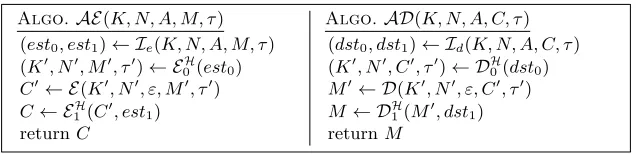
Algo.AE(K, N, A, M, τ) (est0, est1)←Ie(K, N, A, M, τ) (K0, N0, M0, τ0)←E0H(est0) C0←E(K0, N0, ε, M0, τ0)
C←EH
1(C
0
, est1) returnC
Algo.AD(K, N, A, C, τ) (dst0, dst1)←Id(K, N, A, C, τ) (K0, N0, C0, τ0)←D0H(dst0) M0←D(K0, N0, ε, C0, τ0)
M←DH
1(M
0
, dst1) returnM
Fig. 4.A template for a typical generically composed AEAD scheme (AE,AD) from an encryption scheme (without associated data) (E,D) and a hash functionH.
of meeting indifferentiability, and our attacks do not contradict any security claims made under the standard RAE, MRAE, or AE models. Indeed, many AEAD schemes are designed with the goal of maximizing efficiency, forsaking stronger security goals such as misuse resilience or robustness.
4.1 Generic composition
Any construction that is not (M)RAE secure (in the sense of [RS06,HKR15]) can be immediately excluded as one that is indifferentiable: the ideal AEAD is RAE secure (Proposition1), furthermore RAE is a single-stage game and hence implied by indifferentiability (Theorem1). This simple obser-vation rules out the indifferentiability of a number notable AEAD schemes such as OCB [RBBK01], CCM, GCM, EAX [BRW04], and many others. The MRAE insecurity of these schemes are discussed in the respective works.
RAE insecurity can be used to also rule out the indifferentiability of some generic AEAD constructions. In this section, we present a more general result by giving differentiators against a wide class of generically composed schemes, some of which have been proven to achieve RAE security. This class consists of schemes built from a hash function H, which we treat as a random oracle, and an encryption scheme (E,D), which we consider to be an ideal AEADwithout associated data. We assume that the encryption algorithm of the composed scheme operates as follows. An initialization procedure Ie is used to prepare the inputs to a preprocessing algorithm E0H and a
post-processing algorithm E1H. The preprocessing algorithm prepares the inputs to the underlying E algorithm. The post-processing algorithm gets the output ciphertext and completes encryption (e.g., by appending a tag value). The decryption algorithm operates analogously by reversing this process via an initialization procedure Id, a preprocessing algorithm D0H and a post-processing
algorithm D1H. See Figure 4 for the details.
The next theorem shows that this class of generically composed schemes are differentiable as long as certain conditions on information passed between the above sub-procedures are met.
Theorem 3 (Differentiability of generic composition). Let Π be a generically composed AEAD scheme from an encryption scheme (without associated data) (E,D) and a hash function
H that follows the structure shown in Figure 4 for some algorithms (Ie,E0,E1,Id,D0,D1). Let
∆C := |C| − |C0| denote the ciphertext overhead added by the transform. Suppose that one of the following conditions holds.
Type-I : Let est1 be the state passed to E1. We require that for all inputs (K, N, A, M) and for a sufficiently large∆1 we have that|(K, N, A, M)|−|est1| ≥∆1.11Furthermore, there is a recovery
11
algorithmR1 (with no oracle access) that on inputC recovers C0, the internal ciphertext output by E.
Type-II : Let dst0 be the state passed to D0. We require that for all inputs (K, N, A, C) and for a sufficiently large ∆2 we have that|(K, N, A, C)| − |dst0| ≥∆2. Furthermore, there is a recovery algorithm R2 (with no oracle access) that on input M0 recovers M, the output of DH1 (M0, dst1) in decryption.
Then Π is differentiable. More precisely, for any type-I (resp., type-II) scheme Π there exists a differentiator D1 (resp., D2) such that for any simulator S making at mostq queries in total to its ideal AEAD oracles
AdvindiffΠ,S (D1)≥1−q/2∆1 −(q+ 1)/2∆C and AdvindiffΠ,S (D2)≥1−q/2∆2 −(q+ 1)/2n . Proof. We start with type-I schemes. The differentiator computes a ciphertext for a random set of inputs using the construction in the forward direction and then checks if the result matches that computed via the generic composition using the provided primitive oracles. To rule out the existence of successful simulators the differentiator must ensure that it does not reveal information that allows the simulator to use its ideal construction oracles to compute a correct ciphertext. The restriction on the size ofest1 (and the ability to recompute the internal ciphertextC0 via R1) will
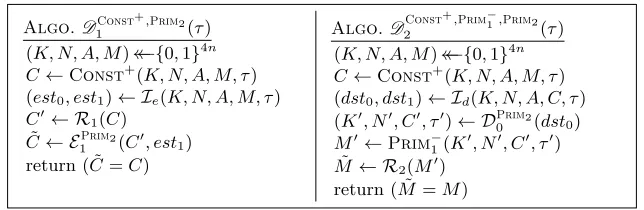
be used to show this. The pseudocode for the differentiator, which we callD1, is shown in Figure5
(left). The attack works for any given value ofτ, and to simplify the presentation, we have assumed all spaces consist of bit strings of lengthn.
Analysis of D1. It is easy to see that when D1 is run in the real world with respect to the
generically composed construction and with its correctly implemented underlying primitives, its output will be always 1. This follows from the fact that R1(C) will correctly recover the internal
ciphertextC0 and hence EPrim2
1 (C
0, est
1), being run with respect to correct inputs and hash oracle,
will also outputC.
We now consider the ideal world. We first modify the ideal game so that the ideal object presented to the simulator is independent of that used to answer construction queries placed by the differentiator. This game is identical to the ideal world unless S queries the forward construction oracle on (K, N, A, M, τ) (call this eventE1) or the backward construction oracle on (K, N, A, C, τ)
(call this event E2). We will bound the probability of each of these events momentarily. In the
modified game, we claim that no algorithm S can compute C from (C0, est1). This is the only
information aboutC that is revealed to a simulator and this claim in particular means that running EPrim2
1 (C0, est1) within D1 won’t output the correct C either. The answers to oracle queries placed
by S can be computed independently of the ideal construction oracles. Furthermore, (C0, est1)
misses at least ∆C bits of information about C as est1 is computed independently of C. The
simulator therefore has at most a probability of 1/2∆C of outputtingC in this game.
We now bound the probability of events E1 and E2 in the modified game. The occurrence of
EventE2is similar to the analysis above for guessing the value ofC, but here we admit thatS can
makeq distinct guesses corresponding to its maximum number of queries; this results in an overall boundq/2∆C. To analyze eventE
1, we observe that (C0, est1) misses∆1 bits of information about
the uniformly chosen (K, N, A, M) asC0 is simply a randomly chosen string. Hence, overq distinct
queries to the construction oracle, S can cause such an event with probability at mostq/2∆1. We therefore obtain an overall upper bound of (q+ 1)/2∆C +q/2∆1 for guessingC.
Algo.DConst +,
Prim2
1 (τ)
(K, N, A, M)←←{0,1}4n
C←Const+(K, N, A, M, τ)
(est0, est1)←Ie(K, N, A, M, τ)
C0←R1(C)
˜
C←EPrim2 1 (C
0
, est1) return ( ˜C=C)
Algo.DConst +,
Prim−1,Prim2
2 (τ)
(K, N, A, M)←←{0,1}4n
C←Const+(K, N, A, M, τ) (dst0, dst1)←Id(K, N, A, C, τ) (K0, N0, C0, τ0)←DPrim2
0 (dst0) M0←Prim−1(K
0
, N0, C0, τ0) ˜
M←R2(M0)
return ( ˜M =M)
Fig. 5.DifferentiatorsD1 andD2 against type-I and type-II schemes respectively.
generically composed encryption algorithm. In this case, however, the differentiator will perform the check by attempting to decrypt the internal ciphertext passed to E and verifying if the result matches themessagequeried to the construction oracle. Once again, the differentiator has to ensure that the simulator does not learn sufficient information to recover the originally queried message. (For example, the simulator would be able to do this via the backward construction oracle if it learns (K, N, A, C).) This will be guaranteed by the restriction imposed on the size ofdst0. AlgorithmR2
will be used to recover the original message M from the internal message M0 (e.g., by removing any tag values or masking). The pseudocode for this differentiator, which we call D2, is shown in
Figure 5(right). Again, the attack will work for any fixed value of τ.
Analysis of D2. It is easy to see that when D2 is run in the real world with respect to the
generically composed construction and its correctly implemented underlying primitives, the output will be always 1. This follows from the fact that Prim−1 oracle will correctly recover the internal
message M0 and hence R2, being run on the correct input, will recover the original messageM.
We follow a similar strategy to that for type-I schemes to analyze the success probability of simulators. We first modify the ideal game so that the ideal object presented to the simulator is independent of that used to answer construction queries placed by the differentiator. This game is identical to the ideal world unless S queries the forward construction oracle on (K, N, A, M, τ) (call this event E1) or the backward construction oracle on (K, N, A, C, τ) (call this event E2).
In this modified game, no algorithm S can compute M from dst0 alone (note that (K0, N0, C0, τ0)
are determined based on dst0). The answers to oracle queries placed by S can be computed
in-dependently of the ideal construction oracles and since dst0 is independent ofM—it is computed
from (K, N, A, C, τ) for a random C—the probability of guessing M is 1/2n. This in particular
means that the sequence of statements inD2 consisting ofD0Prim2,Prim
−
1 and R2 will output the
correct M with probability 1/2n as the sole input to perform these statements is dst 0.
We now bound the probability of events E1 and E2 in the modified game. The occurrence of
Event E2 is similar to the analysis above for guessing the value of M, but here we admit that S
can make q distinct guesses corresponding to its maximum number of queries; this results in an overall bound q/2n.
Finally, we consider the probability of event E2 where the simulator queries (K, N, A, C, τ).
Since the simulator only sees dst0, at least ∆2 bits of information about the uniformly chosen
(K, N, A, C) are missing from its view. Hence, over q distinct queries to the construction oracle, S can cause such an event with probability at mostq/2∆2. We therefore obtain an over all upper
Consequences for generic composition.Namprempre, Rogaway, and Shrimpton [NRS14] ex-plore various methods to generically compose an AEAD scheme from a nonce-based AE scheme (without associated data) and a MAC. In their analysis the authors single out eight favored schemes A1–A8. Roughly speaking, schemes A1, A2, and A3 correspond to Encrypt-and-MAC where, re-spectively, N, (N, A), and (N, A, M) are used in the preparation of the input IV to the base AE scheme. Scheme A4 is the Synthetic Initialization Vector (SIV) mode of operation [RS06, Figure 5], which is misuse resilient. Schemes A5 and A6 correspond to Encrypt-then-MAC, where IV is computed usingN and (N, A), respectively. Schemes A7 and A8 correspond to MAC-then-Encrypt, whereIV is computed usingN and (N, A) respectively. The MAC component in all these schemes is computed over (N, A, M). KeyLis used forIV and MAC generation, and an independent keyK is used in encryption. We refer the reader to the original paper [NRS14, Figure 2] for further details. For convenience we reproduce this figure in AppendixA, Figure20.
A-schemes. Indifferentiability of A1–A6 can be ruled out using the first differentiator D1 above:
the computation of tag T does not depend on the encryption key K, which means that K can be omitted from est1, and hence |est1| is sufficiently smaller than |(K|L, N, A, M)|. We can rule
out the indifferentiability of A7 via our second differentiator D2: the computation of IV does not
depend onA, which means thatIV can be omitted fromdst0and hence|dst0|is sufficiently smaller
than|(K|L, N, A, C)|. (Note that the required recovery algorithms in both cases trivially exist and simply read off the correct outputs from the inputs.) This leaves A8 as the only favored scheme that could meet indifferentiability. Our construction in the next section is similar to A8 and simplifies it by providing authenticity via redundancy (rather than a MAC tag computation).
Key reuse. NRS [NRS14] consider independent keys K and L in their generically composed schemes, a choice that is needed for standard-model security analyses. With ideal components, however, one can consider reuse of keys: setting K = L avoids the differentiator D1. With this
modification, however, the second differentiator D2 can still be used to rule out A1, A3, A4, A5,
and A7. Indeed, in all these schemes,IV is either available in the clear as part of the ciphertext, or its computation does not depend onAat all. This means thatAcan be excluded fromdst0and hence
|dst0|is smaller than|(K, N, A, C)|. This leaves the modified A2, A6, and A8 schemes (i.e., with key
reuse) as plausibly indifferentiable candidates. We note that these schemes, respectively, correspond to the (enhanced) Encrypt-and-MAC, Encrypt-then-MAC, and MAC-then-Encrypt transforms with key reuse. (Here both N and A are included in the computation of IV and (N, A, M) is included in the computation of tag T.) Proving the indifferentiability of these transforms would bring new and strong assurances for these classical constructions. We leave establishing these (or disproving them) to future work.12
Other schemes. NRS also identify eight schemes B1–B8 [NRS14, Figure 3] associated to the A-schemes that are more efficient as their MAC is instantiated via the “XOR3” construction. We observe the B-schemes are not indifferentiable either. Schemes B1, B3, B4, B5, and B7 (with or without key reuse) can be attacked identically to their corresponding A-schemes. For the remaining schemes (with or without key reuse), a differentiator can ensure IV := fL1(N)⊕fL3(A) is always
zero by setting L1 =L3 and N =A. This then enables launching the same attack performed by
D2 in Figure 5 with respect toIV = 0. Among the four N-schemes [NRS14, Figure 6], N1 and N2
follow the structure of A1 and A5 respectively, are type-I and hence differentiable. Schemes N3 and 12We note, however, that a positive result would not provide a satisfactory construction as the underlying assumption
N4 follow that of A7, are therefore type-II and hence also differentiable. In the literature, we also found a recent scheme called Robust Initialization Vector (RIV) [AFL+16], that is MRAE secure
and bears similarities to our construction. We show in Appendix C that RIV is type-I and hence differentiable. For the readers’ convenience, we reproduce the original figures depicting B-schemes and N-schemes from [NRS14] in AppendixA.
4.2 A glimpse of CAESAR
We now take a brief look at the indifferentiability of the 15 third-stage candidates in CAE-SAR [Ber14]. All except two of these candidates are one-pass, preserve prefixes, and hence do not meet MRAE security [RS06, HKR15]. Therefore, by the observations at the beginning of this sec-tion, they are also differentiable. The remaining two candidates are DEOXYS-II, a misuse-resilient version of DEOXYS [JNPS16], and AEZ [HKR15,HKR17].
DEOXYS-II follows the Synthetic Counter-in-Tweak (SCT) composition pattern [PS16]. This is akin to scheme A4 (SIV) discussed above [NRS14] with two exceptions: (1) the keyK is reused in the MAC and encryption computations and (2) the nonceN is both authenticatedand directly fed into the encryption stage. However, as in scheme A4, theIV is encoded explicitly in the ciphertext, which means that associated data need not be known when inverting the encryption layer (cf. [PS16, Figure 4]). According to the terminology introduced in the previous section, associated dataAdoes not need to be present in dst0. For this reason, DEOXYS-II and SCT both fall prey to the same
differentiating attack we described for the A4 construction with key reuse.
For AEZ, we consider the Encipher-AEZ-core algorithm of AEZ v5 [HKR17, Figure 3]. (See also Figure 5 there for a schematic diagram of the construction, which we reproduce for the reader’s convenience in Appendix B.) The computation of the final two ciphertext blocks in this algorithm follows a 4-round Feistel network. For any input message of the formM1M10· · ·MmMm0 MuvMxMy,
the final ciphertext blockCyis fully determined by (K, Mx⊕X, ∆, My). Here the message is broken
into blocks of 128-bits, except for Muv which is at most 256-bits long, K is the secret key, ∆ is
a hash value that is independent of the message being enciphered, and X is fully determined by (K, M1M10· · ·MmMm0 Muv), i.e., by the key and the initial message blocks.
This design is not a problem in the RAE security model, since X and ∆ are unpredictable when K remains hidden from adversary. However, an indifferentiability attacker can learn these intermediate values. Indeed, for any message MMxMy, an attacker can use the oracles for the
underlying round functions to compute X and then choose a distinct messageM0M0
xMy such that
Mx ⊕X = Mx0 ⊕X0. This means that the attacker can cause a collision in the final block of
the construction. A successful simulator in the ideal world would have to provide responses for the round functions so that they also give rise to similar collisions with respect to ideal injection oracles. This, however, is infeasible for any simulator that places a polynomial number of oracle calls. The argument is similar to that used for a differentiating attack against the 5-round Feistel network presented in [CPS08]: With high probability the attacker in the real world is able to generate a set of construction input/output values that satisfy a non-trivial (XOR-based) relation. In the ideal world, however, the simulator is bound to a random object for which such relations only hold with negligible probability. This means that no simulation strategy can be successful.
4.3 Interpretations