62
Estimation of the Breeding Values and Genetic Parameters in
Teleorman Black Head Sheep Breed
Florin Popa, Horia Grosu, Mircea Catalin Rotar, Rodica Stefania Pelmus, Mihail
Alexandru Gras, Cristina Lazar
National Research-Development Institute for Animal Biology and Nutrition, 1, Calea Bucuresti, 077015, Balotesti, Romania
Abstract
The aim of this paper was to study the breeding values and genetic parameters estimation methodology applied on Teleorman Black Head Sheep breed genetic improvement programs. Throughout study were estimated heritability using test-day milk yield and the genetic correlation between test-days milk yield for Teleorman Black Head Sheep from Dobrotești Teleorman area. The genetic parameters of daily milk yield during one lactation of Teleorman Black Head ewes were estimated with random regression test-day animal model. Data consisted of 1032 test-day records from 344 ewes. The breeding values for test day milk yield for the best ewes were ranged between 14.57 g milk and 28.48 g milk. The heritability estimates for three test-day milk yield of ewes were: 0.105 for first test day record, 0.270 for second test day record and 0.250 for third test day record. Genetic correlations between individual test days milk yield records were positive and of medium magnitude. Once again during the present research we observed that the test-day is the most appropriate methodology for milk production genetic evaluation in sheep, who offer the best improvement of the performances by genetic progress. That why random regression model was used the most in different countries, giving a better accuracy for breeding value, andranking better the best ewes.
Keywords: breeding value, ewes, genetic parameters, random regression model, test day milk yield
1. Introduction
Teleorman Black Head Sheep Breed is a local sheep breed well suited for milk production. The average milk production per total lactation is 150-170 kg/sheep. Good production makes ewes suitable for motherhood, lambs recording a good average daily gain in weaning period. This, gives also a very good start in life for the lamb and also for the future reproduction traits. This breed is very well adapted to the south of Romania and the husbandry area for this breed is represented by Teleorman County. Large flocks are recorded in the following villages: Mavrodin, Călimănești, Dobrotești, Tecuci, Măldăieni and Peretu.
Due to the higher yields’ levels, the precocity and the higher breeding indices this breed have the
* Corresponding author: Popa Florin, +40 21 351 20 81, [email protected]
tendency to extend to other breeding areas in our country, being appreciated by the farmers.
The best method for genetic evaluation in sheep is very important for milk production improvement, from the perspective of genetic progress maximization. That’s why, random regression model was used for improving milk production in different countries, giving a better precision for breeding value estimation, and a better ranking of animals.
Studies oriented towards applications of random regression models could be found in the literature for improving sheep performances for the best ranking of the animals by their breeding value [1-4].
63 records at the monthly checks carried out by farmers. This methodology offers a better accuracy of the genetic evaluation, minimizing the expenses, and making possible the selection for persistency of the lactation [5].
Another advantage of the test day model with random regression is that it allows to use an intra-lactation variability. [5]. The objective of this paper was to study the methodology of breeding values and genetic parameters estimation using test-day milk yield and the genetic correlation between test-days milk yield for Teleorman Black Head Sheep from Dobrotești Teleorman County.
2. Materials and methods
The 1032 test-day milk records from 344 Teleorman Black Head Sheep, from farm of S.C. OVIS CAP NEGRU S.R.L., Dobrotești, Teleorman were used in this study. The pedigree covered 559 animals - 344 ewes with records, 33 rams and 182 dams.
The analysis was performed using B.L.U.P. methodology, applied to a Random Regression Test Day Model using by R software, version 3.5.1. (R Core Team (2018).Linear model is described as follows: [5]
𝑦𝑡𝑖𝑗𝑘 = 𝑇𝐷𝑖+ ∑ (𝛽𝑚 3
𝑚=0
∙ 𝑧𝑡𝑚) + ∑ (𝛼𝑗𝑚 3
𝑚=0
∙ 𝑧𝑡𝑚) + ∑ (𝛾𝑗𝑚 3
𝑚=0
∙ 𝑧𝑡𝑚) + 𝑒𝑡𝑖𝑗𝑘
=
tijk
y test day (TD) milk yield record ”k” of ewe ”j” in the lactation measured at time ”t”;
TDi = TD effect ”i”;
=
m
fixed regression coefficient; =jm
random regression coefficients for the breeding value;=
jm
random regression coefficients for the permanent environmental effect;=
tm
z
Legendre Polynomials at time ”t”;=
ijk
et residual error.
Legendre polynomials [11] of order 3 were used for the additive genetic and permanent environmental effects estimation as random regression.
As matrix notation the model is:
y =X1b+X2β+Z1α+Z2γ+e
where:
y = vector of TD milk yield record; X1= incidence matrix for fixed effect
b = vector of fixed effect for test-day; X2 = covariates matrix for fixed effect;
β = fixed regression coefficients; Z1= covariates matrix for all animals;
α = random regression coefficients for the breeding value;
Z2 = covariates matrix for ewes with records;
γ = random regression coefficients for the permanent environmental effect;
e = vector of residual effects.
The (co)variance structure was assumed for random effects of model:
V=
[
A
G
0
0
0
I
P
0
0
0
𝐼𝜎
𝑒2]
Where:
Var (a) =A
G;Var (a) = additive variance;
Where
is Kronecker product function; Var (p) = I
P;Var (p) = environmental variance;
G and P are the matrices of genetic and permanent environmental variances and covariances between random regression coefficients.
I = represents the identity matrix with the size equal with the number of ewes with records;
σ
𝑒2= residual variance for lactation assumed to beconstant throughout the lactation;
The estimates of heritability for milk yield during days in milk t were obtained by:[5]
ℎ
𝑡=2𝑔
𝑡𝑡(g
𝑡𝑡+ 𝑝
𝑡𝑡+ σ
𝑒2)
64
ℎ
𝑡2= heritability for milk yield during days in milk t;𝑔
𝑡𝑡= genetic variance for milk yield during any days in milk t;𝑔
𝑡𝑡= 𝑧
𝑡′∗ 𝐺 ∗ 𝑧
𝑡𝑝
𝑡𝑡= 𝑧
𝑡′∗ 𝑃 ∗ 𝑧
𝑡𝑝
𝑡𝑡= permanent environmental variance for milkyield during any days in milk t;
𝑧
𝑡= co(variables) related to a specific test day l measured during days in milk t;σ
𝑒2= residual variance;The estimates of genetic correlations between test-day t’ and t milk yields were calculated by:[5]
𝑟
𝑔𝑡′𝑡=
𝑔
𝑡′𝑡√𝑔
𝑡′𝑡∗ 𝑔
𝑡𝑡where:
𝑟
𝑔𝑡′𝑡= genetic correlations between test-day t` and t milk yields;𝑔
𝑡′𝑡= genetic covariances between two test days during days in milk;𝑔
𝑡′𝑡= 𝑧
𝑡′′∗ 𝐺 ∗ 𝑧
𝑡𝑧
𝑡′′= transpose of z;The breeding value estimate (EBV) was calculated with the formula:[5]
(
)
= = q m tm jm z EBV 0 305
3. Results and discussion
Table 1 shows the heritability for test-day milk yield for one lactation of Teleorman Black Head population sheep. The heritability estimates for test-day milk yield in our study ranged between 0.105 at 70th day in milk, and 0.270 at 115th day in
milk.
Ligda et al. [6] estimated in his study higher heritability (0.14 - 0.28) in Chios sheep, which were decreasing during the lactation period. In the range of 0.05 to 0.32 were the estimates of heritability obtained by Kominakes et al. [7] in Sfakia sheep. The heritability in East – Friesian sheep estimated by Horstick et al. [2] for daily milk yield was 0.25, similar value with that obtained in the present study.
Regarding the evolution of lactation, heritability was estimated by Komprej A. et al., [1] for daily milk yield and was obtained the highest heritability in the mid lactation (0.17) followed by lower values
of the heritability in the early (0.11) and late (0.08) lactation stage.
The average heritability estimate for daily milk yield found by Horstick A. et al. [2], in his research, was ℎ2 = 0.25 ± 0.03, similar value with the heritability obtained in the present study (range: 0.03 to 0.70).
The estimated heritability obtained by El-Saied et al. [8] for all test-day yields, in his research was 0.14 and the first two test-day yields had 0.15 followed by 0.18 in 120-day milk yields respectively. This heritability was low, mainly because of the higher phenotypic and residual variances obtained.
Bauer et al. [9], reported in his study the heritability ranged between 0.17 and 0.30 obtained with different biometric models. Othmane et al. [10], obtained a heritability of 0.15 for milk yield, a moderate value in comparison with the heritability obtained in the present research ranged between 0.105 and 0.270. Oravcova et al. [11], found the heritability for daily milk yield 0.19 for Tsigai breed sheep, 0.10 for Improved Wallachian and 0.15 for Lacaune studied the evolution for 150-day lactation length. Serrano et al. [12], obtained a higher heritability of 0.33 at 120 lactation days in comparison with the present research where in the same stage was obtained 0.270. The heritability obtained by Pelmus et al. [13] for test-day milk yield for three lactation ranged from 0.015 at 200𝑡ℎ
day in milk to 0.19 at 10𝑡ℎ day in milk for ewes at
first lactation, followed closely from 0.016 at
180𝑡ℎ day in milk to 0.246 at 10 day in milk and second lactation of sheep and 0.018 at 180𝑡ℎ day in milk to 0.249 at 10𝑡ℎ day in milk for third lactation. In table 2 gives the breeding values for 150 days for the best 18 ewes for daily milk yield.
The breeding values obtained in this study for test day milk yield for the best ewes were ranged between 14.57 g and 28.48 g.
Portolano et al. [14], compared estimated breeding values for milk yield using different testing schemes with a test-day animal model and to evaluate the effect of different testing schemes on the ranking of top sheep. Breeding values obtained with alternative recording schemes showed different degrees of Spearman correlation with breeding values obtained using the monthly recording scheme. These correlations ranged from 0.77 to 0.92.
65 Black Head Sheep ranged between 12.26 g and 33.56 g for first lactation, 3.82 g to 10.08 g for second lactation and 5.19 g to 24.34 g for third lactation. The genetic correlations between test-day milk yields were positive ranging from 0.55 to 1. Figure 1 show that the average milk production curve at the beginning of the lactation has a light growth tendency, after which it stays on the plateau
for about 30 days and then, gradually decrease towards the end of lactation.
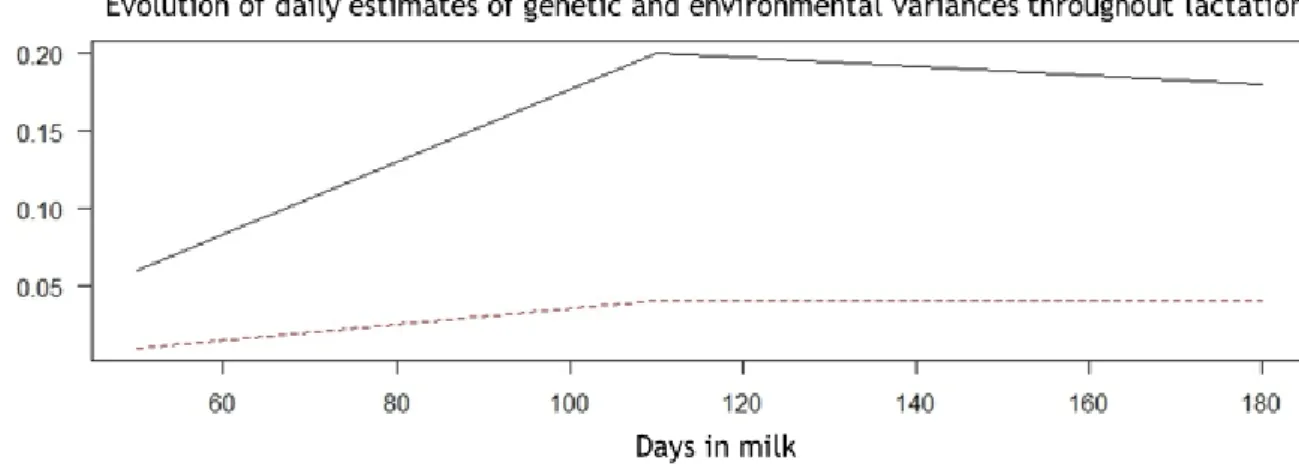
In Figure 2 it can be observed the evolution of variances which start with a lower value at the beginning of the lactation, then increases by half closely to the 120 days in milk and decreases slightly at the end of the lactation at 180 day in milk.
Figure 1. Overall lactation curve
Figure 2. Evolution of daily estimates of genetic and environmental variances throughout lactation (continue line – environmental variance, dotted line- genetic variance)
Table 1. The heritability for daily milk yields tests records
Days in milk Heritability for daily milk yield
70 0.105
115 0.27
150 0.250
Table 3. Genetic correlation estimates between selected days in milk (DIM) of daily yields
DIM 70 115 150 70 1 0.55 0.58
115 - 1 1
66 Table 2. The breeding value for lactation for the best
Teleorman Black Head sheep from our study No. Estimate breeding value
for daily milk yield (kg)
1 28.481
2 25.155
3 20.925
4 18.881
5 18.081
6 18.006
7 17.223
8 16.831
9 16.799
10 11 12 13 14 15 16.230 15.920 15.720 15.344 15.237 15.201 16 17 18 15.052 14.801 14.569 4. Conclusions
The breeding values for test day milk yield for the best ewes in the present study were ranged between 14.57 g and 28.48 g.
The highest heritability was obtained in the mid of lactation, followed by lower heritability during beginning of lactation and average during the late stage of the lactation. The heritability estimates for test-day milk yield of ewes at first lactation ranged between 0.105 at 70 day in milk to 0.270 at 115 day in milk. The genetic correlations between individual test days milk yield obtained in this research were positive, with an average magnitude and are within the limits of the values obtained in the literature.
Random regression model is the best model for genetic evaluation of milk production for sheep, giving a better accuracy of breeding value estimates, minimize the expenses, and make possible the selection for persistency of the lactation curves.
Acknowledgements
This study was funded by Romanian Ministry of Research and Innovation through Program 1 – Development National Research-Development, Sub-program 1.2 – Institutional Performance - Projects funding excellence in R & D, Contract no.17 PFE/ 17.10.2018
This study was supported by the Ministry of Agriculture and Rural Development which financed ADER project no. 8.1.10
References
1. Komprej, A., Malovrh S., Gorjanc G., Kompan D., Kovac M., Genetic and environmental parameters estimation for milk traits in Slovenia dairy sheep using random regression model, Czech J. Anim. Sci, 2013, 58, 3, 125-135
2. Horstick, A., Hamann, H., and Distl, O., Estimation of genetic parameters for daily milk performance of east friesian milk sheep by random regression models, 7th World Congress on Genetics Applied to Livestock Production, August 19-23, 2002, Montpellier, France 3. Banos, G., Arsenos, G., Abas, Z., and Basdagianni, Z., Population parameter estimation of daily milk yield of the Chios sheep using test-day random regression models and Gibbs sampling, British Society of Animal Science, 2005, 81, 233-238
4. Komprej, A., Kompan, D., Kovac, M., Genetic and environmental dispersion parameter estimation by test interval method in dairy sheep, Acta agriculturae Slovenica, Ljubljana 2011, 98/1, 5-13
5. Grosu, H. and Rotar M.C., Estimarea valorii de ameliorare la taurine, pe baza modelelor zilei de control (test day models), Ceres, Bucuresti, 2015
6. Ligda, Ch., Mavrogenis, A., Papadopulus, T., Georgoudis, A., Genetic parameters for test day milk traits and somatic cell counts in Chios dairy sheep, In: proc., Meeting of the Sub-Network on Genetic Resources of the FAO-CIHEAM, Paris, France., Options Mediteraneennes, A 55, 47-54
7. Kominakis, A., Volanis, M., Rogdakis, E., Genetic modelling of test day records in dairy sheep using orthogonal Legendre polynomials, Small Ruminant Research, 2001, 39, 209-217
8. El-Saied, U.M., Carriedo, J.A.., De La Fuente, L.F., San Primitivo, F., Genetic and environmental estimations for test-day and standardized milk yield of dairy sheep, Small Ruminant Research, 1998, 27, 209-215
9. Bauer, J., Milerski M., Pribyl J., Vostry L., Estimation of genetic parameters and evaluation of test-day milk production in sheep, Czech J. Anim. Sci., 2012,11, 522-528
67 12. Serrano, M., Perez-Guzman, M.D., Montoro, V., Jurado, J.J., Genetic parameters estimation and selection progress for milk yield in Manchega sheep, Small Ruminant Research, 1996, 23, 51-57
13. Pelmus, R.S., Grosu, H., Rotar, M.C., Gras, M.A., Lazar, C., Popa, F., Ghita, E., Estimation of the genetic parameters for test-day milk, in Teleorman Black Head
Sheep, Scientific Papers Animal Science and Biotehnologies, 2019, Vol.52, No 1, 56-60