International Journal of Research in Engineering & Applied Sciences
http://www.euroasiapub.org 26
SIMULATIVE INVESTIGATION ON MIMO SYSTEMS FOR ENHANCED
PERFORMANCE
Vishal Gupta* Ranju Kanwar** Malika Singh**
ABSTRACT
The next generation of broadband wireless communication system is expected to
provide user with wireless multimedia services such as high-speed internet access, wireless
television and mobile television. Multiple input and multiple output (MIMO) can be a solution
for such demands. In MIMO systems, multiple antennas at both transmitter & receiver and
diversity techniques can be used to reduce multi-path fading and interference. But transmit
diversity scheme are growing increasingly popular as they promise high data rate transmission
over wireless fading channels in both the uplink and downlink while putting the diversity burden
on the base station and the coding schemes like space time block coding and space time trellis
coding are explored, out of which space time block codes provide full diversity with no coding
gain and space time trellis coding provides full diversity and coding gain with complex
receivers. This paper presents the design of a MIMO system which takes advantage of both these
coding schemes.
Key Words: Alamouti Scheme, Multiple Input and Multiple Output, Space Time Block Coding,
Space Time Diversity, Trellis Code Modulation.
International Journal of Research in Engineering & Applied Sciences
http://www.euroasiapub.org 27
INTRODUCTION
As wireless channel is random and unpredictable by its nature, and in general channel error rates are poorer over a wireless channel than over a wired channel. A major problem in the wireless channel is that out-of-phase reception of multi-path causes deep attenuation in the received signal, known as fading. The distortion induced by the time-varying fading is caused by the superposition of delayed, reflected, scattered and diffracted signal components. Another problem of the wireless channel is variation over time, due to the movements of the mobile unit and objects in the environment. This results into severe attenuation of the signal, referred to as deep fade. This instantaneous decrease of the signal-to-noise ratio (SNR) results in error bursts which degrades the performance significantly.
In a wireless communication system, channel consists of multiple signal paths from the transmitter to the receiver. This multiplicity of paths leads to a phenomenon known as multi-path fading [4]. These multiple paths are caused by the presence of objects in the physical environment that, through the mechanisms of propagation, alter the path of radiated energy. This result in rapid fluctuation in amplitude, phase or multi-path delays of a transmitted signal over a small period of time or travel distance [6]. In some cases, the multiple signals add destructively at the receiver, creating points in space where the composite received signal is greatly attenuated [1].Also the relative motion between the communicating devices induce Doppler shift on multi-path components and results in fading of the signal.
To meet the demand for higher data rates and to combat the effect of fading, an emerging technology called multiple input and multiple output (MIMO) has appeared. In MIMO systems, multiple antennas at both transmitter & receiver and diversity techniques can be used to reduce multi-path fading and interference. Diversity can be achieved by providing a copy of the transmitted signal over frequency, time and space.
International Journal of Research in Engineering & Applied Sciences
http://www.euroasiapub.org 28
diversity at the receiver. Also, in STBC, easily increase the size of the code from two to three and to four, with a very little increase in decoding complexity, due to the fact that only linear processing is required for decoding. Space time trellis coding (STTC) for MIMO systems operate on one input symbol at a time producing a sequence of vector symbols whose length represents number of antennas. STTC also provides coding gain. This paper presents the design of a MIMO system which takes the advantages of both STBC and STTC schemes.
SPACE-TIME TRELLIS CODES
STTCs were originally proposed by Tarokh et al. as an extension of trellis coding to space-time signal structures. Just as trellis codes impose structure within each codeword (over the code space) and also between code words transmitted in sequence (over time), STTCs impose similar constraints in physical space and time by distributing the symbols comprising each codeword over the elements of the transmit antenna array. Thus they are able to provide a diversity gain as well as a coding gain. As in standard trellis coding notation, each node corresponds to a particular encoder state. They are decoded using the Viterbi Algorithm (VA), which scales exponentially with the number of trellis states; the decoder complexity grows exponentially with the spectral efficiency and diversity of the scheme. This very high complexity is one of the main disadvantages of space-time trellis coding. During each symbol period, the space-time encoder
takes as its input one symbol x and generates output symbols1...sN . Note that the encoder is
always initialized to its zero state before beginning a codeword transmission. Therefore the block length L Q and the rate of the STTC is 1 sym/s/Hz. The overall data rate is then specified by
the base-2 logarithm B of the symbol alphabet [7] [11].
SPACE-TIME BLOCK CODING
International Journal of Research in Engineering & Applied Sciences
http://www.euroasiapub.org 29
[3].If we want to increase the coding gain further, we should apply an additional high performance outer code concatenated with an appropriate STBC used as an inner code. Such schemes have been proposed e.g. under the name of Super Orthogonal Space-Time Trellis Codes
[2]. In a general form, an STBC can be seen as a mapping of nN complex symbols
1, 2,..., N
s s s onto a Smatrix of dimension
1, 2,..., N
s s s S (1)
An STBC code matrix S taking on the following form:
~
1
N
n
n n n n
n
S s A j s B (2)
Where s s1, 2,...,sN is a set of symbols to be transmitted with sn Re sn and ~
Im
n n
s s ,
and with fixed code matrices A Bn, n of dimension nt N are called linear STBCs. The
following STBCs can be regarded as special cases of these codes. The Alamouti scheme brought in a revolution of sorts in multi antenna systems by providing full diversity of two without CSI at the transmitter and a very simple maximum likelihood decoding system at the receiver.
Maximum likelihood decoders provide full diversity gain of M R at the receiver. Such a system
provides a guaranteed overall diversity gain of 2M ,R without CSI at the transmitter. This is
achieved by the key feature of orthogonality between the sequences generated by the two transmit antennas. Due to these reasons, the scheme was generalized to an arbitrary number of transmit antennas by applying the theory of orthogonal designs. The generalized schemes are referred to as space-time block codes (STBCs). These codes can achieve the full transmit
diversity of M M T R , while allowing a very simple maximum likelihood decoding algorithm,
based only on linear processing of received signals.
I. SIMULATION RESULTS
To achieve full diversity of orthogonal space time block coding technique and
International Journal of Research in Engineering & Applied Sciences
http://www.euroasiapub.org 30
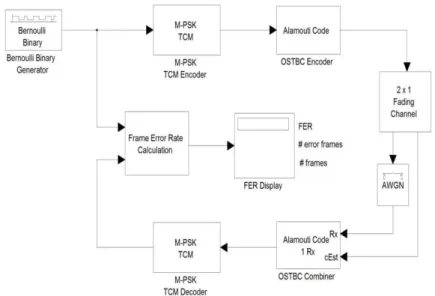
transmit and N receive antennas over the Rician fading channel and the Bernoulli Binary Generator block produces the information source for the simulation.
Figure 1: OSTBC Concatenated with TCM Simulink Model
International Journal of Research in Engineering & Applied Sciences
http://www.euroasiapub.org 31
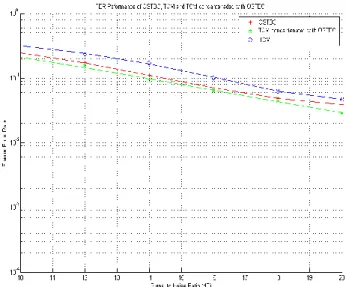
Figure 2: Simulation Results
Table 1: Simulation results of evaluation of FER vs. SNR performance of concatenated
OSTBC and TCM, OSTBC combined with TCM under Rician Fading
Signal
to
Noise
Ratio
(SNR)
Frame
Error
Rate
OSTBC
Frame
Error
Rate
TCM
Frame Error
Rate
TCM+OSTBC
10 0.24
0.32 0.21
12 0.17
0.23 0.16
14 0.11
0.17 0.09
16 0.07
0.10 0.06
18 0.05
0.06 0.05
20 0.04
International Journal of Research in Engineering & Applied Sciences
http://www.euroasiapub.org 32
From figure 2 and table1, it has been concluded that for a given value of signal to noise ratio, the proposed scheme called OSTBC concatenated with TCM results in lowest FER. Also comparison among orthogonal space time block coding and trellis code modulation shows that for a given value of SNR, orthogonal space time block coding performs better than trellis code modulation in terms of frame error rate.
CONCLUSION
Orthogonal space time coding block coding is an attractive technique for MIMO Systems and produces full diversity, on the other hand trellis code modulation is a band efficient scheme which provides large coding gain, thus to achieve full diversity of orthogonal space time block coding and large coding gain of trellis code modulation a new technique called orthogonal space time block coding combined with trellis code modulation has been proposed.
REFERENCES
[1] Alamouti. S. M. (1998) A simple transmit diversity technique for wireless communications. IEEE JSAC, 16: 1451–1458.
[2] Badic B., Herdin M., Rupp M., Weinrichter H. (2004) Quasi Orthogonal Space-Time Block Codes on Measured MIMO Channels. Sympotic Bratislava, 4: 17-20.
[3] Benaissa Mohamed, et.al (2011) Performance Study of the Association TCM-UGM/STBC to Reduce Transmission Errors of JPEG Images. Int'l J. of Communications, Network and System Sciences, 4(6): 388-394.
[4] Costa Nelson, Haykin Simon (1978) Multiple-Input, Multiple-Output Channel Models: Theory and Practice. New York: John Wiley & Sons.
[5] Tarokh V., Seshadri N. and Calderbank A.R. (1998) Space-time codes for high data rate wireless communication: performance criterion and code construction. IEEE Transactions on Information Theory, 44: 744–765.
[6] Tarokh V. and Jafarkhani H. (1999) A differential detection scheme for transmit diversity. IEEE Wireless Communications and Networking Conference, 3: 1043–1047. [7] Wittneben A. (1993) A new bandwidth efficient transmit antenna modulation diversity
International Journal of Research in Engineering & Applied Sciences
http://www.euroasiapub.org 33
[8] Tarokh V., Jafarkhani H. and Calderbank A.R. (1999) Space-time block codes from orthogonal designs. IEEE Transactions on Information Theory, 45(5); 1456–1467.
[9] Tarokh V. and Jafarkhani H. (1999) A differential detection scheme for transmit diversity. IEEE Wireless Communications and Networking Conference, 3: 1043–1047. [10] Winters J.H. (1994) The diversity gain of transmit diversity in wireless systems with
Rayleigh fading. IEEE International Conference on Communications, (New Orleans, LA): 1121– 1125.