Filter System Performance in a Tilapia Recirculating System
Cristian Savin
1,2, Benone P
ă
s
ă
rin
1, Marilena Talpe
ş
2, Gabriel Hoha
1, Magdalena Tenciu
2,
Elpida Paltenea
2, Elena Mocanu
2, Adrian Gruber
11”Ion Ionescu de la Brad” University of Agricultural Sciences and Veterinary Medicine of Iasi,
700490-Iasi, Mihail Sadoveanu, 3, Romania
2Institute of Research and Development for Aquatic Ecology, Fishing and Aquaculture
80021-Galaţi, Portului, 54, Romania
Abstract
It is known that recirculating aquaculture systems, although has some advantages, production costs resulting from these production systems are quite high and is mainly due to the filtration system of technological water. Tilapia is one of the most important species in world aquaculture, the second production after carp, because of the advantages it has being reared in any production system: ponds, net-pens, cages, raceways, recirculating systems. Aim of this study was to evaluate the performance of a filter system in a tilapia recirculating system. Experiments were conducted during October – December 2011, during which feeding was done only with feed, Nutra category, age-appropriate granulation. Main physical – chemical parameters of technological water were monitored, pH, dissolved oxygen, nitrite, ammonia and ammonium, both the water entry in the filter and the exit from the filter. Filtration efficiency varied from 2-3% and up to 50-60%, mainly due to rapid loading of the filter and its need for cleaning. Keywords: aquaculture, filter system, recirculating system, tilapia.
1. Introduction
Tilapia represents one of the most reared species in the world, reaching second place, at this moment, after carp. This evolution its due, mainly, because of nutritional meat quality, her easy reared, especially that is suitable for any production system: ponds, net-pens, cages, raceways, recirculating systems and for very good growth rate. Given that tilapia is a warm water species, in conditions of Romanian aquaculture cannot be raised outside all year, except in areas with hot springs or areas receiving hot water from various technological processes from industry is necessary to develop tilapia recirculating systems. In addition to water conservation, recirculating systems allow large fish yields to be obtained in a relatively small area and provide year-round production [1]. Both attributes increase economic
*Corresponding author: Cristian Savin,
growth potential of the industry. It is known that recirculating aquaculture systems, although has some advantages, production costs resulting from these production systems are quite high and is mainly due to the filtration system of technological water.
The main technical goal to be achieved in a recirculating aquaculture system is to ensure environmental conditions that meet, in a larger measure, eco-physiological peculiarities of the rearing species. A classical filter unit, within a recirculating aquaculture system is a combination of a solids removal (mechanical filtration, gravity separation), control of gas (oxygen addition, CO2 degassing) and biological processes (nitrification of ammonia with a biofilter, UV treatment). Control of physico-chemical parameters is one of the benefits of recirculating systems [2, 3].
Aim of this study was to evaluate the performance of a filter system in a tilapia recirculating system, mainly from nitrogen compounds point of view, knowing that the most important factor to be controlled in intensive aquaculture is TAN (total ammonia nitrogen). Total ammonia nitrogen (TAN) is the product of bacterial decomposition of organic waste solids in the system, and includes two forms unionized ammonia (NH3), very toxic,
and ionized ammonia (NH4+).
2. Materials and methods
Experiments were conducted at the Institute of Research and Development for Aquatic Ecology, Fishing and Aquaculture Galati, from October to December 2011.
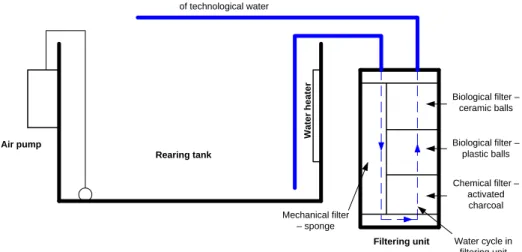
Recirculating aquaculture system, used in this experiment, is represented by an aquarium type tank with a technological water flow of 1 cubic meter/hour, and consists of Rearing tank – represented by a glass aquarium with a water volume of 0.2 mc; Filter system – Fluval 404 type,composed from: mechanical filter - sponge, chemical filter – activated charcoal and biological filter – plastic and ceramic balls; Aeration system – represented by an air pump ELITE 802 type, with a water flow of 2 l air/minute at a pressure of 3.5 PSI; and Heating system – represented by a two thermometers RESUN THERM 25/3000 – RH 9000 type with a power of 150 W. Rearing system is represented schematically in Figure 1.
Wate
r heat
er
Filtering unit Rearing tank
Air pump
Conduct for distribution of technological water
Biological filter – ceramic balls
Biological filter – plastic balls
Chemical filter – activated charcoal Mechanical filter
– sponge
Water cycle in filtering unit
Figure 1. Rearing system scheme used in the experiment (filter system in the right)
At the start of experiments, rearing system was populated with Nile tilapia (Oreochromis Niloticus L.) with average body weight of 8 g/fish. Fish was fed, throughout the experimental period, with Nutra extruded feed (from Skretting), Classic K 1P, 3 mm grain size and a main biochemical composition of 43% crude protein, 11.5% lipids, 4% crude cellulose and 7.5% ash. Frequency of feed was 2 times per day, respectively 08.0 and 16.00; the amount administered being between 1.5 - 2% of fish biomass in 24 hours.
Samples for analyses were collected using plastic containers, the main physico-chemical parameters monitored were pH (upH), dissolved oxygen (mg/l), nitrites (NO2-N - mg/l), ammonia (NH3 - mg/l) and ammonium (NH4 - mg/l). For a fair assessment of filter system, samples were
collected both the water inlet filter system and on its exit, from the filter system. The total quantity of ammonia nitrogen was determined by calculation, analyzing the ammonium nitrogen compounds and ammonia.
Filter performance was evaluated by [4,5,6]: a.) calculating the volumetric TAN conversion rate (VTR) using the formula:
VTR = kc*(TANi - TANe)*Q / Vf ,
where VTR is the volumetric total ammonia conversion rate (gTAN/m3-day), k
c is a conversion
factor of 1.44, TANi is the influent total ammonia
concentration (mg/l); TANe is the effluent total ammonia concentration (mg/l). Q is the flow rate through the filter (l/min.), and Vf is the total
volume of the filter medium (m3).
VNR = VTR + kc*(NO2i – NO2e) *Q / Vf ,
where NO2i is the influent nitrite concentration
(mg/l), NO2e is the effluent nitrite concentration
(mg/l) and VTR, kc, Q, and Vf are as defined
previously, and
c.) calculating the volumetric oxygen consumption rate OCF (g O2/m3-day) that it indicates the total
amount of bacterial activity within the filter, using the formula:
OCF = kc*(DOi - DOe) *Q / Vf ,
where DOi is the influent dissolved oxygen
concentration (mg/l), DOe is the dissolved oxygen
concentration in the filter effluent (mg/l) and and VTR, kc, Q, and Vf are as defined previously.
Also, was evaluated TAN removal efficiency with the formula:
E = [(TANi – TANe)/ TANi]*100 ,
were E is the TAN removal efficiency capacity (%),TANi and TANe are as defined previously.
Statistical processing of data obtained was performed by using descriptive statistics and ANOVA single factor test in Microsoft Office Excel utility.
3. Results and discussion
The present research aimed to evaluate filter system from a recirculating system for rearing Nile tilapia (Oreochromis Niloticus L.), focusing on the removal of nitrogen compounds, oxygen consumption for biological process and influence on pH.
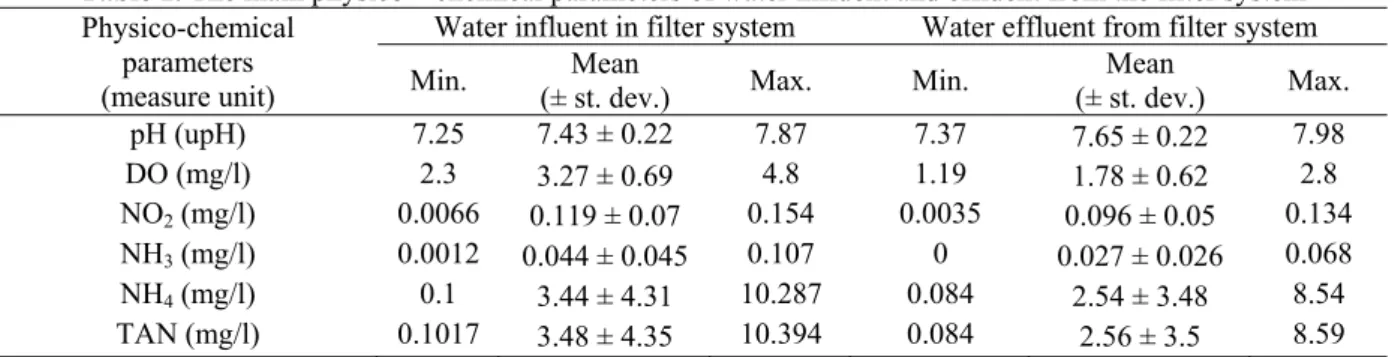
All parameters analyzed were within acceptable levels. Values of the main physico-chemical parameters monitored in the experiment are presented in the table 1.
Table 1. The main physico – chemical parameters of water influent and effluent from the filter system Physico-chemical
parameters (measure unit)
Water influent in filter system Water effluent from filter system
Min. (± st. dev.) Mean Max. Min. (± st. dev.) Mean Max.
pH (upH) 7.25 7.43 ± 0.22 7.87 7.37 7.65 ± 0.22 7.98
DO (mg/l) 2.3 3.27 ± 0.69 4.8 1.19 1.78 ± 0.62 2.8
NO2 (mg/l) 0.0066 0.119 ± 0.07 0.154 0.0035 0.096 ± 0.05 0.134
NH3 (mg/l) 0.0012 0.044 ± 0.045 0.107 0 0.027 ± 0.026 0.068
NH4 (mg/l) 0.1 3.44 ± 4.31 10.287 0.084 2.54 ± 3.48 8.54
TAN (mg/l) 0.1017 3.48 ± 4.35 10.394 0.084 2.56 ± 3.5 8.59
Whitin the recirculating total ammonia nitrogen (TAN) decreased from 3.48 ± 4.35 mg/l (influent) to 2.56±3.5 mg/l (effluent). Mean recorded significant differences (p<0.05) between the two sampling points, while the values obtained in each of the two points did not vary significantly (p> 0.05).
From a statistical viewpoint, ammonia levels differ significantly between them (p<0.05) both in the sampling point, while ammonium ion values showed no significant differences in any of sampling points.
One of the critical processes in a recirculating aquaculture system, and is a key objective in its design, is the removal of ammonia from water [3, 7, 8, 9, 10]. Ammonia is toxic in molecular form; only low levels of 0.01 mg/l resulted in sub-lethal toxic effects (underdeveloped gills, growth slowed or stopped) in salmon and trout populations, while european catfish showing symptoms at
concentrations of 0.12 mg/l. Ammonia in water can have two aspects molecular ammonia (unionized) and ionized ammonia (NH4+).
Temperature and pH factor determining the molecular ratio of ammonia to unionized ammonia in water, the level of acidity having the greatest influence. With increasing pH factor (low acidity), total percentage of toxic ammonia in molecular form, increase logarithmically over the ionized ammonia. Thus, the amount of total ammonia nitrogen (TAN) is often used as a limiting factor of water quality in the design and operation of intensive aquaculture systems [11]. There are several technologies available to remove ammonia nitrogen, but most commonly used is biological filtration [12].
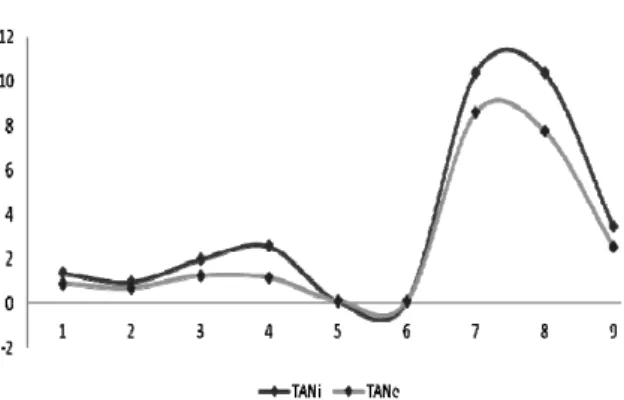
Figure 2. Evolution of TAN in water influent and effluent from the filter system
Performances of filter system, to remove the most important water parameters–nitrogen compounds, have been evaluated through volumetric TAN conversion rate (VTR), volumetric nitrite conversion rate (VNR) and volumetric oxygen consumption rate (OCF). The values obtained for VTR ranged from 4g TAN/m3-day to 3.865 gTAN/m3-day with a mean of 1.353g TAN/m3 -day. These values are more appropriate with those registered by Stahl et al. [13] in three different system, 752, 1.014 and 1.190 gTAN/m3-day, and higher than 300 – 400 gTAN/m3-day of Malone et
al. in 1993 [14] and 600 – 700 gTAN/m3-day of
Thomasson in 1991 [15]. In 1993 Westerman et al. [16] recorded a value of 100g TAN/m3-day,
which is significant lower of mean registered in this research. Recommended nitrification rates are 0.7 kgTAN/m3/day for applications in cold water
systems and 1.0 kgTAN/m3/day for warm water
systems [17]. The regression between VTR and TAN explained 84% variability in VTR (Figure 3).
Figure 3. Regression of VTR versus TAN in recirculating system – predicted and measured VTR
TAN removal efficiency ranged from 2.7% to 55.45% with a mean of 27.5% which is lower than the value registered by author–60%, in the researches for doctoral thesis, testing another type of filter system. Evolution of TAN removal efficiency is presented in Figure 4.
Figure 4. Efficiency of filter system to remove the TAN
The values obtained for VNR ranged from 22g NO2/m3-day to 3.976 gNO2/m3-day with a mean of
1.409 gNO2/m3-day. The overall VNR values
demonstrate higher values than those observed in similar experiments Wimberly, 1990 [18]; Chitta 1993 [19]; Sastry, 1996 [20]. For example, in 1996, Sastry completed a test with a VNR of 130 gNO2/m3-day. Stahl et al. [13] in 1999 approached
with our results, obtaining in three different systems values ranged between 503 and 1.539 gNO2/m3-day.
Volumetric oxygen consumption rate (OCF) ranged from 1.6 kgO2/m3-day to 2.9 kgO2/m3-day
with a mean of 2.2kg O2/m3-day. Wimberly in
1990 [18] and Sastry in 1996 [20] recorded appropiate value, between 0.7 and 3 kgO2/m3-day.
In Figure 5 is presented evolution of VTR, VNR and OCF during the entire research.
4. Conclusions
The recirculating system showed a good performance, at laboratory level, for tilapia rearing in terms of environment quality. The nitrogen compounds were very good controlled, despite the fact that tilapia is a warm water species who need a higher temperature for rearing, that could influence ammonia and ammonium.
Volumetric TAN conversion rate (VTR) registered very good values, whit a mean of 1.353g TAN/m3
-day, which means that the principle is feasible and should be tested in larger recirculating systems, preferably on a commercial scale.
Filtration efficiency ranged between 2-3% and 50-60%, with large differences between values, this is due to the fact that the filter was washed weekly, but not at regular intervals, which could affect the accuracy of data achieved.
Acknowledgements
“This work was co-financed from the European Social Fund through Sectoral Operational Programme Human Resources Development 2007-2013, project number POSDRU/I.89/1.5/S62371 ,,Postdoctoral School in Agriculture and Veterinary Medicine area”
References
1. Van Gorder, S.D., Operating and managing water reuse systems, In: M.B. Timmons and T.M. Losordo, editors. Aquaculture water reuses systems Engineering design and management. Developments in aquaculture and fisheries science, vol. 27. Elsevier Science, Amsterdam, 1994, pp. 281-306
2. Heinen, J.M., Hankins, J. A., Weber, A.L., A semi-closed recirculating-water system for high-density culture of rainbow trout, Prog. Fish Cult.,1996, 58 (1), 1122.
3. Cristea V., Grecu I., Ceapă C., Ingineria sistemelor recirculante, Galaţi, 2002.
4. Malone, R.F., Beecher, L.E., Use of floating bead filters to recondition recirculating waters in warmwater aquaculture production systems, Aquacultural Engineering, 2000, 22, 57–74.
5. Malone, R.F., Pfeiffer, T.J., Rating fixed-film nitrifying biofilters used in recirculating aquaculture systems, Aquacult. Eng., 2006, 34, 389–402.
6. Pfeiffer, T.J., Malone, R.F., Nitrification performance of a propeller-washed bead clarifier supporting a fluidized sand biofilter in a recirculating warmwater fish system, Aquaculture Engineering, 2006, 34, 311-321.
7. Meade, J.W., Allowable ammonia for fish culture, Progress in Fish Culture, 1985, 47, 135-145.
8. Avnimelech, Y., Mozares, N., Shaher, D., Kochba, M., Rates of organic carbon andnitrogen degradation in intensive fish ponds, Aquaculture, 1995, 134, 211-216. 9. Avnimelech, Y., Carbon/nitrogen as a control element in aquaculture system, Aquaculture, 1999, 176, 227–235.
10. Kim, S., Kong, I., Lee, B., Kang, L., Lee, M. and Suh, K., Removal of ammonium – N from a recirculation aquacultural system using an immobilized nitrifiers, Aquaculture Engineering, 2000, 21, 139-150. 11. Losordo, T., Westerman, P. W., Liehr, S. K., Water treatment and wastewater generation in intensive recirculating fish production system, Bull. Natl. Inst. Aquaculture, 1994, suppl. 1, 27 - 36.
12. Losordo, T., Masser, M., Rakocy, J., Recirculating aquaculture tank production systems: An overview of critical considerations, Southern Regional Aquaculture Center Publication, 1992, 451
13. Stahl, J.C., Drennan, G.D., Beecher, E.L., Malone R.F., Enhancing Nitrification in Propeller-Washed Bioclarifiers with Modified Floating Bead Media, 1999 14. Malone, R. F., Chitta, B.S., and Drennan, D.G., Optimizing Nitrification in Bead Filters for Warmwater Recirculating Aquaculture Systems. In: Wang, J. K. (Ed.), Techniques for Modern Aquaculture, American Society of Agricultural Engineers, Michigan, 1993, pp. 315-325.
15. Thomasson, M.P., Nitrification in Fluidized Bed Sand Filters for Use in Recirculating Aquaculture Systems. Master’s Thesis, Louisiana State University, Baton Rouge, Louisiana, 1991, 122 pp.
16. Westerman, P. W., Losordo, T.M., and Wildhaber, M. L., Evaluation of Various Biofilters in an Intensive Recirculating Fish Production Facility. In: Wang, J. K. (Ed.). Techniques for Modern Aquaculture American Society of Agricultural Engineers, Michigan, 1993, pp. 326-334.
17. Timmons, M.B., Ebeling, J.M., Wheaton, F.W., Summerfelt, S.T. & Vinci, B.J., Recirculating Aquaculture Systems, Cayuga Aqua Ventures, Ithaca, NY, USA, 2001, pp. 650.
18. Wimberly, D.M., Development and Evaluation of a Low-Density Media Biofiltration Unit for Use in Recirculating Fish Culture Systems, Master's Thesis, Louisiana State University, Baton Rouge, Louisiana, 1990,
19. Chitta, B.S., Effects of Backwash Frequency on the Nitrification in Plastic Bead Media Biofilters Used in Recirculating Finfish Culture Systems. M. S. Thesis, Louisiana State University, 1993, Baton Rouge, Louisiana.