Screening for Colorectal Cancer: U.S. Preventive Services Task Force
Recommendation Statement
U.S. Preventive Services Task Force*
Description: Update of the 2002 U.S. Preventive Services Task Force (USPSTF) recommendation statement on screening for colo-rectal cancer.
Methods: To update its recommendation, the USPSTF com-missioned 2 studies: 1) a targeted systematic evidence review on 4 selected questions relating to test characteristics and benefits and harms of screening technologies, and 2) a deci-sion analytic modeling analysis using population modeling techniques to compare the expected health outcomes and resource requirements of available screening modalities when used in a programmatic way over time.
Recommendations: The USPSTF recommends screening for colo-rectal cancer using fecal occult blood testing, sigmoidoscopy, or colonoscopy in adults, beginning at age 50 years and continuing until age 75 years. The risks and benefits of these screening meth-ods vary. (A recommendation)
The USPSTF recommends against routine screening for colorectal cancer in adults 76 to 85 years of age. There may be considerations that support colorectal cancer screening in an individual patient. (C recommendation)
The USPSTF recommends against screening for colorectal cancer in adults older than age 85 years. (D recommendation)
The USPSTF concludes that the evidence is insufficient to assess the benefits and harms of computed tomographic colonography and fecal DNA testing as screening modalities for colorectal cancer. (I statement)
Ann Intern Med.2008;149:627-637. www.annals.org For author affiliation, see end of text.
*For a list of the members of the U.S. Preventive Services Task Force, see the
Appendix, available at www.annals.org.
T
he U.S. Preventive Services Task Force (USPSTF) makes recommendations about preventive care services for pa-tients without recognized signs or symptoms of the target condition.It bases its recommendations on a systematic review of the evidence of the benefits and harms and an assessment of the net benefit of the service.
The USPSTF recognizes that clinical or policy decisions involve more considerations than this body of evidence alone. Clinicians and policymakers should understand the evidence but individualize decision-making to the specific patient or situation.
S
UMMARY OFR
ECOMMENDATION ANDE
VIDENCEThe USPSTF recommends screening for colorectal cancer using fecal occult blood testing, sigmoidoscopy, or colonoscopy in adults, beginning at age 50 years and con-tinuing until age 75 years.
The risks and benefits of these screening methods vary. See the Rationale and Clinical Considerations sections for comparisons of the risks and benefits of different screening regimens, as well as the specific intervals for different rec-ommended tests.
This is an A recommendation.
The USPSTF recommends against routine screening for colorectal cancer in adults age 76 to 85 years. There may be considerations that support colorectal cancer screening in an individual patient. This is a C recommendation.
The USPSTF recommends against screening for colo-rectal cancer in adults older than age 85 years. This is a D recommendation.
The USPSTF concludes that the evidence is insufficient to assess the benefits and harms of computed tomographic (CT) colonography and fecal DNA testing as screening mo-dalities for colorectal cancer. This is an I statement.
See also: Print
Editorial comment. . . 680 Related articles . . . 638, 659 Summary for Patients. . . I-44 Web-Only
Appendix CME quiz
Conversion of graphics into slides Downloadable recommendation summary Audio summary
See theFigurefor a summary of the recommendations and suggestions for clinical practice.
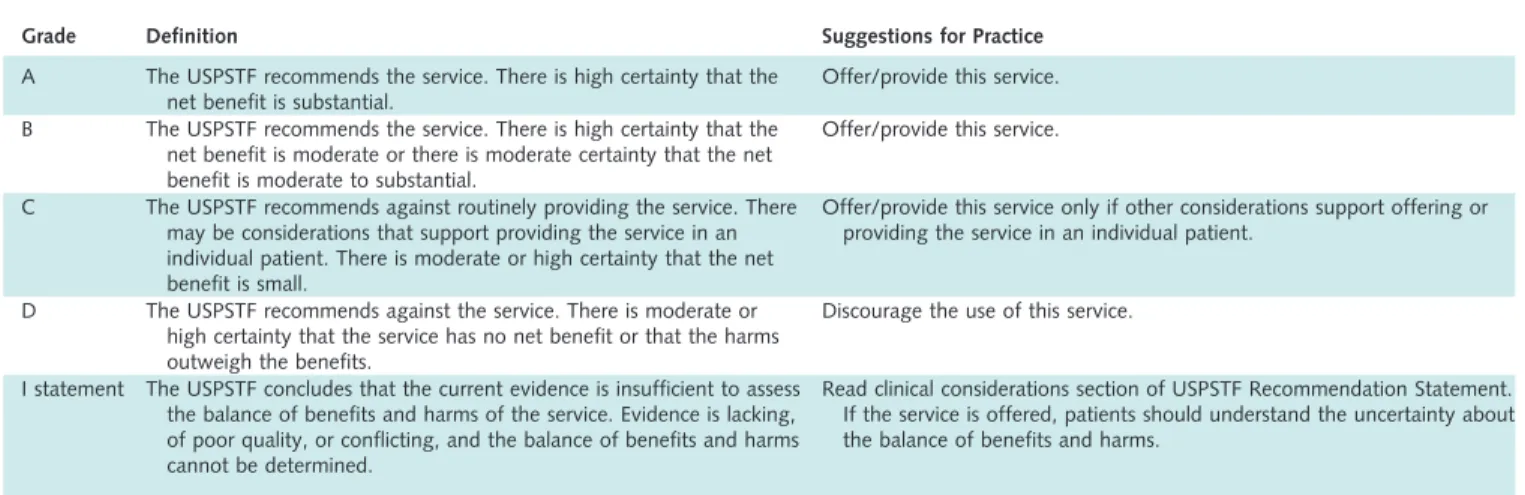
See Table 1 for a description of the USPSTF grades
andTable 2for a description of the USPSTF classification
of levels of certainty about net benefit.
R
ATIONALEImportance
Colorectal cancer is the third most common type of cancer and the second leading cause of cancer death in the United States. Current levels of screening in this country lag behind those of other effective cancer screening tests; it has been estimated that attainment of goals for population colorectal cancer screening could save 18 800 lives per year (1). Colorectal cancer incidence and mortality show health disparities, with a disproportionate burden occurring in certain minority populations, including African Americans and Alaska Natives (2, 3).
Detection
The evidence is convincing that screening for colo-rectal cancer with fecal occult blood testing, sigmoidos-copy, or colonoscopy detects early-stage cancer and adeno-matous polyps.
Although colonoscopy is considered to be the refer-ence standard against which the sensitivity of other colo-rectal cancer screening tests are compared, it is not perfect. Two types of studies to assess the sensitivity of colonos-copy—tandem colonoscopy studies, in which the same pa-tient is studied twice, and studies comparing colonoscopy and CT colonography—show that colonoscopy may miss even polyps larger than 10 mm and colorectal cancer. In addition, most of the evidence about the sensitivity of colonoscopy comes from experienced examiners in research settings. The evidence is inadequate to estimate the sensi-tivity in community practice; however, it is likely to be lower than in research settings.
Although single test performance is an important issue in the detection of colorectal neoplasia, the sensitivity of the test over time is more important in an ongoing screen-ing program. Unfortunately, data that permit assessment and comparison of screening methods to detect colorectal neoplasia in a testing program over time from a population perspective are limited to data from analytic modeling.
Benefits of Detection and Early Intervention
There is convincing evidence that screening with any of the 3 recommended tests reduces colorectal cancer mor-tality in adults age 50 to 75 years. Follow-up of positive screening test results requires colonoscopy regardless of the screening test used. Because of the harms of colonoscopy described below, the chief benefit of less invasive screening tests is that they may reduce the number of colonoscopies required and their attendant risks.
There is adequate evidence that the benefits of detec-tion and early intervendetec-tion decline after age 75 years. The
lead time between the detection and treatment of colorec-tal neoplasia and a morcolorec-tality benefit is substantial, and competing causes of mortality make it progressively less likely that this benefit will be realized with advancing age.
Harms of Detection and Early Intervention
The primary established harms of colorectal cancer screening are due to the use of invasive procedures initially or in the evaluation sequence. Harms may arise from the preparation the patient undergoes to have the procedure, the sedation used during the procedure, and the procedure itself.
Colonoscopy
Evidence is adequate to estimate the harms of colonos-copy. In the United States, perforation of the colon occurs in an estimated 3.8 per 10 000 procedures (4). Serious complications—defined as deaths attributable to colonos-copy or adverse events requiring hospital admission, in-cluding perforation, major bleeding, diverticulitis, severe abdominal pain, and cardiovascular events—are signifi-cantly more common, occurring in an estimated 25 per 10 000 procedures (5).
Flexible Sigmoidoscopy
Evidence is adequate that serious complications occur in approximately 3.4 per 10 000 procedures (5).
Fecal Tests
Evidence about the harms of fecal tests is lacking (in-adequate), but the USPSTF assesses them to be no greater than small.
CT Colonography
Computed tomographic colonography images more than the colon. Up to 16% of people having their first CT colonography are found to have extracolonic abnormalities that require further testing (5, 6). Evidence is inadequate to assess the clinical consequences of identifying these ab-normalities, but there is potential for both benefit and harm. Potential harms arise from additional diagnostic testing and procedures for lesions found incidentally, which may have no clinical significance. This additional testing also has the potential to burden the patient and adversely impact the health system.
The risks for perforation associated with screening CT colonography in research settings are estimated to be 0 to 6 per 10 000 CT colonography studies (4). However, these estimates may be higher than what can be expected in screened populations because the studies included symp-tomatic populations.
Radiation exposure resulting from CT colonography is reported to be 10 mSv per examination. The harms of radiation at this dose are not certain, but the linear no-threshold model predicts that 1 additional individual per
1000 would develop cancer in his or her lifetime at this level of exposure (7). The lifetime cumulative radiation risk from the use of CT colonography to screen for colorectal cancer should be considered in the context of the growing cumulative radiation exposure from the use of other diag-nostic and screening tests that involve radiation exposure. On the other hand, improvements in CT colonography technology and practice are lowering this radiation dose.
USPSTF Assessment
The USPSTF concludes that, for fecal occult blood testing, flexible sigmoidoscopy, and colonoscopy to screen for colorectal cancer, there is high certainty that the net benefit is substantial for adults age 50 to 75 years. See Clinical Considerations for a comparison of the regimens for each of these tests.
The USPSTF concludes that, for adults age 76 to 85 years, there is moderate certainty that the net benefits of screening are small.
The USPSTF concludes that, for adults older than age 85 years, there is moderate certainty that the benefits of screening do not outweigh the harms.
The USPSTF concludes that there is insufficient evi-dence to assess the sensitivity and specificity of fecal DNA testing for colorectal neoplasia, and that therefore the bal-ance of benefits and harms cannot be determined for this test. The USPSTF concludes that, for CT colonography, evidence to assess the harms related to extracolonic findings is insufficient, and the balance of benefits and harms can-not be determined.
C
LINICALC
ONSIDERATIONSPatient Population under Consideration
These recommendations apply to adults 50 years of age and older, excluding those with specific inherited syn-dromes (the Lynch syndrome or familial adenomatous pol-yposis) and those with inflammatory bowel disease. The recommendations do apply to those with first-degree rela-tives who have had colorectal adenomas or cancer, al-though for those with first-degree relatives who developed cancer at a younger age or those with multiple affected first-degree relatives, an earlier start to screening may be reasonable. Data suggest that colorectal cancer has a higher mortality rate in African Americans. The reasons for this differential are not well known, and the recommendations are intended to apply to all ethnic and racial groups.
When the screening test results in the diagnosis of clinically significant colorectal adenomas or cancer, the pa-tient will be followed by a surveillance regimen and recom-mendations for screening are no longer applicable. The USPSTF did not address evidence for the effectiveness of any particular surveillance regimen after diagnosis and/or removal of adenomatous polyps.
Screening Tests
The relative sensitivity and specificity of the different colorectal screening tests with adequate data to assess can-cer detection— colonoscopy, flexible sigmoidoscopy, and fecal tests— can be depicted as follows:
Sensitivity: Hemoccult II ⬍ fecal immunochemical
tests ⱕ Hemoccult SENSA ⬇ flexible sigmoidoscopy ⬍
colonoscopy
Specificity: Hemoccult SENSA ⬍ fecal
immuno-chemical tests⬇ Hemoccult II ⬍ flexible sigmoidoscopy
⫽colonoscopy
For the operator-dependent tests—flexible sigmoidos-copy, CT colonography, and colonoscopy— better opera-tor training and more experience have a high likelihood of improving sensitivity. Approaches related to certification, such as quality standards and possibly minimum volume requirements, could be used to achieve the goal of improv-ing operator performance and therefore test sensitivity. As-surance of performance of high-quality endoscopy should be part of all screening programs.
Because several screening strategies have similar effi-cacy, efforts to reduce colon cancer deaths should focus on implementation of strategies that maximize the number of individuals who get screening of some type. The different options for colorectal cancer screening tests are variably acceptable to patients; eliciting patient preferences is one step in improving adherence. Ideally, shared decision mak-ing between clinicians and patients would incorporate in-formation on local test availability and quality as well as patient preference.
Screening Intervals and Starting and Stopping Ages
Screening for colorectal cancer reduces mortality through detection and treatment of early-stage cancer and detection and removal of adenomatous polyps. The degree to which each of these mechanisms contributes to a reduc-tion in mortality is unknown, although it is likely that the largest reduction in colorectal cancer mortality during the 10 years after initial screening comes from the detection and removal of early-stage cancer. Colonoscopy is a neces-sary step in any screening program that reduces mortality from colorectal cancer. This reduction in mortality does come at the expense of significant morbidity associated with colonoscopy. Evidence does not currently allow a ferential estimate of colonoscopy-related morbidity for dif-ferent age groups or for examinations done with or without biopsy.
In this context, the best measure for the morbidity that results from any screening program for colorectal can-cer is the number of colonoscopies required to achieve a reduction in mortality. Although improvements in mortal-ity will generally be associated with increasing morbidmortal-ity that results from the screening and surveillance program, the goal of a screening program should be to maximize the number of life-years gained while minimizing the harms.
the Cancer Intervention and Surveillance Modeling Net-work (CISNET), investigators conducted microsimulation analyses that applied programs of screening to standard populations of adults in the United States (5). These anal-yses permitted a comparison of expected outcomes among testing strategies involving the fecal tests, flexible sigmoid-oscopy, or colonoscopy (as noted below). In the models, the predicted total number of colonoscopies included those resulting from surveillance after detection of colorectal neoplasia. The models assumed lifetime monitoring by colonoscopy every 3 to 5 years depending on the num-ber and size of the adenomas detected. It is not the intent of the USPSTF to endorse this particular ap-proach to surveillance, but standardizing the apap-proach to surveillance is necessary to compare screening strate-gies in the models.
For all screening modalities, starting screening at age 50 resulted in a balance between life-years gained and colonoscopy risks that was more favorable than commenc-ing screencommenc-ing earlier. Despite the increascommenc-ing incidence of colorectal adenomas with age, for individuals previously screened the gain in life-years associated with extending screening from age 75 years to 85 years was small in com-parison to the risks of screening people in this decade. For adults who have not previously been screened, decisions about first-time screening in this age group should be made in the context of the individual’s health status and compet-ing risks, given that the benefit of screencompet-ing is not seen in trials until at least 7 years later. For persons older than 85 years, competing causes of mortality preclude a mortality benefit that outweighs the harms.
Screening programs incorporating fecal occult blood testing, sigmoidoscopy, or colonoscopy will all be effective in reducing mortality. Modeling evidence suggests that population screening programs between the ages of 50 and 75 years using any of the following 3 regimens will be approximately equally effective in life-years gained, assum-ing 100% adherence to the same regimen for that period (8): 1) annual high-sensitivity fecal occult blood testing, 2) sigmoidoscopy every 5 years combined with high-sensitiv-ity fecal occult blood testing every 3 years, and 3) screening colonoscopy at intervals of 10 years.
The strategies differ in the total number of colonosco-pies that would be required to gain similar numbers of life-years. The first strategy, use of annual high-sensitivity fecal occult blood testing (sensitivity for cancerⱖ70%) that has a false-positive rate less than 10% (that is, speci-ficity⬎90%), is estimated to require the fewest colonosco-pies while achieving a gain in life-years similar to that seen with screening colonoscopy every 10 years. Currently avail-able tests that meet both specifications include SENSA guaiac testing (Beckman Coulter, Fullerton, California) and fecal immunochemical tests with characteristics similar to those of the Magstream quantitative test (Fujirebio, To-kyo, Japan).
Although use of an annual fecal occult blood screening
test with a lower sensitivity has been demonstrated to re-duce colorectal cancer mortality in randomized, controlled trials, modeling suggests that the number of life-years gained will be greater with the strategies using higher-sensitivity tests.
For all screening modalities, the effectiveness decreases substantially as adherence to the regimen declines. At the individual level, adherence to a screening regimen will be more important in life-years gained than will the particular regimen selected. Current data are insufficient to predict adherence to any specific screening regimen at the popula-tion level.
Considerations for Practice When Evidence Is Insufficient
CT Colonography
Potential Preventable Burden.A screening program that incorporates the option of CT colonography could help reduce colorectal cancer mortality in the population if pa-tients who would otherwise refuse screening found it an acceptable alternative.
Potential Harms.The potential harms from evaluation of incidental findings found with CT colonography may be large. The lifetime cumulative radiation risk from use of CT colonography to screen for colorectal cancer should be considered, as well as the growing cumulative radiation exposure from the use of other kinds of diagnostic and screening that involve radiation exposure.
Current Practice. Computed tomographic colonogra-phy performed by trained and experienced radiographers may not be currently available in many parts of the United States.
Costs.Patient time and burden to participate in colo-rectal cancer screening using test strategies that require bowel preparation are substantial. A CT colonography screening strategy that did not involve bowel preparation would decrease the burden of adherence. The cost of CT colonography is high.
Fecal DNA
Potential Preventable Burden. Fecal DNA has poten-tial as a highly specific test, and it could reduce harms associated with follow-up of false-positive test results.
Current Practice.Fecal DNA tests are evolving, and no test is widely used.
Costs. Fecal DNA is likely to have a high monetary cost per test.
Other Approaches to Prevention
Dietary approaches, such as avoidance of red meat and alcohol or consumption of diets very high in fiber, have been suggested to protect against the risk for colorectal adenomas, but these claims are based on associations present in observational studies that have thus far not been substantiated in trials. Certain nonsteroidal anti-inflamma-tory drugs (NSAIDs) are associated with regression and decreased incidence of colonic adenomas, but the harms of
daily NSAID use in asymptomatic persons led the USPSTF to recommend against this use in persons not at increased risk (see below.)
Useful Resources
In 2007, the USPSTF recommended against the use of aspirin or NSAIDs for prevention of colorectal cancer (D recommendation, available at www.ahrq.gov/clinic/uspstf /uspsasco.htm).
O
THERC
ONSIDERATIONSResearch Needs and Gaps
Our understanding of optimal screening strategies would be significantly enhanced if higher-quality data were available about the natural history of small adenomas. Also, the importance of detecting flat adenomas is controversial, and there is a pressing need for further research on the natural history of these lesions.
Information is needed about the age-specific and biop-sy-related harms of colonoscopy. Also needed are studies of the benefits and risks of detection and subsequent evalua-tion of extracolonic lesions through CT colonography. Fi-nally, randomized trials are needed to compare screening programs using different modalities in order to define more clearly their relative benefits and harms.
Ultimately, all screening tests are merely tools, and the most important step is their actual use by patients; as such, further research into systems approaches to promoting the use of colorectal cancer screening could have a large impact on increasing the use of the tools that are available.
D
ISCUSSIONBurden of Disease
As noted earlier, colorectal cancer is the third most common type of cancer in both men and women in the United States (9). Progress has been achieved in reducing the cancer burden in the United States with declining rates in overall cancer deaths since the 1990s (3). However, the increasing proportion of the population older than 65 years has contributed to the increasing absolute total number of cancer deaths (2, 10). For 2008, it is estimated that 148 810 individuals will be diagnosed and that 49 960 will die of colorectal cancer (11).
More than 80% of diagnosed cases of colorectal cancer occur in patients older than 55 years. The age-adjusted incidence for colorectal cancer is 51.6 per 100 000 persons, with a lifetime risk of diagnosis of 5.7% for men and 5.1% for women. Increased age, along with male sex and black race, are associated with increasing colorectal cancer inci-dence (11). Despite these disparities, the inciinci-dence rate for colorectal cancer has declined over the past 20 years among men of all racial and ethnic groups except for Hispanics/
Latinos and Alaska Natives, and has stabilized among women of all racial and ethnic groups except Alaska Na-tives (3, 9).
Scope of Review
In 2002, the USPSTF released a strong recommenda-tion on colorectal cancer screening for average-risk adults age 50 years or older (12). To update this recommenda-tion, the scope of the current review was determined to encompass 2 parts: a targeted systematic evidence review (5) to update information on selected questions from the prior review (13), and a decision analytic modeling analysis commissioned by the USPSTF to use population modeling techniques (8, 14).
The targeted systematic evidence review focused on the following key questions:
1. Do colorectal cancer screening programs have dem-onstrated benefit in reducing colorectal cancer mortality?
2. What is the efficacy of newer screening technolo-gies—the high-sensitivity guaiac fecal occult blood test, the fecal immunochemical test, the fecal DNA test, and CT colonography?
3. What is the effectiveness of optical colonoscopy and flexible sigmoidoscopy in community practice?
4. What are the harms of newer screening technologies and optical colonoscopy and flexible sigmoidoscopy in community practice?
The USPSTF also requested a report from 2 decision analytic modeling groups to offer guidance on the optimal ages at which to start and stop screening, as well as the optimal intervals for different screening modalities. The analyses were carried out by using 2 microsimulation pop-ulation models, both parts of the larger CISNET collabo-ration funded by the National Cancer Institute.
As each individual ages, there is a chance that an adenomatous lesion—the benign precursor to colorectal cancer—will develop. Because the time between the devel-opment of an adenoma and the occurrence of a clinically observable cancer is unknown, the models incorporate dif-ferent assumptions about the adenoma– carcinoma se-quence that yield different estimates of the average time between adenoma development and cancer diagnosis among cancer cases: a 10-year average in one model and a 22-year average in the other. Life expectancy was calculated for different screening strategies, including no screening given a 40-year-old cohort of asymptomatic individuals in the United States. The primary outcome was life-years gained relative to no screening, relative to the number of colonoscopies (14).
This update of the 2002 recommendation did not consider barium enema because it has substantially lower sensitivity than modern test strategies, it has not been sub-jected to screening trials, and its use as a screening test for colorectal cancer is declining.
Accuracy of Screening Tests
Currently, there are 2 recognized approaches for colo-rectal cancer screening: assessment of stool for blood or DNA and visual inspection of the colon and rectum to find precancerous adenomas or early cancer. Since the 2002 review, several new stool-based screening modalities have become available: immunochemical fecal occult blood test-ing and fecal DNA testtest-ing. Certain fecal immunochemical tests have shown gains in sensitivity without excess loss of specificity when compared with established stool tests (15, 16). Screening with fecal DNA is still an evolving tech-nology, with only 1 fair-quality study in average-risk patients providing data on sensitivity (better than Hemoccult II) and on the proportion of all tests that have positive results (higher than Hemoccult II) (17).
Direct visualization techniques offer substantial benefit over fecal tests, with greater sensitivity, when considered as a single test (5). Reduced screening accuracy in the com-munity setting, due to inadequate bowel preparation or provider skill level, may decrease the sensitivity of optical colonoscopy and flexible sigmoidoscopy. Despite these op-erational constraints, these screening modalities remain an important means for detecting and treating colorectal can-cer and its precursor lesions.
Recent clinical studies of CT colonography suggest that this screening method may be at least as sensitive as optical colonoscopy at identifying colorectal cancer and large adenomas in the community setting (18 –20).
Effectiveness of Early Detection
In 2002, the USPSTF concluded that there was fair-to-good evidence that several screening methods were ef-fective in reducing mortality from colorectal cancer (12). The only method with direct evidence for reduction of mortality is a program that tests for blood-positive stools over several years. Since the last recommendation in 2002, the mortality reduction previously reported in FUBT trials was maintained in longer-term follow-up, and a recent meta-analysis estimates the overall colorectal cancer moral-ity reduction at 15% for biennial fecal occult blood testing (21).
There are no new trials that report on mortality for the other optical screening modalities (colonoscopy and sig-moidoscopy) or newer screening methods, such as fecal DNA and fecal immunochemical testing. The decision analytic modeling analysis performed for the USPSTF pro-jected a comparative benefit to screening with colonos-copy, high-sensitivity fecal blood test, or flexible sigmoid-oscopy every 5 years in combination with fecal testing every 3 years or mid-interval screening, relative to the other techniques studied (8). Despite the lack of direct evidence from clinical trials to ascertain which is the most effective strategy, any of the recommended screening methods is effective compared with no screening (22).
Potential Harms
The USPSTF found evidence of harms associated with different colorectal screening programs. With all colorectal cancer screening modalities, a positive test result leads to follow-up testing, specifically colonoscopy, to resolve the diagnosis. This invasive procedure can result in serious morbidity as well as anxiety, inconvenience, discomfort, and additional medical expenses. Below, we first report known harms of each modality in single-use scenarios, and, at the end of this section, we describe the use of the ac-companying decision model report to project the accumu-lated harms (that is, the number of colonoscopies) resulting from each program of screening over the lifetime of a hy-pothetical cohort of people.
Fecal Occult Blood Tests
No current studies adequately address any adverse ef-fects of high-sensitivity stool tests for blood (SENSA, fecal immunochemical testing) (23).
Colonoscopy
Perforation from colonoscopy occurs in an estimated 3.8 per 10 000 procedures in the United States; major bleeding is estimated to occur in 12.3 per 10 000 proce-dures (95% CI, 7.8 to 19.3 per 10 000 proceproce-dures) (4). Serious complications— deaths from colonoscopies in asymptomatic populations or events requiring hospital ad-mission, including perforation, major bleeding, diverticuli-tis, severe abdominal pain, and cardiovascular events—are estimated at 25 per 10 000 procedures (CI, 12 to 76 per 10 000 procedures) (5).
Flexible Sigmoidoscopy
Serious complications— deaths from flexible sigmoid-oscopy in asymptomatic populations or events requiring hospital admission, including perforation, major bleeding, severe abdominal symptoms, and syncope—were fewer than with colonoscopy. The rate of serious complications is estimated at 3.4 per 10 000 procedures (CI, 0.6 to 19 per 10 000 procedures) (4). Perforation from flexible sigmoid-oscopy was relatively uncommon, with a point estimate of 4.6 per 100 000 procedures (CI, 0.36 to 59 per 100 000 procedures) (4). Proportions for other complications were not calculated because of a lack of reliable data.
Fecal DNA
Information on harms from fecal DNA testing is lim-ited at this time. Popular misunderstandings could occur about genetic profiling and insurability, but these are with-out basis because fecal DNA testing relies on the detection of de novo or somatic mutation in the mucosal lining of the bowel and is not related to hereditary (germ-line) mu-tations (24). Despite this distinction, general acceptability may limit the use of this test.
CT Colonography
The risk for perforation, as studied in both symptom-atic and asymptomsymptom-atic populations, from CT colonogra-phy is estimated at 0 to 6 per 10 000 procedures (4). Be-cause rates of perforation are higher for symptomatic persons undergoing CT colonography, the actual risk in a screening population would be expected to be on the low end of this range.
Computed tomographic colonography involves a wider area of examination than just the interior of the colon. Extracolonic findings of potential clinical significance are common and range from 7% to 16% of studies (4). It is not known whether the serendipitous discovery of these lesions results in better outcomes for patients; it is possible that they result in extra follow-up testing without associ-ated benefit.
No studies directly addressed cancer-causing effects from CT colonography–associated radiation exposure. The ionizing radiation from a single CT colonography exami-nation ranges from 1.2 to 23.4 mSv, with the median exposure at 10 mSv. The average radiation dose of 2-view chest radiography is 0.06 mSv (25), and the background radiation experienced by living in the United States is 3 mSv per year (7). However, the potential risk from this low-dose exposure remains uncertain. It is not yet possible to quantify accurately the potential harms of extracolonic findings or radiation exposure associated with CT colonog-raphy (4).
As mentioned above, the risks or harms from a single administration of a screening test must be considered in the framework of how often that test will be repeated in a patient’s lifetime, as well as how many invasive procedures (that is, colonoscopies) will be required to follow up on abnormal screening test results. The model commissioned for this evidence review estimates that the USPSTF-recommended strategies would result in 3756 total colonoscopies per 1000 people for the “colonoscopy every 10 years” strategy, 2654 total colonoscopies for the “annual SENSA” strategy, 2295 for the “annual fecal immuno-chemical testing” strategy, and 1655 for the “flexible sigmoidoscopy every 5 years with SENSA every 3 years” strategy (14). Through the lens of minimizing harms associated with colonoscopy, the flexible sigmoidoscopy plus SENSA and the fecal immunochemical testing strategies are most successful.
Estimate of Magnitude of Net Benefit
In considering the magnitude of benefit from a colo-rectal cancer screening program, the USPSTF noted with high certainty that there are substantial benefits to screen-ing asymptomatic adults. Given the substantial benefit and small harms, the USPSTF recommends screening for colo-rectal cancer in all asymptomatic adults from 50 to 75 years of age. Balancing the small benefit and potential in-creased harms, the USPSTF does not recommend routine screening in asymptomatic adults from 75 to 85 years of
age and recommends against screening in asymptomatic adults older than 85 years of age who have previously been adequately screened.
The decision modeling analysis prepared for the USPSTF used a microsimulation approach to compare the life-year gains and the total colonoscopy burden expected with various strategies (14). The number of colonoscopies expected per 1000 individuals is a proxy for harm and burden of testing because colonoscopy is the final evalua-tive pathway for all the screening methods, with the high-est risks for morbidity, hospitalization, and (rarely) death. The models generated outcomes for 1) no screening, 2) colonoscopy, 3) Hemoccult II, 4) Hemoccult SENSA, 5) fecal immunochemical testing, 6) flexible sigmoidoscopy with biopsy, and 7) flexible sigmoidoscopy with biopsy plus Hemoccult SENSA. This decision modeling analysis did not include colonography.
The modeling analysis used life-years gained relative to the number of colonoscopies required for each strategy to calculate the net benefit, where the number of colonos-copies represents a proxy for resource utilization as well as adverse events from screening. The life-years gained rela-tive to the number of colonoscopies for the scenarios al-lowed for an ordinal ranking of the different screening modalities (14) as follows: 1) colonoscopy (associated with 271 life-years gained for every 1000 persons screened); 2) SENSA, fecal immunochemical testing, and flexible sig-moidoscopy/SENSA (associated with 259, 256, and 257 life-years gained, respectively, for every 1000 persons screened); and 3) Hemoccult II and flexible sigmoidoscopy (218 and 199 life-years gained, respectively, per 1000 per-sons screened).
How Evidence Fits with Biological Understanding
Our knowledge about the development of colorectal cancer currently builds on the concept of an adenoma– carcinoma sequence, wherein it is expected that some ade-nomas will develop into carciade-nomas. The progression from a precursor lesion to colorectal cancer is a multistep process accompanied by alteration in several suppression genes over a period of 10 to 15 years (26). The long preclinical phase from the development of adenomas to colorectal cancer allows for opportunities to successfully screen, inter-vene, and save lives. The efficacy of screening with stool-based methods relies on the detection of bleeding or shed-ding of genetic material from adenomas or carcinomas. Compared with the older stool tests (for example, Hemoc-cult II), the newer stool-based tests are more sensitive but less specific. All optical methods rely on visual recognition of surface alterations, either texture or shape changes in the mucosa of the colorectum. Adequate preparation of the colorectum is critical to ensure visualization of these changes. The impetus for a noninvasive optical technique (that is, CT colonography) was to permit visualization with a much lower risk for perforation and other complications. However, because the field of exposure, both in terms of
radiation and scrutiny, is broad with CT colonography, more studies are required to determine all the risks and benefits associated with its use. Fecal DNA technology (that is, detection of particular gene loci) may advance significantly in the coming years; data on sensitivity and accuracy of this testing are needed. This type of technology may radically alter diagnosis, risk stratification, and surveil-lance of a wide range of cancerous and non-cancerous gas-trointestinal conditions (27).
Update of Previous USPSTF Recommendation
In contrast to the 2002 USPSTF recommendation, which applied to all adults 50 years of age or older without regard to an age at which to stop screening, routine colo-rectal cancer screening is now recommended in adults be-ginning at age 50 and continuing only until age 75 (in people with adequate screening histories). The following screening modalities are recommended: high-sensitivity FOBT, sigmoidoscopy with interval FOBT, or colonos-copy. The USPSTF does not recommend routine screen-ing for adults 75 to 85 years of age and recommends against screening adults older than 85 years of age. With this statement, the USPSTF concludes that for CT colonography and fecal DNA, there is insufficient evidence to permit a recommendation.
R
ECOMMENDATIONS OFO
THERSIn March 2008, the American Cancer Society, the U.S. Multi-Society Task Force on Colorectal Cancer, and the American College of Radiology (28) jointly recom-mended screening for colorectal cancer beginning at 50 years of age by 1) high-sensitivity FOBT or fecal immuno-chemical testing annually, 2) flexible sigmoidoscopy every 5 years, 3) double-contrast barium enema every 5 years, 4) CT colonography (virtual colonoscopy) every 5 years, 5) colonoscopy every 10 years, or 6) fecal DNA at an unspec-ified interval. The report stated that approaches offering visualization of the colon were preferred to indirect meth-ods (available at http://caonline.amcancersoc.org/cgi /reprint/58/3/130). The American College of Obstetricians and Gynecologists recommends colonoscopy as the pre-ferred method (29). In 2001, the Canadian Task Force on Preventive Health Care (30) concluded that there is good evidence for annual or biannual FOBT and fair evidence to include flexible sigmoidoscopy in periodic health exam-inations of asymptomatic people older than 50 years of age (available at www.cmaj.ca/cgi/reprint/165/2/206). The American College of Physicians, American Academy of Family Physicians, American College of Preventive Medi-cine, and Centers for Disease Control and Prevention have issued similar recommendations or endorsed the USPSTF recommendation.
From the U.S. Preventive Services Task Force, Agency for Healthcare Research and Quality, Rockville, Maryland
Disclaimer:Recommendations made by the USPSTF are independent of the U.S. government. They should not be construed as an official posi-tion of the Agency for Healthcare Research and Quality or the U.S. Department of Health and Human Services.
Financial Support: The USPSTF is an independent, voluntary body. The U.S. Congress mandates that the Agency for Healthcare Research and Quality support the operations of the USPSTF.
Requests for Single Reprints:Reprints are available from the Agency for Healthcare Research and Quality Web site (www.preventiveservices .ahrq.gov).
References
1.Maciosek MV, Solberg LI, Coffield AB, Edwards NM, Goodman MJ. Colo-rectal cancer screening: health impact and cost effectiveness. Am J Prev Med. 2006;31:80-9. [PMID: 16777546]
2.U.S. Cancer Statistics Working Group.U.S. Cancer Statistics: 2004 Inci-dence and Mortality. Atlanta: U.S. Department of Health and Human Services, Centers for Disease Control and Prevention and National Cancer Institute; 2007. 3.Espey DK, Wu XC, Swan J, Wiggins C, Jim MA, Ward E, et al.Annual report to the nation on the status of cancer, 1975-2004, featuring cancer in American Indians and Alaska Natives. Cancer. 2007;110:2119-52. [PMID: 17939129]
4.Whitlock EP, Lin JS, Liles E, Beil TL, Fu R, O’Connor E, et al.Screening for colorectal cancer: an updated systematic review. Evidence Synthesis No. 65, Part 1. AHRQ publication no. 08-05124-EF-1. Rockville, MD: Agency for Health-care Research and Quality; October 2008.
5.Whitlock EP, Lin JS, Liles E, Beil TL, Fu R.Screening for colorectal cancer: a targeted, updated systematic review for the U.S. Preventive Services Task Force. Ann Intern Med. 2008;149:638-58.
6.Kim DH, Pickhardt PJ, Taylor AJ, Menias CO.Imaging evaluation of com-plications at optical colonoscopy. Curr Probl Diagn Radiol. 2008;37:165-77. [PMID: 18502324]
7.Committee to Assess Health Risks from Exposure to Low Levels of Ionizing Radiation, Board on Radiation Effects Research, Division on Earth and Life Sciences, and National Research Council of the National Academies.Health Risks from Exposure to Low Levels of Ionizing Radiation: BEIR VII, Phase 2. Washington, DC: National Acad Pr; 2006.
8.Zauber AG, Landsdorp-Vogelaar I, Knudsen AB, Wilschut J, van Ballegooi-jen M, Kuntz KM.Age to begin, age to end, and timing of screening intervals: decision analysis of colorectal cancer screening for the United States Preventive Services Task Force from the Cancer intervention and Surveillance Modeling Network (CISNET). Evidence Synthesis No. 65, Part 2. AHRQ publication no. 08-05124-EF-2. Rockville, MD: Agency for Healthcare Research and Quality; October 2008.
9.American Cancer Society.Colorectal Cancer Facts & Figures. Special Edition. Atlanta: American Cancer Soc; 2005.
10.Edwards BK, Brown ML, Wingo PA, Howe HL, Ward E, Ries LA, et al. Annual report to the nation on the status of cancer, 1975-2002, featuring pop-ulation-based trends in cancer treatment. J Natl Cancer Inst. 2005;97:1407-27. [PMID: 16204691]
11.Ries LA.SEER Cancer Statistics Review, 1975-2005. Bethesda, MD: Na-tional Cancer Institute; 2007.
12.U.S. Preventive Services Task Force.Screening for colorectal cancer: recom-mendation and rationale. Ann Intern Med. 2002;137:129-31. [PMID: 12118971]
13.Pignone M, Rich M, Teutsch SM, Berg AO, Lohr KN. Screening for colorectal cancer in adults at average risk: a summary of the evidence for the U.S. Preventive Services Task Force. Ann Intern Med. 2002;137:132-41. [PMID: 12118972]
14.Zauber AG, Lansdorp-Vogelaar I, Knudsen AB, Wilschut J, van Ballegooi-jen M, Kuntz KM.Evaluating test strategies for colorectal cancer screening: a decision analysis for the U.S. Preventive Services Task Force. Ann Intern Med. 2008;149:659-69.
sys-Figure. Screening for colorectal cancer: clinical summary of a U.S. Preventive Services Task Force (USPSTF ) recommendation.*
SCREENING FOR COLORECT
AL CANCER
CLINICAL SUMMAR
Y
OF U.S. PREVENTIVE SER
VICES T
ASK FORCE RECOMMENDA
TION
Population
Adults Age 50 to 75 Y
ears*
Adults Age 76 to 85 Y
ears*
Adults Older Than 85 Y
ears*
For all populations, evidence is insuf
ficient to assess the benefits and harms of screening with
computed tomographic colonography and fecal DNA testing.
Grade: I (insuf
ficient evidence) Recommendation Screening T ests Screening T est Intervals
Balance of Harms
and Benefits
Relevant USPSTF
Recommendations
High-sensitivity FOBT
, sigmoidoscopy with FOBT
, and colonoscopy are ef
fective in decreasing colorectal cancer mortality
.
The risks and benefits of these screening methods vary
.
Colonoscopy and flexible sigmoidoscopy (to a lesser degree) entail possible serious complications.
Intervals for recommended screening strategies:
The USPSTF recommends against the use of aspirin or nonsteroidal anti-inflammatory
drugs for the primary prevention of colorectal cancer
.
This recommendation is available at www
.preventiveservices.ahrq.gov
.
The benefits of screening outweigh the
potential harms for 50- to 75-year
-olds.
The likelihood that detection and early intervention will yield a mortality benefit
declines after age 75 because of the long average time between
adenoma development and cancer diagnosis.
• Annual screening with high-sensitivity FOBT
• Sigmoidoscopy every 5 years, with high-sensitivity FOBT every 3 years
• Screening colonoscopy every 10 years
Screen with high-sensitivity
FOBT, sigmoidoscopy,
or colonoscopy
Do not screen routinely
Do not screen
Grade: A
Grade: C
Grade: D
Implementation
Focus on strategies that maximize the number of individuals who get screened.
Practice shared decision making; discussions with patients should incorporate information on test quality and availability
.
Individuals with a personal history of cancer or adenomatous polyps are followed by
a
surveillance regimen, and screening guidelines are not applicable.
For a summary of the evidence systematically reviewed in making these recommendations, the full recommendation statement, and supporting docu-ments, please go to www.preventiveservices.ahrq.gov. FOBT ⫽ fecal occult blood testing. * These recommendations do not apply to individuals with specific inherited syndromes (the Lynch syndrome or familial adenomatous polyposis) or those with inflammatory bowel disease.
Table 1. What the U.S. Preventive Services Task Force Grades Mean and Suggestions for Practice*
Grade Definition Suggestions for Practice
A The USPSTF recommends the service. There is high certainty that the
net benefit is substantial.
Offer/provide this service.
B The USPSTF recommends the service. There is high certainty that the
net benefit is moderate or there is moderate certainty that the net benefit is moderate to substantial.
Offer/provide this service.
C The USPSTF recommends against routinely providing the service. There
may be considerations that support providing the service in an individual patient. There is moderate or high certainty that the net benefit is small.
Offer/provide this service only if other considerations support offering or providing the service in an individual patient.
D The USPSTF recommends against the service. There is moderate or
high certainty that the service has no net benefit or that the harms outweigh the benefits.
Discourage the use of this service.
I statement The USPSTF concludes that the current evidence is insufficient to assess
the balance of benefits and harms of the service. Evidence is lacking, of poor quality, or conflicting, and the balance of benefits and harms cannot be determined.
Read clinical considerations section of USPSTF Recommendation Statement. If the service is offered, patients should understand the uncertainty about the balance of benefits and harms.
*USPSTF⫽U.S. Preventive Services Task Force.
Table 2. U.S. Preventive Services Task Force Levels of Certainty Regarding Net Benefit Level of Certainty* Description
High The available evidence usually includes consistent results from well-designed, well-conducted studies in representative primary care
populations. These studies assess the effects of the preventive service on health outcomes. This conclusion is therefore unlikely to be strongly affected by the results of future studies.
Moderate The available evidence is sufficient to determine the effects of the preventive service on health outcomes, but confidence in the estimate
is constrained by such factors as:
the number, size, or quality of individual studies inconsistency of findings across individual studies
limited generalizability of findings to routine primary care practice lack of coherence in the chain of evidence.
As more information becomes available, the magnitude or direction of the observed effect could change, and this change may be large enough to alter the conclusion.
Low The available evidence is insufficient to assess effects on health outcomes. Evidence is insufficient because of:
the limited number or size of studies important flaws in study design or methods inconsistency of findings across individual studies gaps in the chain of evidence
findings that are not generalizable to routine primary care practice a lack of information on important health outcomes.
More information may allow an estimation of effects on health outcomes.
*The U.S. Preventive Services Task Force (USPSTF) definescertaintyas “likelihood that the USPSTF assessment of the net benefit of a preventive service is correct.” The net benefit is defined as benefit minus harm of the preventive service as implemented in a general primary care population. The USPSTF assigns a certainty level based on the nature of the overall evidence available to assess the net benefit of a preventive service.
tematic review focusing on performance characteristics and practicalness. Int J Cancer. 2005;117:169-76. [PMID: 15880368]
16.Itoh M, Takahashi K, Nishida H, Sakagami K, Okubo T.Estimation of the optimal cut off point in a new immunological faecal occult blood test in a cor-porate colorectal cancer screening programme. J Med Screen. 1996;3:66-71. [PMID: 8849762]
17.Colorectal Cancer Study Group.Fecal DNA versus fecal occult blood for colorectal-cancer screening in an average-risk population. N Engl J Med. 2004; 351:2704-14. [PMID: 15616205]
18.Pickhardt PJ, Choi JR, Hwang I, Butler JA, Puckett ML, Hildebrandt HA, et al.Computed tomographic virtual colonoscopy to screen for colorectal neo-plasia in asymptomatic adults. N Engl J Med. 2003;349:2191-200. [PMID: 14657426]
19.Kim SH, Lee JM, Eun HW, Lee MW, Han JK, Lee JY, et al.Two- versus three-dimensional colon evaluation with recently developed virtual dissection software for CT colonography. Radiology. 2007;244:852-64. [PMID: 17709833]
20.Johnson CD, Fletcher JG, MacCarty RL, Mandrekar JN, Harmsen WS, Limburg PJ, et al.Effect of slice thickness and primary 2D versus 3D virtual dissection on colorectal lesion detection at CT colonography in 452 asymptom-atic adults. AJR Am J Roentgenol. 2007;189:672-80. [PMID: 17715116] 21.Hewitson P, Glasziou P, Irwig L, Towler B, Watson E. Screening for colorectal cancer using the faecal occult blood test, Hemoccult. Cochrane Data-base Syst Rev. 2007:CD001216. [PMID: 17253456]
22.Pignone M, Saha S, Hoerger T, Mandelblatt J.Cost-effectiveness analyses of colorectal cancer screening: a systematic review for the U.S. Preventive Services Task Force. Ann Intern Med. 2002;137:96-104. [PMID: 12118964]
23.Burch JA, Soares-Weiser K, St John DJ, Duffy S, Smith S, Kleijnen J, et al. Diagnostic accuracy of faecal occult blood tests used in screening for colorectal cancer: a systematic review. J Med Screen. 2007;14:132-7. [PMID: 17925085] 24.Young GP, Cole S.New stool screening tests for colorectal cancer. Digestion. 2007;76:26-33. [PMID: 17947816]
25.Petrone TJ, Steidley KD, Appleby A, Christman E, Haughey F.X-ray beam energy, scatter, and radiation risk in chest radiography. Health Phys. 1996;70: 488-97. [PMID: 8617588]
26.Winawer SJ.Natural history of colorectal cancer. Am J Med. 1999;106:3S-6S; discussion 50S-51S. [PMID: 10089106]
27.Regueiro CR.Will screening colonoscopy disappear and transform gastroen-terology practice? Threats to clinical practice and recommendations to reduce their impact: report of a consensus conference conducted by the AGA Institute Future Trends Committee. Gastroenterology. 2006;131:1287-312. [PMID: 17030197]
28.Levin B, Lieberman DA, McFarland B, Andrews KS, Brooks D, Bond J, et al. American Cancer Society Colorectal Cancer Advisory Group.Screening and surveillance for the early detection of colorectal cancer and adenomatous polyps, 2008: a joint guideline from the American Cancer Society, the US Multi-Society Task Force on Colorectal Cancer, and the American College of Radiol-ogy. GastroenterolRadiol-ogy. 2008;134:1570-95. [PMID: 18384785]
29.American College of Obstetricians and Gynecologists.ACOG Committee Opinion No. 384 November 2007: colonoscopy and colorectal cancer screening and prevention. Obstet Gynecol. 2007;110:1199-202. [PMID: 17978144] 30.Canadian Task Force on Preventive Health Care.Colorectal cancer screen-ing. Recommendation statement from the Canadian Task Force on Preventive Health Care. CMAJ. 2001;165:206-8. [PMID: 11501466]
CME CREDIT
Readers can get CME credit for the following: 1) questions from the ACP’s Medical Knowledge Self-Assessment Program (MKSAP) related to In the Clinic articles that are published in the first issue of every month, and 2) designated articles in each issue. To access CME questions, click on the CME option under an article’s title on the table of contents at www.annals.org. Subscribers may take the tests free of charge. For a nominal fee, nonsubscribers can purchase tokens electronically that en-able them to take the CME quizzes.
Reviewers who provide timely, high-quality reviews also may get CME credit.
A
PPENDIX: U.S. P
REVENTIVES
ERVICEST
ASKF
ORCEMembers of the U.S. Preventive Services Task Force† are Ned Calonge, MD, MPH, Chair (Colorado Department of Pub-lic Health and Environment, Denver, Colorado); Diana B. Petitti, MD, MPH , Vice-Chair (Keck School of Medicine, Uni-versity of Southern California, Sierra Madre, California); Thomas G. DeWitt, MD (Children’s Hospital Medical Center, Cincinnati, Ohio); Allen J. Dietrich, MD (Dartmouth Medical School, Hanover, New Hampshire); Kimberly D. Gregory, MD, MPH (Cedars-Sinai Medical Center, Los Angeles, California); Russell Harris, MD, MPH (University of North Carolina School of Medicine, Chapel Hill, North Carolina); George Isham, MD, MS (HealthPartners Inc., Minneapolis, Minnesota); Michael L. LeFevre, MD, MSPH (University of Missouri School of Medi-cine, Columbia, Missouri); Roseanne M. Leipzig, MD, PhD
(Mount Sinai School of Medicine, New York, New York): Carol Loveland-Cherry, PhD, RN (University of Michigan School of Nursing, Ann Arbor, Michigan); Lucy N. Marion, PhD, RN (School of Nursing, Medical College of Georgia, Augusta, Geor-gia); Bernadette Melnyk, PhD, RN (Arizona State University College of Nursing & Healthcare Innovation, Phoenix, Arizona); Virginia A. Moyer, MD, MPH (University of Texas Health Sci-ence Center, Houston, Texas); Judith K. Ockene, PhD (Univer-sity of Massachusetts Medical School, Worcester, Massachusetts); George F. Sawaya, MD (University of California, San Francisco, California); and Barbara P. Yawn, MD, MSPH, MSc (Olmsted Medical Center, Rochester, Minnesota).
†Members of the Task Force at the time this recommenda-tion was finalized. For a list of current Task Force members, go to www.ahrq.gov/clinic/uspstfab.htm.