USING DOE 2.1E TO EVALUATE GREEN BUILDING CONSTRUCTION
OPPORTUNITIES AND VENTILATION DESIGN FOR LOTUS SCHOOL
Michael J. Chimack
1and Christine E. Walker
21
Energy Resources Center, University of Illinois at Chicago
Chicago, Illinois 60607, [email protected]
2
Massachusetts Institute of Technology, Building Technology Program
Cambridge, Massachusetts 02139, [email protected]
ABSTRACT
In the standard design process of a building, total building simulation using building simulation software is encouraged to be incorporated into the design process as early as possible. However, this paper demonstrates that building simulation can be used as late in the process as the early construction phase of a building project, though usually with increasing cost of building modifications. Using building utility budget as an indicator, the options presented through use of building simulation tools can justify the change to the design or construction, by showing a reduction in the expected operational costs over the lifetime of the building.
INTRODUCTION
As programs such as the EnergySmart Schools by the U.S. Department of Energy show, schools in
kindergarten through grade 12 waste up to 25% of the $6 billion worth of energy they consume each year because of inefficient heating, cooling, ventilating and insulating systems1. When building new schools, it is important to consider all
architectural and engineering requirements and design the schools using the most feasible energy efficient design. This can significantly reduce the total utility and operation and maintenance costs over the lifetime of the school, and make it less
susceptible to increases in energy costs that might occur.
Lotus School (Lotus), in Illinois School District 114 had decided to build a new grammar school with construction starting in fall 2001. In the summer of 2001, within three months of the final design approval, the design team comprised of members of the school board, architects and engineers of record, the construction manager and the principal of the school decided to evaluate Green Building
construction opportunities and compare the benefits to the baseline construction specifications agreed upon by the design team. The baseline construction
1
http://www.eren.doe.gov/energysmartschools/news_ schools.html
was typical of practices and specifications currently used when building schools throughout Illinois. It was decided to construct an energy simulation model of the school using DOE-2.1E, to provide the expected utility budget comparison of construction and ventilation options being considered.
Engineers familiar with the creation of building models using the DOE-2.1E program from the Energy Resources Center (ERC), a non-teaching department of the College of Engineering at the University of Illinois at Chicago, participated in the design development meetings, and presented topics relating to sustainable and green building design and construction practices. This project was funded by the Illinois Department of Commerce and Economic Opportunity (DCEO)2 partly as an effort to support the Department of Energy (DOE) EnergySmart schools program, and to determine the overall feasibility of building energy efficient schools in Illinois.
BACKGROUND
The actual evaluation of the school had to be completed in less than 8 weeks. This is hardly typical when serious considerations of green building construction techniques are desired. However, DCEO staff, prompted by the principal and operations staff at Lotus, asked for formal guidance and recommendations regardless of the timeline. After the building simulation model was completed, the Lotus design team readily evaluated various combinations of energy efficient design options quickly and effectively, thereby creating an energy efficient school concept design for District 114 without prolonging the deadline for design submittal. This project was able to show that it is possible to have architects, engineers, construction managers, contractors, energy consultants and school officials working as a team to evaluate sustainable building designs including using simulation software not only in the preliminary design phase of a project, but even up through the beginning of building construction.
2
Formally the Illinois Department of Commerce and Community Affairs
Eighth International IBPSA Conference
Eindhoven, Netherlands August 11-14, 2003
Evaluation of the interactive effects of energy savings due to integration of multiple sustainable construction projects was of primary importance to school officials. Use of DOE-2.1E was necessary to quantify these potential benefits for the school district.
Sustainable design options considered included better insulation (walls with R-value greater than 3 5), energy-efficient windows, high efficiency lighting and equipment (including controls), and alternative types of mechanical systems. By using the DOE-2.1E model, the Lotus design team and engineers from ERC were able to evaluate design alternatives to the school’s baseline design. The Superintendent of School District 114 was particularly interested in design concepts yielding the lowest annual utility budget. In addition, better construction decisions and proper zoning of systems can lead to smaller, more efficient mechanical and electrical systems in a well-designed school, which minimizes capital costs. The building simulation model assisted in the comparison of the long-term utility savings with the immediate capital construction costs.
The DOE-2.1E model was created using initial plans provided by Lotus’ architect. The design
comparisons to be simulated were decided by the Lotus design team. Included as part of the design process, the DOE-2.1E simulation was able to compare the impact of design decisions on the heating and cooling loads for the school, and evaluate the difference in the future utility costs of said designs for the school.
Ideally, the building simulation model would have begun as an integral part of the design process. With the Lotus school project, the decision to use building simulation was made after the design architects had submitted the final design. The project was in final design review with significant architectural and engineering work already completed.
PROJECT OVERVIEW
Since the proposed school was in final design review when the subject of sustainability was first addressed, the opportunities to inform the district as to
sustainable design options were limited. Because the ERC was invited into the design team at such a late date, the opportunities for approval and
implementation of sustainable construction designs were restricted. Due to the late involvement in the design process, the probability of changing the baseline design was low no matter how beneficial the changes were.
Lotus Original Design
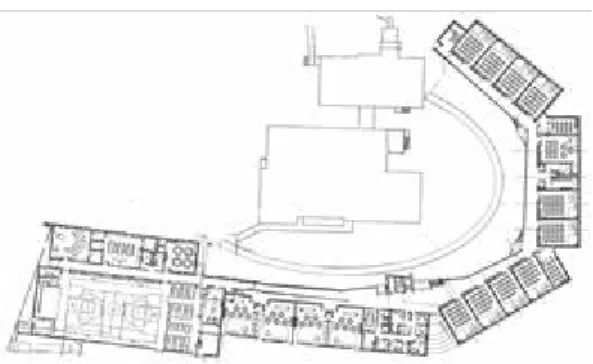
The layout of the new Lotus school was one that curled around the existing school building. The new
school was designed with the requirement that the existing school be used until the completion of the new school. After that, the existing school would be demolished and a parking lot constructed. The main floor layout and elevations of the school are shown in Figure 1, Figure 2 and Figure 3.
Figure 1 Lotus School Design Main Floor
The original design of the Lotus School was a typical school construction, with the building envelope consisting of cementitious roof deck, architectural pre-cast concrete for exterior wall panels including sandwich panel design with 2-inch rigid insulation. Cavity walls were made up of brick and concrete block, while the main structural system of the school was steel joists and girders. Proposed glazing for the school was aluminum windows with insulating glass and thermal break, while interior walls were
constructed of gypsum wallboard.
Figure 2 Lotus School Design North Elevation
Figure 3Lotus School Design South Elevation
The original heating ventilation and air conditioning (HVAC) systems in the new Lotus school included heat-only roof top units (RTUs) for the gym and cafeteria, and built up variable air volume (VAV) system for offices (heating and cooling). Two-pipe fan coil unit ventilators were specified in all the classrooms for heating and cooling. Various cabinet unit heaters and baseboard radiation were specified to condition the hallways and alleviate the other
north end hallway where the preponderance of fenestration was present.
Green Design Opportunities Presented
The first meeting with the Lotus design team consisted of discussing sustainable construction opportunities and a brainstorming session to determine green building opportunities that could realistically be considered for implementation. During the next meeting, a variety of feasible opportunities were presented to the design and construction team, including those that were more costly but still demonstrated the ability to reduce the overall utility budget over the lifetime of the school. After the presentation of green and sustainable building design and construction practices topics, it was decided that several of the ideas should be evaluated using DOE-2.1E. These included lighting modifications, the use of the Solarcrete™ wall building system, fenestration improvements, and HVAC modifications.
SIMULATION
In order to evaluate the design options for the Lotus School district, design information regarding the architectural and mechanical specifications were needed. Then an accurate thermal model could be created and green building design opportunities modeled. It was necessary to provide as accurate a representation of how the school was designed to operate as possible to best evaluate the proposed alternative systems. ERC worked very closely with the architect and construction manager who had built similar schools in other districts during the modeling process.
Schedules
Scheduling was an important factor in modeling Lotus. Obtaining an accurate portrayal of the operating schedules for the various parts of the school was important, as often the gymnasium is used during weekends, whereas the rest of the school is vacant. Additionally, school vacations and summer school schedules had to be considered, as the occupancy and use of the school varies greatly during these periods.
Space Types
The school was defined in terms of several space types characterized by occupancy, internal loads, and schedules. There were several main space types defined for the model. These space types included gymnasium, cafeteria, kitchen, classrooms, common areas, corridors, and offices.
Envelope
The original design of Lotus specified a typical main level wall construction of face brick, rigid insulation, concrete block, and finished with gypsum board and
paint. The second level construction differed from the main level. It had siding, batt insulation, and gypsum board with paint on the steel structure. Both wall constructions were specified to an R-19
construction equivalent.
The roofs were all sloped towards the south, and with a construction comprised of a built up roofing system, rigid insulation, and metal decking; the equivalent to an R-30 construction.
The initial design of the school specified double pane insulated glazing with a grey tint, filled with air. Aluminum frames were to be used for all windows throughout the school.
HVAC Systems and Zoning
The spaces in the DOE-2.1E model were
characterized by not only space type, but by the type of system that served the area. The classrooms were all conditioned by two-pipe fan coil systems, while two roof top units served the gymnasium, cafeteria, and kitchen. The office and general rooms on the second level were conditioned by a variable -air-volume system. Unit heaters were modeled where specified, including vestibules and storage areas.
Plant
The original design of the school included a chiller and a boiler. A 310-ton (3.72 million Btu per hour) air-cooled chiller was specified in the mechanical drawings to provide cooling for the chilled water loop. A boiler with a capacity of 1.44 million Btu per hour was specified to provide the heat for the hot water loop and domestic hot water applications for the school.
Economics
The school district provided current utility bill information in order to evaluate the annual energy costs for the proposed new school. Though the bills were not needed as input to validate the model, they were used as an initial check of the models ability to predict monthly energy use. Using an accurate utility rate as input to the model was important, particularly for evaluating the impact of the proposed options on the future energy budget. The electric rate was a non-time of use constant charge of $0.03232/kWh, so the cost per kilowatt-hour was consistent year round, and not dependant on time of day or seasonal variances. The electric demand charge varied by season, higher rates in the summer ($14.24/kW), and lower in the winter ($11.13/kW).
The natural gas cost was a flat rate per therm, and did not vary throughout the year. This natural gas supply management option was expected to continue into the near-term future for the school district.
Alternative Systems (Lighting)
Once the initial model depicting the original design of the school was created, alternative systems were
modeled using the preliminary design as a base case. The first alternative considered was using a high efficiency lighting system such as switching from a standard T-8 lamp fixture to a T-8 fixture with energy saving lamps and programmable electronic ballasts. Additionally, lighting controls such as photo-sensors and occupancy sensors can assist in turning off lights when areas are unoccupied or sufficient natural light is present. These lighting strategies of using energy saving, high efficacy lamps and proper controls to mitigate light usage conserve significant electric energy.
Alternative Systems (Building Envelope)
The SolarcreteTM prefabricated building envelope erect-on-site system offers significant innovation in building envelope design, specifically walls and roofs. SolarcreteTM wall and roof systems consist of a reinforced concrete insulated sandwich panel. An expanded polystyrene insulation board core is sandwiched between shotcrete faces, which are interconnected with patented ties. Insulation values for these systems can surpass R-35 and have impressive load-bearing capacity similar to other standard prefabricated wall systems. Other advantages include: reduced conditioning requirements from HVAC equipment, low
maintenance, reduced noise levels inside buildings and two-hour fire rated walls (per ASTM E119-79).
Alternative Systems (Fenestration)
Fenestration issues were also considered as an alternative opportunity for Lotus school. The initial specifications called for double pane, gray tinted, air-insulated windows with aluminum frames on all façades. Several additional alternatives are available, including low-e, argon gas-filled and even triple pane windows. Though normally requiring additional upfront cost, with the amount of glazing and
orientation of the building, it was thought that having more efficient windows would have an impact on overall energy usage, and reduce the annual energy budget, specifically if the highest thermal quality windows were installed on the south facing zones of the buildings. The original specified glazing was changed from gray tinted to clear on the north side of the hallway to maximize daylighting opportunities.
Alternative Systems (HVAC Systems)
By modifying the existing HVAC design from multiple systems/system types to one or more central variable air volume ventilation systems, Lotus School could save energy, possibly reduce the size of the chiller and boiler, improve indoor air quality throughout the school and decrease the maintenance budget over the life of the school significantly. Centralized ventilation equipment can be modified with a central exhaust/heat recovery system to preheat/pre-cool outside air. Though the
requirements of the school state that 100 percent outside air will be used during occupied hours, preheating or pre-cooling the air by using a heat recovery system saves energy. The use of enthalpy economizer cycles could maximize “free cooling.” Lastly, this modified system could be controlled with variable frequency drives that would maximize the fan energy savings.
ANALYSIS
All of the proposed alternative designs (PADs) reduced the predicted annual utility consumption and associated annual utility costs when compared to the baseline energy consumption for the new Lotus school design. Some PADs had more impact than others, while combining all of them had a significant impact on the predicted utility budget. The following sections present the effects each PAD had on the Lotus school design annual utility usage.
Efficient Lighting System
This measure included using energy saving T-8 lamps and occupancy and photo-sensor controls. The opportunity to specify energy saving fixtures and sensors could be implemented further into the design process, even after the general lighting scheme has been determined. Theoretically, T-8 lamps should use 6.25 percent less energy than standard T-8 lamps, however, the model accounted for the interactive lighting demand and control effects. The occupancy and photo-sensors were recommended for the corridor of the school, which has windows along the entire length. Implementing both of these measures resulted in an energy savings of 4.4 percent over the baseline case, and a reduction of 3.6 percent in monthly demand.
Solarcrete Wall System
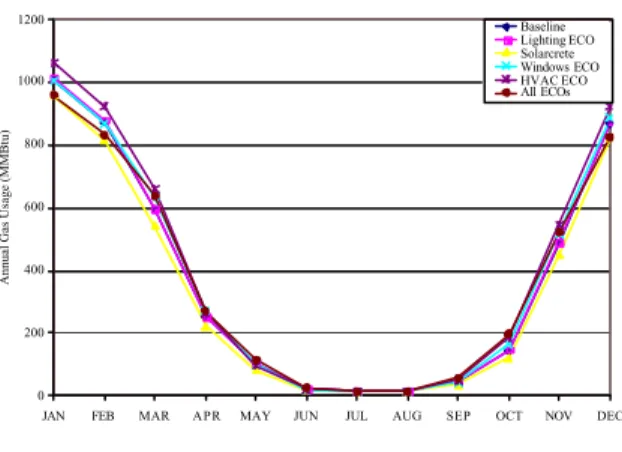
This building opportunity consisting of using the SolarcreteTM envelope construction would involve adjusting the envelope of the school, which is more difficult to do later in the design process. However, this measure has the potential to reduce the natural gas usage by 7.6 percent annually. This was due to the insulating properties (R-35 equivalent wall), and tight construction technique used with this wall system. Using the SolarcreteTM system does not particularly affect either the electric energy usage or the monthly demand for the model of the school.
Fenestration
The original design called for double pane tinted gray air-insulated glass to be installed throughout the school, even on the north façade. This would limit the benefits of daylighting in the north corridor. The proposed opportunity included adjusting the northern glazing to clear double-pane insulated glass, while using double pane, low-e tinted argon-filled
specifically selected for the high incidence of glazing on the southern façade. This measure would take advantage of some potential reduction in the initial cost of fenestration using this design. At best, the total cost of the fenestration might stay constant. This simulation demonstrated that using the more efficient windows, particularly on the southern facing façade, reduced the solar gains throughout the school. This in turn resulted in reduced annual electrical energy consumption by 3.1 percent and monthly electricity demand by 5.6 percent.
HVAC System Options
Typical school mechanical system designs in the Midwest region of the United States use a two-pipe fan coil unit ventilator in classrooms, as was specified for the Lotus school. However, by installing a VAV system for the entire school, with the exception of the gymnasium, cafeteria and kitchen, occupant comfort could be maximized while reducing energy consumption for the school. The model of this PAD kept the gymnasium, kitchen and cafeteria with packaged roof top units. This energy measure demonstrated the potential to have the most impact on the energy consumption of any single opportunity presented, with a reduction in annual energy usage (natural gas and electricity) of 14.8 percent. However, this PAD is perhaps the most difficult to change late in the design process. A major architectural redesign would likely be required to make room for mechanical rooms, ducts, piping runs, etc.
All Green Building Measures
Each of the PAD opportunities provided some degree of energy conservation and cost savings for the school. However, the interactive effects of
implementing all of the options were easily modeled in DOE-2.1E. Combining all of the individual energy measures resulted in a total energy usage reduction of 24.7 percent annually and an electrical demand reduction of 5.8 percent monthly over the baseline model. Combining the above alternative systems did not significantly impact the natural gas usage.
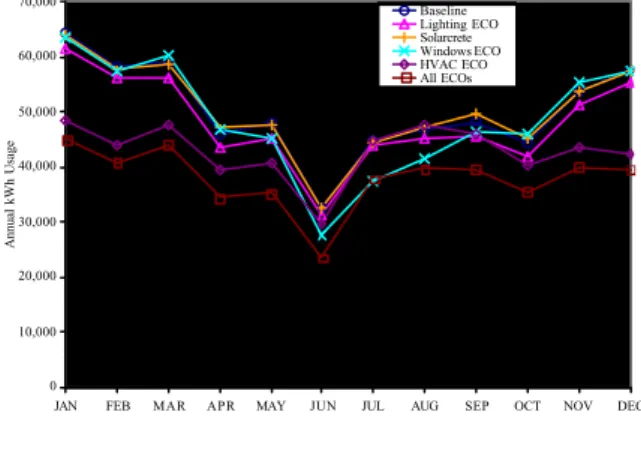
The following figures graphically present all of the PAD cases: baseline, lighting improvements, SolarcreteTM, fenestration improvements, and HVAC system alternatives. The energy usage comparison and monthly demand comparison are shown in Figure 4 and Figure 5 respectively. Note that the monthly demand reduction varies by only 3 to 5.8
percent with the proposed alternative systems. The energy usage reduction varies from 3 to 24.7 percent. Figure 6 presents the comparison of natural gas usage by month, which does not vary significantly, with the exception of the SolarcreteTMoption. Finally, Figure 7 illustrates the annual utility costs for each case, which vary from approximately 3 percent for any single opportunity, to 10 percent for implementing all of the proposed alternatives.
Figure 4 Energy Usage Comparison
Figure 5 Demand Comparison
0 10,000 20,000 30,000 40,000 50,000 60,000 70,000
JAN FEB MAR APR MAY JUN JUL AUG SEP OCT NOV DEC
Annual kWh Usage Baseline Lighting ECO Solarcrete Windows ECO HVAC ECO All ECOs 0 50 100 150 200 250 300 350 400
JAN FEB MAR APR MAY JUN JUL AUG SEP OCT NOV DEC
Monthly kW Baseline Lighting ECO Solarcrete Windows ECO HVAC ECO All ECOs
Figure 6Natural Gas Usage Comparison
Figure 7Annual Utility Cost Comparison
Utility cost per square foot, like other metrics such as kilowatt-hours per square foot and kilowatt-hours per square meter, are used for comparing the
performance of buildings to other similar building types. These metrics, along with the expected annual energy budget and annual energy savings due to implementation of the proposed alternative designs are presented in
Table 1.
Table 1Utility and Savings Summary
ENERGY COST ($/FT2) ENERGY COST ($/M2) TOTAL ENERGY COST ($) ANNUAL ENERGY SAVINGS ($) Baseline $1.19 $12.81 $77,350 ---Lighting ECO $1.16 $12.49 $75,400 $1,950 Solarcrete $1.15 $12.38 $74,750 $2,600 Window ECO $1.15 $12.38 $74,750 $2,600 HVAC ECO $1.16 $12.49 $75,400 $1,950 All ECOs $1.08 $11.63 $70,200 $7,150
CONCLUSION
Sustainable building design alternatives can be evaluated and implemented throughout the design process, even late in the process. DOE-2.1E can be used as a valuable tool to evaluate the annual energy budget impact of alternative green building and proposed sustainable construction designs. During this project, utility budget costs predicted by the DOE-2.1E models were used to evaluate each PAD. Evaluating PADs late in the design process is inherently problematic. However, in this instance, several opportunities were evaluated using DOE-2.1E without impacting the construction timeline. One of the reasons Lotus gave for evaluating these options was they were concerned about the slight volatility in the utility structure in Illinois due to deregulation of the electric utility. In Illinois specifically, natural gas is fully deregulated and the deregulation of the electric utility is progressing rapidly. By 2006, all users of electricity will be able to buy power on the open retail market, unless the existing legislation changes . Deregulation could have a huge impact on utility budgets and redefine how sustainable building practices are interpreted and used.
Typically the costs to implement capital projects are higher the longer the architect/designer/construction manager waits to make a decision. For example, changing the HVAC system type in the majority of the school was clearly cost prohibitive and the Lotus design team was unwilling to consider this.
However, all change types were not necessarily more costly during the evaluation of PADs. For example, based on the results of the DOE-2.1E model, the owner of the SolarcreteTM building systems company was willing to erect the walls and roof of the new school for less than his cost. The marketability of the SolarcreteTM system had that much implicit value to him.
Unfortunately the Lotus design team rejected all of the PADs analyzed as part of this project. Their decision had little to do with whether the DOE-2.1E data was presented in a clear and timely fashion and more to do with the aversion to perceived risk by the Lotus design team. Up to the time the school opened, the authors were presenting the case for sustainable practices, if in no other area than lighting. The final barrier to success for this project was cost overruns. During the final phases of interior construction, there was no budget for any type of change order, even if was deemed critical.
ACKNOWLEDGEMENTS
The authors would like to thank the Illinois Department of Commerce and Economic
0 200 400 600 800 1000 1200
JAN FEB MAR APR MAY JUN JUL AUG SEP OCT NOV DEC
Annual Gas Usage (MMBtu)
Baseline Lighting ECO Solarcrete Windows ECO HVAC ECO All ECOs 66000 68000 70000 72000 74000 76000 78000 80000
Annual Utility Cost ($)
Baseline Lighting ECO Solarcrete Windows ECO HVAC ECO All ECOs
Opportunity for their help and financial support in seeing this project through completion, and School District 114 for the opportunity to participate in and present topics on green building design for the Lotus School.
REFERENCES
Al-Homoud, Mohammad Saad. “Computer-aided building energy analysis techniques”. Building and Environment, vol 36. 2001.
ASHRAE 1995. “Handbook: Fundamentals, Chapter 30-Energy Estimating and Modeling Methods,” Atlanta, Georgia.
ASHRAE 1999. “Proposed Guideline 14P Measurement of Energy and Demand Savings,” Atlanta, Georgia.
Beausoliel-Morrison, Ian, “Development of Detailed Descriptions of HVAC Systems for Simulation Programs,” ASHRAE TC 4.7 Energy Calculations. February 2000.
Federal Energy Management Program (FEMP), “Measurement and Verification Guideline,” Chapter 25.
Gates, S.D. & J.J. Hirsch. DOE-2.1E Enhancements September 1996.
U.S. Department of Energy (DOE), 1990. Architect’s and Engineer’s Guide to Energy Conservation in Existing Buildings. DOE/RL/01830P-H4, Washington, D.C.
Waltz, James P. Computerized Building Energy Simulation Handbook. The Fairmont Press, Inc. Lilburn, Georgia, 1999.