Contents
1 source coding 3
2 Caesar Cipher 4
3 Ciphertext-only Attack 5
4 Classification of Cryptosystems-Network Nodes 6
5 Properties of modulo Operation 10
6 Vernam Cipher 11
7 Public-Key Algorithms 14
8 Double Encryption 15
9 Vigenere Cipher and Transposition 16
10 Permutation Cipher 20 11 Substitution Cipher 21 12 Substitution + Transposition 25 13 Affine Cipher 27 14 Perfect Secrecy 28 15 Feistel Cipher 38 16 Block Cipher 45
17 Digital Encryption Standard (DES) 46
18 Primitive Element 53
19 Diffie-Hellman Key Exchange 54
21 ElGamal 59 22 RSA System 61 23 Euclid’s algorithm 65 24 Protocol Failure 66 25 Complexity 67 26 Authentication 68 27 Protocols 71 28 Hash Functions 73 29 Cipher Modes 78
30 Pseudo Random Number Generators 79
31 Linear Feedback Shift Register 80
32 Challenge Response 87
33 Application of error correcting codes in biometric
authenti-cation 89
1
source coding
Problem 1.1. We consider 64 squares on a chess board. (a) How many bits do you need to represent each square?
(b) In a game on a chessboard one player has to guess where his opponent has placed the Queen. You are allowed to ask six questions which must be answered truthfully by a yes/no reply. Design a strategy by which you can always find the Queen. Show that you can not ensure the exact position when you are allowed to ask five questions.
(c) How do you interpret your result in (b) together with your result in (a)?
Problem 1.2. A language has an alphabet of five letters xi, i = 1,2, ...,5, each occurring with probability 1
5. Find the number of bits needed of a
fixed-length binary code in which:
(a) Each letter is encoded separately into a binary sequence. (b) Two letters at a time are encoded into a binary sequence.
(c) Three letters at a time are encoded into a binary sequence. Which method is efficient in the sense of bit per letter?
Problem 1.3. A language has an alphabet of eight letters xi, i= 1,2, ...,8, with probabilities 0.25,0.20,0.15,0.12,0.10,0.08,0.05 and 0.05.
(a) Determine an efficient binary code for the source output.
(b) Determine the average number of binary digits per source letter. Problem 1.4. Suppose a source outputs the symbols {a, b, c, d, e, f, g} with probability {0.4,0.2,0.1,0.1,0.1,0.05,0.05}.
(a) Give a binary representation for these symbols and calculate the aver-age representation length.
2
Caesar Cipher
Problem 2.1. We consider a Caesar cipher and assume that the plaintext message is in English. Decrypt the following ciphertext by giving a brief explanation:
KN XMNSLKW JXMBF Y JW GJSIXF IRNY XB T W IKNXMW F SIT AJW MJQRNSLF SDIF D
Note: Use the following frequency distribution of the letters in the English language for the cryptanalysis:
Table 1:
a b c d e f g h i j k l m
8,05 1,62 3,2 3,65 12,31 2,28 1,61 5,14 7,18 0,1 0,52 4,03 2,25
n o p q r s t u v w x y z
7,19 7,94 2,29 0,20 6,03 6,59 9,59 3,1 0,93 2,03 0,2 1,88 0,09
(a) What can be the main drawback of the substitution cipher given above?
(b) Caesar cipher is an example of classical cryptosystem. Is this statement true? Why or why not?
(c) Steganography is the art and science of hiding information by embed-ding messages within other, seemingly harmless messages. Take the third letter in each word of the encrypted message above and find the emerging message.
3
Ciphertext-only Attack
Problem 3.1. We consider a ciphertext-only attack on a substitution cipher and assume that the plaintext message is in English. Decrypt the following ciphertext by giving a brief explanation:
XT HQT XJST RF Y Y JW MT BKF W
What can be the main drawback of the substitution cipher given above? Problem 3.2. We consider a ciphertext-only attack on a substitution cipher and assume that the plaintext is in English. Decrypt the following ciphertext:
ynyqj
Hint: Use the frequency distributions of the letters in English language in table 1 for the analysis.
4
Classification of Cryptosystems-Network Nodes
Problem 4.1. Suppose that we have the following network nodes A, B, Cand D (Figure 1): Figure 1: D A C B
(a) How many keys do we have to generate such that A, B and C can communicate with D in a bidirectional secure way using a symmetric encryption algorithm?
(b) We replace the symmetric encryption algorithm with a public key sys-tem. How many public keys do we have to generate in this case such that A, B and C can communicate with D in a bi-directional secure way?
(c) Suppose that we have 8 nodes in a network. How many symmetric keys do we need such that every pair of nodes can communicate in a safe way?
Problem 4.2. (a) Suppose that we have a network with 10 nodes. How many different keys do we have to generate such that every pair of nodes can communicate in a bi-directional secure way using classical cryptosystem?
(b) We replace classical system with a public key system. How many dif-ferent keys do we have to generate such that every pair of nodes can communicate in a bi-directional secure way?
(c) Suppose that we extend the network with one more node. How many new extra keys do we need to generate such that every pair of nodes
can communicate in a bi-directional secure way? (Calculate for classical and public cryptosystems).
(d) What is your short conclusion or the interpretation of the results found above?
Problem 4.3. (a) Suppose that we have a network with 6 nodes. How many keys do we have to generate such that every pair of nodes can communicate in a bi-directional secure way using the DES encryption algorithm?
(b) Suppose that we extend the network with one more node. How many new DES keys do we need such that every pair of nodes can now communicate in a safe way?
(c) Instead of DES, we want to use RSA. How many Public keys do we need such that every pair of nodes can now communicate in a safe way? Problem 4.4. (a) Suppose that we have a network with 6 nodes. How many keys do we have to generate such that every pair of nodes can communicate in a bi-directional secure way using the RSA encryption algorithm.
(b) Suppose that we extend the network with one more node. How many new Public keys do we need such that every pair of nodes can now communicate in a safe way?
(c) Instead of RSA, we want to use DES. How many keys do we need such that every pair of 7 nodes can communicate in a bi-directional safe way?
Problem 4.5. Suppose that we have the following network nodes: A, B, C, D. Nodes can communicate over the links shown below (Figure 2).
Q1: How many keys do we have to generate such that nodes can com-municate over the given links in a bi-directional secure way using the DES encryption algorithm with node A and without node A?
Q2: Instead of DES, we want to use ElGamal public key scheme. How many public keys do we have to generate such that nodes can communicate over the given links in a bi-directional secure way with node A and without
Figure 2:
A B
D C
node A?
Answer the above questions for the following network nodes (Figure 3):
Figure 3:
A B
D C
Problem 4.6. Consider the figure 4 of a network with nodes A, B, C, D and E. Arrows represent the communication in a bidirectional secure way.
Figure 4:
A
B
C D
E
QA) How many keys do we have to generate such that the nodes can com-municate over the arrows in a bidirectional secure way using a symmetric encryption algorithm?
QB) We replace the symmetric encryption algorithm with a public key sys-tem. How many public keys do we have to generate in this case?
5
Properties of modulo Operation
Problem 5.1. Calculate the modulo operations given below:• 101×98 mod 17 = • 75 mod 15 = • 128 mod7 = • 7559 mod 63 = • −7559 mod 63 = • 755911 mod63 = • 17150 mod 151 = • 1410 mod 197 = • 68133 mod 323 = • 1772 mod 73 = • 773 mod 71 = • 1310 mod 167 = • 232 mod 5 = • 864 mod 9 = • 1242 mod 25 = • 163×255 mod23 = • 415 mod 17 =
6
Vernam Cipher
Problem 6.1. Consider a Vernam Cipher with the following encryption scheme (Figure 5):
Figure 5: Key sequence K (random)
C=M K (xor operation) Binary message M
Assume that a language has only three letters A, B and C. Their binary representations are as follows: A= 000,B = 1111, C = 0011. Two words in the language are encrypted with the same key sequence:
W1 = 0101001110111010101100100
W2 = 1011001010000000000101011 Determine the possible message pair.
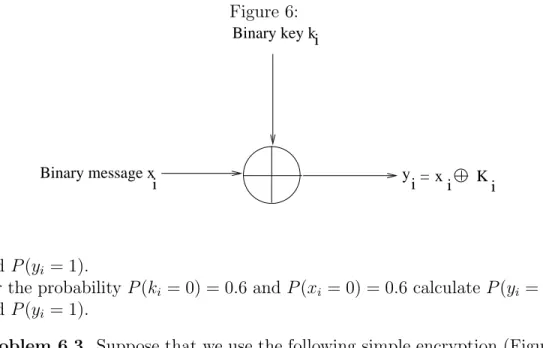
Problem 6.2. The Vernam cipher is an example of a perfect stream cipher (Figure 6):
For the probabilityP(ki = 0) = 0.5 andP(xi = 0) = 0.25 calculateP(yi = 0) and P(yi = 1).
For the probability P(ki = 0) = 0.4 andP(xi = 0) = 0.3 calculate P(yi = 0) and P(yi = 1).
For the probabilityP(ki = 0) = 0.5 andP(yi = 0) = 0.25 calculateP(xi = 0) and P(xi = 1).
For the probability P(ki = 0) = 0.4 andP(yi = 0) = 0.3 calculateP(xi = 0) and P(xi = 1).
For the probability P(ki = 0) = 0.5 andP(xi = 0) = 0.4 calculate P(yi = 0) and P(yi = 1).
Figure 6: y i= xi K i Binary key ki Binary message x i and P(yi = 1).
For the probability P(ki = 0) = 0.6 andP(xi = 0) = 0.6 calculate P(yi = 0) and P(yi = 1).
Problem 6.3. Suppose that we use the following simple encryption (Figure 7):
Figure 7:
= C M R
Binary message M Random bit stream R
A language has only two words: A= 111 and B = 0000. Two sentences in the language are encrypted with the same random binary sequence R. The first sentence S1 is encrypted as 011101101001000111001 and the second
sentence S2 is encrypted as 011010110110100111110. Find good candidates
for the original sentences.
letter A E I M O R T V encoding 000 001 010 011 100 101 110 111
A message M = MARIO is Vernam encrypted into ciphertext C =
AOAMV; C =M ⊕K where ⊕ shows modulo 2 XOR operation. Find the corresponding encryption key. Provide details of your cryptanalaysis.
b) Consider the following two ciphertextsC1 =IEEIAandC2 =ORV RO
that are obtained from messages M1 and M2 respectively under the vernam
encryption and the same encryption key. Encrypted messages are two names. Let us denote withmi,k thekth letter in messageMi. The following is known about messages (names): m1,1 = R and m2,4 = T. Using this information,
try to recover messages M1 and M2, as well as the encryption key. Provide
7
Public-Key Algorithms
Problem 7.1. Encrypt the message ’encoding’ using the double Transpo-sition. Choose Key1 and Key2 as ’exam’ and ’study’.
Problem 7.2. A double transposition cipher uses as first keyword ’exam’ and as second keyword ’topic’.
Find the plaintext corresponding to the ciphertext C=isthastties. Problem 7.3. Decrypt the ciphertext:
HRDY MIP UUNEOBP Y EAM T P OAK
8
Double Encryption
Problem 8.1. We consider double encryption of a private-key algorithm in order to increase the security, such that: y=e2(e1(M)). Assume two ciphers
are given as:
e1(x) = a1.x+b1
e2(z) = a2.z+b2
where x and z represent the input message, a{1,2} and b{1,2} are the
coeffi-cients.
Show that there is a single cipher e3(M) = a3.M +b3 which performs
9
Vigenere Cipher and Transposition
Problem 9.1. (a) For a transposition cipher the letter frequency remains unchanged. (yes/no)?
(b) The number of different transposition ciphers for a binary word of length 4 is . . . ..
(c) A transposition cipher destroys dependency between letters.
Problem 9.2. Encrypt the message below using the following methods. As-sume the English alphabet.
Supplieswillarrivetonight
1. Vigenere with key=system.
2. Double Transposition with key1=make, key2=stand.
What is the main advantage of Vigenere cipher over Caesar cipher? What is the main goal of the transposition?
Why is it stronger to apply double transposition instead of single transposi-tion?
Problem 9.3. A Vigenere type of cipher is given as follows: Plaintext space X={0, . . . ,25}.
Ciphertext space Y ={0, . . . ,25}. Key space K ={0, . . . ,25}. Encryption function is defined by:
E(X, K) = (X+K) mod n.
The following alphabet X = {A, B, . . . , Z} are identified with the natural numbers.
(a) Determine the decryption function.
(b) Encrypt the following text by using the key ”hello” and assuming (as usual) that n= 26.
Write your answer with a block of length 5 and ignore spaces, dots and commas. (Show your steps briefly!)
Mr. P resident,
Figure 8:
Plaintext
Delay elements
D D
modulo 26 Ciphertext
Problem 9.4. Consider a Vigenere type of cipher with the encryption scheme given in Figure 8.
(a) Drepresents the delay elements in time whereCiandPiare the cipher-text and plaincipher-text with the time indexi. Write the encryption function from the figure 8.
(b) Determine the decryption function.
(c) Draw the equivalent decryption implementation. Problem 9.5. Suppose the message
SSDT T RRN NRICNAW COILOAT HKIUSGY IT AT OAAEUN
was encrypted using double transposition. Find the keys as well as the plain-text message. Hint: The keys belong to the set
{SY ST EMS, ENGINEERIN G, U NIV ERSIT Y, ESSEN, DU ISBURG, CRY P T OGRAP HY}.
Problem 9.6. A vigenere type of cipher is given by the rule:
Ci =Pi+Pi−2 modulo 26
whereCi and Pi are ciphertext and plaintext symbols at time i, respectively. It is implemented with two delay elements as shown in figure 9.
Give the rule for deciphering and draw the equivalent implementation to decipher the ciphertext.
Figure 9:
Plaintext
Delay elements
D D
modulo 26 Ciphertext
Problem 9.7. Decrypt the cipher text ICP EY DRCT EP DRHIEA using the following methods, and the given keys. The alphabet is given by A= 1,
B = 2, . . ., Z = 26. (Note: The plain text may not be a readable message). (a) Vigenere (Key = CRY P T O).
(b) Double Transposition (Key1 = CRY P T O, Key2 = ESSEN).
Problem 9.8. We consider a Vigenere type block cipher system. You must choose your key according to the last 4 letters of your surname. (Ex: Name: Mengi, Key: engi) Encrypt the following given messages:
1. spyincountry
2. exam
Hint: A, B, C, D, E, F, G, H, I, J, K, L, M, N, O, P, Q, R, S, T, U, V, W, X, Y, Z. (A=0,.., Z=25).
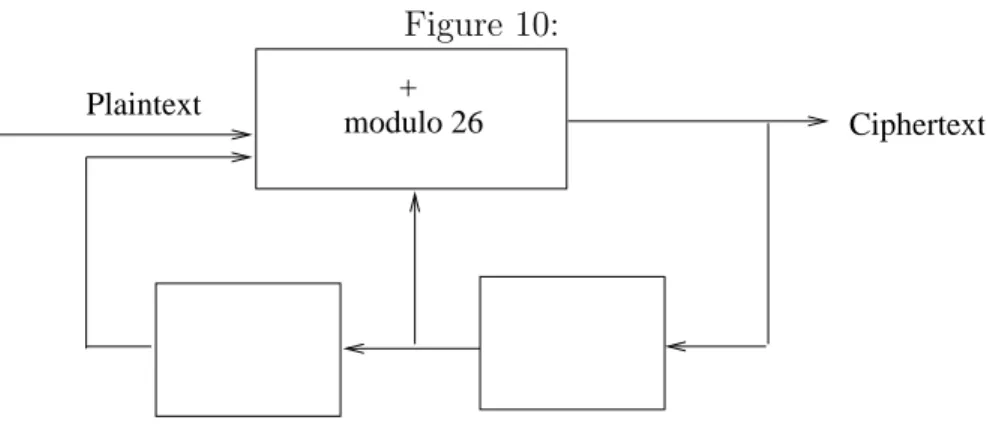
Problem 9.9. A Vigenere type of cipher is given by the rule: Ci = (Pi+
Ci−1+Ci−2)modulo26, whereCiandPiare ciphertext and plaintext symbols at time i, respectively. It is implemented with 2 delay elements as shown in figure 10:
Figure 10: modulo 26 Delay elements Plaintext Ciphertext +
Give the rule for deciphering and draw the equivalent implementation to decipher the cipher text.
10
Permutation Cipher
Problem 10.1. Encrypt the message spyarrivesonthursday using the double Transposition. Choose Key1 and Key2 as your first and second name. (Ex.: anil mengi, then the Key1=anil and Key2=mengi).
11
Substitution Cipher
Problem 11.1. (a) A substitution cipher destroys dependency between letters. (yes/no?)
(b) The number of different substitution ciphers for binary words of length 4 is . . . ..
Problem 11.2. In a substitution cipher we replace symbols by other sym-bols. Suppose that message symbols are elements from the set {0,1,2,3,4}. As an example the symbols {0,1,2,3,4} are replaced by {0,4,1,2,3}.
Note: we assume that substitution from a set{0,1,2,3,4}to a set{0,1,2,3,4}
is also valid.
(a) How many different substitutions are possible for the alphabet with letters {0,1,2,3,4}.
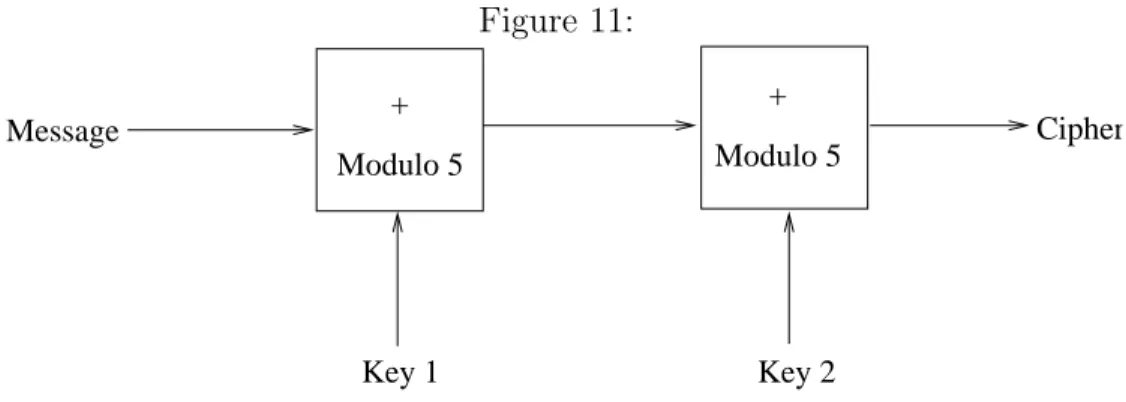
(b) Suppose that we implement a substitution system in a double encryp-tion mode as given in figure 11. All the addiencryp-tions aremodulo5 addition.
Figure 11: + Modulo 5 + Modulo 5 Message Key 1 Key 2 Cipher
Given the message 020 and the corresponding cipher 040, what are the
possible different keys?
Problem 11.3. In a substitution cipher we replace symbols by other sym-bols. As an example the symbols{00,01,10,11}are replaced by{01,10,00,11}.
(a) How many different substitution ciphers are possible for binary words of length 2?
(b) The simple substitution ciphers can be realized with a table lookup, where rows correspond to messages and columns to keys. The entries in the table are the ciphers.
What is the size of your table?
(c) Suppose that we implement the substitution in simple way (Figure 12):
Figure 12: binary message (a,b)
binary key K= (j,k)
cipher (a j,b k) is modulo 2
How many different substitutions are possible for this simple encryp-tion?
(d) We use this simple substitution cipher in a ”double encryption” mode (Figure 13):
Figure 13:
Key K
1 Key K2
Message substitution substitution Cipher
Given the message (0,1) the corresponding cipher is (1,1).
How many different solutions are possible for the key pair (K1, K2)?
Problem 11.4. In a substitution cipher we replace symbols by other sym-bols. Suppose that message symbols are elements from the set {0,1,2,3}. As an example the symbols {0,1,2,3} are replaced by {1,0,3,2}.
(a) How many different substitutions are possible for the alphabet with letters {0,1,2,3}? Suppose that we implement the substitution in a simple way using key symbols from the set {0,1,2,3}.
(b) We use the substitution cipher in a ”double encryption” mode as shown in figure 14:
Figure 14:
Key K
1 Key K2
Message substitution substitution Cipher
= ( j , k ) = ( k , j ) +
+
Given the message (1,2) and the corresponding cipher (3,0), what is the number of possible keys? Give an example of a key K1 = (j, k).
Problem 11.5. Given is the following string of ciphertext which was en-crypted with substitution cipher:
asvphgyt
The encryption rule is given as
C = (M +K)mod 26
where C is the ciphertext, M is the plaintext and K is the key. We assume that the plaintext is in English. You know that the first plaintext letter is a
W. Find the key and decrypt the message.
Problem 11.6. In substitution cipher, we replace symbols by other symbols. The message and the key symbols are elements from the set{0,1,2,3,4,5,6,7,8,9}. As an example the symbols {0,6,5,2,4,0}are replaced by {1,2,3,4,5,1}.
(Q1) How many different substitutions are possible for the alphabet with letters {0,1,2,3,4,5,6,7,8,9}.
Suppose that we implement the substitution in a simple way as given in figure 15. Key is given as {8,5,4,6,8,2}. Assume that the message is the last 6 numbers of your matriculation number. (Ex.: m.n.= 1457652, then the message={4,5,7,6,5,2}).
(Q2) Calculate the cipher.
Figure 15:
+
key K=(j,k,l...)
12
Substitution
+
Transposition
Problem 12.1. Suppose that we have a binary-to-octal and octal-to-binary substitution followed by a binary transposition scheme as shown in figure 16:
Figure 16: 3 2 1 0 4 5 6 7 3 2 1 0 4 5 6 7
(a) How many different schemes can we construct by changing the mapping of the substitutions and transpositions?
Hint: the order should be the same, i.e. Binary-to-octal and octal-to-binary substitution followed by a octal-to-binary transposition scheme.
(b) Assume a language with 8 letters: A, B, D, K, M, O, S, T where the decimal representation is A = 0, B = 1, . . ., T = 7. In order to encrypt a letter in this language, we convert the letter in binary form, apply the scheme above and convert them back into the corresponding letter. Encrypt the given word: BOST AK.
Problem 12.2. Suppose that we have the binary-to-octal and octal-to-binary substitutions followed by a octal-to-binary transposition scheme shown in figure 17:
Q1: How many different schemes can we construct by changing the substi-tutions and transpositions? (The order should be the same: Binary-to-octal and octal-to-binary substitutions followed by a binary transposition.)
Figure 17: 3 2 1 0 4 5 6 7 3 2 1 0 4 5 6 7
Q2: Assume a language with 8 letters: A, B, C, K, L, O, T, Y. In order to encrypt a word in this language, we convert the letters into binary form, apply the scheme above and convert them back to corresponding letters. Encrypt the word: KAL.
13
Affine Cipher
Problem 13.1. We consider the affine code that transforms a message M
into ciphertext C as
C= (19.M+ 6)mod31.
In other words,M is multiplied with 19, 6 is added to the sum and modulo 31 is taken over the result.
(Q1) Encrypt M=29.
(Q2) The message can be recovered by an affine transformation of the form
M = (a.C+b)mod31.
Determine the constants a and b.
Problem 13.2. The encryption for 128 different symbols is given by the following equation:
C = (K1×M +K2)modulo 128;
whereC and M represent the cipher and the message, respectively. Q1: For K1 = 11 and K2 = 17, encrypt M = 70.
Q2: Find the corresponding decryption function.
Q3: Give the message that follows from C = 20 for the same K1 and K2
14
Perfect Secrecy
Problem 14.1. Consider the cryptosystem with probability measures given in figure 18: Figure 18: Key K Message M Cipher C + modulo 4 where: (i) K ∈ {0,1,2,3} and P(K = 0) = 1/3, P(K = 1) =P(K = 2) = 1/6. (ii) M ∈ {0,1,2,3} and P(M = 0) = 1/7, P(M = 1) = 3/7 and P(M =
2) = 2/7.
(iii) C = (M +K) modulo 4.
(a) Calculate the corresponding probabilities: P(M = 3), P(K = 3), P(C= 0), P(C = 2), P(C = 2|M = 0), P(C = 0|M = 0).
(b) What is the condition for perfect secrecy?
(c) Does this cryptosystem provide perfect secrecy? Prove your answer mathematically.
Problem 14.2. Consider the cryptosystem with probability measures given as follows:
• Plaintext space X ={a, b, c}.
• Key space K ={K1, K2}
Encryption functions are defined by:
a b c K1 1 2 3
K2 2 3 4
Plaintext and key distributions are defined by:
a b c
1/4 1/4 1/2
K1 K2
1/4 3/4 (a) What is the condition for perfect secrecy?
(b) Compute the corresponding probability measures on ciphertext (P(Y =
i), i= 1,2,3,4).
(c) Check and prove whether this cryptosystem is secure.
Problem 14.3. A ternary source generates symbols M = {0,1,2} with probability P(M = 0) = 1
2, P(M = 1) = P(M = 2) = 1
4. Consider two
substitution ciphers given in A and B.
Figure 19:
+ mod 3
K
M C
(A) We use a substitution cipher with an encryption rule C = (M +
K) mod 3 (Figure 19), where K ∈ {0,1} is the key with the probability
P(K = 0) = P(K = 1) = 1/2 and C ∈ {0,1,2} is the ciphertext. Answer the following questions:
(b) Does this scheme provide perfect secrecy? Motivate your answer math-ematically!
(B) Another substitution cipher calculates C = M +K (Figure 20), where nowC∈ {0,1,2,3}andK ∈ {0,1}with the probabilityP(K = 0) =P(K = 1) = 1
2. Answer the following questions:
Figure 20:
K
M C
+
(c) Calculate P(M = 0|C = 0) and P(C = 2).
(d) Which scheme A orB gives better security? Why? Problem 14.4. Consider the cryptosystem given in figure 21:
Figure 21:
Message M Cipher C
Key K
• M ∈ {0,1},
• K ∈ {0,1} : P(K = 0) =P(K = 1) = 1 2,
• C =MLK
(a) For a given probability P(M = 0) = 1
3 and P(M = 1) = 23, calculate
the following probabilities:
P(C = 0) =. . . .,
P(M = 0|C = 0) =. . . ..
(b) Does this cryptosystem provide perfect secrecy? Prove your answer mathematically!
Problem 14.5. Suppose that a sender and receiver use the encryption table in figure 22: Figure 22: 0 1 3 2 2 0 1 3 Message x = 0 x = 1 key 00 01 10 11 cipher
We assume further that the keys are selected with equal probability and
P(X = 0) = 1−P(X = 1) = 1 3.
(a) A passive attacker observes the cipher 3. What is the probability that the transmitted message is 1, given the observed cipher is 3?
(b) An active attacker changes an observed cipher 3 with 1. What is the probability that this cipher is accepted as valid by the receiver? (c) An active attacker injects the cipher 3. What is the probability that
this cipher is accepted as valid by the receiver?
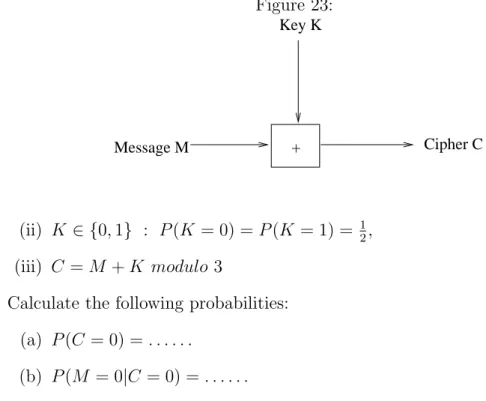
Problem 14.6. Suppose that we have the encryption scheme in figure 23: where
(i) M ∈ {0,1,2} and P(M = 0) =P(M = 1) =P(M = 2) = 1 3,
Figure 23: + Message M Cipher C Key K (ii) K ∈ {0,1} : P(K = 0) =P(K = 1) = 1 2, (iii) C =M+K modulo 3
Calculate the following probabilities: (a) P(C = 0) =. . . .
(b) P(M = 0|C = 0) =. . . .
Problem 14.7. Consider the cryptosystem with probability measures given as follows:
P(K1) P(K2) P(K3) P(a) P(b)
1/4 1/2 1/4 1/4 3/4 Encryption function is given as:
a b K1 1 2
K2 2 3
K3 3 4
Answer the following questions:
• P(1) =. . . . P(2) =. . . . P(3) =. . . . P(4) =. . . .
• Is this cryptosystem secure? Why or why not?
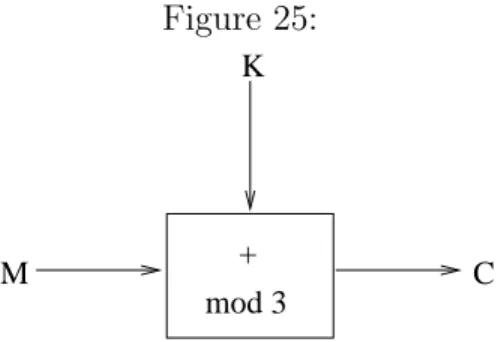
Problem 14.8. Consider the cryptosystem with probability measures given in figure 24: Figure 24: Key K Message M Cipher C + modulo 3 • K ∈ {0,1,2}: P(K = 0) = 1/5, P(K = 1) =P(K = 2) = 2/5. • M ∈ {0,1,2}: P(M = 0) = 1/7, P(M = 1) = 4/7. • C = (M +K) modulo 3
Q1: Calculate the following probabilities:
P(M = 2) =. . . . P(C = 0) =. . . .
Q2: Write down the condition for perfect secrecy.
Q3: Does this cryptosystem provide perfect secrecy? Prove your answer mathematically!
Problem 14.9. Suppose that a sender and receiver use the following en-cryption table: M1 M2 K1 1 2 K2 2 3 K3 2 4 K4 3 2 K5 4 1
where M and K represent the message and the key, respectively. Let the keys be selected with equal probability. Probability distribution of the messages is not known. For each transmission the ciphertext is valid for the particular key which is known by both sides. Assume that an attacker knows the encryption table.
(Q1) Show mathematically that whether this system does provide perfect
secrecy or not.
(Q2) An attacker changes an observed cipher 2 by the value 1. The
proba-bility that this cipher is accepted as valid by the receiver.
(Q3) An attacker changes an observed cipher 3 by the value 2. The
proba-bility that this cipher is accepted as valid by the receiver.
Problem 14.10. Suppose that a sender and receiver use the following en-cryption table: M1 M2 K1 1 2 K2 2 3 K3 3 4 K4 4 1
where M and K represent the message and the key respectively. We assume further that the keys and the messages are selected with probability
P(M1) = 1/4,P(M2) = 3/4, P(K1) = 1/2 and P(K2) =P(K3) = 1/6.
(Q1) Show mathematically that the given system does not provide perfect
secrecy.
(Q2) Modify plaintext and/or key distribution in such a way that perfect
secrecy is obtained. Explain your choice.
Problem 14.11. Consider the cryptosystem in figure 25 with probability measures given as follows:
KeyK ∈ {0,1,2}:P(K = 0) = 3/5, P(K = 1) =P(K = 2) = 1/5, Message M ∈ {0,1,2}:P(M = 0) = 3/7, P(M = 1) = 2/7,
Figure 25: K C M mod 3 + CipherC = (M +K) modulo 3.
Q1: Calculate the following probabilities.
P(M = 2) =.... P(C = 0) =....
Q2: Write down the condition for perfect secrecy.
Q3: Does this cryptosystem provide perfect secrecy? Prove your answer mathematically!
Problem 14.12. Suppose that a sender and receiver use the following en-cryption table:
K1 K2 K3 K4 K5
M1 1 2 3 3 4
M2 2 3 4 3 1
where M and K represent the message and the key, respectively. Let the keys be selected with equal probability. The probability distribution of the message is not known. The key and the message determine the ciphertext. Assume that the particular key and the encryption table are known by both sides.
(Q1) Show mathematically whether this system provides perfect secrecy or
not.
(Q2) An attacker changes an observed cipher 4 by the value 1. Give the
(Q3) An attacker changes an observed cipher 3 by the value 1. Give the
probability that this cipher is accepted as valid by the receiver.
Problem 14.13. Consider the last 3 numbers of your matriculation number. For the simplicity, the last 3 numbers will be denoted as {mat1, mat2, mat3}.
(Ex.: m.n.= 1457652, then the message={mat1 = 6, mat2 = 5, mat3 = 2}).
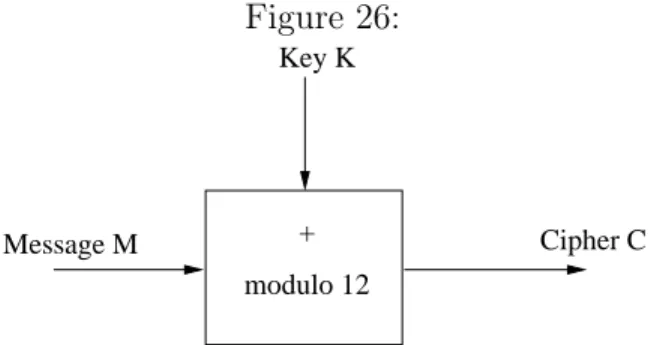
Figure 26: modulo 12 + Key K Cipher C Message M
Consider the cryptosystem given in figure 26 where the message and the key are the elements from a set {0,1,2,3,4,5,6,7,8,9}. The probability distribution of the message is given as follows,
M 0 1 2 3 4 5 6 7 8 9
p(M) 3/10 1/10 1/10 3/20 1/20 1/40 1/10 1/10 1/20 1/40 Keys are equally distributed. Cipher C is calculated as follows,
C= (M +K) modulo12. (1) (Q1) Calculate the following probabilities:
P(C =mat3) =
P(C =mat2|M = 2) =
P(M = 5|C =mat1) =
(Q2) What is the condition for perfect secrecy?
(Q3) Prove mathematically whether this system provides perfect secrecy or
Problem 14.14. The encryption/decryption of a sequence of letters from the alphabet {A, B} into a cipher with letters {a, b, c} is done according to the following table.
Key A B
1 a b
2 b c
3 b a
4 c b
The key letters {1,2,3,4} have equal probability. An unauthorized person knows the table and can observe and modify the ciphertext. A modification is successful if the receiver accepts the modified cipher symbol, i.e. the ciphertext is valid for the particular key.
Example: at time i: plaintext Pi =B and Ki = 3 gives Ci =a. A modification may change a into b for a given Ki = 3.
Q1: Does the cipher provide perfect secrecy? YES/ NO?
Q2: What is the probability of successful modification for an observed cipher
b?
P(success|observed cipher=b) =
Q3: What is the probability of successful modification for an observed cipher
a?
15
Feistel Cipher
Problem 15.1. Consider the Feistel network structure in figure 27: Figure 27:
Cipher L−8 bits Cipher R−8 bits
bitwise XOR operator Data R−8 bits Data L−8 bits Kx Ky e(R,K e(*,K y ) x ) bitwise XOR operator
* represents the incoming data
(a) Write down the general mathematical expression for the outputs; cipher-L and cipher-R.
(b) Linear feedback shift registers are used to generate random binary se-quences. Consider the two LFSRs in figure 28 where ’D’ represents the delay elements. For an initial content (seed) of 1 and 0 for both LFSR’s, write down the output sequences. (at least 8 bits.)
Hint: first output should be the first bit of the sequence.
(c) Consider again the Feistel Cipher. Encryption is done by simple XOR operation. We use LFSR-X to generate key sequence Kx (8 bits) and LFSR-Y to generate key sequence Ky (8 bits). Use the first 8 bits
Figure 28:
D LFSR−X
initial content=1 initial content=0
D output−X
D
initial content=1 initial content=0
D output−Y
LFSR−Y
output of LFSR-X and LFSR-Y and calculate the output bit sequences; cipher L and cipher R where the inputs are given as follows:
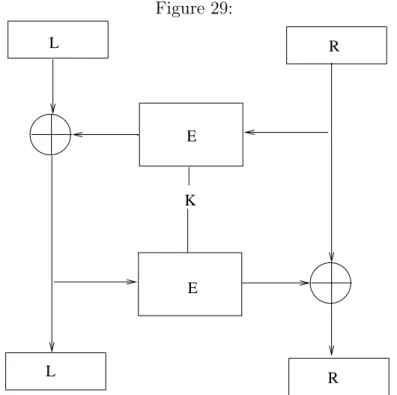
Problem 15.2. Calculate the output of the Feistel-Network in figure 29
given the input 01101011010111011010001111010101 and the key 0111010010101001. Assume that the left and right parts are 16 bits each and that the encryption
function is an exclusive-OR (XOR).
Figure 29: K L R R L E E
Problem 15.3. Consider the Feistel network structure in figure 30. Figure 30: Key L L out Encipher Rout E(*;K2) E(R;K1) R
Q1: Calculate Lout and Rout for the given system above. Q2: Draw the decryption scheme.
Problem 15.4. Consider the Feistel network in figure 31. Superscript e denotes the encryption process andf represents the encryption function with the key. Figure 31: XOR n K Ren e Ln Y e L n−1 R e n−1 f(*,K )n Q1)Express Le
n and Ren through values Len−1 and Ren−1 .
Q2) Given is the last round of an n-round Feistel network in figure 31. Draw the first round of the corresponding decryption network. Use super-scripts d to denote the decryption process.
Hint: In Feistel networks, the encryption and decryption are almost identical operations.
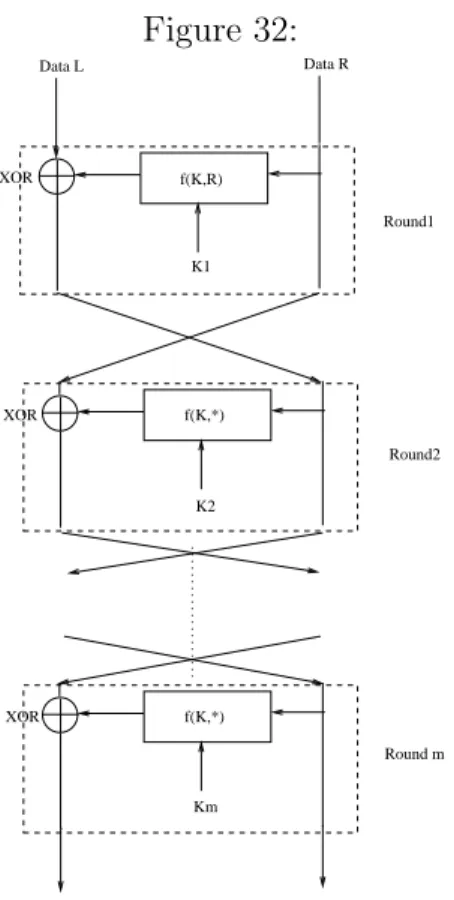
Problem 15.5. Consider an m-round Feistel network as given in figure 32. Assume that all subkeys are equal, i.e. K1 = K2 = .. = Km and with a subkey size half of the block size. The encryption functionf(K, R) = K⊕R.
Figure 32: f(K,R) Data L Data R f(K,*) f(K,*) K2 K1 Km XOR XOR XOR Round1 Round2 Round m
Analyze how (in)secure this cipher is against ciphertext only attacks and known plaintext attacks when
(Q1) m= 2.
(Q2) m= 3.
(Q3) m is arbitrary.
Problem 15.6. Consider figure 32. Assume a simple two round Feistel block cipher with an eight bit key and 16 bit block size. Key derivation is defined as Ki=K(dec)+ 89.i mod 256 where Ki is the ith subkey and K is
the decimal representation of the key. The encryption function f(Ki, Ri) = 127.(Ki(dec)+R(i−1)(dec))mod 256 where R(i−1) represents the input of
the block as seen in the figure.
(Q1) Encrypt the last 2 letters of your surname (ex: surname:mengi,
mes-sage: (g i)). Use ASCII table in Chapter 1 slide 8 to transform the letters into other representations. The key Kis given as 55(hex).
(Q2) How is decryption affected if the ciphertext is modified due to the
16
Block Cipher
Problem 16.1. Let a block cipher with secret key K be chained in the following way:
Ci =Mi−1⊕E((Mi⊕Ci−1), K) fori >0
where M0 and C0 are fixed public initialization vectors, K is the secret key
known to both transmitter and receiver, and E and D represent encryption and decryption, respectively.
Q1) Determine the equation for decryption and draw the block diagram. Q2) Suppose that ciphertext C3 is damaged in transmission. Which
plaintext blocks become undecipherable as a result? Explain.
Problem 16.2. A block cipher uses the recurrence
Ci =E((Mi ⊕Ci−1), K), i >0
where M1M2M3... is the message, C0 is a randomly chosen initial vector,
K is the secret key known to both transmitter and receiver, and E and D
represent encryption and decryption, respectively.
17
Digital Encryption Standard (DES)
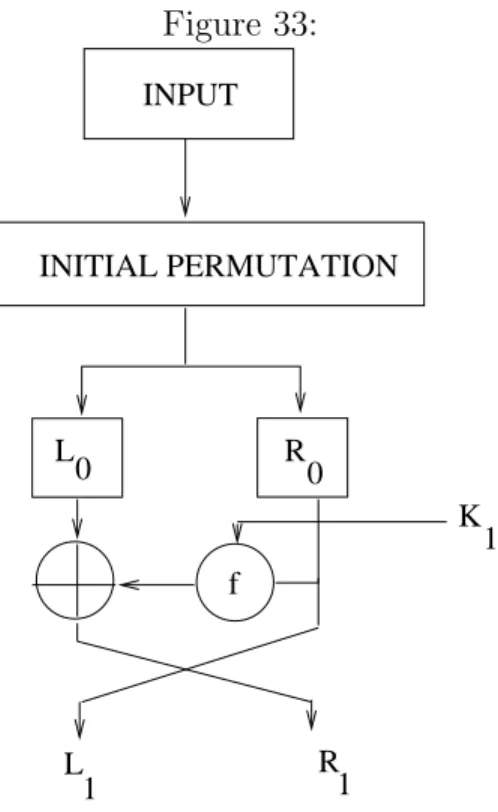
Problem 17.1. We consider a DES-based encryption scheme, which oper-ates on 16-bit blocks of plaintext and uses sub-key of length 12. A sketch of the encryption with first-round is given in figure 33:
Figure 33: R INPUT INITIAL PERMUTATION L 0 R0 K 1 f 1 L 1
Consider the following bit sequence as the input data: 1011000110101100
(a) Describe L1 and R1 with respect to R0, R1 and K1.
(b) The 16 bits of the input are first reorganized by the following initial permutation (IP).
8 13 4 9 16 5 12 1 7 14 3 10 15 6 11 2
That is the permuted input has bit 8 of the input as its first bit, bit 13 as its second bit and so on.
(i) Write down the permuted input.
(ii) Compute the inverse permutation namely IP−1.
(c) Let the 16 bits of the permuted input block consist of an 8 bit block
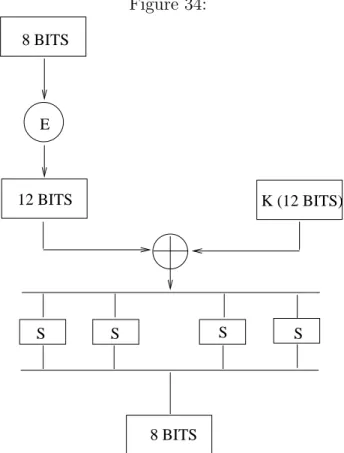
L followed by an 8 bit block R. The internal structure of the cipher function f (see f in figure 33) is given in figure 34.
Figure 34: 8 BITS E 12 BITS K (12 BITS) S 8 BITS S S S
E denotes an expansion function which takes a block of 8 bits as input and yields a block of 12 bits as output according to the table given below. (The first two bits of output are the bits in position 8 and 2
and so on.)
8 2 4 1 3 2 6 1 7 5 3 8 Write down the expanded output.
(d) S denotes the substitution function which takes a block of 3 bits and yields a block of 2 bits. Function is given with a table which contains the decimal representations.
(ex: (101)2 = 5, so from the table, 5 corresponds to 3 which is (11)2.) 0 1 2 3 4 5 6 7
1 3 2 1 0 3 0 2
Write down the output bit sequence with a given sub-keyK1 = 101101100010. (e) Write down L1 and R1 as a bit sequence.
(f) Combine L1 and R1 into 16-bits bit sequence and apply the inverse permutation (IP−1).
Problem 17.2. We consider a Cipher-Block Chaining Mode (CBC mode) for a block cipher which implements the encryption as Ci =E(Mi⊕Ci−1, K)
for i > 0 where M1M2M3. . . is the message and C0 is a randomly chosen
initial vector.
(i) Explain (with motivation) how decryption is done.
(ii) How does a bit error in the ciphertext influence decryption? (Assume that Ci is obtained corrupted because of a bit error. How does it effect the next decryption steps?)
Problem 17.3. Encryption of large blocks using DES (or any fixed size block cipher) can be achieved through the means of modes. For three modes, the encryption is depicted in figures 35, 36 and 37. Draw the decryption block diagram of each of these modes, and give the mathematical expression for the first two of them. What are the advantages and disadvantages of each of the three modes?
Figure 35: Electronic Codebook (ECB) E K Ci P i
Figure 36: Cipher Block Chaining (CBC)
P
i E
K
Ci Shift Register
Figure 37: Cipher Feedback (CF B) (n ≤64)
Pi i C E Shift Register 64 64 select n left bits
n
Problem 17.4. Suppose that we use DES in cipher block chaining mode. The encryption rule for messageMi, keyK and cipher Ci−1 is:
Ci =DES(Mi⊕Ci−1, K)i= 1,2, . . .
where C0 is an initial block and ⊕ the component-wise modulo-2 operation
(XOR).
(i) What is the decryption rule? Mi =· · · ·
(ii) Suppose an attacker changes Ci intoCi0 6=Ci. How many messages are then decrypted incorrectly?
Problem 17.5. Suppose that we use DES in counter mode.
The encryption rule for key K and messageMi, at time i >0 is:
Ci =DES(Ri, K)⊕Mi, Ri =Ri−1 + 1
where R0 = some starting value and ⊕ the component-wise modulo-2
oper-ation (XOR).
(i) What is the decryption rule? Mi =· · · · (ii) Suppose an attacker changesCi, intoC0
i 6=Ci. How many messages are then decrypted incorrectly?
Problem 17.6. Suppose that we use DES in cipher feedback mode. The encryption rule for messageMi, keyK and cipher Ci−1 is:
Ci =Mi⊕DES(Ci−1, K)i= 1,2, . . .
where C0 is an initial block and ⊕ the component-wise modulo-2 operation
(XOR).
(i) What is the decryption rule? Mi =· · · ·
(ii) Suppose an attacker changesCi, intoCi0 6=Ci. How many messages are then decrypted incorrectly?
Problem 17.7. Suppose that we encrypt a message M in 3 DES rounds, as indicated in figure 38:
C =DES(DES−1(DES(M, K
1), K2), K3)
Note: when C =DES(M, K), thenDES−1(C, K) =M.
Figure 38: DES DES DES −1 C M K 1 K2 K3
Problem 17.8. For a cipher block-chaining mode, the encryption is depicted in figure 39. Give the mathematical expression of the encryption, decryption and draw the corresponding block diagram.
Figure 39:
D K
Ci
Pi E(*,K)
(Note: 0D0 represents delay element.)
Figure 40:
Ai D Ai−1
Problem 17.9. We now look at the following variant of key whitening with DES. Suppose that the message M and the keysK1 and K2 are 56 bits long.
The encryption is defined
QA) Show that breaking the scheme above is roughly as difficult as a brute force attack against single DES.
Hint: To get started, it is recommended that you draw a diagram.
QB)What is the complexity of known plaintext-cipher (M andC) attack on that scheme?
Problem 17.10. We consider a triple DES structure as given in figure 41 where the key size is 56 bits.
Figure 41:
DES DES DES
key2 key3
key1 A
C X
(Q1) Apply the known plaintext-ciphertext attack at positionA. Describe
your attack.
(Q2) What is the complexity of your attack?
Problem 17.11. We consider a ’key whitening’ scheme as given in the figure 42. Figure 42: DES X K2 K1 K3 C Xor Xor
(Q1) Describe the encryption function forX.
18
Primitive Element
Problem 18.1. (i) Explain in at most two sentences what a primitive element is.
(ii) Calculate the smallest primitive element for p= 23.
Problem 18.2. Find x and y such that the given equation is satisfied. Hint: use primitive element.
32x= 1 mod 1409. 8y= 9 mod 13. 25x= 1 mod 42. 18y= 11 mod19. 17x= 1 mod 81. 11y= 10 mod13. 8x= 9 mod 17. 14y= 1 mod 17.
19
Diffie-Hellman Key Exchange
Problem 19.1. Assume that two users want to establish a common secret key over an insecure channel by using Diffie-Hellman key exchange protocol. The private key for userAis 15 and for userBis 10. We consider a commonly known prime 29.
(i) Calculate the smallest primitive element for p= 29. (Show your steps clearly.)
(ii) Obtain the common key by using the primitive element found above (Show your steps).
Problem 19.2. Assume that two users want to establish a common secret key over an insecure channel by using Diffie-Hellman key exchange protocol. The private key for userAis 11 and for userBis 14. We consider a commonly known prime 17.
(i) Find the smallest primitive element forp= 17 (Show your steps). (ii) Obtain the common key by using the primitive element found above
(Show your steps).
Problem 19.3. Assume two users want to communicate with one another using symmetric encryption. Each of the two users is in possession of private key only known to him. For UserAhaving the private key 6, and UserB the private key 12, and a commonly known prime 71 and its primitive element 7, find the common key, and describe the procedure the two users use, to obtain this common key (i.e. draw a sequence diagram with all the messages, using the specific values given above, exchanged between the two).
Problem 19.4. We use the Diffie Hellman Key exchange with the following conditions:
Your private key and public key areX and Y =aX mod p, respectively, where p= 29 and a= 2; my public key is 15.
(i) Choose your private key X and calculate your public keyY. (ii) Calculate the common keyK.
Problem 19.5. In the Diffie Hellman Key exchange protocol between user
A and B both users have a private key: XA = 2(6) and XB = 35(12), re-spectively. The public keys areYA=aXA modulo pand YB =aXB modulo p. What is the common key K for p= 71 and a= 7?
Problem 19.6. We use the Diffie Hellman Key exchange with the following conditions:
A private key X and a public key Y = aX modulo p, where p= 13; the primitive element is a= 2; my public key is 10.
Step 1. Choose your private number X and calculate your public key
Y = 2X modulo 13.
EXAMPLE of an answer: X = 5; Y = 8. Other answers depend on X. Step 2. Calculate the common key K = 10X modulo 13. Calculate my private key.
Problem 19.7. We use the Diffie Hellman Key exchange with private keys
X and Y and public keys Z1 =aX modulo pand Z2 =aY modulo p, where
p= 17 and X = 8.
(i) Choose a primitive element a.
(ii) Choose your private keyY , calculate your public keyZ2 and calculate
the common key K.
Problem 19.8. We use the Diffie Hellman Key exchange with: private key
X and public keyY =aX modulo p, where p= 31 anda= 3; my public key is 21.
(i) Choose your private key X and calculate your public keyY. (ii) Calculate the common keyK.
Problem 19.9. We use the Diffie Hellman key exchange with two users where p= 11 and a= 8. User A has a public key 7.
• As user B, choose a private key and calculate the public key respec-tively.
XB =. . . .
• Calculate the common key.
KAB =. . . .
Problem 19.10. We use Diffie Hellman key exchange with two users A and B where p= 23.
Q1: Calculate the smallest primitive element for the given prime number, i.e. p= 23.
Q2: User A chooses a secret keyXA = 5 and user B chooses a secret key
XB = 3. Calculate the common key.
Q3: Does the Diffie-Hellman key exchange provide authentication of the parties? Why or why not? Give a reason.
Problem 19.11. We use the Diffie Hellman key exchange with two users.
QA) Calculate the largest primitive element for a given prime number p=11.
QB) User A chooses a secret keyXA= 5 and user B chooses a secret key
XB = 3. Calculate the common key K for the largest primitive element.
Problem 19.12. Assume that two users want to establish a common secret key over an insecure channel by using Diffie-Hellman key exchange protocol. The public key for user A is YA = aXA mod p and for user B is YB =
aXB mod p.
(Q1) Would any of the following a and p be good choices for the
Diffie-Hellman algorithm (ignoring the fact that the numbers are too small to be secure)? Motivate your answer.
a= 1, p= 179.
a= 2, p= 17.
(Q2) Describe a way to generalize the Diffie-Hellman protocol to three
par-ties. Show the communication between the users.
Problem 19.13. The last four numbers of your matriculation number is represented as m4m3m2m1.
Assume that two users want to establish a common secret key over an insecure channel by using Diffie-Hellman key exchange protocol. The private key for user A is XA = m3 +m1 + 2 and for user B is XB = m4 + 7. We
consider a commonly known prime 23.
(Q1) Calculate the smallest primitive element for p = 23. (Show your steps clearly.)
(Q2) Obtain the common key by using the primitive element found above (Show your steps).
Problem 19.14. We use the Diffie Hellman Key exchange with private keys
X and Y and public keys Z1 = aX modulo p and Z2 = aY modulo p. We
assume p= 71, a= 7.
Q1. Give two possible pairs (X, Y) such that the common key K = 1. Q2. An attacker knows that the product Z1∗Z2 = 7 modulo p.
20
Pohlig-Hellman a-symmetric Encryption
Problem 20.1. Why does the shared secret in the Pohlig-Hellman encryp-tion have to satisfy the equaencryp-tion ed= 1 mod(p−1)?Hint: There is a relation to primitive elements...
Problem 20.2. Two communicators in the Pohlig-Hellman a-symmetric encryption system have as a secret two numbers (e, d) such that e.d = 1 modulo (p − 1), where p is a prime number. The encryption rule for message M isC =Me mod p.
(i) Calculate d for given e= 15 where p= 53.
(ii) What is the message that corresponds to received cipherC = 7? (Show your steps.)
Problem 20.3. Two communicators in the Pohlig-Hellman a-symmetric en-cryption system have as a secret two numbers (e, d) such thated= 1modulo(p−
1), where p is a prime number. The encryption rule for message M is
C =Me mod p.
(i) Give two possible numbers (e, d) for a) p= 47; b) p= 43.
(ii) What is the message that corresponds to a received cipher a) c = 19; b) c= 3?
Problem 20.4. Consider the last 3 numbers of your matriculation
number. For the simplicity, the last 3 numbers will be denoted as{mat1, mat2, mat3}.
(Ex.: m.n.= 1457652, then {mat1 = 6, mat2 = 5, mat3 = 2}).
Two communicators in the Pohlig-Hellman a-symmetric encryption system have as a secret two numbers (e, d) such that e.d = 1 modulo (p - 1), where p is a prime number. The encryption rule for message M is C =Me mod p.
(Q1) Calculate d for given e = 23 where p = 257.
(Q2) Explain the decryption rule and decrypt the message that corre-sponds to received cipher C = 16 (Show your steps.).
21
ElGamal
Problem 21.1. In ElGamal encryption, the process for decryption at user
B receiving a message from a user A is given as: Step 1)K =C1XB mod p.
Step 2) M =C2/K mod p whereC1 and C2 are the cipher texts and XB is the private key of the receiver. The message (C1, C2) was composed by
calculating:
C1 =aXA mod p
C2 =Y BXA ∗M mod p
where YB is the public key of userB and a the common prime element. (i) Explain why this encryption scheme is similar to the Diffie-Hellman
key exchange.
(ii) Proof that the result of the decryption is indeed the transmitted mes-sage M.
Problem 21.2. We recall the ElGamal cryptosystem. A community of users shares a large prime p and a primitive element a. Each user has a key pair (x, Y), where 0 < x < p−1 is randomly chosen and Y = ax mod p. Y is public and x is private.
To send a message M to Alice, who has key pair (xA, YA), Bob performs the following steps:
1. Choose a randomxB with 0< xB < p−1.
2. Computec1 =axB mod pand c2 =M.Y AxB mod p.
3. The ciphertext is (c1, c2).
(i) Explain how Alice decrypts the message, show the steps.
(ii) Assume that prime p= 17 and the primitive element a= 6. Bob, who has a private key xB = 12 wants to send a message M = 5 to Alice, who has a public key YA = 15. Compute the ciphertext is (c1, c2) and
(iii) Alice has a private key xA = 10. Show that how Alice decrypts the message.
Hint: K−1 should be determined such that K−1.K = 1 mod p.
Problem 21.3. Let (p, a, YB) = (53,2,16) be the public-key of an ElGamal cryptosystem and (C1, C2) = (15,50) be a ciphertext with this cryptosystem.
What is the corresponding plaintext?
Problem 21.4. Consider the last 3 numbers of your matriculation
number. For the simplicity, the last 3 numbers will be denoted as{mat1, mat2, mat3}.
(Ex.: m.n.= 1457652, then {mat1 = 6, mat2 = 5, mat3 = 2}).
We recall the ElGamal cryptosystem. A community of users shares a large prime p and a primitive element a. Each user has a key pair (x, Y), where 0 < x < p−1 is randomly chosen and Y =ax mod p. Y is public and x is private.
(Q1) Assume that prime p = 31 and the primitive element a = 3. Bob, who has a private keyxB = 28 wants to send a message M ={mat1+mat2+
mat3} to Alice, who has a public key YA = 16. Compute the ciphertext (c1, c2) and show your steps.
(Q2) Alice has a private key xA = 6. Show how Alice decrypts the message.
Problem 21.5. Givenn= 71 andk = 7 findk−1 such thatk−1k = 1 modulo
22
RSA System
Problem 22.1. Why do the public keye and the private key d in the RSA encryption have to satisfy the equation ed = 1 mod (p−1)(q−1)?
Try to reason in formulas rather than text, it is much easier...
Problem 22.2. The RSA system was used to encrypt the message M into the cipher-textC = 6. The public key is given byn =p.q = 187 ande= 107. In the following, we will try to crack the system and to determine the original message M.
(i) What parameters comprises the public key and what parameters the private key?
(ii) What steps are necessary to determine the private key from the public key?
(iii) Determine the private key for the given system. (iv) What is the original messageM?
Problem 22.3. The RSA system was used to encrypt the message M into the cipher-text C = 9. The public key is given by n = 143 and e = 23. In the following, we will try to crack the system and to determine the original message M.
(i) What parameters comprises the public key and what parameters the private key?
(ii) What steps are necessary to determine the private key from the public key?
(iii) Determine the private key for the given system. (iv) What is the original messageM?
Problem 22.4. Assume a public key for RSA encryption given by the pair (143,11).
(i) Find the private key to the given public key.
(ii) Decode the message (111 4 88 57 116 67), assuming the letters were represented by ASCII values.
(iii) Explain why one would never use the given public key for real encryp-tion, and what one would do to make it really secure.
Problem 22.5. Suppose that we use the RSA scheme with public key (n=
p∗q, e) = (55,7).
(i) Find the private keyd. ( For RSA we haveed= 1modulo(p−1)(q−1).) (ii) Find the corresponding messageM for a cipher C = 3.
Problem 22.6. For RSA, we haven =pq = 55;e= 67; ed= 1 modulo(p−
1)(q−1). d=· · · ·
Problem 22.7. We want to use the RSA scheme for security.
1. We choose the integer 77 as the product of 2 prime numbers pand q. 2. For the public key d and private key e, we have the relation ed = 1 modulo (p−1)(q−1).
(i) What is the public key d for a private key e= 43 ? (ii) Give the message M for an intercepted cipher C = 5.
Problem 22.8. We want to be able to transmit 64 different messages. (i) How many binary digits do we need to uniquely specify every message? (ii) We want to use the RSA scheme for security and thus:
1. We have to choose an integer N that is the product of 2 prime numbers pand q.
2. For the private key e and public key d, we have the relation ed= 1modulo (p−1)(q−1).
Choose the best (smallest) possible N =p×q that allows independent message encryption
Problem 22.9. We want to use the RSA scheme for security.
1. We choose the integer 91 as the product of 2 prime numbers pand q. 2. For the public key d and private key e, we have the relation ed = 1 modulo (p−1)(q−1).
(i) What is the public key d for a private key e= 29? (ii) Give the message M for an intercepted cipher C = 5.
Problem 22.10. We want to be able to transmit 132 different messages. (i) How many binary digits do we need to uniquely specify every message? (ii) We want to use the RSA scheme for security and thus:
1. We have to choose an integer N that is the product of 2 prime numbers pand q.
2. For the private key d and public key e, we have the relation
ed= 1 modulo (p−1)(q−1).
Choose the best (smallest) possible N = p×q that allows inde-pendent message encryption. Later we choose the integer 143 as the product of 2 prime numbers p and q.
(iii) What is the private key d for a public key e= 11? (iv) Give the cipher for the message M = 5.
Problem 22.11. Local Area Network uses a public key infrastructure based on RSA, with known public number N = p.q = 55. User A and B have public keys 3 and 7, respectively. User C encrypts a message M = 13 for A
and B.
(i) Calculate the encrypted messagesCA and CB.
CA= 133 mod 55 =. . . .
CB = 137 mod 55 =. . . .
(ii) Calculate the corresponding private keys dA and dB.
dA =. . . .
dB =. . . .
(iii) Assume that an observer sees CA = 13 and CB = 28. How can he calculate the corresponding message without knowing public number
N where we assume that the observer can not calculate dA and dB? Hint: use the fact that gcd(3,7) = 1.
Problem 22.12. Given p = 19, q = 29, N = p.q and e = 17, compute the private key d corresponding to the RSA system.
Hint: e.d = 1 mod (p−1)(q−1).
Problem 22.13. Consider a RSA public-key system where the public key consists of N = pq = 143 and e = 71. The encryption function is given as
C =Me modulo N.
Q1: Find a number d such that ed= 1 modulo (p−1)(q−1). Q2: Give the decryption function for RSA.
Q3: Decrypt the cipherC = 12.
Problem 22.14. Given secret two large primespandq, RSA modulusN can be computed asN =p.q. Answer the following questions forN = 77 = 7·11.
QA) Which of e= 3 and e= 17 is usable as RSA public key for this N? Why or why not?
QB) Compute the private key d corresponding to your answer e inQA. Problem 22.15. Alice has published her RSA public keys as < N, e > =
< 91,5 >, where N is the known public number and e is her public key. Accordingly, Bob sent her the cipher text 81.
Find the corresponding message.
Problem 22.16. Consider the last 3 numbers of your matriculation
number. For the simplicity, the last 3 numbers will be denoted as{mat1, mat2, mat3}.
(Ex.: m.n.= 1457652, then {mat1 = 6, mat2 = 5, mat3 = 2}).
The cipher (mat1+ 33 +mat3) was obtained from the RSA algorithm using
n = 11413 ande= 7467.
23
Euclid’s algorithm
Problem 23.1. We recall the Euclid’s algorithm. Leteandpbe two integers withgcd(e, p) = 1. Then there exist two integersdandnsuch thate.d+n.p= 1 where d is called the inverse ofe modulo p, since e.d= 1 modulo p.
Let us look at an example:
Suppose that e = 107. The inverse ofe = 107 modulo 160 can be calcu-lated as follows:
160 = 107.1 + 53 gcd(160,107) =gcd(107,53) 107 = 53.2 + 1 gcd(107,53) =gcd(53,1) = 1
From above, we can conclude that there exist two integers d and n such that e.d+n.p = 1. In order to form e.d+n.p = 1, we need to reshape the second equation:
1 = 107−53.2
Replace 53 with the first equation: 1 = 107−53.2
1 = 107−(160−107).2 1 = 3.107−2.160
So we can see that d= 3. General formula is given in script. Find the inverse element of e= 17 modulo 2882.
Problem 23.2. Calculate the greatest common divisor of 14212 and 248. Problem 23.3. Calculate the greatest common divisor of 6564 and 532 . Problem 23.4. Calculate the greatest common divisor of 10434 and 522. Problem 23.5. Consider the last 3 numbers of your matriculation
number. For the simplicity, the last 3 numbers will be denoted as{mat1, mat2, mat3}.
(Ex.: m.n.= 1457652, then {mat1 = 6, mat2 = 5, mat3 = 2}).
Find the inverse of (mat1mat2mat3) mod 1009? (Ex.: m.n.= 1457652, then
(mat1mat2mat3)=652).
Problem 23.6. (Q1) Find integers xand y such that 17x+ 101y= 1. (Q2) Findd such that 7d≡1 (mod 101).