AN ANALYSIS OF EUROPEAN SHALE GAS POLICIES:
WHY EU MEMBER STATES ARE PURUSING DIVERGENT ‘FRACKING’ STRATEGIES
Ben Thorne
A thesis submitted to the faculty at the University of North Carolina at Chapel Hill in partial fulfillment of the requirements for the degree of Masters of Art in the Department of Political
Science, Concentration European Governance.
Chapel Hill 2014
Approved by:
Don Searing
Milada Vachudova
© 2014 Ben Thorne
ABSTRACT
Ben Thorne: An Analysis of European Shale Gas Policies: Why EU Member States are Pursuing Divergent ‘Fracking’ Strategies
(Under the direction of advisor Don Searing)
The recent progression in hydraulic fracturing or ‘fracking’ has enabled energy
companies to extract once-considered, inaccessible hydrocarbons. The United States has been at
the forefront of this controversial industry, revolutionizing the energy market by becoming the
world’s largest oil and natural gas producer as a result of its vast shale deposits. Shale oil and gas
deposits are not unique to North America, however. EU member states are faced with the
dilemma of whether to permit fracking domestically or suspend operations. The United Kingdom
and Romania have issued concessions for exploring their reserves, while France and Bulgaria
have halted all drilling efforts, citing environmental concerns. This paper evaluates why these
four European countries pursued divergent fracking policies, arguing that energy security and
Russian-relations are more relevant and powerful explanatory factors than a country’s
TABLE OF CONTENTS
LIST OF TABLES………
.
....viLIST OF ABBREVIATIONS……….. vii
SECTION 1: INTRODUCTION………....…………
....
……… 1SECTION 2: THE SHALE GAS DEBATE………... 4
SECTION 3: EU FRACKING GOVERNANCE...
.
....
....
... 8SECTION 4: POLICY BY COUNTRY………. 9
4.1: UNITED KINGDOM………
..
94.2: FRANCE……… 10
4.3: ROMANIA
…
……… 104.4: BULGARIA………... 11
SECTION 5: LITERATURE REVIEW
…
………... 125.1: AVAILABILITY………... 12
5.2: ACCESSIBILITY……….. 13
5.3: AFFORDABILITY……… 14
5.4: ACCEPTABILTY
...
... 15SECTION 6: DATA AND FINDINGS
...
... 176.2: DEPENDENCY RATIOS
…
………. 196.3: IMPORT DIVERSIFICATION………. 20
6.4: GREEN PARTY REPRESENTATION……… 22
6.5: FREE MARKET IDEOLOGY AND SOCIAL IDEOLOGY
…
………... 226.6: PUBLIC OPINION……… 24
6.7: ENVIRONMENTAL PROTECTION EXPENDITURE AND TAXES... 26
6.8: DIVERSITY OF ENERGY MIXES... 27
SECTON 7: ANALYSIS... 29
7.1: COMPARATIVE ANALYSIS OF THE UNITED KINGDOM AND FRANCE
...
. 307.2: COMPARATIVE ANALYSIS OF ROMANIA AND BULGARIA... 33
SECTION 8: CONCLUSION... 38
LIST OF TABLES
TABLE 1: ELECTRICITY PRICES
…
……… 18TABLE 1B: NATURAL GAS PRICES………... 19
TABLE 2: DEPENDENCY RATIOS
…
………..……… 20TABLE 3: IMPORT GAS VULNERABILITY
…
………... 21TABLE 4: GREEN PARTY REPRESENTATION
…
………. 22TABLE 5: NATIONAL PARTY IDEOLOGY……… 23
TABLE 6: PUBLIC OPINION………. 25
TABLE 7: ENVIRONMENTAL PROTECTION EXPENDITURE AND TAXES……… 26
LIST OF ABBREVIATIONS
BSP Bulgarian Socialist Party
EIA Energy Information Agency
EU European Union
EUR/100 KWh Euro per 100 Kilowatt Hours
EUR/GJ Euro per Gigajoule
GAL Green/Alternative/Libertarian
GDP Gross Domestic Product
GERB Citizens for European Development of Bulgaria
GWh Gigawatt Hours
kWh Kilowatt Hours
PPP Purchasing Power Parity
PSD Romanian Social Democratic Party
SD Standard Deviation
1. Introduction
Energy security has become a major point of concern for political elites in Brussels and
national capitals throughout Europe. Fossil fuel reserves have peaked on the continent,
necessitating industrial and government circles to find innovative solutions to diminish the
growing reliance on foreign imports and reduce energy costs. The European Union (EU) member
states already import over half of their energy supply from outside the twenty-eight country area
and this total is expected to rise to nearly seventy percent by 2030 (European Commission 2006:
3). Just as troubling as the dependency rates for the member states are the supplying and transit
countries the EU relies upon for receiving its energy. This concern came to fruition in the late
2000s, when the Russian natural gas supplier – Gazprom – cut-off supply to Ukraine,
consequently leaving pockets of Europe without electricity and heating. At the time of writing,
the EU is unable to aggressively confront Russia for its hostile annexation of the Crimea region
in Ukraine because of its dependency on Russian natural gas.
Not only does the regional energy market look bleak for the EU, a resource race is
escalating as global energy demand is estimated to soar fifty-six percent over the next thirty
years with fossil fuels expected to supply eighty percent of the world’s consumption (U.S. EIA
2013: 9). If current fossil fuel consumption rates go unabated, the earth’s temperature will
surpass the two-degrees Celsius threshold, which is expected to cause irreversible, harmful
effects to the planet and human society.
The EU is deeply invested in producing clean, domestic energy through renewable
EU’s energy needs by 2050 (European Commission 2011: 7). The member states are at the
forefront of developing environmentally progressive policies that will help lead to a less
carbon-intensive global economy. Nevertheless, fossil fuels such as oil, natural gas, and coal, will
remain crucial energy sources for a competitive Europe as clean technology develops and
matures. One fossil fuel that is becoming more and more prominent in the member states’ energy
mixes is natural gas. Natural gas is the cleanest of the fossil fuels and provides a more consistent
and reliable energy source than solar and wind power. The global energy market is experiencing
a tremendous boom in natural gas production as progression in technology has recently allowed
for unconventional sources of natural gas to be explored and exploited. This drilling technology
called hydraulic fracturing or “fracking” has enabled the United States to tap into its vast shale
gas deposits to become the leading gas producer in the world.
These hydrocarbon deposits, once thought to be inaccessible, are not unique to North
America. Private and public estimates of shale gas deposits throughout the European continent
have led many to believe several member states can reap modest benefits that fracking has
brought to North America. The shale gas debate does not come without determined opponents
who argue fracking has dangerous implications on the environment and cannot contribute to the
transition to a low-carbon economy for which the EU is championing. Fracking has become one
of the most salient and polarizing issues across political circles and civil societies in Europe. By
and large, the issue has largely been framed as industry promotion and energy competitiveness
versus ecological protection. Some countries in the EU are optimistic about incorporating shale
gas into its domestic energy mix, while others have already suspended the controversial drilling
technique. The EU member states that have either placed a moratorium or a ban on fracking have
In this paper, I ask why environmental concerns were more prominent in some member
states than others and if policy-makers were truly acting in the best interest of the environment
when formulating fracking policy? I analyze what factors account for the variation in EU
member states fracking policies that led some to pursue shale gas exploration, while others have
restricted the drilling practice due to environmental concerns. Does environmental protection tell
the whole story or are there more telling variables that shaped fracking policy-making in EU
member states? Environmental concerns are certainly prominent in anti-fracking policies;
however, I hypothesize countries are more flexible to incorporate ecologically protective policies
if they have a more favorable energy security position.
This paper evaluates the fracking policies of the United Kingdom, France, Romania, and
Bulgaria. The United Kingdom and Romania have issued concessions for the exploration of their
shale gas reserves and both current governments support the exploration and exploitation of
hydrocarbons by fracking. France and Bulgaria, conversely, have halted all fracking operations
as Paris banned the use of fracking and Sofia placed a moratorium against the drilling technique.
Both France and Bulgaria have cited environmental concerns as the justifying principle as to why
policy-makers pursued an anti-fracking agenda.
These four countries were chosen as case studies for several reasons. All four countries
have implemented nation-wide policies and have significant shale gas reserves that have
attracted interest from multinational energy corporations. Most importantly, all countries have
experienced significant domestic opposition to fracking, primarily from environmental groups
and local residents. France and the United Kingdom represent the old member states that have
such as nuclear into their domestic energy mixes. France and the United Kingdom have stable
democracies that would, in theory, represent the public’s opinion towards shale gas.
Bulgaria and Romania both joined the EU in 2007 and are catching up to EU
environmental standards, growing an environmentally conscious civil society, and do not
currently have green parties represented in parliament. Sofia and Bucharest are generally
criticized for high levels of corruption and backsliding on EU mandated reforms. The two former
Communist states also host the lowest levels of economic development in the EU.
This paper follows accordingly. Section two provides an overview of the general debate
behind why fracking has become such a controversial topic. Section three discusses how the
fracking industry is regulated and governed in the EU. The EU overview is followed by a brief
background of the member states’ current fracking policies in section four. Section five provides
a literature review of energy policy and security of supply, and how different policy-makers are
either constrained or directed to certain policy options. Section six describes the independent
variables being used in this paper and evaluates the findings from the data. Section seven uses
two comparative analyses, interpreting the data between the United Kingdom and France and the
statistics of Bulgaria and Romania to determine why environmental protection was more a point
of contention in France and Bulgaria, but not the United Kingdom or Romania. Lastly, section
eight offers general conclusions and avenues for future research.
2. The Shale Gas Debate
The U.S. Energy Information Agency (EIA) estimated Europe has approximately 470
trillion cubic feet of technically recoverable shale gas reserves lying underneath the old continent
technically recoverable shale gas reserves, producing about 4.88 trillion cubic feet of shale gas
per year or twenty-five percent of its natural gas production (Economist 2011; U.S. EIA 2013:
6). European policy-makers, scientists, environmentalists, scholars, industry leaders, and other
concerned citizens have all entered the shale gas debate over whether to explore and possibly
utilize these shale gas deposits. The debate is generally geared towards unproven technology and
whether fracking can be conducted without damaging effects to the environment and surrounding
populations. The position of the United States towards fracking has been relatively unconstrained
because of its long history of drilling and powerful industry influence in Washington. Local and
state opposition have, however, increasingly challenged fracking operations throughout the
country. Europe generally has taken a much more cautious and gradual approach.
To understand the rationale behind why policy-makers of the member states are adopting
the strategies they are taking, it is worth evaluating both sides of the debate. Advocates of
fracking believe European shale gas extraction can negate the growing dependency on foreign
suppliers and limit vulnerability to Russian political leveraging in the energy market. Twelve EU
member states receive more than half of their total natural gas consumption from Russia (Ratner
2013). Gazprom has desperately sought to infiltrate the European energy market by purchasing
natural gas distribution networks throughout the EU. Taking advantage of the absence of a
common European external energy policy, Moscow has strategically played EU member states
against one another with its ‘divide and rule’ political strategy (Umbach 2008: 18). Gazprom
seeks to ‘bilateralize’ natural gas contracts with European national energy companies in order to
diminish trans-European blocs and weaken the bargaining power of the EU (Baran 2006: 133;
Umbach 2009: 18). Pipeline politics with Russia remains one of the most divisive issues in the
Russia at the expense of EU solidarity. Irrespective of the EU evolving from an energy
organization in the 1950s, European energy policy is arguably the least integrated sector in the
EU because of the sensitivity of energy security. The 2014 Russia-Ukraine crisis will
undoubtedly serve as a critical juncture for energy policy in the EU, either leading to more of a
collective energy approach or more national division.
Natural gas is also desired because it is the cleanest of the fossil fuels and will be critical
for the transformation to a low-carbon economy the EU is working towards (European
Commission 2011: 11). The European Commission outlined its ambitious “Energy Roadmap
2050”, which calls for the EU to reduce carbon emissions by eighty-five percent by 2050
(European Commission 2011: 3). Substituting gas fired plants for coal plants will be necessary to
achieve this in the interim. The future of nuclear energy as an electricity source is in limbo in the
EU because of the uncertain costs of new reactors and the radiation leaks that transpired in wake
of the Fukushima disaster in 2011. Because of long lead times for renewable energy and its
inconsistent deliveries when on the grid, natural gas will remain a stable energy source in fuel
mixes. Other proponents argue fracking could have the potential to attract foreign investment,
create jobs, increase Europe’s competitiveness, and provide substantial tax revenues to the
austerity ridden and indebted economies (Shale Gas Europe 2013a).
The anti-fracking community has challenged the validity of many of these arguments.
Although Europe has comparable levels of estimated shale gas deposits to the United States,
technically recoverable shale gas reserves differ from economically recoverable reserves. The
price of European shale gas will be much more expensive than American produced gas. The
United States has a well-developed drilling and pipeline infrastructure that allows this newly
boom in the United States, 1,600 drilling rigs were in operation, whereas Europe only hosted
about 100 rigs (Economist 2011). European reserves tend to be deeper underground and harder
to extract, leading to higher costs. A substantial difference between the United States and Europe
is the right of ownership of minerals. In the United States, mineral rights belong to the
landowner, enticing homeowners to allow drilling in their backyard because they can reap
financial rewards (Economist 2011). In Europe, the minerals are state-owned and citizens only
see unattractive drilling rigs without the direct payoff. Washington and its state governments
have more robust regulations to adapt to unconventional drilling, thus minimalizing legal delays.
Furthermore, shale gas opponents believe political and economic capital should not be diverted
away from renewable energy production for more carbon-intensive projects.
Shale gas opponents can argue that fracking does not improve the security of energy
supply based on its commercial merits alone, but the greatest criticism of fracking is the harmful
impact fracking can have on the environment. Environmentalists and other concerned actors are
actively committed to a green energy sector and have mobilized protests against the industry.
Fracking involves injecting millions of gallons of water mixed with chemicals, acids, and
detergents into layers of shale rock to create fractures that release the desired gas from below
(Brantley and Meyendorff 2013). If this fracking liquid were to infiltrate a drinking supply,
severe health risks would emerge. This injection of millions of gallons of water into the earth and
the subsequent drilling to store the wastes have triggered small to medium-size earthquakes in
North America and the United Kingdom. Now the worry over the method of methane tracking is
becoming a central focus of debate. Fracking implies releasing methane gas, which companies
are legally obliged to capture. According to the International Panel on Climate Change, if leaked,
concerns related to the industry are the unsustainable use of water and sand, noise pollution,
traffic congestion, and the common environmental critiques of conventional hydrocarbon
drilling. Additionally, there are scientific disputes over whether the complete life cycle of shale
gas is cleaner than coal. In sum, anti-fracking campaigners are opposed to investing in another
fossil fuel industry that is experimenting with the earth.
3. EU Fracking Governance
Fracking regulation in the EU involves a myriad of actors and regimes, orchestrating at
multiple levels, creating a fluid and complicated regulatory structure. EU institutions, national
governments, and subnational localities are implementing fragmented and overlapping
regulations of the industry (EU law supersedes all others). Meanwhile, transnational industry
leaders, non-government organizations, and other interest groups are scaling vertically and
horizontally at these levels to lobby their interests.
The European Parliament in 2012 passed a resolution with 492 Members of European
Parliament in favor, 129 against and 13 abstentions to allow EU member states to determine the
fate of fracking domestically (Vote Watch Europe 2012). All hydrocarbon projects, including
those using fracking, are expected to conform to EU laws. This includes the protection of health
and the safety of humans and the environment through responsible maintenance of waste and
chemicals, and safeguarding the surface and groundwater among others (European Commission
2012b). The Commission has played an active role as regulator and overseer of the industry to
ensure environmental and social responsibility by the energy companies. This implies
introducing new laws or reinterpreting non-fracking energy extraction legislation to “ensure that
Commission 2012b: 1).” Fracking policy falls under the guidance of the Directorate General of
the Environment in the Commission, and not Energy or Industry, which reflects the EU’s
commitment to have “a robust regulatory regime” unparalleled in the world (Kanter 2013). EU
fracking policy is constantly in flux. At this point in time, member states maintain sovereignty
over fracking policy, while Brussels introduces best practices through regulations as a result of
the European Parliament resolution.
4. Policy by Country
4.1 United Kingdom
The United Kingdom and the Conservative government of Prime Minister David
Cameron have become one of the greatest supporters of fracking in the EU. In an op-ed
addressed to his home country, David Cameron wrote, “Fracking has become a national debate –
and it’s one that I’m determined to win (Cameron 2013).” Citing lower energy bills, a catalyst
for job creation, and the influx of money that would reach local neighborhoods, Cameron did not
ask his people to keep an open mind to fracking. Instead, he made his position unequivocally
clear that the United Kingdom cannot afford to miss out on this untapped energy source.
The UK Department of Energy and Climate Change released a report that estimated
Northern England has nearly 1,300 trillion cubic feet of shale gas, double which was previously
estimated (Shale Gas Europe 2013c). The amount of technically recoverable shale gas is still
unknown, but the U.S. EIA conservatively estimated this number to be twenty-six trillion cubic
feet. A government commissioned report recently stated as many as 2,800 wells could be fracked
in the country, spanning across almost half of Britain (Gosden 2013). Some of the areas that will
parks and sites designated to conserve wildlife and Britain’s natural beauty (Gosden 2013).
Additionally, the report stated there could be between 14 and 36 trucks a day traversing through
nearby communities for roughly three months during the exploration phase and upwards to
fifty-one a day during the 145 week production period thereafter.
4.2 France
In 2011, France and its center-right Union for a Popular Movement (UMP) government,
led by President Nicolas Sarkozy, became the first country in the world to place a nationwide
ban on fracking hydrocarbons. The succeeding Socialist government and current President
Francois Hollande upheld the ban, promising to continue this course throughout his presidency.
Both the left and center-right governments have claimed environmental protection as the
foremost reason why shale gas is not being explored.
Analysts estimate France possesses the second greatest amount of shale gas in Europe,
mostly concentrated in the south. Business groups have relentlessly lobbied Paris to overturn the
ban, claiming fracking would help reverse France’s industrial decline, improve competitiveness
with cheaper energy prices, and lower unemployment (Energy Market Price 2013). Despite this,
environmental protection of the French countryside and farmland has triumphed corporate
interests thus far.
4.3 Romania
Romania has been an oil and natural gas producer since the 19th century, and diverse
natural resources have made it one of the more energy independent countries in Europe. A recent
U.S. EIA study concluded that Romania could possess the third-largest shale gas deposits in
EIA 2013: 6). In 2011, when in opposition, the current Prime Minister Viktor Ponta and his
Social Democratic Party (PSD), proposed a draft law demanding a complete ban against the
fracking industry (Besliu 2013). Along with vocal citizen disapproval of the industry, the PSD
pressured the Civic Force government to implement a fracking moratorium, which was
implemented in May 2012. Once the PSD assumed control of government in December 2012,
Ponta and the PSD lifted the temporary moratorium against fracking and rejected their own draft
law (Shale Gas Europe 2013b). Since this policy reversal, domestic opposition and protests have
been widespread throughout Romania, culminating in the U.S. energy firm Chevron suspending
its exploration drilling in the village of Pungesti (Reuters 2013). Local villagers squatted the
privately owned drilling site to deter Chevron from resuming operations. Romanian police
eventually removed the occupiers and Chevron proceeded to commence drilling in the area
(Reuters 2013).
4.4 Bulgaria
Fracking policy in Bulgaria has also been a contentious issue. A fracking moratorium was
issued in Bulgaria in January 2012 in response to domestic protests spearheaded by local
residents and environmental groups. Prior to the proposal, thousands of demonstrators protested
on the streets of Sofia and the region of Dobrudzha where Chevron was set to drill (Agence
France-Presse 2012). The originally pro-fracking, conservative Citizens for European
Development of Bulgaria (GERB) government controlled the National Assembly at the time of
voting. Surprising to many analysts, Bulgarian lawmakers reversed course, revoking Chevron’s
drilling permit and overwhelmingly voted 166-6 to impose a fracking moratorium in the Balkan
country (Konstantinova and Carroll 2012). The current Coalition for Bulgaria government, led
5. Literature Review
The purpose of this section is to contextualize the various dimensions of energy security
and provide understanding on why certain energy strategies are pursued in political circles.
Energy security is a multidimensional concept that involves the interaction of technical,
geopolitical, economic, environmental, and social factors. The prevailing definition of energy
security that is generally accepted, but interpreted differently by all, is “the availability of
sufficient supplies at affordable prices (Yergin 2006: 70-71).” The European Commission’s
interpretation of energy security closely mirrors this definition stating:
The European Union’s long-term strategy for energy supply security must be geared to ensuring, for the well-being of its citizens and the proper function of the economy, the uninterrupted physical availability of energy products on the market, at a price which is affordable for all consumers, while respecting environmental concerns and looking towards sustainable development.
(European Commission 2000:2)
Factors that affect energy security, and therefore energy policy, typically fall into the
elements of availability (geological), accessibility (geopolitical), affordability (economical), and
acceptability (environmental and societal) (APERC 2007; Kruyt, van Vuuren, de Vries, and
Groenenburg 2009: 2167). The interplay between these four elements provides tremendous
explanation into why certain energy policies are pursued by member states. These dimensions
will provide the basis for the alternative explanatory variables that are tested later on in the
paper.
5.1 Availability
The availability of supply, the geological or natural elements of energy, is the most basic
deposits can be exploited. As noted before, there is a difference between shale gas reserves,
technically recoverable reserves, and economically recoverable reserves. No two shale gas basins
are identical and only a fraction of rock beds have been explored, leaving the quantity of
economically recoverable reserves unknown. Countries with abundant energy resources will
certainly have different energy policies than countries with limited fossil fuels or environments
hospitable to renewable energy. In terms of shale gas, all countries in the study have an attractive
amount of reserves in the ground. While variation does exist between the size and geology of the
four countries’ reserves, this variable will be held constant.
5.2 Accessibility
Accessibility refers to the geopolitics of energy supply. The EU relies on neighboring and
Middle Eastern countries to supply over half of its energy supply because the continent’s
conventional reserves are depreciating. Securing energy supply for a country differs, depending
on its system of supply corridors (all actors involved in the extraction, refinement, handling, and
delivery); its domestic demands and energy dependence on foreign suppliers; and the
geopolitical relationship with producing and transit countries (Escribano and Garcia-Verdugo
2012: 29). Daniel Yergin takes this one step farther, claiming states must consider the physical
security of these corridors whether the threat comes from natural disasters, terrorist attacks,
cyber sabotage, or inter or inner-state warfare (Yergin 2011: 266-267). Moreover, countries have
dissimilar abilities to develop and acquire energy because of commercial limitations and foreign
policy relations with supplying and transiting states.
Two strategies a nation-state can use to decrease vulnerability and dependence is through
it diversifies the number of supply corridors. Given that Russia holds 17.6 percent of proven gas
reserves and Middle Eastern countries hold 48.1 percent of proven oil reserves, diversification
proves to be one of the greatest challenges for the EU (BP 2013: 20). EU member states cannot
change geology or geography, but they can invest in infrastructure to open new channels of
supply and diversify the number of suppliers and transit areas they are importing energy from.
Diversification can decrease vulnerability, but this strategy does not improve
dependency. Europeans do not live on a treasure trove of fossil fuels, so most EU members states
will remain importers of natural gas, coal, and oil for the foreseeable future. Countries can
reduce dependence on foreign suppliers in a few ways. EU member states can produce more
domestic energy through investment in renewables, nuclear energy, and now fracking.
Governments can change consumer behavior through taxation and other measures and improve
energy efficiency (Umbach 2008: 15). Lastly, the EU can enhance its common energy market
and invest in an integrated infrastructure to make better use of the available energy resources.
5.3 Affordability
Affordability is another element politicians have to consider when determining energy
policy. This component generates the most attention and scrutiny from voters and businesses
alike. The price of energy, in most cases, acts as the greatest indicator for government and
industrial elites in determining energy sources. Energy is a substantial portion of household and
companies’ expenses. With high energy prices, families spend less on other consumer products
and businesses lose competitiveness. Opting for the cheapest energy is not always plausible in a
developed country because these energy sources are often dirty fossil fuels and concentrated in
must do everything in its power to lower energy bills in order to keep households satisfied and
businesses competitive.
5.4 Acceptability
The EU’s inclusion of environmental responsibility and sustainable development into the
standard definition of energy security emphasizes the evolving nature of energy security.
Democratic countries can no longer separate environmental policy and energy policy. The EU is
at the forefront of promoting sustainable energy policies as all member states agreed to reach the
most ambitious climate and energy targets to date known as the 20-20-20 plan. The key
objectives of this plan are to reduce EU greenhouse emissions by twenty percent from 1990
levels; to raise the share of EU energy consumption produced from renewable sources to twenty
percent; and improve the energy efficiency in the EU by twenty percent - all by 2020.
Party competition and the political landscape of countries greatly affect energy
policy-making. Dismissed by many neo-realists and theorists of energy security, policy is going to vary
as a result of a party’s ideological creed or national outlook. Governments are comprised of
politicians and parties that are representative of the domestic populace and seeking re-election.
Each EU member state has a unique political space and party cleavages.
Many scholars argue European parties compete along a two-dimensional space with one
dimension reflecting the traditional left versus right socioeconomic dimension and the vertical
dimension consisting of non-economic factors (Marks et al. 2006). On the left versus right
spectrum, the left prioritizes economic equality and the right prioritizes individual economic
freedom. The second, non-economic dimension has gained credence since the 1970s as the left
non-economic social dimension encompasses ecological, lifestyle, and communal ideologies and
this dimension varies across countries and especially between the West and the East (Marks et al.
2006). The poles of this dimension are green/alternative/libertarian (GAL) and
traditionalism/authority/nationalism (TAN). The GAL-TAN construction was partially a result of
the emergence of the green party in the 1980s. Environmental initiatives did not fit along the left
versus right dimension, which led to green issues constructing a new source of partisan
polarization and a potential new dimension (Dalton 2008: 10). Once green parties across Europe
gained an electoral base, party leadership shifted their economic position and are now more
consistent with existing party alignments along the GAL-TAN dimension (Dalton 2008: 10).
Greens have been able to join governing coalitions as a minority partner in both regional
states and countries, and have become well represented in the European Parliament. Green
parties have certainly realigned the political space and created more salience around
environmental issues in countries in which they have a presence. Protecting and conserving the
planet is one of the foundational values of the party and they have become vocal campaigners
against fracking in Europe.
These four interconnected and multidimensional elements are paramount in shaping
fracking policy as countries strive to produce cheap, domestic energy to reduce dependency and
vulnerability and please its electorates. A well-balanced energy mix that reduces price and
supply risk and improves competitiveness remains the central aim of policy-makers. As we will
see, each country has its own constraints and conditions to secure energy supply, which will
6. Data and Findings
This section will test several alternative explanatory variables to determine what causes
the variation found in EU member states fracking policy. EU member states have not followed a
universal strategy on whether or not to exploit shale gas reserves. Countries differ greatly in their
size of shale gas deposits, and even more so in having the capability to make the reserves
commercially accessible. The four countries in this study, nevertheless, have all attracted interest
because multinational energy corporations determined that profits could be reaped if fracking
were permissible. Moreover, protests against fracking have been widespread in all four countries.
The politicians of Bulgaria and France have decided not to explore their respective reserves
because of the environmental risks that fracking implies; meanwhile, the United Kingdom and
Romania have issued concessions for exploratory drilling. Even though this country list is short,
testing several independent variables will provide clarity to why countries pursue different
strategies.
6.1 Energy Prices
Energy prices are only one expense that households and businesses have to plan for, yet
gas and electricity bills receive a disproportionate amount of attention. Consumers often demand
brash policy changes that will alleviate energy bills and depreciate costs. Whether these policies
are price subsidies, tax cuts, or by increasing supply, citizens will pressure politicians to find
short-term solutions to alleviate the bills or turn to the ballot box to find someone who will.
Energy prices fall under the affordability component of energy security and often this element
Hypothesis 1a: Member states with high electricity prices will be more likely to permit fracking
than member states with low electricity prices.
Table 1: Electricity Prices
Country
Electricity Price in Households
Real Prices Excluding Taxes (EUR/100 KWh)
Electricity Price in Industry Prices Excluding All
Recoverable Taxes (EUR/100 KWh)
EU Average 15.7 11.1
UK 15.8 10.4
France 12.2 7.2
Bulgaria 8.7 6.7
Romania 10.9 8.0
European Commission (2012a): 88. *2011 Second Semester Data
Results 1a: The European Commission data indicates the United Kingdom has significantly
higher household and industry electricity prices than the other three countries, which suggests a
positive relationship with the hypothesis. French industry prices are highly competitive,
supporting the hypothesis as well. Romania has lower electricity prices than France, undermining
the hypothesis. When comparing the two poor, southeastern member states, however, Bulgaria’s
extremely low prices may explain why Sofia opted not to allow fracking and Bucharest did.
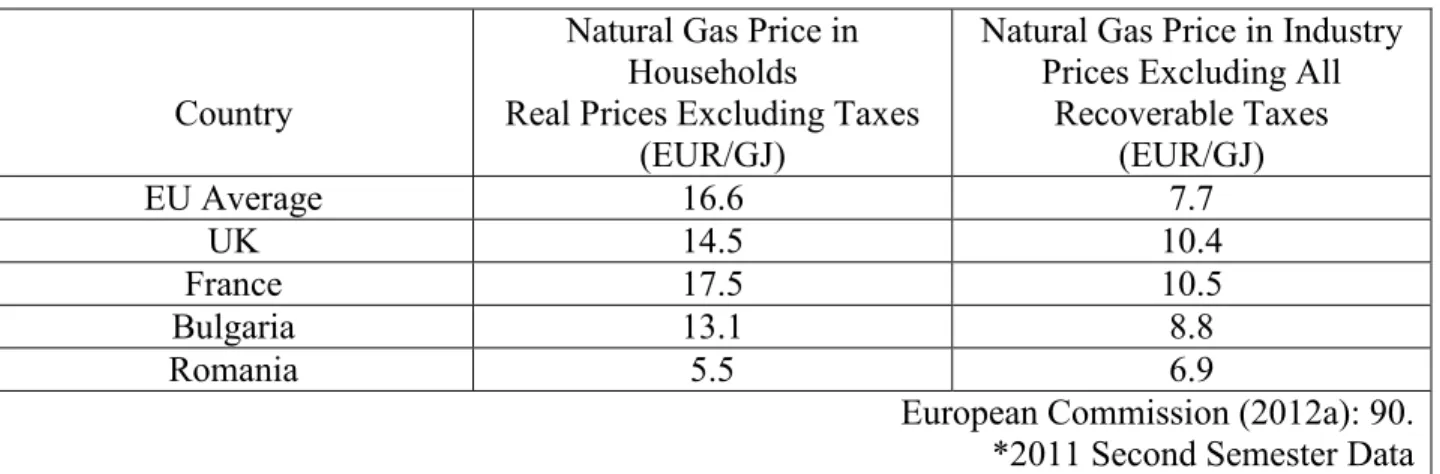
Hypothesis 1b: Member states with high natural gas prices will be more likely to permit fracking
Table 1b: Natural Gas Prices
Country
Natural Gas Price in Households
Real Prices Excluding Taxes (EUR/GJ)
Natural Gas Price in Industry Prices Excluding All
Recoverable Taxes (EUR/GJ)
EU Average 16.6 7.7
UK 14.5 10.4
France 17.5 10.5
Bulgaria 13.1 8.8
Romania 5.5 6.9
European Commission (2012a): 90. *2011 Second Semester Data
Results 1b: Of the four countries, the French Republic hosts the highest household and industry
gas prices, while prices in Romania are substantially lower than the others. The data shows that a
complete reversal occurred to what the paper had hypothesized.
6.2 Dependency Ratios
Countries that rely heavily upon foreign suppliers are in theory more vulnerable to energy
supply cut-offs. This resonates more with natural gas because the source is not yet a global
commodity where supply can easily meet demand if there are disruptions. All countries
unrealistically strive to become energy independent; nevertheless, some European countries see
fracking as a means to achieve this in the short to medium term.
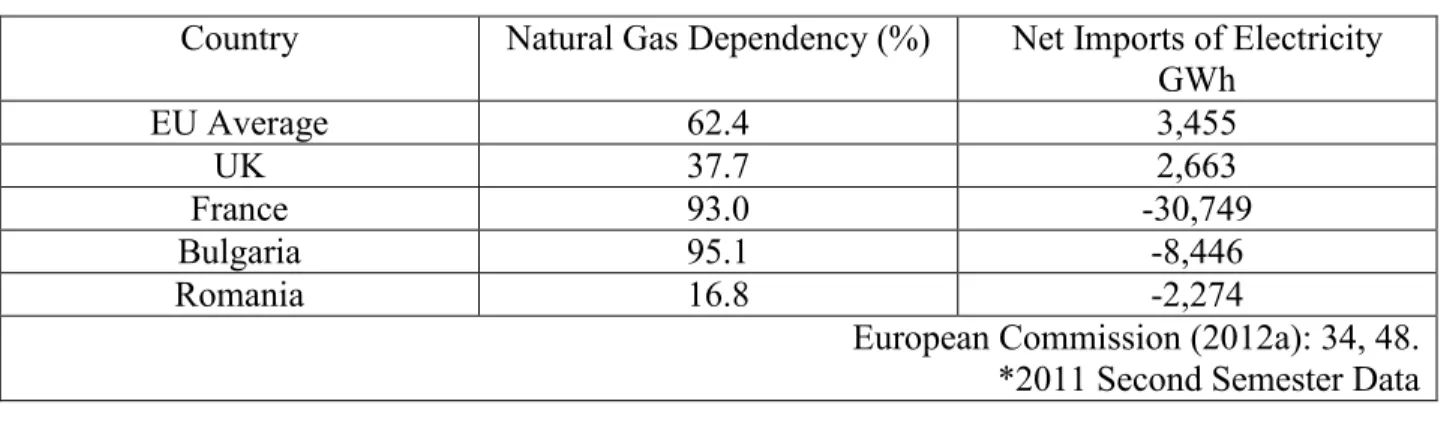
Hypothesis 2a: Member states with high natural gas import ratios will be more likely to permit
fracking than member states with low energy import ratios.
Hypothesis 2b: Member states with high electricity import ratios will be more likely to permit
Table 2: Dependency Ratios
Country Natural Gas Dependency (%) Net Imports of Electricity GWh
EU Average 62.4 3,455
UK 37.7 2,663
France 93.0 -30,749
Bulgaria 95.1 -8,446
Romania 16.8 -2,274
European Commission (2012a): 34, 48. *2011 Second Semester Data
Results 2a: The fracking countries of the United Kingdom and Romania have among the lowest
natural gas dependency ratios in the EU. Therefore, there is no relationship between high gas
dependency rates and fracking policy.
Results 2b: There appears to be a relationship between fracking policy and imports of electricity.
France and Bulgaria possess a tremendous amount of surplus electricity, which would reduce the
need for another source. Weakening the relationship is Romania as Bucharest is a net exporter of
electricity. The United Kingdom, meanwhile, is a net importer.
6.3 Import Diversification
Member states can decrease vulnerability to energy crises if they diversify the number of
supply corridors. Given that Russia holds 17.6 percent of proven gas reserves in the world and is
geographically neighboring the EU, diversification proves to be one of the greatest challenges for
member states (BP 2013: 20). Russia proves to be an unreliable energy partner as Moscow has
disrupted natural gas supply to Europe several times and has engaged in military conflicts with
Ukraine and Georgia. While analysts debate if the EU-Russian energy relationship is a one-sided
dependence or a mutual interdependence, Russia maintains tremendous short-term leverage in
the Eurasian energy market as the dominant supplier. Dependency rates within the EU are
natural gas consumption from Russia, while nine members are completely independent from
Gazprom (Ratner 2013: 13). Moreover, the 2011 Arab Spring uprisings confirmed the inherited
risk that importing from North Africa entails. Member states ideally would import natural gas
outside of North Africa and Russia, but this is difficult to achieve because of the limited number
of suppliers in the region that can deliver affordable supply.
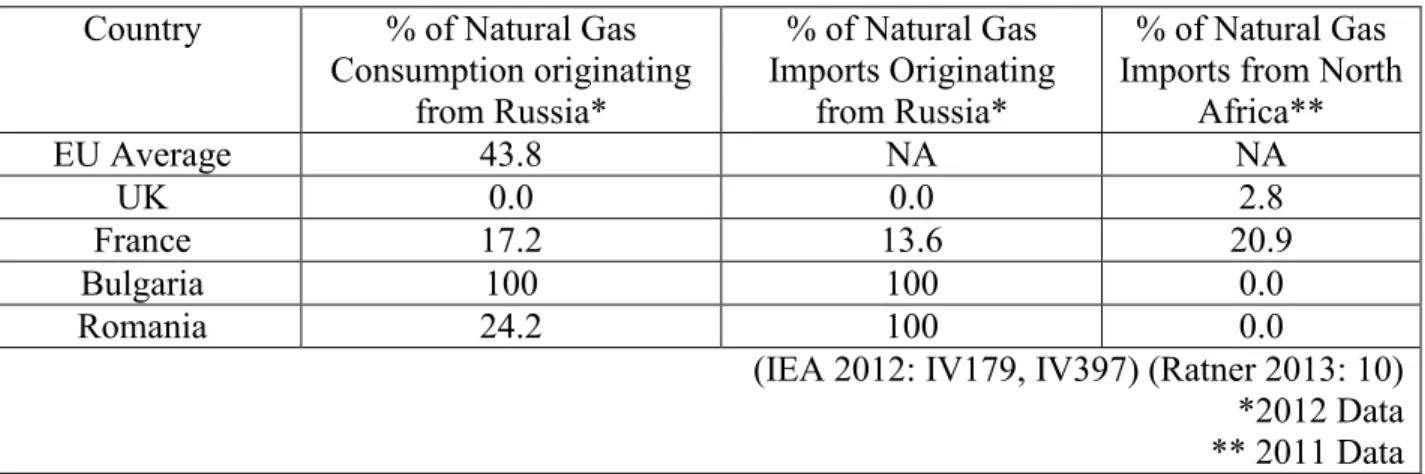
Hypothesis 3: Member states highly dependent on Russian or North African natural gas supply
will be more likely to permit fracking than member states less dependent on Russian or North
African gas supply.
Table 3: Import Gas Vulnerability
Country % of Natural Gas Consumption originating
from Russia*
% of Natural Gas Imports Originating
from Russia*
% of Natural Gas Imports from North
Africa**
EU Average 43.8 NA NA
UK 0.0 0.0 2.8
France 17.2 13.6 20.9
Bulgaria 100 100 0.0
Romania 24.2 100 0.0
(IEA 2012: IV179, IV397) (Ratner 2013: 10) *2012 Data ** 2011 Data
Results 3:Hypothesis three is falsified as the United Kingdom only imports 2.8 percent of its
energy from the turbulent regions of Russia and North Africa. Additionally, the anti-fracking
member state of Bulgaria imports one-hundred percent of its domestic natural gas consumption
from Russia. All of Romania’s imports originate from Russia, but Romania produces more than
6.4 Green Party Representation
Green parties have mixed electoral success across Europe depending on a variety of
factors. Countries with plurality voting systems and single member districts generally have fewer
parties represented in government compared to parliamentary representative democracies. Green
parties in Western Europe have more established roots than in the former Communist states. The
transnational European Green Party has clearly outlined its fracking position, stating, “(Fracking)
is a harmful way to extract fossil fuels. We’ll continue to fight against it, and try to ban it across
the EU (European Green Party 2014).”
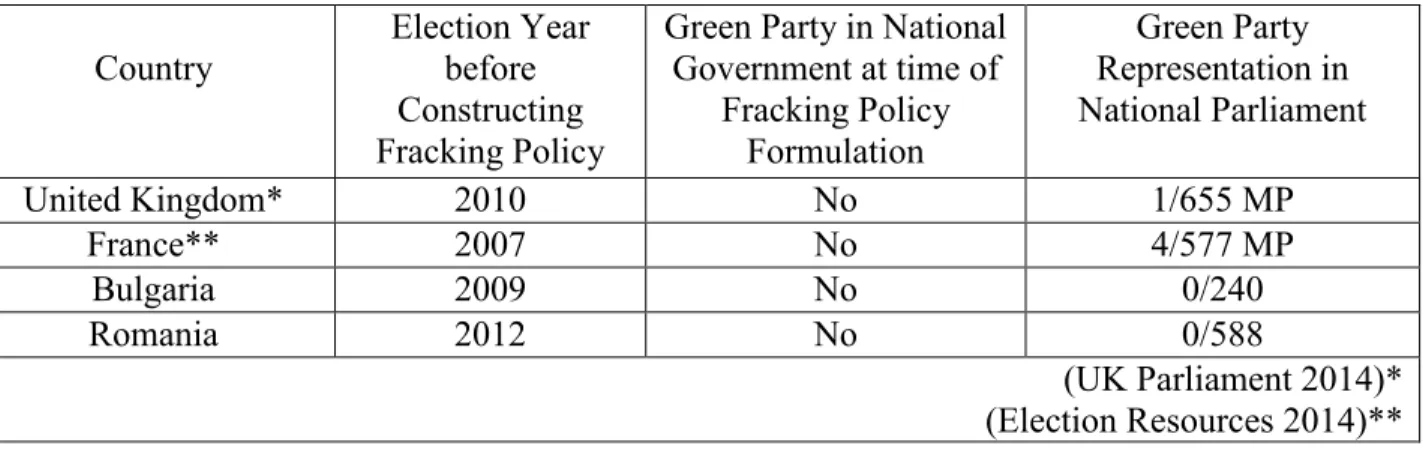
Hypothesis 4: Member states with green party representation in legislature will be more likely to
restrict fracking than countries without green party representation.
Table 4: Green Party Representation
Country
Election Year before Constructing Fracking Policy
Green Party in National Government at time of
Fracking Policy Formulation
Green Party Representation in National Parliament
United Kingdom* 2010 No 1/655 MP
France** 2007 No 4/577 MP
Bulgaria 2009 No 0/240
Romania 2012 No 0/588
(UK Parliament 2014)* (Election Resources 2014)**
Results 4:There is no relationship between green party representation and fracking policy. None
of the countries had a green party in the national government at the time of policy formation and
the number of parliamentarians in the United Kingdom and France was miniscule.
6.5 Free Market Ideology and Social Ideology
A plausible explanatory variable for why some member states might support fracking
social spectrums. The Political Parties: Chapel Hill Expert Survey measures positioning of
parties on the traditional left versus right economic dimension and the social GAL-TAN vertical
dimension (Bakker et al. 2012: 10). The parties are given a score between zero and ten by
political experts in the country. The end values are the aggregate scores of all parties from the
respective countries. States with a more economically right-leaning political position may opt to
promote industry at the expense of risking environmental destruction. Moreover, countries closer
to the GAL pole of the GAL-TAN vertical dimension tend to be more environmentally friendly
and postmaterialist and might be more likely to restrict fracking.
Hypothesis 5a:Member states with high levels of free market ideology will be more likely to
permit fracking than member states with low levels of free market ideology.
Hypothesis 5b: Member states that align closer to the TAN pole are more likely to permit
fracking than member states closer to the GAL ideology.
Table 5: National Party Ideology
Country Economic
Left/Right Placement (SD)
GAL-TAN Placement (SD)
UK 4.84 (1.24) 4.81 (1.31)
France 4.24 (1.56) 4.98 (1.59)
Bulgaria 5.09 (1.77) 6.48 (1.74)
Romania 4.94 (1.44) 5.93 (1.68)
2010 Data (Bakker et al. 2012: 10) SD=Standard Deviation
Results 5a:When evaluating the data for economic left/right party positioning, there appears to
intervention more than the United Kingdom, which would support the hypothesis, but Bulgaria
scores higher on free market ideology than the other three countries.
Results 5b:The GAL-TAN hypothesis does not indicate any relationship to the dependent
variable. It is noteworthy that Bulgarian parties are perceived as the most authoritarian leaning in
the entire EU and are substantially distanced from the green, postmaterialist pole.
6.6 Public Opinion
Public opinion should be a strong independent variable because these states are all
democracies. Public opinion statistics can be misleading for a variety of reasons. Respondents
from cities who are far removed from the environmental repercussions of fracking would be
more likely to support fracking than a rural farmer near the drilling rigs for instance. There are
also questions related to cueing and when the poll was taken. Did the polling occur before or
after policy implementation? Was there sound statistical methodology being performed in the
polls? Cross-country public opinion polls were difficult to come by. A University of Nottingham
survey polled British citizens, asking them the question, “Should shale gas exploration be
allowed in the UK?” Fifty-four percent of respondents said ‘yes’ (O’Hara 2014). In France, a
2013 Harris poll asked if shale gas should be incorporated into France’s energy transition.
Proving to be more averse than the Brits, only thirty percent of French citizens and twenty-three
percent of French business leaders consider fracking to be “compatible” with issues related to the
transformation of the energy system (Werth 2013). In Romania, three towns in Dobrogea were
given an unofficial referendum to determine whether fracking should be permissible in the
region. Only one village, Costineşti, met the designated voter threshold, resulting in 94.4 percent
required number of participants had similar results. No polls related to fracking were found in
Bulgaria.
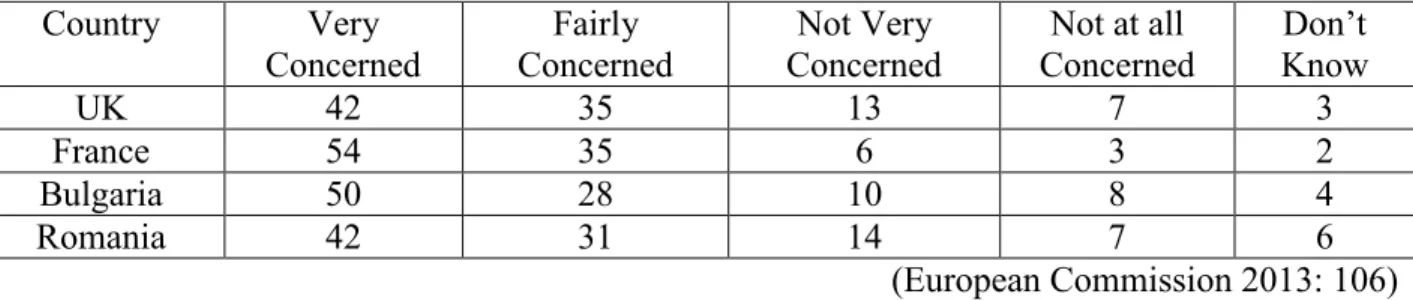
A Eurabarometer poll in 2012, asked, “If a shale gas project were to be located in your
neighborhood, do you think you would be”: “very concerned”, “fairly concerned”, “not very
concerned”, “not at all concerned”, and “don’t know”. This question has its limitations because it
does not specifically address a person’s overall view towards fracking. Most respondents would
be opposed to conventional drilling operations in their neighborhoods. Nevertheless, the data
may provide plausible explanations for why the countries pursued dissimilar shale gas policies.
Hypothesis 6:Member states with high levels of public opinion against fracking will be less
likely to permit fracking than member states whose public opinion are relatively supportive to
fracking.
Table 6: Public Opinion
Country Very
Concerned
Fairly Concerned
Not Very Concerned
Not at all Concerned
Don’t Know
UK 42 35 13 7 3
France 54 35 6 3 2
Bulgaria 50 28 10 8 4
Romania 42 31 14 7 6
(European Commission 2013: 106)
Results 6:The results highlight the two anti-fracking countries, France and Bulgaria, have higher
“very concerned” scores than the two fracking countries, suggesting a strong relationship
between public opinion and fracking policy. When aggregating the percentages of “very
concerned” and “fairly concerned”, France is clearly the most opposed to fracking at 89 percent
and Romania is the lowest at 73 percent. The United Kingdom and Bulgaria have similar
6.7 Environmental Protection Expenditure and Taxes
Countries that prioritize environmental expenditure and tax objects that are harmful to the
environment might indicate a country’s commitment to the environment and green policies. The
environmental protection expenditure variable is the amount of money, as a percentage of GDP,
allocated to activities directly targeting the prevention, reduction, and elimination of pollution or
any other degradation to the environment (European Commission 2012a: 227). “Environmental
taxes are taxes whose tax base is a physical unit of something that has a proven, specific negative
impact on the environment (European Commission 2012a: 228).”
Hypothesis 7a: Member states with high levels of public expenditure and investment towards
environmental projects will be less likely to permit fracking than countries with low levels of
public expenditure and investment towards environmental projects.
Hypothesis 7b:Member states with higher environmental taxes will be less likely to permit
fracking than countries with lower environmental taxes.
Table 7: Environmental Protection Expenditure and Taxes
Country Environmental Protection Expenditure % of GDP*
Environmental Taxes (% of GDP)**
EU Average (2009) 2.25 2.37
UK (2008) .29 2.62
France (2009) 2.16 1.86
Bulgaria (2009) 1.74 2.92
Romania (2009) 2.67 2.05
(European Commission 2012a: 214)* (European Commission 2012a: 202)**
Results 7a: Comparing the United Kingdom and France, Paris spends drastically more on
Romania stymies this hypothesis by having the highest environmental protection expenditure
relative to GDP in the country list.
Results 7b:There is no relationship between environmental taxes as a percentage of GDP and
fracking policy. Bulgaria has the highest percentage of environmental taxes, while France taxes
the lowest on such objects, the opposite of what the hypothesis prescribed.
6.8 Diversity of Energy Mixes
The energy mix of a member state reflects the interaction of the four elements of energy
security. While political leadership is striving to attain a continuous energy supply at affordable
prices, several constraints and conditions alter this strategy as the paper has described. Countries
cannot alter which resources are abundant and exploitable, but they can create a business climate
that attracts investment and pursues policies that improve the security of supply. For the diversity
of energy mix, Winston Churchill’s decree on energy security, “variety, and variety alone,” still
stands as a central strategy for governments in reducing vulnerability to supply disruptions
(Yergin 2011: 716).
Diversity of energy mix is a leading indicator of energy security, and there are many
scenarios that can steer policies in a particular direction. Countries dependent upon coal and
lignite, for instance, may be pressured to pursue more renewable energy options in order to meet
the EU’s 20-20-20 goals. Moreover, countries with favorable wind and solar conditions may be
more willing to phase out natural gas and nuclear energy because of the potential in renewable
energy. Labeling a country’s energy mix as secure or insecure is highly subjective, unless one
source of energy is providing an overwhelmingly amount of energy, thus no hypothesis will be
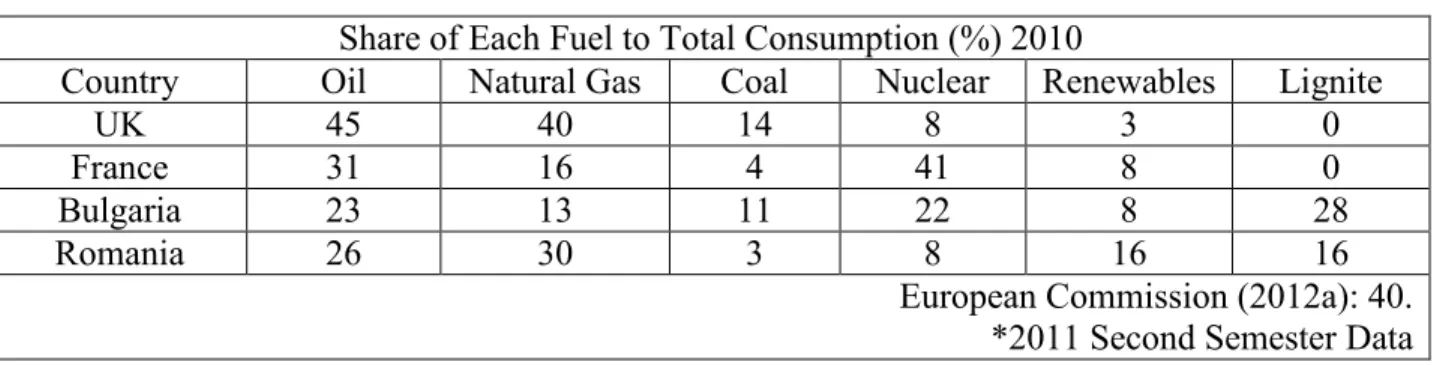
Table 8: Gross Inland Consumption by Fuel
Share of Each Fuel to Total Consumption (%) 2010
Country Oil Natural Gas Coal Nuclear Renewables Lignite
UK 45 40 14 8 3 0
France 31 16 4 41 8 0
Bulgaria 23 13 11 22 8 28
Romania 26 30 3 8 16 16
European Commission (2012a): 40. *2011 Second Semester Data
Results 8: When evaluating the energy mixes of the four member states, all countries have a
decently diversified portfolio. There are a few statistics that convey changes will eventually need
to be made with the current and future policies. In the United Kingdom, there is tremendous civic
pressure to reduce the British carbon footprint. The United Kingdom has a national target of
fifteen percent of energy coming from renewable resources by 2020, which appears distant at
this point with Britain producing just 3.8 percent (European Commission 2014: 10). London is
increasing nuclear energy supply; the implication being coal consumption will reduce. France,
conversely, is looking to diversify away from nuclear energy, so new electricity sources will
need to fill this void. Paris has a 2020 national renewable energy target of twenty-three percent
of gross inland consumption (European Commission 2014: 10). Bulgaria will be looking to phase
out the dirty fuels of coal and lignite, which produce thirty-nine percent of the country’s energy
need. This will need to be achieved by importing more natural gas from the South Stream
pipeline from Russia (if constructed); producing domestic gas by conventional or unconventional
drilling; or building more nuclear reactors. Lastly, Romania has a well-balanced energy
7. Analysis
The qualitative statistical analyses of the independent variables suggest several
interesting explanations as to why the four member states pursued the fracking policies that they
did. A few facts were known before testing. Three center-right parties were in control of the
legislature in France, the United Kingdom, and Bulgaria. Paris and the UMP party banned
fracking. The United Kingdom and the Conservative party became vocal supporters of the
drilling technique, and the GERB party of Bulgaria switched its original, pro-fracking position
and introduced a moratorium against fracking. When the Socialist Party in France came into
power, President Hollande followed Sarkozy’s course and kept the fracking ban. On the other
hand, the once, anti-fracking Social Democrats in Romania are now pro-fracking. Green party
representation in all four countries was negligible.
After evaluating the data, France and the United Kingdom, unsurprisingly, tend to have
similar data points with one another, while Romania and Bulgaria’s data group together as well.
Comparing France and the United Kingdom, there are three interesting independent variables
that provide clarity into why the countries pursued the policies that they did. Public opinion and
price of electricity indicate the French are more opposed to fracking than the Brits, and France
has much lower electricity prices than the United Kingdom. France also exports an extraordinary
amount of electricity while Britain is a net importer.
A second interesting aspect of the results is that almost all energy security indicators
suggest Bulgaria would permit exploration of its shale gas reserves when comparing the country
to Romania. Bucharest is highly dependent upon Russian natural gas reserves and suffers from
democracy is running its course in Bulgaria’s environmental policy. A third standout observation
is Romania no longer has a mainstream party opposing shale gas, even though there are
widespread grassroots movements against fracking. Romania has a long established history of
extracting hydrocarbons and the variables suggest this path will go unaltered. All of these
observations will need to be evaluated more thoroughly. Comparing the data of the United
Kingdom to France, and Romania to Bulgaria, will be useful to help discern why the countries
pursued the fracking policies that they did.
7.1 Comparative Analysis of the United Kingdom and France
The center-right governments of the United Kingdom and France chose divergent
strategies towards securing long-term energy supply vis-à-vis shale gas. The question is, why did
France decide to halt fracking operations to safeguard the environment and the United Kingdom
did not? Both countries had negligible green party opposition who could hold legislation hostage
in return for a fracking suspension. The collective ideology of French political parties on
economic issues slightly favored more government intervention than the United Kingdom’s. The
UK’s political parties, however, aligned closer to the GAL pole on the social dimension,
suggesting the Brits might subscribe to more of an environmental ideology. The results show the
United Kingdom taxes more on objects that negatively impact the environment than France, but
there is substantial variation in public expenditure in environmental protection projects as the
United Kingdom spends the smallest amount in the EU in relation to GDP.
The energy security indicators suggest both countries could benefit from an increase in
natural gas supply. Britain holds a very favorable dependency ratio, producing nearly
from North Africa and Russia (European Commission 2011b: 24). Unfortunately, for Britain,
conventional domestic resources are depleting rapidly. Natural gas output in the United Kingdom
is at its lowest since 1985 and oil reserves have peaked in the North Sea. British oil production
fell under one million barrels per day for the first time in 2013 (Richards et al. 2013: 2).
Paris, too, could benefit from shale gas production. France imports 97.7 percent of oil
consumption, 91.7 percent of coal consumption, and 100.9 percent of natural gas consumption
(European Commission 2011b: 24-30). The country maintains a favorable overall dependency
ratio because of its extensive nuclear industry, producing almost half of its own energy
requirements. This feature is expected to change. In September 2012, to diversify the domestic
electricity mix, President Hollande announced France would decrease nuclear production from
seventy-five percent of its electricity mix to fifty percent by 2025 (Boselli 2013). With absolute
dependence on foreign gas reserves and a nascent, renewable energy industry, many are skeptical
about what sources of energy will fill this void if it is not domestic shale gas.
The primary reasons why France became the first country in the world to ban fracking,
and the United Kingdom ramped up its drilling activity, are because of the discrepancies in
public opinion and electricity prices. According to a 2013 Harris public opinion poll in France,
less than a third of respondents believed shale gas should be incorporated into the country’s
energy transition (Werth 2013). In comparison, a University of Nottinghampoll revealed
fifty-four percent of British respondents say they would support fracking (O’Hara 2014). It should be
noted that the Cameron government has lobbied and pleaded for this support, while the French
elites have cued the populace that fracking is not suitable to the country’s interests. The same
University of Nottingham poll shows the more Brits learn about fracking, the more opposed they
asked, “If a shale gas project were to be located in your neighborhood, do you think that you
would be,” French respondents were the most averse to this question with 89 percent responding
“very concerned” or “fairly concerned” compared to the Brits’ 77 percent (European
Commission 2013: 106).
The French government can more adequately respond to public opinion and claim
environmental protection, as opposed to the United Kingdom, because of low, stable electricity
prices. Electricity prices are substantially higher in the United Kingdom than in France. In
second semester data of 2011, industry electricity prices (EUR/100 kWh,) excluding all
recoverable taxes, were 10.4 cents in the United Kingdom and 7.2 cents in France, the second
lowest in the EU (European Commission 2012b: 88). Relative to purchasing power, average
electricity prices in euros/kWh (2011 PPP) for the United Kingdom was 15 cents compared to 12
cents in France (Wilson 2013). Moreover, household energy bills have increased seventy percent
from 2004 levels in the United Kingdom and British energy leaders have warned that household
energy bills could rise by fifty percent over the next six years (Macalister 2013).
Reports conflict on whether fracking will actually reduce energy prices in the United
Kingdom, but Prime Minister David Cameron has stated, “fracking has real potential to drive
energy bills down….even if we only see a fraction of the impact shale gas has had in America,
we can expect to see lower energy prices in this country (Cameron 2013).” Price shocks have
been less frequent in France because of its stable supply of electricity coming from nuclear
energy. Over fifty French nuclear reactors enable the country to export 30,449 gigawatt hours of
electricity, allowing Paris to be among the top electricity exporters in the world (European
Commission 2012: 48). The tremendous excess in electricity supply does not necessitate France
United Kingdom, but the amount of gas in the energy mix in France is substantially less than its
English Channel counterparts. Rising energy prices have become more of a contested topic in the
British political debate than in France, consequentially leading to the Conservative Party in the
United Kingdom framing fracking as a way to cut the electricity bill. France has had the
flexibility to become an environmental steward against fracking and respond to public opinion
because of stable, cheap electricity prices produced by nuclear energy.
7.2 Comparative Analysis of Romania and Bulgaria
Civil protests against the fracking of shale gas have been widespread in both Romania
and Bulgaria. Demonstrators have organized sit-ins at Chevron’s drilling areas in the two
member states, hoping to cease fracking in the region’s fertile farmlands. The Bulgarian elites
responded to public opinion and reversed its fracking course, suspending all operations, or at
least this is what is portrayed by the government and media. This explanation might be credible,
but when comparing the situation with Romania and the energy security position of Bulgaria, it
appears much more is transpiring behind the scenes.
Romania, on the other hand, continued with its shale gas exploration plans after a
temporary moratorium against fracking was lifted in May 2013. Since Prime Minister Victor
Ponta announced this reversal, citizens have been quite active in voicing their concerns (Besliu
2013). Chevron was forced to suspend its operations momentarily in December of 2013 as a
result of a local demonstration in the small town of Pungesti. Romanians, once again, voiced
their concern to Bucharest when 94.4 percent of the villagers from Costineşti voted against
fracking in a local referendum (Ionescu 2013). Additionally, over 8,000 Romanians publically
operations and for a moratorium until more information was available (Besliu 2013). Less
worrisome than the French and Bulgarians, Romanians are still relatively concerned about shale
gas projects as seventy-two percent of respondents of the Eurobarometer survey said they would
be “very concerned” or “fairly concerned” if fracking were to take place in their neighborhood.
Evaluating the economic and energy security position of Romania, it appears the country
could benefit from shale gas exploitation. The country has significantly higher household
electricity prices compared to Bulgaria and other Eastern European countries. Romania does
enjoy low natural gas prices because of its robust natural gas industry, but increasing production
is necessary to keep prices level, given that Russia provides almost a quarter of Romania’s
natural gas consumption. The two major parties of Romania are now fully supportive of the
industry because of the economic benefits fracking can bring, even though the population is
largely skeptical. This leaves minimal democratic channels open for citizens opposed to fracking.
It is not surprising to see a former Communist and underdeveloped country, with questionable
democratic legitimacy and extensive corruption, prioritize economics over the environment.
What is surprising is Bulgaria’s two major parties are now supporting anti-fracking legislation.
Tapping into Bulgaria’s shale gas deposits could provide substantial benefits for the
country in terms of job creation, reducing dependence on Russia, stabilizing energy supplies,
contributing much needed revenue funds to support a range of government initiatives, and
supporting economic growth. Natural gas currently comprises only eleven percent of the energy
mix for Bulgaria, but Sofia relies upon Russia for nearly the entirety of it (European Commission
2011: 36, Ratner 2013: 10). Bulgaria’s vulnerability to Russian muscling was exposed after the
2009 Ukrainian gas crisis necessitated Sofia to find alternative gas suppliers in the dead of
Bulgarian elites face difficult choices on how best to pursue energy security strategy in
the years ahead. Bulgaria could benefit from increased market competition through domestic
production and gain autonomy in the energy sector in the long-term by undermining Russia’s
dominant position in the market. The country, however, hosts the lowest household electricity
prices in the EU because of its privileged relationship with Russia (Eurostat 2013: 2).
Considering this dichotomy, did Bulgarian parliamentarians vote almost unanimously to
suspend fracking operations because of the citizens’ desire for ecological protection? Half of
Bulgarians polled in the Eurobarometer survey claimed they would be “very concerned” if
fracking was to take place in their neighborhood. Bulgaria has higher tax rates on physical units
that have a negative impact on the environment than the average rate in the EU. Conversely,
Bulgaria allocates almost a full percentage point of GDP less to environmental protection
projects than Romania. Both Romania and Bulgaria have a higher than average free market
ideology and lean more to the TAN pole than the GAL pole compared to other member states.
Evaluating the statistics aggregately, it appears Bulgaria and Romania do have a modest
ecologically conscious society, but this does not adequately explain why the originally
pro-GERB government in Bulgaria voted for a moratorium against fracking and the originally
anti-fracking SDP government in Romania now supports the drilling technique.
Gazprom and the Russian lobby are significant players in shale gas policy at the EU and
member state level (Buisset, Øye, and Selleslaghs 2012: 9). Ivan Sotirov, member of the
Bulgarian National Council and former Senior Advisor to the Bulgarian Minister of Foreign
Affairs, insisted Gazprom manipulated the government into placing a moratorium on shale gas
rather than the claimed notion of democratic legitimacy. His proclamation for why the once
The ostensibly rightist majority at the National Assembly has capitulated, without any serious arguments, to this pseudo-civic pressure, and has adopted a moratorium on prospecting and extracting shale gas in Bulgaria…The most shameful fact is the
realization that after 22 years of democracy Bulgaria's policy continues to be dictated by oligarchic pro-Russian circles, which, hiding behind nationalistic and ecological rhetoric have not allowed a single serious strategic Western investor to set a foot in Bulgaria.
(Daly 2012)
The main opposition party at the time of voting and current leader of the present
governing coalition - the BSP - is perceived as pro-Russian. This is not surprising since the party
evolved from the Bulgarian Communist Party after 1990. Moscow has been quite outspoken
against Bulgarian fracking operations as Russia’s revenue from its energy sector would be
significantly hindered. President Putin has relentlessly pursued regional hegemony in Russia’s
near-abroad throughout his tenure. Gazprom, at the time of voting in Sofia, was negotiating
several gas contracts and pipelines with Bulgaria, namely the South Stream pipeline, which was
competing against the non-Russian Nabucco Pipeline. Fracking Bulgarian shale gas deposits
would challenge Russian power, especially since a U.S. company had the concession rights to
some of the promising shale gas prospects in question. Further alleging Russian-Bulgarian
corruption, Sotirov claimed the three parliamentarians who led the anti-fracking campaign in the
National Assembly were from the BSP and held the closest ties to Gazprom (Duhme 2012).
While Sotirov is just one outspoken National Assemblymen, U.S. Ambassador James
Pardew supports Sotirov’s accusation, when he wrote in a leaked U.S. cable detailing the
ramifications if the BSP won the 2005 elections, “The one area where Russia’s influence is likely
to grow if the BSP takes power is in the economy. Most Bulgarian companies with Russian
business ties are aligned with the BSP, especially in the energy sector (Pardew 2005).” The
BSP is not the lone social group in Bulgaria to be perceived to have less than democratic ideals