The link between volcanism and plutonism in epizonal magma
systems; high-precision U–Pb zircon geochronology from
the Organ Mountains caldera and batholith, New Mexico
The MIT Faculty has made this article openly available. Please share
how this access benefits you. Your story matters.
Citation
Rioux, Matthew et al. “The Link between Volcanism and Plutonism
in Epizonal Magma Systems; High-Precision U–Pb Zircon
Geochronology from the Organ Mountains Caldera and Batholith,
New Mexico.” Contributions to Mineralogy and Petrology 171.2
(2016): n. pag.
As Published
http://dx.doi.org/10.1007/s00410-015-1208-6
Publisher
Springer Berlin Heidelberg
Version
Author's final manuscript
Citable link
http://hdl.handle.net/1721.1/105197
Terms of Use
Creative Commons Attribution-Noncommercial-Share Alike
DOI 10.1007/s00410-015-1208-6
ORIGINAL PAPER
The link between volcanism and plutonism in epizonal magma
systems; high‑precision U–Pb zircon geochronology from the
Organ Mountains caldera and batholith, New Mexico
Matthew Rioux1,2 · G. Lang Farmer3 · Samuel A. Bowring2 · Kathleen M. Wooton4 · Jeffrey M. Amato5 · Drew S. Coleman4 · Philip L. Verplanck6
Received: 1 June 2015 / Accepted: 12 November 2015 / Published online: 21 January 2016 © Springer-Verlag Berlin Heidelberg 2015
of 36.441 ± 0.020 Ma (Cueva Tuff), 36.259 ± 0.016 Ma (Achenback Park tuff), and 36.215 ± 0.016 Ma (Squaw Mountain tuff). An alkali feldspar granite, which is chemi-cally similar to the erupted tuffs, yielded a synchronous weighted mean 206Pb/238U date of 36.259 ± 0.021 Ma.
Weighted mean 206Pb/238U dates from the larger volume
syenitic phase of the underlying Organ Needle pluton range from 36.130 ± 0.031 to 36.071 ± 0.012 Ma, and the young-est sample is 144 ± 20 to 188 ± 20 ka younger than the Squaw Mountain and Achenback Park tuffs, respectively. Younger plutonism in the batholith continued through at least 34.051 ± 0.029 Ma. We propose that the Achenback Park tuff, Squaw Mountain tuff, alkali feldspar granite and Organ Needle pluton formed from a single, long-lived magma chamber/mush zone. Early silicic magmas gener-ated by partial melting of the lower crust rose to form an epizonal magma chamber. Underplating of the resulting mush zone led to partial melting and generation of a high-silica alkali feldspar granite cap, which erupted to form the tuffs. The deeper parts of the chamber underwent continued recharge and crystallization for 144 ± 20 ka after the final eruption. Calculated magmatic fluxes for the Organ Needle pluton range from 0.0006 to 0.0030 km3/year, in agreement
with estimates from other well-studied plutons. The petro-genetic evolution proposed here may be common to many small-volume silicic volcanic systems.
Keywords Organ Mountains · Tuff · Epizonal · Zircon · Pluton · Organ Needle pluton · Caldera
Introduction
Large silicic caldera eruptions can have regional to global impacts. To fully understand caldera magmatism, and Abstract The Organ Mountains caldera and batholith
expose the volcanic and epizonal plutonic record of an Eocene caldera complex. The caldera and batholith are well exposed, and extensive previous mapping and geochemical analyses have suggested a clear link between the volcanic and plutonic sections, making this an ideal location to study magmatic processes associated with caldera volcanism. Here we present high-precision thermal ionization mass spectrometry U–Pb zircon dates from throughout the cal-dera and batholith, and use these dates to test and improve existing petrogenetic models. The new dates indicate that Eocene volcanic and plutonic rocks in the Organ Moun-tains formed from ~44 to 34 Ma. The three largest caldera-related tuff units yielded weighted mean 206Pb/238U dates
Communicated by Timothy L. Grove.
Electronic supplementary material The online version of this article (doi:10.1007/s00410-015-1208-6) contains supplementary material, which is available to authorized users.
* Matthew Rioux
1 Earth Research Institute, University of California, Santa
Barbara, Santa Barbara, CA 93106, USA
2 Department of Earth, Atmospheric and Planetary Sciences,
Massachusetts Institute of Technology, Cambridge, MA 02459, USA
3 Department of Geological Sciences, University of Colorado,
Boulder, CO 80309, USA
4 Department of Geological Sciences, University of North
Carolina, Chapel Hill, NC 27599, USA
5 Department of Geological Sciences, New Mexico State
University, Las Cruces, NM 88003, USA
ultimately the potential hazards posed by these systems, it is necessary to understand the link between intrusive and extrusive magmatism. The role of shallow (<8 km depth) plutons has been debated. Many studies have argued that silicic tuffs undergo fractionation in the upper- to mid-crust prior to eruption and that plutons represent the residual sol-ids from this processes (e.g., Bachmann and Bergantz 2004, 2008; Bachmann et al. 2007; Hildreth 1981, 2004; Lipman 1984, 2007; Lipman and Bachmann 2015; Metcalf 2004; Smith 1979). On the other hand, two recent geochronologic studies have documented an offset between the timing of caldera-related volcanic eruptions and crystallization of spa-tially associated shallow plutons (Mills and Coleman 2013; Tappa et al. 2011) . These and earlier studies have suggested that the relative role of volcanism and plutonism may be related to magmatic fluxes, where high flux regimes favor eruption of silicic magmas formed lower in the crust and lower flux regimes favor intrusive crystallization (Glazner et al. 2004; Mills and Coleman 2013; Tappa et al. 2011).
The Eocene Organ Mountains caldera and batholith, south-central New Mexico, are ideal places to study the link between silicic volcanism and epizonal plutonism in a small- to inter-mediate-volume system. The batholith is exposed directly below preserved caldera deposits, and field relationships and geochemical differentiation trends suggest a genetic link between the plutonic and volcanic sections. Previous stud-ies have used detailed mapping and geochemical analyses to develop petrogenetic models for the system (Seager 1981; Seager and McCurry 1988; Verplanck et al. 1995, 1999). These studies demonstrated geochemical zoning within the plutonic section, which was attributed to magmatic differen-tiation prior to and during eruption of the caldera tuffs. The zoning is consistent with chemical zonation observed in large silicic eruptions (Bachmann and Bergantz 2008; Hildreth 1981). The proposed petrogenetic models can be further tested using high-precision geochronology; however, prior to the present study, the timing of pluton crystallization in the Organ Mountains batholith was poorly constrained (Zimmerer and McIntosh 2013). Here, we present new high-precision isotope dilution-thermal ionization mass spectrometry (ID-TIMS) U– Pb zircon geochronology and whole-rock radiogenic isotope data from both the volcanic and plutonic sections in the Organ Mountains. Our new data provide insight into the link between volcanism and epizonal plutonism, constrain magmatic fluxes, constrain the lifespan of upper crustal magma chambers/mush zones, and directly test and improve existing petrogenetic models for this well-studied system.
Geologic setting
Eocene magmatism in southern New Mexico is generally attributed to the end of the Laramide subduction event and
subsequent Rio Grande rift extension. Laramide subduction in New Mexico was accompanied by magmatism at 75 Ma and 48 to 37 Ma (e.g., McMillan 2004). The younger phase of magmatism is marked by intermediate (primar-ily andesite) composite cones with extensive lava flows and lahars. A change in eruptive composition and style, to large rhyolitic caldera complexes, occurred at ~37 Ma and is attributed to the early phase of Rio Grande rift exten-sion (Cather et al. 1984; Mack et al. 1998; McMillan et al. 2000). The Organ Mountains caldera and batholith likely formed as a result of the early rift magmatism (Seager and McCurry 1988).
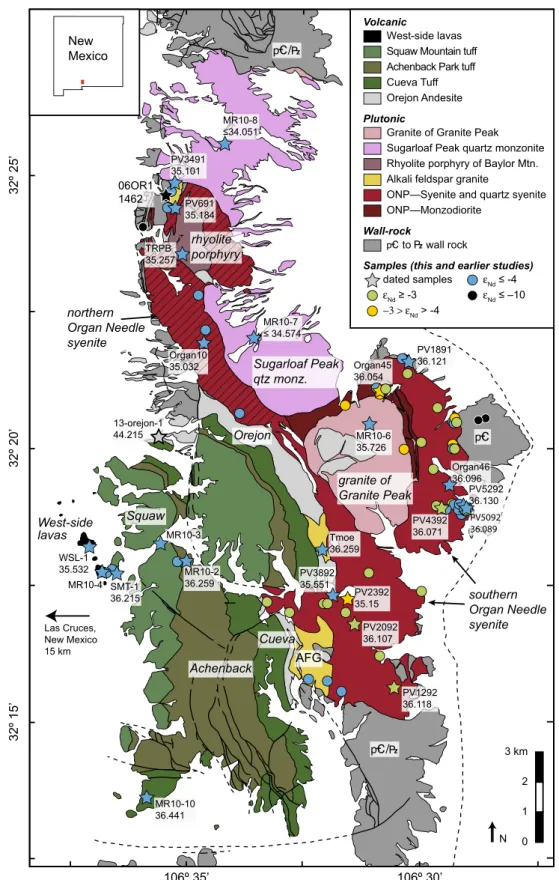
The Organ Mountains caldera and batholith were intruded into and erupted onto Proterozoic granite and Paleozoic sedimentary rocks (Fig. 1). The preserved volcanic stratigraphy consists of the Orejon Andesite (0.5–1 km), Cueva Tuff (0.2–0.6 km), Achenback Park tuff (informally named; 0.2–1 km), Squaw Mountain tuff (informally named; 0.7–1.4 km) and West-side lavas (Fig. 1) (Seager 1981; Seager and McCurry 1988). The Orejon Andesite includes intermediate composition flows and lahar breccias and has been interpreted to represent preexisting volcanic cover or early eruptions related to the caldera-forming magmatism (Seager and McCurry 1988). The Cueva Tuff is the oldest of the caldera-forming ignim-brites and consists of numerous variably welded rhyolitic ash-flow tuffs. The overlying Achenback Park and Squaw Mountain tuffs are each composed of a single cooling unit of moderate to densely welded rhyolitic ash-flow tuff. The West-side lavas are the youngest eruptive unit and include rhyolite, trachyte and dacite lava flows (unit descriptions based on Seager and McCurry 1988). The ash-flow tuff units are separated by disconformities marked by volcani-clastic sandstones and breccias. The estimated total erupted volume is 300–1000 km3 (Seager and McCurry 1988;
Ver-planck et al. 1999).
32º 25
’
106º 35’ 106º 30’
32º 20
’
32º 15’
Las Cruces, New Mexico 15 km
West-side lavas
New Mexico
Volcanic
Plutonic
Wall-rock
West-side lavas Squaw Mountain tuff Achenback Park tuff Cueva Tuff Orejon Andesite
Granite of Granite Peak Sugarloaf Peak quartz monzonite
Samples (this and earlier studies)
dated samples
εNd ≥ -3
Rhyolite porphyry of Baylor Mtn. Alkali feldspar granite
ONP—Syenite and quartz syenite ONP—Monzodiorite
wall rock
0 2 3 km
1
N
εNd ≤ –10 εNd ≤ -4
−3 > εNd > -4
Sugarloaf Peak qtz monz. rhyolite
porphyry
granite of Granite Peak northern
Organ Needle syenite
southern Organ Needle syenite
Achenback Cueva Orejon
Squaw
AFG
PV3491 35.101
PV691 35.184
TRPB 35.257
PV1891 36.121
Organ46 36.096 Organ10
35.032 Organ45
36.054
PV5092 36.089 PV4392 36.071
PV2392 35.15 PV3892 35.551
Tmoe 36.259
PV2092 36.107
PV1292 36.118
MR10-10 36.441 WSL-1
35.532
13-orejon-1 44.215
SMT-1 36.215
MR10-8 ≤34.051
MR10-7 ≤ 34.574
MR10-6 35.726
MR10-2 36.259 MR10-3
MR10-4 06OR1 1462
PV5292 36.130
5592
Fig. 1 Geologic map of the Organ Mountains (after Seager 1981; Verplanck et al. 1999). Location map inset in the upper left. Stars denote locations of samples analyzed in this study. Circles denote sample locations from Verplanck et al. (1995, 1999) and Butcher (1990). Sample labels include sample numbers and dates in Ma, based on the data presented in this manuscript. The hatched pattern denotes the northern exposures of mapped Organ Needle pluton
syen-ites, which our U–Pb dates indicate are significantly younger than the main southern portion of the pluton. Sample symbols are color-coded based on whole-rock εNd, as outlined in the key. ONP, Organ Needle
into the center of the Organ Needle pluton. The Sugarloaf Peak quartz monzonite includes monzonitic to granitic compositions and intruded along the northeastern side of the Organ Needle pluton.
Existing geochemistry and petrogenetic models
Seager and McCurry (1988) argued that the ignimbrites and lavas of the Organ Mountains caldera, including the Cueva Tuff, Achenback Park tuff, Squaw Mountain tuff and West-side lavas, were formed by repeated eruptions from a single, chemically stratified magma chamber. This interpre-tation was based on the minimal erosion between the erup-tive units and the relaerup-tively smooth chemical trends from the bottom to the top of the volcanic series: SiO2 decreases from the Cueva Tuff (72–76 wt%) through the West-side lavas (61–66 wt%), while TiO2, Al2O3, FeO*, MgO, and
CaO increase. The authors argued that the chemical trends are consistent with eruptions sourced from progressively deeper in the silica-rich cap of a stratified magma chamber, with the Organ Needle pluton representing the preserved remnants of deeper levels in the magma chamber.
Verplanck et al. (1995, 1999) used field relationships, petrography, and whole-rock and mineral chemical and isotopic analyses to develop a more detailed model for the formation of the Organ Needle pluton. These and ear-lier studies showed that the Organ Needle pluton is com-positionally stratified from more mafic compositions at the base (~57 wt% SiO2) to more felsic compositions at
the top (68–76 wt% SiO2) (Seager and McCurry 1988; Verplanck et al. 1995, 1999). The data in Verplanck et al. (1995, 1999) further demonstrated isotopic zoning within the pluton; the equigranular syenite at the center of the plu-ton has εNd(t) ≈−2, while the inequigranular syenite at the base of the pluton and the alkali feldspar granite cupolas at the top of the pluton have εNd(t) ≈−5. A thin channel (20– 100 m) of rocks that have εNd(t) ≈−5 and are more silicic than adjacent equigranular syenite is also preserved along the margin of the Organ Needle pluton at higher struc-tural levels; Fig. 1 shows the distribution of isotopic data from the present study, Verplanck et al. (1995, 1999) and Butcher (1990). The Proterozoic wall rocks of the pluton have εNd(t) ≈−12 (Verplanck et al. 1995, 1999). Based on the isotopic data, geochemical data and field relations, Ver-planck et al. (1995, 1999) suggested that the εNd(t) ≈−5 magmas in the pluton were likely generated by assimilation of εNd(t) ≈−12 wall rock into the εNd(t) ≈−2 magma that formed the core of the pluton. The absence of a correlation between Nd concentrations and εNd(t) for the εNd(t) ≈−5 rocks was interpreted to indicate that wall rock assimilation occurred at depth, followed by differentiation and migra-tion of the resultant magma (Verplanck et al. 1995, 1999).
Based on the observations outlined above, Verplanck et al. (1995, 1999) developed a four-stage model for the evolution of the Organ Needle pluton and eruption of the Squaw Mountain tuff (Fig. 14 of Verplanck et al. 1999): (1) An εNd(t) ≈−2 magma intruded into the Proterozoic wall rocks. (2) Partial melting and assimilation of the wall rocks at the base of the pluton generated an εNd(t) ≈−5 magma. (3) The εNd(t) ≈−5 magma underwent differentiation and migrated upwards along the sides of the pluton, encapsu-lating the shallower εNd(t) ≈ −2 magma. The encapsu-lated magma also underwent differentiation, leading to the observed compositional stratification. (4) The εNd(t) ≈−5 magma that reached the shallowest depths erupted to form the Squaw Mountain tuff. The intrusive equivalents crystal-lized to form the alkali feldspar granite cupolas.
A major goal of the present study was to use high-preci-sion geochronology to test and improve the Verplanck et al. (1995, 1999) model. The samples we dated include both samples analyzed for geochemical and isotopic composi-tions in these previous studies and a suite of samples we collected to augment the existing sample suite.
Existing geochronology
Existing geochronology from the Organ Mountains caldera and batholith includes K–Ar, 40Ar/39Ar and laser
ablation-inductively coupled plasma-mass spectrometry (LA–ICP– MS) U–Pb dates. Loring and Loring (1980), Seager (1981), McIntosh et al. (1990) and Verplanck et al. (1995) reported limited K–Ar and 40Ar/39Ar dates from the volcanic and
plutonic sections. In a recent, larger study, Zimmerer and McIntosh (2013) acquired 40Ar/39Ar sanidine, K-feldspar,
biotite and hornblende dates from plutonic and volcanic rocks throughout the Organ Mountains (Supplementary Fig-ure SM1). Weighted mean 40Ar/39Ar sanidine dates for the
Cueva Tuff, Achenback Park tuff, and Squaw Mountain tuff were 36.45 ± 0.08, 36.23 ± 0.14, and 36.03 ± 0.16 Ma, respectively (uncertainties throughout are ±2σ internal).
40Ar/39Ar sanidine, biotite, hornblende, plagioclase and
groundmass dates from the younger West-side lavas ranged from 36.28 ± 0.23 to 35.68 ± 0.09 Ma. Finally, 40Ar/39Ar
biotite cooling and/or reheating dates from the differ-ent compondiffer-ents of the Organ Needle pluton, the granite of Granite Peak and the Sugarloaf Peak quartz monzonite ranged from 36.25 ± 0.12 to 33.46 ± 0.19 Ma. Zimmerer and McIntosh (2013) also reported a smaller number of laser ablation-inductively coupled plasma-mass spectrom-etry (LA–ICP–MS) U–Pb zircon dates from the Organ Mountains batholith, but the utility of the data is limited by relatively large analytical uncertainties (±0.4–0.9 Ma). The best estimate of the age of the Orejon Andesite comes from
the correlative Rubio Peak Formation, exposed in adjacent ranges in south-central New Mexico (McMillan 2004).
The existing radiometric dates precisely date the vol-canic units, but place only limited constraints on the age of pluton crystallization; the LA–ICP–MS U–Pb dates have large uncertainties, and the 40Ar/39Ar dates provide cooling
or reheating dates for the plutonic rocks. Here, we build on these previous studies using high-precision U–Pb zircon geochronology, which provides a detailed record of the tim-ing of plutonism and volcanism in the Organ Mountains.
Terminology
For clarity and brevity in this manuscript, we will adopt a simplified terminology for the different units of the Organ Mountains caldera and batholith based on the combined mineralogy, textures, and isotopic composition. The Organ Needle pluton will be used to refer to the syenite to quartz syenite and monzodioritic rocks from the central Organ Mountains, excluding the alkali feldspar cupolas that are in contact with these units. Within the pluton, we refer to sye-nitic to quartz syesye-nitic rocks from the center of the pluton, which have εNd(t) ≈−2, as “equigranular syenites.” We will refer to inequigranular syenitic to quartz syenitic rocks from the base of the pluton, which have εNd(t) ≈−5, as “inequi-granular syenites.” Additional εNd(t) ≈ −5 syenitic rocks are also located along the margins of the equigranular syen-ite at higher structural levels but do not have inequigranular textures. The new U–Pb dates presented herein suggest that the northern arm of the equigranular Organ Needle syenites (marked with a hatched pattern in Fig. 1) is significantly younger than the main southeastern syenite body, and we will therefore differentiate between the northern and south-ern Organ Needle syenites (Fig. 1). Similarly, we differentiate between the northern alkali feldspar granite cupola (northern AFG) and central and southern alkali feldspar granite cupolas (southern AFG). Finally, we will abbreviate the tuff of Squaw Mountain and the tuff of Achenback Park as the Squaw Mountain tuff and Achenback Park tuff, and refer to the lavas overlying the Squaw Mountain tuff as the West-side lavas.
Results
Our new U–Pb dates from the Eocene caldera and batholith are presented in Figs. 1, 2, 3, and 4, and in Supplementary Tables SM1 and SM2. Twenty samples were dated in the Radiogenic Isotope Laboratory at the Massachusetts Insti-tute of Technology (MIT; Supplementary Table SM1), and three additional samples were dated in the Geochronol-ogy and Isotope Geochemistry Laboratory at the Univer-sity of North Carolina (UNC; Supplementary Table SM2).
Analytical methods, including a detailed discussion of the Th correction applied to the zircon 206Pb/238U dates, are
provided in the Supplementary Text and Supplementary Figure SM2; all 206Pb/238U dates in the text and figures are
Th-corrected. A single sample of Paleozoic wall rock was dated using the sensitive high resolution ion microprobe-reverse geometry (SHRIMP-RG) at Stanford University (Supplementary Text, Supplementary Table SM3, and Sup-plementary Figure SM3). Sample locations are provided in Table 1.
For the volcanic and plutonic samples in this study, high-precision 206Pb/238U dates from a subset of samples define a
single population (mean square of the weighted deviates of the weighted mean; MSWD ≈ 1), but most samples contain a range of dates with a MSWD that is higher than expected for a single population (two-sided p value for the Chi-square goodness of fit ≤0.05; MSWD ≥ 2–3, depending on n). The scatter in dates for most samples could be explained by Pb loss, inheritance or protracted zircon growth in a magma (magma residence). We applied the chemical abrasion method to all of the dated zircons, which minimizes or eliminates the effects of Pb loss in most grains (Mattinson 2005), making it unlikely that there is widespread Pb loss. In most cases, we therefore interpret the intra-sample variations in dates to reflect either magma residence times or assimilation of zircons from older rocks related to the same magmatic system. Interestingly, we only observed older zircons that could reflect inheritance of xenocrysts from the Proterozoic wall rocks in a single sample (Organ10), suggesting that any assimilated grains were efficiently dissolved in the magmas. In the cases of magma residence or inheritance, the youngest date or population of dates in each sample provides the best estimate for the eruption age or final crystallization age of the rock. We calculated weighted mean dates for the youngest population in each sample and interpret these to be the best estimate of the crystallization or eruption age of the sample; however, we note that if we instead take only the youngest date in each sample as the crystallization or eruption age, it does not change the conclusions reached herein. Detailed results for each sample are discussed by map unit below.
Proterozoic granite wall rock
SHRIMP data from a single sample yielded concordant and variably discordant data that plot along a discordia line with an upper intercept of 1452 +33/−26 Ma (MSWD = 2.1, n = 8, Supplementary Table SM3, Supplementary Figure SM3). The lower intercept yielded a poorly constrained date of 91 ± 170 Ma. The three most concordant spot analyses yielded a weighted mean 207Pb/206Pb date of 1462
the three most concordant points to be the best estimate of the crystallization age of the Proterozoic granite.
Volcanic rocks
The dated volcanic samples come from each of the major volcanic units: the Orejon Andesite, Cueva Tuff, Achenback Park tuff, Squaw Mountain tuff, and West-side lavas. Dated zircons from the Squaw Mountain tuff and West-side lavas define single populations with weighted mean 206Pb/238U
dates of 36.215 ± 0.016 Ma (SMT-1, MSWD = 0.96, n= 6/6; ratio denotes number of fractions/zircons included in the weighted mean over the number of fractions/zircons analyzed) and 35.532 ± 0.030 (WSL-1, MSWD = 0.40, n = 5/5), respectively. For the remaining volcanic sam-ples, interpreted weighted mean 206Pb/238U dates or
sin-gle-grain dates for each sample were as follows: Orejon Andesite, 44.215 ± 0.054 Ma (13-orejon-1, iz12, n= 1/4); Cueva Tuff, 36.441 ± 0.020 Ma (MR10-10, MSWD = 2.2, n= 2/9); and Achenback Park tuff, 36.259 ± 0.016 Ma (MR10-2, MSWD = 1.7, n= 6/7) (Figs. 2, 4).
One concern in using U–Pb zircon geochronology to date volcanic eruptions is the possibility that zircons may have crystallized in a magma tens to hundreds of thousands of years prior to eruption (magma residence time) (e.g., Simon et al. 2008). Comparison of the U–Pb dates reported here and published 40Ar/39Ar dates (Zimmerer and
McIn-tosh 2013) (Supplementary Figure SM1) suggest that this was not a major issue in this study. Zimmerer and McIn-tosh (2013) used the recalibrated age of the Fish Canyon Tuff standard (Kuiper et al. 2008) and revised estimates of the 40K decay constant (Min et al. 2000), which minimize
biases between the U–Pb and K–Ar systems. The Zimmerer and McIntosh (2013) 40Ar/39Ar dates overlap our weighted
mean 206Pb/238U dates for the Cueva Tuff, Achenback Park
tuff and Squaw Mountain tuff, within uncertainty, consist-ent with minimal residence time for the dated zircons prior to eruption. 40Ar/39Ar dates for the West-side lavas are
older than our U–Pb dates and may be inaccurate. In the present study, we rely on the U–Pb zircon dates for the vol-canic units, in order to ensure that the data are internally consistent with the dates from the plutonic section.
Organ Needle pluton and alkali feldspar granites
Organ Needle pluton syenite
Seven dated samples from mapped exposures of the equig-ranular and inequigequig-ranular syenite yielded similar dates, while four other samples were significantly younger. Three samples from the equigranular syenite with εNd(t) ≈−2 yielded inter-preted weighted mean 206Pb/238U dates of 36.118
± 0.017 Ma (PV1292, MSWD = 0.066, n= 4/6); 36.107 ± 0.016 Ma
(PV2092, MSWD = 1.4, n= 6/7); and 36.071 ± 0.012 Ma (PV4392, MSWD = 0.12, n= 4/6). Two samples from the basal inequigranular syenite and a single sample from a higher border syenite, which all have εNd(t) ≈ −5, yielded inter-preted weighted mean 206Pb/238U dates of 36.121 ± 0.016 Ma
(PV1891, MSWD = 1.5, n = 4/6); 36.089 ± 0.017 Ma (PV5092, MSWD = 0.36, n= 3/8); and 36.130 ± 0.031 Ma (PV5292, IEQ, MSWD = 1.7, n= 3/6). A final sample of inequigranular syenite, which does not have Nd or Sr iso-topic data, yielded a synchronous interpreted weighted mean 206Pb/238U date of 36.096
± 0.047 Ma (Organ46, MSWD = 0.89, n= 2/5). For PV4392, we excluded one younger date and one older date and took the weighted mean of four zircons with nearly identical 206Pb/238U dates; the one
slightly younger date is anomalously young compared to other analyses from both this sample and the six other sam-ples described above and may reflect residual Pb loss that was not removed by the chemical abrasion method. The seven dated samples are distributed throughout the syenitic phase of the pluton and include both equigranular and inequigranular rocks, and we interpret the dates to reflect the crystallization age of the main southern phase of the Organ Needle pluton.
Four samples from the northern exposure of the syen-ite, exposed west of the Sugarloaf Peak quartz monzonite (marked with a hatched pattern in Fig. 1), and from two exposures in the middle of the southern lobe of the syenite yielded significantly younger dates. The two samples of equi-granular syenite from the northern arm of the syenite yielded weighted mean 206Pb/238U dates of 35.184 ± 0.020 Ma
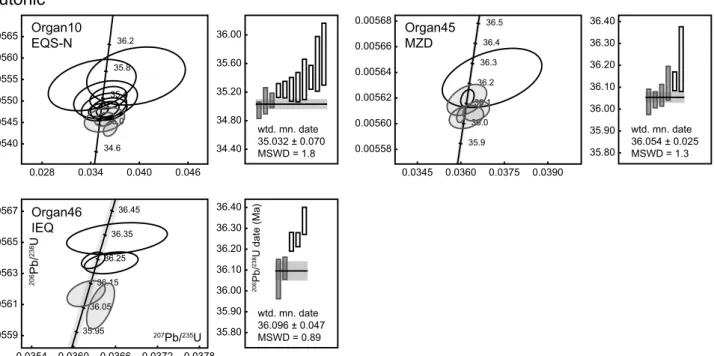
(PV691, MSWD = 1.2, n= 5/6) and 35.032 ± 0.070 Ma (Organ10, MSWD = 1.8, n= 3/11). Sample Organ10 con-tains two older fractions; one fraction was concordant with a 206Pb/238U date of 79.53 ± 0.35, and the second fraction
was discordant with a 206Pb/238U date of 88.4 ± 1.1 Ma.
Fig. 2 Wetherill U–Pb concordia diagrams and weighted mean
206Pb/238U plots for samples dated at the Massachusetts Institute of
Technology. Each data point is an analysis of a single zircon or zir-con fragment. All data are corrected for initial 230Th exclusion, as
dis-cussed in the Supplementary Text. Ages on concordia are in Ma. Gray bands represent 2σ uncertainties on concordia based on decay
con-stant uncertainties of 0.107 % (238U) and 0.136 % (235U) (Jaffey et al. 1971). Axis labels are shown in the upper left plot on each page. Gray data points are included in the weighted mean calculation. For the weighted mean plots, the reported date is either the weighted mean date (Ma) or, for complex samples, the youngest zircon date, which we interpret as a maximum crystallization age (labeled as youngest date). Plots and mean square of the weighted deviates (MSWD) of the weighted mean (wtd. mn.) were generated using the ET_Redux software package (Bowring et al. 2011; McLean et al. 2011). EQS-S, southern equigranular syenite; IEQ-EQS-S, southern inequigranular syenite; EQS-N, northern equigranular syenite; MZD, Organ Needle monzodiorite; AFG-N, northern alkali feldspar granite; AFG-S, mid-dle and southern alkali feldspar granites; RPB, rhyolite porphyry of Baylor Mountain; GPK, granite of Granite Peak; SPQM, Sugarloaf Peak quartz monzonite; SMT, Squaw Mountain tuff; APT, Achenback Park tuff; Cueva, Cueva Tuff; WSL, West-side lavas
44.00 44.30 44.20 44.10 44.40 44.50 36.00 36.40 36.30 36.20 36.10 36.50 36.60 36.70 36.00 36.05 36.10 36.15 36.20 36.25 36.30 36.35 36.00 36.05 36.15 36.25 36.10 36.20 36.30 36.35 35.55 35.40 35.45 35.50 35.35 35.60 35.65 36.00 35.95 36.05 36.10 36.15 36.25 36.20 36.00 36.05 36.15 36.10 36.20 36.00 36.10 35.90 36.20 36.30 35.90 35.95 36.05 36.00 36.10 36.15 36.20 36.00 36.05 35.95 36.10 36.15 36.20 36.25 20 6Pb / 23 8U 20 6Pb / 238
U date (Ma
)
207Pb/235U
0.0415 0.0435 0.0455 0.0475 0.0354 0.0359 0.0364 0.0369 0.0374
0.033 0.035 0.037 0.039 0.0355 0.0360 0.0365 0.0370 0.0375
0.0345 0.0355 0.0365 0.0375 0.0350 0.0360 0.0370 0.0380
0.0341 0.0351 0.0361 0.0371 0.0381 0.0357 0.0360 0.0363 0.0366
0.0350 0.0354 0.0358 0.0362 0.0350 0.0358 0.0366 0.0374 youngest date
44.215 ± 0.054
wtd. mn. date 36.118 ± 0.017 MSWD = 0.066
wtd. mn. date 36.121 ± 0.016 MSWD = 1.5 wtd. mn. date
36.441 ± 0.020 MSWD = 2.2
wtd. mn. date 36.107 ± 0.016 MSWD = 1.4 wtd. mn. date
36.259 ± 0.016 MSWD = 1.7
wtd. mn. date 36.071 ± 0.012 MSWD = 0.12 wtd. mn. date
36.215 ± 0.016 MSWD = 0.96
wtd. mn. date 36.089 ± 0.017 MSWD = 0.36 wtd. mn. date
35.532 ± 0.030 MSWD = 0.40
35.60 35.65 35.55 35.70 35.75 35.80 35.00 35.10 35.20 35.30 35.40 35.50 34.50 34.55 34.65 34.45 34.60 34.70 34.75 34.00 34.10 33.90 34.20 34.30 34.40 34.50 35.00 35.20 34.80 35.40 35.60 35.80 34.70 34.90 35.10 35.30 35.50 35.40 35.50 35.60 35.70 35.80 34.90 34.95 34.85 35.00 35.05 35.10 35.15 35.20 35.25
0.0325 0.0345 0.0365 0.0385 0.0346 0.0354 0.0362 0.0370
0.031 0.033 0.035 0.037 0.039 0.0340 0.0350 0.0360 0.0370
0.0352 0.0356 0.0360 0.0364 0.0343 0.0346 0.0349 0.0352
0.0332 0.0336 0.0340 0.0344 0.0348
0.032 0.034 0.036 0.038
wtd. mn. date 35.184 ± 0.020 MSWD = 1.2
wtd. mn. date 35.726 ± 0.016 MSWD = 1.3
youngest date 35.15 ± 0.20
wtd. mn. date 35.257 ± 0.025 MSWD = 0.59
wtd. mn. date 35.551 ± 0.014
MSWD = 1.8 youngest date34.574 ± 0.028
wtd. mn. date 35.101 ± 0.025
MSWD = 0.49 youngest date34.071 ± 0.026
PV691 EQS-N PV2392 EQS PV3892 EQS MR10-6 GPK TRPB RPB MR10-7 SPQM MR10-8 SPQM PV3491 AFG-N 0.00553 0.00554 0.00555 0.00556 0.00557 0.00558 0.00544 0.00546 0.00548 0.00550 0.00552 0.00554 0.00536 0.00538 0.00537 0.00539 0.00540 0.00541 0.00526 0.00528 0.00530 0.00532 0.00534 0.00536 0.00538 0.00540 0.00545 0.00550 0.00555 0.00560 0.00540 0.00542 0.00544 0.00546 0.00548 0.00550 0.00552 0.00552 0.00554 0.00556 0.00558 0.00542 0.00544 0.00546 0.00548 0.00550 34.8 35.2 35.6 36.0 34.7 34.9 35.1 35.3 35.5 35.45 35.55 35.65 35.75 35.85 35.55 35.60 35.65 35.70 35.75 35.80 35.85 35.0 35.1 35.2 35.3 35.4 35.5 35.6 34.50 34.55 34.60 34.65 34.70 34.75 34.80 33.9 34.0 34.1 34.2 34.3 34.4 34.5 34.6 34.85 34.95 35.05 35.15 35.25 35.35 36.00 36.20 36.30 36.10 36.40 36.50 36.00 36.10 36.30 35.90 36.20 36.40 20 6Pb / 23 8U 206 Pb / 238
U date (Ma
)
207Pb/235U
0.034 0.036 0.038 0.040 0.033 0.035 0.037 0.039 0.041
wtd. mn. date 36.130 ± 0.031 MSWD = 1.7
wtd. mn. date 36.259 ± 0.021 MSWD = 0.40 PV5292
IEQ-S TmoeAFG-S
0.00560 0.00562 0.00564 0.00566 0.00568 0.00560 0.00562 0.00564 0.00566 0.00568 36.0 36.1 36.2 36.3 36.4 36.5 36.0 36.1 36.2 36.3 36.4 36.5 36.6
Plutonic (continued)
We interpret both fractions to be inherited xenocrystic zir-cons. The two samples of equigranular syenite from within the southern lobe yielded a weighted mean 206Pb/238U date
of 35.551 ± 0.014 Ma (PV3892, MSWD = 1.8, n= 4/5) and a low-precision single zircon 206Pb/238U date of
35.15 ± 0.20 Ma (PV2392). The dates from these four sam-ples are ~500–1000 ka younger than the seven other samsam-ples from the southern Organ Needle syenite.
Organ Needle monzodiorite
The Organ Needle monzodiorite has been interpreted as the most primitive phase of the Organ Needle pluton (Seager and McCurry 1988). A single sample from the monzodior-ite yielded an interpreted weighted mean 206Pb/238U date
of 36.054 ± 0.025 Ma (Organ45, MSWD = 1.3, n= 4/6). The date is within uncertainty of the youngest date from the Organ Needle syenites. In detail, the monzodiorite dates plot toward the younger end of the syenite dates; however, we are cautious about over-interpreting the relative dates for the two units because the monzodiorite is one of the three samples dated at UNC and we cannot discount the possibil-ity of a small inter-laboratory bias. Based on this concern, we use the youngest syenite date (36.071 ± 0.012 Ma) as the final crystallization age of the Organ Needle pluton when calculating timescales of crystallization throughout.
Alkali feldspar granite
The three cupolas of AFG that intrude into the base of the Orejon Andesite and Cueva Tuff have been interpreted as the highest level exposures of the Organ Needle pluton (Fig. 1) (Seager and McCurry 1988; Vazquez and Lidz-barski 2012; Verplanck et al. 1995). Zircons from a sam-ple from the middle exposure of the AFG yielded a sin-gle population of 206Pb/238U dates with a weighted mean
of 36.259 ± 0.021 Ma (sample Tmoe, MSWD = 0.4, n= 5/5). This date is similar to, but slightly older than, the dates from the main syenite phase of the Organ Nee-dle pluton. We did not date any samples from the south-ern AFG exposure; however, 40Ar/39Ar biotite cooling
dates reported by Zimmerer and McIntosh (2013) sug-gest that the middle and southern AFG exposures are the same age; cooling dates from the middle and south-ern exposures are 36.25 ± 0.12 and 36.17 ± 0.12 Ma, respectively.
Zircons from the northern exposure of the AFG yielded a younger interpreted weighted mean 206Pb/238U of
35.101 ± 0.025 Ma (PV3491, MSWD = 0.49, n= 6/7). The younger date for the northern AFG (PV3491) overlaps the range of dates from the two northern syenite samples (PV691 and Organ10) and is significantly younger than the main southern phase of the Organ Needle pluton.
34.40 35.60
35.20
34.80 36.00
35.80 36.20 36.10 36.00 35.90 36.30 36.40
35.90 35.80 36.00 36.10 36.20 36.40 36.30
20
6Pb/
23
8U date (Ma)
207Pb/235U
0.028 0.034 0.040 0.046 0.0345 0.0360 0.0375 0.0390
0.0354 0.0360 0.0366 0.0372 0.0378 Organ10
EQS-N
Organ46 IEQ
Organ45 MZD
Plutonic
0.00540 0.00545 0.00550 0.00555 0.00560 0.00565
0.00561
0.00559 0.00563 0.00565 0.00567
0.00558 0.00560 0.00562 0.00564 0.00566 0.00568
20
6Pb/
23
8U
35.95 36.05
36.15 36.25
36.35 36.45
35.9 36.0
36.1 36.2
36.3 36.4
36.5
34.6 35.0
35.4 35.8
36.2
wtd. mn. date 36.054 ± 0.025 MSWD = 1.3 wtd. mn. date
35.032 ± 0.070 MSWD = 1.8
wtd. mn. date 36.096 ± 0.047 MSWD = 0.89
Fig. 3 Wetherill U-Pb concordia diagrams and weighted mean
206Pb/238U plots for samples dated at the University of North
Caro-lina. Each data point is an analysis of a single-grain or small multi-grain fraction (n = 1–3 zircons). Axis labels are shown in the
lower left plot. Two fractions from Organ10 with 206Pb/238U dates
Younger intrusive units
Zircons from the granite of Granite Peak and the rhyolite por-phyry of Baylor Mountain yielded weighted mean 206Pb/238U
dates of 35.726 ± 0.016 Ma (MR10-6, MSWD = 1.3, n = 5/6) and 35.257 ± 0.025 (TRPB, MSWD = 0.59, n = 4/4), respectively. Two samples from the Sugarloaf Peak quartz monzonite yielded variable 206Pb/238U dates. Zircons from
MR10-7 and MR10-8 yielded 206Pb/238U dates from 34.729 ± 0.024 to 34.574 ± 0.028 Ma (n = 4) and 34.456 ± 0.039 to 34.051 ± 0.029 Ma (n= 4), respectively. The range of dates in each sample is most likely caused by significant inheritance of older zircons. We take the youngest date from the two samples (34.051 ± 0.029 Ma) as a maximum crystal-lization age for the Sugarloaf Peak quartz monzonite.
Sm–Nd and Rb–Sr isotopic data
Most of the dated samples were previously analyzed for major element and trace element geochemistry and Sm– Nd and Rb–Sr isotopic compositions by Verplanck et al. (1995, 1999). For the subset of new samples collected in
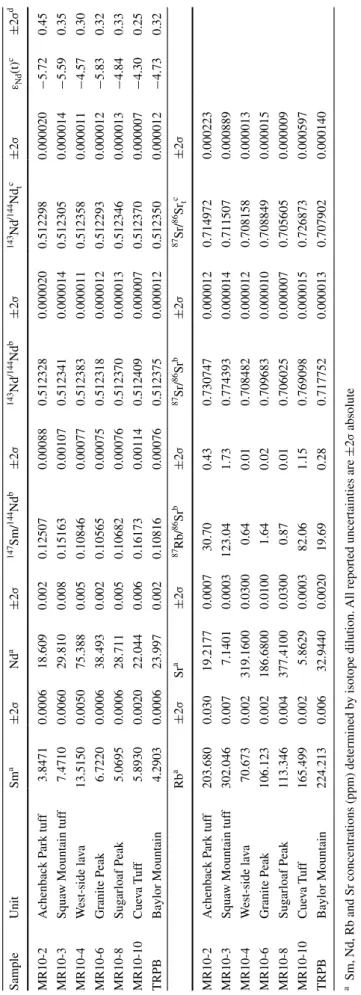
this study, we report whole-rock Sm–Nd and Rb–Sr isotopic data (Table 2, Fig. 5). Seven samples from the Cueva Tuff, Achenback Park tuff, Squaw Mountain tuff, West-side lavas, granite of Granite Peak, Sugarloaf Peak quartz monzonite and rhyolite porphyry of Baylor Mountain have εNd(t) from
−4.3 to –5.8 and 87Sr/86Sr(t) from 0.70561 to 0.72687.
Discussion
Progression of magmatism in the Organ Mountains caldera and batholith
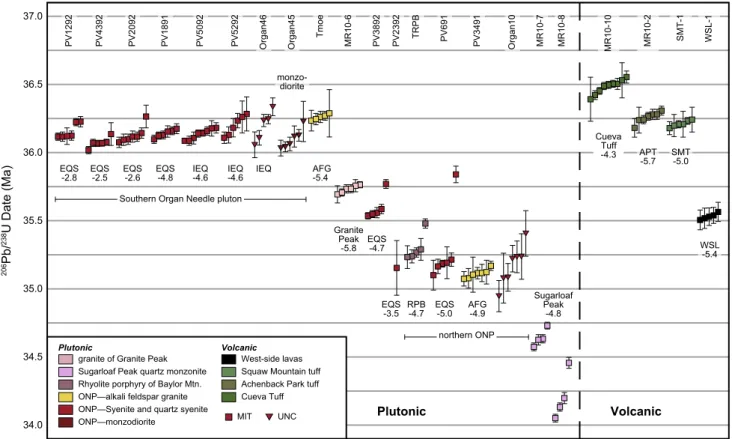
The dated rocks record ~10 Ma of magmatism in the Organ Mountains from 44 to 34 Ma (Figs. 2, 3, and 4). The progres-sion of magmatism is illustrated in Fig. 6 and outlined below.
Pre‑Achenback Park tuff
A Paleozoic granite intruded by the Organ Mountains batholith recorded a U–Pb date of 1462 ± 28 Ma. The Ore-jon Andesite (44.215 ± 0.054 Ma) preserves the earliest 34.0
34.5 35.0 35.5 36.0 36.5 37.0
Plutonic Volcanic
206
Pb
/
238U Date (Ma)
AFG -5.4
monzo-diorite
northern ONP Southern Organ Needle pluton
Tmoe
MR10-6
PV3892 PV239 TRPB
2
PV691
Sugarloaf Peak
-4.8
Cueva Tuff -4.3 APT
-5.7 SMT-5.0
WSL -5.4
PV349
1
MR10-7
MR10-8
MR10-10
MR10-2
SMT-1
WSL-1
Organ10
PV1292 PV4392 PV2092 PV189
1
PV5092 PV5292 Organ46 Organ45
EQS
-2.8 EQS-2.5 EQS-2.6 EQS-4.8 IEQ-4.6 IEQ-4.6 IEQ
EQS -4.7 Granite
Peak -5.8
EQS
-3.5 RPB-4.7 EQS-5.0 AFG-4.9
Volcanic
West-side lavas Squaw Mountain tuff Achenback Park tuff Cueva Tuff MIT
Plutonic
granite of Granite Peak Sugarloaf Peak quartz monzonite Rhyolite porphyry of Baylor Mtn. ONP—alkali feldspar granite ONP—Syenite and quartz syenite
ONP—monzodiorite UNC
Fig. 4 Summary of the Th-corrected 206Pb/238U dates from the Organ
Mountains. Symbol colors correspond to the map units in Fig. 1. Numbers are εNd(t) values from this study, Verplanck et al. (1995, 1999) and Butcher (1990); values for the Squaw Mountain tuff and West-side lavas are average values from other samples from these units, and Tmoe value is an average value for samples from the
cen-tral and southern AFGs. For clarity, we excluded analyses with Th-corrected 206Pb/238U uncertainties greater than ±0.2 Ma and two
record of Cenozoic magmatism and predates the main phases of the Organ Mountains caldera by ~8 Ma, likely reflecting earlier subduction-related magmatism associated with the Laramide orogeny. The Cueva Tuff was subse-quently erupted at 36.441 ± 0.020 Ma. There are no plu-tonic rocks as old as either the Orejon or Cueva eruptions in the Organ Mountains batholith, suggesting that either there was little or no plutonic record formed during these events or that any associated plutonic rocks are not exposed.
Achenback Park tuff, Squaw Mountain tuff and Organ Needle pluton
The largest volcanic and plutonic units were formed in rapid succession, but the new dates reveal small but
important age differences. The two largest eruptive units, the Achenback Park and Squaw Mountain tuffs, were erupted at 36.259 ± 0.016 and 36.215 ± 0.016 Ma, respec-tively. The single-grain dates from the two units overlap within uncertainty, and the weighted mean dates are sepa-rated by 44 ± 23 ka, consistent with field observations sug-gesting minimal erosion between the two eruptions (Seager and McCurry 1988).
The differences in dates between these eruptive units and the underlying plutonic sequences are variable. 206Pb/238U
dates from the central cupola of alkali feldspar granite overlap the data from the two tuffs within uncertainty, and the weighted mean date (36.259 ± 0.021 Ma) is the same as the eruption age for the Achenback Park tuff. The three units are also chemically and isotopically similar (Supple-mentary Figure SM4) (Butcher 1990; Seager and McCurry 1988; Verplanck et al. 1995, 1999), and the central and southern alkali feldspar granites likely represent the plu-tonic remnants of the magma chamber that fed one or both of these eruptions.
The zircon 206Pb/238U dates from the main southern
por-tion of the Organ Needle pluton postdate the 206Pb/238U
dates from the Achenback Park tuff, Squaw Mountain tuff and central AFG. Weighted mean 206Pb/238U dates
from equigranular and inequigranular syenites range from 36.130 ± 0.031 to 36.071 ± 0.012 Ma, and the weighted mean date from the youngest sample is 144 ± 20 to 188 ± 20 ka younger than the weighted mean dates from the Squaw Mountain tuff and the central AFG/Achenback Park tuff, respectively. The dated syenite and quartz syenite samples come from throughout the southern extent of the Organ Needle pluton, include both equigranular and inequi-granular portions of the pluton and have εNd(t) ≈−2 to −5, suggesting that the main volume of the southern Organ Needle pluton intruded and/or underwent final crystalliza-tion over a short interval of 59 ± 33 ka. The dated sample from the Organ Needle monzodiorite (36.054 ± 0.025 Ma) is within uncertainty of the syenites. The relationship of the Organ Needle pluton to the tuff units is discussed in detail below.
Post‑Organ Needle pluton
The mapped northernmost exposures of the syenitic phase of the Organ Needle pluton (hatched pattern in Fig. 1), the northern cupola of AFG, and the rhyolite porphyry of Baylor Mountain all significantly postdate intrusion of the main phase of the Organ Needle pluton. Samples from these units yielded weighted mean 206Pb/238U dates of
35.184 ± 0.020 Ma (syenite), 35.032 ± 0.070 Ma (syen-ite), 35.101 ± 0.025 Ma (AFG) and 35.257 ± 0.025 Ma (Baylor Mountain). The U–Pb dates suggest that these units crystallized in relatively rapid succession. Table 1 Sample locations and descriptions
a WGS 84
b ONP, Organ Needle pluton; SP, Sugarloaf Peak
c Samples with geochemical and isotopic data reported in Verplanck
et al. (1995, 1999). Locations for these samples were approximated from topographic maps
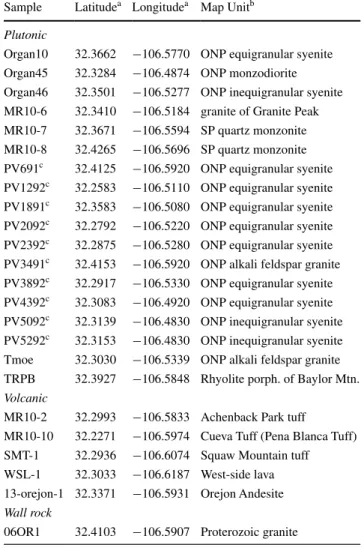
Sample Latitudea Longitudea Map Unitb
Plutonic
Organ10 32.3662 −106.5770 ONP equigranular syenite Organ45 32.3284 −106.4874 ONP monzodiorite Organ46 32.3501 −106.5277 ONP inequigranular syenite MR10-6 32.3410 −106.5184 granite of Granite Peak MR10-7 32.3671 −106.5594 SP quartz monzonite MR10-8 32.4265 −106.5696 SP quartz monzonite PV691c 32.4125 −106.5920 ONP equigranular syenite
PV1292c 32.2583 −106.5110 ONP equigranular syenite
PV1891c 32.3583 −106.5080 ONP equigranular syenite
PV2092c 32.2792 −106.5220 ONP equigranular syenite
PV2392c 32.2875 −106.5280 ONP equigranular syenite
PV3491c 32.4153 −106.5920 ONP alkali feldspar granite
PV3892c 32.2917 −106.5330 ONP equigranular syenite
PV4392c 32.3083 −106.4920 ONP equigranular syenite
PV5092c 32.3139 −106.4830 ONP inequigranular syenite
PV5292c 32.3153 −106.4830 ONP inequigranular syenite
Tmoe 32.3030 −106.5339 ONP alkali feldspar granite TRPB 32.3927 −106.5848 Rhyolite porph. of Baylor Mtn. Volcanic
MR10-2 32.2993 −106.5833 Achenback Park tuff
MR10-10 32.2271 −106.5974 Cueva Tuff (Pena Blanca Tuff) SMT-1 32.2936 −106.6074 Squaw Mountain tuff WSL-1 32.3033 −106.6187 West-side lava 13-orejon-1 32.3371 −106.5931 Orejon Andesite Wall rock
Table
2
Whole-rock Sm–Nd and Rb–Sr isotope data
a Sm, Nd, Rb and Sr concentrations (ppm) determined by isotope dilution.
All reported uncertainties are
±
2
σ
absolute
b Fractionation, blank and spik
e-corrected isotopic ratios
c Initial ratios and εNd
calculated using preferred crystallization ages for the units as discussed in the te
xt, present-day b
ulk Earth v
alues of 143 Nd/ 144 Nd = 0.512638 and 147 Sm/ 144 Nd = 0.1967, λ 147 Sm = 6.54 × 10 −
12 year
−
1 (Lugmair and Marti
1978 ), and λ 87Rb = 1.42 × 10 −
11 year
−
1 (Da
vis et
al.
1977
)
d Uncertainties estimated follo
wing Ick ert ( 2013 ) Sample Unit Sm a ± 2 σ Nd a ± 2 σ 147 Sm/ 144 Nd b ± 2 σ 143 Nd /144 Nd b ± 2 σ 143 Nd /144 Nd t c ± 2 σ εNd (t) c ± 2 σ d MR10-2 Achenback P ark tuf f 3.8471 0.0006 18.609 0.002 0.12507 0.00088 0.512328 0.000020 0.512298 0.000020 − 5.72 0.45 MR10-3 Squa
w Mountain tuf
f 7.4710 0.0060 29.810 0.008 0.15163 0.00107 0.512341 0.000014 0.512305 0.000014 − 5.59 0.35 MR10-4 W est-side la va 13.5150 0.0050 75.388 0.005 0.10846 0.00077 0.512383 0.000011 0.512358 0.000011 − 4.57 0.30 MR10-6 Granite Peak 6.7220 0.0006 38.493 0.002 0.10565 0.00075 0.512318 0.000012 0.512293 0.000012 − 5.83 0.32 MR10-8 Sug arloaf Peak 5.0695 0.0006 28.711 0.005 0.10682 0.00076 0.512370 0.000013 0.512346 0.000013 − 4.84 0.33 MR10-10 Cue va T uf f 5.8930 0.0020 22.044 0.006 0.16173 0.00114 0.512409 0.000007 0.512370 0.000007 − 4.30 0.25 TRPB Baylor Mountain 4.2903 0.0006 23.997 0.002 0.10816 0.00076 0.512375 0.000012 0.512350 0.000012 − 4.73 0.32 Rb a ± 2 σ Sr a ± 2 σ 87Rb/ 86Sr b ± 2 σ 87Sr/ 86Sr b ± 2 σ 87Sr/ 86Sr t c ± 2 σ MR10-2 Achenback P ark tuf f 203.680 0.030 19.2177 0.0007 30.70 0.43 0.730747 0.000012 0.714972 0.000223 MR10-3 Squa
w Mountain tuf
Single-grain dates from the two syenites and one AFG sample overlap within uncertainty and permit the interpre-tation that these two units were co-magmatic. The Baylor Mountain porphyry appears to be slightly older; weighted mean dates indicate an interval of 156 ± 35 ka between the Baylor Mountain porphyry and the northern AFG. The age of these units is ~800–1000 ka younger than the main southern phase of the Organ Needle pluton, indi-cating that the northern arm of the Organ Needle pluton formed during a separate magmatic event. This observa-tion is important because Verplanck et al. (1999) used geochemical trends between the main phase of the Organ Needle pluton and the northern quartz syenite and AFG to infer petrogenetic processes. The new dates require that the conclusions drawn from the geochemical trends be reassessed.
The older, southern portion of the Organ Needle plu-ton was also intruded by younger magmas. Two samples from exposures mapped as Organ Needle syenite yielded a weighted mean 206Pb/238U date of 35.551 ± 0.014 Ma
(PV3892) and a single zircon 206Pb/238U date of
35.15 ± 0.20 Ma (PV2392). The dates are ~500–1000 ka younger than the surrounding Organ Needle syenites, and the younger sample is coeval with crystallization of the northern AFG and syenite. The older of the two sam-ples has εNd(t) =−4.7, whereas the adjacent syenites have εNd(t) ≈−2. Verplanck et al. (1999) suggested this sample could reflect back mixing of marginal εNd(t) ≈ −5 mag-mas into the core of the Organ Needle pluton; the U–Pb dates suggest instead that the rock formed by intrusion of younger magma.
The granite of Granite Peak yielded a weighted mean
206Pb/238U date of 35.726
± 0.016 Ma, indicating the paren-tal magma intruded and crysparen-tallized between formation of the southern Organ Needle pluton and the later intrusions of the northern syenites and AFG. The West-side lavas erupted at 35.532 ± 0.030 Ma, within uncertainty of the crystallization age of the granite of Granite Peak. The Sug-arloaf Peak quartz monzonite is the youngest intrusive unit, with a maximum crystallization age of 34.051 ± 0.029 Ma (MR10-8).
The volcanic–plutonic link
A key goal of this and previous work in the Organ Moun-tains has been to understand the link between epizonal plutonism and co-spatial volcanism. Seager and McCurry (1988) argued that smooth geochemical trends between the Cueva Tuff, Achenback Park tuff, Squaw Mountain tuff, and West-side lavas reflect progressive eruptions from a chemi-cally zoned magma chamber, and suggested that the Organ Needle pluton may be the intrusive remnants of that cham-ber. Verplanck et al. (1999) similarly argued that the Organ Needle pluton is chemically stratified and that the AFG cupolas formed by differentiation of the εNd(t) ≈−5 inequi-granular syenites exposed at the base of the Organ Nee-dle pluton. They suggested that the AFG cupolas erupted to form the Squaw Mountain tuff. Zimmerer and McIn-tosh (2013) presented 40Ar/39Ar dates from the Cueva Tuff
(36.45 ± 0.08 Ma), Achenback Park tuff (36.23 ± 0.14 Ma) and Squaw Mountain tuff (36.03 ± 0.16 Ma; 2σ inter-nal), which all overlap within uncertainty, and concluded
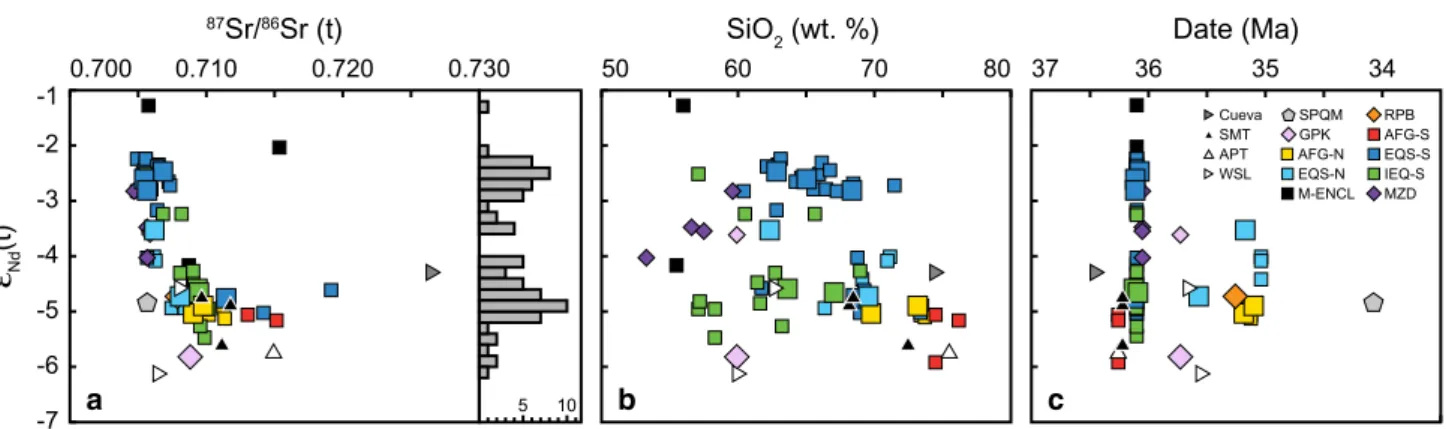
ε
Nd(t)
87Sr/86Sr (t) SiO
2 (wt. %) Date (Ma)
5 10
34 35
36 37
80 70
60 50
-7 -6 -5 -4 -3 -2
-1 0.700 0.710 0.720 0.730
GPK
MZD EQS-S AFG-S
IEQ-S APT
WSL
M-ENCL EQS-N AFG-N SMT
Cueva SPQM RPB
a b c
Fig. 5 Whole-rock Sm–Nd and Rb–Sr isotopic data from this study, Verplanck et al. (1995, 1999), Verplanck (1996) and Butcher (1990).
a Initial 87Sr/86Sr versus ε
Nd(t). Large symbols are dated samples.
Smaller symbols are undated samples with ages inferred based on field relationships to dated samples. The right axis shows a histogram of εNd(t) for all of the existing plutonic and volcanic data. b. SiO2
(wt%) versus εNd(t). c. Date (Ma) versus εNd(t). For undated Organ
Needle syenite samples, we assumed a date of 36.098 Ma, calculated
as the average of the dated syenite samples. Two analyses of a sin-gle sample of Squaw Mountain tuff (TssA6) from Butcher (1990) were excluded because repeat analyses yielded different 87Sr/86Sr
and εNd(t). The two younger syenitic intrusions into the southern
that all of the tuffs may have erupted from a long-lived (420 ± 240 ka) magma chamber in the upper crust.
The new U–Pb dates provide a more precise record of the volcanic history and directly date the timing of pluton crystallization, allowing for a more detailed comparison. The small offset in crystallization ages between the main phase of the Organ Needle pluton, and the Achenback Park tuff (188 ± 20 ka), Squaw Mountain tuff (144 ± 20 ka) and central AFG (188 ± 24 ka) could reflect a range of different processes. Three potential explanations are as follows: (1) The volcanic units and AFG formed from an older magma,
which crystallized prior to intrusion of the syenitic phase of the Organ Needle pluton; (2) all of the units are geneti-cally related and reflect evolution of the magmatic system over tens to hundreds of thousands of years; or (3) all of the units are synchronous, but the older dates for the Achen-back Park tuff, Squaw Mountains tuff and AFG reflect magma residence for the zircons prior to eruption. We dis-count the latter model, because it is unlikely that the tuff eruptions would not include younger zircons recorded in the plutonic record, there is good agreement between the tuff dates and the plutonic AFG, and the tuff dates overlap
PV3892 PV2392
WSL
Rhyolitic Porphyry
Northern AFG and syenite
44.2 Ma: Orejon Andesite erupts on p crust.
35.7–35.5 Ma: Intrusion of the granite of Granite Peak, PV3892 and eruption of the West-side lavas.
35.26 Ma: Intrusion of the Rhyolitic Porphyry of Baylor Mountain.
35.18–35.03 Ma: Intrusion of northern arm of Organ Needle syenite, northern AFG, and PV2392.
≤34.0 Ma: Intrusion of the Sugarloaf Peak quartz monzonite.
36.4 Ma: Cueva Tuff erupts. 36.2 Ma: Organ Needle syenites
intrude, AFGs crystalize, and AP and SM tuffs erupt.
36.1 Ma: Crystallization of the Organ Needle pluton.
Fig. 6 Progression of plutonism and volcanism in the Organ Moun-tains caldera and batholith, based on the U-Pb dates from this study. Blue stars mark the location of dated samples in each time step. Map
within uncertainty with reported 40Ar/39Ar dates (Zimmerer
and McIntosh 2013).
It is not possible to definitively differentiate between the first two hypotheses. In the field, the AFGs appear to grade into the more massive syenitic phase of the Organ Nee-dle pluton over distances of centimeters to meters (Seager and McCurry 1988). Geochemical data from the middle and southern AFG cupolas plot along fractionation trends with the Organ Needle syenites, for both major elements and trace element ratios such as Th/U and La/Yb (Sup-plementary Figure SM3) (Verplanck et al. 1995, 1999). These trends support the Verplanck et al. (1995, 1999) interpretation that the AFG formed by differentiation of the εNd(t) ≈−5 syenitic magmas at the base of the Organ Nee-dle pluton. Verplanck et al. (1999) further argued that low concentrations of P2O5, Sr, and the light rare earth elements (LREE), low normalized La/Yb, and negative Eu anoma-lies in the AFG (Supplementary Figure SM3) are consistent with plagioclase, apatite and titanite fractionation. Chemi-cal and textural evidence suggests that the inequigranular syenites from the base of the Organ Needle pluton contain these cumulate phases and could represent the residual sol-ids from differentiated AFG magmas, suggesting a genetic link between the syenites and the AFG. These chemi-cal relationships are apparent even when considering just the central and southern AFG, and excluding the younger northern AFG. Finally, the middle and southern AFGs also have εNd(t) =−5.9 to −5.1, which overlap, but extend to slightly lower values than, the low εNd(t) portions of the Organ Needle syenites (−3.2 to −5.5). Taken together, these observations permit a genetic relationship between the main syenitic phase of the Organ Needle pluton and the middle and southern AFGs, but do not require such a rela-tionship, as demonstrated by the similar chemical trends in the northern syenite and AFG, which significantly postdate the main southern phase of Organ Needle plutonism.
The U–Pb zircon systematics in the Organ Needle syen-ites may reflect a protracted magmatic history. Although the youngest dated zircons in the southern Organ Needle syenites are systematically younger than zircons from the AFG, Achenback Park tuff and Squaw Mountain tuff, six of the seven samples recorded a range of dates larger than analytical uncertainties, and the oldest dates in these sam-ples overlap within uncertainty with the youngest dates in the AFG, Achenback Park tuff and Squaw Mountain tuff (Fig. 4).
Given the geochemical trends, similar isotopic composi-tions, and the duration of U–Pb dates in the Organ Needle syen-ites, we favor the interpretation that the Achenback Park tuff, Squaw Mountain tuff, middle and southern AFGs, and Organ Needle syenites are genetically related and formed from a long-lived magmatic system. This interpretation implies that some form of magma chamber or mush zone persisted just below the
volcanic system for a period of ≥188 ± 20 ka—calculated as the difference between the eruption age of the Achenback tuff (MR10-2) and the youngest crystallization age for the Organ Needle pluton syenites (PV4392)—although the system may have been at near-solidus conditions for large portions of this time period (Cooper and Kent 2014). The similar isotopic com-position and the complementary trace element trends described above suggest that the alkali feldspar granite, Achenback Park tuff and Squaw Mountain tuff may represent felsic differenti-ates from the εNd(t) ≈−5 inequigranular syenites. A detailed model for the development of the system is presented below.
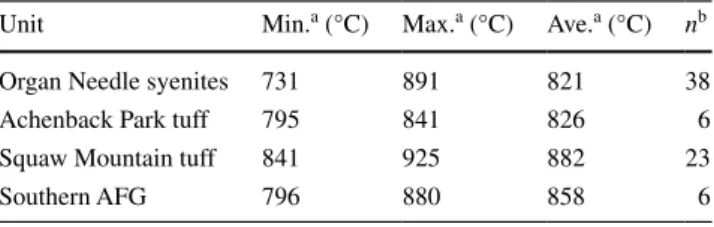
Some of the observed offset between the Organ Nee-dle pluton and the central AFG and Squaw Mountain tuff may reflect variable zircon saturation temperatures in the crystallizing magmas. Zircon saturation temperatures were calculated using the Watson and Harrison (1983) zircon solubility model and existing whole-rock geochemical data from the Organ Mountains system (Butcher 1990; Ver-planck 1996; Verplanck et al. 1995, 1999). Although the whole-rock data from plutonic samples likely do not reflect melt compositions, calculated zircon saturation tempera-tures are insensitive to compositional variations as a result of addition of cumulate feldspar (<2 °C variations for addi-tion of up to 20 % cumulate feldspar). The Organ Needle syenites, Achenback Park tuff, southern AFG and Squaw Mountain tuff have average zircon saturation temperatures of 821, 826, 858 and 882 °C, respectively (Table 3). The range of saturation temperatures suggests that even if all of the parental magmas formed synchronously, the southern AFG and the parental magma to the Squaw Mountain tuff would have started to crystallize zircon 35 to 60 °C earlier than the Organ Needle syenites (assuming zircon satu-rated in the magma prior to eruption of the Squaw Moun-tain tuff), potentially explaining some of the offset in ages between these units. However, the Achenback Park tuff has similar zircon saturation temperatures to the Organ Needle syenites, suggesting the older dates from this unit and the offset dates between the volcanic units and the Organ Nee-dle syenites are not just related to a higher zircon liquidus temperatures.
Table 3 Zircon saturation temperatures
a Minimum, maximum and average zircon saturation temperatures
(Watson and Harrison 1983) calculated using whole-rock geochemi-cal data of Verplanck et al. (1995, 1999), Verplanck (1996) and Butcher (1990)
b Number of data points
Unit Min.a (°C) Max.a (°C) Ave.a (°C) nb
Organ Needle syenites 731 891 821 38 Achenback Park tuff 795 841 826 6 Squaw Mountain tuff 841 925 882 23
The northern Organ Needle syenites and associated AFG cupola have similar compositions and geochemical trends to the southern syenites and AFG (Supplementary Figure SM3), despite being ~1 Ma younger. The temporal evolu-tion of the northern syenites and AFG is not as precisely constrained; however, it seems likely that the northern and southern bodies formed by similar magmatic processes that episodically generated syenitic parental magmas, which differentiated to form alkali feldspar granite caps, which then erupted as silicic tuffs (any volcanic record is not pre-served for the younger northern syenite-AFG system).
The U–Pb dates from the West-side lavas and granite of Granite Peak overlap within uncertainty, suggesting that the West-side lavas may represent the extrusive equivalent of the granite of Granite Peak.
Magma fluxes and plutonic cooling rates
The precise U–Pb dates can be used to estimate the mag-matic fluxes during formation of the Organ Needle plu-ton (see the Supplementary Text for details on the flux calculations). The calculated magmatic fluxes depend on what units are included as part of the pluton. In our pre-ferred model, the southern and central AFGs and the main southern body of Organ Needle pluton syenites all formed from a single long-lived magma chamber/mush zone. The total lifespan of the magma chamber/mush zone is then 188 ± 24 ka, requiring minimum magmatic fluxes of 0.0006–0.0008 km3/year. If instead the AFG formed from
an earlier unrelated magma, the duration of Organ Nee-dle pluton magmatism was 59 ± 33 ka, requiring higher magma fluxes of 0.002–0.003 km3/year. These rates are
similar to calculated fluxes of other well-studied plutons from magmatic arcs and silicic caldera systems (0.0001– 0.003 km3/year) (e.g., Davis et al. 2012; Matzel et al. 2006;
Mills and Coleman 2013; Tappa et al. 2011). If the Achen-back Park tuff and Squaw Mountain tuff are included in the flux, the minimum total plutonic plus volcanic magmatic flux is 0.002 km3/year. If the pluton is thicker than the
exposed section or mafic cumulates are preserved at depth, the magmatic fluxes could be significantly higher.
Recent numerical thermal models have studied the time-scales of crystallization in periodically recharged shallow crustal magma chambers. The duration of crystallization is dependent of the magmatic flux. Numerical modeling by Annen (2009) suggests that at magmatic fluxes of 0.003– 0.005 km3/Ma, similar to the minimum combined
mag-matic and volcanic flux of ≥0.002 km3/year calculated
above, a mush zone (>40 % melt) can be established in ~30–100 ka (incubation period) and reach a maximum volume of ~20–30 % of a cylindrical silicic pluton with a diameter and depth of 10 km, emplaced at a depth of 5 km in the crust. The exposed area of the Organ Needle pluton
has a diameter of ~12 km, but the total depth of the pluton is poorly constrained.
Gelman et al. (2013) carried out similar numerical models using a nonlinear crystallization–temperature rela-tionship and temperature-dependent thermal conductivity, which resulted in higher melt volumes at a given magmatic flux. For fluxes of 0.00314–0.00525 km3/Ma, the mean
melt fractions ranged from ~8 to 55 % and the modeled plutons crystallized over periods of <0.02–0.7 Ma; mod-eled plutons had a 20 km diameter and 10 km depth and were emplaced at 5 km depth in the crust. The numerical thermal models therefore permit the interpretation that the southern AFG, Squaw Mountain tuff, Achenback tuff and Organ Needle syenites formed from a long-lived magmatic system that was active for ≥188 ± 20 ka.
The proposed lifespan of the magmatic system is also consistent with magma residence times of 104–105 years
based on U-series, U–Pb and 40Ar/39Ar dating of
acces-sory and major minerals in volcanic samples (Brown and Fletcher 1999; Cooper and Kent 2014; Cooper and Reid 2008; Reid 2014; Reid et al. 1997; Schoene et al. 2012; Simon et al. 2008; Vazquez and Reid 2002).
Isotopic constraints on magma evolution in the Organ Mountains
The majority of the Sm–Nd isotopic data from the Organ Mountains system form two clusters at εNd(t) ≈−2.5 and
−5; out of the 76 whole-rock analyses from volcanic and plutonic rocks from the Organ Mountains system, 25 clus-ter between εNd(t) of −2.2 and −2.8 and 39 fall between εNd(t) of −4.0 and −5.5 (Fig. 5) (this study; Butcher 1990; Verplanck 1996; Verplanck et al. 1995, 1999). A small group of five samples have εNd(t) < −5.5 (Fig. 5); however, all but one of these samples are from units that record a range of isotopic compositions. Multiple analyses from different samples of the Squaw Mountain tuff, West-side lavas, central-southern AFG and granite of Granite Peak have εNd(t) of −4.7 to −5.8 (n= 4), −4.6 to −6.1 (n= 2), −5.1 to −5.9 (n= 3) and −3.6 to −5.8 (n= 2), respectively. A single sample from the Achenback tuff has an εNd(t) =−5.7. The variable values for these units could reflect true heterogeneity in the isotopic composi-tion of the magmas or analytical scatter. For the volcanic rocks, the low εNd(t) data may also reflect incorporation of xenocrysts or lithic fragments from Proterozoic wall rocks [εNd(t) < −10] in some of the analyzed samples.
assimilation of wall rocks into a parental magmas with higher εNd(t) resulted in magmas with a consistent isotopic composition over long time periods, or (2) the magmas were derived from a homogenous source with εNd(t) ≈−5.
Verplanck et al. (1995, 1999) showed that mafic enclaves within both the equigranular [εNd(t) ≈−2.5] and inequigranular [εNd(t) ≈ −5] Organ Needle syenites have εNd(t) = −1.3 to −2, likely reflecting a parental magma composition with similar or higher εNd(t). They further showed that partially melted xenoliths of the Proterozoic wall rock occur within the inequigranular syenite and that the εNd(t) ≈ −5 magmas could have been generated by mixing of a parental magma composition similar to the mafic enclaves and partial melts of the Proterozoic wall rocks at shallow crustal levels. These data demonstrate that wall rock assimilation was at least locally important and that the εNd(t) ≈−5 magmas in the Organ Needle pluton could be related to melting and assimilation of Paleozoic to Proterozoic wall rocks into parental magmas with higher εNd(t) at shallow crustal levels.
If the consistent εNd(t) ≈−5 magmatism over 2.4 Ma in the Organ Mountains system was generated by a simi-lar process, it could suggest some fundamental control on the degree of wall rock melting or the composition of the partial melts. Given that the analyzed wall rocks have εNd(t) < −10, there is no a priori reason that wall rock assimilation would consistently lead to εNd(t) ≈−5 mag-mas, rather than a range of compositions. One possibility is that partial melts from the wall rocks have a different composition than the analyzed whole rocks; variable Sm/ Nd in different minerals in the wall rocks could lead to variable 143Nd/144Nd, which could in turn result in a
liq-uid with a different isotopic composition than the whole rock during partial melting. However, isotopic data from Verplanck et al. (1999) indicate that this explanation is unlikely because εNd(t) from analyzed samples of both the Proterozoic wall rocks and partially melted xenoliths are similar.
Alternately, the consistent εNd(t) could reflect a rela-tively constant ratio for the volume of parental magma to the volume of assimilated partial melt, assuming both had constant compositions. This model would suggest that the integrated volume of intruded magma was the same order of magnitude in each of the major phases of magmatism during formation of the batholith and caldera; however, such a process would be fortuitous.
We consider it more likely that silicic εNd(t) ≈−5 mag-mas in the Organ Needle system were generated by partial melting of the lower crust, rather than melting and assimi-lation of the Proterozoic wall rocks. Jacob et al. (2015) used whole-rock geochemistry and isotopic data to argue that small-volume silicic epizonal plutons, and associated volcanic rocks, in the Never Summer igneous complex,
north-central Colorado, were generated by such a process. In the Never Summer system, evidence from crustal xeno-liths entrained in Devonian kimberlites shows that Precam-brian mafic lower continental crust beneath this portion of the southern Rocky Mountains has Nd and Sr isotopic com-positions identical to those observed for silicic intrusive rocks and related, small-volume topaz rhyolites. The Organ Mountains system shares a similar geologic setting to the Never Summer igneous complex, as both are small-volume igneous centers that formed at the periphery of large-vol-ume igneous centers (the Mogollon-Datil and southwestern Colorado volcanic fields, respectively). The two systems also formed within a thick section of Paleoproterozoic con-tinental lithosphere: the Mazatzal province in New Mexico and the Yavapai province in Colorado. The isotopic compo-sitions of the Never Summer and Organ Mountains system are also similar. High-silica intrusive rocks in the Never Summer system have εNd(t) ≈ −5 to −6, and the most radiogenic rocks have εNd(t) ≈ 0 to −2.
The consistent εNd(t) ≈−5 magmatism within the Organ Mountains system may therefore reflect partial melting of εNd(t) ≈−5 lower crust by mantle-derived basaltic magmas with εNd(t) = −1.3 to −2, as constrained by the isotopic composition of mafic enclaves. More robust testing of this hypothesis is limited by the lack of available lower crus-tal xenoliths in pre-Cenozoic volcanic rocks from New Mexico, which could constrain the chemical and isotopic compositions of the lower continental crust during Organ Mountains magmatism.
The evolved composition of the Organ Mountains sys-tem is consistent with formation by epizonal differentiation of silicic lower crustal partial melts. The exposed southern Organ Needle syenites, Organ Needle monzodiorite, and the middle and southern AFGs have basaltic trachyandesite to rhyolitic compositions with an approximate average of ~64 wt% SiO2—estimated by weighting the average of published chemical data by the exposed area for each unit. The preserved plutonic section is too felsic to represent closed-system fractionation of basaltic magma, suggesting that either a silicic parental magma was delivered to shal-low crustal magma chambers from deeper in the crust, or mafic residues from basaltic differentiation are preserved below the current levels of exposure.