Mendelian randomisation and instrumental variable analysis
Adult height, coronary heart disease and
stroke: a multi-locus Mendelian
randomization meta-analysis
Eveline Nu¨esch,
1,2Caroline Dale,
1Tom M Palmer,
3,4Jon White,
5Brendan J Keating,
6,7,8Erik PA van Iperen,
9,13Anuj Goel,
10Sandosh Padmanabhan,
11Folkert W Asselbergs,
12,13,14EPIC-Netherland Investigators (WM Verschuren, C Wijmenga,
YT Van der Schouw, NC Onland-Moret),
15Leslie A Lange,
16GK Hovingh,
17Suthesh Sivapalaratnam,
17Richard W Morris,
18Peter H
Whincup,
19Goya S Wannamethe,
18Tom R Gaunt,
20,21Shah Ebrahim,
1Laura Steel,
6Nikhil Nair,
6Alexander P Reiner,
22Charles Kooperberg,
23James F Wilson,
24,25Jennifer L Bolton,
24Stela McLachlan,
24Jacqueline F Price,
24Mark WJ Strachan,
26Christine M Robertson,
24Marcus E Kleber,
27Graciela Delgado,
27Winfried Ma¨rz,
28Olle
Melander,
29Anna F Dominiczak,
11Martin Farrall,
10Hugh Watkins,
10Maarten Leusink,
30,31Anke H Maitland-van der Zee,
30Mark CH de Groot,
30,31Frank Dudbridge,
1Aroon Hingorani,
32Yoav Ben-Shlomo,
21Debbie A Lawlor,
20,21UCLEB Investigators
(A Amuzu, M Caufield, A Cavadino, J Cooper, TL Davies, IN Day,
F Drenos, J Engmann, C Finan, C Giambartolomei, R Hardy,
SE Humphries, E Hypponen, M Kivimaki, D Kuh, M Kumari, K Ong,
V Plagnol, C Power, M Richards, S Shah, T Shah, R Sofat, PJ Talmud,
N Wareham, H Warren, JC Whittaker, A Wong, D Zabaneh),
33George Davey Smith,
20,21Jonathan C Wells,
34David A Leon,
1,35Michael V Holmes
14,36,37,*†and Juan P Casas
1,14,*†1
Faculty of Epidemiology and Population Health, London School of Hygiene and Tropical Medicine,
London, UK,
2CTU Bern, Department of Clinical Research and Institute of Social and Preventive Medicine
(ISPM), University of Bern, Bern, Switzerland,
3Warwick Medical School, University of Warwick,
Coventry, UK,
4Department of Mathematics and Statistics, Lancaster University, Lancaster, UK,
5UCL
Genetics Institute, Department of Genetics, Evolution and Environment, University College London,
London, UK,
6Department of Pediatrics, Perelman School of Medicine, University of Pennsylvania,
Philadelphia, PA, USA,
7Department of Surgery,
8Division of Genetics, University of Pennsylvania,
Philadelphia
9Department of Biostatistics, Academic Medical Center Amsterdam, Amsterdam, The
Netherlands,
10Wellcome Trust Centre for Human Genetics and Radcliffe Department of Medicine,
University of Oxford, Oxford, UK,
11Institute of Cardiovascular and Medical Sciences, College of Medical
Veterinary and Life Sciences, University of Glasgow, Glasgow, UK,
12Department of Cardiology, Division
VCThe Author 2015; all rights reserved. Published by Oxford University Press on behalf of the International Epidemiological Association 1927 This is an Open Access article distributed under the terms of the Creative Commons Attribution License (http://creativecommons.org/licenses/by/4.0/), which permits unrestricted reuse, distribution, and reproduction in any medium, provided the original work is properly cited.
Heart and Lungs, University Medical Centre Utrecht, Utrecht, The Netherlands,
13Durrer Center for
Cardiogenetic Research, ICIN-Netherlands Heart Institute, Utrecht, The Netherlands,
14Institute of
Cardiovascular Science, Faculty of Population Health Sciences, University College London, London, UK,
15
EPIC-NL, Bilthoven and Utrecht, The Netherlands,
16Department of Genetics, University of North
Carolina at Chapel Hill, Chapel Hill, NC, USA,
17Department of Vascular Medicine, Academic Medical
Center Amsterdam, Amsterdam, The Netherlands,
18Department of Primary Care & Population Health,
University College London, London, UK,
19Population Health Research Institute, St George’s, University of
London, London, UK,
20MRC Integrative Epidemiology Unit, School of Social and Community Medicine,
University of Bristol, Bristol, UK,
21School of Social and Community Medicine, University of Bristol,
Bristol, UK,
22Department of Epidemiology, University of Washington, Seattle, WA, USA / Division of
Public Health Sciences, Fred Hutchinson Cancer Research Center, Seattle, WA, USA,
23Division of Public
Health Sciences, Fred Hutchinson Cancer Research Center, Seattle, WA, USA,
24Usher Institute for
Population Health Sciences and Informatics, University of Edinburgh, Edinburgh, UK,
25MRC Human
Genetics Unit, Institute of Genetics and Molecular Medicine, University of Edinburgh, Edinburgh, UK,
26
Metabolic Unit, Western General Hospital, Edinburgh, UK,
27Fifth Department of Medicine, Medical
Faculty Mannheim, Heidelberg University, Heidelberg, Germany,
28Medical Clinic V (Nephrology,
Hypertensiology, Endocrinology, Diabetolgy, and Rheumatology), Mannheim Medical Faculty, University
of Heidelberg, Germany, Synlab Academy, Synlab Services GmbH, Mannheim and Augsburg, Germany,
Clinical Institute of Medical and Chemical Laboratory Diagnostics, Medical University of Graz, Austria,
29
Lund University, Sweden,
30Division of Pharmacoepidemiology & Clinical Pharmacology, Utrecht
Institute for Pharmaceutical Sciences, Utrecht University, Utrecht, The Netherlands,
31Julius Center for
Health Sciences and Primary Care, University Medical Center Utrecht, Utrecht, The Netherlands,
32
Department of Epidemiology and Public Health, University College London Medical School, London, UK,
33
UCLEB, London, Edinburgh and Bristol, UK,
34Childhood Nutrition Research Centre, UCL Institute of
Child Health, London, UK,
35Department of Community Medicine, Arctic University of Norway, UiT,
36
Department of Surgery and Clinical Epidemiology Unit, Center for Clinical Epidemiology and
Biostatistics, Perelman School of Medicine, University of Pennsylvania, Philadelphia, PA, USA and
37
Clinical Trial Service Unit & Epidemiological Studies Unit (CTSU), Nuffield Department of Population
Health, University of Oxford, Oxford, UK
*Corresponding authors. Michael V Holmes, Clinical Trial Service Unit & Epidemiological Studies Unit (CTSU), Nuffield Department of Population Health, University of Oxford, Richard Doll Building, Old Road Campus, Roosevelt Drive, Oxford OX3 7LF, UK. E-mail: [email protected]; Juan P Casas, Faculty of Epidemiology and Population Health, London School of Hygiene and Tropical Medicine, London, UK. Email: [email protected]
†Equally contributing authors.
Accepted 15 April 2015
Abstract
Background:
We investigated causal effect of completed growth, measured by adult
height, on coronary heart disease (CHD), stroke and cardiovascular traits, using
instru-mental variable (IV) Mendelian randomization meta-analysis.
Methods:
We developed an allele score based on 69 single nucleotide polymorphisms
(SNPs) associated with adult height, identified by the IBCCardioChip, and used it for IV
analysis against cardiovascular risk factors and events in 21 studies and 60 028
partici-pants. IV analysis on CHD was supplemented by summary data from 180 height-SNPs
from the GIANT consortium and their corresponding CHD estimates derived from
CARDIoGRAMplusC4D.
IV analysis revealed no association with stroke (odds ratio 0.97; 95% CI: 0.79 to 1.19). IV
analysis showed that a 6.5-cm increase in height resulted in lower levels of body mass
index (
P
<
0.001), triglycerides (
P
<
0.001), non high-density (non-HDL) cholesterol
(
P
<
0.001), C-reactive protein (
P
¼
0.042), and systolic blood pressure (
P
¼
0.064) and higher
levels of forced expiratory volume in 1 s and forced vital capacity (
P
<
0.001 for both).
Conclusions:
Taller individuals have a lower risk of CHD with potential explanations
being that taller people have a better lung function and lower levels of body mass index,
cholesterol and blood pressure.
Introduction
Observational studies have shown associations of adult height used as a measure of completed growth, with major non-communicable diseases.1,2,3,4Studying over 1 million participants, the Emerging Risk Factors Collaboration (ERFC) found a 6% decrease in risk of dying from coron-ary heart disease (CHD) and stroke per 6.5 cm increase in adult height.4Controversy remains about the explanations for these associations. Some authors suggest adult height is only a proxy of circumstances affecting growth in infancy and childhood,2,5whereas others argue for confounding by behavioural, psychosocial and biological factors. Finally, reverse causation could arise from ‘shrinkage’ in early stages of disease.1,5,6
Given that genetic variants are unlikely to be affected by the wide range of confounders that usually bias multi-variable analyses and cannot be influenced by reverse caus-ality, we employed a multiple instruments Mendelian randomization approach7,8,9to investigate the causal effect of completed growth, measured by adult height, with CHD and stroke and examine several cardiovascular traits to gain insight about potential mechanisms.
Methods
We included individual participant data from 60 028 par-ticipants of European ancestry from 21 prospective studies
(for details seeTable S1, available asSupplementary data atIJEonline) with recorded standing adult height and at least one of the outcomes (CHD or stroke). All participat-ing studies obtained informed consent for DNA analysis and received ethical approval.
Two multiple instruments were created. The first incorp-orates 69 loci identified in a gene-centric meta-analysis of height with the Institute for Translational Medicine and Therapeutics (ITMAT) Broad Institute CARe consortium (IBC) CardioChip array10,11(a chip designed to assess SNPs across relevant loci for a range of cardiovascular disease (CVD) syndromes), and was applied in 21 prospective stud-ies (60 028 participants) with access to individual participant data. The second was based on summary data from 180 stat-istically independent height-associated SNPs from the Genetic Investigation of ANthropometric Traits (GIANT) Consortium12and their corresponding summary CHD esti-mates derived from the Coronary Artery Disease Genome-wide Replication and Meta-analysis (CARDIoGRAM) plus the Coronary Artery Disease (C4D) Genetics Consorium, collectively known as CARDIoGRAMplusC4D,13 down-loaded from [http://www.CARDIOGRAMPLUSC4D.org]. The GIANT Consortium12was a meta-genome-wide associ-ation study (GWAs) including 183 727 individuals, that identified 180 independent loci associated with adult height, explaining 10% of the phenotypic variation. The CARDIoGRAMplusC4D Consortium13 identified SNPs
Key Messages
• Observational studies show associations of adult height with risk of coronary heart disease (CHD) and stroke;
how-ever, these associations could arise from confounding or reverse causality
• To investigate the causal effect, we conducted a multi-locus Mendelian randomization study incorporating data from
180 height-related SNPs using both individual participant data from prospective cohorts and summary data from
large genetics consortia
• A 6.5-cm increase in adult height (instrumented by 180 SNPs) causally reduced the odds of CHD by 10%, with
poten-tial mechanisms including blood pressure, body mass index and non-HDL cholesterol; the effect of adult height on
associating with CHD in 63 746 CAD cases and 130 681 controls.
Genotyping was conducted with the IBC Cardiochip array in 16 studies,14and with Metabochip15in the five re-maining studies (Table S2, available as Supplementary dataatIJEonline).We selected 69 SNPs, representing 69 different loci, independently associated with adult height at array-wide significance (P<2.4106) in gene-centric meta-analysis of height from 114 223 individuals and 47 studies genotyped with the IBC Cardiochip array (includ-ing 16 studies also analysed here) to construct the allele score.10 In the five studies with Metabochip genotyping, we used imputed SNPs in linkage disequilibrium (R2>0.8)
with those from IBC Cardiochip.16SNPs were coded as 0, 1 and 2 indicating the number of height-raising alleles. A per-allele positive effect weighted by the summary beta coefficients from the meta-analysis was summed for each risk allele to construct an allele score.10In a sensitivity ana-lysis, allele scores were constructed without weighting, to address potential overfitting given that the studies included here contributed to the meta-analysis that provided the weights.
The primary outcome was prevalent or incident (fatal and non-fatal) CHD. The secondary outcome was preva-lent or incident (fatal and non-fatal) stroke including haemorrhagic or ischaemic events. Validated events were preferred over non-validated, self-reported events. Details for outcome definitions in each study are provided in Table S3, available asSupplementary dataatIJEonline.
To gain insight into the mechanisms that may explain the association of height with CHD and stroke, we used available information from individual studies on estab-lished or promising risk factors for CHD and stroke [sex, age, blood pressure, body mass index, smoking, type 2 diabetes, high-density lipoprotein (HDL) cholesterol, non-HDL cholesterol, triglycerides, fasting glucose, C-reactive protein; for details see Table S4, available as Supplementary data at IJE online] and on lung function [forced expiratory volume in 1 s (FEV1), forced vital cap-acity (FVC)] given the established association with adult height.2
Statistical analysis
The same analytical script was used by all studies. For each of the SNPs (69 SNPs for studies using IBC CardioChip and 35 for studies using Metabochip;Table S5, available as Supplementary data at IJE online), we calculated frequencies of the height-increasing allele andP-values for Hardy–Weinberg equilibrium. In each study, we fitted re-gression models to estimate the association between adult height and the allele score, with the allele score treated as a
continuous trait or divided into deciles. We estimated the proportion of variance (R2) of height explained by the al-lele score and the corresponding standard error by boot-strapping. We used inverse-variance weighted fixed-effects meta-analysis to pool estimates across studies.17
We used linear or logistic regression models to examine the genetic association of the allele score with clinical events, cardiovascular traits and confounders (smoking) in individual studies. Owing to skewed distributions, trigly-cerides and C-reactive protein were analysed on the natural logarithmic scale. For comparability across cardiovascular traits, the original values were divided by the standard deviation. Fixed-effect meta-analysis was used to estimate pooled associations across studies.
For the instrumental variable (IV) analysis, we used the logistic control function estimator to estimate study-specific odds ratios (ORs) between height and clinical events.18,19This involved a two-stage process: we first con-ducted within each study a linear regression analysis with adult height as the dependent variable and the allele score as the independent variable. The residuals from the first step were then incorporated into a logistic regression model of the binary trait on the predicted adult height from the first stage. We specified heteroskedasticity robust standard errors in the second stage to incorporate the un-certainty in the estimated residuals from the first stage. Results were expressed as odds ratios (ORs) per 6.5 cm height with corresponding 95% confidence intervals (CIs) to make them comparable to observational estimates from the ERFC.4For continuous traits, we used two-stage least squares analysis using the allele score as the IV for adult height. We also fitted IV models including the following cardiovascular risk factors as covariables: systolic blood pressure, body mass index, lipids [triglycerides, non-HDL cholesterol], lung function [FEV1, FVC] and C-reactive protein. The reason we selected these traits is that they were identified (by our genetic instrument) as potential downstream biological consequences of height. This ap-proach required that studies had measured the traits of interest; studies without this information were excluded.
We pooled study-specific instrumental variable esti-mates using fixed-effects meta-analysis.20We calculated I2 statistics to quantify heterogeneity between studies and derivedP-values from Cochran’s Q test.21AllP-values are two-sided.
taking the inverse cumulative standard normal distribution of the P-value and divided the beta coefficient by the Z statistic to obtain the standard error. We identified the cor-responding SNPs and summary estimates for CHD in the CARDIoGRAMplusC4D Consortium and arranged SNPs so that the estimates for height and CHD corresponded to the same reference allele (Table S6, available as Supplementary dataatIJEonline). Using the summary es-timates for height and CHD, we synthesized instrumental variable estimates for each SNP by dividing the SNP-CHD association by the SNP-height association and using the delta method to approximate the standard error.22 This generated an instrumental variable estimate for each of the 180 individual SNPs, which we pooled using fixed-effects meta-analysis to yield a summary effect of height on CHD.20
Results
A total of 21 studies (60 028 participants) with data on IBC CardioChip array were included (Tables S2and S4) with a median age at baseline of 61 years (range 26 to 74 years), and 51% were women (range 0% to 100%). The median height was 169 cm (range 156 to 175 cm). In total, there were10 848 CHD and 4 878 stroke cases.
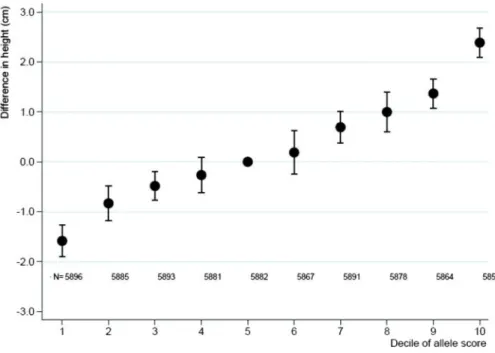
Adult height increased by 0.79 cm (95% CI: 0.75 cm, 0.84 cm) per one-unit increase in allele score derived from the IBC CardioChip array with low heterogeneity across studies (I2¼29%, P¼0.108) (Figure 1), and explained
1.4% (95% CI: 1.2%, 1.5%) of the variance in adult height. The allele score showed no association with smok-ing (20 studies with 57 075 participants includsmok-ing 32 665 smokers, OR 0.97; 95% CI: 0.87, 1.07).
An IV analysis, using the allele score derived from IBC CardioChip array, that included 19 studies with 10 848 prevalent or incident CHD cases, found that for each 6.5-cm increase in adult height the pooled OR of CHD was 0.90 (95% CI: 0.78, 1.03). The corresponding IV estimate derived from summary data from 180 independent SNPs from the GIANT and CARDIoGRAMplusC4D Consortia (including up to 183 727 individuals with height and 63 746 CHD cases) yielded an OR of CHD of 0.90 (95% CI: 0.85, 0.95) for the same difference in adult height. These IV estimates were in agreement with the observa-tional estimate reported by the ERFC (hazard ratio 0.93, 95% CI: 0.91, 0.94,Figure 2).4
We analysed 4 878 cases of stroke in 43 790 partici-pants in 17 studies (Figure 2) with data on IBC CardioChip array. The ERFC observed an OR of 0.93 (95% CI: 0.91, 0.96) per 6.5 cm difference in adult height. Our pooled IV estimate for the same height difference showed a not very dissimilar point estimate, though with wide confidence intervals (OR 0.97, 95% CI: 0.79, 1.19).
the IV estimate, which would arise from weak instrument bias and thus bias the overall meta-analysis of IV estimates. SNP-spe-cific instrumental variable estimates derived from summary-level data (GIANT and CARDIoGRAMplusC4) are presented in Figure S3 and a cross-hair plot showing the relationship of height and risk of CHD across the SNPs is presented inFigure S4(available asSupplementary dataatIJEonline). These show significant heterogeneity, suggesting that the causal effect identi-fied by the allele score is a composite of multiple causal path-ways which identify different magnitudes of causal effect.
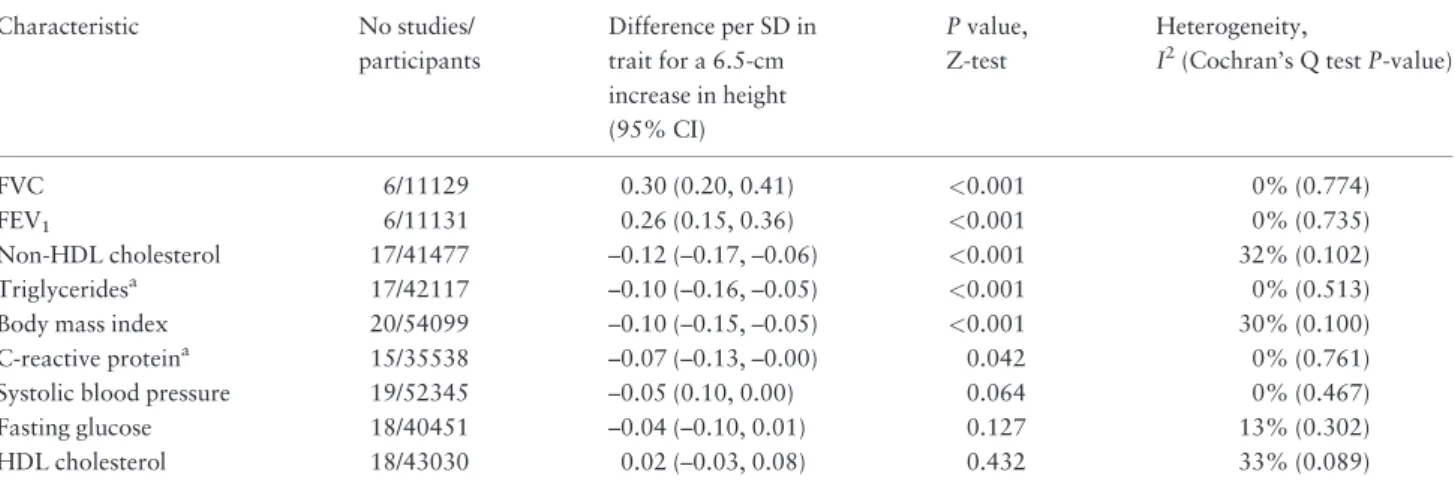
Instrumental variable analyses of height derived from IBC CardioChip array on cardiovascular traits, showed that an increase of 6.5 cm in adult height had the strongest association with lung function, with a difference of 0.26 standard deviation (SD) units of FEV1 (95% CI: 0.15, 0.36) and of 0.30 SD units of FVC (95% CI: 0.20, 0.41) (Table 1). An increase of 6.5 cm in height associated with lower levels of body mass index (0.10 SD units, 95% CI: -0.15, 0.05), triglycerides (0.10 SD, 0.16, 0.05), non-HDL cholesterol (0.12 SD, 0.17, 0.06), Figure 2.Meta-analysis pooled causal effects for a 6.5-cm increase in adult height on the risk of cardiovascular disease. Odds ratios and correspond-ing 95% confidence intervals (CI) are estimated from fixed-effect meta-analysis of instrumental variable (IV) estimates from individual studies. Hazard ratios are taken from estimates published by the Emerging Risk Factors Collaboration (ERFC).4
Effect estimates are per 6.5 cm increase in adult height. An estimate below 1 indicates that increasing adult height decreases the risk of cardiovascular events.
Table 1.Meta-analysis pooled estimates derived from instrumental variable analysis for a 6.5-cm increase in adult height on
cardiovascular traits. Traits are sorted according to the magnitude of the association observed with adult height
Characteristic No studies/
participants
Difference per SD in trait for a 6.5-cm increase in height (95% CI)
Pvalue, Z-test
Heterogeneity,
I2(Cochran’s Q testP-value)
FVC 6/11129 0.30 (0.20, 0.41) <0.001 0% (0.774)
FEV1 6/11131 0.26 (0.15, 0.36) <0.001 0% (0.735)
Non-HDL cholesterol 17/41477 –0.12 (–0.17, –0.06) <0.001 32% (0.102)
Triglyceridesa 17/42117 –0.10 (–0.16, –0.05) <0.001 0% (0.513)
Body mass index 20/54099 –0.10 (–0.15, –0.05) <0.001 30% (0.100)
C-reactive proteina 15/35538 –0.07 (–0.13, –0.00) 0.042 0% (0.761)
Systolic blood pressure 19/52345 –0.05 (0.10, 0.00) 0.064 0% (0.467)
Fasting glucose 18/40451 –0.04 (–0.10, 0.01) 0.127 13% (0.302)
HDL cholesterol 18/43030 0.02 (–0.03, 0.08) 0.432 33% (0.089)
Results from instrumental variable analyses are derived from 2-stage least-squares regression and pooled using fixed-effects meta-analysis. FEV1, forced expiratory volume in 1 s; FVC, forced vital capacity; HDL, high-density lipoprotein.
aEffects of triglycerides and C-reactive protein are estimated after log-transformation. A negative difference indicates that levels of traits decrease with an
C-reactive protein (0.07 SD,0.13,0.00) and a trend to lower levels in systolic blood pressure (0.05 SD, 0.10, 0.00). We did not find evidence for an association between adult height and fasting glucose (0.04 SD, 0.10, 0.01) or type 2 diabetes (19 studies, 60 171 partici-pants,7340 cases, OR per 6.5 cm height 0.99, 95% CI: 0.85, 1.15).
In an exploratory analysis using a sub-sample of pro-spective studies with clinical events and cardiovascular traits, we conducted a multivariate IV analysis that included height and the traits that showed an association with the gene score for height (blood pressure, BMI, lipids, lung function and CRP). These analyses suggested a dimin-ution of the IV estimate between adult height and CHD (Figure S5, available asSupplementary dataatIJEonline). The null effect for stroke remained unchanged after adjust-ment for these traits.
Results for IV analysis derived from the IBC CardioChip array with CHD, stroke and cardiovascular traits using an unweighted allele score were similar to those externally weighted (Table S7, available as Supplementary dataatIJEonline).
Discussion
In order to investigate the causal effect of completed growth, measured by adult height, on cardiovascular events and traits, we used multiple genetic instruments (derived from IBC CardioChip array, and GIANT-CARDIoGRAMplusC4D consortia) associated with adult height representing completed growth, and through IV analysis showed that genetically taller individuals had a lower risk of CHD as well as differences in several cardio-vascular (CV) traits that may explain the cardio-protective effect. The IV estimate indicates a 10% risk reduction in CHD for every 6.5 cm increase in standing height. This is in agreement with the observational estimate reported by the ERFC.4Although we did not find evidence for a causal effect between adult height and risk of stroke, the IV esti-mate was imprecise, meaning we cannot exclude a causal effect.
Our analysis showed that genetically taller individuals had lower levels of adiposity (body mass index), lipid frac-tions (non-HDL cholesterol and triglycerides) and better lung function. Our results suggest that these physiological variables may contribute to explain the association of adult height (and completed growth) on CHD. Additional biolo-gical mechanisms, which we were not able to explore, might also explain the observed effects on CHD. For ex-ample, shorter individuals have smaller vessel calibre,23 which becomes more easily occluded leading to increased arterial occlusive events,24and have a higher risk of more
advanced coronary atherosclerosis.25 Shorter individuals also have faster heart rate and increased augmentation of the primary systolic pulse, indicating greater ventricular systolic work.26
According to the principles of Mendelian randomiza-tion, we would expect the genetic variants to be evenly dis-tributed with respect to potential confounding factors. However in this particular case, with respect to exposures acting in utero, a potential confounding factor described as a “dynastic effect” may lead to an imbalance whereby adults carrying more height raising alleles may have experi-enced greater on average maternal height (due to genomic sharing between mothers and offsping). This greater mater-nal height could affect the in utero environment experi-enced by the offspring, which could possibly influence their long-term health.27 However, these early environ-mental determinants of adult height are unlikely to entirely explain the association of adult height with CHD, derived from our IV analysis. However, it does not mean that early growth, a key period when these genes act, is not an im-portant mechanism.28 Since genotype is invariant, our re-sults also suggest that the reverse causation phenomenon of ‘shrinkage’ due to illness does not explain our effect of adult height on CHD. Furthermore, we did not observe an association between the allele score and smoking, which is a potential confounder.
specificity of our genetic instrument, we were also able to dissect the downstream biological consequence of the intermediate trait of interest (i.e. differences in blood pres-sure, lung function and lipid traits as consequence of differ-ences in adult height), known as vertical pleiotropy32,33 and its presence does not violate the IV assumptions. We weighted the IBC CardioChip allele score by the summary beta coefficients from the meta-analysis,10which included all of the studies in this analysis and, therefore, there is a risk of overfitting in the IV estimates. However, when we compared our results with IV results obtained from un-weighted scores, we found very similar results,9,34,35 sug-gesting that the magnitude of potential overfitting to be unlikely to invalidate our findings. Fourth, our findings are in alignment with a very recent Mendelian randomization study of height and risk of coronary artery disease;36 we additionally considered the effect of height on risk of stroke, and our access to participant data from the UCLEB consortium allowed us to explore potential mediators of the relationship between adult height and CHD.
An interesting finding from our IV analysis on cardio-vascular traits was that taller people tend to have lower body mass index. Previous studies have shown that whereas adult height is directly associated with most body girths, it is inversely associated with waist girth.37A link between short stature and adiposity may emerge through associations between poor growth in early life and altered metabolism,38 which may allow partial reduction of the height deficit while also favouring insulin resistance and central fat accumulation.
The main strength of our study is use of the Mendelian randomization approach incorporating data from two very large consortia consisting of studies with validated cardio-vascular endpoints, and two different multiple-genetic instruments. Our approach of using multiple SNPs in com-bination for Mendelian randomization has been used for causal inference for a broad range of environmental expos-ures and diseases (including BMI39 and lipids17) and use of an allele score in this regard yields reliable causal estimates.40
One limitation of our study was that we were unable to explore additional biological mechanisms, which might also explain the causal effects of height on CHD. Second, we rescaled the IV effect for comparability with the pub-lished ERFC results, which is only valid when assuming a linear association between the height and the IV effect. Third, the absence of association of our genetic instrument with risk of stroke should be interpreted with caution: additional Mendelian randomization studies using multiple instruments in larger sample sizes (such as METASTROKE) are needed to clarify the effect of adult height on stroke. Interesting next steps would include
expanding this approach to cancer, as well as exploring the potential effect modification that adverse conditions dur-ing pregnancy or in early childhood may have on the asso-ciations of health outcomes with genetic instruments for completed growth.41
Summary
Our multiple instruments Mendelian randomization approach provided evidence that people with a genetic predisposition to achieve a higher completed growth, measured by adult height, have a reduced risk of CHD, and with potential mechanisms including better lung func-tion and lower levels of body mass index, non-HDL choles-terol, triglycerides and blood pressure.
Supplementary Data
Supplementary dataare available atIJEonline.
Funding and Acknowledgments
E.N. was a recipient of a Marie Curie Intra-European Fellowship for Career Development (grant No FP7-PEOPLE-2010-IEF-273673). F.W.A.is supported by UCL Hospitals NIHR Biomedical Research Centre. G.K.H. is recipient of a VENI grant (NWO nr91612122). S.S. received a grant from Ipse Movet. T.G., D.A.L. and G.D.S. work in a unit that is supported by the Medical Research Council (MC_UU_12013/1, 5 and 8). M.V.H. was sup-ported by a Medical Research Council Population Health Scientist Fellowship (G0802432).
BRHS (British Regional Heart Study). BRHS has been funded principally by a series of programme and project grants from the British Heart Foundation (BHF), with add-itional support from the UK Medical Research Council, the Department of Health (England), the Institute of Alcohol Studies, the Stroke Association, the BUPA Foundation, the Wellcome Trust and the National Institute for Health Research School of Primary Care Research. DNA extraction was funded by a BHF Senior Fellowship.
CAPS (The Caerphilly Prospective study). The CAPS study was undertaken by the former MRC Epidemiology Unit (South Wales) and was funded by the Medical Research Council of the UK. The DNA bank was estab-lished with funding from a MRC project grant. The data archive is maintained by the University of Bristol.
The IBC array data (also known as ‘Cardiochip’ or ‘CVDSNP55v1_A’ from the National Heart, Lung and Blood Institute (NHLBI) Candidate Gene Association Resource (CARe) was downloaded with appropriate per-missions from The database of Genotypes and Phenotypes (dbGaP) [www.ncbi.nlm.gov/gap].
CARe (Candidate gene Association Resource). The CARe Consortium wishes to acknowledge the support of the National Heart, Lung, and Blood Institute and the contribu-tions of the research institucontribu-tions, study investigators, field staff and study participants in creating this resource for bio-medical research (NHLBI contract number HHSN268200960009C). The following nine parent studies have contributed parent study data, ancillary study data and DNA samples through the Massachusetts Institute of Technology-Broad Institute (N01-HC-65226) to create this genotype/phenotype database for wide dissemination to the biomedical research community: the Atherosclerosis Risk in Communities (ARIC) study, the Cardiovascular Health Study (CHS), the Cleveland Family Study (CFS), the Cooperative Study of Sickle Cell Disease (CSSCD), the Coronary Artery Risk Development in Young Adults (CARDIA) study, the Framingham Heart Study (FHS), the Jackson Heart Study (JHS), the Multi-Ethnic Study of Atherosclerosis (MESA) and the Sleep Heart Health Study (SHHS). The ARIC study is car-ried out as a collaborative study supported by National Heart, Lung, and Blood Institute contracts N01-HC-55015, HC-55016, HC-55018, HC-55019, N01-HC-55020, N01-HC-55021, and N01-HC-55022. The au-thors thank the staff and participants of the ARIC study for their important contributions. MESA was conducted and sup-ported by contracts N01-HC-95159 through N01-HC-95169 and RR-024156 from the National Heart, Lung, and Blood Institute (NHLBI). The authors thank the participants of the MESA study, the Coordinating Center, MESA investigators and study staff for their valuable contributions. A full list of participating MESA investigators and institutions can be found at: [http://www.mesa-nhlbi.org].
EAS (Edinburgh Artery Study). EAS is funded by the British Heart Foundation (Programme Grant RG/98002), with Metabochip genotyping funded by a project grant from the Chief Scientist Office of Scotland (Project Grant CZB/4/672).
ELSA (English Longitudinal Study of Ageing). ELSA is funded by the National Institute on Aging in the US (R01 AG017644; R01AG1764406S1) and by a consortium of UK
Government departments involved in areas related to the ageing process (including: Department for Communities and Local Government, Department for Transport, Department for Work and Pensions, Department of Health, HM Revenue and Customs and Office for National Statistics). ELSA was developed by a team of researchers based at the National Centre for Social Research, University College London and the Institute of Fiscal Studies. The data were collected by the National Centre for Social Research.
EPIC-NL (European Prospective Investigation into Cancer and Nutrition in The Netherlands). The EPIC-NL study was funded by ‘Europe against Cancer’ Programme of the European Commission (SANCO), Dutch Ministry of Public Health, Welfare and Sports (VWS), Netherlands Cancer Registry (NKR), LK Research Funds, Dutch Prevention Funds, Dutch Cancer Society, ZonMW, The Netherlands Organisation for Health Research and Development and World Cancer Research Fund (WCRF) (The Netherlands). Genotyping was funded by IOP Genomics grant IGE05012 from Agentschap NL.
ET2DS is funded by the Medical Research Council (Project Grant G0500877), the Chief Scientist Office of Scottish (Programme Support Grant CZQ/1/38), Pfizer plc (Unrestricted Investigator Led Grant) and Diabetes UK (Clinical Research Fellowship 10/0003985). Research clinics were held at the Wellcome Trust Clinical Research Facility and Princess Alexandra Eye Pavilion in Edinburgh.
LURIC was supported by the 7th Framework Program (integrated project AtheroRemo, grant agreement number 201668 and RiskyCAD, grant agreement number 305739) of the European Union and by the INTERREG IV Oberrhein Program (Project A28, Genetic mechanisms of cardiovascular diseases) with support from the European Regional Development Fund (ERDF) and the Wissenschaftsoffensive TMO. NORDIL (Nordic Diltiazem study). The NORDIL clinical study was supported by a grant from Pharmacia. Genetic studies were supported by the British Heart Foundation (grant number CH/98001, RG/07/005/23633 to A.F.D.) and European Union Ingenious HyperCare Consortium: Integrated Genomics, Clinical Research, and Care in Hypertension (grant num-ber LSHM-C7-2006-037093). Genotyping was supported by the British Heart Foundation (grant number PG/07/131/ 24254 to P.B.M.). We thank Prof. Thomas Hedner (Department of Clinical Pharmacology, Sahlgrenska Academy, Gotheburg, Sweden) and Prof. Sverre Kjeldsen (Ullevaal University Hospital, University of Oslo, Oslo, Norway), who are investigators of the NORDIL study.
Programme (LSHM-CT-2007-037273) and the sample col-lection by AstraZeneca AB and the BHF. R.C., M.F. and H.W. are supported by the BHF Centre for Research Excellence; M.F. and H.W. acknowledge support from a Wellcome Trust core award (090532/Z/09/Z). R.C. ac-knowledges support from the MRC; Anders Hamsten ob-tained support for this project from the Swedish Heart-Lung Foundation, the Swedish Medical Research Council (8691), the Knut and Alice Wallenberg Foundation, the Karolinska Institute and the Stockholm County Council (560183).
UCLEB (University College London-London School of Hygiene and Tropical Medicine-Edinburgh-Bristol). The UCLEB consortium is funded by a British Heart Foundation programme grant (ref RG/10/12/28456).
WHI (Women’s Health Initiative). The WHI pro-gramme is funded by the National Heart, Lung, and Blood Institute, National Institutes of Health, U.S. Department of Health and Human Services through contracts N01WH22110, 24152, 32100-2, 32105-6, 32108-9, 32111-13, 32115, 32118-32119, 32122, 42107-26, 42129-32, and 44221.
WHII (Whitehall II study). The WHII study is sup-ported by grants from the Medical Research Council (G0902037; ID85374), British Heart Foundation (RG/07/ 008/23674), Stroke Association, National Heart Lung and Blood Institute (5RO1 HL036310), National Institute on Aging (5RO1AG13196) Agency for Health Care Policy Research (HS06516), and the John D. and Catherine T. MacArthur Foundation Research Networks on Successful Midlife Development and Socio-economic Status and Health. We gratefully thank the subjects and the investiga-tors of this project.
The funders had no role in study design, data collection and analysis, decision to publish or preparation of the manuscript.
Conflict of interest:Anke H Maitland-van der Zee has an
unrestricted research grant for research on pharmacoge-netics from GSK. All other primary authors declare no conflicts of interest.
References
1. Waaler HT. Height, weight and mortality. The Norwegian ex-perience.Acta med Scand Suppl1984;679:1–56.
2. Davey Smith G, Hart C, Upton Met al. Height and risk of death among men and women: aetiological implications of associations with cardiorespiratory disease and cancer mortality.J Epidemiol Community Health2000;54:97–103.
3. Green J, Cairns BJ, Casabonne Det al. Height and cancer inci-dence in the Million Women Study: prospective cohort, and meta-analysis of prospective studies of height and total cancer risk.Lancet Oncoly2011;12:785–94.
4. The Emerging Risk Factors Collaboration. Adult height and the risk of cause-specific death and vascular morbidity in 1 million people: individual participant meta-analysis. Int J Epidemiol
2012;41:1419–33.
5. Leon DA, Davey Smith G, Shipley M, Strachan D. Adult height and mortality in London: early life, socioeconomic confounding, or shrinkage?J Epidemiol Community Healthh1995;49:5–9. 6. Batty GD, Shipley MJ, Gunnell Det al. Height loss and future
coronary heart disease in London: the Whitehall II study.
J Epidemiol Community Health2011;65:461–64.
7. Hingorani A, Humphries S. Nature’s randomized trials.Lancet
2005;366:1906–08.
8. Davey Smith G, Ebrahim S. ‘Mendelian randomization’: can genetic epidemiology contribute to understanding environmental determinants of disease?Int J Epidemiol2003;32:1–22. 9. Burgess S, Butterworth A, Thompson SG. Mendelian
randomiza-tion analysis with multiple genetic variants using summarized data.Genet Epidemiol2013;37:658–65.
10. Lanktree MB, Guo Y, Murtaza Met al. Meta-analysis of dense genecentric association studies reveals common and uncommon variants associated with height.Am J Hum Genet2011;88:6–18. 11. Sammalisto S, Hiekkalinna T, Schwander Ket al. Genome-wide linkage screen for stature and body mass index in 3.032 families: evidence for sex- and population-specific genetic effects.Eur J Hum Genet2009;17:258–66.
12. Lango Allen H, Estrada K, Lettre Get al. Hundreds of variants clustered in genomic loci and biological pathways affect human height.Nature2010;467:832–38.
13. Consortium CARDIoGRAMplusC4D; Deloukas P, Kanoni S
et al. Large-scale association analysis identifies new risk loci for coronary artery disease.Nat Genet2013;45:25–33.
14. Keating BJ, Tischfield S, Murray SSet al. Concept, design and implementation of a cardiovascular gene-centric 50 k SNP array for large-scale genomic association studies.PloS One2008;3: e3583.
15. Voight BF, Kang HM, Ding Jet al. The metabochip, a custom genotyping array for genetic studies of metabolic, cardiovascu-lar, and anthropometric traits.PLoS Genet2012;8:e1002793. 16. Shah T, Engmann J, Dale Cet al. Population genomics of
cardio-metabolic traits: design of the University College London-London School of Hygiene and Tropical Medicine-Edinburgh-Bristol (UCLEB) Consortium.PloS One2013;8:e71345. 17. Holmes MV, Asselbergs FW, Palmer TM,et al. Mendelian
ran-domization of blood lipids for coronary heart disease.Eur Heart J2015;36:539–50.
18. Palmer TM, Lawlor DA, Harbord RMet al. Using multiple gen-etic variants as instrumental variables for modifiable risk factors.
Stat Methods Med Res2012;21:223–42.
19. Palmer TM, Sterne JA, Harbord RMet al. Instrumental variable es-timation of causal risk ratios and causal odds ratios in Mendelian randomization analyses.Am J Epidemiol2011;173:1392–403. 20. Harris R, Bradburn MJ, Deeks JJ, Harbord RM, Altman DG,
Sterne JAC. metan: fixed- and random-effects meta-analysis.
Stata J2008;8:3–28.
21. Higgins JP, Thompson SG, Deeks JJ, Altman DG. Measuring in-consistency in meta-analyses.BMJ2003;327:557–60.
23. Lemos PA, Ribeiro EE, Perin MAet al. Angiographic segment size in patients referred for coronary intervention is influenced by constitutional, anatomical, and clinical features. Int J Cardiovasc Imaging2007;23:1–7.
24. West NE, Ruygrok PN, Disco CMet al. Clinical and angio-graphic predictors of restenosis after stent deployment in dia-betic patients.Circulation2004;109:867–73.
25. Kortelainen ML, Sarkioja T. Coronary atherosclerosis associated with body structure and obesity in 599 women aged between 15 and 50 years.Int J Obes Relat Metab Disord1999; 23:838–44.
26. Smulyan H, Marchais SJ, Pannier B, Guerin AP, Safar ME, London GM. Influence of body height on pulsatile arterial hemo-dynamic data.J Am Coll Cardiol1998;31:1103–09.
27. Gray L, Davey Smith G, McConnachie A, Watt GC, et al. Parental height in relation to offspring coronary heart disease: examining transgenerational influences on health using the west of Scotland Midspan Family Study.Int J Epidemiol2012;41: 1776–85.
28. Demerath EW, Choh AC, Czerwinski SA et al. Genetic and environmental influences on infant weight and weight change: the Fels Longitudinal Study.Am J Hum Biol2007;19: 692–702.
29. Holmes MV, Simon T, Exeter HJet al. Secretory phospholipase A2-IIA and cardiovascular disease: A Mendelian randomization study.J Am Coll Cardiol2013;62:1966–76.
30. Pichler I, Del Greco MF, Gogele Met al. Serum iron levels and the risk of Parkinson disease: a mendelian randomization study.
PLoS Med2013;10:e1001462.
31. Zuccolo L, Lewis SJ, Davey Smith Get al. Prenatal alcohol ex-posure and offspring cognition and school performance. A ‘Mendelian randomization’ natural experiment. Int J Epidemiol2013;42:1358–70.
32. Tyler AL, Asselbergs FW, Williams SM, Moore JH. Shadows of complexity: what biological networks reveal about epistasis and pleiotropy.BioEssays2009;31:220–27.
33. Davey Smith G, Hemani G. Mendelian randomization: genetic anchors for causal inference in epidemiological studies.Hum Mol Genet2014;23:R89–98.
34. Burgess S, Thompson SG. Use of allele scores as instrumental variables for Mendelian randomization.Int J Epidemiol2013; 42:1134–44.
35. Pierce BL, Burgess S. Efficient design for Mendelian randomiza-tion studies: subsample and 2-sample instrumental variable esti-mators.Am J Epidemiol2013;178:1177–84.
36. Nelson CP, Hamby SE, Saleheen Det al. Genetically determined height and coronary artery disease.N Engl J Med2015. PMID 25853659. [Epub ahead of print.]
37. Wells JC, Treleaven P, Cole TJ. BMI compared with 3-dimen-sional body shape: the UK National Sizing Survey.Am J Clin Nutr2007;85:419–25.
38. Hoffman DJ, Sawaya AL, Verreschi I, Tucker KL, Roberts SB. Why are nutritionally stunted children at increased risk of obesity? Studies of metabolic rate and fat oxidation in shanty-town children from Sao Paulo, Brazil.Am J Clin Nutr2000;72: 702–07.
39. Holmes MV, Lange LA, Palmer Tet al. Causal effects of body mass index on cardiometabolic traits and events: a Mendelian randomization analysis.Am J Hum Genet2014;94:198–208. 40. Davies NM, von Hinke Kessler Scholder S, Farbmacher H,
Burgess S, Windmeijer F, Davey Smith G. The many weak instru-ments problem and Mendelian randomization.Stat Med2015; 34:454–68.