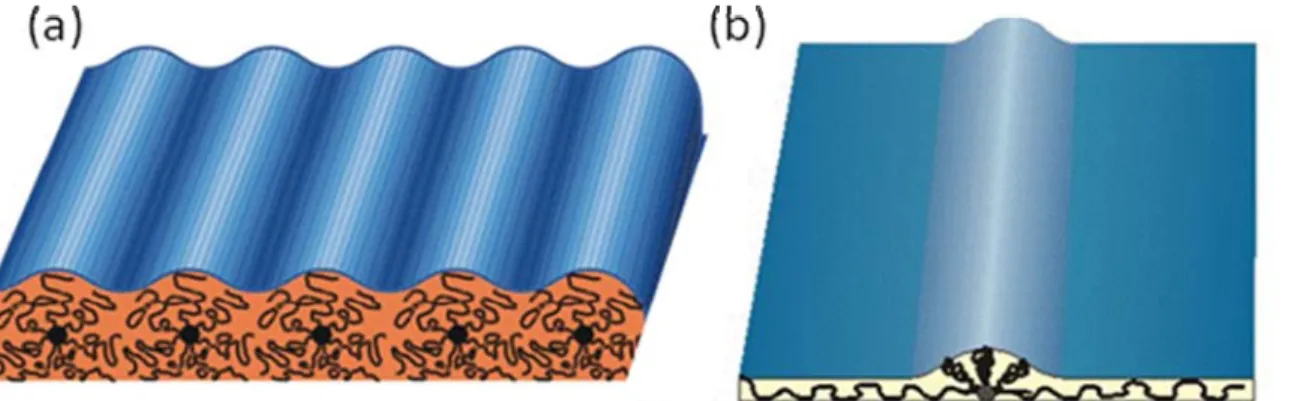
LITHOGRAPHY AND REVERSIBLE SHAPE MEMORY
Jing Zhou
A dissertation submitted to the faculty of the University of North Carolina at Chapel Hill in partial fulfillment of the requirements for the degree of Doctor of Philosophy in the
Materials Science.
Chapel Hill 2014
©2014 JING ZHOU
ABSTRACT
JING ZHOU: LITHOGRAPHY AND REVERSIBLE SHAPE MEMORY (under the direction of Sergei Sheiko)
This research describes the development of unique methods to create patterns from 2D structure in molecular level to surface lithography and finally controlled reversible motions of macroscopic object.
Mixing of chemically incompatible substances is a canonical problem that is particularly challenging for macromolecules. Here, we present an assembly strategy to create patterns of long range arrays of perfectly mixed, i.e., intercalated, macromolecules at a fluid interface via entropic release of steric repulsion between brush-like polymers. Such entropic templating (ET) strategy was successfully applied to mixtures macromolecules with a variety of polymer architectures and enables long range patterning of thin films on sub-100 nm length scales.
Irreversibility is the major drawback of the shape memory polymers. To incorporate reversibility into programmable shape memory, we introduce a universal protocol for three shape memory behavior, the conventional, one time reversible and multi time reversible shape memory. With the new protocol, we can create
programmable spontaneous reversible motions and control the reversibility via material properties or experimental conditions.
ACKNOWLEDGEMENTS
Most importantly I would like to thank my advisor Dr. Sergei Sheiko for the opportunity to conduct research in his lab. I will be forever indebted to him for the time he has given me to help shape me into the scientist I have become today.
I would like to thank every member of the Sheiko groups who have helped me along the way. Thank you Qiaoxi for collaborating with you on the project. Thank you Ping, Yuan Chao and Will for the opportunity to work along with you. Thank you Sara from Ashby group and Alper Nese from Carnegie Mellon for the wonderful synthetic work. I would also like to thank Professor Michael Rubinstein Professor Samulski for their thought provoking discussions during our polymer physics group seminars.
TABLE OF CONTENTS
LIST OF TABLES………...xi
LIST OF FIGURES………...xii
LIST OF SYMBOLS AND ABBREVIATIONS………..…...xvi
Chapter 1. INTRODUCTION...………..…...1
1.1 Mixing and surface patterning ………...…...1
1.1.1 2D Mixing in monolayers ………..…...2
1.1.2 Conformational entropy induced mixing ………...…...4
1.1.3 Model molecules ………....…...4
1.2 Shape memory polymer and lithography ………...…...7
1.2.1 Triggering mechanism ………...9
1.2.2 Acoustic heating ………...10
1.2.3 Acoustic lithography on shape memory materials …...13
1.3 Reversible shape memory polymers ………...14
1.3.1 One time reversible shape memory polymers ………...16
1.3.2 Polymer crystallization ………...17
1.3.3 Multi-time shape memory polymers …………...19
1.3.4 Memory of crystalline physical network ………...20
2. PERFECT MIXING OF IMMISCIBLE MACROMOLECULES
AT FLUID INTERFACES...………...31
2.1 Introduction ……….….….….….….….….….….….…...….….31
2.2 Experimental …….……….…...32
2.2.1 Materials ………...32
2.2.2 Langmuir- Blodgett monolayer preparation …………...35
2.2.3 Atomic Force Microscopy ………...38
2.3 PDMA brushes on water surface ………...40
2.4 Conformational entropy induced brush brush mixing ……...42
2.5 Mixing with molecules of different architectures ………...45
2.6 Mixing mechanism ………...47
2.7 Intercalation ………...53
2.8 Stability of the film ………...58
2.9 Conclusion ………..………..………..………...60
REFERENCES …………..……….……….………...61
3. ACOUSTIC ACTIVATION OF SHAPE MEMORY MATERIAL...63
3.1 Introduction ……….….….….….….….….….….….…...63
3.2 Experimental …….………...64
3.2.1 Materials ………...64
3.2.2 Differential Scanning Calorimetry ………...66
3.2.3 Small angle X-ray diffraction ………...67
3.2.4 Acoustic property measurement ………...69
3.2.5 Acoustic activation of shape memory effect………...70
3.3 Heat generation from acoustic beam ………...73
3.4 Acoustic lithography on shape memory materials …………...74
3.5 Size control of the acoustic lithography ………...77
3.6 Conclusion ………..…...….…...80
REFERENCES …………..……….……….………...81
4. ONE TIME REVERSIBILITY ….….….…..….…….….…….….…...83
4.1 Introduction ……….….….….….….….….….….….…...83
4.2 Experimental …….………...84
4.2.1 Materials ………...84
4.2.2 Crystallization characterization ………...85
4.2.3 One time reversibility protocol ………...87
4.2.4 Flow control setup ………...89
4.3 Programmability of one time reversibility ………...90
4.4 Mechanism of one time reversibility ………...92
4.5 Sequential crystallization and melting ………...95
4.6 Stability of shapes in one time reversibility ………...99
4.7 Flow rate control ………...100
4.8 Conclusion ………..…...….…...102
REFERENCES …………..……….……….………...103
5. MULTI TIME REVERSIBILITY ………...105
5.1 Introduction ……….….….….….….….….….….….….…...105
5.2 Experimental …….………...105
5.2.2 Material characterization ………....……....108
5.2.3 Multi time (two-way) reversibility protocol ………....……....112
5.2.4 Reversibility analysis ………...……....113
5.3 Programmable multi time reversibility …….………....……....115
5.4 Mechanism of multi time reversibility ………...……....118
5.5 Microscopic reversibility of crystals ………...……....118
5.6 Effect of partial melting temperature ………....……....121
5.7 Kinetic controlled reversibility ………....……....126
5.8 Reversibility for different materials ………...……....128
5.9 Further development of model ………...……....131
5.10 Conclusion ………..…...….…...……....135
REFERENCES …………..……….……….………...……....136
6. KINETIC CONTROLLED TRIPLE SHAPE MEMORY...……....138
6.1 Introduction ……….….….….….….….….….….….…...……....138
6.2 Experimental …….………...……....139
6.2.1 Materials ………...……....139
6.2.2 Differential Scanning Calorimetry ………..……....140
6.2.3 Dynamic Mechanic Analysis………...……....140
6.2.4 Shape change analysis ………...……....140
6.3 Model for kinetic controlled triple shape memory…………...……....142
6.3.1 Isothermal crystallization as a kinetic process……...……....142
6.3.2 Sequential crystallization and melting………...……....144
6.4 Two angle protocol ………...……....147
6.5 One time reversible protocol ………...……....148
6.6 Time controlled shape memory………...……....149
6.7 Conclusion ………..…...….…...…….152
LIST OF TABLES Table
2.1 Molecular weight and molecular distribution of linear polymers..…….32
2.2 Molecular weight and molecular distribution of brush polymers and DP of sidechains………...……...34
2.3 Molecular weight and DP of different arms of the star polymer...….35
3.1 Composition and property of the prepoymer ………...…64
3.2 Properties of the shape memory material ………...……69
LIST OF FIGURES Figure
1.1 Possible States of Two-Component Mixing ………...2
1.2 Architecture of a polymer brush. ………...6
1.3. Conformations of a polymer brush on surface ………...6
1.4 Images of polymer brushes ………...7
1.5 Shape memory cycle ……….…...9
1.6 Acoustic absorption ………...…...…...11
1.7 Confinement effect and Self-seeding …………..……..……...21
2.1 Grafting of side chains ………...33
2.2 Synthesize of polymer stars ….….….….….….….….….….…...34
2.3 Langmuir trough ………...36
2.4 LB transfer ………..…..…..…..…..…..…..…..…..…...37
2.5 Atomic force microscope………...38
2.6 Stability of PDMA brush at water surface ………...40
2.7 Conformation change of PDMA ………...41
2.8 Comparison between linear and brush mixing
………...44
2.9 Brush mixed with other systems ………...46
2.10 Conventional and novel mixing scenarios at a fluid interface...49
2.11 Spacing control ………...51
2.12 Linear/brush mixture with different compositions ………...53
2.13 Isotherm study on intercalation ………...55
2.15 Unlike pair fraction against pressure increase ………...58
2.16 Reversibility of the film through expansion and compression ...59
2.17 Phase separation on mica surface under humidity treatment ...60
3.1 Synthesis of shape memory polymer.………...65
3.2 DSC measurement ………...67
3.3 Bragg’s law for X-ray scattering ………...68
3.4 Lateral pressure distribution of the focused acoustic beam …...70
3.5 Experimental setup of acoustic activation of shape memory ...71
3.6 Interferometer .………..…...72
3.7 3D image analysis ………...73
3.8 Temperature increase on shape memory polymers ………...74
3.9 Acoustic lithography on shape memory polymer foams……...75
3.10 Bumps acoustically activated on solid films of shape memory material …...77
3.11 Bumps created by acoustic beam with different intensities …...78
3.12 Bumps created by acoustic beam with different pulse duration …...80
4.1 Mayer rod technique for thin film preparation ………...85
4.2 AFM image on thin polymer films ………...86
4.3 Protocol for one time reversibility ………...88
4.4 Flow control setup ………...90
4.5 One time reversibility of hairpin ………...…………...91
4.6 One time reversibility of helixes ……….……….………...92
4.7 Microscopic explanation for one time reversibility ………...94
4.9 Crystal change in crystallization and melting process ………...96
4.10 Size of crystals ………...97
4.11 Multiple cycles of crystallization through partial melting ……...98
4.12 Stability of shapes in one time reversibility process …………...99
4.13 Flow rate control ………..……...101
5.1 Shape memory materials prepared with different crosslinking methods …....107
5.2 Shape memory materials prepared with different chemical composition …...108
5.3 DMA measurement ……….……….………...109
5.4 Protocol for multi time reversibility ………..…………..…...113
5.5 Reversibility analysis with DMA ……….…………...114
5.6 Multi time reversibility of hairpins ………...…………...116
5.7 Two way transition of various shape changes ………...117
5.8 Mechanism of multi time reversibility ………...119
5.9 Crystallization from complete melt ………...120
5.10 Reversible crystallization and melting ………...120
5.11 SAXS measurement of reversibility of crystals …………..…...121
5.12 Reversible shape change at different partial melting temperature …………..122
5.13 Analysis effect of partial melting temperature on reversibility ...123
5.14 Comparison of different memeory effects ………...125
5.15 Effect of recrystallization temperature ………...126
5.16 Effect of annealing during partial melting ………...127
5.17 Reversibility over multiple cycles …....………...128
5.19 Material property effect on reversibility ………...130
5.20 Decay over cycles of for different material ………...131
5.21 Macro and microscopic change through melting …………...132
5.22 Meltng versus recovery………...134
5.23 Model for different stages in partial melting …………...…………...135
6.1 Protocol for two angle memory ………...141
6.2 Protocol for one time reversible shape memory………...142
6.3 Isothermal crystallization as a function of time………...143
6.4 Fixation rate change as a function of time ………...144
6.5 Crystals in isothermal crystallization………...145
6.6 Sequential order for isothermal crystallization ………...146
6.7 Model for kinetic controlled triple shape memory………...147
6.8 Angle change in two angle protocol………...148
6.9 Angle change in one time reversible protocol………...149
6.10 One time reversibility with different partition of fixation time ...150
6.11 One time reversibility controlled by fixation time………...150
LIST OF ABBREVIATIONS AND SYMBOLS
m
F
Free energy of mixing
m
H
Enthalpy of mixing
m
S
Entropy of mixing
k Boltzmann constant
Flory-Huggins parameter Chemical composition
N Degree of polymerization
2D Two dimensional
PMMA poly(methyl methacrylate) 3D Three dimensional
DP Degree of polymerization ATRP Atomic transfer radical reaction
I Acoustic intensity Adsorption coefficient x Depth of penetration
Angular frequency Relaxation time Viscosity
Density
p
T
Coefficient of thermal conductivity
Ratio of the isobaric and isothermal heat capacities
PCHMA Poly (Cyclohexylmethacrylate) PCL poly(ε-caprolactone)
m
T Melting point
0 m
T Melting temperature for infinitively large crystals
e
Surface energy
c
L Lamella thickness
0
h
Melting enthalpy
Mn Number average of molecular weight Mw/Mn Polydispersity
PBPEM poly(2-(2-bromopropionyloxy)ethyl methacrylate) PBA polybutylacrylate
PDMA poly dimethylacrylamide LB Langmuir- Blodgett
Surface tension Surface pressure
b Kuhn length
l Monomer length
p Stiffness parameter
PDMS poly(dimethylsiloxane)
A Monomeric area
DSC Differential scanning calorimetry min minute
mN milli Newton
N backbone degree of polymerization n side chain degree of polymerization N Newton
Ne monomers per entanglement nm nanometer
O.P. Order parameter PBA poly n-butyl acrylate
PBPEM
poly (2-(2-bromopropionyloxy) ethyl methacrylate)
PDI polydispersity index PDMS poly(dimethylsiloxane) Pe entanglement strands
R film length
r distance along the film
R0 drop radius Redge radius of precursor film Rg Radius of gyration RH relative humidity s second
S spreading coefficient SEM scanning electron microscopy STM scanning tunneling microscopy t time
Tg glass transition temperature U Lenard-Jones potential energy U electric potential U electric potential V velocity of fluid
V velocity of brush V volt V0 velocity of matrix
v0 monomer volume
Vslip slip velocity
w brush width
adsorption blob size x distance along the film
γslip fitting parameter
ε Lenard-Jones interaction parameter ε0 permittivity of free space
η viscosity
θ bond angle
θc contact angle κ dielectric constant
μm micrometer
ξ friction coefficient of the fluid-surface interface ξ friction coefficient of the brush-surface interface ξ polymer-surface friction
ξ0 friction coefficient of the matrix-surface interface ξbm brush matrix friction
Π surface pressure
ρ density
σ Lenard-Jones particle diameter σij energy of an interface
φ fitting parameter
CHAPTER 1: INTRODUCTION
1.1 Mixing and surface patterning
Mixing of chemically incompatible substances is a canonical problem limiting advances in fields ranging from health care to materials engineering. The phase behavior of multicomponent systems is determined by the free energy of mixing
m m
m H TS
F
, where Hm andSm are, respectively, the changes in enthalpy and entropy
upon mixing of the constituting species. There are three different possible states for a two component blend as shown in Figure 1.1. Blends phase separate if the free energy increases (Fm 0), when increase in interaction energy is larger then gain in mixing
entropy. This typically occurs for large species, such as particles and macromolecules. Random mixing occurs when gain in translational entropy gain during mixing more than compensates for the enthalpy loss. The system will stay at an entropically favorable random state and typically occurs with small molecule blends. A third rare scenario is ordered mixing or intercalation, the entropic incentive to random mix has also to be small and usually only occurs when the two species have specific interactions.
For polymer blends, the mixing enthalpy calculated by HmkT(1) is
theory,
ln (1 )ln(1 ) B A m N N kT
S , NA and NB are degree of polymerization of the
two mixing polymers, and are usually large for most macromolecules. That makes positive mixing enthalpy ( Hm 0 ) and negligible gains in translational entropy
(TSmHm). So it is always challenging to mix two large molecules and most
polymers are considered immiscible. However, the low translational entropy gain also means high possibility for the third intercalation state. If two kinds of large molecules do mix, they are likely to form an ordered mixing. Such ordering could be valuable in applications like surface patterning and functional assemblies.
Figure 1.1Possible States of Two-Component Mixing Phase separation usually occurs in mixed polymer systems due to their large size. There are two scenarios for fixed state, random mixing when mixing is induced by translational entropy or
intercalation when mixing is induced by energy or conformational entropy gain through specific alignment.
1.1.1 2D Mixing in monolayers.
monolayer also has been extensively studied for the potential application as functional films10-16.
Two or multi-component Langmuir monolayer has long been studied and many developments have been made toward the miscibility of the large molecules in recent years. The miscibility of in the 2D monolayer might have difference from the 3D state because the adsorption of the hydrophilic group onto the water surface resulted in specific alignment at the interface, the different chain packing and interfacial energy can all affect the miscibility or morphology of polymer mixtures in monolayer. One example is the mixing of isotactic poly(methyl methacrylate) (it-PMMA) and syndiotactic poly(methyl methacrylate) (st-PMMA)17-19. These molecules can form stereocomplexation within the monolayer at compression of the mixed monolayer and transfer from a phase separated state to a uniformly mixed film at water air interface. Similar phenomenon can be observed between other complexation forming pairs such as poly(L-lactide)/poly(D-lactide)20-23.
1.1.2 Conformational entropy induced mixing.
Mixing of chemically different components is usually driven by entropy increase. There are two kinds of entropy involved in a multi component system. The translational entropy is the driving force for most of the mixing of small molecules, but is negligible for large molecules. In contrast, the conformational entropy is insignificant for small molecules, but plays an effective role in large molecules. So here we propose, by designing conformationally frustrated maromolecules, we could increase the effect of conformational entropy change in mixing and provide a new driving force to mix otherwise immiscible polymers. Since the translational mixing entropy will still be small, it may well lead to ordered mixing describe in figure 1.1 and form alternating surface patterns. We lay groundwork to answer the following questions:
Can two chemically different polymers mix through architecture design and driven by conformational entropy?
Can ordered alternative patterns be created through conformational entropy driven mixing?
Will the mixed blend thermally or kinetically stable?
Are there any requirement for the properties and structure of the molecules that can be mixed through this particular method?
1.1.3 Model molecules.
this text). The large number of side-chains and high grafting density makes it a good conformationally frustrated system, where an increase in volume fraction of branched macromolecules (either in solution or at interface) causes stretching of polymer chains and thus significant decrease of conformational entropy.
A polymer brush (Figure 1.2) consists of a linear polymer chain as backbone, with a degree of polymerization (DP) = N. Polymer side chains are densely grafted to it, each with an average DP =n. Molecules are synthesized by ATRP and both of these parameters and the grafting density are synthetically controlled, which determines the shape of the molecule.
The conformation of a brush-like molecule is determined by the competition between the entropic elasticity of the flexible backbone and the steric repulsion of the densely grafted side chains. Molecules adopt a cylindrical conformation due to chain arrangement. This conformation may change in response to the surrounding environment, which effectively changes the interaction between the densely grafted side chains. Molecules are greatly effected when deposited upon surfaces, the conformation of brush molecules depends on the interaction of the side chains with the surface which results in a larger variety of conformations. (Figure 1.3) Their sensitivity to environmental changes such as compression also makes them the perfect modals for studying effect of conformational entropy change.
All the advantages listed above make polymer brushes the best choice to focus on to study the effect conformational entropy changes on mixing of polymer blends. Different structures as linear or star like polymers will also be considered to determine the variety of the structures that could be mixed with this new method.
Figure 1.2 Architecture of a polymer brush. The architecture of a cylindrical polymer brush with a back bone degree of polymerization (N) and a side chain degree of
polymerization (n)
Figure 1.3 Conformations of a polymer brush on surface. (a) Cylindrical
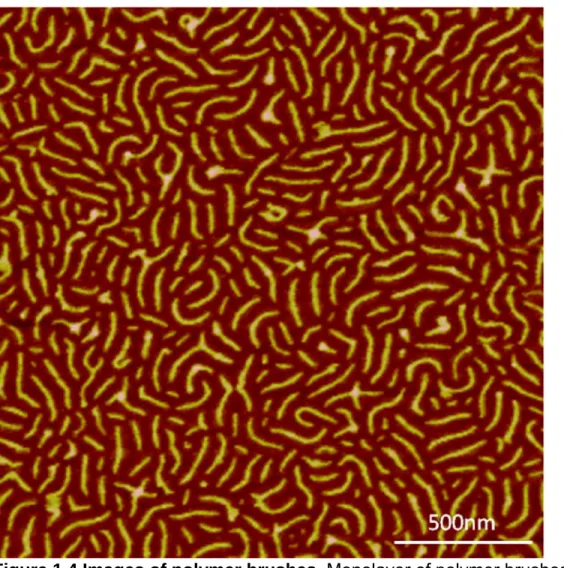
Figure 1.4 Images of polymer brushes. Monolayer of polymer brushes visualized by AFM.
1.2 Shape memory polymer and lithography.
Shape memory materials are a class of smart materials that has the ability to be deformed by application of external stress and fixed in a second, temporary shape35-41. This temporary shape is retained until the shaped body is exposed to an appropriate stimulus, which induces the recovery of the original shape. There are two types of shape memory materials, shape memory alloys and shape memory polymers. Shape memory alloys have been discovered over half a century and find numerous
fabrics42-49. The shape memory effect bases on the alloy transition from the martensite phase to the austenite phase50-53. Shape memory polymers have been developed more recently. Compared to shape memory alloys, the polymers have much lower cost and lower density, and higher elasticity, it also have high potential to develop
biocompatibility and biodegradability.
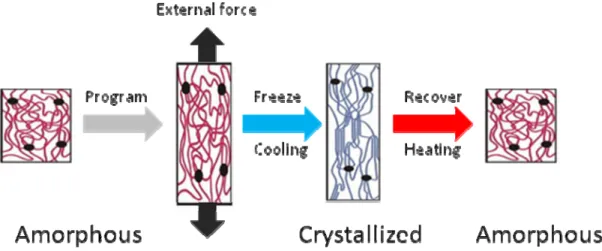
The shape memory behavior can be best described in a shape memory cycle (Figure 1.5). At a temperature higher than the SMP transition temperature, at which the material exists in a rubbery, elastic state, the material is deformed to a certain
predetermined shape by application of external force. Subsequent cooling under the constant force to a low temperature causes the material to adopt a more rigid state, in this case the semicrystalline state, therefore immobilizing the constituent polymer chains and allowing fixing or freezing of the deformation as latent strain energy. Upon unloading at the low fixation temperature, a minor instantaneous recovery may occur. The shape recovery is achieved by heating the material without any stress to a
Figure 1.5 Shape memory cycle. Sample is melted at stress free stage (high
temperature), deformed to programmed shape at melt stage under external force and fixed at frozen state (low temperature), and return to initial shape after trigger (high temperature) is applied.
A shape memory polymer is an elastic polymer networks that have stimuli-responsive switches. The initial network consists of permanent crosslinks, typically covalent chemical bonds. The polymer chains are able to perform a transition that can reversibly freeze or unfreeze their mobility. The most typical transitions in shape memory polymers are glass transition or melting-crystallization transition.
1.2.1 Triggering mechanism.
An external stimulus is required to trigger the shape memory material to recover from the fixed shape to the initial shape54-66. Majority of the shape memory material reported so far, use heat as the triggering stimulus. Direct heating is one of the most simple and fast triggering mechanism. However, in many applications, it is either inconvenient or inapplicable to apply direct heat source to the material. Indirect
trigger transition without disturbing the temperature. The other and more widely applied method is to use indirect heating to increase the temperature.
Infra red irradiation is a common method for non-contact heating. It has been demonstrated as laser activated shape memory devices. Carbon nanotubes and carbon black are often incorporate to enhance the photothermal effect and heat conduction. The drawback of the method is the low penetration depth of the infra red in many materials especially water.
Incorporating carbon nanotubes in shape memory polymers can also make the material electric conductive61,62. The electric current can also create heat since the resistance of material is very high. However, in many applications, it is difficult to maintain a complete electric circuit.
Magnetic particles can also be incorporated into the polymer to induce shape memory effect through magnetic field63-66. In an alternating magnetic field the inductive particles can generate heat to trigger the transition.
In all the indirect heating mechanisms above, there are always limitations in applicable environment, and usually requires incorporation of functional particles that can affect the materials properties of the original material. So there is demand for new triggering method for variety of shape memory polymers in a variety of environment.
1.2.2 Acoustic heating.
medium particles from their resting position. These disturbances induce a displacement of these particles and are transmitted step by step to other parts of the medium.
The energy transported in an ultrasound wave is usually characterized by an acoustic intensity I defined as the energy transmitted per unit time (usually 1 s) and per unit area (usually 1cm2) in the direction normal to the considered area. In the field of medical ultrasound, intensity is measured in W·cm−2.
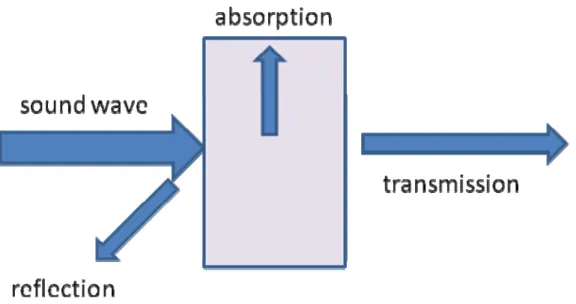
When acoustic wave interacts with a sample, part of the energy will be absorbed by the material and transformed in the form of heat (Figure 1.6). The absorption can be calculated by
x) exp(-I =
I 0
Where I is the absorbed intensity and is the absorption coefficient; x is the depth of penetration.
Different mechanisms are responsible for absorption phenomena67-69, the viscous (respectively viscoelastic) forces between neighboring particles moving with different velocities are one of the major sources of acoustic wave absorption. The absorption due to viscous forces is
3 2
2 / 4 /3
c
c
Where is the angular frequency of the sound wave, is the relaxation time, c is the sound speed, is the viscosity of the material and is the density.
Thermal transport phenomena arising from the temperature gradients in the material is another source of the absorption and is calculated as
p
T c C
c 2 3
2 / ( 1)/
is the ratio of the isobaric and isothermal heat capacities of the material, T is the coefficient of thermal conductivity and Cp is the constant pressure specific heat of
the material. Absorption of viscous forces and heat conduction together are called classic absorption.
Other models hypothesized that a significant fraction of the absorption of
acoustic waves in materials can involve a spectrum of chemical relaxation mechanisms at the molecular scale especially in macromolecules. This is also called nonclassical absorption.
The total absorption can be expressed as the sum of all the possible mechanism
chm
The acoustic heating has several major advantages over the other stimuli. It can penetrate through non-transparent media, especially human tissues which is
impenetrable for most optic techniques. The sound can also penetrate at large depth at over 10cm. Interaction of acoustic waves with a shape-memory polymer causes local heating (within an area of ca. 1 mm) the use of high intensity focused ultrasound allows discrete site-specific shape transformation in both time and space, thus enabling
surgical shape modifications one step at a time. Acoustic treatment is also a well established therapy for medical care and become a convenient choice for shape memory applications in biomedical field. We would test acoustic waves as a new triggering mechanics for shape memory polymers.
1.2.3 Acoustic lithography on shape memory materials.
Lithography has long been developed as important technique for patterning and fabrication. Recent researches focused on lithography in micro or nano scales70-88. New techniques emerges from photolithography to nanoimprint lithography, interference lithography, X-ray lithography, extreme ultraviolet lithography, magneto-lithography and scanning probe lithography.
Can localized recovery be triggered through acoustic heating on shape memory polymers?
What kind of shapes and patterns can be generated through acoustic lithography?
What is the size of the features that can be generated through acoustic lithography?
How the size and shapes are affected by the acoustic waves or material properties?
1.3 Reversible shape memory polymers.
Active polymers that can respond to external stimuli by changing their
macroscopic shapes and creating property change or mechanical motions are or great interest for material research. Generally there are two types of active polymers. One is shape memory material which is described in chapter 1.2, the other is shape changing materials89-95. Shape changing materials also based on an elastic polymer networks but adopts different mechanisms as shape memory polymers. One group of shape
as long as they are exposed to a suitable stimulus. They recover their original shape as soon as the stimulus is terminated. The shape change can be repeated several times. Unlike shape memory material where the shape change is determined by programming, the geometry of the movement of the work piece is determined by its original three-dimensional shape.
Comparing two classes of active polymers, the major advantage of shape
memory polymer is the programmability. For shape changing polymers, the motions and changes an object can perform is usually simple and pre-determined once the material has been synthesized. More complicated motions are only possible with very delicate object designing, using composite materials or micro patterning. And any object can only perform the one task it designed for, any adjustment or minor alternation means going back to the synthetic stage. In contrast, shape memory polymers have an
additional step called programming step. The programmed shape is only determined by external force exerted onto the material. It means a variety of different shapes can be assigned to one simple object, including many complicated shapes. And a shape memory material can always be reprogrammed once it returns to the original shape, which means one object is up to numerous assignments. It means shape memory materials are much easier to synthesize and more flexible in applications.
So the challenge lay on whether we could combine the programmability of the shape memory material and the reversibility of the shape changing material. Or in other words develop a reversible shape memory material.
1.3.1 One time (Pseudo) reversible shape memory polymers.
One solution to the irreversibility is to increase the shapes programmed in one shape memory cycle. When two different shapes can be programmed subsequently the material will recover from the second programmed shape to the first programmed shape before recover back to the initial shape. If the second programmed shape is designed to be the same as the initial shape and recovers, microscopically it is still a one way
transition but macroscopically the object performs a reverse motion. Such pseudo reversible material can still be valuable in many applications where only one time reverse motion is required, e.g. insertion and removal of a medical stent.
However, conventional shape memory materials are only up to remember one programmed shape in one cycle, the pseudo reversibility require a triple or multiple shape memory materials which only has made major progress until recently.
The simplest way for triple shape memory is to attach two different shape
memory materials together or using plasticizers to monitor transition temperature in part of the sample. Such material can only be programmed at separate parts and unable to perform reversible shape change.
of PCHMA and the melting transition of PCL97. The copolymer can perform a triple shape memory cycle. However, the copolymers are difficult to synthesize and the system will be extremely complex if multiple shapes are required.
An intriguing method for multi shape memory is developed based on temperature memory effect98,99. Unlike small molecules, polymers generally have broad transition through a temperature range. Specific designed polymer like nafion98 can have a broad glass transition peak over 100 degrees. The temperature memory effect demonstrates the phenomenon that the material has memory at the temperature at which it is fixed. So by programming and fixing the sample at different temperatures within the broad transition, multiple shapes can be memorized in one shape memory cycle. The phenomena are observed both in glass transition and melting transition based shape memory materials. The only drawback of the technique is the requirement to fix different shapes at every distinct temperature and as a result, usually requires specifically
designed polymers to broaden the transition. It would be attempting to further improve the technique to lower the requirement for different fixing temperatures and apply the method to most common shape memory materials.
1.3.2 Polymer crystallization.
compose larger spheroidal structures named spherulites. Many factors effect the crystallization process including molecular weight distribution, tacticity, chain
composition, cooling rate, temperature gradient and impurities ect. That means, unlike chemical bonds that are identical regardless of their formation process. Crystals are distinctive in size and hierarchy and significantly affected by the kinetic process. Like crystallization, melting is also a process when different crystals melt at different
temperature in particular order, the Thomson-Gibbs equation predicts a linear relation shape between melting point and the reciprocal of crystal thickness, or more generally smaller crystals melt first.
) 2 1 ( 0 0 h L T T c e m m 0 m
T is the melting temperature for infinitively large crystals. e is the surface energy, Lc
is the lamella thickness and 0
h
is the melting enthalpy.
So apart from the crystallization temperature, which correspond to the temperature memory effect. The sequential order of crystallization and melting in general can make different crystals formed at different stage of crystallization fix and each can memorize a programmed shape. We would investigate this new method for triple or multiple shape memory effect and apply it on one time reversible shape memory. Following questions will be answered in the later chapters:
Did the crystallization and melting of polymer crystals follow particular sequential order?
Can models be established to link the kinetic crystallization and shape memory?
Can pseudo reversible shape memory be achieved using the new protocol?
What kind of shape changes and motions can be performed reversibly with the new protocol?
What is the stability of the shapes in one pseudo reversible shape memory cycle?
What are the effects on the pseudo reversible shape memory effect?
Are there possible applications for the pseudo reversible shape memory polymer?
1.3.3 Multi-time shape memory polymers.
and the programmability, which is the major advantage over the changing polymers, is significantly reduced. Our research will focus on new protocols to make multi-time reversible shape memory without any external load and free to program as conventional shape memory polymers.
1.3.4 Memory of crystalline physical network.
Most polymers are semi-crystalline which means the crystallinity is always less than 100%, there always amorphous segments remain in a crystallized polymer sample. So in a semi-crystalline shape memory polymer, the shape is not merely held by freezing of all chain movement as in the case of glass transition. The crystals also act as additional physical crosslinks in the network. A semi-crystalline shape memory can be described as a dual network systems with a chemical network formed at the initial state during synthesis, and a physical network formed at the programmed state during fixation.
In conventional shape memory researches, the memory is only preserved in the permanent chemical network which corresponds to initial shape. The only role for switching segment is to temporarily freeze the programmed shapes, no history or memory remains through transition. In our goal to create reversible shape memory behavior, we would like to ‘teach’ the physical network to retain the memory as well as the chemical network.
the melting point. Above this size, thenucleation occurs sporadically. In heterogeneous nucleation,nucleation sites pre-exist in a sample and are activated instantaneously and kinetically much faster than the homogeneous nucleation. When a polymer is only partially melted or even above the melting point, if the melt temperature or its holding time is insufficient, remnants of the previous structure (residual crystal) can act as predetermined nucleation sites upon subsequent cooling. This phenomenon is referred to as self-seeding effect and offers memory for the partially melted crystals103. Figure 1.7 demonstrate one scenario of the effect as crystals are partially melted, the
amorphous chains are confined by neighboring remaining crystals, and the structure and position of the previous crystals are conserved and its kinetically favorable for previous crystals to reform when the crystallization starts again.
Figure 1.7 Confinement effect and Self-seeding. When a crystal is partially molten the molten chains are kinetically confined in their crystalline position and highly likely to recrystallize into the same crystals before partial melting.
We propose to create microscopically reversible change of crystals between partial melted and crystalline states, and according to independent network hypothesis, transfer the microscopic reversibility to macroscopic shape changes and demonstrate true reversible shape memory effect using semi-crystalline polymers. Our research will look into answers of the following questions:
Can polymer crystals be reversibly controlled through partial melting and crystallization?
Can new protocols be developed to transfer the microscopic reversibility to macroscopic shape change?
Can multiple cycles of reversible shape change be achieved using the new protocol?
What kind of shape changes and motions can be performed reversibly with the new protocol?
REFERENCES
1 Gabrielli, G.; Puggelli, M.; Faccioli, R. J. Colloid Interface Sci. 37, 213 (1971)
2 Gabrielli, G.; Puggelli, M.; Faccioli, R. J. Colloid Interface Sci. 86, 485–500 (1982)
3 Masami Kawaguchi, Ryuji Nishida, Compatibility of Polymer Chains at the Air/Water Interface, Langmuir. 6, 492-496,(1990)
4 E. Sackmann, Science 271 43 (1996).
5 B.A. Cornell, V.L.B. Maksvytis-Braach, L.G. King, P.D.J. Osman, B. Raguse, L. Wieczorek, R.J. Pace, Nature 387, 580 (1997).
6 M. Menke, S. Ku¨nneke, A. Janshoff, Eur. Biophys. J. 31, 317 (2002).
7 C. Yuan, J. Furlong, P. Burgos, L.J. Johnston, Biophys. J. 82, 2526 (2002).
8 P.-E. Milhiet, C. Domec, M.-C. Giocondi, N. Van Mau, F. Heitz, C. Le Grimellec, Biophys. J. 81, 547 (2001) .
9 V. Vie´, N. Mau Van, E. Lesniewska, J.P. Goudonnet, F. Heitz, C. Le Grimellec, Langmuir 14, 4574 (1998)
10 D.Y. Takamoto, M.M. Lipp, A. von Nahmen, K.Y.C. Lee, A.J.Waring, J.A. Zasadzinski, Biophys. J. 81, 153 (2001)
11 B.N. Flanders, S.A. Vickery, R.C. Dunn, J. Microsc. 202, 379 (2001).
13 P. Moraille, A. Badia, Angew. Chem. Int. Ed. 41, 4303 (2002).
14 C. Duschl, M. Liley, G. Corradin, H. Vogel, Biophys. J. 67, 1229 (1994).
15 S. Sivasankar, W. Brieher, N. Lavrik, B. Gumbiner, D. Leckband, Proc. Natl. Acad. Sci. USA 96, 11820(1999)
16 Z.W. Yu, T.L. Calvert, D. Leckband, Biochemistry 37, 1540(1998).
17 Naoyuki Aiba, Yuhtaro Sasaki, Jiro Kumaki. Langmuir. 26(15), 12703–12708 (2010)
18 Yuhtaro Sasaki, Naoyuki Aiba, Hiroshi Hashimoto, and Jiro Kumaki, Macromolecules, 43, 9077–9086. (2010)
19Liu, J; Zhang, Y; Zhang, JM, J. Phys. Chem. C, 111, 6488-6494 (2007)
20 Bourque, H.; Laurin, I.; P_ezolet, M.; Klass, J. M.; Lennox, R. B.; Brown, G. R. Langmuir 17, 5842–5849. (2001),
21
Klass, J. M.; Lennox, R. B.; Brown, G. R.; Bourque, H.; P_ezolet, M. Langmuir, 19,
333–340. (2003)
22 Pelletier, I.; P_ezolet, M. Macromolecules , 37, 4967–4973. (2004)
23 Lee,W.-K.; Iwata, T.; Gardella, J. A., Jr. Langmuir, 21, 11180–11184. (2005)
24 Park, S. Y. et al. Nature 451, 553–556 (2008).
25 Nykypanchuk, D., Maye, M. M., van der Lelie, D. & Gang, O. Nature 451, 549–552 (2008).
27 Sacana, S., Irvine, W.T.M., Chaikin, P.M., Pine, D.J. Nature 464, 575-578 (2010).
28 Chen, Q., Bae, S.C., Granick, S. Nature 469, 381-385. (2011).
29 Glotzer, S. C. & Solomon, M. J. 6, 557–562 (2007).
30 Mann, S. Nature Mater. 8, 781–792. (2009)
31 Liu, K. et al. Science 329, 197–200. (2010)
32 Shevchenko, E. V., Talapin, D. V., Kotov, N. A., O’Brien, S. & Murray, C. B. Nature
439, 55–59. (2006)
33 Leunissen, M. E. et al. Nature 437, 235–240 (2005).
34 Bartlett, P. & Campbell, A. I. Phys. Rev. Lett. 95, 128302 (2005).
35 Lendlein A, Kelch S. Angew. Chem. Int. Ed. 412034–57 (2002)
36 Liu C, QinH,Mather PT. J. Mater. Chem. 17 1543–58 (2007)
37 Dietsch B, Tong T. J. Adv.Mater. 39, 3–12 (2007)
38 Gunes IS, Jana SC. J. Nanosci. Nanotechnol, 1616–37 (2008)
39 Mano JF. Adv. Eng. Mater.10, 515–27 (2008)
40 Ratna D, Karger-Kocsis J. J. Mater. Sci. 43:254–69 (2008)
43 Mondal, S., and Hu, J. L., Indian J. Fibre Textile Res. 31, 66 (2006)
44 Charlesby, A., Atomic Radiation and Polymers, Pergamon Press, New York, 198 (1960)
45 Campbell, D., et al.In 46th AIAA/ASME/ASCE/AHS/ASC
Structures, Structural Dynamics, and Materials Conference, Austin, Texas, (2005)
46 Hussein, H., and Harrison, D.In Designand Manufacture for Sustainable Development 2004, Bhamra, T., and Hon, B.(eds.), Wiley-VCH, Weinheim, (2004)
47 Wache, H. M., et al., J. Mater. Sci.: Mater. Med. 14, 109 (2003)
48 Lendlein, A., and Langer, R., Science 296, 1673 (2002)
49 Metcalfe, A., et al., Biomaterials, 24, 491 (2003)
50 H. Funakubo, Shape Memory Alloys, Gordon and Breach Science Publishers, New York, NY, USA, (1987)
51 C. M. Wayman, Progress in Materials Science, vol. 36, no.1, pp. 203–224, (1992)
52 K. Otsuka and C. M. Wayman, Shape Memory Materials, Cambridge University Press, Cambridge, Mass, USA, (1998)
53 K. Otsuka and X. Ren Progress in Materials Science, vol. 50, no. 5, pp. 511–678, (2005)
54Lv HB, Leng JS, Liu YJ, Du SY. Adv. Eng. Mater.10:592–95 (2008)
55 Chen MC, Tsai HW, Chang Y, Lai WY, Mi FL, et al. Biomacromolecules 8:2774–80 (2007)
57 Small W, Metzger MF,Wilson TS, Maitland DJ. IEEE J. Sel. Top. Quantum Electron. 11:892–901 (2005)
58 Small W,Wilson TS, Benett WJ, Loge JM, Maitland DJ. Opt. Expr. 13:8204–13 (2005)
59 Yu YL, Ikeda T. Macromol. Chem. Phys. 206:1705–8 (2005)
60 Sahoo NG, Jung YC, Goo NS, Cho JW. Macromol. Mater. Eng. 290:1049–55
61 Leng JS, Lv HB, Liu YJ, Du SY. Appl. Phys. Lett. 91:144105 (2005)
62 Leng JS, Lan X, Liu YJ, Du SY, Huang WM, et al. Appl. Phys. Lett. 92:014104 (2008)
63 Hazelton CS, Arzberger SC, Lake MS, Munshi NA. J. Adv. Mater. 39:35–39 (2007)
64 Mohr R, Kratz K,Weigel T, Lucka-Gabor M, Moneke M, Lendlein A. Proc. Natl. Acad. Sci. USA 103:3540–45 (2006)
65 Schmidt AM. Macromol. Rapid Commun. 27:1168–72 (2006)
66 Buckley PR, McKinley GH, Wilson TS, Small W, Benett WJ, et al. IEEE Trans. Biomed. Eng. 53:2075–83 (2006)
67 A. P. Bovsunovsky, Eng. Fract. Mech., 71, 2271-2281 (2004)
68 A. L. Audenino, V. Crupi, E. M. Zanetti, Int. J. of Fatigue, 25, 343–351 (2003)
69 R. B. Mignogna, R. E. Green Jr, J. C. Duke Jr, E. G. Henneke II, K. L. Reifsnider, Ultrasonics, (1981)
71 Gates BD, Xu Q, Stewart M, Ryan D, Willson CG, Whitesides GM. Chem. Rev. 105: 1171–1196. (2005)
72 Xia, Y.; Kim, E.; Zhao, X.-M.; Rogers, J. A.; Prentiss, M.; Whitesides, G. M. Science, 273, 347. (1996)
73 Chou, S. Y.; Krauss, P. R.; Zhang, W.; Guo, L.; Zhuang, L. J. Vac. Sci. Technol. B, 15, 2897.(1997)
74 Chou, S. Y.; Krauss, P. R.; Renstrom, P. J. Science, 272, 85. (1996)
75 Xia, Y.; Whitesides, G. M. Angew. Chem., Int. Ed. Engl. 37, 550. (1998)
76 Xia, Y.; Rogers, J. A.; Paul, K. E.; Whitesides, G. M. Chem. Rev. 99, 1823. (1999)
77 Gates, B. D.; Xu, Q.; Love, J. C.; Wolfe, D. B.; Whitesides, G. M. Annu. Rev. Mater. Res. 34, 339.(2004)
78 Xia, Y.; Whitesides, G. M. Annu. Rev. Mater. Sci. 28, 153. (1998)
79 Eigler, D. M.; Schweizer, E. K. Nature 344, 524. (1990)
80 Quate, C. F. Surf. Sci. 386, 259. (1997)
81 Piner, R. D.; Zhu, J.; Xu, F.; Hong, S.; Mirkin, C. A. Science 283, 661.(1997)
82 Ginger, D. S.; Zhang, H.; Mirkin, C. A. Angew. Chem., Int. Ed. 43, 30. (2004)
83 Kraemer, S.; Fuierer, R. R.; Gorman, C. B. Chem. Rev. 103, 4367. (2003)
85 Aizenberg, J.; Black, A. J.; Whitesides, G. M. Nature 398, 495. (1999)
86 Aizenberg, J.; Black, A. J.; Whitesides, G. M. Nature 394, 868. (1998)
87 Flanders, D. C.; White, A. E. J. Vac. Sci. Technol. 19, 892. (1981)
88 Xu, Q.; Gates, B.; Whitesides, G. M. J. Am. Chem. Soc. 126, 1332. (2004)
89 OSADA, Y; MATSUDA, A, NATURE, 376, 6537, 219-219 (1995)
90 Behl, Marc; Zotzmann, Joerg; Lendlein, Andreas, S, Advances in Polymer Science, 226, 1-40 (2010)
91 Yu, Haifeng; Ikeda, Tomiki, ADVANCED MATERIALS, 23, 19, 2149-2180 (2011)
92 Kobatake, Seiya; Takami, Shizuka; Muto, Hiroaki; et al, NATURE, 446, 7137, 778-781 (2007)
93 Yu, YL; Nakano, M; Ikeda, T, NATURE, 425, 6954, 145-145 (2003)
94 Miyata, T; Asami, N; Uragami, T, NATURE, 399, 6738, 766-769 (1999)
95 Camacho-Lopez, M; Finkelmann, H; Palffy-Muhoray, P; et al, NATURE MATERIALS, 3, 5, 307-310 (2004)
96 I. Bellin, S. Kelch, R. Langer and A. Lendlein, Proc. Natl. Acad. Sci. U. S. A. 103(48), 18043–18047. (2006)
98 Xie, Tao, NATURE, 464, 7286, 267-270 (2010)
99 Kratz, Karl; Madbouly, Samy A.; Wagermaier, Wolfgang; et al, ADVANCED MATERIALS, 23, 35, 4058-+ (2011)
100 Zotzmann, Joerg; Behl, Marc; Hofmann, Dieter; et al, ADVANCED MATERIALS, 22, 31, SI, 3424-3429 (2010)
101 Behl, Marc; Zotzmann, Joerg; Lendlein, Andreas, INTERNATIONAL JOURNAL OF ARTIFICIAL ORGANS, 34, 2, 231-237 (2011)
102 Pandini, S.; Passera, S.; Messori, M.; et al, Polymer, 53, 1915-1924 (2012)
103 Mamun, Al; Umemoto, Susumu; Okui, Norimasa; et al, MACROMOLECULES, 40, 17, 6296-6303 (2007)
104 Svaneborg, Carsten; Everaers, Ralf; Grest, Gary S.; et al, MACROMOLECULES, 41, 13, 4920-4928 (2008)
CHAPTER 2: PERFECT MIXING OF IMMISCIBLE MACROMOLECULES AT FLUID INTERFACES
2.1 Introduction.
Mixing of chemically incompatible substances is a canonical problem limiting advances in fields ranging from health care to materials engineering. It is particularly challenging for large species such as macromolecules and colloidal particles that acquire miniscule gains in translational entropy on mixing. Self-assembly of chemically different moieties has been demonstrated in various systems, including coordination complexes, supramolecular structures, and colloidal lattices1-13. In all these systems however, the mechanisms of mixing largely rely on specific interfacing of chemically, physically or geometrically complementary objects. Here, we present an assembly strategy that does not require any specifically encoded complementarity. Long range arrays of perfectly mixed, i.e., intercalated, macromolecules are obtained at a fluid interface via entropic release of steric repulsion between brush-like polymers. The net repulsion derives from a significant increase of conformational entropy of polymeric branches with increasing distance between adjacent macromolecules creating so-called entropic traps that readily attract other species independent of their chemical
2.2 Experimental.
2.2.1 Materials.
All linear polymers are purchased from the Polymer Source, and listed on the table 2.1
Table 2.1 Molecular weight and molecular distribution of linear polymers
Linear polymer Mn Mw/Mn
PDMA-1 2.31105 1.90
PDMA-2 1.99106 2.50
PBA-1 1.44103 1.14
PBA-2 3.11103 1.16
PBA-3 4.12104 1.13
PBA-4 7.70104 1.15
PBA-5 2.26105 1.13
PBA-6 1.13106 1.18
PDMS 8.0103 1.30
Brush polymers are chosen as the modal molecules and were synthesized in Professor Matyjaszewski’s group at Carnegie Mellon University using a polymerization method known as atom transfer radical polymerization (ATRP)14-16. ATRP is a controlled radical polymerization technique, which results in molecules with a narrow distribution of molecular weights, i.e. a low polydispersity index. Low polydispersity gives much better control of the polymer shape and properties which is a major advantage of ATRP over other synthetic techniques as free radical polymerization. The synthesis of a linear polymer via ATRP involves the use of an initiator molecule, commonly alkyl halides, to initiate the polymerization. The halide atom in the initiator will reversibly bind to a
able to rebind to chain end, thus temporarily deactivating the reaction site and starting the process over again.
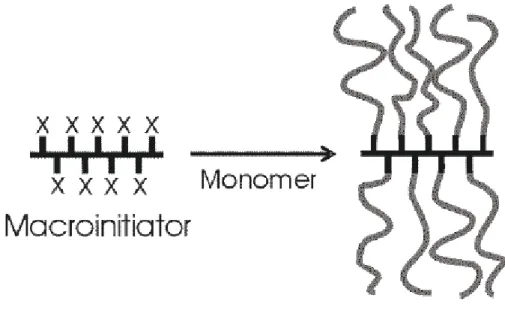
The synthesis of the polymer brushes consists two steps. First, a macroinitiator, which becomes the backbone of the polymer, is synthesized. In this specific case PBPEM (poly(2-(2-bromopropionyloxy)ethyl methacrylate)) with the same degree of polymerization is used as backbone. Second, monomers were grafted from this backbone (Figure 2.1) using ATRP which allowed for the controlled growth of side chains. Two types brush with two different side chains are synthesized one is the hydrophobic PBA(polybutylacrylate), the other is hydrophilic PDMA(poly
dimethylacrylamide). Brushes with different side chain DPs are listed in table 2.2
Table 2.2 Molecular weight and molecular distribution of brush polymers and DP of side chains.
Brush polymer DP of side chains Mn Mw/Mn
PDMA-brush-1 70 2.46106 1.20
PDMA-brush-2 97 5.12106 1.22
PDMA-brush-3 121 6.36106 1.17
PBA-brush-1 38 9.97105 1.27
PBA-brush-2 55 3.26106 1.14
PBA-brush-3 80 4.69106 1.21
The star polymer was synthesized by Professor Tsukruk’s group in Georgia Institute of Technology17. The PSn(P2VP-PtBA)n heteroarm polymer stars were prepared through a multi-step sequential anionic living polymerization. PS arms was formed by reacting sBuLi with styrene, the active PS arms reacted with DVB forming star polymer with polyDVB core and PS arms. Second generation of arms was generated from polymerization of 2VP, the living ends of P2VP arms initiate polymerization of PtBA forming PSn(P2VPPtBA)n heteroarm star block terpolymer. The
Figure 2.2 Synthesize of polymer stars. Schematic of synthesize of polymeric stars
Name Mw Total arms Dp of PS Dp of P2VP Dp of PtBA
PSn(P2VP-PtBA)n 717,000 44 34 136 119
2.2.2 Langmuir- Blodgett monolayer preparation.
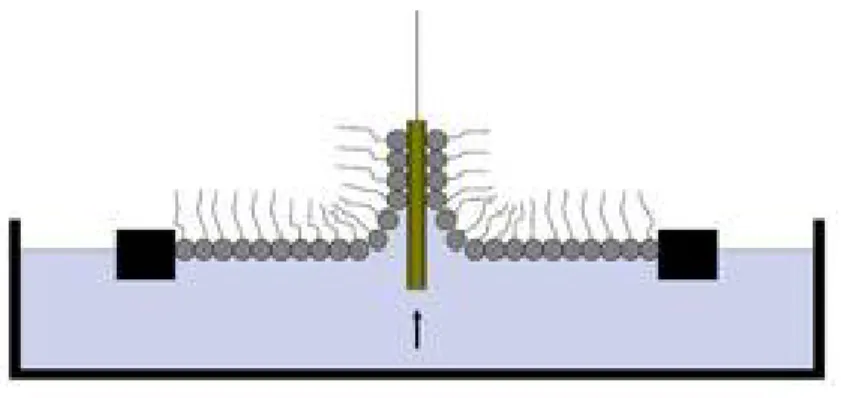
Langmuir- Blodgett (LB) method is an important method to prepare thin films since it can yield both molecularly thin films18, as well as multilayered films. When a solution of an amphiphile in a water insoluble solvent is placed on a water surface with a micro syringe, the solution spreads rapidly to cover the available area. As the solvent evaporates, a monolayer is formed. When the available area for the monolayer is large the distance between adjacent molecules is large and their interactions are weak. The monolayer can then be regarded as a two-dimensional gas. Under these conditions the monolayer has little effect on the surface tension of water. If the available surface area of the monolayer is reduced by a barrier system (Figure 2.3) the molecules start to exert a repulsive effect on each other. This two-dimensional analogue of a pressure is called surface pressure and is given by the following relationship:
0
Where is the surface tension in absence of a monolayer and 0 is the surface tension with the monolayer present.
Important thin film properties are given by measuring the surface pressure as a function of the area of water surface available to each molecule. This is carried out at constant temperature and is known as a surface pressure - area isotherm.
Figure 2.3 Langmuir trough. Schematic illustration of a Langmuir film balance with a Wilhelmy plate balance measuring the surface pressure, and barriers for reducing the available surface area.
Figure 2.4 LB transfer. Schematic illustration of a LB transfer of monolayer to a substrate.
In our research, surface Pressure-Monomeric Area (π-A) Isotherm is measured by LB KSV-5000 instrument equipped with a Wilhemy plate balance. Solution of brush poly(n-butyl acrylate) (PBA, Mn= 3.26x 10⁶ and poly(dimethylacrylamide) (PDMA, Mn=2.46 x 10⁶) in chloroform and their mixture were prepared. The dilute solution was deposited onto the water surfaces in LB trough at room temperature. 20 minutes were allowed for the solvents to evaporate before compression. The compression rate is 10mm/min. The monomeric area is determined by dividing the surface area by total number of monomers contained in deposited molecules.
at a compression rate of 10mm/min, and was transferred to newly cleaved mica while the program controlled constant pressure. The pulling rate of the mica was 5mm/min.
2.2.3 Atomic Force Microscopy.
Atomic force microscopy (AFM) resolves the interactions between the sample and the imaging probe19. It is a very high-resolution type of scanning probe microscopy, and the resolution can reach nanometers in scale.
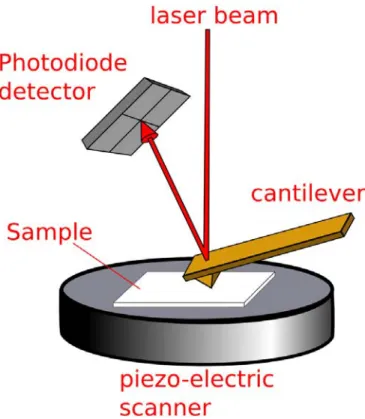
The AFM consists of 3 major components: the probe tip, the detection system, and the scanning peizo (Figure 2.5). The probe tip is the sensor which collects the force information by interacting with the local force fields of the sample. It consists of a very sharp tip on the edge of a cantilever which deflects upon attraction or repulsion from the surface. A focused laser on the back of the cantilever is directed towards a quad photo detector which can measure the deflection of the laser as the cantilever moves. The sample is controlled by a sensitive peizo system that scans the sample underneath the tip with nanometer precision.
Tapping mode operates by using a current to oscillate the cantilever and
measures differences in its deflection as it passes over objects of different height. This method is preferred over contact AFM which slides the probe tip over the surface because it is less destructive when measuring soft or fragile samples. Since the
backbone on our brush molecules have excellent height contrast, this method is ideal to image films of these polymers.
In addition to measuring a sample’s height, tapping mode can produce an image based on contrasting adhesion and viscoelastic properties. This imaging method is known as phase imaging, the AFM detects changes in the phase of the oscillation of the AFM tip as it comes in contact with the surface. A soft sample will shift the tips phase to a different degree than a hard sample and likewise attractive, adhesive, and repulsive samples will all have different effects on the phase of the oscillations.
cantilevers (Mikromasch-USA) with a resonance frequency of about 160 kHz and a spring constant of about 5 N/m.
2.3 PDMA
brushes
on
water
surface.
Hydrophilic polymers such as poly dimethylacramide (PDMA) can spread on the water surface and form stable monolayers. The stability is tested by running
consecutive isotherm curves. As shown in figure 2.6a, two full cycles of isotherms had been performed on PDMA brush monolayers from gaseous state to 7mN/m, the curves are fully reversible and no shift is observed, indicating the film is stable at this given pressure range. The films can be unstable when further compressed. As shown in figure 2.6b, there is clear shift from each cycle which indicates part of the film has been
dissolved into the water. The stability is mainly affected by the molecular weight of the polymer, small linear PDMA are easily dissolved at lower pressure while large linear or brush polymers are relatively stable in our experiment conditions.
Figure
2.6
Stability
of
PDMA
brush
at
water
surface.
(a) two cycles of isotherms forPDMA brushes(Mn=2.46 x 10⁶) from 0 to 7mN/m. (b) two cycles of isotherms for PDMA brushes(Mn=2.46 x 10⁶) from 0 to 8mN/m
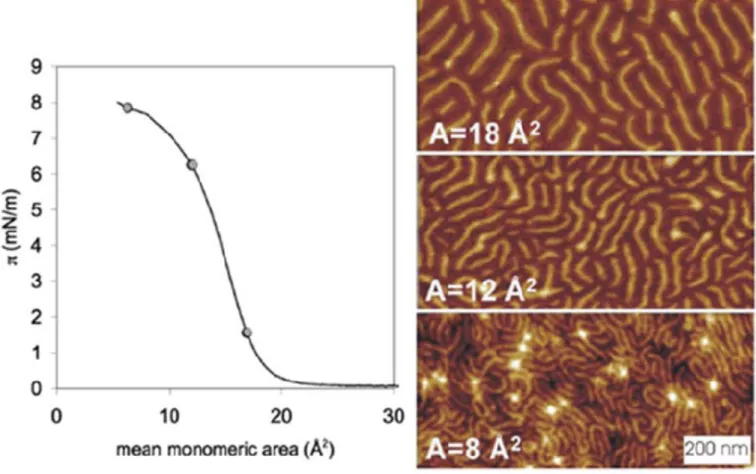
Combining the AFM and LB techniques provides a facile method for studying conformational changes in single molecules. For PDMA brushes (see Fig.2.7), the brush spread on the surface and the repulsion cause the backbone to be extended at low pressure. As the pressure increases, the distance between molecules gradually decreases, while the contour length of the molecules remains the same. The molecules eventually become very closely packed, adopting a cylindrical shape. The transition occurs at around 6mN/m making them conformationally frustrated20.
Figure
2.7
Conformation
change
of
PDMA.
Conformation change of hydrophilic PDMA brush(Mn=5.12x 10⁶) under compression
2.4 Conformational entropy induced brush brush mixing.
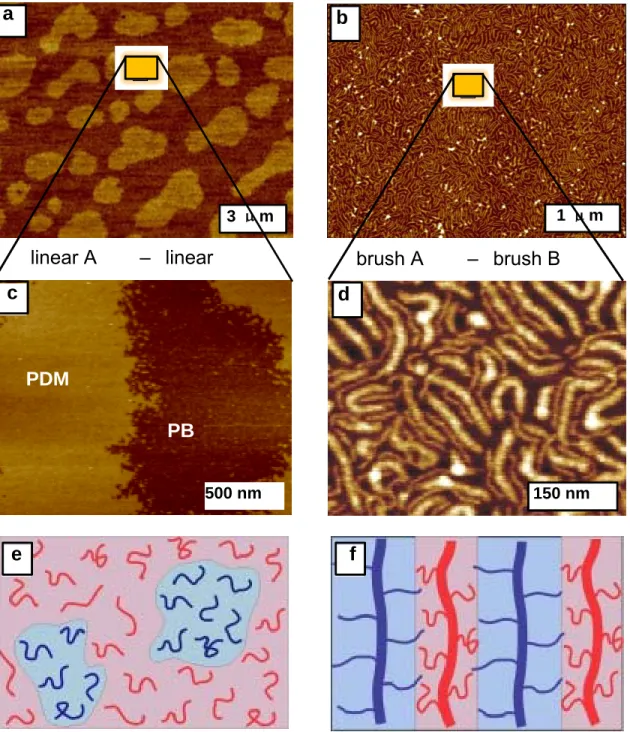
Chemically different large molecules are difficult to mix as shown in Figure 2.8a, where a mixture of linear poly(n-butylacrylate) (PBA) and linear poly(dimethylacrylamide) (PDMA) undergo phase separation when deposited on a substrate. The marginal role of the translational entropy highlights a challenging problem of how to enhance
orientational and conformational contributions to Sm, and shift the free energy balance
towards mixing. As discussed, this can be achieved through modification of
macromolecular architecture by tethering multiple linear chains to a single branching center or line. Dense grafting results in a conformationally frustrated system, where an increase in volume fraction of branched macromolecules (either in solution or at
interface) causes stretching of polymer chains and thus significant decrease of
conformational entropy. In this case, mixing of the conformationally frustrated (“charged”) macromolecules with conformationally relaxed (“neutral”) species such as nanoparticles and collapsed polymers, may reduce stretching of polymer branches and thus enhance the net entropy of mixing. This enhancement has been demonstrated for molecular brushes, in which every monomeric unit of a polymer backbone carries a long polymer side-chain, thus resulting in an extremely densely-branched system. Figure 2.8b shows a monolayer of a 50/50 mol/mol mixture of PBA and PDMA bottlebrushes. Unlike phase separation of linear polymers in Figure1a, monolayers of the corresponding
Figure
2.8
Comparison
between
linear
and
brush
mixing
The AFM height image of (a,c) linear PBA (Mn=2.26×10⁵) mixed with linear PDMA (Mn= 2.31×10⁵) transferred to a mica substrate at 1mN/m, (b,d) a 50/50 mol.% mixture of PBA (Mn=9.97×10⁵) and PDMA (Mn=6.36×10⁶) brushes prepared at a film pressure of 7mN/m
500 nm
3 m 1 m
b a
c
PB PDM
150 nm
d
linear A – linear brush A – brush B
2.5 Mixing with molecules of different architectures.
2.9c shows AFM micrographs of the LB monolayers of mixtures of the hydrophilic PDMA bottlebrushes finely mixed with hydrophobic PSn(P2VP-b-PtBA)m stars that prefer to concentrate in between the wormlike PDMAs .
Figure
2.9
Brush
mixed
with
other
systems
The AFM height image of (a)a mixture of PBA brush (Mn= 3.26×10⁶ ) and linear PDMA(Mn=1.99×10⁶), (b) a mixture of linear PBA and brush PDMA (Mn=6.36×10⁶), and (c) 50/50 wt% mixture of PDMA brushes (Mn=2.46×10⁶) and PSn(P2VP-b-PtBA)m heteroarm stars (Mn=7.17×10⁵).
200 nm 200 nm
a b
linear A – brush B
200 nm
c
brush A – star B
PDM
PB
2.6 Mixing mechanism.
Figure 2.10 explains the concept of conformational enhancement of molecular mixing at liquid/air interfaces leading to intercalation of chemically different species (Fig. 2.10a). This concept differs from others where the ineffectiveness of the translational entropy was ameliorated by short1-3 and long-range9-11 specific attractions (Fig. 2.10b) and/or depletion forces (Fig. 2.10c) that require particular complementarity of the objects’ shapes, sizes, and chemical composition. In the entropic templating (ET) mechanism exploited here, global segregation is prevented since the mixing process includes a significant increase of one component’s conformational entropy (TSc Hm).
(Fig. 2.10f). Effectively, the diluent species play a role of spacers that may have a different chemical compositions or shapes, e.g. nanoparticles, linear chains, and branched macromolecules. Juxtaposing a hydrophobic diluent next to the hydrophilic polymer brush results in energetically unfavorable contacts (Hm 0), but this energetic