Association between in utero zidovudine
exposure and nondefect adverse birth outcomes:
analysis of prospectively collected data from the
Antiretroviral Pregnancy Registry
V Vannappagari,a,bN Koram,cJ Albano,dH Tilson,bC Geee
aEpidemiology and Real World Evidence, ViiV Healthcare, Research Triangle Park, Raleigh, NC, USAbGillings School of Global Public Health, University of North Carolina-Chapel Hill, Chapel Hill, NC, USAcWorldwide Epidemiology, GlaxoSmithKline, Research Triangle Park, Raleigh, NC, USAdINC Research, Post Approval & Strategic Services, Raleigh, NC, USAeINC Research, Biostatistics, Wilmington, NC, USA
Correspondence: V. Vannappagari, 5 Moore Drive, Mail Stop: A.2412, PO Box 13398, Research Triangle Park, NC 27709-3398, USA. Email [email protected]
Accepted 24 May 2015. Published Online 12 August 2015.
ObjectiveTo examine the association between nondefect adverse birth outcomes and in utero exposure to zidovudine (ZDV)-containing regimens versus non-ZDV antiretroviral (ARV) regimens.
DesignAnalysis of prospectively-collected data.
SettingGlobal.
PopulationHIV-infected pregnant women prenatally exposed to antiretrovirals.
MethodsEstimation of prevalence of and risk for nondefect adverse birth outcomes among HIV-infected women.
Main outcome measuresPrevalence of and risk for nondefect adverse birth outcomes.
ResultsAmong 12 780 singleton birth outcomes with in utero ZDV exposure, 96.1% were live births; 3.9% were spontaneous abortions, induced abortions or stillbirths. Among live births, 16.4% were low birthweight (LBW); 12.3% were premature. Among 1904 outcomes with in utero exposure to non-ZDV ARV regimens, 85.8% were live births; 14.2% were spontaneous abortions, induced abortions or stillbirths. Among live births,
14.1% were LBW; 12.4% were premature. Relative risk comparing exposure to ZDV-containing ARV regimens to non-ZDV ARV regimens for spontaneous abortions was 0.18 (95% confidence interval [95% CI] 0.14–0.22); induced abortions 0.28 (95% CI 0.22–0.36); stillbirths 0.76 (95% CI 0.51–1.12); premature births 1.00 (95% CI 0.87–1.15) and LBW 1.17 (95% CI 1.02–1.33).
ConclusionPrevalence of nondefect adverse birth outcomes is lower among outcomes with in utero ZDV exposure versus in utero non-ZDV ARV exposure. The risks for spontaneous and induced abortions were no different for ZDV-containing regimens versus non-ZDV ARV regimens. For premature births and stillbirths, there was no significant difference in risk between the two regimens. The risk of LBW was statistically significantly higher among ZDV-containing regimens versus non-ZDV ARV regimens.
Keywords Epidemiology HIV, pregnancy outcomes, zidovudine.
Tweetable abstractZDV-containing regimens do not increase the risk for nondefect adverse birth outcomes.
Please cite this paper as: Vannappagari V, Koram N, Albano J, Tilson H, Gee C. Association between in utero zidovudine exposure and nondefect adverse birth outcomes: analysis of prospectively collected data from the Antiretroviral Pregnancy Registry. BJOG 2016;123:910–916.
Introduction
Zidovudine (ZDV) was the first antiretroviral (ARV) to be approved for treatment of HIV/AIDS in the USA. WHO guidelines for first-line regimens for HIV-positive pregnant women include ZDV.1,2
2.5–3.3)3*. This proportion is not significantly higher than those reported in the APR’s two population-based com-parators, the Metropolitan Atlanta Congenital Defects Pro-gram (the Centers for Disease Control and Prevention’s birth defects surveillance system) with 2.72 per 100 live births4and the Texas Birth Defects Registry with a reported rate of 4.17 per 100 live births.5 Among first-trimester ZDV exposures, the APR reports no increase in the risk of overall birth defects, nor in the risk of birth defects in the cardiovascular and genitourinary systems.6 The prevalence of birth defects among women with first-trimester ZDV exposure is 3.2% (95% CI 2.7–3.8%).3 The complete APR interim report is available online at http://www.apregistry.-com/forms/interim_report.pdf.
The full prescribing information for ZDV in the USA suggests that although no differences in pregnancy-related adverse events between pregnant women with ZDV expo-sure compared with those with placebo expoexpo-sure have been observed, animal studies have shown teratogenicity, result-ing in a US Food and Drug Administration Pregnancy Cat-egory C status. In this analysis, we examine the association between adverse pregnancy outcomes other than birth defects and the use of ZDV-containing regimens during pregnancy, compared with non-ZDV ARV regimens.
Methods
This is a secondary analysis of data from the APR from 1 January 1989 through to 31 July 2013. The APR is described in detail in a previous analysis.7 Briefly, the APR is a pregnancy registry that monitors for early signal of increased risk for birth defects following prenatal exposure to ARVs. The majority of case reports are from the USA and its territories (77.6%); the remaining reports are from 66 other countries.3
Pregnant women prenatally exposed to any ARV are prospectively registered before the birth outcome being known, and are followed through to the end of the preg-nancy. Data on maternal risk factors and birth outcomes are also collected. The APR has institutional review board
(IRB) approval from Western IRB, and was granted a waiver from obtaining informed consent.
A birth outcome is defined at the time of delivery or fetal loss, or when a defect detected on a prenatal test is reported at enrolment. Although the APR also collects data from clinical trials and retrospective studies, the primary APR cohort is limited to prospectively registered women. Only singleton births are included in the current analysis; multiple births such as twin and triplet births are excluded because of the increased risk of adverse outcomes associ-ated with such pregnancies.8–10 We also compare in utero ZDV exposure at any time during pregnancy to in utero non-ZDV exposure, because drug exposure at any time during pregnancy may be relevant for birth outcomes.
Gestational weeks are calculated starting from the first day of the last menstrual period. If the date of the last menstrual period is unknown, the estimated delivery date is used. If gestational week is inconsistent with exposure dates and/or the date of outcome (outside 1 week for the first trimester, outside 2 weeks for the second and third trimesters), a corrected estimated delivery date where ultrasound data are available is used.
The following adverse birth outcomes other than birth defects are included in our analyses: spontaneous and induced abortions, stillbirths, premature births (<37 weeks gestation), very premature births (<32 weeks gestation), low birthweight (LBW; <2500 g) and very low birthweight (VLBW; <1500 g). The APR defines spontaneous abortion as death of a fetus or expulsion of the products of concep-tion before 20 weeks gestaconcep-tion. A stillbirth is defined as the death of a fetus occurring at 20 weeks of gestation or more, or for situations in which the gestational age is unavailable, a fetus weighing at least 500 g.
Statistical analysis
The prevalence of nondefect adverse birth outcomes was estimated, and the relative risks and 95% CI comparing outcomes with prenatal exposure to ZDV-containing regi-mens versus exposure to non-ZDV ARV regiregi-mens were cal-culated. Depending on whether the data analysed were continuous or categorical, the independentt-test or Fisher’s exact test was used to calculate P-values. Unknown or missing values were excluded from the analysis. For sponta-neous losses, induced abortions and stillbirths, prevalence was estimated using the total number of pregnancies as the denominator, with the 95% CI based on the Clopper– Pear-son exact binomial method.11,12For prematurity and LBW, prevalence was estimated using the total number of live singleton births as the denominator. Outcomes with birth defects, and all outcomes with unknown gestational age or unknown birthweight, were excluded. The 95% CI were calculated using the Clopper–Pearson exact binomial method. Relative risks were calculated comparing *The APR Advisory Committee Consensus Statement3: In reviewing all
ZDV-containing regimens to non-ZDV ARV regimens. The 95% CI for the relative risks were calculated using the nor-mal asymptotic method. All analyses were performed using SAS v9.3 (SAS Institute Inc., Cary, NC, USA).
Results
Maternal demographics
Of the 14 950 pregnancies from prospectively registered HIV-infected women for which outcome is known, 14 684 were singleton pregnancies, 262 were pregnancies with twins and four were with triplets. Pregnancies with multi-ple outcomes were excluded from all subsequent analyses.
Of the 14 684 singleton pregnancy outcomes, 12 780 were prenatally exposed to ZDV in any trimester; 1904 had prenatal non-ZDV ARV exposure. Table 1 describes mater-nal demographics for these two groups. We found no dif-ference between groups in baseline CD4 counts; however, women exposed to non-ZDV ARV combinations were older. A higher proportion of Hispanic women were on ZDV-containing regimens compared with non-ZDV ARV
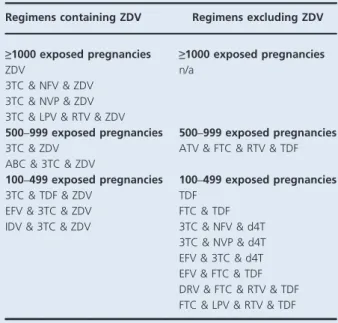
regimens (Table 1). A listing of ZDV-containing regimens and non-ZDV regimens is presented in Table 2.
Among the 12 780 singleton pregnancies with in utero ZDV exposure, 96.1% were live births, and 3.9% were non-defect adverse outcomes (spontaneous abortions 1.3%; induced abortions 1.4%; stillbirths 1.2%). When restricted to ZDV exposures in the first trimester, the prevalence of spontaneous abortions increased to 3.7% and induced abortions increased to 4.2%. Among live births, 16.4% had LBW<2500 g, 2.1% had VLBW <1500 g, 12.3% were pre-mature<37 weeks gestation, and 2.2% were very premature
<32 weeks gestation. Among 1904 outcomes with in utero non-ZDV ARV regimen exposure, 85.8% were live births and 14.2% resulted in nondefect adverse outcomes (sponta-neous abortions 7.6%; induced abortions 5.1%; stillbirths 1.5%). When restricted to non-ZDV exposures in the first trimester, the proportion of spontaneous abortions increased to 9.6% and induced abortions increased to 6.4%. Among live births, 14.1% had LBW <2500 g, 1.9% had VLBW <1500 g, 12.4% were premature <37 weeks of gestation, and 2.1% were very premature <32 weeks of
Table 1.Maternal characteristics: singleton prospective pregnancies by ZDV exposure during pregnancy among HIV-infected women reported to the APR through to 31 July 2013 with outcome
Characteristic Overall Regimens containing ZDV Regimens excluding ZDV P-value
Number of pregnancies 14 684 12 780 1904
Age (years)*
n 14 608 12 725 1883 <0.0001
Mean (SD) 28.2 (6.04) 27.9 (6.00) 30.0 (6.00)
Median (interquartile range) 28.0 (9.0) 28.0 (9.0) 30.0 (8.0)
Minimum–Maximum 13–55 13–55 14–48
Missing 76 (0.5%) 55 (0.4%) 21 (1.1%)
Race,n(%)**
White 2272 (15.5) 1969 (15.4) 303 (15.9) <0.0001
Black 8682 (59.1) 7506 (58.7) 1176 (61.8)
Hispanic 2915 (19.9) 2623 (20.5) 292 (15.3)
Asian 128 (0.9) 99 (0.8) 29 (1.5)
Other 402 (2.7) 333 (2.6) 69 (3.6)
Missing 285 (1.9) 250 (2.0) 35 (1.8)
CD4+T-cell categories at start of pregnancy,n(%)**
≥500ll 4561 (31.1) 3966 (31.0) 595 (31.3) 0.1071
200–499ll 6583 (44.8) 5692 (44.5) 891 (46.8)
<200ll 2407 (16.4) 2122 (16.6) 285 (15.0)
Unknown 77 (0.5) 64 (0.5) 13 (0.7)
N/A 24 (0.2) 13 (0.1) 11 (0.6)
Missing 1032 (7.0) 923 (7.2) 109 (5.7)
Country of reported origin,n(%)
USA 11 872 (80.8) 10 684 (83.6) 1188 (62.4) <0.0001
Other 2808 (19.1) 2093 (16.4) 715 (37.6)
Missing 4 (0.0) 3 (0.0) 1 (0.1)
Percentages are based on the number of pregnancies; pregnancies include 266 multiple gestation births (262 twin and four triplet). *P-value is based on the independentt-test.
gestation (Table 3). For APR overall, 8.6% of term deliver-ies (≥37 weeks) were LBW <2500 g. Among pregnant women with exposure to ZDV-containing regimens, 8.8% of term deliveries (≥37 weeks) were LBW <2500 g; among those with non-ZDV ARV exposure, 7.0% of term deliver-ies were LBW.
The relative risks comparing exposure to ZDV-contain-ing regimens with non-ZDV ARV regimens were 0.18 (95% CI 0.14–0.22;P< 0.0001) for spontaneous abortions; 0.28 (95% CI 0.22–0.36;P <0.0001) for induced abortions; 0.76 (95% CI 0.51–1.12;P=0.17) for stillbirths; 1.00 (95% CI 0.87–1.15; P =0.97) for preterm births; and 1.17 (95% CI 1.02–1.33;P=0.02) for LBW (Table 3).
The relative risks for spontaneous abortions and induced abortions were significantly lower in the ZDV-exposed group. The risks for stillbirths and preterm births were similar between the two groups. The risk for LBW was sta-tistically significantly higher among those with prenatal exposure to ZDV.
Discussion
Main findings
A higher proportion of nondefect adverse pregnancy out-comes was observed among infants with prenatal exposure to non-ZDV ARV regimens, compared with those with prenatal exposure to ZDV-containing regimens. For LBW, a higher proportion was observed among infants with pre-natal exposure to ZDV-containing regimens. However, sim-ilar rates of prematurity were observed among both groups. The risk for spontaneous and induced abortions was signif-icantly lower among those with prenatal ZDV exposure, compared with those with prenatal non-ZDV ARV expo-sure, although this finding must be interpreted with cau-tion as discussed below. The risk for LBW was significantly higher among infants with in utero exposure to ZDV-con-taining regimens. No significant difference was observed between the two groups in risk of stillbirths and premature births.
Strength and limitations
An advantage of this study is its large sample size. How-ever, likely confounders such as disease status and severity, which are not completely ascertained by the APR, and unmeasured confounders, particularly non ARV-drug fac-tors like concomitant drugs, illicit drug use, alcohol and tobacco use, are not measured and controlled for in the analyses. Unmeasured confounders may also include health-related behaviours such as poor nutrition, which can influence maternal body mass index. Adverse birth out-comes other than birth defects are not the primary goal of the APR or the reporting provider. This may have resulted in possible underestimation of the birth outcomes analysed in this study. Since LBW and VLBW are also outside the scope of the APR, it was not possible to assess the morbid-ity associated with these two variables. Very early preg-nancy losses are difficult to capture under the voluntary reporting nature of the registry, which leads to underesti-mation of the losses. Reporting bias due to cultural or legal constraints in countries where induced abortions are illegal is also a possibility in this study and can result in the mis-classification of these types of abortions as spontaneous abortions. There is a lack of information regarding the tim-ing of the initiation of antiretroviral therapy, as well as indication for antiretroviral therapy; however, information comparing exposure for the first time during the first tri-mester versus in the second/third tritri-mesters is available and has been assessed in this analysis. Future research assessing the risk associated with prenatal exposure to ARVs could consider propensity scoring or use of instrumental vari-ables, subject to availability of data, for more accurate esti-mates.
Table 2.Regimens with and without ZDV by number of exposed pregnancies reported to the APR through to 31 July 2013 with outcome
Regimens containing ZDV Regimens excluding ZDV
≥1000 exposed pregnancies ≥1000 exposed pregnancies
ZDV n/a
3TC & NFV & ZDV 3TC & NVP & ZDV 3TC & LPV & RTV & ZDV
500–999 exposed pregnancies 500–999 exposed pregnancies
3TC & ZDV ATV & FTC & RTV & TDF ABC & 3TC & ZDV
100–499 exposed pregnancies 100–499 exposed pregnancies
3TC & TDF & ZDV TDF
EFV & 3TC & ZDV FTC & TDF IDV & 3TC & ZDV 3TC & NFV & d4T
3TC & NVP & d4T EFV & 3TC & d4T EFV & FTC & TDF DRV & FTC & RTV & TDF FTC & LPV & RTV & TDF
Regimens with<100 exposed pregnancies reported are not listed. 3TC, lamivudine; ABC, abacavir; ADV, adefovir dipivoxil; APV, amprenavir; ATV, atazanavir sulphate; d4T, stavudine; ddC, zalcitabine; ddI, didanosine; DLV, delavirdine mesylate; DRV, darunavir; EFV, efavirenz; ETR, etravirine; ETV, entecavir; FOS, fosamprenavir calcium; FTC, emtricitabine; IDV, indinavir; LdT, telbivudine; LPV/r, lopinavir/ritonavir; MVC, maraviroc; NFV, nelfinavir; NVP, nevirapine; RAL, raltegravir; RPV, rilpivirine; RTV, ritonavir; SQV, saquinavir mesylate or saquinavir;
Interpretation
In a review of published literature, studies that have examined the association between ZDV use in pregnancy and adverse outcomes have typically looked at preterm delivery as the outcome of interest.13–15 These studies also compared the use of highly active antiretroviral
therapy (HAART) during pregnancy and ZDV
monotherapy. As most studies defined HAART based upon the presence of either a protease inhibitor or non-nucleoside reverse transcriptase inhibitor, and did not specify the components of the nucleoside reverse tran-scriptase inhibitor backbone of the regimen, it was often not possible to determine the proportion of women receiving ZDV for any particular analysis. In this study, a wider range of adverse birth outcomes other than birth defects are examined, as well as prematurity, and ZDV-containing regimens are compared with non-ZDV ARV regimens to better isolate the influence of ZDV use during pregnancy on birth outcomes, so contributing to the literature.
Data on the influence of ZDV use during pregnancy on birth outcomes in published literature are conflicting. In some studies that have compared HAART use to ZDV monotherapy, an increased risk of preterm delivery among HAART users has been reported.14,15 However, Tuomala et al.16 reported on a combined analysis of five prospective cohorts and two randomised controlled trials, and did not find an effect of HAART on preterm delivery, in com-parison to ZDV monotherapy (odds ratio 1.08, 95% CI 0.71–1.62). In this study, no significant difference in risk of preterm delivery was observed between ZDV-containing regimens and non-ZDV ARV regimens. Among studies that examined LBW as an outcome, two African studies14,17 found an increased risk of LBW with HAART exposure (either before pregnancy or antenatal exposure), whereas three others16,18,19 (two in the USA, one in Latin America and the Caribbean) found no effect. Data from this study indicated an increased risk for LBW among pregnancy out-comes with exposure to ZDV-containing regimens, com-pared with non-ZDV ARV regimens.
Table 3.Prevalence and relative risk of non-defect adverse pregnancy outcomes: ZDV versus non-ZDV ARV exposed, reported to the Antiretroviral Pregnancy Registry, prospective data through July 31, 2013
Birth outcomes Regimens containing ZDV Regimens excluding ZDV Relative
risk******* (95% CI)
P -value*******
n(%) Prevalence (%)
(95% CI)
n(%) Prevalence (%)
(95% CI)
Live births 12 278 (96.1) – 1633 (85.8) – –
Spontaneous Abortions*
171 (1.3) 1.34 (1.15, 1.55) 145 (7.6) 7.62 (6.46, 8.90) 0.18 (0.14, 0.22) <0.0001
Stillbirths* 147 (1.2) 1.15 (0.97, 1.35) 29 (1.5) 1.52 (1.02, 2.18) 0.76 (0.51, 1.12) 0.17
Induced abortions* 184 (1.4) 1.44 (1.24, 1.66) 97 (5.1) 5.09 (4.15, 6.18) 0.28 (0.22, 0.36) <0.0001
Total adverse birth outcomes**
502 (3.9) – 271 (14.2) – – –
Birth weight*** n*****= 11044 – n*****=1508 – – –
<2500 g 1811 (16.4) 16.40 (15.71, 17.10) 212 (14.1) 14.06 (12.34, 15.92) 1.17 (1.02, 1.33) 0.02
<1500 g 232 (2.1) – 28 (1.9) – – –
Unknown 881 – 89 – – –
Gestational Age****
n******=11907 – n******=1587 – – –
<37 weeks 1467 (12.3) 12.32 (11.74, 12.92) 196 (12.4) 12.35 (10.77, 14.07) 1.00 (0.87, 1.15) 0.97
<32 weeks 257 (2.2) – 34 (2.1) – – –
Unknown 18 – 10 – – –
Percentages are based on the total outcomes in the respective analysis.
*Prevalence is based on the number of pregnancies. 95% CI is based on the exact binomial (Clopper-Pearson) method.
**Total adverse birth outcomes include still births, spontaneous or induced abortions, and exclude birth defects in live births
***Prevalence is based on the number of live singleton births–excludes cases with defects and cases with unknown birth weight. 95% CI is based on the exact binomial (Clopper-Pearson) method.
****Prevalence is based on the number of live singleton births–excludes cases with defects and cases with unknown gestational age. 95% CI is based on the exact binomial (Clopper-Pearson) method.
*****Excludes cases with unknown birth weight
******Excludes cases with unknown gestational age.
In studies that have examined the relationship between HAART or ZDV monotherapy use during pregnancy, HAART was associated with a higher risk of still-birth.14,20,21 Tuomala et al. reported a decreased risk of stillbirth and prematurity associated with use of ZDV-con-taining antiretroviral therapy in late pregnancy compared with non-ZDV ARV therapy (odds ratio 0.06, 95% CI 0.02–0.18).21 In contrast, this study observed no significant difference in risk of stillbirths associated with ZDV-con-taining regimens compared with non-ZDV ARV regimens. We also found that the risks for spontaneous abortions and induced abortions were lower for ZDV-containing regimens compared with ZDV ARV regimens. However, non-ZDV regimens in this study were associated with older maternal age, a variable highly correlated with pregnancy loss rates, and this may explain some of the difference noted here. Due to limitations in the data collection pro-cess already described, although a statistically significant lower risk for pregnancy loss was observed for ZDV-con-taining regimens, it cannot be concluded that this regimen is protective, but rather that compared to non-ZDV ARV regimens, ZDV-containing regimens do not increase the risk for spontaneous and induced abortions. Data on these two outcomes in published literature are limited and fur-ther research is recommended.
Conclusion
Data from this study show that the prevalence of adverse birth outcomes other than birth defects is similar among pregnant HIV-positive women prenatally exposed to ZDV compared with those prenatally exposed to non-ZDV ARV regimens. The risks for spontaneous abortions and induced abortions were no different for exposure to ZDV-contain-ing regimens compared with non-ZDV ARV regimens. For prematurity and stillbirths, there was no significant differ-ence in risk between the two regimens. However, the risk of LBW was significantly higher among ZDV-containing regimens compared with non-ZDV ARV regimens. Preg-nant women must be carefully evaluated, and ZDV-con-taining therapy prescribed only if the potential benefits to the woman outweigh the potential risks to the fetus.
Disclosure of interests
Full disclosure of interests available to view online as sup-porting information.
Contribution to authorship
VV was involved in the study design, protocol writing, data interpretation and manuscript writing and review; NK was involved in protocol writing, data analysis, data interpreta-tion and manuscript writing; JA and CG were involved in
study design, data analysis, data interpretation and manu-script review; HT was involved in study design, data inter-pretation and manuscript review.
Details of ethics approval
Institutional review board approval was obtained from the Western IRB for the protocol to establish and maintain the APR, and all study procedures were conducted in accor-dance with the ethical standards of the Western IRB and with the Helsinki Declaration of 1975, as revised in 2000. The APR was granted a waiver from obtaining patient informed consent. To preserve the patient’s confidentiality, registration is conducted anonymously through the health-care provider rather than the patient. Registry data are col-lected with no patient identifiers, and follow up is managed through the use of APR-assigned identification numbers maintained by the healthcare providers.
Funding
The APR is funded by the 24 manufacturers of the 38 antiretroviral medications monitored by the APR. This study received additional funding from ViiV Healthcare.
Other disclosures: Clinical Trial Registration: ClinicalTri-als.gov. NCT01137981. Preliminary analyses of these data were presented in 2013: Vani Vannappagari, Jessica Albano, Hugh Tilson, Conway Gee, Anisha Gandhi, Nana Koram, Catherine Ryan. ‘Zidovudine Exposure during Pregnancy and Birth Outcomes: Data from The Antiretroviral Preg-nancy Registry’ (Poster). 29th ICPE (International Confer-ence on PharmacoEpidemiology); August 25-28, 2013; Montreal, Canada.
Acknowledgements
The authors acknowledge the efforts of all clinicians sub-mitting cases to the APR; the APR Steering Committee in reviewing this manuscript; Taylor Cook, INC Research, LLC Coordinating Center staff; Catherine Ryan, Project Manager at INC Research at the time the work was done; and Anisha Gandhi, research assistant at GlaxoSmithKline at the time the work was done.&
References
1World Health Organization. New guidance on prevention of mother-to-child transmission of HIV and infant feeding in the context of HIV. 2010. [www.who.int/hiv/pub/mtct/PMTCTfactsheet/ en/]. Accessed 1 May 2013.
2World Health Organization. Consolidated guidelines on the use of antiretroviral drugs for treating and preventing HIV infection: recommendations for a public health approach. 2013 [www.who.int/hiv/pub/guidelines/arv2013/download/en/]. Accessed 30 April 2015.
through 31 January 2014. 2014. Wilmington, NC, Registry Coordinating Center. [www.apregistry.com] Accessed 1 August 2014.
4Correa A, Cragan JD, Kucik JE, Alverson CJ, Gilboa SM, Balakrishnan R, et al. Metropolitan Atlanta Congenital Defects Program 40th anniversary edition surveillance report: reporting birth defects surveillance data 1968–2003 [published correction appears in Birth Defects Res A Clin Mol Teratol 2008;82:41–62]. Birth
Defects Res A Clin Mol Teratol2007;79:66–93.
5Texas Department of State Health Services. Report of birth defects among 2000-2009 deliveries. 2012. [www.dshs.state.tx.us/birth defects/data/BD_Data_00-09/Report-of-Birth-Defects-Among-2000– 2009-Deliveries] Accessed 1 August 2014.
6Covington DL, Tilson H, Elder J, Doi P. Assessing teratogenicity of antiretroviral drugs: monitoring and analysis plan of the Antiretroviral Pregnancy Registry.Pharmacoepidemiol Drug Saf2004;13:537–45.
7Vannappagari V, Koram N, Albano J, Tilson H, Gee C. Abacavir and lamivudine exposures during pregnancy and non-defect adverse pregnancy outcomes: data from the Antiretroviral Pregnancy Registry.J Acquir Immune Defic Syndr2015;68:359–64.
8Glinianaia SV, Rankin J, Wright C. Congenital anomalies in twins: a register-based study.Hum Reprod2008;23:1306–11.
9Weber MA, Sebire NJ. Genetics and developmental pathology of twinning.Semin Fetal Neonatal Med2010;15:313–8.
10Tang Y, Ma CX, Cui W, Chang V, Ariet M, Morse SB, et al. The risk of birth defects in multiple births: a population-based study.Matern
Child Health J2006;10:75–81.
11Schuette P, Rochester G. Confidence intervals for binomial proportions with applications to product safety signaling in drug exposure registries. Presented at the 2011 Joint Statistical Meetings; July 30–August 4, 2011; Miami Beach, FL.
12Schuette P, Rochester CG, Jackson M. Power and sample size for safety registries: new methods using confidence intervals and saw-tooth power curves. Presented at the 8th International R User Conference; June 12–15, 2012; Nashville, TN.
13Short CE, Douglas M, Smith JH, Taylor GP. Preterm delivery risk in women initiating antiretroviral therapy to prevent HIV mother-to-child transmission.HIV Med2014;15:233–8.
14Chen JY, Ribaudo HJ, Souda S, Parekh N, Ogwu A, Lockman S, et al. Highly active antiretroviral therapy and adverse birth outcomes among HIV-infected women in Botswana. J Infect Dis
2012;206:1695–705.
15Thorne C, Patel D, Newell ML. Increased risk of adverse pregnancy outcomes in HIV-infected women treated with highly active antiretroviral therapy in Europe. AIDS2004;18:2337–
9.
16Tuomala RE, Shapiro DE, Mofenson LM, Bryson Y, Culnane M, Hughes MD, et al. Antiretroviral therapy during pregnancy and the risk of an adverse outcome. N Engl J Med 2002;346:1863– 70.
17Ekouevi DK, Coffie PA, Becquet R, Tonwe-Gold B, Horo A, Thiebaut R, et al. Antiretroviral therapy in pregnant women with advanced HIV disease and pregnancy outcomes in Abidjan, C^ote d’Ivoire.AIDS
2008;22:1815–20.
18Cotter AM, Garcia AG, Duthely ML, Luke B, O’Sullivan MJ. Is antiretroviral therapy during pregnancy associated with an increased risk of preterm delivery, low birth weight, or stillbirth?J Infect Dis
2006;193:1195–201.
19Szyld EG, Warley EM, Freimanis L, Gonin R, Cahn PE, Calvet GA, et al. Maternal antiretroviral drugs during pregnancy and infant low birth weight and preterm birth.AIDS2006;20:2345–53.
20Townsend CL, Cortina-Borja M, Peckham CS, Tookey PA. Antiretroviral therapy and premature delivery in diagnosed HIV-infected women in the United Kingdom and Ireland. AIDS
2007;21:1019–26.
21Tuomala RE, Watts DH, Li D, Vajaranant M, Pitt J, Hammill H, et al. Improved obstetric outcomes and few maternal toxicities are associated with antiretroviral therapy, including highly active antiretroviral therapy during pregnancy. J Acquir Immune Defic