International and Interdisciplinary Identification
of Health Care Transition Outcomes
Cynthia Fair, LCSW, DrPH; Jessica Cuttance, MS; Niraj Sharma, MD, MPH; Gary Maslow, MD, MPH; Lori Wiener, PhD; Cecily Betz, PhD, RN; Jerlym Porter, PhD, MPH; Suzanne McLaughlin, MD; Jordan Gilleland-Marchak, PhD; Amy Renwick, MD; Diana Naranjo, PhD; Sophia Jan, MD, MSHP; Karina Javalkar, BA; Maria Ferris, MD, MPH, PhD; for the International and Interdisciplinary Health Care Transition Research Consortium
IMPORTANCEThere is a lack of agreement on what constitutes successful outcomes for the process of health care transition (HCT) among adolescent and young adults with special health care needs.
OBJECTIVETo present HCT outcomes identified by a Delphi process with an interdisciplinary group of participants.
DESIGN, SETTING, AND PARTICIPANTSA Delphi method involving 3 stages was deployed to refine a list of HCT outcomes. This 18-month study (from January 5, 2013, of stage 1 to July 3, 2014, of stage 3) included an initial literature search, expert interviews, and then 2 waves of a web-based survey. On this survey, 93 participants from outpatient, community-based, and primary care clinics rated the importance of the top HCT outcomes identified by the Delphi process. Analyses were performed from July 5, 2014, to December 5, 2014.
EXPOSURESHealth care transition outcomes of adolescents and young adults with special health care needs.
MAIN OUTCOMES AND MEASURESImportance ratings of identified HCT outcomes rated on a Likert scale from 1 (not important) to 9 (very important).
RESULTSThe 2 waves of surveys included 117 and 93 participants as the list of outcomes was refined. Transition outcomes were refined by the 3 waves of the Delphi process, with quality of life being the highest-rated outcome with broad agreement. The 10 final outcomes identified included individual outcomes (quality of life, understanding the characteristics of conditions and complications, knowledge of medication, self-management, adherence to medication, and understanding health insurance), health services outcomes (attending medical appointments, having a medical home, and avoidance of unnecessary
hospitalization), and a social outcome (having a social network). Participants indicated that different outcomes were likely needed for individuals with cognitive disabilities.
CONCLUSIONS AND RELEVANCEQuality of life is an important construct relevant to HCT. Future research should identify valid measures associated with each outcome and further explore the role that quality of life plays in the HCT process. Achieving consensus is a critical step toward the development of reliable and objective comparisons of HCT outcomes across clinical conditions and care delivery locations.
JAMA Pediatr. 2016;170(3):205-211. doi:10.1001/jamapediatrics.2015.3168 Published online November 30, 2015.
Editorialpage 197
Supplemental contentat jamapediatrics.com
Author Affiliations:Author affiliations are listed at the end of this article.
Group Information:The members of the International and Interdisciplinary Health Care Transition Research Consortium are listed in the eAppendix in theSupplement.
H
ealth care transition (HCT) refers to “the movement of adolescents and young adults with chronic physical and medical conditions from child-centered to adult-oriented health care systems”1(p570)and is a process thatre-quires preparation along with periodic assessment of progress toward transition readiness. The assessment of HCT readiness involves the evaluation of indicators related to disease self-management, such as knowledge of illness, medications, and ability to communicate with health care professionals, that ado-lescents and young adults with special health care needs (AYA-SHCN) must have as they transfer to the adult-focused health care system.2Although there is broad agreement that
prepara-tion is needed to help AYA-SHCN transfer from pediatric- to adult-focused health care, there is no consensus regarding what constitutes successful HCT. Achieving consensus regard-ing HCT outcome metrics is a critical step toward reliable and objective comparisons across clinical conditions and health care delivery settings.
Studies examining the health of AYA-SCHN have looked at a wide range of outcomes from psychosocial to health outcomes. Findings include that some AYA-SHCN experience poor health is-sues, such as declines in disease self-management,3-6increased
health-related complications,7-9deterioration of health status,10-13
graft loss in organ transplantation,14emergence of secondary
conditions,15and treatment-related late effects as reported in
sur-vivors of childhood cancer.16-18Other studies have focused on
nonmedical aspects as outcomes. For example, Bloom and colleagues19conductedasystematicreviewofHCToutcomes,and
the included studies examined a variety of psychosocial outcomes in addition to medical outcomes: employment, life satisfaction, social development, mental health, education, access to health insurance, satisfaction with care, outcomes of care (eg, health care utilization and metabolic control), and quality of care (eg, hav-ing a usual source of care). A recent review20assessed the HCT
literature through the lens of the Triple Aim of health care reform, examining outcomes of population health, patient experience, and cost. Despite the diversity of studies, much of this research has been limited by factors such as a lack of appropriate theoreti-cally directed studies, small sample sizes, lack of appropriate con-trol groups, and extensive focus on service and process measures rather than post-HCT outcomes for AYA-SHCN.19-34
The present study used a Delphi method to define out-come indicators for successful HCT and examined the relative priority of these outcomes with international and interdisci-plinary collaborators (primary care vs specialists and medical vs psychosocial professionals). In-person and online surveys were conducted to develop outcome indicators for HCT.
Methods
The study was approved and deemed exempt by the institu-tional review board at the University of North Carolina–Chapel Hill. Participants did not receive financial compensation and in-formed consent was waived. The study started on January 5, 2013, and ended July 3, 2014. Analyses were completed by December 5, 2014. The identification of HCT outcomes oc-curred in 3 phases using a modified version of the iterative Delphi
consensus method,35as depicted in theFigure. The Delphi
pro-cess involves repeated surveys to gather previously unknown information from a group of people with expertise in a particu-lar area.36Participants in the Delphi process are typically given
a large number of items that need to be rated, ranked, or oth-erwise categorized. The subsequent iterations of each stage of the Delphi process are designed to reduce the number of items based on analyses of participant responses so that the final prod-uct is more concise and represents the consensus of the in-cluded experts.
To identify outcome criteria for successful HCT, we con-ducted a 3-stage modified Delphi process relying on the exper-tise of an international and interdisciplinary group of AYA-SHCN, parents and caregivers of AYA-SHCN, and clinicians and re-searchers who were members of the Health Care Transition Re-search Consortium (HCTRC), as well as health care profession-als and researchers involved in the field of HCT who attended a special interest group (SIG) associated with an international pediatric conference, as detailed below. The HCTRC members represent a wide range of interdisciplinary health care profes-sionals, including those working within pediatric and adult pri-mary and specialty care medicine, social work, occupational therapy, physical therapy, nutrition, nursing, speech and lan-guage, rehabilitation, and psychology. The AYA-SHCN and their family members who are involved in activities of the HCTRC also play a critical role in the consortium.
Stage 1
On January 5, 2013, a literature search of HCT-related outcomes was completed using the termshealth care transition, adoles-cent transition,patient transfer,chronic disease, ortransitionin the PubMed database, and an exhaustive review of the exist-ing HCT websites was conducted. Initially, 187 English-language articles were identified, 28 of which discussed potential out-comes. An extensive list of youth-related outcomes for success-ful transition was extracted from the articles reviewed and HCT websites. The list was shared with several members of the HCTRC, who categorized similar outcomes into broad themes. In addition, 14 in-depth interviews were completed with ex-perts who had published articles on HCT, including an AYA pa-tient and 2 parents of AYA-SHCN. The primary interview ques-tion centered on what constitutes a successful HCT. No further interviews were conducted when data saturation was achieved.
At a Glance
•There is a need to define outcomes for the process of health care transition among adolescents and young adults with special health care needs.
•This study describes a 3-stage Delphi process designed to identify health care transition outcomes with members of the Health Care Transition Research Consortium.
Outcomes were further refined during stage 1 at the 2013 SIG on Self-management and Health Care Transition meeting embed-ded in the annual Pediatric Academic Society/Society of Pediat-ric Research Conference in Washington, DC. At the meeting, a fa-cilitator distributed note cards to participants who were asked to list the 5 most important HCT outcomes. Next, participants were given the list of previously identified HCTs and asked to rank them from most to least important. They were asked to rate the importance of each and comment on other outcomes to allow the inclusion of themes and outcomes not listed as part of the litera-ture review. Finally, the facilitator engaged the participants in dia-logue about HCT outcomes during a 60-minute discussion. All 39 participants who attended the SIG participated in the Delphi process. Participants included consumers (AYA-SHCN or a fam-ily member) and individuals representing a wide variety of health care professionals, including pediatric specialists, primary care physicians, nurses, rehabilitation specialists, social workers, and psychologists. More detailed demographic information was not collected from participants at this time. The research team used the results from the ratings, rankings, and open-ended responses to create a refined list of potential outcomes to be used in the next iteration of the Delphi process.
Stage 2
Following the conference, a survey was distributed to the en-tire HCTRC using the web-based platform Qualtrics.37In a
pro-cess similar to that used in stage 1, participants were asked to rate the importance of the newly refined list of outcomes (from 1 to 10, with 1 being the least important) and offer suggestions for additional outcomes. Those who attended the SIG did not complete the online survey so as to prevent duplicative re-sponses. Survey responses were tallied; means for each outcome were calculated, and members of the HCTRC categorized open-ended responses. Ten members of the HCTRC from multiple disciplines (including C.F., J.C., K.J., and M.F.) coded the open-ended responses by identifying the recurrent themes after detailed instructions were given. Two coinvestigators (C.B. and M.F.) resolved all discrepant responses.
Stage 3
During the final phase of the process, a list of the outcomes refined in stage 2 was distributed at the SIG on HCT at the Pe-diatric Academic Society/Society of PePe-diatric Research 2014 Conference in Vancouver, British Columbia, Canada, and elec-tronically to the HCTRC members who did not attend the
Figure. Summary of Activities Connected as Part of the 3-Stage Delphi Process for Defining Health Care Transition (HCT) Outcomes
Stage 1
Output: beginning list
18 Refined transition outcomes for stage 2
1. Adherence (eg, to medications, medical appointments, and diet restrictions) 2. General patient autonomy 3. Patient autonomy from parents
4. Patient autonomy from health care providers 5. Conservatorship to full adult independence 6. Health services overuse
7. Understanding access and use of insurance 8. General disease knowledge
9. Knowledge of diagnosis/prognosis/ complications
10. Knowledge of medications/procedures 11. Securing medical homes and “neighborhoods”
(eg, have primary care provider, appropriate specialists, and community agencies) 12. Self-management (eg, understanding good
health practices, reproductive health) 13. Social satisfaction (eg, ability to pursue
education, recreation, and work) 14. Patient/parent satisfaction with transition
process
15. Clinical biomarker outcomes (eg, HbA1c, mortality, and graft failure)
16. Psychological/behavioral outcomes 17. Understanding of transition process 18. Communication and records transfer
Stage 2
Output: refined outcomes list
13 Transition outcomes retained after stage 2
1. Achieving optimal quality of life 2. Understanding characteristics of conditions
and complications
3. Knowing names and purpose of medications 4. Adherence to medications/treatment 5. Self-managing own condition 6. Attending most medical appointments 7. Having a medical (health) home 8. Appropriate emergency department use 9. Avoidance of unnecessary hospitalizations 10. Understanding health insurance options 11. Having a social network of friends 12. Adhering to diet restrictions 13. Living independently
Stage 3
Output: final outcomes list
10 Transition outcomes retained after completion of stage 3
1. Achieving optimal quality of life 2. Understanding characteristics of conditions
and complications
3. Knowing names and purpose of medications 4. Adherence to medications and/or other
treatment
5. Self-managing own condition 6. Attending most medical appointments 7. Having a medical (health) home 8. Avoidance of unnecessary hospitalizations 9. Understanding health insurance options 10. Having a social network of friends
Stage 1 included an initial list of transition outcomes generated by a literature review, interviews with experts, and facilitated discussions during the 2013 HCT special interest group at a pediatric conference. Stage 2 consisted of a survey sent to members of the HCT Research Consortium (HCTRC) in 2013; members were asked to rate the importance of each outcome from 1 to 10 and to provide
conference, using the same web-based platform as in stage 2. In keeping with the methods used by Elwyn et al,35
partici-pants were asked to rate the importance of the remaining HCT outcomes from 1 to 9, with 1 being the least important.
Statistical Analysis
Comments from the survey submitted by participants at stage 2 and stage 3 were analyzed from July 5, 2014, to December 5, 2014, using traditional qualitative data analyses approaches.38
Three coders used open coding to generate themes and closed coding to identify whether the comments described out-comes already listed. We came to a consensus on the codes. For stage 3, based on the methods of Elwyn et al, we estab-lished a threshold for retaining transition outcomes based on the overall level of agreement among participants in stage 3. We determined that “participants ‘disagreed’ if 30% or more of the ratings were in the lower third (ratings 1-3) and 30% or more of the ratings were in the upper third (ratings 7-9).”35(p5)
Outcomes were viewed as important if they had a mean of 7 to 9 (without disagreement). Outcomes rated 4 to 6 were con-sidered equivocal, and those rated 1 to 3 were rated as not im-portant. Comparisons between the ratings of outcomes by country of practice, type of service, and type of practice were conducted for the importance scores from stage 3 using SPSS, version 21.39Analyses comparing responses of pediatric vs
adult care professionals were not completed owing to the small number of adult care professionals. A Mann-Whitney test was performed to determine significance since the scores were not normally distributed. Dependent variables were ordinal, dependent variables contained 2 or more categories, and in-dependence of observations between groups was observed, all rendering a Mann-Whitney test as the appropriate statistical approach.40
Results
During stage 1, the literature review conducted by the study team resulted in a list of 18 outcomes (Figure). After analyz-ing the expert interviews and the data collected duranalyz-ing the SIG,
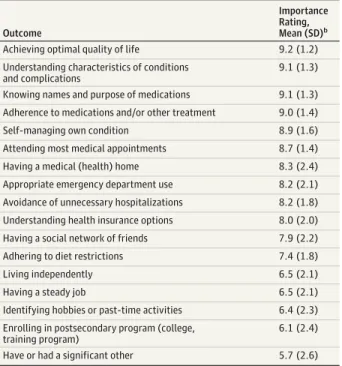
the 18 outcomes were used as part of the Delphi process in stage 2. During stage 1, some outcomes were split into more than 1 part. For example, adherence was split into 3 separate catego-ries (adherence to medications and/or other treatments, at-tending medical appointments, and adhering to diet restric-tions). Other outcomes were eliminated at this stage, including process and readiness categories such as communication and records transfer and understanding of the transition process. For stage 2, the 18 outcomes received importance ratings from 117 members of the HCTRC ranging from 1 to 10, with 1 indicating the least importance.Table 1provides details re-garding the sample; most were from the United States (102 [87.9%]) and were specialists (those who work in a specialty clinic; 58 [58.6%]) as opposed to primary care (8 [8.1%]) or oth-ers (33 [33.3%]), such as transition coordinators, parents, youth, and researchers. More than half of the participants were health care professionals (52 [53.1%]); of the 117 participants, 80 (68.3%) were pediatric professionals. Importance scores from stage 2 are presented inTable 2. Quality of life, understand-ing the characteristics of the conditions and complications, knowing the names and purposes of medications, adhering to medications and/or other treatments, and self-managing one’s condition were the top 5 outcomes at this stage. As a result of the scores and other elements of the stage 2 Delphi process, 4 outcomes were eliminated: having hobbies/pastime activi-ties, being enrolled in a college or training program, having a steady job, and having a significant other.
Forty-two participants provided qualitative comments about the outcomes, which supported the inclusion of the 13 outcomes in the stage 3 survey. In addition, the coders noted that special importance was placed on the types of outcomes
Table 1. Demographics of Participants in Stages 2 and 3
Characteristic
No. (%)a
Stage 2 (n = 117)
Stage 3 (n = 93) Country
United States 102 (87.9) 78 (83.9)
Other 14 (12.1) 15 (16.1)
Type of practice
Specialist 58 (58.6) 66 (75.0)
Primary care 8 (8.1) 10 (11.4)
Other 33 (33.3) 12 (13.6)
Type of service
Medical 52 (53.1) 67 (76.1)
Psychosocial 38 (38.8) 20 (22.7)
Other 8 (8.2) 1 (1.1)
aSome data were missing.
Table 2. Mean Importance Ratings of Stage 2 Outcomesa
Outcome
Importance Rating, Mean (SD)b
Achieving optimal quality of life 9.2 (1.2)
Understanding characteristics of conditions and complications
9.1 (1.3)
Knowing names and purpose of medications 9.1 (1.3)
Adherence to medications and/or other treatment 9.0 (1.4)
Self-managing own condition 8.9 (1.6)
Attending most medical appointments 8.7 (1.4)
Having a medical (health) home 8.3 (2.4)
Appropriate emergency department use 8.2 (2.1)
Avoidance of unnecessary hospitalizations 8.2 (1.8)
Understanding health insurance options 8.0 (2.0)
Having a social network of friends 7.9 (2.2)
Adhering to diet restrictions 7.4 (1.8)
Living independently 6.5 (2.1)
Having a steady job 6.5 (2.1)
Identifying hobbies or past-time activities 6.4 (2.3)
Enrolling in postsecondary program (college, training program)
6.1 (2.4)
Have or had a significant other 5.7 (2.6)
aSample of 117 participants.
for AYA-SCHN with cognitive disabilities and how the types of outcomes for these individuals might differ from those for in-dividuals without cognitive disabilities. For example, 7 of 42 participants (16.7%) who offered comments noted that “liv-ing independently” may not be a realistic outcome. The AYA-SCHN with cognitive disabilities, as well as other partici-pants, suggested that another set of outcomes should be created for this group.
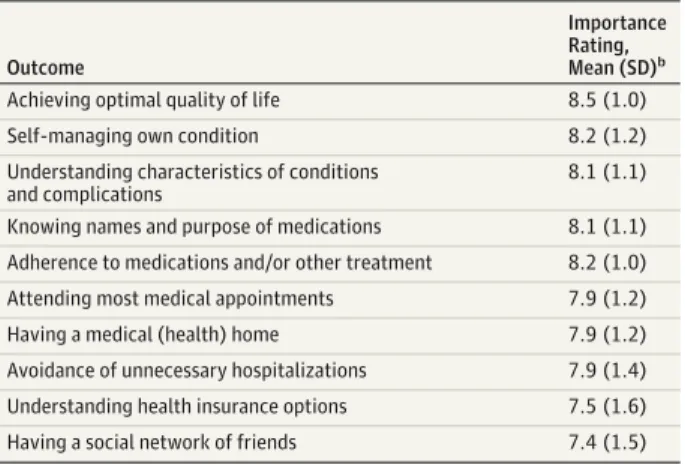
Stage 3 included 93 participants, with most from the United States (78 [83.9%]); others were from Canada, Switzerland, and the United Kingdom. Of 88 participants who reported on their service, most were specialists (66 [75.0%]), including hema-tology/oncology, adolescent medicine, and cardiology, and medical (67 [76.1%]) and psychosocial (20 [22.7%]) profes-sionals (eg, social workers and psychologists). Participants rated quality of life as the most important HCT outcome across groups, followed by disease self-management (Table 3). Ad-hering to diet restrictions, living independently, and appro-priate emergency department use were removed from the list because they did not meet the threshold of 70% agreement.41
The eTable in theSupplementpresents the 10 outcomes and the difference between importance scores based on coun-try of practice, type of practice, and type of professional. Qual-ity of life was rated the most important HCT outcome across groups, followed by disease self-management and adherence to medications and/or other treatment. Participants in the United States rated the importance of understanding insur-ance options significantly higher compared with those from other countries (P= .04). No other significant group differ-ences were found.
Discussion
As a result of a Delphi process conducted in 3 waves, our study refined a list of 10 transition outcomes that were broadly ac-ceptable to a diverse group of HCT experts. In addition, the qualitative examination of comments from participants did not yield additional HCT outcomes except that there is a need to develop a set of outcomes specific to AYA-SHCN with cogni-tive disabilities. The findings of this study align with our cur-rent understanding of HCT outcomes, including the concep-tual model developed by Betz and colleagues42from the
HCTRC. Their conceptual model views HCT as a process that involves individual, social, and health service domains. The results of the present study are consistent with this concep-tual model since the outcomes fit within these domains, in-cluding individual outcomes (quality of life, knowledge of medication, self-management, adherence to medication, di-etary adherence, understanding health insurance, and under-standing the characteristics of the conditions, and complica-tions), social outcomes (having a social network), and health services outcomes (attending medical appointments, having a medical home, and avoidance of unnecessary hospitaliza-tion). Other factors within each level of the conceptual model can affect HCT outcomes. For example, number of hospital-izations can be influenced by individual factors, such as dis-ease severity, or health care system factors, including access
to primary care. Grouping these outcomes by level may allow researchers to conduct focused evaluations of current processes and more detailed evaluation of interventions.
The identification of quality of life as the most important factor is a unique feature of this study. Suris and Akre43also
used a Delphi process to examine key elements and indica-tors of HCT. However, their findings emphasized continuity of care rather than outcomes associated with quality of life, such as social and educational opportunities. The authors noted that the primary focus on health outcomes was somewhat surpris-ing given that AYA-SHCN are at increased risk for poor educa-tional attainment and low incomes in adulthood.44,45
Incor-porating quality of life as an aspect of transition may facilitate a more holistic approach to HCT that, in turn, could facilitate more effective transition to adult care for vulnerable popula-tions. Similar to the study of Suris and Akre, the present study included international participants who primarily worked in pediatric specialty clinics.
The present study adds to the efforts under way to gener-ate a standard set of HCT outcomes that can be evalugener-ated across conditions and settings, which has been largely neglected in literature discussing disease-specific chronic ill-ness. In addition, our results can be used to guide individual patient care and program priorities for AYA-SHCN. In particu-lar, the health services outcomes are consistent with the find-ings from the 2007 Survey of Adult Transition and Health. To determine HCT outcomes, Oswald and colleagues46defined
successful HCT as having a usual health care source, having a professional providing adult care, having health insurance, having at least one preventive health care visit, being satis-fied with health care, and not having delayed or forgone nec-essary health care services. The specific medical outcomes that are important for individual conditions were not a part of the HCT outcomes generated by the Delphi process in the present study; however, these outcomes are important to consider for specific conditions and for evaluating the suc-cess of transition for AYA-SCHN. Future research should focus on more disease-specific differences, including indi-viduals with cognitive disabilities.
Table 3. Mean Importance Ratings of Stage 3 Outcomesa
Outcome
Importance Rating, Mean (SD)b
Achieving optimal quality of life 8.5 (1.0)
Self-managing own condition 8.2 (1.2)
Understanding characteristics of conditions and complications
8.1 (1.1)
Knowing names and purpose of medications 8.1 (1.1)
Adherence to medications and/or other treatment 8.2 (1.0)
Attending most medical appointments 7.9 (1.2)
Having a medical (health) home 7.9 (1.2)
Avoidance of unnecessary hospitalizations 7.9 (1.4)
Understanding health insurance options 7.5 (1.6)
Having a social network of friends 7.4 (1.5)
aSample included 93 participants.
Limitations of the study are that it used a Delphi process to measure and develop consensus on outcomes for HCT. Re-sults are limited to the opinions of respondents; owing to the anonymity of the web-based contributions, we are not able to directly compare characteristics of respondents and nonre-spondents. For example, patients and families who have with-drawn from the transition process are of significant interest to clinicians and researchers, and the perspectives of such pa-tients and families have often been represented by proxy respondents who provided services to them and were in-formed of their HCT needs and future planning.47,48The
in-clusion of an interdisciplinary and international consortium, SIG sessions at pediatric meetings attended by international researchers, and a web-based survey platform attempted to maximize access and minimize participant costs to improve involvement. However, some terms, such asmedical home, may not be universally applicable.
Another limitation of the present study is the low repre-sentation of AYA-SCHN and their family members beyond stage 1. The HCTRC membership includes AYA-SCHN and families; however, they either did not participate in the online surveys or did not self-identify as such when they completed the sur-vey. Furthermore, we did not plan to recruit a panel of par-ents and young people. Future research should include a focus on the perspectives of AYA-SCHN living with chronic conditions as well as their families.
Our sample contained many specialists and was almost en-tirely composed of pediatric health care professionals. For this reason, the outcomes may not fully represent the HCT out-comes that primary care or adult-focused health care
profes-sionals view as important. This factor is a limitation, but it pro-vides an opportunity for an important next step. These 10 outcomes could be presented to groups of adult-focused and primary care health care professionals through a Delphi pro-cess and thus be further refined. The methods allow multiple viewpoints to emerge and, simultaneously, limit the emer-gence of a dominant individual or perspective that might lead to the exclusion of other important components.49
Conclusions
Our study was designed to be inclusive of diverse input with a transparent selection process and clearly defined acceptable lev-els of consensus. The results highlight the importance of iden-tifying meaningful elements that go beyond an individual’s readiness for HCT. The Delphi process lays the groundwork for future research to define and operationalize the measurement of these outcomes. Health care transition is a complex process with a wide range of potential end results. It is important to iden-tify the associations between variables, such as HCT readiness and adherence, that are stepping stones toward more patient-centered outcomes, such as quality of life. The HCT outcomes identified in the present study at each stage are general con-cepts. Next, it will be necessary to define (both for research and clinical practice) and identify valid measures associated with each outcome. We hope that, by identifying and developing in-terventions targeting such proximate outcomes, we can im-prove the more distal patient-centered outcomes and ensure success broadly defined for AYA-SCHN.
ARTICLE INFORMATION
Accepted for Publication:September 2, 2015.
Published Online:November 30, 2015. doi:10.1001/jamapediatrics.2015.3168.
Author Affiliations:Department of Human Service Studies, Elon University, Elon, North Carolina (Fair); End-Stage Kidney Disease Program, University of North Carolina–Chapel Hill (Cuttance, Javalkar, Ferris); Medicine-Pediatrics Residency Program, Brigham and Women's and Boston Children's Hospital, Harvard Medical School, Boston, Massachusetts (Sharma); Duke University Psychiatry and Behavior Sciences and Pediatrics, Durham, North Carolina (Maslow); Pediatric Oncology Branch Center for Cancer Research, National Cancer Institute, Bethesda, Maryland (Wiener); Department of Pediatrics, Keck School of Medicine, University of Southern California, Los Angeles (Betz); Department of Psychology, St Jude Children’s Research Hospital, Memphis, Tennessee (Porter); Internal Medicine/Pediatrics, Brown University, Providence, Rhode Island (McLaughlin); Department of Pediatrics and Medicine, Hasbro Hospitals, Providence, Rhode Island (McLaughlin); Department of Pediatrics, Emory University School of Medicine, Atlanta, Georgia (Gilleland-Marchak); Transition of Care, Nemours/Alfred I. duPont Hospital for Children, Wilmington, Delaware (Renwick); Department of Psychiatry, School of Medicine, Stanford University, Stanford, California (Naranjo); Division of General
Pediatrics, Children’s Hospital of Philadelphia, Philadelphia, Pennsylvania (Jan).
Author Contributions:Drs Fair and Ferris had full access to all the data in the study and take responsibility for the integrity of the data and the accuracy of the data analysis.
Study concept and design:Fair, Sharma, Wiener, Gilleland-Marchak, Ferris.
Acquisition, analysis, or interpretation of data:Fair, Cuttance, Sharma, Maslow, Betz, Porter, McLaughlin, Gilleland-Marchak, Renwick, Naranjo, Jan, Javalkar, Ferris.
Drafting of the manuscript:Fair, Cuttance, Sharma, Maslow, Porter, McLaughlin, Gilleland-Marchak, Naranjo, Jan, Ferris.
Critical revision of the manuscript for important intellectual content:Fair, Cuttance, Sharma, Maslow, Wiener, Betz, McLaughlin, Gilleland-Marchak, Renwick, Jan, Javalkar, Ferris.
Statistical analysis:Cuttance, Sharma, Javalkar, Ferris.
Obtained funding:Ferris.
Administrative, technical, or material support: Cuttance, Betz, Naranjo, Javalkar, Ferris. Study supervision:Fair, Sharma, Ferris.
Conflict of Interest Disclosures:None reported.
Group Information:The members of the International and Interdisciplinary Health Care Transition Research Consortium are listed in the eAppendix in theSupplement.
Additional Contributions:We acknowledge the members of the Health Care Transition Research
Consortium who participated in the Delphi process and are dedicated to the advancement of evidence-based research on health care transition and self-management.
REFERENCES
1. Blum RW, Garell D, Hodgman CH, et al. Transition from child-centered to adult health-care systems for adolescents with chronic conditions: a position paper of the Society for Adolescent Medicine.
J Adolesc Health. 1993;14(7):570-576.
2. Schwartz LA, Daniel LC, Brumley LD, Barakat LP, Wesley KM, Tuchman LK. Measures of readiness to transition to adult health care for youth with chronic physical health conditions: a systematic review and recommendations for measurement testing and development.J Pediatr Psychol. 2014; 39(6):588-601.
3. Fredericks EM, Magee JC, Opipari-Arrigan L, Shieck V, Well A, Lopez MJ. Adherence and health-related quality of life in adolescent liver transplant recipients.Pediatr Transplant. 2008;12 (3):289-299.
4. LaGreca AM, Follansbee D, Skyler JS. Developmental and behavioral aspects of diabetes management in youngsters.Child Health Care. 1990;19(3):132-139.
6. Reed-Knight B, Lewis JD, Blount RL. Association of disease, adolescent, and family factors with medication adherence in pediatric inflammatory bowel disease.J Pediatr Psychol. 2011;36(3):308-317. 7. Bryden KS, Peveler RC, Stein A, Neil A, Mayou RA, Dunger DB. Clinical and psychological course of diabetes from adolescence to young adulthood: a longitudinal cohort study.Diabetes Care. 2001;24 (9):1536-1540.
8. Fredericks EM, Dore-Stites D, Well A, et al. Assessment of transition readiness skills and adherence in pediatric liver transplant recipients.
Pediatr Transplant. 2010;14(8):944-953. 9. Kipps S, Bahu T, Ong K, et al. Current methods of transfer of young people with type 1 diabetes to adult services.Diabet Med. 2002;19(8):649-654. 10. Yeung E, Kay J, Roosevelt GE, Brandon M, Yetman AT. Lapse of care as a predictor for morbidity in adults with congenital heart disease.
Int J Cardiol. 2008;125(1):62-65.
11. Wiener LS, Kohrt BA, Battles HB, Pao M. The HIV experience: youth identified barriers for
transitioning from pediatric to adult care.J Pediatr Psychol. 2011;36(2):141-154.
12. Bell LE, Bartosh SM, Davis CL, et al. Adolescent transition to adult care in solid organ
transplantation: a consensus conference report.
Am J Transplant. 2008;8(11):2230-2242. 13. Annunziato RA, Emre S, Shneider B, Barton C, Dugan CA, Shemesh E. Adherence and medical outcomes in pediatric liver transplant recipients who transition to adult services.Pediatr Transplant. 2007;11(6):608-614.
14. Watson AR. Non-compliance and transfer from paediatric to adult transplant unit.Pediatr Nephrol. 2000;14(6):469-472.
15. Dosa NP, Foley JT, Eckrich M, Woodall-Ruff D, Liptak GS. Obesity across the lifespan among persons with spina bifida.Disabil Rehabil. 2009;31 (11):914-920.
16. Bassal M, Mertens AC, Taylor L, et al. Risk of selected subsequent carcinomas in survivors of childhood cancer: a report from the Childhood Cancer Survivor Study.J Clin Oncol. 2006;24(3): 476-483.
17. Lorenzi MF, Xie L, Rogers PC, Pritchard S, Goddard K, McBride ML. Hospital-related morbidity among childhood cancer survivors in British Columbia, Canada: report of the childhood, adolescent, young adult cancer survivors (CAYACS) program.Int J Cancer. 2011;128(7):1624-1631. 18. Sun C-L, Francisco L, Kawashima T, et al. Prevalence and predictors of chronic health conditions after hematopoietic cell transplantation: a report from the Bone Marrow Transplant Survivor Study.Blood. 2010;116(17):3129-3139.
19. Bloom SR, Kuhlthau K, Van Cleave J, Knapp AA, Newacheck P, Perrin JM. Health care transition for youth with special health care needs.J Adolesc Health. 2012;51(3):213-219.
20. Betz CL, Lobo ML, Nehring WM, Bui K. Voices not heard: a systematic review of adolescents’ and
emerging adults’ perspectives of health care transition.Nurs Outlook. 2013;61(5):311-336. 21. Bryant R, Walsh T. Transition of the chronically ill youth with hemoglobinopathy to adult health care: an integrative review of the literature.
J Pediatr Health Care. 2009;23(1):37-48. 22. Christie D, Viner R. Chronic illness and transition: time for action.Adolesc Med State Art Rev. 2009;20(3):981-987, xi.
23. Crowley R, Wolfe I, Lock K, McKee M. Improving the transition between paediatric and adult healthcare: a systematic review.Arch Dis Child. 2011;96(6):548-553.
24. Jalkut MK, Allen PJ. Transition from pediatric to adult health care for adolescents with congenital heart disease: a review of the literature and clinical implications.Pediatr Nurs. 2009;35(6):381-387. 25. Pai AL, Ostendorf HM. Treatment adherence in adolescents and young adults affected by chronic illness during the health care transition from pediatric to adult health care: a literature review. Child Health Care. 2011;40:16-33.
26. Rapley P, Davidson PM. Enough of the problem: a review of time for health care transition solutions for young adults with a chronic illness.
J Clin Nurs. 2010;19(3-4):313-323. 27. Sawyer SM, Macnee S. Transition to adult health care for adolescents with spina bifida: research issues.Dev Disabil Res Rev. 2010;16(1): 60-65.
28. Wang G, McGrath BB, Watts C. Health care transitions among youth with disabilities or special health care needs: an ecological approach.J Pediatr Nurs. 2010;25(6):505-550.
29. Watson R, Parr JR, Joyce C, May C, Le Couteur AS. Models of transitional care for young people with complex health needs: a scoping review.Child Care Health Dev. 2011;37(6):780-791.
30. Betz CL. Transition of adolescents with special health care needs: review and analysis of the literature.Issues Compr Pediatr Nurs. 2004;27(3): 179-241.
31. Betz CL, Smith K. Measuring health care transition planning outcomes: challenges and issues.Intl J Child Adolesc Health. 2010;3(4):463-472.
32. While A, Forbes A, Ullman R, Lewis S, Mathes L, Griffiths P. Good practices that address continuity during transition from child to adult care: synthesis of the evidence.Child Care Health Dev. 2004;30 (5):439-452.
33. Binks JA, Barden WS, Burke TA, Young NL. What do we really know about the transition to adult-centered health care? a focus on cerebral palsy and spina bifida.Arch Phys Med Rehabil. 2007;88(8):1064-1073.
34. Ferris ME, Harward DH, Bickford K, et al. A clinical tool to measure the components of health-care transition from pediatric care to adult care: the UNC TR(x)ANSITION scale.Ren Fail. 2012; 34(6):744-753.
35. Elwyn G, O’Connor A, Stacey D, et al; International Patient Decision Aids Standards
(IPDAS) Collaboration. Developing a quality criteria framework for patient decision aids: online international Delphi consensus process.BMJ. 2006;333(7565):417.
36. Gill FJ, Leslie GD, Grech C, Latour JM. Using a web-based survey tool to undertake a Delphi study: application for nurse education research.Nurse Educ Today. 2013;33(11):1322-1328.
37.Qualtrics[computer program]. Version 61472 of the Qualtrics Research Suite. Qualtrics website. http://www.qualtrics.com.Published 2015. Accessed December 12, 2015.
38. Strauss A, Corbin J.Basics of Qualitative Research: Grounded Theory Procedures and Techniques.Newbury Park, CA: Sage Publications; 1990.
39.SPSS for Windows[computer program]. Rel. 21. Chicago, IL: SPSS Inc; 2014.
40. Corder GW, Foreman DI.Nonparametric Statistics: A Step-by-Step Approach.2nd ed. Hoboken, NJ: John Wiley & Sons; 2014.
41. Kleynen M, Braun SM, Bleijlevens MH, et al. Using a Delphi technique to seek consensus regarding definitions, descriptions and
classification of terms related to implicit and explicit forms of motor learning.PLoS One. 2014;9(6): e100227.
42. Betz CL, Ferris ME, Woodward JF, Okumura MJ, Jan S, Wood DL. The Health Care Transition Research Consortium health care transition model: a framework for research and practice.J Pediatr Rehabil Med. 2014;7(1):3-15.
43. Suris JC, Akre C. Key elements for, and indicators of, a successful transition: an international Delphi study.J Adolesc Health. 2015; 56(6):612-618.
44. Maslow GR, Haydon A, McRee AL, Ford CA, Halpern CT. Growing up with a chronic illness: social success, educational/vocational distress.J Adolesc Health. 2011;49(2):206-212.
45. Maslow GR, Haydon AA, Ford CA, Halpern CT. Young adult outcomes of children growing up with chronic illness: an analysis of the National Longitudinal Study of Adolescent Health.Arch Pediatr Adolesc Med. 2011;165(3):256-261. 46. Oswald DP, Gilles DL, Cannady MS, Wenzel DB, Willis JH, Bodurtha JN. Youth with special health care needs: transition to adult health care services.
Matern Child Health J. 2013;17(10):1744-1752. 47. Sonneveld HM, Strating MM, van Staa AL, Nieboer AP. Gaps in transitional care: what are the perceptions of adolescents, parents and providers?
Child Care Health Dev. 2013;39(1):69-80. 48. Olds J, Fitzpatrick E, Séguin C, Moran L, Whittingham J, Schramm D. Facilitating the transition from the pediatric to adult cochlear implant setting: perspectives of CI professionals.