Comparing States that Do and Do Not Use the Kindergarten English Language Arts Common Core State Standards
Katherine Anne Thayer
Senior Honors Thesis School of Education
University of North Carolina at Chapel Hill 2018
Abstract
In 2009, the English Language Arts Common Core State Standards (ELA CCSS) were released by the U.S. Department of Education with the goal of unifying the skills and
information taught to students across the nation. Research shows a need for teaching phonics, phonemic awareness, fluency, vocabulary, and reading comprehension in elementary school, scaffolding tasks as students increase their independence, and cultural responsiveness and inclusion in American classrooms. The present study shows the results of a critical analysis of the ELA Standards in 9 states (MN, CT, KY, MT, NE, TX, TN, VA, and SC) that either edited or replaced the ELA CCSS in their states, and then compared each states’ standards to the
original ELA CCSS to identify differences within the skills and competencies taught, the amount of scaffolding present, and the inclusion of cultural education. The study categorized all the differences in skills and competencies into sections, with the most compelling being within personal engagement and connection, understanding the importance of print structure, print’s ability to convey meaning, conversational cues, cultural themes, and research. All five of the states that replaced or did not adopt the ELA CCSS omitted between 11 and 31 of the standards included in the Kindergarten ELA CCSS. Scaffolding differences were categorized as either removed or added. Most states either only increased or only decreased the amount of
Table of Contents
Abstract ...2
Introduction ...5
Why Are Educational Standards Needed? ...6
Problems in No Child Left Behind ...8
Research Questions ...11
Literature Review ...11
Skills and Competencies ...12
Scaffolding ...18
Cultural Themes ...21
Methodology ...23
Research Design ...23
Sample and Data Collection ...23
Results ...27
Skills and Competencies ...29
Omission of CCSS ...29
Additions to existing standards ...34
Additional standards ...36
Scaffolding ...41
Removed scaffolding ...42
Added scaffolding ...44
Discussion ...45
Preliminary Findings ...46
Patterns of Additions of Skills and Competencies ...49
Soft Skills ...50
Expansions ...53
Analysis...54
Fundamental Skills...57
Early Implementation ...58
Scaffolding ...61
Implications ...61
Future Explorations ...65
Limitations ...64
References ...68
Comparing States that Do and Do Not Use the Kindergarten English Language Arts Common Core State Standards
President Barack Obama signed the Every Student Succeeds Act (ESSA) into law in December of 2015 as the newest reauthorization of the Elementary and Secondary Education Act (ESEA) of 1965. In September of 2017, sixteen states and Washington, D.C. had their ESSA plans approved by the U.S. Department of Education, and displayed their K-12 content standards on their respective websites. States are responsible for setting their own academic standards that challenge students and prepare them for college or future careers (Lee, 2018). States are
approaching student achievement in different ways, and all are addressing subgroup achievement in hopes of eliminating inequities in public education. This goal has been in place for many decades, and after a few years of CCSS implementation, states began adding their own standards for their students to learn.
Why Are Educational Standards Needed?
There is a 44-year history in education reform in the United States. The first widespread and federally implemented attempt of modern education reform was the Elementary and
Secondary Education Act of 1965 (ESEA). President Lyndon Johnson signed ESEA into law as an attempt to end poverty and eliminate the achievement gaps between low- and high-income students in public education by offering grants to schools with identified socioeconomic need to provide supplemental resources for disadvantaged students. By doing this, the federal
government was able to address the nationwide achievement gaps without interfering with America’s state-run public education system (Standerfer, 2006). However, despite years of school reform, ESEA did not have the measured success it hoped for on decreasing achievement gaps or poverty levels according the National Assessment of Educational Progress (NAEP).
In 1983, National Commission on Excellence in Education, a committee created by President Ronald Reagan’s administration, published A Nation at Risk (Graham, 2013). The report claimed the United States was no longer a leading force in innovation and technological advances in the world with statistics such as “23 million American adults [were] functionally illiterate” (Gardner, D. P., Larsen, Y. W., Baker, W., Campbell, A., & Crosby, E. A., 1983, p. 11). Following the outline of risks, the report expressed the aim of educational excellence. According to the report, educational excellence included striving toward improvement on tests and personal limits at the individual level, setting high expectations with resources that make them attainable at the school level, and electing responsible local officials to the school board at the societal level so the changes could be seen throughout the country (Gardner et al., 1983).
will equip people with the skills required for new careers and for citizenship” (Gardner et al., 1983, p. 31). These recommendations included high expectations, standardized testing to measure success, an increased amount of time students spend in school, and a public responsibility to ensure local officials hold schools to a high standard.
Based on the report by the National Commission on Excellence in Education, it is clear that educational recommendations by the federal government has been happening since before the beginning of Common Core. The former President of the National Education Association (NEA), Van Roekel, revealed in his 2014 keynote speech at the 2014 Representative Assembly that he was surprised to see such long-lasting effects from one report, but he also said this report completely changed the way political leaders and citizens viewed education. In the years since A Nation at Risk, schools have been held to increasing levels of standards in many areas of
education. William Bennett, Reagan’s Secretary of Education, investigated expanding NAEP in order to study differences in state results to support increasing accountability (Standerfer, 2006). This continued as both President George H.W. Bush and President Bill Clinton synthesized initiatives to increase student achievement and accountability (Klein, 2014; Standerfer, 2006). President H. W. Bush and other political leaders stated the country needed to come together to set goals for American education and ways to stay accountable to those goals (Klein, 2014). The Bush administration invited White House officials and representatives from almost every state to discuss the possible solutions in 1989. It was clear to them the issues raised in A Nation at Risk were not able to be solved by schools or states working independently, so this summit of national and state leaders devised a plan beginning with adequately preparing students for kindergarten and continuing through increasing the graduation rate to 90 percent by 2000. By doing so, the country would be expected to be a top leader in science and math again, school would be
academic subjects at the end of 4th, 8th and 12th grades. President H.W. Bush announced America 2000 as a follow-up to the summit, but Congress did not pass the proposal. His efforts continued through the remainder of his presidency, but bipartisan disagreement on the information within the standards and public concern for the federal government’s involvement kept his initiatives from succeeding.
In 1992, President Bill Clinton’s plan, Goals 2000, proposed funding to states to develop standards and then assembling a standards review board to approve each state’s plan (Klein, 2014). This plan was reinforced in President Clinton’s reauthorization of ESEA, but was ultimately abandoned in the middle of his presidency due to a change in party control over Congress. Even so, states had already began creating their own state standards and assessing students, and they continued to until President George W. Bush’s presidency and his proposal of No Child Left Behind.
Problems in No Child Left Behind
all they needed to master by the end of that grade. Schools that did not meet their self-specified level of proficiency, or in other words, did not have a large enough percentage of students meeting the state’s level of proficiency, two years in a row were required to allow students to transfer to a nearby school that did meet AYP (Klein, 2015). Free tutoring services were required to be given at school after three consecutive years of not meeting AYP. After that, schools could be shut down, turned into charter schools, or other consequences determined by the state.
Klein (2015) outlines many criticisms in her overview of NCLB. Despite schools being required to allow students to transfer to a school that met AYP or offering tutoring to students, many students did not take those opportunities. The standardized testing also made teachers feel that subjects, such as foreign languages and arts, were consistently losing instruction time in order to have time to teach the students everything for the tests.
Despite the extra time often given to reading in public schools, Dee and Jacob (2010) found no significant effects one the impact of accountability systems on student reading achievement; however, it did not examine Reading First, an initiative designed within NCLB specifically addressing literacy. Reading First gave states support to provide their schools with evidence-based literacy curriculum and relevant resources so all students would be proficient by third grade (US Department of Education, 2014). Though, criticisms of Reading First say that the initiative did not follow the advice of the National Reading Panel (NRP) or the National Early Literacy Panel (NELP) that explicitly stated, “systematic phonics instruction should be integrated with other reading instruction to create a balanced reading program” (Cummins, 2007; National Reading Panel, 2000, p. 2-136).
that vary from state to state and do not agree on what students should know and be able to do at each grade level” (Para 3). Common Core is voluntarily implemented at each state’s discretion and incorporates each of the areas deemed crucial in the National Reading Panel Report through Reading – Literature, Informational, and Foundational, Writing, Speaking and Listening, and Language standards. For the purpose of this study, the standards at the entrance of school, when language and literacy foundational skills are critical, the standards in kindergarten will be examined. The literature supports the need for phonics, phonemic awareness, fluency, vocabulary, and comprehension as advised by the National Reading Panel’s Report, and scaffolding and cultural inclusion in the classroom (NRP, 2000; Cuticelli, 2015; López-Robertson & Haney, 2017). Scaffolding is an important approach toward teaching students, especially in their first year of school, because it guides teachers in their efforts to assess each child’s individual independence. Cuticelli et al., (2015) found that a two-tiered system for vocabulary development, where some students were identified for additional support, resulted in students of both groups performing at the same level for vocabulary acquisition. Finally,
incorporating cultural inclusive texts and activities in classrooms allows students to feel appreciated and valued for their differences or uniqueness (López-Robertson & Haney, 2017).
As mentioned before, ESSA gives states the opportunity to follow the suggestions of the NRP unlike NCLB, but also the option to amend and add onto Common Core. To date, there is no literature that examines the differences in the English Language Arts Standards for
Research Questions
1. How do states that do and do not use the Kindergarten English Language Arts Common Core State Standards differ on the skills and competencies in kindergarten?
2. What are states using for their Kindergarten English Language Arts state learning standards?
3. How do states that do and do not use the Kindergarten English Language Arts Common Core State Standards differ on degree and quantity of scaffolding and independence in kindergarten?
4. How do states that do and do not use the Kindergarten English Language Arts Common Core State Standards differ on the cultural themes included in kindergarten?
Literature Review
The English Language Arts Common Core State Standards are centered around the five core components: phonemic awareness, phonics, fluency, vocabulary, and comprehension (NRP, 2000). These skills build on each other as a student progresses through school, but also rely on each other for a full understanding of each skill. The fact that some states decided to write their own standards suggests that there will be many differences when compared with them because rejecting the English Language Arts Common Core State Standards means the states feel they do not fully address all the skills that should be taught in kindergarten.
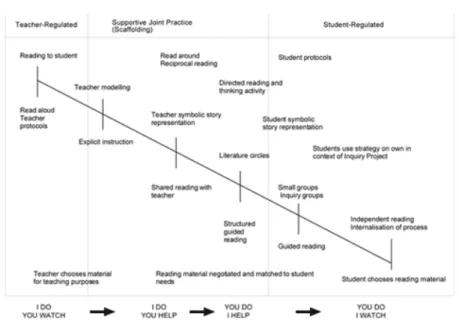
Figure 2.1: Scaffolding. Way, E. & Winsler, A. (2005).
Finally, examining the cultural themes present in the selected states will show how the importance of cultural inclusion, education and acceptance in classrooms is displayed in states’ standards.
Skills and Competencies
The National Reading Panel (NRP) identified five core features needed in K-12
curriculum, and the National Assessment of Educational Progress (NAEP) tests those features in grades 4, 8, and 12 (National Assessment of Educational Progress Reading Assessment
Framework, 2009; National Reading Panel, 2000). These features are phonemic awareness, phonics, fluency, vocabulary, and reading comprehension. These are seen throughout literacy standards of all kinds in the United States. Below are definitions of each feature as described in the Reading First Impact Study Final Report.
language. The students begin to remember and recognize patterns, which increases their ability to decode new words. Fluency is a student’s ability to read quickly and without mistakes. Students with higher levels of fluency have more time and attention to focus on the meaning of the words they are reading. Vocabulary has two functions in reading development. The first is using the development of oral vocabulary to recognize words on paper, again using the letter-sound relationship concept. The second function is using the development of a reading vocabulary, words used in print, to increase their ability to read more complex texts. Finally, reading comprehension is the ability to take meaning from a passage by being able to decode or comprehend the words. These skills build on each other but are taught simultaneously because it is not a sequential process. Each skill benefits the other four skills, so although in Common Core the skills more related to comprehension only require that students are able to do them with support, they are still taught in the earliest grades. On the same note, one of these components is not enough to predict or lead to future literacy success. The National Reading Panel Report (2000) calls phonemic awareness “a means rather than an end” because it cannot guarantee literary success but it can “yield significant dividends in the acquisition of reading and writing skills” (p. 2-6; p. 2-7). The same study says phonics should start early in elementary schools in a multi-focus program for the best effects. Fluency and vocabulary act more as bridges between decoding and comprehension because they require the decoding skills but lead to better comprehension.
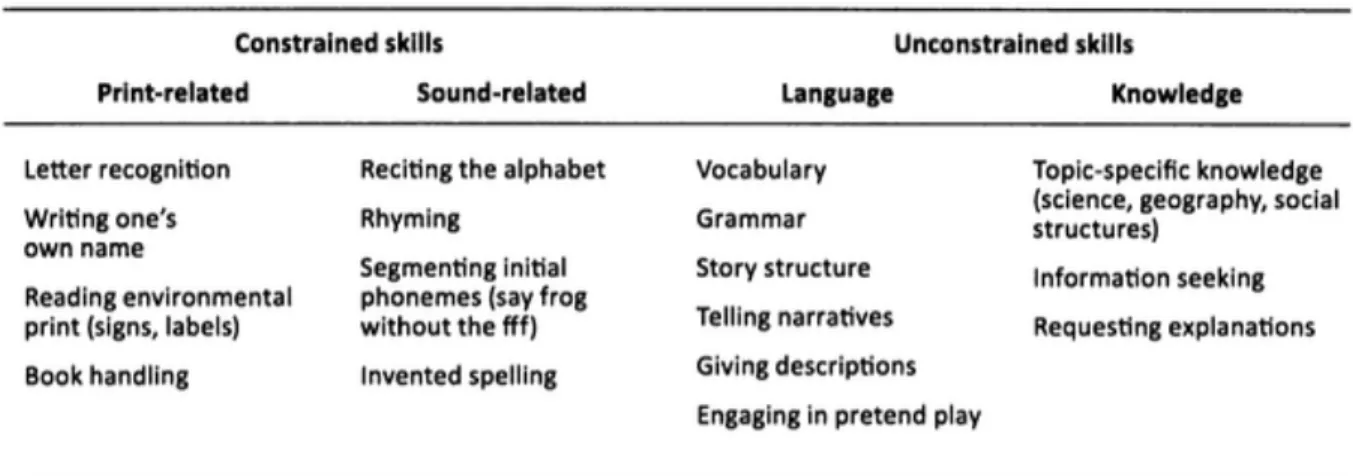
directly (Snow & Matthews, 2016, p. 59). These skills include the ability to correctly apply grammar rules, make connections to the outside world, and use and acquire vocabulary (Figure 2.2).
Figure 2.2. Reading and Language in the Early Grades (p. 59)
The Reading First movement in the early 2000’s was put into place in order to increase student outcomes by providing a list of approved literacy programs and professional
development. Abt Associates and the MDRC evaluated Reading First schools and determined decoding skills had improved, but comprehension had not, showing constrained skills were more easily improved than unconstrained (Snow & Matthews, 2016). The researchers suggested it may take more time for effects to be shown in unconstrained skills because they are more gradual and built-on skills. The CCSS standards for Kindergarten Literature, Informational, and Language indicate that students should be able to perform most constrained skills independently, but unconstrained skills indicate support from teachers at the end of the school year is sufficient.
collection of words and more academic vocabulary, and the CCSS identifies narrative books as an important type of text to read.
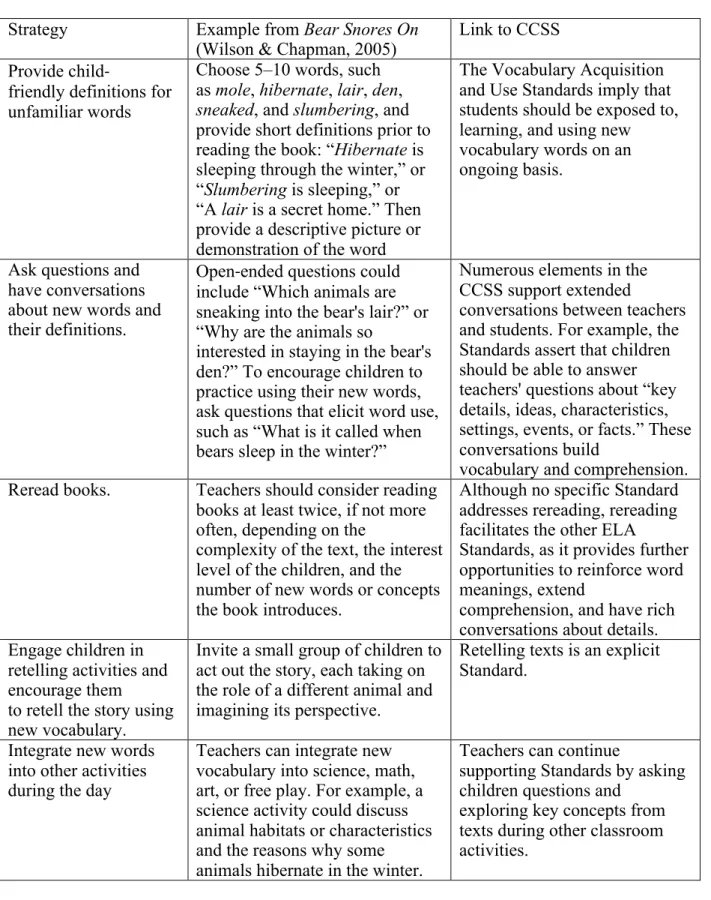
Figure 2.3. Recommended Strategies, Examples, and Links to Common Core State Standards (Snell et al., 2015).
Strategy Example from Bear Snores On
(Wilson & Chapman, 2005) Link to CCSS Provide
child-friendly definitions for unfamiliar words
Choose 5–10 words, such as mole, hibernate, lair, den, sneaked, and slumbering, and provide short definitions prior to reading the book: “Hibernate is sleeping through the winter,” or “Slumbering is sleeping,” or “A lair is a secret home.” Then provide a descriptive picture or demonstration of the word
The Vocabulary Acquisition and Use Standards imply that students should be exposed to, learning, and using new vocabulary words on an ongoing basis.
Ask questions and have conversations about new words and their definitions.
Open-ended questions could include “Which animals are sneaking into the bear's lair?” or “Why are the animals so
interested in staying in the bear's den?” To encourage children to practice using their new words, ask questions that elicit word use, such as “What is it called when bears sleep in the winter?”
Numerous elements in the CCSS support extended
conversations between teachers and students. For example, the Standards assert that children should be able to answer teachers' questions about “key details, ideas, characteristics, settings, events, or facts.” These conversations build
vocabulary and comprehension. Reread books. Teachers should consider reading
books at least twice, if not more often, depending on the
complexity of the text, the interest level of the children, and the number of new words or concepts the book introduces.
Although no specific Standard addresses rereading, rereading facilitates the other ELA
Standards, as it provides further opportunities to reinforce word meanings, extend
comprehension, and have rich conversations about details. Engage children in
retelling activities and encourage them
to retell the story using new vocabulary.
Invite a small group of children to act out the story, each taking on the role of a different animal and imagining its perspective.
Retelling texts is an explicit Standard.
Integrate new words into other activities during the day
Teachers can integrate new vocabulary into science, math, art, or free play. For example, a science activity could discuss animal habitats or characteristics and the reasons why some animals hibernate in the winter.
Teachers can continue
supporting Standards by asking children questions and
The first recommendation to define new words for students relates to the Vocabulary Acquisition and Use sections of the English Language Arts CCSS Language Anchor Standards (Snell et al., 2015). Many of the studies reviewed included definitions that were easy to
understand and related to concepts, objects, or other words already known by the students. This study did not focus on only kindergarten, but the L.K.5a and L.K.5c standards fulfill this strategy by sorting words into concept-based categories and making connections to real-life.
The second recommendation to have conversations about new words, but this is not explicitly stated in a Common Core standard (Snell et al., 2015). This is a step above the first strategy because having a discussion about the new words within a story is a more in depth and personal way than only providing the definitions. Teachers are able to ask, listen, and follow up with students while using this strategy, also known as “dialogic reading.” Snell et al. (2015) suggest incorporating these vocabulary talks into the other CCSS-promoted conversations between teacher and students, for example, SL.K.1 which is about participating in conversation about “kindergarten topics and texts.”
The third strategy recommended for teachers is rereading books because multiple
exposures to new words increases the chances of students learning and remembering more of the target words (Snell et al., 2015). Teachers focusing on new parts of the book or different words each time through the book allows students to not only hear the words in the book multiple times, but to build discussions on previous lessons and add to their understanding. This
recommendation is not directly related to a Common Core standard specifically, but can succeed in supporting comprehension and key details in addition to word meanings.
vocabulary words is not. However, this is a good way of combining skills into one lesson. The authors mention retelling in the sense of acting out a story so that multiple students get the chance to participate.
Finally, the fifth suggestion is to use the newly introduced vocabulary throughout other lessons in the day (Snell et al., 2015). The authors recommend centering class small-group activities around the book and its vocabulary. At least one of the studies they reviewed showed that students that read the book and complete related activities retain more of the new vocabulary words than students that only read the book.
Scaffolding
Another bridge to identify in these literacy standards is that which connects a new skill and mastery of that skill - scaffolding. Scaffolding is the easiest concept to point out in literacy standards because it is included in phrases like “with prompting and support” that typically precede the standard itself. Jung & Recchia (2013) described parental or adult roles in child development as creating environments that allow children to “reach beyond their present level toward their potential development” (p. 832). In his theory of the zone of proximal development, Vygotsky proposed the concept that children learn how to solve problems by following alongside adults or peers, and then eventually develop the skills to solve the problem on their own
(Vygotsky, 1978). In some ways, schooling can be considered one long continuous cycle of scaffolding and independence. As students enter school, almost everything is taught to them step by step until they start to follow the steps themselves.
Jung and Recchia (2013) conducted research on three infant teachers in child care centers aimed to explore the types of scaffolding present and the teachers’ views on the effects of
& Recchia, 2013, p. 837). She focuses on factors like the infant’s intentions, interest level and needs when deciding if or how to aid them. Sometimes straightforward modeling is needed, while other times encouragement is enough.
The second teacher, Katie, ensures every child she cares for is supported emotionally and physically so that they are in an environment sufficient for learning (Jung and Recchia, 2013). She provides emotional support and promotes self-regulation techniques while students are working toward a new solution. Katie mentioned her concern with her limited relationship with a few of her infants because she felt it decreased the amount of help she could provide. She felt it was easier to interact and help a child that she held a relationship with, which shows the
importance of relationships in learning even at this early of an age (Jung & Recchia, 2013). Finally, the third teacher, Irene, believed adults merely interrupted child’s play, so she only intervened when absolutely necessary. Her stance was that if an infant tried something ten times, it may look the same to an observer, but there is no way to know what the child is thinking (Jung & Recchia, 2013). Each of these teachers saw success with their scaffolding, while also admitting to trial and error, even though they have different approaches than each other and different tactics for each child. This supports the idea that scaffolding is a continuum with two dimensions. The amount of help can vary based on the need of the child, but so can the type of help. There is not a single correct way to scaffold, but the best way to help a child in one moment may be entirely different from the next time that child needs help.
Scaffolding is also incorporated into elementary schools through certain programs and methods, like Reading Recovery and running records. Based on prior research that states children tend to get little formal instruction on vocabulary until third grade, Baumann,
multi-tiered approach, teachers are able to give the vocabulary lesson to all students at once, and then assess the class to determine which students might benefit from a more intense, small-group lesson. Research shows a multi-tiered approach to vocabulary has the potential to help all students reach the same level of proficiency when those who need extra instruction receive it (Cuticelli, et al. 2015). Those who received the second tier of scaffolding and support not only increased their vocabulary growth, but also achieved the same amount of growth as students not designated as needing second-tier instruction.
Scaffolding in school involved more than being supportive or guiding students through reading strategies. Each child is different and requires help with a different skill set than the student he or she sits next to in class. Rodgers (2016) conducted a study with a goal of providing teachers with a better operational definition of scaffolding because while the amount of help varies for each student, the resulting student outcomes are not clearly correlated. In the following study, Rodgers’ (2016) study followed ten first-grade teachers and eighty-five of their students through recordings of Reading Recovery exercises throughout the year. Students were to read a new book to the teacher, and the interactions between the pair were transcribed and coded. Interestingly, the participants were not divided into comparison groups until after student outcomes were determined at the end of the school year, which allowed Rodgers to evaluate the methods of scaffolding as it relates to student achievement.
Rodgers (2016) coded interactions as either domain contingencies or instructional
contingencies. Domain contingencies are defined as what the teacher choses to focus on in order to help the student in the most efficient and effective way, like a strategy not used, while
instructional contingencies are defined as the quantity of assistance given. Both contingencies are important for student learning, but using only one is not sufficient. Teachers that used
in a comparable manner to teachers in the group that did not have student outcomes above the national average. However, teachers with higher outcomes were eight times more likely to be domain contingent that teachers with lower outcomes.
This shows that instructional contingencies were not as influential in student outcomes as domain contingencies. However, both are still important dimensions to vary for each child. Too much focus on the missing information may lead to frustration and possibly disengagement (Rodgers, 2016). This also relates to the fact that not every mistake needs to be addressed. Patterns in mistakes or difficulties are more important targets than the accidental or
uncharacteristic errors. Rodger’s work supports the individualized model of scaffolding that should be incorporated in standards that aim for each student’s individual proficiency. Cultural Themes
Another study focused on whether or not cultural competencies should be included in the standards rather than the specific criteria within cultural competencies. Mongillo and Holland (2016) concluded the best way to incorporate multicultural teachings in the classroom is through a local or site-by-site decision. They found that administrative support had a stronger influence on the manner and amount of multicultural ideas included in the classroom. Teachers that were required to cover cultural identities and practices were less likely to make it an everyday activity and less likely to have a broad selection of multicultural texts than those that were not mandated by state standards. Strong administrative support also enables the teachers to teach about all cultures represented in the classroom without fear of parental backlash or scrutiny, a concern expressed by many teachers in the study. Overall, one might suggest leaving multicultural activities out of standards but including the need for multicultural resources within curriculum.
An example of using a culturally aware text is seen in the case study done by López-Robertson and Haney (2017). López-López-Robertson conducted a study in Haney’s third grade classroom on child identities in school by reading The Best Part of Me: Children Talk About Their Bodies in Pictures and Words by Wendy Ewald. This book has pictures of Ewald’s students talking about their favorite body part and the reason behind their choice. Reading this book to Haney’s class allowed her students to make connections to their own lives, see
characters in a book that look like them, and see that every choice or reason is valid and unique (López-Robertson & Haney, 2017). Another book may have given them similar results in regards to the success of picking favorite body parts, but this particular book provoked feelings of
their classmates. Not only does using cultural texts in the classroom enhance the experience of students that represent that culture, but also those who do not. All students benefit because it supports healthy relationship building and social acceptance.
Methods
Research Design
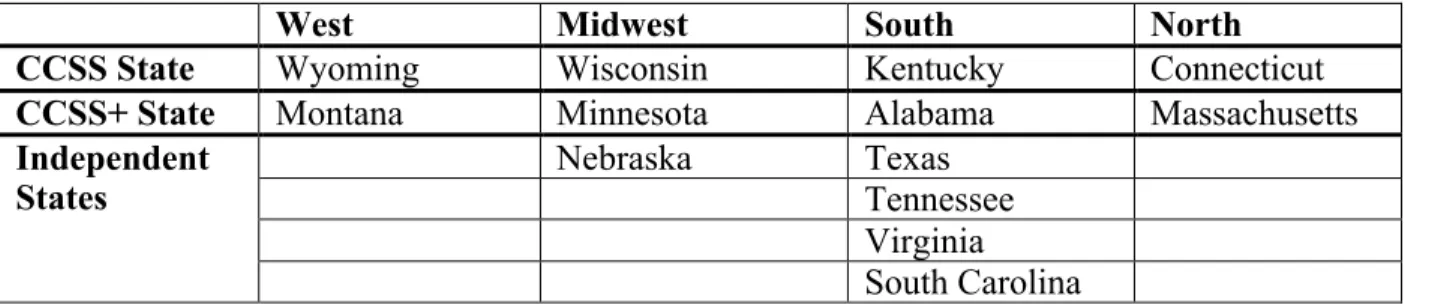
This research is a multiple case study of 13 state’s English Language Arts standards in the United States for kindergarten. To determine the states that would be studied, the researcher established three ways states designed their standards: 1) adopted the Common Core State Standards (CCSS), 2) added and amended CCSS, and 3) developed state standards independent of CCSS. These categories will be referred to by the following labels:
1. A “CCSS state” will refer to the states that adopted the Common Core State Standards.
2. A “CCSS+ state” will refer to the states that adopted the Common Core State Standards and then added standards deemed important by their Department of Education.
3. An “Independent state” will refer to states that rejected the adoption of the Common Core State Standards and developed their own standards.
This study will examine four CCSS states, four CCSS+ states, and five Independent states. The standards for each of the thirteen states were found by searching “[state name] state standards ELA k12,” and locating the documents through the state’s Department of Education website.
Sample and Data Collection
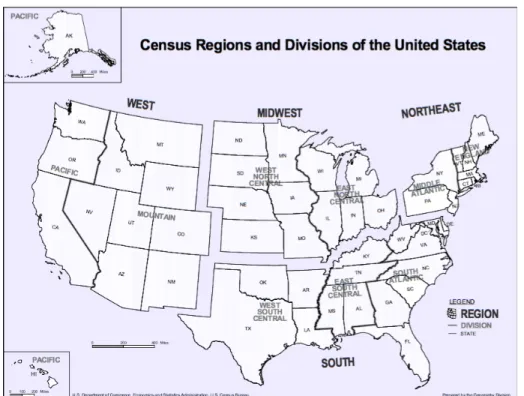
state, or an Independent state. Then the states and Washington, D.C. were divided into the four regions (West, Midwest, Northeast, and South) used by the U.S. Census Bureau in order to analyze standards across the country (Figure 3.1). During my observations, I discovered many states do not claim to use or cite CCSS on their websites or in their standards. While comparing Alaska and Florida to CCSS as Independent states, I discovered they were actually quite similar to CCSS despite not being identified as such. These states were then removed from the selection of Independent states
Figure 3.1. Census Regions and Divisions of the United States
At least one type of state from each region was selected for review, but upon analysis, only the Midwest and South regions had both CCSS+ and Independent states to analyze. So those two regions will be complete analyses and the Northeast and West regions will each only look at a CCSS+ state and no Independent states.
All identified Independent states were analyzed, and the group consists of Nebraska, Texas, Tennessee, Virginia, and South Carolina. Nebraska was paired with Wisconsin, Texas,
Tennessee, Virginia and South Carolina were paired with Kentucky based on their geographical region as indicated by the U.S. Census Bureau (See Table 3.1).
Table 3.1: States Selected for Observation Divided by Geographical Region
West Midwest South North
CCSS State Wyoming Wisconsin Kentucky Connecticut
CCSS+ State Montana Minnesota Alabama Massachusetts
Independent
States Nebraska Texas Tennessee
Virginia South Carolina
For each of the four regions of the U.S., one CCSS state and one CCSS+ state were randomly selected using Excel. Even though the CCSS and CCSS+ categories had multiple states from each region, they were not expected to have as many significant differences due to the fact that the English Language Arts Common Core State Standards were used in all states within these categories. It was still important to include the CCSS+ states to add a dimension of comparison. All of the Independent states were analyzed because they were predicted to have the most compelling findings.
Data was collected through close comparison analysis of the standards to the Common Core. This will be done by looking through the randomly selected CCSS and CCSS+ state standards side-by-side and highlighting the differences in the standards themselves. The differences will then be analyzed for type of difference.
RL.K.1 were not found in one state’s standards, it would be counted as an omission for that state. Additions to existing standards refers to the standards in CCSS+ and Independent states that include an English Language Arts Common Core kindergarten standard with additional
information included. For example, if a state added an extra skill within RL.K.1 that is not found in any where else within the, it would be counted as a difference in skills and competencies for that state because it is a change in a standard still included in the English Language Arts Common Core State Standards for Kindergarten. Additional standards are standards from a CCSS+ or an Independent state that are not found in the English Language Arts Common Core State Standards for Kindergarten. For example, if a state added “writing poetry” to their
kindergarten standards, it would be included as an addition for that state because kindergarteners are not required to write poetry by the English Language Arts Common Core State Standards.
The additions to existing standards and the additional standards were further divided into sub categories based on observed patterns during the critical analysis. Additions to existing standards were categorized as one of the following: minor additions, such as doing tasks orally, making predictions, and understanding and writing poetry, and major additions, such as personal engagement, word consciousness, and cultural themes. Additional standards were categorized into one of these 11 categories: Predictions, Prewriting, Vocabulary and Grammar, Directions, Print Conveying Meaning, Conversational Cues, Personal Engagement and Connection, Literary Devices, Structure and Characteristics of Print, Research, and Decoding.
Finally, scaffolding is addressed as either removed or added from standards in CCSS+ or Independent states. Removed scaffolding was identified in the critical analysis as a standard that resembled a kindergarten standard from the English Language Arts Common Core State
was identified as a standard that resembled a kindergarten standard from the English Language Arts Common Core State Standards, but with the phrase “With prompting and support” at the beginning to indicate a lower level of independence needed at the end of the year.
Results
In this section, the findings on the differences between states that do and do not use the Common Core State Standards are presented. Table 4.1 shows all the differences between each of the analyzed states for each of the main categories. Differences listed for the categories on each row indicate the amount of differences between each state and the English Language Arts Common Core State Standards for Kindergarten for that category. For Skills and Competencies, all the additions to existing standards are included as differences because although they are additions, they are not fully separate from the English Language Arts Common Core State
Standards for Kindergarten. For Scaffolding, any standard from English Language Arts Common Core State Standard for Kindergarten that is included in a CCSS+ or Independent state with removed or added scaffolding is included. In this study, scaffolding refers to the level of
English Language Arts Common Core State Standards for Kindergarten. The total number of additions is particularly notable because Nebraska has more differences than the number of standards in all of the ELA Common Core (71 standards), and Texas, South Carolina, and Virginia have almost as many. The Net Gain of ELA Standards shows the number of standards each state has compared to the English Language Arts Common Core State Standards for Kindergarten. Finally, the percentages of omissions by state is to display the amount of standard overlap between the Independent states and the English Language Arts Common Core State Standards for Kindergarten.
Table 4.1: Total Number of Differences in States by Category as Compared to the English Language Arts Common Core State Standards for Kindergarten.
CCSS+ States Independent States
MT MN AL MA NE TX VA SC TN
Skills and
Competencies 6 6 1 8 12 4 1 2 6
Scaffolding 0 0 2 4 7 9 8 14 6
Culture * 0 0 0 * * 0 0 0
Additions 0 6 0 0 31 23 28 35 5
Omissions 0 0 0 0 31 29 28 13 11
Total Differences 6 12 3 12 81 65 64 65 28
Net Gain of ELA
Standards 0 6 0 0 0 -6 0 22 -6
% of ELA CCSS Standards
Omitted
0% 0% 0% 0% 43.7% 40.8% 39.4% 18.3% 15.5%
The results in the skills and competencies category were divided into several
planning, and predictions. Scaffolding differences consist mostly of CCSS+ and Independent states omitting the scaffolding and requiring independence by the end of kindergarten to be proficient. As for the cultural themes, Montana is the only state in the study that incorporates culturally specific skills within the preexisting literacy standards. Because of this, cultural differences will be listed as another subcategory of skills and competencies in order to compile the data in a more cohesive manner.
Skills and Competencies
The critical analysis of the CCSS+ States includes only additions to existing ELA
Common Core standards, while the critical analysis of the Independent States includes additions to existing Common Core standards, additional individual standards, and omissions of ELA Common Core Standards from Independent States. This section lists the omissions by the domains used by ELA Common Core State Standards (Reading, Writing, Speaking & Listening, and Language), while the additions to existing standards and individual standards are listed within categories created after sorting the additions by similarity.
Omission of CCSS. Independent states varied in the amount of CCSS standards they
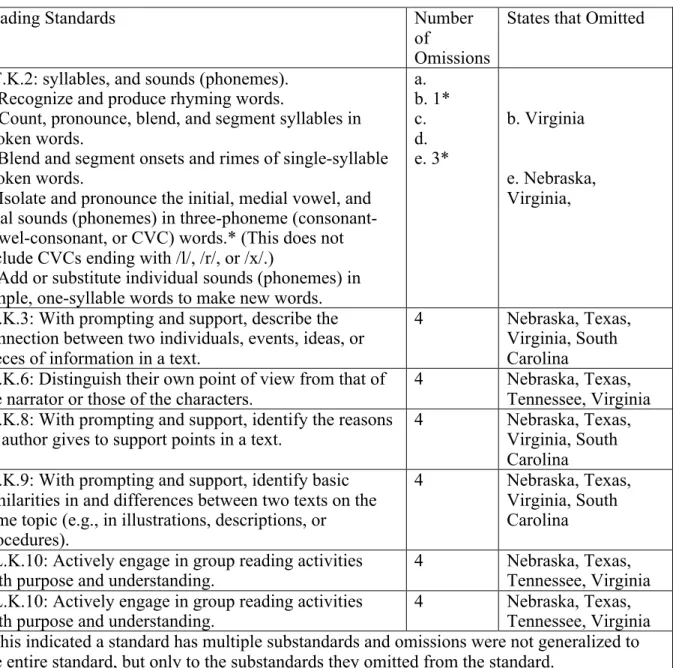
omitted from their state standards, but there are some patterns between states in the specific standards omitted. Starting with the percentage of omissions for each Independent state, it is shown that Nebraska, Texas, and Virginia omitted almost half of CCSS from their state’s
RI.K.6, RI.K.8, RI.K.9, RL.K.10, and RI.K.10) were omitted from four of them (Table 4.2). See Appendix A for the full list of omitted reading standards.
Table 4.2: Omitted Reading Standards.
Reading Standards Number
of
Omissions
States that Omitted
RF.K.2: syllables, and sounds (phonemes). a. Recognize and produce rhyming words.
b. Count, pronounce, blend, and segment syllables in spoken words.
c. Blend and segment onsets and rimes of single-syllable spoken words.
d. Isolate and pronounce the initial, medial vowel, and final sounds (phonemes) in three-phoneme (consonant-vowel-consonant, or CVC) words.* (This does not include CVCs ending with /l/, /r/, or /x/.)
e. Add or substitute individual sounds (phonemes) in simple, one-syllable words to make new words.
a. b. 1* c. d. e. 3* b. Virginia e. Nebraska, Virginia,
RI.K.3: With prompting and support, describe the connection between two individuals, events, ideas, or pieces of information in a text.
4 Nebraska, Texas, Virginia, South Carolina RI.K.6: Distinguish their own point of view from that of
the narrator or those of the characters. 4 Nebraska, Texas, Tennessee, Virginia RI.K.8: With prompting and support, identify the reasons
an author gives to support points in a text. 4 Nebraska, Texas, Virginia, South Carolina
RI.K.9: With prompting and support, identify basic similarities in and differences between two texts on the same topic (e.g., in illustrations, descriptions, or procedures).
4 Nebraska, Texas, Virginia, South Carolina RL.K.10: Actively engage in group reading activities
with purpose and understanding. 4 Nebraska, Texas, Tennessee, Virginia RL.K.10: Actively engage in group reading activities
with purpose and understanding. 4 Nebraska, Texas, Tennessee, Virginia *This indicated a standard has multiple substandards and omissions were not generalized to the entire standard, but only to the substandards they omitted from the standard.
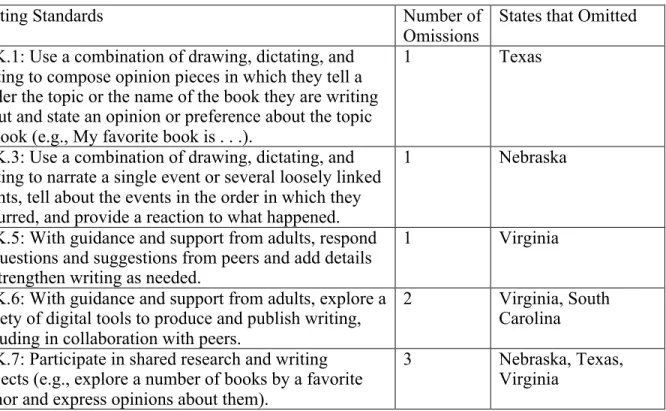
Texas, and Virginia not addressing shared research in their standards. See Table 4.3 for the full list of omitted writing standards.
Table 4.3: Omitted Writing Standards
Writing Standards Number of
Omissions States that Omitted W.K.1: Use a combination of drawing, dictating, and
writing to compose opinion pieces in which they tell a reader the topic or the name of the book they are writing about and state an opinion or preference about the topic or book (e.g., My favorite book is . . .).
1 Texas
W.K.3: Use a combination of drawing, dictating, and writing to narrate a single event or several loosely linked events, tell about the events in the order in which they occurred, and provide a reaction to what happened.
1 Nebraska
W.K.5: With guidance and support from adults, respond to questions and suggestions from peers and add details to strengthen writing as needed.
1 Virginia
W.K.6: With guidance and support from adults, explore a variety of digital tools to produce and publish writing, including in collaboration with peers.
2 Virginia, South Carolina W.K.7: Participate in shared research and writing
projects (e.g., explore a number of books by a favorite author and express opinions about them).
3 Nebraska, Texas,
Virginia
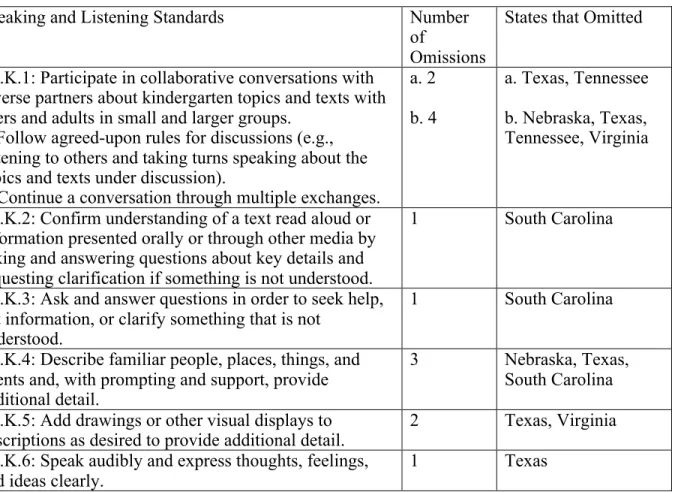
Table 4.4: Omitted Speaking and Listening Standards.
Speaking and Listening Standards Number
of
Omissions
States that Omitted
SL.K.1: Participate in collaborative conversations with diverse partners about kindergarten topics and texts with peers and adults in small and larger groups.
a. Follow agreed-upon rules for discussions (e.g., listening to others and taking turns speaking about the topics and texts under discussion).
b. Continue a conversation through multiple exchanges.
a. 2 b. 4
a. Texas, Tennessee b. Nebraska, Texas, Tennessee, Virginia
SL.K.2: Confirm understanding of a text read aloud or information presented orally or through other media by asking and answering questions about key details and requesting clarification if something is not understood.
1 South Carolina
SL.K.3: Ask and answer questions in order to seek help, get information, or clarify something that is not
understood.
1 South Carolina
SL.K.4: Describe familiar people, places, things, and events and, with prompting and support, provide additional detail.
3 Nebraska, Texas, South Carolina SL.K.5: Add drawings or other visual displays to
descriptions as desired to provide additional detail. 2 Texas, Virginia SL.K.6: Speak audibly and express thoughts, feelings,
and ideas clearly. 1 Texas
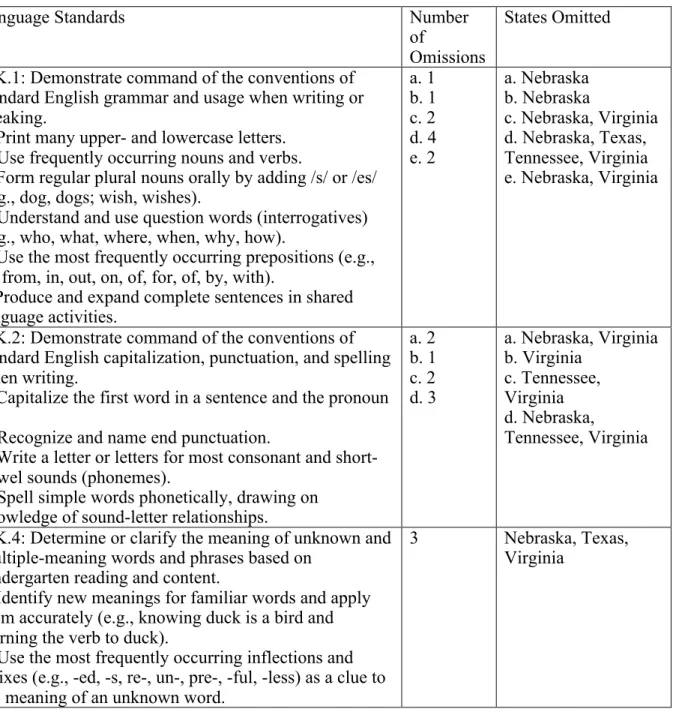
Table 4.5: Omitted Language Standards.
Language Standards Number
of
Omissions
States Omitted
L.K.1: Demonstrate command of the conventions of standard English grammar and usage when writing or speaking.
a. Print many upper- and lowercase letters. b. Use frequently occurring nouns and verbs.
c. Form regular plural nouns orally by adding /s/ or /es/ (e.g., dog, dogs; wish, wishes).
d. Understand and use question words (interrogatives) (e.g., who, what, where, when, why, how).
e. Use the most frequently occurring prepositions (e.g., to, from, in, out, on, of, for, of, by, with).
f. Produce and expand complete sentences in shared language activities. a. 1 b. 1 c. 2 d. 4 e. 2 a. Nebraska b. Nebraska
c. Nebraska, Virginia d. Nebraska, Texas, Tennessee, Virginia e. Nebraska, Virginia
L.K.2: Demonstrate command of the conventions of standard English capitalization, punctuation, and spelling when writing.
a. Capitalize the first word in a sentence and the pronoun I.
b. Recognize and name end punctuation.
c. Write a letter or letters for most consonant and short-vowel sounds (phonemes).
d. Spell simple words phonetically, drawing on knowledge of sound-letter relationships.
a. 2 b. 1 c. 2 d. 3
a. Nebraska, Virginia b. Virginia
c. Tennessee, Virginia d. Nebraska,
Tennessee, Virginia
L.K.4: Determine or clarify the meaning of unknown and multiple-meaning words and phrases based on
kindergarten reading and content.
a. Identify new meanings for familiar words and apply them accurately (e.g., knowing duck is a bird and learning the verb to duck).
b. Use the most frequently occurring inflections and affixes (e.g., -ed, -s, re-, un-, pre-, -ful, -less) as a clue to the meaning of an unknown word.
Table 4.5 (continued): Omitted Language Standards L.K.5: With guidance and support from adults, explore word relationships and nuances in word meanings. a. Sort common objects into categories (e.g., shapes, foods) to gain a sense of the concepts the categories represent.
b. Demonstrate understanding of frequently occurring verbs and adjectives by relating them to their opposites (antonyms).
c. Identify real-life connections between words and their use (e.g., note places at school that are colorful).
d. Distinguish shades of meaning among verbs
describing the same general action (e.g., walk, march, strut, prance) by acting out the meanings.
a. 3 b. 5 c. 4 d. 4 a. Tennessee, Virginia, South Carolina
b. Nebraska, Texas, Tennessee, South Carolina, Virginia c. Texas, Tennessee, South Carolina, Virginia
d. Nebraska, Texas, South Carolina, Virginia
L.K.6: Use words and phrases acquired through
conversations, reading and being read to, and responding to texts.
2 Texas, South
Carolina
Additions to existing standards. Many standards in both the CCSS+ and Independent
states included new content and skills rather than simply expanding upon the existing standard. Some additions did not substantially change or add additional skills to existing standards, for example, Nebraska’s addition of “and/or media” to a standard that calls for retelling major events from a text (RL.K.2). Adding this to the standard does add another type of print or source of information, but the skill being developed with RL.K.2 is retelling the story and details, so the substantive aspect of the standard remains the same. These kinds of differences were noted in the initial analysis but they are not discussed in this study because they do not change the standards of what students should be taught.
minor either because they are less generalized across states or because they only have a handful of instances of the addition. Those that are considered more significant or broader changes and additions are not more important or meaningful based on this categorization, they just have more related added standards within the category or are spread across more of the nine states studied.
Minor changes and additions. There were many skills provided by CCSS that were
included in the states analyzed, but Tennessee, Texas, and Virginia added the aspect of doing certain tasks orally. Tennessee added the oral aspect to the CCSS Reading Standards for Literature and Informational Skills that involve retelling certain parts of stories read (RL.K.2, RI.K.2), acknowledging the relationships between illustrations and text (RL.K.7, RI.K.7), comparing details within a text (RI.K.3), or comparing various texts to each other (RL.K.9, RI.K.9). Texas and Virginia’s additions are centered on the Reading Foundational skills found in Common Core with rhyming and blending phonemes both specified as needing to be done orally.
Predictions are only specified in Common Core once, and it is not until the second grade standards. Two states, Virginia and Alabama, included predictions in two of the existing
Common Core standards (RI.K.7, RL.K.1). Similarly, Common Core does not mention planning or writing drafts in the specific standards, but Texas, Minnesota, and South Carolina included prewriting activities in the existing CCSS Writing Standards (W.K.3, Writing Anchor Standard 5, and W.K.5).
Major changes and additions. There are three major patterns of addition in this section: Personal Engagement, Word Consciousness, and Cultural Inclusions. The first two listed are both patterns seen specifically within Minnesota. The need for personal engagement in standards attends to student interests when reading (RL.K.10, RI.K.10). The two standards specifically address student enjoyment and interests when reading “with purpose and understanding” in groups. Minnesota also specifically mentions word consciousness (L.K.5), a practice to increase student vocabulary by encouraging students to be interested and excited about learning
(Neugebauer et al., 2017). Montana noted the importance of cultural texts and resources by adding to six existing Common Core Standards, stating the needed use of “sources by and about American Indians” (RL.K.2, RI.K.3, W.K.7, and W.K.8). The other two cultural additions to the Montana state standards were to include words and phrases of American Indian cultural
significance (RI.K.4), and including stories about American Indian culture when comparing in-text details (RL.K.9).
Additional standards. A large portion of the findings resides within the content included
in additions to the Common Core standards because it shows what states outside of Common Core find essential, constructive, and practical for students to learn. Most of the additions between the CCSS+ and Independent states fall into nine main patterns with a few smaller categories of similarities. The 11 overarching patterns are Predictions, Prewriting, Vocabulary and Grammar, Directions, Print Conveying Meaning, Conversational Cues, Personal
Engagement and Connection, Literary Devices, Structure and Characteristics of Print, Research, and Decoding.
Minor additions. Predictions, Prewriting, Vocabulary and Grammar, and Directions are
vocabulary, and grammar to their state standards. The standards on predictions include using context clues to infer the meaning of unknown words, and using prior knowledge, illustrations, titles, and covers to predict the upcoming events in a story or text. Predictions are included in the additions to existing Common Core standards, but in these three states they are separate and independent skills deemed important for kindergarteners to master. Planning, drafting, and revising, however, are not included in CCSS. These states prioritized generating ideas and drafting during or as a result of class discussion, and revising ideas before presenting the findings. They also added many standards not found in Kindergarten Common Core Standards related to vocabulary and grammar acquisition. Nebraska and South Carolina include that students should be able to use grade and topic specific vocabulary that can vary based on the type of text or writing. Texas and South Carolina focus on using specific parts of speech, tenses, compound words, and conjunctions.
Nebraska, Texas, and Virginia added directions as a needed competency either orally, pictorial, or generally. Texas even specifically mentions understanding and using recipes and science experiments as following directions.
Four states, Nebraska, Texas, Virginia, and South Carolina, added specific standards on the students’ understanding of the relationship between print and meaning. These standards include understanding that print conveys meaning, understanding multiple sources and media, identifying meaning of signs (traffic signs, warnings, logos), and explaining the meaning of their own writings.
Major additions. The following patterns involve a heavier focus on each topic as
signified by the number of standards and skills addressed by each state. Four Independent states, Virginia, Nebraska, Texas, and South Carolina, and one CCSS+ state, Minnesota placed
Conversational Cues consist of verbal and nonverbal skills. The verbal skills noted in these standards consist of varying intonation, voice level, appropriate and polite word choice, stress patterns, and rhythm. The nonverbal skills include facial expressions, eye contact, facing the speaker, posture, and emotional awareness. In addition to these two categories, Virginia places importance on class echo and choral recitations.
Personal Engagement and Connection was largely based on Minnesota’s additions to existing standards in the above section, but upon further analysis, many states value the students’ personal interest and ability to connect texts to their lives. Nebraska, Texas, and South Carolina have a combined emphasis on connecting text of various kinds to personal experiences. Texas and Virginia specify being able to spell and read their names. Virginia and South Carolina include personal interest in research endeavors by using using interest and curiosity to generate topics to study further. Finally, Nebraska requires that kindergarteners connect texts to cultures that are similar and different from their own, and that kindergarteners are aware of safe internet use practices.
Standards within Literary Devices were originally included in Structure and
Characteristics and Print, but the category became too broad to summarize. Nebraska, Texas, and South Carolina emphasize recognizing various literary devices in text that are not included in the Common Core Kindergarten standards. These devices are rhyme, rhythm, repetition, alliteration, onomatopoeia, and sensory details. South Carolina added understanding that word choice can suggest feelings and emotions, and the understanding of problems and solutions and cause and effect.
After removing literary devices from Structure and Characteristics of Print, the remaining standards from Nebraska, Texas, Virginia, and South Carolina are centered around the
specific features for different topics and types of text, and the relationship between the features and the text itself. South Carolina has significantly more standards in this category than the other three states, and its additional standards focused on structure and characteristics of print include understanding how words and phrases shape meaning and tone in print, identifying narrators, identify the speaker’s purpose, and identify the introduction and conclusion of a presentation. Research in Common Core is discussed as answering a question, looking in provided informational sources, and publishing work. Nebraska, Virginia, and South Carolina added measures on discussing the credibility of sources, abiding by copyright and citation rules, using reference materials for new words, and using sources such as pictures and people for
information. Again, South Carolina has a larger amount of standards that include generating questions based on interests, building deeper understanding of disciplinary concepts through exploration and collaboration, create a plan to carryout and share research, analyze data to find patterns, reflect on findings, and monitor progress to guide the next step.
Five states, Nebraska, Tennessee, Texas, Virginia, and South Carolina have additional standards related to decoding. Some of these standards are similar to the Common Core
standards for decoding but address the skills in different manners, while others are new entirely. For example, Common Core’s L.K.2c standard says “write a letter or letters for most consonant and short-vowel sounds (phonemes),” implying students should be able to write these graphemes individually. However, Tennessee has a standard that says “spell VC (at, in) and CVC (pet, mud) words with short vowels; spell V (a, I) and CV (be, go) words with long vowels,” implying students should have an understanding of letter-sound correspondences and also be able to spell words using that understanding. Other decoding standards from these five states include
has a vowel, blending multisyllabic words, finger-tracking to help when reading texts with multisyllabic words, and recognize regularly and irregularly spelled words.
Not all the additions from the states studied could fit into the above categories, but are still important findings to report. These noteworthy but less encompassing categories are Concepts About Print, Number Concepts, Arts, Purposes of Reading, Stamina, Writing,
Matching Voice to Print, Literary Connections, and Minnesota’s Media Literacy. Most of these have only one or two states that identified the need for a standard in these categories, for
example, Virginia is the only state that measures students’ abilities to hold books the proper way. Virginia and Massachusetts (CCSS+) include understanding number words and the ability to use them properly when speaking and writing. Two states Virginia and South Carolina specify using art, drama, creative play, and story-telling to create meaning and develop various other skills. Finally, Nebraska is the only state in this study that mentions students should acknowledge the author’s purpose for writing the text, either to inform or entertain.
The remaining categories have more than two states, but have either very few standards or a minor additional skill. Three states, Tennessee, Nebraska, and South Carolina measure the stamina built up by reading and writing often. Nebraska, Texas, and Tennessee each have additional standards related to writing, for example, comparing mentor texts to examples and then using those comparisons to create their own work, or writing poetry. Tennessee’s writing to build stamina is counted in both categories, Stamina and Writing, because it also addresses increasing fluency levels, one of the five core components of Common Core. Matching voice to print is a single-lined standard added to Nebraska, Tennessee, and Virginia as foundational and speaking and listening standards.
and contrast one text presented in different medias and formats, Texas’s students will recognize recurring characteristics of fairytales and folktales between cultures, and South Carolina’s students will be able to do a thematic study within one author’s works.
Finally, Minnesota’s Media Literacy standards are included in this section despite its label as a CCSS+ state because they are complete additions to the Common Core standards. Two Anchor Standards with one grade-level standard each were added to the Speaking and Listening CCSS standards, labeled Speaking, Viewing, Listening and Media Literacy. The Anchor
Standards call on students to analyze information specifically found digitally, and then use the information in a publication created with diverse media formats. In Kindergarten, students are expected to distinguish between print, digital and multimodal texts, recognize common signs and logos, and identify advertisements and commercials. With assistance, they are also expected to create a shared work using digital media for a specific and predetermined purpose.
Some of these additional standards are similar to Common Core standards in later grades, some similar to first grade and others similar to seventh grade standards, but they are included in the additional standards measurement because it is compelling that many skills (RL.3.9, RL.4.9, RL.6.4) \are thought to be important and worthwhile for kindergarten classrooms in some states but not until much later in others.
For a complete listing of Omissions and Additions from CCSS, see Appendix A. Scaffolding
independently. When states remove that scaffolding from those standards, it increases the level of skill each state considers proficient by the end of the year. There are also some standards in three states, Alabama, Tennessee, and South Carolina, that had scaffolding added to them that was not included in CCSS. The instances of adding scaffolding were far less often, but still notable. The following sections will outline the skills that require independence or allow prompting and support in the six states mentioned above.
Removed scaffolding. The majority of the standards that no longer include “With
prompting and support” fall under the Reading for Literature (RL) and Informational Texts (RI) categories. Thirteen standards within RL and RI standards include scaffolding in CCSS’s level of skill proficiency, and at least 10 of them no longer have that level of support in at least one Independent State. The removed scaffolding can be seen in Tables 4.6 and 4.7, respectively organized by state and standard.
All of the scaffolded RL standards were made to require independence in at least one state with RL.K.3 being the most frequent to be changed. CCSS RL standards with scaffolding focus on identifying and retelling characteristics and key details of texts, understanding the relationship between the author, illustrator and the text, and the comparisons of related texts. In the Independent states, these are the skills students are expected to have mastered by the end of kindergarten.
There are two standards that no longer allow prompting and support in four out of five of the Independent states, LK.5 and RI.K.7. Common Core has four substandards under L.K.5 and the state analyses vary in the amount of substandards that are included in their plans, most only including one or two. Substandard A no longer has scaffolding in Nebraska and Texas,
connecting words to their real-lie uses, and understanding many verbs have similar meanings and being able to use the proper verb for slightly different contexts are the three aspects of L.K.5 that were changed to independent skills in the states mentioned above. The second standard that no longer includes adult support in four states is RI.K.7. This standard involves the skill of comparing text and illustrations.
Finally, only three Writing standards include adult prompting and support and all three were made to require independence in various states. These three standards are centered around creating writing with digital tools, peers, and sources to answer questions. Texas removed scaffolding from all three Writing Standards, meaning all the writing standards in Texas requires independence from kindergarteners.
Table 4.6: Scaffolding Removed and Added When Compared to CCSS (Viewed by State).
NE AL TX TN VA SC
Removed
Scaffolding RL/RI.K.1 RL.K.3 W.K.6 L.K.5a, c
RL/RI.K.2 RL.K.3 RI.K.7 W.K.5,6,8 L.K.5
RL/RI.K.1 RL.K.3,6,7 RL/RI.K.4 W.K.8
RL.K.6 RL.K.7 RI.K.7 RL.K.9 Added
Scaffolding L.K.1,2 L.K.1b,c W.K.1-3 RF.K.2a SL.K.6
Table 4.7: Scaffolding Removed and Added When Compared to CCSS (Viewed by Standard). Standards with
Removed Scaffolding States Standards with Added Scaffolding States
RL.K.1 Nebraska, Virginia, RF.K.2a Tennessee
RL.K.2 Texas W.K.1 Tennessee
RL.K.3 Nebraska, Texas,
Virginia W.K.2 Tennessee
RL.K.6 Virginia, South
Carolina W.K.3 Tennessee
RL.K.7 South Carolina W.K.7 South Carolina
RL.K.9 South Carolina SL.K.6 Tennessee
RI.K.1 Nebraska, Virginia L.K.1 Alabama (all)
a)
b) Texas, South Carolina c) Texas, South Carolina d) South Carolina
e) South Carolina f) Tennessee
RI.K.2 Texas L.K.2 Alabama
RI.K.4 Virginia L.K.4 South Carolina
RI.K.7 Texas, Virginia,
South Carolina L.K.6 South Carolina
W.K.5 Texas
W.K.6 Nebraska, Texas
W.K.8 Texas, Virginia
L.K.5 a-d a) Nebraska, Texas b)
c) Nebraska d) Tennessee
Added scaffolding. Fifteen CCSS standards, including substandards, without scaffolding
guidance. Tennessee added adult support to the first three Writing standards that focus on drawing, dictating, and writing opinion, informative, or narrative pieces, producing rhyming words, and expressing thoughts and feelings out loud. South Carolina reduced the level of mastery to using adult guidance for L.K.1, which focuses on standard English grammar usage, for all substandards except printing upper- and lower-case letters (Substandard A), L.K.4 which focuses on acquiring new meanings for words and the acquisition of affixes, and L.K.6, which focuses on using words acquired through experiences. Finally, South Carolina added scaffolding to W.K.7 regarding research and writing projects.
The main pattern seen in the removal or addition of scaffolding in CCSS+ or Independent states is states were mostly consistent with their decision to add or remove the adult support. Texas’s removals greatly out number its additions (4:1) and the additions are substandards within the same standard. South Carolina is the only state that truly does not fit the pattern as it has a relatively balanced amount of each (4:7). However, Nebraska and Virginia only removed scaffolding, and Alabama and Tennessee only added it.
The other main finding in this analysis is that out of all the omissions of scaffolding, 17 out of the total 26 instances were within the Reading Standards domain, while only one of the 21 additions is within a Reading Standard. Additions of scaffolding focused more on the Language and Writing Standards.
Discussion
answered in the results section and Appendix A, but is revisited at the end of this section. The first, third, and fourth questions are answered in the following sections.
Preliminary Findings
First, a compelling finding before the analysis of each state was that many states either claim to have created their own standards or make no mention of Common Core on their website or within their standards. However, upon looking through their standards documents, I noticed most of the standards either resembled Common Core’s phrasing (Arkansas and Alaska) or were the exact layout and structure of the official CCSS document without the CCSS logo and title (West Virginia and Pennsylvania). Each of these CCSS+ states use Common Core standards throughout their document with only minor differences but rename them possibly to avoid labeling them as Common Core or at least crediting Common Core for the majority of standards. This could be because of the negative connotation attached to Common Core as it became a buzzword in the US. Common Core is also attached to failed or problematic approaches to school accountability and student outcomes in No Child Left Behind, and leaving “Common Core” or “CCSS” out of their documents may prevent the state’s Department of Education from backlash on adopting or using CCSS. By doing this, it is possible that parents and other
stakeholders may believe Common Core is not used in their state, or that their state has
implemented standards individualized to their state. This is unfair of states to not credit the work of the Common Core developers and to deceive stakeholders in their state’s education.
Patterns of Omission of Skills and Competencies
on the skills and competencies valued. The varying levels of scaffolding reveal what level of independence, full or with guidance, a child should be comfortable with on each task by the end of the year. The content from CCSS that is not included in the states observed is important to note because these standards are the basis of the state’s education system. If one task is included in Common Core but not in other states’ plans, it may indicate that Common Core should re-evaluate the developmental readiness of the skill, or it may indicate other states are missing an important skill.
There are 71 individual standards in Common Core, including each substandard within the main standards, 36 of which are Reading Standards (23 standards with a total of 13
substandards only in RF Standards). Only two of the 36 Reading Standards were kept in all five Independent states, RL.K.2 and RL.K.3. Both of these standards focus on identifying key details and key elements of familiar stories. This displays the wide variety of omissions between each of the states. Nebraska, Texas, and Virginia each have at least 15 reading omissions, or roughly half of the Reading Standards. These states also had the most instances of removing scaffolding with the remaining Reading Standards, meaning there are very few Reading Standards left as they are in CCSS, which in combination with the omissions shows how adamant these states were about not adopting Common Core.