Page 1 of 12 Discover the Universe – 2012
Learning the sky
Although it is impossible to observe the stars during school hours, it is interesting to learn the sky to better understand its apparent motions and to learn the constellations. Here you will find tips on how to find the major constellations visible at this time of year.
All information below is given for observations made in the evening, around 8:30pm. If you observe much later in the evening, the stars will have moved westward and descriptions may no longer match your observations.
When you observe the sky, your eyes adapt to the darkness and your pupils dilate to let in more light. This night vision is very useful in astronomy! But your eyes can take 20-30 minutes to adapt well to darkness and, unfortunately, a single bright light can ruin your night vision quickly. This is why it is advisable to observe away from lights as much as possible (or turn your back to them) and to use a red flashlight. Red light does not affect your night vision as much as white light does. If you do not have a red flashlight, you can simply put a piece of red plastic (from a bag for example) on top of a normal flashlight and attach it with a rubber band.
Page 2 of 12 Discover the Universe – 2012
1
stevening – Circumpolar constellations
To start learning the sky, we will first focus on the circumpolar stars and constellations. These constellations seem to rotate around the North Star during the night and never disappear below the horizon. They are therefore visible through the year. The best known constellation is Ursa Major, which includes the Big Dipper.
Note that the circumpolar constellations will vary from one place to another, depending on your latitude. We will explore the circumpolar constellations at latitudes of 45–50 degrees (southern Canada). If you are located further north, you will see more circumpolar constellations and if you travel further south, you will see less.
We will begin our observations by locating the Big Dipper. At this time of the year, the Big Dipper is upside down, very high in the sky. It is composed of seven relatively bright stars. Officially, the Big
Dipper is not a constellation but an asterism, which is a pattern of stars that is easily recognizable in the sky, but not one of the 88 official constellations. The Big Dipper is the most obvious part of the constellation Ursa Major.
Try to locate Mizar, the middle star in the handle of the Dipper. If you have good eyes, you should be able to see another faint star close to Mizar: it is Alcor. According to recent studies, Mizar and Alcor are really part of a binary system, which means they are connected by their own gravity. Actually, Mizar is composed of four stars connected gravitationally and Alcor is composed of two stars. Therefore, this system would be a sextuple system: six stars bound together by gravity!
Page 3 of 12 Discover the Universe – 2012 Now that you know the Big Dipper is part of
Ursa Major, the great bear, you might wonder where the bear is! This drawing might help you find it, but it is actually difficult to locate when there is light pollution in the sky. Many of the stars forming the bear are quite faint and are only visible in a dark sky. Ursa Major is one of the early constellations that were drawn by the Ancient Greeks.
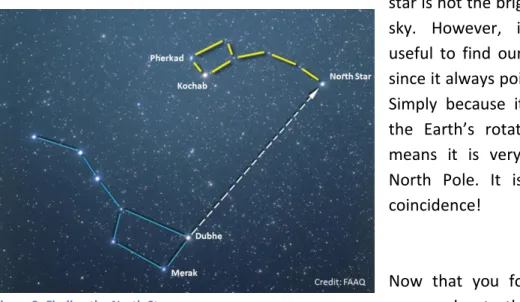
Before we finish tonight, you will use the Big Dipper to locate the North Star. The trick is quite simple: use the stars Merak and Dubhe to draw and extend a line until you reach the next relatively bright star: the North Star. Note that, contrary to popular belief, this star is not the brightest one in the sky. However, it is extremely useful to find our way in the sky since it always points north. Why? Simply because it is in line with the Earth’s rotation axis, which means it is very far above the North Pole. It is a very useful coincidence!
Now that you found the north, you can locate the other cardinal directions. While facing north, east will be to your right and west to your left. Of course, south will be right behind you.
The North Star, or Polaris, is in the constellation Ursa Minor, better known for its asterism the Little Dipper. This constellation is not easy to locate since most of its stars will be lost unless you have a very dark sky. We usually only see Polaris and the two opposite stars, Kochab and Pherkad. The Little Dipper is like a reverse ladle being emptied in the Big Dipper. Once again, the bear is not easy to visualize. You can use a computer program like Stellarium to help you.
Figure 2 - Ursa Major
Page 4 of 12 Discover the Universe – 2012 We will end our tour of the circumpolar region with the
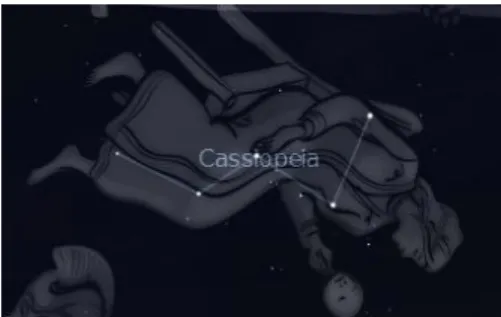
constellation Cassiopeia. This constellation is usually easy to find with its W (or M) shape. Cassiopeia is a queen on her throne. She is the wife of Cepheus, the king, and the mother of Andromeda. In Greek mythology, she was punished for being vain and was forced to spend half the year upside down on her throne, which is not a dignified position for a queen.
Congratulations! You can now locate the main circumpolar constellations. Try to observe them regularly in the next few weeks, or at different times during a night, and you will see how they seem to rotate around Polaris. Since these constellations are visible throughout the year, they are an excellent reference to find your way across the sky.
Page 5 of 12 Discover the Universe – 2012
2
ndevening – Looking west
Before starting tonight, try to find the circumpolar constellations you already know. Use the Big Dipper to find the North Star and take a minute to orient yourself.
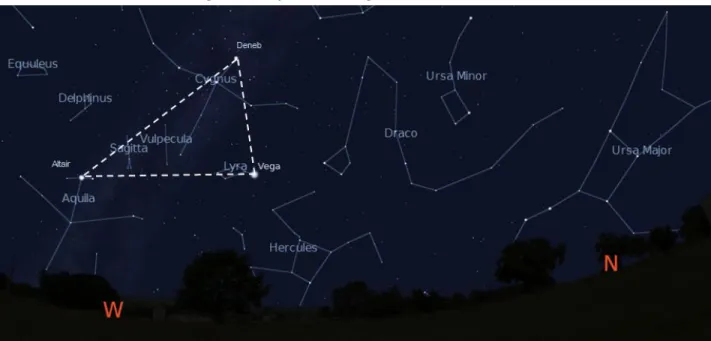
At this time of the year, it is still possible to see some summer constellations looking west in early evening. Three stars stand out and form what is called the Summer Triangle. The Summer Triangle is not a constellation but an asterism composed of three bright stars, each in its own constellation. Just like the Big Dipper is the reference for circumpolar constellations, the Summer Triangle is the reference in the summer sky when it is located high above our heads in the evening. Late fall, the Triangle is low on the western horizon.
To help you visualize the size of the Triangle, the following image shows it relative to other constellations including Ursa Major on the right.
Figure 5 - The Summer Triangle, as seen mid-November at 8:30pm
The brightest star in the Summer Triangle is Vega, a nearby star 25 light-years away. It is part of the constellation Lyra, which looks like a small parallelogram located next to Vega.
Another star in the Summer Triangle is Deneb, a blue-white supergiant star. It is the brightest star in the constellation Cygnus, the swan. The word Deneb meaning “tail”, it is
Page 6 of 12 Discover the Universe – 2012 therefore the tails of the swan. Cygnus is a pretty
constellation, sometimes called the Northern Cross (Deneb would be the top of the cross).
We will finish our tour of the Summer Triangle with the star Altair, the main star in the constellation Aquila, the eagle. Now take a moment to compare Altair and Deneb. These stars look very similar to the naked eye. However, Deneb is 100 times further away than Altair, which is approximately 17 light-years away. Imagine all the energy emitted by Deneb for it to be visible across such a distance (over 1600 light-years).
Page 7 of 12 Discover the Universe – 2012
3
rdevening – Looking south
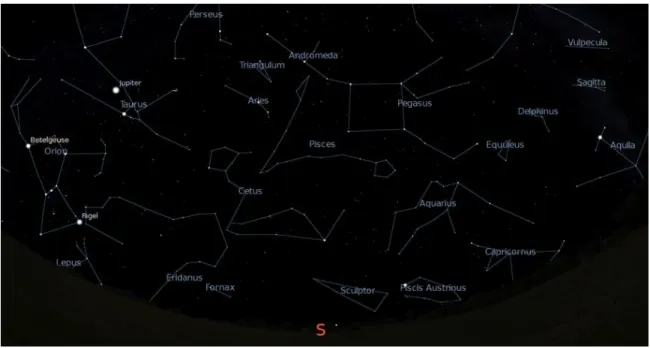
Fall constellations are not very bright but a few nice surprises can be found in some of them. You can see these constellations while looking south.
The main fall constellation is Pegasus, the winged horse, which actually looks like a large square in the sky. You will find
Pegasus high in the southern sky. Although the stars forming the square, which represents the horse’s body, are not especially bright, they are usually relatively easy to locate.
Actually, the top left star in the square, Alpheratz, is part of the
constellation Andromeda.
Andromeda consists of a line of stars connected to Alpheratz from the left. This constellation is quite
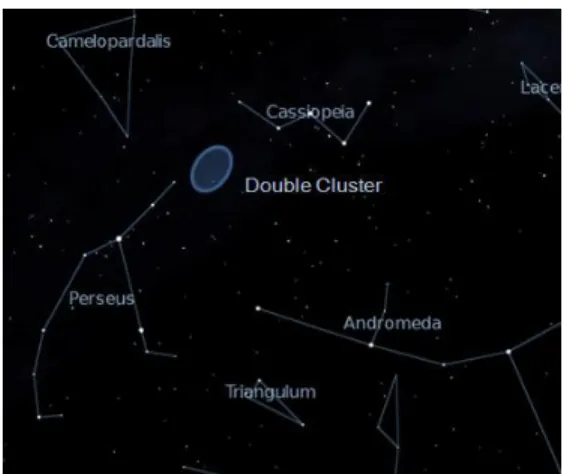
Figure 8 - Pegasus and Andromeda Figure 7 - Fall constellations, looking south
Page 8 of 12 Discover the Universe – 2012 ordinary, but we find a very interesting object within it: the Andromeda galaxy.
To locate the Andromeda galaxy, we can use the star Alpheratz and move two stars to the left, then up two stars. The Andromeda galaxy is located just to the right of the last star. These days, it is almost at the zenith in the evening. See figure 8.
This galaxy is the most distant object visible to the naked eye at 2.5 million light-years, but requires a dark sky without light pollution or moonlight to successfully capture its faint glow. You can also use binoculars to help locate it. When you see it, remember that the light reaching your eyes has been travelling in empty space for over 2 million years. It’s breathtaking!
The image you see will be different from the colour pictures, like the one shown here. These photographs are taken with cameras which are much more sensitive to light than our eyes and can capture details invisible to the eye. In particular, the eye only detects colours when an object is bright enough, which is unfortunately not the case for most celestial objects. Still, do not be disappointed, there is always something magical about seeing objects "live" in the real sky!
Under Pegasus we find a few faint constellations which are not easy to notice in the sky. This is the case for Pisces, Aries and Cetus, the whale. To help you this month, the Moon crosses Pisces from November 21st to 24th and will be in Aries, the short line of three stars, on November 25th and 26th. If you have clear skies during these evenings, take the opportunity to observe the motion of the Moon relative to the stars night after night. We will finish our visit of the fall constellations with
Perseus, the mythological hero who saved the princess Andromeda. Use the constellation Cassiopeia to locate it. Between Perseus and Cassiopeia, we find another interesting celestial object: the Double cluster. Visible to the naked eye under good conditions, these two star clusters are beautiful with binoculars or with a telescope at low magnification. There you will find hundreds of hot young stars, located about 7000 light-years away.
Figure 9 – Andromeda Galaxy Credit: Rémi Lacasse
Page 9 of 12 Discover the Universe – 2012 It may also be interesting to explore the mythology linking several of these fall constellations. In its simple version, this story portrays Perseus, Andromeda, Cassiopeia, Cetus and Cepheus (another circumpolar constellation). Cassiopeia, the queen, and Cepheus, the king, are Andromeda’s parents. Cassiopeia often bragged about her daughter’s beauty, going as far as saying she was more beautiful than the sea nymphs. Insulted, the sea nymphs asked the sea god, Poseidon, to send Cetus, the whale (or sea monster) to destroy Cepheus’ kingdom. To save his kingdom, the king had his daughter Andromeda chained to the rocks as an offering to the monster. However Perseus, the hero, managed to save Andromeda and, as in any good story, they fell in love and lived happily ever after!
Page 10 of 12 Discover the Universe – 2012
4
thevening – Looking east
We conclude our tour of the sky with the winter constellations which are starting to be visible in the east. These constellations are very bright and can be easily located.
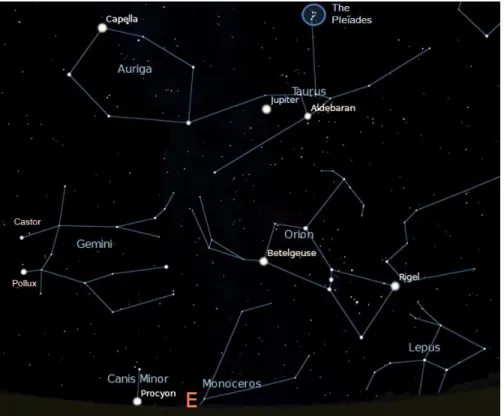
Figure 11 - Winter constellations, as seen mid-November at 8:30pm
The first star you'll notice in this part of the sky is actually the planet Jupiter. It is very bright and will be visible until late spring, when it will join the Sun in the daytime sky. In the meantime, it is very easy to observe with the eye as well as with an instrument. A good pair of binoculars or a small telescope will be powerful enough to reveal its four major moons. If you have the chance to observe them, you will not be disappointed! The Moon is near Jupiter on November 28.
In the sky, Jupiter is very close to the bright star Aldebaran, the eye of Taurus the bull, which is a red giant star located 65 light-years from us. Further to the left and above Jupiter is the bright star Capella in the constellation Auriga.
Right and above Jupiter and Aldebaran is a very interesting star cluster: the Pleiades. This small cluster contains thousands of stars but
Page 11 of 12 Discover the Universe – 2012 only a few are visible to the naked eye. The position of the stars can remind us of the Big Dipper, which explains why the Pleiades are sometimes mistaken for the Little Dipper. Although visible in some pictures, the blue nebulosity around the stars is impossible to see with the naked eye, nor with a small instrument.
Under Aldebaran and Jupiter is one of the best known constellations: Orion the hunter. This constellation is composed of bright stars and is the main winter constellation. His belt consists of three similar stars which are easily identified. His body looks like an hourglass surrounding the belt. Look at figure 9 to help you. In this constellation you will find two interesting stars, especially when we compare them. Betelgeuse, the right shoulder of Orion, is a red supergiant; one of the largest known stars. If it replaced the Sun in the centre of our solar system, the first four planets, including Earth, would find themselves inside it! You may notice its reddish
colour, especially if you compare it with Rigel, Orion's left foot, which is a blue giant. Rigel is much hotter than Betelgeuse.
Under Orion’s belt you will find his sword which is also a line of stars, but fainter. What looks like a star in the middle of the sword is actually the Orion Nebula, an enormous cloud of gas and dust where new stars are being born. It is a stellar nursery! Binoculars or a small telescope will allow you to see the fuzzy aspect of this nebula, which is a favourite among amateur astronomers.
We finish our tour of the winter stars with the two main stars in the constellation Gemini, Castor and Pollux. You can see them to the left of Orion. These two stars have about the same brightness and are the heads of the twins of Gemini.
Even if you can’t yet recognize the constellations shown here, you might want to identify the brightest stars: Aldebaran, Capella, Betelgeuse, Rigel, Castor and Pollux. Soon, there will be two more: Procyon and Sirius, which are a bit lower in the sky. All these stars form a great hexagon in the winter sky, with Betelgeuse in the centre. You can use Stellarium to view it.
Figure 13 – The Orion Nebula, as seen by the Hubble Space Telescope
Page 12 of 12 Discover the Universe – 2012 Congratulations! You now have a good knowledge of the autumn sky. If you completed all the activities during the workshop, you have learned over ten constellations and stars as well as many deep sky objects. Even though there are many more constellations in the sky, these will allow you to find your way across the autumn sky as well as the circumpolar region. Keep observing the sky regularly and you will see how it changes: the fall constellations will move westward as the winter and spring constellations will appear in the east: Sirius, Leo the lion, Arcturus....
You can also take a few minutes to observe the sky in all its splendor. Knowing the constellations is useful to find your way across the sky, but it can also be nice to observe the sky without seeing the usual shapes. The constellations tend to make us think of the stars as being on a celestial sphere, without depth, while in reality they are all located at greatly varying distances from us. You may find it a profound experience to imagine that in all its vastness the sky is home to countless suns most of which having planets bound to them. Maybe on one of those planets, someone else is looking out at the sky with similar interest and wonder...