Faith D Wahlers. Availability and Range of Large Print Books for Children and Teens in North Carolina Public Libraries. A Master’s Paper for the M.S. in L.S degree. April, 2019. 52 pages. Advisor: Mary Grace Flaherty
Several studies have shown that large swaths of our younger patrons suffer from vision issues, and especially undiagnosed vision issues. Additionally, research has shown that large print books can help children with vision issues, like low vision and dyslexia. This study examined the catalogs of five of the best funded public libraries in North Carolina, searching for books labeled both as large print and for children and teens. The available items meeting this criteria did not meet the collection development policies set out by the libraries. Of the five total libraries surveyed, there were only 52 books that appeared when searching for large print and children or teens. Furthermore, adults make up 55-80% of the readership for YA books. For these reasons, large print versions of children and teen books should be collected.
Headings:
Public libraries -- Services to people with visual disabilities Large type books
People with visual disabilities Children's library use studies Teenagers
AVAILABILITY AND RANGE OF LARGE PRINT BOOKS FOR CHILDREN AND TEENS IN NORTH CAROLINA PUBLIC LIBRARIES
by Faith D Wahlers
A Master’s paper submitted to the faculty of the School of Information and Library Science of the University of North Carolina at Chapel Hill
in partial fulfillment of the requirements for the degree of Master of Science in
Library Science.
Chapel Hill, North Carolina April 2019
Approved by
Table of Contents
Introduction ... 2
Literature review ... 5
Methodology ... 12
1.1 Sample Population Description ... 12
1.2 General Overview of Methods ... 12
1.3 Analysis Criteria ... 14
1.4 Methodology One ... 15
1.5 Methodology Two ... 16
1.6 Methodology Three ... 17
Findings... 18
1.7 Library A ... 19
1.8 Library B ... 20
1.9 Library C ... 20
1.10 Library D ... 21
1.11 Library E ... 22
Results ... 24
1.12 Library A ... 26
1.13 Library B... 27
1.14 Library C... 28
1.15 Library D ... 30
1.16 Library E ... 32
Conclusion ... 34
Bibliography ... 36
Appendix ... 39
1.17 Item 1: Collection Development Policy for Library A ... 39
1.18 Item 2: Collection Development Policy for Library B ... 41
Introduction
Library services for blind and visually-impaired patrons have improved greatly over the years. The first instance of accessible materials in US public libraries was in 1868, when the Boston Public Library was gifted 8 embossed, now known as raised letter, volumes (Reynolds, 2013, p. 5). In 1931, the Pratt-Smoot Act was signed into law, creating the National Library Service for the Blind and Physically Handicapped (Caulton, 2006, p. 260). At present, visually-impaired patrons are able to borrow a wide range of accessible materials from their state’s library for the blind. North Carolina’s Library for the Blind and Physically Handicapped will mail the desired items to the patron free of charge (North Carolina Library for the Blind and Physically handicapped, n.d.). Additionally, visually-impaired patrons are given specialized assistance at information institutions, as is mandated by the ADA, to help insure an equitable experience
(Southwell & Slater, 2013, p. 34). These measures, paired with the generally more accessible nature of digital information, when compared to print information, have made library services more accessible to visually-impaired patrons. However, there is a difference between better accessibility, and equitable enjoyment, as is mandated by the ADA in Title III (Gilardi, 1993, p. 712).
3.2 million Americans have corrected low vision, meaning when the person is wearing corrective lenses, they have 20/40 vision or worse but are not blind (Varma et al., 2016, p. 804). However, 8.2 million Americans had low vision due to uncorrected vision, meaning if the person had access to corrective glasses, their eyesight would be better than the 20/40 that qualifies them as low vision (Varma et al., 2016, p. 802). This gap is a difficult challenge that public libraries must consider when curating their collections and services.
Additionally, books for teens and children are not necessarily only read by teens and children. Titles in the young adult (YA) section are often enjoyed by adults as well. Many YA novels have become block buster hits, it would be near impossible for
someone to avoid at least hearing about Harry Potter, Twilight, or The Hunger Games, and these cultural phenomena have not gone by without note from adult readers. Shelley Diaz notes in her 2015 article that YA books have at least a 55% adult readership, with some estimates putting that number closer to 80% (Diaz, 2015). Even adults once
skeptical of this type of book have found novels they love (Bott, 2008). Expanding large print collections to include more books traditionally written for teens and children will only make a collection stronger, as adults who enjoy these books will have all the more to read, and children who may need these larger print sizes will be able to comfortably read books written with them in mind.
education advocate Joel Zaba published an article highlighting the growing crisis of uncorrected visual-impairments in school-aged children. Zaba states, “Experts estimate vision problems are prevalent in 25% of all schoolchildren in the United States . . . of children in the 9 to 15 years old age group, only 10% who needed eyeglasses actually had them.” (Zaba, 2011, p. 39). This prevalence of visual-impairments in both the general public and children necessitates an adequate large print collection for all readers.
The research conducted in this study examines five of the best funded public libraries in North Carolina, examining their large print collections for materials
Literature review
Large print has long been a staple in public libraries, as far back as 1941 libraries have been concerned with providing an enjoyable variety of large print books for patrons (Library Association Record, 1941). However, large print books can benefit a variety of patrons, not just the stereotypical older adults. In addition to aiding those with low vision, large print books can provide a higher level of enjoyment for those with print disabilities, and undiagnosed vision problems. Children and teens with these conditions can also benefit from large print texts. Many publishers overlook these patrons, in favor of older adults. While E-books are an excellent alternative, some patrons prefer
traditional books, and still others are still separated by the digital divide and cannot utilize these items.
To begin this discussion, it is helpful to remember that providing accessible materials is not just a good thing to do for the library’s community, it is a legal mandate. While there is a difference between having a small and outdated large print collection versus a completely inaccessible library website, large print books are still created to be used by those with a disability, and should be given a similarly empathetic and thoughtful consideration.
these institutions. The general guidelines for public institutions must inform how they hire employees and run their facilities, in addition to defining which institutions must adhere to said guidelinesi. One of the ways the ADA defines an institution as accessible, is that they provide disabled individuals a “equal enjoyment” of facilities, often through “auxiliary aids and services” (Gilardi, 1993, p. 712). These definitions are certainly basic in comparison to the discussions of disability in current library scholarship. Nonetheless, understanding the foundations of a movement are critical to proper implementation.
While there are necessary restrictions and guidelines for making information institutions accessible to persons with visual disabilities, there are also special privileges afforded to make information distribution more efficient. According to J. W. Roos, who was the director of the South African Library for the Blind, many countries make special provisions for duplicating copyrighted material so that it can be made into an accessible format. For instance, US law states that copyrighted materials may be reproduced as long as it is in, “specialized formats exclusively for use by blind or other persons with
disabilities” (qtd. In (Roos, 2007, p. 895)). This gives some flexibility to information institutions, especially non-profits that specialize in persons with visual-impairments, in creating accessible materials. However, these provisions are not without their inhibiting bureaucracy, as a license is required to produce accessible version of copyrighted materials. A lack of bargaining power during license negotiations, format and geographical limitations on distribution, and the high cost of creating accessible
with visual-impairments. For instance, the US does not include provisions for large print materials, even though Australia, the UK, and Canada feature laws with broader
definitions of accessibility that typically include large print (Roos, 2007, p. 897). These laws show that while much has been done to facilitate accessibility for persons with visual disabilities, persons with low vision are often left out of the picture.
A review of national law is essential for understanding the basics of how to make information institutions more accessible to those with visual disabilities. However, public libraries are often put in unique situations when it comes to assisting their visually-impaired patrons (VIPs). It is important to remember that public libraries should be partnering with their state’s library for the blind and other organizations to assist VIPs, as
a public library’s already strained budget will not be enough to fulfill the information needs of their VIPs. The range of accessible materials available are vast and at times expensive, Junaid Rayaini writes in their 2017 articles that materials such as Braille books, talking or audiobooks, talking newspapers, large print materials, voice recognition software, screen readers and accessible websites and online texts are all tools potentially necessary for VIPs access to information (Rayini, 2017, pp. 4–5, 7). By partnering with outside organizations, resources can be utilized to a greater impact.
revealed that three of the 14 public libraries that responded did not have any large print books in their system, and that only six of the 14 public libraries had magnifiers available for patrons. Furthermore, only two public libraries had any type of screen reading
software available in their library (Yannie, 2004, p. 50). While this study is a bit dated, it still illustrates the point that accessible materials are often left out of a public library’s collection development.
As these previous points have shown, public libraries often have room to improve in their collection of accessible materials. Furthermore, large print books are often ignored or under collected, despite the fact that they can assist not only VIPs, but also those with print disabilities. Author Gwenda Bond notes in two articles, Seeing the Big Picture, and Large as Life that large print books have a much wider readership than is traditionally thought. Bond interviewed Elizabeth Burns, a librarian at the National Library Service for the Blind and Physically Handicapped (NLS) who states,
‘Large print is very popular with children and teens who have low vision or dyslexia,’ says Burns. ‘It can be harder to find at local public libraries than adult large print, because many people think large print is for older folks who need reading glasses because they're older, not realizing that children and teens need it, also.’ (Bond, 2011, p. 26).
This shows that large print books can aid younger patrons and those with print
press, states that public libraries are the key to large print sales (Bond, 2010, p. 20). Currently, there is certainly a lack of large print books being published, as Thorndike press only publishes two YA books a month as of 2009 (Burns, 2009, p. 18). Reviewing Thorndike press in March of 2019 reveals that they still do not have a wide selection of YA books, with 265 currently being offered, compared to 648 Christian books, or 262 Biographies (Gale, n.d.). However, the range of large print books may be limited at present, but they can be expanded through the advocacy of their largest purchaser, public libraries.
Librarian Elizabeth Burns further expands on Bonds points about the benefits of large print for younger audiences. The NLS librarian explains that children with dyslexia often have an easier time reading large print materials, as do children with undiagnosed vision problems (Burns, 2009, p. 18). Undiagnosed vision problems are not at all
uncommon, Hark et al. discusses the findings of the Wills Eye Vision Screening Program for Children, a charity that screens elementary school children in Philadelphia for
that have difficulties learning to read, have these issues because of undiagnosed vision problems (Thurston, 2014, p. 162). While these studies demonstrate a definite need to provide better vision care for children, they also show that children with undiagnosed vision issues make up a large portion of the adolescent population. The best thing to help these children would obviously be better vision care, but large print books can at least help until vison care is made a higher priority. Additionally, children with print
disabilities such as dyslexia have been shown to benefit from reading print with greater spacing between words. Zorzi et al. wrote in 2012 that increasing the spacing between words can help prevent the “jumbling” of letters, and subsequent misrecognition, that is caused by crowdingv (Zorzi et al., 2012, p. 11455). The researchers state that increasing the spacing of letters is one of the ways to make reading easer for dyslexic patients, and that it fits in well with the current way to improve reading speeds, which is to have them read more (Zorzi et al., 2012, pp. 11457–11458). Furthermore, Yale University estimates that 20% of the population is affected by dyslexia (The Yale Center for Dyslexia and Creativity, 2017). Large print books may be a convenient low tech way public libraries can assist with this treatmentvi, as they by nature have larger spacing between letters than the industry typical 8- or 10-point font.
Researchers Fayaz Ahmad Loan and Refhat-un-nisa Shah interviewed 150 eleventh and twelfth graders in Srinagar India and found that 71% preferred print books over E-books (Loan & Shah, 2017, p. 85). Similarly, researchers Shaheen Majid, Hazel Kai Jie Ng, and Su Ying found that bilingual 13-16-year-olds greatly prefer physical books. 82.5% of the respondents indicated a preference for physical books, while only 13.2% of the students preferred E-books (Majid, Kai Jie Ng, & Ying, 2017, p. 6). These statistics suggest that while E-books can be useful resources for VIPs, physical books should still be collected.
Lastly, a wide range of large print books are necessary as patrons have a wide range of tastes. This is not so much of a revelation, as a reminder for collection development. Loan and Shah found that fiction detective mysteries and non-fiction biographies were nearly equally read by students (Loan & Shah, 2017, p. 89). Similarly, Majid, Kai ji Ng, and Ying found that romance, fantasy, and science fiction were
Methodology
1.1
Sample Population Description
This study analyzes the large-print collections of five of the best funded public libraries in North Carolina. The term “best funded” was determined by examining the per capita expenditures as noted in the North Carolina State Library Website’s Annual Statistical Report for Public Libraries (State Library of North Carolina, n.d.).
Additionally, all types of public libraries were included in this analysis: county, regional, and municipal. Of the 81 total public library systems in North Carolina, five were randomly selected from the top ten best funded libraries. This was done by listing and numbering the ten libraries in an excel spreadsheet, and then using a random number picker to choose the five libraries in the study. If a library’s catalog did not allow refining the results to just large print and juvenile/young adult materials, then it was not included in this study.
1.2
General Overview of Methods
The large-print collection of five of the best funded public libraries in North Carolina were analyzed using unobtrusive measures (Gray, 2004, pp. 272–273). More specifically, I used multiple collection centered, mixed-methods approaches to find out what types of books are available to young visually-impaired patrons (YVIPs) (Evans and Saponaro 2012, 137–43; Johnson, Hille, and Reed 2005, 228–31). The collection
centered approaches tend more towards list checking, checking a collection’s holdings against a pre-determined list of core titles, and collection standards, seeing if a collection meets professionally regulated collection guidelines (Evans & Saponaro, 2012, pp. 137– 143). Conversely, user-centered approaches often look at circulation statistics and ask user for their thoughts and opinions (Evans & Saponaro, 2012, pp. 143–148). Firstly, this study employs collection-centered measures, using descriptive methods to analyze the contents of the collections for several different factors, including copyright year, genre, and age range. Secondly, the library holdings were checked against a list of some of the most popular young adult (YA) titles using a list checking methodology. Lastly, the library holdings were checked for their holdings of a specific author, J. K. Rowling, as she has both popular YA and adult titles available, to see if her children’s or adult novels were more often collected. A list checking method and a descriptive method were used so that a more holistic understanding of North Carolina public libraries can be created. Previous experience with North Carolina public libraries has shown that most large-print collections for YVIPs tend to be in the low single to double digits. Therefore, only searching for a select number of titles may be far too narrow of a lens to view the collections.
Additionally, the first part of this study used mix-methods to analyze this collection. Determining the age demographic and genre of the book necessitates a more qualitative approach, as these categories are more subjective, while collecting the number of available titles and averaging the publication dates of the books is more of a
The second portion of this study was two basic list-checking methods. These additional searches were included as it is possible that children or teen titles may be available in large print, but they were cataloged only as large print, and not as an age group. The list checking method does have some drawbacks, as different communities have different needs, and there is no penalty for collecting poor titles (Evans & Saponaro, 2012, p. 138). However, the five titles checked are extremely popular, and some of the best-selling YA books, it can be reasonably assumed that a public library would be interested in collecting them. Additionally, these five novels are currently available on Amazon for approximately $20-$30.
1.3
Analysis Criteria
Healthy collections’ content can vary between public libraries depending on the needs of their communities. Therefore, comparing all of the institutions surveyed against one standard may be unfair. The collections were compared to the publicly available collection development policy published by each library. If the collection policy states that a collection needs to be up-to-date, yet the average age of their large print collection for teens and children was 25 years old, then they have failed to appropriately develop this collection. If the library did not have a collection development policy available, then they were compared to the Library A’s collection development policy. Library A’s collection development policy was chosen as it was fairly broad and was already a part of this study. The collection development policies were sourced from the libraries websites and then pasted and reformatted in the appendix of this paper, with all identifying
1.4
Methodology One
In addition to using a collection-centered design, this research entailed
specifically browsed the public libraries’ online catalog, refining the collection materials to large-print only, and then narrowing by age range. While this exact approach does not seem to have been completed before, others have used similar methods to analyze various collections. Mary Ellen George’s 1997 article details the collection analysis she
conducted concerning books for and about deaf children. Similar to my research methods, she analyzed each book in the collection for their 1) genre, 2) fiction or Non-fiction, 3) age demographics, and 4) publication date (George, 1997, p. 40).
Additionally, Nicole Minor conducted a collection analysis of graphic novels in her 2016 article, in order to determine whether a book was fiction or non-fiction, and what genre the book was, she also consulted a third-party book database, in this case it was
Amazon.com (Minor, 2016, p. 5).
The large-print book collections used in this study were examined for 1) the number of large-print books held, 2) each book’s intended age demographics, 3) whether the book is fiction or non-fiction, 4) genres for each book, and 5) copyright date for each book. Online library catalogs and NoveList were used to collect the data for these
listed in the library catalog was used as opposed to the age range listed in NoveList as it was assumed that the typical YVIP would use these guidelines when searching for a book. Children’s picture books and beginning readers were not included in this sample, as although they are often printed in a larger type point, they are not made specifically to be accessible materials for YVIPs, rather they are the norm for the genre. Fiction or non-fiction was determined by searching the MARC record on the library’s online catalog, if the library did not specify whether a book was fiction or non-fiction, NoveList was consulted. Additionally, NoveList was used to determine the genre of each book, using the “Genre” category on each book’s entry on NoveList’s site. If it was not listed on NoveList, Amazon was consulted. If both sites did not have a genre listed for the book, then the book was marked as “Unknown”. Lastly, the Copyright date for each book was sourced from the NoveList.
1.5
Methodology Two
large print versions of these books was checked, as if a library does not have a regular print copy of a book, it can be assumed that this was more of an intentional gap in the collection.
1.6
Methodology Three
Lastly, as conducting the previous two methodologies described revealed interesting data, a third methodology was added. The five public libraries were also checked for their holdings of author J. K. Rowling. This was done by entering the last name “Rowling” into the library’s online catalog, and then refining to only large print. The last name “Galbraith” was also checked, as Rowling has previously published her adult books under this name, and some catalogs still had this pen name listed as the author. As J. K. Rowling is arguably the most well know children’s author currently publishing, and as she has both adult and children’s/teen’s books available, the presence
Findings
Five libraries were surveyed for this study, the data was collected during February and March 2019 using the methods described in the previous section. As the libraries were anonymized, they will be referred to as libraries A, B, C, D, and E. A total of 52 books were both labeled as children or teens, and as large print. Out of the five libraries, only one had any of the five best selling YA novels, and then that library only had one. Four of the Five libraries had at least one novel written by J. K. Rowling available in large print.
Library A is a large Municipal library with a population of over 50,000 people, situated near a university1.
Library B is a small Municipal library located in a suburban town with a population of about 5,000 people, located on the edge of a larger metropolitan area.
Library C is a Municipal library serving a town of just over 10,000 people, also on the edge of a larger metropolitan area.
Library D is a county system of seven libraries serving a population of over 250,000 people.
Lastly, library E is a municipal library situated in a small town of just under 10,000 people.
1.7
Library A
Library A had 24 books available in large print and cataloged for teens or
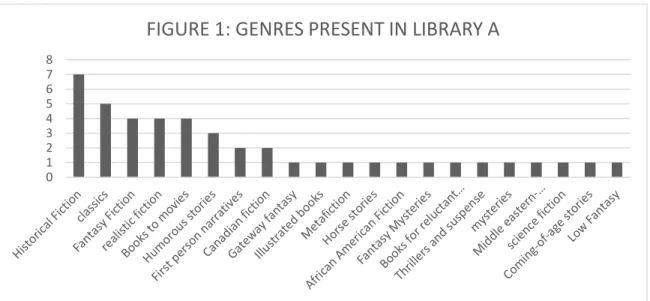
children. Of these 24 books, 5 were listed for teens, and 19 were listed for children. The average copyright date for these books was 1993, with the newest being copyrighted in 2017 and the oldest in 1947. All 24 of the books were fiction, none were non-fiction. The most common genre present in the collection was Historical Fiction, at seven books. Five books were marked as Classics, and Five books were marked as some type of Fantasy. See Figure 1 for a further break down. This library had regular print copies of all the five books (Harry Potter and the Sorcerer’s Stone, Divergent, Twilight, The
Hunger Games, and The Fault in Our Stars), but none of them were available in large print. Additionally, four books written by J. K. Rowling were available at Library A, The Casual Vacancy, Lethal White, The Cuckoos Calling, and Career of Evil, were available in the large print section.
0 1 2 3 4 5 6 7 8
1.8
Library B
Library B had only three books total that were both labeled at teens or children and large print. By the Shores of Silver Lake, by Laura Ingalls Wilder, Then Again, Maybe I Won’t, by Judy Blume, and Harry Potter and the Chamber of Secrets, by J. K. Rowling. These books were either listed as Juvenile or 9-13 years in the catalog, and no books were listed as for teens. The average year of first copyright was 1970, with the newest book copyrighted in 1999, and the oldest in 1939. All three were works of fiction, with no non-fiction books meeting the study’s requirements present in this library. The most common genre of book present was Classics, with two of the three2 books marked as classics. More details can be seen in Figure 2. This library had regular print copies of all five books checked, but none in large print. Additionally, library B had one book published by J. K. Rowling, Harry Potter and the Chamber of Secrets available in large print.
1.9
Library C
Library C had six titles available according to the methodology. These books were listed as either Juvenile or ages 14-17, making five books for children and one book
2 It should be noted that the first Harry Potter book is listed as a classic, The Chamber of Secrets is the
second book.
2
1 1 1
0 0.5 1 1.5 2 2.5
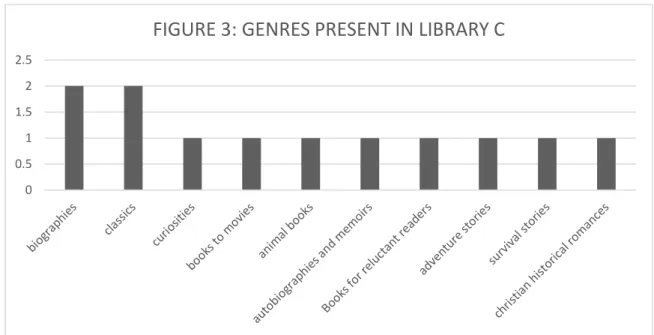
for teens. The average year of first copyright was 1994, with the oldest copyrighted in 1961, and the newest in 2016. Three were fiction and three were non-fiction. The most common genre was Biographies and Classics, with two books each. A further breakdown of genres can be seen in Figure 3. This library had none of the five books available in large print, and only three of the five books were available in any physical copy, The Hunger Games, The Fault in Our Stars, and Divergent. Harry Potter and the Sorcerer’s
Stone was available as an E-book and Audiobook, but not as a physical book. Similarly, this library only had a copy of one of the Twilight Saga books as an audiobook, New Moon. Library C did not have any books written by J. K. Rowling available in large print.
1.10
Library D
Library D had only one book available that met the criteria of the study. However, a further investigation showed that there were at least two other books that were both large print and for children or teens, but were not cataloged as such, so they do not appear in the specified search results. The Sea of Monsters by Rick Riordan was
0 0.5 1 1.5 2 2.5
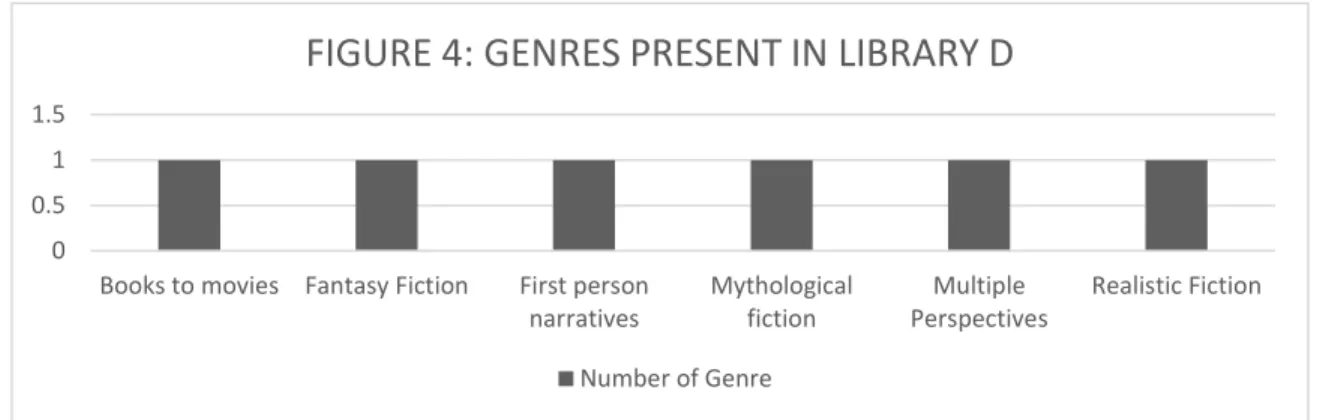
available at library D and showed up in the search results when performed as stated in the methodology section. This children’s book was copyrighted in 2006. This was a fiction book, its genre was marked as Book to Movies, Fantasy Fiction, First Person Narratives, and Mythological Fiction. However, when the term “Large Print” was searched in the “Anywhere” search box, another book appeared in the results page, Return to Sender by Julia Alvarez. This children’s book was listed as Multiple Fiction and Realistic Fiction book, it was published in 2009. Furthermore, one of the five titles mentioned in the second methodology was present in Library D, Harry Potter and the Sorcerer’s Stone was available in large print, they have the other four books available in regular print, but not large print. As for books written by J. K. Rowling, The Casual Vacancy, and the 1st, 3rd, 5th, 6th, and 7thHarry Potter books were all available in large print. A list of
Riordan’s and Alvarez’ book genres are available in Figure 4.
1.11
Library E
Lastly, Library E had 16 books available matching the methodology criteria. All of the books available were listed as Juvenile in the catalog, making it 16 children’s books and zero teen books. The average year of copyright was 1989, with three books published in 2010, and the oldest book published in 1937. Three of the books held were non-fiction, and 13 fiction. The most common genres present was a version of Fantasy,
0 0.5 1 1.5
Books to movies Fantasy Fiction First person narratives
Mythological fiction
Multiple Perspectives
Realistic Fiction
FIGURE 4: GENRES PRESENT IN LIBRARY D
at four books, and Books to Movies, Picture books for Children, and Mysteries with two books a piece. See Figure 5 for a further breakdown. Three of the books present likely were not actually intended for children or teens, as two were cataloged as picture books (Pooh Gets a Checkup, and Subway Ride), and one is a well-known adult mystery
(Sizzling Sixteen). Of the five titles specifically searched for, none were available in large print, and all but Divergent by Veronica Roth were available in regular print. A full breakdown of the five best seller books by library is available in Figure 6. Four books written by J. K. Rowling were available at Library E, The Casual Vacancy, Harry Potter and the Half Blood Prince, Harry Potter and the Prisoner of Azkaban, and Harry Potter and the Goblet of Fire. A full breakdown of the J.K. Rowling books is available in Figure 7. 0 1 2 3 4 5 6 Harry Potter and the Sorcerer's Stone Large Print Harry Potter and the Sorcerer's Stone Regular Print The Hunger Games Large Print The Hunger Games Regular Print The Fault in Our Stars Large Print The Fault in Our Stars Regular Print Twilight Large Print Twilight Regular Print Divergent Large Print Divergent Regular Print
FIGURE 6: LARGE PRINT VERSUS REGULAR PRINT OF THE
FIVE BEST SELLERS
0 0.51 1.52 2.53 3.5
FIGURE 7: J. K. ROWLING BOOKS AVAILABLE BY LIBRARY
Discussion
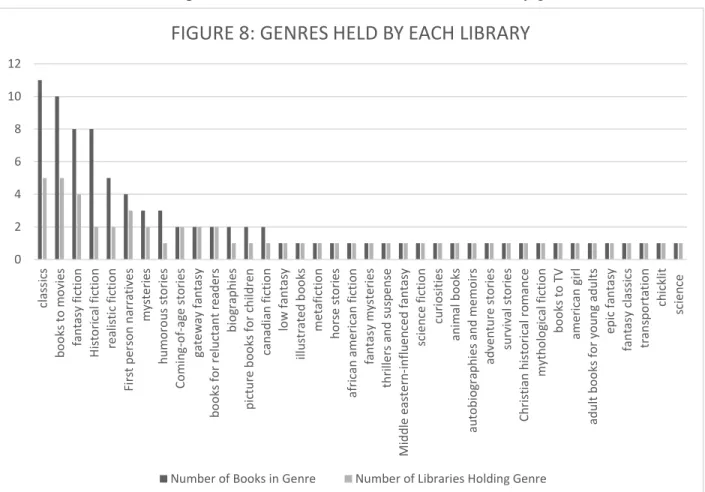
The findings suggest that these libraries do not purposely collect large print books for teens and children, given that the average age of the five libraries’ collection overall was 28 years (median copyright year of 1991.29), and that there were only 52 books between these libraries that match the first methodology criteria. These books also were not extremely varied, as most of the collection was comprised of Classics and Books-to-Movies, the full breakdown of the genres present at all libraries is available in Figure 8. This is not saying that these genres should not be collected, just that libraries should strive to have more depth to their collection other than these relatively generic ones.
0 2 4 6 8 10 12 cl as si cs b o o ks to m o vie s fant as y f ic ti o n H is to ri cal fi cti o n re al is ti c fictio n Fi rs t p ers o n n arr ati ve s mys te ri es h u mo ro u s s to ri es Co m in g-o f-a ge s to ri es gate w ay f an tas y b o o ks fo r r el u ctan t r ead ers b io gr ap h ie s p ic tu re b o o ks fo r c h ild re n can ad ian fictio n lo w fan tas y ill u st rat ed b o o ks me taficti o n h o rs e s to ri es afri can amer ic an fictio n fant as y m ys te ri es th ri lle rs an d s u sp e n se Mi d d le e as te rn -in flu e n ce d f an tas y sc ie n ce fictio n cu ri o si ti es an im al b o o ks au to b io gr ap h ie s an d me mo irs ad ve n tu re s to ri e s su rvi val s to ri e s Ch ri sti an h is to ri cal ro man ce myt h o lo gi cal fi cti o n b o o ks to T V amer ic an g irl ad u lt b o o ks fo r yo u n g ad u lts ep ic fa n tas y fant as y c las si cs tr an sp o rt ati o n ch ic kl it sc ie n ce
FIGURE 8: GENRES HELD BY EACH LIBRARY
However, the best determinant of the libraries dedication to collecting this type of materials, is to compare their collections against their collection development statements (CDS). Libraries A, B, and D made their CDS available online, and libraries C and E did not have their CDS available online, and therefore they will be compared to library A’s CDS as it is fairly broad in nature. These items are available in the Appendix, as items 1, 2, and 3, they have been copied over from the library’s website with identifying
information blocked out to maintain the anonymity of the study.
1.12
Library A
Generally speaking, Library A’s collection of 24 books does not quite meet the requirements laid out in their CDS. The basis of their statement is,
. . . to collect, curate, and make accessible library materials in a wide variety of formats that respond to community interests and demographics. The library’s goal is to maintain a popular, up-to-date collection attuned to the diverse needs of Chapel Hill residents. . .
Evaluation Criteria
• Popular demand!
• Critical reviews from the industry and media
• Established authority of an author or their publisher
• Current or long-term significance of a work
• Accuracy and timeliness
• Relationship to existing collection
• Price, format, condition, and ease of use (Appendix, Item 1).
Firstly, as there were only 24 books available in large print for children or teens, there is inherently a lack of a variety of formats for this demographic. While they do mention that collection is driven by patron requests, the literature review at the start of this paper showed that children often need this format but do not realize it is a helpful possibility for them.
collection was 26 yearsix and none of the popular books searched for were available in large print. A collection that is popular and up to date would surely still have at least one of these titles available, especially as these titles were available elsewhere in the library. Furthermore, the library’s thinking of large print as not for children and teens was again shown in their collection of J. K. Rowling books. All of Rowling’s adult novels were collected in large print, while none of her children’s books were available.
There were certain titles that do meet the criteria, Strange the Dreamer by Laini Taylor for instance has received excellent critical reviews, even winning the Printz award, and is a recent release (American Library Association, 2018). Nevertheless, the lack of any non-fiction items, the age of the collection, and the lack of popular reading materials means that this library’s collection of large print books for children and teens does not meet its own CDS.
1.13
Library B
Library B only had three total titles available in large print for children or teens. This small sample size makes it difficult to compare fairly to their CDS. However, there is a line in the CDS that merits conversation.
The general criteria by which most materials are considered include: recency, accuracy, authority, depth of coverage, cost, format, popular demand, historical value, availability, quality, durability, and special features. These selection criteria will be applied equally to all materials, regardless of format. . .
Ability to satisfy the needs and interests of the community Obsolescence of information
Number of copies in the collection
Number of Circulations, requests and reserves over a set period of time Adequacy of other resources in the subject area to meet patron’s needs In-print status
Ease of replacement by purchasing another copy or a similar resource Availability of the resource or information outside the Library at another institution
These criteria give priority to more recent or historically significant publications, with additional preference given to popular, accuracy of information, and cost efficiency. Looking at these three books through this lens, the titles generally meet the criteria. Judy Blume and Laura Ingalls Wilder are surely historically significant writers, and the
inclusion of the second Harry Potter book does at least give a nod towards popular materials. However, there were only three fiction juvenile books. There certainly needs to be a few non-fiction books, and a few books for teens in this collection. There was also the issue of having none of the five book titles checked. An up to date collection of popular materials would surely contain at least one of these titles.
Lastly, the state of their large print collection overall may be less than ideal. The only J. K. Rowling book owned in large print was Harry Potter and the Chamber of Secrets. The lack of the first novel in a series is questionable, and the absence of any of Rowling’s adult novels is also concerning, as they are fairly popular in their own
demographic.
Generally speaking, these three books do meet the library’s CDS, but there is simply not enough of them. A further development of both their children and teen’s collection, and possibly their adult large print collection, would bring the needed breadth and depth to their collection.
1.14
Library C
for teens. As this library did not have a publicly available CDS it is compared to Library A’s, as it has a fairly universal CDS. The gist of Library A’s CDS is,
. . . to collect, curate, and make accessible library materials in a wide variety of formats that respond to community interests and demographics. The library’s goal is to maintain a popular, up-to-date collection attuned to the diverse needs of Chapel Hill residents. . .
Evaluation Criteria
• Popular demand!
• Critical reviews from the industry and media
• Established authority of an author or their publisher
• Current or long-term significance of a work
• Accuracy and timeliness
• Relationship to existing collection
• Price, format, condition, and ease of use (Appendix, Item 1).
Therefore, this library does not meet the general CDS. Many of the books available were older, 1961, 1969, and 1998, and there was only one better known book present, Where the Red Fern Grows. The authors are not overly well known, and the titles are not particularly timely.
However, it is possible that the library itself focuses more on online materials. When the five titles were searched in the catalog, none were available in large print. Interestingly, only four of the five titles were available in regular print, and one of those was only available as an E-book or audiobook. This lack of the more popular titles present in a physical format might hint at internal collection development priorities being set more towards online materials. If this is the case, and if the community is
Lastly, only one J. K. Rowling book was available at this library, Career of Evil, the third book in the CormoranStrike series. The collection of only one adult novel follows the trend of prioritizing adult large print books, much like the other libraries surveyed. Similarly, the lack of the previous Cormoran Strike novels also calls their general large print collection into question.
1.15
Library D
Library D was an extremely difficult library to review, as only one book appeared when the first methodology was followed, the first Harry Potter book was available when the second methodology was followed, and an additional four of the seven Harry Potter
books were found when following the last methodology. A further investigation of the library website resulted in another book found. However, seven books do not make a collection. Additionally, locating where to check out these books was difficult, as the
Percy Jackson novel did not list the library where it is heldx. This library does have the most recent collection, with an average age of 11.5 years for both books. This library also had more popular titles available, including The Sea of Monsters, and most of the
Harry Potter series. Library D featured a more, relatively, diverse and relevant holding,
Return to Sender by Julia Alvarez. This story features the story of a family of Mexican immigrants in Vermont illegally. These titles line up fairly well with the library’s CDS. The selection criteria and retention criteria are,
Selection Criteria
1. Authority and reputation of the author/producer 2. Responsible and timely treatment of the subject
3. Clarity, organization, and readability of both design and content 4. Significance and/or usefulness in relation to the existing collection 5. Evaluation of critical and/or professional reviews
8. Cost relative to work’s value to the collection 9. Durability of format
10.Appropriateness of medium to subject portrayed 11.Relevance to the interests and needs of the community 12.Popular demand considered with the above criteria Retention Criteria
1. frequency of circulation 2. format or physical condition 3. currency of information 4. role in the overall collection (Appendix Item 3)
When looking at all three books, they generally meet these criteria, Return to Sender is a timely story to have available, and both The Sea of Monsters and Harry Potter and the Sorcerer’s Stone are extremely popular items with well-known authors.
Furthermore, despite the issues with cataloging, the first Harry Potter book was available in this system, the best of all the libraries surveyed. Nonetheless, this must be taken with a grain of salt. As great as it is that a popular title was collected in large print, the other four titles checked for were still not available in large print, despite the regular print formats of these books being available in Library D.
This library also had the most J. K. Rowling books available, with The Casual vacancy, The Cuckoos Calling, Harry Potter and the Deathly Hallows, Harry Potter and
the Order of the Phoenix, Harry Potter and the Prisoner of Azkaban, and Harry Potter and the Sorcerer’s Stone all available for check out. These titles include most of the
Harry Potter series and a few of Rowling’s adult novels. The fact that these Harry Potter books did not come up in the first methodology’s search is concerning, as many of
1.16
Library E
The last library surveyed was Library E, which held a total of 16 books resulting from the first methodology criteria. Unfortunately, this library had multiple problems with its cataloging. When the catalog was searched for both large print, and children and teens books, two picture books, which were not included in this survey, and one adult fiction novel were returned along with the other matching items. Furthermore, the average copyright date of these books was 1989, all the books available were for children, and all but three of the results were fiction. As this library did not make it’s CDS available online, it will be compared to Library A’s, which generally adheres to these standards,
. . . to collect, curate, and make accessible library materials in a wide variety of formats that respond to community interests and demographics. The library’s goal is to maintain a popular, up-to-date collection attuned to the diverse needs of Chapel Hill residents. . .
Evaluation Criteria
• Popular demand!
• Critical reviews from the industry and media
• Established authority of an author or their publisher
• Current or long-term significance of a work
• Accuracy and timeliness
• Relationship to existing collection
• Price, format, condition, and ease of use (Appendix, Item 1).
Library E also has none of the titles checked for available in large print, and was missing Divergent in regular print. Again, the lack of extremely popular titles in this collection is an easily rectifiable oversight.
Four J. K. Rowling books were available at Library E, The Casual Vacancy, Harry Potter and the Half Blood Prince, Harry Potter and the Prisoner of Azkaban, and
Conclusion
Some of the best funded public libraries in North Carolina consistently show a lack of planning when developing their large print collection for teens and children. Only 52 books were available that were marked as both large print, and demographically as for children or teens. Only one library had a large print copy of one of the five popular YA titles searched, and most of the J. K. Rowling books available were her adult novels. A larger number of large print books were hoped for, as these are some of the best funded public libraries in North Carolina. A high number of children and teens suffer from vision problems, and many adults enjoy Young Adult literature just as much as young adults (Bott, 2008; Zaba, 2011). Increasing a public library’s holdings of such books will benefit all persons involved, and will not take away materials from patrons without vision issues, as they can enjoy large print books just the same. This problem is more than just a collection development problem at public libraries, publishers also need to offer more children and teen books available in large print. Nonetheless, making at least the more popular titles available in public libraries can be beneficial for young and old patrons alike.
A comprehensive review of what large print publishers currently offer in teen and children books would greatly help this subject area. Knowing what could be available to public libraries, and having concrete evidence that not enough is being done on a
older adults would like to read in large print could help grow the collections in ways that benefit traditional users. A study of dyslexic user’s opinions of large print would also be beneficial in creating print books that are easier for them use, and could help develop new materials that help 20% of the current population (The Yale Center for Dyslexia and Creativity, 2017).
Bibliography
American Library Association. (2018). Strange the Dreamer. Retrieved March 20, 2019, from http://www.ala.org/awardsgrants/strange-dreamer
Bond, G. (2010). Seeing the Big Picture. Publishers Weekly, 257(19), 18–23. Bond, G. (2011). Large as Life. Publishers Weekly, 258(14), 25–27.
Bott, C. J. (2008). Hooked on YA Lit! A Book Group for Teachers and Librarians. Voice of Youth Advocates, 31(5), 400–403.
Burns, E. (2009). Easy on the Eyes: Large Print Books for Teens. Young Adult Library Services, 8(1), 18–19.
Caulton, J. (2006). NLS at 75: National Program For Blind Readers Examines Its Past and Looks Toward Its Future. Library of Congress Information Bulletin, 65(11), 260–262.
Diaz, S. M. (2015). YA’s Long Reach. (cover story). School Library Journal, 61(11), 22– 25.
Gale. (n.d.). Large Print Young Adult Fiction - Thorndike - Gale. Retrieved March 20, 2019, from https://www.gale.com/thorndike/young-adult-fiction/-/N-5pZ1z12enz Gilardi, R. (1993). The Archival Setting and People with Disabilities - a Legal Analysis.
American Archivist, 56(4), 704–713.
for Pediatric Ophthalmology and Strabismus, 20(5), 439-443.e1. https://doi.org/10.1016/j.jaapos.2016.07.219
Library Association Record. (1941). Books for tired eyes. Library Association Record, 60–60.
Loan, F. A., & Shah, R., (2017). Survey of the Literature Reading Habits and Preferences of Adolescents: A Study of a Public School in India. LIBRES: Library &
Information Science Research Electronic Journal, 27(2), 80–96.
Majid, S., Kai Jie Ng, H., & Ying, S. (2017). Leisure Reading Preferences of Bilingual Female Students in Singapore. LIBRES: Library & Information Science Research Electronic Journal, 27(1), 1–12.
North Carolina Library for the Blind and Physically handicapped. (n.d.). How We Serve You | State Library of North Carolina. Retrieved September 9, 2018, from https://statelibrary.ncdcr.gov/lbph/about/how-we-serve-you
Pew Research. (2018, February 5). Demographics of Internet and Home Broadband Usage in the United States. Retrieved March 13, 2019, from
http://www.pewinternet.org/fact-sheet/internet-broadband/
Rayini, J. (2017). Library and Information Services to the Visually Impaired Persons.
Library Philosophy and Practice; Lincoln, 1–13.
Reynolds, E. A. (2013). THE ORIGINS OF LIBRARY SERVICES FOR BLIND ADULTS IN THE UNITED STATES, 32.
Southwell, K. L., & Slater, J. (2013). An Evaluation of Finding Aid Accessibility for Screen Readers. Information Technology and Libraries (Online); Chicago, 32(3), 34–46.
The Yale Center for Dyslexia and Creativity. (2017). Dyslexia FAQ. Retrieved November 21, 2018, from http://dyslexia.yale.edu/dyslexia/dyslexia-faq/ Thurston, A. (2014). The Potential Impact of Undiagnosed Vision Impairment on
Reading Development in the Early Years of School. International Journal of Disability, Development & Education, 61(2), 152–164.
https://doi.org/10.1080/1034912X.2014.905060
Varma, R., Vajaranant, T. S., Burkemper, B., Wu, S., Torres, M., Hsu, C., …
McKean-Cowdin, R. (2016). Visual Impairment and Blindness in Adults in the United States: Demographic and Geographic Variations From 2015 to 2050. JAMA Ophthalmology, 134(7), 802. https://doi.org/10.1001/jamaophthalmol.2016.1284 Yannie, M. (2004). Extent of Service: Minnesota Libraries Disability Services and
Quality of Websites: Assessing Public & Academic Libraries. Christian Librarian, 47(2), 48–52.
Zaba, J. N. (2011). Children’s Vision Care in the 21st Century & Its Impact on
Education, Literacy, Social Issues, & the Workplace: A Call to Action. Journal of Behavioral Optometry, 22(2), 39–41.
Zorzi, M., Barbiero, C., Facoetti, A., Lonciari, I., Carrozzi, M., Montico, M., … Ziegler,
J. C. (2012). Extra-large letter spacing improves reading in dyslexia. Proceedings of the National Academy of Sciences, 109(28), 11455–11459.
Appendix
1.17
Item 1: Collection Development Policy for Library A
Goals
A core function of Chapel Hill Public Library is to collect, curate, and make accessible library materials in a wide variety of formats that respond to community interests and demographics. The library’s goal is to maintain a popular, up-to-date collection attuned to the diverse needs of Chapel Hill residents. Collection formats, subject matter, and target audiences will be reflective of community demand.
If you want us to consider an item that’s not in our collection, please feel free to send us a suggestion.
Evaluation Criteria
How do we decide what enters or leaves the collection? Here are some of the factors that we consider:
• Popular demand!
• Critical reviews from the industry and media
• Established authority of an author or their publisher
• Current or long-term significance of a work
• Accuracy and timeliness
• Relationship to existing collection
• Price, format, condition, and ease of use
The library Director has ultimate authority for the collections. That responsibility is shared with our staff of professional librarians.
Intellectual Freedom
We fully subscribe to the principles adopted by the American Library Association in its Library Bill of Rights and interpretive statements. In short, we welcome all points of view.
Gifts and Donations
When we receive a monetary donation for the purchase of materials, we are extremely thankful. We follow all of the guidelines on this page as we choose how to best invest those funds.
We also accept donated materials for consideration as additions to the collection, including works by local authors. We reserve the right to use or not use any donation as we see fit. Once we accept a donation, it becomes the property of Chapel Hill Public Library. Due to the high volume of donations, we do not return donations or track their status in the consideration process.
The library may choose not to add materials to the collection that do not meet its evaluation criteria.
Authors Automatically Added to the Collection
We buy every new book published by the authors listed below. Their new books appear in our catalog about 2 – 3 months before they’re released. You can place holds on them and we will notify you when they arrive.
1.18
Item 2: Collection Development Policy for Library B
I. Mission and Statement of Purpose
The Farmville Public Library supports, strengthens, and enriches the residents and communities in which it serves by acquiring, organizing, and distributing a select collection of print and nonprint materials to meet their informational, professional, educational, recreational, and cultural needs. The Farmville Public Library Board of Trustees has adopted the following Collection Development Policy to guide library staff and to inform the public about the principles upon which the library’s collections are developed, offered, and maintained.
II. Intellectual Freedom Statement
Patrons of the Farmville Public Library represent a wide variety of cultural, educational, ethnic, religious, political, and financial backgrounds. The Library is committed to providing access to materials and information sources that reflect and respond to the nature and diverse interests of the population it services. The Library’s role is to make ideas and information accessible to everyone. It does not endorse every idea or
information or information resource by including them in the collection or by providing access to them electronically. However, the Library does support each person’s right to access them.
The Farmville Public Library affirms its commitment to making available the widest possible diversity of views and modes of expression, including those that may be thought unusual, unorthodox, or unpopular. The Library recognizes that many materials are controversial and that any given item may offend some. Only individuals can determine what is most appropriate for their needs and can define what material or information is consistent with their personal or family values. Individuals can apply those values to the use of library materials only for themselves. Only parents and legal guardians may restrict their own children’s access to library materials, resources, and services.
The Farmville Public Library does not create labels for materials except for those that indicate where or how an item is to be shelved, nor does it rate materials. Labels and ratings on an item that is received from a publisher or producer, however, are considered an integral part of the item and are not removed or altered.
The Farmville Public Library endorses the principles documented in the American Library Association's Library Bill of Rights, Freedom to Read Statement, Freedom to View Statement, and all other documents adopted by the American Library Association’s Office for Intellectual Freedom.
III. Collection Development
A. Selection Criteria the Farmville Public Library acquires materials of lasting and
The general criteria by which most materials are considered include: recency, accuracy, authority, depth of coverage, cost, format, popular demand, historical value, availability, quality, durability, and special features. These selection criteria will be applied equally to all materials, regardless of format, whether they are purchased by or given as fits to the library. The library reserves the right to place materials that do not meet the selection criteria in its book sale or donate them to another library or institution.
B. Selection Process the Collection Development Policy, as approved by the Library Board of Trustees, will be administered by the Library Director. The Children’s
Librarian, under the supervision of the Library Director, is responsible for the selection of material for children and young adults. The community’s involvement in the selection process is encouraged via questionnaires or surveys, making reserve requests, and providing purchase suggestions to library staff. Final decisions on patron suggestions will be governed by this Collection Development Policy in making additions to or deleting items from the collection.
Tools used in the selection process include professional journals, trade journals, subject bibliographies, online resources, publishers’ promotional materials, and reviews from reputable sources.
C. Maintenance of Collection The Library’s collection of resources, regardless of format, is continually and systematically reviewed, evaluated, and weeded to keep it responsive to patron’s needs, to make room for new materials, and to keep it viable. Under the direction of the Library Director, delegated staff may be responsible for determining which resources should be weeded, repaired, updated or replaced. The collection review process includes the following factors:
Ability to satisfy the needs and interests of the community Obsolescence of information
Number of copies in the collection
Number of Circulations, requests and reserves over a set period of time Adequacy of other resources in the subject area to meet patron’s needs In-print status
Ease of replacement by purchasing another copy or a similar resource
Availability of the resource or information outside the Library at another institution
E. Honoraria and Memorials Books or other library materials may be donated in honor or in memory of a friend or family member and are marked with a special bookplate. A thank you card will be sent to the donor, and, when appropriate, a notification card will be sent to the individual or family for whom the material was donated. Donations in the form of honoraria and memorials follow the same collection development maintenance as all purchased or donated library materials.
IV. Reconsideration of Library Materials
Should a patron be concerned about a particular resource in the collection, they should complete a Material Reconsideration Form (found in APPENDIX A). This form may be obtained at the Circulation Desk and must be completed in its entirety. All such forms should be given to a staff member, who will then give it to the Library Director. Upon receipt, the Material Reconsideration Form will be reviewed by the Library Director and designated library staff in conjunction with the selection criteria, its place in the
collection, and the reasons for its inclusion. A written response from the Library Director will be sent within three weeks. If the patron is still unsatisfied with the decision
1.19
Item 3: Collection Development Policy for Library D
Resources Selection
A. PURPOSE
The Resources Selection Policy defines the criteria used by Library collection development staff in choosing Library resources and materials.
B. POLICY STATEMENT
Durham County Library offers the community print and non-print resources and materials consistent with the library’s mission to encourage discovery, connect the community and lead in literacy.
Selection of Resources
All resources and materials considered for addition to the collection will be judged on the following criteria, evaluating the work as a whole. Not all criteria must be met and no one criterion will be decisive.
13.Authority and reputation of the author/producer 14.Responsible and timely treatment of the subject
15.Clarity, organization, and readability of both design and content 16.Significance and/or usefulness in relation to the existing collection 17.Evaluation of critical and/or professional reviews
18.Content (literary or artistic merit and/or validity of ideas, insights) 19.Production quality (visual aspects or sound elements)
20.Cost relative to work’s value to the collection 21.Durability of format
22.Appropriateness of medium to subject portrayed 23.Relevance to the interests and needs of the community 24.Popular demand considered with the above criteria
Recommended Internet sites will be subject to these additional criteria: 1. Currency and frequency of maintenance
2. Availability of contact information for responsible parties
3. Quality of access through fast loading files, clearly defined elements, ease of use, and graphics that complement rather than distract
4. Stable Uniform Resource Locator
Electronic resources and digital content will be subject to these additional criteria: 1. Print versus electronic cost considerations
2. Compatibility with library platforms 3. Technical quality of the reproduction 4. Ease of use
5. Demonstrated widespread and enduring adoption of a given technology 6. Content output options
7. Training requirements for staff and the public 8. Remote access capability
9. Legal and licensing terms 10.Technical support capability 11.Availability to public libraries 12.Privacy practices of the provider Non-curated Collections
In order to expand the range of digital content available to library card holders, the library provides access to non-curated collections of digital content. These collections are ones for which the content is solely determined by the content provider. As with Durham County Library curated collections, parents and legal guardians are responsible for the selection and use of Library materials and resources by their children. The Library supports the right of individuals to reject for themselves or their children resources and materials they find unsuitable or objectionable; however, the freedom of others to read, view, listen or inquire will not be restricted.
Patron suggestions
The Library welcomes suggestions for resources from the public and will consider such suggestions following the criteria outlined in Selection of Resources.
Curricular materials
The Library selects educational resources useful to the general reader but does not provide curricular materials for programs of formal instruction.
Resource Sharing
Realizing that no one library collection can be comprehensive, the Library may provide for the needs of its patrons by using the resources of other libraries in compliance with the National Interlibrary Loan Code for the United States.
Collection Maintenance
5. frequency of circulation 6. format or physical condition 7. currency of information 8. role in the overall collection Intellectual Freedom
Recognizing that ours is a free society, the Durham County Library provides access to a collection of materials that is balanced and diverse. Selections are not made on the basis of anticipated approval or disapproval by specific segments of the community but on the merits of the material and the selection criteria described above. The Library subscribes to the Library Bill of Rights set forth by the American Library Association. In addition, the Library endorses the Freedom to Read Statement, and the Freedom to View
Statement, also developed by the ALA and adopted by the Library Board of Trustees on January 28, 1985.
These documents are appended to the Resources Selection Policy.
Parents and legal guardians are responsible for the selection and use of Library materials and resources by their children. The Library supports the right of individuals to reject for themselves or their children resources and materials they find unsuitable or objectionable; however, the freedom of others to read or inquire will not be restricted.
Requests for reconsideration: The library recognizes that a diverse collection may result in some requests for reconsideration. In order to ensure that they are handled in a consistent manner, requests for removal of items from the collection should be made using the following procedure:
1. Borrowers wishing to register a formal complaint about the inclusion of any particular title will receive a copy of the Resources Selection Policy and a “Request for Reconsideration of Library Resources” form from the location manager or manager on duty at that location.
2. Requests for Reconsideration will then be reviewed by a committee composed of the Deputy Director, the manager of the facility where the complaint took place, the Resources and Finance Officer, the Collection Development Administrative Librarian and other Library staff as deemed appropriate.
3. The recommendation of this committee will be communicated to the Library Director.
4. The Library Director will make a decision and communicate it by letter to the complainant.
5. To appeal the decision, a complainant may request a hearing by the Library Board of Trustees. Such a request should be made in writing to the Library Director at least one week prior to a board meeting. The Library Board of Trustees advises the Library Director, who is authorized by the County Manager to make a final decision.
Gifts of materials will be evaluated by the Library’s Collection Development staff, according to the criteria in the Library’s Resources Selection Policy and the Library’s Gift policy. Collection Development staff are responsible for determining if gifts can be used within the system. Items that are not accepted into the Library’s collection may be returned or disposed of at the Library’s discretion.
D. APPLICABILITY
The Resources Selection Policy applies to all Durham County Library selectors. E. PROCEDURE
Responsibility for developing and implementing effective procedures to support this policy lies with the library collection development staff. The Resources Selection Policy is reviewed annually by the Collection Development Coordinator and collection
development staff and is updated periodically as needed. F. RESPONSIBILITY
Item 4: Screenshots of the Five Searched for Titles
(Screenshot on March 20, 2019)
(Screenshot on March 20, 2019)
Endnotes
i Interestingly enough, the ADA also gives a definition of disability, making a clear note that both physical and mental disabilities are covered by the ADA (Gilardi, 709-710, 1993).
ii Printing in Braille requires a specialized printer, and recording audio and talking books requires time and money. These limitations are exacerbated when libraries and non-profits are the ones expected to produce such materials, and not the publishing companies.
iii This is not to say that public libraries are merely book repositories. However, it would surely be discouraging for a VIP if they came into the library and had no way to use any resources supposedly available to them.
iv 13.27%, the author notes multiple times that there is not enough data on this subject to make a confident estimate at causation and not just correlation. However, the numbers are so correlated for such a long time and consistently over so many studies that there is more than enough evidence to warrant a more thorough and actionable study.
v “Crowding refers to the interference of flanking letters on the recognition of target letters.” (Zorzi et al. 2012, 11455). By separating the letters, theres less of a chance that the letters next to the one being focused on will affect the way a person with dyslexia sees them.
vi A specific study on the reading speeds of persons with dyslexia and large print has not been done yet according to my research for this paper. However, it is the authors opinion that such a research endeavor would be extremely helpful to the dyslexic community. vii 35% of US adults do not have a home broadband network and 11% of US adults are not internet users, according to Pew Research.
viii Libraries A, B, and D had collection development policies available. Libraries C, and E did not.
ix 1993.125 is the average year of copyright
x This is one of the reasons why the system was surveyed and not an individual library, as the Percy Jackson book would not have been included, despite it being the only book that met the first methodology criteria. The second reason was a lack of main library.