J
OURNAL OF
C
LINICAL
O
NCOLOGY
O R I G I N A L R E P O R TAuthor affiliations appear at the end of this article.
Published online ahead of print at
www.jco.orgon April 4, 2016. Authors’disclosures of potential conflicts of interest are found in the article online at
www.jco.org. Author contributions are found at the end of this article.
Corresponding author: Brian C. Shaffer, MD, Memorial Sloan Kettering Cancer Center, 1275 York Ave, New York, NY 10065; e-mail: [email protected].
© 2016 by American Society of Clinical Oncology
0732-183X/16/3416w-1864w/$20.00
DOI: 10.1200/JCO.2015.65.0515
Scoring System Prognostic of Outcome in Patients
Undergoing Allogeneic Hematopoietic Cell Transplantation
for Myelodysplastic Syndrome
Brian C. Shaffer, Kwang Woo Ahn, Zhen-Huan Hu, Taiga Nishihori, Adriana K. Malone, David Valc´arcel, Michael R. Grunwald, Ulrike Bacher, Betty Hamilton, Mohamed A. Kharfan-Dabaja, Ayman Saad, Corey Cutler, Erica Warlick, Ran Reshef, Baldeep Mona Wirk, Mitchell Sabloff, Omotayo Fasan, Aaron Gerds, David Marks, Richard Olsson, William Allen Wood, Luciano J. Costa, Alan M. Miller, Jorge Cortes, Andrew Daly,
Tamila L. Kindwall-Keller, Rammurti Kamble, David A. Rizzieri, Jean-Yves Cahn, Robert Peter Gale, Basem William, Mark Litzow, Peter H. Wiernik, Jane Liesveld, Bipin N. Savani, Ravi Vij, Celalettin Ustun, Edward Copelan, Uday Popat, Matt Kalaycio, Richard Maziarz, Edwin Alyea, Ron Sobecks, Steven Pavletic, Martin Tallman, and Wael Saber
A B S T R A C T
Purpose
To develop a system prognostic of outcome in those undergoing allogeneic hematopoietic cell transplantation (allo HCT) for myelodysplastic syndrome (MDS).
Patients and Methods
We examined 2,133 patients with MDS undergoing HLA-matched (n = 1,728) or -mismatched (n = 405) allo HCT from 2000 to 2012. We used a Cox multivariable model to identify factors prognostic of mortality in a training subset (n = 1,151) of the HLA-matched cohort. A weighted score using these factors was assigned to the remaining patients undergoing HLA-matched allo HCT (validation cohort; n = 577) as well as to patients undergoing HLA-mismatched allo HCT.
Results
Blood blasts greater than 3% (hazard ratio [HR], 1.41; 95% CI, 1.08 to 1.85), platelets 503109/L or less at transplantation (HR, 1.37; 95% CI, 1.18 to 1.61), Karnofsky performance status less than 90% (HR, 1.25; 95% CI, 1.06 to 1.28), comprehensive cytogenetic risk score of poor or very poor (HR, 1.43; 95% CI, 1.14 to 1.80), and age 30 to 49 years (HR, 1.60; 95% CI, 1.09 to 2.35) were associated with increased hazard of death and assigned 1 point in the scoring system. Monosomal karyotype (HR, 2.01; 95% CI, 1.65 to 2.45) and age 50 years or older (HR, 1.93; 95% CI, 1.36 to 2.83) were assigned 2 points. The 3-year overall survival after transplantation in patients with low (0 to 1 points), intermediate (2 to 3), high (4 to 5) and very high ($6) scores was 71% (95% CI, 58% to 85%), 49% (95% CI, 42% to 56%), 41% (95% CI, 31% to 51%), and 25% (95% CI, 4% to 46%), respectively (P,.001). Increasing score was predictive of increased relapse (P,.001) and treatment-related mortality (P,.001) in the HLA-matched set and relapse (P,.001) in the HLA-mismatched cohort.
Conclusion
The proposed system is prognostic of outcome in patients undergoing HLA-matched and -mis-matched allo HCT for MDS.
J Clin Oncol 34:1864-1871. © 2016 by American Society of Clinical Oncology
INTRODUCTION
Myelodysplastic syndrome (MDS) is a progressive disorder characterized by defective myeloid pro-genitor cell maturation resulting in blood cyto-penias and increased likelihood of progression to acute myelogenous leukemia.1,2 Among avail-able therapies, only allogeneic hematopoietic cell
transplantation (allo HCT) is considered cura-tive.3-6 The decision to proceed with allo HCT, however, is complicated by several factors, including the potential for transplantation-related mortality (TRM), disease heterogeneity, and patient comor-bidities and preference.7,8
determine patient prognosis.9,10 The IPSS-R includes updated cytogenetic classifications, incorporates patient age, and offers greater prognostic value over the IPSS.11,12Despite this, the IPSS is typically used to determine disease-specific transplantation eligibility and has been integrated into the National Comprehensive Cancer Network guidelines.13 The rationale for this algorithm is based in part on analyses using Markov decision modeling to predict benefit of allo HCT in populations based on IPSS score. Thefirst of these analyses demonstrated that younger patients with intermediate-2– or high-risk MDS benefited from myeloablative allo HCT at diagnosis, whereas patients with lower-risk disease did not.14 Koreth et al15 updated thesefindings in a cohort of patients undergoing reduced-intensity conditioning allo HCT, with similar results. The IPSS-R has also been independently validated as offering prognostic information for post–allo HCT outcomes.11Thus, both the IPSS and IPSS-R may be used to determine disease-specific variables that would indicate a benefit from transplantation.
A major limitation to both the IPSS and IPSS-R is that they are not specific to patients undergoing transplantation and do not take into account other factors that may enter into a decision to pursue allo HCT. To address these problems, we used data from the Center for Blood and Marrow Transplant Research (CIBMTR) registry to identify disease-, patient-, and transplantation-specific variables that are associated with outcome in patients undergoing allo HCT for MDS. The primary objective of this study was to develop a risk-stratification tool prognostic of survival after transplantation. We applied this tool to patients undergoing matched, HLA-mismatched sibling, or unrelated-donor allo HCT. We then sought to determine if this tool was also prognostic of relapse, TRM, or disease-free survival (DFS) in these populations.
PATIENTS AND METHODS
Data Source
The CIBMTR is a combined research program of the Medical College of Wisconsin and the National Marrow Donor Program. The CIBMTR comprises a voluntary network of more than 450 transplantation centers worldwide that contribute data on consecutive allo and autologous HCTs to a centralized statistical center. Observational studies conducted by the CIBMTR are performed in compliance with all applicable federal regu-lations pertaining to the protection of human research participants. Protected health information used in the performance of such research is collected and maintained in the capacity of the CIBMTR as a public health authority under the Health Insurance Portability and Accountability Act Privacy Rule. Additional details regarding the data source are described elsewhere.16
Patients
Patients age 18 years or older who underwent HLA-matched or -mismatched related-donor or URD allo HCT for MDS reported to the CIBMTR from 2000 to 2012 were included. Patients undergoing hap-loidentical, syngeneic, umbilical cord blood, or more than two HLA loci– or allele–mismatched URD transplantation or with missing donor data were excluded from this analysis (n = 663). Pediatric patients (n = 262) were also excluded. An additional 84 patients were removed because of missing date of diagnosis, unknown graft-versus-host disease (GVHD) prophylaxis, or missing complete 100-day follow-up data. Patients who had bone marrow or blood blasts of 20% or greater at any time before transplantation but who were reported as having MDS were excluded (n = 11). A total of 1,728 patients met these criteria and underwent
HLA-matched allo HCT. An additional 405 patients underwent one to two HLA loci–mismatched allo HCT and formed the HLA-mismatched set.
Cytogenetics were stratified based on the MDS Comprehensive Cytogenetic Scoring System.12 The prognostic subgroups were defined based on the following karyotype results: the very good subgroup included del(11q) and2Y; the good subgroup included normal karyotype, del(5q), del(12p), and del(20q); the intermediate subgroup included del(7q), +8, i(17q), +19, and other independent clones; the poor subgroup included inv(3), translocations involving 3q, del(3q), and complex karyotype (three abnormalities); and the very poor subgroup included very complex kar-yotype more than three abnormalities). Monosomal karkar-yotype (MK) was defined as monosomy of two or more chromosomes or one single autosomal monosomy in the presence of other structural abnormalities.17Advanced MDS was defined as having either bone marrow blasts of 5% or greater at HCT or French-American-British classification of refractory anemia with excess blasts-1 or refractory anemia with excess blasts-2.18 Continuous variables were stratified using the maximum-likelihood method and
con-firmed with false-discovery rate control.19Overall survival (OS) and DFS were calculated from the day of transplantation to the day of death or either death or relapse, respectively, using the Kaplan-Meier method.
Statistical Analysis
A total of 1,728 patients who underwent HLA-matched allo HCT and met selection criteria were randomly assigned to a training data set comprising 67% (n = 1,151) of the cohort and a validation data set including the remaining 33% (n = 577). The training data set was used to develop a prognostic scoring system, and the validation data set was used to assess the prognostic ability of the scoring system. A Cox proportional hazards model with a stepwise selection procedure was used to select significant covariates for OS. Maximum likelihood from the Cox model was used to establish cutoffs for continuous variables. Forward-selection and backward-elimination procedures were used to confirm the significant covariates. Interaction between significant covariates was examined, and proportional hazards assumption was examined. On the basis of the magnitude of the hazard ratios (HRs) associated with variables, a weighted score was assigned to factors positively associated with OS in the training cohort. HRs between 1.25 and 1.79 were assigned 1 point, whereas HRs of 1.8 or greater were assigned 2 points. Scores were grouped based on associated HRs into good-, intermediate-, high-, and very high–risk groups. Patients with missing data were included in the multivariable Cox model analysis but were excluded from analysis of thefinal risk score in the training and val-idation sets. Cause-specific HRs are reported in the analysis of secondary end points with competing events. These results were confirmed using the Fine and Gray method to account for competing risks.20Concordance indices were calculated for the proposed prognostic scoring system as well as the IPSS and IPSS-R using the validation cohort as previously described.21
RESULTS
Patients
in the training cohort and 60%, 47%, and 39% in the validation cohort, respectively (P= not significant). The 3-year incidences of relapse and TRM were 25% (95% CI, 22% to 28%) and 34% (95% CI, 31% to 37%) in the training cohort and 25% (95% CI, 22% to 29%) and 31% (95% CI, 27% to 35%)in the validation cohort, respectively (P= not significant).
Development of Prognostic Scoring System
We constructed a Cox proportional hazards model using the HLA-matched training set that included the following varia-bles: patient age; sex; and Karnofsky performance status; disease stage at transplantation; comprehensive cytogenetic risk status; bone marrow and peripheral blood blast percentages; hemoglobin, neutrophil, and platelet counts at diagnosis and pretransplantation; lactate dehydrogenase at transplantation; pretransplantation therapy (hypomethylating agents, chemotherapy, neither, or both); time from diagnosis to transplantation; year of transplantation; conditioning regimen and regimen intensity (myeloablativevreduced intensity); donor–recipient sex match or mismatch; GVHD prophylaxis; graft type (bone marrowvperipheral blood); presence of secondary MDS; and URD versus related donor.
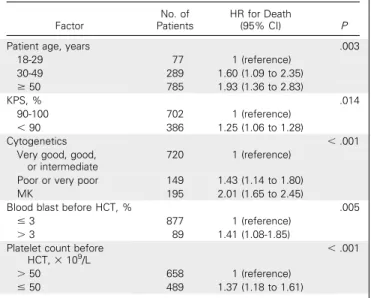
Table 2summarizes the variables relevant to OS identified in the multivariable analysis of the 1,151 patients in the HLA-matched training cohort. This multivariable model identified five inde-pendent predictors of survival: age, Karnofsky performance status less than 90%, cytogenetics, blood blasts greater than 3% at the time of HCT, and platelet count 503109/L or less at the time of HCT. On the basis of an HR of 1.8 or higher, a weighted score of 2 was assigned to older age (.50 years) and monosomal karyotype, whereas other factors were assigned a score of 0 or 1 based on an HR of less than 1.25 and 1.25 to 1.79, respectively (AppendixTable A2, online only). The overall score ranged from 0 to 7, with increasing scores indi-cating greater risk. On the basis of these data, we created a four-category system: low, score of 1 or lower; intermediate, score of 2 to 3; high, score of 4 to 5; and very high, score of 6 or higher. The HR for death (using the low-risk group as reference) was 1.76 (95% CI, 1.24 to 2.49) for the intermediate-risk group, 2.87 (95% CI, 1.99 to 4.14) for the high-risk group, and 6.75 (95% CI, 4.28 to 10.67) for the very high–risk group (overallP,.001;Table 3).
Important variables that were not associated with OS in the multivariable analysis included donor source (siblingvunrelated), conditioning intensity, GVHD prophylaxis, and bone marrow blasts at the time of transplantation. Factors associated with worse
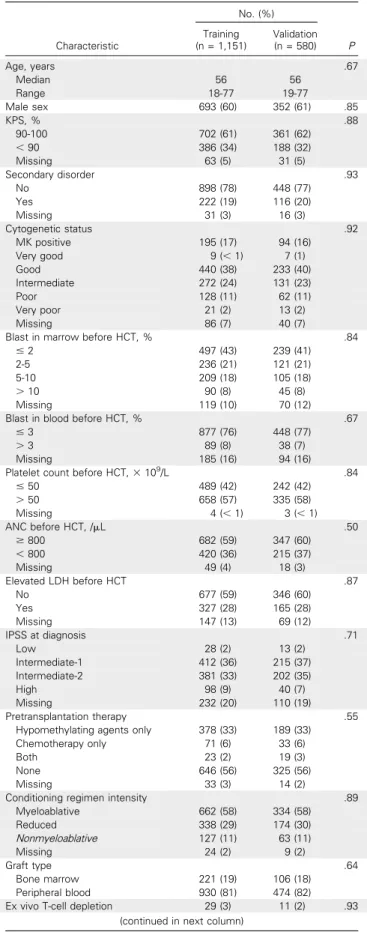
Table 1.Demographic and Clinical Characteristics of HLA-Matched Validation and Training Cohorts
Characteristic
No. (%)
P Training
(n = 1,151)
Validation (n = 580)
Age, years .67
Median 56 56
Range 18-77 19-77
Male sex 693 (60) 352 (61) .85
KPS, % .88
90-100 702 (61) 361 (62)
,90 386 (34) 188 (32) Missing 63 (5) 31 (5)
Secondary disorder .93
No 898 (78) 448 (77)
Yes 222 (19) 116 (20) Missing 31 (3) 16 (3)
Cytogenetic status .92
MK positive 195 (17) 94 (16) Very good 9 (,1) 7 (1) Good 440 (38) 233 (40) Intermediate 272 (24) 131 (23) Poor 128 (11) 62 (11) Very poor 21 (2) 13 (2) Missing 86 (7) 40 (7)
Blast in marrow before HCT, % .84 #2 497 (43) 239 (41) 2-5 236 (21) 121 (21) 5-10 209 (18) 105 (18)
.10 90 (8) 45 (8)
Missing 119 (10) 70 (12) Blast in blood before HCT, % .67
#3 877 (76) 448 (77)
.3 89 (8) 38 (7)
Missing 185 (16) 94 (16) Platelet count before HCT,3109
/L .84
#50 489 (42) 242 (42)
.50 658 (57) 335 (58) Missing 4 (,1) 3 (,1)
ANC before HCT, /mL .50
$800 682 (59) 347 (60)
,800 420 (36) 215 (37) Missing 49 (4) 18 (3)
Elevated LDH before HCT .87
No 677 (59) 346 (60)
Yes 327 (28) 165 (28) Missing 147 (13) 69 (12)
IPSS at diagnosis .71
Low 28 (2) 13 (2)
Intermediate-1 412 (36) 215 (37) Intermediate-2 381 (33) 202 (35)
High 98 (9) 40 (7)
Missing 232 (20) 110 (19) Pretransplantation therapy .55
Hypomethylating agents only 378 (33) 189 (33) Chemotherapy only 71 (6) 33 (6)
Both 23 (2) 19 (3)
None 646 (56) 325 (56) Missing 33 (3) 14 (2)
Conditioning regimen intensity .89 Myeloablative 662 (58) 334 (58) Reduced 338 (29) 174 (30) Nonmyeloablative 127 (11) 63 (11)
Missing 24 (2) 9 (2)
Graft type .64
Bone marrow 221 (19) 106 (18) Peripheral blood 930 (81) 474 (82) Ex vivo T-cell depletion 29 (3) 11 (2) .93
(continued in next column)
Table 1.Demographic and Clinical Characteristics of HLA-Matched Validation and Training Cohorts (continued)
Characteristic
No. (%)
P Training
(n = 1,151)
Validation (n = 580)
ATG or alemtuzumab 335 (29) 174 (30) .09
Type of donor .92
Sibling 491 (43) 246 (42) Unrelated 660 (57) 334 (58)
OS on univariable but not on multivariable analysis were RBC transfusion dependence (HR, 1.23; 95% CI, 1.05 to 1.44;P= .009), presence of secondary MDS (HR, 1.22; 95% CI, 1.01 to 1.47;
P= .04), and advanced disease at transplantation (HR, 1.25; 95% CI, 1.07 to 1.47;P= .005). Although higher percentage of bone marrow blasts was associated with presence of blood blasts, bone marrow blast percentage alone was not prognostic of survival.
Validation of Prognostic Scoring System
We then used the scoring system to calculate a risk score for individuals in the training cohort for whom complete data on allfive variables were available (n = 839). On the basis of these data, we applied the score to the HLA-matched validation cohort (Table 3). Complete data for all variables were missing for 150 patients. We analyzed relapse and TRM incidence and OS in the patients with missing data versus those with complete data and found no difference in any of these outcomes. Therefore, the 150 patients with missing data were excluded, leaving 427 patients in the analysis. Among these 427 patients, the scoring system was associated with OS (P,.001; Table 3). The 3-year OS in the HLA-matched validation cohort was
71% (95% CI, 58% to 85%) in low-risk, 49% (95% CI, 42% to 56%) in intermediate-risk, 41% (95% CI, 31% to 51%) in high-risk, and 25% (95% CI, 4% to 46%) in very high–risk patients (Fig 1A).
Because the training set was developed based on OS and not other outcomes, we combined the 839 patients from the training cohort with the 427 patients from the validation cohort for analysis of secondary objectives (Table 4). In the combined HLA-matched cohort, the scoring system was associated with relapse (P,.001), TRM (P,.001), and DFS (P,.001).
Application of MDS Scoring System in HLA-Mismatched Cohort
The prognostic score was applied to an additional cohort of 405 patients undergoing one to two HLA loci–mismatched allo HCT. Complete data were available for 289 patients, who were analyzed in this set. When compared with the HLA-matched cohort, HLA-mismatched patients were more likely to have poor-risk karyotype (11% v 16%;P,.001), undergo reduced-intensity conditioning (31%v39%;P= .003), receive a bone marrow graft (19% v 25%; P = .009), or receive antithymocyte globulin or alemtuzumab with conditioning (29%v43%;P,.001; Appendix Table A1). The 1-, 3-, and 5-year OS were 46%, 34%, and 27% in the HLA-mismatched cohort, respectively. In the HLA-mismatched cohort, the 3-year incidence of TRM was 42% (95% CI, 37% to 47%), and relapse was 25% (95% CI, 21% to 30%). The prognostic score was prognostic of relapse in this cohort (P= .04) but not TRM (P= .82), DFS (P= .21), or OS (P= .13;Fig 1B).
Comparison of Proposed Scoring System With IPSS and IPSS-R
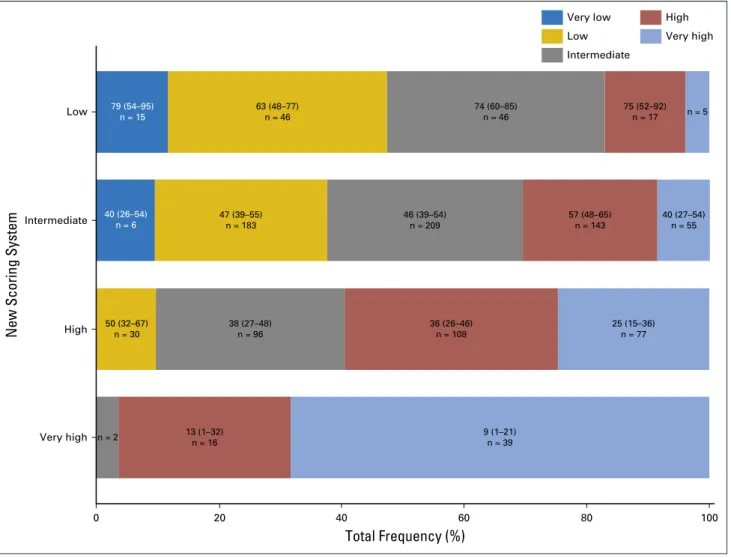
To determine if the proposed scoring system was superior to the IPSS or IPSS-R prognostic tool, we compared the three scoring systems in the HLA-matched validation set. Wefirst generated a cross table of proposed patient classifications (rows), with IPSS-R classifications represented in colors on thex-axis (Fig 2). We found that the systems generally agreed on patients at very high risk; however, the proposed system resulted in significant reclassifi ca-tion of patients in the low-, intermediate-, and high-risk
classi-fications. To quantify which prognostic system betterfit actual outcomes, we calculated a concordance index including 384 patients for whom complete data were available for the IPSS, IPSS-R, and proposed systems. Concordance indices describe the probability that predicted and observed survival times are similar among ranked pairs within a given system.22As the prognostic capability
Table 2.Multivariable Analysis of Factors Associated With OS in HLA-Matched Training Cohort
Factor
No. of Patients
HR for Death
(95% CI) P
Patient age, years .003
18-29 77 1 (reference) 30-49 289 1.60 (1.09 to 2.35) $50 785 1.93 (1.36 to 2.83)
KPS, % .014
90-100 702 1 (reference)
,90 386 1.25 (1.06 to 1.28)
Cytogenetics ,.001
Very good, good, or intermediate
720 1 (reference)
Poor or very poor 149 1.43 (1.14 to 1.80) MK 195 2.01 (1.65 to 2.45)
Blood blast before HCT, % .005 #3 877 1 (reference)
.3 89 1.41 (1.08-1.85) Platelet count before
HCT,3109 /L
,.001
.50 658 1 (reference) #50 489 1.37 (1.18 to 1.61)
Abbreviations: HCT, hematopoietic cell transplantation; HR, hazard ratio; KPS, Karnofsky performance status; OS, overall survival.
Table 3. OS by Prognostic Score in HLA-Matched Training and Validation Cohorts
Risk Group
Training Cohort Validation Cohort
No. of Patients HR (95% CI) P No. of Patients HR (95% CI) P
Low (0-1) 98 1.00 47 1.00
Intermediate (2-3) 459 1.76 (1.24 to 2.49) .0017 258 1.66 (1.01 to 2.71) .045 High (4-5) 237 2.87 (1.99 to 4.14) ,.001 104 2.29 (1.35 to 3.87) .002 Very high ($6) 45 6.75 (4.28 to 10.67) ,.001 18 5.02 (2.48 to 10.15) ,.001
OverallP* ,.001 ,.001
of a system improves, the concordance index will approach 1. We found the concordance index for the proposed scoring system to be 0.575, compared with 0.538 and 0.554 for the IPSS and IPSS-R, respectively, indicating a modest improvement in prognostic capability using the proposed model.
DISCUSSION
Here we present a scoring tool prognostic of outcome in patients undergoing allo HCT for MDS. Using multivariable analysis, we
identified pretransplantation thrombocytopenia, MDS compre-hensive cytogenetic score, patient age, performance status, and increased blood blasts as having prognostic relevance to survival. Selection of patients for allo HCT is largely based on the IPSS and, more recently, the IPSS-R tools. Although both of these systems are prognostic of outcome after allo HCT, they were not generated specifically from patients undergoing transplantation and do not take into account non–disease-specific factors. A recent large-scale evaluation of the prognostic utility of the IPSS-R in patients undergoing transplantation conducted by the European Society for Blood and Marrow Transplantation (EBMT) found similar out-comes between the very good–, good-, and intermediate-risk groups as well as the poor- and very poor–risk groups.23These
findings indicate that although the IPSS-R may account for disease-specific causes of death after transplantation, a system developed based on patient factors may offer more specificity to patients facing potential transplantation. Here we note that the proposed system generally agrees with the IPSS-R in the very high–risk subcategory; however, a significant portion of patients in high- and very high–risk IPSS-R groups were represented in the low- and intermediate-risk proposed scoring subcategories. The 3-year survival in patients classified as high risk with the IPSS-R was 75%; it was 57% in those classified as low or intermediate risk with the proposed system. The proposed system offers improved prognostic capability, particularly for patients in the low-, intermediate-, and high-risk subgroups. Similar to the IPSS-R, we identified cyto-genetics as a major factor prognostic of outcome. As in the EBMT analysis and that conducted by Della Porta et al,11we found MK to offer prognostic relevance beyond the other karyotype
classi-fications.23-26Outcomes in patients with MK are poor, indicating this group may benefit from strategies designed to prevent relapse after allo HCT.
More recently, Armand et al27defined the disease risk index (DRI) using a large data set of patients undergoing transplantation at Dana-Farber Cancer Institute. The DRI offers prognostic information for patients undergoing allo HCT based on disease risk and stage. In the context of MDS, the DRI defines two groups of MDS-specific risk based on cytogenetics. The authors addi-tionally found that the HCT comorbidity score defined by Sorror et al28 offered further prognostic information related to patient
fitness before transplantation. In contrast, here we offer a single score that takes into account both patient- and disease-related factors to form a single prognostic score.
An important finding in this study is the absence of an association between conditioning intensity and outcome. An obvious limitation to this conclusion is bias introduced from the
A
P < .001
Probability (%)
Survival (years)
100
20 40 60 80
0
No. of patients
2 3 4
1
181 123 87
247
No. of patients 132 85 61 35
Low
Intermediate
B
P = .13
Probability (%)
Survival (years)
100
20 40 60 80
0 1 2 3 4
High Very High
Low Intermediate
High Very High
Fig 1.Overall survival in the (A) HLA-matched and (B) -mismatched cohorts by prognostic scoring system risk classification.
Table 4.Relapse, TRM, and DFS in Combined HLA-Matched Training and Validation Cohorts by Prognostic Score
Risk Score No. of Patients
Relapse TRM DFS
HR (95% CI) P HR (95% CI) P HR (95% CI) P
Low 139 1.00 1.00 1.00
Intermediate 696 2.09 (1.3 to 3.36) .002 1.40 (0.99 to 1.97) .0582 1.63 (1.23 to 2.15) ,.001 High 332 3.71 (2.28 to 6.04) ,.001 1.92 (1.33 to 2.79) ,.001 2.53 (1.89 to 3.39) ,.001 Very high 60 7.49 (4.11 to 13.66) ,.001 4.43 (2.71 to 7.27) ,.001 5.47 (3.75 to 7.98) ,.001
OverallP ,.001 ,.001 ,.001
use of retrospective registry data, where patients perceived as having greater disease-specific risk are encouraged to undergo myeloablative therapy. We did not find any significant demo-graphic or disease-specific differences between patients undergoing reduced-intensity versus myeloablative conditioning; however, it is impossible to control for all variables in a cohort such as was analyzed here. Nevertheless, recentfindings from a prospective, randomized study conducted by the EBMT (the RICMAC [Reduced Versus Standard Conditioning in MDS/Secondary Acute Myelogenous Leukemia] trial) seem to confirm that myeloablative conditioning does not confer a survival benefit.29It remains an open question whether specific, high-risk disease subsets would preferentially benefit from higher-intensity con-ditioning. Missing from this analysis are data on somatic mutations identified by genomic technologies that have more recently become relevant in MDS prognostication.8As these data become more relevant to therapeutic decisions, the next gen-eration of prognostic tools will need to account for this in-formation. A second limitation in this study is the use of Karnofsky performance status, which is subjective and can vary between clinicians or at different times during the transplantation
evaluation. More-objective tools evaluating patient fitness, including the HCT comorbidity index, should be used as they become available in large patient data registries. Finally, although this scoring system demonstrated improved prognostic capacity over the IPSS-R, the magnitude of this benefit was limited, suggesting that incorporation of genomic aberrations will refine systems in the future.
Despite the limitations identified, the scoring system pre-sented here is of use to clinicians evaluating patients with MDS. The scoring system uses readily available clinical data and can be calculated quickly, facilitating patient consultation with respect to allo HCT, and may also be used to identify high-risk populations where interventions such as post–allo HCT maintenance therapies may be of benefit.
AUTHORS’DISCLOSURES OF POTENTIAL CONFLICTS OF INTEREST
Disclosures provided by the authors are available with this article at
www.jco.org.
Total Frequency (%)
63 (48–77) n = 46
74 (60–85) n = 46
75 (52–92) n = 17 n = 5
40 (26–54) n = 6 79 (54–95)
n = 15
47 (39–55) n = 183
46 (39–54) n = 209
57 (48–65) n = 143
40 (27–54) n = 55
50 (32–67) n = 30
38 (27–48) n = 96
36 (26–46) n = 108
25 (15–36) n = 77
13 (1–32) n = 16
n = 2 9 (1–21)
n = 39 Low
Intermediate
High
Very high
New Scoring System
0 20 40 60 80 100
Very low
Intermediate Low
High
Very high
AUTHOR CONTRIBUTIONS
Conception and design:Brian C. Shaffer, Kwang Woo Ahn, Zhen-Huan Hu, Taiga Nishihori, Adriana K. Malone, Michael R. Grunwald, Ulrike Bacher, Betty Hamilton, Corey Cutler, Ran Reshef, Baldeep Mona Wirk, Mitchell Sabloff, David Marks, Luciano J. Costa, Jorge Cortes, Andrew Daly, Rammurti Kamble, Jean-Yves Cahn, Robert Peter Gale, Basem William, Mark Litzow, Peter H. Wiernik, Jane Liesveld, Bipin N. Savani, Edward Copelan, Richard Maziarz, Edwin Alyea, Steven Pavletic, Martin Tallman, Wael Saber
Provision of study materials or patients:Ran Reshef, Edward Copelan
Collection and assembly of data:Brian C. Shaffer, Richard Olsson, Edward Copelan, Wael Saber
Data analysis and interpretation:Brian C. Shaffer, Kwang Woo Ahn, Zhen-Huan Hu, David Valc´arcel, Michael R. Grunwald, Mohamed A. Kharfan-Dabaja, Ayman Saad, Erica Warlick, Ran Reshef, Baldeep Mona Wirk, Mitchell Sabloff, Omotayo Fasan, Aaron Gerds, Richard Olsson, William Allen Wood, Alan M. Miller, Jorge Cortes, Andrew Daly, Tamila L. Kindwall-Keller, David A. Rizzieri, Ravi Vij, Celalettin Ustun, Uday Popat, Matt Kalaycio, Ron Sobecks, Wael Saber
Manuscript writing:All authors
Final approval of manuscript:All authors
REFERENCES
1. Cazzola M, Della Porta MG, Malcovati L: The genetic basis of myelodysplasia and its clinical rele-vance. Blood 122:4021-4034, 2013
2. Ad `es L, Itzykson R, Fenaux P: Myelodysplastic syndromes. Lancet 383:2239-2252, 2014
3. de Witte T, Hagemeijer A, Suciu S, et al: Value of allogeneic versus autologous stem cell trans-plantation and chemotherapy in patients with mye-lodysplastic syndromes and secondary acute myeloid leukemia: Final results of a prospective randomized European Intergroup Trial. Haematolog-ica 95:1754-1761, 2010
4. Valc ´arcel D, Martino R, Caballero D, et al: Sustained remissions of high-risk acute myeloid leukemia and myelodysplastic syndrome after reduced-intensity conditioning allogeneic hema-topoietic transplantation: Chronic graft-versus-host disease is the strongest factor improving survival. J Clin Oncol 26:577-584, 2008
5. Lim Z, Brand R, Martino R, et al: Allogeneic hematopoietic stem-cell transplantation for patients 50 years or older with myelodysplastic syndromes or secondary acute myeloid leukemia. J Clin Oncol 28: 405-411, 2010
6. Runde V, de Witte T, Arnold R, et al: Bone marrow transplantation from HLA-identical siblings as first-line treatment in patients with myelodys-plastic syndromes: Early transplantation is asso-ciated with improved outcome. Bone Marrow Transplant 21:255-261, 1998
7. Bartenstein M, Deeg HJ: Hematopoietic stem cell transplantation for MDS. Hematol Oncol Clin North Am 24:407-422, 2010
8. Bejar R, Stevenson KE, Caughey B, et al: Somatic mutations predict poor outcome in patients with myelodysplastic syndrome after hematopoietic stem-cell transplantation. J Clin Oncol 32:2691-2698, 2014
9. Greenberg PL, Tuechler H, Schanz J, et al: Revised international prognostic scoring system for myelodys-plastic syndromes. Blood 120:2454-2465, 2012
10. Greenberg P, Cox C, LeBeau MM, et al: International scoring system for evaluating prognosis in myelodysplastic syndromes. Blood 89:2079-2088, 1997
11. Della Porta MG, Alessandrino EP, Bacigalupo A, et al: Predictive factors for the outcome of allo-geneic transplantation in patients with MDS stratified according to the revised IPSS-R. Blood 123: 2333-2342, 2014
12. Schanz J, T ¨uchler H, Sol ´e F, et al: New comprehensive cytogenetic scoring system for pri-mary myelodysplastic syndromes (MDS) and oligo-blastic acute myeloid leukemia after MDS derived from an international database merge. J Clin Oncol 30:820-829, 2012
13. Greenberg P, Stone RM, Bejar R, et al: Mye-lodysplastic syndromes, version 2.2015. J Natl Compr Canc Netw 13:261-272, 2015
14. Cutler CS, Lee SJ, Greenberg P, et al: A decision analysis of allogeneic bone marrow trans-plantation for the myelodysplastic syndromes: Delayed transplantation for low-risk myelodysplasia is associated with improved outcome. Blood 104: 579-585, 2004
15. Koreth J, Pidala J, Perez WS, et al: Role of reduced-intensity conditioning allogeneic hema-topoietic stem-cell transplantation in older patients with de novo myelodysplastic syndromes: An inter-national collaborative decision analysis. J Clin Oncol 31:2662-2670, 2013
16. Horowitz M: The role of registries in facilitating clinical research in BMT: Examples from the Center for International Blood and Marrow Transplant Research. Bone Marrow Transplant 42:S1-S2, 2008 (suppl 1)
17. Breems DA, Van Putten WL, De Greef GE, et al: Monosomal karyotype in acute myeloid leu-kemia: A better indicator of poor prognosis than a complex karyotype. J Clin Oncol 26:4791-4797, 2008 18. Bennett JM, Catovsky D, Daniel MT, et al: Proposals for the classification of the myelodys-plastic syndromes. Br J Haematol 51:189-199, 1982 19. Benjamini Y, Hochberg Y: Controlling the false discovery rate: A practical and powerful approach to multiple testing. J R Stat Soc Series B Stat Methodol 57:289-300, 1995
20. Fine JP, Gray RJ: A proportional hazards model for the subdistribution of a competing risk. J Am Stat Assoc 94:496-509, 1999
21. G ´onen M, Heller G: Concordance probability and discriminatory power in proportional hazards regression. Biometrika 92:965-970, 2005
22. Raykar VC, Steck H, Krishnapuram B, et al: On ranking in survival analysis: Bounds on the con-cordance index. Presented at the 21 Annual Con-ference on Neural Information Processing Systems, Vancouver, British Columbia, Canada, December 3-6, 2007
23. Koenecke C, G ¨ohring G, de Wreede LC, et al: Impact of the revised International Prognostic Scoring System, cytogenetics and monosomal karyotype on outcome after allogeneic stem cell transplantation for myelodysplastic syndromes and secondary acute myeloid leukemia evolving from myelodysplastic syndromes: A retrospective multi-center study of the European Society of Blood and Marrow Transplantation. Haematologica 100: 400-408, 2015
24. Hwang KL, Song MK, Shin HJ, et al: Mono-somal and complex karyotypes as prognostic parameters in patients with International Prognostic Scoring System higher risk myelodysplastic syn-drome treated with azacitidine. Blood Res 49: 234-240, 2014
25. Ustun C, Trottier BJ, Sachs Z, et al: Mono-somal karyotype at the time of diagnosis or trans-plantation predicts outcomes of allogeneic hematopoietic cell transplantation in myelodysplastic syndrome. Biol Blood Marrow Transplant 21: 866-872, 2015
26. Deeg HJ, Scott BL, Fang M, et al: Five-group cytogenetic risk classification, monosomal kar-yotype, and outcome after hematopoietic cell transplantation for MDS or acute leukemia evolving from MDS. Blood 120:1398-1408, 2012
27. Armand P, Gibson CJ, Cutler C, et al: A disease risk index for patients undergoing allogeneic stem cell transplantation. Blood 120:905-913, 2012
28. Sorror ML, Maris MB, Storb R, et al: Hema-topoietic cell transplantation (HCT)-specific comorbidity index: A new tool for risk assess-ment before allogeneic HCT. Blood 106:2912-2919, 2005
29. Kr ¨oger N, Brand R, Niederwieser D, et al: Reduced intensity vs. standard conditioning followed by allogeneic stem cell transplantation for patients with MDS or secondary AML: A prospective, randomized phase III study of the Chronic Malig-nancies Working Party of the EBMT (RICMAC-trial). Blood 124:320, 2014
Affiliations
Levine Cancer Institute, Carolinas HealthCare System, Charlotte; William Allen Wood, University of North Carolina at Chapel Hill, Chapel Hill; David A. Rizzieri, Duke University Medical Center, Durham, NC; Ulrike Bacher, University of Medicine G¨ottingen, G¨ottingen, Germany; Betty Hamilton and Aaron Gerds, Cleveland Clinic Taussig Cancer Institute; Matt Kalaycio and Ron Sobecks, Cleveland Clinic Foundation, Cleveland; Basem William, Ohio State University Medical Center, Columbus, OH; Ayman Saad and Luciano J. Costa, University of Alabama at Birmingham, Birmingham, AL; Corey Cutler and Edwin Alyea, Dana-Farber Cancer Institute, Boston, MA; Erica Warlick and Celalettin Ustun, University of Minnesota Medical Center, Minneapolis, MN; Baldeep Mona Wirk, Seattle Cancer Care Alliance, Seattle, WA; Mitchell Sabloff, University of Ottawa and Ottawa Hospital Research Institute, Ottawa, Ontario; Andrew Daly, Tom Baker Cancer Center, Calgary, Alberta, Canada; David Marks, University Hospitals Bristol National Health Service Trust, Bristol; Robert Peter Gale, Imperial College London, London, United Kingdom; Richard Olsson, Karolinska Institutet, Stockholm, Sweden; Alan M. Miller, Baylor University Medical Center; Rammurti Kamble, Baylor College of Medicine, Dallas; Jorge Cortes and Uday Popat, University of Texas MD Anderson Cancer Center, Houston, TX; Tamila L. Kindwall-Keller, University of Virginia Health System, Charlottesville, VA; Jean-Yves Cahn, University Hospital Grenoble, La Tronche, France; Bipin N. Savani, Vanderbilt University Medical Center, Nashville, TN; Ravi Vij, Washington University School of Medicine, St Louis, MO; Richard Maziarz, Oregon Health and Science University, Portland, OR; and Steven Pavletic, National Cancer Institute, Bethesda, MD.
Acknowledgment
The CIBMTR is supported by Public Health Service Grant/Cooperative Agreement U24-CA76518 from the National Cancer Institute (NCI), the National Heart, Lung and Blood Institute (NHLBI), and the National Institute of Allergy and Infectious Diseases (NIAID); a Grant/Cooperative Agreement 5U01HL069294 from NHLBI and NCI; a contract HHSH234200637015C with Health Resources and Services Administration (HRSA/DHHS); two Grants, N00014-06-1-0704 and N00014-08-1-0058, from the Office of Naval Research; and grants from Allos, Inc.; Amgen, Inc.; Angioblast; an anonymous donation to the Medical College of Wisconsin; Ariad; Be the Match Foundation; Blue Cross and Blue Shield Association; Buchanan Family Foundation; CaridianBCT; Celgene Corporation; CellGenix, GmbH; Children’s Leukemia Research Association; Fresenius-Biotech North America, Inc.; Gamida Cell Teva Joint Venture Ltd.; Genentech, Inc.; Genzyme Corporation; GlaxoSmithKline; Kiadis Pharma; The Leukemia & Lymphoma Society; The Medical College of Wisconsin; Millennium Pharmaceuticals, Inc.; Milliman USA, Inc.; Miltenyi Biotec, Inc.; National Marrow Donor Program; Optum Healthcare Solutions, Inc.; Otsuka America Pharmaceutical, Inc.; Seattle Genetics; Sigma-Tau Pharmaceuticals; Soligenix, Inc.; Swedish Orphan Biovitrum; THERAKOS, Inc.; and Wellpoint, Inc. The views expressed in this article do not reflect the official policy or position of the National Institutes of Health, the Department of the Navy, the Department of Defense, or any other agency of the U.S. Government.
AUTHORS’DISCLOSURES OF POTENTIAL CONFLICTS OF INTEREST
Scoring System Prognostic of Outcome in Patients Undergoing Allogeneic Hematopoietic Cell Transplantation for Myelodysplastic Syndrome
The following represents disclosure information provided by authors of this manuscript. All relationships are considered compensated. Relationships are self-held unless noted. I = Immediate Family Member, Inst = My Institution. Relationships may not relate to the subject matter of this manuscript. For more
information about ASCO’s conflict of interest policy, please refer towww.asco.org/rwcorjco.ascopubs.org/site/ifc.
Brian C. Shaffer
No relationship to disclose
Kwang Woo Ahn
No relationship to disclose
Zhen-Huan Hu
No relationship to disclose
Taiga Nishihori
No relationship to disclose
Adriana K. Malone
No relationship to disclose
David Valc´arcel
Honoraria:Celgene, Amgen, Takeda Pharmaceuticals, Novartis, GlaxoSmithKline, Astellas Pharma
Consulting or Advisory Role:Celgene, Amgen, GlaxoSmithKline, Novartis, Takeda Pharmaceuticals
Speakers’Bureau:Celgene, Novartis, Amgen, GlaxoSmithKline, Astellas Pharma
Travel, Accommodations, Expenses:Celgene, Amgen, Pfizer, GlaxoSmithKline
Michael R. Grunwald
Stock or Other Ownership:Medtronic
Consulting or Advisory Role:Incyte, Alexion Pharmaceuticals
Research Funding:Incyte (Inst), Amgen (Inst), FORMA Therapeutics (Inst), Janssen Pharmaceuticals (Inst)
Ulrike Bacher
No relationship to disclose
Betty Hamilton
No relationship to disclose
Mohamed A. Kharfan-Dabaja
Honoraria:Incyte, Alexion Pharmaceuticals, Seattle Genetics
Speakers’Bureau:Incyte, Alexion Pharmaceuticals, Seattle Genetics
Ayman Saad
Research Funding:Astellas Pharma (Inst)
Corey Cutler
No relationship to disclose
Erica Warlick
No relationship to disclose
Ran Reshef
Consulting or Advisory Role:Concert Pharmaceuticals, Incyte, Spectrum Pharmaceuticals, Atara Biotherapeutics, RadMD, TEVA Pharmaceuticals Industries
Travel, Accommodations, Expenses:TEVA Pharmaceuticals Industries, Incyte, Concert Pharmaceuticals
Baldeep Mona Wirk
No relationship to disclose
Mitchell Sabloff
Consulting or Advisory Role:Celgene, Lundbeck, Amgen
Omotayo Fasan
No relationship to disclose
Aaron Gerds
Consulting or Advisory Role:Genentech, Incyte, AstraZeneca/ MedImmune, CTI BioPharma
Research Funding:Pfizer, CTI BioPharma, Incyte, Genentech, Gilead Sciences, Celgene
David Marks
Consulting or Advisory Role:Amgen
Richard Olsson
Employment:AstraZeneca
William Allen Wood
No relationship to disclose
Luciano J. Costa
No relationship to disclose
Alan M. Miller
Employment:Texas Oncology
Jorge Cortes
Consulting or Advisory Role:ARIAD Pharmaceuticals, Bristol-Myers Squibb, Astellas Pharma, Ambit BioSciences, BiolineRx, Novartis, Pfizer, Amphivena Therapeutics
Research Funding:ARIAD Pharmaceuticals (Inst), Bristol-Myers Squibb (Inst), Novartis (Inst), Pfizer (Inst), TEVA Pharmaceuticals Industries (Inst), Celgene (Inst), Arog Pharmaceuticals (Inst), Astellas Pharma (Inst), Ambit BioSciences (Inst), Sanofi(Inst), AstraZeneca (Inst), Celator (Inst)
Andrew Daly
No relationship to disclose
Tamila L. Kindwall-Keller Research Funding:Celldex
Rammurti Kamble
No relationship to disclose
David A. Rizzieri
No relationship to disclose
Jean-Yves Cahn
No relationship to disclose
Robert Peter Gale
No relationship to disclose
Basem William
No relationship to disclose
Mark Litzow Honoraria:Amgen
Consulting or Advisory Role:Amgen
Research Funding:Amgen
Travel, Accommodations, Expenses:Amgen
Peter H. Wiernik Honoraria:Novartis
Speakers’Bureau:Novartis
Travel, Accommodations, Expenses:Novartis
Jane Liesveld
Bipin N. Savani
No relationship to disclose
Ravi Vij
No relationship to disclose
Celalettin Ustun
No relationship to disclose
Edward Copelan
No relationship to disclose
Uday Popat
No relationship to disclose
Matt Kalaycio
No relationship to disclose
Richard Maziarz
No relationship to disclose
Edwin Alyea
No relationship to disclose
Ron Sobecks
No relationship to disclose
Steven Pavletic
No relationship to disclose
Martin Tallman
Research Funding:Epizyme, Boehringer Ingelheim, Bioline
Wael Saber
Appendix
Table A1. Demographic and Clinical Characteristics of HLA-Matched and -Mismatched Cohorts
Variable
No. (%)
P Matched
(n = 1,731)
Mismatched (n = 405)
Age, years .13
Median 56 55
Range 18-77 18-73
Male sex 1,045 (60) 231 (57)
KPS, % .12
90-100 1,063 (61) 253 (62)
,90 574 (33) 140 (35) Missing 94 (5) 12 (3)
Secondary disorder .44
Yes 338 (20) 85 (21)
Missing 47 (3) 7 (2)
Cytogenetic status ,.001
MK positive 289 (17) 52 (13) Very good 16 (,1) 1 (,1) Good 673 (39) 134 (33) Intermediate 403 (23) 97 (24) Poor 190 (11) 66 (16) Very poor 34 (2) 5 (1) Missing 126 (7) 50 (12)
Blast in marrow before HCT, % .06 #2 736 (43) 162 (40)
2-5 357 (21) 90 (22)
5-10 314 (18) 73 (18)
.10 135 (8) 47 (12)
Missing 189 (11) 33 (8)
Blast in blood before HCT, % .10 #3 1,325 (77) 316 (78)
.3 127 (7) 38 (9)
Missing 279 (16) 51 (13) Platelet count before HCT,3109
/L .06
#50 731 (42) 197 (49)
.50 993 (57) 206 (51) Missing 7 (,1) 2 (,1) ANC before HCT, /mL .71
$800 1,029 (59) 235 (58)
,800 635 (37) 151 (37) Missing 67 (4) 19 (5)
(continued in next column)
Table A1. Demographic and Clinical Characteristics of HLA-Matched and -Mismatched Cohorts (continued)
Variable
No. (%)
P Matched
(n = 1,731)
Mismatched (n = 405)
Elevated LDH before HCT .58 No 1,023 (59) 243 (60)
Yes 492 (28) 119 (29) Missing 216 (12) 43 (11)
IPSS at diagnosis .31
Low 41 (2) 7 (2)
Intermediate-1 627 (36) 130 (32) Intermediate-2 583 (34) 138 (34)
High 138 (8) 34 (8)
Missing 342 (20) 96 (24)
Pretransplantation therapy .71 Hypomethylating agents only 567 (33) 132 (33)
Chemotherapy only 104 (6) 19 (5)
Both 42 (2) 7 (2)
None 971 (56) 234 (58) Missing 47 (3) 13 (3)
Conditioning regimen intensity .003 Myeloablative 996 (58) 215 (53)
Reduced 543 (31) 156 (39) Nonmyeloablative 159 (9) 34 (8)
Missing 33 (2) 0
Donor–recipient sex match .48 Male–Male 693 (40) 153 (38)
Male–Female 397 (23) 89 (22) Female–Male 342 (20) 77 (19) Female–Female 281 (16) 81 (20) Missing 18 (1) 5 (1)
Graft type .009
Bone marrow 327 (19) 100 (25) Peripheral blood 1,404 (81) 305 (75)
Ex vivo T-cell depletion 40 (2) 13 (3) .20 ATG or alemtuzumab 510 (29) 174 (43) ,.001
Abbreviations: ANC, absolute neutrophil count; ATG, antithymocyte globulin; HCT, hematopoietic cell transplantation; IPSS, International Prognostic Scoring System; KPS, Karnofsky performance status; LDH, lactate dehydrogenase; MK, monosomal karyotype.
Table A2. Calculation of Prognostic Scoring System
Prognostic Variable
Score Value
0 1 2
Age, years 18-29 30-49 $50
KPS, % 90-100 ,90
Comprehensive cytogenetic score* Intermediate, good, or very good Poor or very poor MK
Blood blasts at transplantation, % #3 .3
Platelet count at transplantation,3109
/L .50 #50
Abbreviations: KPS, Karnofsky performance status; MK, monosomal karyotype.