Shifting Frames, Shifting Policy:
How Frame Sets Influence Policy Making in Congress
Kelsey M. Shoub
A dissertation submitted to the faculty of the University of North Carolina at Chapel Hill in partial fulfillment of the requirements for the degree of Doctor of Philosophy in the Department of Political Science.
Chapel Hill 2018
Approved by:
Frank R. Baumgartner James A. Stimson Sarah Treul
ABSTRACT
KELSEY M. SHOUB: Shifting Frames, Shifting Policy: How Frame Sets Influence Policy Making in Congress
(Under the direction of Frank R. Baumgartner)
In this dissertation, I pose and answer three questions about the presence and role of policy discussion in Congress: (1) why are some issues discussed more in the House and Senate than others; (2) do the parties differ in how they discuss issues; and (3) why does that discussion influence bill outcomes? First, I posit and show that parties are reactive to each other and pursuit of electoral goals influence how much a general policy area is discussed. Additionally, I show that, while the relationships appear to be the same across the two chambers of Congress, they are conditioned by majority party status.
Second, I posit and show that pursuit of the party’s electoral goal not only informs how much different issues are discussed, but also informs how they are discussed. I show that the parties differ in which frames they use to discuss policy. In doing so, I present a new measure of frames in Congress that using a set list of broad frames that facilitates comparisons across policy areas.
Finally, building from the first and second questions, I question whether the policy discussion that occurs influences bill outcomes. I propose that the construction of policy discussion through the selection of frames shapes the considerations of those evaluating proposed legislation, which ultimately influences action (i.e. voting) in Congress. In doing this, I shift the focus from the use of individual frames and their characteristics to the concept of the frame set, a holistic look at how the issue is framed. Following from this, I posit and show that as the frame set changes more, policy change (i.e. bill passage) is more likely.
ACKNOWLEDGEMENTS
I would like to thank Frank Baumgartner, Tom Carsey, Jason Roberts, Tim Ryan, Jim Stimson, and Sarah Treul for all the time and expertise they invested in helping me develop this project. Not only did their advice make this project better, but their support was invaluable. In particular, I would like to thank two of my committee members. First, I would like to thank my adviser, Frank Baumgartner, for his patience, encouragement, and advice both throughout my graduate school career and specifically through the dissertation process. Additionally, I would like to particularly thank Tom Carsey who made me a better scholar, teacher, and general political science community member through his mentorship and advice.
TABLE OF CONTENTS
LIST OF TABLES . . . ix
LIST OF FIGURES . . . xi
1 Introduction . . . 1
1.1 Previous Studies on Policy Change & Framing . . . 4
1.1.1 Policy Making & Change in Congress . . . 5
1.1.2 Issue Framing & Policy . . . 8
1.1.3 The Constraints of Political Parties . . . 10
1.2 When and How is Policy Discussed? . . . 12
1.3 A Theory of Framing & Policy Change . . . 14
1.3.1 Framing & Policy Change in the Abstract . . . 16
1.3.2 Framing & Change in Congress . . . 21
1.3.3 Implications of a Connection in Congress . . . 24
1.4 How Can Discourse and Framing be Measured? . . . 26
1.5 A Brief Overview of the Dissertation . . . 27
2 Reaction, Reelection, & Public Discussion . . . 29
2.1 How Much are Issues Discussed in Both Chambers? . . . 32
2.1.1 Studies of the Congressional Floor . . . 33
2.1.2 From Partisan Priorities to Policy Discussion. . . 34
2.1.3 The Pull of the Legislative Agenda . . . 36
2.2 Identifying Speech . . . 37
2.3 Explaining Policy Discussion . . . 41
2.3.2 Analysis . . . 45
2.4 Conclusion . . . 48
3 Measuring Frame Use in Congress . . . 50
3.1 Policy Discussion on the Chamber Floor . . . 53
3.1.1 Variation in Frame Use in Policy Discussion . . . 54
3.1.2 General versus Specific Policy Discussion . . . 57
3.2 Identifying and Validating Frames by Issue Area . . . 58
3.2.1 Identifying Frames . . . 59
3.2.2 Validation Exercise 1: Recovering Frames . . . 62
3.2.3 Validation Exercise 2: Content of the Argument Clusters . . . 64
3.2.3.1 Establishing a Baseline . . . 67
3.2.3.2 Evaluating the Human Clustering Validation . . . 69
3.3 Examining How Issues Are Discussed . . . 71
3.3.1 Differential Framing by Issue Area . . . 71
3.3.2 Differential Framing by Political Party . . . 72
3.4 Conclusion . . . 76
4 Shifting Frames to Shifting Legislation . . . 78
4.1 Previous Studies on Policy Change & Bill Passage . . . 81
4.2 Relating Frames to Policy Change in Congress . . . 83
4.3 Constructing the Measures & Data . . . 88
4.3.1 Tracking Legislation Across Congresses . . . 89
4.3.2 Measuring Change in the Frame Set by Issue Area . . . 91
4.3.3 Additional Variables . . . 94
4.4 Testing the Possible Connections . . . 96
4.5 Conclusion . . . 103
5 Conclusion . . . 105
5.1.1 Problems of Endogeneity . . . 108
5.2 Future Research Questions . . . 108
5.2.1 Explaining the Changing Frame Set . . . 108
5.2.2 Connections to the Public Discussion . . . 109
5.3 Normative and Practical Implications . . . 110
A Appendix to Chapter 2 . . . 112
A.1 Summary Statistics . . . 112
A.2 Are Alternative Specifications Robust? . . . 112
A.2.1 Comparison to Null Models . . . 112
A.2.2 Alternative Measures of the Time Spent Discussing Policy . . . 113
B Appendix to Chapter 4 . . . 117
B.1 Comparison to Null Models. . . 117
B.2 Comparison to Models without Agenda Controls. . . 117
C Applying CAP Topic Codes . . . 121
C.1 Gathering the Data . . . 121
C.2 Known Policy Issue Area Codes . . . 123
C.2.1 Merging One Minute Speech CAP Codes . . . 123
C.2.2 Merging Congressional Bills Project CAP Codes Using Speech Titles . . . 125
C.2.3 Procedural Speeches Where No Policy Topic is Discussed . . . 126
C.2.4 Summary of the Resulting Labels . . . 129
C.2.5 (CAP) Topic Codes and Definitions . . . 131
C.3 Training a Supervised Machine Learning Algorithm . . . 133
C.3.1 Creating the Training Set and Document-Feature Matrix . . . 134
C.3.2 The Algorithm . . . 135
C.3.3 Validating the Algorithm . . . 136
D Identifying Speech Types & Arguments . . . 138
LIST OF TABLES
2.1 Paragraphs from “PROPER AND LEGITIMATE ROLE OF GOVERNMENT” . . . 40
2.2 Summary Statistics for the Dependent Variables . . . 43
2.3 Explaining the Amount of Time on Policy by Issue Area, Log(Number of Sentences) 47 3.1 Adjusted Categories of the Media Frames Corpus . . . 61
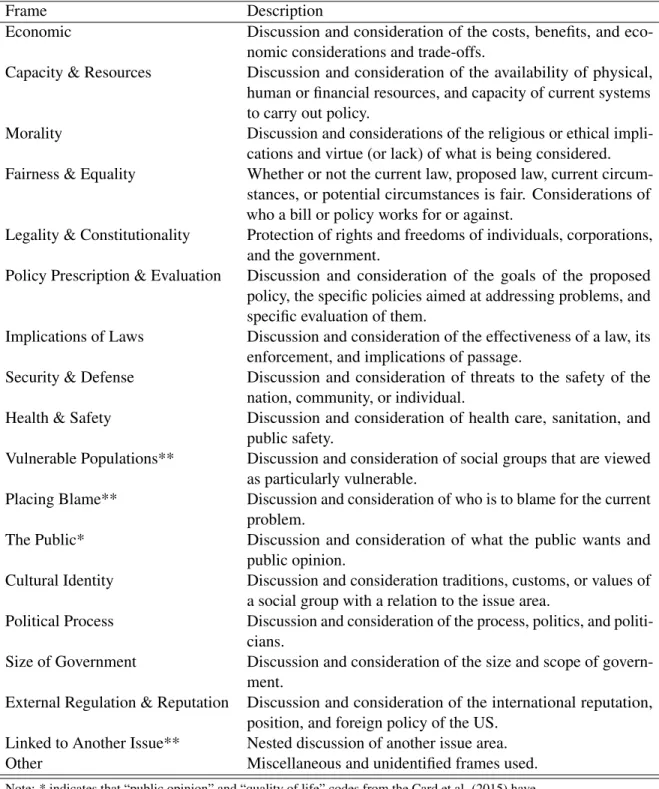
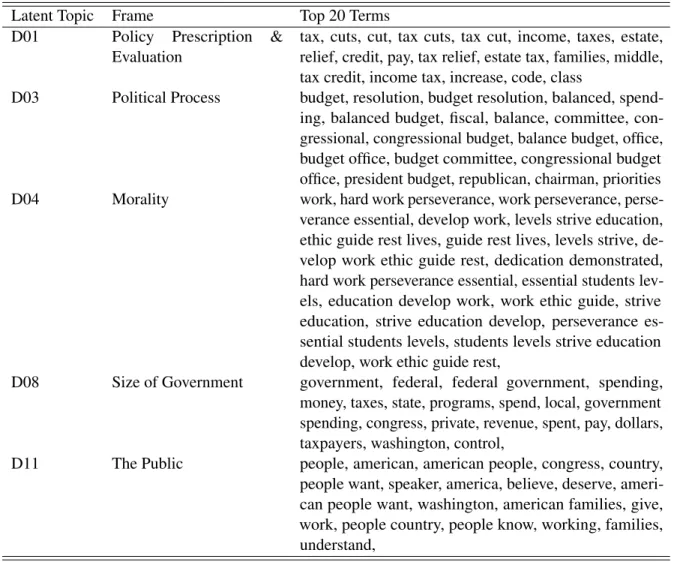
3.2 Five Example Latent Topics and their Assigned Frames from Macroeconomics . . . 62
3.3 Identification of Frames in Congressional Debates . . . 64
3.4 Comparison of Paragraph Clusters on Immigration . . . 70
3.5 Number of Issue Areas Using Each Frame . . . 72
3.6 Top 3 Frames Used by Issue Area . . . 73
3.7 Percentage of Paragraphs Using Each Frame by Party and Chamber . . . 75
4.1 Summary of Bill Outcomes Between Congresses by Chamber . . . 91
4.2 Example Change in Frame Set Calculation . . . 93
4.3 Summary Statistics for Change in the Argument Set by Chamber & Team . . . 94
4.4 Summary Statistics of Control Variables . . . 95
4.5 Explaining Change in Bill Outcomes by Chamber. . . 98
A.1 Summary Statistics for Continuous Variables in Models . . . 112
A.2 Explaining the Amount of Time on Policy, Restricted Model . . . 113
A.3 Explaining the Amount of Time on Policy, Log(Number of Paragraphs) . . . 115
A.4 Explaining the Amount of Time on Policy, Log(Number of Words) . . . 116
B.1 Explaining Change in Bill Outcomes in the House . . . 118
B.2 Explaining Change in Bill Outcomes in the Senate . . . 119
B.3 Explaining Change in Bill Outcome by Chamber, No Agenda Controls . . . 120
LIST OF FIGURES
1.1 Overview of the Theoretical Argument . . . 15
1.2 Frames Connecting Position to Dimensions . . . 18
1.3 Changing Proximity of Preferences to Choices in Different Decision Spaces . . . 20
3.1 Example Screen shot of the Clustering Process . . . 66
4.1 Change in the Frame Set Over Time, Macroeconomics . . . 94
4.2 Change in Probability of Bill Passage in the House Given Change in the Frame Set (t & t-2) in Different Circumstances . . . 99
4.3 Change in Probability of Bill Passage in the Senate Given Change in the Frame Set (t & t-1) in Different Circumstances . . . 102
Chapter 1
Introduction
Is the estate tax the rich paying their fair share or a burdensome and unfair death tax? Are immigrants criminals sneaking into this country to steal jobs or are they seeking refuge, willing to contribute to their new communities? Over time, the amount of discussion about these issues has fluctuated and the answers to these questions have changed. With this changing rhetoric, the policies and legislation that relate to them have also changed. For example, in the early and mid 1900s, the estate tax was discussed as the way rich American families fairly contributed to a war effort. By the early 2000s, the dominant frames used in the discussion depicted it as a death tax hurting American families and business. Mirroring this change in framing came fluctuations in the policy: in the early and mid 1900s, it was established and raised, and then it was slashed in the early 2000s (Scheve and Stasavage, 2016; Meagher, 2013; Bittker, Clark and McCouch, 2015). In similar ways, immigration policy seems to fluctuate depending on the depiction of immigrants. Depictions of immigrants primarily as illegal, threatening, and “the other” reduce support for increasing immigration quotas but increase support for building a wall along the US-Mexican border. Conversely, depictions of immigrants as fleeing atrocities and disasters or as people who will contribute to the betterment of society see increases in support for raising quotas and relaxing the process (Daniels, 2005; Monogan, 2013; Nevins, 2010; Wright, Levy and Citrin, 2016; P´erez, 2014).
have shown that framing can shape and influence the attitudes and opinions of individuals. Even a subtle reorganization of the narrative structure of a newspaper article has been shown to shift attitudes (Berinsky and Kinder, 2006). At the societal level (macro framing), a number of studies have shown that as the general framing of an issue changes then the policy and policy outputs related to it change. For example, as the debate surrounding the death penalty shifted from a focus on the heinous nature of the crimes committed toward the possible innocence of those being executed, its use decreased (Baumgartner, De Boef and Boydstun, 2008). Similar investigations have not been conducted about their possible influence within Congress to affect policy. However, these studies hint that how legislators discuss the bills and policies before them matter.
Not only do studies of framing in other contexts tell us that frames concerning policy might matter within Congress, but others have posited and shown that information matters in the Congressional policy making process. They have done so in a number of different ways and by adopting a number of different approaches from game theoretic models to large-N analysis to interviews on the Hill. However, these studies have essentially focused onwhetherandhow muchconsideration takes place through debate or deliberation rather than the content and construction of it.
While the role of framing—if any—in the policy making process of Congress is not well understood, rich and nuanced literatures have developed explaining and exploring policy making in Congress more generally. These emphasize how parties, gate keepers within Congress, procedure, the tides of public opinion, and information processing influence policy making. Additionally, studies that have specifically looked at whether or not individual bills pass have examined the role of cosponsors and characteristics of the primary sponsor at different stages of the process. However, the possible role of framing have not been included in these studies.
outcomes)? Specifically, I study the relationship between the changing frames used to discuss a general issue area and policy change within that issue area. In answering these questions, I also make two methodological contributions to the study of framing, and specifically to the study of framing in Congress. I first present one low cost way to identify frames and their in the Congressional Record. I then show that by shifting the study of frames from the use and characteristics of specific frames to changes to the bundle of frames used, the frame set, greater traction on the question of how and whether frames matter can be had.
By answering these questions, I take steps to directly incorporate framing into explanations of when policy change occurs in Congress. I directly incorporate framing into explanations of why some bills become law, while others fail. Further, I examine when more or less policy discussion within Congress about different general issue areas occurs and whether the parties frame issues differently. One related question that is outside of the scope of this dissertation is why and when the frames used to discuss an issue area change. Here I narrow my focus to examine whether and why changing the frames used to discuss an issue area changes policy outcomes.
To do so, I first examine the question of how much members of Congress may even decide to talk about different issue areas (chapter 2). Drawing from previous research, I assume that public discussion of issue areas are coordinated by the parties. I then posit that each party is reactive to the other party and that electoral goals drive what each party in each chamber decides to talk about and how much they say on that issue. As I will show, these claims hold true regardless of chamber, and they are conditioned by majority party status.
I then examine whether how issues are framed vary in response to the each party’s dual goals of achieving or maintaining majority party status and pursuing policy goals (chapter 3). To facilitate this analysis, I present one way that frames can be detected in the Congressional Record in a cheap, valid, and reliable manner. As I will show, frame use varies party and by issue area.
acceptable policy. If a legislative battle takes place over multiple Congresses, which often happens, proponents of legislation will adapt their strategy to increase the likelihood of passage in each successive iteration. This implies that as the frame set changes more between rounds of consideration, then the probability that is passes in successive rounds of consideration increases. Note that in this depiction theframe setrather than the individual frames is the focus.
To test these claims, I rely on a large-N empirical analysis. The empirical analysis relies on a unique data set of the Congressional Record coded for general policy area and how that policy area is discussed using a mixture of supervised and unsupervised text analysis. In the analysis, I provide evidence that a party’s electoral goals influence which issues are discussed and how they are framed. Additionally, I show that the changing construction of the policy framing influences whether or not policy change via the passage of legislation occurs. Before discussing either the theory or tests in more detail, it is important to clarify how this dissertation contributes to our understanding of the role of framing in the policy process—specifically in the US Congress.
1.1 Previous Studies on Policy Change & Framing
Previous studies have much to say about the process of policy change, why and when framing influences various outcomes, and how political parties constrain or exacerbate the patterns predicted in theories of policy change. While scholars have made significant contributions to our understanding of the broader political process within each of these literatures, all three rarely speak to one another. As a result, there is an under appreciation and lack of understanding of the role of framing in how policy is made within Congress. Conversely, few studies of framing have addressed how those theories and findings translate to political elites operating within defined institutional structures. This dissertation addresses and integrates these literatures.
Third, I draw on the literature on political parties in the US. I do so because party constrains the behavior of its members. This is especially true in an era of relatively strong parties and a decreased focus on the individual legislator in favor of the party or caucus.
1.1.1 Policy Making & Change in Congress
When making and monitoring policy and policy outcomes in Congress, members face a problem: there is not enough time to address every possible problem. Rather, attention must be allocated to some issues, while others are ignored or allocated minimal attention. In Congress, this typically takes the form of allocating more or less attention to specific bills, because bills are the primary vehicle by which members can change policy. Given this problem—too many possible problems and bills and not enough space on the agenda—many have sought to explain whether, why, and the extent of policy change enacted by Congress. The two standard explanations of how policy change occurs are incrementalism and punctuated equilibrium theory. Incremenetalism claims that policy change happens slowly over time. This is because policy makers, in this case members of Congress, make small adjustments at regular intervals to the status quo policy (Lindblom, 1959; Hayes, 1992; Wildavsky, 1964). However, this underestimates and ignores that most major policy change occurs suddenly, often in landmark pieces of legislation, such as the Bush era tax cuts in 2002 and 2003 or the Affordable Care Act of 2010. Conversely, punctuated equilibrium theory says that policy jumps from one equilibrium point to another. On average, from year to year, the same policy is in effect. It hovers around an equilibrium point. However, from time to time that point suddenly and drastically shifts. It is those shifts that symbolize and indicate policy change (Baumgartner and Jones, 2010). The existence of this pattern and process has been replicated across branches of the government and countries (Jones et al., 2009; Baumgartner et al., 2009).
and punctuated equilibrium theory, many have sought to explain why, not just how, policy change occurs—or does not occur. Often, these studies do so in the context of questioning why policy change occurs in a seemingly gridlocked system rife with polarization and dysfunction.
Adler and Wilkerson (2013) propose that one way members of Congress force themselves to still make and update policy is through recurring legislation. Essentially, in the version of the bill that becomes law, members of Congress incorporate a date at which a bill’s provisions expire unless Congress votes to extend or amend and extend the bill’s provisions. Each time a law is reconsidered members of Congress are required to re-evaluate and update that specific policy. Additionally, these laws typically allow for Congress to consider the funding structure and main provisions governing a specific agency periodically rather than every Congress. Theoretically, this allows them to make space on the agenda for other issues that need to be addressed. Examples of this type of legislation include the agriculture bill or bills concerning the estate tax. Their book relies on the idea that each policy and each general policy area has a history and occurs in an iterative process, where members of Congress are allowed to update their views of and orientation toward specific policies. Adler and Wilkerson are not the only ones to rely on such an assumption. Rather, it is commonly used in theories of policy change and the changing landscape of ideology, such as by Carmines and Stimson (1989).
of information. Additionally, he documents the awareness of its potential power to derail a bill’s progress through the process by the members and the leadership through interviews on the Hill. Thus, the level and control of information is inextricably linked to the probability of a bill becoming law and whether policy changes. However, these studies have focused in one way or another onwhether
discussion and consideration of specific policy and general issue areas occurs, rather than examining what the content and construction of that discussion might be. Similarly, none of these studies seeks to understand why issues are discussed at differing levels, which shapes how much information already exists about an issue and how much information is likely to be injected into the conversation.
Additionally, researchers have sought to explain and predict whether specific bills in Congress will or will not pass or become public law. These studies are relevant to this discussion because the main vehicle in Congress by which policy changes is through legislation. The underlying theme to all of these studies is that a bill actually becoming law is difficult. To start down the road of the legislative process on Capitol Hill means accepting that it is highly unlikely to actually be passed. These studies have found effects for relationships between campaign promises and party brands (Sides, 2006; Aldrich, 1995; Rohde, 2010; Bawn et al., 2012; P´etry and Collette, 2009), sponsor characteristics (ex. whether they chair a committee and ideological distance to the speaker) (Anderson, Box-Steffensmeier and Sinclair-Chapman, 2003; Wilson and Young, 1997), and public opinion and media attention (Lax and Phillips, 2009; Maestas, 2000; Page and Shapiro, 1983; Burstein, 2003) on the probability of bill passage. Additionally, they have found mixed effects for the relationship between the number of cosponsors and the passage (Anderson, Box-Steffensmeier and Sinclair-Chapman, 2003; Wilson and Young, 1997; Krutz, 2005; Carson, Lynch and Madonna, 2011). A unifying theme throughout these studies is that if a bill actually makes it to the floor for final consideration, it is likely to become law (Cox and McCubbins, 2005, 2007).
context of policy change as legislation, this means that, while within a single congress a bill may be introduced and fail, it may be reintroduced again and again until it is finally passed. Examples of this can be seen in efforts to reform health care with the continual introduction of measures to establish universal health care in the US until the passage of the Affordable Care Act of 2010. Essentially, rather than being a static, one-shot game, it is an iterative process that is dynamic. Or to put it in the framework of Carmines and Stimson, issues evolve (Carmines and Stimson, 1989). Fourth, as shown by the studies on the role and power of information in Congress, what members of Congress discuss influences policy change in some way.
However, those studies do not explore why information influences outcomes or the extent to which changes in the information available influence policy change or outcomes. This dissertation seeks to make a contribution by doing just that: connecting the content of discussion to policy change and outcomes. Specifically, I do so in the context of bill passage in Congress, where bill passage is a proxy for policy change.
1.1.2 Issue Framing & Policy
influences opinions, attitudes, actions, and policy outcomes. These studies typically do not expand their focus to environments where political elites both shape and receive frames nor to the inner workings of political institutions.1
Initial framing studies showed that a connection exists between frames and attitudes and opinions; namely that frames can influence attitudes and opinions (Chong and Druckman, 2007; Entman, 1993). Since then, framing studies have shown that the strength of the frames used matter (Druckman, Peterson and Slothuus, 2013), the type of frames—such as a moralistic or an economic frames—used matter (Jerit, 2008; Ryan, 2014; Baumeister et al., 2001; Wright, Levy and Citrin, 2016), and that source cues matter (Druckman, 2001; Druckman and Nelson, 2003). Across these studies, two of the most relevant findings for this dissertation are: (1) the effects of frames have limits; and (2) one way that they shape attitudes and opinions is by shifting which (internal) evaluative dimensions are used to make the decision. These two findings are especially important, because they provide the microfoundations for a theory of how the use and non-use of frames among elites might work—after all we are all still human—while providing a clue as to what the magnitude and limits of those effects might be. Namely that the effect will be substantively small and on the margins, because it is expected to be constrained by what choices are even presented to different individuals and groups in the first place.
Some researchers have sought to extend these studies of individual behavior to macro-level theories of the role of framing both generally in society and specifically in the policy making process. They have shown that the support for framing effects found in the lab can also be found in the wild. One stark example of where frames changed policy is the debate regarding the death penalty in the U.S. As the use of the innocence frame rose over time, the use of the death penalty declined (Baumgartner, De Boef and Boydstun, 2008). Similar studies have shown that the process can be repeated: frames and framing can influence public policy (Rose and Baumgartner, 2013; Scheve and Stasavage, 2012; Armstrong, 2003; Schrad, 2010; Meagher, 2013). Other studies have shown that media framing of different issues can influence macro-opinion, attitudes, evaluations, and behavior of the public (Kellstedt, 2003, 2000; Soroka, Stecula and Wlezien, 2015; McCall, 2013). These
studies show that either by directly or indirectly effecting the public macro-opinion, policy, and policy outputs can change. However, they have been conducted in arenas that are largely free of constraints as individuals and groups face when operating within a governmental institution.
Fewer have sought to test whether and how these findings and processes operate within political institutional environments. Those that have examine shifts in the paradigms in how members of a legislature or the government generally conceive of issues (Smith, 2007; Hall, 1993). One exception to this is William Riker’s work. While not using the direct terminology of frames and framing, he studied the role of rhetoric and herestheic (Riker, 1986, 1996), which at its heart is the study of frames and their effects. As he says, “Rhetoric is concerned with the persuasion-value of sentences. And heresthetic is concerned with the strategy value of sentences” (Riker 1986, x). He shows that rhetoric and heresthetic inform campaign strategy and the outcomes of a campaign by shaping the considerations of those watching (Riker, 1996). Since his studies, scholars have applied and further developed his theories as they apply to modern electoral campaigns such as gubernatorial elections (Carsey, 2009) and congressional campaigns (Sides, 2006). Each of these studies either emphasize the role offramesin the campaign or the choice of issues on which to campaign.
As in the studies of framing at the individual level, Riker and those using his framework assert that by manipulating which aspects of an issue—or which issues—are presented then the related attitudes and opinions of onlookers may change, and that the related outcomes themselves may change. In this dissertation I do just that: transport and expand Riker’s ideas into the legislative process in Congress and put it in conversation with the constraints that come along with that process (ex. party politics). Additionally, I question whether political parties use different frames to discuss issues in an attempt to shape how their relationship with that issue area is perceived by they public.
1.1.3 The Constraints of Political Parties
Alluded to in the previous two subsections is that policy making and framing do not happen in a vacuum. Instead, they occur within an institutional context. One important facet of that context is the constraints political parties place on policy making and on the effects of framing, which is the subject of a wide and diverse literature. From this broad literature, two points should be highlighted.
the majority, while the minority party orients its strategy towards becoming the majority. Two ways they do so is through coordinated messaging campaigns and by introducing and passing a publicly coherent legislative agenda. Organizing each party’s overall strategy is the construction and maintenance of its brand or label. However, the degree to which a legislative agenda plays into these strategies varies by theory, and the degree to which they gamble with a legislative agenda varies. According to Conditional Party Government, the majority party will actively seek to pursue their voiced legislative priorities (Rohde, 2010; Aldrich, 1995). While Cartel Theory makes no claims about the positive power of the party to actively pursue a legislative agenda, it does claim that the majority party will protect itself from being rolled; it will exercise negative agenda setting power. By negative agenda setting power, I mean halting bills and issues from reaching the stage of formal consideration. Essentially, it is the theoretical exposition behind what is commonly called the Hasterert Rule; the practice that no bill is brought to the floor if it will pass and over half of the majority party is against it (Cox and McCubbins, 2005, 2007). Whereas, Strategic Party Government posits that there will be a calculated trade off where the majority party attempts to maximize passing legislation that furthers its policy agenda while holding onto the majority. However, the parties and their members prioritize getting out their message over actually passing policy (Lebo, McGlynn and Koger, 2007; Carson et al., 2010; Koger and Lebo, 2017).
In each case, however, parties do choose to pursue policy goals through legislation. Each attempts to change the status quo through legislation. Barring actually changing the status quo, they might be expected to publicly talk about those issues that further its message and attempt to frame issues in ways that provide them an advantage. These expectations as to what and how issues are discussed have been studied in campaigns. However, expectations on what is discussed and how it is discussed within Congress have gone untested. Additionally, implicit in these these expectations and theories is the assumption that the party leadership has the power to hold members accountable when they deviate from the party line. The degree to which they can do so varies over time and across issues. This implies that parties will coordinate within their ranks.
ensuring every individual member of Congress of the party gets reelected (Carson et al., 2010; Koger and Lebo, 2017). This means that even with the ability of the party to punish, individual members may still defect from their party’s strategy and either form temporary alliances with the other party or seek a third option. As a result, there are marginal members who can be persuaded to defect—at least sometimes.
However, there has been little research done on the motivations and constraints of the party may manifest themselves in coordinated speech on the chamber floor. Additionally, there has been little work on whether possible framing effects may influence enough legislators to alter policy outcomes (i.e. bill outcomes). Essentially, the parties literature has not often been put in conversation with the policy process and making literature. Further, the extent to which the parties literature has been put in conversation with the framing literature is the extent to which studies on information span all three literatures and when studying electoral campaigns for office. In the theory that follows, I do so by treating parties as a coordinating and constraining force in the process. I then study how parties inform how much different issue areas are discussed, differences in how issues are framed, and how each might influence policy change.
1.2 When and How is Policy Discussed?
If framing can influence policy outcomes, then party leadership and the core coalition pushing for policy change are right to be afraid of extended consideration, deliberation, and debate of a bill. The more time spent on public discussion of a bill or a policy area more generally then it becomes more likely that new frames and information may be introduced. In turn, the new frames and information may derail the progression of the proponents of legislation through Congress. Thus, if the majority party wants to pass policy in a certain area, they may try to suppress the discussion of that policy area on the floor of either chamber. However, the desire of individual members to publicly take stances on issues that might assist in their personal reelection efforts conflicts with the desire of majority party leadership to keep legislation on track.
frames are used in policy discussion? The answers to these questions provide a better understanding for when framing effects may even be felt and what informs them.
Previous research provides some answers to this question. First, research has shown that member characteristics influence the propensity for a member of Congress to speak on the chamber floor (Maltzman and Sigelman, 1996; Morris, 2001; Pearson and Dancey, 2011). The leadership in each party (majority/minority party leaders, committee chairs, ranking committee members, etc.) and outsiders (ex. ideological extremists, junior members, etc.) speak more than rank and file members willing to toe their party’s line.
Second, speakers aim to increase their personal diffuse support through speeches (Hill and Hurley, 2002; Proksch and Slapin, 2014). One way they do so is by publicly taking stances on issues central to their party’s brand and prioritized in their platform. By doing so, they can show that they are working towards the policy goals that they promised they would work on in their campaigns. Further, another way they do so is by attacking the other party, framing the issue as partisan and political. However, these studies have not pushed passed examination of whether a member is “on message” or using partisan attacks to more broadly examine which issues are discussed and how.
Third, although the majority of studies on who speaks on the chamber floor have focused on the individual member, others have shown that parties significantly coordinate the delivery of speeches. They have shown this by focusing on “unstructed” time in the House. By “unstructured” time, they typically refer to time not governed by a rule, and they specifically analyze one-minute speeches in the House (Hughes, 2016; Harris, 2005).
Beyond the Hughes (2016) study, Strategic Party Government (SPG) theory and Conditional Party Government (CPG) theory provide additional insights into how parties may use Congressional floor speech. To benefit all members in the party, parties seek to build and maintain labels or brands. A label or brand can be used as a heuristic for voters, so that, even if they do not know everything about a candidate running for office, they can still quickly evaluate whether or not they like the party (Koger and Lebo, 2017; Rohde, 2010; Aldrich, 1995; Lebo, McGlynn and Koger, 2007). In pursuit of building and maintaining the party’s brand, parties will coordinate floor speech around the issues the party prioritizes and discuss issues in ways that benefit the party.
For example, if a party is perceived as better at safe guarding the nation and its core voters are more attentive to possible threats, that party may highlight issues of national security and rely on frames that highlight threats to security across issue areas. Conversely, if a party is perceived as better at taking care of vulnerable populations in society and its core voters are more attentive to issues of inclusion and fairness, that party may talk about social welfare more and use frames that highlight how policies affect specific vulnerable populations more than the other party.
A number of questions linger. Two in particular will be the subject of further study. First, do the same patterns that are seen at the individual level hold at the party level? Second, do the same patterns that appear in the House appear in the Senate? In the analysis to come, I first address these questions and test whether the expectations developed from previous studies that were focused solely on the House and on one type of speech generalize to the Senate other public speech on the chamber floor viewed holistically. The exploration and explanation of when more or less policy discussion occurs by general policy area is important, because actually discussing policy is a necessary condition for framing to have any effect.
1.3 A Theory of Framing & Policy Change
frames used change—as theframe setchanges—policy changes. However, if the frames used do not change, then policy is less likely to change. Further, this occurs within a broader context and institutional system. Changes in the broader context and system may also and will influence policy change. I should highlight that this explanation relies on changes to the bundle of frames used rather than on the use, strength, and characteristics of specific, individual frames. This is a shift from how traditional studies of framing effects connect frames to change. An abstracted, brief, summary of the story told and tested in this dissertation is presented in figure 1.1.
The frames used do not necessarily persuade onlookers on the merits. Rather they either implicitly or explicitly help members of Congress evaluate whether or not their constituents will react to the bill at all, whether that reaction will be positive or negative, and whether it might hurt their constituents. To put this another way, while occasionally the frames used may shape the evaluations on the merits, more often the public discussion of policy is a public relations game riddled with cheap talk and coded language. The frames chosen and the overall discourse—the sum of frames chosen—to discuss a general policy area (ex. health) and a specific policy (ex. the Affordable Care Act) serve a dual purpose. On the one hand, public statements allow members of Congress to stake out policy positions to signal to their constituents and other members where they stand. On the other hand, public statements provide information to other members about how shifts within that policy area and the passage or failure of specific pieces of legislation might be more generally received and affect their reelection prospects.
To further build this explanation, I proceed in two steps. First, I present a theory of how framing influences policy change in the abstract, where the only constraint on an individual’s action is to vote
in line with their policy preferences and the primary goal is to make the best possible policy. While these conditions and this environment are never truly experienced, it is helpful to discuss the link between framing and policy change in its simplest form before complicating that explanation. Then, I turn to the complications introduced when the abstract is placed in the context of the US Congress, where individual members and the parties they belong to have to seek to achieve two (sometimes competing) goals.
1.3.1 Framing & Policy Change in the Abstract
The policy making process begins, both in this abstraction and in Congress, as a series of informal discussions and formally begins once legislation begins to be drafted. Eventually, it may be introduced. Once introduced, legislators are given a binary choice: to pass it into law or not. How this is done and the associated time line may vary, but the choice is the same. As a result, three groups form: proponents of passage, opponents of passage, and those who are undecided. Opponents of passage by definition are also protectors of the status quo; they do not want the current proposed change to that status quo to pass. The goal of the proponents and opponents (or status quo protectors) is to attract as many of the third group—the undecideds—to their side as possible. To do so, proponents and opponents first clearly stake out and define their positions.
defined by a dimension cluster, which is the relevant subset of dimensions used (Riker, 1996; Jones, 2001). This prompts another question: How are positions tied to dimensions?
The answer is frames. Frames are a justification for the position that contain relevant information about the policy (Riker, 1996). They are made to provide a clear connection between the position taken (ex. HR 318 should be passed) and evaluative dimension (ex. how fair HR 318 is). By manip-ulating which frames are used, the decision space changes. The frames made and the importance placed on them provide a mapping between positions and dimensions. While there are an infinite number of possible frames that could be used, only a small subset of them actually are. A small number are made because time is scarce (i.e. Baumgartner and Jones 2010 and Adler and Wilkerson 2013), which means that there is not enough time to use every possible frames even if desired, and legislators are rationally bounded (i.e. Jones 2001 or Miller 1956), which means they are cognitively limited in how many frames they can process and utilize.
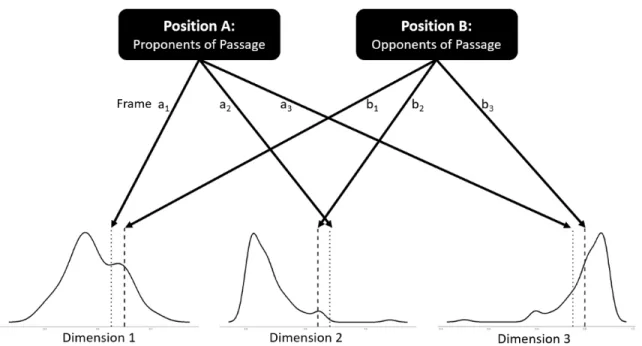
For a pictorial depiction of these connections, see Figure 1.2. In Figure 1.2, you can see the three component parts: the possible dimensions, the frames, and the positions. The three horizontal lines represent the possible dimensions, 1, 2, and 3. The density plots along each scale indicate the distribution of the preferences of the undecided legislators along each dimension.2 The two rectangles represent the two alternative positions: bill passage (A) and bill failure or maintenance of the status quo (B). The arrows indicate the individual frames mapping alternatives to dimensions,a1, a2,a3,b1,b2,b3.
As can be seen in the figure, arrows connect each position to a point on each dimension. The vertical dotted and dashed lines indicate the point on the dimension that belongs to position A, while the dashed lines indicate the point on the dimension that belongs to position B. In this scenario, depending on which pair of frames are made (a1 andb1,a2 andb2, ora3 andb3) shapes how the positions are connected to dimensions. The location of each position is different for each dimension. Additionally, depending on which set of frames are used, different dimensions are used to evaluate the choices, and a different number of undecided legislators will be attracted to each side. This assumes legislators side with the position that lies closer to their preference. For example, if frame pair 1 (a1andb1) is used, then the positions are mapped to dimensions 1. In this case a majority of the
2
Figure 1.2: Frames Connecting Position to Dimensions
undecideds lie closer to position A. Conversely, if either frame pair 2 or 3 is used, then the positions are mapped to dimensions 2 and 3 respectively. In either of these cases, position B succeeds.
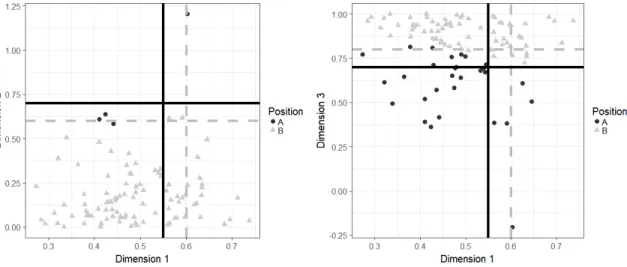
To illustrate this further, the three hypothetical combinations of frame mappings from above can be examined. These are presented in Figure 1.3. Each axis represents one of the three distinct dimensions. Each combination shows how the positions map onto the decision space when each combination of frames are used. Solid black lines indicate the placement of the proponent’s position along each dimension, while dashed gray lines indicate the placement of the opponent’s position along each dimension. The intersection of the lines is the position of each choice in the specified and identified decision space. Finally, the points in each graph indicate the positions adopted by the undecided members given the dimensions identified by the frame sets. Black circles indicate that the position held by the undecided legislator is closer to the proponent’s position, while gray triangles indicate that the position held by the undecided legislator is closer to the opponent’s position.
In the series of sub-figures shown in figure 1.3, the proportion of undecideds falling into each camp varies depending on the set of frames used to determine the decision space. In the sub-figures a and c, the majority of undecideds are closest to the position of the opponents, while in sub-figure b the majority are closest to the proponents. This highlights how the frame set—which frames are used to tie positions to dimensions—matter, at least in the abstract.
(a) Frames Used Emphasize Dimensions 1 and 2 (b) Frames Used Emphasize Dimensions 1 and 3
(c) Frames Used Emphasize Dimensions 2 and 3
Figure 1.3: Changing Proximity of Preferences to Choices in Different Decision Spaces
1.3.2 Framing & Change in Congress
In this abstracted view of how framing influences policy, choices are made in a vacuum, where the individual actors are not constrained except by their personal preferences and evaluations. Additionally, these abstracted individuals wish to make the best public policy possible. However, policy change rarely if ever occurs and is considered in such an environment. Policy change typically occurs in venues where there are constraints placed on those voting for (or against) proposed policy alternatives. Not only does policy change rarely occur purely based on the merits, the individuals making the decision are rarely completely altruistic; making the best possible policy is rarely the sole motivate of members of Congress. In Congress, three characteristics of the institution and those operating within its walls in both chambers complicate the connection between the effects of the frame set and the policy outcomes. These are: the possibly conflicting internal goals of the parties, conflict between individual and party goals, and an institutional facet of Congress. Additionally, there are many other strategies that those pushing for or against a policy change via legislation may adopt. By focusing on how the frame set influences policy change, I do not mean that nothing else matters, but that in addition to all of those other strategies and explanations, the set of frames used also matters.
its professed policy preferences (Rohde, 2010; Aldrich, 1995; Noel, 2014). Additionally, at the very least, the party leadership will aim to block any piece of legislation or general proposed policy change that might split the party (Cox and McCubbins, 2005, 2007). However, this is a secondary goal, because being in the majority is essentially a necessary condition to working on their legislative policy agenda. In other words, to attempt to change policy through legislation they need to be in the majority. This is because the majority party essentially controls agenda access at every point in the process (Cox and McCubbins, 2005, 2007).
To pursue these goals, they must communicate to the public and to each other information about proposed policy changes, policy changes that are sought, and where they stand on those issues. In crafting those messages, the parties—and more specifically those actively engaged with the issue as active proponents and opponents—chose which frames to use; they build their frame set. In doing so, they construct the decision space within which they operate both generally for the issue area and distinctly for each bill. This duality of the levels of discussion exists because the broader conversation about the general policy area informs how specific bills within that policy area can be discussed. Through the public construction of the decision space, the proponents of a bill within the majority party hope to increase the probability of their bill passing. Note that I am talking about the public discussion of the general policy area and specific bills, not what is said behind closed doors. Behind closed doors, the discussion may be more explicitly about electoral concerns than about policy or not occur in a substantive way. However, publicly positions and actions need to be explained and justified.
With this party-centric view of Congress, the individual member of Congress has been obscured. While, on average, each individual member may agree to toe the party line and see the benefits of doing so, there are sometimes points at which the goals of the party and of some individual members are at odds. Just as each party has electoral and policy goals, individual members do as well. The primary goal of individual members is to be reelected, which is their electoral goal, and secondarily to enact policy that shifts the status quo closer to their preferences or those of their constituents. If the same legislative strategy could get everyone in the same party reelected, then there would possibly be no tension between the goals of the party and the goals of each of its members. However, this is not the case; passing some pieces of legislation may significantly damage the electoral prospects of some of their members (Carson et al., 2010). As a result, individual members may sometimes break from the party line; they may vote against the wishes of the party. Anecdotal evidence of this conflict and the occasional break between party goals and individual action has been very publicly seen multiple times in recent years. One example is the public break from the party that Senators Collins (R-ME), Murkowski (R-AK), and McCain (R-AZ) made during one attempt to repeal the Affordable Care Act, also known as Obamacare, in 2017.
Thus, there are two ways policy change via legislation may be advanced or blocked: convince the party leadership to intercede if they are not already involvedoridentify and target the few legislators on the margin who would fall on the other side of the issue given a modestly different decision space. Those actively pushing for change in a policy area and those actively protecting the status quo against those changes can use the public discussion aiming to do so. Each can attempt to construct the decision space in a favorable manner, such that they can it increases the probability that they see their desired outcome. This is complicated further, because as a bill progresses through the process, however, who uses and relies on this strategy shifts. With each step down the legislative process (ex. considered in committee, reported from committee, etc.), the probability of passage increases. As a result, those actively pushing a bill forward might rely on other tactics to continue the momentum of their bill. Conversely, the active opponents to a bills passage—those who prefer the current status quo policy over the proposed change—will attempt to shift the set of frames used in public to shift the decision space.
the one hand, the size of the chamber might complicate the relationship between frame use and outcomes. Smaller chambers may see a more immediate influence of shifts in the frame set than larger chambers. This is because only one or two legislators may need to be convinced to join a either the proponents or opponents in a smaller chamber, as in the Senate. However, in larger chambers, many more legislators may need to be convinced, as in the House. It takes time to do so. As a result, it may take longer for the influence of shifts in the frames used to discuss issues to be felt in the House than in the Senate. On the other hand, the proportion of the venue needed to make a decision might complicate the relationship between frame use and outcomes; high levels delay the connection. The higher the proportion need, the longer it takes to reach a point where a vote can be taken delaying action. This is because with a higher threshold comes a greater role for the individual member and a reduced ability of the party to exert influence. The result is a delay in action, because defection from a small number can deride steps toward passage. Delaying action results in a delayed felt effect between a change in the frame set used and eventual outcome for a bill. In Congress, higher thresholds are characteristic of the Senate rather than the House. In the Senate, most legislation requires passage of a unanimous consent agreement to facilitate consideration on the floor and in the modern Senate 60 votes are needed to invoke cloture during most deliberation.
As a result, conflicting expectations emerge as to the role of institution in delaying or facilitating the influence of frames used in the discussion on bill passage. However, regardless of how long it takes for frames to influence the outcome, this still implies that changes in the frames result influence the probability of bill passage. These considerations condition rather than obstruct the connection between change in the frame set used to discuss an issue area and the passage (or not) of bills associated with that policy area.
1.3.3 Implications of a Connection in Congress
the Congressional agenda beyond simply being introduced then the probability of eventual passage steadily increases. As it gets closer to being considered on the floor, the greater procedural power over the process the party leadership may wield. Because there are limited procedural maneuvers that members who oppose the passage of a specific bill can fall back on they turn to other avenues. One such avenue is publicly making speeches about the issue in an attempt to shape the decision space. As a result, observed shifts in which frames are used should decrease the probability that bill is passed, because the opponents are seeking leverage. However, identifying the set of frames used for every bill and connecting that speech to that bill is incredibly difficult, approaching impossible. As a result, instead of focusing the efforts of this dissertation on the first implication, I turn my attention to the second major implication of this theory.
Secondly, if an over time view of the policy process is taken, then the shifting frame set used by those attempting to change the status quo and those seeking to protect it will have strategies. Proponents seek to change policy, which is a difficult task. As a result, they update their strategy; in this case that strategy is the choice of which frames they use, the construction of the frame set. Proponents will seek to increase the probability of bill passage by selecting frames that will shape the decision space favorably. Conversely, opponents seek to maintain the status quo policy. As a result, until they are faced with possible failure of maintaining the status quo, they do not shift their strategy. On average, opponents will not change the frame set used. In the face of possible failure—policy change—opponents will seek to decrease the probability of bill passage by selecting frames that will shape the decision space in their favor. Taken together, this implies that greater change in the frame set overall will result in greater policy change or an increased likelihood that bills in the related issue area pass. Additionally, due to the varying institutional structures at different stages in the process and in the different chambers, framing effects may take a longer or shorter amount of time to affect outcomes. On the one hand, if more legislators are needed to make a decision, then framing will take longer to have an effect. On the other hand, if a higher proportion of those making the decision are needed to make a decision and/or to pass a bill, then framing will take longer to have an effect. This is because it simply takes longer to conduct business. These implications are explored in greater detail in chapters 3 and 4 and is tested in chapter 4.
all issue areas, because members are trying to both implicitly and explicitly signal to each other why voting for or against specific bills or general types of policy will hurt their probability of being reelected or damage their standing with possible allies and donors. In public, the most explicit way to do so is to explicitly talk about the opinion of the people and how a given policy will affect the lives of the people. However, these are not the only frames that should be used: others should be explicitly about the policy or process, and implicitly connect proposed policy changes to an individual member’s reelection calculus and to a party’s estimation of their probability of retaining or gaining the majority. I will return to this discussion in chapter 3, when I discuss how members of Congress talk about issues in greater detail.
1.4 How Can Discourse and Framing be Measured?
To do this, I use a mixture of supervised and unsupervised machine learning, which is discussed in more detail in Chapters 2 and 3.3 Supervised machine learning is a method of classifying a data set according to a known codebook by identifying a subset of the desired data set whose labels are known, and using them to train the computer to label the remaining unlabeled observations. I do this to identify the over policy issue area. I code the speeches according to the Comparative Agendas Project’s major topic coding scheme. Unsupervised machine learning is a method of extracting and identifying concepts latent in documents. With text, these methods identify latent concepts using individual words and strings of words. Because I use a data set that ranges over a decade and am thus worried that concept drift may occur, I fit a separate dynamic topic model for each policy issue area (Greene and Cross, 2017).
Due to my focus on the Congressional Record, I should clarify three underlying assumptions in its use beyond that it is a representative proxy for the broader discourse occurring within Congress. First, speech on the chamber floors at best represents the intended message and the public strategy adopted—speech is strategic. While this may be obvious when considering the use of procedural tactics, it is less so when considering discussion of policy. This means that by studying the text alone sincere policy positions may or may not be recovered. Rather, speech on the floor presents the message and information that is intended to shape perceptions, persuade onlookers, and structure choice (Proksch and Slapin, 2014; Benoit, Laver and Mikhaylov, 2009; Austen-Smith, 1990). Second, coordination on the floor occurs. Individual members of Congress do not necessarily randomly appear and talk. Rather it often is a coordinated effort by a party caucus or of another caucus (ex. the Freedom Caucus or the Progressive Caucus). Third, coordination and strategy may vary across policy areas and over time. In sum, speech is a coordinated strategy used to further goals.
1.5 A Brief Overview of the Dissertation
Essentially, this dissertation will work through each of these question in three separate chapters. Additionally, across those three chapters the dataset is slowly built: first, I introduce the Congressional Record as a data sources and discuss how speeches are coded for what issue area they discuss (chapter 2); then I address how frames are identified in the Congressional Record (chapter 3); and finally, I
3
introduce a measure of change in the frame set between two time points using the Congressional Recorded coded for issue area and frame use (chapter 4).
In the second chapter, I pose and answer the question: why and when are some issues discussed in the House and Senate more than others? I explore how party goals and interactions with each other shape how much different issues are discussed. I propose that the parties use the chamber floor in both the House and the Senate to promote and build their brand by discussing those issues they prioritize. Additionally, I propose that the parties react to one another in what they talk about and that what is on the legislative agenda informs their choices of what to talk about. To test these claims, I introduce the main data set used throughout the dissertation: the Congressional Record from the 104th through the 112th congress (1995-2012) coded for what general policy topic each speech discusses. I discuss how the policy area being discussed and whether a given paragraph discuss policy is identified.
Building on the findings and dataset presented in the second chapter, in chapter 3, I question whether the parties not only discuss issues at different rates but also discuss them in different ways. I propose that in pursuit of further building their brands parties strategically frame issues in ways that benefit them. In order to explore this, I present a cheap and reliable way to identify frames in the Congressional Record using machine learning techniques. I show that frames are used at different rates by the two parties and across issue areas.
Chapter 2
Reaction, Reelection, & Public Discussion
Representative Kevin Brady (R-TX) officially introduced what would come to be known as the Tax Cuts and Jobs Act on November 2, 2017. Within two months both chambers had passed it, and President Trump had signed it into law. Because the construction of the final bill took only a few months, public knowledge of its contents was limited before passage. What discussion and speculation did take place occurred in the media—on television news shows and in newspapers—not within Congress. In fact, very little meaningful debate or deliberation directly on the bill occurred due to the strategic choice by the Republican leadership to constrain the time frame for introduction and consideration. In response to this process, Senator Durbin (D-IL), along with many of his fellow Democratic senators, tweeted his displeasure about the process. Upon the Senate passing the initial bill, he tweeted “On the floor of the world’s greatest deliberative body. @SenateGOP rammed through a bill without even reading it.”1
However, the Republican party of both the House and the Senate had been drawing attention to the issue of tax reform for years. Additionally, various previous reforms had been proposed both as distinct pieces of legislation and in the general discussion beforehand. As a result, while the bill itself and the specifics within it may have been rushed, the broad strokes had been shaped and informed by multiple years of discussion. Similar complaints and comparisons could be drawn about the Affordable Care Act of 2010, also known as Obamacare, whose process was also rushed, if less so. The complaints raised by the Democrats during the (brief) consideration of the tax reform bill—and by the Republicans during the debate on health care reform—may be justified, but those complaints obscure part of the larger discussion and broader considerations that did take place and were raised.
This prompts the central question of this chapter: why do some issue areas see more discussion than others?
How much the parties publicly discuss issues is important for a number of reasons. First, attention allocation is indicative of the search for problems and solutions that informs and occurs before setting the legislative agenda. By influencing what is publicly discussed, parties can simultaneously signal what problems they are actively working on before and without being tied to specific pieces of legislation, and they can influence what problems will even be addressed. Examples of this can be seen in the numerous speeches that were given advocating for a repeal of the Affordable Care Act before specific legislation was proposed and seriously considered. In shaping how problems are identified and defined, each party can influence the eventual winnowing of agenda items (Kingdon, 2011; Baumgartner and Jones, 2015), which any specific bill needs to survive in order to become law (Krutz, 2005). Second, public discussion of issues systematically informs what is done to address those policies by setting “general themes that transcend a particular incident, structuring the content of political discourse and policy making over a relatively long period of time” (Sulkin 2005: 45). This provides a constrained set of considerations that influence which solutions (ex. bills) are proposed to respond to problems that arise within general issue areas. Additionally, issue areas refer to broad policy domains, such as education, the environment, or immigration. Third, beyond influencing which issue areas see greater activity, public discussion of issues can influence the prospects of specific bills. It can do so either by affecting public opinion, which then influences the considerations of the parties, or by highlighting different aspects of an issue pertinent to individual members, such as whether the passage or failure of a bill could damage reelection prospects. As a result, Congressional leaders strategically attempt to control the amount of discussion that occurs (Curry and Lee, 2017; Austen-Smith, 1990). Together these points suggest that the public discussion that occurs within Congress matters.
possibly the only party that really matters is the one who controls access to the legislative agenda, which ranges from establishing the parameters for debate to controlling committee outputs to which version of a bill is actually voted upon (Cox and McCubbins, 2005, 2007; Stiglitz and Weingast, 2010; Miller and Overby, 2010).
While many prognoses of the current operation of both chambers of Congress often look bleak, recent studies have shown that Congress may be modestly less dysfunctional than much of the media coverage, research by academics, and those working within Congress have depicted. Recent studies of the House of Representatives, where the prognosis has been the most dire, have shown that more legislative collaboration occurs than is commonly thought. One study has shown that bills today see the same levels of bipartisan support as in early periods, at least for those bills that receive serious consideration or pass in the House of Representatives (Curry and Lee, 2017). Using Dear Colleague Letters, another study has shown that members in the House of Representatives still use and seek out bipartisan coalitions to craft and pass legislation (Craig, 2018). Additionally, not only have studies examined the direct incorporation of the minority party into the legislative process, but Hughes (2016) shows that the parties are reactive to each other in what they choose to publicly discuss on the Congressional floor using one-minute speeches in the House. These studies and other work currently being conducted do not claim that either or both chambers of Congress are smoothly run institutions; neither chamber operates in the same way that they did in the 1950s, 60s, or 70s. Rather, they highlight that there is still a role for bipartisanship and the minority party in today’s Congress. However, these findings have not been extended to studies in the Senate. Thus, studying how both the majority and minority parties operate and how they apply to the Senate should be better understood.
Specially, I examine each party’s allocation of attention in in the discussion of issues on the floor of each chamber. While practitioners and watch dog groups have raised concerns about the amount—or lack—of policy discussion in Congress, it has been understudied within our discipline. This prompts the central question for this chapter: why are some issues discussed more than others on the House floor and on the Senate floor?
expectations as to when different issue areas are discussed at different rates. Additionally, I propose that what bills are actually proposed, considered, and voted upon influence what is discussed even when parties are not constrained to talking about specific pieces of legislation. Second, I address how I measure policy discussion on the floor using the Congressional Record, which has been coded according to the Comparative Agendas Project (CAP) major topic codes using supervised machine learning. Finally, I test the expectations drawn from previous studies. Similar to Hughes (2016), I find that the parties are reactive to each other; if one talks about an issue area, the other will also talk about it. Additionally, I find that the issues that parties prioritize in their election platforms see greater discussion than those that see less of an emphasis. This follows from expectations drawn from theories that tell us parties will seek to build and maintain a party brand (Aldrich, 1995; Lebo, McGlynn and Koger, 2007; Koger and Lebo, 2017; Cox and McCubbins, 2005, 2007). Additionally, as expected, I show that the legislative agenda conditionally influences how much attention either the majority or minority party discusses different issue areas even when they are not required to discuss specific pieces of legislation.
2.1 How Much are Issues Discussed in Both Chambers?
2.1.1 Studies of the Congressional Floor
The only study of congressional floor speech that focused on party strategy rather than individual member behavior is by Hughes (2016). He proposes and then shows that the minority party can influence the majority party’s agenda, at least in what is discussed in the House of Representatives, He also shows that the reverse is true. Issue agendas of each party in the House converge on each other, because parties are responsive to the same broader forces (ex. public opinion and the media). As a result, to appear responsive, both parties must address the same issues. Additionally, because attention across different venues is likely endogenous, one party talking about an issue may increase the the amount of attention the media gives the issue and the importance the public places on the issue. In turn, this induces the other party to talk about the same issue. This is true even if it is only to discredit the other party’s claims about the issue area. These connections and this reactive process is reinforced and amplified, because the electoral fortunes of individual members of Congress are often intrinsically tied to their party’s label or brand. As a result, individual members accept coordination in what they discuss by the party leadership (Cox and McCubbins, 2005; Aldrich, 1995; Lee, 2009).
While his study focused on the House, similar processes may be at work in the Senate. While the institutional rules vary between the two chambers and each has distinct histories, the same forces influence behavior in each and members have to periodically run for reelection in each. This produces the first hypothesis to be tested, which is:
H1: If one party allocates more time to discussing an issue area, then the other party will allocate more time to discussing that issue area as well.
when she/he speak, and the more likely she/he are to give partisan speeches (Hill and Hurley, 2002; Morris, 2001). Additionally, in pursuit of both their reelection goals and in an effort to inform policy, more ideologically extreme members speak more and are more likely to give off-message speeches (Harris, 2005). In sum, pursuit of reelection influences whether individual members speak and what they say when they do.
Unfortunately, there are two problems with trying to directly extract implications from these studies. First, these studies focus specifically onwhetherspeeches were given, whether they were policy oriented, and whether they were partisan. They do not evaluate what policy area they discussed. Second, these studies focused on individual members of Congress rather than the party, which is the subject of this chapter. Making this additional step is not problematic, because parties organize and coordinate floor speech at almost every point—both during periods governed and not governed by a rule or in committee on the whole in the House or by a Unanimous Consent Agreement or in executive session in the Senate. As a result, one reason policy discussion may vary is due to electoral considerations of each party rather than the individual members. The question then is how and why.
2.1.2 From Partisan Priorities to Policy Discussion
While the specific literature on what is said on the floor of either the House or Senate cannot directly provide expectations based on electoral considerations, the broader literature on how parties behave can. More specifically, those theories that produce expectations as to how the parties construct their agendas are most informative. For this, I turn to Cartel Theory and Strategic Party Government for an answer. The starting place for each theory is that each party in Congress seeks to retain or gain majority party status. This means that electoral considerations constantly shape party strategy in every form, which is in line with the findings in previous studies on individual members of Congress. From this, I can generate analogous expectations as those in previous studies but for the party rather than for the individual members.