! ! ! AN INVESTIGATION OF THE EFFECTS OF OXYTOCIN ON SOCIAL COGNITION
AND SOCIAL FUNCTIONING IN SCHIZOPHRENIA
Clare Marks Gibson, M.A.
A dissertation submitted to the faculty of the University of North Carolina at Chapel Hill in partial fulfillment of the requirements for the degree of Doctor of Philosophy in the
Department of Psychology (Clinical).
Chapel Hill 2012
!
Approved by: David Penn, PhD
!
""!
!
Abstract
CLARE MARKS GIBSON: An investigation of the effects of oxytocin on social cognition and social functioning in schizophrenia
(Under the direction of David L. Penn)
Social functioning is a core feature of schizophrenia, and it is related to outcome and disease onset. Social cognitive processes underlie social functioning and as such have been a treatment target in schizophrenia; however, psychosocial treatments targeting social cognition are often not available in clinics and there are no current psychopharmacological agents that improve social cognition or social functioning in schizophrenia. Consequently, there has been great interest in oxytocin (OT) as a potential treatment for social cognition in schizophrenia, and as an additive to current psychological approaches. OT stimulates prosocial behavior and antipsychotic-like effects in animals and humans, and there is preliminary evidence supporting OT’s role in social cognition in humans. Therefore, the current study explored whether OT can improve social cognition and social functioning in schizophrenia using a six-week, double-blind design. Twenty individuals with schizophrenia were randomized to receive either intranasal OT or a saline placebo solution and completed a battery of social cognitive measures, as well as measures of social functioning,
community functioning, neurocognition and psychiatric symptoms. Results showed improvements on self-reported cognitive empathy, deception detection, and global social skills in the OT condition as compared to the PL condition. In addition, post-hoc analyses demonstrated improved identification of intense facial emotions and a reduction in negative symptoms for the OT condition. These
"""!
!
Acknowledgements
I would like to acknowledge a few individuals without whom this endeavor would not have been possible. First, I am grateful to the undergraduate research assistants in the Penn Laboratory. In particular, Janitra Venkatesan, who put a great deal of time and thought into this study. I would also like to thank my dissertation committee for their time and input on this project. I am indebted to Dr. Cort Pedersen for his mentorship and for introducing me to my favorite neuropeptide, oxytocin. I am appreciative of his generosity and support. I am forever grateful to Dr. David Penn for his mentorship, support, and guidance over the last six years. He has facilitated my growth as a psychologist and reinforced my commitment to working with the severely mentally ill. I would also like to acknowledge two important people in my personal life. I would like to thank my father, Roger McCoy Marks, for
!
"#!
!
Table of Contents
LIST OF TABLES……….…….v
ABBREVIATIONS………vi
Chapter I. INTRODUCTION………...1
Social functioning in schizophrenia………..2
Social cognition………...….…6
Oxytocin……….24
The current study………...34
II. METHODS……….…40
III. DATA ANALYTIC PLAN………....55
IV. RESULTS……….….61
V. DISCUSSION……….…...73
APPENDIX………...101
#!
!
List of Tables
Table
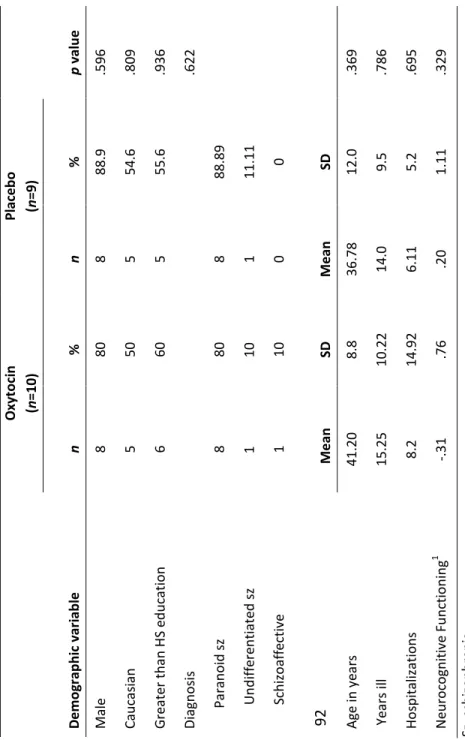
1. Inclusion criteria for the 6 and 12-week trials……….91 2. Demographic Information………...92
3. Social cognitive measures: BL and 6-week within and between
group analyses...93-94
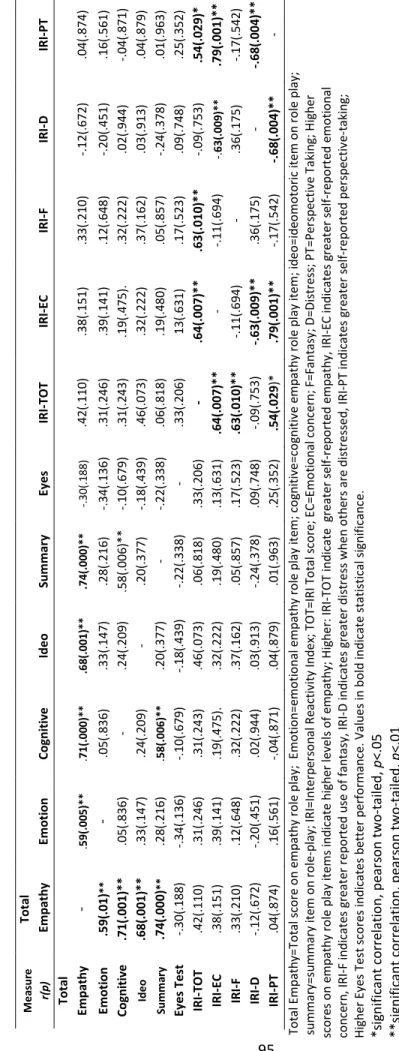
4. Correlations between empathy role-play scores, IRI, and
Eyes Test (n=21)………..………95
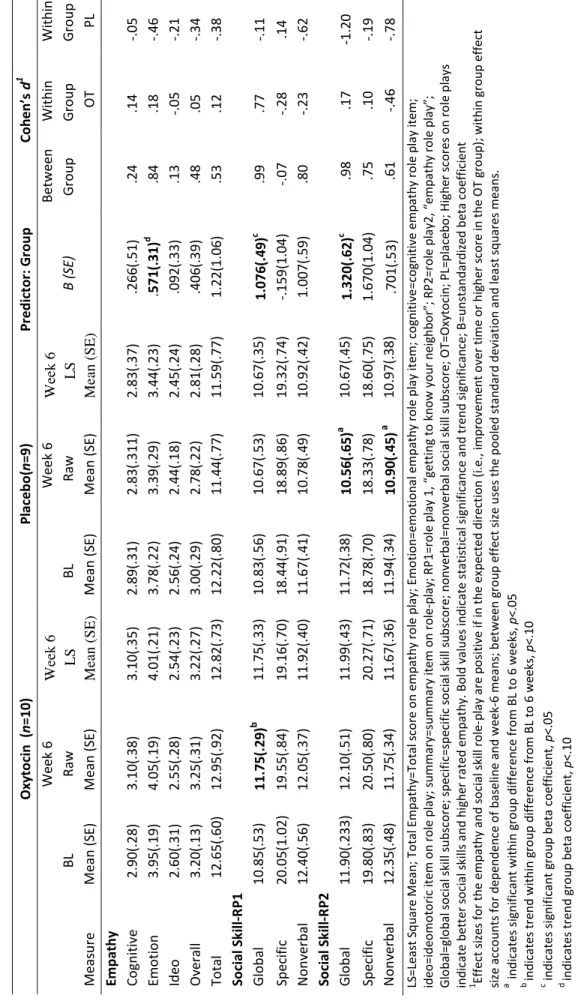
5. Role-play measure: BL and 6-week within and between group
analyses…………...96
6. Exploratory analyses: BL and 6 week within and between group
analyses………97
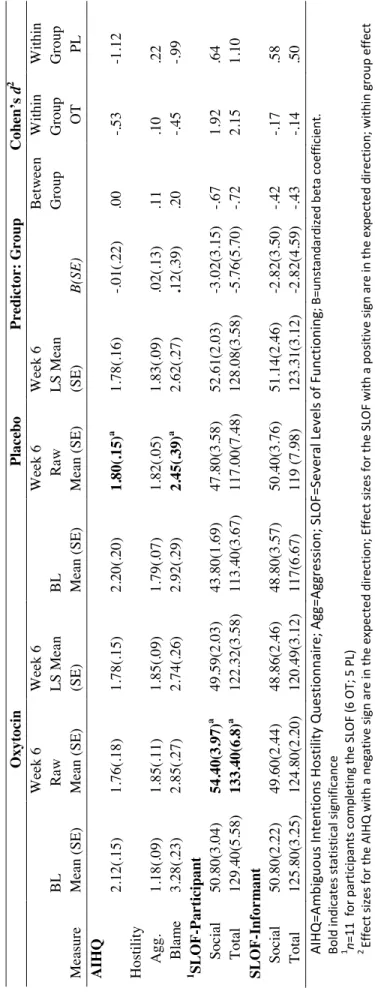
7. Symptom Measures: BL and 6-week within and between group
analyses……….98 !!!!
!
!!8.!Correlations between compliance and 6 week-change scores on social
cognitive, self-report measures and symptoms………..………99
9. Correlations between compliance and 6 week-change scores on
!
#"!
!
List of Abbreviations
AIHQ=Ambiguous Attributions and Hostility Questionnaire BACS=Brief Assessment of Cognition in Schizophrenia BSI-A=Brief Severity Index, anxiety items
ER-40=Emotion Recognition-40 IRI=Interpersonal Reactivity Index LSAS= Liebowitz Social Anxiety Scale OT=Oxytocin
PANSS=Positive and Negative Symptom Scale
! ! !
CHAPTER I
Introduction
This study investigated the effects of oxytocin on social cognition in schizophrenia, as well as on community and social functioning. One of schizophrenia’s hallmark features is social impairment (Bellack, Morrison, Wixted, & Mueser, 1990), which is related to critical disease-related factors, such as relapse (Sullivan, Marder, Liberman, Donahoe, & Mintz, 1990). Social cognition, our ability to perceive and interpret others’ intentions (Fiske & Taylor, 2008), underlies social functioning. Indeed, individuals with schizophrenia show impaired social cognition (Penn, Sanna, & Roberts, 2008) and these impairments are associated with poor social functioning in schizophrenia (Couture, Penn, & Roberts, 2006). Thus, researchers have explored avenues to remediate social cognition. Since
pharmacological agents have not appeared to be beneficial in improving social cognition (Harvey, Patterson, Potter, Zhong, & Brecher, 2006), psychotherapeutic approaches have been developed and show promise (Horan, Kern, Green & Penn, 2008). In light of the
importance of social functioning in schizophrenia and a paucity of current treatments, there is a need to explore other potential therapeutic approaches, such as oxytocin.
Oxytocin (OT) is a neuropeptide that has been referred to as the “great facilitator of life” (Lee, Macbeth, Pagani, & Young, 2009) because of its role in human social behavior. OT has recently been applied to psychological disorders where social functioning is
!
$
!
number of published studies evaluating the effects of exogenous OT on social cognition (Averbeck, Bobin, Evans, Shergill, 2012; Goldman, Gomes, Carter & Lee, 2011; Pedersen et al., 2011) and only one randomized control trial to evaluate daily OT dosing (Pedersen et al., 2011). Additionally, no study has evaluated the effects of OT on social and community functioning. This current study examined OT’s role in improving social cognition, social functioning, and community functioning to elucidate the therapeutic potential of OT for schizophrenia.
The introduction will provide the reader with the most relevant background
concerning social functioning, social cognition, and oxytocin as they relate to schizophrenia. The introduction begins with a review of social functioning and its relationship to such variables as prognosis and quality of life. Then, a discussion of the processes that underlie social functioning namely, social cognition will be explored. Specifically, the social cognitive domains of emotion perception and theory of mind will be highlighted since current OT research indicates it has a beneficial impact on these areas. Other areas of social cognition, such as empathy, social judgment and attributional style will also be reviewed because OT may theoretically have a beneficial impact on these domains. This will lead to a broad review of oxytocin, followed by a more focused discussion of oxytocin’s role in social cognition in healthy controls, and preliminary evidence of its role in psychological disorders, including schizophrenia. The introduction will end with the present study’s aims and
hypotheses.
Social Functioning in Schizophrenia
%
!
(Bellack et al., 2004). Social functioning is a broad term that refers to a variety of socially related behaviors such as interpersonal skills, work and school functioning, and independent living skills (Couture et al., 2006). Specifically, individuals with schizophrenia have shown worse interpersonal skills (Pinkham & Penn, 2006; Sitzer, Twamley, Patterson, & Jeste, 2008) and display fewer prosocial behaviors (Brune, Abdel-Hamid, Sonntag, Lehmkamper, & Langdon, 2009) compared to non-clinical controls. In addition, poor social support (e.g., lack of contact with family and few friends) is related to prognosis and functioning, such as self-care and employment (Erickson, Beiser, Iacono, Fleming, & Lin, 1989; Evert, Harvey, Trauer, & Herrman, 2003).
Social functioning deficits do not appear to be a function of disease onset or chronicity; rather they are evident throughout the course of the illness. Addington et al. (2007) found social functioning deficits throughout the course of the illness including those in the
prodrome (i.e., individuals displaying attenuated positive symptoms), and in first and multi-episode psychosis. Social functioning was also associated with quality of life in each of these groups. Supporting the evidence that social deficits are not necessarily a function of disease onset is that attenuated deficits in social behavior are observed in first-degree relatives (Dworkin, Lewis, Cornblatt, & Erlenmeyer-Kimling, 1994; Gibson, Penn, Prinstein, Perkins, & Belger, 2010; Tarbox & Pogue-Geile, 2008). Thus, evidence suggests social functioning could be considered a marker of disease vulnerability and not necessarily a byproduct of disease related variables, such as the effects of stigma, medication or institutionalization.
!
&
!
Cochrane, Wetton, & Copestake, 1990), where participants rate their social functioning. Second, informant reports are widely used where a family member or mental health
professional rates the affected family member’s social behavior (e.g., The Specific Levels of Functioning Scale [SLOF]; Schneider & Struening, 1983). Both the self-report and informant reports capture overall community functioning, such as daily activities, daily skills, and work skills (Mausbach et al., 2010). Third, performance-based measures, such as role-plays are used to assess social skills, and are thought to capture functional capacity (Mausbach et al., 2010). Role-plays typically involve participants engaging in a videotaped conversation with a confederate and the participants’ social skills are later evaluated and rated (Mueser &
Bellack, 1998; Patterson, Goldman, McKibbin, Hughs, & Jeste, 2001). Objective measures such as role-plays are a valuable tool for measuring social behavior in light of research suggesting individuals with schizophrenia lack insight into their social skill deficits (Mueser & Bellack, 1998) and more generally have poor metacognitive abilities (Kircher, Koch, Stottmeister, & Durst, 2007). Performance-based tools are also associated with community functioning assessments. Mausbach et al. (2010), for example, assessed individuals with schizophrenia and bipolar disorder with a role-play measure and a community functioning assessment, the SLOF. Better role-play performance was related to both greater residential independence and informant ratings on the SLOF. Therefore, performance-based measures are a valid assessment of real-world functioning and alleviate the potential confound of poor insight and bias found in self-reports.
Baron-'
!
Cohen & Wheelwright, 2003; e.g., Depression; Erickson et al., 1989; e.g., Bipolar Disorder; Mausbach, et al., 2010), these social difficulties are more compromised and have shown to play a critical role in outcome in schizophrenia. Mausbach et al. (2010) found individuals with schizophrenia had worse functional and community functioning scores compared to individuals with bipolar disorder. Additionally, research evaluating social functioning and schizophrenia has highlighted the importance of this area as valuable in elucidating disease trajectory and as a treatment target. The role of social functioning as a target for early intervention is highlighted by the findings that social functioning is a robust a predictor of disease outcome (Addington et al., 2007; Niendam, Jalbrzikowski, & Bearden, 2009) and a predictor of disease onset (Cannon et al., 2008). Additionally, social functioning, such as availability of acquaintances has been a predictor of outcome in those with chronic schizophrenia (Evert et al., 2003; Erickson et al., 1989) and better social functioning is related to increased therapeutic alliance (Couture et al., 2006). Thus, social functioning is an essential area to target in schizophrenia as it is both related to outcome and relapse.
!
(
!
social functioning is amenable to improvement; however, while social skills interventions for schizophrenia often include elements to facilitate generalization of skills (Kopelowicz, Liberman, & Zarate, 2006; Kurtz & Mueser, 2008), social interactions may be too nuanced and complex to fully address in social skills training. That is, social skills interventions for schizophrenia tend to focus more of specific skills (e.g., eye contact) but not on the
underlying processes that might enhance skill generalization across a variety of social situations.
Social Cognition
One area that has received recent attention as a possible mechanism underlying social deficits in schizophrenia is social cognition. Social cognition refers to our ability to understand others intentions, beliefs, and emotions (Fiske & Taylor, 2008) and has been studied extensively in humans, as well as primates (Silk, 2007). The Social Brain hypothesis is consistent with an evolutionary basis of social cognition, where it is hypothesized that our brains have evolved to navigate complex social interactions and larger brain size is
associated with increased social networks in primates (Dunbar, 2009).
)
!
these findings suggest that social cognitive processes underlie social functioning and are critical to the ability to effectively interact in the social world.
Although there is no definitive empirical consensus regarding the domains that constitute social cognition, a few domains have been theoretically proposed. Specifically, the major domains of social cognition in schizophrenia include emotion processing, theory of mind, social perception, and attributional style (Green, Olivier, Crawley, Penn, & Silverstein, 2005; Green et al., 2008; Penn et al., 2008). Emotion processing refers to the ability to identify and understand emotions in oneself and others (Green et al., 2008). Emotion processing is
utilized in behaviors such as emotion recognition and empathy. Theory of Mind (ToM) is the ability to infer another person’s mental or affective state and is critical to effective social functioning (Roncone et al., 2002). Social perception involves the integration of social information to inform judgments made about one’s social world; for example the degree to which one may find another trustworthy. Attributions refer to the causal inferences one makes about a situation or event (Bentall, Kaney, & Dewey, 1991; Green, et al., 2008; Kinderman, Kaney, Morley, & Bentall, 1992). As Green et al. (2008) point out, social cognitive abilities are not mutually exclusive, per se, but rather there is a great deal of overlap; for instance, theory of mind may include an affective perspective-taking
component—such that it becomes an integration of emotion recognition and theory of mind. Each of the components of social cognition will be discussed in more detail later in the introduction.
!
*
!
Corrigan, Bentall, Racenstein, & Newman, 1997). In a recent meta-analysis, Fett et al. (2010) found that social cognition explained more variance in community functioning compared to neurocognition. Specifically, social cognition explained 16 percent and neurocognition six percent of the variation in functional outcome. The functional outcome variables in their meta-analysis included community functioning (e.g. work and social functioning), social problem solving (e.g., ability to generate solutions to daily social occurrences) and social skills (as measured by role plays). When Fett et al. controlled for potential moderators such as gender, age, illness chronicity, and inpatient status, there was no effect on the relationship between social cognition and functional outcome, although these moderators slightly
mitigated the relationship between neurocognition and functional outcome. Fett et al. recommend that more research should evaluate the relationship between social cognition, neurocognition and social skills and social problem solving, since a majority of the studies found in their review focused predominately on community functioning.
+
!
Emotion Recognition
Emotion recognition is well studied in schizophrenia, specifically facial emotion recognition. (For reviews see Chan, Li, Cheung, & Gong, 2010; Kohler, Walker, Martin, Healey, & Moberg, 2009; Marwick & Hall, 2008; Morris, Weickert, & Loughland, 2009). Meta-analyses and narrative reviews indicate individuals with schizophrenia have worse facial emotion perception in schizophrenia compared to healthy controls. Other areas of emotion perception, such as vocal emotion recognition are also impaired (for a meta-analysis see Hoekert, Kahn, Pijnenborg, & Aleman, 2007). Chan et al.’s (2010) meta-analysis found large effect sizes for emotion perception in schizophrenia, which were higher than control tasks such as overall face and age recognition deficits. Additionally, facial emotion recognition deficits appears to be specific to emotionally laden stimuli; for instance (Schneider et al., 2006) found individuals with schizophrenia performed worse on a facial emotion recognition task compared to more difficult non-emotional tasks (e.g., age discrimination). Thus, facial emotion perception does not appear to be a generalized cognitive deficit, but is specific to emotion recognition.
!
,-!
!
fear, as well as neutral faces. The ER-40 has showed high-levels of test-retest reliability in schizophrenia samples and does not show ceiling effects (Carter, Barch, Gur, Pinkham, & Ochsner, 2009), which is often a cited problem in tests of emotion recognition (Kohler & Martin, 2006) measures.
Emotion perception is critical to effective social interactions and overall social functioning. Poor affect recognition is related to worse social functioning in schizophrenia (Addington et al., 2006; Couture, Penn, et al., 2006; Pan, Chen, Chen, & Liu, 2009) and worse interpersonal skills (Pinkham & Penn, 2006). Meyer and Kurtz (2009) found affect perception was a stronger predictor of social skills than neurocognition. Interestingly,
emotion perception deficits are not limited to individuals with chronic schizophrenia, but are also seen in individuals experiencing their first-episode (FE) of psychosis (Addington et al., 2006; Edwards, Pattison, Jackson, & Wales, 2001; Pinkham et al., 2005), individuals in the prodrome (Addington, Penn, Woods, Addington, & Perkins, 2008; Addington et al., 2006), and is similarly related to social functioning deficits at these early stages of illness
(Addington, et al., 2006). There is also evidence of emotion perception deficits in the unaffected first-degree relatives (Li, Chan, Zhao, Hong, & Gong, 2010).
,,!
!
schizophrenia compared to a healthy control sample, where increased amygdalar activation was related to improved fear identification. In addition, increased amygdalar response to fearful facial stimuli was associated with flat affect.
Aside from disrupted limbic activation, poor emotion recognition is linked to decreased efficiency in scan paths such that individuals with schizophrenia do not attend to critical facial features such as the eye and mouth region (Combs et al., 2008; Morris et al., 2009). Similar restricted scanning of emotion-laden faces is observed in first-degree relatives (Loughland, Williams, & Harris, 2004). Furthermore, interventions targeted at training individuals with schizophrenia to focus attention to critical facial features (i.e., the center region of the face) have shown to be efficacious (Combs, Chapman, Waguspack, Basso, & Penn, 2010).
Theory of Mind
Theory of Mind (ToM) is the ability to infer another person’s mental state and is important for effective social functioning (Roncone et al., 2002). Reviews indicate
individuals with schizophrenia have poor ToM (e.g., Bora, Yucel, & Pantelis, 2009; Sprong, Schothorst, Vos, Hox, & van Engeland, 2007) and ToM deficits are observed throughout the course of the illness (Bora et al., 2009). Frith (2004) argues that there is heterogeneity in ToM deficits in schizophrenia, such that those with negative symptoms may have a true ToM deficit, and those with predominately positive symptoms have a ToM, but they
!
,$!
!
plan to harm them). Frith notes this difficulty with mentalizing naturally leads to social discomfort and social withdrawal.
The construct of ToM has been divided into social perceptual and social cognitive components (Sabbagh, 2004), as well as affective and cognitive components (Shamay-Tsoory, Shur, Barcai-Goodman, et al., 2007). The cognitive components of ToM are thought to depend on underlying cognitive processes, which require mentalizing about other’s beliefs and intentions. Social perceptual ToM relies on more automatic perceptual abilities, and involves mentalizing about the emotional states of others. The affective component of ToM similarly requires mentalizing about emotional states (i.e., affective perspective-taking) versus beliefs (Shamay-Tsooray et al., 2007). There is neurological research supporting these distinctions between ToM components; for example different areas of the brain are evoked when performing social perceptual versus cognitive ToM tasks (Shamay-Tsoory, Aharon-Peretz, & Levkovitz, 2007). Additionally, individuals with schizophrenia have shown worse performance on the affective component of ToM as compared to the cognitive component (Shamay-Tsoory, Shur, Barcai-Goodman, et al., 2007). Thus, it is prudent to consider and evaluate ToM as a multidimensional rather than a unitary construct.
There are well-established ToM measures, which are routinely applied to schizophrenia samples. The cognitive ToM measures generally tap into the ability to
successfully complete picture sequencing tasks and answer questions about the beliefs of the characters in the stories. These tasks evaluate higher orders of ToM (e.g., second order theory of mind, where a participant is asked to imagine what another person is thinking about
,%!
!
questions about the characters’ mental states. Individuals with schizophrenia have shown worse performance on cognitive ToM measures (Brune, 2005) compared to healthy controls. Although there is clearly a cognitive load to such tasks, differences between schizophrenia and healthy controls remain on ToM tasks even after controlling for cognitive variables, such as executive functioning (Brune, 2005).
Social perceptual and affective ToM measures involve perceiving the affective states of others. Although social perceptual and affective ToM converges on emotion perception, research indicates these ToM components are independent of general emotion recognition (Kington, Jones, Watt, Hopkin, & Williams, 2000). One highly cited social perceptual and affective measure, The Reading the Mind in the Eyes Test or the Eyes Test (Baron-Cohen, Wheelwright, Hill, Raste, & Plumb, 2001) is often used in the schizophrenia literature (e.g., Bora, et al., 2006; Bora, Gokcen, & Veznedaroglu, 2008; de Achaval, et al., 2010; Shur, Shamay-Tsoory, & Levkovitz, 2008). Compared to healthy controls, individuals with schizophrenia perform worse on the Eyes Test (Bora et al., 2006; de Achaval et al., 2010; Irani et al., 2006; Kelemen et al., 2005; Kelemen, Keri, Must, Benedek, & Janka, 2004). ToM deficits on the Eyes Test are observed in first-episode psychosis (Kettle,
O'Brien-Simpson, & Allen, 2008) and in unaffected first-degree relatives (Irani et al., 2006). Kelemen et al. (2005) tested ToM in remitted medicated and unmedicated participants and found no difference in performance between these groups. Thus, it seems ToM deficits are not a result of years of illness or medication, and could be considered a disease-related endophenotype.
!
,&!
!
performance on an affective ToM measure than a cognitive ToM measure. Interestingly, the Eyes Test and negative symptoms were found to be the most robust predictors of social functioning in Bora et al. (2006), although negative symptoms and the Eyes Test were not correlated with one another. Bora et al. suggest negative symptoms and ToM may have separate yet significant associations with social functioning. These findings are consistent with those who have found ToM is associated with social skills (Brune, 2005; Couture et al., 2006); and others who found ToM to be one of the social cognitive variables most related to functioning (Fett et al., 2010).
Empathy
Empathy is another area of social cognition that has received recent attention in schizophrenia research (Lee, Farrow, Spence, & Woodruff, 2004). Leiberg and Anders (2006, p. 419) define empathy as the “ability to accurately perceive and understand another person’s emotions and react appropriately.” Similar to ToM, empathy taps into the broader affective (i.e., an emotional experience) and cognitive (i.e., affective perspective taking) domains of emotional processing (Decety & Jackson, 2004). Empathy is related to social functioning in schizophrenia (Baslet et al., 2009) and less empathy is associated with
,'!
! (e.g., anxiety as a result of other people’s distress).
Individuals with schizophrenia have demonstrated empathic difficulties, such as lower empathic concern on the IRI compared to healthy controls (Shamay-Tsoory, Shur, Harari, & Levkovitz, 2007), and lower self-reported affective perspective-taking ability as compared to healthy controls (Haker & Rossler, 2009; Montag, Heinz, Kunz, & Gallinat, 2007; Shamay-Tsoory, Aharon-Peretz, et al., 2007). The majority of the studies have found increased self-reported personal distress in response to other’s emotional experiences (Derntl, et al., 2009; Haker & Rossler, 2009; Montag, et al., 2007). Thus, there is some evidence that individuals with schizophrenia appear able to self-reflect on their empathic deficits; however, Derntl et al. (2009) found that empathic deficits were more impaired when using behavioral tasks of empathy (i.e., they implemented a task where participants chose the emotion that a person would most likely feel in a variety of scenarios) as compared to the self-report measure. Derntl et al. (2009) argue that while self-report measures provide some information about empathy, using only report measures of empathy is limiting. This suggests that self-reported empathy in schizophrenia should be supplemented with other measurement strategies.
Another way empathy has been studied is via imitative paradigms (i.e., where
!
,(!
! Rossler, 2009).
Thus, there is evidence of empathic deficits in schizophrenia, and greater levels of distress in response to others’ emotional states are experienced in this clinical population; however, there appears to be some indication that self-report measures of empathy are
limiting when used in isolation and without other measurement approaches. Given empathy’s role in forging relationships with others and the evidence for disrupted empathic processing in schizophrenia, this is a valuable area to assess further and perhaps target in treatment.
Social perception: Evaluation of trustworthiness
Social perception is another area of social cognition underling social functioning. Social perception involves using verbal and nonverbal information to make inferences or judgments about social information (Green et al., 2005). Social perception is a broad domain that includes a variety of social inferences one may make, including inferences about a person, situation, or social role based on the available social cues. As Green et al. (2005) explain, social perception converges on emotion perception, but the focus is slightly
different; for example an emotion perception task may require one to indicate how someone feels, whereas a social perceptual measure may require one to infer what series of events would have lead a person to feel a particular way.
,)!
!
competence and social interest in Penn et al. (2002). Indeed, poor social perception is related to a variety of functional outcomes, such as worse social problem solving (Couture et al., 2006) and social perception appears to mediate the relationship between neurocognition and functional outcome (Couture et al., 2006). This suggests that social perception is an integral component of everyday functioning.
There are a variety of social perceptual measures; however, for the purpose of the current study, I focused on one measure that is particularly pertinent to oxytocin research, namely the Trustworthiness Task (Adolphs et al., 1998). As will be discussed later, trustworthiness judgments are influenced by intranasal oxytocin (Kosfeld, Heinrichs, Zak, Fischbacher, & Fehr, 2005) and oxytocin levels seem to be related to trustworthiness in schizophrenia (Keri, Kiss, & Kelemen, 2009). Overall, trustworthiness tasks require individuals to assess the level of trustworthiness of a series of facial stimuli (i.e., the degree to which they either trust or distrust the face shown). The Trustworthiness Task (Adolphs et al., 1998) displays facial stimuli where participants rate trustworthiness on a scale from negative three (very untrustworthy) to positive three (very trustworthy). Making such trustworthiness judgments not only requires immediate perception of the stimuli, but also accessing past experiences with people or situations similar to the presented stimuli.
!
,*!
!
detect (Bass et al., 2008). Additionally, similar social judgment biases have been observed in first-degree relatives (Bass et al., 2008) and individuals in the schizophrenia prodrome (Couture et al., 2008). Such findings indicate that social perception is another area of social cognition that appears to be trait and not state-related.
It should be noted that some have also found a bias in rating the normed trustworthy versus untrustworthy faces (Pinkham, Hopfinger, Pelphrey, Piven, & Penn, 2008a; Pinkham, Hopfinger, Ruparel, & Penn, 2008b) particularly for subgroups of individuals with
predominately paranoid symptoms. Pinkham et al. (2008a) and Pinkham et al. (2008b) found that individuals with predominately paranoid symptoms rated faces as more untrustworthy than participants with fewer positive symptoms and healthy controls. Additionally, Pinkham et al. (2008a) found reduced amygdalar activation in the paranoid schizophrenia sample when rating untrustworthy faces as compared to healthy controls and the non-paranoid schizophrenia sample, and reduced amygdalar activation was related to worse social
functioning. These findings are consistent with studies assessing trustworthiness judgments in individuals with bilateral amygdala damage (Adolphs et al., 1998), where trustworthiness biases are also observed. Pinkham et al. (2008a) hypothesize that abnormal amygdalar activation may be related to impaired trustworthiness judgments in schizophrenia.
,+!
!
persecutory delusions. This is consistent with Penn et al. (2002) who also found individuals with schizophrenia did not use contextual cues in forming social judgments.
Attributional Style
Lastly, attributional style was investigated in the current study. Attributional style refers to the reasons one makes for the causes of a situation, and is widely studied in a variety of psychological disorders (e.g., Depression; Alloy, Peterson, Abramson, & Seligman, 1984; Joiner, 2001). Studies have shown that healthy controls tend to demonstrate what is referred to as a self-serving bias. That is, causal attributions tend to be “self-serving” in that negative life events are attributed to external factors (e.g., “I failed the exam because he is not a good teacher”), while positive life events are attributed to internal factors (e.g. “I passed the exam because I am proficient in this subject matter”) (Campbell & Sedikides, 1999).
Attributional style has been of great interest to schizophrenia researchers because of its association with symptoms, such as paranoia (An et al., 2010; Bentall, Corcoran, Howard, Blackwood, & Kinderman, 2001; Martin & Penn, 2002). Individuals with increased paranoia are more likely to demonstrate an exaggeration of the self-serving bias (Bentall et al., 2001). Furthermore, when external attributions are broken down into personal (e.g., an individual purposefully caused an event) and situational (e.g., a situation was caused accidentally) factors, individuals with schizophrenia show a tendency towards external-personal
!
$-!
!
attributions in explaining negative events compared to patients who did not currently have paranoid delusions. Lastly, as has been noted earlier, social cognitive domains are not mutually exclusive but have a degree of overlap. Bentall and Kinderman (1998) have argued that poor ToM interferes with the ability for individuals with schizophrenia to make
situational attributions. This assertion is supported by empirical data; for example, Randall, Corcoran, Day, & Bentall (2003) found that ToM was a predictor of making more external attributions in schizophrenia. Therefore it seems that improving ToM could also have an effect on attributional style in schizophrenia.
There are a variety of measures of attributional style in schizophrenia (e.g., the Ambiguous Intentions Hostility Questionnaire, Combs et al. 2007; the Internal Personal and Situational Attributions Questionnaire; Kinderman & Bentall, 1996; the Attributional Style Questionnaire, Peterson et al., 1982). These measures present participants with hypothetical scenarios where they have to discern the causes of the events. On the Attributional Style Questionnaire (ASQ; Peterson et al., 1982) and the Internal Personal and Situational
Attributions Questionnaire (IPSAQ; Kinderman & Bentall, 1996), participants rate whether the event was caused by them or another person in the scenario (external-internal dimension). The IPSAQ further evaluates whether the cause is perceived as personal or external-situational. Studies have shown discrepancies between the ratings of participants and
$,!
!
A recent measure, the Ambiguous Intentions Hostility Questionnaire (AIHQ; Combs et al. 2007) has sound psychometric properties and is a promising new measure of
attributional style in schizophrenia. Similar to other attributional measures, participants indicate the causes of a variety of situations that have occurred to them. They also indicate what they would do about the situations. The situations, however, vary in the intentionality, where some are accidental, intentional or ambiguous. Participants rate whether the person acted a certain way to them on purpose, how angry it would make them feel and how much they would blame the other person (these three ratings yield a “blame score”). Independent raters score the degree of hostility in the causal responses and aggression in how they would approach the scenario. The AIHQ is unique in that it assesses hostility and includes
ambiguous situations, which are not found on the ASQ or IPSAQ. It is critical to assess hostility in schizophrenia because individuals with paranoia have shown to identify hostility in situations where hostility is not evident (Combs, et al., 2009) and the use of ambiguous situations rather than just intentional events is more likely to tap into social cognitive biases. Indeed, individuals who are high in paranoia are more apt to perceive threat in ambiguous situations (Combs et al., 2007). The inclusion of ambiguous situations also bolsters the AIHQ’s external validity as many of the daily interactions that one experiences are
ambiguous, and do not have definitive closure (e.g., people laughing as you walk by). Thus, attributional style is more comprehensively measured by evaluating not only locus of control, but hostility and aggression in ambiguous situations.
!
$$!
!
compared to those without PDs. The PD group demonstrated a personalizing bias such that they had more hostility and blame attributions to ambiguous situations and hostility bias was a significant predictor of paranoia. The AIHQ appears sensitive enough to detect treatment effects in schizophrenia; for example following eighteen weeks of Social Cognitive
Interaction Training (SCIT), participants had significantly lower hostility and blame subscale scores on the AIHQ compared to before treatment, as well as compared to individuals in the treatment control group (Combs et al., 2007).
Consistent with other areas of social cognition, the aforementioned attributional biases are evident throughout the course of the illness. Similar attributional style has been observed in the prodrome and first-episode (FE) psychosis (An et al., 2010). Interestingly, in An et al. (2010), FE and prodromal individuals both showed a hostility bias on the AIHQ compared to healthy controls, and the prodromal individuals had a significantly higher blame bias (i.e., blaming other for negative outcomes) than the FE group and healthy controls. In the FE and prodromal groups, hostility bias was related to paranoia, and blame was related to level of paranoia in the prodromal group. Further support for attributional style as a
vulnerability marker comes from the research not only showing an external attributional style in first-degree of individuals with schizophrenia, but also that it is a predictor of future psychosis onset (Frenkel, Kugelmass, Nathan, & Ingraham, 1995).
$%!
!
functioning in individuals with schizophrenia. Lastly, a personalizing bias is related to insecure attachment styles in schizophrenia (Donohoe, et al., 2008). In light of the evidence that attributional style contributes to paranoia, and is possibly related to social functioning and ToM, it is certainly a promising area to target in treatment.
Summary and Implications of Social Cognition and Schizophrenia Research
In summary, individuals with schizophrenia have marked difficulties in social functioning, which are associated with outcome and relapse. Due to social functioning’s impact on schizophrenia, it is essential to evaluate more proximal underlying processes, such as social cognition. Individuals with schizophrenia have shown deficits and biases in a variety of social cognitive domains including emotion identification, theory of mind, empathy, social perception, and attributional style. Social cognitive deficits are observed across the course of the illness, as well as in first-degree relatives. Therefore, these deficits are not necessarily a byproduct of medication or disease chronicity, but are more likely associated with disease vulnerability. In addition, social cognitive impairments in schizophrenia are strongly related to social functioning beyond other variables such as neurocognition. These findings underscore the importance of social cognition as a treatment target.
A variety of efforts have been put forth to improve social cognition. While
pharmacological approaches have not shown efficacious in remediating social cognitive deficits (Harvey et al., 2006; Penn et al., 2009), psychosocial approaches have been
!
$&!
!
they also point out there are no current medications that similarly improve social cognition or social functioning in schizophrenia. As Kern et al. suggest, pharmacological agents can be useful for initiating engagement in psychotherapy and augmenting its benefits. Additionally, some facilities may not have the resources to properly train clinicians in psychological approaches for individuals with schizophrenia, so pharmacological approaches targeting social cognition could be of great utility in community clinics. Thus, there is a need for pharmacological agents that could be used to facilitate improvements in social cognition and social functioning. One such pharmacological agent is oxytocin. The next section will provide an overview of oxytocin, as well as evidence of its role in social behavior and its potential use in schizophrenia. This review will include research in non-human mammals, humans, and preliminary evidence of its effects on social cognition in non-clinical
populations and clinical populations, including schizophrenia.
Oxytocin
Oxytocin: Background and Basic Research
$'!
!
where some have found that OT expression is higher in females (Carter, 2007; Yamasue, Kuwabara, Kawakubo, & Kasai, 2009).
Animal models of OT, specifically prairie voles, provide much of what we know about the effects of OT on behavior (Carter, Williams, Witt, & Insel, 1992). Prairie voles are often used as models of human social behavior because they are monogamous and display biparental behavior patterns (Carter et al., 2009; Carter et al., 1992). Animal research has shown that levels of OT are related to maternal behavior, where increased OT expression throughout the rat brain is related to increased maternal behavior, such as grooming pups (Lee et al., 2009). Increased OT in plasma is even observed in expectant mice fathers during pregnancy (Gubernick, Winslow, Jensen, Jeanotte, & Bowen, 1995). In prairie voles, OT is involved in mate bonding and increased social contact and exploration of new situations (Carter, et al., 1992).
Interestingly, early experiences (i.e., prenatal and postnatal stages) have implications for later parenting and OT levels (e.g., Carter, Boone, et al., 2009; Pedersen & Boccia, 2002). In rats, prenatal stress is related to OT levels in offspring (Carter et al. 2009). Additionally, Carter et al. (2009) discuss a series of studies where prairie voles were disrupted after the offspring were born (e.g., the voles were moved to different cages in a cup). This disruption was related to later decreased levels of OT in the male offspring, and decreased parental behavior. When OT was directly manipulated in the postnatal stage, such that newborn voles were given either OT or an OT antagonist, the OT males had more pair bonding; whereas, the OT antagonist voles had decreased parental behavior (e.g., not attending to vole pups).
!
$(!
!
OT antagonist or whose postnatal experience was disrupted were given OT later in life, they displayed increased social behavior (e.g., increased parental behaviors). While the animal research has provided the scientific community with strong evidence of the role of OT in behavior, the effects on human social behavior and bonding remain mostly unanswered (Lee et al., 2009).
OT and Social Behavior in Humans
$)!
!
Aside from the antidepressant and antianxiety effects in healthy controls, underlying social cognitive processes are related to OT. A recent review by MacDonald and MacDonald (2010) summarizes the evidence that OT improves social cognition in healthy controls. Specifically, increased levels of OT are associated with increased trust (Kosfeld et al., 2005), correct emotion identification (Domes, et al., 2010) and improved mentalizing (Domes, Heinrichs, Michel, Berger, & Herpertz, 2007) in healthy control samples (Lee et al. 2009).
It should be noted the relationship between OT and emotion identification is
somewhat complex. Some have found OT is related to improved emotion recognition for all emotions in healthy control samples (Domes, Heinrichs, Glascher, et al., 2007), while others have found OT is related to improved emotion recognition for specific emotions (Di
!
$*!
!
Ambady (2007), for example, found fear recognition was the best predictor of social behavior in a healthy control sample. Therefore, it is necessary to evaluate OT’s impact on specific emotions, such as fear and anger, as opposed to evaluating emotional accuracy in general.
In addition to emotion recognition, OT has been related to ToM in healthy controls. Domes, Heinrichs, Michel, et al. (2007) found that OT was related to increased performance on the Eyes Test. Specifically, performance improved on the more difficult Eyes Test items (determined by median of item difficulty from a pilot study). One mechanism that may mediate the positive effects of OT on mentalizing is increased attention to critical facial features, such as the eye region. Indeed, Guastella, Mitchell, and Dadds (2008) found a single dose of OT was related to increased gaze to the eye region of human faces in a healthy
control sample. This is consistent with the attention training research in schizophrenia, where emotion perception has shown improvements following instruction to attend to the eye regions of faces (Combs et al., 2010).
The effects of OT extend to social perception, specifically trust in others. Increased trust has been repeatedly observed in healthy controls administered intranasal OT (Kosfeld et al., 2005). Kosfeld et al. (2005) found participants administered a single dose of intranasal OT gave more money to another participant during a trust paradigm. Interestingly, when a risk paradigm was implemented (same as the trust paradigm but without the social
$+!
!
emotion perception, such that one is more apt to trust another if they can more accurately perceive their cognitive and affective states.
There has also been research looking at the effects of intranasal OT on empathy in humans, which is unsurprising given the association between OT and increased feelings of bonding (Carter et al., 1992). Hurlemann et al. (2010) found intranasal OT improved emotional, but not cognitive empathy. In Hurlemann et al.’s study, OT increased emotional empathy in men to levels comparable to the women in their sample, which were significantly different before the intranasal OT dose. Hurlemann et al. hypothesize that cognitive and emotional empathy may have different neurological underpinnings, where emotional empathy is related to amygdalar functioning. Their results are somewhat inconsistent with research showing OT improves ToM, since cognitive empathy is closely related to ToM; however, Hurlemann et al.’s assessment of cognitive empathy involved social scenes where participants were asked to guess how the people were feeling in the scenes (i.e., participants could not directly see the faces of the individuals in the scenes). This is in contrast to the Eyes Test where the stimuli are the eye regions of faces and participants stare directly at the stimuli. Perhaps participants in Hurlemann et al.’s study did not improve on the cognitive empathy measure because they could directly see the faces and thus were not able to discern the mental states. Clearly more research is needed to elucidate OT’s role in empathic
!
%-!
!
behavior, namely social cognition, and thereby improve social functioning. Of course, the directionality and relationship between OT and social behavior is unknown; for instance, it is possible that the relationship is bi-directional in that social withdrawal could lead to
decreased social relationships and a reduction in OT. Lower OT levels, in turn, may have a deleterious impact on social cognitive processes, such as emotion perception, and positive social behavior (i.e., social skills). Such a transactional relationship is supported by OT’s association with perceived reward in social interactions (Bell, Nicholson, Mulder, Luty, & Joyce, 2006). That is, lower levels of OT are related to not finding social interactions
rewarding. Lack of social reinforcement may prevent individuals from practicing social skills and lead to further impairments in social functioning.
OT in Schizophrenia and Other Clinical Populations
The role of oxytocin in psychiatric disorders has been evaluated in light of the evidence of its anxiolytic, antidepressant (Bell et al., 2006; Ozsoy, Esel, & Kula, 2009) and antipsychotic effects (Caldwell, Stephens, & Young, 2009; Feifel, Shilling, & Belcher, 2012), as well as the aforementioned impact OT appears to have on underlying social cognitive processes. In fact, there has been a recent surge in reviews of OT’s role in
psychiatric disorders (Bartz, Zaki, Bolger & Ochsner, 2011, Lee et al., 2009; Macdonald & Macdonald, 2010; Marazziti & Catena Dell'osso, 2008). The reviews highlight the
%,!
!
autism. Macdonald and Macdonald (2010) argue OT’s relevance to a variety of psychiatric disorders does not diminish its utility; rather social relations are frequently affected in psychological disorders, so it reasons OT can be applied to multiple disorders.
Abnormal OT levels have been observed in schizophrenia as compared to healthy controls (Beckmann, Lang, & Gattaz, 1985; Goldman, Marlow-O'Connor, Torres, & Carter, 2008). OT has also demonstrated antipsychotic properties (Bakharev, Tikhomirov, & Lozhkina, 1986; Bujanow, 1974; Caldwell et al., 2009; Feifel et al., 2010; Pedersen et al., 2011) and shown to restore Prepulse Inhibition (PPI; Feifel et al., 2012; Feifel & Rezza, 1999). PPI is a measure of sensorimotor gating, where a reduced startle response to a stimulus is observed when it is preceded by a weaker stimulus. Individuals with
schizophrenia display a decreased PPI response and antipsychotics reverse the disrupted PPI seen in schizophrenia (Feifel et al., 2012; Feifel & Rezza, 1999). Interestingly, Feifel et al. (2012) found that OT could similarly restore PPI in rat models of psychosis, which is consistent with the effects of antipsychotics.
!
%$!
!
study visits as compared to the two-week visits. In Pedersen et al.’s (2011) randomized control trial, they found significant reductions in a variety of symptoms (positive, general, anxiety) and a trend reduction in negative symptoms after two-weeks of 24 IUs of intranasal OT. These studies suggest OT has therapeutic implications of for the treatment of
schizophrenia-related symptoms.
However, the majority of the OT research has focused on OT’s amelioration of the symptoms of schizophrenia. Less attention has focused on targeting social cognitive
processes, which is surprising in light of the animal and healthy control research linking OT with social cognition (Macdonald & Macdonald, 2010). In the OT and social cognitive research that does exist, autism has been one of the most studied disorders. In fact
researchers have begun to explore abnormalities in genes responsible for OT expression in autism (Lee et al., 2009). Lower levels of OT plasma have been found in autism, and there is preliminary evidence intranasal OT can improve affect recognition in autism (Yamusue, 2009). Guastella et al. (2010) found a single dose of intranasal OT in autism spectrum disorders improved ToM as measured by performance on the Eyes Test. OT has also shown to reduce the repetitive, self-stimulating behaviors often observed in autism (Hollander et al., 2003). Overall, the autism literature is promising and suggests that OT can be applied to other populations where social cognition is impaired, such as schizophrenia.
%%!
!
OT to social cognition in schizophrenia. Researchers have only begun to postulate about the potential benefits of OT in remediating social cognitive deficits in schizophrenia. Rosenfeld, Lieberman, & Jarskog’s (2010) recent review paper discusses OT and social cognitive research, as well as hypothesize that OT can make a significant contribution to our
understanding of social cognition in schizophrenia. There have even been a few empirical studies looking at the relationship between OT and social cognition in schizophrenia. In one study, low levels of OT in schizophrenia were associated with decreased emotion perception accuracy (Goldman, Marlow-O'Connor, Torres, & Carter, 2008). Keri et al. (2009) found significantly lower OT levels in those with schizophrenia compared to healthy controls after a trust interaction (writing a secret on a piece of paper and presenting it to the tester). Keri et al. additionally found that low levels of OT were related to negative symptoms and were not related to cognitive functioning or medication.
!
%&!
!
different doses of OT and a placebo three days apart (10 and 20 IUs of OT) and completed the Ekman facial recognition task at each time point. In addition to identifying the emotions displayed, they rated the intensity of the emotions (absent, present, intense). Goldman et al. found that the 20 IU dose lowered intensity ratings in the polydispsic group. In addition, they found that the higher OT dose (20 IU), but not the lower dose (10 IU), increased emotion recognition accuracy. Specifically, the improvements in their study were found for fearful faces in the polydipsic schizophrenia sample. In fact, they found that 10 IUs actually decreased affect recognition in all participants with schizophrenia.
In Pedersen et al.’s (2011) randomized-control trial, participants received daily OT for two weeks and completed a social cognitive battery at baseline and two weeks. Results showed significant improvements on second order false belief ToM (i.e., the ability to discern what an individual is falsely thinking about another’s thoughts or intentions) as measured by the Brune Task and a trend towards rating untrustworthy faces (i.e., faces rated as untrustworthy by a normative sample) as trustworthier in the OT group. Notably, Pedersen et al. examined multiple rather than single OT doses; whereas the previous two studies examining OT and social cognition evaluated either one (Averbeck et al., 2012) or two (Goldman et al., 2011) doses. These results are promising and underscore the need to investigate OT in a longer clinical trial assessing a broader range of social cognitive measures.
The Current Study
%'!
!
evaluated the effects of OT on facial emotion recognition, theory of mind (ToM), empathy, social perception and attribution style. The aims and hypotheses will follow accordingly. Additionally, the effects of OT on social and community functioning were explored in light of the relationship between social cognition and these life domains (Couture et al., 2006; Smith et al., 2012).
Aims & Hypotheses
Aim 1: Evaluate the effects of OT on facial emotion recognition, specifically fear
and anger.
The first aim was to evaluate the effects of OT on facial emotion recognition. Averbeck et al.’s (2012) and Goldman et al.’s (2011) findings suggest OT has a role in emotion recognition in schizophrenia. Specifically, OT may improve recognition of the emotions of fear and anger in schizophrenia given the evidence that OT improves recognition of these emotions in healthy controls (Fischer-Shofty, Shamay-Tsoory, Harari, & Levkovitz, 2010; Guastella et al., 2009) and preliminary evidence that it improves fear recognition in schizophrenia (Averbeck et al., 2012; Goldman et al., 2011). This aim is further supported by Morris et al.’s (2009) argument that OT may reduce amygdalar activation to fearful faces in schizophrenia and thereby reduce distress that comes from negative emotional stimuli. Therefore, it was hypothesized that OT would improve recognition of fear and anger in schizophrenia using a well-validated, behavioral facial emotion recognition task, The ER-40 (Carter et al., 2009).
Aim 2: Evaluate the effects of OT on Theory of Mind (ToM).
!
%(!
!
2004; Shamay-Tsoory, Shur, Barcai-Goodman, et al., 2007). Therefore, the current study explored affective and cognitive ToM. OT appears to have beneficial effects on ToM based on the research with healthy controls (Domes et al., 2007) and individuals with autism (Guastella et al., 2010). Pedersen et al.’s (2011) two-week trial provides preliminary evidence OT can improve cognitive ToM. (Note that ten of the participants in the current study are from the Pedersen et al., 2011 trial.) Based on the current body of evidence, it was hypothesized that OT would improve cognitive ToM using a social-reasoning cognitive ToM task, namely the Brune Task. It was also hypothesized OT would improve affective ToM as measured by a behavioral affective ToM task, the Eyes Test.
Aim 3: Evaluate effects of OT on empathy.
The next aim was to evaluate the relationship between OT and empathy in
schizophrenia. OT is associated with feelings of closeness (Carter et al., 1992) and evidence with healthy controls suggests OT is associated with increased empathy (Hurlemann et al., 2010). Since empathy is closely related to affective ToM (Derntl, et al., 2009) and emotion perception (Feschbach, 1987; Green et al., 2008), it stands to reason that OT could lead to increased empathic processing in schizophrenia. The current study used a well-established self-report empathy measure, the IRI (Davis, 1983), to assess the effects of OT on cognitive and affective empathy. It was hypothesized that OT would improve self-reported empathy in schizophrenia.
%)!
!
performance on the empathy role-play was considered exploratory; however the preliminary psychometric properties of the role-play empathy measure were also assessed.
Aim 4: Evaluate effects of OT on social judgments.
There is initial support that intranasal OT can increase trustworthiness in individuals with schizophrenia (Pedersen et al., 2011). Additionally, Keri et al. (2009) found lower OT plasma levels in individuals with schizophrenia were related to decreased trust during a trustworthiness paradigm. Thus, aim four was to explore how OT impacts social judgment on a behavioral measure of trustworthiness, namely the Trustworthiness Task (Adolphs et al., 1998). It was hypothesized that the OT group would have improved social judgment, such that ratings on the trustworthiness task would be similar to ratings observed in healthy controls. Specifically, it was hypothesized that OT would be related to greater ratings of trustworthiness.
Exploratory Aims
Exploratory Aim 1: Evaluate effect of OT on attribution style.
Since no current research has directly explored how OT affects attribution style in schizophrenia (nor in non-clinical samples in general), the first exploratory aim was to examine the effects of OT on attribution style in schizophrenia using a behavioral task, namely the AIHQ. This is a worthwhile endeavor since there is some evidence that
!
%*!
!
Exploratory Aim 2: Evaluate effects of OT on social and community functioning.
An additional aim was to examine how OT impacts social functioning using a functional capacity (i.e. role play) measure and community functioning using a self and informant report measure. Since OT has been related to improved social skills in healthy controls (Ditzen et al., 2009), OT may have a similar observable effect on functional capacity in schizophrenia. The relationship between social cognition and social functioning also suggests OT could have an effect on functional capacity. However, the research in this area is lacking in clinical populations, and so the effects of OT on functional capacity were
considered exploratory.
In light of research showing improved social functioning is related to better community functioning (Couture et al., 2006; Evert et al., 2003), the impact of OT on
community functioning over the course of the present study’s treatment trial was additionally explored. Due to potential lack of insight in functioning deficits, both informant and self-reports were administered to examine community functioning.
Exploratory Aim 3: Moderator and Mediators of OT effects on social cognition.
Due to a potentially limited sample size, evaluating mediators and moderators was considered exploratory. Hoyle and Kenny (1999) have found that simple mediation models are indeed possible with small sample sizes. To better characterize possible treatment effects, it was considered critical to evaluate whether there were any variables that may potentially mediate, as well as moderate the effects of OT on multiple domains of social cognition. Specific mediators that were proposed to explore included anxiety and neurocognition. Since OT has known anxiolytic effects (Lee et al., 2009), treatment effects on anxiety could
%+!
!
performance could be a function of decreased anxiety. Additionally, given the research demonstrating OT is tentatively related to improved cognitive abilities (Macdonald &
Macdonald, 2010), neurocognition was also tested as a mediator. Lastly, gender was explored as a moderator; animal studies have shown that OT has a greater effect on social behavior in male than female voles (Carter et al., 2009) and there is an array of studies showing
! ! !
CHAPTER II
Methods
Participants
Twenty participants were recruited as part of the Oxytocin Treatment of Social Deficits and Psychotic Symptoms in Schizophrenia study conducted at the Clinical and Translational Research Center (CTRC) at the University of North Carolina Hospitals and the North Carolina Psychiatric Research Center (NCPRC). (Note, five of the participants in the current sample were part of a 12-week OT treatment trial and the other 15 participants were part of the 6-week OT trial; differences in inclusion/exclusion criteria are discussed below.) Participants were recruited from UNC’s Department of Psychiatry Schizophrenia Treatment and Evaluation Program (STEP) outpatient clinics, the UNC Hospitals Psychotic Disorders inpatient unit, the inpatient unit at Dorothea Dix Hospital, other studies conducted at UNC Hospitals, as well as flyers in the community and advertisements in the National Alliance of Mental Illness (NAMI) newsletter.
&,!
!
symptom severity, and baseline social cognition (Table 1). Diagnosis was based on extensive chart review and consultation with the attending psychiatrist. The Structured Clinical Interview for DSM-IV Axis I Disorders (SCID-I; First et al., 2002), Mood Disorders and Psychotic Disorders modules was administered by trained research clinicians or
advanced graduate students for participants who not been followed by UNC’s Department of Psychiatry or participants whose diagnosis was unclear (e.g., schizophrenia versus
schizoaffective disorder).
Exclusion criteria for both trials included low literacy as indicated by an inability to read and understand the consent form and performance on the Wide Range Achievement Test (WRAT; only administered in the 12-week OT trial), dependence on substances other than tobacco or caffeine; positive urine drug screen for illegal substances or drugs that have not been prescribed; debilitating medical conditions; major surgery or trauma in the past year; pregnancy or breast-feeding; having given birth in the past 6 months or breast-feeding in the past 3 months; abnormalities found during medical evaluation during study
participation; and, an inability to learn self-administration of intranasal treatments.
Procedures
The current study used a randomized, double-blind, placebo-controlled design. Half of the participants (n=10) received an oxytocin nasal spray and half (n=10) received a normal saline placebo nasal spray. Potential participants were contacted by study staff and completed a telephone screen (described in more detail below) to determine study eligibility.
Participants completed a screening visit to further determine eligibility based on the aforementioned inclusion and exclusion criteria. Before the screening visit began,
!
&$!
!
the consent to ensure they understood the document. In order to participate in the study, participants must have been able to read and understand the informed consent document.
Baseline measures of social cognition, social functioning, community functioning, neurocognition and psychiatric symptoms were then obtained for eligible participants (measures are described below). The schedule of study visits was different for the 6 and 12-week trials. Both trials collected social cognition, social functioning, and psychiatric symptoms at baseline and 6 weeks. While both studies assessed neurocognition and
community functioning at baseline, these areas were only assessed at 6 weeks for the 6-week OT participants (and not the 12-week participants). The participants from the 6-week trial had additional study visits at the 2 and 4-weeks, while the 12-week participants did not complete social cognitive measures at 2 and 4 weeks. The social cognitive, symptom, social and community functioning measures and a flow sheet of the study visit procedures for both trials can be found in the Appendix.
During the baseline visit, participants identified two people that knew them well (e.g., family member, friend, mental health professional) to complete the informant version of the community functioning assessment, the Specific Levels of Functioning (SLOF) scale (described below). Informants who have frequent contact with the study participant (e.g., speak on the phone daily, see each other at least twice a week) were asked to complete the SLOF over the phone with a research clinician or psychology graduate student once at baseline and again at 6-weeks for participants in the 6-week trial only.
&%!
!
Participants were then given new vials at each study visit. Participants in the 12-week trial were given two 30 ml vials at their 2-week visit to ensure they had an adequate amount of spray to last until their 6 week visit. The vials were weighed before the participants took the vials home and then again when they returned so as to track compliance with the study treatment (see flow sheet in Appendix for schedule of compliance tracking).
Participants were called daily for two to seven days after their baseline visit by research staff. These reminder calls were intended to remind participants to take the spray, assess that they were administering it correctly and assess for adverse effects. Participants who had more difficulty remembering to take the nasal-spray or trouble with the
administration instructions were called more frequently during the first week. Participants were called weekly for the remainder of the study once they demonstrated that they remembered to take the spray and were familiar with the administration.
The study visits lasted about two hours for the social cognition and social functioning measures. Trained psychology graduate students, research assistants or advanced
undergraduate students administered the social cognitive and social functioning measures. Trained psychology graduate students or clinicians administered the symptom measures. Study staff administering the assessments were blind to treatment group. Trained
undergraduate research assistants, also blind to treatment group, rated the role-plays and the attributional style measure (i.e., AIHQ; as described below).
Measures
Screening measures.
!
&&!
!
A telephone screen was developed to screen participants for inclusion criteria, such as diagnosis and substance use in the last year. The telephone screen includes questions tapping into the potential participant’s comfort in social situations (e.g., “How do you react to the presence of strangers?”). The potential participant was asked to elaborate on their perceived difficulty in social settings. Based on the telephone screen and consultation with the
potential participant’s mental health professionals, participants were scheduled for a screening visit.
Psychotic Symptoms.
The Positive and Negative Symptoms Scale (PANSS; White et al., 1997) is a 30-item scale on which an interviewer rates the subject for severity of positive and negative psychotic symptoms and mood and behavioral symptoms after asking a standard series of questions. Items are rated on a scale of 1 (absent) to 7 (severe), and yield three main subscores: positive symptoms, negative symptoms, and general psychopathology. The PANSS was administered by an experienced psychiatric clinician or trained doctoral graduate students blind to
treatment group.
Social cognitive measures.
Emotion Perception.
&'!
!
stimuli. The stimuli are presented in a randomized order each time they are administered. A scoring program automatically records accuracy and median response time.
The ER-40 faces were derived from the University of Pennsylvania Emotion Recognition Task, 96 faces version, and are balanced for equality and intensity of emotion, age, gender and ethnicity. As mentioned earlier, the ER-40 has showed strong psychometric properties, such as high-levels of test-retest reliability in schizophrenia samples and does not show ceiling effects (Carter et al., 2009). A sample ER-40 stimulus can be found in the Appendix.
Theory of Mind.
In the Theory of Mind Picture Stories Task (Brune, 2003), participants are shown a series of six sets of four cartoon pictures that illustrate interactions between two or more individuals. The cartoon cards were displayed to the participant in a predetermined
scrambled order (i.e., they are displayed to each participant in the same scrambled order). Participants are asked to rearrange the pictures in an order that conveys a logical story. Participants are given two practice items and provided with feedback to ensure they understand the task.