LOSS AND DISCARD OF TRADITIONAL ECOLOGICAL KNOWLEDGE: ARCHAEOLOGY OF CATAWBA FOODWAYS
Rosemarie Blewitt
A thesis submitted to the faculty at the University of North Carolina at Chapel Hill in partial fulfillment of the requirements for the degree of Master of Arts in the Department of
Anthropology.
Chapel Hill 2016
ABSTRACT
Rosemarie Blewitt: Loss and Discard of Traditional Ecological Knowledge: Archaeology of Catawba Foodways (Under the direction of C. Margaret Scarry)
Erosion of traditional ecological knowledge in local communities has generally been studied using ethnographic and ethnohistorical data. I argue that changes in foodways related to the loss of traditional ecological knowledge can also be observed in the archaeological record. I analyzed archaeobotanical remains recovered from two historic period Catawba sites, the Old Town and the New Town sites, and compared them with assemblages from other Catawba sites to track changes in plant use over time. The Catawba Nation, located in South Carolina,
ACKNOWLEDGEMENTS
TABLE OF CONTENTS
CHAPTER 1: INTRODUCTION………...……….1
CHAPTER 2: LOSS AND DISCARD OF TRADITIONAL ECOLOGICAL KNOWLEDGE………6
Catawba Traditional Ecological Knowledge and Colonial Instability……….9
CHAPTER 3: BACKGROUND TO THE CATAWBA PROJECT………..27
The Old Town Site (SoC634)………29
The New Town Site (SoC632 and SoC635)………..31
Other Catawba Project Sites: Nassaw-Weyapee, Charraw Town, and Ayers Town……….33
CHAPTER 4: PALEOETHNOBOTANICAL ANALYSIS………..35
Methods………..37
Results………40
CHAPTER 5: DIACHRONIC COMPARISON OF CATAWBA PLANT USE………..…55
Siouan Project Sites………...56
Catawba Plant Use from A.D. 1750-1820……….58
CHAPTER 6: INTEGRATING BOTANICAL AND FAUNAL ANALYSIS……….60
Old Town and Ayers Town………65
Integrating Botanical and Faunal Remains from A.D. 1750-1820………68
CHAPTER 7: CHANGING ECONOMIC STRATEGIES AT CATAWBA SITES……….71
LIST OF TABLES
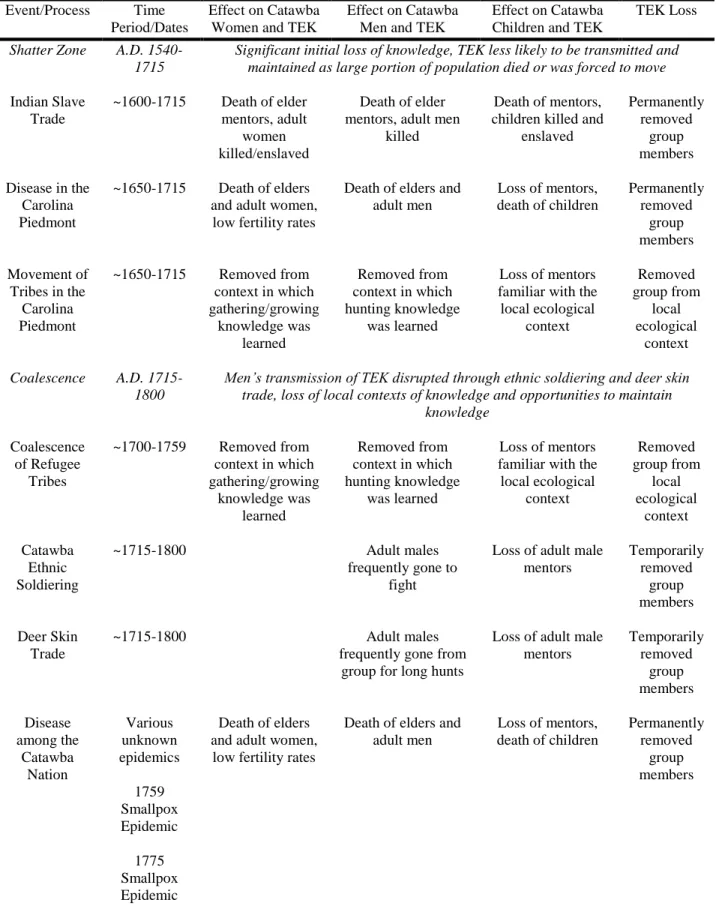
Table 2.1 Loss of Traditional Ecological Knowledge Among the Catawba
Over Time……….12-13
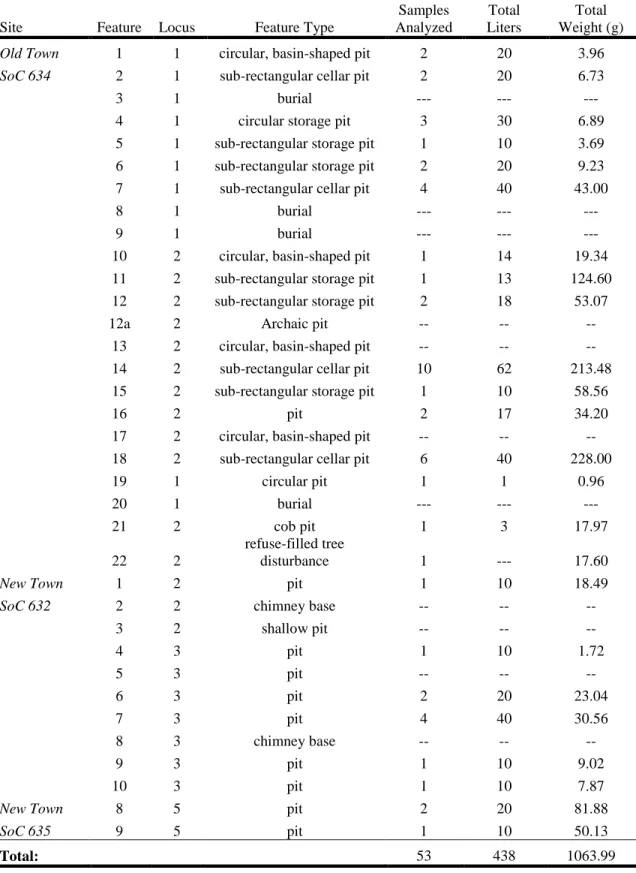
Table 4.1 Feature List. ………..36
Table 4.2 Old Town Features by Temporal Affiliation. ………...39
Table 4.3 Complete List of Taxonomic Names for Identified Plants………41
Table 4.4 Old Town 1 Botanical Remains. ……….43-44 Table 4.5 Old Town 2 Botanical Remains. ……….45-46 Table 4.6 Old Town Unaffiliated Botanical Remains. ………47-48 Table 4.7 New Town (SoC632) Botanical Remains. ………..51-52 Table 4.8 New Town (SoC635) Botanical Remains. ………..53-54 Table 5.1 Paleoethnobotanical Evidence for Change in Plant Use Among the Catawba Over Time. ……….56
Table 6.1 Faunal Remains from Five Catawba Towns. ………..………63-65 Table A.1 Number of Identified Specimens (NISP) at Old Town 1 by Feature………76
Table A.2 Number of Identified Specimens (NISP) at Old Town 2 by Feature………....77
Table A.3 Number of Identified Specimens (NISP) at Old Town Unaffiliated by Feature. ……….78
Table B.1 Raw Data for Figure 5.1. ………..79
Table B.2 Eigenvalues and % inertia by component for Figure 5.1………..79
Table B.3 Component Scores for Cases and Units for Figure 5.1……….79
Table B.4 Raw Data for Figure 6.1. ………..80
Table B.5 Eigenvalues and % inertia by component for Figure 6.1………..………80
LIST OF FIGURES
Figure 1.1 Map of sites excavated as part of the UNC Research
Laboratories of Archaeology Catawba project………... 2
Figure 3.1 Map of Old Town Site Loci………...29
Figure 3.2 Old Town Locus 1 Excavation Map……….30
Figure 3.3 Old Town Locus 2 Excavation Map……….31
Figure 3.4 Map of New Town………...32
Figure 5.1 Correspondence Analysis Graph of Botanical Remains from Five Catawba Sites………...……….60
Figure 6.1 Correspondence Analysis of Botanical and Faunal Remains from Old Town 1, Old Town 2, and Ayers Town……….67
CHAPTER 1: INTRODUCTION
The disruption of communities and corresponding losses of traditional ecological knowledge over the past century has been explored frequently in the anthropological literature. While most of these studies are based on ethnographic investigations of current social groups, this process could also be examined through the archaeological record, which would provide scholars with a much longer view of how these disruptions and losses affect and are affected by people and their environment. I will discuss the archaeological evidence from my analysis of the Catawba Old Town site (SoC634) and New Town site (SoC632 and SoC635), previous work done on the sites of Nassaw-Weyapee (38YK434), Charraw Town (38YK17), and Ayers Town (38YK534), and the ethnographic literature on loss of traditional ecological knowledge to suggest that the Catawba people may have lost and discarded that knowledge throughout the historic period. The Old Town and New Town sites were excavated as part of the University of North Carolina’s Research Laboratories of Archaeology (RLA) Catawba project. This project, an extension of the Siouan project that seeks to trace the evolution of native societies of the
Carolina piedmont, involved the excavation of other Catawba sites occupied between c. 1750 and 1820 including Charraw Town, Nassaw-Weyapee, and Ayers Town (Figure 1.1) (Davis and Riggs 2004).
Foodways, defined as “the whole interrelated system of food conceptualization,
values (Deetz 1977: 73). I analyzed data from archaeobotanical remains to determine what plants were being used at Old Town and New Town, how these compared to other Catawba
occupations, how they fit into other lines of evidence including faunal remains, ceramics, and ethnohistorical records, and what these changes (or lack thereof) in Catawba foodways tell us about the Catawba colonial experience and the process of coalescence. Through this thesis, I will illustrate (1) what plants people used at Old Town and New Town, (2) how foodways at Old Town and New Town compared to the foodways of their ancestors, (3) how changes in Catawba foodways relate to particular historical circumstances, and (4) how historical events and
processes influenced the maintenance and transmission of traditional ecological knowledge related to foodways.
I begin my argument in chapter 2, where I discuss the theoretical background and ethnographic literature regarding loss of traditional ecological knowledge (TEK). While the ethnographic examples that I draw on are separated from the Catawba Nation by time and space, I argue that some of the general points regarding the practice, maintenance, and loss of TEK in local communities could reasonably be applied to the Catawba example. I go on to discuss the history of the Catawba Nation from the shatter zone period (A.D. 1540-1715), through the coalescent period (A.D. 1715-1800), and finally the post-coalescent period (A.D. 1800-present). I consider the historical events and processes of those time periods (such as the deer skin trade and various epidemics), and propose that these events and processes would have differentially impacted groups of people within the Catawba Nation based on gender and age. I suggest that members of the Catawba Nation may have ultimately prioritized traditional knowledge of pottery making as the best way to make their livelihood and preserve their nation, leading to further loss and discard of TEK regarding growing and gathering their own food.
After explaining the theoretical basis of my hypothesis that the Catawba Nation lost and discarded traditional ecological knowledge in response to the instability of the colonial world, I move on in chapter 3 to describe the background to the Catawba Project. The RLA launched the Catawba Project in 2001 with goals to:
Trace the evolution of native societies in the Carolina piedmont through the eighteenth and early nineteenth centuries… to illuminate the emergence of the modern
Catawba Nation in the early eighteenth century, and to document the creative adaptations that have enabled the endurance of the Catawba people in their ancient homeland. (Davis and Riggs 2004: 2)
assemblages, though they contained many of the expected plant taxa including corn, nuts, and a variety of fruits, were nevertheless relatively sparse compared to assemblages from older Catawba and piedmont sites.
In chapter 5, I compare the results of my own analysis with the datasets from three other Catawba sites – two sites from an earlier time period (Charraw Town and Nassaw-Weyapee) and the roughly contemporaneous Ayers Town. Using correspondence analysis, a statistical
technique that maps associations between categories based on abundance, I investigated
diachronic changes in plant use over the roughly 70-year time period over which those sites were occupied. Based on those tests, I argue that after the demographic collapse corresponding with the A.D. 1759 smallpox epidemic, the Catawba people greatly curtailed their own food
production activities and instead focused their energy on their growing success as itinerant potters. Looking farther back in time to the piedmont groups that were the likely ancestors of the Catawbas, I included botanical data from the Wall, Fredricks, and Jenrette sites in North
Carolina. Comparison with those assemblages suggests that the Catawba people living at pre-1759 towns may actually have practiced more diverse plant use than they had previously, but soon abandoned those practices during the turmoil of the late eighteenth century.
CHAPTER 2: LOSS AND DISCARD OF TRADITIONAL ECOLOGICAL KNOWLEDGE
Who produced the food eaten at Old Town, New Town, and other Catawba sites, who consumed the food, and who passed on and received traditional knowledge of foodways there? By the time of Henrietta Liston’s visit to the Catawba Nation in 1797, the Nation numbered about 300 people. This was part of a significant demographic decline in the eighteenth century due primarily to European-introduced diseases, but also affected by the earlier Indian slave trade and associated wars (McReynolds 2004). McReynolds used ethnohistorical records to track population decline and eventual resurgence in the Catawba Nation during the eighteenth and nineteenth centuries. She stated that the population loss “encouraged tribal and ethnic merging, upset cultural norms and eliminated traditional knowledge, altered relationships between humans and their natural environment, and brought about changes in settlement and subsistence
practices” among other important cultural transformations (McReynolds 2004: 42). Traditional ecological knowledge is defined as “the cumulative environmental
knowledge, belief, and practice of local and indigenous people. TEK is a product of enduring links between humans and environments” (McCarter and Gavin 2014: 288). It is most often transmitted within households through socialization, and requires close relationships and
by age and gender (McCarter and Gavin 2014; Setalaphruk and Price 2007). Erosion and loss of TEK can be affected by internal and external forces, and are frequently associated with other social changes such as new and shifting market economies.
Setalaphruk and Price (2007) conducted an ethnographic study of children’s traditional ecological knowledge of wild foods in a rural village in northeast Thailand to examine breaks in intergenerational transfer of knowledge. This village was especially interesting to the researchers because it is a community where many parents migrate to more populous cities to find work, often leaving children behind in the care of their grandparents. The researchers hypothesized that children raised primarily by their grandparents might have less TEK because family wholeness is an important factor in the transmission of TEK. They suggested that changes in household
composition might hinder transmission of this knowledge, leading to its loss. They found that there was no observable difference in knowledge between those children raised by their
grandparents and those raised by parents. Children in both groups retained the skill to name wild food sources. Nevertheless, children’s practical in-depth knowledge of how to find and use those sources was eroding. Setalaphruk and Price attributed the lack of difference between knowledge of children with or without migrant parents to alternate channels of learning that information, where both grandparents and the children’s own peer group can provide them with information and practice that they cannot get from their parents.
had some impact on those plants with which children were most familiar, there were numerous easily obtained plants that children did not gather or know as much about because they did not have a desirable taste and had a low marketability.
Brembeck’s (2009) ethnographic study of changing foodways among immigrant families
focused on how children engage with shifting foodscapes. The author interviewed Bosnian and
Iraqi families living as immigrants in Sweden to understand how they incorporated newly
available foods (particularly fast food and junk food) into their diets. Brembeck strongly
underscored the importance of understanding children’s acquisition of knowledge and
construction of perceptions of foodways in changing foodscape contexts. Brembeck concluded
that “children’s ‘becoming other’ in frontiering foodscapes needs to be highlighted in order to
better understand processes of integration, as well as children’s agency more generally, and the
importance of food in this respect” (2009: 145).
varied; for instance, practices related to medicinal plants underwent little change, whereas belief in the ‘devils’ of the bush underwent major changes or disappeared altogether (McCarter and Gavin 2014: 292).
McCarter and Gavin argued that loss of TEK is a complex and dynamic process, and that these losses are due not only to external but also internal forces. Participants in their study were concerned by loss of ‘respect’ for the environment within younger generations, and suggested that loss of TEK happened because of the inattention and lack of appreciation for ecological knowledge by the community at large (McCarter and Gavin 2014: 294). In their conclusion, they addressed the contemporary concern with preserving TEK and stated “TEK maintenance is only likely to succeed if genuinely driven from within the community” (2014: 295). McCarter and Gavin’s perspective on TEK loss in Vanuatu is useful because it acknowledges that these changes are not purely unintended consequences of instability and ecological degradation, but are also the result of community members not prioritizing that knowledge because it is no longer useful to them. It is important to emphasize that erosion of traditional ecological knowledge need not be seen only as a passive response to colonialism, but can also be an active adaptive strategy in response to new pressures.
Catawba Traditional Ecological Knowledge and Colonial Instability
targeted and killed. He argued that not everyone within a group will have all specialized knowledge available to them, and thus the death of certain members of a group can effectively destroy that knowledge. I will describe the history of the post-Contact Catawba and indicate how TEK may have been lost and discarded. In later chapters I will discuss the archaeological
evidence for foodway changes and loss of TEK during this time period.
The arrival of Europeans in the Carolina Piedmont during the 16th century heralded the beginning of centuries of violence and chaos that drastically changed the political and social structures of Native American groups. During the first 150 years or so of contact, European diseases, raids by Indian slave traders, and fighting with European colonists caused many
piedmont groups to abandon their ancestral homelands and take refuge with other stronger tribes such as the Kadapau, Esaw, Sugaree, and Wateree (Davis and Riggs 2004). The refugees that settled along the Catawba River in upper South Carolina, while they continued to maintain their separate group identities, worked together to establish themselves as a respected military force. They leveraged their position as auxiliary troops for the English colonies to retain control over their lands and to get supplies from the colonists. Following the devastating 1759 smallpox epidemic, the distinct tribal identities collapsed and the remaining people coalesced into the unified Catawba Nation. Despite finding new success in the colonial market as itinerant potters, the nation continued to decline during the decades following the coalescence due to disease and chronic alcohol abuse. Many predicted that the nation would soon disappear entirely. Due to the persistence and strength of the Catawba people the nation survived and ultimately flourished, continuing to live in their ancestral homeland and to create their traditional pottery.
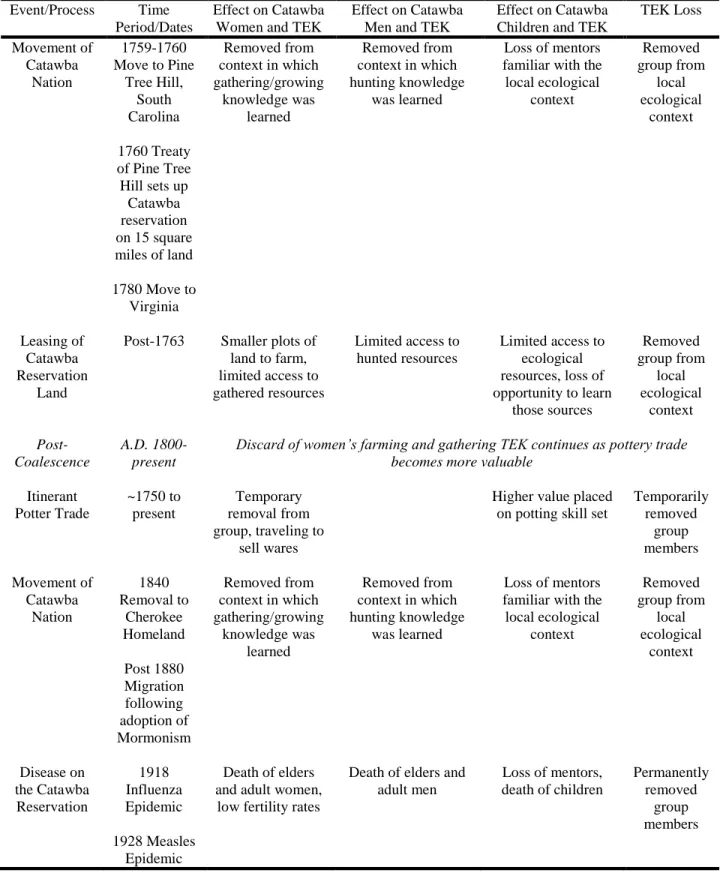
affected TEK loss and groups them into three broad time periods: the shatter zone (A.D. 1540-1715), coalescence (A.D. 1715-1800), and post-coalescence (A.D. 1800-present). Many of the processes listed under the different time periods continued outside of the given time range, but I have attempted to base my dates on when the process had the greatest impact. For example, the deerskin trade continued on some level throughout most of the colonial interactions, but took on an increased importance after the end of the Indian slave trade, and declined in importance at the end of the eighteenth century after deer populations had dropped significantly. In the following pages I will illustrate how TEK loss differed in these three broad time periods, and how the events and processes that took place in those time periods affected it.
The Shatter Zone (A.D. 1540-1715)
The Mississippian shatter zone is a conceptual framework used to understand the collapse of the Mississippian world and the incorporation of indigenous peoples into the European
capitalist economy. Ethridge (2009: 2) defined the term as:
A large region of instability in eastern North America that existed from the late sixteenth through the early eighteenth centuries and was created by the combined conditions of the structural instability of the Mississippian world and the inability of Native polities to withstand the full force of colonialism; the introduction of Old World pathogens and the subsequent serial disease episodes and loss of life; the inauguration of a nascent capitalist economic system by Europeans through a commercial trade in animal skins and especially in Indian slaves, whom other Indians procured and sold to European buyers; and the intensification and spread of violence and warfare through the Indian slave trade and particularly through the emergence of militaristic Native slaving societies who held control of the European trade.
Table 2.1 Loss of Traditional Ecological Knowledge Among the Catawba Over Time.
Event/Process Time Period/Dates
Effect on Catawba Women and TEK
Effect on Catawba Men and TEK
Effect on Catawba Children and TEK
TEK Loss
Shatter Zone A.D. 1540-1715
Significant initial loss of knowledge, TEK less likely to be transmitted and maintained as large portion of population died or was forced to move
Indian Slave Trade
~1600-1715 Death of elder mentors, adult
women killed/enslaved
Death of elder mentors, adult men
killed
Death of mentors, children killed and
enslaved
Permanently removed
group members Disease in the
Carolina Piedmont
~1650-1715 Death of elders and adult women,
low fertility rates
Death of elders and adult men
Loss of mentors, death of children
Permanently removed
group members Movement of
Tribes in the Carolina Piedmont
~1650-1715 Removed from context in which gathering/growing
knowledge was learned
Removed from context in which hunting knowledge
was learned
Loss of mentors familiar with the local ecological context Removed group from local ecological context
Coalescence A.D. 1715-1800
Men’s transmission of TEK disrupted through ethnic soldiering and deer skin trade, loss of local contexts of knowledge and opportunities to maintain
knowledge
Coalescence of Refugee
Tribes
~1700-1759 Removed from context in which gathering/growing
knowledge was learned
Removed from context in which hunting knowledge
was learned
Loss of mentors familiar with the local ecological context Removed group from local ecological context Catawba Ethnic Soldiering
~1715-1800 Adult males
frequently gone to fight
Loss of adult male mentors Temporarily removed group members Deer Skin Trade
~1715-1800 Adult males
frequently gone from group for long hunts
Loss of adult male mentors Temporarily removed group members Disease among the Catawba Nation Various unknown epidemics 1759 Smallpox Epidemic 1775 Smallpox Epidemic
Death of elders and adult women,
low fertility rates
Death of elders and adult men
Loss of mentors, death of children
Permanently removed
Table 2.1 Loss of Traditional Ecological Knowledge Among the Catawba Over Time (continued).
Event/Process Time Period/Dates
Effect on Catawba Women and TEK
Effect on Catawba Men and TEK
Effect on Catawba Children and TEK
TEK Loss Movement of
Catawba Nation
1759-1760 Move to Pine
Tree Hill, South Carolina 1760 Treaty of Pine Tree Hill sets up
Catawba reservation on 15 square miles of land 1780 Move to
Virginia
Removed from context in which gathering/growing
knowledge was learned
Removed from context in which hunting knowledge
was learned
Loss of mentors familiar with the local ecological context Removed group from local ecological context Leasing of Catawba Reservation Land
Post-1763 Smaller plots of land to farm, limited access to gathered resources
Limited access to hunted resources
Limited access to ecological resources, loss of opportunity to learn
those sources Removed group from local ecological context Post-Coalescence A.D. 1800-present
Discard of women’s farming and gathering TEK continues as pottery trade becomes more valuable
Itinerant Potter Trade ~1750 to present Temporary removal from group, traveling to
sell wares
Higher value placed on potting skill set
Temporarily removed group members Movement of Catawba Nation 1840 Removal to Cherokee Homeland Post 1880 Migration following adoption of Mormonism Removed from context in which gathering/growing
knowledge was learned
Removed from context in which hunting knowledge
was learned
Loss of mentors familiar with the local ecological context Removed group from local ecological context Disease on the Catawba Reservation 1918 Influenza Epidemic 1928 Measles Epidemic
Death of elders and adult women,
low fertility rates
Death of elders and adult men
Loss of mentors, death of children
Permanently removed
Beck (2009) outlined the ways in which the shattering of the Carolina Piedmont chiefdoms of Cofitachequi, Guatari, and Joara differed from those of the Mississippian world. While disease is often cited as the first destabilizing factor, the archaeological evidence does not suggest increased mortality in the Carolina Piedmont until the late seventeenth century and it has been argued that the social geography of the south was not conducive to widespread epidemics before the late seventeenth century (Davis et al. 2014). Beck argued that the first epidemics in the Carolina Piedmont were likely no earlier than 1675, with the first major smallpox epidemic reported in 1696. High mortality rates during this time period in the piedmont may also be attributed to the raids conducted by the Westo and Occaneechi, two of the early militaristic Native slaving societies. While Native American groups did take slaves before the arrival of Europeans, it was not a large-scale process. The slave trade intensified during the seventeenth century as demand for slaves (mostly women and children) and availability of firearms increased (Fitts and Heath 2009). Elders and young children were frequently killed in raids because they could not be sold, and adult males were killed as warriors in large numbers. Sometimes slaves were incorporated into the raiding tribe to replace members lost to disease and warfare, but often they were sold and sent further north or to English plantations in other countries. The Tuscarora War of 1712 and the Yamassee War of 1715 effectively ended the slave trade, but by that point the significant chaos and turmoil had forced many groups to move away from their native homelands and ally with stronger tribes.
important to different tribes. Without the Indian slave trade, the groups that would become the Catawba Nation engaged heavily in the deer skin trade and ethnic soldiering as their primary interaction with the capitalist economic system. It is difficult to track exactly how the shatter zone affected later Catawba TEK, because these groups were still spread throughout the piedmont. High mortality rates for adult males due to disease and the Indian slave trade would have permanently removed mentors who would have passed on hunting knowledge to male children. High mortality rates for adult females and children due to disease, and removal of adult females and children from their tribes as part of the slave trade would have also affected the intergenerational transfer of gathering and farming knowledge.
Additionally, the movement of tribes throughout the Carolina Piedmont would have removed people from the local ecological contexts in which they learned hunting, gathering, and farming TEK. Movement outside of local contexts is cited by ethnographic cases of TEK loss as an important factor in disrupting the transmission and maintenance of that knowledge (McCarter and Gavin 2014; Setalaphruk and Price 2007). While the refugee tribes stayed in the Carolina Piedmont and thus did not move to radically different ecological zones, intimate knowledge of where the first berries ripened, where the best nut groves were located, and where there were game trails and fishing holes would have been lost (Binford 1980; Gremillion 2004). The specific knowledge of local resource patches that people would have mapped onto their
homeland could not easily be transposed to a new area. The shatter zone period set the stage for Catawba coalescence, which brought about new factors affecting the maintenance of TEK. Coalescence (A.D. 1715-1800)
skin trade and ethnic soldiering became the new ways of participating in the capitalist economic system (Ethridge 2009). In the early eighteenth century, a series of treaties were written
guaranteeing specific prices for deerskins and regulating the behavior of colonial traders
(Mancall et al. 2005). This period also brought traders into the backcountry with European goods including guns and alcohol. Following a brief decline in the deerskin trade during the Yamassee War, exports of deerskins increased significantly throughout the 1700s. In 1748 alone,
approximately 140,000 pounds of deerskins were exported (Mancall et al. 2005: 310). This practice proved not to be sustainable over the long term though, and by the end of the eighteenth century it was no longer a major economic activity of the Catawba. Nevertheless, while the trade was going on it would have required adult men to leave their families for long periods of time as they traveled great distances to hunt deer and then sell the skins to traders. This would have removed adult male mentors from the group temporarily, potentially eroding intergenerational transmission of traditional ecological knowledge about hunting (although boys may have joined these hunting groups as they transitioned from childhood to adolescence). Plane (2004) also noted that participation in the deerskin trade promoted the incorporation of European commodities into Indian lifeways, transforming native technologies and related knowledge.
military prowess and courage, and how they used those strengths as political leverage when negotiating with European colonists for preferential trade agreements. Through their
participation in the Tuscarora (1711) and Yamassee (1715-1718) Wars, the Catawbas used their fighting skills “to promote the tribe’s political and economic autonomy” (Bauer 2011: 75). During the Yamassee War the Catawba initially allied themselves with the Yamassee coalition, but left to join forces with the British colonists after suffering massive losses of men, women, and children at Goose Creek in 1715 (Fitts and Heath 2009).
The Catawba continued this warrior tradition by participating in the Seven Years War (1756-1763), but when the warriors returned home in 1759 they brought smallpox with them. The following epidemic killed over half of the Catawba Nation (McReynolds 2009). The Catawba later allied themselves with the American revolutionaries during the Revolutionary War, guaranteeing their good standing in the newly independent United States of America. According to historian Thomas Blumer, all sixteen of the nation's able-bodied men served in the American Civil War, and only five of those men returned (Augusté 2009). While the practice of ethnic soldiering has no solid official ending, there were less than 50 warriors in the Catawba Nation by 1826, suggesting an effective end to this economic strategy (McReynolds 2009).
The frequent movement of families and recurring epidemics throughout the coalescent period would have hindered the maintenance and transmission of traditional ecological
both explicit and learned through practice, of those who hold TEK, gathering would be
unproductive at best and possibly fatal if poisonous plants are consumed. The coalescent period started with refugees from tribal groups throughout the Carolina Piedmont joining the relatively strong Catawbas and moving to their tribal homeland. This migration would have produced an initial disconnect from the land and possibly contestation over gathering and hunting grounds as local families had claim to such resources (McReynolds 2009). Following the 1759 smallpox epidemic, the Catawbas moved to Pine Tree Hill, South Carolina, for a year before returning to their Nation Fords homeland. They were forced to move again in 1780 by British troops, staying in Virginia for a year before returning home again. During the eighteenth century there were also multiple epidemics causing many people to die (Reynolds 2009). The 1759 epidemic caused the greatest loss of life, and its devastating effects are often cited as the event that solidified Catawba unification. Losing so many people, along with the frequent removals from local contexts onto which resource patches had been mapped, would have eroded passage of traditional ecological knowledge.
Calamity to them in former Times… near Neighborhood of the English, they say, drives away their Game; and deprives them of the means of subsisting on such Emergencies" (Lipscomb 1989). Mancall et al. (2005) noted that accounts from colonial officials suggest that reliable food sources were increasingly lost throughout the eighteenth century. In 1755 alone, the colony of South Carolina paid for 500 pounds of corn for the Catawba and reimbursed numerous colonists for providing Indians with beef (Mancall et al. 2005: 309). Efficiency and productivity of
agricultural and cultivated resources may have diminished through loss of traditional knowledge. There are better and worse conditions and techniques for growing and tending plants, and the nuances of that knowledge likely suffered in the colonial instability.
Peach trees are frequently described as very easy to grow, and were adopted into Native foodways very quickly after Contact due in part to ease of growing as well as similarity to already existing Native resources (Chandler 1928; Gremillion 1993; Talbert and Murneek 1939). Nevertheless, there are better and worse places and techniques for growing peaches. Frank Waugh (1913) wrote a book intended for industrial peach orchard growers, and included a
chapter for home growers. He provided instructions for choosing the best land to plant trees, how to properly fertilize them, prune them, and keep away pests. He concluded that “good peaches and plenty of them can be grown by anyone who is physically and morally capable of garden work of any sort, all that is required being reasonably good garden conditions, reasonably sound horticultural instincts and reasonably decent care” (1913: 184). Good garden conditions and good care may not have been options for people relegated to small tracts of land and frequent needs to travel. If adults were not able to tend crops consistently, it might not have been worth their time to try to grow them at all.
with it, yet ethnohistorical accounts clearly suggest that the colonial presence substantially influenced farming of corn. Growing and processing corn was a labor-intensive process that benefitted both from specialized knowledge and community organization. Scarry (2008: 394-395) outlined the general process of farming corn. In late winter or early spring, men would create new fields by girdling trees and burning stumps and underbrush, or prepare old fields by burning weeds. After the fields had been cleared, women were responsible for preparing the fields by using digging sticks and hoes to create hills at regularly spaced intervals. Women then planted several grains of corn in each hill, sometimes planting squash and beans with the corn as part of an intercropping system. When crops sprouted, women weeded the fields, thinned the plants, and hoed up soil around the plants to promote root development (Swanton 1946:306–308, 710–717; Wenhold 1936:13). When the corn ripened, women (and sometimes men) harvested it and prepared it for storage. Specific knowledge of when to start planting, how much plants needed to be thinned to thrive, and other steps throughout the corn growing process would have been at risk as elderly and adult females died from disease or warfare without passing on that knowledge. While the crop could still be grown, it might not yield as much or be able to make a large contribution to the overall diet.
episodes of disease (McReynolds 2009: 49). Fitts’ (2014) analysis of the spatial patterning of corn kernel remains at Ayers Town suggested a change in corn farming or processing practices. Changes in the production of corn may have accompanied loss of knowledge and of labor. VanDerwarker et al. (2013), in their overview of Cherokee foodways from A.D. 1300-1783, argued that a decline in corn production among the Cherokee during the historic period along with increased foraging and resource diversification was a strategy of risk mitigation that prioritized resources with more immediate rewards. Fruits, for instance, require less investment of labor to grow and process. Polyvalence, the combining of several types of productive
economic activities, is another strategy that they mention for preventing and responding to loss (VanDerwarker et al. 2013: 73). Since an initial review of the botanical remains from Catawba historic sites suggest a decrease rather than an increase in resource diversification, polyvalence may have been the Catawbas’ preferred strategy for coping with the uncertainty in the food systems caused by colonial upheavals (Fitts 2014).
Henrietta Liston’s (1797) recorded in a description of her visit to a Catawba town that people there grew corn only for travel, suggesting that the Catawba might have been relying more on imports of food purchased or traded. She described some of the foods being used in the village, including wild turkey and deer being cooked for breakfast in pots on hearths. Liston stated:
The only cultivation we saw was a small quantity of Indian corn in the vicinity of the Town, cultivated I am told, by the Women, & this is rather for traveling with (when an Indian sets out on a journey the flour of Indian Corn in a bag & pot to boil it in is all his provision) than to use as bread. [Liston 1797: 27]
L. Keys, described this mixture as remarkably refreshing, stating that upon consuming this concoction “"the requirements of Nature are satisfied - and the traveler goes on his way as much refreshed as when he began his journey in the early morning" (Keys 1966: 192).
Loss of knowledge and loss of land were both factors in worsening agricultural yields. Foster (2003) modeled field use for the eighteenth century Creek town of Cussetah. He argues that the townspeople practiced a form of swidden cultivation; rotating field plots every four years and allowing eight years before fallowed plots were replanted. He concluded that declining fertility would require new land for new fields after thirty years (Scarry and Scarry 2005). Mt. Pleasant and Burt (2010) re-assessed Foster’s model through field experiments and historical literature on traditional Iroquoian cropping systems. They concluded that Foster’s study had overestimated the impact on soils and frequency of need for new fields in traditional corn agriculture. Mt. Pleasant and Burt also addressed Baden and Beekman’s (2001) and Schroeder’s (1999) studies of corn productivity and concluded that those studies had underestimated corn productivity. The impact of corn agriculture on land fertility and the subsequent impact on harvest yields remains a complicated question and may have varied depending on the ecological zone. Nevertheless, loss of land available for farming would have likely had an impact on the ability of the Catawba to produce their own food.
resources as mature forests used for nuts and timber had less time and space to grow. With the 1760 Treaty of Pine Tree Hill, the Catawba Nation relinquished its claim to a large territory in exchange for a guaranteed title to the 15-square-mile tract that they considered their core
homeland (Davis and Riggs 2004). Furthermore, by the late eighteenth century the Catawbas had begun to lease their land to white planters for rent payments, further limiting their ability to rotate fields to contend with loss of soil nutrients. Rev. Thomas Coke, visiting in 1792, remarked that:
They possess a quantity of land, fifteen miles square on the river Catawba. A very small part of this land they cultivate themselves: a much larger part they let out in long leases to the white people. [Coke 1792: 11-12]
Colonial encroachment onto Catawba territory would have resulted in less land to choose from for optimal growing and collecting. Faced with the difficult task of producing food in a limited space, the Catawba may have opted not to teach TEK for farming and gathering when it would not have been a productive option.
Post Coalescence (A.D. 1800-present)
Ethnohistorical accounts suggest that the Catawba were only minimally engaged in agriculture after the 1700s, and Plane (2010: 47) noted, “Obtaining food from commercial activity rather than from primary production is typical for itinerant groups.” Based on preliminary reports of botanical remains recovered from Nassaw, Old Town, and New Town, Plane argued that the Catawba were no longer growing the majority of their food.
N.N. Augusté (2009) described the crisis and transition experienced by the Catawba during the United States Civil War. Augusté contended that the Catawba nation lost almost all of its able-bodied men during the war, leaving women to support their families through their
pottery. Although the Catawba pottery trade had started at least 60 years before the Civil War, it took on a new importance in the nation after the war. Augusté stated that in this time, women made the active choice not to focus on producing their own food on their limited reservation land, rather: “Catawba Indian women knew that at that time the only profitable resource that could be extracted from the infertile land was its clay: plentiful and marketable for the exchange of food, clothing, and other goods” (2009: 149). Hudson (1970: 75-76) quoted one Catawba child as saying about the pottery trade “That’s the way we got our clothes and part of our groceries. There was never any farming to amount to anything.” If, as in the case of the village children in northeast Thailand, the Catawba children valued traditional ecological knowledge based on desirability of foods and market value, it is understandable that those children may not have learned as much about plants in favor of learning more marketable trades. Augusté wrote in depth about genealogies of Catawba potters who passed on their craft to their children by
could provide for their families. In addition to producing the pots, women were traveling to sell them. Augusté (2009) recounted stories of Catawba women living in the nineteenth century who walked as much as seventy miles away from home to sell pottery, often in exchange for corn meal or flour, which would have further affected the opportunities for children to learn TEK from adult mentors.
It is beyond the scope of this paper to recount the full history of the Catawba Nation since 1800, so I will only add that disease and migration continued to be factors effecting the Catawba population and the transmission and maintenance of TEK. While no major epidemics were recorded among the Catawba throughout the nineteenth century, the nation lost many people during the 1918 influenza epidemic and the 1928 measles epidemic (McReynolds 2009).
Population had grown slowly since the lowest point in the mid-nineteenth century, and began to grow rapidly after the 1950s. There were also two major migrations post-1800 (McReynolds 2009). In 1840, almost the entire nation left their reservation to move in with the Eastern Cherokees in North Carolina. By 1848, most of the nation had returned to their South Carolina reservation or had moved to join the Choctaws in Arkansas. During the 1880s many Catawbas converted to Mormonism and left the reservation to move to Utah, Colorado, New Mexico, and other areas of South Carolina more tolerant of Mormons. Currently, many members of the Catawba Nation live on their reservation in Rock Hill, South Carolina.
Speck thought that this language change did not imply that the Catawba were also using English notions of plant use, rather that they were just using more familiar words. Speck’s study of Catawba plant use relied heavily on his female informants, particularly Margaret Brown and Sally Gordon. He generated an extensive list of botanicals with curative properties used by the Catawba, along with the Catawba word for the plant. Persimmon bark, peach, and even corn are recorded as plants that can be used for healing practices.
CHAPTER 3: BACKGROUND TO THE CATAWBA PROJECT
The sites excavated as part of the Catawba Project span an important period of time in the development of the modern Catawba Nation, as the diverse polyethnic community completed coalescence and began to consider themselves unified under the Catawba identity (see Figure 1.1 for map of sites). This history is one punctuated with diseases, war, migrations, and loss of land resulting in rapid and extreme changes in cultural and sociopolitical landscapes (see Davis and Riggs 2004 for a more extended discussion of these events). The Kadapau (also known as the Esaus or Nassaus), along with the Sugaree and Wateree tribes, were the primary native power of the piedmont interior and absorbed numerous refugee groups as European-introduced diseases, Iroquois raiding, and Indian colonial wars wreaked havoc upon these populations. The ethnically diverse Catawba Nation that emerged from this amalgamation used its’ military prowess to leverage political power in the colonies (Davis and Riggs 2004; Riggs et al. 2006). The Seven Years War (or French and Indian War) mobilized Catawba warriors as part of their alliance with English forces, but ended with warriors returning from Quebec bringing smallpox into the
After assisting the English in a war against the Cherokee from 1760 to 1761, the Catawba moved back upriver to the Waxhaw Old Fields (Davis and Riggs 2004). The Late Colonial Period ended in 1776 with the start of the Revolutionary War. During the Revolutionary period (1776-1781) the Catawbas allied with the Americans and provided warriors and sanctuary for American forces. English troops under the command of General Cornwallis forced the Catawbas to retreat to Virginia, during which time Old Town was abandoned and possibly burned by the English forces. In the post-Revolutionary Federal period (1781-1820), during which New Town was established, the remaining members of the Catawba Nation returned to the Waxhaw Old Fields and survived through subsistence farming, hunting, and money made through pottery trade and land rents. While the steady decline in the Catawba population once led people to believe that the group would disappear entirely, they underwent resurgence in the nineteenth century and are now a federally recognized tribe in South Carolina with over 2,000 members.
and was occupied until the death of Sally New River in 1820. I analyzed plant remains from these two sites and compared my results with the data from three other Catawba sites (Nassaw-Weyapee, Charraw Town, and Ayers Town) to examine how plant use changed during this critical time period.
The Old Town Site (SoC634)
The Old Town site is located along the east side of the Catawba River in Lancaster County, South Carolina, near present day Rock Hill. Old Town is a dispersed village of at least five cabin loci named for the adjacent stream “Old Town Branch.” It is located along terrace remnants that flank the Catawba River valley known as Waxhaw Old Fields (Davis and Riggs 2004). Old Town was one of two villages formed near Twelve Mile Creek in 1762 following the Catawbas’ return from Pine Tree Hill, at which time the Catawbas numbered approximately 300 people following a significant demographic decline.
Five loci were identified by metal detection survey, of which two have been excavated (Figure 3.1). During the 2003 field season, UNC Chapel Hill archaeological field school students under the supervision of Dr. R.P. Steve Davis and Dr. Brett Riggs uncovered a number of
features in Locus 1 (Figure 3.2). During the 2009 field season, students excavated Locus 2 features (Figure 3.3). For the 2014 field season, further excavations were done at Locus 2 but the results of that field season are not included in this report. A third identified locus has yet to be excavated. Features from these excavations could be assigned to two consecutive occupations, Old Town 1 and Old Town 2, but these designations do not correspond with the locus
designations. The temporal hiatus matches the 1780 destruction of Catawba settlements by Lord Cornwallis’s army during the Revolutionary War (Riggs 2010). Figures 3 and 4 show the two excavated loci and the temporal affiliation of the various features where they could be
determined.
Figure 3.3 Old Town Locus 2 Excavation Map (courtesy of David Cranford).
The New Town Site (SoC632 and SoC635)
The New Town site is located on an upland ridge overlooking the Catawba valley in northern Lancaster County (Davis et al. 2014). Metal detector survey conducted by UNC archaeologists between 2003 and 2005 identified seven cabin loci, with an eighth household identified during a 2012 visit to the site (Figure 3.4). These households were initially considered to be three separate neighborhoods, a northern neighborhood, a central neighborhood, and a southern one, and were given two separate site numbers (McReynolds Shebalin 2011).
comparatively little soil was waterscreened or floated over the course of excavations. Cabin Locus 4 was one of the most extensively excavated areas of the site, and has been posited as the residence of Sally New River. The artifact assemblage from the site yielded many pieces of western equipment, but contained significantly less firearms and ammunition, likely reflecting the declining importance of hunting and warfare in the Catawba economy. Potters’ tools and Catawba-made earthenwares attest to the importance of the ceramics industry at the site.
Following the death of Sally New River, the matriarch of New Town, in 1820, the families who had lived there moved across the river to the location of the present-day Catawba reservation.
Figure 3.4 Map of New Town showing eight cabin loci located through metal detection survey, and areas excavated. Loci 1, 2, 3, 6, and 7 are designated SoC632,
Other Catawba Project Sites: Nassaw-Weyapee, Charraw Town, and Ayers Town
The history of excavations at Nassaw-Weyapee, Charraw Town, and Ayers Town and the interpretation of materials from those sites are thoroughly summarized in Davis et al. 2014 and Fitts 2015. Dr. Mary Beth Fitts (2015) did the analysis of botanical remains for the three sites, Dr. Thomas Whyte analyzed faunal remains from Nassaw-Weyapee and Ayers Town, and Ashley Peles analyzed faunal remains from Charraw Town. Nassaw-Weyapee and Charraw Town represent Coalescent Period settlements, and Ayers Town was a post-coalescent site, so these sites are important for showing diachronic change of foodways in the Catawba nation.
Nassaw and Weyapee (38YK434) were paired towns occupied from 1750 A.D. until the 1759 smallpox epidemic (Davis et al. 2014). The site of Nassaw-Weyapee was discovered in 2005 along an upland ridge near Fort Mill, South Carolina, surveyed in 2007, and excavated in 2007 and 2008 by the UNC field school. Metal detector survey indicated the presence of two clusters separated by a small drainage. The larger northern cluster has been interpreted as the remains of Nassaw, and the smaller southern cluster as Weyapee. Excavations at Nassaw and Weyapee uncovered six households at Nassaw and one at Weyapee. Abundant commercially manufactured goods were recovered at Nassaw, reflecting their strategic alliance with Carolina.
midden areas were excavating, yielding significant amounts of artifacts. Numerous class beads and other European-manufactured artifacts, along with Charraw’s location along a trail that branched off of the Great Trading Path, attest to its’ strong participation in trade activities.
CHAPTER 4: PALEOETHNOBOTANICAL ANALYSIS
My examination of changes in food use and loss of TEK is based primarily upon analysis of 53 samples from two sites dating between A.D. 1760-1820. All analyzed samples were
excavated between 2003 and 2009, and floated by Dr. Mary Beth Fitts at the RLA. Flotation was conducted using a SMAP-type machine that collected heavy fractions in 0.01-in2 (0.25-mm2) mesh and light fractions in approximately 125µ chiffon fabric (Watson 1976). The volume of each sample was measured in a calibrated bucket prior to flotation. Standardization by volume is necessary for quantitative comparison between samples to demonstrate that any differences are not due simply to variation in amount of soil processed. Poppy seed recovery rates for the RLA version of this system have not been established (Wagner 1982), but the identification of tobacco seeds from other samples floated with this system may be a positive measure of its effectiveness (Fitts 2014). Light and heavy fraction material were combined as part of routine processing of flotation samples prior to my involvement with the project.
Table 4.1. Feature List.
Site Feature Locus Feature Type
Samples Analyzed Total Liters Total Weight (g)
Old Town 1 1 circular, basin-shaped pit 2 20 3.96
SoC 634 2 1 sub-rectangular cellar pit 2 20 6.73
3 1 burial --- --- ---
4 1 circular storage pit 3 30 6.89
5 1 sub-rectangular storage pit 1 10 3.69 6 1 sub-rectangular storage pit 2 20 9.23 7 1 sub-rectangular cellar pit 4 40 43.00
8 1 burial --- --- ---
9 1 burial --- --- ---
10 2 circular, basin-shaped pit 1 14 19.34 11 2 sub-rectangular storage pit 1 13 124.60 12 2 sub-rectangular storage pit 2 18 53.07
12a 2 Archaic pit -- -- --
13 2 circular, basin-shaped pit -- -- -- 14 2 sub-rectangular cellar pit 10 62 213.48 15 2 sub-rectangular storage pit 1 10 58.56
16 2 pit 2 17 34.20
17 2 circular, basin-shaped pit -- -- -- 18 2 sub-rectangular cellar pit 6 40 228.00
19 1 circular pit 1 1 0.96
20 1 burial --- --- ---
21 2 cob pit 1 3 17.97
22 2
refuse-filled tree
disturbance 1 --- 17.60
New Town 1 2 pit 1 10 18.49
SoC 632 2 2 chimney base -- -- --
3 2 shallow pit -- -- --
4 3 pit 1 10 1.72
5 3 pit -- -- --
6 3 pit 2 20 23.04
7 3 pit 4 40 30.56
8 3 chimney base -- -- --
9 3 pit 1 10 9.02
10 3 pit 1 10 7.87
New Town 8 5 pit 2 20 81.88
SoC 635 9 5 pit 1 10 50.13
features from Old Town and New Town from which I did not analyze any samples. I prioritized samples from storage and cellar pits, particularly those pits that the excavators described as being large and rich in artifacts. Each sample was size-graded into four fractions: greater than 2 mm, greater than 1.40 mm, greater than 0.71 mm, and pan (any material less than 0.71 mm). I
examined each size grade under a low power stereoscopic microscope. I sorted the greater than 2 mm fraction completely into material categories and counted and weighed each category (except for wood, which I only weighed). I identified all botanical items to lowest possible taxonomic category, usually genus, except for wood. I scanned the less than 2 mm fraction under higher magnification; I removed any seeds, corn, nutshell or other unusual botanical material and identified them to the lowest taxonomic level possible. Since there is variation among
paleoethnobotanists with regard to the recording of nutshell, corn kernel fragments, and other materials less than 2 mm in size, I recorded these items separately to allow for comparison with other studies. I made identifications with the aid of the laboratory’s comparative collection, identification manuals, and through consultation with Dr. C. Margaret Scarry (i.e., Martin and Barkley 1961).
Methods
each half of each zone. All smudge pits were floated in their entirety. For some contexts,
charcoal was removed directly from the soil or the materials from fine-screen sieving were later floated. The charcoal from these collection processes is not statistically comparable to that from the flotation samples. However, for Feature 22 only materials floated from fine-screen sieving were taken, so I analyzed and included this sample in tables since it represents the only botanical materials from that context. Materials recovered from smudge pits are excluded from general statistics because they would skew results and do not represent general food use.
I analyzed 39 flotation samples and one sample floated from fine-screen sieving from 16 features that spanned the Old Town 1 and Old Town 2 occupations (features listed by temporal affiliation in table 4.2). This represents 46 % of the total number of flotation samples collected and 84 % of the features for the 2003 and 2009 field seasons (excluding burials). Analyzed samples were floated from 317.5 liters of soil and had a combined total weight of 841.28 grams. The majority of samples came from multi-zoned pits, likely used for storage, refuse disposal, or as smudge pits. Due to limited time I was not able to analyze any samples from Features 13 and 17 (identified as clay processing pits), and there were several features for which I was not able to analyze every zone. The resultant assemblage contains large amounts of wood, with lesser but significant amounts of nutshell, corn (maize), seeds from a variety of starchy, oily, and fleshy-fruited plants, and various other floral remains (I will refer to maize as corn throughout the rest of this paper to keep my terminology consistent with that used in ethnohistorical sources).
Beth Fitts previously analyzed three samples from Locus 5 in the southern hamlet (SoC635). Samples came from eight features, representing 36 % of all site features. Analyzed samples were floated from 130 liters of soil and had a combined total weight of 222.71 grams. The majority of samples came from multi-zoned pits, though many of the pits were shallow. The resultant assemblage contains wood and small amounts of nutshell, corn, seeds, and other floral remains.
Table 4.2. Old Town Features by Temporal Affiliation.
Feature # Locus
# Samples
Analyzed Total Liters Total Weight (g)
Old Town 1
2 1 2 20 6.73
5 1 1 10 3.69
12 2 2 18 53.07
13 2 0
15 2 1 10 58.56
17 2 0
18 2 6 40 228.00
Old Town 2
4 1 3 30 6.89
6 1 2 20 9.23
7 1 4 40 43.00
10 2 1 14 19.34
11 2 1 13 124.60
14 2 10 62 213.48
16 2 2 17 34.20
Unaffiliated
1 1 2 20 3.96
19 1 1 1 0.96
21 2 1 3 17.97
22 2 1 --- 17.60
Burials
3 1 --- --- ---
8 1 --- --- ---
9 1 --- --- ---
20 1 --- --- ---
Archaic
12a 2 0
Results
I have summarized the taxonomic name and common name for all plants recovered at Old Town and New Town in table 4.3 so that I can discuss my results using the common name of plants. Table 4.4 summarizes the botanical material recovered from all features that could
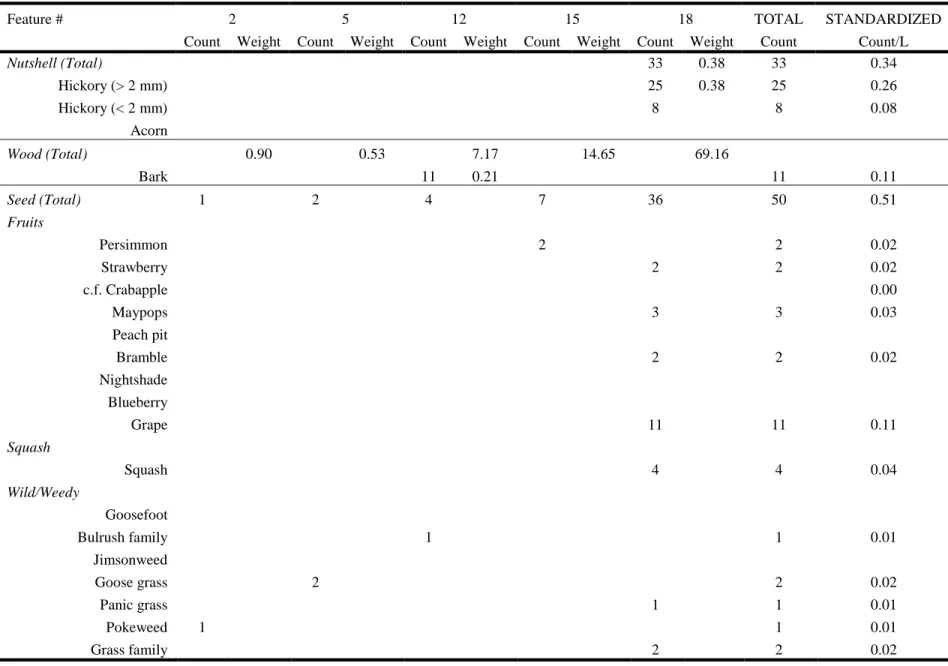
confidently be attributed to the Old Town 1 occupation, and table 4.5 summarizes the same information for all Old Town 2 features. Old Town 1 had five features that produced 12 samples, with a mean charcoal density of 3.57 grams per liter and a mean wood charcoal density of 0.94 grams per liter. Old Town 2 had seven features from which I analyzed 23 samples, with a mean charcoal density of 2.31 grams per liter and a mean wood charcoal density of 0.53 grams per liter. This suggests that samples from the two temporal zones were roughly comparable in terms of the amount of charcoal recovered and that neither mean was skewed by the presence of recovered wood (as may have been a concern, given the suggested burning of Old Town 1). There were two features with a combined five zones from Old Town 1 from which I did not analyze any materials, and there are five additional zones from Old Town 2 features that I did not analyze. Thus the difference in number of samples analyzed for the two contexts reflects the difference in number of samples recovered from the two time periods. Old Town 1 had 796 counted remains with an average of 8.12 per liter and Old Town 2 had a total of 1946 counted remains with an average of 9.95 per liter, again suggesting roughly comparable samples.
and diet at the site. The remaining two features (Features 1 and 19) contained almost no
botanical materials to add to the dataset. Generally this group will be left out of discussion due to the sampling and dating issues.
Table 4.3. Complete List of Taxonomic Names for Identified Plants.
Common Name Taxonomic Name
Cultigens
c.f. Bean Phaseolus vulgaris
Corn Zea mays
Squash Cucurbita sp.
Sunflower Helianthus annuus
Nuts
Acorn Quercus sp.
Hickory Carya sp.
Walnut Juglans sp.
Fruits
Blueberry Vaccinium sp.
Bramble Rubus sp.
c.f. Crabapple Malus sp.
Grape Vitis sp.
Maypop Passiflora incarnata
Nightshade Solanum sp.
Peach Prunus persica
Persimmon Diospyros virginiana
Strawberry Fragaria sp.
Sumac Rhus. sp.
Wild/Weedy
Bulrush family Cyperaceae
Compositae family Compositae
Copperleaf Acalypha gracilens
Goosefoot Chenopodium sp.
Goose grass Eleusine indica
Grass family Poaceae
Jimsonweed Datura stramonium
Panic grass Panicum sp.
Pine cone Pinus sp.
Pokeweed Phytolaca americana
Purslane family Portulacaceae (c.f. Calandrinia sp.)
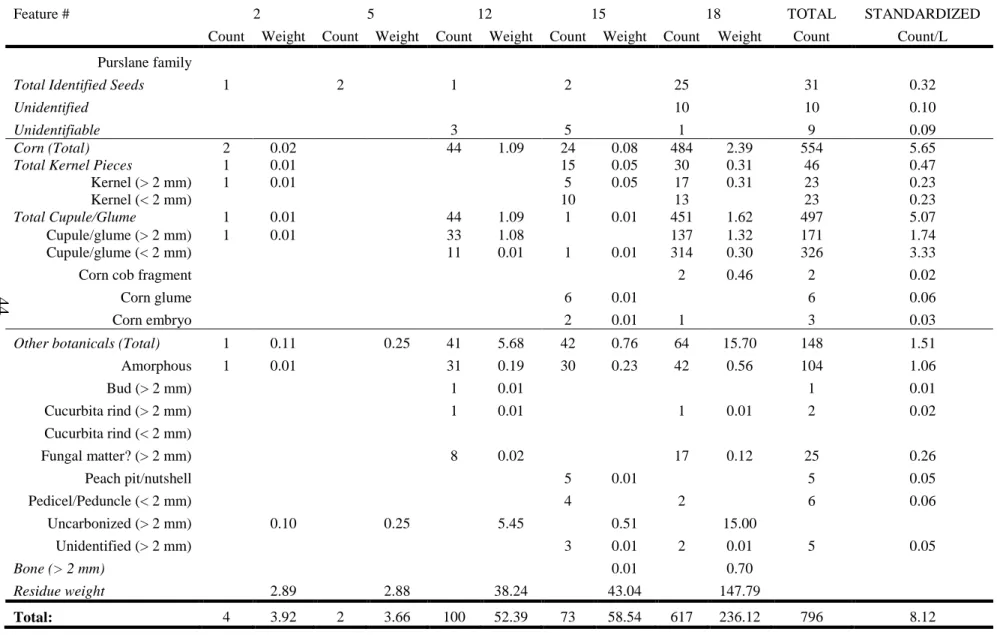
Materials from Old Town 1 represent a narrow range of plant resources. Both Old Town 1 and Old Town 2 had high ubiquities of corn, with a slightly higher count per liter from Old Town 1. Both contexts had low ratios of kernels to cupules (OT1 = 0.10; OT2 = 0.20) indicating that corn was likely grown and processed on site. Generally people do not expend effort to transport cobs over distances. A high kernel-to-cupule ratio indicates that kernels were present in higher proportions than cupules at the site, suggesting that people grew and/or processed the corn elsewhere, and brought only edible kernels to the site. The enormous amounts of cupules
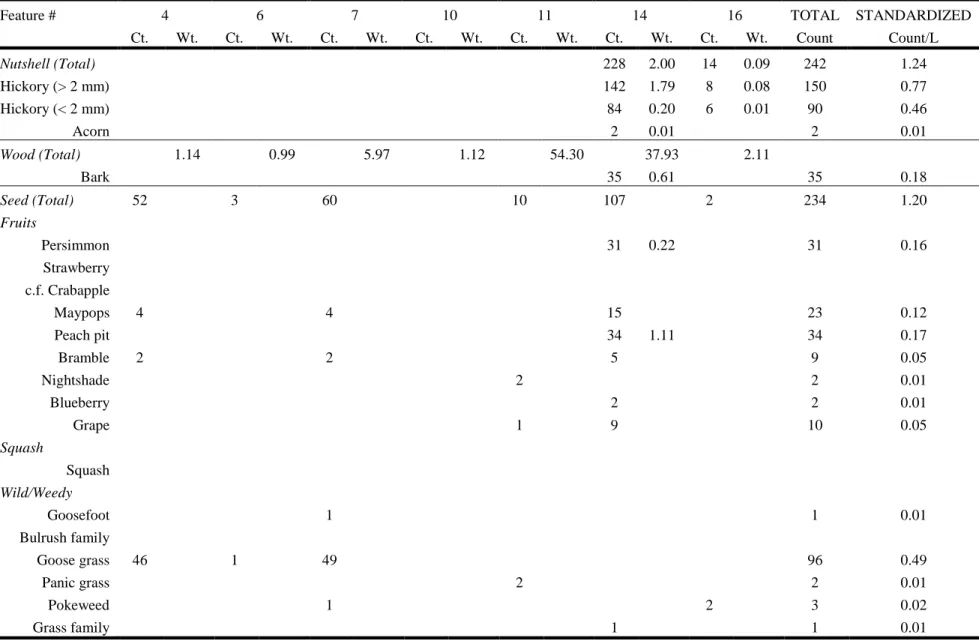
recovered from the unaffiliated cob pit and refuse-filled tree disturbance further support this idea. I found little nutshell in the samples. Old Town 1 only had hickory shell; total nutshell ubiquity was 20 percent, with a count per liter ratio of 0.34. In contrast, Old Town 2 had both hickory and acorn shell, with a ubiquity of 29 percent and count per liter ratio of 1.24.
43
Table 4.4. Old Town 1 Botanical Remains.
Feature # 2 5 12 15 18 TOTAL STANDARDIZED
Count Weight Count Weight Count Weight Count Weight Count Weight Count Count/L
Nutshell (Total) 33 0.38 33 0.34
Hickory (> 2 mm) 25 0.38 25 0.26
Hickory (< 2 mm) 8 8 0.08
Acorn
Wood (Total) 0.90 0.53 7.17 14.65 69.16
Bark 11 0.21 11 0.11
Seed (Total) 1 2 4 7 36 50 0.51
Fruits
Persimmon 2 2 0.02
Strawberry 2 2 0.02
c.f. Crabapple 0.00
Maypops 3 3 0.03
Peach pit
Bramble 2 2 0.02
Nightshade Blueberry
Grape 11 11 0.11
Squash
Squash 4 4 0.04
Wild/Weedy
Goosefoot
Bulrush family 1 1 0.01
Jimsonweed
Goose grass 2 2 0.02
Panic grass 1 1 0.01
44
Table 4.4. Old Town 1 Botanical Remains (continued).
Feature # 2 5 12 15 18 TOTAL STANDARDIZED
Count Weight Count Weight Count Weight Count Weight Count Weight Count Count/L Purslane family
Total Identified Seeds 1 2 1 2 25 31 0.32
Unidentified 10 10 0.10
Unidentifiable 3 5 1 9 0.09
Corn (Total) 2 0.02 44 1.09 24 0.08 484 2.39 554 5.65
Total Kernel Pieces 1 0.01 15 0.05 30 0.31 46 0.47
Kernel (> 2 mm) 1 0.01 5 0.05 17 0.31 23 0.23
Kernel (< 2 mm) 10 13 23 0.23
Total Cupule/Glume 1 0.01 44 1.09 1 0.01 451 1.62 497 5.07
Cupule/glume (> 2 mm) 1 0.01 33 1.08 137 1.32 171 1.74
Cupule/glume (< 2 mm) 11 0.01 1 0.01 314 0.30 326 3.33
Corn cob fragment 2 0.46 2 0.02
Corn glume 6 0.01 6 0.06
Corn embryo 2 0.01 1 3 0.03
Other botanicals (Total) 1 0.11 0.25 41 5.68 42 0.76 64 15.70 148 1.51
Amorphous 1 0.01 31 0.19 30 0.23 42 0.56 104 1.06
Bud (> 2 mm) 1 0.01 1 0.01
Cucurbita rind (> 2 mm) 1 0.01 1 0.01 2 0.02
Cucurbita rind (< 2 mm)
Fungal matter? (> 2 mm) 8 0.02 17 0.12 25 0.26
Peach pit/nutshell 5 0.01 5 0.05
Pedicel/Peduncle (< 2 mm) 4 2 6 0.06
Uncarbonized (> 2 mm) 0.10 0.25 5.45 0.51 15.00
Unidentified (> 2 mm) 3 0.01 2 0.01 5 0.05
Bone (> 2 mm) 0.01 0.70
Residue weight 2.89 2.88 38.24 43.04 147.79
45
Table 4.5. Old Town 2 Botanical Remains.
Feature # 4 6 7 10 11 14 16 TOTAL STANDARDIZED
Ct. Wt. Ct. Wt. Ct. Wt. Ct. Wt. Ct. Wt. Ct. Wt. Ct. Wt. Count Count/L
Nutshell (Total) 228 2.00 14 0.09 242 1.24
Hickory (> 2 mm) 142 1.79 8 0.08 150 0.77
Hickory (< 2 mm) 84 0.20 6 0.01 90 0.46
Acorn 2 0.01 2 0.01
Wood (Total) 1.14 0.99 5.97 1.12 54.30 37.93 2.11
Bark 35 0.61 35 0.18
Seed (Total) 52 3 60 10 107 2 234 1.20
Fruits
Persimmon 31 0.22 31 0.16
Strawberry c.f. Crabapple
Maypops 4 4 15 23 0.12
Peach pit 34 1.11 34 0.17
Bramble 2 2 5 9 0.05
Nightshade 2 2 0.01
Blueberry 2 2 0.01
Grape 1 9 10 0.05
Squash
Squash
Wild/Weedy
Goosefoot 1 1 0.01
Bulrush family
Goose grass 46 1 49 96 0.49
Panic grass 2 2 0.01
Pokeweed 1 2 3 0.02
46
Table 4.5. Old Town 2 Botanical Remains.
Feature # 4 6 7 10 11 14 16 TOTAL STANDARDIZED
Ct. Wt. Ct. Wt. Ct. Wt. Ct. Wt. Ct. Wt. Ct. Wt. Ct. Wt. Count Count/L
Purslane family 2 2 0.01
Total Identified Seeds 52 1 57 5 99 2 216 1.10
Unidentified 5 2 7 0.04
Unidentifiable 2 3 6 11 0.06
Corn (Total) 12 0.02 7 0.06 28 0.12 1 0.01 19 0.07 721 4.98 38 0.08 826 4.23
Total Kernel Pieces 5 0.06 6 0.07 1 0.01 123 0.28 135 0.69
Kernel (> 2 mm) 4 0.06 5 0.07 1 0.01 44 0.26 54 0.28
Kernel (< 2 mm) 1 1 79 0.02 81 0.41
Total Cupule/Glume 12 0.02 2 22 0.05 1 0.01 18 0.06 577 3.42 38 0.08 670 3.43 Cupule/glume (> 2 mm) 7 0.02 11 0.04 1 0.01 6 0.06 252 3.00 7 0.04 284 1.45
Cupule/glume (< 2 mm) 5 2 11 0.01 12 325 0.42 31 0.04 386 1.97
Corn cob fragment 21 1.28 21 0.11
Corn glume Corn embryo
Other botanicals (Total) 0.33 0.39 4 1.35 13 0.96 134 6.27 454 11.95 4 1.04 609 3.12
Amorphous 4 0.05 13 0.28 124 1.07 356 2.88 3 0.03 500 2.56
Bud (> 2 mm)
Cucurbita rind (> 2 mm) 3 1.02 1 0.01 4 0.02
Cucurbita rind (< 2 mm) 1 1 0.01
Fungal matter? (> 2 mm) 10 0.02 14 0.06 24 0.12
Peach pit/nutshell 10 0.66 10 0.05
Pedicel/Peduncle (< 2 mm) 1 0.03 1 0.01
Uncarbonized (> 2 mm) 0.33 0.39 1.30 0.68 5.18 6.66 1.00
Unidentified (> 2 mm) 69 0.64 69 0.35
Bone (> 2 mm) 0.09 0.09 0.39 1.02 0.03
Residue weight 5.19 7.63 22.57 17.05 63.13 153.64 30.56
47
Table 4.6. Old Town Unaffiliated Botanical Remains.
Feature # 1 19 21 22 TOTAL STANDARDIZED
Count Weight Count Weight Count Weight Count Weight Count Count/L
Nutshell (Total)
Hickory (> 2 mm) Hickory (< 2 mm) Acorn
Wood (Total) 0.90 0.01 0.47 8.22
Bark
Seed (Total) 1 85 0.57 86 3.58
Fruits
Persimmon Strawberry
c.f. Crabapple 2 2 0.08
Maypops 16 16 0.67
Peach pit 64 0.57 64 2.67
Bramble Nightshade Blueberry Grape
Squash
Squash
Wild/Weedy
Goosefoot Bulrush family
Jimsonweed 3 3 0.13
Goose grass
Panic grass
48
Table 4.6. Old Town Unaffiliated Botanical Remains (continued).
Feature # 1 19 21 22 TOTAL STANDARDIZED
Count Weight Count Weight Count Weight Count Weight Count Count/L Purslane family
Total Identified Seeds 1 85 0.57 86 3.58
Unidentified Unidentifiable
Corn (Total) 2 0.02 2166 13.44 785 2.81 2953 123.04
Total Kernel Pieces 1 0.01 1 0.04
Kernel (> 2 mm) 1 0.01 1 0.04
Kernel (< 2 mm)
Total Cupule/Glume 1 0.01 2055 7.26 782 2.67 2838 118.25
Cupule/glume (> 2 mm) 1 0.01 680 5.75 224 1.75 905 37.71
Cupule/glume (< 2 mm) 1375 1.51 558 0.92 1933 80.54
Corn cob fragment 111 6.18 3 0.14 114 4.75
Corn glume Corn embryo
Other botanicals (Total) 1 0.11 1 0.12 0.49 48 0.38 50 2.08
Amorphous 1 0.01 1 0.01 21 0.13 23 0.96
Bud (> 2 mm) Cucurbita rind (> 2 mm) Cucurbita rind (< 2 mm) Fungal matter? (> 2 mm)
Peach pit/nutshell 27 0.03 27 1.13
Pedicel/Peduncle (< 2 mm)
Uncarbonized (> 2 mm) 0.10 0.11 0.49 0.22
Unidentified (> 2 mm)
Bone (> 2 mm) 0.11
Residue weight 2.89 0.84 3.52 5.15
Peach was the only European-introduced plant species recovered at the site. This is not to say that there were not other European foods present, but those foods were likely brought into the camp already processed. Peaches were one of the earliest crops adopted by southeastern Native Americans, and they were apparently easily incorporated into existing systems of plant cultivation. Gremillion (1993) suggested that peaches could be grown without pre-existing knowledge of peach husbandry because they were introduced to a number of tribes independent of European interactions. Despite the many purported benefits of peaches, there were no clearly identifiable remains found in the Old Town 1 occupation, and all of the peach from the Old Town 2 occupation came from two zones of the same feature. This may suggests that the plant was not heavily utilized at the site, and the recovered peach pits may even have been from fruit brought to the site from other sources further away. Alternatively, peach pit preservation and recovery could have simply been poor.