Impact of genomic testing and patient-reported outcomes on
receipt of adjuvant chemotherapy
Chalanda N. Evans1, Noel T. Brewer2, Susan T. Vadaparampil3, Marc Boisvert4, Yvonne Ottaviano5, M. Catherine Lee3, Claudine Isaacs1, Marc D. Schwartz1, and Suzanne C. O’Neill1
Suzanne C. O’Neill: [email protected]
1Department of Oncology, Fisher Center for Familial Cancer Research, Lombardi Comprehensive
Cancer Center, Georgetown University, 3300 Whitehaven Street, NW, Suite 4100, Washington, DC 20007, USA
2Gillings School of Global Public Health, Lineberger Comprehensive Cancer Center, University of
North Carolina, Chapel Hill, NC, USA
3Moffitt Cancer Center, Tampa, FL, USA
4MedStar Washington Hospital Center, Washington, DC, USA 5Franklin Square Medical Center, Baltimore, MD, USA
Abstract
Practice guidelines incorporate genomic tumor profiling, using results such as the Oncotype DX Recurrence Score (RS), to refine recurrence risk estimates for the large proportion of breast cancer patients with early-stage, estrogen receptor-positive disease. We sought to understand the impact of receiving genomic recurrence risk estimates on breast cancer patients’ well-being and the impact of these patient-reported outcomes on receipt of adjuvant chemotherapy. Participants were 193 women (mean age 57) newly diagnosed with early-stage breast cancer. Women were
interviewed before and 2–3 weeks after receiving the RS result between 2011 and 2015. We assessed subsequent receipt of chemotherapy from chart review. After receiving their RS, perceived pros (t = 4.27, P < .001) and cons (t = 8.54, P <.001) of chemotherapy increased from pre-test to post-test, while perceived risk of breast cancer recurrence decreased (t = 2.90, P = . 004). Women with high RS tumors were more likely to receive chemotherapy than women with low RS tumors (88 vs. 5 %, OR 0.01, 0.00–0.02, P < .001). Higher distress (OR 2.19, 95 % CI 1.05–4.57, P < .05) and lower perceived cons of chemotherapy (OR 0.50, 95 % CI 0.26–0.97, P < . 05) also predicted receipt of chemotherapy. Distressed patients who saw few downsides of chemotherapy received this treatment. Clinicians should consider these factors when discussing chemotherapy with breast cancer patients.
Correspondence to: Suzanne C. O’Neill, [email protected]. Conflict of interest The authors declare that they have no conflict of interest.
HHS Public Access
Author manuscript
Breast Cancer Res Treat
. Author manuscript; available in PMC 2017 April 08.Published in final edited form as:
Breast Cancer Res Treat. 2016 April ; 156(3): 549–555. doi:10.1007/s10549-016-3780-5.
A
uthor Man
uscr
ipt
A
uthor Man
uscr
ipt
A
uthor Man
uscr
ipt
A
uthor Man
uscr
Keywords
Breast cancer; 21-Gene; Chemotherapy; Treatment decisions
Introduction
Several clinical practice guidelines incorporate genomic profiling of early-stage, estrogen receptor-positive (ER+) breast tumors with specific pathologic features (i.e., node-negative) to refine recurrence estimates and guide decisions about adjuvant chemotherapy [1–4]. Multiple recent studies demonstrate continued adoption of genomic testing in breast cancer treatment decision making [5–7]. As research continues on the clinical utility of genomic tests, significant challenges arise in effectively communicating this risk information to patients and integrating this information with patient preferences to inform treatment decisions.
The Oncotype DX Breast Cancer Assay, a widely used genomic test, is a 21-gene assay that measures breast cancer recurrence risk and chemotherapy benefit in early-stage, estrogen receptor-positive patients. The results are expressed as a Recurrence Score (RS) that is categorized as low, intermediate, or high. These results, when combined with standard pathological tumor features, provide information that oncologists and patients can use in making chemotherapy treatment decisions. For example, patients with high RS tumors have been shown to derive benefit from adding chemotherapy to prescribed hormonal therapy in order to decrease their risk of recurrence, whereas patients with a low RS can be treated with hormonal therapy alone, safely avoiding chemotherapy and its side effects [8–10]. Several clinical studies have demonstrated that the RS informs oncologists’ and patients’ treatment decisions [5, 11–13]. In one recent study, oncologists changed their recommendation from chemotherapy plus hormone therapy to hormone therapy alone in 25–44 % of patients who received their RS [14]. Patients and oncologists endorse the value of testing in treatment decision making, especially when there is uncertainty regarding treatment plans in the context of existing pathology alone [15–17].
Testing occurs in the broader context of breast cancer treatment decisions that are already complex and stressful [18]. Many women with early-stage breast cancer are reluctant to decline chemotherapy due to concerns about the possibility of recurrence and a desire to do everything possible to fight their cancer [19–21]. These decisions can be driven by perceived risk of recurrence, distress related to the diagnosis, and the advantages and drawbacks women perceive regarding chemotherapy treatment (i.e., perceived pros and cons) [19, 22, 23]. We do not yet know whether receipt of their RS leads to a shift in these variables, or how these factors and the RS contribute to whether patients receive chemotherapy above and beyond the contribution of demographic and clinical variables.
In the present study, we sought to assess whether receipt of the RS changed patient-reported outcomes and whether these factors predicted chemotherapy. We hypothesized that patients with low RS would report decreases in perceived risk, distress and perceived pros of chemotherapy and increases in cons of chemotherapy, and those with high RS would report increased perceived risk, distress and perceived pros with decreased cons. We also examined
A
uthor Man
uscr
ipt
A
uthor Man
uscr
ipt
A
uthor Man
uscr
ipt
A
uthor Man
uscr
whether perceived risk of recurrence, cancer-related distress, and the perceived pros and cons of chemotherapy were prospectively associated with receipt of chemotherapy. We hypothesized that women with a high RS tumor would be more likely to receive
chemotherapy than those with intermediate or low RS tumors, and that women with greater perceived risk of recurrence, distress, stronger perceived pros, and weaker perceived cons of chemotherapy would be more likely to receive this treatment.
Methods
Participants
Participants were women recruited from 2011 to 2015 through four clinical sites in Washington, DC (Lombardi Comprehensive Cancer Center and Washington Hospital Center), Maryland (Franklin Square Medical Center), and Florida (H. Lee Moffitt
Comprehensive Cancer Center). Eligible participants were recently diagnosed female breast cancer patients who had Stage I or II hormone receptor-positive tumors and received Oncotype DX testing. We excluded women with a prior cancer diagnosis and those who initiated chemotherapy or received her RS prior to the pre-test interview. We identified eligible women through their treating medical/surgical oncologist or from the pathology record tracking system of test orders. The Georgetown University Institutional Review Board approved our protocol. Informed consent was obtained from all individual participants included in the study.
Our study staff contacted eligible women for recruitment shortly after their clinicians ordered Oncotype DX testing. Consenting patients completed a pre-test interview via telephone before receiving their RS. Study staff contacted participants 2–3 weeks after the pre-test interview once they received their RS to schedule and complete a post-test interview. We identified 352 potentially eligible women diagnosed with stage I or II breast cancer for whom the Oncotype DX test was expected to be ordered. Sixty-four were unreachable by phone. Of the 288 reached, 38 were ineligible, and 19 declined participation. Two hundred and thirty-one women completed the pre-test interview. Seven withdrew between pre-test and post-test and 31 were unreachable for the post-test interview. This yielded a final sample of 193 participants. Study staff conducted interviews via telephone. Participants received $25 for each interview they completed.
Measures
Pre-test and post-test surveys
Participant characteristics: Surveys assessed age, ethnicity, education, race, marital status, and income (pre-test only).
Perceived recurrence risk: Surveys assessed perceived risk of recurrence using a single item: “What do you think the chance is that your breast cancer will come back or spread to other parts of the body? Please choose a number between 0 % (no chance) and 100 % (definitely will).”
A
uthor Man
uscr
ipt
A
uthor Man
uscr
ipt
A
uthor Man
uscr
ipt
A
uthor Man
uscr
Cancer-specific distress: Surveys included the 15 item Impact of Event Scale (IES) [24]. The IES has two sub-scales which measure intrusive and avoidant ideation (possible range = 0–60). Reliability was high for the IES at both time points (α = .88–.92).
Pros/cons of chemotherapy: Surveys measured eight pros (e.g., “To reduce the risk of my breast cancer coming back or spreading”) and eight cons (e.g., “I was concerned about severe side effects”) of chemotherapy, adapted from previously used measures [25, 26] from the response scale ranged from Not at all important (coded as 1) to very important (4). Reliability was high for pros (α = .90–.92) and cons (α = .81–.82).
Chart review—Study staff performed chart reviews to obtain RS, tumor stage, grade, tumor size, nodal status, hormonal therapy received, and receipt of chemotherapy.
Statistical analyses
We assessed changes between patient-reported outcomes of pre-test and post-test for perceived risk of recurrence, distress, and perceived pros and cons of chemotherapy. We also examined whether these changes differed by RS by examining the interaction with RS. We standardized patient-reported outcomes to support the interpretation of our results. We examined bivariate and multivariate correlates of chemotherapy uptake using logistic regression. We conducted analyses using SPSS v 23.0. Tests were 2-tailed, using a critical alpha of .05.
Results
Most participants were white (65 %) and had at least a college degree (60 %). Most cancers were Stage I (59 %) and yielded low RS (60 %) (Table 1).
Changes in patient-reported outcomes
Perceived pros of chemotherapy increased from pre-test to post-test (t = 4.27, P <.001) and perceived cons also increased (t = 8.54, P < .001) (Fig. 1). Perceived risk of breast cancer recurrence decreased over time (t = 2.90, P = .004). Cancer-related distress did not increase from pre-test to post-test, but the difference was marginally statistically significant (t = 1.69, P = .09). None of these changes differed by RS (all interactions, not statistically significant).
Receipt of chemotherapy
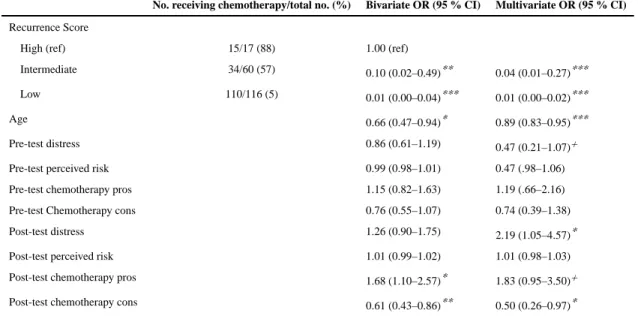
Overall, 24 % of patients received chemotherapy. As expected, patients with low RS tumors typically received hormonal therapy only (110 of 116, 95 %), while patients with high RS tumors typically received chemotherapy in addition to hormonal therapy (15 of 17, 88 %) (Table 2). Among patients with intermediate RS tumors, 57 % (34 of 60) received hormonal therapy only and 43 % (26 of 60) received combined therapy. In the group as a whole, on bivariate analyses, patients who received chemotherapy were younger than those who did not (OR 0.66, 95 % CI 0.47–0.94, P < .05). Higher histological grade (OR 4.06, 95 % CI 2.16–7.66, P < .001), larger tumor size (OR 1.63, 95 % CI 1.10–2.42, P < .05), and Stage II versus Stage I cancers (OR 2.04, 95 % CI 1.15–3.63, P < .05) were also associated with greater likelihood of receiving chemotherapy.
A
uthor Man
uscr
ipt
A
uthor Man
uscr
ipt
A
uthor Man
uscr
ipt
A
uthor Man
uscr
In multivariate analyses, younger patients (OR 0.89, 95 % CI 0.83–0.95, P < .001) were more likely to receive chemotherapy, as were patients with high RS tumors, as compared to those with intermediate (OR 0.04, 95 % CI 0.01–0.27, P < .001) or low RS tumors (OR 0.01, 95 % CI 0.00–0.02, P < .001). Higher post-test distress (OR 2.19, 95 % CI 1.05–4.57, P < . 05) and lower perceived cons (OR 0.50, 95 % CI 0.26–0.97, P < .05) of chemotherapy predicted receipt of chemotherapy. The odds of receiving chemotherapy were more than two times higher for every half-standard deviation increase in distress and were halved for every half-SD increase in perceived cons. Higher perceived pros were not associated with receipt of this treatment, although the association was marginally statistically significant (OR 1.83, 95 % CI 0.96–3.50, P = .07).
Discussion
Our findings suggest that breast cancer patients were responsive to their RS test results. Specifically, we found an increase in perceived pros and cons from pre- to post-testing; this finding did not differ by test result. This pattern of findings could potentially be due to a greater comprehension of the treatment following medical oncology appointments for adjuvant treatment planning in addition to the RS result itself. A recent systematic review of breast cancer patients’ preferences for adjuvant treatment found that while most patients judged that even small survival benefits would make receipt of chemotherapy worthwhile, preferences of individual patients varied widely across the studies included in this review. Further, 2–19 % of patients in the studies included in the review would refuse chemotherapy regardless of the survival benefits [27]. This review also found that clinical characteristics, such as nodal status and sociodemographics, did not predict patients’ treatment preferences. Evolving research suggests that patient preferences change over time. This should be particularly true as patients receive more information about their cancer and the potential benefit of chemotherapy (or the limited rationale for this treatment) and this knowledge is integrated with preferences within the clinical encounter [28].
Distress did not change following the receipt of the RS. Distress at pre- and post-testing in this sample was moderate [29]. These findings suggest that women do not experience a great sense of reassurance following testing. Future work could assess whether recent prospective validation demonstrating an excellent outcome in those with tumors with very low RS 0–10 (5-year risk of distant relapse of 99.3 %; 95 % CI, 98.7–99.6) [30] would result in different patient-reported outcomes.
We also saw a decrease in perceived risk of recurrence. Few studies of tested patients have been designed to allow for the assessment of change in outcomes from pre- to post-testing. Previous studies suggest an overall decline in anxiety [31] and decisional conflict [32] following the receipt of the RS. Our results are similar to those of another study conducted within the context of the MINDACT trial, testing another common gene expression profiling test for breast cancer. Specifically, 6–8 weeks after surgery, women in the MINDACT trial who received high risk results reported higher distress and perceived risk as compared to those who received low risk results [33]. That we did not find increases in perceived risk of recurrence among high risk patients [34] perhaps was due to our much smaller sample size
A
uthor Man
uscr
ipt
A
uthor Man
uscr
ipt
A
uthor Man
uscr
ipt
A
uthor Man
uscr
of patients with high RS tumors. Alternatively, their perceived risk of recurrence could have reflected the benefit of planning to receive chemotherapy.
Our hypothesis regarding predictors of chemotherapy uptake was partially confirmed. We found that chemotherapy uptake was higher among women with higher cancer-related distress and lower perceived cons for chemotherapy, with marginal effects for perceived pros of chemotherapy. In contrast, perceived risk did not contribute to our model. Previous studies have demonstrated that higher distress can interfere with decision making [35] and be associated with more aggressive treatment [36]. More concerns about chemotherapy could elicit lower willingness on the patient’s part to follow treatment recommendations. This is an especially important factor considering women with high RS tumors receive greater benefit from chemotherapy treatment.
Our study has several strengths. To our knowledge, this is the first study to prospectively assess women’s distress, perceived risk of recurrence, and preferences for chemotherapy before and after receipt of their RS and to report differences in these variables according to test results. Further, our results suggest that patient-reported variables can help to explain treatment received following this common genomic test, above and beyond the strong effects for test result and patient age. Oncologists should consider the potential impact of their patients’ emotional state and the advantages and disadvantages they perceive from
chemotherapy when engaging their patients in shared treatment decisions [37]. Finally, our sample was racially diverse and is drawn from both comprehensive cancer centers and community clinical settings.
In terms of limitations, while our sample was racially diverse, participants were generally well-educated and affluent. Our study was limited by its recruitment in clinics in the Eastern US, though we drew from both comprehensive cancer centers and academic community settings. Also, while we had a relatively low rate of active decliners, a number of patients were unreachable for a pre-test interview. This likely reflects our need to refine our recruitment approaches to reach patients in the relatively short 2-week window between when the test is ordered and when results are disclosed in clinic to the patient. Patients who were unreachable for their pre-test interview may differ from women we were able to assess for eligibility and consent to a pre-test interview.
Our study adds to the growing literature on outcomes among women who receive genomic tumor profiling when they are diagnosed with early-stage breast cancer. Our findings suggest potential intervention targets to improve outcomes in this population. Future research should examine the reason for increases in both pros and cons of treatment after testing.
Acknowledgments
This study and manuscript preparation were supported by grants from the American Cancer Society
(MRSG-10-110-01) and National Cancer Institute (P30CA05100). The content is solely the responsibility of the authors and does not necessarily represent the official views of the National Cancer Institute or the National Institutes of Health. We thank the physicians and staff of the MedStar Cancer Network and the H. Lee Moffitt Cancer Center for their assistance during the study. Most importantly, we thank the women who participated in this study.
A
uthor Man
uscr
ipt
A
uthor Man
uscr
ipt
A
uthor Man
uscr
ipt
A
uthor Man
uscr
References
1. Goldhirsch A, Winer EP, Coates AS, Gelber RD, Piccart-Gebhart M, Thurlimann B, Senn HJ. Personalizing the treatment of women with early breast cancer: highlights of the St Gallen International Expert Consensus on the Primary Therapy of Early Breast Cancer 2013. Ann Oncol. 2013; 24(9):2206–2223. [PubMed: 23917950]
2. Harris L, Fritsche H, Mennel R, Norton L, Ravdin P, Taube S, Somerfield MR, Hayes DF, Bast RC Jr. American Society of Clinical Oncology 2007 update of recommendations for the use of tumor markers in breast cancer. J Clin Oncol. 2007; 25(33):5287–5312. [PubMed: 17954709]
3. National Comprehensive Cancer Network. [Accessed 5 Oct 2015] NCCN clinical practice guidelines in oncology. Breast Cancer. 2015. Version 3.2015. http://www.nccn.org/professionals/ physician_gls/pdf/breast.pdf
4. Senkus E, Kyriakides S, Ohno S, Penault-Llorca F, Poortmans P, Rutgers E, Zackrisson S, Cardoso F. Primary breast cancer: ESMO Clinical Practice Guidelines for diagnosis, treatment and follow-up. Ann Oncol. 2015; 26(Suppl 5):v8–v30. [PubMed: 26314782]
5. Dinan MA, Mi X, Reed SD, Hirsch BR, Lyman GH, Curtis LH. Initial trends in the use of the 21-gene Recurrence Score assay for patients with breast cancer in the Medicare population, 2005– 2009. JAMA Oncol. 2015; 1(2):158–166. [PubMed: 26181015]
6. Enewold L, Geiger AM, Zujewski J, Harlan LC. Oncotype Dx assay and breast cancer in the United States: usage and concordance with chemotherapy. Breast Cancer Res Treat. 2015; 151(1):149–156. [PubMed: 25859924]
7. O’Neill SC, Isaacs C, Chao C, Tsai HT, Liu C, Ekezue BF, Selvam N, Kessler LG, Schwartz MD, Lobo T, Potosky AL. Adoption of gene expression profiling for breast cancer in US oncology practice for women younger than 65 years. J Natl Compr Canc Netw. 2015; 13(10):1216–1224. [PubMed: 26483061]
8. Cleator S, Ashworth A. Molecular profiling of breast cancer: clinical implications. Br J Cancer. 2004; 90(6):1120–1124. [PubMed: 15026788]
9. Hornberger J, Cosler LE, Lyman GH. Economic analysis of targeting chemotherapy using a 21-gene RT-PCR assay in lymph-node-negative, estrogen-receptor-positive, early-stage breast cancer. Am J Manag Care. 2005; 11(5):313–324. [PubMed: 15898220]
10. Lyman GH, Cosler LE, Kuderer NM, Hornberger J. Impact of a 21-gene RT-PCR assay on treatment decisions in early-stage breast cancer: an economic analysis based on prognostic and predictive validation studies. Cancer. 2007; 109(6):1011–1018. [PubMed: 17311307]
11. Augustovski F, Soto N, Caporale J, Gonzalez L, Gibbons L, Ciapponi A. Decision-making impact on adjuvant chemotherapy allocation in early node-negative breast cancer with a 21-gene assay: systematic review and meta-analysis. Breast Cancer Res Treat. 2015; 152(3):611–625. [PubMed: 26126971]
12. Levine MN, Julian JA, Bedard PL, Eisen A, Trudeau ME, Higgins B, Bordeleau L, Pritchard KI. Prospective evaluation of the 21-gene Recurrence Score assay for breast cancer decision-making in Ontario. J Clin Oncol. 2015; doi: 10.1200/JCO.2015.62.8053
13. Rutter CE, Yao X, Mancini BR, Aminawung JA, Chagpar AB, Saglam O, Hofstatter EW, Abu-Khalaf M, Gross CP, Evans SB. Influence of a 21-gene Recurrence Score assay on chemotherapy delivery in breast cancer. Clin Breast Cancer. 2016; 16(1):59–62. [PubMed: 26483315]
14. Fried G, Moskovitz M. Treatment decisions in estrogen receptor-positive early breast cancer patients with intermediate oncotype DX Recurrence Score results. Springerplus. 2014; 3:71. [PubMed: 24567880]
15. Bombard Y, Rozmovits L, Trudeau ME, Leighl NB, Deal K, Marshall DA. Patients’ perceptions of gene expression profiling in breast cancer treatment decisions. Curr Oncol. 2014; 21(2):e203– e211. [PubMed: 24764705]
16. Bombard Y, Rozmovits L, Trudeau M, Leighl NB, Deal K, Marshall DA. The value of
personalizing medicine: medical oncologists’ views on gene expression profiling in breast cancer treatment. Oncologist. 2015; 20(4):351–356. [PubMed: 25746345]
A
uthor Man
uscr
ipt
A
uthor Man
uscr
ipt
A
uthor Man
uscr
ipt
A
uthor Man
uscr
17. Spellman E, Sulayman N, Eggly S, Peshkin BN, Isaacs C, Schwartz MD, O’Neill SC. Conveying genomic recurrence risk estimates to patients with early-stage breast cancer: oncologist
perspectives. Psychooncology. 2013; 22(9):2110–2116. [PubMed: 23447452]
18. Whelan T, Levine M, Willan A, Gafni A, Sanders K, Mirsky D, Chambers S, O’Brien MA, Reid S, Dubois S. Effect of a decision aid on knowledge and treatment decision making for breast cancer surgery: a randomized trial. JAMA. 2004; 292(4):435–441. [PubMed: 15280341]
19. Duric VM, Fallowfield LJ, Saunders C, Houghton J, Coates AS, Stockler MR. Patients’
preferences for adjuvant endocrine therapy in early breast cancer: what makes it worthwhile? Br J Cancer. 2005; 93(12):1319–1323. [PubMed: 16333242]
20. Duric VM, Stockler MR, Heritier S, Boyle F, Beith J, Sullivan A, Wilcken N, Coates AS, Simes RJ. Patients’ preferences for adjuvant chemotherapy in early breast cancer: what makes AC and CMF worthwhile now? Ann Oncol. 2005; 16(11):1786–1794. [PubMed: 16126738]
21. Duric VM, Butow PN, Sharpe L, Heritier S, Boyle F, Beith J, Wilcken NR, Coates AS, Simes RJ, Stockler MR. Comparing patients’ and their partners’ preferences for adjuvant chemotherapy in early breast cancer. Patient Educ Couns. 2008; 72(2):239–245. [PubMed: 18434070]
22. Duric VM, Butow PN, Sharpe L, Boyle F, Beith J, Wilcken NR, Heritier S, Coates AS, John SR, Stockler MR. Psychosocial factors and patients’ preferences for adjuvant chemotherapy in early breast cancer. Psychooncology. 2007; 16(1):48–59. [PubMed: 16856128]
23. Mandelblatt JS, Sheppard VB, Hurria A, Kimmick G, Isaacs C, Taylor KL, Kornblith AB, Noone AM, Luta G, Tallarico M, et al. Breast cancer adjuvant chemotherapy decisions in older women: the role of patient preference and interactions with physicians. J Clin Oncol. 2010; 28(19):3146– 3153. [PubMed: 20516438]
24. Horowitz M, Wilner N, Alvarez W. Impact of Event Scale: a measure of subjective stress. Psychosom Med. 1979; 41(3):209–218. [PubMed: 472086]
25. O’Neill SC, Brewer NT, Lillie SE, Morrill EF, Dees EC, Carey LA, Rimer BK. Women’s interest in gene expression analysis for breast cancer recurrence risk. J Clin Oncol. 2007; 25(29):4628– 4634. [PubMed: 17925559]
26. O’Neill SC, Valdimarsdottir HB, DeMarco TA, Peshkin BN, Graves KD, Brown K, Hurley KE, Isaacs C, Hecker S, Schwartz MD. BRCA1/2 test results impact risk management attitudes, intentions, and uptake. Breast Cancer Res Treat. 2010; 124(3):755–764. [PubMed: 20383578] 27. Hamelinck VC, Bastiaannet E, Pieterse AH, Jannink I, van de Velde CJ, Liefers GJ, Stiggelbout
AM. Patients’ preferences for surgical and adjuvant systemic treatment in early breast cancer: a systematic review. Cancer Treat Rev. 2014; 40(8):1005–1018. [PubMed: 24986544]
28. Street RL Jr, Elwyn G, Epstein RM. Patient preferences and healthcare outcomes: an ecological perspective. Expert Rev Pharmacoecon Outcomes Res. 2012; 12(2):167–180. [PubMed: 22458618]
29. Horowitz, M. Stress response syndromes and their treatment. In: Goldberger, L.; Breznitz, S., editors. Handbook of stress: theoretical and clinical aspects. Free Press; New York: 1982. p. 711-732.
30. Sparano JA, Gray RJ, Makower DF, Pritchard KI, Albain KS, Hayes DF, Geyer CE Jr, Dees EC, Perez EA, Olson JA Jr, et al. Prospective validation of a 21-gene expression assay in breast cancer. N Engl J Med. 2015; doi: 10.1056/NEJMoa1510764
31. Lo SS, Mumby PB, Norton J, Rychlik K, Smerage J, Kash J, Chew HK, Gaynor ER, Hayes DF, Epstein A, Albain KS. Prospective multicenter study of the impact of the 21-gene Recurrence Score assay on medical oncologist and patient adjuvant breast cancer treatment selection. J Clin Oncol. 2010; 28(10):1671–1676. [PubMed: 20065191]
32. Holt S, Bertelli G, Humphreys I, Valentine W, Durrani S, Pudney D, Rolles M, Moe M, Khawaja S, Sharaiha Y, et al. A decision impact, decision conflict and economic assessment of routine Oncotype DX testing of 146 women with node-negative or pNImi, ER-positive breast cancer in the UK. Br J Cancer. 2013; 108(11):2250–2258. [PubMed: 23695023]
33. Retel VP, Groothuis-Oudshoorn CG, Aaronson NK, Brewer NT, Rutgers EJ, van Harten WH. Association between genomic recurrence risk and well-being among breast cancer patients. BMC Cancer. 2013; 13:295. [PubMed: 23777535]
A
uthor Man
uscr
ipt
A
uthor Man
uscr
ipt
A
uthor Man
uscr
ipt
A
uthor Man
uscr
34. Wiebe, DJ.; Korbel, C. Defensive denial, effect, and the self-regulation of health threats. In: Cameron, LD.; Leventhal, H., editors. The self-regulation of health and illness behaviour. Routledge; New York: 2003. p. 184-203.
35. O’Donnell S, Goldstein B, Dimatteo MR, Fox SA, John CR, Obrzut JE. Adherence to mammography and colorectal cancer screening in women 50–80 years of age the role of psychological distress. Womens Health Issues. 2010; 20(5):343–349. [PubMed: 20800770] 36. Schwartz MD, Isaacs C, Graves KD, Poggi E, Peshkin BN, Gell C, Finch C, Kelly S, Taylor KL,
Perley L. Long-term outcomes of BRCA1/BRCA2 testing: risk reduction and surveillance. Cancer. 2012; 118(2):510–517. [PubMed: 21717445]
37. Ganz PA. Psychological and social aspects of breast cancer. Oncology. 2008; 22(6):642–646. 650. [PubMed: 18561553]
A
uthor Man
uscr
ipt
A
uthor Man
uscr
ipt
A
uthor Man
uscr
ipt
A
uthor Man
uscr
Fig. 1.
Changes in patient-reported outcomes from pre- to post-test. Error bars report standard errors
A
uthor Man
uscr
ipt
A
uthor Man
uscr
ipt
A
uthor Man
uscr
ipt
A
uthor Man
uscr
A
uthor Man
uscr
ipt
A
uthor Man
uscr
ipt
A
uthor Man
uscr
ipt
A
uthor Man
uscr
Table 1
Participant characteristics (N = 193)
N (%) M (SD)
Demographic characteristics
Age 57.14 (9.87)
Education
≥High school degree 33 (17.2)
Some college 44 (22.8)
College degree 42 (21.8)
Graduate/professional training 74 (38.3)
Race
White 125 (65.4)
African American 50 (26.2)
Asian American 10 (5.2)
Other/missing 8 (3.4)
Latina ethnicity 12 (6.3)
Marital status
Married/partner 117 (62.3)
Single/widow/divorced 76 (37.7)
Annual household income
<$50,000 28 (14.7)
$50,000–100,000 53 (27.5)
>$100,000 78 (40.8)
Missing 34 (17.6)
Breast cancer characteristics
Recurrence Score
Low 116 (60.1)
Intermediate 60 (30.1)
High 17 (8.8)
Stage
I 115 (60)
IIA 36 (19)
IIB 11 (6)
Missing/undefined 31 (16)
Histologic grade
Low 46 (23.8)
Intermediate 81 (42.0)
High 32 (16.6)
Missing/undefined 34 (17.6)
Tumor size
≤1 cm 51 (26.4)
A
uthor Man
uscr
ipt
A
uthor Man
uscr
ipt
A
uthor Man
uscr
ipt
A
uthor Man
uscr
ipt
N (%) M (SD)
2.1–3 cm 20 (10.4)
3.1–5 cm 13 (6.8)
Missing/undefined 21 (10.8)
Nodal status
Positive 16 (8.3)
Negative 155 (80.3)
A
uthor Man
uscr
ipt
A
uthor Man
uscr
ipt
A
uthor Man
uscr
ipt
A
uthor Man
uscr
Table 2
Predictors of chemotherapy use
No. receiving chemotherapy/total no. (%) Bivariate OR (95 % CI) Multivariate OR (95 % CI)
Recurrence Score
High (ref) 15/17 (88) 1.00 (ref)
Intermediate 34/60 (57) 0.10 (0.02–0.49)** 0.04 (0.01–0.27)***
Low 110/116 (5) 0.01 (0.00–0.04)*** 0.01 (0.00–0.02)***
Age 0.66 (0.47–0.94)* 0.89 (0.83–0.95)***
Pre-test distress 0.86 (0.61–1.19) 0.47 (0.21–1.07)+
Pre-test perceived risk 0.99 (0.98–1.01) 0.47 (.98–1.06)
Pre-test chemotherapy pros 1.15 (0.82–1.63) 1.19 (.66–2.16)
Pre-test Chemotherapy cons 0.76 (0.55–1.07) 0.74 (0.39–1.38)
Post-test distress 1.26 (0.90–1.75) 2.19 (1.05–4.57)*
Post-test perceived risk 1.01 (0.99–1.02) 1.01 (0.98–1.03)
Post-test chemotherapy pros 1.68 (1.10–2.57)* 1.83 (0.95–3.50)+
Post-test chemotherapy cons 0.61 (0.43–0.86)** 0.50 (0.26–0.97)*
In sensitivity analyses, tumor stage, size, and grade did not significantly contribute to the model and model results were similar to those presented. Due to this and missing data on these variables, we did not include them in the final model
+ P < .10;
* P < .05;
** P < .01;