SEPARATING FROM THE SCHOOL: AN ANALYTICAL AND EMPIRICAL STUDY OF THE LEGAL ENTITY STRUCTURES OF FOOTBALL BOWL
SUBDIVISION ATHLETIC DEPARTMENTS
Ernest L. Washington
A thesis submitted to the faculty of the University of North Carolina at Chapel Hill in partial fulfillment of the requirements for the degree of Master of Arts in the Department
of Exercise and Sport Science (Sport Administration)
Chapel Hill 2013
Approved by:
ii ©2013
iii ABSTRACT
ERNEST L. WASHINGTON: Separating From the School: An Analytical and Empirical Study of the Legal Entity Structures of Football Bowl Subdivision Athletic Departments
(Under the direction of Barbara Osborne, J.D.)
iv
ACKNOWLEDGEMENTS
I want to thank Barbara Osborne, my advisor, for not only the countless time and effort she has provided with my thesis but throughout the past two years as well. The guidance and experience has been invaluable and will serve me well throughout my professional career.
I also want to thank Dr. Edgar Shields and Martina Ballen, my committee members for their guidance throughout my thesis. Their advice and help has been extremely invaluable during the process of my thesis.
In addition, I would like to acknowledge my classmates within the Sport Administration program as well as the School of Law for all the help and support they have provided me while in graduate school. It’s been a privilege to get to know all of them.
v
TABLE OF CONTENTS
LIST OF TABLES ... vii
Chapter I. INTRODUCTION ... ii
Statement of Purpose ... 4
Research Questions ... 4
Delimitations ... 5
Definition of Terms... 5
Significance of the Study ... 6
II. LITERATURE REVIEW ... 9
Separate Legal Entities and Athletic Departments ... 9
Athletic Departments as an Auxiliary Enterprise ... 9
Eleventh Amendment and Arm of the State Doctrine Implications ... 10
Enterprise Liability and Respondeat Superior ... 13
Taxation Issues... 16
Institutional Theory ... 22
Variables Relating to Athletic Department Success ... 26
III. METHODOLOGY ... 9
Subjects ... 9
Instrumentation and Data Collection ... 9
Data Analysis ... 30
IV. MANUSCRIPT ... 31
Introduction ... 31
Research Questions ... 34
vi
Separate Legal Entities and Athletic Departments ... 34
Eleventh Amendment and Arm of the State Doctrine Implications ... 37
Enterprise Liability and Respondeat Superior ... 39
Taxation Issues... 42
Institutional Theory ... 47
Variables Relating to Athletic Department Success ... 50
Methodology ... 52
Subjects ... 53
Instrumentation and Data Collection ... 53
Data Analysis ... 53
Results: Athletic Department Entity Statuses ... 54
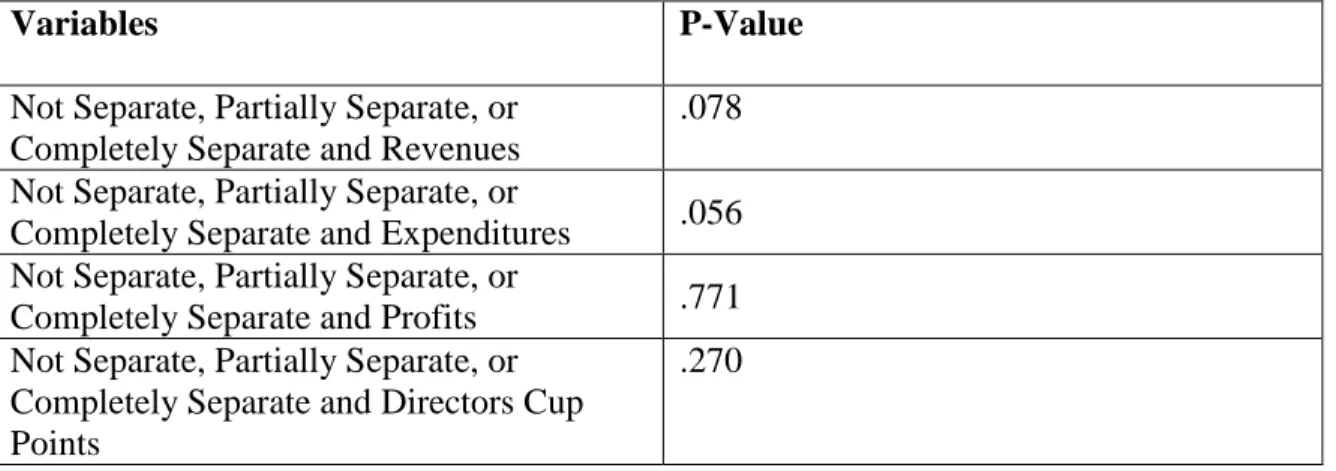
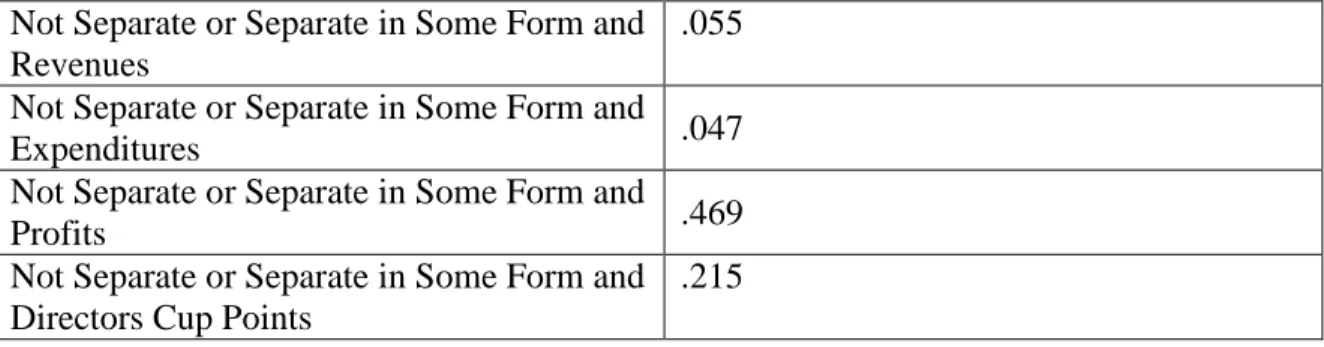
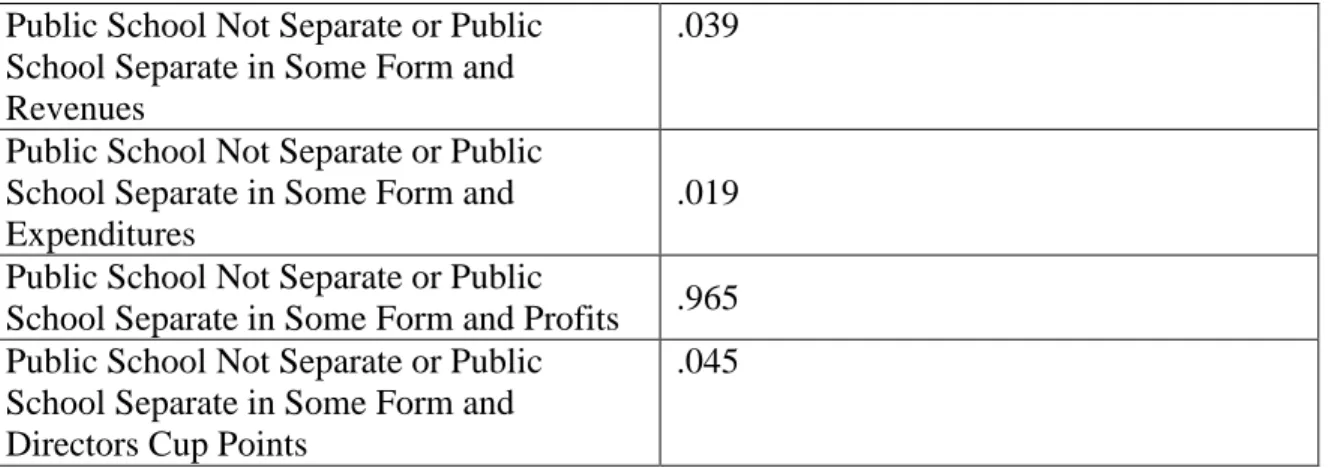
Results: Differences Between Entity Status and Revenues, Expenditures, Profits, and Directors Cup Points... 55
Discussion ... 57
Conclusions ... 63
Limitations and Future Research ... 63
APPENDIX A: Survey Instrument ... 65
APPENDIX B: SCHOOL INFORMATION ... 66
vii
LIST OF TABLES
1. Variables Used……….55
CHAPTER I
INTRODUCTION
Athletics departments have a history of operating independently from the school. Examples of this are that in the beginning of collegiate athletics, students would
coordinate and conduct the sporting events outside from the schools. This trend of
independence continued even as schools began to take responsibility for the management of athletics responsibilities (Duderstadt, 2000). As football started to increase in
popularity, college athletics started to witness massive growth. Large stadiums were built to accommodate the increased interest, and radio broadcasts of college football games further aided in its growth (Duderstadt, 2000). In the 1960’s and 70’s, college athletics gained even more exposure as television started to play a significant role in promoting and marketing these programs (Duderstadt, 2000). Athletics were becoming the “front porch of the university” (Duderstadt, 2000).
A landmark Supreme Court decision in 1984 became a catalyst for increasing the commercialization of college athletics. In NCAA v. Board of Regents of the University of Oklahoma (1984), the Supreme Court ruled that it was an antitrust violation for the
2
dollars (Duderstadt, 2000). This growth has continued today, with licensing and sponsorship deals being larger, conferences such as the Big Ten and Pacific-12 having their own networks, the facilities arms-race, and the internet serving as another content provider for college athletics.
As the revenues and expenses in big-time college athletics continued to escalate, some schools opted to legally organize the athletics department as a non-profit entity separate from the university. Athletic departments that are a separate legal entity are able to have more control over their finances (Duderstadt, 2000). Even though athletic
departments that operate as separate legal entities must cover their costs, they possess the ability to do so themselves through avenues such negotiating licensing and sponsorship contracts as well as setting prices for ticket sales (Duderstadt, 2000). Furthermore, it has been demonstrated athletics departments operating as separate entities possess the ability incur questionable expenses and justify them by saying that as a separate entity the school as a whole is not responsible for those costs (Duderstadt, 2000).
The status of athletics departments as separate legal entities as a whole, however, is starting to come into question. Richard G. Johnson, an attorney who served as
plaintiff’s counsel for Oliver v. NCAA (2009), believes that congress should create an act that requires “any college or university with an athletic department that derives revenue from its athletic program shall operate from within that institution and not from within any separate entity” (Johnson, 2011, ¶6). In response to the Penn State University sexual abuse situation, Dennis Dodd, a columnist for cbssports.com, stated that
3
has to be the point when universities quit bowing down to King Football, quit drooling over the prospect of colorful uniforms, stop being beholden to ratings” (Dodd, 2011 ¶7).
Duderstadt, who was the former president of The University of Michigan, has noted that “[the athletics department’s] more independent financial status has led to many instances not only to different rules and policies governing athletics, but to management values and cultures that depart quite significantly from those of the academic core of the university” (2000, p. 87). As scandals and legal trouble have plagued college athletics recently, more people are pushing for athletics departments to not operate as a separate legal entity from the school in order for the school to have more oversight over the athletic department.
Transparency issues of an athletics department operating as a separate legal entity also exist. Colombo (2010) noted that “the lack of transparency in athletic department operations has been a consistent theme of reformers and has led to well-documented cases of abuse” (p. 115). After the University of Kentucky decided to dissolve the
University of Kentucky Athletic Association and have the University of Kentucky Board of Trustees oversee athletics matters, a Kentucky state senator stated "I hate to use the overused word 'transparency,' but I think that's exactly what [the potential move to dissolve the UKAA] brings" (Blackford & Tipton, 2011, ¶21). Noting how athletic departments do not undergo the same level of scrutiny as other aspects of the school and are therefore less transparent, Duderstadt (2000) said:
4
departments that are allowed to operate in such an independent and cavalier fashion can walk the universities far out on a limb that threatens the integrity of their academic mission” (p. 102-103).
Considering that the entity status of athletic departments are starting to come into question, examining whether there is a relationship between an athletic department’s entity status and various factors is important in determining whether it is justifiable for an athletic department to operate as a separate legal entity from the school or not.
Statement of Purpose
The purpose of this study was to determine the legal entity status of Football Bowl Subdivision (FBS) athletic departments and discover whether a relationship exists between that status and its success, expenditures, revenue generation, maintaining a profit, and academic ranking.
Research Questions
This study is guided by the following research questions:
RQ1: What are the legal entity statuses of FBS athletic departments?
RQ2: Is there a significant relationship between an athletic department’s entity status and the following variables:
• Directors’ Cup Results
• Expenditures
5 Limitations
The main limitation with this study involves gathering the information regarding the entity status of the school. While Freedom of Information Act requests were sent to the schools, not all of the schools complied with the request. The study is also limited by variables that are measureable by secondary databases that already exist.
Delimitations
This study is delimited to schools that competed at the FBS level during the 2011-12 academic year. Furthermore, all statistical data gathered relates to the 2011-2011-12
academic year only. Definition of Terms
Football Bowl Subdivision (FBS): A subdivision of Division I football in which a
maximum of 85 full football scholarships can be given and there is required paid or actual attendance of 15,000 during a rolling two-year period.
Legal Entity: An association, corporation, partnership, proprietorship, trust, or individual
that has legal standing in the eyes of law. A legal entity has legal capacity to enter into agreements or contracts, assume obligations, incur and pay debts, sue and be sued in its own right, and to be held responsible for its actions.
Profit: The excess of returns over expenditure in a transaction or series of transactions.
Revenue: The total income produced by a given source.
Separate Legal Entity: A legal entity, typically a business, which is defined as detached
6 Significance of the Study
CHAPTER II
LITERATURE REVIEW
The purpose of this research is to discover the legal entity stratus of FBS athletic departments and determine if there is a relationship between the entity status and
Director’s Cup competitive success, expenses, revenue, and profit. In order to more fully understand the scope and importance of this study, the literature review includes an examination the advantages and disadvantages of a separate legal entity status, an analysis of intuitional theory and how it relates to this study, and recapping previous studies which compared the success of athletic departments to various factors. Separate Legal Entities and Athletic Departments
Athletic Departments as an Auxiliary Enterprise
Even though schools generally have the ability to operate auxiliary enterprises and are increasingly doing so, a consideration of whether or not it is better from a legal standpoint to operate separately is a very important consideration that athletic
departments need to consider (Kaplan & Lee, 2006). An analysis of a school’s use of auxiliary enterprises is very important in terms of whether or not it is better for an
8
Lee, 2006 p. 1618). Schools are increasingly using auxiliary enterprises in a variety of ways (Kaplin & Lee, 2006). Examples of auxiliary enterprises at schools include graphics, printing and copying services, campus bookstores, and schools renting out its facilities to outside groups for a fee (Kaplin & Lee, 2006).
Athletics departments at most Football Bowl Subdivision schools are considered auxiliary enterprises (Duderstadt, 2000). If the auxiliary enterprises are used for
educational purposes and involve goods, services, or facilities not available from local business, then the potential for scrutiny of these enterprises are very low (Kaplin & Lee, 2006). Where issues do arise, however, is when the auxiliary enterprise’s operations extend beyond educational purposes by placing the institution in a competitive position with other entities (Kaplin & Lee, 2006). Examples of this scrutiny are when the
customers are drawn to the institution’s activities instead of local business as well as the institution’s activities having unfair advantages such as tax-exempt status and better funding sources (Kaplin & Lee, 2006).
As a result, it is important to figure out the scope to which an athletic department can operate as a separate legal entity from the school. If a separate athletics department is limited in its functions, then it might not be in the best interest for the athletics
9
For public schools, the key in answering the question of whether or not it is best to operate as a separate entity requires an investigation into how broad the constitutional and statutory provisions delegating the authority to the school are as well as the
appropriations acts authorizing expenditures of public funds (Kaplin & Lee, 2006). Separate athletics departments benefit from appropriations acts being broad because it places fewer limits on the activities that they can do. Furthermore, courts also consider the particular functions and objectives of the enterprise, the relation of these functions and objections to the institution’s educational purposes, and judicial precedent in that state indicating how to construe the scope of delegated powers (Kaplin & Lee, 2006). Even though the cases that are critical in this analysis do not directly involve athletics departments, the issues in these cases – Iowa Hotel Association v. State Board of Regents (1962), Churchill v Board of Trustees (1982), and Jansen v Attiyeh (1987) – as well their outcomes relate to matters involving athletics departments that are separate legal entities and serve as useful tools for analysis.
Iowa Hotel Association indicates that a separate athletics department has the
ability to construct, renovate, and expand facilities necessary for the benefit of the student-athletes as well as the student body as a whole that benefits and gains
10
reasonably. One potential limitation for these public school athletics departments comes from Medical Society of South Carolina v Medical University of South Carolina (1999) in which the court noted that “an agency created by statute has only the authority granted it by the legislature.” Even so, as long as the athletics departments are created by statute, they possess the ability to engage in a wide array of activities that at least makes it viable for public school athletics departments to be a separate legal entity.
For private school athletic departments, it is necessary to determine whether a private school’s corporate charter and bylaws, made under state corporate law and educational licensing laws, allow the institution to engage in creating athletics departments that are separate legal entities (Kaplan & Lee, 2006). Then it becomes possible to evaluate whether or not a private school’s athletics departments have the ability to and whether or not they should function as auxiliary enterprises. It should be noted, though, that private schools typically encounter fewer obstacles – if any – than public schools in terms of being able to operate auxiliary enterprises (Kaplan & Lee, 2006). As a result, it seems that the only issue private school athletics departments might encounter involves the extent of what they can do as a separate legal entity. State ex rel. v. Southern Junior College (1933) indicates that as long as athletics departments abide by
the school’s corporate charter and bylaws and those charters and bylaws comply with state laws and rules, private school athletics departments that are separate legal entities should be able to engage in a wide range of activities.
Eleventh Amendment and Arm of the State Doctrine Implications
11
Amendment and the arm of the state doctrine. The Eleventh Amendment states that “the judicial power of the United States shall not be construed to extend to any suit in law or equity, commenced or prosecuted against one of the United States by Citizens of another State, or by Citizens or Subjects of any Foreign State” (U.S. Const. amend. XI). The implication on public schools, therefore, is that they are protected by the Eleventh
Amendment from lawsuits arising out of their athletic programs (English v. University of Hawaii, 2005; Graham v. NCAA, 1986). Athletics departments that do not operate as a
separate legal entity from the school would benefit by enjoying these same Eleventh Amendment protections since they are the same entity as the school (Graham v. NCAA, 1986). On the contrary, Eleventh Amendment protection issues may potentially arise when athletics departments are separate legal entities from the schools (Kansas State Univ. v. Prince, 2009). In making this determination, the arm of the state doctrine becomes extremely important.
12
university’s athletics association, it is not automatically persuasive (Kansas State Univ. v. Prince, 2009).
The important factor considering the arm of the state test is whether it should really impact a school’s decision to have its athletics department as a separate legal entity. Based off the Tenth Circuit in Kansas State University v. Prince (2006) in which the court could not reach a determination of whether the IAC is an arm of the state as it simply stated “it may be,” public schools should take careful note of the analysis in Kansas State University – in particular those schools located in states are part of the
Tenth Circuit –because depending on certain factors unique to that state and the school involved, the courts might very well rule that an athletics department organized as a separate legal entity is not an arm of the state, which would not afford that athletics department certain protections that the school as a whole might otherwise have. Athletics departments that are not separate legal entities from the school are essentially free from Eleventh Amendment issues regarding the arm of the state doctrine because in various courts public schools are have been almost universally deemed as arms of the state (Md. Stadium Auth. v. Ellerbe Becket, Inc., 2005). Courts, however, have been inconsistent in decided whether athletics departments that are organized as separate entities are, or are not, arms of the state. Braswell v. Bd. of Regents (2005) ruled that the University of Georgia’s Athletic Department was ruled as being entitled to Eleventh Amendment Immunity because they were an arm of the state, whereas the court in Kansas State Univ. v. Prince (2009) was unable to come up with a conclusion to whether
13
entitled to sovereign immunity. If the federal circuit the school is located in had not declared that an athletics department separated from the school is an arm of the state, administrators should either do an extensive analysis of the arm of the state doctrine to make sure that the athletics program would satisfy the requirements of the federal circuit the institution is located in.
Enterprise Liability and Respondeat Superior
Athletics departments that operate as separate legal entities also need to consider enterprise liability and respondeat superior-related matters in determining whether or not to operate as a separate legal entity. Enterprise liability is defined as the “liability
imposed on each member of an industry responsible for manufacturing a harmful or defective product, allotted by each manufacturer’s market share of the industry” (Black’s Law Dictionary, 2004 p. 997). Very similar to the notion of enterprise liability is
respondeat superior, which is “the doctrine holding an employer or principal liable for the employee’s or agent’s wrongful acts committed within the scope of the employment or agency” (Black’s Law Dictionary, 2004 p. 1426). In the athletics context where injuries and incidents can occur as a result of an athletic department employee’s negligence within the context of his or her job or from property belonging to the athletics
department, enterprise liability and respondeat superior issues are significant matters for collegiate athletics departments.
14
The child filed suit against the foundation for compensation dealing with the injuries from the sexual harassment. Although the defendants argued that non-profit organizations should be exempt from liability, the court refused to acknowledge such an exemption, noting that “it is difficult to conclude that the fact that the appellant does good work in the community without expectation of profit makes it unjust that it should be held vicariously responsible for the abuse of the respondent” (Bazley, para. 51).
Bazley aligns with the widely accepted idea that even though athletics departments are
generally non-profits, they should not be immune from any sort of financial
consequences stemming from legal matters. Christopher D. Stone (1980) noted that “in some circumstances, it becomes necessary to replace or reinforce enterprise liability with various interventionist techniques that restrict the autonomy of the participants. These interventions—overrulings, we might say, of the ordinary presumption in favor of managerial expertise—range from displacing the enterprise from full control over its agents' conduct and compensation, to subjecting the enterprise to certain constraints on the selection of bureaucratic and production variables” (p. 77). As a result, it is crucial to determine whether there is a difference in the impact of potential enterprise liability or respondeat superior suits to employers and coaches working in athletic departments that are separate legal entities from the school in comparison to those who remain a part of the educational institution. In particular, how does enterprise liability and respondeat superior operate in terms of lawsuits where the separate legal entity is held as a party in the case along with a similar- and larger-functioning entity?
15
not operating as separate legal entities because they would be less likely to be able to be properly named as defendants in a lawsuit. In Coursey, Jonathan M. Coursey filed a lawsuit against two officers, the city of Peoria, and the Police Department to recover damages incurred when he was arrested. Coursey complained that excessive force was used and that false arrest potentially occurred as well. The defendants argued that the Police Department was not a proper party in the suit because it was not a separate legal entity, and the court agreed. Another non-sports case is relevant in this discussion. In Cobb v. Mason County (1989), the plaintiff filed a complaint against a county, a county
Sheriff's Department, and a sheriff stemming from injuries that occurred as a result of work he was doing while in prison. The plaintiff alleged that he was improperly required to do manual labor – including the heavy lifting required to set up a Blood Mobile Drive –and that his early requests for immediate medical treatment in regards to his injuries were ignored. As in Coursey, the defendants in Cobb moved to dismiss the lawsuit because the Police Department was not a separate legal entity. What is unique about Cobb, however, is that the defendants pointed to Rule 17 of the Federal Rules of Civil
16
Coursey illustrates that athletics departments may benefit under enterprise
liability and respondeat superior doctrine by not operating as separate legal entities because if they were not a separate legal entity, they would be less likely to be able to be properly named as defendants in a lawsuit. If an athletics department does exist as a separate legal entity, Cobb illustrates the importance of how much state law can have an impact in making this determination in whether it is better from an enterprise liability and respondeat superior aspect to operate as a separate legal entity. As a result, while separate athletics departments in the state of Michigan might look at Cobb favorably, other states might not have the same laws in place as does Michigan. Even though athletics
departments can be held liable for improper actions, they seem to benefit by not operating as a separate legal entity from the school as it is potentially harder for them to be held as parties in lawsuits where the university is also involved. As a result, an intensive look at state law is necessary regarding how athletics departments operating as separate legal entities in that state might potentially deal with respondeat superior and enterprise liability situations as in Cobb and Coursey.
Taxation Issues
17
Collegiate Athletic Association (NCAA) Myles Brand which asked the NCAA to defend its status as a tax-exempt organization. This scrutiny also applied to athletics departments as well, in particular with coaches’ salaries (Colombo, 2010). While Colombo (2010) noted that athletics departments rely on the Internal Revenue Code (hereinafter IRC) for tax exemption status, do separate athletics departments need to worry about whether they are legitimately able to enjoy income tax protection status?
While the arm of the state doctrine and enterprise liability/respondeat superior impacts public school athletics departments more than they do private schools, private school athletics departments have bigger implications than their public school
18
Athletics departments affiliated with private schools, however, rely on different sections of the IRC. They rely on Section 170 as well as Section 501(c)(3) of the IRC in order to have income tax exemption, which requires a stricter analysis. Section 170 provides a tax exemption for charitable contributions. Furthermore, Section 170(c)(2)(b) mandates that “the term ‘charitable contribution’ means a contribution or gift to or for the use of…a corporation, trust, or community chest, fund, or foundation…organized and operated exclusively for religious, charitable, scientific, literary, or educational purposes, or to foster national or international amateur sports competition (but only if no part of its activities involve the provision of athletic facilities or equipment), or for the prevention of cruelty to children or animals.” Section 501(c)(3), which is similar to Section 170 of the Code, provides tax-exempt status for “corporations, and any community chest, fund, or foundation, organized and operated exclusively for religious, charitable, scientific, testing for public safety, literary, or educational purposes, or to foster national or international amateur sports competition (but only if no part of its activities involve the provision of athletic facilities or equipment).” In terms of analyzing Section 501(c)(3), the charitable and educational purposes aspects of Section 501(c)(3) are extremely crucial in evaluating whether athletics departments deserve income-tax exemption, as there is a two-part test to determine whether an entity is allowed to have Section 501(c)(3)
protection (Colombo, 2010).
19
2010). The second part is the operational test, which requires that “the entity in question actually must engage ‘primarily’ in charitable activities, such as educational activities” (Colombo, 2010). Even if the athletics departments pass the 501(c)(3) test, there are two hurdles, and one in particular that could impact athletics departments that are separate legal entities.
The first hurdle deals with what is known as the Unrelated Business Income Tax (UBIT). John Colombo, the UBIT mandates that “if a business is ‘substantially related’ to the organization’s charitable purpose, then any business profit continues to be tax-free; if, however, the business is not substantially related, any profit is taxed at the usual
20
amateur athletics, there is no doubt that big-time athletics departments are focusing on generating large amounts of revenue (Dosh, 2011). Duderstadt (2010), furthermore, notes that athletic departments operating as auxiliary enterprises are “focus[ing] most of the athletic department’s energy…on revenue generation rather than cost management” (p. 145).
With this in mind, even if one believes that athletics departments really do promote amateur athletics in an age of multi-billion dollar television contracts, because an athletics department operating as separate legal entity from the school possesses the ability to generate large amounts of revenue, one could reasonably argue that the commerciality limitation should apply to these athletics departments. In particular, with athletics departments operating as a separate legal entity, legal questions could exist in terms of whether they should benefit from the same income-tax protection as the schools and athletics departments that are not separate legal entities. While no cases which have directly dealt with private school athletics departments that are separate legal entities exist, Community Hospital Linen Services, Inc. v. Commissioner of Taxation (1976) provides some useful guidance relative to these entities. In this case, which dealt with non-profit hospitals and the use of property, the court had to determine “whether the fact that the hospitals own and operate the property through an incorporated association, which is technically a separate legal entity, should disqualify the property for the tax exemption” (Community Hospital Linen Services, Inc., 1976 p. 543). In making its ruling that the hospitals had tax-exempt status in terms of the use of property, the court noted that
21
corporation merely to grant tax relief at the expense of the state where the subsidiary is incorporated or acquired for the purpose of advantageously carrying on some phase of the parent corporation’s activities or business. If a corporation elects to treat itself as an independent business for some purposes, it should not be permitted to disavow that identity merely to avoid the resultant tax
consequences. However, we expressly recognized an exception to this rule when the subsidiary corporation was created solely for and devoted exclusively to serving the purposes of the parent corporations. Thus in such a situation where the subsidiary corporation ‘could have no purpose or existence apart from the operations of its corporate owners’, the substance of the
arrangement should control and the fact that the subsidiary is technically a separate legal entity may be disregarded for tax purposes” (Community Hospital Linen Services, Inc., 454-55).
Noting the analysis in the court’s decision, the key language of “when the subsidiary corporation was created solely for and devoted exclusively to serving the purposes of the parent corporations” makes it seem as though private school athletics departments that are separate legal entities from the school could be entitled to the same tax-exempt status as the school it represents (Community Hospital Linen Services, Inc., 454-55). Athletics departments are created to serve the purpose of the school and the students. Even one that is a cynic of collegiate athletics cannot deny that there would be no athletics
department without the school or student-athletes. Whether athletics departments deserve tax-exempt status as a whole is one thing; in terms of separate athletics departments, however, private school athletics departments based off the rationale of Community Hospital Linen Services could argue that they deserve income-tax exemption. However,
even with Community Hospital Linen Services, the commercial limitation could prove to be a very strong factor because of how much corporate-like behavior athletics
22
hue’ - that is, the activity is one that competes with commercial providers, is priced similarly to how a for-profit would price the same service or sale of goods, and in fact produces significant profits” (p. 130).
In summary, it seems as if there are no issues regarding private and public schools being able to operate the athletic department as an auxiliary enterprise. Regarding
Eleventh Amendment and Arm of the State doctrine issues, while there are no issues with private schools, public schools need to do an analysis of its school as well as the various factors within its federal circuit to determine if any issues are present. Public schools would benefit more than private schools regarding potential respondeat superior and enterprise liability issues if their athletic departments were not separate legal entities. Also, regarding taxation issues, although public schools likely would not face issues, there might be some doubt regarding private schools being able to utilize tax benefits if they operated as separate legal entities. When deciding what’s best from a legal
standpoint, each school must be analyzed separately in order to make the best determination.
Institutional Theory
23
defined as “a condition reflecting cultural alignment, normative support, or consonance with relevant rules or laws” (Scott, 1995 p. 45). The second element of institutional theory is isomorphism, which is “the constraining process that forces one unit in a population to resemble other units that face the same set of environmental conditions” (DiMaggio & Powell, 1983). Isomorphism notes that institutional characteristics change depending on how the environmental characteristics change; the number of institutions depends on how much the environment can handle the amount of institutions available and how the diversity of institutional forms align with environmental diversity
(DiMaggio & Powell, 1983). The third element of institutional theory involves rational myths. Rational myths are “the beliefs generated about the legitimacy of certain actions leading to desired outcomes of organized processes” (Lammers & Barbour, 2006 p. 359).
24
and to establish legitimacy for their operational autonomy. According to DiMaggio and Powell, if institutional isomorphism is studied within the institution, such an examination can help institution understand how fields become homogeneous, which will allow for a better understanding of why the institution evolved to its current state. This relates to athletic departments and its entity structure because if there is a significant relationship between the entity structure of an athletic department and variables such as success, expenditures and profit, other athletic departments might evolve towards the entity status which is more likely to yield these positive results.
Oliver (1991) considers how institutions respond to isomorphism. Reasons that companies desire not to conform include: not being resource dependent; desiring autonomy over decision making; having the ability to adapt flexibly if situations arise; and using the institution’s objectives to alter or control the work environment. Five types of strategic responses to conformity pressures were discovered. The first, acquiescence, involves the company succumbing to conformity either via habit, imitation or
compliance. Compromise involves the institution attempting to balance, pacify, or bargain with external constituents. Avoidance involves a company hiding their non-conformity, protecting themselves from pressures institutionally or deciding not to follow institutional rules. Defiance involves the company dismissing, challenging, and/or
25
money and generate the most money, even if negatives exist with adopting the new entity status.
Institutional theory has also been analyzed within the sports realm. In their study designed to determine what elements NCAA Division I athletic administrator value with the sports in its athletic department as well as to develop a further understanding of athletic administration theory, Cooper and Weight (2011) consider how institutional theory helps shape collegiate athletic administrators as well as athletic departments as a whole. Through normative isomorphism, Cooper and Weight also note that the
similarities are in large part due to the various decision makers’ value systems. For example, athletic departments within the same conference (such as the Atlantic Coast Conference) would have similar core values, institutional structures and budget priorities. Through their research, Cooper and Weight note that as a result of institutional
isomorphism, there is a “warped sense of reality held by many administrators that the football and basketball teams are the answer to their financial ailments” (p. 85). If the research demonstrates that athletic departments have almost the same entity status, Cooper and Weight’s research could help provide an understanding of why this is the case. Also, an athletic department’s entity status could also be tied to the athletic department’s ability to allow the football and basketball teams to achieve maximum success, revenues and profits without taking into account what would benefit the athletic department as a whole.
Overall, one of the implications of institutional theory might be that
26
perceived or implied value systems. If the research determines that there is a relationship between the entity status of an athletic department and other variables, athletic
departments might start copying each other and employing the same entity status model. If the research shows that being operating as a completely separate legal entity is the best model in terms of success, expenditures, revenues and profits, athletic departments would have to consider the potential legal issues that exist with operating as a separate legal entity in deciding whether to change its entity status. Even if athletic departments understand the negatives that exist with operating as a separate legal entity, they might start to feel the pressure and as a result change its entity status to being completely separate if it’s determined that operating as a separate legal entity is most likely to yield the best success and financial results.
Variables Relating to Athletic Department Success
27
there is a significant relationship between “team expenditures” and the probability of making the NCAA tournament. Regarding a relationship between success and revenues, Orzag & Israel found that there was a positive, statistically significant relationship in football between finishing in the top 25 in the Associated Press poll and revenue, but that no relationship existed between revenue and football and basketball winning percentage as well as making the NCAA basketball tournament.
Albert (2006) focused on whether there is a relationship between athletic expenditures and NCAA Division I baseball, softball, men’s soccer, women’s soccer, men’s tennis, women’s tennis, and women’s volleyball. Albert determined whether there were differences between “Elite” (teams that finished in the top 16 in their respective NCAA championships), “Successful” (teams that finished in the 17-32 of their respective NCAA championships), “Qualifying” (teams that qualified for the NCAA championships but lost in the first round) and “Non-qualifying” (teams that did not qualify for their respective NCAA championship tournament) teams (Albert, 2006, p. 4-8). Albert’s research indicated that with some exceptions, the teams that achieved the highest level of success reported the greatest median expenditures and that a relationship existed between athletic expenditures and athletic success for the teams and sports analyzed. Albert cited recruiting and development factors for teams that spend the most money as well as the trickle-down effect for schools that have powerful football and basketball teams as possible reasons for this relationship.
28
difference at a school between the percentage of female student athletes and female student – and determine if a relationship existed between the Lassiter rank and how it finished in the Directors’ Cup as well as the athletic department’s total budget (Lassiter, 2001, p. 1). Lassiter determined that a moderately significant relationship existed between the Lassiter rank and the Directors’ Cup ranking as well as the athletic
department’s total budget. Lassiter also determined that a relationship existed between a school’s athletic department budget and its Directors Cup ranking – in fact, it was the strongest relationship examined in Lassiter’s study.
Jones’ (2012) study focused on the relationship between an athletic department’s expenditures and the overall on-field success of the athletic department. Using NACDA Director’s Cup points as the indicator of on-field success, Jones discovered that at FBS schools there was a statistically significant positive relationship between athletic expenditures and a team’s on-field success. Jones also found that among FBS schools, BCS conference affiliation had no impact on the relationship between athletic
CHAPTER III
METHODOLOGY
This study is an exploratory examination of the legal structure of FBS athletic departments. Questions regarding the legal and organizational structures of FBS athletic departments as well as success, revenues and profits were answered via information gathered online and in direct email communication.
Subjects
The populations at interest were the 120 NCAA FBS athletic departments and schools. The university’s general counsel office from each FBS institution was surveyed in order to answer questions of interest. The director of compliance from each FBS conference and the director of compliance from the NCAA Division I schools that are Independent in football were also contacted in order to gain information.
Instrumentation and Data Collection
An e-mail was sent to an athletic department administrator or the university’s general counsel in order to obtain the information about the school’s legal entity status. The e-mail asked the respondents to state the entity status of the schools during the 2011-12 school year. For this study, “success” is determined by how many points the school scored in the 2011-12 National Association of Collegiate Directors of Athletics
30
the Equity in Athletics Disclosure Act interactive online database for the 2011-12 school year.
Data Analysis
CHAPTER IV
MANUSCRIPT
Introduction
Athletics departments have a history of operating independently from the school. Examples of this are that in the beginning of collegiate athletics, students would
coordinate and conduct the sporting events outside from the schools. This trend of
independence continued even as schools began to take responsibility for the management of athletics responsibilities (Duderstadt, 2000). As football started to increase in
popularity, college athletics started to witness massive growth. Large stadiums were built to accommodate the increased interest, and radio broadcasts of college football games further aided in its growth (Duderstadt, 2000). In the 1960’s and 70’s, college athletics gained even more exposure as television started to play a significant role in promoting and marketing these programs (Duderstadt, 2000). Athletics were becoming the “front porch of the university” (Duderstadt, 2000).
A landmark Supreme Court decision in 1984 became a catalyst for increasing the commercialization of college athletics. In NCAA v. Board of Regents of the University of Oklahoma(1984), the Supreme Court ruled that it was an antitrust violation for the
32
NCAA to be the exclusive broadcaster of the NCAA basketball tournament for $1 billion dollars (Duderstadt, 2000). This growth has continued today, with licensing and
sponsorship deals being larger, conferences such as the Big Ten and Pacific-12 having their own networks, the facilities arms-race, and the internet serving as another content provider for college athletics.
As the revenues and expenses in big-time college athletics continued to escalate, some schools opted to legally organize the athletics department as a non-profit entity separate from the university. Athletic departments that are a separate legal entity are able to have more control over their finances (Duderstadt, 2000). Even though athletic
departments that operate as separate legal entities must cover their costs, they possess the ability to do so themselves through avenues such negotiating licensing and sponsorship contracts as well as setting prices for ticket sales (Duderstadt, 2000). Furthermore, it has been demonstrated athletics departments operating as separate entities possess the ability incur questionable expenses and justify them by saying that as a separate entity the school as a whole is not responsible for those costs (Duderstadt, 2000).
The status of athletics departments as separate legal entities as a whole, however, is starting to come into question. Richard G. Johnson, an attorney who served as
plaintiff’s counsel for Oliver v. NCAA (2009), believes that congress should create an act that requires “any college or university with an athletic department that derives revenue from its athletic program shall operate from within that institution and not from within any separate entity” (Johnson, 2011, ¶6). In response to the Penn State University sexual abuse situation, Dennis Dodd, a columnist for cbssports.com, stated that
33
athletic departments; the overpaid, out-of-touch coaches; the apparel companies; the networks; maybe even the NCAA. This is where the excess has to stop. This has to be the point when universities quit bowing down to King Football, quit drooling over the prospect of colorful uniforms, stop being beholden to ratings” (Dodd, 2011 ¶7).
Duderstadt, who was the former president of The University of Michigan, has noted that “[the athletics department’s] more independent financial status has led to many instances not only to different rules and policies governing athletics, but to management values and cultures that depart quite significantly from those of the academic core of the university” (2000, p. 87). As scandals and legal trouble have plagued college athletics recently, more people are pushing for athletics departments to not operate as a separate legal entity from the school in order for the school to have more oversight over the athletic department.
Transparency issues of an athletics department operating as a separate legal entity also exist. Colombo (2010) noted that “the lack of transparency in athletic department operations has been a consistent theme of reformers and has led to well-documented cases of abuse” (p. 115). After the University of Kentucky decided to dissolve the
University of Kentucky Athletic Association and have the University of Kentucky Board of Trustees oversee athletics matters, a Kentucky state senator stated "I hate to use the overused word 'transparency,' but I think that's exactly what [the potential move to dissolve the UKAA] brings" (Blackford & Tipton, 2011, ¶21). Noting how athletic departments do not undergo the same level of scrutiny as other aspects of the school and are therefore less transparent, Duderstadt (2000) said:
34
allowed to operate relatively autonomously from these controls…athletic departments that are allowed to operate in such an independent and cavalier fashion can walk the universities far out on a limb that threatens the integrity of their academic mission” (p. 102-103).
Considering that the entity status of athletic departments are starting to come into question, examining whether there is a relationship between an athletic department’s entity status and various factors is important in determining whether it is justifiable for an athletic department to operate as a separate legal entity from the school or not.
Research Questions
This study is guided by the following research questions:
RQ1: What are the legal entity statuses of FBS athletic departments?
RQ2: Is there a significant difference between an athletic department’s entity status and the following variables:
• Directors’ Cup Results • Expenditures
• Revenue
• Profit Literature Review
Separate Legal Entities and Athletic Departments
Even though schools generally have the ability to operate auxiliary enterprises and are increasingly doing so, a consideration of whether or not it is better from a legal standpoint to operate separately is a very important consideration that athletic
35
auxiliary enterprises is very important in terms of whether or not it is better for an
athletics department to operate as a separate legal entity. Auxiliary enterprises are defined as “a broad range of functions that are claimed to be ‘auxiliary’ to the education and research that are the central mission of a higher education institution…such functions must place the institution or one or one of its subsidiary or affiliated organizations in the position of seller and must be (or have the potential to be) income producing” (Kaplin & Lee, 2006 p. 1618). Schools are increasingly using auxiliary enterprises in a variety of ways (Kaplin & Lee, 2006). Examples of auxiliary enterprises at schools include graphics, printing and copying services, campus bookstores, and schools renting out its facilities to outside groups for a fee (Kaplin & Lee, 2006).
Athletics departments at most Football Bowl Subdivision schools are considered auxiliary enterprises (Duderstadt, 2000). If the auxiliary enterprises are used for
educational purposes and involve goods, services, or facilities not available from local business, then the potential for scrutiny of these enterprises are very low (Kaplin & Lee, 2006). Where issues do arise, however, is when the auxiliary enterprise’s operations extend beyond educational purposes by placing the institution in a competitive position with other entities (Kaplin & Lee, 2006). Examples of this scrutiny are when the
customers are drawn to the institution’s activities instead of local business as well as the institution’s activities having unfair advantages such as tax-exempt status and better funding sources (Kaplin & Lee, 2006).
36
department to operate as separate legal entity because they could then engage in more functions if they weren’t separate. Public schools and private schools also undergo a different analysis in terms of their ability to operate auxiliary enterprises because for public schools statutory and constitutional considerations become more important, with public schools in particular liable to be subjected to more scrutiny than private schools (Kaplin & Lee, 2006).
For public schools, the key in answering the question of whether or not it is best to operate as a separate entity requires an investigation into how broad the constitutional and statutory provisions delegating the authority to the school are as well as the
37
that the only issue private school athletics departments might encounter involves the extent of what they can do as a separate legal entity.
Eleventh Amendment and Arm of the State Doctrine Implications
An extremely important consideration in terms of whether or not it is better for an athletic department to be a separate legal entity from the school involves the Eleventh Amendment and the arm of the state doctrine. The Eleventh Amendment states that “the judicial power of the United States shall not be construed to extend to any suit in law or equity, commenced or prosecuted against one of the United States by Citizens of another State, or by Citizens or Subjects of any Foreign State” (U.S. Const. amend. XI). The implication on public schools, therefore, is that they are protected by the Eleventh
Amendment from lawsuits arising out of their athletic programs (English v. University of Hawaii, 2005; Graham v. NCAA, 1986). Athletics departments that do not operate as a
separate legal entity from the school would benefit by enjoying these same Eleventh Amendment protections since they are the same entity as the school (Graham v. NCAA, 1986). On the contrary, Eleventh Amendment protection issues may potentially arise when athletics departments are separate legal entities from the schools (Kansas State Univ. v. Prince, 2009). In making this determination, the arm of the state doctrine becomes extremely important.
38
State Univ. v. Prince, 2009). The arm of the state doctrine is not applied uniformly to all schools in all states because even though the Eleventh Amendment is a federal matter determined law, state law must be analyzed in making this determination (Regents of the Univ. of Cal. v. Doe, 1997). Therefore, even if a case in a different state examines a state
university’s athletics association, it is not automatically persuasive (Kansas State Univ. v. Prince, 2009).
The important factor considering the arm of the state test is whether it should really impact a school’s decision to have its athletics department as a separate legal entity. Based off the Tenth Circuit in Kansas State University v. Prince (2006) in which the court could not reach a determination of whether the IAC is an arm of the state as it simply stated “it may be,” public schools should take careful note of the analysis in Kansas State University – in particular those schools located in states are part of the
39 Enterprise Liability and Respondeat Superior
Athletics departments that operate as separate legal entities also need to consider enterprise liability and respondeat superior-related matters in determining whether or not to operate as a separate legal entity. Enterprise liability is defined as the “liability
imposed on each member of an industry responsible for manufacturing a harmful or defective product, allotted by each manufacturer’s market share of the industry” (Black’s Law Dictionary, 2004 p. 997). Very similar to the notion of enterprise liability is
respondeat superior, which is “the doctrine holding an employer or principal liable for the employee’s or agent’s wrongful acts committed within the scope of the employment or agency” (Black’s Law Dictionary, 2004 p. 1426). In the athletics context where injuries and incidents can occur as a result of an athletic department employee’s negligence within the context of his or her job or from property belonging to the athletics
department, enterprise liability and respondeat superior issues are significant matters for collegiate athletics departments.
40
the community without expectation of profit makes it unjust that it should be held vicariously responsible for the abuse of the respondent” (Bazley, para. 51).
Bazley aligns with the widely accepted idea that even though athletics departments are
generally non-profits, they should not be immune from any sort of financial consequences stemming from legal matters.
While not a sports case, Coursey v. City of Peoria (1977) illustrates that athletics departments may benefit under enterprise liability and respondeat superior doctrine by not operating as separate legal entities because they would be less likely to be able to be properly named as defendants in a lawsuit. In Coursey, Jonathan M. Coursey filed a lawsuit against two officers, the city of Peoria, and the Police Department to recover damages incurred when he was arrested. Coursey complained that excessive force was used and that false arrest potentially occurred as well. The defendants argued that the Police Department was not a proper party in the suit because it was not a separate legal entity, and the court agreed. Another non-sports case is relevant in this discussion. In Cobb v. Mason County (1989), the plaintiff filed a complaint against a county, a county
Sheriff's Department, and a sheriff stemming from injuries that occurred as a result of work he was doing while in prison. The plaintiff alleged that he was improperly required to do manual labor – including the heavy lifting required to set up a Blood Mobile Drive –and that his early requests for immediate medical treatment in regards to his injuries were ignored. As in Coursey, the defendants in Cobb moved to dismiss the lawsuit because the Police Department was not a separate legal entity. What is unique about Cobb, however, is that the defendants pointed to Rule 17 of the Federal Rules of Civil
41
Sheriff Department to sue or be sued, and there is no constitutional or statutory authority in Michigan which indicates that the sheriff's department is a body corporate with the capacity to sue or be sued” (Cobb, 1989, p. *5). The courts ruled in favor of the defendants, noting that arguments as the plaintiff could not prove that “the Sheriff's department is a separate legal entity capable of being sued in its own right” (Cobb, 1989, p. *7). As a result, the defendants’ motion for summary judgment regarding the Mason County Sheriff's Department was granted.
Coursey illustrates that athletics departments may benefit under enterprise
liability and respondeat superior doctrine by not operating as separate legal entities because if they were not a separate legal entity, they would be less likely to be able to be properly named as defendants in a lawsuit. If an athletics department does exist as a separate legal entity, Cobb illustrates the importance of how much state law can have an impact in making this determination in whether it is better from an enterprise liability and respondeat superior aspect to operate as a separate legal entity. As a result, while separate athletics departments in the state of Michigan might look at Cobb favorably, other states might not have the same laws in place as does Michigan. Even though athletics
42 Taxation Issues
Another important consideration in terms of whether it is better for an athletics department to be a separate legal entity involves taxation issues. Even though athletics departments as non-profits are able to have income-tax exemption, they (and the NCAA for that matter) have experienced increased scrutiny over whether they should have this exemption (Colombo, 2010). A major catalyst for this increased scrutiny occurred in 2006 when Representative Bill Thomas of California – who was then the chair of the House Ways and Means Committee – sent a letter to then President of the National Collegiate Athletic Association (NCAA) Myles Brand which asked the NCAA to defend its status as a tax-exempt organization. This scrutiny also applied to athletics departments as well, in particular with coaches’ salaries (Colombo, 2010). While Colombo (2010) noted that athletics departments rely on the Internal Revenue Code (hereinafter IRC) for tax exemption status, do separate athletics departments need to worry about whether they are legitimately able to enjoy income tax protection status?
While the arm of the state doctrine and enterprise liability/respondeat superior impacts public school athletics departments more than they do private schools, private school athletics departments have bigger implications than their public school
43
thereof.” With Section 115, if an entity is separate from the government, its income will be subject to tax unless an exclusion or exemption applies (http://www.irs.gov/pub/irs-tege/eotopice90.pdf.). However, as discussed previously, if the arm of the state doctrine applies to those athletics departments that are separate legal entities, then they should be able to have the same income tax exemptions that the public universities have. Therefore, in terms of public athletics departments operating as a separate legal entity, no IRC problems appear to exist.
44
in evaluating whether athletics departments deserve income-tax exemption, as there is a two-part test to determine whether an entity is allowed to have Section 501(c)(3)
protection (Colombo, 2010).
The first part is the organizational test, which requires that “it must be organized as a state-law nonprofit organization…must limit its authorized activities to charitable ones, and must have a provision in its organizing documents that its assets will be transferred to another charity or to the government if it goes out of business” (Colombo, 2010). The second part is the operational test, which requires that “the entity in question actually must engage ‘primarily’ in charitable activities, such as educational activities” (Colombo, 2010). Even if the athletics departments pass the 501(c)(3) test, there are two hurdles, and one in particular that could impact athletics departments that are separate legal entities.
The first hurdle deals with what is known as the Unrelated Business Income Tax (UBIT). John Colombo, the UBIT mandates that “if a business is ‘substantially related’ to the organization’s charitable purpose, then any business profit continues to be tax-free; if, however, the business is not substantially related, any profit is taxed at the usual
45
limitation (in particular the latter) impacts athletics departments that are separate legal entities because as a single entity, it seems as though athletics departments engage in activities for the primary benefit of the separate athletic department themselves and not the school in general. In particular, Dosh (2011) noted that “there are plenty of schools [whose athletics departments turned a profit] who have shown no evidence giving back to their university for anything other than required expenses.” While a major reason that, in general, athletics departments have income-tax exemption is because they promote amateur athletics, there is no doubt that big-time athletics departments are focusing on generating large amounts of revenue (Dosh, 2011). Duderstadt (2010), furthermore, notes that athletic departments operating as auxiliary enterprises are “focus[ing] most of the athletic department’s energy…on revenue generation rather than cost management” (p. 145).
46
non-profit hospitals and the use of property, the court had to determine “whether the fact that the hospitals own and operate the property through an incorporated association, which is technically a separate legal entity, should disqualify the property for the tax exemption” (Community Hospital Linen Services, Inc., 1976 p. 543). In making its ruling that the hospitals had tax-exempt status in terms of the use of property, the court noted that
“[t]he general rule is that courts are reluctant to disregard the separate legal entities of the parent corporation and the subsidiary corporation merely to grant tax relief at the expense of the state where the subsidiary is incorporated or acquired for the purpose of advantageously carrying on some phase of the parent corporation’s activities or business. If a corporation elects to treat itself as an independent business for some purposes, it should not be permitted to disavow that identity merely to avoid the resultant tax
consequences. However, we expressly recognized an exception to this rule when the subsidiary corporation was created solely for and devoted exclusively to serving the purposes of the parent corporations. Thus in such a situation where the subsidiary corporation ‘could have no purpose or existence apart from the operations of its corporate owners’, the substance of the
arrangement should control and the fact that the subsidiary is technically a separate legal entity may be disregarded for tax purposes” (Community Hospital Linen Services, Inc., 454-55).
Noting the analysis in the court’s decision, the key language of “when the subsidiary corporation was created solely for and devoted exclusively to serving the purposes of the parent corporations” makes it seem as though private school athletics departments that are separate legal entities from the school could be entitled to the same tax-exempt status as the school it represents (Community Hospital Linen Services, Inc., 454-55). Athletics departments are created to serve the purpose of the school and the students. Even one that is a cynic of collegiate athletics cannot deny that there would be no athletics
47
tax-exempt status as a whole is one thing; in terms of separate athletics departments, however, private school athletics departments based off the rationale of Community Hospital Linen Services could argue that they deserve income-tax exemption. However,
even with Community Hospital Linen Services, the commercial limitation could prove to be a very strong factor because of how much corporate-like behavior athletics
departments perform. Colombo (2010) noted that “a number of court cases have held that a charity risks its exempt status if it conducts substantial activities with a ‘commercial hue’ - that is, the activity is one that competes with commercial providers, is priced similarly to how a for-profit would price the same service or sale of goods, and in fact produces significant profits” (p. 130).
Institutional Theory
48
depending on how the environmental characteristics change; the number of institutions depends on how much the environment can handle the amount of institutions available and how the diversity of institutional forms align with environmental diversity
(DiMaggio & Powell, 1983). The third element of institutional theory involves rational myths. Rational myths are “the beliefs generated about the legitimacy of certain actions leading to desired outcomes of organized processes” (Lammers & Barbour, 2006 p. 359).
DiMaggio and Powell (1983) authored one of the seminal articles dealing with institutional theory – in particular focusing on isomorphism. They note that institutional change happens as a result of institutions trying to mirror each other without considering how the changes will impact efficiency. They further note that in the long run this leads to an environment where institutional change in the future will be hard to accomplish. This relates to athletic departments and its entity structure because if there is a significant relationship between the entity structure of an athletic department and variables such as success, expenditures and profit, other athletic departments might evolve towards the entity status which is more likely to yield these positive results.
49
spend the most money and generate the most money, even if negatives exist with adopting the new entity status.
Institutional theory has also been analyzed within the sports realm. In their study designed to determine what elements NCAA Division I athletic administrator value with the sports in its athletic department as well as to develop a further understanding of athletic administration theory, Cooper and Weight (2011) consider how institutional theory helps shape collegiate athletic administrators as well as athletic departments as a whole. Through normative isomorphism, Cooper and Weight also note that the
similarities are in large part due to the various decision makers’ value systems. For example, athletic departments within the same conference (such as the Atlantic Coast Conference) would have similar core values, institutional structures and budget priorities. Through their research, Cooper and Weight note that as a result of institutional
isomorphism, there is a “warped sense of reality held by many administrators that the football and basketball teams are the answer to their financial ailments” (p. 85). If the research demonstrates that athletic departments have almost the same entity status, Cooper and Weight’s research could help provide an understanding of why this is the case. Also, an athletic department’s entity status could also be tied to the athletic department’s ability to allow the football and basketball teams to achieve maximum success, revenues and profits without taking into account what would benefit the athletic department as a whole.
Overall, one of the implications of institutional theory might be that
50
perceived or implied value systems. If the research determines that there is a relationship between the entity status of an athletic department and other variables, athletic
departments might start copying each other and employing the same entity status model. If the research shows that being operating as a completely separate legal entity is the best model in terms of success, expenditures, revenues and profits, athletic departments would have to consider the potential legal issues that exist with operating as a separate legal entity in deciding whether to change its entity status. Even if athletic departments understand the negatives that exist with operating as a separate legal entity, they might start to feel the pressure and as a result change its entity status to being completely separate if it’s determined that operating as a separate legal entity is most likely to yield the best success and financial results.
Variables Relating to Athletic Department Success