R
EPORT FOR
HARACTERIZATION
AND
R
EMEDIATION
LNAPL C
Multi-Phase Extraction and Dual-Pump Recovery of LNAPL at the
BP Former Amoco Refinery, Sugar Creek, MO
March 2005
(5102G) www.epa.gov/tio
Cost and Performance Report for LNAPL Recovery
Multi-Phase Extraction and Dual-Pump Recovery of LNAPL
at the BP Former Amoco Refinery,
This case study represents the views and opinions of the authors and those who participated in its development. It has been subjected to U.S. Environmental Protection Agency (EPA) expert review, however it does not necessarily reflect the views of the EPA or any other federal government agency. The information is not intended, nor can it be relied upon, to create any rights enforceable by any party in litigation with the United States or any other party. Reference herein to any specific commercial product, process, or service by trade name, trademark, manufacturer, or otherwise does not imply its endorsement or recommendation for use. The information provided maybe revised periodically without public notice.
CONTENTS Section Page EXECUTIVE SUMMARY ... 5 1.0 INTRODUCTION... 7 2.0 SITE INFORMATION ... 7 2.1 BACKGROUND... 7
2.1.1 Lower Refinery Area ... 9
2.1.2 Crawford Area ... 12
3.0 MATRIX DESCRIPTION AND LNAPL CHARACTERISTICS... 15
3.1 MATRIX CHARACTERISTICS AND OPERATING PARAMETERS AFFECTING TECHNOLOGY COST OR PERFORMANCE ... 15
3.1.1 Dual-Pump Recovery ... 15
3.1.2 Multi-Phase Extraction ... 16
3.2 LNAPL CHARACTERIZATION ... 16
3.2.1 Dual-Pump Recovery Area ... 17
3.2.2 Multi-Phase Extraction Area ... 18
3.3 LNAPL SPECIFIC THICKNESS... 18
3.4 LNAPL CHARACTERIZATION ... 21
3.5 LNAPL VOLUME ESTIMATES ... 21
4.0 REMEDIATION GOALS AND PERFORMANCE OBJECTIVES ... 22
4.1 LNAPL REMEDIATION GOAL ... 22
4.2 DUAL-PUMP RECOVERY AND MULTI-PHASE EXTRACTION PROTECTION GOALS ... 22
4.3 DEFINING APPROPRIATE ENDPOINTS ... 23
4.3.1 API Distribution and Recovery Modeling ... 23
5.0 RECOVERY SYSTEMS DESCRIPTION, PERFORMANCE, AND COST ... 26
5.1 DUAL-PUMP RECOVERY SYSTEM ... 26
5.1.1 Dual-Pump Recovery System Description... 26
5.1.2 Dual-Pump Recovery System Performance ... 26
5.1.3 Dual-Pump Recovery System Costs... 31
5.1.4 Dual-Pump Recovery System Observations and Lessons Learned 32 5.2 MULTI-PHASE EXTRACTION SYSTEM ... 33
5.2.1 Multi-Phase Extraction System Performance ... 33
5.2.2 Multi-Phase Extraction System Costs... 34
5.2.3 Multi-Phase Extraction System Observations and Lessons Learned ... 35
5.3 COMPARISON OF DUAL-PUMP RECOVERY TO MULTI-PHASE EXTRACTION
... 35
5.4 TECHNOLOGY PERFORMANCE AND COST ... 36
5.4.1 Meeting Protection Goals and Endpoints ... 36
5.4.2 Cost per Gallon of LNAPL Removed ... 36
6.0 OBSERVATIONS AND LESSONS LEARNED ... 37
7.0 REFERENCES... 41
8.0 SITE CONTACTS ... 43
FIGURES
Figure Page
1 Site Map: BP Products North America, Inc. Former Refinery, Sugar Creek, Missouri ... 7
2 Dual-Pump Recovery System Location Map ... 9
3 Dual-Pump Recovery Flow Diagram ... 9
4 Multi-Phase Extraction System Location Map... 13
5 Multi-Phase Extraction Flow Diagram ... 13
6 LNAPL Schematic in a Typical Monitoring Well ... 18
7 LNAPL Recovery for Dual-Pump Recovery System: Modeled vs Actual ... 24
8 Predicted Yearly LNAPL Recovery from the Dual-Pump Recovery System... 25
9 Dual-Pump Recovery System Annual LNAPL Recovery ... 28
10 Lower Refinery Recovery Well Network Cumulative LNAPL Recovery... 28
11 Dual-Pump Recovery System Annual Groundwater Recovery... 29
12 Well R-007 Fluid Level Measurements and Weekly LNAPL Recovery for 2003 ... 31
13 Multi-Phase Extraction LNAPL Recovery Compared to API Modeled Results ... 34
TABLES Table Page 1 Dual-Pump Recovery Well Status ... 10
2 Dual-Pump Recovery Well Construction Details... 11
3 Multi-Phase Extraction Construction Details ... 12
4 Matrix Characteristics and Operating Parameters Affecting Technology Cost or Performance of Dual-Pump Recovery ... 14
5 Matrix Characteristics and Operating Parameters Affecting Technology Cost or Performance of the Multi-Phase Extraction System ... 15
6 LNAPL Saturations versus Depth for the Dual Pump Recovery Area ... 16
7 LNAPL Saturations versus Depth for the Multi-Phase Extraction Area ... 17
8 Comparison of Measured versus Specific LNAPL Thickness (Do) ... 19
9 Comparison of LNAPL Characteristics for the Dual-Pump Recovery and Multi-Phase Extraction Areas... 20
10 Dual-Pump Recovery Annual Water and LNAPL Recovery... 27
11 Measured LNAPL Thicknesses in Dual-Pump Recovery System Observation Wells ... 30
12 Dual-Pump Recovery System Estimated Capital Costs... 31
13 Dual-Pump Recovery System Estimated O&M Costs... 32
14 Multi-Phase Extract System Estimated Capital Costs... 34
ACRONYMS AND ABBREVIATIONS
µm micrometer
amsl above mean sea level
API American Petroleum Institute
ASTM American Society for Testing and Materials
bgs below ground surface
cm/sec centimeters per second
CMS Corrective Measures Study
cp centipoise
former refinery BP Former Amoco Refinery
gpm gallons per minute
GC gas chromatograph
LNAPL light non-aqueous phase liquid
mm millimeters
non-VOC non-volatile organic compound
POTW publicly owned treatment works
PTS PTS Laboratories, Inc.
psi pounds per square inch
psig pounds per square inch gauge
RCRA Resource Conservation and Recovery Act
RFI RCRA Facility Investigation Report
ROC radius of capture
ROI radius of influence
SVOC semi-volatile organic compound
USCS Unified Soil Classification System
EXECUTIVE SUMMARY
This case study was prepared to summarize the recovery of light non-aqueous phase liquid (LNAPL) at two locations at the BP Products of North America, Inc. Former Amoco Refinery
(former refinery) in Sugar Creek, Missouri. The purpose of this case study was to evaluate the cost and performance of two remediation systems - one innovative (high-vacuum multi-phase
extraction) and one comprised of a more traditional approach (dual-pump LNAPL and groundwater recovery). Two locations were selected for the case study based on differing soil lithology,
hydrogeologic and LNAPL characteristics, and remedial approach. This case study illustrates the benefits of using site characterization and LNAPL recovery data to predict the effectiveness and longevity of the technologies. In addition, a cost comparison is made between the two LNAPL recovery technologies: dual-pump recovery applied in sand and multi-phase extraction applied in silt.
Dual-Pump Recovery
Dual-pump recovery has been applied at the Lower Refinery Area to recover LNAPL beginning with three wells in 1982, expanding to 15 wells in 1988. System optimization and asymptotic recovery has resulted in a reduction in the number of operating wells to six by 2004. The geology of the Lower Refinery Area consists of silty to fine sand with 11 to 69 percent fines, and hydraulic
conductivity ranging from 10-3 to 10-4 centimeters/second (cm/sec). Measured LNAPL saturations in the dual-pump recovery area were as high as 36 percent of the pore volume and averaged between 7 and 10-percent per soil core. The dual-pump recovery wells have collectively recovered approximately 1.82 million gallons of LNAPL and 183.5 million gallons of groundwater from 1982 through 2003 and recovered another 79,500 gallons of LNAPL and 12 millions gallons of
groundwater during 2004. The total groundwater to LNAPL recovered ratio for the dual-pump recovery system is 109:1.
Multi-Phase Extraction
Multi-phase extraction technology was applied in a portion of the former refinery known as the Crawford Area. Multi-phase extraction involves application of a high vacuum to the subsurface to recover LNAPL and groundwater and control migration of LNAPL from seeping into Sugar Creek, a small stream that bisects the former refinery property. The Crawford Area site geology is silt loess, with 92 to 98-percent fines, and is characterized by low hydraulic conductivity on the order of 10-6 cm/sec. Measured LNAPL thicknesses in monitoring wells in the Crawford Area were up to 16 feet, but soil core analyses indicated the LNAPL was discontinuous and limited in volume with a
maximum LNAPL saturation of only 1.4 percent of the pore volume. The multi-phase extraction system was operated from January 2001 until January 2003. Over two years of operation, it operated at 26-inches of mercury vacuum and recovered only 151 gallons of LNAPL and 216,000 gallons of groundwater. The total groundwater to LNAPL recovered ratio for the multi-phase extraction system is 1,430:1.
Cost and Performance
The dual-pump recovery system has recovered 1.899 million gallons of LNAPL and is predicted to recover an additional 321,900 gallons of the estimated source volume of 1.1 million gallons over the next six years. Overall, the dual pump recovery system is expected to recover a total of 2.25 million gallons of LNAPL, which is equal to 67-percent of the estimated recoverable LNAPL source volume, based on the API Model-estimated LNAPL specific thickness over the plume area. The percent recovery of the initial LNAPL spill volume is unknown, due to lack of spill data, and does not take into account additional LNAPL in the unsaturated zone, smear zone or outside each recovery well’s radius of capture. Additional LNAPL likely exists outside of influence of the
pumping radius of capture. By comparison, the total LNAPL recovery for the multi-phase extraction system amounted to less than 10-percent of the original estimated in-place LNAPL volume.
Each remedial system’s performance and associated cost are very dependent on the different soil matrices (silt versus sand). Although the total cost of the dual-pump recovery system ($3,554,349) was much greater than the cost of the multi-phase extraction system ($183,053), the normalized cost per gallon of LNAPL recovered was significantly less, with dual-pump recovery equal to only $1.87 per gallon compared to multi-phase extraction at $1,212 per gallon. The dual-pump recovery system continues to recover significant quantities of LNAPL, and recovered an additional 79,500 gallons in 2004. The multi-phase extraction system was shutdown in January 2003 due to no LNAPL recovery over its last six months of operation.
Observations and Lessons Learned
Overall, the large difference in LNAPL recovery and performance of the two systems indicates that LNAPL recovery is much more effective from higher-permeability sands than low-permeability silts and clays, irrespective of the remediation technology. Although dual-pump recovery proves to be continually effective at recovering LNAPL from sand, it is not expected to be an appropriate technology for LNAPL recovery in silts and clays. Therefore, protection goals and LNAPL endpoints should reflect the technical limitations of remediation technologies and soil type, with appropriate performance expectations, operational timeframes, and shutdown criteria. This case study suggests that LNAPL recovery for the purpose of source removal and migration control is a viable remediation goal in sands whereas LNAPL source control and containment is more attainable and an appropriate remediation goal in silts and clays.
1.0 INTRODUCTION
Remediation of light non-aqueous phase liquid (LNAPL) in contaminated media is a particularly
challenging problem at large-scale sites. At former petroleum refineries, for example, LNAPL may consist of volatile organic compounds (VOCs), semi-volatile organic compounds (SVOCs), non-volatile organic compounds and trace metals. When released into the subsurface, they can release dissolved
contaminants to groundwater or VOCs into subsurface gas and potentially indoor air for an extended period of time. In addition, if sites have low-permeability soils, characterization and remediation of LNAPL is particularly difficult. No single technology has been identified as the best solution for all sites and all soil types contaminated with LNAPL.
This case study summarizes the application of two LNAPL remedial technologies at two different locations at a large former petroleum refinery, the BP Products North America, Inc. Former Amoco Refinery in Sugar Creek, Missouri. This case study focuses on two LNAPL remediation systems at the former refinery, a multi-phase extraction system and a dual-pump recovery system. The locations of the two systems are in portions of the refinery known as the Crawford Area and the Lower Refinery Area, which are shown on Figure 1. The remedial systems were initially selected as interim measures based on their performance in two different soil matrices (i.e., silt/clay versus sand).
The purpose of this case study is to evaluate the cost and performance of the two LNAPL remediation systems and highlight how soil type can have a considerable effect on LNAPL recovery, cost, and
performance. Remediation goals, LNAPL recovery, performance, lessons learned, data collection needs, modeling approaches, and LNAPL endpoint strategies are also discussed herein.
2.0 SITE INFORMATION 2.1 BACKGROUND
From 1904 to 1982, the Standard Oil Company and then Amoco Oil Company operated a petroleum refinery along the southern bank of the Missouri River east of Kansas City and north of Independence, Missouri in the township of Sugar Creek, Missouri. The former refinery property occupies approximately 500 acres of the southern floodplain and bluffs along the Missouri River (Figure 1), and Sugar Creek is a small urban stream that bisects the former refinery property and discharges to the Missouri River. Refining operations ceased in 1982 and most tanks, process equipment, and buildings were dismantled by 1989. Petroleum products refined at the Sugar Creek refinery included gasoline, jet fuel, kerosene, furnace oil, liquified petroleum gases, petroleum coke, sulfur, and propylene polymers. Presently, BP Products North America, Inc. (BP) owns the refinery property and the only active industrial operations include a bulk storage and pipeline terminal for petroleum products, and an asphalt terminal. The majority of the former refinery property is currently inactive. The only residential use is off-site in the surrounding community of Sugar Creek.
Upon mutual agreement with United States Environmental Protection Agency (U.S. EPA) Region 7 and the Missouri Department of Natural Resources (MDNR), the site was divided into ten parcels for RCRA Corrective Action (Figure 1), based on prior refining use, proposed land use, geography, contaminants of concern, and soil conditions. In each area, various interim measures technologies have been applied including horizontal well total fluids extraction, vacuum truck enhanced fluid recovery, biosparging, hydraulic control pumping, multi-phase extraction, dual-pump LNAPL recovery, and gravity-draining interceptor trenches. In general, interim measures are designed and operated to abate imminent threats to human health and the environment. These technologies have been applied with varying degrees of success, and, based on their performance, are proposed for final corrective measures for the former refinery. Two interim measures technologies discussed in this case study include the Lower Refinery Recovery Well Network (i.e., dual-pump recovery) and Crawford Multi-Phase Extraction System (i.e.,
The overall remediation goal of both systems is source reduction through LNAPL recovery to reduce mobility and risk to the environment. Prior to implementation, LNAPL seeps and sheens were periodically observed in Sugar Creek. Therefore, the goal of the interim measures systems was to eliminate LNAPL seeps and sheens while reducing LNAPL sources to the practical limit of recovery. Based on the historical performance of the systems, the dual-pump recovery system was proposed as a final corrective measure for the Lower Refinery Area, while the multi-phase extraction system was determined not to be effective as a long-term remedy for the Crawford Area. The multi-phase extraction system was replaced with a hydraulic control pumping network in 2003, and presently both proposed final corrective measures technologies are currently under review as final remedies by U.S. EPA Region 7 and MDNR.
2.1.1 Lower Refinery Area
Initial operations at the refinery began in the Lower Refinery Area in 1904, and, over the course of its operation, included numerous process units and storage tanks. Process units in the Lower Refinery consisted of the coke, crude, and pressure stills, an acid treating plant, a clay plant, a batch agitator, oil/water separator box, and storage tank area. Expansion added a naphtha sweetening plant, a paraffin plant, cracking unit separator, pipe stills, and a heater oil treating plant. In addition, there were three separate loading areas, a tetraethyl lead storage and blending area, and a total of 97 storage tanks in the Lower Refinery Area. The tanks were used to store crude feedstocks, intermediates, heater oil, fuel oil, diesel oil, gasoline oil, jet fuel, caustic, coalescer, prefractionator bottoms, slop oil, and process water. Currently, the only remaining storage tanks include Tank 95R, which is used for recovered LNAPL storage for the dual-pump recovery system, and two asphalt storage tanks.
Historically, LNAPL has been observed in 41 observation and monitoring wells in the Lower Refinery Area (RETEC, 2004a). The LNAPL observed in the Lower Refinery Area is thought to be the result of historical releases from process units and storage tanks present in the Lower Refinery Area dating back to the start of the Amoco Refinery in 1904. Historic LNAPL releases at the surface may have migrated vertically through the subsurface silty clay/clayey silt via macropores or preferential pathways (RETEC, 2004a). Upon reaching the deeper lithology sand and gravel, the LNAPL would have migrated laterally due to its larger pore sizes and greater permeability. In general, groundwater flow is to the north towards the Missouri River and to the west towards Sugar Creek. However, the sand and gravel are below the water table for most of the year, and the LNAPL is therefore under pressure in a semi-confined condition and is immobile under natural gradients. The LNAPL’s initial lateral migration was limited by the pressure head of LNAPL at the time of release, and the LNAPL has not migrated beyond the Lower Refinery Area since its release. This semi-confined phenomenon is believed to be the reason LNAPL in the Lower Refinery Area has not migrated downgradient to the Riverfront Area, Sugar Creek or the Missouri River (Figure 1). The conceptual site model for the presence of LNAPL and the hydrogeology of the Lower Refinery Area is discussed further in Section 3.
The presence of LNAPL in monitoring wells installed in the Lower Refinery Area in the early 1980s prompted the installation of the first phase of the recovery well network (Woodward-Clyde, 1989). The first three recovery wells (R-001, R-002, and R-003) were installed in 1982. Recovery well R-003 was replaced by R-004 in 1984. Alternatives for expanding the recovery well system followed. Beginning in 1987, six additional recovery wells (R-005, R-006, R-007, R 008, R-009, and R-010) were added to the area. Six other recovery wells (R-011 to R-016) were installed in 1988. The newer recovery wells were placed in areas of significant LNAPL accumulation (i.e., greater than two feet thick) (Woodward-Clyde, 1987). The recovery wells (active and inactive) and their status are outlined in Table 1. Well construction specifications are included in Table 2.
Today, only seven of the original 16 wells still operate. The other recovery wells were shut down due to minimal LNAPL recovery, borehole collapse, or biological fouling. Six of the seven remaining operating recovery wells are used to recover LNAPL from the subsurface and the seventh (R-015) is used solely for hydraulic control of an LNAPL seep location along Sugar Creek (SCOP-08) (RETEC, 2004c). Thus, recovery well R-015 is not discussed further in this case study.
In early 2002, it appeared that many of the recovery wells were not operating as originally designed, primarily due to the age of the system, and the equipment was modified or replaced to increase the efficiency of the active recovery wells. The remaining six recovery wells (R-001, R-002, R-006, R-007, R 008, and R 009) constitute the dual-pump recovery system evaluated in this case study. The six
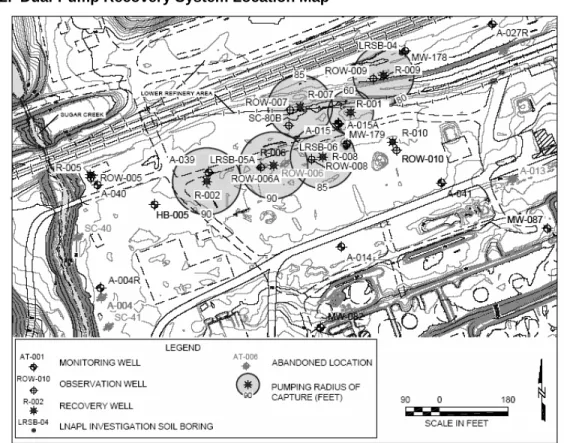
remaining operational recovery wells are shown in Figure 2, and a schematic of one of the recovery wells and the dual-pump recovery flow diagram is provided in Figure 3. Groundwater is transferred to a Clarifier Tank and batch treated via air stripper and discharged to the local Publicly Owned Treatment Works (POTW), while LNAPL is transferred to Tank 95R for eventual recycling at an off-site facility.
Figure 2. Dual-Pump Recovery System Location Map
Table 1. Dual-Pump Recovery Well Status Recovery
Well
Date
Installed Status Comments
R-001 1982 Modified and replaced equipment in 2003 to increase efficiency Operational
R-002 1982
Modified and replaced equipment in
2003 to increase efficiency Operational
R-003 1982 Limited operation from December 1982 to March 1984
Borehole collapse and suspected screen damage prevented adequate recovery and allowed silt to build up. Replaced with R-004 in 1984.
R-004 1984 Shut down in 1996
Excessive biological growth caused shut down; current vacuum liquid recovery location.
R-005 1987 Shut down in 1992
Shut down due to minimal LNAPL recovery.
R-006 1987 Modified and replaced equipment in 2003 to increase efficiency Operational R-007 1988 Modified and replaced equipment in 2002 to increase efficiency Operational R-008 1988 Modified and replaced equipment in 2002 to increase efficiency Operational
R-009 1987
Modified and replaced equipment in 2002 to increase efficiency. Placed in skimmer mode in April 2004 for
testing purposes Operational
R-010 1987 Temporarily shut down in 2002
Temporarily shut down due to minimal LNAPL recovery. See Corrective Measures Study for more information.
R-011 1988 Shut down in 1992 Shut down due to minimal LNAPL recovery.
R-012 1988 Shut down in 1995 Shut down due to minimal LNAPL recovery.
R-013 1988 Shut down in July 2002
Shut down due to minimal LNAPL recovery.
R-014 1988 Shut down in 1995 Shut down due to minimal LNAPL recovery.
R-015 1988 Hydraulic Barrier System
Acting as a hydraulic barrier system; no longer part of the recovery well network.
Table 2. Dual-Pump Recovery Well Construction Details
Elev. Elev. Approx.
Recovery Top of Ground Screened
Well Casing Surface Casing Screen Interval
Number (ft amsl) (ft amsl) Material Material (ft bgs)
R-001 743.2 741.9 Steel Stain. Steel 11-46
R-002 743.2 743.2 PVC SCH.80 PVC SCH.80 15-50
R-003 NA NA PVC SCH.80 PVC SCH.80 N/A
R-004 742.8 740.8 PVC SCH.80 Galv. Steel 17.5-52.5
R-005 743.1 740.6 Carbon Steel Stain. Steel 20-55
R-006 743.9 741.4 Carbon Steel Stain. Steel 11-46
R-007 743.3 740.9 Carbon Steel Stain. Steel 19-54
R-008 744.3 741.3 Carbon Steel Stain. Steel 22-57
R-009 743.4 741.3 Carbon Steel Stain. Steel 25-60
R-010 743.5 741.7 Carbon Steel Stain. Steel 19-54
R-011 739.2 736.7 Carbon Steel Stain. Steel 16-51
R-012 741.6 736.2 Carbon Steel Stain. Steel 14-49
R-013 738.8 739.0 Carbon Steel Stain. Steel 14-49
R-014 744.5 741.7 Carbon Steel Stain. Steel 16-51
R-015 745.8 743.5 Carbon Steel Stain. Steel 5-40
R-016 748.7 745.6 Carbon Steel Stain. Steel 5-40
Notes:
ft. amsl – feet above mean sea level
ft. bgs – feet below ground surface
All recovery wells are 12-inches in diameter and have a 20 slot screen size. Each recovery well is
equipped with an automated dual-pump system: one dedicated for groundwater and the other for LNAPL. A cone of depression develops around the recovery well when the water pump extracts water from the well and LNAPL within the cone of depression is drawn toward the well. Each well has a dedicated LNAPL pump which removes the LNAPL automatically after it reaches a predetermined thickness. Meters are attached to each water and LNAPL pump to record the quantity of liquids removed. The system automatically adjusts for fluctuations in groundwater elevations, maintaining a constant
groundwater elevation in the well. All LNAPL is pumped to Tank 95R for storage and eventual recycling. Field personnel record the volume of extracted LNAPL and groundwater and the fluid level
measurements weekly. The elevation of the Missouri River is also recorded on a weekly basis, due to its effect on LNAPL and groundwater recovery. These monitoring requirements are outlined in the Interim Measures Work Plan (Woodward-Clyde, 1989) and the data are provided in Quarterly Progress Reports (BP, 1989 through 2004). Each recovery well has an associated observation well, typically installed within 30 feet of the recovery wells, used to monitor LNAPL thicknesses. The depths to LNAPL and groundwater in the observation wells are measured on a monthly basis.
2.1.2 Crawford Area
The Crawford Area is located in the south-central portion of the refinery along the western bank of Sugar Creek, as shown in Figure 1. The Crawford Area was part of the refinery’s major expansion efforts in the 1920s and 1930s on a tract of land west of Sugar Creek (Figure 1). Refining operations began in the Crawford Area in 1921 and continued until the late 1950s. Currently there are no active petroleum operations or tank storage in the Crawford Area.
LNAPL has been observed in monitoring wells and piezometers in the Crawford Area (RETEC, 2004b). Groundwater flow is from the Crawford Area east towards Sugar Creek. Sugar Creek is a gaining stream
although average base flows are only 720 gallons per minute (gpm) (i.e., 1.6 cubic feet per second). Based on the hydraulic conductivity and gradient, the estimated groundwater seepage rate from the Crawford Area into Sugar Creek is only 0.14 gpm, which is approximately 0.02 percent of the average base flow rate of 720 gpm for Sugar Creek (RETEC, 2004b).
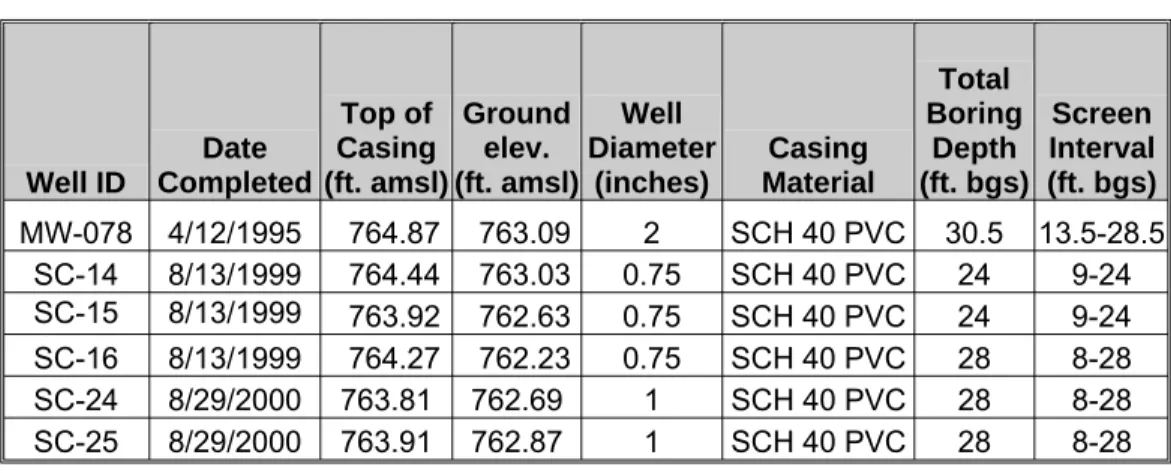
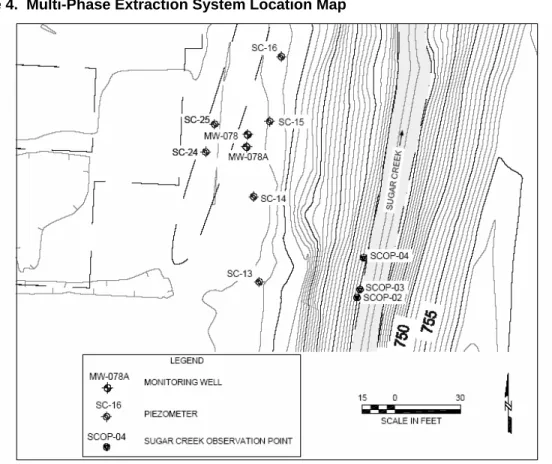
Isolated and periodic LNAPL seeps were observed in Sugar Creek which are believed to be from historical releases in the Crawford Area (RETEC, 2004b). To abate the seeps and due to the fine-grained low-permeability soils in the Crawford Area, multi-phase extraction was selected as an interim measure to extract LNAPL and groundwater under high vacuum. The system was pilot tested in 1998 and then full-scale operation on six extraction wells was started in January 2001. The extraction wells, MW-078, SC-14, SC-15, SC-16, SC-24, and SC-25, are shown in Figure 4, and a process flow diagram of the multi-phase extraction system is provided in Figure 5. Table 3 provides construction information on the multi-phase extraction wells. The multi-phase extraction system was cycled for four months, and then it was determined that more LNAPL recovery could be achieved through full-time extraction from one well, MW-078, which was operated until January 2003. Total fluids were extracted via a 10 horsepower high-vacuum liquid ring vacuum pump, separated in a knockout tank and water was discharged to an oil water separator and to the POTW. Vapors were treated with granular activated carbon drums and discharged to the atmosphere. LNAPL was periodically transferred to the Tank 95R.
Table 3. Multi-Phase Extraction Well Details
Well ID Date Completed Top of Casing (ft. amsl) Ground elev. (ft. amsl) Well Diameter (inches) Casing Material Total Boring Depth (ft. bgs) Screen Interval (ft. bgs) MW-078 4/12/1995 764.87 763.09 2 SCH 40 PVC 30.5 13.5-28.5 SC-14 8/13/1999 764.44 763.03 0.75 SCH 40 PVC 24 9-24 SC-15 8/13/1999 763.92 762.63 0.75 SCH 40 PVC 24 9-24 SC-16 8/13/1999 764.27 762.23 0.75 SCH 40 PVC 28 8-28 SC-24 8/29/2000 763.81 762.69 1 SCH 40 PVC 28 8-28 SC-25 8/29/2000 763.91 762.87 1 SCH 40 PVC 28 8-28 Notes:
ft. amsl – feet above mean sea level ft. bgs – feet below ground surface
Figure 4. Multi-Phase Extraction System Location Map
3.0 MATRIX DESCRIPTION AND LNAPL CHARACTERISTICS
Matrix characteristics and operating parameters can affect the cost or performance of a treatment technology. This section evaluates the key parameters that affect cost or performance of dual-pump recovery and multi-phase extraction. The matrix characteristics documented in this section include soil types, soil properties, hydrogeology, LNAPL characteristics, and LNAPL volume estimates. The operating parameters include system parameters, such as pumping rates and applied vacuum.
3.1 MATRIX CHARACTERISTICS AND OPERATING PARAMETERS AFFECTING TECHNOLOGY COST OR PERFORMANCE
3.1.1 Dual-Pump Recovery
Unconsolidated sediments in the Lower Refinery Area consist of colluvium overlying alluvial deposits within the floodplains of both the Missouri River and Sugar Creek. The upper lithologic zone (Zone A) exists from ground surface to approximately 25 to 35 feet bgs. Zone A is described on Lower Refinery Area boring logs as silty clay or clayey silt with occasional fine sand (RETEC, 2004a). Zone B extends to bedrock (approximately 60 feet bgs) and pinches out to the south. Zone B is described as a silty to coarse sand which coarsens with depth in the Lower Refinery Area (RETEC, 2004a).
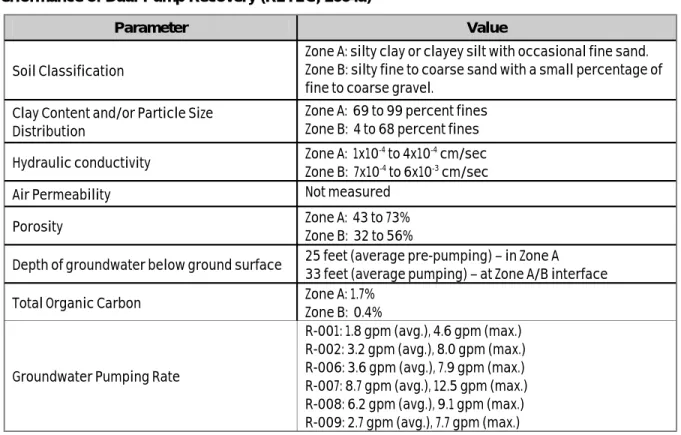
Table 4 lists the matrix characteristics of the soil in the Lower Refinery Area which affect the cost or performance of the dual-pump recovery system.
Table 4. Matrix Characteristics and Operating Parameters Affecting Technology Cost or Performance of Dual-Pump Recovery (RETEC, 2004a)
Soil Classification
Parameter
Zone A: silty clay or clayey silt with occasional fine sand. Zone B: silty fine to coarse sand with a small percentage of fine to coarse gravel.
Value
Clay Content and/or Particle Size Distribution
Zone A: 69 to 99 percent fines Zone B: 4 to 68 percent fines Hydraulic conductivity
Air Permeability
Zone A: 1x10⁻⁴ to 4x10⁻⁴ cm/sec
Zone B: 7x10⁻⁴ to 6x10⁻³ cm/sec
Not measured
Porosity Zone A: 43 to 73% Zone B: 32 to 56%
Depth of groundwater below ground surface 25 feet (average pre-pumping) – in Zone A
33 feet (average pumping) – at Zone A/B interface
Total Organic Carbon Zone A: 1.7% Zone B: 0.4%
Groundwater Pumping Rate
R-001: 1.8 gpm (avg.), 4.6 gpm (max.) R-002: 3.2 gpm (avg.), 8.0 gpm (max.) R-006: 3.6 gpm (avg.), 7.9 gpm (max.) R-007: 8.7 gpm (avg.), 12.5 gpm (max.) R-008: 6.2 gpm (avg.), 9.1 gpm (max.) R-009: 2.7 gpm (avg.), 7.7 gpm (max.) Notes:
cm/sec – centimeters per second
3.1.2 Multi-Phase Extraction
LNAPL in the Crawford Area is located in unconsolidated deposits consisting of fill; silt, clayey silt to silty clay; and silt loess (RETEC, 2004b). Loess, consisting of windblown silt and clay, is the predominant soil lithology in the Crawford Area. Lithologic data collected in the Crawford Area describe the loess as poorly sorted silts and clayey silts with low to high plasticity, very stiff when unsaturated to soft when saturated.
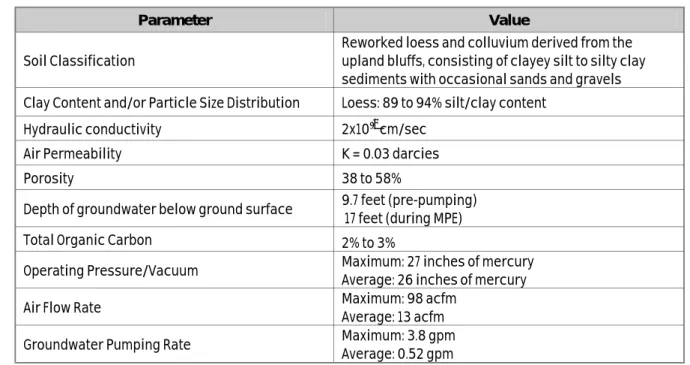
Table 5 lists the matrix characteristics and operating parameters of the soil in the Crawford Area which affects the cost or performance of the multi-phase extraction system.
Table 5. Matrix Characteristics and Operating Parameters Affecting Technology Cost or Performance of Multi-Phase Extraction at the Former Refinery (RETEC, 2004b)
Parameter Value
Soil Classification
Reworked loess and colluvium derived from the upland bluffs, consisting of clayey silt to silty clay sediments with occasional sands and gravels
Clay Content and/or Particle Size Distribution Loess: 89 to 94% silt/clay content
Hydraulic conductivity 2x10⁻⁶ cm/sec
Air Permeability K = 0.03 darcies
Porosity 38 to 58%
Depth of groundwater below ground surface 9.7 feet (pre-pumping) 17 feet (during MPE)
Total Organic Carbon 2% to 3%
Operating Pressure/Vacuum Maximum: 27 inches of mercury Average: 26 inches of mercury
Air Flow Rate Maximum: 98 acfm Average: 13 acfm
Groundwater Pumping Rate Maximum: 3.8 gpm Average: 0.52 gpm
Notes:
cm/sec – centimeters per second
acfm – actual feet per minute
gpm – gallons per minute
Overall, the soils in the multi-phase extraction area are predominantly cohesive silts and clays, and classified as fine-grained soils. Overall they have less air permeability and lower hydraulic conductivity than the soils in the dual-pump recovery area, which is reflected in the differences in groundwater
pumping rate. Even at a vacuum-enhanced 26-inches of mercury, the multi-phase extraction system only averaged 0.52 gpm, while the dual-pump recovery wells average between 1.8 and 8.7 gpm per well (RETEC, 2004d).
3.2 LNAPL CHARACTERIZATION
The following sections provide information on LNAPL characterization, LNAPL saturation, and distribution at the dual-pump recovery and multi-phase extraction systems.
3.2.1 Dual-Pump Recovery Area
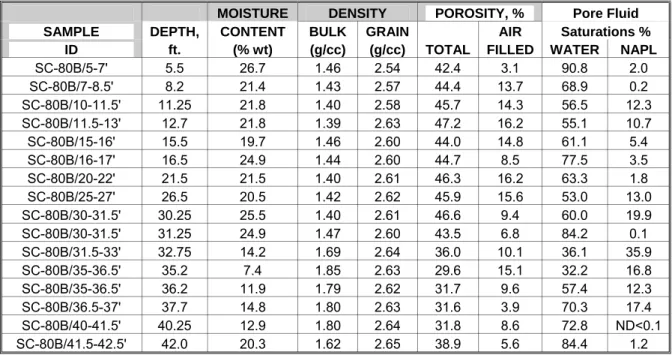
Table 6 provides the LNAPL pore fluid saturations for the dual-pump recovery area. Sample
identification (i.e., “ID”) is by soil boring ID and core interval in feet below ground surface (bgs). Sample locations are shown in Figure 2.
Table 6. LNAPL Saturations versus Depth for the Dual Pump Recovery Area (RETEC, 2004d)
MOISTURE DENSITY POROSITY, % Pore Fluid SAMPLE DEPTH, CONTENT BULK GRAIN AIR Saturations %
ID ft. (% wt) (g/cc) (g/cc) TOTAL FILLED WATER NAPL
LRSB-4A/20-22.5' 21.0 45.4 1.09 2.61 58.3 7.4 87.3 ND<0.1 LRSB-4A/20-22.5' 22.0 47.5 1.07 2.62 59.3 8.6 85.4 0.1 LRSB-4A/22.5-25' 23.0 91.7 0.71 2.62 73.0 8.0 88.1 0.9 LRSB-4A/22.5-25' 24.1 38.1 1.26 2.60 51.5 3.2 92.5 1.2 LRSB-4A/25-27.5' 26.0 26.9 1.39 2.63 47.1 8.8 81.3 ND<0.1 LRSB-4A/25-27.5' 27.0 22.5 1.42 2.61 45.5 11.6 54.4 20.1 LRSB-4A/27.5-30' 28.0 31.4 1.31 2.55 48.8 7.8 84.0 0.1 LRSB-4A/27.5-30' 29.0 34.6 1.26 2.59 51.4 7.3 79.4 6.4 LRSB-4A/30-32' 30.5 23.3 1.45 2.69 46.1 11.8 67.6 6.8 LRSB-4A/30-32' 31.5 13.8 1.50 2.68 44.0 22.0 34.6 15.3 LRSB-4A/32-32.5' 32.4 38.0 1.17 2.63 55.5 26.3 38.7 14.0 LRSB-4A/32.5-35' 33.5 19.0 1.52 2.66 42.9 12.6 53.3 17.3 LSRB-5A/32.5-35' 33.0 20.0 1.48 2.61 43.2 13.0 56.2 13.6 LSRB-5A/32.5-35' 34.1 22.5 1.41 2.56 44.7 11.5 49.4 24.9 LSRB-5A/35-37 35.5 17.0 1.62 2.61 37.7 8.1 70.8 7.9 LSRB-5A/35-37 36.6 20.4 1.52 2.63 58.3 26.8 53.9 ND<0.1 LRSB-5A/37-39' 37.5 18.1 1.54 2.64 41.8 13.8 66.4 0.6 LRSB-5A/37-39' 38.5 13.8 1.66 2.64 37.4 14.2 61.9 ND<0.1 LSRB-5A/39-40.5' 39.25 19.1 1.52 2.63 63.2 33.7 46.7 ND<0.1 LSRB-5A/39-40.5' 40.25 12.7 1.79 2.63 31.8 9.0 70.6 1.0 LRSB-5A/40.5-42.5' 41.0 14.5 1.75 2.64 33.9 8.2 74.0 1.8 LRSB-5A/40.5-42.5' 42.0 12.6 1.81 2.65 31.7 8.8 71.9 0.3 LRSB-6A/30-32.5' 31.0 29.7 1.30 2.61 50.3 11.5 75.1 2.2 LRSB-6A/30-32.5' 32.1 26.7 1.31 2.62 50.1 13.3 53.5 19.9 LRSB-6A/32.5-35' 33.0 28.9 1.27 2.62 51.6 13.9 61.4 11.7 LRSB-6A/32.5-35' 34.1 27.6 1.29 2.63 51.0 14.0 55.5 17.1 LRSB-6A/35-37.5' 35.5 28.4 1.23 2.62 53.0 16.4 54.4 14.7 LRSB-6A/35-37.5' 36.9 26.4 1.36 2.62 48.1 10.4 61.4 17.0 LRSB-6A/37.5-40' 38.5 24.7 1.40 2.64 46.8 11.5 70.8 4.5 LRSB-6A/37.5-40' 39.5 23.9 1.43 2.64 45.7 11.2 75.2 0.3 LRSB-6A/40-42' 40.5 15.2 1.63 2.64 38.4 13.3 64.9 0.4 LRSB-6A/40-42' 41.5 12.2 1.75 2.64 33.8 12.2 63.7 0.2
Table 6. LNAPL Saturations versus Depth for the Dual Pump Recovery Area, continued (RETEC, 2004d) SAMPLE ID SC-80B/5-7' SC-80B/7-8.5' SC-80B/10-11.5' SC-80B/11.5-13' SC-80B/15-16' SC-80B/16-17' SC-80B/20-22' SC-80B/25-27' SC-80B/30-31.5' SC-80B/30-31.5' SC-80B/31.5-33' SC-80B/35-36.5' SC-80B/35-36.5' SC-80B/36.5-37' SC-80B/40-41.5' SC-80B/41.5-42.5' DEPTH, ft. 5.5 8.2 11.25 12.7 15.5 16.5 21.5 26.5 30.25 31.25 32.75 35.2 36.2 37.7 40.25 42.0 MOISTURE CONTENT (% wt) 26.7 21.4 21.8 21.8 19.7 24.9 21.5 20.5 25.5 24.9 14.2 7.4 11.9 14.8 12.9 20.3
DENSITY POROSITY, % Pore Fluid BULK GRAIN AIR Saturations % (g/cc) (g/cc) TOTAL FILLED WATER NAPL
1.46 2.54 42.4 3.1 90.8 2.0 1.43 2.57 44.4 13.7 68.9 0.2 1.40 2.58 45.7 14.3 56.5 12.3 1.39 2.63 47.2 16.2 55.1 10.7 1.46 2.60 44.0 14.8 61.1 5.4 1.44 2.60 44.7 8.5 77.5 3.5 1.40 2.61 46.3 16.2 63.3 1.8 1.42 2.62 45.9 15.6 53.0 13.0 1.40 2.61 46.6 9.4 60.0 19.9 1.47 2.60 43.5 6.8 84.2 0.1 1.69 2.64 36.0 10.1 36.1 35.9 1.85 2.63 29.6 15.1 32.2 16.8 1.79 2.62 31.7 9.6 57.4 12.3 1.80 2.63 31.6 3.9 70.3 17.4 1.80 2.64 31.8 8.6 72.8 ND<0.1 1.62 2.65 38.9 5.6 84.4 1.2
3.2.2 Multi-Phase Extraction Area
Table 7 provides the LNAPL pore fluid saturations for the multi-phase extraction system, and the soil boring location is shown on Figure 4.
Table 7. LNAPL Saturations versus Depth for the Multi-Phase Extraction Area (RETEC, 2004b) Sample ID SC-24/4.6’ SC-24/5.5’ SC-24/5.6’ SC-24/6.2’ SC-24/7.8’ SC-24/8.5’ SC-24/8.9’ SC-24/9.5’ SC-24/9.8’ SC-24/11.9’ Depth (ft.) Moisture Content % 4.6 24.3 5.5 24.1 5.6 22.1 6.2 20.4 7.8 23.3 8.5 22.3 8.9 20.2 9.5 25.8 9.8 26.3 11.9 24.4 Density Bulk (g/cc) Grain (g/cc) 1.53 2.63 1.56 2.64 1.6 2.63 1.53 2.48 1.62 2.65 1.51 2.63 1.63 2.65 1.48 2.63 1.51 2.61 1.54 2.64 Porosity Total Air Filled 41.8 4.6 40.9 3.4 39.1 3.5 38.1 6.7 38.9 1.3 42.6 9 38.4 5.4 43.8 5.6 42.2 2.8 41.7 4.1 Pore Fluid Saturation, % Pore Volume Water LNAPL 89.8 0.1 90.6 1.4 92.1 <0.1 83.6 <0.1 99.9 <0.1 82.0 <0.1 88.5 <0.1 87.8 0.1 96.7 <0.1 91.5 <0.1
3.3 LNAPL SPECIFIC THICKNESS
Traditionally, the conceptual model for the occurrence of LNAPL in the subsurface pictured an LNAPL layer, “pool”, or “pancake” floating on a depressed representation of the capillary fringe or water table
(Ballestero et al. 1994). This was based on laboratory experience in highly uniform sand or glass beads (idealized porous media), because those conditions are easiest to replicate in bench scale tests and can be performed rapidly. The concept of measured LNAPL thickness in an observation well equalizing with the LNAPL layer within the capillary fringe of the soil (even though the LNAPL saturation in the soil may be low), made it possible to explain large (5 or more ft) accumulations of LNAPL in observations wells while LNAPL recovery attempts in those conditions often resulted in recovery of little LNAPL.
Adamski, et al. (2004) explains the differences between LNAPL in homogenized sand versus fine-grained soils like those in the multi-phase extraction area. Counter-intuitive behaviors include the fact that a very small and discontinuous volume of LNAPL observed in the surrounding soil may result in several feet of LNAPL in an observation well; very low LNAPL recovery volumes when large LNAPL accumulations are present in neighboring wells; and apparent LNAPL migration below the water table. Because these observations did not fit with the traditional understanding of LNAPL in ideal porous media, LNAPL volumes were estimated based on a revised conceptual model for LNAPL in the subsurface.
To accurately estimate the quantity of LNAPL in the subsurface, the LNAPL specific thickness (i.e., “Do”)
must be estimated from soil core or monitoring well data. Do is the integral of the LNAPL saturation over
the depth of a soil column. It represents the total thickness of LNAPL that occurs as disseminated and discontinuous pockets of LNAPL throughout the LNAPL-impacted porous medium (i.e., subsurface soil). Therefore, Do is defined as the specific thickness of LNAPL, which is representative of the amount of
LNAPL in a formation. For example, if you had a core of soil separated into its respective media (i.e., air, water, LNAPL, and soil), Do is a normalized volume of LNAPL (feet3/feet2) per unit surface area, but is
expressed as a thickness (in units of feet). At equilibrium, due to capillary forces in soil, the measured LNAPL thickness in a monitoring well is always greater than Do.
The following schematic shows a conceptualization of a typical monitoring well in the subsurface with groundwater and LNAPL:
Figure 6. LNAPL Schematic in a Typical Monitoring Well (Charbeneau et al., 1999)
z
aoz
owz
awb
oWater Table
LNAPL
Layer
The LNAPL thickness is located between the air-NAPL interface zao and the NAPL-water interface zow.
The total monitoring well LNAPL thickness is bo. The elevation of the water table, zaw, provides the
datum for fluid levels. While the water table is not measured in a monitoring well because of the LNAPL layer, its elevation is determined from the elevations zao and zow, and the LNAPL specific gravity.
The relationship between measured monitoring well LNAPL thickness, bo, and the specific LNAPL
volume, Do, may be calculated from the following equation:
z max
b
D
o( )
o=
∫
n
S
o( )
z
dz
zow
Where: Zmax = height of oil
Zow = height of the oil/water interface
So = saturation of oil
n = soil porosity
The function Do(bo) may be approximated piecewise by a linear function integration of soil core LNAPL
saturations with depth. LNAPL specific thickness. Do. is calculated as follows:
Do = LNAPL % * porosity * soil core interval (ft.)
Where:
LNAPL % = oil saturation (in % of pore volume) porosity = site-specific total porosity (in %)
soil core interval = interval of LNAPL impacted core (in feet)
Tables 6 and 7 summarize soil core data for both the Lower Refinery and Crawford Area monitoring wells. Table 8 provides the results of measured LNAPL thickness in wells compared to the integrated specific thickness Do. The results demonstrate that the specific thickness of LNAPL in the soil
(expressed in units of feet) is a small fraction of the measured LNAPL thickness in monitoring wells.
Table 8. Comparison of Measured versus Specific LNAPL Thickness (Do) (RETEC, 2004b, 2004d) bo Measured Location Monitoring Well Soil Type (USCS Code) LNAPL Thickness (ft.) Do (ft3/ft2 Ratio of bo/Do Remediation Technology ) 0.09 0.51 0.24
Crawford SC-24 Loess (CL) 15 164 MPE
Lower
Refinery MW-178 Silty Sand (SM) 4.16 8 DPR
Lower
Refinery ROW-006A Silty Sand (SM) 5.6 23 DPR
Lower
Refinery MW-179 Silty Sand (SM) 3.69 0.5 7 DPR
Lower
Refinery SC-80B Fine Sand (SW) 9.35 1.55 6 DPR
Notes:
USCS – Unified Soil Classification System (CL – Clay, SM – silty sand, SW – well graded sand)
Do is defined as the integral of the LNAPL saturation over the depth of the soil column, also known as the specific thickness of
LNAPL over a given soil column area. MPE – Multi-Phase Extraction DPR – Dual Pump Recovery
For this case study, relative change in measured LNAPL thickness from observation wells within the Lower Refinery Area is used as a measurable indicator of recovery well performance (i.e., LNAPL recovery over time). This comparative relationship is valid only because of the consistency in soil and fluid properties within this area. Note that any measured LNAPL thickness presented throughout this evaluation is not indicative of actual LNAPL thickness in the subsurface. In addition, measured LNAPL
thickness alone is not indicative of potential recoverability or the true volume of LNAPL in the subsurface. Soil and fluid properties must also be known to make accurate estimates of these values.
3.4 LNAPL CHARACTERIZATION
Table 9 compares characteristics of LNAPL at the dual-pump recovery and multi-phase extraction areas.
Table 9. LNAPL Characterization for the Dual-Pump Recovery and Multi-Phase Extraction Areas (RETEC, 2004b, 2004d)
LNAPL Type
Parameter
light crude oil, slightly to moderately weathered
Dual-Pump Recovery Area
middle distillate range diesel or fuel oil, heavily weathered
Multi-Phase Extraction Area
LNAPL Specific Thickness (Do)
LNAPL Pore Fluid Saturations LNAPL Density
LNAPL Viscosity
Interfacial Tension (LNAPL/Water) Surface Tension (Air/LNAPL) Benzene Percentage of Total LNAPL TEX Percentage of Total LNAPL
initially: unknown Presently: 0.70 feet (avg.) <0.1 to 35.9%
0.81 grams per milliliter (g/mL) 1.18 to 1.49 centipoise 14.3 to 20.5 dynes/cm 25.1 to 25.4 dynes/cm 2.82% 25.0% Initially: 0.09 feet Presently: 0.04 feet <0.1 to 1.4%
0.92 grams per milliliter (g/mL) 6.3 to 13.9 centipoise
17.3 to 20.2 dynes/cm 27.4 to 30.7 dynes/cm
0.36% 1.12% Note: TEX – Toluene, Ethylbenzene, and Xylenes
The LNAPL in the multi-phase extraction system is less volatile, more viscous, and more degraded than in the dual-pump recovery area, which limits the effectiveness of a high-vacuum extraction technology. To overcome these factors, a 10 horsepower liquid ring vacuum pump was utilized to provide 26-inches of mercury vacuum to the subsurface to enhance groundwater and LNAPL recovery rates.
3.5 LNAPL VOLUME ESTIMATES
Even though up to 15 feet of LNAPL were measured at multi-phase extraction wells in the Crawford Area, the Do specific thickness equals only 0.09 ft3/ft2. For an estimate of LNAPL volume, the estimated plume
extent equals approximately 50 ft. by 50 ft. is multiplied by Do specific thickness. Under these
assumptions, the estimated volume of LNAPL in the Crawford Area was approximately 1,700 gallons. In the dual-pump recovery area, LNAPL volume was estimated using an average Do from all soil cores in
the Lower Refinery Area (Table 8, equal to 0.70 ft3/ft2) and a total plume size estimated at 5 acres. The current in-place LNAPL volume estimate within each recovery well’s radius of capture is 1.1 million gallons, which is significantly higher than in the multi-phase extraction area. Additional LNAPL exists in the unsaturated zone and outside of each well’s radius of capture. The larger amount of LNAPL in the dual-pump recovery area is due to a larger plume size, larger pore size, higher permeability soils and higher LNAPL saturations (see Table 6 and Table 7).
4.0 REMEDIATION GOALS AND PERFORMANCE OBJECTIVES
Remediation goals and performance objectives for the former refinery are individual for each interim measure, but are designed and operated to abate imminent threats to human health and the environment. The overall remediation goal of both multi-phase extraction and dual-pump recovery systems is source reduction through LNAPL recovery to reduce mobility and risk to the environment. During the technology evaluation process in the CMS, particular technologies are evaluated as potential final corrective measures technologies if they have a likelihood of meeting proposed LNAPL remediation goals and endpoints in a reasonable timeframe. Remediation goals and performance objectives provide a decision-making framework to guide a practicable and attainable approach for RCRA Corrective Action and long-term management of contaminated media and LNAPL in the subsurface.
The Handbook of Groundwater Protection and Cleanup Policies for RCRA Corrective Action (U.S. EPA, 2004) provides guidance on defining short, intermediate and long-term protection goals, as well as a timeframe for reaching endpoints at large RCRA corrective action sites. Overall protection goals are broad objectives, while endpoints are specifically identified to measure the progress towards meeting the goals. Short-term goals focus on immediate or imminent threats to human health and the environment, which are characterized under Groundwater and Human Health Environmental Indicators (EIs) (U.S. EPA, 2001) and, at RCRA sites, are typically addressed under RCRA interim measures. The short-term protection goal has been demonstrated through the issuance of the Human Health (U.S. EPA, 2002) and Groundwater (U.S. EPA, 2004b) EIs, which indicates that current human exposures and contaminated groundwater are under control at the former refinery. Intermediate protection goals are broader and longer-term than short-term goals and, for the former refinery, were defined for final corrective measures which have reachable and measurable endpoints in a tangible time frame. Long-term protection goals include final cleanup goals that ensure long-term protection of human health and the environment, control the source of releases, and achieve media cleanup objectives.
4.1 LNAPL REMEDIATION GOAL
The overall remediation goal for LNAPL at the former refinery is to recover LNAPL to the maximum extent reasonably, technically, and economically feasible and consistent with prudent engineering
practices (i.e., reduce LNAPL to its practicable limit of recoverability). For both the multi-phase extraction and dual-pump recovery systems, the American Petroleum Institute’s (API) LNAPL Distribution and Recovery Model (Charbeneau, 2003) was used to define the practical limit of LNAPL recovery.
4.2 DUAL-PUMP RECOVERY AND MULTI-PHASE EXTRACTION PROTECTION GOALS
The former refinery is currently an interim status facility under RCRA, although final protection goals have been proposed to U.S. EPA and MDNR and are currently under review. The proposed protection goals for the LNAPL include the following:
Short-term protection goals:
•
Eliminating LNAPL seeps to Sugar Creek (source/boundary control) Intermediate protection goals:•
Eliminating LNAPL in the subsurface that may serve as a risk to surface water Long-term protection goals:•
Reducing interior sources of LNAPL such that dissolved-phase hydrocarboncontaminants migrating from groundwater to surface water meet ECOTOX criteria in surface water (U.S. EPA, 1996)
4.3 DEFINING APPROPRIATE ENDPOINTS
Endpoints are defined as site-specific, measurable criteria and milestones that demonstrate progress towards meeting protection goals. The following subsection outlines the proposed endpoints for shutdown of the dual-pump recovery and multi-phase extraction systems. The multi-phase extraction system was shutdown in January 2003 after six-months of no LNAPL recovery.
4.3.1 API Distribution and Recovery Modeling
Dual-pump recovery is designed to meet the intermediate protection goal of LNAPL source reduction to the practicable limit of LNAPL recovery. In order to define the practicable limit of LNAPL recovery, the API LNAPL Distribution and Recovery Model (Charbeneau, 2003) was used to predict LNAPL recovery from the dual-pump recovery system. The API modeling process includes two steps, distribution modeling of LNAPL in the subsurface, and recovery modeling under dual-pumping conditions, as summarized below. The API model results are then used to predict long-term LNAPL recovery to propose shutdown criteria (endpoints) for the dual-pump recovery system.
The distribution portion of the model predicts LNAPL saturation and permeability based on measured LNAPL thickness in a monitoring well and several site-specific soil, fluid (i.e., LNAPL and groundwater), and soil-fluid interaction parameters. Using the results of the distribution model, the recovery portion of the API model predicts LNAPL recovery from individual wells over time. After predicting LNAPL recovery for each recovery well, the model results were validated against one year of actual LNAPL recovery data (Figure 7) (RETEC, 2004d).
Inputs necessary to run the API distribution model include the following:
• Measured LNAPL thickness
• Soil input parameters: porosity, the van Genuchten parameters “N” and “α,” irreducible water saturation, and residual LNAPL saturation in the vadose and saturated zones
• Fluid input parameters: LNAPL density, air/water surface tension, air/LNAPL surface tension, and LNAPL/water surface tension
These parameters were taken from field measurements and observations, the results of the lab analysis of the soil plug samples and the fluid samples, or were based on professional judgment. The results from the API distribution model for each recovery well are then used as the basis for the API recovery model. For recovery modeling, the data required to predict LNAPL recovery over time includes the radius of capture (ROC) for the well, radius of influence (i.e., cone of drawdown), the LNAPL viscosity, and water production rate. For a water-enhanced system, the effective depth of penetration of the well into the aquifer must also be specified. The API recovery model gives estimates of the total volume of LNAPL within the radius of capture of each recovery well, the amount of LNAPL that is recoverable at each well, the rate of recovery, the total time in which that LNAPL can be recovered, the measured LNAPL
thickness over time in the recovery well, and the LNAPL recovery rate over time.
The API model was applied at the six remaining operational dual-pump recovery wells. Validation was performed using 18 months of actual LNAPL recovery data (from June 2003 to December 2004). The total LNAPL recovery of all six wells from June 2003 to December 2004 was equal to 133,533 gallons, which is approximately 6-percent less than the API model prediction of 141,500 gallons. Modeled results for the system, along with the first year validation are shown in Figure 7. Overall the API model results show good calibration to actual LNAPL recovery results.
Figure 7. LNAPL Recovery for Dual-Pump Recovery System: Modeled vs Actual (RETEC, 2004d) 350,000 300,000 250,000 200,000 150,000 100,000 50,000 0 ] l i l A 133,533 gallons Total LN APL R ecovery Vol u me [gallons
Tota Modeled NAPL Recovery (All S x Wells - Dua Pumping)
Total Actual NAPL Recovery (All Six Wells -1.5 yrs)
ctual LNAPL recovery over 18 months =
0 1 2 3 4 5 6
Figure 8. Predicted Yearly LNAPL Recovery from the Dual-Pump Recovery System (RETEC, 2004d) LNAP L Volume (gallons) 100,000 90,000 80,000 70,000 60,000 50,000 40,000 30,000 20,000 10,000 0 Years
Based on predictive LNAPL recovery modeling of the performance of the dual-pump recovery system (Figure 8), the proposed endpoint will be when LNAPL reaches an asymptotic rate of recovery. Based upon the API modeling results, the asymptote for LNAPL recovery is estimated to be reached at some point after six to ten years of operation, although actual shut-down of the recovery wells will be based on empirical recovery data. At that time, the recovery wells will be transitioned to skimming wells using the former refinery’s vacuum truck to continue LNAPL source reduction. Long-term management and vacuum truck removal of residual LNAPL from monitoring and inactive recovery wells will be determined in a forthcoming Long-Term Management Plan, which will be submitted to the agencies in 2005.
5.0 RECOVERY SYSTEMS DESCRIPTION, PERFORMANCE, AND COST
The following section provides a summary of the performance and cost of the dual-pump recovery and multi-phase extraction systems at the former refinery. Lessons learned and comparative performance are also discussed herein.
5.1 DUAL-PUMP RECOVERY SYSTEM
The dual-pump recovery system has operated at the former refinery for more than 20 years. Over that period of time, recovery well equipment has been replaced and modified following internal evaluations to optimize the system and improve system performance. This section primarily concentrates on the recovery well system performance since the system modifications were implemented, with pertinent historical information provided as appropriate. This section also includes items that affect the system as a whole; individual active recovery well performance is discussed in the next section.
5.1.1 Dual-Pump Recovery System Description
LNAPL recovered via the recovery well system is pumped directly from each well to LNAPL storage Tank 95R. Recovered LNAPL is stored in Tank 95R until it is sent off site for recycling. The Tank 95R gauge is used to measure the quantity of water and LNAPL within the tank on a weekly basis. These
measurements are used to check the LNAPL mass balance.
The water treatment system includes a water totalizer, clarifier tank, and air stripper. Recovered groundwater is piped from each active recovery well to the clarifier tank prior to batch-transfer to the air stripper. Groundwater from the air stripper is discharged to the City of Independence publicly owned treatment works (POTW) for final treatment and disposal.
5.1.2 Dual-Pump Recovery System Performance
Based on historical records presented in the Quarterly Progress Reports (BP, 2004), the dual-pump recovery system has recovered 1.82 million gallons of LNAPL and over 200 million gallons of
groundwater between 1982 and 2003. The following table provides annual totals of numbers of operating recovery wells, water recovery and LNAPL recovery.
Table 10. Dual-Pump Recovery System Annual Water and LNAPL Recovery (RETEC, 2004c)
Year 1982 1983 1984 1985 1986 1987 1988 1989 1990 1991 1992 1993 No. of Operating Recovery Wells 2 2 3 3 3 3 15 15 15 15 13 13 Water Recovery (gallons) 81,700 81,700 122,600 122,600 122,600 122,600 612,910 13,594,543 22,555,415 20,718,219 18,537,399 12,283,788 LNAPL Recovery (gallons) 12,000 12,000 18,000 15,000 15,000 15,000 92,365 179,799 180,000 180,000 180,000 150,000 Gallon water / gallon LNAPL 6.8 6.8 6.8 8.2 8.2 8.2 6.6 76 125 115 103 82
Year 1994 1995 1996 1997 1998 1999 2000 2001 2002 2003 2004 No. of Operating Recovery Wells 13 10 9 9 9 9 9 9 7 6 6 Water Recovery (gallons) LNAPL Recovery (gallons) Gallon water / gallon LNAPL 3,823,121 50,927 75 13,810,350 119,552 116 15,687,000 134,672 116 10,745,430 68,492 157 13,531,570 94,239 144 13,609,270 95,286 143 11,573,710 72,301 160 8,421,900 50,362 167 2,607,390 11,186 233 12,100,000 73,500 165 12,462,984 79,500 157 Total = 207,328,799 1,899,181
Total Water/LNAPL ratio = 109.2
The system recovered a total of 79,500 gallons of LNAPL in 2004. The increased LNAPL recovery from 2002 to 2004 is believed to be from operational enhancements detailed in the next section. The total groundwater to LNAPL recovered ratio for the dual-pump recovery system is 109:1. Figures 9 and 11 show the respective annual LNAPL and groundwater recovery for the dual-pump recovery system from 1982 to 2004. Figure 10 shows the cumulative LNAPL recovery from 1982 through 2004, as well as the superimposed API-model predicted recovery over the next ten years. In addition, the number of
operating recovery wells per year is plotted at the base of each figure. Model predictions were based on LNAPL saturations collected in June 2003, so there is approximately 18 months of overlap for validation purposes.
Figure 9. Dual-Pump Recovery System Annual LNAPL Recovery (RETEC, 2004c) 0 ( ) 10,000 20,000 30,000 40,000 50,000 60,000 70,000 80,000 90,000 100,000 110,000 120,000 130,000 140,000 150,000 160,000 170,000 180,000 190,000 200,000 LN APL Re co very g al lo n s 198 2 198 3 198 4 198 5 198 6 198 7 198 8 198 9 199 0 199 1 199 2 199 3 199 4 199 5 199 6 199 7 199 8 199 9 200 0 200 1 200 2 200 3 200 4 2 2 3 3 3 3 15 15 15 15 13 13 13 10 9 9 9 9 9 9 7 6 6
Number of Wells in Operation
Figure 10. Lower Refinery Recovery Well Network Cumulative LNAPL Recovery
0 ) 500,000 1,000,000 1,500,000 2,000,000 2,500,000 L NAP L Re cov e re d (ga l. J-14 J-13 J-12 J-11 J-10 J-09 J-08 J-07 J-06 J-05 J-04 J-03 J-02 J-01 J-00 J-99 J-98 J-97 J-96 J-95 J-94 J-93 J-92 J-91 J-90 J-89 J-88 J-87 J-86 J-85 J-84 J-83 J-82 Year ( l
Figure 11. Dual-Pump Recovery System Annual Groundwater Recovery (RETEC, 2004c) 10,000 100,000 1,000,000 10,000,000 100,000,000 G roundw ater Re cov e ry (gal lons) 1982 1983 1984 1985 1986 1987 1988 1989 1990 1991 1992 1993 1994 1995 1996 1997 1998 1999 2000 2001 2002 2003 2004 2 2 3 3 3 3 15 15 15 15 13 13 13 10 9 9 9 9 9 9 7 6
Number of Wells in Operation
The effectiveness of LNAPL source recovery is indicated in reductions in measured LNAPL thickness over time. Table 11 shows measured LNAPL thickness reductions over time in monitoring wells in the dual-pump recovery network.
Table 11. Measured LNAPL Thicknesses Reductions in Dual-Pump Recovery System Observation Wells over Time (RETEC, 2004d)
Well Well 1986/ 1987 1989/ 1990 1992/ 1993 1996/ 1997 1999/ 2000 2003/ 2004 in LNAPL A-014 NA 0.07 0.8 0 0.24 0.02 0 100% A-015 5.54 NM NM 2.1 NM NM 62% A-015A 10.87 NM NM 4.51 NM NM 59% A-038 NA 6.27 0 0.2 2.74 0.27 0 100% A-039 2.25 NM NM 1.62 NM 0 100% A-040 0.26 NM NM 0 NM NM 100% A-041 NA 1.77 NM NM 0.72 NM 0.55 69% NA NM NM NM 0.84 NM NM NA MW-179 NA NM NM NM NM NM 7.12 NA NM 7.3 0 NM NM NM 100% NM NM NM NM NM 4.99 NA NM 8.7 10.3 9.35 4.83 4.42 49% NM 7.8 9.3 10.65 6.65 3.29 58% NM 7.6 7.1 3.71 0.01 0 100% NM 10.3 3.7 0 0.09 NM 99%
Measured LNAPL Thickness (feet) Observation Recovery % Decrease Thickness R-001 R-001 R-002 R-005 HB-005 ROW-006 R-006 ROW-006A R-006 ROW-007 R-007 ROW-008 R-008 ROW-009 R-009 ROW-010 R-010 Notes: NM – Not Measured
% Decrease in LNAPL thickness is calculated using 2003/2004 data, if it exists. Earlier numbers are used in some cases.
The data in Table 11 demonstrates that initial LNAPL thickness measurements averaged 7 feet before source reduction and system optimization in 2002 (RETEC, 2002). Measured LNAPL thickness has been significantly reduced over time in each observation well located within the vicinity of the recovery well network. The observation wells show a minimum 49 percent and average 83 percent decrease in measured LNAPL in 2003/2004 when compared to initial measurements (Table 11), with many of the wells showing no measurable LNAPL during the most recent gauging events. The decrease in measured LNAPL thickness in the observation wells indicates that the dual-pump recovery system is successfully removing LNAPL volume and reducing saturation in the subsurface.
The recovery well system optimization (RETEC, 2002) determined that groundwater elevation and LNAPL thickness in the recovery wells should be maintained at approximately 705 feet above mean sea level (amsl) to increase LNAPL recovery rates. This corresponds to the interface between lithologic Zones A and B, and was considered to be the optimum groundwater level for LNAPL recovery in the recovery wells (RETEC, 2002). As the Missouri River elevation increases above 705 feet amsl, the gradient to the dual-pump recovery wells is increased and LNAPL recovery is increased. Figure 12 shows an example of LNAPL recovery at recovery well R-007 when the water level was maintained at 705 ft. amsl from January to July 2003 and lowered to 699 ft. amsl from July through December 2003. The chart shows that LNAPL recovery increased with pump elevations lowered to 699 ft. amsl, which corresponds with the lowest elevation the pumps can be placed in recovery well R-007.
Figure 12. Well R-007 Fluid Level Measurements and LNAPL Recovery for 2003 (RETEC, 2004c) l ( l) 0 l ( ) ( / ) l ( l) l ( l)
R-007 Fluid Level Measurements
695 697 699 701 703 705 707 709 711
Jan-03 Feb-03 Apr-03 May-03 Ju -03 Sep-03 Oct-03 Dec-03 Date E lev at io n fe et a m s 200 400 600 800 1,000 1,200 1,400 W ee k y L N A P L R e co ve ry g a l
LNAPL Recovered gal week Water E ev. ft. ams LNAPL E ev. ft. ams
Based on the LNAPL/water recovery ratio, well R-007 is one of the most effective recovery wells in the system. It has the greatest daily LNAPL recovery rate at approximately 97 gallons, although it also has the greatest daily water recovery rate at 9,900 gallons. In 2004, it recovered over 42,000 gallons of LNAPL, which is greater than the estimated LNAPL recovery of all other recovery wells combined.
5.1.3 Dual-Pump Recovery System Costs
The following capital costs were estimated for the dual-pump recovery system, based on installation dates of dual-pump recovery wells:
Table 12. Dual-Pump Recovery System Estimated Capital Costs
Year No. of Wells Drilled Drilling Cost per well Pump cost per well 1982 3 $ 10,000 $ 2,000 1984 1 $ 12,000 $ 2,400 1987 4 $ 14,000 $ 2,800 1988 8 $ 15,000 $ 3,000 Electrical Controls per well $ 6,000 $ 8,000 $ 10,000 $ 11,000 Labor per well $ 4,000 $ 5,000 $ 7,000 $ 8,000 Design/ Oversight (25%) $ 5,500 $ 6,850 $ 8,450 $ 9,250 Subtotal per well Subtotal (per year) $ 27,500 $ 82,500 $ 34,250 $ 34,250 $ 42,250 $ 169,000 $ 46,250 $ 370,000 Total = $ 655,750 NPV = $ 1,258,514
In addition, the following are estimated annual O&M Costs:
Table 13. Dual-Pump Recovery System Estimated O&M Costs
Year 1982 1983 1984 1985 1986 1987 1988 1989 1990 1991 1992 1993 1994 1995 1996 1997 1998 1999 2000 2001 2002 2003 2004 No. of Operating Recovery Wells 2 2 3 3 3 3 15 15 15 15 13 13 13 10 9 9 9 9 9 9 7 6 6 Annual O&M Costs $ 20,000 $ 20,000 $ 30,000 $ 30,000 $ 30,000 $ 30,000 $ 150,000 $ 150,000 $ 150,000 $ 150,000 $ 130,000 $ 130,000 $ 130,000 $ 100,000 $ 90,000 $ 90,000 $ 90,000 $ 90,000 $ 90,000 $ 90,000 $ 90,000 $ 142,000 $ 100,000 POTW Water Disposal Costs $ 163 $ 163 $ 245 $ 245 $ 245 $ 245 $ 1,226 $ 27,189 $ 45,111 $ 41,436 $ 37,075 $ 24,568 $ 7,646 $ 27,621 $ 31,374 $ 21,491 $ 27,063 $ 27,219 $ 23,147 $ 16,844 $ 5,215 $ 24,200 $ 25,125 Oil Sale ($0.50/gallon) $ (6,000) $ (6,000) $ (9,000) $ (7,500) $ (7,500) $ (7,500) $ (46,183) $ (89,900) $ (90,000) $ (90,000) $ (90,000) $ (75,000) $ (25,464) $ (59,776) $ (67,336) $ (34,246) $ (47,120) $ (47,643) $ (36,151) $ (25,181) $ (5,593) $ (36,750) $ (52,933) Subtotal O&M Costs $ 14,163 $ 14,163 $ 21,245 $ 22,745 $ 22,745 $ 22,745 $ 105,043 $ 87,290 $ 105,111 $ 101,436 $ 77,075 $ 79,568 $ 112,183 $ 67,845 $ 54,038 $ 77,245 $ 69,944 $ 69,576 $ 76,997 $ 81,663 $ 89,622 $ 129,450 $ 72,192 Total O&M = $1,574,083 NPV = $2,295,835 Notes:
Annual O&M costs include labor, electricity, replacement materials.
Annual O&M costs from 1982 to 2002 are estimated based O&M cost per well and number of wells operating. NPV = Net Present Value at a 3.5 percent discount rate
Based on the estimated capital cost ($1,258,514) and O&M cost ($2,295,835), the total cost of the dual-pump recovery system, accounting for inflation, is equal to $3,554,349. Assuming 1.899 million gallons of LNAPL have been recovered to date, the cost per gallon to recover LNAPL using dual-pump recovery is $1.87 per gallon.
5.1.4 Dual-Pump Recovery System Observations and Lessons Learned
Originally, tracking water levels in the dual-pump recovery system with the Missouri River stage was proposed in the Interim Measures Work Plan (Woodward-Clyde, 1989). This procedure was used until 2002 but now is not considered the most efficient method of running the system. It now appears that the most effective method to run the system is to maintain pump levels at an elevation of 699 ft. (instead of 705) amsl and let the Missouri River fluctuations fluctuate, seasonally developing a large gradient between the recovery system and the river. At an elevation of 709 feet amsl, for example, LNAPL