MONETIZATION: A THEORY AND APPLICATIONS
James R. Hull
A dissertation submitted to the faculty of the University of North Carolina at Chapel Hill in partial fulfillment of the requirements for the degree of Doctor of Philosophy in the Department of Sociology.
Chapel Hill 2009
iii
ABSTRACT
JAMES R. HULL: Monetization: A Theory and Applications (Under the direction of Dr. Barbara Entwisle)
Chapter 1 introduces the topic. In Chapter 2, I present a review of the theoretical work on monetization and money. This chapter identifies the classic schools of thought on what monetization is and combines these with recent interdisciplinary scholarship to produce a theory of monetization for the 21st Century. It is shown that this theory provides improved explanatory power and generates many more interesting avenues for further research than the current theories. The major contribution of this chapter is a new theory of monetization that builds on the work of classic sociology, economics, and anthropology. Chapter 3 extends the theoretical work of Chapter 2 to connect it with familiar sociological literatures describing exchange, social networks, and trust. It highlights the importance these factors for understanding monetization as institutional change. It compares this enhanced theoretical understanding to simpler economic models typically employed and demonstrates that the social network interpretation of
iv
demographic, economic, and agricultural factors that predict this transition in a
v
vi
ACKNOWLEDGEMENTS
I am deeply indebted to many who have helped me toward completion of this dissertation. Dr. Barbara Entwisle, my advisor and committee chair, provided invaluable advice and guidance along the way, both on the dissertation itself and about how to be a better professional sociologist and demographer. The other members of my committee, Dr. Guang Guo, Dr. Ted Mouw, Dr. Andy Perrin, and Dr. Ronald R. Rindfuss, all read numerous drafts, adding their expert advice and greatly improving the final version. The usual disclaimer should be made that all remaining defects are solely my responsibility.
The many individuals who have worked on the Nang Rong Projects and assisted me over the past few years are too numerous to mention individually, but I would especially like to thank Rick O’Hara and Mary Williams for patiently answering all of my initial questions about Nang Rong and the data.
vii
viii
TABLE OF CONTENTS
LIST OF TABLES...xiii
Chapters I. INTRODUCTION TO THE DISSERTATION...1
Organization...1
Introduction to the Topic...2
Significance and Contributions of Each Chapter...3
II. THE SOCIOLOGICAL SIGNIFICANCE OF MONEY AND MONETIZATION...7
Introduction...7
Reexamining Money and Monetization...9
The General Sociological Problem...9
Popular Understandings of Money and Monetization...12
The Conceptual Problem...14
Existing Theoretical Approaches to Money: A Critique...17
The Materialist-Functionalist Approach to Defining Money...18
Marx and the “Riddle of Money”...24
Simmel and the “People Behind the Objects”...32
Institutions, Information, and Money: A Synthesis...35
ix
The Role of Information in Exchange...36
Barter and Monetary Exchange Institutions...37
Dodd’s Social Network Contribution...39
Synthesis...40
Money and Monetization in the World: Radford Revisited...41
An Empirical Application...41
Three Interpretations of Radford’s Account...46
Evaluation...49
Implications for Level of Analysis, Conceptualization, and Agency...53
Discussion: Reclaiming Money and Monetization...55
III. SOCIAL NETWORKS AND MONETIZED LABOR...60
Introduction...60
Theory...61
What is Monetization? ...61
Monetization, Information, and Trust...63
Social Network Hypotheses...71
Context and Data...73
Nang Rong District, Thailand...73
Units of Analysis and Sample...78
Measurement and Methods...80
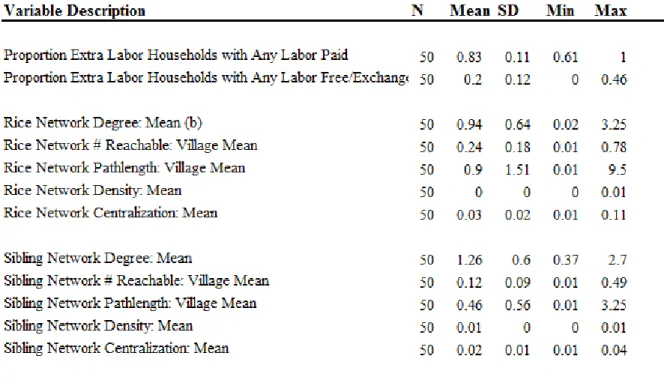
Variable Descriptions...80
x
Results...86
Village-Level Descriptive Results...87
Village-Level Correlation Results...88
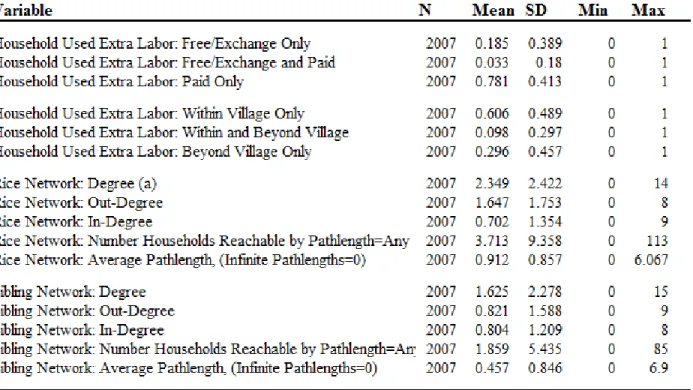
Household-Level Descriptive Results...90
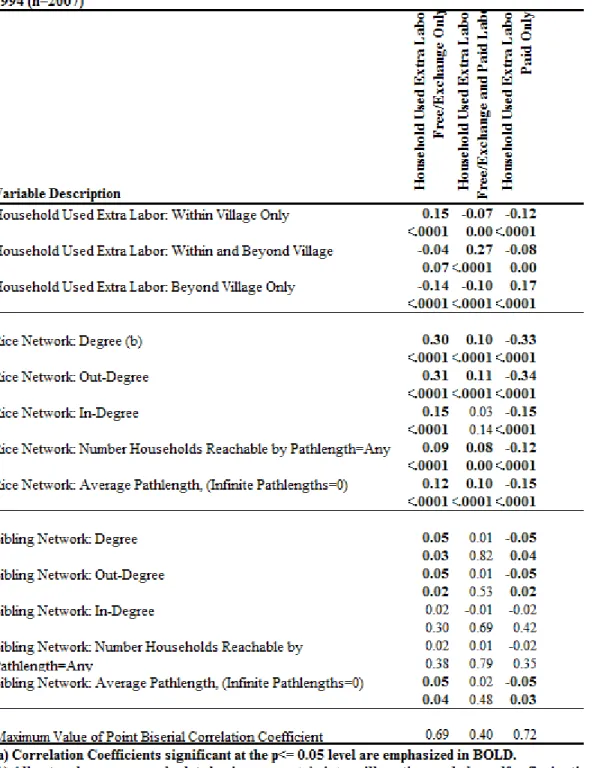
Household-Level Correlation Results...90
Discussion...93
Potential Threats to Internal and External Validity...93
Competing Explanations of Findings...99
Conclusions...102
IV. AGRICULTURAL PARTICIPATION AND LABOR MONETIZATION IN A TRANSITIONAL ECONOMY...113
Introduction...113
Conceptualization and Theory...119
Case...122
Why Nang Rong? ...122
Context: The Rice Harvest and Rice Labor...124
Methods...129
Dependent Variable Measurement...129
Independent Variable Measurement...130
Model and Sample...137
Results...138
Descriptive Results...138
xi
The Rice-Growing Equation...144
Results of the Decomposition Analysis...146
Discussion...148
Potential Threats to Internal and External Validity...149
Conclusions...154
V. CONCLUSION TO THE DISSERTATION...164
Review of Major Findings and Significance...164
General Implications for Future Studies of Monetization...166
Specific Implications for Data and Measurement...168
APPENDICES...171
Appendix 1A: Full Matrix of Pearson Correlations among Village Characteristics and Rice Harvest Labor Measures, 1994 (r and p-values)...171
Appendix 1B: Full Matrix of Pearson Correlations among Village Characteristics and Rice Harvest Labor Measures, 2000 (r and p-values)...172
Appendix 2A: Full Matrix of Pearson Correlations among Household-Level Network and Rice Harvest Labor Measures, 1994 (r and p-values)...173
Appendix 2B: Full Matrix of Pearson Correlations among Household-Level Network and Rice Harvest Labor Measures, 2000 (r and p-values)...174
Appendix 3: Demography Articles Drawing Theoretical Connections Between Monetization and Other Subjects, Organized by Thematic Areas...175
Appendix 4: Maximum Likelihood Heckman Selection Model of Paid Labor Use (With Huber-White Robust Standard Errors at Village Level)...179
xii
LIST OF TABLES
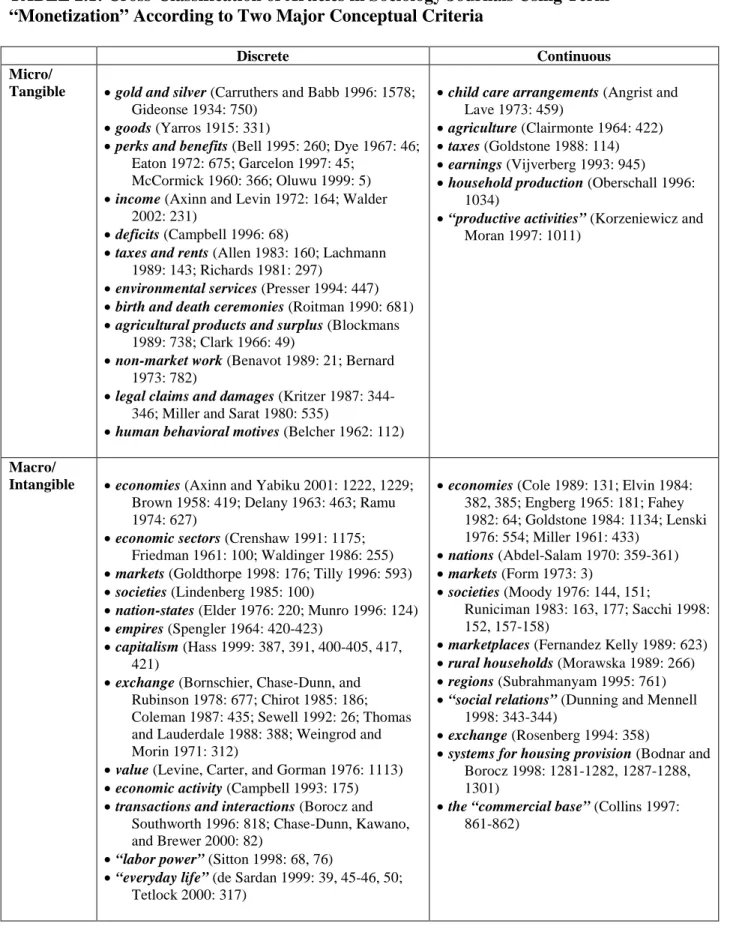
TableCross-Classification of Articles in Sociology Journals Using Term “Monetization” According to Two Major Conceptual Criteria...59
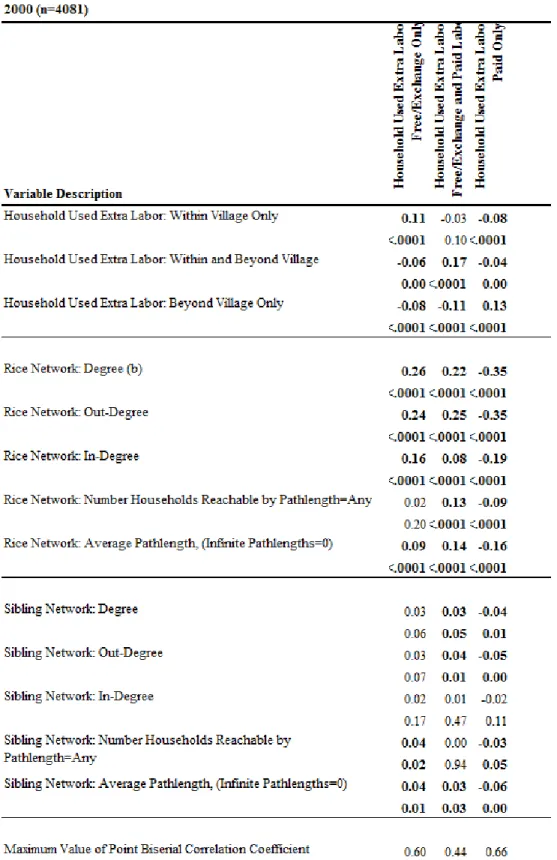
3.1 Descriptive Statistics for All Village-Level Measures, 1994 & 2000...105 3.2 Pearson Correlations among Village Characteristics and Rice
Harvest Labor Measures, 1994 (r and p-values)...106 3.3 Pearson Correlations among Village Characteristics and Rice
Harvest Labor Measures, 2000 (r and p-values)...107 3.4 Descriptive Statistics for Household-Level Measures,
1994 & 2000...108 3.5 Pearson Correlation between Household-Level Network and Rice
Harvest Labor Measures, 1994 (r and p-values)...109 3.6 Pearson Correlation between Household-Level Network and Rice
Harvest Labor Measures, 2000 (r and p-values)...110 3.7 Proportions of Households at Each Stage of Sample Selection...111 3.8 Correlation between Village Labor Demand and Various
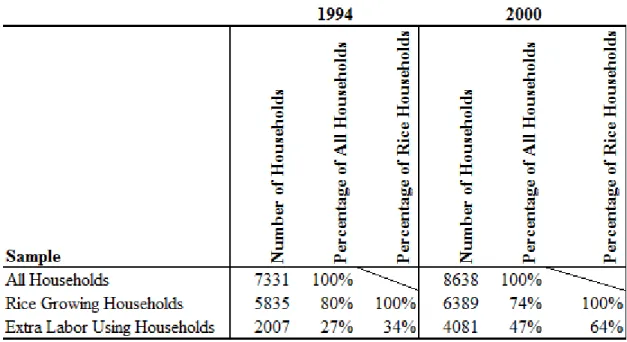
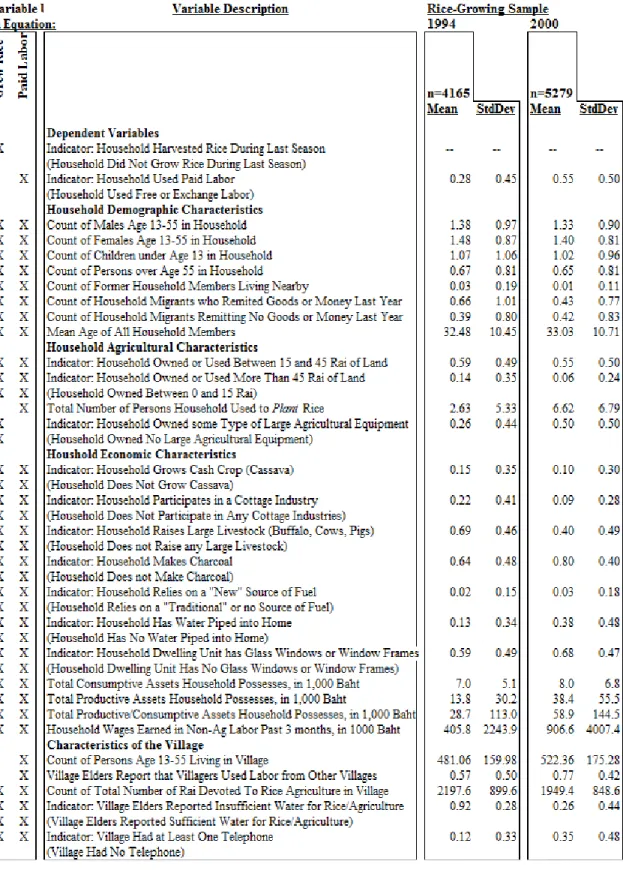
Measures of Monetization………..112 4.1 Descriptive Statistics for Full and Rice-Growing Samples,
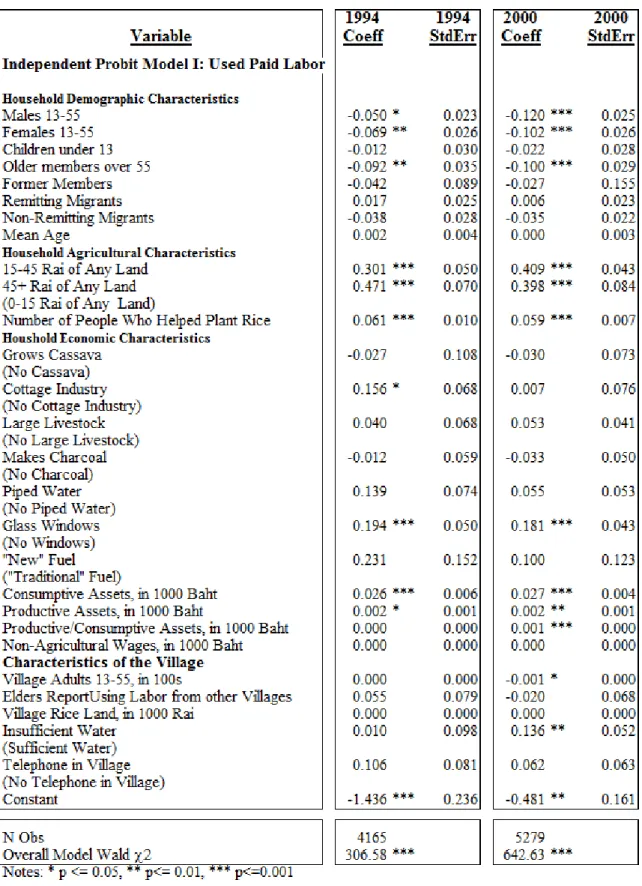
All Variables...158 4.2 Independent Probit Models of Paid Labor Use and Rice Growing
(With Huber-White Robust Standard Errors at Village Level)...160 4.3 Decomposition Using Probit Predicted Probabilities...162 4.4 Predicted Probabilities of Monetized Labor Using Means of
CHAPTER 1
INTRODUCTION TO THE DISSERTATION
ORGANIZATION
The three chapters that follow introduce and develop the formal concept of monetization, derive basic predictions about the nature of this phenomenon, and use variety of analytical strategies for evaluating these predictions. In Chapter 2, I present a review and synthesis of the theoretical work on monetization, and by necessity, a
comprehensive review of the literature on money itself. I then provide two very different types of applications (Chapters 3 and 4) that each accomplish several goals. First, they illustrate empirically how researchers can begin to think more carefully about
2
organizational structure of academic research. But, first, a brief introduction to the general topic is in order.
INTRODUCTION TO THE TOPIC
Monetization, and money itself, share the dubious distinction of being concepts that engender a false sense of familiarity. Perhaps it is because of antiquity of the initial “transition from barter to money” in the highly developed social contexts inhabited by most professional researchers, or perhaps because of the ubiquity of money in such a context, but such speculation is quite limited in the present work. Instead, in the papers that follow I confine myself to the immediate, and considerable, implications of taking excessive liberties with concepts that should be central to sociology, as well as
economics, anthropology, and other disciplines. Therefore, one common thread among these three stand-alone articles is the attempt to avoid a similarly cavalier treatment of the concept. Rather than presuming a shared understanding of what money is, and what it means for something or someone to experience “monetization,” I devote as much attention as space allows to explicitly conceptualizing both terms. And while far from a complete treatment, it is my hope that the reader will be satisfied with the theoretical and empirical progress that result.
3
disciplines: modernization, commercialization, Westernization, development,
mechanization, and on and on. Connections to myriad other more specialized sociological subjects are frequently implied as well.
The existence of two such widely divergent views, even in to disciplines that regularly disagree theoretically and methodologically, is a curiosity in its own right. But, given the enormous research potential suggested by this second view, one would expect to find considerable theoretical and empirical work directed at understanding
monetization – what it is, what causes it, what it causes, and what its implications are from a variety of perspectives. And yet, in hundreds of published articles that relate monetization to one or another topic, not one devotes space to defining, discussing, or elaborating on the conceptual meaning of monetization. I do not fault the authors of these articles, for it is also clear that none were written with the explicit goal of improving understanding of monetization. Instead, the implication of this pattern of treatment is that all of the diverse subjects related to monetization might be relatable in intriguing new theoretical ways, and understandings of each improved, if understanding of monetization itself were a significant goal of at least a few sociological writers.
SIGNIFICANCE AND CONTRIBUTIONS OF EACH CHAPTER
4
focusing on the technology of money rather than on the social institutions and network structures that exist and regulate its use. Among early sociological writers, Karl Marx and Georg Simmel devoted considerable theoretical attention to what Marx called the
“riddle” of money. But for reasons that can be explored only briefly in the chapter, these theoretical treatments failed to inspire a field of empirical study of money from a
sociological perspective. I argue that this is a major loss to the discipline, and attempt to provide a theory of money and monetization for the 21st Century that might better support such empirical investigations. This revised theory incorporates core elements of Simmel and Marx, but also synthesizes theoretical insights scattered in other disciplines to provide a comprehensive, interdisciplinary theory of monetization that outperforms conventional treatments on several measures.
Chapter 3 is entitled “Social Networks and Monetized Labor.” It builds on the work of chapter 2 extending it further to connect up with more familiar sociological literatures describing exchange, social networks, and trust. The result is a set of testable, if simple, hypotheses about the most prominent characteristics of social exchange
networks associated with monetized and non-monetized exchange. Chapters 3 highlights the importance of social networks, information, and trust for understanding monetization as institutional change and again compares this enhanced theoretical understanding to simpler economic models typically employed. Methodologically, this chapter emphasizes the usefulness of basic correlation analysis to support or refute these empirical
5
monetization and money. But, it is acknowledged that much work remains to be done before monetization can be fully described as a shift in the structure of exchange networks and the information transmitted by these networks as it is suggested will be possible by Chapter 2.
Chapter 4 is entitled “Agricultural Participation and Labor Monetization in a Transitional Economy.” It is truly unique in treating monetization as an outcome variable and exploring the basic demographic, economic, and agricultural factors that help to predict this transition in a specific type of transaction common to many world economies: the exchange of agricultural labor. I devote considerable space in the chapter to a
discussion of methodological problems that will be common in modeling the
6
monetization and traditional agriculture. Utilizing the longitudinal character of the data, the greater degree of monetization observed at a later time period is shown to be a response to changes in the structural parameters of the model, while declining
agricultural participation is better explained by the shifting composition of the population through common demographic processes like population aging.
Lastly, it is important that I also address the question of what new measurement procedures and data collection initiatives are suggested by the results of these chapters, and what types of data will be required to more satisfactorily evaluate the new theory presented here. This is the principal function of the Conclusion to this dissertation, in addition to reviewing the major connections between chapters. While smaller
CHAPTER 2
THE SOCIOLOGICAL SIGNIFICANCE OF MONEY AND MONETIZATION
INTRODUCTION
In this paper, I present revised conceptual definitions of money and monetization which synthesize the strongest elements from Marxist and Simmelian analyses of money with
contemporary scholarship. This new theoretical framework incorporates institutional and social network views of the role of money in society and the process of social change that is
monetization. That such a theoretical development has utility for researchers is shown in two ways. First, I note that in current sociology, no one writes papers about the sociological
significance of monetization itself; rather, authors write papers about many other topics in which monetization is recognized as somehow connected, but for reasons not fully clear, is not brought under direct scrutiny, or measured and incorporated into models. The absence of research
directly addressing monetization has resulted in a disorganized state of affairs in which little agreement exists even about even the most basic conceptual issues. I suggest that one reason for this is that we lack a contemporary sociological theory of money, one that is easily relatable to other major subjects of sociological inquiry, as well as compatible with the research traditions of economics and anthropology, where money currently receives more attention.
8
World War II, selected for its comparatively contemporary setting, the prospective, first-hand documentation provided about the events by an economist of the time, and its considerable reputation as a pedagogical tool in illustrating the functions and utility of money. In analyzing the significance of the account as traditionally presented and then pointing out its weaknesses, I aim to do more than just provide a better theory. I also hope to persuade more sociologists (and not just economic sociologists) to take a renewed look at money and monetization as the fully sociological concepts that they are and to consider ways to incorporate elements of monetization theory directly into their own work.
Third, I argue that this synthesis of classical sociological writing and scholarship from multiple disciplines yields a fundamentally different way of thinking about money and
monetization, one that performs an important function of theory – the generation of novel research questions and new avenues for research – far better than the current, rather stagnant theoretical understanding of money. The revised theory of money and monetization presented here places social institutions and network relationships in the foreground, replacing the money instrument as the key feature that enables monetized exchange to be identified. Further, the new theory will make explicit statements about the nature of monetization that are currently absent from sociological writing on the subject, specifically, that it is best conceptualized not as discrete or continuous, but as both depending on the scale at which the phenomenon is studied. Together, these and other aspects of the theory allow monetization to be easily related to the already well-established fields of research on social networks and social exchange and suggest a number of research questions that are as old as either Marx or Simmel and yet remain unanswered today.
9
better sense of just how important monetization is as a general subject, and at the same time to reveal how much is to be gained from a better theory of money. I turn in Section III to a formal review of economic, and classical sociological theories of money and monetization in order to ground the theory I develop later in classical sociological work and to remind contemporary sociologists of the central significance that money once occupied in the writings of the
discipline. In Section IV, I introduce the various theoretical elements that contribute to a revised theory of money and monetization. Section V provides an evaluation of the new theory using one of the most well-known and best-documented cases of monetization in action, as well as an elaboration of the broader utility of the theory. Lastly, I return in Section VI to the objectives stated above and several more specific questions posed throughout the chapter to again make a broader call for the revitalization of sociological interest in monetization.
REEXAMINING MONEY AND MONETIZATION
The General Sociological Problem
Exchange is one of the oldest and most pervasive of all human activities. It is so central to the human experience that Simmel once proclaimed it to be the most unique identifying characteristic of the human “exchanging animal” (2006: 291). That oldest form of direct commodity exchange, barter, has been with humanity from time immemorial, and money, too, has been a fixture of societies since at least the time of Aristotle, who provided perhaps the first serious analysis of money (Mielke 2000). And yet even in the most market-oriented economies on Earth, a surprising number of social exchanges that could in principle involve money remain fully or partially non-monetized, or undergo monetization before our eyes, or involve
10
observation by itself, but more interesting still from a sociological perspective is the question of
why some types of exchange continued to be monetized while others are not. More fundamental
still, questions remain about what precisely occurs when some type of exchange becomes
monetized, that is, when money, whatever it is, becomes an acceptable means of payment. Under what conditions does monetary exchange emerge and flourish? Under what conditions is it extinguished? What other social phenomena are affected by the way social exchange is carried out and how? And what implications might monetary exchange have for the cultural and moral fabric of a village, state, or nation? These questions should encourage the reexamination of classic works on money from the previous century as well as the role of money in contemporary society.
Two major questions lurk continually behind the present analysis, and are better addressed sooner rather than later. First, is it really true that sociology has had so little to say about money in recent decades? And second, if so, what is the reason? The first question will take up much of the next two sections, but it should be said at the outset that what is in fact lacking are 20th Century sociological theories of what money is and what it does in society, not theories that incorporate money indirectly, of which there are many for money is ubiquitous and inherently social. On the second question, it has been suggested that the study of money was simply ceded to economics altogether during the Methodenstreit of the late 19th and early 20th Century (Ingham 1998; Ingham 2000). That is, as sociology and economics grew into distinct disciplines and carved out (and defended) subject domains, money became economists’ turf. But this interpretation ignores the glaring fact, to be detailed below, that economic theories of
11
The sociologists ceded the field [of money theory] to the economists (presumably on the grounds that money is pre-eminently an economic subject), but as has been shown, the prevailing tendency among the economists was to relegate the discussion of money to a very low order of priority. It would seem, however, that any unified social science worthy of the name must at some point seriously confront what has always been, and still is, one of the key social institutions in everyday life. (2000a: 7).
Here Smithin points to the problem: a lack of serious consideration of money across two major social sciences that ought to both have more to say on the subject. But he leaves unanswered the question of why. I would suggest as a common explanation for the lack of critical attention in both economics and sociology that money is a fundamental and ever-present part of the habitus of nearly every practicing social researcher. It is something used every day by nearly every one of us to accomplish myriad tasks, ranging from the most mundane, such as feeding ourselves, to the more significant, such as purchasing an automobile or a better education. Such observations may well have been as true in the day of Marx, Weber, and Durkheim as they are today. But perhaps because using money seems as natural as breathing air, the nature of money and what distinguishes it from other forms of value largely escapes critical attention and scrutiny. It is simply too common and vulgar to attract notice.
12
economy, which has served for more than a century as an example for textbooks, Radford’s account has been repeated and reimagined many times by scholars attempting to gain new insight or to argue just the opposite – that the current understanding of money is more than sufficient to explain such cases. It is precisely because of the great popularity of Radford’s account with scholars of money that it will be used here as well to highlight the advantages of a fully
sociological theory of money and monetization. But, more generally, a science of money that is built solely on the analysis of its perversities and anomalies is still insufficient to the task of understanding the general role of money in society, a task that has only grown in magnitude over time. Thus, along with other authors who have called for renewed sociological attention to money as a subject of interest in its own right (Deflem 2003; Ingham 1998; Ingham 2000; Keister 1992; Swedberg 1997), I suggest that there is much to be gained from a theory of money and monetization for the 21st Century.
To see just what is to be gained, I will shortly present a broad review of the sociological literature discussing monetization, but to better ground this review, I first present a brief
discussion of the popular understanding of the concepts of money and monetization.
Popular Understandings of Money and Monetization
Although this review focuses on the formal, scientific theories of money, it is extremely useful to begin where most people begin, researchers and non-researchers alike, with the popular understanding of what is special and unique about money and what it means for something to become monetized. At this most basic level, there exists a clever bit of semantic sleight-of-hand, one that is often imitated in more formal academic treatments, in which the definition of
13
Monetization is defined by the OED as a noun corresponding to the verb monetize, so to
discover its meaning, one must investigate the entry for monetize (2002a). To monetize,
according to the OED, is to “convert to the use of money” (2002b). Slightly more information is provided for the adjective monetized, with the addition of the parenthetical phrase “(as opposed to barter)” (2002c). In this derivative way it becomes necessary to examine the manifold
meanings of the word money in order to discover fully what either monetize or monetized mean. This approach, closely mimicked in the social science literature, focuses on money itself as the key feature distinguishing monetary transactions from non-monetary transactions. That is, to define monetization one must first define money. Having done so, identifying monetization ought to be a straightforward task, as one simply looks for the use of money and if it is found, then monetization and monetized exchange there is also.
Further, the meaning of money exchange is often pegged to the meaning of barter
14
These popular and highly standardized definitions of barter are insufficient on their own merits because each treats a separate, antonymic concept as sufficient to define the most
important features of a different concept. In short, they only tell us what barter is not, and vice versa. Without an adequate definition of money, barter remains logically undefined. Returning to the OED yields this problem in its starkest form yet, “any generally accepted medium of
exchange which enables a society to trade goods without the need for barter…” (2002d). What, then, is money in the popular understanding? It is any form of exchange that is not barter. And what is barter? It is any form of exchange that does not use money. To see the confusion created by allowing money and monetization to remain as popular terms rather than properly defined scientific concepts, I now consider the general pattern of usage in the sociological literature.
The Conceptual Problem
Among the benefits of a better theory of money and monetization, the one with the greatest potential to impact research throughout the discipline would be improved conceptual clarity among sociologists discussing the relationship of this phenomenon to other sociological subjects. Assessing the manner in which the concept is employed by researchers whose principal focus is not monetization provides a measure of the extent of the problem of theory
underdevelopment and the ability of scholarship on monetization to reach a wider audience, while giving one a tantalizing glimpse of what is to be gained through better integration of these many and varied lines of research if the problem be resolved.
The term “monetization” has been used to describe an exceedingly wide range of phenomena operating at an equally wide range of scales in the sociology literature. To simplify the presentation I use a typology to sort current usage of the concept according to two
15
whether it is conceptualized at a macro or micro level. The result is a two-by-two table in which each article is placed in the quadrant that most closely describes the way in which the term is conceptualized by its authors.
The first dimension assesses whether monetization is identified or implied as an “all or nothing” sort of transformation. A discrete conceptualization suggests that something either is monetized or is not monetized, while a continuous conceptualization suggests that something can be partially monetized or in the process of monetizing. Determining which category a particular usage belongs to is sometimes difficult, owing to ambiguity in the discussion or the fleeting nature of the authors’ use of the term. In these instances, the author’s unstated conceptual model can often be divined by asking whether monetization is described as a single, one-time event, or as an ongoing or gradual, process. The former consistently suggest a discrete conceptualization, while the latter imply a continuous treatment in nearly every case.
The second dimension assesses the scale at which the process identified as monetization is said to be operating. As with the first dimension, authors do not always provide much context to use in classifying their usage, and in these cases it is sometimes easier to ask whether the phenomenon undergoing monetization is an individual relation or thing or a corporate actor or social institution. Thus, this second dimension can also be thought of as indexing the degree to which the thing described as being monetized is a tangible, concrete thing like gold or
agricultural products or a more intangible, abstract concept, like a society or economy.1
1 Of special interest is the increasingly common practice of using “monetization” to describe a stand-alone process,
16
The result of this cross-classification is presented in Table 2.1. The purpose of this table is not to completely represent the exact pattern of usage across the entire field (or fields) of sociology as might be done in a formal subject review. Rather, it is to demonstrate that
considerable heterogeneity exists in the pattern of usage. Thus, the most important observation about this table is quite simply that all four quadrants contain many articles. This suggests that while individual authors no doubt feel confident about the conceptual meaning of monetization when they employ the term, a very different picture emerges when these works are viewed as a collective whole. There is actually considerable disagreement about whether monetization occurs at the scale of individual transactions or entire economies and whether it occurs all at once or in a more ragged, piecemeal fashion.2 As these are two of the most basic conceptual questions
imaginable, they speak to the low level of theoretical development surrounding monetization. The key challenge posed by these many diverse appearances of the term in the literature is determining if and how they might be unified by a single theoretical construct. It may be the case that some of these are eclectic formations, resulting from a researcher’s own creative
grasping for words to describe a process observed in empirical research. But, the very uniqueness of the term “monetization,” suggests that these many diverse instances are an attempt to describe the same core process or quality. If so, then a better appreciation for what precisely occurs when something undergoes monetization may enable the unification of many of these discrepant uses of the term under a single consistent theoretical framework. It would seem at first glance that different models of the spread of monetization are implied by the discrete/continuous distinction, as are different approaches to observing and measuring the concept. Likewise, the range of scales at which the process is thought to operate and the types of phenomena said to be undergoing
2
17
monetization are also quite broad. But as I will show in Section V, the conceptual definition of monetization developed in this paper relates the seemingly disparate phenomena at either end of these continua in a simple, yet consistent and grounded fashion. Under this new conceptual understanding, these different models and depictions of monetization are allowed to coexist, side-by-side, without the necessity of declaring one or another empirical account invalid.
Thus, the present state of affairs in sociology would appear to be one of considerable confusion, though largely unrecognized, over what exactly monetization is and therefore what it does. In order to address this state of under-theorization it is necessary to shed our familiarity with this thing that is money and examine it as a strange new object, for it is only in
reestablishing the sociological meaning and significance of money itself that monetization can be fully understood. Therefore, in the next section, I take a much closer look at the range of existing theories of money, and by implication, of monetization.
EXISTING THEORETICAL APPROACHES TO MONEY: A CRITIQUE
Of the multiple perspectives on money, its meaning, and function, three major schools are identified here that represent well the diversity of thought on these matters. The first, shared almost universally in economics, I label the materialist-functionalist school, following Dodd (1994). The second school is the classic Marxist analysis of money, a vital element in the larger critique of capital and political economy offered in Capital and earlier works. The third school is based on the work of Simmel on human interaction, and receives its principal expression in The Philosophy of Money. While other writers have been inclined to discuss money and its
18
The Materialist-Functionalist Approach to Defining Money
THE MATERIALIST APPROACH. What I label the materialist-functionalist perspective
is in fact comprised of two independent theoretical approaches that are united in a shaky alliance by many scholars of money. The first, a materialist approach to the problem, emerged in the latter 19th Century as economists attempted a more systematic analysis of money. While the materialist approach to defining money does not fully supplant the popular notion of, “not barter,” it does lend an air of objectivity to the concept. One of the earliest and most enduring of these classifications has been attributed to Jevons (1875), who stated that in order to be
considered money, a substance must have certain material properties, which he summarized as
portability, indestructibility, homogeneity, divisibility, and cognizability (ease of recognition,
difficulty of forgery)3. These material qualities of money gained widespread use as a theoretical construct, becoming as popular among anthropologists as they were among the economists who promulgated them, and have survived to the present day almost exactly as Jevons proposed them(Bradford 1928; Dobeck and Elliot 2007; Neale 1976; Plattner 1989).
All such attempts to define, categorize, and evaluate substances as money fall under the designation of materialist approaches to conceptualizing money. As Dodd (1994) explains, the key conceptual task in this approach is descriptive in nature (xv). The argument is elegant at first glance: certain substances or commodities are better suited to serve as money than others, and therefore the characteristics determining fitness ought to be useful criteria for the identification of money. A materialist framework often underlies ideographic approaches to research, in which a great many substances that have in reality functioned as money throughout history and across
3 While it is reasonable to credit Jevons with the organization of these various qualities into a single system, many, if
not all were present in the writings of his contemporaries. As perhaps the best example, Marx, who was developing his critique of capital contemporaneously with Jevons, identifies at least four of these five qualities as the
19
cultures are catalogued and evaluated. This is borne out by the encyclopedic compendiums in economic anthropology detailing the many substances, the more unusual the better, that have served as money (e.g. Neale 1976). Plattner (1989), for one, applauds these efforts:
One of the major contributions of early economic anthropology was to describe the wide range of things used to accomplish money functions. The list is enormous, including salt, shells, stones, beads, feathers, fur, bones, and teeth, as well as agricultural crops, animals, and of course, metals, from iron to gold and silver (175).
Without diminishing the importance of such catalogues, their contribution to a conceptual definition of money is questionable. First, while the materialist approach has the appearance of generality, in practice it is deeply rooted in analyses of “premodern”4 forms of money, and the influence of these studies on the manner in which the definition is applied can be very strong at times, especially when the attempt is made to apply them to more “modern” contexts. The very descriptors portability or indestructibility must be reimagined considerably to achieve
compatibility with a number of 21st century monetary forms. Just consider the myriad means of transferring funds electronically over the internet, as when an individual arranges to have “money” removed from a personal savings account and transferred to the account of an online merchant. Is this money, comprised solely of binary data indestructible in the same way as elemental metals such as gold or silver? Even granting that the elements of a materialist definition can be extended to new forms of money, the sheer volume and variety of substances that functioned historically as money, as well as the ever-growing list of monetary instruments that exist in fully “modern” economies suggest that virtually anything can be money, for better or for worse. Consequently, such an approach to defining money is only current until a new form of
4 The terms modern and premodern, along with similar terms, are enclosed in quotes throughout in order to stress the
20
money comes along, at which point it must be added to the list (and the standards possibly adjusted to acknowledge some new technological breakthrough). From a theoretical standpoint, materialist definitions of money are therefore greatly conflated with the historical period in which that money is studied. Worse still, from the standpoint of theory-building, such deeply idiographic descriptions of the exact nature, function, and use of so many diverse monetary instruments work in opposition to the goal of generalizability.
But there is a second, more fundamental flaw in the materialist approach to defining money. Many of the substances that can function as money do not always function as money (Dodd 1994). Even an ideal substance for monetary exchange, one that is highly portable, indestructible, homogeneous, divisible, and recognizable, can be traded directly for another substance or used in a “non-monetary” way. Gold and silver coins could historically be melted down to produce jewelry, for example. Plattner’s list of substances that have functioned as money recounted above (e.g. salt, fur, etc.) clearly speaks to this fact. The implication is that any definition of money that is solely dependent upon the physical characteristics of the substance will fail to consistently distinguish money exchange from other forms.
THE FUNCTIONALIST APPROACH. As if acknowledging the shortcomings of a pure
materialist approach, this list of material qualities is frequently supplemented with a qualitatively
21
an idealized set of functions, collectively embodied in the notion of “general purpose money” (Dodd 1994; Plattner 1989). In contrast, the idiographic, materialist task was providing an accurate assessment of the nature of the instrument and its fitness for use as money.
The functions that money is argued to perform in society comprise a highly standardized list of elements. Money is said to act as 1.) a medium of exchange, 2.) a common measure of value (or a unit of account) 3.) a store of wealth or value, and, sometimes, 4.) a standard of deferred payment (Barker 1913; Bradford 1928; Dobeck and Elliot 2007; Kemmerer 1935; Plattner 1989; Shapiro 1975). The exact number of functions changes slightly as they are combined or replicated on the list, as do the labels given to these functions. In any case, the content of this ideal set of functions is of less significance than the way they define and identify money.
To explain the need for a given function, and hence money, writers have long followed the now-familiar pattern of juxtaposing money exchange against the more “cumbersome” system of barter. For instance, one undesirable consequence of barter that has been regularly noted is the lack of “coincidence of wants”, famously illustrated by both Barker (1913) and Kemmerer (1935) with the quaint (and nearly verbatim) account by Jevons of “poor Mademoiselle Zélie,” a Parisian singer who agreed to give a concert in the Society Islands in exchange for a third of the show’s receipts. Her take was 3 pigs, 23 turkeys, 44 chickens, 5000 coconuts, and considerable quantities of bananas, lemons, and oranges (1913). As Barker dryly observes, “The Society Islanders, no doubt wanted to hear Mlle. Zélie sing, but Mlle. Zélie certainly did not want five thousand coconuts” (1913: 4).
22
want if the transaction is completed. When there are parties in one’s vicinity who have something of interest, and who are willing to accept what one has to offer in return, a “coincidence of wants” obtains. Because a substance which is recognized as a medium of exchange (money) may be accepted and held onto without fear of becoming stuck with it or its losing value over time, it is argued that money is able to overcome the coincidence of wants problem by decoupling the acts of buying and selling in both space and time. This observation also forms a central plank of the Marxist analysis, presented next.
This approach to defining money again falls short of the promises of objectivity and conceptual rigor for two major reasons. First, in the same way that a particular substance may not always be used as money, no single monetary form (at present) is able to simultaneously fulfill all of these functions perfectly (Dodd 1994). In fact, there are natural antagonisms between the functions. For example, if money is to function maximally as a medium of exchange, then it might be presumed that the more portable and transient it is the better. Meanwhile, if money is to function best as a store of value it must resist all decay, whether elemental or social. Shells, copper, silver, gold; each in its turn improved the overall functioning of money incrementally, thereby bringing the money in question into closer agreement with the ideal definition. This succession continued with the introduction of bank notes, paper money, personal checks, credit cards, debit cards, and on and on. All of these forms of money seek to fulfill the many functions of general purpose money completely and simultaneously, but in practice each remains at best only an approximation of this ideal type.
23
payment. But as a medium of exchange, the two-dollar bill often functions quite poorly in practice. Numerous popular reports recount store clerks who refuse to accept a $2 bill as
payment for services or goods, having never seen one before and believing them to be counterfeit (Olesker 2005). In one documented incident in 1993, an employee of Taco Bell refused to accept a customer’s $2 bill as payment for his order. The vexed customer escalated the encounter until a manager was called to the scene only to have the manager express the same doubt, not just as to whether the bill was authentic but whether such a thing as a $2 bill existed at all. Not until a security guard arrived was the impasse resolved (Urban Legends Reference Pages 2005).
This example provides a nice illustration of two points. First, despite having all the backing of the Federal Reserve, the United States Treasury, and many other parts of the federal government apparatus, the ability of the two-dollar bill (or any potential medium of exchange) to function as money can be completely negated by a single naïve exchange partner. One question for theorists who embrace the functionalist approach is this: in that moment and precise social context, was the two-dollar bill money? It still functioned as a store of value equal to two dollars perfectly well, whatever that value is, but it has clearly ceased to function for the moment as a medium of exchange. What was required in this case to reestablish the $2 bill as money was the involvement of a representative of law enforcement, or a trusted authority figure, essentially an agent of the “state” who legitimated and enforced the acceptance of the medium of exchange (with the implicit threat of involving still further agents, if necessary). The significance of this story should be clear: the physical form and the functions of money are neither necessary nor sufficient in all cases for the completion of a monetary transaction.
24
a material quality of money is nearly always muddled in practice. After all, it is just as valid to say that the two dollar bill failed the test of cognizability – and that it was this which prevented it from performing its function as a medium of exchange. As this illustration makes clear, these two systems are mutually reinforcing, each leaning on the other to an extent for support, both incomplete on their own. But even presented together in hybrid fashion, the materialist-functionalist approach to defining money fails on at least one major point. Even with the most detailed possible accounting of what money does and why it does it so well, proponents of the approach cannot theoretically distinguish what constitutes money a priori, but are only able to identify empirical examples post hoc. This amounts to an “I know it when I see it” strategy, providing some utility for researchers, but failing entirely in the larger tasks of stating exactly what is unique about money (Dodd 1994).
In contrast, the Marxist tradition which I describe next offers an exhaustive analysis of the forms of value, including money, from a very different perspective. Marx builds upon the work of his economist contemporaries, but among the improvements that the Marxist approach offers over the purely material-functionalist perspective is a theoretical bridge to the analysis of the wider human relations surrounding exchange.
Marx and the “Riddle of Money”
Befitting his status as a contributor to both economics and sociology, Marx’s analysis of money contains elements of both the traditional materialist-functionalist perspective just
described and the sociological, institutional view of Simmel and others explored below. But while much of Marx’s multi-thousand page corpus deals in some way with the development and implications of a money economy, it is in his analysis of value that one finds the clearest
25
of value assumes its place in his writing only insofar as it is a necessary part of the groundwork for his larger project of critiquing capital, and as soon as it is adequately addressed, Marx moves on to this primary task.5 Thus it is possible, and a great simplification, to confine this discussion of the general Marxist perspective on money to the fullest expression of Marx’s theory of value, found in Capital Volume 1 (Marx 1887).6 I leave the connection between Marx’s larger analysis of capital and the theory of monetization for future exploration, delving instead more deeply into the contrast Marx paints between barter and money exchange as distinct phenomena.
In his analysis of the forms of value, Marx posits a typology consisting of one form of use value plus four forms of exchange value, presented in a definite order that reflects an
underlying model of the historical development of the money form (1887: Ch 1, Sect 3). Each of the forms of exchange value describes a particular expression of the relationship between
commodities, and each is fundamentally distinct from the use value of the commodity. This careful distinction between the use value of a commodity, assessed in highly personal terms for the person who will use it, and the exchange value of that commodity in relation to some other commodity is an important contribution to the general analysis of money, one that Simmel, for one, is less clear about. Marx notes with frequency that these two distinct forms of value were often confused by his contemporaries, to the detriment of a proper understanding of value and money (1887: Ch 1, Sect 1).
Laying aside use value for the moment, Marx’s four-part typology of exchange value begins with the Elementary or Accidental Form of Value. At the heart of this formulation lies the
5 The truth of this is demonstrated by the fact that the term “barter” and discussions of this form of exchange appear
almost exclusively in the first three chapters of Capital.
6 Multiple translations, versions, and printings of Capital exist, many with different page numbers. To reduce
26
concept of human labor. While the production of each useful commodity requires qualitatively different types of labor, all commodities relate themselves to each other through the basic quality that all embody: human labor (1887: Chapter 1, Section 2). In the case of this first form of exchange value, two commodities relate directly and uniquely to one another without an intermediary, a process that must therefore be carried out for each possible combination of commodities; tedious to say the least. Marx’s favored illustration makes this type of relationship between commodities clear: a certain amount of linen (say 20 yards) can be exchanged for one coat. The exchange value of each commodity can thus be expressed in a certain quantity of the other commodity, which functions in the role of the equivalent value.
Slightly better than the elementary form of value, the total or expanded form of value allows multiple commodities to be related to each other in a chain. But, as Marx notes, this is “nothing but the sum of the elementary expressions or equations of the first kind” (1887: Ch 1, Section 3, Subsect B). Continuing with Marx’s simple illustration, the coat-value of 20 yards of linen is first determined, and then the tea-value of 1 coat, and then the coffee value of 10lbs of tea, and so on, with the chain of equivalences continuing indefinitely through as many different possible pairings as exist in the entire sphere of economic exchange. While cumbersome, the expanded form of value represents an important intermediate stage of development leading to the general form of value.
The third form of value, the general, represents a qualitative leap in human ingenuity, as the exchange value of all commodities is now expressed in a single commodity (1887: Ch 1, Sect 3, Subsect C). Marx notes that the functions of this commodity, known as the general equivalent, are best performed by gold for the reasons discussed in connection with the
27
Sect 3, Subsect C). But lending support to the critique of the pure materialist position described above, Marx implies that these characteristics do not determine what constitutes money in a physical sense, but rather define those commodities that best perform the function of money in a social sense:
In proportion as exchange bursts its local bonds, and the value of commodities more and more expands into an embodiment of human labour in the abstract, in the same
proportion the character of money attaches itself to commodities that are by Nature fitted to perform the social function of a universal equivalent. (1887: Ch 2, emphasis added).
It is but a small intuitive leap from this sort of general equivalent embodied in a commodity to the fourth form of value, the money form. The chief difference between money and the general equivalent is that general equivalents are commodities that, when not functioning in their role as measure of value, have some use values of their own, whereas the money form is exchange value in its purest expression, a commodity that exists only to measure value (1887: Ch 1, Sect 3, Subsect D).
28
principally occurs, a problem that was also observed to hold for the materialist-functionalist approach. Marx implies that barter can take place only in contexts where commodities are not produced with an eye toward exchange because when production for exchange occurs the elementary form of value replaces barter as the mechanism permitting exchange (1887: Ch 2). Thus, it can be extrapolated that, for Marx, what distinguishes barter from the other forms of exchange is the purpose that drives the expenditure of labors in the first place, a potentially difficult concept to measure reliably.
A second difference between money and barter that Marx more explicitly identifies concerns the sequence of events involved in an exchange of one commodity for another. This is best illustrated using the notation favored by both Aristotle and Marx, in which a commodity is represented by C and money by M. Using this notation, monetized exchange might be
characterized as C—M M—C (sometimes just C—M—C), a circuit of exchange where a commodity first drops out of circulation and is replaced by money and the circuit is then completed from the perspective of the original seller when the money is again converted into a different commodity (1887: Ch 3, Sect 2, Subsect A). Barter exchange, in contrast, could be represented in this notation by C—C, where this is a literal depiction of the exchange and not shorthand for the longer C—M M—C circuit as Marx sometimes employed the expression. The implication is not only that money is not involved in barter, but that the barter exchange occurs principally between two actors who simultaneously act as both “buyers” and “sellers,” whereas the money form enables an actor’s act of selling to be separated in time and space from the act of buying, a quality previously ascribed to money. It also allows each portion of the
29
One significant consequence of the two previous observations is that much of what others describe as barter may not constitute barter at all according to Marx. Rather, these exchanges may actually involve one of the higher forms of value, but are carried out without an actual physical money form being present. This might be represented as C—(M M)—C, where the partitioning of money in the center is meant to signify this portion of the exchange process takes places entirely as mental activity on the part of actors who use money as a unit of account to measure the value of two commodities, and then exchange them directly. In such a case, Marx would be right to deny that this type of transaction is direct barter by his own standards. First, while hidden to the unobtrusive observer, it is the exchange values of the commodities that are being related, not their use values. Second, and more fundamentally, such a mode of exchange suggests that the commodities may have been produced with an eye toward exchange, a key characteristic of non-barter exchange for Marx.
Beyond these points, what most sets Marx (and Simmel) apart from the
materialist-functionalist school is the context of the exchanges described in the foregoing presentation. Marx makes explicit many times and in many ways that money is a wholly social phenomenon with no reality or meaning apart from the social interaction of exchange. In the sampling of passages that follows, Marx fully reveals his sociological inclinations:
It thus becomes evident that since the existence of commodities as values is purely social, this social existence can be expressed by the totality of their social relations alone, and consequently that the form of their value must be a socially recognised form (1887: Ch 1, Sect 3, Subsect C1).
30
…a particular commodity cannot become the universal equivalent except by a social act (1887: Ch 2).
And perhaps Marx’s clearest statement about both the distinction between barter and the monetary exchange of commodities and the social character of the latter process,
We see here, on the one hand, how the exchange of commodities breaks through all local and personal bounds inseparable from direct barter, and develops the circulation of the products of social labour; and on the other hand, how it develops a whole network of social relations spontaneous in their growth and entirely beyond the control of the actors (Marx 1887: Ch 3, Sect 2, Subsect A, emphasis added).
There are a number of ideas contained in the above passage that will reemerge in the theory developed in the next section. In particular, while Marx explicitly states elsewhere that money is not a pure symbol, he seems to hedge this statement by suggesting that the money form contains a certain abstract quality that is a purely social construction (1887: Ch 2). That this quality has the potential to be divorced from the others rescues much of his subsequent analysis from the criticism that it does not allow for money to regularly take the sorts of wholly
immaterial physical forms (i.e. not gold) that it regularly has done so in the past century. And in any case, Marx is not to be faulted for failing to be perfectly prophetic. The possibility of this purely symbolic money, of which the token is an example, is even more clearly acknowledged when Marx writes,
…in this process which continually makes money pass from hand to hand, the mere symbolical existence of money suffices. Its functional existence absorbs, so to say, its material existence. Being a transient and objective reflex of the prices of commodities, it serves only as a symbol of itself, and is therefore capable of being replaced by a token. One thing is, however, requisite; this token must have an objective social validity of its own, and this the paper symbol acquires by its forced currency. This compulsory action of the State can take effect only within that inner sphere of circulation which is
31
that money completely responds to its function of being the circulating medium… (1887: Ch 3, Sect 2, Subsect C).
By invoking the State as the only way symbolic money can function in the absence of a material form of value, Marx implicitly reinforces the institutional perspective on money developed here. Put simply for now, money, to function as a pure symbol, requires the
compulsory action of the State (or a similar institutional structure) to enforce the acceptance of an object or symbol with no inherent use value in exchange for the alienated product of one’s own labor. Moreover, Marx makes clear that money in this form is inseparable from such an institutional structure because the functionality of money extends only as far as the influence of the State.
32
Simmel and the “People behind the Objects”
Simmel’s analysis of money, presented in The Philosophy of Money (Simmel 2006), is a unique work, employing few of the conventions found in other treatments. The level of attention he devotes to money in the more than 400 page Philosophy of Money surpasses that of even Marx. But it is the fundamentally sociological character of Simmel’s approach that makes it ideally suited to serve as the basis of a modern sociological theory of money and monetization. Specifically, Simmel’s observation that it is the “people behind the objects” that are of principal interest in studying exchange, monetized or not, should serve as the foundation of both the theoretical and methodological analysis of money. As I will show in Section IV, by situating human exchange in an explicit institutional context, and acknowledging the roles of information and social network structure in shaping this exchange, this fundamental contribution of Simmel can be extended to serve as the basis of a more complete understanding of money and
monetization.
As with Marx, Simmel’s careful study leads to some of the same general observations about money made by the materialist and functionalist approaches:
• Money is a medium of exchange (2006: 126),
• Money should exhibit divisibility (2006: 128),
• Money is the pure value of a thing and not the thing itself (2006: 121), and
• Money must be counted on to have a consistent value in the future (2006: 178).
33
Far more plainly than Marx, Simmel establishes himself as working from the emerging sociological perspective when he references the fundamental social nature of both money and exchange:
…exchange is a sociological phenomenon sui generis, an original form and function of social life (2006: 100).
It is, therefore, almost a tautology to say that exchange brings about socialization: for exchange is a form of socialization (2006: 175).
…since money is entirely a sociological phenomenon, a form of human interaction, its character stands out all the more clearly the more concentrated, dependable and agreeable social relations are (2006: 172, emphasis added).
As the last statement indicates, Simmel believes that the very development and existence of a monetary system of exchange is predicated on certain essential characteristics of human
interaction. This is a familiar theme to students of Simmel, for whom nearly all human
interaction is exchange of one sort or another, whether of information, goods, labor, or other thing of value: “Every interaction has to be regarded as an exchange: every conversation, every affection (even if it is rejected), every game, every glance at another person” (2006: 82).
34
53). But instances appear to abound of societies that function with both systems intact without any visible signs of antagonism. One economic sector may become monetized while another “lags” behind, remaining “mired” in barter transactions. This coexistence may be merely a transitional stage, but if so, the transition has been occurring since the introduction of money and continues to the present day, even in highly developed economies.7 Thus, in contrast to the common practice of defining barter as the cipher of money exchange and money exchange as anything that is not barter, Simmel’s view is that they are in fact two forms of the same
sociological phenomenon. In conceptual terms, both are theoretically distinct, and yet are clearly
subsumed under some larger conceptual umbrella.
Against the three analyses of money presented in this previous section, I will posit a theory of monetization which, while rooted heavily in the work of Simmel with contributions from Marx’s critique, also brings in important interdisciplinary contributions from
anthropological and economic writings and from institutional and social network theory. In order to make the presentation of these widely divergent streams of thought as efficient as possible, they are discussed only in terms of their utility for this synthetic theory, and not in their broader context as independent lines of research in their own right. To this end, I address four major issues: 1.) the theoretical meaning of exchange, as separate from transfers and transactions, 2.) the role of information in exchange, 3.) the institutional framework of exchange, and 4.) the social network significance of modifying the manner in which exchange is carried out. At the
7 It may also be the case that the advent of new technologies has actually increased the practicality and use of barter
35
conclusion of this discussion, I present this synthetic theory and then proceed to evaluate its utility in comparison to two of the three perspectives presented above.
INSTITUTIONS, INFORMATION, AND MONEY: A SYNTHETHIS
Exchange, Transactions, and Transfers
I turn first to providing a stronger theoretical framework for understanding general human exchange, of which Simmel maintains barter and money are examples. This is necessary to fully appreciate the final observation of the previous section that barter and monetary
exchanges are two forms of the same sociological phenomenon. Hunt (2002) reviews anthropological literature on exchange and suggests that the three traditional approaches to conceptualizing forms of exchange in anthropology result in suboptimal formations. To advance the analysis of economic exchange, Hunt proposes a distinction between economic transfers and economic exchange. They are nested concepts in his framework. All economic exchanges involve transfers, but not all transfers are exchanges. To constitute a transfer, a thing of value must change ownership, at least temporarily (2002: 108). There need not be reciprocity. Prior concepts including “the gift” and “negative reciprocity” (Sahlins 1972: 195-196) can be
subsumed under the concept of the transfer. These are, essentially, “one-sided exchanges.” In a full-fledged exchange, another thing of value must be returned (Hunt 2002: 109).
Two observations about this formulation hold special relevance. First, the exchange need not be simultaneous. Ongoing systems of economic exchange may exist in which assemblages of goods or services are doled out in ongoing fashion. Such a system often characterizes “personal” or “embedded” social networks (Granovetter 1985), owing to its dependence on long-term
36
Second, it seems likely that few actors in economic systems or societies acknowledge an exchange as two independent transfers. Rather, in practice, the exchange is viewed as a single act. Marx, for one, makes this point and goes further, to suggest that in cases of a C-M-C type circuit, the entire interaction will likely be viewed as a single economic act by all concerned, despite the highly significant fact (for Marx) that half of the circuit is typically carried out with a different party than the other (Marx 1887: Ch 3, Sect 2, Subsect A). Viewing multiple economic actions involving two or more parties as single acts serves to conflate acts of transfer and
exchange and is partly responsible for the conceptual confusion which Hunt describes.
Thus, in the present analysis, exchange denotes the most general concept, synonymous with the transaction. Both barter and monetary exchange constitute full forms of exchange, in which things of value trade hands, while a transfer is conceptualized as a 1-sided shift in
resources from one to another. In practice, many transfers may be incomplete exchanges, but this distinction is of less importance to the present theory than the recognition that monetization, whatever it is, must involve an alteration in the way that exchange is carried out. So linking the study of money to the study of social exchange generally will have numerous theoretical advantages.
The Role of Information in Exchange
As the preceding section demonstrates, the current anthropological study of exchange addresses several fundamental questions surrounding exchange that garner little attention in other disciplines. The role of information in exchange is another important example. Plattner observes that all exchanges involve several distinct forms of information (1989). This
37
perceived attributes of the thing to be exchanged. Examples include size, color, and composition in the case of goods, but this category of information could apply equally well to other things of value such as labor and services. Also grouped as information about “goods” is what Plattner terms “experience quality” – attributes of goods that are only exposed through use, such as durability, or in the case of labor, the intensity or skill with which a worker performs her or his tasks. Next, information about the “transaction” includes price, the conditions of payment (i.e. what will be accepted in exchange), and the probability that the given exchange will be
successfully completed. Lastly, the type of information available about “actors” is concisely summarized by Plattner’s statement that “Knowing who a trader is may sometimes be the best way to know what he is buying or selling” (1989: 218).
If barter and money are different means of accomplishing economic exchanges, which take place in all societies, then a better way to understand the difference between these two forms of exchange may lie in the multiple forms of information embedded in the exchange just enumerated. To better understand these differences, and place both forms of exchange in the proper institutional context, I turn now to the institutional nature of exchange.
Barter and Monetary Exchange Institutions
Simmel described money as “an original form and function of social life” and indeed it is appropriate to conceptualize economic exchange, monetary exchange, and barter as requiring a set of social institutions. I employ the term institution to denote a “…structure that human beings impose on their dealings with each other” (North 1992: 9). Many conceptualizations of
38
should be dealt with both as institutions themselves and as phenomena that are impacted by institutions.
Elaborating on the concept of institutions, Hodgson (2004) states that they are:
…durable systems of established and embedded social rules that structure social interactions…. By their nature, institutions must involve some shared conceptions, in order to make rules operative. According to this definition, systems of language, money, law, weights and measures, traffic conventions, table manners, firms (and all other organizations) are all institutions… (2004: 14, emphasis added).
Hodgson, like North, declares that money systems are undoubtedly institutions. I have already shown that Marx shared this view, and one finds an equally plain assertion that money is a social institution in the writings of Simmel (2006: 184).
While at times money, money systems, exchange systems, and barter are all
interchangeably referred to as social institutions, the observations made earlier suggest a more precise interpretation. It is in fact not money itself that is the institution. Money is, for lack of a better term, a technology which has no function outside the context of the social institutions that exist for its use and support. Marx, to his credit, made this point explicitly as has been seen. Simmel draws attention to the same when he asks,
If the embodiment of the action of exchange in a particular form is accomplished technically in such a way that each object is first exchanged for this form rather than directly for another object, the question arises: upon closer examination, what is the corresponding behavior of the people behind the objects?” (2006: 177, emphasis added).
The acknowledgment and identification of a social institutional framework for the