THE 1000 GENOMES TOXICITY SCREENING PROJECT: UTILIZING THE
POWER of HUMAN GENOME VARIATION FOR POPULATION-SCALE IN
VITRO TESTING
Nour Abdo
A dissertation submitted to the faculty of the University of North Carolina at Chapel Hill in partial fulfillment of the requirements for the degree of Doctor of Philosophy in the Department
of Environmental Sciences and Engineering, Gillings School of Global Public Health
Chapel Hill 2014
Approved by:
Ivan Rusyn
Fred Wright
Rebecca Fry
Kari North
ii
© 2014 Nour Abdo
iii
ABSTRACT
Nour Abdo: The 1000 Genomes Toxicity Screening Project:Utilizing the power of human genome variation for population-scale in vitro testing
(Under the direction of Ivan Rusyn, M.D., Ph.D.)
Incorporation of novel toxicity screening approaches is a crucial tool for tackling the complex
contemporary challenges in evaluating the human health hazards of exposure to chemicals.
Current in vitro testing paradigms still have major gaps that need addressing, such as
population-based in vitro approaches to qHTS screening. This study evaluated the hypothesis that
comparative population genomics with efficient in vitro experimental design can be used for the
evaluation of the potential hazard, mode of action, and the extent of population variability in
response to chemicals. In Aim 1, we evaluated and assessed the validity of in vitro genetically–
anchored population human model system in assessing chemical toxicity and identifying
candidate genetic susceptibility. We screened 81 human lymphoblast cell lines with 240
chemicals at 12 different concentrations and assessed the toxic response using different
endpoints (cell death and caspase production). We evaluated the toxic responses to a panel of
chemicals observed in lymphoblast cell lines, and compared them to other toxic responses seen
with different cell lines that originate from different sources. In Aim 2, we expanded our model
to include more than one population. The goals were to (1) quantitatively assess
population-based toxicological hazard to environmental contaminants, (2) determine the extent of human
inter-individual variability in chemical toxicity, identify susceptible sub-populations or races, (3)
understand the genetic determinants of the inter-individual variability, (4) generate testable
iv
and HapMap Projects, and (5) use the data obtained from this research to build predictive in
silico models. In Aim 3, we addressed some of the remaining challenges in our model, such as
the ability to screen chemical mixtures. We explored the potential and efficiency of our model in
assessing new challenges such as the evaluation of environmental chemical mixtures in a
population in vitro screening, and the extrapolation of the in vitro hazard to an oral equivalent
dose. In summary, this research not only will use novel tools to investigate population
genetically anchored variability, but it will also offer exceptional methodology for incorporating
v
DEDICATION
To myfamily, Ivanka, Rami, Danny and Rani
I couldn’t have done all this work without you continuous support and guidance. I appreciate all
the prayers, sacrifices, and advice you have given me along the way. I also want to thank my
vi
ACKNOWLEDGEMENTS
I am extremely indebted to my advisor, Dr. Rusyn for his continuous guidance and
support throughout my study. I am also grateful for the advice and tremendous help from Dr.
Wright without whom this work would not have been possible. I also deeply appreciate my
wonderful committee (Dr. Rusyn, Dr. Wright, Dr. Fry, Dr. North, and Dr. Gold) who supported
and guided me in my research. Great teachers like my committee are not easy to find and I
appreciate all their time, patience, and ability to make time for my questions and helping me to
grow professionally.
I wish to thank many people who I have collaborated with and they contributed
tremendously to my projects. It is of great pleasure to recognize:
Dr. Ray Tice from National Institute of Health : National Institute of Environmental Health Sciences/National Toxicology Program
Christopher Austin, Menghang Xia, Ruili Huang, Srilatha Sakamuru from the National Center for Advancing Translational Sciences.
Dr. Alison Motsinger-Reif, Dr. Damian Shea, Dr. Chad Brown, Dr. John Jack, Dr. Yihui Zhou from North Carolina State University
Dr. Munir Pirmohamed, and Philippe Marlot from University of Liverpool, United Kingdom.
Dr. Eric Lock and Paul Gallins from Biostatistics Department at University of North Carolina at Chapel Hill.
Dr. Barbara Wetmore from The Hamner Institute
vii
Current and former members of Rusyn lab including Oksana Kosyk, Grace Chapel, Andrew Shapiro, Jessica Wignall, Dr. Hong Sik Yoo, Dr. Mary Kushman, Svitlana Shymonyak, Blair
Bradford, Dr. Shinji Furuya, Abhishek Venkatratnam, Shannon O’shea, Samantha Tulenko,
viii
TABLE OF CONTENTS
LIST OF TABLES ……….xi
LIST OF FIGURES ………..xii
LIST OF ABBREVIATIONS ……….xiv
CHAPTERS
I. GENERAL INTRODUCTION ………1
A. THE OVERARCHING NECESSITY TO REGULATE
THOUSANDS OF CHEMICALS………..……….…...1
1. The shortcomings of traditional toxicological methods
to inform risk assessment…………...………...………...3
2. What alternatives to animal models exist to meet
the high demand of regulating thousands of chemicals?
Toxicity Testing in the 21st Century….……..………4
3. Current in vitro paradigms do not measure population variability and rely on rigid
unproven assumptions…………...………..6
B. GAUGING POPULATION VARIABILITY………...7
C. LYMPHOBLASTOID CELL LINES IN PHARMACOGENOMIC
DISCOVERY AND CLINICAL TRANSLATION……….……10
1. Establishment of lymphoblastoid cell lines
(LCLs)……….……...10
ii. The 1000 Genomes Project………..10
ix
2. Utility of LCLs in pharmacogenomics discovery………..13
D. UTILIZING LYMPHOBLASTOID CELL LINES IN
TOXICOGENOMIC POPULATION-BASED IN VITRO
TOXICITY SCREENING……….…………....15 .
1. Advantages and Limitations of Utilizing LCLs in Toxicogenomic
Discovery………...15
2. Toxicity Phenotype ………. .17
3. How in vitro data could inform
systematic risk assessment? ………...20
E. SPECIFIC AIMS ………...……….……..22
1. AIM 1: To evaluate and assess the validity of an in vitro, genetically–anchored human population model system in assessing chemical toxicity and identifying
candidate genetic susceptibility……….23
2. AIM 2: To quantitatively evaluate inter-individual variability for diverse
environmental chemicals using high throughput large scale in-vitro model across genetically
-defined genetically-diverse populations………….………..24
3. AIM3: To investigate remaining challenges of in vitro genetically–anchored population human model, such as the potential
to screen complex mixtures……….………... 24
x
II. CHAPTER 2: QUANTITATIVE HIGH-THROUGHOUT
SCREENING FOR CHEMICAL TOXICITY IN A
POPULATION-BASED IN VITRO MODEL………....35
A. ABSTRACT ………..36
B. INTRODUCTION ………....37
C. MATERIALS AND METHODS ………..…39
D. RESULTS ……….………45
E. DISCUSSION ………...52
F. REFERENCES ……….72
III. CHAPTER 3: GENETIC MAPPING OF IN VITRO SUSCEPTIBILITY TO CYTOTOXIC COMPOUNDS- THE 1000 GENOMES HIGH THROUGHPUT SCREENING STUDY………...76
A. ABSTRACT ………..…78
B. INTRODUCTION ………79
C. MATERIALS AND METHODS ………...82
D. RESULTS ……….…....88
E. DISCUSSION ……….….97
F. REFERENCES ………...147
IV. CHAPTER 4: IN VITRO SCREENING FOR INTER-INDIVIDUAL AND POPULATION VARIABILITY IN TOXICITY OF PESTICIDE MIXTURES ………..…….152
A. ABSTRACT ………..………..153
B. INTRODUCTION ………..154
C. MATERIALS AND METHODS ………...……… 155
xi
E. DISCUSSION ……… 165
F. REFERENCES ………...…198
V. GENERAL DISCUSSION ………..202
A. SUMMARY AND CONCLUSIONS ……….201
1. QUANTITATIVE HIGH-THROUGHOUT SCREENING FOR CHEMICAL TOXICITY IN A POPULATION-BASED IN VITRO MODEL ……….…..201
2. GENETIC MAPPING OF IN VITRO SUSCEPTIBILITY TO CYTOTOXIC COMPOUNDS-THE 1000 GENOMES HIGH THROUGHPUT SCREENING STUDY ………..202
3. IN VITRO SCREENING FOR INTER- INDIVIDUAL AND POPULATION VARIABILITY IN TOXICITY OF PESTICIDE MIXTURES ………..………..205
B. SIGNIGICANCE, IMPACT, AND INNOVATION OF THIS STUDY ……….208
C. LIMITATIONS ………...212
D. FUTURE DIRECTIONS ………...….215
xii
LIST OF TABLES
Table 1.1 Largest pharmacogenomics studies that utilized
LCLs for GWAS analysis ………...………...……...14
Table 2.1 List of 240 Screened Chemicals ………...…66
Table 3.1 Average EC10 Cytotoxicity Values and Fold-Ranges ………...………….111
Table 3.2 Chemicals showing significant EC10 variation across populations or by sex ……….………..…117
Table 3.3 MAGWAS Multivariate Association Results ……….…………....121
Table 3.4 Significant EC10 –SNP associations among set of 1.3m SNPs ……...124
Table 3.5 Significant EC10 –SNP associations among larger set of 12m SNPs………...………..134
Table 3.6 SNP set pathway ……….………145
Table 3.7 LASSO prediction accuracy of expression vs. EC10 for chemicals with proportion of variance explained R2>0.01.Prediction accuracy of expression vs. EC10.…………... ……….146
Table 4.1 The Screened Population’s Distribution ………...…..190
Table 4.2 Individual Pesticides in Chlorinated Pesticide Mixture. ………191
Table 4.3 Individual Pesticides Current-use Pesticide Mixture ……….192
Table 4.4 Summary Statistics of EC10s for each mixture ….……….194
Table 4.5 Margin of Exposure for Current-Use Pesticide Mixture ……….…………195
Table 4.6 Margin of Exposure for Chlorinated Pesticide Mixture ……….196
xiii
LIST OF FIGURES
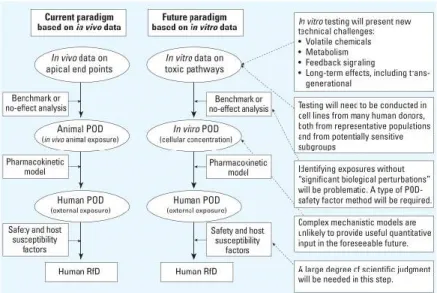
Figure 1.1 Schematic comparison of current and envisioned
risk assessment paradigm ,,...6
Figure 1.2 The 1000 Genomes Project Populations ………...11
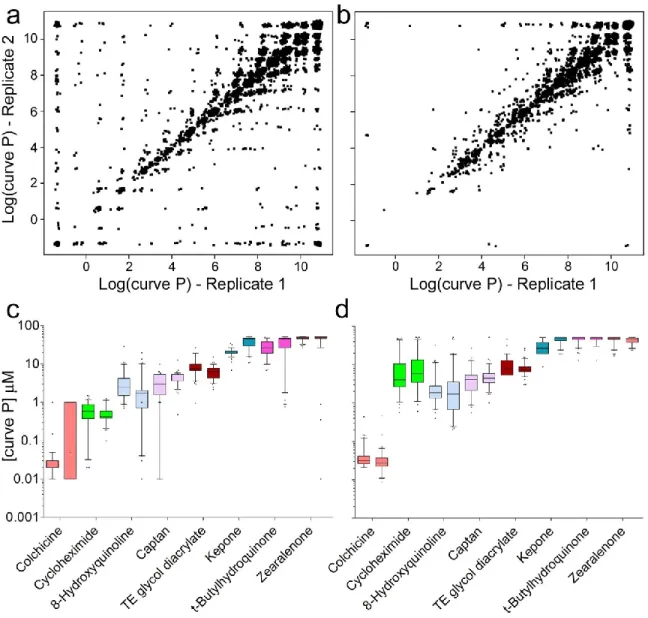
Figure 2.1 Experimental reproducibility ………....56
Figure 2.2 Distribution of cytotoxicity across chemicals ………..……….57
Figure 2.3 Cytotoxicity Distributions across Cell Lines ………….……..……….58
Figure 2.4 Inter-individual Variability Range for the 240 Chemicals ...………59
Figure 2.5 Toxicity-genotype Associations ………61
Figure 2.6 Toxicity-RNA expression Associations………...62
Figure 2.7 Comparison of Cytotoxicity across Different Studies .……….64
Figure 2.8 Comparison of Cytotoxicity Range across Different Studies…..………..65
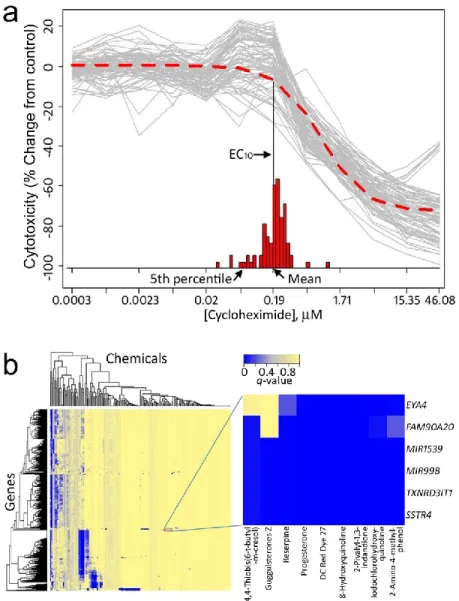
Figure 3.1 Illustrative Fits for Cytotoxicity Estimation .………..…………...……100
Figure 3.2 Distributions of the LCLS among the 9 Populations ………...…...101
Figure 3.3 Flow Chart of Data Processing to Obtain Cytotoxicity Response Values and EC10.………..… ……….102
Figure 3.4 Comparison of the Current Study to Other Comparable LCL cell line/screening studies and Reproducibility ………..103
Figure 3.5 Magnitude of Inter-Individual Variability Across Chemicals and Populations ………..………...……105
Figure 3.6 P-values vs. partial R2…..………..………..…..….107
Figure 3.7 Genotype-Cytotoxicity Associations ………..………108
Figure 3.8 MAGWAS vs. PLINK for an example chemical/region …………....…………109
Figure 3.9 Heritability of EC10 …....………...110
xiv
Figure 4.1 Inter-individuals and Population Variability and
Reproducibility of the Mixtures. ….………...178
Figure 4.2 Boxplots of Population Differences for Each Mixture …...………..……180
Figure 4.3 Illustrative Flow Chart of Predicted Exposure Limits
Calculations ………….………181
Figure 4.4 Distribution of EC10s and Oral Equivalent Dose Across
146 cell lines for each mixture.………... 182
Figure 4.5 Illustrative Flow chart of Oral Equivalent Dose Calculations ………...….184
Figure 4.6 Oral Equivalent Doses with the Four Different Scenarios. ……….…185
Figure 4.7 Inter-individuals and Population Variability and
Reproducibility of the Mixtures.………..………186
xv
LIST OF ABBREVIATIONS
ATP adenosine triphosphate
CEPH Centre d’Etude du Polymorphisme Humain
FBS fetal bovine serum
FDR False Discovery Rate
GWAS Genome Wide Association Study
qHTS Quantitative high-throughput screening
MAGWAS Multivariate ANCOVA Genome-Wide Association Software
SNP single nucleotide polymorphisms
PK Pharmacokinetics
1
CHAPTER 1: GENERAL INTRODUCTION
A. THE OVERARCHING NECESSITY TO REGULATE THOUSANDS OF
CHEMICALS.
Several federal agencies in the United States have been bestowed the responsibility to
regulate a diverse variety of environmental compounds. For example, the Toxic Substances
Control Act (TSCA), which was passed in 1976, granted authority to the U.S. Environmental
Protection Agency (EPA) to oversee the safety of chemical products in commerce to both the
public and the environment, and to ensure continuous reviewing and regulation of chemicals in
commerce (EPA 2012). Consequently, those federal agencies are responsible for implementing
regulations that sets the maximum permissible thresholds for environmental compounds in
drinking water, establish acceptable limits of exposure in occupational settings, and to determine
tolerances for pesticides residues in food, among other tasks (National Research Council 2006).
Previously, the US EPA has relied primarily on information obtained from in vivo animal
models. Traditional toxicity testing is carried out in laboratory animals to assess the hazards and
risks associated with exposure to environmental agents. Animal models have afforded valuable
information on the possible harmful effects of exposure to a chemical and the associated dose at
which effects may be observed. With limited confounding, controlled experimental design, and
whole intact body system, in vivo animal models were deemed an invaluable resource for
2
With traditional animal models, each chemical requires multiple tests, can use up to 5000
animals (or even 12,000 for some pesticides), costs millions of dollars, and take up to 5 years of
testing or more. These disadvantages are in addition to ethical concerns that have been raised
about animal welfare (Abbot 2005). There are more than 10,000 chemicals in commercial use in
the United States, with hundreds being introduced each year (Anastas et al. 2010). However,
only a small fraction of these chemical have been adequately evaluated for their potential risk to
human health (Anastas et al. 2010; Judson et al. 2008). Accordingly, there has been a growing
concern from governmental agencies about the need to adequately and accurately assess
thousands of chemicals in a rapid and efficient manner. New paradigms are inevitably needed for
the fast and accurate evaluation of the potential human health hazard of environmental chemicals
(Collins et al. 2008).
The emerging massive demand for to identify data sources for regulating chemicals is not
limited to the United States. There is a global awareness of the challenges associated with
toxicology testing. The European Union's Registration, Evaluation, Authorisation, and
Restriction of Chemicals (REACH) legislation is one of the international agencies that have set
out to better understand and manage risks to human health and the environment that arise from
the manufacture and use of chemicals (Anastas et al. 2010).
Incorporation of novel toxicity screening approaches is a crucial tool for tackling the
complex contemporary challenges in evaluating the human health hazards of exposure to
chemicals. A shift in toxicity testing from in vivo to in vitro methods may efficiently prioritize
compounds, reveal new mechanisms, and enable predictive modeling. The emergence of new
toxicity methods and strategies might address several risk assessment needs, as well as bring
3
remaining challenges to meet risk assessment demands for chemicals with variable modes of
action.
1. The shortcomings of traditional toxicological methods to inform risk assessment.
Using animal models to evaluate toxicological response depends primarily on observing an
adverse health outcome with high doses of a chemical. Uncertainties associated with animal data
are usually handled by the use of a 10-fold interspecies uncertainty factor when extrapolating
from laboratory animals to humans (EPA, 2004). However, the 10-fold interspecies uncertainty
factor does not account for the additional uncertainty in extrapolating from high doses in animal
experiments to environmental exposure levels that are orders of magnitude lower (Andersen and
Krewski 2009). Although studies using animal models have improved dramatically in recent
years in term of dosing, existing challenges and limitations remain. These include the high cost
and labor required to handle animals, the extensive amount of time needed to conduct, assess and
fully evaluate the health outcomes seen in animals, the challenges in translating human relevance
in toxicological outcomes that are species dependent, the limited capability of assessing multiple
compounds simultaneously, the inability to assess mixtures or several compounds at once, and
most importantly the limited ability to provide timely relevant information to support informed
regulation of environmental compounds. Due to the above reasons, growing concern and
frustration has been expressed by health protection and regulatory agencies, leading to the
4
hundreds of thousands of commercial chemicals that require proper assessment and evaluation
(Andersen and Krewski 2009).
2. What alternatives to animal models exist to meet the high demand of regulating thousands
of chemicals? Toxicity Testing in the 21st Century.
The growing concern from regulatory agencies, such as the Registration, Evaluation,
Authorization and Restriction of Chemicals (REACH) in Europe and the Toxic Substances
Control Act reform in the US, to meet the high demand of regulation of thousands of chemicals
that are being released to the environment has resulted in a shift in toxicity assessment from in
vivo to in vitro and in silico methods (Plunkett et al. 2010). The proposed shift should be carried
out by the development of rapid screening methods based on the mechanistic understanding of
biological processes (Plunkett et al. 2010; Judson et al. 2010). It is necessary to merge
high-information content biology and modeling with mechanistic research to build a predictive
framework of an intact biological system (Chiu et al. 2011).
Several recent governmental initiatives have been established in the US to meet the
requirements and needs of exploration of new methodologies in toxicology to be incorporated
into current and future risk assessments. For example, the Tox21 program (Collins et al. 2008), a
partnership between four governmental agencies (EPA, NTP: National Toxicology Program,
NCGC: NIH Chemical Genomics Center, and FDA: Food and Drug Administration), is currently
screening thousands of chemicals for their potential to disturb biological pathways that may
result in human disease, with a broad spectrum of in vitro assays utilizing quantitative high
5
in vitro endpoints can be utilized as toxicity-based triggers to assist in decision-making (Reif et
al. 2010), act as predictive surrogates for in vivo toxicity (Zhu et al. 2008; Martin et al. 2010), or
to generate testable hypotheses on the mechanisms of toxicity (Xia et al. 2008a). Another
governmental initiative is The NexGen program, a collaborative effort between EPA, NTP,
ATSDR, NCGC and CalEPA (US EPA, 2011), which is developing new approaches and
methods to better utilize novel molecular toxicology data to understand the risks posed by
environmental exposures. The NexGen program provides the opportunity to address challenges
and opportunities of converting data generated through Tox21 into knowledge and ultimately
into the scientific basis for NexGen risk assessments (US EPA 2011).
Nevertheless, a major gap that is not being currently addressed in either Tox21 or NexGen,
but is the focus of the research detailed herein, is the population-based in vitro approach to qHTS
screening. The availability of genetically diverse defined renewable sources of human cells, such
as transformed lymphoblasts, will allow for the investigation of the hazard and degree of
inter-individual biological variability in the human population, as well as to understand and
comprehensively characterize the role of human genome sequence variation in observed
6
3. Current in vitro paradigms do not measure population variability and rely on rigid
unproven assumptions.
Risk assessments need to be regularly reviewed and modified to meet the demands of
new discoveries and evolving technologies. With the recent shift from in vivo to in vitro in
toxicity testing, the Committee on Toxicity Testing and Assessment of Environmental
Agents of the National
Research Council (National
Research Council 2007) has
recommended certain
visionary guidelines for
assessing in vitro testing as
depicted in Figure 1 (fully
reproduced from (Crump et
al. 2010). The suggested
paradigm proposes a similar
modified approach to deal
with in vitro data to the
previous current in vivo
paradigm. The future model
includes different
components to make it a
successful and valuable tool. Two of those important components and suggestions are: (i) to
test cell lines from many human donors that are representative of diverse populations and (ii) Figure 1.1: Schematic comparison of current and envisioned risk assessment paradigm adapted from EHS (Crump et al. 2010). Fully reproduced from PMC under
“The following PMC journals are U.S. Government publications: Addiction Science & Clinical Practice (vol. 1 through vol. 6) Emerging Infectious Diseases
Environmental Health Perspectives Preventing Chronic Disease
All material published in these journals is in the public domain and may be used and reproduced without special permission. However, anyone using the material is requested to properly cite and
acknowledge the source. ”
http://www.ncbi.nlm.nih.gov/pmc/about/copyright/
7
to incorporate certain safety and host susceptibility factors that require a large degree of
scientific judgment to derive a meaningful human reference dose (Crump et al. 2010). While
the Tox21 program is currently screening thousands of environmental chemicals for their
potential to affect biological pathways that may result in human disease (Xia et al. 2008a),
the current screening paradigms do not contain enough human cell lines to assess the degree
of inter-individual biological variability in the human population. Such variability is of
particular importance in assessing potential human health hazard (National Research Council
2007). Instead, the current default assumption for inter-individual variability, which is not
based on any biological assessment, is a fold difference in toxicodynamic studies and a
3-fold difference in toxicokinetics studies (International Programme for Chemical Safety
2001).
B. GAUGING POPULATION VARIABILITY
Exposure to environmental chemicals may result in a variety of health outcomes that are
different in type or magnitude among individuals and/or populations. Those differences in
response are due to underlying human variability and should be addressed for a valuable human
health risk assessment of chemicals (Guyton et al. 2009; Hattis 1997; National Research Council
2009). The variety of health outcomes from exposure to chemicals can be a result of intrinsic
factors (genetic variability), extrinsic factors (life style, environment, etc), or the interaction of
both intrinsic and external factors (Zeise et al. 2013). Human variability is currently assessed by
applying “uncertainty” or “adjustment” factors (U.S. EPA, 2011). A factor of 1, 3, or 10 has been
8
further divided to separately account for variation in pharmacokinetics and pharmacodynamics
(US EPA 2011) (Sonich-Mullin et al. 2001).
Characterizing genetic variability can enhance our understanding of population variability in
response to chemicals. The finding of genetic loci associated with susceptibility can potentially
inform us of important cellular proteins that affect health outcome and can uncover novel
toxicity pathways. Endeavors to map human variability have been focused on discovering
genetic variations (Schadt and Bjorkegren 2012), or other -omics variations including
epigenomics, transcriptomics, proteomics, and metabolomics (Chen et al. 2008; Emilsson et al.
2008; Illig et al. 2010; Manolio 2010; Cornelis et al. 2010; Schadt 2009). Genetic
polymorphisms may act together or separately to alter susceptibility to adverse effects of
exposure to environmental agent. Thus, understanding genetic susceptibility has the potential for
predicting toxicity pathways (National Research Council 2009). For instance, adverse health
outcome to occupational exposure to welding fumes has been associated with genetic
polymorphisms in DNA repair and detoxifying genes. Consequently, sensitive individuals have
evidence of higher chromosomal and DNA damage (Iarmarcovai et al. 2005).
Modern approaches to genetic epidemiology include valuable approaches to integrate toxicity
exposure in population-based setting to potentially associated genetic loci. Several studies have
been able to utilize genetic epidemiology to determine the relationship between specific genes in
the population and adverse health outcomes from environmental chemical exposure. For
example, human epidemiological studies have provided information on DNA damage in
arsenic-exposed populations(Andrew et al. 2006). Further in vitro studies were able to elucidate the
specific DNA-repair pathways affected by arsenic (Andrew et al. 2006). While genetic
9
ability to overcome new challenges in toxicology. First, it is difficult to estimate and accurately
measure environmental exposure amounts. Furthermore, it is challenging to link the exposure
with the outcome. The level of exposure (by amount in air, or water) does not necessarily reflect
the actual dose that enters the body. While certain biomarkers could reflect internal
ingested/inhaled exposure, they are seldom measured. Biomarkers might be invasive, expensive
to measure, or/and not characterized or known for certain chemicals. Genetic epidemiology
depends on actual real human exposures. This means we can only evaluate chemicals that
individuals are exposed to and cannot make assessments on new chemicals. Second, genetic
epidemiology can be enormously expensive and requires large sample sizes (Burton et al. 2009).
Except for a few diseases, health outcomes are complex and the contribution of individual
genetic loci is modest at best (Manolio et al. 2009). In order to have enough power to detect
potentially associated loci, thousands of individuals need to be exposed and genotyped for a
meaningful study. With humans, confounding factors are a major issue, where individuals are
exposed to other potential chemicals and have predisposed internal and external factors that
could confound the outcome or increase variability of outcomes. While large sample sizes and
careful epidemiological designs can potentially decrease confounding, it is difficult to achieve
pure design principles with the reality of real human exposures. Third and most importantly, the
overarching challenge of evaluating thousands of chemicals and mixtures in a short amount of
time in epidemiological studies is not tenable.
Other potential ways to investigate population variability is either through in vivo or in vitro
toxicity testing paradigms. Several in vivo studies with genetically defined mouse models were
designed to discover the genetic determinants of susceptibility and population variability (Rusyn
10
population, in addition to the human relevance of the detected susceptibility loci in mice has yet
to be fully determined (Rusyn et al. 2010). Moreover, animal model studies are labor intensive,
not amenable to high-throughput screening, and can only effectively evaluate one chemical at a
time.
In vitro population based testing paradigms have been deemed useful in identifying adverse
health outcomes that were not detected in preclinical and clinical testing for pharmaceutical
products (IOM 2007), and in tailoring chemotherapy treatment based on patient’s genetics
(Phillips and Mallal 2010) or tumor type (La Thangue and Kerr 2011). With the expense of
developing new drugs, pharmacogenomics studies have been aimed to maximize effective
therapy response and to minimize adverse reactions by prescribing treatment based on a patient’s
genetic profile (Wheeler and Dolan 2012).
C. LYMPHOBLASTOID CELL LINES IN PHARMACOGENOMIC DISCOVERY AND
CLINICAL TRANSLATION.
1. Establishment of lymphoblastoid cell lines (LCLs).
I. The 1000 Genomes Project
The 1000 Genomes Project is an international consortium with multiple centers, platforms,
and funders to construct a foundational data set for human genetics (Kuehn 2008; Clarke 2012).
The main purpose of the project is set to discover virtually all common human variations by
11
discover population level human genetic variations of all types (95% of variation > 1%
frequency), define haplotype structure in the human genome, and develop sequence analysis
methods, tools, and other reagents that can be transferred to other sequencing projects (Kuehn
2008; Clarke 2012)
.
The consortium recruited healthy adult volunteers from different continents, representing
wide variation in genetic ancestries. From blood samples, the consortium isolated
B-Lymphocytes to be later transformed to lymphoblastoid cell lines (LCLs) and genotyped via
standard array technologies, and eventually these individuals will be sequenced to high coverage
(Clarke 2012). The consortium also included cell lines developed as part of the HapMap project,
including early CEPH populations (Clarke 2012). Figure 2 illustrate the up-to-date populations
that were included in the 1000 Genomes Project.
12
II. Transformation of B-Lymphocytes to LCLs
Immortalization is the process of transforming normal primary B-Lymphocytes to LCLs and
giving them the ability to indefinitely proliferate. Consequently,having an unlimited life span
with no other additional changes (Miller 1982). Normal cells are mortal, in part because their
telomeres shorten with each cell division (Higaki et al. 2004). Telomeres are repetitive
nucleotides at the end of chromosomes that act as a buffer layer to protect chromosomes from
fusing together and genes from being lost during cell division. With cell division and replication,
the DNA duplicates and the telomere sequences become shorter (Qian et al. 2014). Replenishing
telomeres is dependent upon the enzymetelomerase reverse transcriptase (Qian et al. 2014).
LCLs are immortalized by developing strong telomerase activity and other cellular changes upon
Epstein-Barr virus (EBV) integration (Miller et al. 1982). In vitro infection with EBV of
B-Lymphocytes aids in their transformation to LCLs (Miller et al. 1982). EBV, which is a human
herpes virus, is a common virus in humans and has been associated with mononucleosis (Weiss
and O'Malley 2013), autoimmune diseases such as multiple sclerosis, dermatomyositis, systemic
lupus erythematosus, rheumatoid arthritis (Toussirot and Roudier 2008; Dreyfus et al. 2011;
Pender et al. 2012; Ascherio and Munger 2010), various forms of cancer such as Hodgkin's
lymphoma, Burkitt's lymphoma, nasopharyngeal carcinoma (Niedobitek et al. 2001; Epstein
2001), and conditions associated with human immunodeficiency virus (HIV) such as hairy
leukoplakia and central nervous system lymphomas (Kawa 2000; Maeda et al. 2009).
It was discovered in 1968 that EBV infects resting primary human B cells, activates them,
and establishes a latent infection in them (Henle and Henle 1980). After in vitro infection with
EBV, the B-lymphocytes continue proliferating and give rise to stable LCLs with genomic virion
13
virion DNA exists as independent complete multicopy circular extrachromosomal plasmid-like
DNA, and is not integrated into the cell’s chromosomes (Miller 1982). Moreover, the virion
DNA replicates as the cellular DNA in the nucleus replicates in latency, infected proliferating B
cells (Kalla and Hammerschmidt 2012) and mostly does not express its genetic information
except for some viral products (Miller 1982).
2. Utility of LCLs in pharmacogenomics discovery
The utilization of lymphoblastoid cell lines (LCLs) as a human model has emerged as a
promising tool in the study of the genetics of drug response. Many studies have used LCLs for
pharmacogenomics discoveries by observing response to chemotherapeutics (Wheeler and Dolan
2012), radiation (Smirnov et al. 2009; Niu et al. 2010), statins (Simon et al. 2006; Mangravite et
al. 2008; Wilke et al. 2008; Medina et al. 2008), selective serotonin reuptake inhibitors (Morag et
al. 2011), immunosuppressants (Wheeler and Dolan 2012), pain relievers and β-blockers
(Wheeler and Dolan 2012).
Pharmacogenomics studies using LCLs have not only proven to yield suggestive
associations between genetic variants and drugs, but these associations have been supported in
real clinical data. For example, LCL-based GWAS led to the discovery of an association between
cytarabine arabinoside cytotoxicity and FKBP5 gene expression (Li et al. 2008). In a follow up
clinical targeted gene study, both event-free and overall survival for acute myeloid leukemia
patients treated with cytarabine arabinoside were associated with SNPs located in the FKBP5
gene (Mitra et al. 2011). Successful clinical translation of LCL pharmacogenomics discoveries is
not limited to the previous example. Several other studies have found value in performing
14
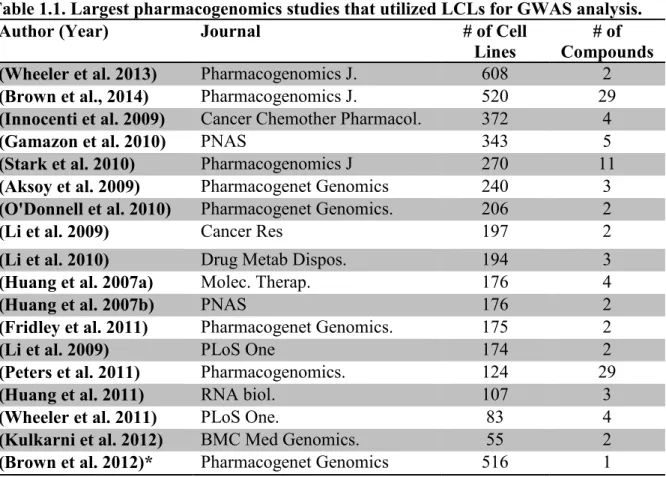
The following table (Table 1.1) illustrates the biggest GWA pharmacogenomics studies, showing
the number of cell lines and the drugs that were utilized in each study.
Table 1.1. Largest pharmacogenomics studies that utilized LCLs for GWAS analysis.
Author (Year) Journal # of Cell
Lines
# of Compounds
(Wheeler et al. 2013) Pharmacogenomics J. 608 2
(Brown et al., 2014) Pharmacogenomics J. 520 29
(Innocenti et al. 2009) Cancer Chemother Pharmacol. 372 4
(Gamazon et al. 2010) PNAS 343 5
(Stark et al. 2010) Pharmacogenomics J 270 11
(Aksoy et al. 2009) Pharmacogenet Genomics 240 3
(O'Donnell et al. 2010) Pharmacogenet Genomics. 206 2
(Li et al. 2009) Cancer Res 197 2
(Li et al. 2010) Drug Metab Dispos. 194 3
(Huang et al. 2007a) Molec. Therap. 176 4
(Huang et al. 2007b) PNAS 176 2
(Fridley et al. 2011) Pharmacogenet Genomics. 175 2
(Li et al. 2009) PLoS One 174 2
(Peters et al. 2011) Pharmacogenomics. 124 29
(Huang et al. 2011) RNA biol. 107 3
(Wheeler et al. 2011) PLoS One. 83 4
(Kulkarni et al. 2012) BMC Med Genomics. 55 2
(Brown et al. 2012)* Pharmacogenet Genomics 516 1
15
D. UTILIZING LYMPHOBLASTOID CELL LINES IN TOXICOGENOMIC
POPULATION-BASED IN VITRO TOXICITY SCREENING.
Pharmacogenomics studies were among the first to recognize the utility of LCLs as a model
in testing pharmaceutical drugs. They mainly employed LCLs to discover genetic loci that are
associated with either drug toxicity and/or survival prognosis. With the realization of the full
potential of LCLs in addressing major gaps in current risk assessment, the present work aimed to
extend their utility to (i) quantitatively assess and address population based toxicological effects
or hazard of environmental contaminants, (ii) determine the extent of human inter-individual
variability in chemical toxicity, (iii) identify susceptible sub-populations or races, (iv) understand
the genetic determinants of the inter-individual variability, (v) generate testable hypotheses about
toxicity pathways by leveraging genetic and genomic data from 1000 Genomes and HapMap
Projects and (vi) use the data obtained from this research to build predictive in silico models.
1. Advantages and Limitations of Utilizing LCLs in Toxicogenomic Discovery
Our novel central hypothesis is that human lymphoblast cells derived from various human
populations can be efficiently utilized to better understand the hazard and magnitude of human
inter-individual variability in response to different environmental chemicals. LCLs are derived
from various human populations representing diverse genetic ancestries and are publicly
available for researchers from the 1000 Genomes Project (1000 Genomes Project Consortium et
al. 2012). Because they are immortalized, LCLs represent a renewable source for repeated
16
experimental manipulation. Unlike human epidemiological studies or in vivo animal
experiments, the same cell lines could be treated with different concentrations of multiple
compounds at the same time. Therefore, LCLs are amenable for high throughput screening and
lack the confounders that are often present in in vivo studies. Genome-wide genotype (The SNP
Consortium; International HapMap Project;The 1000 Genomes Project; Human Variation Panel
dbGaP Access) and gene expression data (Gene Expression Omnibus; Gene Expression Omnibus
b; CEU RNA-Seq Data), including next-generation sequencing (DNA and RNA-Seq) data, is
publicly available for hundreds of established LCLs.
Like any toxicological model system, in vitro assessment using LCLs presents a number
of technical challenges for extrapolation to humans, including lack of metabolism, and the
inability to establish cell-cell interactions or evaluate chronic toxicity. The liver is the major site
of xenobiotic metabolism and plays a central role in preventingaccumulation of a wide range of
compounds by converting them into a form suitable for elimination (Lerapetritou et al. 2009).
Human lymphoblast cell lines are not hepatocytes and their main role is not meant to metabolize
chemicals. Although lymphocytes do not have the metabolic capacity of the liver, or even that of
freshly isolated hepatocytes, they do express a number of nuclear receptors, as well as most
genes of phase I and II metabolism, and transporters (Siest et al. 2008). A comparison of the
population-wide (250+ individuals of various races, ages and gender) variability in mRNA levels
for several dozen liver-specific thyroid hormone-related genes between human liver (Schadt et
al. 2008) and lymphoblast cell lines (Stranger et al. 2007) showed that most of the nuclear
receptors and metabolism genes are expressed in lymphoblasts, albeit at a 10- to 100-times lower
17
Potential confounders that affect the utility of LCLs include baseline growth rates, EBV
copy numbers and ATP levels (Choy et al. 2008). While growth rate of LCLs was associated
with chemotherapeutic-induced cytotoxicity in one study (Stark et al. 2010), it was not, in
aggregate, associated with the cytotoxicity of 100+ chemicals in Lock et al. (2012). Altered
apoptosis has been observed as a result of EBV transformation in LCLs with cancer drugs (Liu et
al. 2004).
The immortalization process or EBV transformation has been observed to affect
gene-expression and promoter-methylation profiles of majority of genes compared to primary B cells
(Caliskan et al. 2011). However, the difference in expression levels between the primary and
immortalized cells was small in magnitude (<1.5 fold). Moreover, the inter-individual variability
in gene expression was the same between primary B cells and LCLs (Caliskan et al. 2011).
Furthermore, many expression quantitative trait loci eQTLs observed in LCLs were observed in
primary tissues like the liver, lung, and skin (Schadt et al. 2008; Bullaughey et al. 2009; Ding et
al. 2010).
2. Toxicity Phenotype
With the recent shift in toxicology from in vivo to in vitro, hundreds of toxicity assays were
developed to assess different cellular or biological endpoints. While those assays vary widely in
their phenotypes and qualities, a good assay should be sensitive, robust, and able to
quantitatively measure toxicity endpoint in a high throughput manner.
Generally, toxicity phenotypes can be classified to include general hazard,
carcinogenicity, genotoxicity, developmental toxicity, reproductive toxicity, and chronic toxicity
18
their potential hazard (Knudsen et al. 2013). More than 650 in vitro assays including biochemical
assays, human cells and cell lines, and alternative models such as mouse embryonic stem cells
and zebrafish embryo development have been developed and utilized for these chemicals, to
understand their mechanisms and potential hazards (Knudsen et al. 2013).
The definition of “hazard” in chemical evaluation is broad and includes multiple potential
definitions. A “hazardous” chemical evaluation could be derived from an acute and subchronic
rodent study, or from material safety data sheets (Judson et al. 2009). To evaluate the in vitro
potential hazard for a wide range of compounds, two essential things need to be properly
selected: an appropriate end-point phenotype that represents general toxicity and is sensitive and
broadly applicable to a variety of compounds, and a human relevant concentration range to
determine the concentration for which the chemical will elicit toxicity. Determining the
concentration at which chemical might elicit an endpoint is not enough, by itself, to quantify
hazard. Because the in vitro assay endpoint does not incorporate metabolic clearance and plasma
protein binding, ranking the chemicals by nominal assay concentrations might result in over- or
under- estimation of the steady-state of a chemical (Rotroff et al 2010). However, incorporation
of reverse dosimetry and exposure estimates when exploring concentration-response
relationships for individual chemicals can aid tremendously in assessing human hazard and has
been assessed by EPA and others (Rotroff et al. 2010; Judson et al. 2011) as a proposed
approach.
The “CellTiter-GloTM Luminescent Cell Viability Assay” is a commonly used assay in toxicity screening for cytotoxicity evaluation. It is a homogeneous “add-mix-measure” method to
determine the number of viable cells in culture based on quantification of Adenosine
19
the number of viable metabolically active cells (Promega). The assay results in cell lysis and a
luciferase reaction. It is well-known that luciferase from fireflies or bacteria can be used to
measure ATP (Fan and Wood 2007). A highly stabilized form of luciferase created by optimized
strategies (Hall et al., 1998) is utilized in the CellTitelGlo assay, reacting with ATP to produce
luciferyl adenylate, which is oxidized to produce a glow-like luminescent signal, among other
products. The final signal has been shown to be proportional to the amount of ATP (Fraga et al.
2006). The luminescent signal, produced by the modified luciferase reaction, has a prolonged
half-life (>5 hrs), making it resistant to a broad spectrum of detergents and suitable for
batch-mode processing of multiple plates (Riss et al., 2006;Fan et al., 2005).
In a normal living cell, the generation of ATP requires harmonized interactions of many
enzymes (Fan and Wood 2007). ATP concentrations are sustained upon equilibrium between
consumption and demand enzyme pathways (Fan and Wood 2007). Upon cell death, the
enzymes that generate ATP cease to function while the enzymes that consume ATP keep
working, resulting in ATP consumption. Therefore, the concentration of intracellular ATP drops
instantaneously upon cell death with a corresponding loss of luminescence when assayed using
luciferase (Fan and Wood 2007).
CellTiter-GloTM Luminescent Cell Viability Assay has many advantages that make it a great choice for quantitative high throughput screening. First, the unique homogeneous format
reduces pipetting errors that may be introduced during the multiple steps required by other ATP
measurement methods, thus decreasing experimental inconstancies. Second, the assay is
extremely sensitive in the measurement of number of cells below the detection limits of standard
colorimetric and fluorometric assays, reducing the number of cells required per assay. Third, the
20
high-throughput protocols. Fourth, among all cytotoxicity assays, bioluminescent ATP assays
have been the most widely used in high-throughput applications (Riss et al. 2006; Melnick et al.
2006). Finally, the assay is very robust with extremely stable luminescent and a long half-life (>5
hrs). The homogeneous assay procedure involves the addition of a single reagent
(CellTiter-GloTM Reagent) directly to cells cultured in serum-supplemented medium. Cell washing, removal of medium or multiple pipetting steps are not required (Promega).
Moreover, the CellTiter-GloTM Luminescent Cell Viability Assay has been utilized and extensively evaluated for in vitro screening of cytotoxicity in high-throughput settings with
proper evaluation of time points at the National Institutes of Health Chemical Genomics Center
(NCGC) (Xia et al. 2008a). It was used to screen the NTP 1,408-compound library for
cytotoxicity in 13 cell types (9 human, 2 rat, 2 mouse) (Xia et al. 2008b). The cell types
originated from different tissues and included cell lines, cell strains, and primary cell populations
(Tice et al. 2013). While some compounds were cytotoxic to all cell types, others were only toxic
in some cell lines but not others. The results indicated that no single cell type would be
universally informative for cytotoxicity or other endpoints, such as apoptosis (Xia et al. 2008a;
Tice et al. 2013; Huang et al. 2008).
3. How can in vitro data inform systematic risk assessment?
Thousands of chemicals are being currently screened with hundreds of in vitro assays in
the Tox21 and Toxcast projects. The predominant question is how to move forward from an in
21
is to apply the findings of an in vitro study to a more traditional in vivo risk assessment. First, the
hazard is established from a concentration-response in vitro assay. It is recommended that the in
vitro testing be established from cell lines representing populations with sensitive individuals.
Second, PK modeling is applied to derive the dose that results in the hazardous outcome. Third,
uncertainty factors are applied to establish a human reference dose (Crump et al. 2010).
Another approach is to find the biological pathway altering dose (BPAD) for
high-throughput risk assessment (HTRA). With this framework, a biological pathway is defined that is
linked to adverse effects. Then, the in vitro concentration that perturbs the specified biological
pathway is measured. Furthermore, PK modeling is applied to estimate the in vivo dose that
could result in the hazardous concentration. From there, uncertainty and population variability
estimates are incorporated to identify the protective exposure limit (Judson et al. 2011).
A third approach for toxicity assessment of in vitro assays is the tiered step-wise decision
tree (Thomas et al. 2013). In this approach, chemicals are ranked based on their relative
selectivity and the point of departure (POD) is established from the in vitro assays. Reverse
toxicokinetic modeling (Rotroff et al. 2010; Wetmore et al. 2013; Wetmore et al. 2012) can then
be applied to estimate the corresponding dose for the in vitro POD. The calculated external dose
can then be computed to human exposure estimates to establish the margin of exposure (MOE).
In the second tier, after selecting chemicals from tier I, in vivo animal testing is carried out with a
focus on refining dose-response, PK evaluations, and other estimates. The third tier is
characterized by traditional animal studies that are currently used to assess chemicals.
Regardless of the paradigm implemented to assess potential adverse health outcomes that
are associated with chemical exposures from in vitro assays, one thing is standard and consistent
22
importance. Testing human cell lines that represent various populations and identify sensitive
subpopulations can substantially improve any risk assessment paradigm where decision making
will be relied on actual estimated rather than mere statistical assumptions that may or may not be
satisfied.
E. SPECIFIC AIMS
Quantitative assessment of the degree of inter-individual biological variability in the
human population is a major aspect for properly evaluating potential human health hazards. A
comprehensive characterization of human genome sequence variation is important for
understanding inherited sources of variation in toxicity phenotypes. Genetic polymorphisms can
have a profound influence on disease risk after drug or toxicant exposure. However, such
characterization and assessment is difficult to quantitatively evaluate using current in vivo animal
test systems or in vitro methods with established cell lines. The availability of genetically- and
geographically-representative diverse and genetically-defined renewable sources of human cells,
such as lymphoblasts from the International HapMap and 1000 Genomes projects, enables in
vitro testing at the population level. As the focus of risk assessment processes shifts toward in
vitro data, the quantitative assessment of inter-individual variability in response to chemicals,
and an understanding of the underlying genetic causes are necessary for regulatory decisions to
be based on scientific data rather than on default assumptions.
Previous pilot work showed that utilizing those lymphoblasts for in vitro toxicity
assessment was very successful in assessing inter-individual variability and the molecular
23
proposal’s central hypothesis that genetic variability and chemical toxicity can be assessed using
a lymphoblast cell line-based in vitro model that serves as a model for the human population. To
accomplish the objective of this application, this hypothesis was tested by pursuing the following
specific aims:
Aim 1: To evaluate and assess the validity of an in vitro, genetically–anchored human
population model system in assessing chemical toxicity and identifying candidate genetic
susceptibility.
In this Aim, we hypothesized that genetic variability and chemical toxicity can be assessed
using an in vitro model of lymphoblast cell lines that represent a human population. To
demonstrate the feasibility of an in vitro model system to assess inter-individual and
population-wide variability of chemical-induced toxicity phenotypes, cells from over 80
Centre d’Etude du Polymorphisme Humain (CEPH) cell lines were exposed to 12
concentrations of 240 environmental chemicals. The induction of caspase-3/7, indicative of
apoptosis, was then assessed and intracellular levels of adenosine triphosphate (ATP) as a
surrogate for cell number, was measured to evaluate cytotoxicity. We utilized the available
dense genetic data to perform a Genome Wide Association Study (GWAS). We also assessed
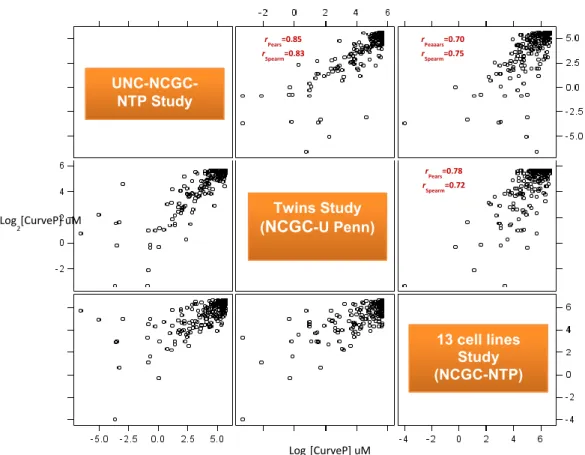
the validity of the in vitro genetics–anchored human model system by comparing it to similar
24
Aim 2: To quantitatively evaluate inter-individual variability for diverse environmental
chemicals using high throughput large scale in-vitro model across genetically-defined
genetically-diverse populations.
In this aim, we developed an in-vitro screening model that had sufficient power to
quantitatively assess the potential human health hazards and inter-individual variability in
chemical toxicity, identify susceptible sub-populations, understand the genetic determinants
of the inter-individual variability, generate testable hypotheses about toxicity pathways by
leveraging genetic and genomic data from 1000 Genomes and HapMap Projects, and use the
data obtained from this research to build predictive in silico models. We screened 1104
lymphoblast cell lines from 9 ancestrally and geographically diverse populations representing
5 continents. Those cell lines were chosen based on availability of dense genetic information
and were exposed to 180 diverse environmental chemicals at 8 different concentrations. We
assessed cytotoxicity based on measuring intracellular levels of ATP.
Aim 3: To investigate remaining challenges of in vitro genetically–anchored population
human model, such as the potential to screen complex mixtures.
This specific aim addressed remaining challenges that require further assessment to increase
the utility of the information obtained from this model, including limited metabolic capacity
of lymphoblasts and the potential to screen complex mixtures. We selected lymphoblast cell
lines from 4 ancestrally and geographically diverse populations based on availability of
genome sequence and basal RNA-seq information. The cell lines were exposed to 2 pesticide
chemical mixtures, at 8 different concentrations. This design enabled us to investigate the
25
F. REFERENCES
EPA. 2012. Toxic Substances Control Act (TSCA). Available http://www.epa.gov/oecaagct/lsca.html
National Research Council. 2006. Assessing the Human Health Risks of Trichloroethylene: Key Scientific Issues Washigton, DC: The National Academies Press.
Abbot A. 2005. Nobel laureates: close encounters. Nature 436(7048): 170-171.
Anastas P, Teichman K, Hubal EC. 2010. Ensuring the safety of chemicals. Journal of exposure science & environmental epidemiology 20(5): 395-396.
Judson R, Richard A, Dix D, Houck K, Elloumi F, Martin M, et al. 2008. ACToR--Aggregated Computational Toxicology Resource. Toxicol Appl Pharmacol 233(1): 7-13.
Collins FS, Gray GM, Bucher JR. 2008. Toxicology. Transforming environmental health protection. Science 319(5865): 906-907.
EPA. 2004. Intentional Human Dosing Studies for EPA Regulatory Purposes: Scientific and Ethical Issues: The National Academies Press.
Andersen ME, Krewski D. 2009. Toxicity testing in the 21st century: bringing the vision to life. Toxicol Sci 107(2): 324-330.
Plunkett LM, Kaplan AM, Becker RA. 2010. An enhanced tiered toxicity testing framework with triggers for assessing hazards and risks of commodity chemicals. RegulToxicol Pharmacol 58(3): 382-394.
Judson RS, Houck KA, Kavlock RJ, Knudsen TB, Martin MT, Mortensen HM, et al. 2010. In Vitro Screening of Environmental Chemicals for Targeted Testing Prioritization: The ToxCast Project. Environ Health Perspect 118(4): 485-492.
Chiu WA, Euling SY, Scott CS, Subramaniam RP. 2011. Approaches to advancing quantitative human health risk assessment of environmental chemicals in the post-genomic era. Toxicol Appl Pharmacol: in press.
Xia M, Huang R, Witt KL, Southall N, Fostel J, Cho MH, et al. 2008a. Compound cytotoxicity profiling using quantitative high-throughput screening. Environ Health Perspect 116(3): 284-291.
Reif DM, Martin MT, Tan SW, Houck KA, Judson RS, Richard AM, et al. 2010. Endocrine profiling and prioritization of environmental chemicals using ToxCast data. Environ Health Perspect 118(12): 1714-1720.
26
Martin MT, Dix DJ, Judson RS, Kavlock RJ, Reif DM, Richard AM, et al. 2010. Impact of environmental chemicals on key transcription regulators and correlation to toxicity end points within EPA's ToxCast program. Chem Res Toxicol 23(3): 578-590.
US EPA. 2011. Advancing the Next Generation (NexGen) of Risk Assessment Available: http://www.epa.gov/risk/nexgen/
National Research Council. 2007. Toxicity testing in the 21st century: A vision and a strategy. Washington, DC: National Academies Press.
Crump KS, Chen C, Louis TA. 2010. The future use of in vitro data in risk assessment to set human exposure standards: challenging problems and familiar solutions. Environ Health Perspect 118(10): 1350-1354.
International Programme on Chemical S. 1993. Biomarkers and risk assessment concepts and principles. 9241571551. Geneva, Switzerland:World Health Organization.
International Programme for Chemical Safety. 2001. Guidance Document for the Use of Data in Development of Chemical-Specific Adjustment Factors (CSAFs) for Interspecies Differences and Human Variability in Dose/Concentration–Response Assessment. WHO/PCS/01.4.
Guyton KZ, Kyle AD, Aubrecht J, Cogliano VJ, Eastmond DA, Jackson M, et al. 2009. Improving prediction of chemical carcinogenicity by considering multiple mechanisms and applying toxicogenomic approaches. Mutation research 681(2-3): 230-240.
Hattis D. 1997. Human variability in susceptibility - how big, how often, for what responses to what agents. Environmental Toxicology & Pharmacology 4(3-4): 195-208.
National Research Council. 2009. Science and Decisions: Advancing Risk Assessment. Washington, DC: National Academies Press.
Zeise L, Bois FY, Chiu WA, Hattis D, Rusyn I, Guyton KZ. 2013. Addressing human variability in next-generation human health risk assessments of environmental chemicals. Environ Health Perspect 121(1): 23-31.
Sonich-Mullin C, Fielder R, Wiltse J, Baetcke K, Dempsey J, Fenner-Crisp P, et al. 2001. IPCS conceptual framework for evaluating a mode of action for chemical carcinogenesis. Regulatory toxicology and pharmacology : RTP 34(2): 146-152.
Schadt EE, Bjorkegren JL. 2012. NEW: network-enabled wisdom in biology, medicine, and health care. Science translational medicine 4(115): 115rv111.
Chen L, Tong T, Zhao H. 2008. Considering dependence among genes and markers for false discovery control in eQTL mapping. Bioinformatics 24(18): 2015-2022.
27
Illig T, Gieger C, Zhai G, Romisch-Margl W, Wang-Sattler R, Prehn C, et al. 2010. A genome-wide perspective of genetic variation in human metabolism. Nat Genet 42(2): 137-141.
Burton PR, Hansell AL, Fortier I, Manolio TA, Khoury MJ, Little J, Elliott P. 2009. Size
matters: just how big is BIG?: Quantifying realistic sample size requirements for human genome epidemiology. Int J Epidemiol. 38(1):263-73.
Manolio TA. 2010. Genomewide association studies and assessment of the risk of disease. N Engl J Med 363(2): 166-176.
Cornelis MC, Agrawal A, Cole JW, Hansel NN, Barnes KC, Beaty TH, et al. 2010. The Gene, Environment Association Studies consortium (GENEVA): maximizing the knowledge obtained from GWAS by collaboration across studies of multiple conditions. Genet Epidemiol 34(4): 364-372.
Schadt EE. 2009. Molecular networks as sensors and drivers of common human diseases. Nature 461(7261): 218-223.
Iarmarcovai G, Sari-Minodier I, Chaspoul F, Botta C, De Meo M, Orsiere T, et al. 2005. Risk assessment of welders using analysis of eight metals by ICP-MS in blood and urine and DNA damage evaluation by the comet and micronucleus assays; influence of XRCC1 and XRCC3 polymorphisms. Mutagenesis 20(6): 425-432.
Andrew AS, Burgess JL, Meza MM, Demidenko E, Waugh MG, Hamilton JW, et al. 2006. Arsenic exposure is associated with decreased DNA repair in vitro and in individuals exposed to drinking water arsenic. Environ Health Perspect 114(8): 1193-1198.
Burton PR, Hansell AL, Fortier I, Manolio TA, Khoury MJ, Little J, Elliott P. 2009. Size
matters: just how big is BIG?: Quantifying realistic sample size requirements for human genome epidemiology.Int J Epidemiol. 38(1):263-73.
Manolio TA, Collins FS, Cox NJ, Goldstein DB, Hindorff LA, Hunter DJ, McCarthy MI, Ramos EM et al. 2009. Finding the missing heritability of complex diseases. Nature 461, 747-753
Rusyn I, Gatti DM, Wiltshire T, Kleeberger SR, Threadgill DW. 2010. Toxicogenetics: population-based testing of drug and chemical safety in mouse models. Pharmacogenomics 11(8): 1127-1136.
Lexchin JR. 2005. Implications of pharmaceutical industry funding on clinical research. The Annals of pharmacotherapy 39(1): 194-197.
Phillips EJ, Mallal SA. 2010. Pharmacogenetics of drug hypersensitivity. Pharmacogenomics 11(7): 973-987.
28
Wheeler HE, Dolan ME. 2012. Lymphoblastoid cell lines in pharmacogenomic discovery and clinical translation. Pharmacogenomics 13(1): 55-70.
Kuehn BM. 2008. 1000 Genomes Project promises closer look at variation in human genome. JAMA : the journal of the American Medical Association 300(23): 2715.
Clarke. 2012. The 1000 Genomes Project A History, Results and Tools.
Miller G. 1982. Immortalization of human lymphocytes by Epstein-Barr virus. The Yale journal of biology and medicine 55(3-4): 305-310.
Higaki T, Watanabe T, Tamatomi I, Tahara H, Sugimoto M, Furuichi Y, et al. 2004. Terminal telomere repeats are actually short in telomerase-negative immortal human cells. Biol Pharm Bull 27(12): 1932-1938.
Qian Y, Yang L, Cao S. 2014. Telomeres and telomerase in T cells of tumor immunity. Cell Immunol 289(1-2): 63-69.
Weiss LM, O'Malley D. 2013. Benign lymphadenopathies. Modern pathology : an official journal of the United States and Canadian Academy of Pathology, Inc 26 Suppl 1: S88-96.
Toussirot E, Roudier J. 2008. Epstein-Barr virus in autoimmune diseases. Best practice & research Clinical rheumatology 22(5): 883-896.
Dreyfus DH, Liu Y, Ghoda LY, Chang JT. 2011. Analysis of an ankyrin-like region in Epstein Barr Virus encoded (EBV) BZLF-1 (ZEBRA) protein: implications for interactions with NF-kappaB and p53. Virology journal 8: 422.
Pender MP, Csurhes PA, Pfluger CM, Burrows SR. 2012. CD8 T cell deficiency impairs control of Epstein--Barr virus and worsens with age in multiple sclerosis. Journal of neurology,
neurosurgery, and psychiatry 83(3): 353-354.
Ascherio A, Munger KL. 2010. Epstein-barr virus infection and multiple sclerosis: a review. Journal of neuroimmune pharmacology : the official journal of the Society on NeuroImmune Pharmacology 5(3): 271-277.
Niedobitek G, Meru N, Delecluse HJ. 2001. Epstein-Barr virus infection and human malignancies. Int J Exp Pathol 82(3): 149-170.
Epstein MA. 2001. Reflections on Epstein-Barr virus: some recently resolved old uncertainties. The Journal of infection 43(2): 111-115.
Kawa K. 2000. Epstein-Barr virus--associated diseases in humans. International journal of hematology 71(2): 108-117.
29
Henle W, Henle G. 1980. Epidemiologic aspects of Epstein-Barr virus (EBV)-associated diseases. Annals of the New York Academy of Sciences 354: 326-331.
Kalla M, Hammerschmidt W. 2012. Human B cells on their route to latent infection--early but transient expression of lytic genes of Epstein-Barr virus. Eur J Cell Biol 91(1): 65-69.
Amon W, Binne UK, Bryant H, Jenkins PJ, Karstegl CE, Farrell PJ. 2004. Lytic cycle gene regulation of Epstein-Barr virus. Journal of virology 78(24): 13460-13469.
Smirnov DA, Morley M, Shin E, Spielman RS, Cheung VG. 2009. Genetic analysis of radiation-induced changes in human gene expression. Nature 459(7246): 587-591.
Niu N, Qin Y, Fridley BL, Hou J, Kalari KR, Zhu M, et al. 2010. Radiation pharmacogenomics: a genome-wide association approach to identify radiation response biomarkers using human lymphoblastoid cell lines. Genome Res 20(11): 1482-1492.
Simon JA, Lin F, Hulley SB, Blanche PJ, Waters D, Shiboski S, et al. 2006. Phenotypic predictors of response to simvastatin therapy among African-Americans and Caucasians: the Cholesterol and Pharmacogenetics (CAP) Study. The American journal of cardiology 97(6): 843-850.
Mangravite LM, Wilke RA, Zhang J, Krauss RM. 2008. Pharmacogenomics of statin response. Current opinion in molecular therapeutics 10(6): 555-561.
Wilke RA, Berg RL, Linneman JG, Zhao C, McCarty CA, Krauss RM. 2008. Characterization of low-density lipoprotein cholesterol-lowering efficacy for atorvastatin in a population-based DNA biorepository. Basic Clin Pharmacol Toxicol 103(4): 354-359.
Medina RJ, O'Neill CL, Devine AB, Gardiner TA, Stitt AW. 2008. The pleiotropic effects of simvastatin on retinal microvascular endothelium has important implications for ischaemic retinopathies. PloS one 3(7): e2584.
Morag A, Pasmanik-Chor M, Oron-Karni V, Rehavi M, Stingl JC, Gurwitz D. 2011. Genome-wide expression profiling of human lymphoblastoid cell lines identifies CHL1 as a putative SSRI antidepressant response biomarker. Pharmacogenomics 12(2): 171-184.
Li L, Fridley B, Kalari K, Jenkins G, Batzler A, Safgren S, et al. 2008. Gemcitabine and cytosine arabinoside cytotoxicity: association with lymphoblastoid cell expression. Cancer Res 68(17): 7050-7058.
Mitra AK, Crews K, Pounds S, Cao X, Downing JR, Raimondi S, et al. 2011. Impact of genetic variation in FKBP5 on clinical response in pediatric acute myeloid leukemia patients: a pilot study. Leukemia 25(8): 1354-1356.
The SNP Consortium Database. http://snpdata.cshl.edu.
30
The 1000 Genomes Project. www.1000genomes.org.
Human Variation Panel dbGaP Access. www.ncbi.nlm.nih.gov/projects/gap/cgi-bin/study.cgi?study_id=phs000211.v1.p1.
SCAN Database. www.scandb.org.
Gene Expression Omnibus (CEPH pedigrees GEO accession: GSE1485) www.ncbi.nlm.nih.gov/geo/query/acc.cgi?acc=GSE1485.
Gene Expression Omnibus (Human Variation Panel GEO accession: GSE24277) www.ncbi.nlm.nih.gov/geo/query/acc.cgi?acc=GSE24277.
CEU RNA-Seq Data. http://jungle.unige.ch/rnaseq_CEU60.
eQTL resources at the Pritchard Lab. http://eqtl.uchicago.edu/Home.html.
IOM (Institute of Medicine). 2007. The Future of Drug Safety: Promoting and Protecting the Health of the Public. Washington, DC: The National Academies Press.
Wheeler HE, Gamazon ER, Stark AL, O'Donnell PH, Gorsic LK, Huang RS, et al. 2013. Genome-wide meta-analysis identifies variants associated with platinating agent susceptibility across populations. Pharmacogenomics J 13(1): 35-43.
Innocenti F, Mirkov S, Nagasubramanian R, Ramirez J, Liu W, Bleibel WK, et al. 2009. The Werner's syndrome 4330T>C (Cys1367Arg) gene variant does not affect the in vitro cytotoxicity of topoisomerase inhibitors and platinum compounds. Cancer chemotherapy and pharmacology 63(5): 881-887.
Brown CC, Havener TM, Medina MW, Jack JR, Krauss RM, McLeod HL, et al. 2014. Genome-wide association and pharmacological profiling of 29 anticancer agents using lymphoblastoid cell lines. Pharmacogenomics 15(2): 137-146.
Gamazon ER, Huang RS, Cox NJ, Dolan ME. 2010. Chemotherapeutic drug susceptibility associated SNPs are enriched in expression quantitative trait loci. Proc Natl Acad Sci USA 107(20): 9287-9292.
Stark AL, Zhang W, Mi S, Duan S, O'Donnell PH, Huang RS, et al. 2010. Heritable and non-genetic factors as variables of pharmacologic phenotypes in lymphoblastoid cell lines. Pharmacogenomics J 10(6): 505-512.