O
NLINE
T
ASK
D
ESIGN
Christian Bokhove
A recent discussion involves the elaboration on possible design principles for sequences of tasks. This paper builds on three principles, as described by Bokhove and Drijvers (2012a). A model with ingredients of crises, feedback and fading of sequences with near-similar tasks can be used to address both procedural fluency and conceptual understanding in an online environment. Apart from theoretical underpinnings, this is demonstrated by analyzing a case example from a study conducted in nine schools in the Netherlands. To-gether with quantitative results of the underlying study, it is showed that the model described could be a fruitful addition to the task design repertoire. Keywords: Crisis; Design; Fading; Feedback; Near-similar; Sequence; Task
Uso de crisis, realimentación y desvanecimiento para el diseño de tareas en línea
Una discusión reciente implica la elaboración de posibles principios para el diseño de secuencias de tareas. Este documento se basa en tres principios, descritos en Bokhove y Drijvers (2012a). Un modelo que comprende las com-ponentes de crisis, realimentación y desvanecimiento de secuencias con ta-reas muy similares puede ser utilizado para abordar tanto la fluidez procedi-mental como la comprensión conceptual en un entorno en línea. Además de estar fundamentado teóricamente, esto se demuestra mediante el análisis de un ejemplo de caso de un estudio realizado en nueve centros educativos de los Países Bajos. Junto con los resultados cuantitativos del estudio subyacen-te, se muestra que el modelo descrito podría ser una incorporación útil en el repertorio del diseño de tareas.
Términos clave: Crisis; Desvanecimiento; Diseño; Realimentación; Secuencia; Tarea; Tareas similares
In recent years, more and more attention has been paid to task design. In the call for papers for the 22nd International Commission on Mathematical Instruction (ICMI) study on task design, the reasons for this were clearly described (Watson & Ohtani,
2012). One problem is that tasks are often only described vaguely. Furthermore, Schoenfeld (2009) advises on having more communication between designers and re-searchers. In this way, educational research and design can be bridged, as the commu-nities involving task design are naturally overlapping and diverse. This paper was triggered by some of the remarks that were made in Watson and Ohtani (2012).
♦ The topic of understanding whether and how doing tasks, of whatever kind,
en-able conceptual learning. The study reported in this paper supports Lagrange (2002) who suggested that applying routine techniques can achieve results, and also provide the basis for conceptual understanding and new theorizing.
♦ To not only address tasks as single events, but also address the question of
se-quences of tasks.
♦ It is suggested that the design of sequences of near-similar tasks deserves
atten-tion. Therefore, the paper makes a point of defining a task to mean a wider range of “things to do” than just one task, and include repetitive exercises.
♦ Several types of task sequences are mentioned.
♦ One of these types of task sequences is that in which the problem formulation
remains constant but the numbers used increase the complexity of the task, say moving from small positive integers—for which answers might be easy to guess—to other ranges of numbers for which a method might be needed. Build-ing on an earlier article (Bokhove & Drijvers, 2012a), an extra type of task se-quences is proposed, whereby the complexity of tasks first increases, and then—with the help of feedback—decreases.
♦ In one sense, this can be seen as an adaptation of the “variation” Watson and
Mason (2006) coined as follows.
From a modelling perspective the term micromodelling may be helpful to de-scribe learners’ response to exercises in which dimensions of variation have been carefully controlled, because the aim is to promote generalization of the dimensions being varied in the exercise, and hence to focus on mathematical relationships between dimensions. (p.104)
Summarizing these points, we would want to formulate design principles for: (a) se-quences of tasks, (b) near similar and/or repetitive tasks, and (c) addressing both con-ceptual understanding and procedural fluency. This paper synthesizes, elaborates on and illustrates design principles of a study first described by Bokhove and Drijvers (2012a, 2012b). The principles regarding crises, feedback and fading are applied to a sequence of digital tasks. This paper sets out to describe the three principles in an ad-ditional cohesive model, and describes one case example of student work. Bearing the aforementioned goals in mind, it should be a model that could prove to be fruitful while designing tasks. The model bears elements of both my roles as a designer and researcher when doing my PhD as a teacher at a secondary school in the Netherlands.
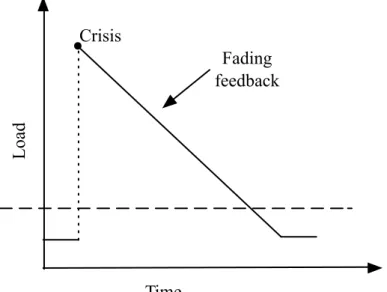
The study called Algebra met Inzicht (Algebra with Insight) was designed in the Digi-tal Mathematical Environment (http://www.fi.uu.nl/dwo/en)1. The intervention con-sists of a pen-and-paper pre-test, four digital modules, a digital diagnostic test, a final digital test and, finally, a pen-and-paper post-test. It was deployed in fifteen 12th grade classes from nine Dutch secondary schools (N=324), involving eleven mathe-matics teachers. The schools were spread across the country and showed a variation in school size and pedagogical and religious backgrounds. The participating classes con-sisted of pre-university level wiskunde B students (which is roughly comparable to grade 12 in Anglo-Saxon countries). As this article is about design principles, I refer to different articles for more details of the set-up of the study and the actual effects of the digital intervention (Bokhove & Drijvers, 2012a, 2012b). Figure 1 shows the pro-posed model for sequences of (near-similar) tasks.
Figure 1. Proposed model for crises, feedback and fading
I contend that it is okay to use near-similar tasks and repetitive exercises, but suggest that the sequence is interspersed by intentional crises, i.e. tasks that are hard or impos-sible to solve with skills and knowledge that are available. In other words, the “load” of the task is too high. I will not go into the word load in detail. There is a vast body of research connected to the expression cognitive load theory (Sweller, 1988). There also is, rightly so, criticism (De Jong, 2010). For the purpose of this paper, we will on-ly assume that knowledge that is not known potentialon-ly will bear a larger load than unknown knowledge. Then, let students overcome crises by providing feedback. To avoid a dependency on feedback for the summative assessments fade the feedback during the course of the sequence of tasks.
1 An English translation of part of the module can be found at http://www.fi.uu.nl/dwo/soton. Log in
as guest, and choose “Demo for 22nd ICMI study”. Java is needed.
L oa d Crisis Fading feedback Time
A
M
ODEL FOR
S
EQUENCES OF
N
EAR
-S
IMILAR
T
ASKS
I will first elaborate on the three main components of the model: crises, feedback and fading.
With a crisis, we refer to a principle that the poet John Keats so eloquently de-scribed in the early 19th Century “failure is the highway to success”. This principle corresponds to similar concepts that have been described during the years. Piaget (1964) used the concept of equilibrium and disequilibrium. This meant that a child would assimilate experiences that would confirm his or her mental model. When the experience was new and unexpected, the result would be disequilibrium, and a child may experience as confusion or frustration. Eventually, the child changes his or her cognitive structures to accommodate the new experience and moves back into equilib-rium. While Piaget studied the individual case, on a societal level, Kuhn (1962) re-ferred to a paradigm shift, arguing that scientific advancement is not evolutionary, but rather a “series of peaceful interludes punctuated by intellectually violent revolutions” (p. 10), and that in those revolutions “one conceptual world view is replaced by an-other” (p. 10). Tall (1977) refers to cognitive conflicts: “One of the distinguishing fac-tors in catastrophe theory is the existence of discontinuities, or sudden jumps in be-haviour when certain paths are taken” (p. 6). In his levels of thinking, Van Hiele (1985) discerns structure and insight. There can be a “crisis of thinking”, which has a link to the Vygotskian zone of proximal development. The common ground between the two is that there is a need for challenge. More recently, Kapur (2010) uses the term productive failure and paraphrases Clifford (1984).
However, allowing for the concomitant possibility that under certain condi-tions letting learners persist, struggle, and even fail at tasks that are complex and beyond their skills and abilities may in fact be a productive exercise in failure requiring a paradigm shift.(p. 524)
Kapur (2010) explains this by stating that it is reasonable to reinterpret these findings as an argument for a delay of structure in learning and problem-solving situations, ei-ther in the form of feedback and explanations, coherence in texts, or direct instruction. The difference with my own work (Bokhove & Drijvers, 2012a) seems to be whether crisis are an inherent part of learning when solving open problems, or actually embed-ding tasks that could intentionally cause a crisis. It is proposed that intentional crisis tasks are added to sequences of near-similar tasks, for example in the way depicted in Table 1, which illustrates the way in which crisis items are integrated within the digi-tal tool. The general structure of a sequence is: pre-crisis items, crisis item, and post-crisis items. In the case of the algebra items in the intervention, choosing values for the items can also be seen as designing a sequence of didactical variables (Brousseau, 1997). The underlying assumption is that seemingly minor differences in tasks can have significant effects on learning, a statement that is supported by cognitive psy-chology (e.g., Anderson & Schunn, 2000), studies on worked examples (e.g., Renkl, 2005) and the application of variation theory to learning study (Runesson, 2005).
Table 1
Sequence of Items Illustrating Crises and Feedback
N. Tasks (“Solve the following equations”) Explanation Pre-crisis items
1 In the initial items students are
confronted with equations they have experience with. Students may choose their own strategy. Many students choose to expand brackets as that is the strategy that they have used often: Work towards the form ax^2+bx+c=0 and use the quadratic formula. There is some limited feedback on the task. 2
3 4
Crisis item
5 Students are then confronted with an
intentional crisis: If a student uses his/her conventional strategy of expanding the expression. The yellow tick at the bottom of the screen denotes that the equation is algebraically equivalent to the initial one, but that it is not the final answer. This is
accompanied by a partial score for an item and some feedback in Dutch: “You are rewriting correctly”.
Table 1
Sequence of Items Illustrating Crises and Feedback
N. Tasks (“Solve the following equations”) Explanation 6
Although these students showed good rearranging skills, in the end they were not able to continue, as they did not master the skill to solve a third order equation. There is some limited feedback on the task.
Post-crisis items
7 After the crisis item students are
offered help by providing a “voorbeeldfilm”, an instructional screencast, and buttons to get hints, the next step in the solution or a worked solution. These features have in
common that they provide feedforward information at the task level and self-regulation. 8 9 10 11 12 Note: N = number
Having established the usefulness of the first design principle of crises, the next ques-tion becomes: How can students address this crisis? Can we add another principle which enables students to use assessment for learning? One way would be to make use of formative assessment. Black and Wiliam (1998) define assessment as being formative only when feedback from learning activities is actually used to modify teaching to meet the learner’s needs. From this it is clear that feedback plays a pivotal role in the process of formative assessment. Hattie and Timperley (2007) conducted a meta-review of the effectiveness of different types of feedback. The feedback effects of hints and corrective feedback are deemed best. However, in my personal experience as a teacher I have seen there can be an over-reliance on feedback that is provided. Assuming that students finally have to pass an exam themselves, it makes sense to address this over-reliance on feedback. In a follow-up paper, Kapur (2011)
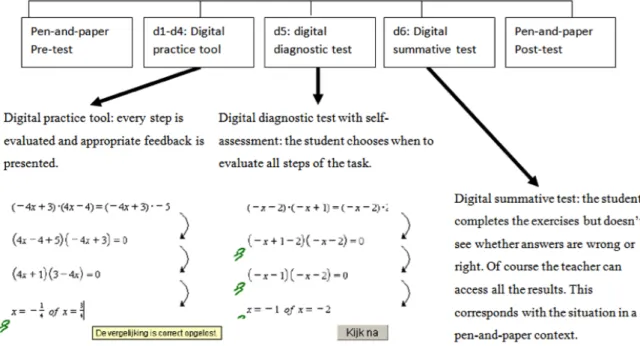
notes that scaffolding implies help to overcome failure (Pea, 2004). It turns out that when dealing with previously stored information in the long term memory, these lim-its tend to disappear. As Kirschner, Sweller, and Clark (2006) argued “any instruc-tional theory that ignores the limits of working memory when dealing with novel in-formation or ignores the disappearance of those limits when dealing with familiar information is unlikely to be effective” (p. 77). As a design principle, it is therefore proposed that initially a lot of feedback is provided to foster learning, but the amount is decreased towards the end, to facilitate transfer. Using scaffolding this way is based on the concept of fading (Renkl, Atkinson, & Große, 2004). Formative scenarios (Bokhove, 2008) are a variation of this concept, starting off with a lot of feedback, and providing a gradually decreasing amount of feedback. Figure 2 shows how this principle was implemented in the intervention. At the start feedback is provided for all intermediate steps of a solution. The subsequent part of the intervention concerns self-assessment and diagnostics: The student performs the steps without any feedback and chooses when to check his or her solution by clicking a check button. Feedback is then given for the whole of the exercise.
Figure 2. Outline of fading feedback in formative scenarios
Finally, students get a final exam with no means to see how they performed. Just as is the case with a paper test, the teacher will be able to check and grade the exam (in this case automatically) and give students feedback on their performance. A student needs to be able to accomplish tasks independently, without the help of a computer. An im-plicit advantage of implementing feedback in a sequence of tasks is that teachers and designers have to think upfront about possible student responses.
P
RINCIPLES AT
W
ORK
:
A
C
ASE
E
XAMPLE
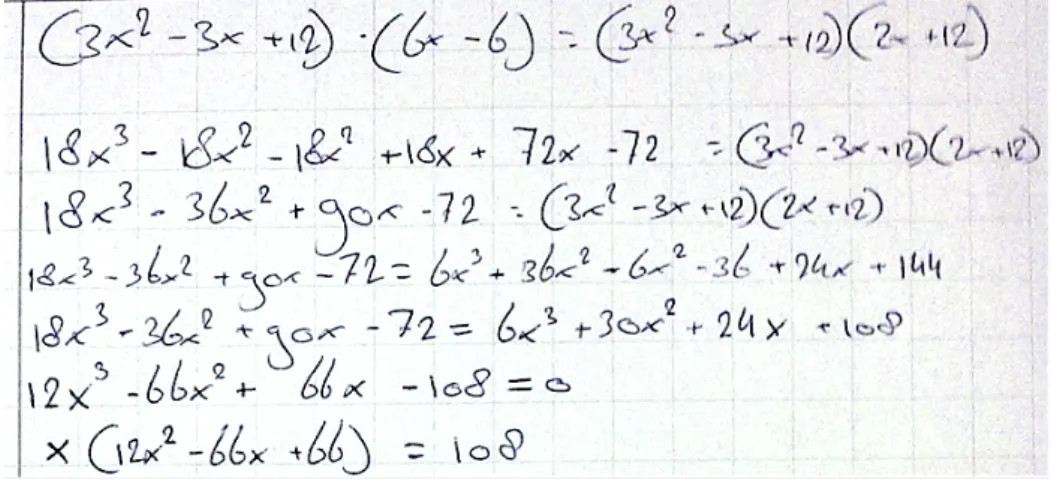
Let’s look at one student named Paula during the course of this module. The student starts off with a pre-test. Apart from the calculation error on the right hand side of the equation, Figure 3 clearly shows that Paula’s strategy here is to expand the expres-sions, similar to students in earlier phases of the study (Bokhove & Drijvers, 2010).
Figure 3. Example of Paula’s pre-test pen-and-paper work
Not surprisingly this strategy fails in the case of this equation. Paula only scores 14 out of 100 for the whole pre-test. On a measure for symbol sense, with a negative number showing more non-symbol sense behaviour than symbol sense behaviour and a positive number the opposite, Paula scores −4 —for more details on the calculation
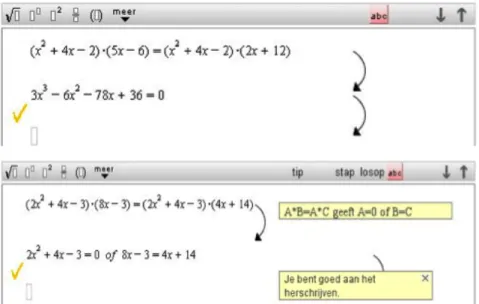
I refer to Bokhove and Drijvers (2012b). Paula then starts with the sequence of digital tasks. In the first task the student has to get acquainted with the digital environment. The pre-crisis items pose no problem for most students, including Paula. On arriving at the crisis item students exhibit three behaviours, roughly corresponding with the ones already observed in the pre-test: (a) students solve the equation correctly, (b) students recognize the pattern of the equation but subsequently make mistakes (for example by losing solutions in the process), and (c) students expand the expressions and get stuck with an equation of the third power that they can not solve. Figure 4 shows that case student Paula again exhibits the third type of behaviour. At this mo-ment feedback is still restricted to correct/incorrect. In addition, students are allowed to choose their own strategies, even when they are not efficient or would lead to prob-lems. In the post-crisis items, in addition to feedback on correct/incorrect, Paula is provided with buttons for hints, and a movie clip demonstrating the solution. From the log-files of the online environment it becomes clear that Paula fails at the crisis-item (0 points out of 10), but succeeds at the post-crisis item with feedback (10 points out of 10). When looking at attempts made, Paula attempts the crisis-item 73 times, and the post-crisis item, being aided by feedback, only 3 times.
Figure 4. Paula’s digital work. Above: crisis item left. Below: post-crisis item Finally, in the pen-and-paper post-test Paula shows a significant increase in the total score (70 out of 100, an increase of 56) and symbol sense behaviour (+1, an increase of 5). Even though mistakes are made, they were not caused by a lack of symbol sense any more but by errors in calculations. Focusing only on similar types of equations, it becomes clear that Paula manages to solve these equations correctly. Paula is not a unique case in this school. Overall, students in participating schools improved on their scores and symbol sense behavior.
C
ONCLUSION
Illustrated by the theoretical underpinnings, the overall results in the study, and case example, it is concluded it would be a good idea to study design principles that can be used to design sequences of near-similar tasks in more detail. By combining three principles from an initial study-crises, feedback and fading-in one model for sequenc-es of tasks, three important aspects are addrsequenc-essed: (a) sequencsequenc-es of tasks, (b) near sim-ilar and/or repetitive tasks, and (c) addressing both conceptual understanding and pro-cedural fluency. We propose that educators, teachers, designers and researchers alike can adopt these principles when designing and implementing sequences for (near-similar) tasks. However, it is important to note some points of discussion. The diffi-culty of every task or sequence of tasks depends on the context. What can be a simple task for one year eight student can prove to be difficult for another student, even when at first sight they seem fairly similar. Also, the way in which a crisis is overcome can differ: Some students learn from repeating near-similar tasks, others seem to recog-nize a pattern immediately and apply this to new tasks. Given this diversity, it is im-portant to field-test and evaluate sequences of tasks, again combining the power of teaching, researching and designing. I think it would be unfair to indefinitely classify
certain tasks as more creative and other tasks as less creative. This fact also depends on the background and context of the learner: A wonderful, new and creative task can become a repetitive task the second time around. Looking back on this paper, I won-der whether the predicate “near-similar" does not actually apply to all tasks, in those cases in which a student has seen a task before, even the elaborate, creative ones. It is my wish that we look at the total picture, and integrate all these tasks in one clear pic-ture for the learning student. One way would be to not so much study the napic-ture of solitary tasks but to place them in sequences and their corresponding contexts. Hope-fully, this paper provides general design principles that can be used, and task design can be taken forward.
R
EFERENCES
Anderson, J. R., & Schunn, C. D. (2000). Implications of the ACT-R learning theory: no magic bullets. In R. Glaser (Ed.), Advances in instructional psychology: Educa-tional design and cognitive science (Vol. 5, pp. 1-34). Mahwah, NJ: Lawrence Erl-baum Associates.
Black, P., & Wiliam, D. (1998). Inside the black box: Raising standards through class-room assessment. Phi Delta Kappan, 80(2), 139-149.
Bokhove, C. (2008, June). Use of ICT in formative scenarios for algebraic skills. Pa-per presented at the 4th conference of the International Society for Design and De-velopment in Education, Egmond aan Zee, The Netherlands.
Bokhove, C., & Drijvers, P. (2010). Symbol sense behavior in digital activities. For the Learning of Mathematics, 30(3), 43-49.
Bokhove, C., & Drijvers, P. (2012a). Effects of feedback in an online algebra inter-vention. Technology, Knowledge and Learning, 17(1-2), 43-59. doi:10.1007/s10758-012-9191-8
Bokhove, C., & Drijvers, P. (2012b). Effects of a digital intervention on the develop-ment of algebraic expertise. Computers & Education, 58(1), 197-208. doi:10.1016/j.compedu.2011.08.010
Brousseau, G. (1997). Theory of didactical situations in mathematics 1970-1990. Dordrecht, The Netherlands: Kluwer.
Clifford, M. M. (1984). Thoughts on a theory of constructive failure. Educational Psychologist, 19(2), 108-120.
De Jong, T. (2010). Cognitive load theory, educational research, and instructional de-sign: Some food for thought. Instructional Science, 38(2), 105-134. doi:10.1007/s11251-009-9110-0
Hattie, J., & Timperley, H. (2007). The power of feedback. Review of Educational Re-search, 77(1), 81-112.
Kapur, M (2010). Productive failure in mathematical problem solving. Instructional Science, 38(6), 523-550.
Kapur, M. (2011). A further study of productive failure in mathematical problem solv-ing: Unpacking the design components. Instructional Science, 39(4), 561-579. Kirschner, P. A., Sweller, J., & Clark, R. E. (2006). Why minimal guidance during
instruction does not work. Educational Psychologist, 41(2), 75-86.
Kuhn, T. S. (1962). The structure of scientific revolutions. Chicago, IL: University of Chicago Press.
Lagrange, J.-B. (2002). Etudier les mathématiques avec les calculatrices symboliques. Quelle place pour les techniques? [Studying mathematics with symbolic calcula-tors. What role for tehcniques ?] In D. Guin & L. Trouche (Eds.), Calculatrices symboliques. Transformer un outil en un instrument du travail mathématique: un problème didactique [Symbolic calculators. Transforming a tool into an working mathematics instrument: A didactical problem] (pp. 151-185). Grenoble, France: La Pensée Sauvage.
Pea, R. D. (2004). The social and technological dimensions of scaffolding and related theoretical concepts of learning, education, and human activity. Journal of the Learning Sciences, 13(3), 423-451.
Piaget, J. (1964). Development and learning. In R. E. Ripple & V. N. Rockcastle (Eds.), Piaget rediscovered (pp. 7-20). New York, NY: Cornell University Press. Renkl, A. (2005). The worked-out-example principle in multimedia learning. In R.
Mayer (Ed.), The Cambridge handbook of multimedia learning (pp. 229-246). Cambridge, United Kingdom: Cambridge University Press.
Renkl, A., Atkinson, R. K., & Große, C. S. (2004). How fading worked solution steps works—A cognitive load perspective. Instructional Science, 32(1-2), 59-82.
Runesson, U. (2005). Beyond discourse and interaction. Variation: A critical aspect for teaching and learning mathematics. The Cambridge Journal of Education, 35(1), 69-87.
Schoenfeld, A. H. (2009). Bridging the cultures of educational research and design. Educational Designer, 1(2). Retrieved from http://www.educationaldesigner.org /ed/volume1/issue2/article5
Sweller, J. (1988). Cognitive load during problem solving: effects on learning. Cogni-tive Science, 12(2), 257-285. doi:10.1016/0364-0213(88)90023-7
Tall, D. (1977, February). Cognitive conflict and the learning of mathematics. Paper presented at the First Conference of The International Group for the Psychology of Mathematics Education, Utrecht, The Netherlands. from http://www.warwick.ac.uk/staff/David.Tall/pdfs/dot1977a-cog-confl-pme.pdf Van Hiele, P. M. V. (1985). Structure and insight: A theory of mathematics education.
Orlando, FL: Academic Press.
Watson, A., & Mason, J. (2006). Seeing an exercise as a single mathematical object: Using variation to structure sense-making. Mathematical Thinking and Learning, 8(2), 91-111.
Watson, A., & Ohtani, M. (2012). Task design in mathematics education. Discussion document. Retrieved from http://ncm.gu.se/media/ncm/dokument/ ICMI_Study_22_announcement_and_call_for_papers.pdf
This document was originally published as Bokhove, C. (2013). Using crises, feed-back, and fading for online task design. In C. Margolinas (Ed.), Proceedings of ICMI Study 22. Task Design in Mathematics Education (pp. 17-23). Oxford, United King-dom: International Commission on Mathematical Instruction.
Christian Bokhove University of Southampton
[email protected] Received: January 2014. Accepted: February 2014.