EXHIBIT 5.1
Examples of Best Practices and Use of Technology
Examples from the Program Level Best Practices and Using Technology
Secondary Teacher Education History
Technology is a central feature of how we prepare new history teachers, from accessing online resources to build engaging and challenging curriculum for students to showcasing professional growth and development as educators.
Technologies include wikis, social bookmarking, video materials, flipped classroom structures, blended learning and professional learning network.
Methods Courses: EDUC 514: Teaching History and Political Science in Middle and High School and EDUC 613: New Development in Secondary School History & Political Science
Students in both classes use and contribute to
resourcesforhistoryteachers, an award-winning wiki that has pages for every learning standard in the Massachusetts History & Social Science Curriculum Framework
Use of social bookmarking technologies to save exemplary web materials for curriculum development
Teaching new teacher candidates how to access and assess online resources so they can teach students in schools how to critically evaluate web materials
All history teacher education courses encourage the development of a web-based professional learning network where new teacher
candidates showcase their professional skills and accomplishments
Secondary Teacher Education Science
Two tenants of our conceptual framework guide best practice in teaching:
Throughout the science education program teacher candidates will experience modeling of best practice in the following areas:
- Promoting the concept of Community of learners
- Integrating science and science education research and promoting the appreciation and connection of that integration into the practice of science teaching
Instructional strategies, including: scientific inquiry and engineering design, cognitive approaches, cooperative & collaborative approaches, discussion (whole & small group), lecture, laboratory work, modeling scientific thinking
Lesson preparation and planning: Planning with the end in mind, objectives and their relation to the Massachusetts Science/Technology Curriculum Framework and the Next Generation Science Standards, phases of a lesson, key questions and how you expect students to answer, safety aspects and care of living specimens, accommodation for Special Needs students and English Language Learners, reflect students’ interest and equity issues (e.g., cultural sensibility of topics, gender-specific interest) and developmental levels (social, moral, and cognitive development) of age group for which you develop the lesson plan., assessment strategies
Strategies for engaging diverse students through various instructional strategies ( see list above)
Assessment strategies include the use of the following: Various forms of summative and formative assessments, laboratory reports,
performance assessments, portfolios, unit plans, oral presentations
Classroom management strategies, including the use of: learning and behavioral expectations, personal relationship building, democratic practices, thoughtful decision making
Reflective practice, including the use of: Journals, peer discussions, mentoring
Involvement with professional associations including the use of resources from: National Science Teacher Association, Pioneer Valley STEM, American Association of Physics Teachers, American
Association of Chemistry Teachers, National Association of Biology Teachers, Massachusetts Association of Science Teachers
Use of Technology, including: Moodle as part of instruction and modeling how to use a learning platform to create a personalized learning environment: activities include feedback for submitted assignments, readings, and a forum for postings and discussions, PowerPoint presentations, video clips, simulations, various
computer/personal device apps integrated into class/group activities (e.g. graphing, stopwatch, metronome), promoting the integration of technology in the science classroom, including creating an effective learning environment and using classroom management strategies. Collaborative Teacher Education Program:
Elementary
State clear learning objectives (since I require students to write
objectives on their Lesson Plans, I try to model this). I think it is good practice to "set the stage" for the content of a class
Utilize Exit Tickets on a regular basis as an informal (formative) assessment
Instill cooperative learning strategies by choosing groups and
providing specific tasks, assigning roles to group members, and trying to be specific about each group's assignment and their reporting out to the whole group.
Technology is used to support classroom instruction (often it is simply PowerPoint, an online video clip, a radio spot, etc.). Students are permitted to use laptops in my classes in order to take notes, research, work on group projects, etc.
Some classes in CTEP utilize Poll Everywhere in order to increase student engagement in lectures - they can respond to poll questions (based on a lecture) and the results are immediately shown on the screen
Classes also use Moodle or Blackboard Learn and have fully integrated Electronic Textbook.
Early Childhood Education Poll Everywhere which allows for immediate feedback from student using their cell phones.
Video--For example, Denise and I created a video of me administering an informal reading inventory.
I use a webquest to teach students about writing to advocate for children and families.
Students share video of their own teaching for reflection and analysis. Examples from various faculty on the
implementation of best teaching practices and use of technology
All differentiated - meaning the process and products of the curriculum are tailored to address student’s readiness, interests, and learning styles. For example, in the Leadership for C&I, students have the option of completing a Curriculum Audit or facilitating Instructional Rounds (details are in the syllabus).
Course content is organized around big ideas/essential understandings - material is introduced by way of a problem that small groups of
students attempt to solve. For example, when teaching the idea that there is a "curriculum landscape” with many intersecting forms of curriculum (written, taught, tested, etc.) student first work with each other to physically place these ideas in relation to one another (using pictures, or other physical objects) and then publicly defend/explain their point of view. The students then physically “see” the gaps between types of curriculum (such as a disconnect between what is taught and what students are tested one). This activity leads to the big idea that leadership for C&I challenge is to close gaps across the landscape of curriculum. Each student can see themselves somewhere in that landscape and recognizes that s/he can make a difference.
Every class begins with a “hook” and “set” and includes small and large group dialogue, targeted lecture, formative assessment, and a closing share out of a key take-home idea. And all courses require the completion of an authentic performance assessment, that is students complete an activity that actual educational leaders do in the field. (i.e. PLC audit, curriculum reviews, curriculum mapping, supervision of instruction, etc.)
Use of technology: Including the integration of webinars (e.g. from the Education Trust), ®Skyping in national experts to class discussion (i.e. Karin Chenoweth), Moodle group forums/posts/discussion,
SurveyMonkey for self-assessments, the web for accessing all kinds of real time information, e.g. NCES datasets, RBT videos of
teaching/teaming/leading, etc.
I am also now using Ucinet, which is an innovative software platform for the collection and analysis for social network data. I wrote a proposal to gain a College site license for Ucinet, which we now have. I use Ucinet in the new course EDUC 790E: Social Network Analysis for Educational Leadership. Students create socio-gram and matrices using the software.
Using video capture, and using class time for a mix of activity and lecture rather than solely lecture. There is a lot of outside video use, through the UMass library. Syllabus doesn't say much about it, but is attached.
In EDUC/PSYCH 305 for their summative assessment I'm having them do videos of themselves teaching as one of the options. About 50 of the students last semester did this. In EDUC 293 they create a Powerpoint about possible careers, including job tasks, future outlook, related professions, required education, and salary. That syllabus is also attached (you can also see what I did with the 3-4 credit situation).
We use video extensively for our clinical classes (EDUC 631, EDUC 688, EDUC 886 and EDUC 698 (prepractium) and EDUC 701 (practicum) both in and out of class). Students videotape themselves counseling, running groups, and teaching social/emotional content and then review that in class with peers and professor to both share ideas, demonstrate proficiency (later in the process) and get support and critiques.
To answer the question about best practices, I would say that in all my classes I make sure to engage in multiple modes of instruction,
including lecture, discussion, think/pair/share, group work, team-based learning, group questions, debate, case studies, guided study questions, test review sessions, use of PowerPoint, and in-class writing. I provide clear examples I consider to be excellent versions of every
assignment. I also make sure to have multiple options for assessment of learning, including papers, tests, creative projects, videotape production, artifact production, and peer feedback. Another best practice is to engage personally with all of my students, and to reward student participation, even in large classes.
In terms of the use of technology, I use Moodle extensively to post readings, videos, and all course materials. I also communicate on a regular basis using email. Also PPt. and videos in class.
Technology is an integral part of my teaching. My classrooms are paperless and the majority of class activities occur in or are supported by online tools and technologies (e.g., Google Docs, iMovie,
Wikispaces, Google Sites). I mainly use technology to enhance learning and empower students as learners. For example, I have all of my students build their own professional learning networks (PLNs) using web 2.0 and social media tools. This empowers the students to take charge of their learning experiences. I also setup an online community (using Google+ Communities) for each class in order to allow students to engage in conversations and share resources and ideas outside of class time. Additionally, I had students in my Technology in the Curriculum course build digital portfolios, that featured technology-enhanced lesson plans and a teaching philosophy statement, to show to future employers. I also have my students participate in Twitter chats to connect with other classrooms and the broader education community.
Examples from Courses
EDUC 497I: Tutoring in Schools Uses a free open education wiki called teams-tutoring in schools to replace a costly textbook
Received an OER Grant from the University's Du Bois Library to expand wiki resources
Weekly online reading, viewing, listening assignments on the wiki as a way to create a flipped learning classroom in the University's new Integrated Learning Center
Integration of video resources into weekly workshops as part of flipped classroom structure
EDUC 691R Promising Math Practices Use of technology In the course—the purpose of which is to give master’s/credential students opportunities to study the core ideas of learning and teaching elementary mathematics—we use technology as a way to explore lesson design, a key element of learning to teach. I outline what I see as a challenge for this course, followed by the use of technology as a way to address this challenge.
Challenge facing elementary mathematics: In programs such as CTEP and the majority of elementary pre-service teacher (PST) programs in our country, we engage PSTs in how to support inquiry-oriented classrooms in which all children are positioned as doers of
mathematics. This approach is overwhelmingly supported by decades of research on learning and teaching as well as various sets of
standards documents. At the same time, a flaw in such preparation programs is that we have no control over where PSTs may eventually get jobs and into which sorts of districts and climates they might enter. While I and most mathematical educators firmly and unequivocally support inquiry oriented classrooms that engage all learners in conceptual understanding of mathematics, our PSTs may get jobs in classrooms with traditional curricula that completely conflict with what they learn in methods coursework, leaving new teachers unprepared to interpret traditional materials to support their elementary students. For this reason, I have developed a research strand focusing on teacher noticing of mathematics curriculum.
Incorporating technology: I made use of online animations in which CTEP students take available curricular materials (i.e., Everyday Math or Investigations in Number, Data, and Space), design a lesson plan,
and then animate the beginning of this lesson. This particular
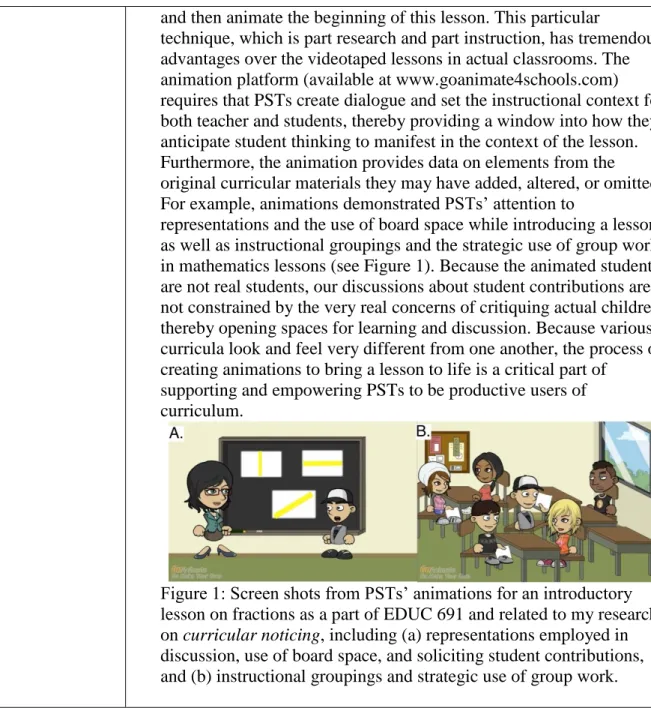
technique, which is part research and part instruction, has tremendous advantages over the videotaped lessons in actual classrooms. The animation platform (available at www.goanimate4schools.com) requires that PSTs create dialogue and set the instructional context for both teacher and students, thereby providing a window into how they anticipate student thinking to manifest in the context of the lesson. Furthermore, the animation provides data on elements from the original curricular materials they may have added, altered, or omitted. For example, animations demonstrated PSTs’ attention to
representations and the use of board space while introducing a lesson, as well as instructional groupings and the strategic use of group work in mathematics lessons (see Figure 1). Because the animated students are not real students, our discussions about student contributions are not constrained by the very real concerns of critiquing actual children, thereby opening spaces for learning and discussion. Because various curricula look and feel very different from one another, the process of creating animations to bring a lesson to life is a critical part of
supporting and empowering PSTs to be productive users of curriculum.
Figure 1: Screen shots from PSTs’ animations for an introductory lesson on fractions as a part of EDUC 691 and related to my research on curricular noticing, including (a) representations employed in discussion, use of board space, and soliciting student contributions, and (b) instructional groupings and strategic use of group work.
USE OF INTEGRATED LEARNING CENTER
The Integrative Learning Center provides state-of-the-art classroom and academic space for the Amherst campus with the first classes starting in the Fall Semester 2014.
This building is located in the heart of campus in close proximity to the Lincoln Campus Center and Student Union. Its location not only provides students with convenient access to classrooms, but also creates a hub of student activity to animate these three spaces. Students and faculty can walk to the ILC from any departure point within the campus core in less than ten minutes. With a turnover of 3,600 students each hour during the class day, this site and the buildings around i t will become the truly lively, natural center that the campus has envisioned through its planning process.
Housed within the walls of the four-story 150,000 sq. ft. structure there are nearly 2,000 seats of classroom space, as well as space for several academic programs including Communications, Journalism and Linguistics.
Examples of Courses using the Integrated Learning Center and Service Learning Components
Course # Title Course Description Instructional Mode
EDUC 115 Embracing Diversity
This course is about cultural diversity in the University community and how we can better understand ourselves and others through an appreciation of college education as a cultural experience, with its own unique set of rules, biases, and expectations. The course is designed for first year students.
Integrated Learning Center Team Based Learning Classroom
EDUC 190A Education at the Movies
Course introduces students to selected essential topics in modern educational theory and
practice using depictions of teachers, students,
Integrated Learning Center Case Study Classroom
and schools in movies as springboards for inquiry.
EDUC 218 Hip Hop Nation and Literacy Practices
This course explores the relationship between hip hop culture and language and literacy practices of global youth cultures. We will look at this relationship in school and out-of-school contexts.
Integrated Learning Center Team Based Learning Classroom
Service Learning Component EDUC 229 International
Education
This course is designed to introduce students to the role of culture in education. After
exploring the theoretical basis of culture, and its relationship to education, students will be exposed to a range of cultural perspectives from Africa, Asia and Latin America.
Integrated Learning Center
Team Based Learning Classroom
EDUC 377 Introduction to Multicultural Education
Introduction to the sociohistorical,
philosophical, and pedagogical foundations of cultural pluralism and multicultural
education. Topics include experiences of racial minorities, white ethnic groups and women; intergroup relations in American society, sociocultural influences and biases in schools; and philosophies of cultural pluralism.
Service Learning Component
EDUC 462 Teaching Science in Elementary School
Preparation for pre-service students in teaching science in elementary schools. Methods, materials, and latest curriculum work.
Integrated Learning Center Service Learning Component EDUC
497I/587R
Tutoring in Schools
This course will introduce University undergraduates to pedagogical and methodological issues and strategies for
Team Based Learning Classroom
tutoring linguistic minority students. Students who participate in this course provide
academic assistance to secondary school students while working with Project Coordinators, the Faculty Director of the TEAMS project, public school teachers and administrators, and members of the
community.
Integrated Learning Center
EDUC 533 Theories and Methods for Sheltered Instruction in ELL
This course aims to prepare ELL and
mainstream teachers to address the challenge of helping bilingual and emergent bilingual learners succeed in regular academic content classes. We will consider research supporting the view that second language acquisition is enhanced by rigorous academic content instruction. We will also explore instructional practices aligning English Language
Proficiency Benchmarks and Outcomes for English Language Learners with those of science and other content areas.
Service Learning Component
EDUC 597S Service Learning and Teaching with
Computational Media
This course take a generative justice approach to learning and teaching with computational media. Through coursework, students prepare to work with youth in Holyoke in an after school computer club.