2011 Report on UC and Cloud-Based
Services for SMBs
State-of-the-Market Report
February 2011 Page 1
Unified Communications and
Cloud-Based Services Yield
Exponential Savings For SMBs
A Webtorials State-of-the-Market Report
Introduction
Small and Medium Businesses (SMBs) in the 21st century experience a technological dilemma regardless of their vertical industry: They seek to be on the leading edge and yet their existing infrastructure (personnel and hard assets) impede the achievement of this goal. Their inefficiencies and old business model keep them in the 20th century. The larger enterprises are far out-pacing them. SMBs are seldom able to achieve the economies of scale that their larger counterparts enjoy as a result of being able to deploy a single solution to a large number of workers.
In December 2010 and January 2011, the Webtorials database – relatively highly skilled IT professionals – and other individuals who had demonstrated an interest in Cloud-based IP Telephony solutions were presented with an extensive set of statements and asked to indicate their level of agreement with the statements. A State-of-the-Market Report, 2011 SMB Communications Plans and Priorities, has already been released based on these findings.
Additional information was garnered from an analysis of demographic questions. The results presented here are representative of the leading edge of SMBs, representing only the tip of the iceberg of the mass market. Trends identified here as shorter term should therefore be expected to be adopted by SMBs as a whole over the next few years.
The bottom line is clear: SMBs can see business-critical increases in productivity and commensurate cost savings by implementing Unified Communications (UC) using a cloud-based model.
2011 Report on UC and Cloud-Based
Services for SMBs
State-of-the-Market Report
February 2011 Page 2
Unified Communications: The Key to Dramatic Productivity Increases
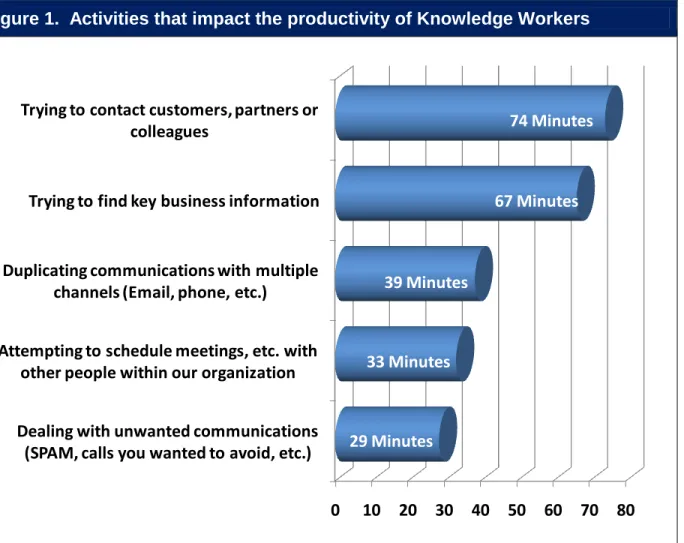
The Knowledge Worker staff is the largest group of employees in a typical SMB. Among the respondents, 60% reported that 75% or more of total employees are “Knowledge Workers,” and 73% reported more than half of their workforce consists of “Knowledge Workers,”As seen in Figure 1, the responses to “How much time per day do you think the average "Knowledge Worker" spends each day on each of the following tasks?” illustrate an fascinating phenomenon: SMB Knowledge Workers spend 50% of their time on overhead tasks.
Figure 1. Activities that impact the productivity of Knowledge Workers
How much time per day (in minutes) do you think the average "Knowledge Worker" spends each day on each of the following tasks?
0
10
20
30
40
50
60
70
80
Dealing with unwanted communications
(SPAM, calls you wanted to avoid, etc.)
Attempting to schedule meetings, etc. with
other people within our organization
Duplicating communications with multiple
channels (Email, phone, etc.)
Trying to find key business information
Trying to contact customers, partners or
colleagues
29 Minutes
33 Minutes
39 Minutes
67 Minutes
74 Minutes
2011 Report on UC and Cloud-Based
Services for SMBs
State-of-the-Market Report
February 2011 Page 3
If one examines these results and assumes an eight-hour work day,
36% of the time is spent trying
to contact people,
to find information, and
to schedule meetings.
14% is spent:
duplicating information (forwarding emails; phone calls to see if the fax / email / text message was received)
dealing with unwanted communications (spam emails / unsolicited time-wasting phone calls.)
These tasks consume 50% of the Knowledge Workers’ time1
Knowledge Workers now have so much information at their finger tips and so many capabilities for various communications channels that they are overloaded with options. They spend a great deal of time “churning” and trying to get to the right information – that exists “somewhere” – but they spend vast amounts of time figuring out exactly where that information is and managing the information that they do have. For instance, SalesForce.Com offers a great database for CRM, but the database must be created and actively maintained.
This is especially key for the SMB. Simply put, SMBs don’t have the luxury of support staff and overhead to deal with inefficiencies. The reason that so much innovation comes from the SMB segment is the jack-of-all-trades and do-it-yourself mentality that accompanies the SMB mindset. Consequently, the implementation of any new
technology that can make the Knowledge Worker more efficient has tremendous payoff. In fact, reducing a Knowledge Worker’s unproductive time by 25 percent (one hour per day) can yield an extra six weeks in productivity each year, per employee. So the question becomes one of exactly how much does this translate into in “real” dollars.
This is quite difficult to quantify because of the extremely large number of variables. Consequently, it must be considered on a case-by-case basis. One must start with an estimate of how much time can be saved by implementing UC for each of the
1 These percentages and values are very much in line with many other studies. In fact, studies as far back as 1995 show similar use of time by Knowledge Workers. While this lack of change over time may in some ways seem to be counter-intuitive, the Knowledge Worker today deals with much more information than was available 15 years ago. IT capabilities have brought together vast quantities of information and communications channels to be dealt with.
2011 Report on UC and Cloud-Based
Services for SMBs
State-of-the-Market Report
February 2011 Page 4
listed tasks. Then we consider the characteristics of the sample base. On the one hand, we know that the SMBs included in our sample are at the technological leading edge of SMBs. At the same time, SMBs tend to have a much lower percentage of implementation of UC than their larger counterparts.
Additionally, there is no “typical” SMB. Further, compensation for a SMB may very well be based on a factor not typically accounted for – equity interest in the company. The Knowledge Worker in a SMB may very well be working for a smaller salary in exchange for the expectation that at some point they will have an equity interest in the company itself.
Appendix 1 both serves as both an explanation of our methodology and provides the reader with a template for calculating specific savings. Using this methodology, we created a prototype small business with 50 Knowledge Workers. Of the 50 Knowledge Workers, we assumed a wide range of salaries ranging from $40,000 per year to $110,000 per year, with the number of employees weighted to the less expensive employees. We also assumed modest productivity gains of two hours per day by weighting the expected increases in efficiency by implementing UC in each of the above categories.
Based on these relatively conservative assumptions, the prototypical company with fifty Knowledge Workers is able to recover a time value of roughly one million dollars per year in increased productivity.
The exact value for our fictional company is $942,500.2 But realizing these savings is non-trivial. The implementation of UC solutions is quite intensive in terms of IT staff services, and the expense of the IT staff is inordinately high for SMBs. This leads us to a discussion of the importance of cloud-based services.
In fact, the best method, and perhaps the only method, for SMBs to turn this incredible time value and increased productivity into “real” dollars with a significant RoI is by the use of cloud-based services.
2011 Report on UC and Cloud-Based
Services for SMBs
State-of-the-Market Report
February 2011 Page 5
Cloud-Based Services and Efficiencies: It’s Still about Economies of
Scale
Contrary to popular belief, there’s nothing new or snazzy about “cloud services.” We’ve had them for years – but they have been known by different names and the economies have shifted as various parts of the cost structure have evolved.
In the earliest days of computing, when the only computers were “mainframes,” the price of computing cycles was the driving force. If remote access was needed to a computer, it was accomplished by a protocol … and the “Cloud” – which was most likely a “private cloud” – began its existence.
The era of the PC ushered in a dramatic shift. All of a sudden, it became economical for individual Knowledge Workers to have computing capabilities on their desktops.
Computing power and “human power” became essentially equal, and the productivity of the individual became a more expensive part of the equation than the expense of the computing facilities.
Now, as cloud-based services cycle back into the leading position, the overriding issue remains economics. The cost of computing power as compared to productivity is miniscule. However, the issue now is operations, administration, and maintenance (OA&M) for IT services – both from a computing perspective and from a communications perspective. Indeed the ultimate “convergence” is becoming a reality as computers, applications, and communications are melded into a single entity.
The reasoning behind cloud-based services is simplicity itself. As is shown in the
following analysis, businesses in general, and SMBs in particular, can’t afford not to avail themselves of the economics of scale. It makes no sense to have highly skilled IT professionals replicate themselves over and over at each individual company when a single solution can be distributed to many, many users.
A great example of this is the rapid move to cloud-based email. As services like Gmail become available with “corporate editions,” the business case for maintaining individual email servers quickly evaporates. Additionally, many of the time-consuming and expensive tasks, such as ensuring regulatory compliance, can be off-loaded to the service provider.
We see this as becoming especially critical as arguably the most important task facing SMBs – taking full advantage of Unified Communications (UC) – can be achieved in a services-based model without the need for each SMB to replicate the equipment and employee support costs.
2011 Report on UC and Cloud-Based
Services for SMBs
State-of-the-Market Report
February 2011 Page 6
IT Support Staff for Knowledge Workers
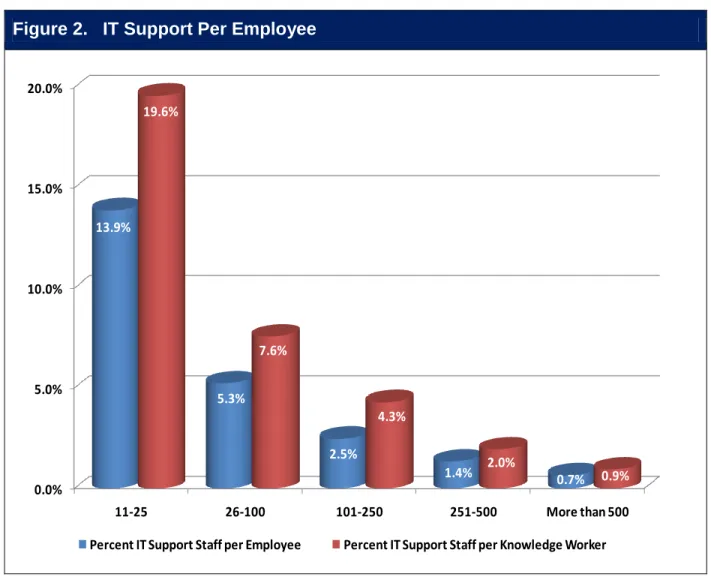
Figure 2 graphically demonstrates the dramatic difference, based on the company size, in the allocation of IT staff to the employees, and specifically Knowledge Workers. "Knowledge Workers" are employees who rely substantially on telecommunications capabilities (i.e., phone, PC) as an integral part of their duties, as compared to workers in a traditional production facility, construction, etc.
As the company size increases, the ratio of IT Support Staff to the company staff decreases dramatically. There is a correlate decrease in the ratio of IT Support Staff to the Knowledge Worker Staff. With each increase with company size range, the ratio is cut in half.3
3 For companies with “More than 500” employees, we estimated 1,000 employees.
Figure 2. IT Support Per Employee
0.0% 5.0% 10.0% 15.0% 20.0% 11-25 26-100 101-250 251-500 More than 500 13.9% 5.3% 2.5% 1.4% 0.7% 19.6% 7.6% 4.3% 2.0% 0.9%
2011 Report on UC and Cloud-Based
Services for SMBs
State-of-the-Market Report
February 2011 Page 7
The economies of scale are clearly illustrated here. Smaller companies have more invested (in time and infrastructure) in their technology and IT Support Staff relative to the larger companies.
An alternate look at the economies of scale is illustrated in Figure 3. In this case, rather than looking at the IT Support Staff per employee or Knowledge Worker, we show the number of employees or Knowledge Workers supported per IT Staff person. The same result is apparent. SMBs have a tremendous disadvantage because they cannot take advantages of economies of scale. And this already overworked staff is deploying and implementing technologies and services specific to their SMB, so there are few
resources available for deploying UC Services.
Figure 3. Employees Supported By A Single IT Staff Person
0 20 40 60 80 100 120 140 160 11-25 26-100 101-250 251-500 more than 500 7 19 40 74 152 5 13 23 51 106
2011 Report on UC and Cloud-Based
Services for SMBs
State-of-the-Market Report
February 2011 Page 8
In transitioning to UC and cloud-based services, the company would transfer a major portion of their IT overhead to the service-provider whose workforce is almost entirely IT Support Staff specializing in UC.
Were a company to utilize UC and cloud-based services, they would be able to reallocate their IT Support Staff to support the technologies unique to their company while also enabling the latest standardized technologies (such as Unified
Communications). This would be the “highest and best” use of this highly skilled and expensive personnel investment.
As demonstrated in a companion State-of-the-Market Report, 2011 SMB Communications Plans and Priorities :
The myth that IT professionals are reluctant to move to cloud-based (or other) services is exactly that … a myth. These IT professionals are already
overworked, so making the move from being a manager of equipment to a manager of services is not a major issue.
The fact that three quarters of the respondents disagreed with the assertion that “Cloud-based technology is overrated and mostly hype” indicates that there is strong acceptance of moving IT and communications functions into the cloud. While this sample is admittedly among the more technologically sophisticated cohort of SMB IT professionals, it nevertheless indicates that cloud-based services are being taken seriously, and SMBs are eager to make a move to these services.
SMBs are ready to make a strong move into advancing their capabilities. They are not sitting idly by and leaving the rapid adoption of new services to the
Enterprise. Rather, they are eager to embrace new solutions in order to enhance their all-important bottom line.
For the SMBs surveyed, minimizing impact on their total cost of operations, maximizing their working capital / cash flow, and markedly improving their overall operations
(particularly in the arena of communications) are the factors that will drive their business decisions.
Unified Communications is the “what’s next” technology for SMBs to adopt. The ability to access all information regardless of location is a key component of increasing the productivity of their Knowledge Workers. As devices such as smart phones and pad/tablet computers become a major component of the SMBs network, the economic impact of these relatively inexpensive devices can have a major impact in SMB
2011 Report on UC and Cloud-Based
Services for SMBs
State-of-the-Market Report
February 2011 Page 9
Implementing Cloud-based UC will enable them to further impact that bottom line by increasing the efficiency of and eliminating the redundancies of the IT support staff, allowing them to make the move from being a manager of equipment to a manager of services.
Conclusion
In examining two related IT capabilities, Unified Communications and cloud-based services, we see that each individually brings tremendous power to companies of all sizes. However, many of the strongest advantages of implementing UC have eluded SMBs because of the cost of having an IT staff to support this effort.
Bringing the two together – implementing Unified Communications as a cloud-based service – provides a perfect confluence.
As noted above, the annual recovered time-value for a theoretical company with 50 Knowledge Workers could be $942,500. Providers of these services will be able to demonstrate a rapid RoI both by minimizing capital costs and by optimizing the efforts of hard-to-find IT Support Staff allowing them to concentrate on business-specific needs. The bottom line is that support of UC for the SMB moves from being a major IT
undertaking to being a commodity product. The time for UC-as-a-Service is now.
2011 Report on UC and Cloud-Based
Services for SMBs
State-of-the-Market Report
February 2011 Page 10
Appendix 1 – Assumptions and Methodology for Calculating Unified
Communications Savings
Calculating the potential cost savings for a UC implementation is an inexact science at best. Each company has different needs. And UC implementations do not consist of an exact set of components. Rather, there are many capabilities that may or may not be implemented in a series of stages.
Thus, we offer this appendix both to demonstrate the assumptions that were made in the preparation of this report, and, perhaps more importantly, to serve as a template for calculating your own cost savings.
In the survey, the participants were asked How much time per day do you think the average "Knowledge Worker" spends each day on each of the following tasks? Choices were 0 to 30 minutes, 31 to 59 minutes, 1 to 3 hours, More than 3 hours. For analysis purposes, an average time was computed for each category of tasks, with the mean value used for the first three choices and, being quite conservative, 181 minutes (3 hours and 1 minute) used for “More than 3 hours.” This value is shown in
Table 1 as “Hours.”
The next step was to assign a percentage of the time spent on a task that could be saved using UC. As noted above, the respondents are sophisticated and probably have implemented UC to some degree. However, the extent to which UC is implemented in the typical SMB is relatively small. The percent of time that we estimate could be saved with UC then is indicated in the column titled “Savings with UC.” This results in an amount, here noted as “Recovered Time,” that could be realized with a UC
implementation.
As shown in the sum, the calculated total was 1.91 hours, so we assumed 2 hours per day.
Table 1
Answer Options Hours Savings
with UC
Recovered Time Trying to contact customers, partners or colleagues 1.24 50% 0.62 Trying to find key business information 1.11 25% 0.28 Duplicating communications with multiple channels
(Email, phone, etc.)
0.64 75% 0.48
Attempting to schedule meetings, etc. with other people within our organization
0.56 75% 0.42
Dealing with unwanted communications (SPAM, calls you wanted to avoid, etc.)
0.48 25% 0.12
2011 Report on UC and Cloud-Based
Services for SMBs
State-of-the-Market Report
February 2011 Page 11
The next task is to monetize this two hours per day of recovered time per Knowledge Worker. There are no standards, and our anecdotal research ranged from a typical salary of $40,000 per year to over $100,000 per year depending on a wide range of factors, including industry and geographic location. Additional research indicated typical ranges from roughly $60,000 per year to $120,000 per year.
Rather than arbitrarily assigning “typical” values, we produced a simple table, as shown in Table 2, which demonstrates the value of the recovered time at a range of salaries from $40,000 to $110,000. The second column, “Salary with Benefits,” represents an industry-typical 30% addition to the base salary.
The “Salary with Benefits” was then converted to an hourly rate, based on 1,920 hours worked per year (based on 48 weeks of 40-hour weeks), again what we consider to be conservative estimates when accounting for holidays, vacations, sick leave, etc. This is then reflected in the “Weekly Savings” and “Yearly Savings” for each base salary. For our prototypical company, we assigned 50 Knowledge Workers at various salary levels. This was very heavily weighted toward the lower end of the compensation range. These are shown in the “Number of Knowledge Workers” column, with the resulting “Recovered Time Value” in the right-most column.
Table 1
Base Salary Salary with Benefits Weekly Savings Yearly Savings Number of Knowledge Workers Recovered Time Value $ 40,000 $ 52,000 $ 270.83 $ 13,000 16 $ 208,000 $ 50,000 $ 65,000 $ 338.54 $ 16,250 12 $ 195,000 $ 60,000 $ 78,000 $ 406.25 $ 19,500 10 $ 195,000 $ 70,000 $ 91,000 $ 473.96 $ 22,750 4 $ 91,000 $ 80,000 $ 104,000 $ 541.67 $ 26,000 2 $ 52,000 $ 90,000 $ 117,000 $ 609.38 $ 29,250 1 $ 29,250 $ 100,000 $ 130,000 $ 677.08 $ 32,500 2 $ 65,000 $ 110,000 $ 143,000 $ 744.79 $ 35,750 3 $ 107,250 50 $ 942,500
2011 Report on UC and Cloud-Based
Services for SMBs
State-of-the-Market Report
February 2011 Page 12
About the Sponsor – Fonality
This report is made possible in part due to the generous support of Fonality. Fonality is North America’s fastest growing business communications company and a leading provider of cloud-based, VoIP and Unified Communications solutions for small and mid-sized businesses. With a unique software model approach, Fonality provides all the features of legacy providers without the cost or complexity. Founded in 2004, Fonality has delivered more than two billion phone calls across the cloud while enabling more than one million users of open-standards based communications software. Investors include Draper Fisher Jurvetson, Intel Capital and Azure Capital Partners. Visit www.fonality.com for more information or call 877-FONALITY.
About the Webtorials
®Editorial/Analyst Division
The Webtorials® Editorial/Analyst Division, a joint venture of industry veterans Steven Taylor and Jim Metzler, is devoted to performing in-depth analysis and research in focused areas such as Metro Ethernet and MPLS, as well as in areas that cross the traditional functional boundaries of IT, such as Unified Communications and Application Delivery. The Editorial/Analyst Division’s focus is on providing actionable insight through custom research with a forward looking
viewpoint. Through reports that examine industry dynamics from both a demand and a supply perspective, the firm educates the marketplace both on emerging trends and the role that IT products, services and processes play in responding to those trends.
For more information and for additional Webtorials® Editorial/Analyst Division products, please contact Jim Metzler at [email protected] or Steven Taylor at [email protected].
This report was prepared by Steven Taylor, Co-founder and Leslie Barteaux, Senior Analyst / Editor. Published by Webtorials Editorial/Analyst Division www.Webtorials.com Division Cofounders: Jim Metzler [email protected] Steven Taylor [email protected]
Professional Opinions Disclaimer
All information presented and opinions expressed in this publication represent the current opinions of the author(s) based on professional judgment and best available information at the time of the
presentation. Consequently, the information is subject to change, and no liability for advice presented is assumed. Ultimate responsibility for choice of appropriate solutions remains with the reader.
Copyright © 2011, Webtorials
For editorial and sponsorship information, contact Jim Metzler or Steven Taylor. TheWebtorials Editorial/Analyst Division is an analyst and consulting joint venture of Steven Taylor and Jim Metzler.