LRS BIANCHI TYPE-II MASSIVE STRING COSMOLOGICAL MODELS IN GENERAL RELATIVITY
ANIL KUMAR YADAV1, ANIRUDH PRADHAN2, ARCHANA SINGH3 1Department of Physics, Anand Engineering College, Agra-282 007, India
E-mail: [email protected], [email protected]
2Department of Mathematics, Hindu Post-graduate College, Zamania-232 331, Ghazipur, India E-mail: [email protected], [email protected]
3
Department of Mathematics, Post-graduate College, Ghazipur-221 001, India Received November 25, 2010
The present study deals with locally rotationally symmetric (LRS) Bianchi type II cosmological models representing massive string. The energy-momentum tensor for such string as formulated by Letelier (1983) is used to construct massive string cosmo-logical models for which we assume that the expansion (θ) in the models is proportional to the shear (σ). This condition leads toA=Bm, where A and B are the metric coeffi-cients and m is constant. We have derived two types of models depending on different values of m i.e. form6=√2andm=√2respectively. For suitable choice of constant m (i.e. form=12), it is observed that in early stage of the evolution of the universe, the universe is dominated by strings in both cases. Our models are in accelerating phase which is consistent to the recent observations of type Is supernovae. Some physical and geometric behaviour of the models are also discussed.
Key words: Massive string, LRS Bianchi type-II models, Accelerating universe. PACS: 98.80.Cq, 04.20.-q, 04.20.Jb
1. INTRODUCTION
The large scale matter distribution in the observable universe, largely mani-fested in the form of discrete structures, does not exhibit homogeneity of a high or-der. In contrast, the cosmic background radiation (CMB), which is significant in the microwave region, is extremely homogeneous, however, recent space investigations detect anisotropy in the CMB. The observations from cosmic background explorers differential microwave radiometer (COBE-DMR) have detected and measured CMB anisotropies in different angular scales. These anisotropies are supposed to hide in their fold the entire history of cosmic evolution dating back to the recombination epoch and are being considered as indicative of the geometry and the content of the universe. More about CMB anisotropy is expected to be uncovered by the investi-gations of Wilkinson Microwave Anisotropy Probe (WMAP). There is widespread consensus among cosmologists that CMB anisotropies in small angular scales have
the key to the formation of discrete structures. Our interest is in observed CMB anisotropies in the large angular scales and we intend to attribute it to the anisotropy of the spatial cosmic geometry. Bianchi type space-times exhibit spatial homogene-ity and anisotropy. In this paper we assume that the geometry of the universe is that of a locally rotationally symmetric (LRS) Bianchi type II space-time.
In recent years, there has been considerable interest in string cosmology. Cos-mic strings are topologically stable objects which might be found during a phase transition in the early universe (Kibble [1]). Cosmic strings play an important role in the study of the early universe. These arise during the phase transition after the big bang explosion as the temperature goes down below some critical temperature as predicted by grand unified theories (Zel’dovich et al. [2, 3]; Kibble [1, 4]; Ev-erett [5]; Vilenkin [6]). It is believed that cosmic strings give rise to density perturba-tions which lead to the formation of galaxies (Zel’dovich [7]). These cosmic strings have stress-energy and couple to the gravitational field. Therefore it is interesting to study the gravitational effects that arise from strings. The pioneering work in the formulation of the energy-momentum tensor for classical massive strings was done by Letelier [8] who considered the massive strings to be formed by geometric strings with particle attached along its extension. Letelier [9] first used this idea in obtaining cosmological solutions in Bianchi I and Kantowski-Sachs space-times. Stachel [10] has studied massive string.
Baliet al.[11]−[17] have obtained Bianchi types-I, III and IX string cosmo-logical models in general relativity. Yadavet al.[18] have studied some Bianchi type-I viscous fluid string cosmological models with magnetic field. Recently Wang [19]−
[22] has also discussed LRS Bianchi type-I and Bianchi type-III cosmological models for a cloud string with bulk viscosity. Sahaet al.[23, 24] have studied Bianchi type-I cosmological models in presence of magnetic flux. Yadavet al. [25] have obtained cylindrically symmetric inhomogeneous universe with a cloud of strings. Baysalet al. [26] have investigated the behaviour of a string in the cylindrically symmetric inhomogeneous universe. Yavuz et al. [27] have examined charged strange quark matter attached to the string cloud in the spherically symmetric space-time admitting one-parameter group of conformal motion. Kaluza-Klein cosmological solutions are obtained by Yilmaz [28]. Singh & Singh [29], and Singh [30, 31] have studied string cosmological models in different symetry and Bianch space-times. Reddy [32, 33], Reddyet al. [34]− [36], Rao et al.[37]−[40], Pradhan [41, 42], and Pradhan et al.[43]−[45] have studied string cosmological models in different contexts. Re-cently, Tripathiet al.[46, 47] have obtained cosmic strings with bulk viscosity.
The present day universe is satisfactorily described by homogeneous and isotropic models given by the FRW space-time. The universe in a smaller scale is neither ho-mogeneous nor isotropic nor do we expect the Universe in its early stages to have these properties . Homogeneous and anisotropic cosmological models have been
widely studied in the framework of General Relativity in the search of a realistic picture of the universe in its early stages. Although these are more restricted than the inhomogeneous models which explain a number of observed phenomena quite satisfactorily. Bianchi type-II space-time has a fundamental role in constructing cosmological models suitable for describing the early stages of evolution of uni-verse. Asseo and Sol [48] emphasized the importance of Bianchi type-II uniuni-verse. A spatially homogeneous Bianchi model necessarily has a three-dimensional group, which acts simply transitively on space-like three-dimensional orbits. Here we con-fine ourselves to a locally rotationally symmetric (LRS) model of Bianchi type-II. This model is characterized by three metric functions R1(t),R2(t)andR3(t) such
thatR1=R26=R3. The metric functions are functions of time only. (For non-LRS
Bianchi metrics we haveR16=R26=R3). For LRS Bianchi type-II metric, Einstein’s
field equations reduce, in the case of perfect fluid distribution of matter, to three nonlinear differential equations.
Roy and Banerjee [49] have dealt with LRS cosmological models of Bianchi type-II representing clouds of geometrical as well as massive strings. Wang [50] stud-ied the Letelier model in the context of LRS Bianchi type-II space-time. Belinchon [51, 52] studied Bianchi type-II space-time in connection with massive cosmic string and perfect fluid models with time varying constants under the self-similarity ap-proach respectively. Recently, Pradhan, Amirhashchi and Yadav [53] and Amirhashchi and Zainuddin [54] obtained LRS Bianchi type-II cosmological models with perfect fluid distribution of matter and string dust respectively. Recently, Pradhanet al.[55] obtained an LRS Bianchi type-II massive string cosmological model in general rela-tivity. The strings that form the cloud are massive strings instead of geometric strings. Each massive string is formed by a geometric string with particles attached along its extension. Hence, the string that form the cloud are generalization of Takabayasi’s relativistic model of strings (called p-string). This is simplest model wherein we have particles and strings together. Motivated by the situations discussed above, in this paper, we have revisited the solution of Pradhanet al.[55] and find out two types of general solutions for LRS Bianchi type-II space-time for a cloud of strings which are different from the other author’s solutions. Our solutions generalize the solutions recently obtained by Pradhanet al.[55]. The paper is organized as follows. The met-ric and the field equations are presented in Section 2. In Section 3, we deal with two types of exact solutions of the field equations with cloud of strings. In Subsections 3.1 and 3.2, we deal with two cases, i.e., form6=√2andm=√2respectively. In Section 4, we describe some physical and geometric properties of the both models. Finally, in Section 5, concluding remarks have been given.
2. THE METRIC AND FIELD EQUATIONS
We consider the LRS Bianchi type II metric in the form
ds2=−dt2+B2(dx+zdy)2+A2(dy2+ dz2), (1) whereAandB are functions oftonly. The energy momentum tensor for a cloud of string is taken as
Tij=ρvivj−λxixj, (2) whereviandxisatisfy condition
vivi=−xixi=−1, vixi= 0, (3) where ρ is the proper energy density for a cloud string with particles attached to them,λis the string tension density,vithe four-velocity of the particles, andxi is a unit space-like vector representing the direction of string. In a co-moving co-ordinate system, we have
vi= (0,0,0,1), xi=
1
B,0,0,0
. (4) If the particle density of the configuration is denoted byρp, then we have
ρ=ρp+λ. (5) The Einstein’s field equations (in geometrized units8πG=c= 1)
Rji−1
2Rg j i =−T
j
i, (6)
for the line-element (1) lead to 2 ¨A
A +
˙
A2 A2−
3 4
B2
A4 =−λ, (7)
¨
A A+
¨
B B +
˙
AB˙ AB+
1 4
B2
A4 = 0, (8)
2 ˙AB˙ AB +
˙
A2
A2 −
1 4
B2
A4 =ρ, (9)
where an over dot stands for the first and double over dot for the second derivative with respect tot. The particle densityρp= (ρ−λ)is given by
ρp= 2 ˙AB˙
AB +
1 2
B2 A4 −
2 ¨A
A . (10)
The average scale factoraof LRS Bianchi type-II model is defined as
a= (A2B)13. (11) A volume scale factor V is given by
We define the generalized mean Hubble’s parameterHas
H=1
3(H1+H2+H3), (13) where H1 =
˙
B
B and H2 = H3 =
˙
A
A are the directional Hubble’s parameters in the directions of x, y and z respectively.
From Eqs. (12) and (13), we obtain
H=1 3 ˙ V V = ˙ a a= 1 3
2 ˙A A + ˙ B B ! . (14) An important observational quantity is the deceleration parameterq, which is defined as
q=−aa¨
˙
a2. (15)
The physical quantities of observational interest in cosmology i.e. the expansion scalarθ, the shear scalarσ2and the average anisotropy parameterAmare defined as
θ=ui;i= 2 ˙A
A + ˙ B B ! , (16)
σ2=1 2σijσ
ij =1 2
" 2 ˙A2
A2 +
˙ B2 B2 # −θ 2
6, (17)
Am=1 3 3 X i=1 4 Hi H 2 , (18) where4Hi=Hi−H(i= 1,2,3).
3. SOLUTIONS OF THE FIELD EQUATIONS
We have revisited the solution recently obtained by Pradhanet al.(2010). The field equations (7)-(9) are a system of three equations with four unknown parameters
A,B, ρ andλ. One additional constraint relating these parameters are required to obtain explicit solutions of the system. We assume that the expansion (θ) in the model is proportional to the shear (σ). This condition leads to
A=Bm (19) wherem is constant. The motive behind assuming this condition is explained with reference to Thorne [56], the observations of the velocity-red-shift relation for ex-tragalactic sources suggest that Hubble expansion of the universe is isotropic today within≈30per cent [57, 58]. To put more precisely, red-shift studies place the limit
σ H ≤0.3
on the ratio of shear σ to Hubble constant H in the neighbourhood of our Galaxy today. Collinset al.[59] have pointed out that for spatially homogeneous metric, the normal congruence to the homogeneous expansion satisfies that the condition σθ is constant.
Eqs. (8) and (19) lead to
(m+ 1)B¨
B+m
2B˙2
B2+
1 4B
2(1−2m)= 0. (20)
The general solution of equation (20) is given by
t= Z dB k q 2r s+1B
2k+s−1
k +αB
2k−2
k
whenm6=√2
Z
dB kBk−k1
q
2r
kln|B|+α
whenm=√2
(21)
whereα is a positive integrating constant,r=−m4(2m++1)m+12 ,s=
−3m2−m+3
m2+m+1 andk= m+1
m2+m+1.
3.1. CASE(I):m6=√2 Form6=√2, equation (20) leads to
dt= dB
k
q
2r s+1B
2k+s−1
k +αB
2k−2
k
(22)
Hence the model (1) is reduced to ds2=− dB
2
k2 2r s+1B
2k+s−1
k +αB
2k−2
k
+B
2(dx+zdy)2+B2m(dy2+dz2). (23)
After using a suitable transformation of co-ordinates the model (22) reduces to ds2=− dT
2
k2 2r s+1T
2k+s−1
k +αT
2k−2
k
+T
2(dx+zdy)2+T2m(dy2+ dz2) (24)
whereB=T anddt= dT
k r
2r s+1T
2k+s−1
k +αT2
k−2
k
.
3.2. CASE(II):m=√2 Form=√2, equation (20) lead to
dt= dB
kBk−k1
q
2r
k ln|B|+α
Hence the model (1) is reduced to ds2=− dB
2
k2B2(k−k1) 2r
k ln|B|+α +B
2(dx+zdy)2+B2m(dy2+ dz2). (26)
After using a suitable transformation of co-ordinates the model (26) reduces to ds2=− dτ
2
k2τ2(k−k1) 2r
k ln|τ|+α +τ
2(dx+zdy)2+τ2m(dy2+ dz2) (27)
whereB=τ anddt= dτ
kτ
k−1
k q
2r kln|τ|+α
.
4. SOME PHYSICAL AND GEOMETRIC PROPERTIES OF THE MODELS
Here we discuss some physical and kinematic properties of string model (24) and model (27).
4.1. CASE(i):m6=√2
The energy density (ρ), the string tension(λ)and the particle density (ρp) for the model (24) are given by
λ=3 4T
2(1−2m)−mk2
2r s+ 1T
s−1
k +αT −2
k
−2mk
s+ 1 h
(2k+s−1)kTs−k1 + (k−1)(s+ 1)αT −2
k
i
, (28)
ρ=m(m+ 2)k2
2r s+ 1T
s−1
k +αT −2
k
−1
4T
2(1−2m), (29)
ρp=m(m+ 3)k2
2r s+ 1T
s−1
k +αT −2
k
+2mk
s+ 1 h
(2k+s−1)kTs−k1 + (k−1)(s+ 1)αT −2
k
i
−T2(1−2m). (30) From (29), we observe thatρ≥0when
T4k(m−k1)+1
2r s+ 1T
s+1+α
≥ 1
4(m+ 2)k2. (31)
From (30), we observe thatρp≥0when 2mk2
(s+ 1){r(m+ 3) + (2k+s−1)}T s−1
k +mkα(km+ 5k−2)T−
2
k ≥T2(1−2m).
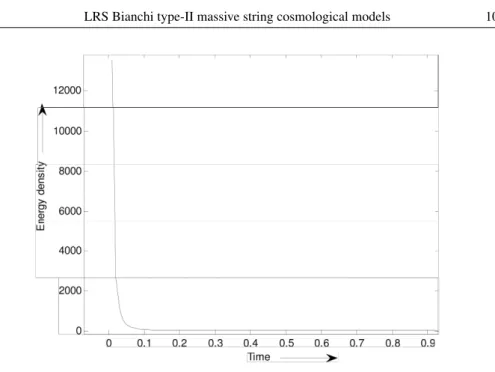
Hence the energy conditionsρ≥0andρ≥0are satisfied under above conditions. From Eq. (29), it is noted that the proper energy densityρ(t)is a decreasing function of time and it approaches a small positive value at present epoch. This behaviour is clearly depicted in Figure 1 as a representative case with appropriate choice of constants of integration and other physical parameters using reasonably well known situations.
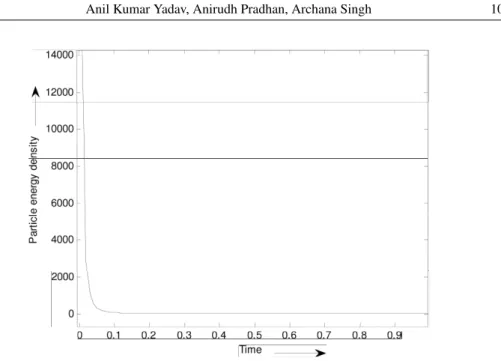
From Eq. (30), it can be seen that the particle densityρp is a decreasing function of time andρp>0for all times. This nature ofρpis clearly shown in Figure 3. All the physical quantities ρ, ρp andλtend to infinity at T = 0 and 0 at T =∞. The model (25) therefore starts with a big-bang atT =oand it goes on expanding until it comes to rest atT =∞. We also note that T = 0andT =∞ respectively correspond to the proper time t= 0 andt=∞. There is a point type singularity (MacCallum, [60]) in the model atT= 0. Bothρpandλtend to zero asymptotically. We note form=12 andT→0
ρp
λ =−
4
3. (33)
According to Kibble, [1] and Kroriet al., [61], whenρp/|λ|>1, in the process of evolution, the universe is dominated by massive strings, and whenρp/|λ|<1, the universe is dominated by the strings. From (33), we observe
ρp
|λ|<1.
Thus, in this case, the universe is dominated by the strings in early stage of evolu-tion of the universe. The expressions for the scalar of expansion θ, magnitude of shearσ2, the average anisotropy parameterAm, deceleration parameterqand proper
volumeV for the model (24) are given by
θ= (2m+ 1)k
2r s+ 1T
s−1
k +αT −2
k
12
, (34)
σ2=(m−1)
2k2
3
2r s+ 1T
s−1
k +αT −2
k
, (35)
Am= 2
m−1 2m+ 1
2
, (36)
q=−1−
3h2(rs(+1)s−1)kTs−k1−2α
k T
−2
k
i
2(2m+ 1)hs2+1r Ts−k1−αT −2
k
Fig. 1 – The plot of energy density (ρ)vs.time (T)
V =T2m+1. (38) The rate of expansionHiin the direction of x, y and z are given by
H1=k
2r s+ 1T
s−1
k +αT −2
k
12
(39)
H2=H3=mk
2r s+ 1T
s−1
k +αT −2
k
12
(40) Hence the average generalized Hubble’s parameter is given by
H=(2m+ 1)k 3
2r s+ 1T
s−1
k +αT −2
k
1 2
. (41) From equation (34) and (35), we obtain
σ θ =
(m−1)
√
3(2m+ 1). (42)
From Eq. (37), we conclude the following three cases: (i) WhenT =hr(ss+1−1)i
k
(s+1)
,q=−1,i.e., we get de Sitter universe; (ii) ForT <
h
3(s+1)α+(2m+1)(s+1)α
3(s+1)+2(2m+1)kr is+1k
, q <0, i.e., we obtain accelerating model of the universe;
Fig. 2 – The plot of particle energy density (ρp)vs.time (T) (iii) ForT >
h
3(s+1)α+(2m+1)(s+1)α
3(s+1)+2(2m+1)kr is+1k
, q >0, i.e., the model is in decelerating phase.
It is remarkable to mention here that though the current observations of SNe Ia (Perl-mutteret al.[62]−[64], Riesset al.[65,66]) and CMBR favour accelerating models, but both do not altogether rule out the decelerating ones which are also consistent with these observations (see, Vishwakarma, [67]).
The geometric properties of the derived model are almost the same of the model as obtained in previous paper of Pradhanet al.[55]. So we have not discussed these properties here. It is remarkable to mention here that for some particular value of m, we can derive the solution of Pradhanet al.[55].
4.2. CASE(ii):m=√2
The energy density (ρ), the string tension(λ)and the particle density (ρp) for the model (27) are given by
λ= 3 4τ
2(1−2m)−mkτ−k2
2r+ (2mk−1)
2r
k ln|τ|+α
, (43)
ρ=m(m+ 2)k2τ−k2
2r
k ln|τ|+α
−1
4τ
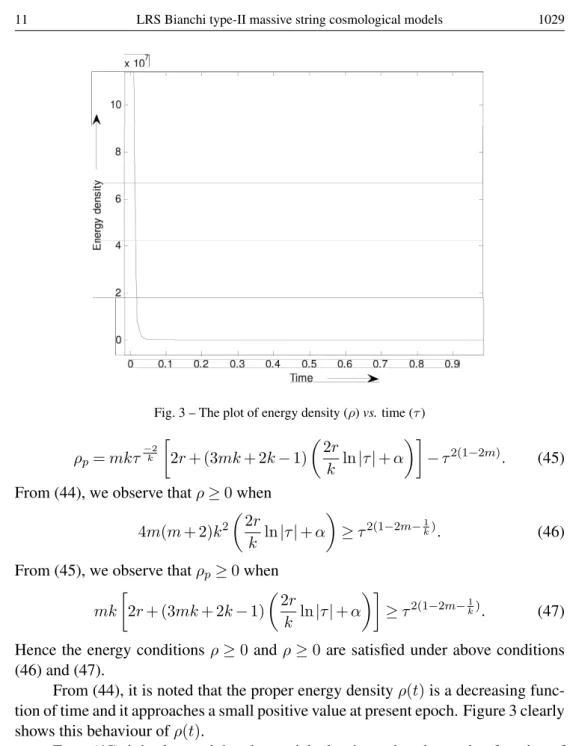
Fig. 3 – The plot of energy density (ρ)vs.time (τ) ρp=mkτ
−2
k
2r+ (3mk+ 2k−1)
2r
k ln|τ|+α
−τ2(1−2m). (45) From (44), we observe thatρ≥0when
4m(m+ 2)k2
2r
k ln|τ|+α
≥τ2(1−2m−1k). (46)
From (45), we observe thatρp≥0when
mk
2r+ (3mk+ 2k−1)
2r
k ln|τ|+α
≥τ2(1−2m−1k). (47)
Hence the energy conditions ρ≥0 andρ≥0are satisfied under above conditions (46) and (47).
From (44), it is noted that the proper energy densityρ(t)is a decreasing func-tion of time and it approaches a small positive value at present epoch. Figure 3 clearly shows this behaviour ofρ(t).
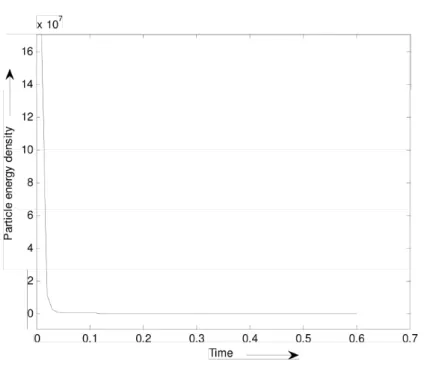
From (45), it is observed that the particle densityρpis a decreasing function of time andρp>0for all times. This nature ofρpis clearly shown in Figure 4.
All the physical quantities ρ, ρp and λtend to infinity at τ = 0and 0 at τ =∞. The model is expanding, shearing and non-rotating in general. We also note that
Fig. 4 – The plot of particle energy density (ρp)vs.time (τ)
ρpandλtend to zero asymptotically.
From (45) and (43), we note that form= 12 andτ →0
ρp
λ =−
4
3 <1, (48)
which shows that the model is dominated by the strings in early stage of evolution of the universe.
The expressions for the scalar of expansion θ, magnitude of shearσ2, the average anisotropy parameter Am, deceleration parameter q and proper volume V for the model (27) are given by
θ= (2m+ 1)kτ−k1
r 2r
k ln|τ|+α (49) σ2=(m−1)
2k2
3 τ
−2
k
2r
k ln|τ|+α
(50)
Am= 2
m−1 2m+ 1
2
, (51)
q=−1− 3
1− 2krln|τ|+α
V =τ2m+1 (53) The rate of expansionHiin the direction ofx,yandzare given by
H1=kτ−
1
k
r 2r
k ln|τ|+α (54)
H2=H3=mkτ−
1
k
r 2r
k ln|τ|+α (55)
Hence the average generalized Hubble’s parameter is given by
H=(2m+ 1)k
3 τ
−1
k
r 2r
k ln|τ|+α (56)
From equation (49) and (50), we obtain
σ θ =
(m−1)
√
3(2m+ 1) (57)
From (52), we conclude the following three cases:
(i) Whenln|τ|= (1−2rα)k,q=−1,i.e.we get de-Sitter universe; (ii) Ifτ <exp
h k
2r
3
3−(2m+1)k−α i
,q <0,i.e. we obtain accelerating model of the universe;
(iii) For τ >exph2kr3−(2m3+1)k−αi, q >0, i.e. the model is in decelerating phase.
From the above results, it can be seen that the spatial volume is zero atτ= 0and it increases with the increase ofτ. This shows that the universe starts evolving with zero volume atτ = 0and expands with cosmic timeτ. The shear scalar diverges at
τ = 0. Asτ→ ∞, the scale factorsA(t),B(t)tend to infinity. The expansion scalar and shear scalar all tend to zero asτ→ ∞. The mean anisotropy parameter is uniform throughout whole expansion of the universe whenm6=−12 but form=−12 it tends to infinity. The dynamics of the mean anisotropy parameter depends on the value of m. This shows that the universe is expanding with the increase of cosmic time but the rate of expansion and shear scalar decrease to zero and tend to isotropic.At the initial stage of expansion, whenρis large, the Hubble parameter is also large and with the expansion of the universeH,θ decrease as doesρ. Since σθ is constant, the model does not approach isotropy at any time.
5. CONCLUDING REMARKS
In this paper we have presented two types of new exact solutions of Einstein’s field equations for LRS Bianchi type-II space-time with a cloud of strings which are different from the other author’s solutions. In general, the models are expanding,
shearing and non-rotating. The energy conditionsρ≥0,ρp≥0are satisfied under proper conditions. It is worth mentioned here that in case (i), T = 0 andT =∞
correspond to the proper timet= 0andt=∞respectively. Similarly in case (ii),τ= 0andτ=∞correspond to the proper timet= 0andt=∞respectively. The initial singularity of the model is of the Point Type (MacCallum, [60]). Our universe starts evolving with zero volume att= 0and expands with cosmic time (t). We observe that
σ
θ is constant in both cases, therefore the models do not approach isotropy at any time. The models (24) and (27) represent realist models. It is interesting to mention here that form= 1, the anisotropy parameterAmtends to zero, therefore the space-time anisotropy disappear and the models of our universe approach isotropy form= 1.
The particle density and the tension density of the string are comparable at the two ends and they fall off asymptotically at similar rate. It is observed that in early stage of the evolution of the universe, the universes in both cases are dominated by strings. Our solution of case (i) generalizes the solution recently obtained by Pradhanet al.[55]. The results of this paper are in favour of observational features of the universe.
Finally, we would like to mention here that in the derived models, the proper energy density ρ and particle density ρp are positive. Therefore, the weak energy condition (WEC) as well as null energy condition (NEC) are obeyed in the present system.
Acknowledgements. Authors (A. K. Yadav and A. Pradhan) would like to thank the Institute of Mathematical Sciences (IMSc.), Chennai, India for providing facility and support under associateship scheme where part of this work was carried out.
REFERENCES 1. T.W.B. Kibble, J. Phys. A: Math. Gen.9, 1387 (1976).
2. Ya.B. Zel’dovich, I. Yu. Kobzarev, L. B. Okun, Zh. Eksp. Teor. Fiz.67, 3 (1975). 3. Ya.B. Zel’dovich, I. Yu. Kobzarev, L. B. Okun, Sov. Phys.-JETP40, 1 (1975). 4. T.W.B. Kibble, Phys. Rep.,67, 183 (1980).
5. A.E. Everett, Phys. Rev.,24, 858 (1981). 6. A. Vilenkin, Phys. Rev.,D 24, 2082 (1981).
7. Ya.B. Zel’dovich, Mon. Not. R. Astron. Soc.,192, 663 (1980). 8. P.S. Letelier, Phys. Rev.,D 20, 1294, (1979).
9. P.S. Letelier, Phys. Rev.,D 28, 2414 (1983). 10. J. Stachel, Phys. Rev.,D 21, 2171 (1980).
11. R. Bali, S. Dave, Pramana-J. Phys.,56, 513 (2001).
12. R. Bali, R.D. Upadhaya, Astrophys. Space Sci.,283, 97 (2003). 13. R. Bali, S. Dave, Astrophys. Space Sci.,288, 503 (2003). 14. R. Bali, D.K. Singh, Astrophys. Space Sci.,300, 387 (2005). 15. R. Bali, Anjali, Astrophys. Space Sci.,302, 201 (2006).
16. R. Bali, U.K. Pareek and A. Pradhan, Chin. Phys. Lett.,24, 2455 (2007). 17. R. Bali, A. Pradhan, Chin. Phys. Lett.,24. 585 (2007).
18. M.K. Yadav, A. Pradhan, S. K. Singh, Astrophys. Space Sci.,311, 423 (2007). 19. X.X. Wang, Astrophys. Space Sci.,293, 933 (2004).
20. X.X. Wang, Chin. Phys. Lett.,21, 1205 (2004). 21. X.X. Wang, Chin. Phys. Lett.,22, 29 (2005). 22. X.X. Wang, Chin. Phys. Lett.,23, 1702 (2006).
23. B. Saha, M. Visinescu, Astrophys. Space Sci.,315, 99 (2008). 24. B. Saha, V. Rikhvitsky, M. Visinescu, arXiv:0812.1443 (2008).
25. A.K. Yadav, V. K. Yadav and L. Yadav, Int. J. Theor. Phys.,48, 568 (2009).
26. H. Baysal, ˙I. Yavuz, I. Tarhan, U. Camci, and ˙I. Yilmaz, Turk. J. Phys.,25, 283 (2001). 27. ˙I. Yavuz, ˙I. Yilmaz, and H. Baysal, Int. J. Mod. Phys. D,8, 1365 (2006).
28. ˙I. Yilmaz, Gen. Relativ. Gravit.,38, 1397 (2006).
29. G.P. Singh, T. Singh, Gen. Relativ. Gravit.,31, 371 (1999). 30. G.P. Singh, IL Nuovo Cimento B ,110, 1463 (1995). 31. G.P. Singh, Pramana-J. Phys.,45, 189 (1995).
32. D.R.K. Reddy, Astrophys. Space Sci.,281, 365 (2003). 33. D.R.K. Reddy, Astrophys. Space Sci.,300, 381 (2005).
34. D.R.K. Reddy, Subba Rao, M. V. Rao, Astrophys. Space Sci.,305, 183 (2005). 35. D.R.K. Reddy, R.L. Naidu, Astrophys. Space Sci.,307, 395 (2007).
36. D.R.K. Reddy, R.L. Naidu, and V.U.M. Rao, Int. J. Theor. Phys.,46, 1443 (2007). 37. V.U.M. Rao, M. Vijaya Santhi, T. Vinutha, Astrophys. Space Sci.,314, 73 (2008). 38. V.U.M. Rao, T. Vinutha, M. Vijaya Santhi, Astrophys. Space Sci.,314, 213 (2008). 39. V.U.M. Rao, T. Vinutha, K. V. S. Sireesha, Astrophys. Space Sci.,323, 401(2009). 40. V.U.M. Rao and T. Vinutha, Astrophys. Space Sci.,325, 59 (2010).
41. A. Pradhan, Fizika B,16, 205 (2007).
42. A. Pradhan, Commun. Theor. Phys.,51, 367 (2009).
43. A. Pradhan, K. Jotania, and A. Singh, Braz. J. Phys.,38, 167 (2008). 44. A. Pradhan, P. Mathur, Astrophys. Space Sci.,318, 255 (2008). 45. A. Pradhan, R. Singh, J.P. Shahi, Elect. J. Theor. Phys.,7, 197 (2010).
46. S.K. Tripathi, S.K. Nayak, S.K. Sahu, T. R. Routray, Astrophys. Space Sci.,323, 281 (2009). 47. S.K. Tripathi, D. Behera, T.R. Routray, Astrophys. Space Sci.,325, 93 (2010).
48. E. Asseo and H. Sol, Phys. Rep.,148, 307 (1987).
49. S.R. Roy and S.K. Banerjee, Class. Quant. Grav.,11, 1943 (1995). 50. X. X. Wang, Chin. Phys. Lett.,20, 615 (2003).
51. J.A. Belinchon, Astrophys. Space Sci.,323, 307 (2009). 52. J.A. Belinchon, Astrophys. Space Sci.323, 185 (2009).
53. A. Pradhan, H. Amirhashchi, M.K. Yadav, Fizika B18, 35 (2009). 54. H. Amirhashchi, H. Zainuddin, Elect. J. Theor. Phys.,23, 213 (2010).
55. A. Pradhan, P. Ram, R. Singh, Astrophys. Space Sci. DOI 10.1007/s10509-010-0423-x (2010). 56. K.S. Thorne, Astrophys. J.,148, 51 (1967).
57. R. Kantowski, R.K. Sachs, J. Math. Phys.,7, 433 (1966). 58. J. Kristian, R.K. Sachs, Astrophys. J.,143, 379 (1966).
59. C.B. Collins, E.N. Glass, D.A. Wilkinson, Gen. Rel. Grav.,12, 805 (1980). 60. M.A.H. MacCallum, Comm. Math. Phys.,20, 57 (1971).
61. K.D. Krori, T. Chaudhuri, C.R. Mahanta, A. Mazumdar, Gen. Rel. Grav.,22, 123 (1990). 62. S. Perlmutter,et al., Astrophys. J.,483, 565 (1999).
63. S. Perlmutter,et al., Nature,391, 51 (1999). 64. S. Perlmutter,et al., Astrophys. J.,517, 5 (1999). 65. R.G. Riess,et al., Astron. J.,116, 1009 (1998). 66. R.G. Riess,et al., Astrophys. J.,607, 665 (2004). 67. R.G. Vishwakarma, Class. Quant. Grav.,17, 3833 (2000).