POST-9/11 GI BILL
Additional Actions
Needed to
Help Reduce
Overpayments and
Increase Collections
Highlights of GAO-16-42, a report to the Ranking Member, Committee on Homeland Security and Governmental Affairs, U.S. Senate
Why GAO Did This Study
VA provided $10.8 billion in Post-9/11 GI Bill education benefits to almost 800,000 veterans in fiscal year 2014. GAO was asked to review
overpayments for the program, which can create financial hardships for veterans who are generally required to pay them back and which can result in a significant loss of taxpayer dollars if they are not collected.
This report examines (1) the extent of overpayments, (2) how effectively VA has addressed their causes, and (3) the effectiveness of VA’s collection efforts. GAO analyzed overpayment data for fiscal years 2013 and 2014, examined the causes from a generalizable sample of high-dollar overpayments (greater than $1,667), conducted a case file review of 20 overpayments (selected for a variety of causes), and reviewed VA’s monitoring of overpayments. GAO also
interviewed senior and frontline staff at two VA offices that process claims and collect debts, officials at nine schools (selected for variation in program length and their status as public, nonprofit, and for-profit), higher education associations, and veteran service organizations.
What GAO Recommends
Congress should consider granting VA explicit authority to require training for school officials. In addition, GAO is making a number of recommendations to improve VA’s guidance and
processes, including providing program guidance to veterans, verifying
veterans’ monthly enrollment, and developing additional debt notification methods. VA agreed with GAO’s recommendations to the agency and plans to address these issues.
What GAO Found
The Department of Veterans Affairs (VA) identified $416 million in Post-9/11 GI Bill overpayments in fiscal year 2014, affecting approximately one in four veteran beneficiaries and about 6,000 schools. Overpayments most often occur when VA pays benefits based on a student’s enrollment at the beginning of the school term and the student later drops one or more classes (or withdraws from school altogether). Students therefore receive benefits for classes they did not complete, and the “overpayment” must be paid back to VA. A small percentage of
overpayments occurred because of school reporting or VA processing errors. GAO found that most overpayments were collected quickly, but as of November 2014 (when VA provided these data to GAO), VA was still collecting $152 million in overpayments from fiscal year 2014, and an additional $110 million from prior years, primarily owed by veterans with the remainder owed by schools.
Inadequate guidance, processes, and training have limited VA’s efforts to reduce overpayments caused by enrollment changes and school errors.
• Guidance for veterans. Many veterans may not realize they can incur overpayments as a result of enrollment changes because VA provides limited guidance to veterans on its policies. As a result, veterans may be unaware of the consequences of enrollment changes until after they have already incurred their first overpayment debt, according to school officials. Because VA is not effectively communicating its program policies to veterans, some veterans may be incurring debts that they could have otherwise avoided.
• Enrollment verification process. While veterans using other VA education programs have to verify their enrollment each month, VA generally does not require those using the Post-9/11 GI Bill to do so. By not requiring veterans to verify their enrollment every month, which can cause significant time to lapse between when veterans drop courses and when this is reported, VA’s process allows veterans to incur thousands of dollars in overpayments and also increases the program’s costs associated with collecting these debts.
• Training for school officials. Overpayments also occur when schools make errors, such as reporting enrollment information incorrectly, which VA officials said is sometimes attributable to a lack of training. For example, some school officials routinely made systematic errors reporting enrollment information, creating thousands of dollars in overpayments. Not all school officials attend the different training opportunities VA offers and VA officials said the agency lacks the authority to require school officials to participate in any of them. VA officials said they would like school officials to take a minimum level of training, which could help reduce errors and related overpayments. The effectiveness of VA’s collection efforts is hindered by its notification methods. VA relies solely on paper mail to notify schools and veterans of overpayments. VA generally sends veterans’ notices to the addresses from veterans’ initial benefit applications. However, these addresses can often be out-of-date, so some veterans do not receive the letters, leaving them unaware of their debts. This can cause veterans to unknowingly miss deadlines for disputing their debts and leave them unprepared to cover living expenses if VA begins
View GAO-16-42. For more information, contact Melissa Emrey-Arras at (617)
788-Letter 1
Background 3
VA Identified Over $400 Million in Post-9/11 GI Bill Overpayments in Fiscal Year 2014 and Does Not Effectively Monitor These
Debts 10
Inadequate Guidance, Controls, and Training Have Limited VA’s Effectiveness in Reducing Overpayments from Enrollment
Changes and School Errors 18
VA’s Notification Methods and Overpayment Calculations Hamper
Its Collection Efforts 26
Conclusions 33
Matter for Congressional Consideration 34
Recommendations for Executive Action 35
Agency Comments and Our Evaluation 36
Appendix I Objectives, Scope, and Methodology 37
Appendix II Comments from the Department of Veterans Affairs 42
Appendix III GAO Contact and Staff Acknowledgments 46
Tables
Table 1: Responsibility for Repaying Post-9/11 GI Bill
Overpayment Debts 6
Table 2: Summary Statistics from VA’s FY14 1st Quarter Report
on High-Dollar Overpayments 39
Table 3: Institutions Selected for Interviews with School Officials 40
Figures
Figure 1: VA’s Processing of Post-9/11 GI Bill Payments 4 Figure 2: Examples of Post-9/11 GI Bill Overpayment Scenarios 7 Figure 3: Timeline for VA Collection Actions When Overpayment
Debts Are Not Otherwise Repaid 8
Figure 5: Causes of Post-9/11 GI Bill High-Dollar Overpayments,
Fiscal Years 2013 and 2014 12
Figure 6: Distribution of Post-9/11 GI Bill Overpayment Debt
Amounts, Fiscal Year 2014 13
Figure 7: Uncollected Post-9/11 GI Bill Overpayment Debts by
Year of Origin, as of November 2014 14
Figure 8: Process for Notifying Veterans and Schools of
Overpayment Debts 29
Figure 9: Effect of Prorating Overpayments Based on the End of
the Month 31
Figure 10: Overpayment Example when Veteran Withdraws during
School’s 100 Percent Refund Period 32
Abbreviations
OMB Office of Management and Budget
Post-9/11 GI Bill Post-9/11 Veterans Educational Assistance Act of 2008
VA Department of Veterans Affairs
Yellow Ribbon Program Yellow Ribbon G.I. Education Enhancement Program
This is a work of the U.S. government and is not subject to copyright protection in the United States. The published product may be reproduced and distributed in its entirety without further permission from GAO. However, because this work may contain copyrighted images or other material, permission from the copyright holder may be necessary if you wish to reproduce this material separately.
October 21, 2015
The Honorable Thomas R. Carper Ranking Member
Committee on Homeland Security and Governmental Affairs United States Senate
Dear Senator Carper:
The Department of Veterans Affairs (VA) provided $10.8 billion in Post-9/11 GI Bill education benefits to almost 800,000 veterans and other beneficiaries in fiscal year 2014.1 For eligible veterans, VA sends tuition
and fee payments to schools, as well as housing benefits and book payments directly to the veteran, based on the initial enrollment information that schools submit to VA at the beginning of each term. If veterans subsequently reduce their course load (or withdraw from school altogether), it can reduce their eligible benefit amount, and any
“overpayments” of tuition or housing benefits must be paid back to VA. Given the size and projected future growth of the Post-9/11 GI Bill program, these overpayments can result in a significant loss of taxpayer dollars if they are not recovered. In addition, overpayment debts can create financial hardships for veterans and administrative burdens for schools.
You asked us to review issues related to Post-9/11 GI Bill overpayments. This report examines:
1. What is known about the extent of Post-9/11 GI Bill overpayments and collections, and how effectively VA monitors them?
2. How effectively has VA addressed the causes of overpayments? 3. How effectively do VA’s policies and procedures support the collection
of overpayments?
1 In this report we generally refer to Post-9/11 GI Bill beneficiaries as veterans, although
under certain circumstances, veterans can transfer their Post-9/11 GI Bill benefits to their
To examine the extent of overpayments, we reviewed available Post-9/11 GI Bill financial data from fiscal years 2013 and 2014. We also analyzed data on all outstanding overpayment debts dating back to the start of the Post-9/11 GI Bill program in 2009. We assessed the reliability of these data by reviewing VA’s reporting systems and conducting electronic testing of the underlying data, and we determined that the data were sufficiently reliable for our reporting purposes. We also reviewed VA’s monitoring of overpayments and collections by examining its data tracking and reporting practices and assessed these efforts against guidance for government receivables in OMB Circular A-129.2 To identify the causes of
overpayments, we reviewed VA’s Quarterly High-Dollar Overpayment Reports and supporting documentation for fiscal years 2013 and 2014. We assessed the reliability of these data through an in-depth file review of 20 overpayment cases and interviews with knowledgeable agency
officials and we determined that the data were sufficiently reliable for our reporting purposes. We also reviewed a selection of school compliance surveys, which VA uses to assess whether schools that receive VA education benefits adhere to applicable laws and regulations. To examine the effectiveness of VA’s efforts to address both the causes of
overpayments and the collection of overpayment debts, we reviewed relevant federal laws, regulations, and policy guidance for processing and collecting VA debts. We interviewed senior VA officials and visited one of VA’s four Regional Processing Offices as well as VA’s debt collection office, the Debt Management Center, to interview management and frontline staff. We also interviewed representatives from several veterans service organizations, higher education associations, and administrators at nine schools about the effects of overpayments on veterans and schools. We selected the nine schools to include a mix of program lengths (2-year and 4-year schools), sectors (public, nonprofit, and for-profit), and student veteran populations ranging from 14 to more than 14,000. We assessed VA’s efforts to address the causes of
overpayments and collect overpayment debts against the requirements in the Post-9/11 GI Bill’s statute and regulations, and government standards for internal controls. For more information on our scope and
methodologies, see appendix I.
2 OMB Circular A-129 provides guidance to agencies for, among other things, managing
the federal government’s receivables (also referred to as claims or debts), including overpayments to beneficiaries. Executive Office of the President, OMB Circular A-129 (as revised Jan. 2013).
We conducted this performance audit from April 2014 to October 2015 in accordance with generally accepted government auditing standards. Those standards require that we plan and perform the audit to obtain sufficient, appropriate evidence to provide a reasonable basis for our findings and conclusions based on our audit objectives. We believe that the evidence obtained provides a reasonable basis for our findings and conclusions based on our audit objectives.
The Post-9/11 GI Bill, which took effect on August 1, 2009, is now VA’s largest educational program.3 In fiscal year 2014, the Post-9/11 GI Bill
program had 790,000 participants and made $10.8 billion in payments for tuition, fees, housing, and books. This program provides benefits
generally to veterans who served on active duty for at least 90 days on or after September 11, 2001.4 Full benefits are available to those who
served on active duty for 36 months, for which VA will pay the full in-state tuition and fees at any public school and up to an annual maximum amount at nonprofit and for-profit schools ($21,085 in academic year 2015-16).5
VA pays schools directly for tuition and fees and sends additional payments for housing and books directly to veterans who are eligible for these payments.6 Housing benefits are provided to veterans through a
monthly housing allowance, paid at the beginning of each month based
3 Post-9/11 Veterans Educational Assistance Act of 2008, Pub. L. No. 110-252, tit. V, §
5003(d), 122 Stat. 2357, 2378.
4 38 U.S.C. § 3311(b)(8).
5 38 U.S.C. §§ 3311(b)(1) and 3313(c)(1). Veterans can also receive full benefits if they
served on active duty for at least 30 continuous days and where discharged due to service-connected disability. Veterans who served on active duty for less than 36 months are eligible for a portion of the maximum tuition amount based on their time served. Veterans attending participating nonprofit or for-profit schools may receive additional benefits to cover tuition and fees through the Yellow Ribbon G.I. Education Enhancement Program (Yellow Ribbon Program). 38 U.S.C. § 3317. Through this program, schools enter into voluntary agreements with VA to pay a portion of the tuition and fees that exceed an individual’s Post-9/11 GI Bill benefit and VA matches the schools’ contribution.
6
Background
Post-9/11 GI Bill Benefits
on the previous month’s enrollment, and the amount depends on the veteran’s rate of academic pursuit (e.g., full- or part-time) and the geographic location of the school they are attending.7
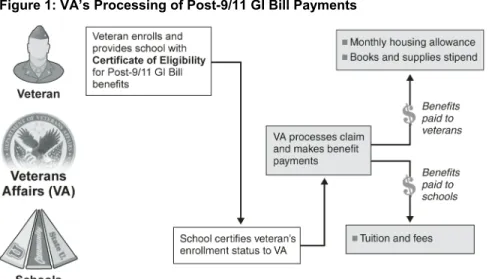
For veterans to start receiving Post-9/11 GI Bill benefits, school employees, known as school certifying officials, must certify to VA that they are enrolled in classes (see fig. 1).8 VA recommends that schools
certify veteran enrollments prior to the start of the school term.
Figure 1: VA’s Processing of Post-9/11 GI Bill Payments
Post-9/11 GI Bill overpayments occur when VA makes a payment in excess of what a veteran is entitled to. This can result from either erroneous payments or subsequent changes in the veteran’s enrollment status or tuition or fee amounts after benefits have already been paid. Enrollment changes cause overpayments because the Post-9/11 GI Bill program, by design, pays tuition to schools in advance based on
individual veterans’ expected enrollment. These types of overpayments are not considered “improper” (i.e., made in error) because the payments
7 38 U.S.C. § 3313(c)(1)(B)(i)-(iii). The monthly housing allowance is based on the
Department of Defense Basic Allowance for Housing. Students enrolled exclusively online can also receive a portion of the housing allowance.
8 38 C.F.R. § 21.9720.
Post-9/11 GI Bill
Overpayments
were originally correct when issued.9 Once VA begins paying Post-9/11
GI Bill benefits, veterans and schools are responsible for notifying VA of any changes in the veteran’s enrollment (e.g., dropping a class or withdrawing from school) and schools are responsible for notifying VA of any subsequent adjustments in tuition or fees. VA processes these changes, which can increase or decrease the payment amounts veterans are eligible for. When enrollment changes decrease a veteran’s
calculated benefit amount, an overpayment is created for any excess funds VA has already paid. For example, tuition and fee overpayments can be created for any tuition and fees paid for classes that a veteran did not complete.10 Changes in a veteran’s enrollment can also affect the
amount of housing and book stipend payments that the veteran is eligible to receive.
VA sends tuition and fee payments directly to schools on behalf of students, and VA often holds veterans liable for tuition and fee
overpayments in accordance with its statutory authority.11 Veterans are
generally responsible for repaying any overpayments resulting from enrollment changes during the school term (see table 1).12 Schools are
only responsible for repaying these benefits to VA in certain
circumstances, such as when the veteran completely withdraws from the school on or before the first day of the term.13 Veterans are solely
responsible for repaying any overpayments of housing or book stipend benefits. VA does not hold veterans liable for overpayments that result
9 However, overpayments caused by school reporting or VA processing errors are
counted as improper payments. An improper payment is defined by statute as any payment that should not have been made or that was made in an incorrect amount (including overpayments and underpayments) under statutory, contractual, administrative, or other legally applicable requirements. 31 U.S.C. § 3321 note. It includes, for example, any payment to an ineligible recipient, any payment for an ineligible good or service, any duplicate payment, and any payment for a good or service not received (except for such payments where authorized by law).
10 Veterans must also repay benefits for any courses in which they received a grade that
does not earn credit towards their degree (e.g., incomplete, no credit).
11 38 U.S.C. § 3685.
12 38 C.F.R. § 21.9695(b)(2).
13 Schools are also responsible if the overpayment is the result of willful or negligent (1)
false certification by a school or (2) failure by a school to certify excessive absences, discontinuance of a course by the school, or interruption of a course by the veteran. 38
from administrative errors or an error in judgment on the part of VA, unless the veteran should have known the overpayment was patently excessive (such as a duplicate payment or a payment amount that exceeds the amount displayed on an award letter), according to VA officials.14
Table 1: Responsibility for Repaying Post-9/11 GI Bill Overpayment Debts Schools are responsible for tuition
overpayments when: Veterans are responsible for tuition overpayments when: • Student never attended any classes
• Student completely withdraws on or before the first day of the term • Student died during the term or
before start of the terma
• School reports reduced tuition and fee charges and/or Yellow Ribbon amountb
• School received an erroneous or duplicate payment from VA
• Overpayment resulted from school’s willful or negligent false certification or failure to certify significant changes
• Student withdrew after the first day of the term
• Student reduced hours either before or during the term
• Student attended at least one day of any of the certified classes
• School reports a reduction in tuition, fees, and/or Yellow Ribbon amount due to student action
• Student drops a course and adds a course which results in a reduction in tuition, fees, and/or Yellow Ribbon amount, even if there is no net change in training time
Veterans are also responsible for all housing and book stipend overpayments
Source: GAO analysis of VA guidance. │GAO-16-42 a38 C.F.R. § 21.9635(a).
bThe Yellow Ribbon G.I, Education Enhancement (Yellow Ribbon) Program provides veterans
attending participating private schools or public schools as out-of-state students with additional benefits to cover costs that exceed their Post-9/11 GI Bill benefit. Through this program, schools enter into voluntary agreements with VA to pay a portion of the tuition and fees that exceed an individual’s Post-9/11 GI Bill benefit and VA matches the school’s contribution. 38 U.S.C. § 3317.
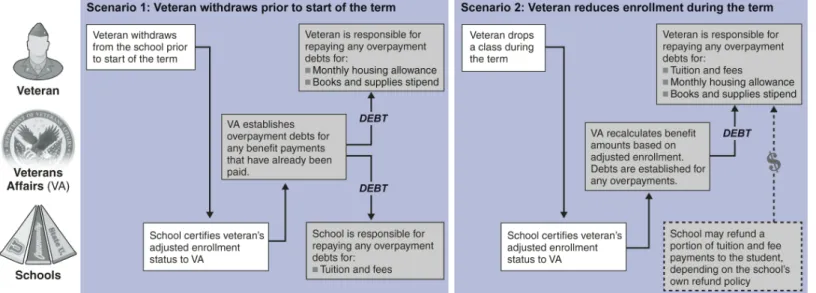
VA determines the type and amount of any overpayments based on the enrollment and tuition information submitted by schools or after identifying and correcting any school reporting or internal processing errors. When an overpayment is caused by an enrollment change, VA establishes an overpayment debt for the veteran, the school, or both depending on the circumstances (see fig. 2).
14 38 C.F.R. § 21.9695(b)(1)(ii).
Figure 2: Examples of Post-9/11 GI Bill Overpayment Scenarios
Overpayment debts are forwarded to VA’s centralized collection office, the Debt Management Center, for collection. Once schools or veterans receive a collection letter from the Debt Management Center, they can arrange to repay the debt in full, set up a payment plan, dispute the existence or amount of the debt, or request a waiver of the debt due to financial hardship or special circumstances.15 If schools or veterans do
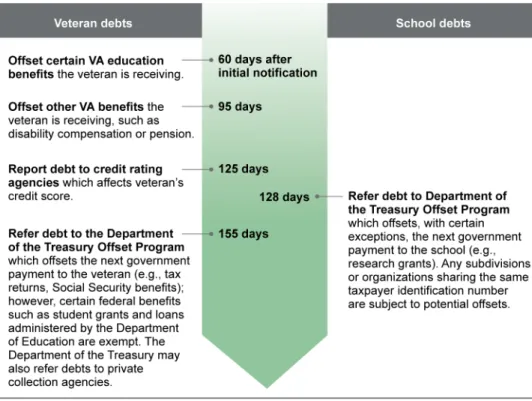
not initiate one of these options to address the debt, VA begins pursuing more aggressive collection methods. These can include offsetting—that is, reducing or withholding—future Post-9/11 GI Bill payments or tax returns and reporting debts to credit rating agencies, as illustrated in figure 3. Since veterans are liable for most overpayments, VA collects debts from hundreds of thousands of individual veterans.
15 38 U.S.C. § 5302(a) and 38 C.F.R. § 1.963. The standard for granting a waiver is that
recovery would be “against equity and good conscience.” VA officials also noted that only veterans have the option of requesting a waiver; schools may not do so. Veterans also have the option of submitting a compromise offer (of a lesser amount) to settle a debt, but officials from VA’s Debt Management Center said they have not accepted any
VA Collection Process
Figure 3: Timeline for VA Collection Actions When Overpayment Debts Are Not Otherwise Repaid
Notes: This timeline can vary based on how long it takes for debts to be transferred from the regional processing offices to the Debt Management Center for collection. For this figure we included 5 days for the transfer process, which VA officials said can take between 2 to10 days.
Post-9/11 GI Bill tuition and fee payments to schools are exempt from offsets. Offsets to VA compensation and pension benefits do not follow a standard timeline, since they are identified through a monthly data match, but would not begin until 95 days after a veteran’s initial notification.
We have previously compared VA’s processes to those of the
Department of Education.16 The Department of Education uses a different
structure than VA for processing and collecting federal student aid overpayments. In contrast to VA, Education generally works directly with schools to return overpayments of federal student aid funds, focusing its collection efforts on a few thousand schools rather than working directly
16 GAO, Veterans’ Education Benefits: Enhanced Guidance and Collaboration Could
Improve Administration of the Post-9/11 GI Bill Program, GAO-11-356R (Washington, D.C.: May 5, 2011).
Comparison with
Department of
Education Processes
with hundreds of thousands of students. The Department of Education payment systems also allow schools to reconcile any enrollment changes before the term by adjusting the school’s aggregate receipt of federal student aid funds, rather than issuing individual debts and new payments to the school. In contrast, VA processes each tuition payment and
collection separately.
In reaction to our prior work comparing VA’s processes with the
Department of Education’s, VA officials raised concerns about adopting similar practices to the Department of Education. For example, according to VA officials if VA started collecting all tuition overpayments from
schools, schools would still be able to bill veterans for overpayment debts and potentially would not allow veterans to reenroll for class until these debts were repaid. In addition, veterans would have to repay any overpayment debts to their school out-of-pocket, rather than through offsets to their Post-9/11 GI Bill housing payments.
VA made $416 million in Post-9/11 GI Bill overpayments in fiscal year 2014, or 4 percent of the over $10 billion in benefits paid during that period. The bulk of these overpayments went to veterans instead of schools, as shown in figure 4.17 Overpayments increased by nearly 20
percent from fiscal year 2013 to 2014, the only 2 years for which data were available, while total program payments increased by just 6 percent.
17 Schools can only receive tuition and fee overpayments, while veterans can receive
overpayments for tuition, housing, and books.
VA Identified Over
$400 Million in
Post-9/11 GI Bill
Overpayments in
Fiscal Year 2014 and
Does Not Effectively
Monitor These Debts
One in Four Beneficiaries
and 6,000 Schools
Incurred Overpayments in
Fiscal Year 2014, Caused
Primarily by Veteran
Enrollment Changes after
VA’s Initial Payments
Figure 4: Amount and Type of Post-9/11 GI Bill Overpayments to Veterans and Schools, Fiscal Years 2013 and 2014
Note: Individual amounts for 2014 do not sum to $416 million due to rounding. The “other” benefits category includes fees for student licensing or certification tests and national tests (e.g. SAT, GRE, LSAT).
Most overpayments are caused by veteran enrollment changes, over which VA has limited control. In these cases, VA’s original payments were correct based on the veteran’s planned enrollment, but some or all of the original payment became an overpayment when the veteran
subsequently dropped a class or withdrew from school. VA estimated that veteran enrollment changes caused 90 percent of high-dollar Post-9/11
GI Bill overpayments (see fig. 5).18 The remaining high-dollar
overpayments were caused by school reporting errors (e.g., submitting incorrect enrollment or tuition information) and VA processing errors (e.g., duplicate payments or data entry errors).19
Figure 5: Causes of Post-9/11 GI Bill High-Dollar Overpayments, Fiscal Years 2013 and 2014
Note: VA’s estimates are based on a sample with a 95 percent confidence level and a ± 5 percent confidence interval.
Approximately 1 out of 4 beneficiaries incurred an overpayment in fiscal year 2014—more than 225,000 veterans. The median amount that
18 VA is required to produce quarterly reports on high-dollar overpayments. Exec. Order
No. 13,520, § 3(f), 74 Fed. Reg. 62,201, 62,203 (Nov. 20, 2009). For fiscal years 2013 and 2014, VA reviewed a sample of overpayments each quarter that were over $1,667.
19 Similarly, enrollment changes account for the vast majority of overpayment dollars. For
example, we estimated that veteran enrollment changes account for around $247 million of the $280 million high-dollar overpayments VA made in fiscal year 2014. VA’s estimate of 90 percent is based on a sample with a 95 percent confidence level and a ± 5 percent confidence interval. Our dollar estimates are based on a sample with 95 percent confidence intervals of $226 million to $267 million for student enrollment changes and $259 million to $301 million for the total.
veterans had to repay was about $570, which could correspond to dropping a single class during the term and can be a sizable debt for a college student with limited income. Some veterans incurred much larger overpayments. For example, over 7,000 veterans had overpayments of more than $5,000, which can occur when a veteran completely withdraws from school or receives several months of housing overpayments (see fig. 6).
Figure 6: Distribution of Post-9/11 GI Bill Overpayment Debt Amounts, Fiscal Year 2014
Almost 6,000 schools incurred overpayments in fiscal year 2014, often for multiple veterans, with a total median debt of $7,800 per school. School overpayments arise when veterans never attended classes or withdrew from school on or before the start date, although they can also be caused by VA and school error in certain cases. About 5 percent of schools accounted for almost half of all school overpayments.20
20 Overpayments were distributed among the different types of schools that enroll
veterans. In fiscal year 2014, for-profit schools received $70 million in overpayments (94 percent of which had been repaid to VA by November 2014), public schools had received $44 million (95 percent of which had been repaid by November 2014), and nonprofit schools had received $32 million (96 percent of which had been repaid by November
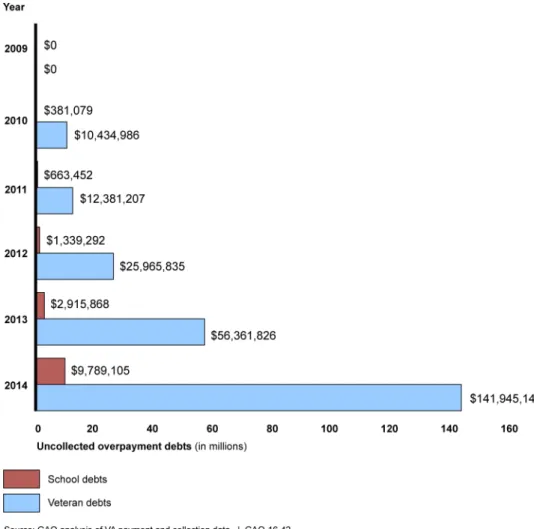
VA had $262 million in outstanding Post-9/11 GI Bill overpayment debts, as of November 2014, primarily owed by veterans. More than half of these uncollected debts are from overpayments that occurred in fiscal year 2014, some of which were still in the initial stages of collection and likely have been repaid since VA provided these data. VA has had more time to collect debts from prior years. However, $110 million in
uncollected debts are older than 1 year, some of which date back to 2010 (see fig. 7).
Figure 7: Uncollected Post-9/11 GI Bill Overpayment Debts by Year of Origin, as of November 2014
VA Has $152 Million in
Uncollected Overpayment
Debt from Fiscal Year
2014 and an Additional
$110 Million from Prior
Years, Primarily Owed by
Veterans
Veterans are responsible for the vast majority of uncollected overpayment debts since VA has less success collecting debts from veterans than from schools. Of the total amount outstanding, more than 90 percent was owed by veterans rather than owed by schools. Schools had already repaid almost all of the overpayment debts they incurred in fiscal years 2013 and 2014, while veterans had so far repaid 75 percent of overpayments from fiscal year 2013 and 46 percent from 2014.21 School overpayments are
generally collected through direct payments (e.g., check, credit card, electronic funds transfer), while veteran overpayments are collected through several methods, most commonly by deducting the debt amounts from subsequent GI Bill or other VA payments. VA also collected from veterans through direct payments, offsetting other federal payments such as federal tax returns, and private debt collection agencies.22
21 These collection rates also reflect the flexibility that VA offers to veterans to enter into
repayment plans for their overpayment debts, which can generally last up to a year.
22 In fiscal year 2014, VA collected 61 percent of veteran overpayments by deducting the
debts from subsequent GI Bill or other VA payments, 23 percent from direct payments, 12 percent from offsetting other federal payments, and 5 percent from private debt collection
VA does not monitor the full extent of Post-9/11 GI Bill overpayments and collections. For example, VA does not regularly track the number of overpayments or the amount of uncollected student debts.23 Although VA
was able to provide this information in response to our data request, it is not something the agency actively monitors on a regular basis. VA has instead focused its current monitoring efforts on one subset of
overpayments, those that are considered “improper.” As it is legally required to do, VA reports an estimated improper payment rate for different benefit programs.24 While these rates are a useful
government-wide accountability measure, they do not capture the vast majority of Post-9/11 GI Bill overpayments that occur due to subsequent enrollment changes.25 The approximately 90 percent of overpayments resulting from
veteran enrollment changes are not categorized as improper since the payments are correct when issued and only become overpayments at a later date after the veteran makes an enrollment change. As a result, VA’s estimated improper payment rate for the Post-9/11 GI Bill provides little insight into the over $400 million in overpayments the agency made in fiscal year 2014. As for collections, the only specific data on the Post-9/11 GI Bill that the Debt Management Center actively monitors is for school debts, which only account for about a third of program
23 VA’s payment and collections data systems are continuously updated and reconciled as
overpayments occur and are collected; however, VA management does not actively monitor this information.
24 The Improper Payments Information Act of 2002 requires executive agencies to
determine whether any of their programs are susceptible to significant improper payment and annually report estimates of improper payments for any such programs. Pub. L. No. 107-300, § 2(d)(2), 116 Stat. 2350, 2350-51 (codified as amended at 31 U.S.C. § 3321 note). The act defines an improper payment as any payment that should not have been made or that was made in an incorrect amount (including overpayments and
underpayments) under statutory, contractual, administrative, or other legally applicable requirements. This includes, for example, any payment to an ineligible recipient, any payment for an ineligible good or service, any duplicate payment, and any payment for a good or service not received (except for such payments where authorized by law).
25 While VA collects some information on overpayments caused by enrollment changes
for its Quarterly High-Dollar Overpayment Reports, these reports are primarily focused on improper payments.
VA Does Not Monitor
the Full Extent of
Overpayments and
Collections, Which
Hinders Its Ability to
Manage the Post-9/11
GI Bill Program
overpayments.26 VA officials do not regularly monitor collection rates for
student overpayments, which represent the majority of uncollected debts. VA’s limited monitoring of overpayments and collections makes it difficult to effectively manage the Post-9/11 GI Bill program. OMB Circular A-129 instructs all federal agencies to use comprehensive reports on the status of overpayments and other receivables to monitor their effectiveness and enable data-driven decision making.27 VA’s limited monitoring efforts fall
short of this standard. VA’s ability to monitor historical trends in overpayments and collections is in some ways constrained by the
limitations of its data systems. Specifically, debts are removed from VA’s main payment and collection database and archived 2 years after
repayment. While this limits the availability of summary information for analyzing prior historical trends and performance, VA could replicate the analysis we conducted for this study by periodically calculating key measures from the available data records. One area where VA has made some strides is by monitoring school debts on a monthly basis. However, as evidenced by its significantly limited monitoring activity, VA has not prioritized the need to actively monitor veteran overpayments and collections for the Post 9/11 GI Bill program, although VA officials acknowledged that additional monitoring would help improve program management. By not actively monitoring available data on overpayments and collections, VA cannot assess its efforts to reduce overpayments nor can it gauge the effectiveness of its collection efforts. This also limits VA’s ability to proactively manage the program to address overpayment or collection issues, for example, by identifying trends and targeting outreach to the small number of schools that account for the majority of overpayment dollars.
26 The Debt Management Center’s annual report also provides aggregate information on
total collections for multiple VA benefit programs, but not program-specific information, although the types of debts and populations served by each program are significantly different (e.g., students using the Post-9/11 GI Bill vs. homebuyers using the Home Loan program).
27
Despite enrollment changes being responsible for most overpayments, VA provides limited guidance to veterans about the possible
consequences of enrollment changes. Staff from VA’s Debt Management Center and its Education Call Center, as well as staff who conduct school compliance surveys, said that many veterans who incur overpayments as a result of enrollment changes may not realize that they are doing so. VA informs veterans about their potential liability for overpayment debts resulting from enrollment changes in the letter it sends veterans when they become eligible for benefits. VA also posts responses to some overpayment-related questions on the Post-9/11 GI Bill website.
However, VA does not explain—either in the benefits letter, on the Post-9/11 GI Bill website, or in other places veterans are likely to seek program information—how to avoid creating debts once enrolled in school. The letter veterans receive simply tells them that they are responsible for all debts resulting from reductions or terminations of their enrollment. It does not explain, for example, the difference between VA overpayments and school refund policies or that failure to promptly notify VA of enrollment changes can increase the incidence and amount of housing
overpayments. In addition, VA does not disclose its formula for calculating overpayments in any of the guidance it provides to veterans or schools, which makes it difficult for veterans—and school certifying officials who advise them—to accurately estimate the potential tuition overpayments veterans might incur for dropping a class. In contrast, VA requires schools
Inadequate
Guidance, Controls,
and Training Have
Limited VA’s
Effectiveness in
Reducing
Overpayments from
Enrollment Changes
and School Errors
VA Lacks Adequate
Guidance and Controls
That Could Reduce
Overpayments from
Enrollment Changes
to include information about school refund policies for unused tuition and fee payments in information available to all veterans.28
As a result, officials at two of the schools we interviewed said that the majority of overpayment issues arise among new student veterans who are not aware of the consequences of enrollment changes until after they have already incurred their first overpayment debt. In other cases,
veterans are confused about when overpayments are created. For example, staff from VA’s Debt Management Center explained that some veterans incorrectly think they will not incur a debt if they drop a class before their school’s deadline to add or drop classes.29 Moreover, our
review of complaints veterans have made to VA also demonstrates some veterans’ confusion about how the Post-9/11 GI Bill works.30 For example,
one veteran was shocked to learn he had incurred a debt of over $5,000 stemming from his enrollment changes. According to federal internal control standards, all agencies should ensure they are using adequate means of communicating with external stakeholders who may have a significant impact on the agency achieving its goals.31 If VA does not
enhance its guidance to veterans about its overpayments policies, veterans may continue to incur debts that could be avoided.
VA has an optional process for schools to report veteran enrollments that can help prevent overpayments due to enrollment changes, but only a small proportion of schools currently use it. Typically, a school certifying official sends a veteran’s enrollment information (e.g., tuition, fees, term dates) to VA soon after a veteran enrolls in an upcoming term. Once VA processes the claim and makes tuition and fee payments to the school, any subsequent enrollment changes can create overpayments. As an alternative, VA gives schools the option of using a two-stage process,
28 38 C.F.R. § 21.4254(b)(9). This requirement generally affects schools that are not
already subject to the Department of Education’s requirement to disclose their institutional refund policies. 34 C.F.R. § 668.43(a)(2).
29 VA calculates tuition and housing overpayments by prorating the student’s attendance
based on the portion of the class attended, rounded up to the end of that month the student dropped the class.
30 VA launched its GI Bill Feedback System in January 2014 to accept complaints about
schools from veterans using the GI Bill.
31 GAO, Standards for Internal Control in the Federal Government, GAO/AIMD-00-21.3.1
called dual-certification. Schools can initially precertify a veteran’s
enrollment for $0 for tuition and fees before the term begins, which allows VA to start paying housing benefits without delay. The school can then recertify the enrollment with the actual tuition and fees amount at a later date—e.g., after the period to add or drop classes ends when many enrollment changes have already occurred. Since VA does not send tuition payments until the school certifies an actual tuition and fee amount, dual-certification can help prevent tuition overpayments that occur when a veteran drops a class at the beginning of the term. Despite the potential benefits, dual-certification has not been widely adopted, in part because VA’s guidance to schools does not explain the benefits of using this process. According to a 2013 survey by the National Association of College and University Business Officers, 30 percent of the 239 schools responding to the survey reported that they used
dual-certification.32 Only one of the nine schools we interviewed uses this
approach, and an official at this school said that switching to the dual-certification process was responsible for reducing the school’s overpayment amount from $500,000 to $50,000 each semester. In contrast, six of the schools we interviewed send tuition and fee information to VA by the start of the term.33 An official at one of these
schools does not like to use dual-certification because it requires submitting enrollment information to VA twice. A VA official further explained that many schools want to be paid up front, so they submit the course enrollment and expected tuition and fees before the term.
Recognizing that dual-certification may not work well for some schools, given the additional work involved and delay in receiving tuition
payments, VA does not require this approach. Nevertheless, this can be a useful option for some schools and VA’s guidance to schools does not explain how dual certification can prevent overpayments. Internal control standards stipulate that adequate communication with external parties through guidance and other methods is essential for achieving agency goals.34 By not providing guidance to schools about the benefits of using
32 National Association of College and University Business Officers, Student Financial
Services Policies and Procedures (Washington, D.C.: March 2015).
33 The other two schools waited to submit any enrollment information to VA until about 1
week after their terms begin, which avoids some overpayments from enrollment changes but may delay housing payments to veterans.
34GAO/AIMD-00-21.3.1.
dual-certification, VA is missing an opportunity to reduce a potentially large number of overpayments as well as the burden placed on veterans and schools to repay those debts.
Finally, unlike most other GI Bill programs, VA has not required veterans in traditional degree and certificate programs using the Post-9/11 GI Bill to regularly verify their enrollment throughout the school term, which exacerbates the incidence and amount of housing benefit overpayments due to delayed reporting of enrollment changes.35 When veterans reduce
their enrollment, they continue to receive housing benefit overpayments each month until VA is notified of the change.36 Even though VA’s
guidance to veterans instructs them to promptly notify their school certifying official and VA of any enrollment changes, they do not always do so. In one case file we reviewed, the veteran withdrew from school one day before the term began in mid-August, but the enrollment change was not reported to VA until late October. As a result, this veteran
received an extra 2 months of housing benefits after withdrawing, which created an overpayment of over $3,000. In another case file review, a veteran’s enrollment changes were reported to VA 3 months after they happened. As a result the veteran incurred a housing overpayment of $2,200. These housing overpayments would have been avoided if veterans using the Post-9/11 GI Bill were required to verify their monthly enrollment.
VA officials said they would like to require veterans using the Post-9/11 GI Bill to verify their monthly enrollment but would need to develop a new verification process.37 One option VA has considered is developing a new
online system, but VA officials said the agency has not yet developed the
35 Students who receive education benefits through VA for traditional degree and
certificate programs (such as those under the Montgomery GI Bill–Active Duty, Montgomery GI Bill–Selected Reserve, and the Reserve Educational Assistance Program), as well as for on-the job-training, apprenticeships, or correspondence training programs are generally required to verify their enrollment monthly. 38 C.F.R. §§ 21.4203 and 21.4204.
36 While delays in reporting enrollment changes can create larger housing overpayments,
they do not affect the amount of tuition overpayments. This is because tuition is a one-time charge paid up front and the amount of the overpayment is based on the date the veteran dropped the class, rather than when the enrollment change was reported.
37 VA officials said the current enrollment verification system used for other GI Bill
system due to budgetary constraints. A VA contractor estimated in 2013 that it would cost approximately $10 million to implement an online verification system, although VA officials were unsure if this estimate is still accurate. Such an investment would provide substantial long-term savings for VA in comparison with the current system by reducing housing overpayments and also help VA comply with federal
requirements to establish practices that ensure funds are safeguarded against waste or loss.38 For example, VA made almost $111 million in
housing overpayments in fiscal year 2013, almost $29 million of which was still uncollected as of November 2014. Although requiring veterans to verify their enrollment would not eliminate all of these overpayments, if the contractor’s prior cost estimates are still correct, the new system could still pay for itself in 1 year if it reduced uncollected housing
overpayments by just one-third. The potential savings from an enrollment verification system would likely increase in future years as the size of the Post-9/11 GI Bill program continues to grow, creating a long term benefit for VA and taxpayers. Federal internal control standards state that agencies need effective policies and procedures to help achieve results and ensure stewardship of government resources.39
Schools cause overpayments when they make processing errors, such as reporting the wrong enrollment dates or billing VA for non-allowable fees. VA estimated that these errors account for 8 percent of high-dollar overpayment cases in fiscal years 2013 and 2014, while we estimated that they account for around $28 million of the $280 million in high-dollar overpayments VA made in fiscal year 2014.40 School errors also
accounted for over half of the overpayment findings in VA’s initial analysis of compliance surveys conducted in fiscal years 2014 and 2015. Similarly, we identified a variety of school errors that resulted in overpayments
38 31 U.S.C. § 3512(c) and GAO/AIMD-00-21.3.1.
39GAO/AIMD-00-21.3.1.
40 School officials also make data entry errors. In addition, VA’s high-dollar overpayment
reports also classify as school errors any overpayments resulting from changes schools report to correct tuition and fee information. For example, schools may need to revise the tuition amount after a student receives a scholarship or adjust certain fees, such as health insurance premiums. VA’s estimate of 8 percent is based on a sample with a 95 percent confidence level and a ± 5 percent confidence interval. Our dollar estimates are based on a sample with 95 percent confidence intervals of $19 million to $36 million for school errors and $259 million to $301 million for the total.
School Officials with
Inadequate Training
Contribute to Reporting
Errors
among the 24 compliance surveys we reviewed. For example, in one compliance survey, the school certifying official did not know how to correctly report the last day of the school term, resulting in overpayments of $7,000, $4,000, and $3,500 for three different students. School officials can also create overpayments when they are unfamiliar with what types of school fees VA allows under the Post-9/11 GI Bill program. For example, in one school compliance survey we reviewed, a school certifying official billed VA $200 for non-allowable book fees for multiple students. At another school, the school certifying official billed VA for a variety of unallowable fees, all of which resulted in overpayments. VA compliance survey specialists used these reviews to educate school officials on VA payment policies and sometimes recommended that the school certifying officials obtain additional training.
School officials without adequate training were commonly cited as a source of school errors in our interviews with staff from VA’s Regional Processing Office and Debt Management Center. Regional processing office staff described some common errors made by school certifying officials. For example, some school officials do not adjust the tuition or fee amount when reporting an enrollment change; they submit conflicting information in the comments field; and they sometimes report the wrong withdrawal date (e.g., using the date the form was submitted, rather than when the enrollment change occurred). VA Debt Management Center staff stated that school certifying officials often have trouble reporting enrollment changes correctly and could benefit from additional training on Post-9/11 GI Bill policies. For example, school certifying officials
sometimes do not understand that veterans will incur an overpayment for dropping classes after the term has begun and are often confused by VA’s definition of school terms. Compliance survey officials noted that there is a high level of turnover among school certifying officials, and that staff who are new to the job face a steep learning curve. Additionally, a 2014 VA Inspector General report identified multiple school reporting errors and noted that if school certifying officials completed VA’s recommended training, it could improve the timeliness and accuracy of their submitted claims.41
41 Department of Veterans Affairs, Office of Inspector General, Audit of Post-9/11 G.I. Bill
Monthly Housing Allowance and Book Stipend Payments,13-01452-214 (Washington,
VA offers a variety of training opportunities for school officials, but VA officials said the agency lacks the authority to require that school certifying officials complete any of its training about how to correctly process enrollment information, despite the fact that the Post-9/11 GI Bill program is complex for schools to administer and that schools caused an estimated $28 million in high-dollar overpayments in fiscal year 2014. In addition to publishing a handbook for school certifying officials, VA offers a 40-hour, self-paced, online course to provide a comprehensive
overview of schools’ responsibilities and GI Bill payment processes.42
Prior GAO and VA Inspector General reports have recommended that VA do more to encourage school certifying officials to take advantage of VA training opportunities. While VA has taken some steps to address these recommendations and officials said they have conducted outreach through conferences and workshops, the number of school officials completing VA’s online training remains low.43 In 2014, only 29 percent of
school certifying officials (666 of 2,259) who accessed this training completed it; the same percentage have completed the training so far in 2015 (358 of 1,218 as of June 2015). According to VA officials, VA lacks direct legal authority to require school certifying officials to complete a minimum level of training on how to implement the program, although they indicated that they would like the ability to do so. However, school officials have essential duties in processing Post-9/11 GI Bill payments and need to possess and maintain a level of competence to do their job, which includes receiving training. This would be consistent with federal internal control standards.44 In the absence of minimum level training
requirements for school officials, VA lacks reasonable assurance that
42 VA also hosts quarterly webinars to provide updates and answer questions, participates
in education conferences sponsored by other organizations, and school officials can request advice via VA’s school official hotline or their VA education liaisons. Additionally, compliance survey officials can provide some targeted training during compliance reviews.
43 In 2011, for example, VA implemented our recommendation to raise awareness of
training opportunities for school certifying officials by creating a central website for information about online training and conferences. See GAO, VA Education Benefits: Actions Taken, but Outreach and Oversight Could Be Improved, GAO-11-256
(Washington, D.C.: Feb. 28, 2011). More recently in 2014, the VA Inspector General recommended that the agency reinforce the need for school certifying officials to complete the agency’s training, which VA has since implemented by sending school certifying officials an email to remind them of available online training and highlighting training resources for school certifying officials during an August 2014 webinar. See Department of Veterans Affairs, 13-01452-214.
44GAO/AIMD-00-21.3.1
staff with key responsibilities in the payment process know how to avoid creating overpayments.
VA causes overpayments when it issues a duplicate payment or makes data entry errors regarding tuition or fee amounts, training time, and other key enrollment data. VA estimated that these errors caused 2 percent of the high-dollar overpayment cases in fiscal years 2013 and 2014 and we estimated that they account for around $6 million of the $280 million in high-dollar overpayments VA made in fiscal year 2014.45 In one of the
case files we reviewed, a veteran had to repay $7,200 in tuition debt because VA erroneously calculated a larger benefit than he was eligible for based on his years of service. In another case, VA sent a tuition payment to the wrong school, which the school then had to repay. In the case of a veteran housing overpayment we reviewed, VA accidentally processed a veteran’s enrollment certification twice, so that it looked like he was enrolled for more classes than he actually was. As a result of this error, VA provided housing payments to the veteran, although he should have been ineligible because he was enrolled less than half-time.46 The
veteran ended up with a $3,000 overpayment when the error was detected.
VA has taken steps to address processing errors through technology improvements, quality assurance reviews, and training. For example, agency investments in technology improvements have allowed a proportion of claims to be processed automatically, reducing the
possibility of human error, according to VA officials. In fiscal year 2014, VA automatically processed 51 percent of Post-9/11 GI Bill claims. VA also monitors overall payment accuracy at the four regional offices. A quality assurance team reviews a sample of 25 Post-9/11 GI Bill payments from each regional office every quarter. VA officials said any common errors identified during these reviews are addressed through additional training or guidance. In addition, officials from the regional office we visited said that each month they review five claims processed by each employee to monitor payment accuracy. VA also ensures that
45 VA’s estimate of 2 percent is based on a sample with a 95 percent confidence level and
a ± 5 percent confidence interval. Our dollar estimates are based on a sample with 95 percent confidence intervals of $3 million to $10 million for VA errors and $259 million to $301 million for the total.
46
VA Uses Quality Controls
to Address Internal
Processing Errors
claims processers stay up-to-date on program policies by requiring 24 hours of refresher training each year.
VA relies on mailed letters to notify veterans and schools of
overpayments, which can leave some veterans and schools unaware of their debts until VA begins collecting them. Once an overpayment debt is created, VA mails a sequence of letters to notify the responsible veteran or school of their debt. For veterans, these letters are generally sent to the addresses listed on their initial application for Post-9/11 GI Bill benefits, according to VA officials.47 However, students are a highly
transient population and Post-9/11 GI Bill benefits can be used over multiple years, so for many veterans the addresses VA relies on may no longer be accurate, according to VA and school officials.
When veterans do not receive notification letters for their debts, they may not know they have a debt, causing them to miss key deadlines.
Specifically, VA will not suspend collection actions if a veteran requests a waiver or disputes the amount of a debt more than 30 days after the initial notification letter. Then, if VA begins collecting the debt by offsetting other benefits, such as monthly housing payments, veterans may be
unprepared and unable to cover their expenses, potentially creating financial obstacles towards continuing their education, according to officials from veteran service organizations. Although VA does not keep data on undeliverable mail, VA call center staff said they frequently
receive calls from veterans who were unaware of their overpayment debts
47 VA officials said veterans generally have to contact VA’s Education Call Center to
update their address. Any address changes submitted to other VA programs are not uploaded into the veteran’s Post-9/11 GI Bill records. Even address changes submitted through VA’s eBenefits website are not always automatically uploaded into the Post-9/11 GI Bill system. For returned mail, officials from the Debt Management Center said they try to identify correct addresses through various address search providers. School addresses are continually updated in VA’s school directory database.
VA’s Notification
Methods and
Overpayment
Calculations Hamper
Its Collection Efforts
VA’s Notification Methods
Can Leave Veterans and
Schools Unaware of Their
Overpayment Debts
until their federal tax returns were offset, which makes it difficult for these veterans to proactively plan and budget for how to cover their living expenses in light of impending collections. If veterans do not receive a notification letter, these deadlines will pass without the veterans’ knowledge, leaving them with limited recourse to halt collection actions and potentially having negative effects on their credit rating.48
For schools, VA mails the letters to the school’s central address, leaving the school responsible for directing the letter to the appropriate
administrator or office. However, some school administrators told us that these letters sometimes get lost in transit, putting schools at risk of having future federal grants offset for collection. These problems with mailed letters not only create complications for veterans and schools, but they also make it more difficult for VA to collect debts since veterans and schools are less likely to repay their debts in a timely manner if they are unaware that the debts exist.
VA is required to notify veterans and schools of any debts in writing.49
According to federal internal control standards, all agencies should ensure they are using adequate means of communicating with external stakeholders.50 To effectively communicate with veterans and schools,
VA may also need to use other notification methods in addition to mailed letters. For example, administrators at six of the nine schools we
interviewed expressed a preference for VA to use electronic rather than mailed correspondence.51 Students are also generally accustomed to
electronic communication, as one school official noted, and could benefit from electronic communication, therefore alleviating potential issues with out-of-date mailing addresses. VA already has existing online portals that could be leveraged to inform veterans and schools about their
overpayment debts. VA’s eBenefits portal, for example, already provides
48 38 C.F.R. § 3.103. The mailed notification letters also include essential information on
veterans’ other due process rights, such as the opportunity to request an oral hearing or seek representation from a veteran service organization or attorney.
49 31 U.S.C. § 3711(e)(1)(C) and 38 C.F.R. § 1.911(b).
50GAO/AIMD-00-21.3.1
51 VA also sends schools a monthly summary of any outstanding overpayment debts.
School administrators we spoke with said this summary is beneficial because it helps them better track their debts. However, a few school administrators said they would still
over 3 million veterans with access to personalized information about their VA benefits. VA officials said this system could be upgraded to provide veterans with online access to debt notification letters; however, the agency has not implemented this proposal due to other funding priorities.52 Officials at six of the nine schools we interviewed suggested
email as another potential low cost option; however, VA would need a mechanism to ensure it is using up-to-date email addresses. By not pursuing alternative mechanisms to supplement mailed letters, significant numbers of veterans and schools may remain unaware of their
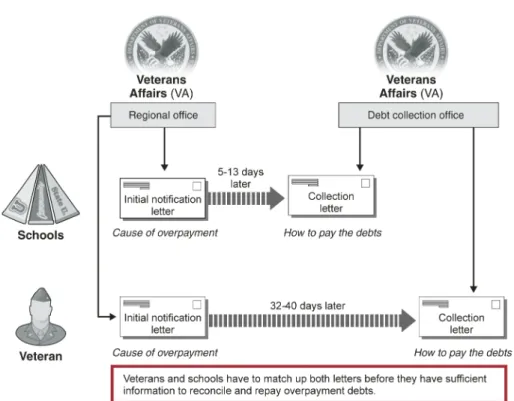
overpayment debts and unprepared for the financial consequences, which could also complicate and prolong VA’s collection efforts. VA’s debt notification letters also provide essential information in two separate letters, making it difficult for veterans and schools to reconcile and repay overpayment debts. VA is required to provide debtors with information on the amount of the debt, the reason for the debt, their right to dispute the debt or request a waiver, and how to repay it.53 However,
VA conveys this information in two separate letters, neither of which contains all the information a veteran or school needs to understand the overpayment and how to repay it (see fig. 8). For example, VA’s regional offices mail veterans an initial notification letter which includes information on the amount and cause of their overpayment debt. However, it is not until more than 30 days later that VA’s debt collection office mails the veteran a second letter with information on how to repay the debt, according to VA officials. Since each of these letters only provides
veterans with half of the information they need, they can create confusion. Specifically, VA debt collection staff said they frequently receive
questions from veterans who are confused because information on the cause of overpayments and the collection process is conveyed in
separate letters. For example, officials from the debt collection call center said one of the most common questions they receive from veterans is to ask why their debt was established, since this information is not included in the second letter veterans receive from the debt collection office. This delay in receiving all of the information associated with their debt could
52 As for schools, VA officials said that its Stakeholder Enterprise Portal, which is currently
designed as a tool for veteran service organizations, could potentially be expanded for use as a portal for communications with schools. The agency does not currently have any plans to implement this upgrade.
53 38 C.F.R. § 1.911(b) and (c).
also delay the collection process since veterans may be less likely to repay their debts until they understand both the cause of overpayments and have the information they need on how to repay them. VA similarly mails this information to schools in two separate letters, and school officials told us this creates some confusion since they must wait to repay any overpayment debts until they can match up both letters from VA, which can also delay collections. One school administrator told us that it can be particularly difficult to keep track of the two separate letters at larger schools that enroll thousands of veterans, so they had to hire two new staff to deal with the administrative burden of researching
overpayment debts.
Figure 8: Process for Notifying Veterans and Schools of Overpayment Debts
VA officials said the initial notification letters are sent separately from the debt collection letters to promptly notify veterans about their debts and to allow veterans time to dispute them. Although this may justify sending two separate letters, it would still help avoid confusion for veterans and
mailed by VA’s debt collection office do not include details on the cause of debts because VA’s regional offices do not currently share this information when referring debts for collection. Officials from VA’s debt collection office told us they would like to include some basic information on the cause of debts in their letters, such as the term dates associated with a veteran withdrawal. However, VA officials responsible for
administering the Post-9/11 GI Bill said the cause of the overpayments is already clearly communicated in the initial notification letters.
Nevertheless, this should not preclude the regional processing offices from sharing basic information on the causes of overpayments so it could be included in subsequent letters along with information on how to repay debts. Given VA’s regulatory requirement to provide students and schools with information on both the cause of their debts and how to repay them, VA could improve its efforts to convey this information. This would also be consistent with federal internal control standards for information sharing. The current lack of information sharing between offices limits VA’s ability to communicate both the overpayment cause and repayment options in at least one of the letters VA sends to veterans and schools. This process can lead to confusion and cause delays in veterans and schools repaying their debts in a timely manner.
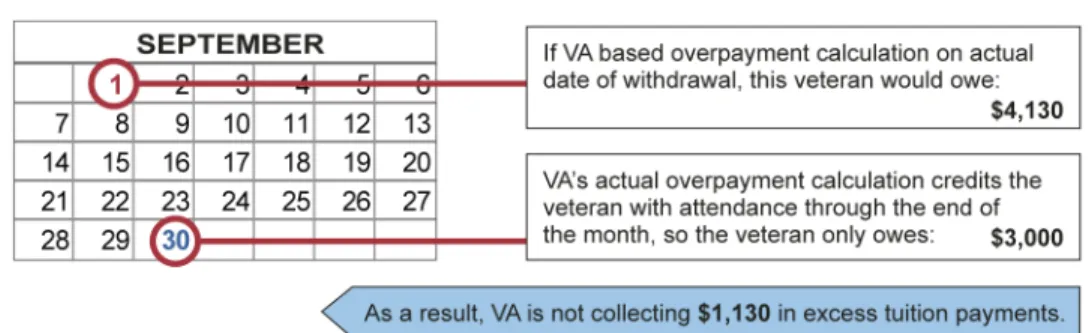
VA’s formula for prorating overpayments gives veterans credit for extra days of attendance after they drop a class, thereby reducing the amount subject to collection. When a Post-9/11 GI Bill beneficiary drops a class during the term, VA prorates the resulting overpayment as though the veteran attended class through the end of the month rather than using the actual date of the withdrawal.54 For example, if a student drops a class on
September 1, VA would prorate the overpayment amount as though the student had been enrolled through September 30. This in effect credits students for up to 30 extra days of classes they did not attend, which can reduce the overpayment amount subject to collection by hundreds of dollars per veteran (see fig. 9). VA officials said this policy was designed for monthly housing benefits, and then applied to tuition benefits that are
54 According to the law, VA is authorized to prorate overpayment debts based on the
student’s period of enrollment if the student is ordered to active duty or if the student can document that mitigating circumstances—unanticipated and unavoidable events beyond a student’s control (e.g., illness or injury, change in employment)—are responsible for the student’s inability to complete a course. 38 U.S.C. § 3680(a)(3). However, VA’s current practice is to prorate all overpayment debts whether or not the student meets these criteria, according to VA officials.
VA’s Formula for Prorating
Tuition Overpayments
Reduces Total Collections
paid separately under the Post-9/11 GI Bill. Although crediting a student for a full month of enrollment may be appropriate for benefits that are paid on a monthly basis, such as housing, it is less appropriate for benefits that are paid as up-front lump sums, such as tuition, particularly since the law stipulates that education benefits shall only be paid for the period of time during which the veteran is enrolled.55 Since VA’s overpayment
calculation is crediting veterans for school days they did not attend, it is inappropriately increasing the cost of the program.
Figure 9: Effect of Prorating Overpayments Based on the End of the Month
In addition, VA’s formula for prorating overpayment amounts does not account for schools’ own internal refund policies, and can sometimes result in veterans receiving surplus funds that VA is not collecting. Some schools have fairly generous tuition refund policies when students drop a class or withdraw from school early in the term. In these cases, a school may send the veteran a tuition refund that is larger than the overpayment amount the veteran owes to VA, leaving the veteran with a potential financial gain. For example, one of the community colleges we examined provided a 100 percent tuition refund if a student withdrew within the first two and a half weeks of the term, so a veteran withdrawing from school would receive a full refund of $2,100 from the school. However, VA will create an overpayment debt of $1,750 for this veteran since they had attended two and half weeks of the 15 week term before withdrawing.56
55 38 U.S.C. § 3680(a).
56 When a veteran withdraws from some but not all of their classes, VA’s overpayment
calculation would instead prorate the overpayment amount as though the veteran had kept attending class through the end of the month rather than using the actual date of the