Master of Science
in
Computing Security
For more information contact: Rochester Institute of Technology Department of Computing Security
152 Lomb Memorial Drive GOL-2120
Rochester, NY 14623-5603 (585) 475-2963 (voice)
~ Table of Contents ~
Introduction ... 3
Learning Format Options ... 5
Entrance Requirements ... 6
Application & Deadlines... 6
Prerequisites ... 7
The Bridge Program ... 7
The Curriculum ... 8
Co-operative Work Experience ... 10
Program Cost ... 10
Departmental Financial Aid ... 10
RIT’s 7-Year Degree-Completion Rule……….………11
Academic Honesty ... 11
Contact Information ... 11
Course Descriptions ... 11
Academic Calendar ... 11
Campus Map ... 11
ROCHESTER INSTITUTE OF TECHNOLOGY Department of Computing Security
Master of Science
inComputing Security
Introduction
In recent years, there have been ever increasing numbers of computer-based crimes against the information and economic infrastructure of our society. A number of troubling trends have emerged: the time from the discovery of a vulnerability to the creation of its exploit has shortened dramatically; attackers are increasingly focusing on attacks that cause the most harm to public and private networks; confidential data is increasingly becoming the focus of attacks in support of criminal activity; and attackers are developing large, highly sophisticated networks of “compromised” computers for denial-of-service and other cyber attacks. However, despite these risks, organizations of all shapes and sizes are establishing “web identities” and looking to computing technologies and interconnectivity to enhance both their employee productivity and competitiveness in the face of global competition. These trends have lead to additional responsibilities for network and system administrators along with the emergence of a new computing specialization, that of the computer security specialist.
The Master of Science in Computing Security (MS/CSEC) focuses on the theoretical, organizational, and applied aspects of computing security. The curriculum is unique in its recognition of the need for students to have a broad-based understanding of the myriad of issues involved in providing secure, yet useful, computing environments that enhance the productivity of users while at the same time living up to the fundamental pillars of computing security as enhanced to encompass the full scope of information assurance: confidentiality, integrity, availability (together, the CIA principle), plus authentication and non-repudiation.1
Program Goals and Objectives
Upon completion of the MS/CSEC program, successful students will have acquired the necessary skills to do the following:
• Protect computer systems from the threats, exposures and risks, possible through unauthorized access in today’s networked computer environment.
• Outline and apply appropriate methods and mechanisms that can be used to protect enterprise data to help manage the risk of unauthorized data access, data tampering, or theft.
• Communicate effectively, both orally and in writing, with other security and computing professionals.
• Research security issues, synthesize the information, and communicate the results of the research to business and computing professionals.
• Design and analyze basic cryptographic algorithms and protocols.
• Apply appropriate software engineering techniques to address security needs in software development.
• Evaluate security mechanisms in terms of their effectiveness, maintenance and appropriateness in computer networks.
• Evaluate ethical controversies and use various decision-making approaches for resolving ethical dilemmas in complex situations.
1
http://www.cnss.gov/Assets/pdf/cnssi_4009.pdf; http://www.nsa.gov/about/about00019.cfm
Program Design
The MS in Computing Security program consists of a core of three (3) courses that provide a common knowledge-base in the theoretical principles underlying computing security and information assurance today. Together, these courses ensure that graduates acquire the intellectual tools necessary to stay up-to-date in this challenging and rapidly evolving discipline. Students can then develop depth in an area of expertise in Systems and Network Security, Systems and Network Forensics, Secure Coding, and Security Theory by selecting five or six related elective courses. The program of study is capped off with a six-credit thesis, a three-credit project, or a three-credit capstone course.
The program includes courses that enable students to understand the theoretical foundations of computing security, to join a team of professionals solving the challenges of ensuring secure computing environments, and to become leaders in implementing solutions computing security and information assurance. Alternately, students can prepare for further academic study and careers in academia or research.
MS in Computing Security is designed for individuals whose undergraduate major, or minor, was in a computing discipline with a solid theoretical foundation as well as those who have a strong background in a field to which computers are applied, such as Engineering, Science, or Mathematics. Students admitted without this background must complete bridge study as assigned by the Graduate Director and the faculty to ensure that they have the prerequisite knowledge necessary for success in this program.
This MS degree is comprised of 30 semester-credits of graduate study which include:
• 3 core courses (9 credits); focusing on foundation security theory, forensics concepts, research practices and cryptography
• 5 or 6 elective courses (15 - 18 credits), depending upon the capstone option chosen, to develop breadth and depth in security topics of individual interest
• the MS capstone experience: a thesis (6 credits), a project (3 credits), or a capstone course (3 credits)
Each RIT academic program is identified by an alphabetic code; the MS in Computing Security program code, or “student plan,” is COMPSEC-MS (previously VNSS when the degree was named MS in Computing Security and Information Assurance).
Relevancy
With mobile communications; ubiquitous computing; the advantages of cloud computing; and issues of securing “big data” caused by the world-wide explosion of eBusiness and eCommerce today, secure computing environments and appropriate information management have become critical issues to all sizes and types of organizations. Therefore, computing specialists who understand computing within networked environments and the issues critical to information security are vital. The
Occupational Outlook Handbook, 2008-2009 Edition
(http://www.bls.gov/OCO/), stated:Demand for computer security specialists will grow as businesses and government continue to invest heavily in “cyber security,” protecting vital
computer networks and electronic infrastructures from attack. The information security field is expected to generate many new system administrator jobs over the next decade as firms across all industries place a high priority on safeguarding their data and systems.
Plus, in the section on Tomorrow’s Jobs, Bureau of Labor Statistics at that time, it stated that:
Employment in computer systems design and related services will grow by 38.3 percent and add nearly one-fourth of all new jobs in professional, scientific, and technical services. Employment growth will be driven by the increasing reliance of businesses on information technology and the continuing importance of maintaining system and network security. … Demand for these services will be spurred by the increased use of new technology and computer software and the growing complexity of business.
The need projected back in 2008-9 has only increased today. The 2010-11 Edition of the BLS handbook, stated that:
The responsibilities of computer security specialists have increased in recent years as cyber attacks have become more sophisticated. … Computer security specialists can advance into supervisory positions, or may move into other occupations, such as computer systems analysts.
Today, security-related employment opportunities for computer professionals in the U.S. is expected to “grow 22 percent from 2010 to 2020, faster than the average for all occupations” (Occupational Outlook Handbook, 2012-13 Edition, Information Security Analysts page (www.bls.org/ooh)). And, per O*NET, the Occupational Information Network, the projected growth for this career area for 2010 to 2020 is “faster than average” [for all occupations] which is their 20% to 28% growth range. Their 2014 summary report for Computer Security
Specialists is available online at http://www.onetonline.org/link/summary/15-1122.00
Typical Job Titles (per O*NET)
Information Technology Specialist, Data Security Administrator, Information Security Analyst, Information Security Officer, Computer Specialist, Information Security Specialist, Information Systems Security Analyst, Computer Security Specialist, Information Security Manager, Information Technology Security Analyst.
This degree program is designed to provide the educational foundation that will prepare individuals, with strong technical and computing skills, for careers at the forefront of the expanding need for computing security professionals.
Learning Format Options
This program is intended for either full-time or part-time study primarily on campus.
A wide variety of support services are available including advising, online library catalogs and indexes (some with full text), inter-library loans, internet-based audio conferences, computer conferencing, etc.International students seeking an I-20 to reside in the United States while studying in this program should note that they are required to be enrolled for at least nine (9) credits per semester to maintain their full-time status. Of those 9 credits, international students may only count 1
online course (or 3 credits) towards their full-time course load. They may take additional online courses “outside” of the 9 credits.
Entrance Requirements
Degree applicants should minimally have a baccalaureate or equivalent degree from an accredited institution of higher education and a minimum cumulative grade-point average equivalent to 3.0/4.0 (‘B’ average). International students must also have equivalent of at least a 3.0/4.0 from an accredited university using the US system of grading or at least a first class degree from an accredited university using the British system of grading.
Additionally, applicants with degrees from foreign universities must submit Graduate Record Examination (GRE) scores2. The GRE may also be required for those applicants requesting
consideration whose undergraduate grade-point average is less than 3.0/4.0.
Applicants whose native language is not English must take and submit the TOEFL examination. A minimum score of 570 (paper-based exam) or 88 (internet-based exam) is required. Other evidence of language proficiency, such as writing samples and GRE scores, may also be evaluated to assess functional English ability. Applicants with a lower TOEFL may be admitted conditionally. However, they will be required to take a prescribed program in English along with a reduced program course load until the required English level is achieved.
Information about the GRE and the TOEFL examinations is available at http://www.ets.org.
Application & Deadlines
The application process typically takes four to six weeks after the Office of Graduate Enrollment Services (GES) has received a complete application. However, international applications may take longer. The graduate director only evaluates applications after all of the information has been submitted and verified by a GES counselor.
Student applications are considered for fall term admission only. However, acceptance into the program does not guarantee availability of prerequisite or program courses. As the start of the semester approaches, many classes become full. Students, who apply just before the start of the year, may need to wait until the following year before starting their course work.
All applicants are required to submit the following:
• An electronic or paper application.
• A well-written statement of purpose that discusses your background relevant to and your personal goals for this degree program.
• Application fee.
• Official transcripts from all universities listed on the application.
• Two (2) recommendations from educational or professional sources. An electronic graduate application is available at the URL
http://www.rit.edu/emcs/ptgrad/grad_admission.php. (Note: there is an underscore (_) between the ‘d’ and the ‘a’ in “grad_admission.”) Requests for information can be made from this page.
2 RIT’s reporting number for ETS’s GRE and TOEFL examinations is 2760.
Prerequisites
Applicants wishing to enter this master’s program should have an undergraduate degree in computing related areas with a solid education in mathematics and computer programming fundamentals. Programs that may provide the necessary background are degrees in Computing Security, Computer Science, Software Engineering, Computer Engineering – depending upon the student’s previous course work and/or work experience. The specific prerequisites are:
• Mathematical maturity, including Integral Calculus depth and Discrete Mathematics.
• Solid skills in computer programming.
• Knowledge in natural sciences such as physics, biology, etc.
• Knowledge of basic networking concepts, including: Ethernet, TCP/IP, routing and switching, cable construction, and basic LAN design and construction principles.
• Knowledge of basic networking infrastructure services, including DHCP, DNS, and other discovery and name resolution protocols.
• Knowledge of basic system services and system administration functions, including scripting for UNIX, user administration, networked file systems, web services, networked information systems (such as NIS), and networked security and permission issues.
Students without this background, but with a strong background in computing (including programming) may be admitted conditionally at the discretion of the faculty.
The Bridge Program
All students must have the required coursework and documented experience before matriculating into this MS program. Students, whose undergraduate preparation or industrial/work experience does not satisfy the above requirements, can make up this deficiency through study, taking one or more courses as prescribed by the graduate director and faculty. This coursework may be completed at any accredited college or university that is convenient.
The courses offered by RIT that can be used to satisfy the above prerequisites are (prerequisites and notes are included in parentheses after each course):
• 2-course Calculus sequence (equivalent to COS-MATH 181 Project-Based Calculus I and COS-MATH 182 Project-Based Calculus II)
• Discrete mathematics (equivalent to COS-MATH 190 Discrete Mathematics for Computing)
• Computer Programming skills (equivalent to CSCI-141 Intro to Programming I and CSCI-142 Intro to Programming II and CSCI-242 Mechanics of Programming)
• Statistics (equivalent to STAT-145 or MATH-251)
• Computer Networking (equivalent to NSSA-241)
• Systems Administration (equivalent to NSSA-605)
Students are expected to achieve a 3.0 (‘B’ grade) or better average in course work done as part of the bridge program. Bridge program courses are not part of the 30-semester credit hours required for the master’s degree. Bridge courses may not be applied towards degree requirements. If taken before matriculation, grades for bridge courses are not included in a student’s graduate grade-point average. However, grades for bridge courses taken after matriculation are included in student’s graduate grade-point average.
Students who have been admitted to the program before completing prerequisite requirements must satisfactorily complete bridge coursework within the first two semesters of matriculation to
continue in the program. Prior approval of the graduate director is required before any other courses in the program may be taken.
To meet individual needs, a bridge program can be designed differently from that described above. Other courses can be substituted, or courses at other colleges can be applied. However, such courses must be approved in advance. Contact the graduate director (see contact information later in this document) for approval prior to beginning bridge coursework.
The Curriculum
This Master of Science degree is thirty (30) semester-credit hours of study. It includes the core coursework, 9 credits or three (3) courses; fifty or eighteen (15 or 18) credits of upper-level electives from a prescribed set of courses; and the capstone experience, a 6-credit thesis, or a 3-credit project, or a 3-3-credit capstone course.
The MS/CSEC Core (9 credits)
• CSEC-601 Research Methods and Proposal Development
• CSEC-603 Enterprise Security and Forensics
• CSEC-604 Cryptography and Authentication Upper-level Electives Concentration (15 or 18 credits)
• GCCIS-CSEC-730 Advanced Computer Forensics
• GCCIS-CSEC-731 Web Server and Application Security Audits
• GCCIS-CSEC-732 Mobile Device Forensics
• GCCIS-CSEC-730 Advanced Computer Forensics
• GCCIS-CSEC-733 Information Security and Risk Management
• GCCIS-CSEC-741 Sensor and SCADA Security
• GCCIS-CSEC-742 Computer System Security
• GCCIS-CSEC-743 Computer Viruses and Malicious Software
• GCCIS-CSEC-744 Network Security
• GCCIS-CSEC-750 Covert Communications
• GCCIS-CSEC-751 Information Security Policy and Law
• GCCIS-ISTE-721 Information Assurance Fundamentals
• GCCIS-CSCI-622 Secure Data Management
• GCCIS-CSCI-642 Secure Coding
• GCCIS-CSCI-662 Foundations of Cryptography
• GCCIS-CSCI-734 Foundations of Security Measurement and Evaluation
• GCCIS-CSCI-735 Foundations of Intelligent Security Systems
• GCCIS-CSCI-762 Advanced Cryptography
• KGCOE-CMPE-661 Hardware and Software Design for Cryptographic Applications Note: Graduate courses from other RIT departments may be used as electives, with the prior approval of the graduate director.
The MS/CSEC Capstone (3 or 6 credits)
• GCCIS-CSEC-790 MS Thesis (6 credits) or
• GCCIS-CSEC-792 CSEC Project (3 credits) or
• GCCIS-CSEC-793 Capstone for Computing Security (3 credits)
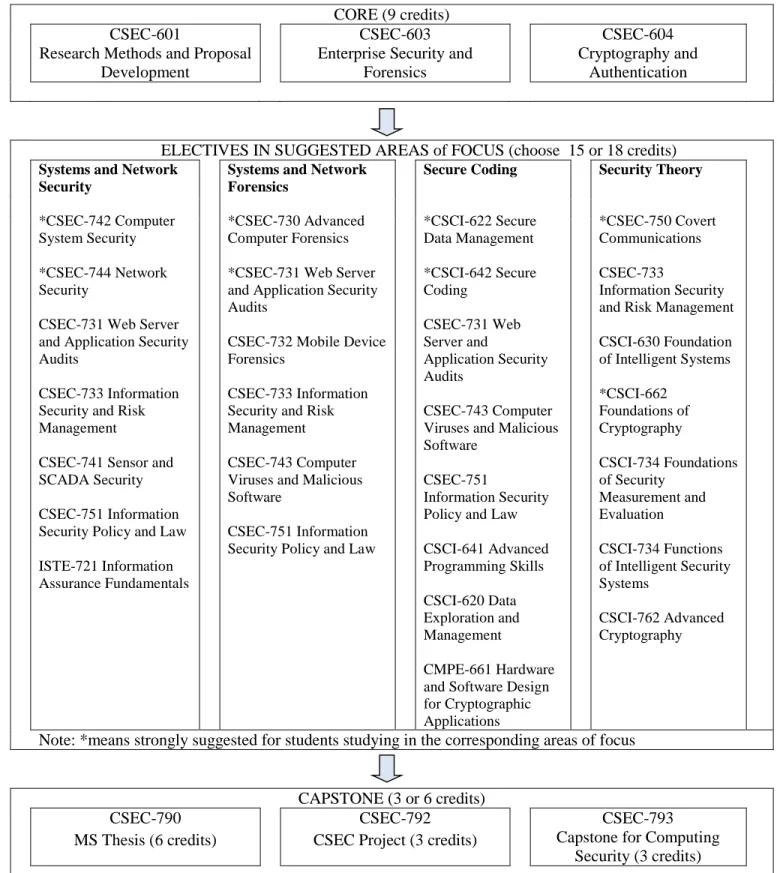
The Course Plan for MS in Computing Security is given below. CORE (9 credits)
CSEC-601
Research Methods and Proposal Development
CSEC-603 Enterprise Security and
Forensics
CSEC-604 Cryptography and
Authentication
ELECTIVES IN SUGGESTED AREAS of FOCUS (choose 15 or 18 credits) Systems and Network
Security
*CSEC-742 Computer System Security *CSEC-744 Network Security
CSEC-731 Web Server and Application Security Audits
CSEC-733 Information Security and Risk Management
CSEC-741 Sensor and SCADA Security CSEC-751 Information Security Policy and Law ISTE-721 Information Assurance Fundamentals
Systems and Network Forensics
*CSEC-730 Advanced Computer Forensics *CSEC-731 Web Server and Application Security Audits
CSEC-732 Mobile Device Forensics
CSEC-733 Information Security and Risk Management CSEC-743 Computer Viruses and Malicious Software
CSEC-751 Information Security Policy and Law
Secure Coding *CSCI-622 Secure Data Management *CSCI-642 Secure Coding CSEC-731 Web Server and Application Security Audits CSEC-743 Computer Viruses and Malicious Software
CSEC-751
Information Security Policy and Law CSCI-641 Advanced Programming Skills CSCI-620 Data Exploration and Management CMPE-661 Hardware and Software Design for Cryptographic Applications Security Theory *CSEC-750 Covert Communications CSEC-733 Information Security and Risk Management CSCI-630 Foundation of Intelligent Systems *CSCI-662 Foundations of Cryptography CSCI-734 Foundations of Security Measurement and Evaluation CSCI-734 Functions of Intelligent Security Systems
CSCI-762 Advanced Cryptography
Note: *means strongly suggested for students studying in the corresponding areas of focus
CAPSTONE (3 or 6 credits) CSEC-790
MS Thesis (6 credits)
CSEC-792 CSEC Project (3 credits)
CSEC-793 Capstone for Computing
Security (3 credits)
Co-operative Work Experience
Up to two (2) terms of an optional co-operative educational experience (co-op) is available, prior to capstone completion, for those students who wish to enhance their resume with employment experience. Students need to complete all bridge study (including English Language Center study), have completed 2/3 of their course work, and have a 3.0/4.0 or better program grade-point-average (GPA) before going on co-op.
Students need prior approval of the graduate director to register for Graduate Co-op, the course CSEC-699 (zero (0) credits; no cost). The Office of Cooperative Education and Career Services (OCE&CS; http://www.rit.edu/emcs/oce/) can assist students in finding a co-op position or students can find positions on their own and have them approved by the graduate director.
Program Cost
The cost of graduate study at RIT is available on the RIT website at https://www.rit.edu/fa/sfs/billing-information. Cost information is available for both full- and part-time study. Information about financial aid to support study with us is available at www.rit.edu/emcs/financialaid/graduate.html.
Departmental Financial Aid
The CSEC department can offer a small Merit Scholarship to qualified students who are not receiving significant financial support from other sources. This award is based upon demonstrated need, previous educational performance, and employment background (if applicable).
If granted, the merit scholarship is initially awarded for one (1) academic year (excluding summer) from the semester in which the student is admitted. For the summer term, the student must request continuation of the scholarship. The award will, in general, be extended if the student has made steady progress towards the degree and has maintained at least a 3.0/4.0 GPA, which is the minimum required to graduate with a MS degree at RIT.
The Computing Security department offers a limited number of graduate assistantship (GA) positions to individuals with strong academic, interpersonal and technical skills for the purpose of supporting the educational and research activities of the department. These positions can also provide financial support for the qualifying students in the department. Assistantships are awarded for a maximum of one (1) academic year. Both full and part-time assistantships may be offered. A full-time assistantship provides up to full tuition benefits plus an hourly wage each academic term; a part-time assistantship covers a portion of the cost of tuition and an hourly wage. The student is responsible for all degree-related financial obligations not covered by the award.
A full-time GA works 20 hours per week for the department; part time GA works 10 hours per week. Graduate assistants are not responsible for direct course delivery. Instead they may be teaching assistants, or tutors in the undergraduate program, support the faculty in their research efforts or support the Systems Administrator with the lab infrastructure. A GA must maintain good academic standing (U>U 3.0/4.0 GPA; ethical behavior) to retain the assistantship. An assistantship may be terminated at any time due to unacceptable performance or unethical behavior.
RIT’s 7-Year Degree-Completion Rule
Graduate students must successfully complete all of the requirements for their programs within seven (7) years of the date of the first (oldest) course counted towards the degree. This requirement includes courses transferred into the program from other RIT departments or other universities, but excludes prerequisite courses. For example, if the first course was completed in fall term 2014 (2121), then the program must be completed before the start of fall term 2019 (2191). Please contact the graduate director immediately if you find that you are coming close to your 7-year deadline.
Academic Honesty
Academic honesty is an expectation of all students at RIT. Any act of improperly representing another person’s work as one’s own is an act of academic dishonesty. The RIT code of academic conduct is documented in the university’s Policies and Procedures manual: https://www.rit.edu/academicaffairs/policiesmanual/d080
Contact Information
Additional information about this program and the undergraduate program offered by the Computing Security (CSEC) department at RIT may be obtained by contacting us at:
US Mail: Graduate Program Director Computing Security Department
Golisano College of Computing & Information Sciences Rochester Institute of Technology
152 Lomb Memorial Drive Rochester, New York 14623-5603 Telephone: (585) 475-2963
FAX: (585) 475-2181
Course Descriptions
Courses descriptions are available at
https://mycampus.rit.edu/psc/sasrch/EMPLOYEE/HRMS/c/COMMUNITY_ACCESS.SS
S_BROWSE_CATLG.GBL - Choose CSEC.
Information about course availability is also available on the RIT website at
https://mycampus.rit.edu/psc/sasrch/EMPLOYEE/HRMS/c/COMMUNITY_ACCESS.C
LASS_SEARCH.GBL. You will need to select a specific academic term.
Academic Calendar
RIT academic calendar is available at www.rit.edu/calendar/.
Campus Map
MS/CSEC courses are generally be held in the Golisano College of Computing & Information Sciences (GOL or building 70). RIT’s various campus maps are available at facilities.rit.edu/campus/maps/.
MS/CSEC Program Worksheet (as of 2014-15)
Master of Science in Computing Security
Prerequisite Bridge Program2 Must be completed prior to start of program of study. 1 year of programming
Discrete Mathematics Calculus – 1 year Statistics
2 courses in natural sciences
NSSA-241 Intro to Routing and Switching or Equivalent NSSA-605 Principles of System Administration or Equivalent
~ Program of Study (30 semester credit hours) ~
Core Courses:(9 credit hours) Quarter Grade Comments
GCCIS-CSEC-601 Research Methods & Proposal Devel.
GCCIS-CSEC-603 Enterprise Security & Forensics GCCIS-CSEC-604 Cryptography and Authentication Electives: (15 - 18 credit hours)1,3
Capstone: (3 or 6 credit hours) 1,4
CSEC-79___ Capstone [ Course | Project | Thesis ] (3 credits)
CSEC-790 Thesis (3 credits)
Notes: 1The credit for the electives and the capstone must total to twenty-one (21).
Guidelines for Completion of a Program of Study:
This worksheet is sent to you when you are accepted into the MS in Computing Security (MS/CSEC). The RIT program code for this program is COMPSEC-MS. To earn the MS degree, you must complete the prerequisites and degree requirements shown on the front of this page. Contact the Graduate Director periodically to review your progress and receive an updated copy. If you lose your worksheet, the Student Services office can give you a current copy.
Applicable Notes:
Note #2: Prerequisite courses must be completed prior to beginning study in the
MS/IAF program, typically within the first two terms after matriculation.
Note #3: Electives should be chosen in consultation with your graduate faculty.
Ideally, these courses should be selected to focus on one specific area, or at
most two synergistic areas, of interest. Certain electives may require
additional prerequisite study. One less elective is needed with a thesis
capstone.
Note #4: The capstone may be a MS project or the capstone course (both 3 credits), or a
MS thesis (6 credits).
Matriculation
When a student is accepted into the MS/CSEC program and registers for courses, the student is “matriculated” in this program of study and his/her academic status is “active.”
Good Academic Standing
A 3.0 GPA or higher is required to graduate. All courses (undergraduate or graduate) taken after matriculating into an MS program at RIT are counted towards your grade-point average (GPA). To be in good academic standing, a graduate student at RIT must maintain a cumulative GPA of 3.0/4.0 or better throughout a program of study. RIT institute policy states that “’D’ or ‘F’ grades do not count toward the fulfillment of program requirements for a graduate degree.” However, they are calculated into your GPA.
Inactive Status
If you have no registration activity in the term for which you were admitted, do not register for four (4) consecutive terms during your program of study, withdraw, or graduate, your academic status at RIT will become “inactive.”
Discontinued Status
After four (4) consecutive terms without registration activity, the RIT Registrar will change your status to “de-matriculated,” which means that you are no longer a student in the MS/CSEC program. To return to matriculated status, you will need to reapply to RIT. If more than two years have elapsed since you were matriculated, your program of study will be reviewed, and you may have to complete the degree requirements currently in effect to obtain your degree. This could mean loss of waivers and transfer credit as well as doing additional coursework for readmission or degree completion. Contact the Graduate Director for assistance.
Course Waivers
On rare occasions, a required course may be waived due to prior academic or
employment experience. If this occurs, to complete the total number of credits required
for the degree, the student must take another course to replace the one that was waived.
This is does not apply to prerequisite courses.
7-Year Rule