STATE
OF
DELAWARE
TRAFFIC RECORDS
ASSESSMENT
December 4-8, 2000
National Highway Traffic
Safety Administration
Technical Assessment Team
Bob W. Bailey, M.A.
Major Larry C. Holestine
Robert A. Scopatz, Ph.D.
Langston A. (Lang) Spell
NOTES AND DISCLAIMERS
NOTE: The terms "Highway Safety Information System" and "Traffic Records System" are interchangeable. This Advisory uses the term, "Traffic Records System" to be consistent not only with its traditional use, but also with references in many of the publications and documents listed at the back of this Advisory, as well as its use in various pieces of legislation.
NOTE: The term “crash” is used in lieu of the term “accident” in this document. Many of the references cited in this document use the term “accident” as do many of the laws defining crashes or accidents at the state level. This advisory recommends that states begin to use the term
TABLE OF CONTENTS
EXECUTIVE SUMMARY... 1
ACKNOWLEDGMENTS... 3
INTRODUCTION... 6
Assessment Background... 6
Methodology ... 6
Recommendations ... 7
Report Contents... 7
SECTION 1: TRAFFIC RECORDS SYSTEM INFORMATION COMPONENTS ... 8
1-A: Crash Information ... 12
1-B: Roadway Information... 17
1-C: Vehicle Information ... 19
1-D: Driver Information ... 22
1-E: Enforcement/Adjudication Information ... 25
1-F: Injury Surveillance System Information ... 27
1-G: Other Information ... 30
1-H: Data Integration... 33
SECTION 2: INFORMATION QUALITY... 35
2-A: Crash Information Quality ... 36
2-B: Roadway Information Quality... 40
2-C: Vehicle Information Quality ... 42
2-D: Driver Information Quality ... 44
2-E: Enforcement/Adjudication Information Quality ... 46
2-F: Injury Surveillance Systems Information Quality... 48
SECTION 3: USES OF A TRAFFIC RECORDS SYSTEM... 50
3-A: Operational Purposes ... 51
3-B: Research and Program Development ... 52
3-C: Program Management and Evaluation ... 54
3-D: Private Sector and Public Requests... 56
3-E: Policy Development ... 57
SECTION 4: MANAGEMENT INITIATIVES ... 58
4-A: Coordination ... 59
4-B: Integrated Safety Planning Process ... 61
4-C: Strategic Planning ... 62
4-D: Training and Staff Capabilities ... 64
SELECTED REFERENCES... 65
GLOSSARY OF TERMS AND ACRONYMS ... 67
EXECUTIVE SUMMARY
Following are the major recommendations drawn from the main body of the report: MAJOR RECOMMENDATIONS
Coordination
! Insure that the Traffic Records Coordinating Committee (TRCC) includes representation from all stakeholders including: Office of Highway Safety (OHS), Delaware Department of Transportation (DelDOT), Delaware State Police (DSP), Division of Motor Vehicles (DMV), Office of Emergency Medical Services (OEMS), Delaware Justice Information System (DELJIS), Office of Administrative Services (OAS), Courts, Delaware Chiefs of Police Association, Metropolitan Plannining Organizations (MPOs), and Community Traffic Safety Programs (CTSPs).
! Assign oversight responsibility to the TRCC to assure that the traffic records system will meet the needs of all state and local agencies with a highway safety responsibility. Strategic Plan
! Assign the TRCC the responsibility for developing the Traffic Records System Strategic Plan.
! Insure that DMV participates fully in the TRCC.
New Crash System/Data Usage
! Develop a formal, written process for the specification, design, and development of the new automated crash report system.
! Revise and implement a new crash report form now, using the new crash data elements as established in 1997. This should be accomplished in advance of the design and
development of the new automated crash system.
! Create a statewide Traffic Records System Resource Guide to give users and potential users the information they need on data sources and system capabilities.
! Promote use of simpler query tools and allow broader access to systems in DSP, DelDOT, and DELJIS.
! Extend training to all member agencies to provide a wide range of users with the
information technology skills they need to manage transportation safety programs at the state and local levels.
DelDOT Systems Integration
! Insure that DelDOT personnel who play a key role in the use of crash information, take an active role in the development of the new crash system.
! Establish an enterprise-wide Geographic Information System (GIS) that will enhance accuracy, accessibility, and integration of the various DelDOT files.
Injury Surveillance Systems (ISS) Initiatives
! Fully implement the Crash Outcome Data Evaluation System (CODES) project to improve data linkage with highway safety databases.
ACKNOWLEDGMENTS
The Traffic Records Assessment Team would like to acknowledge and thank Tricia Roberts, Director, Office of Highway Safety, for her support and able assistance in making this assessment possible.
Also, the team would like to recognize the contributions of Jana Simpler, Management Analyst, Office of Highway Safety, for her expert guidance, planning, logistical arrangements and support in making this assessment effort a success.
Kay Banks support during the preparation phase of this report was especially appreciated. The team wishes to recognize her patience, skills, cooperative spirit, and sense of humor.
The team would like to thank Clayton Hatch, team facilitator, for giving a national perspective to the assessment process and its goals.
The team would also like to thank the principal participants in the assessment for the time invested, the information they presented, and their candor in answering the many questions put forth by the team.
List of Presenters Tricia Roberts Director
Office of Highway Safety Jana Simpler
Management Analyst Office of Highway Safety Captain James Paige Traffic Director Delaware State Police Sargent Mark Collendar Truck Enforcement Unit Delaware State Police Chief George Dickerson
Fenwick Island Police Department Martin Johnson
Coordinator
Delaware Police Chief’s Council Michael J. McDonald
Director
DSP Information Technology Tammy Hyland
Statistician
Delaware State Police Sandy Ryder
FARS Analyst
Delaware State Police Cheryl Roe
Computer Services Administrator Division of Motor Vehicles Elizabeth Jonkiert
Management Analyst Court of Common Pleas
T. Allen Barnes
Professional Standards Division Manager Sussex County EMS
Michael E. Schnyder EMS System Analyst Delaware Office of EMS Cini McLaughlin
Injury Prevention Coordinator Delaware Office of EMS Colin T. Faulkner
Director of Public Safety Kent County Legislative Court Ken Pennington
Planning Technology Supervisor
Delaware Department of Transportation Randall Grunden
Planning HSIP Manager
Delaware Department of Transportation Joyce “Joy” Hall
Statistics, Research, & Special Programs
Delaware Department of Transportation Tyrone Crittenden
Manager, Statistics, Research, & Special Programs
Delaware Department of Transportation Vince Rucinski
OIS Manager
Delaware Department of Transportation David Saladino
Planner/Engineer WILMAPCO
Juanita Wieczoreck Executive Director
Dover/Kent County Metropolitan Planning Organization
Pat Griffin Chief Magistrate
Justice of the Peace Court Tom Nagle
Court Administrator Justice of the Peace Court Carole Kirshner
Court Administrator Court of Common Pleas Peggy Bell
Operations Manager
Delaware Justice Information System Ron Torgerson
Executive Director
INTRODUCTION
A complete traffic records program is necessary for planning (problem identification),
operational management or control, and evaluation of a state’s highway safety activities. Each state, in cooperation with its political subdivisions, should establish and implement a complete traffic records program. The statewide program should include, or provide for, information for the entire state. This type of program is basic to the implementation of all highway safety countermeasures and is the key ingredient to their effective and efficient management.
As stated in the National Agenda for the Improvement of Highway Safety Information Systems, a product of the National Safety Council's Traffic Records Committee:
"Highway safety information systems provide the information which is critical to the development of policies and programs that maintain the safety and the
operation of the nation's roadway transportation network."
A traffic records system is generally defined as a virtual system of independent real systems which collectively form the information base for the management of the highway and traffic safety activities of a state and its local subdivisions.
Assessment Background
The Traffic Records Assessment is a technical assistance tool that the National Highway Traffic Safety Administration (NHTSA) and the Federal Highway Administration (FHWA) offer to state offices of highway safety to allow management to review the state's traffic records program. NHTSA and FHWA have co-published a Highway Safety Program Advisory for Traffic Records which establishes criteria to guide state development and use of its highway safety information resources. The Traffic Records Assessment is a process for giving the state a snapshot of its status relative to that Advisory.
This assessment report documents the state's traffic records activities as compared to the provisions in the Advisory, notes the state's traffic records strengths and accomplishments, and offers suggestions where improvements can be made.
Methodology
The assessment process follows a "peer" review team approach. Working with the NHTSA Regional Office, the FHWA Division Office, and the state's highway safety office, the NHTSA and FHWA selected a team of individuals with demonstrated expertise in major highway safety program areas including: law enforcement, engineering, driver and vehicle services, injury
surveillance systems, and general traffic records development, management, and use. Credentials of the assessment team are listed in the Team Credentials section of this report. The state
officials who were interviewed during this assessment are listed in the List of Presenters section. Throughout the assessment, NHTSA and FHWA representatives served as observers and are also listed in the Acknowledgments section.
Recommendations
The recommendations in the sections following may include suggestions on how they might best be achieved, based on the experience of team members and information provided.
Report Contents
In this report, the text following the "Advisory" excerpt heading was drawn from the Highway Safety Program Advisory for Traffic Records. The "Advisory" excerpt portion is in italics to distinguish it from the "Status and Recommendations" related to that section which immediately follows. The status and recommendations represent the assessment team's understanding of the state’s traffic records system and their suggestions for improvement. The findings are based entirely on the documents provided prior to and during the assessment, together with the information gathered through the face-to-face discussions with the listed state officials.
Recommendations for improvements in the state’s records program are based on the assessment team's judgment.
It is recognized that, based on resources and other program priorities, the recommended improvements would be considered for implementation through a strategic plan established by the Delaware Office of Highway Safety in coordination with all affected state and local agencies. The report will follow the outline in the Advisory and present the "Advisory" excerpt followed by the "Status" and “Recommendation” for each section and subsection of the Advisory. Section 1-A would present the text from the 1-Advisory related to Crash Information followed by a statement of the findings and the recommendations for improvements to crash information. Section 1-B would repeat for Roadway Information, etc.
SECTION 1:
TRAFFIC RECORDS SYSTEM INFORMATION COMPONENTS
BACKGROUND
At the time of passage of the Highway Safety Act of 1966, state central traffic records systems generally contained basic files on crashes, drivers, vehicles, and roadways. Some states added data on highway safety-related education, either as a separate file or as a subset of the Driver File. As highway safety programs matured, many states added Emergency Medical Services (EMS) and Citation/Conviction Files. Additionally, some states and localities also maintain a Safety Management File, which consists of summary information from the central files useful for problem identification and safety planning.
As the capabilities of computer hardware and software systems increased and the availability of powerful systems has expanded to the local level, many states have adopted a more distributed model of data processing. For this reason, the model of a traffic records system needs to incorporate a view of information and information flow, as opposed to focusing on the files in which that information resides. Figure 1 displays this view of distributed data processing in a traffic records system.
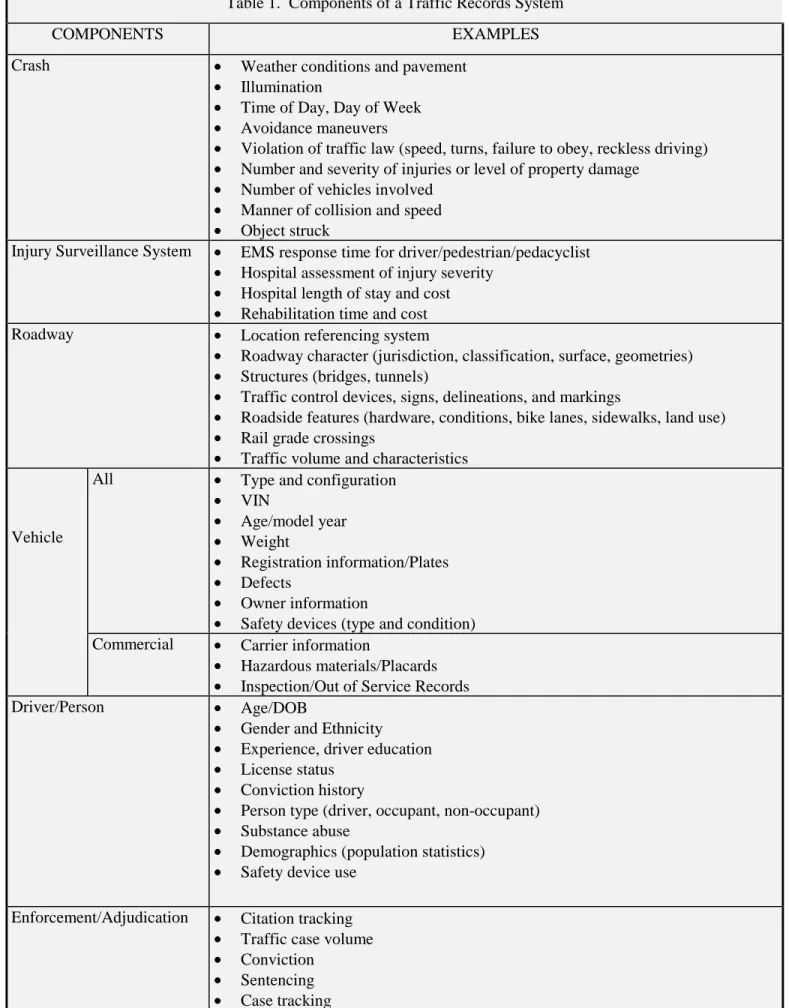
Under this more distributed model, it doesn’t matter whether data for a given system component are housed in a single file on a single computer or spread throughout the state on multiple local systems. What matters is whether or not the information is available to users, in a form they can use, and that this information is of sufficient quality to support its intended uses. Thus it is important to look at information sources. These information sources have been grouped to form the following major components of a traffic records system (see also Table 1):
! Crash Information
! Roadway Information
! Vehicle Information
! Driver/Person Information
! Enforcement/Adjudication Information
! Injury Surveillance Information
Together, these components should provide information about places, property, and people involved in crashes and about the factors that may have contributed to the events described in the traffic records system. The system should also contain information that may be used in judging the relative magnitude of problems identified through analysis of data in the traffic records system. This should include demographic data (social statistics about the general
population such as geographic area of residence, age, gender, ethnicity, etc.) to control for differences in exposure (normalization) and cost data for benefit/cost and cost effectiveness determinations. Performance level data should be included to support countermeasure management.
Figure 1: Model of Distributed Data Processing in a Traffic Records System
Enforcement/ Adjudication Information Driver License History Driver History Driver/Person Information Convictions, Dispositions Crashes, Operator Reports Crash Information Injury Surveillance Information Vehicles, Titles, Registrations Titles, Registrations, Inspections Driver HistoryEMS Run Reports, Trauma Data, Discharge Summaries, Rehabilitation Vital Statistics, Cost Data VIN, Tag, Owner Roadway Information Traffic, Pavement Condition, Inventory, Ratings
Reports Characteristics,Road
Location, Structures Crash Characteristics Citations, Arrests EMS Response, BAC, Drug, Death
Information Analysis, Reports Reports Crash Characteristics Roadway and Traffic Data Inspections, Carrier Data Vehicle Information 13
Table 1. Components of a Traffic Records System
COMPONENTS EXAMPLES
Crash • Weather conditions and pavement
• Illumination
• Time of Day, Day of Week
• Avoidance maneuvers
• Violation of traffic law (speed, turns, failure to obey, reckless driving)
• Number and severity of injuries or level of property damage
• Number of vehicles involved
• Manner of collision and speed
• Object struck
Injury Surveillance System • EMS response time for driver/pedestrian/pedacyclist
• Hospital assessment of injury severity
• Hospital length of stay and cost
• Rehabilitation time and cost Roadway • Location referencing system
• Roadway character (jurisdiction, classification, surface, geometries)
• Structures (bridges, tunnels)
• Traffic control devices, signs, delineations, and markings
• Roadside features (hardware, conditions, bike lanes, sidewalks, land use)
• Rail grade crossings
• Traffic volume and characteristics
Vehicle
All • Type and configuration
• VIN
• Age/model year
• Weight
• Registration information/Plates
• Defects
• Owner information
• Safety devices (type and condition) Commercial • Carrier information
• Hazardous materials/Placards
• Inspection/Out of Service Records Driver/Person • Age/DOB
• Gender and Ethnicity
• Experience, driver education
• License status
• Conviction history
• Person type (driver, occupant, non-occupant)
• Substance abuse
• Demographics (population statistics)
• Safety device use Enforcement/Adjudication • Citation tracking
Section 1-A: Crash Information Advisory
The Crash Component documents the time, location, environment, and characteristics (sequence of events, rollover, etc.) of a crash. Through links to the crash-involved segments of Roadway, Vehicle, and Driver Information, the Crash Component identifies the roadways, vehicles, and people involved in the crash and documents the consequences of the crash (fatalities, injuries, property damage, and violations charged). In addition to providing information on a particular crash, the Crash Component supports analysis of crashes in general and crashes within specific categories defined by: person characteristics (e.g., age or gender), location characteristics (e.g., roadway type or specific intersections), vehicle characteristics (e.g., condition and legal status), and the interaction of various components (e.g., time of day, day of week, weather, driver actions, pedestrian actions, etc.).
The Crash Component of the Traffic Records System should contain some basic information about every reportable motor vehicle crash on any public roadway in the state. Details of various data elements to be collected are described in a number of publications. The Model Minimum Uniform Crash Criteria (MMUCC) provides a guideline for a suggested minimum to be collected for each crash. Additional information should be collected (as necessary) for crashes involving an injury or fatality to meet the requirements for tracking and analysis for the state and other systems (e.g., the Fatality Analysis and Reporting System [FARS]).
Status
The Delaware Uniform Traffic Collision Report (Form 438, Rev 1/88) is used statewide by law enforcement officers to collect information on crashes. The report form includes fields for coding information on the time, location, environment and characteristics of crashes. Data describing the vehicles and drivers involved in crashes are collected on all crashes. Information is collected on injured persons involved in the crash using a separate form – the Delaware
Uniform Traffic Collision Report: Injury Information report (Form 439, Rev. 10/87). Additional information on trucks and buses involved in crashes is recorded on the Delaware State Police Commercial Vehicle Accident Supplement (Form 438A, Rev. 11/96).
The Delaware Motor Vehicle Law, chapter 42 describes the requirements for reporting crashes. Drivers involved in crashes are required (section 4203) to immediately report the crash to the jurisdictionally responsible police agency. That agency, in turn, must complete a crash report form for all reportable crashes in their jurisdiction. When a crash occurs in Delaware, the responding agency (Delaware State Police, County or Municipal Police Department) has 10 days to forward the completed crash report (including any injury and Commercial Motor Vehicle – CMV – supplemental forms) to the Delaware State Police (DSP) Traffic Unit for data entry. Most agencies in the state have a policy of completing a crash report even if the crash does not meet the state’s reporting threshold (currently set at a minimum of $1400 in property damage, or any crash involving an injury or fatality). These non-reportable crashes, including hit-and-run cases, are routinely sent to DSP along with all reports of above-threshold, reportable crashes.
The current crash report is not considered MMUCC compliant. A 1997 effort to develop a new data dictionary included a review of MMUCC variables in order to increase the level of
compliance at a future date when the crash report form is revised. The data dictionary
subsequently became part of the State’s plan for a redesigned crash data collection and reporting system. The details of this system are discussed in more detail at the end of this section. There are several key data elements that are not captured on the current crash report form. In particular, the state does not have a good way of coding crash dynamics such as Harmful Events at the crash level and Sequence of Events for each vehicle. This information is gleaned from the narrative, diagram, and to a lesser extent from a series of circle-and-arrow diagrams on the first page of the form. Most other data elements on the form are similar to nationally recommended data
definitions such as MMUCC or ANSI D-16. Three key data elements (Hit & Run, Construction Zone, and Rail Bridge) were mistakenly dropped from the report form in the 1988 revision and are gathered instead by the responding officer making a manual notation on the header of the form.
Once a crash report arrives at DSP, it is reviewed by data entry staff, assigned a DSP crash report number, and keyed into the Department’s statewide crash file. This is the official crash file for the state. Even non-reportable crashes are entered into the DSP crash file, although only minimal information is input (location, time, date and crash report number, for example). The crash file is an ADABAS application resident on a mainframe in the DSP Traffic Unit. Data entry includes both manual and automated edit checks designed to ensure high quality data. If the data entry clerks discover an error, they will either correct it, send the report back to the officer (in the case of DSP reports) or make note of the problem encountered for later follow-up with the issuing agency if the error occurs frequently (DSP and other agencies). There is no provision for follow-up to correct errors on individual crash reports from agencies other than DSP. There is no appreciable data entry backlog; the norm is 10-15 days to complete data entry once the reports arrive at DSP.
Not all information on the crash report form (and the injury supplement) is entered by DSP into the crash file. Vehicle area of damage and vehicle registration numbers are examples of fields which are collected on the form, but not entered into the crash file. For the three hand-written data elements (Hit & Run, Construction Zone, and Rail Bridge), data entry clerks review the crash to ensure that the notation should be there, and add it if the officer failed to do so. Despite not having a specific field on the form to record these data elements, the DSP data managers and analysts felt that they were collecting good data regarding both construction zone crashes and hit & run crashes. Delaware Department of Transportation (DelDOT) staff reported that the hand-annotations are often missing from the form for rail bridge and construction zone crashes. In the case of hit & run crashes, the report form would almost certainly contain other evidence such as a vehicle section with missing data indicators (e.g., “UNK”). In the case of crashes in a
construction zone or at a rail bridge, it is likely that there is no way to tell how many crashes are missing the annotation.
the driver of one of the involved vehicles. If the crash involves injury to a pedestrian or
pedalcyclist, the information for those individuals is entered on the injury report including BAC data if collected.
In the event of a fatality, law enforcement agencies in the state complete a short form as part of the Fatal Accident Mailing System (FAMS). The forms are sent to the DSP FARS analyst via teletype, fax, or e-mail. The information is entered into the FAMS database where it is available for reporting purposes. Standard reports provide data on YTD comparisons to the previous year’s fatal crash experience. Roadside signs (Fatal Boards) are used to display this information to the public. All fatal crashes are investigated by trained crash reconstructionists.
Following initial data entry at DSP, a copy of each paper report is forwarded to DelDOT.
DelDOT staff manually adds location codes (milepoints) to the crash report forms, then manually enters 33 data fields into their own crash data file residing on a DEC VAX system. Only
reportable, above-threshold crashes are entered in the DelDOT system.
Following data entry at DSP, report forms are copied to microfiche and ultimately stored in the State’s archive. Once the microfiche is delivered to the archive, the original paper reports are destroyed.
There is a separate process for data entry of commercial vehicle information collected on the CMV supplement form. This form does not go through data entry in the DSP Traffic Unit which handles the main crash report. The information is not stored in the main crash file. Instead, the supplement form is forwarded to the DSP Motor Carrier unit (the Motor Carrier Safety
Assistance Program (MCSAP) agency for the State) where data are entered into the Motor Carrier Management Information System (MCMIS) via SafetyNet. There is no linkage or automated data sharing between the main crash file and the MCMIS/SafetyNet database.
The crash file at DSP does not contain automated links to any other traffic records data sources. A recently implemented Crash Outcome Data Evaluation System (CODES) project is testing probabilistic linkages to EMS run report data using victim/patient name, location, date and time as linking variables. The initial test of this linkage method in Delaware resulted in a very low match – eight percent of records matched between the two files. According to the NHTSA CODES program manager, this result is not unexpected and may reflect either the low percentage of injured parties who are hospitalized in the first place (if in fact the match was attempted against hospital discharge data as opposed to EMS run data) and may also be a reflection of the typical start up experience of new CODES states. Regardless of the reasons, it is anticipated that Delaware will eventually be able to perform probabilistic matches between EMS, hospital and crash records using the CODES methodology.
From the DelDOT crash file, it is possible to link crash information to all other roadway files which are indexed by the same milepoint system. This includes the Roadway Inventory and Traffic Volume files maintained at DelDOT. In addition, the crash file information is uploaded monthly to the DelDOT Geographic Information System (GIS) for mapping and other geographic analysis. There are no other existing links between the crash file and other sources of data useful
for analysis of the crash experience in the State. The milepoint location coding method applies to state-maintained roads only. This includes most of the roadways in the State, but excludes city and private roads. Crashes off the State-maintained system are entered into the DelDOT crash system, but no milepoint codes are added to the record for these crashes. There is no roadway Inventory or traffic data for local roads in the DelDOT systems either.
DSP plans to replace the current crash report form with an automated version that will be shared with all police agencies in the state. The primary goal is to move to completely automated field data collection with electronic data transfer to a new DSP central crash file. The new crash file will most likely be a client-server application with a standardized query tool. Since the RFP has not been finalized at the time of this report, it is not possible to fully describe the intended system design or functionality. The DSP staff member in charge of the new design effort has held preliminary meetings with various stakeholders in the state (most notably personnel throughout DSP and in DelDOT’s planning and data management areas). There is, as yet, no formal process for review of the draft RFP, the system design, or to assist in the application development
process. The State’s Traffic Records Coordinating Committee (TRCC) has discussed the project, but does not have any oversight or assistance role in the process, which is being managed by DSP alone. Several agencies in the state expressed interest in participating in various aspects of the system design, including reviews of the draft RFP, vendor selection, Joint Application
Development (JAD) sessions and/or user-centered design sessions. It is not clear how much outside input will be sought by DSP, in part because they are seeking to use commercial off-the-shelf (COTS) products where possible and thus may not need assistance in designing or
developing at least some aspects of the new application.
The new system will include a new paper report form in order to accommodate agencies in the near term who fail to automate the field data collection of crashes. This will be phased out as soon as possible, the goal being that all agencies will submit reports electronically to DSP using the state-approved software.
Recommendations
! Revise the crash report form and finalize in paper format now. Implement the recommended data dictionary as developed in the 1997 review.
! Develop a formal, written process for the specification, design and development of the new automated crash report system.
! Assign the TRCC the oversight and coordination responsibility for monitoring this process in the development of the new crash report system.
! Expand the TRCC to be more inclusive of all stakeholder agencies.
! Include the CMV supplemental data within the new crash system and use that as the data source for electronic downloads of information to MCMIS/SafetyNet.
! Develop linkages to DMV driver and vehicle files from the new crash file for support of data entry in the field, improved quality, and data analysis.
Section 1-B: Roadway Information Advisory
Roadway information includes roadway location, identification, and classification, as well as a description of a road’s total physical characteristics and usage which are tied to a location reference system. Linked safety and roadway information are valuable components in support of a state’s construction and maintenance program development.
Roadway information should be available for all public roads in the state whether under state or local jurisdiction. A location reference system should be used to link the various components of roadway information as well as other information sources (e.g., Crash/Environment information, EMS records) for analytical purposes.
Status
The DelDOT is responsible for 3,883 miles of the state’s 5,730 miles of public roads, 321 miles of which are on the National Highway System. The Traffic Statistical Unit of the Delaware State Police creates the repository of all reported crashes that occur in the state and provide copies of all crash reports to DelDOT. The Planning Division of DelDOT creates and manages the crash database for all Department functions requiring crash data.
Crashes are located by county road number/milepoint for the state maintained system. Crashes that occur on municipal streets are located by county/town/subdivision and street(s). The DelDOT Bureau of Traffic maintains records of traffic volume data that are regularly updated using permanent recorders.
An inventory of roadway elements such as pavement type and width, shoulder type and width, bridge, railroad and intersection locations, highway type and classification is maintained by the Office of Planning.
The major safety program supported by the road and crash data systems is the Highway Safety Improvement Program (HSIP). The following reports are produced for analysis for development of the HSIP:
• General Accident Reports - A listing of all crashes by location including county, maintenance road number, direction of traffic and milepoint.
• Hazardous Spot locations - This report provides a listing of hazardous locations which are presented in descending order of Critical Rate ratios. These ratios are derived by using a statistical test to determine whether the crash rate at a particular location is significantly higher than a predetermined average rate for locations with similar characteristics.
• Road Study Report - Crash statistics of road sections under investigation by DelDOT personnel.1
No single organizational unit within DelDOT is responsible for coordinating and maintaining the various road inventory, traffic, geometric, crash and location reference files. Because of the fragmented approach to the maintenance of the various DelDOT road and safety files, there is no clear responsibility for the coordination and integration of files for program development and management.
The Department maintains several GIS systems. There is an ongoing effort to develop one Department-wide GIS for all file use.
Access to data from the various files requires contacting an individual in the section maintaining the particular file. This is a cumbersome process.
There are two Metropolitan Planning Organizations (MPO) in Delaware, Wilmington Area Planning Council and the Dover/Kent County MPO. These organizations rely solely on DelDOT for data and studies to determine the Transportation Improvement Program projects within their jurisdictions. While they find this process convenient and effective, they believe response for data relating to other MPO studies can be improved. They also believe a standard format for information request by the MPOs would help expedite requests and reduce response times. The Delaware State Police are embarking on a major revision of the state’s crash record system. DelDOT’s role in this effort has not been formalized.
Recommendations
! Establish a coordinating and integration function for roadway geometry, characteristics, traffic, hardware, signs, and crash files maintained by DelDOT.
! Establish a department-wide GIS for all DelDOT data files.
! Develop electronic, user-friendly access to all department files for authorized department personnel, as well as government partners of DelDOT (e.g. other state departments, MPO’s, local government officials) who are responsible for highway safety on the state’s streets and highways. Install the security functions necessary to prevent abuse of federal and state statutes and department policy regarding the requested information.
! Insure that DelDOT personnel who play a key role in the use of crash information, take an active role in the development of the new crash system.
1 Annual Evaluation Report Highway Safety Improvement Program, federal fiscal year 2000, Department of
Section 1-C: Vehicle Information Advisory
Vehicle information includes information on the identification and ownership of vehicles registered in the state. Data should be available regarding vehicle make, model, model year, body type, and miles traveled in order to produce the information needed to support analysis of vehicle-related factors which may contribute to a state’s crash experience. Such analyses would be necessarily restricted to crashes involving in-state registered vehicles only.
This information should also be available for commercial vehicles and carriers which may be registered in other states, but which are licensed to use the public roadways in the state.
Status
The Division of Motor Vehicles (DMV) maintains the vehicle registration and title file which covered 675,640 registered vehicles in 1999. The scope of information on all vehicles, private and commercial, exceeds the recommendations of the Advisory and is fully consistent with the standards of the American Association of Motor Vehicle Administrators Telecommunications Network (AAMVAnet).
Beyond maintaining the information necessary for the vehicle registration and title functions, the information from the file supports inquiries on individual records from law enforcement, the OHS, and supporting data as required for the crash reporting system, most notably the FARS system. A variety of summary reports are made upon request through ad hoc statistical queries. Standard summaries are not routinely produced for distribution outside of DMV.
The vehicle file has links with the driver file (Driver Name, Date of Birth, and Driver License Number) which enables associations of the driver/owner data as applicable (for private
ownership). Thus registration (tag) numbers may be retrieved in connection with a driver/owner query or vice versa.
Registrations are currently renewed on a bi-monthly basis (24 cycles per year), but the processing capability for daily renewals is a present capability not yet implemented.
Odometer readings are captured with registration renewals, and three titling actions: Add Title, Correct Title, Transfer Title. Up to ten odometer readings are retained in the file if applicable. Temporary registration and stolen vehicle reports are updated online. The DMV anticipates implementing the National Motor Vehicle Title Information System (NMVTIS) in 2001 which will feature acquisition of electronic Manufacturer’s Statement of Origin data on new vehicles and the perpetuation of the vehicle descriptive data with previous title information on vehicles being re-titled, including those of other states which have implemented NMVTIS. Thus the data quality and timeliness of vehicle data will be improved.
Within the constraints of the state’s Privacy Protection Act (PPA), the vehicle file serves a wide variety of users. Those include:
• Law enforcement
• Insurance companies
• Legal representatives
• Other jurisdictions
• Banks
• R. L. Polk (processing vehicle recall information)
• Universities, and
• Legislature
Biennial (2-year cycle) safety and emissions inspections are required in Delaware through state inspection stations. The information is maintained on the inspections in the master vehicle record.
Vehicle salvage information is obtained from insurance companies and salvage yards, and title brand information is applied to the title immediately. Title brands are reflected in the usage code and include the following conditions: Reconstructed, Previous Taxi, Flood Damaged, and
Salvaged. The usage codes also include indicators for New vs. Transferred-Used and Antique and Disabled Veteran notations. Inasmuch as the Usage Code is a single alpha digit, the non-exclusive code set reflects a hierarchy that is applied to any given vehicle. Brand indicators are not standardized nationwide, and there might be situations in which multiple brands would be meaningful.
Plans anticipate implementing a 2-D bar code on registration and title documents which will contain the following data elements:
• Current odometer reading
• Mileage disclosure statement
• Title status (administration action: duplicate; title brand)
• Title and registration number (the same number in Delaware)
• Expiration date
• Title issue date
• Vehicle Make
• Vehicle Model
• Vehicle Body Style
• Vehicle Identification Number
• Registered weight
• Yearly fee
• Usage
• Owner name
• Owner address (street, city, state, and zip code)
Identification and descriptive information for vehicles is acquired when the Delaware Justice Information System (DELJIS) creates a record when entering citation data. The initialization of a record in DELJIS consists, in part, of entering the registration (tag) number for a vehicle
registered in Delaware. The DMV record is accessed online to populate the DELJIS record with that part of the DMV record needed for the citation entry. DELJIS also has a need for vehicle characteristics, such as color of vehicle, which is not readily available.
DMV is in process of supporting the consequences of failure to pay child support. DELJIS initiates the process by which Child Welfare is notified, and they in turn notify the DMV where the suspension process is executed.
The DMV has advanced processing capabilities and options for file linkage with virtually all applicable components of a comprehensive, integrated traffic records system. Accordingly, DMV can provide both leadership and a unique, valuable perspective in new strategic planning processes particularly in the area of user interfaces. This applies especially to the emerging crash data system of the Delaware State Police.
Recommendations
! Insure that DMV participates fully in the Traffic Records Coordinating Committee.
! Examine whether the Usage Code in the current system has indicators which might be more useful if separated into two discreet sets of indicators: Usage and Title Brand(s).
Section 1-D: Driver Information Advisory
Driver information includes information about the state's population of licensed drivers. It should include: personal identification, driver license number, type of license, license status, driver restrictions, convictions for traffic violations, crash history, driver improvement or control actions, and driver education data.
Driver information should also be maintained to accommodate information obtained through interaction with the National Driver Register (NDR) and the Commercial Driver License Information System (CDLIS) to enable the state to maintain complete driving histories and to prevent drivers from circumventing driver control actions and obtaining multiple licenses.
Status
The Motor Vehicle Division maintains the driver file which recorded 548,322 licensed drivers in 1999. The driver file contains driver history, driver identification, and driver control
information. The driver and vehicle files are linked.
The interface between the driver file and the DELJIS data system parallels that which is described for the vehicle. Identification and basic characteristics information for drivers is acquired on licensed Delaware drivers when the DELJIS data system creates a record when entering citation data. The initialization of a record in DELJIS consists, in part, of entering the driver license number. The driver record is accessed online to populate the DELJIS record. DMV is in process of supporting the consequences of failure to pay child support. DELJIS initiates the process by which Child Welfare is notified, and they in turn notify the DMV where the license suspension process is executed.
A graduated license law was implemented in July 2000 for a Level 1 Learner’s Permit and Class D Operator’s License for persons under age 18.
Delaware participates in the Driver License Compact which enables recording data from the previous license state, but information is only retained for commercial operators in a hold file in compliance with the requirements of CDLIS. Information is not retained for all other drivers. Delaware participates fully in the Problem Driver Pointer System (maintained by NHTSA). Identification of the source of driver education (school or program) is maintained but not the performance or grade for the course.
All conviction data are entered directly into the driver history record via electronic transmission from the criminal justice data system, DELJIS, generally within 24 hours of the action.
Information on cited violations is not maintained if a conviction does not result, nor is the original charge contained if the conviction is for a different (lesser) charge. Administrative
suspensions for DUI arrests are recorded. BAC information is entered if available. Suspensions and revocations resulting from convictions are dated 14 days forward from the notification to the affected driver, providing sufficient time for receipt of the notice and for appeal.
The driver data are structured to meet most of the recommendations of the Advisory and the functional requirements of AAMVAnet. The exception is the lack of information on all crash involvements. Crash information is not posted to a driver file unless a conviction was
adjudicated in connection with the crash involvement.
Within the constraints of the state’s Privacy Protection Act (PPA), the driver file serves a wide variety of users. Those include:
• Courts
• Law enforcement
• Insurance companies
• Legal representatives
• Other jurisdictions
• Universities
• Motor voter requirements, and
• Legislature
As with the vehicle file, plans anticipate applying a 2-D bar code to each driver license and driver identification card. The following data elements would be included:
• Driver License or Identification Card Number
• Applicant name
• Applicant address
• Date of birth
• Sex
• Applicant eye color
• Height
• Weight
• Class of license
• Issue date
• Expiration date
• Restrictions
• Endorsements
• Duplicate indicator
• Sex offender indicator
A hope of the DMV is the eventual implementation of an All Driver Pointer System which would operate approximately in parallel to the CDLIS. That implementation would supercede the Problem Driver Pointer System.
In addition to the information available for regular driver licensing and driver control functions, a confidential Medical Advisory Board (medical information) data section is maintained where a driver’s medical condition dictates the need for the information and conditions or restrictions are set, if needed. Access is restricted to a few individuals within the DMV.
If a posting error occurs, DMV corrects the entry process by a required match on the driver license number, the first five characters of the surname, and the date of birth.
Recommendations
! Participate fully in the recently formed Traffic Records Coordinating Committee.
! Include crash involvements on the driver history record for all crash-involved drivers.
! Maintain records of convictions for serious offenses, e.g., DUI convictions, when received from a previous licensing state.
Section 1-E: Enforcement/Adjudication Information Advisory
Information should be available which identifies arrest and conviction activity of the state, including information which tracks a citation from the time of its distribution to an enforcement jurisdiction, through its issuance to an offender, and its disposition by a court. Information should be available to identify the type of violation, location, date and time, the enforcement agency, court of jurisdiction, and final disposition. Similar information for warnings and other motor vehicle incidents that would reflect enforcement activity are also useful for highway safety purposes.
This information is useful in determining level of enforcement activity in the state, accounting and control of citation forms, and monitoring of court activity regarding the disposition of traffic cases.
Status
Delaware has a state approved uniform traffic citation for use by all law enforcement agencies. All citations are numbered and have prefixes that identify the law enforcement agency to which they were issued. It is the responsibility of the individual law enforcement agencies to track the citations through their departments. The DSP has plans to create and implement an electronic citation. It was reported that two departments (New Castle County Police and Wilmington Police Department) have not ordered uniform citations for some time and possibly were not using the approved citation.
In 1982, an executive level group with criminal justice interests designed the concept of the Criminal Justice Information System (CJIS), which, among other things, records the citation from its issuance to a traffic violator through final disposition. CJIS is commonly called DELJIS (Delaware Criminal Justice Information System), although DELJIS is actually the department that manages the CJIS. The Board of Managers, an executive level board, exercises oversight over DELJIS.
All written citations are forwarded to the Voluntary Assessment Center (VAC) in Dover or one of the eight Alderman Courts. Alderman Courts (municipal courts) are required to enter all of their citations into DELJIS but it was reported that this does not happen all of the time. All citations sent to VAC are entered into DELJIS for tracking through the system. If the fines for the citations sent to the VAC are not paid a warrant is issued for the defendant and their driver’s license is suspended. Final adjudications from the Magistrate and Alderman Courts are entered into DELJIS and convictions are forwarded electronically to the driver file. The driver history also electronically updates DELJIS with driver actions.
Magistrate Court electronically but does not act on them until they receive the hard copy of the citation. At the Court of Common Pleas the case is entered into the Judicial Information Center, maintained by the Administrative Office of the Courts, where it is tracked through the court. Upon adjudication the disposition is forwarded to DELJIS electronically from the Judicial Information Center. Convictions from the Court of Common Pleas forwarded to DELJIS are electronically forwarded automatically to the driver file.
The DELJIS file contains information to identify the original charge, final disposition, enforcement agency, date of occurrence, time of occurrence, location of occurrence, police agency, adjudicating agency, etc. This information is available on regular reports as well as ad-hoc reports. Data in the file are adequate for law enforcement to monitor countermeasures to insure they are being effective.
DSP is currently entering data to the DELJIS file for their own uses. There are concerns about the amount of time it takes to get ad-hoc reports from DELJIS. However, DELJIS is very
agreeable to allowing other agencies access to their data if that agency can demonstrate sufficient programming skills in the access language. DELJIS developed a traffic citation tracking system that has not been used. It is unfortunate that some law enforcement agencies do not realize DELJIS facilities and outputs could be used by and be beneficial for them.
Recommendations
! Continue with complete development of an electronic citation and implement it statewide, insuring compatibility with DELJIS.
! Require all law enforcement to use the approved uniform traffic citation.
! Formalize a statewide citation tracking system with the capability to monitor a citation from its printing and distribution through issuance to final disposition, using DELJIS design and management.
! Expand the availability of DELJIS data to authorized users.
! Exploit the linkage between the DELJIS file and the crash file to allow a comparison between crashes and enforcement countermeasure activity.
! Promote increased law enforcement use of the full capabilities of DELJIS for citation tracking, capture of additional data fields, and analysis/reporting.
Section 1-F: Injury Surveillance System Information Advisory
With the growing interest in injury control programs within the traffic safety, public health, and enforcement communities, there are a number of local, state, and federal initiatives which drive the development of Injury Surveillance Systems (ISS). These systems typically incorporate pre-hospital (EMS), emergency department (ED), pre-hospital admission/discharge, trauma registry, and long term rehabilitation databases to track injury causes, magnitude, costs, and outcomes. Often, these systems rely upon other components of the traffic records system to provide information on injury mechanisms or events (e.g., traffic crash reports).
This system should allow the documentation of information which tracks magnitude, severity, and types of injuries sustained by persons in motor-vehicle related crashes. Although traffic crashes cause only a portion of the injuries within any population, they often represent one of the more significant causes of injuries in terms of frequency and cost to the community. The ISS should support integration of the ISS data with police reported traffic crashes. The EMS run reports and roadway attributes are first critical steps in the identification of a community’s injury problem, and in turn, the identification of cost-effective countermeasures which can positively impact both the traffic safety and health communities.
The use of these data should be supported through the provision of technical resources to analyze and interpret these data in terms of both the traditional traffic safety data relationships and the specific data relationships unique to the health care community. In turn, the use of the ISS should be integrated into the injury control programs within traffic safety, and other safety-related programs at the state and local levels.
Status
The Delaware Department of Health and Social Services, Office of Emergency Medical Services (OEMS) and the Delaware State Fire Prevention Commission share responsibilities for
Emergency Medical Services (EMS) in Delaware. The State Fire Prevention Commission is responsible for Basic Life Support (BLS) and ambulances, while the OEMS is responsible for Advanced Life Support (ALS) as well as other functions.
There are between 150 and 175 ambulances in Delaware, 61 BLS providers and 4 ALS providers responding to over 60,000 calls a year. The four ALS providers include one ALS provider for each of Delaware’s three counties and the Delaware State Police Medivac helicopters. There are 200 EMT-Paramedics serving the 4 ALS providers. Sixty percent of the funding for the four ALS programs is provided annually by the state through grants. ALS programs do not provide ambulance transportation but function in quick response vehicles under a tiered response. If ALS care is needed in route to the hospital the paramedic will ride with the patient in the BLS
There are approximately 1,500 BLS personnel serving as either First Responders or EMT-basics. Volunteers, generally from the fire service, provide most of the BLS service but there is at least one private BLS provider. EMS is dispatched through one of seven Emergency Medical Dispatch (EMD) Centers in the state. Emergency Medical dispatchers are trained and provide pre-arrival instructions as well as determining the level of response, BLS or ALS, required for each call.
Eight hospitals are located within Delaware. All serve as trauma centers with one being
designated as a level I trauma center and four centers serving as level III trauma centers utilizing the American College of Surgeons (ACS) verification. The remaining three hospitals are state verified level IV trauma centers. All hospitals participate in the state trauma registry and collect data for the trauma registry using Cales and Associates software and utilize ICD-9 codes and Injury Severity Scales. The trauma registry data represents about five percent of the Emergency Department population in the state.
There is no statewide Injury Surveillance System (ISS) in place but one is currently under development in conjunction with the Centers for Disease Control (CDC). This process began in October of 2000 and calls for a three phased approach. The first phase is development of the foundation for a statewide ISS. Phase two calls for surveillance of severe injuries and phase three would expand surveillance to other injuries. The OEMS Injury Prevention Coordinator and an injury Epidemiologist will administer the ISS program. The ISS plan calls for eleven core data areas including vital records, hospital discharge data, Fatality Analysis Reporting System (FARS), Behavioral Risk Factor Surveillance System, Youth Risk Behavior Surveillance System, emergency department data, medical examiner data, child death review, national occupant
protection use survey, Uniform Crime Reporting (UCR) system, and emergency medical
services. The core data currently does not include hospital admission data or long term care data. The OEMS has created The Delaware Coalition for Injury Prevention (DCIP) Committee to help oversee the development of the state ISS program. There are 14 members on the Coalition executive committee including the state medical director, emergency physicians, state medical examiner, Fire Commissioner, Chief of Police, Director of Highway Safety, Consumer Protection Safety Council, Legislative and other stake holders. The Coalition does not appear to have any authority or mandate from high-level policy makers within state government.
The OEMS has developed a statewide-computerized patient care report system. The EMS Data Information Network (EDIN) is Internet based and allows local providers to access and
manipulate their data. The state has contracted to provide training to providers in EDIN
beginning in January of 2001. Two of the four ALS providers are already utilizing EDIN and the remaining two ALS providers are expected to begin using EDIN in January of 2001. EDIN is mandated for all ALS providers but not for BLS providers. A subset of data points from EDIN has been used to develop a shorter BLS run report and a memorandum of understanding has been signed between the OEMS and the State Fire Prevention Commission to encourage BLS
providers to utilize EDIN. While EDIN has over 100 data points it was developed using the NHTSA Uniform Prehospital Data Set.
Delaware is in the process of implementing the Crash Outcome Data Evaluation System (CODES). The OEMS has identified several common identifiers to link with highway safety data including name, social security number, date of birth, patient address and incident location. An initial attempt to link EMS data with highway crash data resulted in an eight percent linkage. It is anticipated that as the CODES project advances the match will improve substantially.
Recommendations
! Fully implement the CODES project to improve data linkage with highway safety databases.
! Complete implementation of the EDIN system for both ALS and BLS providers.
! Continue implementation of the statewide Injury Surveillance System.
! Expand the DCIP to include other appropriate stakeholders such as Safe Communities, MADD, local EMS, etc.
! Obtain commitment and policy level support for the DCIP from the Department of Health and Social Services.
! Provide a mechanism to allow the DCIP and the TRCC to work cooperatively to provide effective integration and linking of all appropriate data.
! Provide a mechanism to allow the DCIP and TRCC to work cooperatively to educate public officials and decision-makers in the various state, county, and local agencies on the value of data linkage to the highway safety community, injury prevention community, and the general public.
Section 1-G: Other Information Advisory
The Traffic Records System should acknowledge the importance of, and incorporate where feasible, other types of information from the state and local level which will be useful in the identification of traffic safety problems and the evaluation of countermeasures. These supporting components may include:
! Geographic Information System (GIS) and Global Positioning System (GPS) data. ! Insurance data (carrier, policy number, expiration date, claims cost).
! Safety Program Evaluation data.
! Data specifically required by state or Federal programs (e.g. the Transportation Equity Act for the 21st Century (TEA-21).
! Demographic data (data on the state's population including gender, age, rural/urban residence, ethnicity) sufficient to be used in normalizing crash data to the state's general population.
! Behavioral data (e.g., occupant protection, speeding).
! Attitude/perception/knowledge data (e.g., telephone surveys, focus groups). ! Economic loss data (e.g., medical, insurance cost, workers’ compensation, lost
productivity).
! Human factors data (e.g., inattention, task workload, life cycle changes).
! Inventory - Each state should have in place procedures that result in the compilation of an inventory of state and local information sources. This inventory should include information on the source, ownership (contact agency/person), quality, and availability of these data from each information source.
! Performance data - Performance level data, as part of a traffic records system, are those measures relating to an ongoing or proposed countermeasure that addresses a crash problem. They can include number and types of citations and convictions, number or percent of drivers and occupants using occupant protection, average Blood Alcohol Concentration (BAC) levels, average speeds, percent of injured receiving EMS response, recidivism rates for past offenders/crash-involved drivers, highway countermeasures (e.g., breakaway signs) etc.
! Cost data - Cost data consist of dollar amounts spent on countermeasure programs, together with the costs of fatalities, injuries, and property damage crashes. The National Highway Traffic Safety Administration (NHTSA), the National Safety Council (NSC), and other national and state agencies have published cost data for use by the states. NHTSA has also made easy-to-use cost modeling software available. In addition, specific local costs can be accumulated through injury surveillance systems or other means of
collecting treatment costs and outcomes.
Status
The Delaware traffic records system includes a variety of data sources which are used to help identify traffic safety improvement opportunities and to describe the state’s crash experience. There is, however, no easy way for potential users to identify sources of traffic records
information that they may be unfamiliar with.
DelDOT is attempting to establish an enterprise-wide GIS capable of mapping locations based on milepoint location codes and spatial coordinates (e.g., latitude/longitude). At present, only users on the DelDOT intranet have access to this GIS, and only the databases maintained at DelDOT have sufficient location code information to support mapping or geographic analysis using the GIS.
At DSP, an annual crash facts book is produced using vehicle miles traveled, driver-population demographics, state population and vehicle registrations as normalizing variables. The analyses are performed in-house using the NATURAL language to access the ADABAS crash file. Other users do not have direct access to the files to run queries, so they typically ask either DSP or DelDOT to give them analytic results.
The DELJIS system includes data on most citations issued in Delaware, excluding those filed in some Alderman Courts. It includes original charges, court actions and final dispositions in one file. Through a link to the DMV, DELJIS updates the driver history file automatically with conviction data. The DELJIS system is open to potential users provided they can be approved for access by DELJIS managers, and can demonstrate the necessary NATURAL programming skills. There are several analytic users of the DELJIS system who are outside the agency. A new,
simpler to use query tool (G Product) has opened the system to even more users.
There are no specific files for monitoring the progress or effectiveness of traffic safety programs in the state. To receive a state highway traffic safety grant under any of the various federal grant sources (section 402, 411, 153, etc.), applicants must supply information identifying the problem and projecting the benefits of the proposed program. During the grant period, program managers must collect and report performance monitoring data. Such data can include any measures relevant to the program, including number of citations or crashes, average travel speeds, proportion of vehicle occupants properly restrained, and others.
The Office of Highway Safety coordinates and conducts annual occupant protection surveys in compliance with the NHTSA approved procedures. No other examples of attitudinal or human factor studies were reported.
Economic loss and cost/benefit analyses are used by various agencies in the state to support grant requests, proposals like that for funding of the new crash reporting system, and monitoring the overall crash experience of the state. DSP uses the NSC crash cost estimates to project the annual cost to the state of property damage crashes, injuries and fatalities. With the advent of the state’s CODES project, and potential linkages later on to hospital discharge data, analysts may be able to collect more detailed data on selected cost components.
Recommendations
! Create a statewide Traffic Records System Resource Guide to give users and potential users the information they need on data sources and system capabilities.
! Promote easier access to and use of the crash file information (with appropriate safeguards for confidentiality) for analytic purposes.
! Direct by executive level mandate one enterprise-wide GIS be used for location based highway safety information.
Section 1-H: Data Integration Advisory
Although various information sources may exist separately, these sources should be easily tied together to support analysis and decision making. This integration can eliminate the need to duplicate data, thus reducing data collection, entry, and storage costs. The best example is the link between the Crash and Roadway Information. Information on individual crashes can be correlated to traffic and roadway features to support analysis of locations and traffic patterns and their contribution to the state’s crash experience. To provide for data integration, each physical data file must include appropriate common data elements (also called linking variables or unique identifiers). Information can be passed (shared) between sources as long as one or more data elements are common. States are also encouraged to consider implementing probabilistic linkages of their traffic safety, public health, and medical files to evaluate the magnitude of their traffic injury problem and attendant financial and medical outcomes. The following examples of linking variables are the most commonly used in Traffic Records Systems: ! Crash number
! EMS run report number
! Location coding (latitude/longitude coordinates, linear referencing system, GIS, GPS, mile points)
! Vehicle Identification Number (VIN) or vehicle registration number ! Driver License number
! Social Security Number ! Citation number
Discussions of a Comprehensive Computerized Safety Recordkeeping System (CCSRS), related file linkages, and advantages of linked systems are included in the Transportation Research Board (TRB) publication, Introduction to Comprehensive Computerized Safety Recordkeeping Systems, in the TRB's Study Report of Methods to Improve the Application of State Traffic Records Systems, and the NHTSA technical report, So You Want to Link Your State Data. The studies, and others, present information on general advantages of linking data from several sources and describe the CODES project as a method of probabilistic linkage between information sources.
Status
Members of the Delaware highway safety community and the custodians of various data files such as the DelDOT, DSP, DELJIS and OEMS demonstrated that they understood the benefits of integrating and linking various data files to support data analysis and decision making. It was also clear that many constituents were frustrated with the inability to obtain timely, useful data or their ability to identify what data was available to them from various sources.
with the notable exception of DELJIS, which has a wealth of information and linkage ability. Efforts are underway, notably by DSP, to design a new crash system that has the potential to link various data files. Lack of linkages is attributed to incompatible file formats, inaccessible databases, confidentiality issues, turf, funding and personnel.
Recommendations
! Assign responsibility to the TRCC to oversee integration efforts and eliminate duplicate data entry processes.
! Create a statewide Traffic Records System Resource Guide to give users and potential users the information they need on data sources and system capabilities.
SECTION 2:
INFORMATION QUALITY
BACKGROUND
A state’s traffic records information should be of an acceptable level of quality to be useful and should be maintained in a form that is readily accessible to users throughout the state. The quality of information in a state's traffic records system is determined by the following characteristics:
! Timeliness
! Consistency
! Completeness
! Accuracy
! Accessibility
! Data integration with other information
The definition of each of these attributes and their relative significance may vary for each information area (crash, roadway, etc.). For example, while a high degree of timeliness may be crucial for entry of actions in a driver history database, it may not be as significant for certain roadway related data.