OVERVIEW
Cisco
7600
Optical Services Router
Overview
Service-Enabled IP+Optical Solutions for Service Provider Networks
The Cisco 7600 Optical Services Router delivers optical WAN and MAN networking with a focus on line-rate delivery of high-touch IP services at the edge of service providers networks. Now, service providers can “service enable” their networks at optical speeds, enabling the SP to differentiate their service offerings for
competitive advantage. The Cisco 7600 Optical Services Router is an important component of Cisco's end-to-end IP+Optical offerings, which help service providers break through service and bandwidth barriers to increase revenue and profits.
The rapid growth in demand for Internet connectivity and Internet-enabled applications has led to a rapid increase in the scale and scope of the bandwidth deployed in service provider networks. This widespread availability of bandwidth, coupled with growing industry competition, has placed increased pricing pressure on traditional network transport services. As a result, service providers seek new means of coping with this rapid bandwidth growth, while reducing costs and differentiating themselves from the competition.
Optical networking has recently emerged to deliver efficient scalability during network expansion, while reducing costs and simplifying service provisioning. Most traditional public networking equipment was designed and
optimized for transport of voice traffic, but does not scale easily to meet the high-speed
requirements of modern data transport. Optical networking equipment solves this scalability problem by offering seamless and efficient growth to 10-Gbps interfaces for high-speed data transport. It pushes customer traffic aggregation closer to the network edge, simplifying the equipment deployed in a metropolitan transport network. It also reduces the cost and complexity of long-haul transport by easing the requirement for intermediate signal regeneration.
Over the next few years, service provider success will depend on the ability to take advantage of optical networking technology to speed the creation and delivery of services. Success will also depend on the ability to deliver tiered pricing structures in a competitive marketplace.
Successful service providers, furthermore, will be characterized by delivery of a broad portfolio of unique value-added services over a common optical infrastructure. These value-added service offerings will enable them to enjoy market leadership and differentiation for sustainable competitive advantages.
However, the lack of scalability of the very equipment service providers use to deliver value-added services has prohibited the rapid adoption and growth of next-generation Internet services. To break this stalemate, service providers need intelligent IP routing equipment that can
create and enforce tiered levels of provisioned bandwidth and pricing, and that scales for simultaneous service application for thousands of subscribers.
Software services such as quality of service (QoS), security, traffic shaping, traffic accounting and billing, and Multiprotocol Label Switching (MPLS) are now critical components of the Internet’s evolution. These foundation services in turn enable higher-level service creation, such as voice and video over IP, e-commerce, and application hosting.
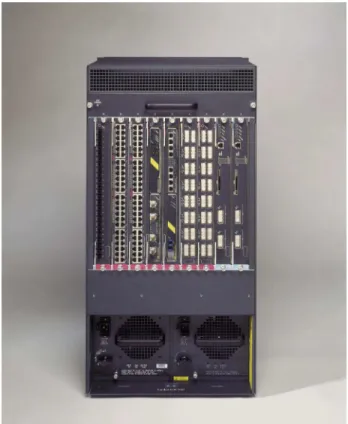
Cisco Systems now offers a revolutionary product family—the Cisco 7600 Optical Services Router (OSR)—which combines optical networking with IP service delivery (Figure 1). The product family combines direct optical connectivity over a range of
high-performance interfaces with a broad range of intelligent IP services to turbocharge service provider networks. The OSR is designed to enable linear scalability in performance and IP service application at the service provider’s network edge, where service creation and delivery have the greatest impact upon the entire subscriber base.
Figure 1 Cisco 7600 Optical Services Router
This application of scalable, high-speed IP services is enabled through the use of a unique Cisco processing technology, Parallel Express Forwarding (PXF). PXF is implemented in a new PXF IP Services Processor, which provides parallelized, pipelined IP packet processing with integrated application of high-touch IP services at rates up to 6 million packets per second (Mpps). These IP services processors (typically two) are deployed in a distributed fashion on each of a set of new linecards—Optical Services Modules (OSMs)—for the Cisco 7600 OSR (Figure 2).
Figure 2 Parallel Express Forwarding (PXF) IP Services Processor
These new modules uniquely offer the ability for service providers to scale network bandwidth and performance while offering a wide range of IP services that may be applied without performance degradation. Service providers can deploy this solution in various tiers of a network architecture, allowing network performance and IP service delivery to scale linearly along with customer base growth. Furthermore, the IP services allow for peerless customer intimacy, with services such as QoS,
Column Mem. Column Mem. IM 3 IM Output Mux 7 IM 11 IM Input Demux 15 IM 2 IM 6 IM 10 IM 14 IM 1 IM 5 IM 9 IM 13 IM 0 IM 4 IM Feedback Column Mem. Column Mem. 8 IM 12
security, traffic shaping, and billing offered not only on a per-customer basis, but also in a manner that scales for simultaneous IP service application to thousands of individual customers.
Each PXF IP Services Processor provides 16
microprocessing units capable of processing IP packets simultaneously. Where two PXF processors are deployed on each OSM, IP services may be applied at line rate of up to 32 packets simultaneously per linecard at any point in time. Local packet memory is provided on each OSM processor, delivering more than 200 ms of packet buffering per port, as well as up to 256 MB of
user-configurable memory for local route table storage via Cisco Express Forwarding (CEF).
The true value of the PXF IP Services Processor, however, is in its “adaptive network processing”. Unlike traditional hardware-based solutions, the PXF processor is capable of being upgraded via software for delivery of new IP services—without performance degradation. PXF combines the benefit of rapid software development and deployment with the line-rate performance of hardware processing elements. This unique Cisco developed, and patented IP Services Processor, when combined with the optical connectivity provided by each OSM, provides best-in-class performance with peerless flexibility to uniquely meet the requirement to scale IP service delivery over next-generation optical networks.
Cisco offers a wide range of Optical Services Modules. The modules meet various interface scalability
requirements and allow for line-rate IP service application in several areas within a service provider point of presence (POP). Cisco provides the following OSMs, each of which shares a common set of IP services and provide the same 6 Mpps of distributed service application performance:
Packet over SONET (POS)
• 8-port OC-3c/STM-1c POS with 4ports of Gigabit Ethernet
• 16-port OC-3c/STM-1c POS with 4ports of Gigabit Ethernet
• 2-port OC-12c/STM-4c POS with 4ports of Gigabit Ethernet
• 4-port OC-12c/STM-4c POS with 4ports of Gigabit Ethernet
• 1-port OC-48c/STM-16c POS with 4ports of Gigabit Ethernet
ATM
• 2-port OC-12c/STM-4c ATM with 4ports of Gigabit Ethernet
Gigabit Ethernet
• 4-port Gigabit Ethernet WAN
As noted above, each of the POS and ATM OSMs provide an additional four ports of Gigabit Ethernet to
complement the WAN ports on each linecard. These Gigabit Ethernet ports are not PXF enabled, as are the POS and ATM ports, and thus don’t take advantage of the granular IP services provided by the PXF IP Services Processor. They do, however, provide basic packet buffering and QoS mechanisms, as well as Cisco Gigabit EtherChannel® technology. However, the 4 ports on the Gigabit Ethernet WAN OSM mentioned above are all PXF enabled, and they can be used to provide Gigabit Ethernet in wide area and metropolitan area networks. The major value of these extra Gigabit Ethernet ports is to provide nonblocking 4 Gbps “East-to-West” intra-POP connectivity between OSMs in different chassis, while maximizing “North-to-South” connectivity and port density from the WAN edge to the core. For example, several Cisco 7600 OSRs might be deployed in the access layer of a service provider POP for OC-3 POS customer aggregation, using OC-48 POS trunks for core
connectivity. Each of these access layer routers may be interconnected in a full mesh—perhaps also including a local Web server farm in the POP—using the integrated Gigabit Ethernet ports for nonblocking intra-POP connectivity without sacrificing optical port density. Feature Summary
• Up to two distributed Parallel Express Forwarding (PXF) IP services processors per linecard, delivering wire-speed packet forwarding with no performance degradation for application of IP services. Each PXF IP Services Processing Engine consists of 16
microprocessing units, each equipped with local memory, to deliver a pipelined, parallelized processing
array. At any point in time, each linecard can apply IP services to 32 different packets simultaneously—all at wire-speed for small size packets.
• Wire-speed forwarding performance for distributed IP services, at rates up to 6 Mpps per OSM in both receive and transmit directions simultaneously.
• Programmable software feature sets for “evergreen” IP service delivery. Unlike traditional ASICs, which have feature sets hardcoded in silicon, each PXF engine can be enhanced in the field via easy software upgrades, while retaining the same wire-speed forwarding characteristics.
• Deep packet buffering to maximize TCP Goodput, with advanced traffic management and prioritization schemes to ensure deterministic packet delivery. IP Services Summary
Numerous software features have been microcoded onto the PXF IP Services Processor, taking advantage of the unique architecture of the Cisco 7600 OSR. The processor, therefore, delivers these service-enabled processing capabilities:
• Input and output traffic shaping • QoS—WRR, WRED and CBWFQ • Traffic accounting/billing
• Destination-sensitive services
• Multiprotocol Label Switching (MPLS), (future capability)
These distributed, PXF-accelerated IP services are complemented by centralized application of some specific IP services such as security access control lists (ACLs), which provide the ability to deliver line-rate packet filtering at rates up to 30 Mpps.
Optical Services Routing Architecture
The PXF-enabled linecards work in conjunction with a set of key foundation components, which provide the base infrastructure that the OSMs build upon. Each
PXF-enabled linecard complements this infrastructure to provide distributed IP service application. Specifically, these base components include the following:
Chassis
The OSR base platform is available in a nine-slot Network Equipment Building Systems (NEBS) Level 3 compliant chasses. This chassis features vertical card mounting and front-to-back airflow. The OSR can be either AC or DC powered. Power sizing options include 1000W, 1300W, and 2500W supplies. Redundant power supplies are supported.
Supervisor Engine 2, with an MSFC2 and a PFC2
• MSFC2—Populates and manages the IP routing table for the system, which, in turn, is distributed to the PFC2 and each OSM via Cisco Express Forwarding (CEF) for hardware-accelerated Layer 3 forwarding. Provides up to 512 MB of ECC SDRAM for supporting up to 256,000 simultaneous IP routes with multiple BGP4 peers in the forwarding table.
• PFC2—Uses a local Forwarding Information Base (FIB) table, populated via CEF from the MSFC2, to forward packets at rates up to 30 Mpps for the entire system. Provides hardware-based, wire-speed security access list application for complex packet filtering operations at rates up to 30 Mpps. Protects against denial of service (DoS) attacks with wire-speed filtering operations at performance rates up to 30 Mpps. Classifies and enforces QoS parameters at Layers 2, 3 and 4 upon individual packets at wire-speed rates up to 30 Mpps. Uses CEF to provide destination-based per-packet load balancing in hardware over up to six simultaneous paths.
256-Gbps Crossbar Switch Fabric
• Provides up to 32 Gbps of capacity to each linecard slot, with a multicast-optimized architecture and an internal triple-overspeed capacity to prevent head-of-line blocking or oversubscription. Delivered in a modular, upgradable form factor to provide an option for future in-place bandwidth growth—unlike competitive platforms which use fixed, active backplanes, which require replacement of the entire chassis merely to deliver increased capacity.
Ordering Information
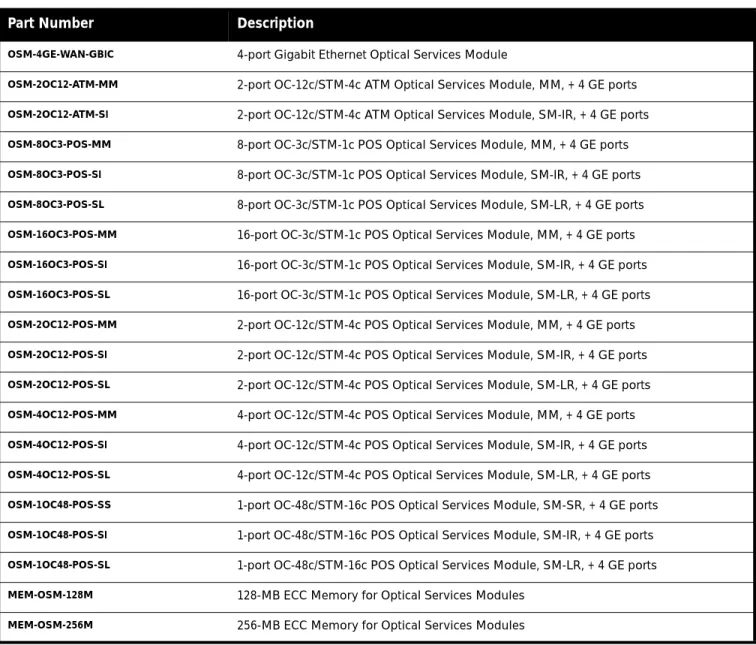
Table 1 Cisco 7600 Optical Services Module Ordering Information
Part Number Description
OSM-4GE-WAN-GBIC 4-port Gigabit Ethernet Optical Services Module
OSM-2OC12-ATM-MM 2-port OC-12c/STM-4c ATM Optical Services Module, MM, + 4 GE ports
OSM-2OC12-ATM-SI 2-port OC-12c/STM-4c ATM Optical Services Module, SM-IR, + 4 GE ports
OSM-8OC3-POS-MM 8-port OC-3c/STM-1c POS Optical Services Module, MM, + 4 GE ports
OSM-8OC3-POS-SI 8-port OC-3c/STM-1c POS Optical Services Module, SM-IR, + 4 GE ports
OSM-8OC3-POS-SL 8-port OC-3c/STM-1c POS Optical Services Module, SM-LR, + 4 GE ports
OSM-16OC3-POS-MM 16-port OC-3c/STM-1c POS Optical Services Module, MM, + 4 GE ports
OSM-16OC3-POS-SI 16-port OC-3c/STM-1c POS Optical Services Module, SM-IR, + 4 GE ports
OSM-16OC3-POS-SL 16-port OC-3c/STM-1c POS Optical Services Module, SM-LR, + 4 GE ports
OSM-2OC12-POS-MM 2-port OC-12c/STM-4c POS Optical Services Module, MM, + 4 GE ports
OSM-2OC12-POS-SI 2-port OC-12c/STM-4c POS Optical Services Module, SM-IR, + 4 GE ports
OSM-2OC12-POS-SL 2-port OC-12c/STM-4c POS Optical Services Module, SM-LR, + 4 GE ports
OSM-4OC12-POS-MM 4-port OC-12c/STM-4c POS Optical Services Module, MM, + 4 GE ports
OSM-4OC12-POS-SI 4-port OC-12c/STM-4c POS Optical Services Module, SM-IR, + 4 GE ports
OSM-4OC12-POS-SL 4-port OC-12c/STM-4c POS Optical Services Module, SM-LR, + 4 GE ports
OSM-1OC48-POS-SS 1-port OC-48c/STM-16c POS Optical Services Module, SM-SR, + 4 GE ports
OSM-1OC48-POS-SI 1-port OC-48c/STM-16c POS Optical Services Module, SM-IR, + 4 GE ports
OSM-1OC48-POS-SL 1-port OC-48c/STM-16c POS Optical Services Module, SM-LR, + 4 GE ports
MEM-OSM-128M 128-MB ECC Memory for Optical Services Modules
Cisco Systems has more than 190 offices in the following countries. Addresses, phone numbers, and fax numbers are listed on the
C i s c o . c o m W e b s i t e a t w w w . c i s c o . c o m / g o / o f f i c e s .
Argentina • Australia • Austria • Belgium • Brazil • Bulgaria • Canada • Chile • China • Colombia • Costa Rica • Croatia • Czech Republic • Denmark • Dubai, UAE Finland • France • Germany • Greece • Hong Kong • Hungary • India • Indonesia • Ireland • Israel • Italy • Japan • Korea • Luxembourg • Malaysia • Mexico • The Netherlands • New Zealand • Norway • Peru • Philippines • Poland • Portugal • Puerto Rico • Romania • Russia • Saudi Arabia • Scotland • Singapore • Slovakia
Corporate Headquarters
Cisco Systems, Inc. 170 West Tasman Drive San Jose, CA 95134-1706 USA www.cisco.com Tel: 408 526-4000 800 553-NETS (6387) Fax: 408 526-4100 European Headquarters
Cisco Systems Europe 11, Rue Camille Desmoulins 92782 Issy Les Moulineaux Cedex 9 France www.cisco.com Tel: 33 1 58 04 60 00 Fax: 33 1 58 04 61 00 Americas Headquarters
Cisco Systems, Inc. 170 West Tasman Drive San Jose, CA 95134-1706 USA
www.cisco.com Tel: 408 526-7660 Fax: 408 527-0883
Asia Pacific Headquarters
Cisco Systems Australia, Pty., Ltd Level 17, 99 Walker Street North Sydney
NSW 2059 Australia www.cisco.com Tel: +61 2 8448 7100 Fax: +61 2 9957 4350