Undergraduate HRD Programs, Page 1
Undergraduate HRD programs in the United States
Jessica Li
University of North Texas
Kim Nimon
University of North Texas
Abstract
Responding to the need to broaden the knowledge base of HRD undergraduate program, this study compared the curricular characteristics and course content of such programs to published HRD models. The results of this study will provide instructional leaders a basis from which they can compare their curricula to like programs. This paper also calls attention to potential deficits in the breadth of HRD content areas covered in undergraduate programs and identifies areas for future research.
Keywords: Human Resource Development, undergraduate, HRD program, HRD Curriculum, Benchmarking.
Undergraduate HRD Programs, Page 2 Introduction
Responding to business and societal needs to develop the 21st century workforce, many colleges and universities offer undergraduate programs to help individuals prepare for jobs in the human resource sector. While the educational background of individuals serving the human resource sector vary based on position, the 2006-2007 Occupational Outlook Handbook identified that when filling entry-level positions, many employers seek college graduates who have majored in a human resources related field. Depending on the school, courses leading to a career in human resources may be found in departments of business administration, education, instructional technology, organizational development, human services, communication, public administration, or within a separate human resources institution or department (U.S. Department of Labor, 2006)
Given the considerable variation in paths leading to a degree in human resources, this study sought to determine the institutional characteristics and content area of undergraduate programs, specific to the field of human resource development (HRD). This study also compared the content areas of undergraduate programs to published HRD models to determine to what extent entry-level professionals are educated in the various components of HRD.
The rationale for the decision to narrow the lens of study to the field of HRD follows. First, the field of HRD is germane to the Academy of HRD. Second, there are questions about the boundaries of the field and its professional identity (Kuchinke, 2002), that this study might help answer. Third, when compared to other human resource fields (e.g. human resource
management), there is a need to expand the reservoir of literature as less as been written on HRD practitioners and models (Mankin, 2001).
Given the emergent nature of HRD and society (Walton, 1999), it is important to
benchmark undergraduate U.S. programs against converging HRD models. Even if academicians have not yet come to a consensus on the same definition of HRD (McLean & McLean, 2001) or the need to have such a definition (Lee, 2001; Ruona, 2000a,b), investigating undergraduate curricula may lend insight into what instructional leaders perceive as important in developing HRD professionals. Additionally, such data may benefit HRD program coordinators who decide to review their curriculum and course design. Comparing undergraduate curricula to published HRD models may also help the HRD community observe to what extent their actions match their words. The authors believe that critical reflection on current practice is an important stimulus for improving HRD curriculum and models for the betterment of society.
Prior Literature
The study of HRD programs is at its infancy. As Kuchinke observed in 2002, systematic information on HRD academic programs and departments are lacking. The few studies that have been conducted indicate that there is a large degree of heterogeneity among programs,
departmental affiliations, and specializations. For example, across the 55 universities in his sample, Kuchinke found 31 different programs names and11 different school or college
affiliations. Other researchers (Chalofsky & Daugherty, 1999; Gaudet & Vincent, 1993; Hatcher, 1998; Klein & Butler, 2002) have found similar divergences in addition to disparities in the foci of curricula. However, these researchers also concluded that a significant number of programs were named HRD and that the vast majorities were hosted under a college of education. For
Undergraduate HRD Programs, Page 3 example, Kuchinke reported that 18 out of 55 programs were name HRD and 42 out of 55 were hosted in the college of education. This suggests that some generalizations can be made. It also suggests that it may be difficult to generate a comprehensive list of all HRD related programs in the U.S. because programs use many different names and are affiliated with a number of
different colleges.
When compared to graduate HRD programs, research indicates that undergraduate HRD programs are offered less frequently in U.S. universities. In their study, Gaudet and Vincent (1993) reported that only 21% of the programs surveyed offered bachelor degrees, while 56% offered master degrees, and 23% offered Ph.D. degrees. Chalofsky and Larson-Daugherty (1996) presented similar findings using the ASTD’s Academic Directory of programs in HRD. The limited availability of undergraduate programs may be one reason that undergraduate HRD programs have not been researched more often.
In terms of curricula, there are also differences between program offerings (Hatcher, 1998; Gaudet & Vincent, 1993; Klein & Butler, 2002). For example, Kuchinke (2002) reported 31 content areas which varied from most frequently addressed areas such as instructional design, instructional delivery, and evaluation, to least frequently addressed areas such as quality
management and educational policy. This variation in academic curricula may present an advantage to the HRD field because each program can design their curriculum to fit a particular aspect of the HRD practice or research area. However, it may also add to the ambiguous and problem nature of the concept of HRD especially if a basic level of education is not provided across all HRD components.
Theoretical Framework
This study was informed by several theoretical frameworks relating to the scope of HRD. First, McLagan’s (1989) definition of HRD provided an underlying theme that guided the
researchers through the data collection and data analysis processes. For the purposes of this study, HRD was defined as the “integrated use of training and development, organization development, and career development to improve individual, group, and organizational effectiveness” (p. 53). While other definitions of HRD exist (McLean & McLean, 2001;
Weinberger, 1998), the researchers chose this definition of HRD as it is seminal to the field and provided a practical benchmark vehicle.
Second, the components of HRD as identified by Thomson and Mabey (1994) provided a theoretical model from which HRD related undergraduate course content could be mapped to HRD disciplines. Thomson and Mabey identified three components of HRD: (a) organizational development (OD), (b) career development (CD), and (c) training and development (TD). This model was chosen for the three reasons. The first is historical. As most of the academic programs under study have been around for many years, the curricula under study would have been based on a model which existed at the time of program initiation. Second, newer models such as the New Learning and Performance Wheel (Davis, Naughton, & Rothwell, as cited in Werner & DeSimone, 2006) have typically been developed with a focus on skills and competencies instead of academic disciplines or curriculum designs. Third, as benchmarking is a process that
compares current practices to a proven record, a widely accepted and applied model served our purpose best. Therefore, the model of Thomson and Mabey, represented diagrammatically in Figure 1, was used.
Undergraduate HRD Programs, Page 4 Figure 1. The components of human resource development (Mankin, 2001, p. 67)
Research Questions
The purpose of this study was to respond to the need to broaden the knowledge base related to the characteristics of HRD undergraduate programs in the United States by answering three questions:
1. What are the institutional characteristics of undergraduate HRD programs? 2. What is the core body of knowledge taught in HRD programs?
3. How does the core body of knowledge relate to HRD models?
Methodology
The methodology for this study was based on Spendolini’s (1992) benchmarking process and Kuchine’s (2002) study of graduate programs in the U.S. Modifications were made to suite the scope and purpose of this study.
The first step was to identify the target population. The target population for this study consists of all HRD undergraduate programs in the U.S. Given that the likelihood of a university with a graduate HRD program also having an undergraduate HRD program is high, the
researchers generated an initial list of universities and colleges to research by reviewing
resources for graduate programs. The researchers analyzed sources including Peterson’s Guide to Graduate and Professional Study (http://www.petersons.com), an online graduate school
directory (http://www.gradschools.com), and Kuchinke’s (2002) list of 55 graduate HRD programs. As it was also posited that professors belonging to a HRD related society might serve as faculty in a HRD related program, academic and professional associations were included in the data collection process. Using membership lists from organizations such as the Academy of Human Resource Development (AHRD), America Society for Training and Development (ASTD), and International Society for Performance Improvement (ISPI), the researchers considered universities from which faculty members were affiliated.
Organization Development Career Development Training & Development Human Resource Development
Undergraduate HRD Programs, Page 5 For each university and college identified, the researchers searched its web site to
determine if it had an undergraduate HRD program. With the understanding that there may be a large degree of heterogeneity among programs names, the search was conducted using key words, including Human Resource Development, Workforce Education, Instructional
Technology, Instructional Design, Training and Development, Career and Technical Education, and Performance Improvement. As a consequence of this web search, a list of 27 universities with undergraduate HRD or HRD related programs was developed.
The second step was to establish a benchmark. Research question 3 required that a benchmark be established from which HRD program content could be classified and compared. Based on published theoretical frameworks, it was decided to map HRD related courses to the following HRD components: OD, CD, and TD.
The third step was to collect the data. For each undergraduate program identified, data from the program website were collected. In addition to program name, program description, college affiliation, undergraduate degree plan, and detailed course descriptions were obtained.
The fourth step was to analyze the data. Both qualitative and quantitative modes of analysis were employed. To map like programs, this study followed Kuchinke’s (2002)
methodology and employed simple frequency distributions. To answer research question three, a qualitative thematic strategy of data analysis was used to categorize and make judgments about the meaning of the HRD related courses. The course description data produced in step three were analyzed and coded based on three core HRD components: OD, CD, and TD using what Glaser and Strauss (1967) called a constant comparative method. To ensure reliability of the study, two researchers coded the data and made constant comparisons to establish a consistency of
judgments between the researchers to determine code development and its applications to data analysis (Boyatzis, 1998). The number of course hours offered in each of the 3 areas was then tabulated and rank ordered. For courses covering the broad discipline of HRD, hours were split between the 3 content areas.
Results and Discussion
Exhibit 1 identifies the list of universities found to offer an undergraduate degree related to HRD. The sample included 27 universities. The size of this sample is somewhat smaller than prior literature (Gaudet & Vincent , 1993) that found 41 HRD programs being offered at the undergraduate level. The difference may be due to differences in how programs were categorized or potentially an observed decrease in the number of undergraduate programs offered.
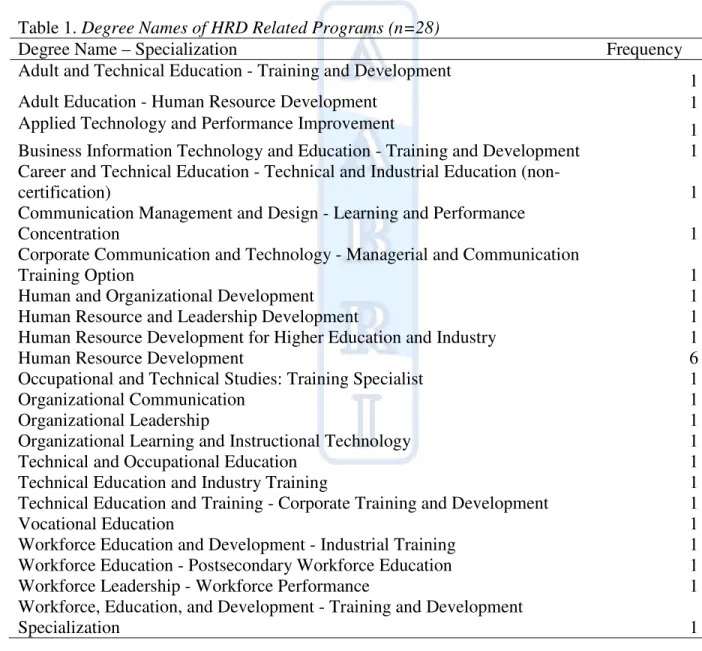
As depicted in Table 1, the range of names for degrees relating to HRD is almost as diverse as the number of universities sampled. However, some synergy was found when considering program names containing the key words: human, resource, and development. In particular, 5 (18.5%) of the programs sampled exclusively used HRD to name their
undergraduate degree. When considering programs with HRD in their names, the number of programs increases to eight. This finding is significant as the resulting percentage (29.6%) comes close to what Kuchinke (2002) found when studying graduate programs (32.7%).
Exhibit 1. Universities Offering Bachelor’s Degrees in HRD Related Field (n=28) Eastern Kentucky University Southern Illinois University, Carbondale Ithaca College Texas A&M University, College Station James Madison University University of Texas, Tyler
Undergraduate HRD Programs, Page 6 Kansas State University University of Arkansas
Louisiana State University University of Central Florida Marshall University University of Louisville Middle Tennessee State University University of Minnesota
Northeastern Illinois University University of Nevada, Las Vegas Oakland University University of New Mexico Ohio State University University of North Texas
Oklahoma State University University of Southern Mississippi Old Dominion University Utah State University
Penn State University Vanderbilt University San Diego State University Wright State University
Table 1. Degree Names of HRD Related Programs (n=28)
Degree Name – Specialization Frequency
Adult and Technical Education - Training and Development
1
Adult Education - Human Resource Development 1
Applied Technology and Performance Improvement 1
Business Information Technology and Education - Training and Development 1 Career and Technical Education - Technical and Industrial Education
(non-certification) 1
Communication Management and Design - Learning and Performance
Concentration 1
Corporate Communication and Technology - Managerial and Communication
Training Option 1
Human and Organizational Development 1
Human Resource and Leadership Development 1
Human Resource Development for Higher Education and Industry 1
Human Resource Development 6
Occupational and Technical Studies: Training Specialist 1
Organizational Communication 1
Organizational Leadership 1
Organizational Learning and Instructional Technology 1
Technical and Occupational Education 1
Technical Education and Industry Training 1
Technical Education and Training - Corporate Training and Development 1
Vocational Education 1
Workforce Education and Development - Industrial Training 1
Workforce Education - Postsecondary Workforce Education 1
Workforce Leadership - Workforce Performance 1
Workforce, Education, and Development - Training and Development
Specialization 1
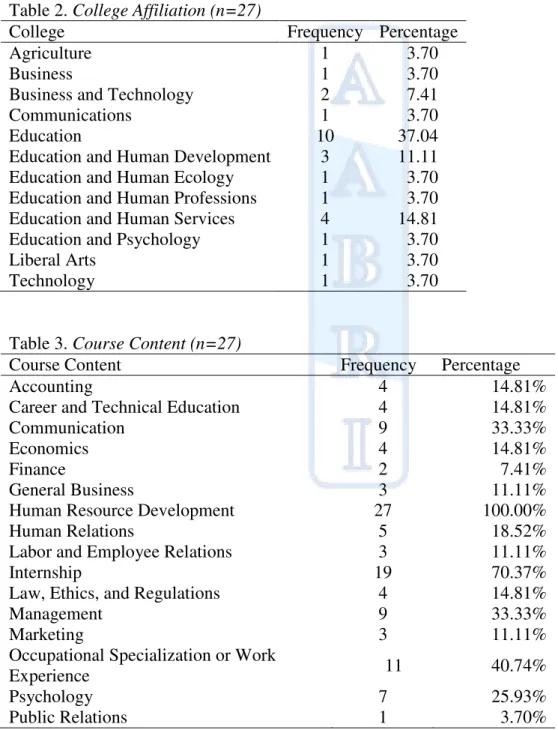
When considering the college affiliation of the universities offering HRD related undergraduate degrees, this study found that 10 (37.04%) were in the College of Education.
Undergraduate HRD Programs, Page 7 However, when considering the number of colleges that include education in their name (just not exclusively), the number of colleges increases to 20. This finding is significant as the resulting percentage (62.95%) is similar to what Kuchinke (2002) found when studying graduate programs (72.36%).
Consistent with the demographics of the programs surveyed, 100% of the programs covered HRD content (see Table 3). The next highest areas of homogeneity were internship and occupational specialization or work experience. Nineteen (70.37%) of the programs sampled required that students participate in an internship, practicum, or field experience. Eleven
(40.74%) of the programs sampled offered students a broad range of course choices to satisfy an occupational specialization and/or course credit for prior workplace experience.
Table 2. College Affiliation (n=27)
College Frequency Percentage
Agriculture 1 3.70
Business 1 3.70
Business and Technology 2 7.41
Communications 1 3.70
Education 10 37.04
Education and Human Development 3 11.11
Education and Human Ecology 1 3.70
Education and Human Professions 1 3.70 Education and Human Services 4 14.81
Education and Psychology 1 3.70
Liberal Arts 1 3.70
Technology 1 3.70
Table 3. Course Content (n=27)
Course Content Frequency Percentage
Accounting 4 14.81%
Career and Technical Education 4 14.81%
Communication 9 33.33%
Economics 4 14.81%
Finance 2 7.41%
General Business 3 11.11%
Human Resource Development 27 100.00%
Human Relations 5 18.52%
Labor and Employee Relations 3 11.11%
Internship 19 70.37%
Law, Ethics, and Regulations 4 14.81%
Management 9 33.33%
Marketing 3 11.11%
Occupational Specialization or Work
Experience 11 40.74%
Psychology 7 25.93%
Undergraduate HRD Programs, Page 8 Safety 1 3.70% Sociology 1 3.70% Statistics 5 18.52% Technology 9 33.33% Writing 6 22.22%
As a consequence of mapping HRD course content to HRD components, training and development was found to be the primary emphasis in 23 (88.20%) of the programs sampled (see Table 4). Organizational development was found to be the secondary emphases in 13 (48.15%) of the programs and career development was found to be the tertiary emphasis in 10 (37.05%) of the programs. On the flipside, only 1 (3.70%) program did not include training and development in its course content. However, organizational development was found to be not included in 8 (29.60%) of the programs and career development was found to be not included in 11 (40.70%) of the programs. When considering the distribution of jobs by occupation specialty in the category of human resources, training, and labor relations managers and specialists, the primary emphasis on training and development and the tertiary emphasis on career and development are generally consistent with findings from the 2006-2007 occupational handbook. The handbook indicated that in the year 2004, training and development specialists had the most number of jobs (216,000, 26.34%) followed by employment, recruitment, placement specialists (182,000,
22.19%). The Bureau of Labor and Statistics did not specifically parcel out jobs relating to organizational development in the category of human resources, training, and labor relations managers and specialists.
Table 4. Course Content Emphases by HRD Component (n=27)
HRD Component Frequency Percentage
Career Development
Primary Emphasis 0 0.00
Secondary Emphasis 6 22.25
Tertiary Emphasis 10 37.05
Not Covered in Course Content 11 40.70 Organizational Development
Primary Emphasis 6 22.25
Secondary Emphasis 13 48.15
Tertiary Emphasis 0 0.00
Not Covered in Course Content 8 29.60 Training Development
Primary Emphasis 23 85.20
Secondary Emphasis 2 7.40
Tertiary Emphasis 1 3.70
Not Covered in Course Content 1 3.70
Conclusions
This study found similar institutional characteristics for HRD undergraduate program as prior research on graduate programs. While there was much disparity in program names, 30% of the undergraduate degree names contained the key words: human, resource, and development
Undergraduate HRD Programs, Page 9 and 63% of the undergraduate programs sampled were housed in a college of education. These findings reflect the beginning of an expected trend of consistency between undergraduate and graduate HRD related programs.
With the exception of HRD related courses, internships, and work
experience/occupational specialty requirements, the course content, exclusive of core university requirements, varied across the programs sampled. This seems to be reflective of the ambiguous nature of the concept of HRD and the fact that there is no universally accepted definitive
statement of the meaning of HRD (Mankin, 2001). However, it is also possible that such a finding could be an artifact of differences in college affiliations and themes. Clearly, more research is needed to uncover the underlying themes behind these differences.
Perhaps the most salient findings relate to the mapping of program content to the core components of HRD. Given that HRD and TD are viewed by many as interchangeable terms (Walton, 1999), the preponderance of programs covering training and development as a primary emphasis is not remarkable. However, the lack of programs offering course content in CD is astonishing. Given that the second highest occupation reported by the Department of Labor in the category of human resources are those jobs that deal with career development, it seems that this need is being filled by undergraduate programs outside the disciplines of HRD. Also, given the impending issues relating to the retirement of the baby-boomer generation, one wonders if HRD undergraduates are being educated in concepts such as the stage of life and career development, the career plateau, and new employment relationships. Clearly, HRD
undergraduate program coordinators should take care to ensure that their students are being provided a foundation in all the functions of HRD, not just the functions associated with learning. And if such functions are deemed not important to be explicitly covered in course content, perhaps new theoretical models of HRD should be developed that reflect what is being accomplished in business.
This study also provides new insights into future research on undergraduate HRD programs. Given that the number of undergraduate programs is small, it would seem feasible to interview program coordinators to add another dimension of data to this study. Such interviews would also mitigate the limitation of this study’s reliance on program website data. As the researchers had to make assumptions about the content included in courses, follow-on interviews could uncover potential problems with how data were classified. For example, one would expect that the course content described in a program website or document may not always reflect the course content that is delivered. Perhaps, the educational and professional background of the professors teaching HRD related courses would add another layer of information to the data collected. It would also be interesting to survey students participating in internships to determine how much time they spent conducting the three primary HRD functions (i.e., CD, OD, TD) identified in literature.
Implications
While the findings of this study are preliminary, they do provide information for HRD academics to consider. For example, given that the occupational outlook for human resource professionals is expected to grow faster than average through 2014 (U.S. Department of Labor, 2006), is it reasonable to expect that current undergraduate programs can keep up with
businesses’ need to fill job openings that will arise due to growth and attrition? Also consider a program’s college affiliation and its impact on course curriculum. Are core courses required for
Undergraduate HRD Programs, Page 10 college of education majors, for example, salient for future HRD professionals, given the
differences between educational and business sectors? What about the role of work in
undergraduate programs? Could businesses be better served if undergraduate programs required internships for all students that did not have prior work experience? Also consider the
relationship between HRD models and undergraduate course curricula. What should the mapping of programs to models be? For example, should all undergraduate programs provide students sufficient education to help them understand how employees select, work within, and make decisions to change their working lives? Or is CD to broad a field to be covered in undergraduate programs? Perhaps, differences in HRD component emphases can be viewed as program
differentiators. If so, how does the HRD community maintain the integrity of the field? Theses are just a few of the questions that the researchers hope this study initiates.
References
Boyatzis, R. (1998). Transforming qualitative information: Thematic analysis and code development. Thousand Oaks, CA: Sage Publications.
Chalofsky, N., & Larson-Daugherty, C.A. (1996). Academic programs for HRD professionals. In R.L. Craig (Ed.) The ASTD training and development handbook (4th ed) (pp. 991-998). New York: McGraw-Hill.
Gaudet C. & Vincent, A. (1993) “Characteristics of training and human resource development degree programs in the United States. The Delta Pi Epsilon Journal, 35(3), 139-159. Glaser, B. & Strauss, A. (1967). The discovery of grounded theory: Strategies for qualitative
research. Chicago, IL: Aldine
Hatcher, T. (1998). A study of HRD degree programs in higher education in the US. Workforce Education Forum, 25(2), 46-68.
Klein, C. & Butler M. N. (2002). National comparison of graduate level human resource development programs. In T. M. Egan & S. A. Lynham (Eds.), Proceedings of the Academy of Human Resource Development 2002 International Conference (pp. 3-4, 26-33). Honolulu, HI: AHRD.
Kuchinke, K. P. (2002). Institutional and curricular characteristics of leading graduate HRD programs in the United States. Human Resource Development Quarterly, 13(2), 127-143. Mankin, D. A. (2001). A model for human resource development. Human Resource
Development International, 4(1), 65-85.
McLagan, P.A. (1989). Models for HRD practice. Alexandria, VA: American society for Training and Development.
McLean, G., N., & McLean, L. (2001). If we can’t define HRD in one country, how can we define it in an international context? Human Resource Development International, 4(3), 313-326.
Ruona, W. E. A. (2000a). Core beliefs in human resource development: A journey for the profession and its professionals. Advances in Developing Human Resources, 2(3), 1-27. Ruona, W. E. A. (2000b). Should we define the profession of HRD? View of leading scholars, In
K. P. Kuchinke (Ed.), Proceedings of the Academy of Human Resource Development 2000 Conference (section 8.1). Baton Rouge, LA: AHRD.
Spendolini, M. J. (1992). The Benchmarking Book. New York: AMACOM.
Thomson, R., & Mabey, C. (1994). Developing human resources. London: Butterworth Heinemann.
Undergraduate HRD Programs, Page 11 U.S. Department of Labor (2006). Occupational outlook handbook, 2006-2007 edition.
Washington, DC: Bureau of Labor Statistics, Department of Labor.
Walton, J. (1999). Strategic human resource development. Harlow: Financial Times/Prentice Hall.
Weinberger, L. A. (1998). Commonly held theories of human resource development. Human Resource Development International, 1(1), 75-93.
Werner, J. M., DeSimone, R. L. (2006), Human resource development (4th ed.). Mason, OH: Thomson South-Western.