in the population sciences published by the Max Planck Institute for Demographic Research Konrad-Zuse Str. 1, D-18057 Rostock·GERMANY www.demographic-research.org
DEMOGRAPHIC RESEARCH
VOLUME 14, ARTICLE 9, PAGES 157-178
PUBLISHED 07 MARCH 2006
http://www.demographic-research.org/Volumes/Vol14/9/ DOI: 10.4054/DemRes.2006.14.9
Research Article
A model for geographical variation
in health and total life expectancy
Peter Congdon
c
1 Introduction 158
2 The proportionality assumption (multiplicative model) 158
3 A model based on proportionality 160
4 Estimation 162
5 Modelling non-proportional age and area effects 166
6 Other models for age effects and spatially varying age effects 169
7 Implications for life table parameters 171
8 Conclusions 172
A model for geographical variation
in health and total life expectancy
Peter Congdon1
Abstract
This paper develops a joint approach to life and health expectancy based on 2001 UK Census data for limiting long term illness and general health status, and on registered death occurrences in 2001. The model takes account of the interdependence of different outcomes (e.g. ill health and mortality) as well as spatial correlation in their patterns. A particular focus is on the proportionality assumption or ’multiplicative model’ whereby separate age and area effects multiply to produce age-area mortality rates. Alternative non-proportional models are developed and shown to be more parsimonious as well as more appropriate to actual area-age interdependence. The application involves mortality and health status in the 33 London Boroughs.
1.
Introduction
Health expectancy is increasingly emphasised as an indicator for population health that takes account of both mortality and morbidity or disability. While morbidity and dis-ability data are often only obtainable from surveys, the recent UK 2001 Census includes questions on both limiting long term illness and general health status. Thus, in England and Wales63%of adults (aged16and over) said they had good health,26%reported they had fairly good health and11%said their health was not good. A variety of measures of health expectancy are available that may be based on limited function or self-perceived health status; these include disability free life expectancy and healthy life expectancy (Bebbington et al, 1993; Robine and Ritchie, 1991).
While both total life expectancy and health expectancy have improved in the UK, there are wide variations between geographic areas and socio-economic groups. Anal-yses of such contrasts, especially of spatial variations, have typically used standard life table calculations. These do not take account of features such as interdependence of dif-ferent outcomes (e.g. ill health and mortality), or of spatial correlation in their patterns, or of sampling variations in deaths or other outcomes. Where statistical modelling tech-niques are adopted, simplifying assumptions about the impacts of demographic variables and area are often made; for example, the proportionality assumption or ‘multiplicative model’ (Hoem, 1987) whereby separate age and area effects multiply to produce age-area mortality rates.
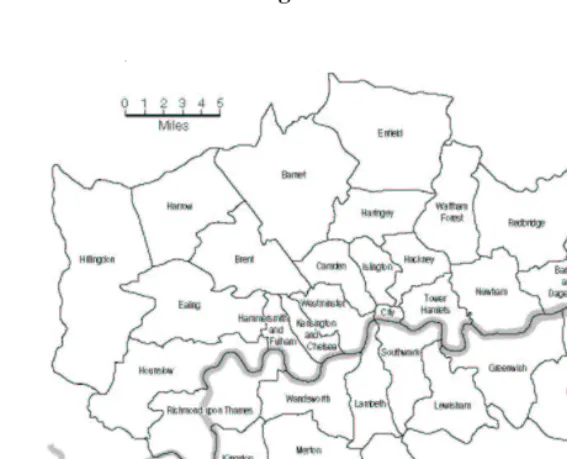
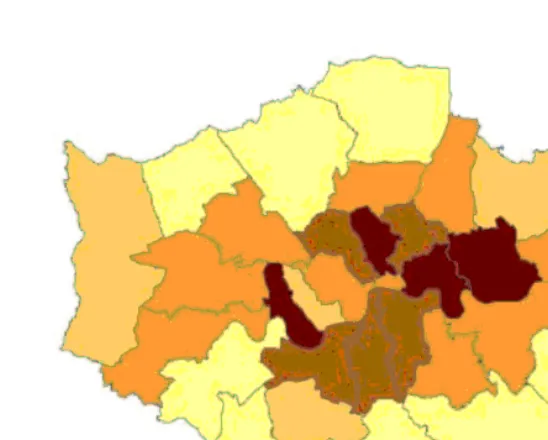
The present paper considers how evidence from mortality, limiting illness and self-rated health for sets of areas may be integself-rated in life tables for sets of contiguous areas. It includes consideration of the validity of the multiplicative model, and considers how interactions between age and area effects may be parsimoniously modelled. The appli-cation involves the33London Boroughs (Figure 1) and combines information from the two 2001 Census questions on disabling illness and self assessed health with recorded deaths in 2001 for the same areas. The result is a joint life table model for life and health expectancies by area.
2.
The proportionality assumption (multiplicative model)
Let populations in areaa(a= 1, . . . , A), and age bandx(x= 1, . . . , X)be denotedPax. Then deathsDaxby area and age band will be binomial
Dax|µax∼Bin(Pax, µax)
In line with many spatial epidemiology studies (e.g. Wakefield et al, 2000), the propor-tionality assumption is that
Figure 1: The London boroughs
whereρa are unknown relative risks for areaaandrxare death rates at agex. For rare outcomes, the binomial distribution may be approximated by a Poisson distribution for theDax(e.g. Sun et al, 2000, p. 2108)
Dax∼Poi(Paxµax)
where µax is often taken as proportional as in (1). A relevant model (e.g. with log link) forµaxwould then takelog(ρa)andlog(rx)as independent effects. Alternatively under the proportionality assumption one may collapse over the age groups to obtain a model where the area death totalsDa = xDaxare Poisson with meansEaρa where
Ea =xPaxrxare expected deaths. If an internal demographic standardisation is used thenaDa =aEaand so theρawill have average1, and posterior densities forρa concentrated on values over1(e.g. with95%credible interval all above1) then indicate excess relative risk in areaa.
assump-tion is that age effects are independent of area (e.g. McNab and Dean, 2001), though changes over time in the age profile of mortality may be included (Sun et al, 2000).
The present analysis uses age and area classifiers only and considers either total deaths (males and females combined) or deaths for one sex only. Extensions to include more classifiers (e.g. time) or to bivariate life table analysis (male and female life tables in one overall model) are, however, possible. Life and health expectancy may be jointly modelled for a set of areas using data on health status and long term illness as well as mortality data. An initial analysis using the proportionality assumption for these outcomes is contrasted in terms of fit and substantive implications with an analysis allowing for age-area interactions. The age-age-area interaction model draws on the principles in the Carter and Lee (1992) model for age-time interactions in mortality, and the related log-linear model of Goodman (1979). More heavily parameterised models that use random effects for each age-area interaction are also considered.
3.
A model based on proportionality
The relevant data are deathsDaxfor the year 2001, numbers of long term ill in areaa at agex,Gax, and the numbersHaxj in areaaand agexin thej = 1, . . . ,3categories of the general health (good, fairly good, not good). There area = 1, . . . ,33areas and
x= 1, . . . ,19age bands (namely0−4,5−9, . . . ,85−89,over90).
Letsadenote spatially correlated area effects,uabe random errors without any spatial structure, andδx denote age effects. To reflect correlated outcomes one may include a common spatial effect across the responses, since it is plausible that a common structure between excess mortality and morbidity exists and that it follows a spatial structure. Then coefficientsθjmay be introduced to express the differential impact ofsaon each outcome
j. Hence thesacan be seen as a spatially correlated factor scores, andθ= (θ1, θ2, ..)as factor loadings, that account for correlations between the outcomes. Ifvar(sa)is taken as a free parameter then for identifiability oneθcoefficient is assigned a set value (e.g.
θ1= 1), while ifvar(sa)is set, e.g.var(sa) = 1, allθcoefficients may be free.
Several models are possible for age effects. Sun et al (2000) treat them as fixed ef-fects; McNab and Dean (2001) and Nandram et al (1999) use spline models; Ibrahim et al (2001) suggest random walks, while demographic applications (Anson, 1991) may use polynomials in age. Here the first two models use a random effects approach combin-ing a structured random walk prior with unstructured age effects. Thus withjdenoting mortality/morbidity responses(j= 1, ..K)
δjx=vjx+wjx
effects with wjx ∼ N(0, ϕj). To reflect the correlation among the outcomes j it is assumed that rather than separate state space models for each of theK series of effects
vjx, the processes are interlinked according to
vjx =φjVx
where theφjare loadings on a shared structured age effect
Vx∼N(Vx−1, ξ).
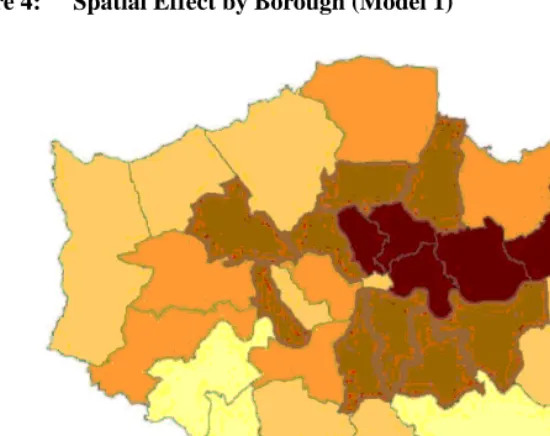
One possible model (model 1) for deaths and long term illness totals based on age-area proportionality is then
Dax∼Po(Paxµax)
log(µax) =α1+φ1Vx+w1x+θ1sa+u1a (1a)
Gax ∼Bin(Pax, λax)
logit(λax) =α2+φ2Vx+w2x+θ2sa+u2a (1b)
whereαjare intercepts. For numbersHaxkin the health status groups, a cumulative logit model involving
υaxj =πax1+· · ·+πaxj=Pr(Haxk≤j), j= 1, J−1
(J = 3here) is often assumed. Other links allowing for asymmetric departures from the cumulative logit might also be considered such as the cumulative log-log link or links involving a transformation parameter (Zayeri et al, 2005; Agresti, 2002). A proportional cumulative logit model would require common age gradients and area effects acrossj. In the current application considerable gains in fit were made if age gradients and area effects were allowed to differ between levels of health status, leading to a non-proportional model (Peterson and Harrell, 1990). WhileJ−1non-parallel regression lines may cross when explanatory variables are continuous, this problem does not occur for explanatory variables that are categorical, as here (Gibbons and Hedeker, 2000). The cumulative logit model is then
logit(υax1) =κ1−(φ3Vx+w3x+θ3sa+u3a) (1c)
logit(υax2) =κ2−(φ4Vx+w4x+θ4sa+u4a) (1d)
The probabilitiesπaxj of the health status distribution (Hax1, Hax2, Hax3) in areaaand agexare obtained as
πax1=υax1 πax2=υax2−υax1 πax3= 1−υax2
The ICAR prior of Besag et al (1991) is used for the shared spatial effectssa. Define theA×Acontiguity matrixCwith elementscab=cba= 1if areasaandbare adjacent and zero otherwise, letLa be the neighbourhood of areas adjacent to a (excluding area a itself) and letNabe the number of areas in the neighbourhood. Then the Normal version of the ICAR prior (with varianceτ) assumes
f(sa|s[−a]) =
N
a
2πτ
0.5
exp{−0.5Na
τ (sa−Sa)2}
wheres[−a]denotes all{s1, s2, ..sA}exceptsa, andSais the average ofsbfor the areas
bin the localityLaof areaa. Equivalently
sa|s[−a]∼N(
b
cabsb, τ /Na)
To ensure identification thesaare recentred at each iteration to have mean zero. Theuja are taken to be unstructured Normal random effects with mean zero.
Note that a close fit to the data may be attained by effectively modelling each ob-servation, namely adding random age-area effects{e1ax, e2ax, e3ax, e4ax} in (1a)-(1d). However, this approach is heavily parameterised, and leads to complex interpretation is-sues of model results in substantive terms. Instead the goal is relatively parsimonious and interpretable models that clearly improve fit as an alternative to introducing age-area interaction effects. This objective is pursued in subsequent model elaboration.
4.
Estimation
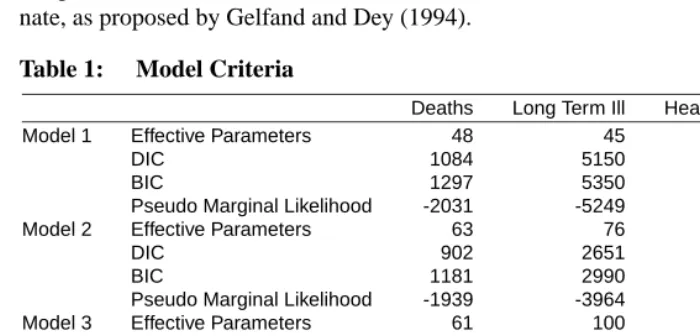
To assess model fit, one criterion used is the DIC of Spiegelhalter et al (2002), un-der which the number of effective parameterspeis derived as the difference between the averaged sampled deviance Dev and the deviance atΦ, the posterior mean of the full pa-rameter setΦ. The DIC is then the average deviance plus the effective parameter total (see Table 1 for fit statistics for model 1 and subsequent models). Another is the pseudo marginal likelihood based on the Monte Carlo estimate of the conditional predictive ordi-nate, as proposed by Gelfand and Dey (1994).
Table 1: Model Criteria
Deaths Long Term Ill Health Status Total
Model 1 Effective Parameters 48 45 72 165
DIC 1084 5150 7950 14184
BIC 1297 5350 8319 14916
Pseudo Marginal Likelihood -2031 -5249 -9178 -16458
Model 2 Effective Parameters 63 76 154 293
DIC 902 2651 4611 8164
BIC 1181 2990 5404 9467
Pseudo Marginal Likelihood -1939 -3964 -7464 -13367
Model 3 Effective Parameters 61 100 194 355
DIC 904 2278 3987 7169
BIC 1175 2722 4983 8746
Pseudo Marginal Likelihood -1928 -3744 -7114 -12786
Model 4 Effective Parameters 159 467 905 1531
DIC 868 1154 2291 4313
BIC 1574 3228 6937 11112
Pseudo Marginal Likelihood -1920 -3126 -6181 -11227
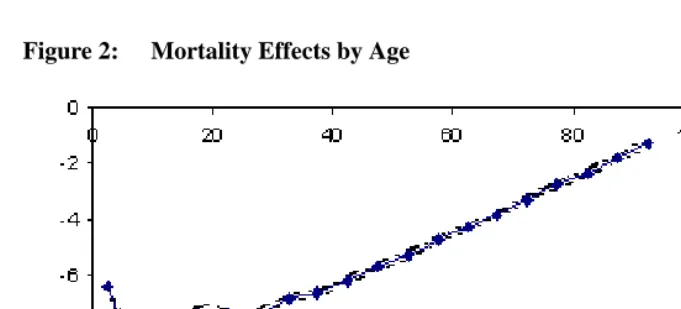
Figure 2: Mortality Effects by Age
5.
Modelling non-proportional age and area effects
To allow for non-proportional impacts means age effects and area effects will interact. As noted above, the most heavily parameterised models allowing this are random ef-fects models with termsejaxspecific to area, age and outcome. These would usually be assumed spatially unstructured, though for a small number of age groupsxone might assumeeja1, eja2, . . . ,etc to have distinct spatially correlated densities.
Alternatively for a relatively parsimonious model with substantive interpretability one may adapt the Carter-Lee model for forecasting mortality (Carter and Lee, 1992) to the present spatial application. The Carter-Lee model for mortality rates in age and timeµtx (without an area dimension) takes the form
log(µtx) =α1+δx+βxκt
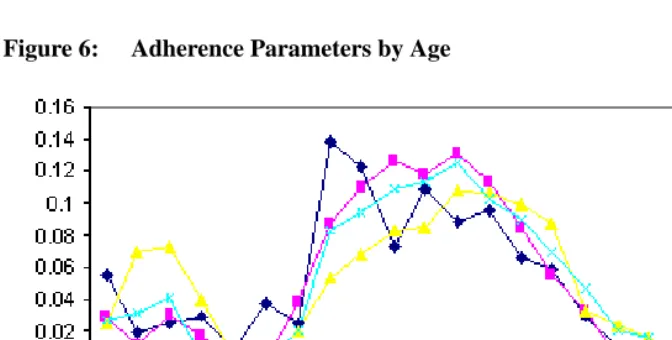
with constraints on the multiplicative functionβxκtto ensure identifiability. Lee (2000) assumes theβx to be positive and sum to1over allx, and constrains the κtto sum to zero. Theβxparameters express variations between ages in the adherence to the overall mortality trend represented by theκt parameters. If theκtwere declining as mortality fell then largerβxindicate for which age groups the rates are declining more rapidly.
In the present spatial mortality application one may incorporate this form of non-proportionality (leading to model 2). This involves first re-defining the mortality model as
Dax∼Po(Paxµax)
log(µax) =α1+δ1x+β1xγa+u1a (2a)
where theβ1xare assumed positive and sum to1and theγa are centred to sum to zero. The mixed random effects model for the age effectsδjx used in model (1) is retained in model 2. The remaining components of the model are redefined as
logit(λax) =α2+δ2x+β2xγa+u2a (2b) logit(γax1) =κ1−(δ3x+β3xγa+u3a) (2c) logit(γax2) =κ2−(δ4x+β4xγa+u4a) (2d)
childhood and middle age bands, but low at old ages. Disability or poor health in middle age also tends to be elevated in deprived areas.
Extensions of the basic non-proportional model with generic form
log(µax) =α+δx+ua+βxγa
may be envisaged. For example, it may be that there are discordant spatial effects or that the interaction between age and spatial effects is less clearly defined in some areas than others. The generic model reduces to the proportional model
log(µax) =α+δx+ua+γa
when all theβxare equal, so one might propose a two group discrete mixture whereby in one group theβxvary less than in another group. Thus
log(µax) =α+δx+ua+βxGaγa
whereGa ∈(1,2). One possible prior for theβxinvolves a multiple logit link, namely
βx= exp(ax)/
1 +X−1
x=1
exp(ax)
x= 1, . . . , X−1
βX = 1/
1 +X−1
x=1
exp(ax)
whereaxare random effects, e.g.ax∼N(0, τa). So the discrete mixture would involve constrainingτato be lower in one group than the other. Another possible model allowing for spatial outliers would mix over a normal ICAR spatial effectγ1a and a heavy tailed (e.g. Laplace) spatial effectγ2a. This can be done using continuous mixing using beta weightsha∼Beta(g1, g2)whereg1andg2are known (Lawson and Clark, 2002). So
log(µax) =α+δx+ua+βx[haγ1a+ (1−ha)γ2a].
Figure 6: Adherence Parameters by Age
6.
Other models for age effects and spatially varying age effects
Instead of assuming a random walk prior for the structured component in the age mixture model δjx = vjx+wjx, one might represent vjx by a basis function (e.g. a polyno-mial spline or B spline), and then assume spatially varying coefficients applied to certain components in each function. This may be combined with predictor selection on other components of the function, leading to averaging over a number of different models. As noted by Smith and Kohn (1996) this implies a nonparametric regression model for age effects in which several predictor variables may be redundant. Here a cubic spline in age with terms{x, x2, x3,(x−t1)3+, . . . ,(x−tM)3+} is assumed in a third model. Define
B1(x) = x, B2(x) = x2, . . . , BM+3(x) = (x−tM)3
+ then the smooth in age has the form
vjx =M+3
k=1
gjkηjkBk(x)
wheregjkare binary selection indicators with Bernoulli(0.5) priors, andηjkare coeffi-cients applied toBk(x)only whengjk= 1. The linear coefficient in ageηj1is taken as necessary by default so thatgj1= 1(e.g. see Figures 2 and 3). All other terms are subject to predictor selection. TheMpotential knots are taken as the mid-points of each five year age band, excluding the first and last so there are seventeen potential knots (at ages7.5, 12.5, etc. to87.5). An unstructured random age termwjxis retained to model remaining residual age impacts for outcomej.
and illness outcomes, so that linear coefficient in age for outcomejis area specific,ηj1a. There is evidence at a higher geographical scale, for example, that high and low mortality regimes in developed societies may differ in their age slopes (Gakidou et al, 2000). To additionally reflect the correlation between outcomes (death, long term limiting illness, etc) the area linear effect on age is modelled as
ηj1a =ωja+ψjξa
whereξa is a shared spatially correlated error,ωjais an outcome specific unstructured error with meanηj1andψjare outcome specific loadings. The remainder of the model is an in model 2.
Then model 3 for mortality is
log(µax) =α1+w1x+ (ω1a+ψ1ξa)x+ [g12η12x2+g
13η13x3+
g14η14(x−t1)3
++· · ·+g1,M+3η1,M+3(x−tM)3+]+
β1xγa+u1a (3a)
The models for illness and health status are accordingly
logit(λax) =α2+w2x+ (ω2a+ψ2ξa)x+ [g22η22x2+g
23η23x3+
g24η24(x−t1)3
++· · ·+g2,M+3η2,M+3(x−tM)3+]+
β2xγa+u2a (3b)
logit(γax1) =κ1−(w3x+ [ω3a+ψ3ξa]x+{g32η32x2+g
33η33x3+
g34η34(x−t1)3
++· · ·+g3,M+3η3,M+3(x−tM)3+}+
β3xγa+u3a) (3c)
logit(γax2) =κ2−(w4x+ [ω4a+ψ4ξa]x+{g42η42x2+g
43η43x3+
g44η44(x−t1)3
++· · ·+g4,M+3η4,M+3(x−tM)3+}+
β4xγa+u4a (3d)
As compared to model 2 this representation produces a further gain in fit at the ex-pense of a relatively small increase in the effective parameter total. The spatially varying linear age effectsηj1a tend to be higher in deprived boroughs, but the correlation with deprivation is higher for health and illness outcomes than for mortality.
status analysis. For the mortality analysis this is only slight with Dev(Φ) = 782but for illness the same quantity is2078, while for health status it is3599. As mentioned above one generalisation of model 1 or subsequent models is to include unstructured age-area random effects (Dean et al, 2001). So let effectsejaxreplace the unstructured are effects
ujain model 2.
This leads to model 4
log(µax) =α1+δ1x+β1sa+e1ax (4a) logit(λax) =α2+δ2x+β2sa+e2ax (4b) logit(γax1) =κ1−(δ3x+β3sa+e3ax) (4c) logit(γax2) =κ2−(δ4x+β4sa+e4ax) (4d)
where theejaxare assumed to be unstructured with outcome specific variances
ejax∼N(0, τej).
While producing a clear reduction in the average deviance, this approach also has a cost in model complexity. The effective parameter total of around1500compares to the number of categories being modelled, namelyNc= (19×33)+(19×33)+(2×19×33) = 2508.
Alternative measures of fit such as the BIC that penalise complexity more heavily than the DIC (or its classical equivalent the AIC) are available. There is evidence that the AIC tends to select complex models, i.e. is prone to overfitting (Geweke and Meese, 1981). An informal definition of the BIC that uses the effective parameter estimate for each of the three outcomes is contained in Table 1. This is based on the average deviance plus the product of the effective parameters by the log of the number of categoriesNc being modelled:
BIC=Dev(Φ) +pelog(Nc).
Although model 4 has a relatively low DIC and the highest pseudo marginal likeli-hood, its BIC exceeds those for the less complex models. Model 3 has the lowest BIC.
7.
Implications for life table parameters
a) life expectancy by area at agex,Eax;
b) disability free life expectancyWax1 , namely years to be lived beyond agexbefore the onset of limiting long term illness;
c) healthy life expectancyWax2 , in terms of years to be lived in good health beyond agex
d) G1ax, average years lived with disability, namely the gap betweenEaxandWax1; e) and average years lived in poor healthG2ax, the gap betweenEaxandWax2 .
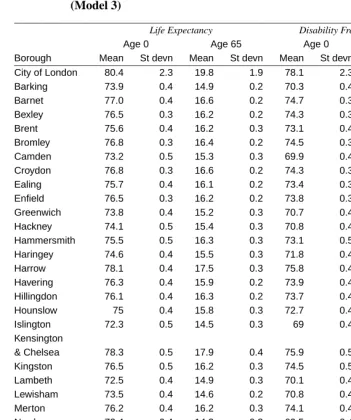
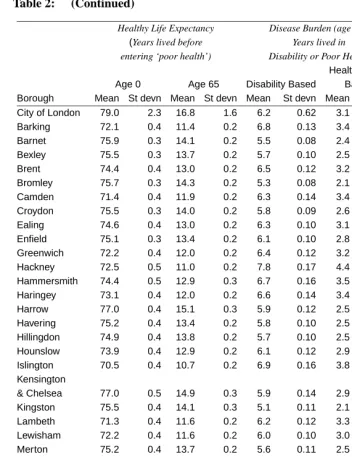
Table 2 shows posterior means and standard deviations by borough for total life ex-pectancy and the two forms of health exex-pectancy (at birth and age65) under model 3. Table 2 also contains a deprivation index devised by the UK Department of Environment, Transport and Regions. For example, the disability free life expectancy at birthWa10varies from69to78.1and correlates−0.85with deprivation.
In terms of the disease burden at age65, Table 2 shows that years lived in poor health
G2
a,65after age65is typically around three years, or half of the years lived in disability
G1
a,65. Hence the worst category of the health status question is apparently identifying more severe morbidity than the long term illness (limiting disability) question. There is a0.95correlation between the disease burden measureG2a,65and deprivation. ForG1a,65 the correlation with deprivation is slightly lower, namely0.92.
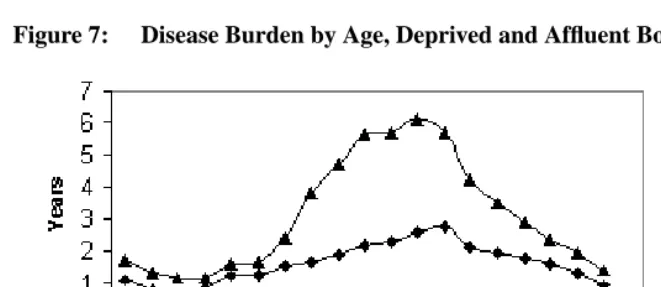
Of interest for health needs profiling is the disease burden at different ages and how this varies between geographic areas. As noted above the area gradients for illness on ageηj1a are more highly correlated with area deprivation than those for mortality. This implies that the age profile of the disease burden would be discrepant between affluent and deprived boroughs, and Figure 7 contrasts the burden-age profile for the deprived inner city borough of Tower Hamlets with that in the affluent suburban area of Bromley. The clear excess in morbidity in the inner city borough, especially in middle ages, can be seen.
8.
Conclusion
This paper has sought to develop and investigate the fit of a set of models that depart from the often used proportionality assumption for mortality and morbidity data which are crossed by age and area. Instead relatively parsimonious models for age-area interactions in data on deaths and health in London have shown that the proportionality assumption is very much a simplification that does not match actuality for this city region.
Table 2: Life Table Parameters, Mortality and Health, London Boroughs (Model 3)
Life Expectancy Disability Free Life Expectancy
Age 0 Age 65 Age 0 Age 65
Borough Mean St devn Mean St devn Mean St devn Mean St devn
City of London 80.4 2.3 19.8 1.9 78.1 2.3 13.6 1.3
Barking 73.9 0.4 14.9 0.2 70.3 0.4 8.1 0.1
Barnet 77.0 0.4 16.6 0.2 74.7 0.3 11.1 0.2
Bexley 76.5 0.3 16.2 0.2 74.3 0.3 10.5 0.2
Brent 75.6 0.4 16.2 0.3 73.1 0.4 9.7 0.2
Bromley 76.8 0.3 16.4 0.2 74.5 0.3 11.2 0.2
Camden 73.2 0.5 15.3 0.3 69.9 0.4 8.9 0.2
Croydon 76.8 0.3 16.6 0.2 74.3 0.3 10.8 0.2
Ealing 75.7 0.4 16.1 0.2 73.4 0.3 9.7 0.2
Enfield 76.5 0.3 16.2 0.2 73.8 0.3 10.1 0.2
Greenwich 73.8 0.4 15.2 0.3 70.7 0.4 8.8 0.2
Hackney 74.1 0.5 15.4 0.3 70.8 0.4 7.6 0.2
Hammersmith 75.5 0.5 16.3 0.3 73.1 0.5 9.6 0.2
Haringey 74.6 0.4 15.5 0.3 71.8 0.4 8.9 0.2
Harrow 78.1 0.4 17.5 0.3 75.8 0.4 11.6 0.2
Havering 76.3 0.4 15.9 0.2 73.9 0.4 10.1 0.2
Hillingdon 76.1 0.4 16.3 0.2 73.7 0.4 10.6 0.2
Hounslow 75 0.4 15.8 0.3 72.7 0.4 9.7 0.2
Islington 72.3 0.5 14.5 0.3 69 0.4 7.6 0.2
Kensington
& Chelsea 78.3 0.5 17.9 0.4 75.9 0.5 12.0 0.3
Kingston 76.5 0.5 16.2 0.3 74.5 0.5 11.2 0.2
Lambeth 72.5 0.4 14.9 0.3 70.1 0.4 8.7 0.2
Lewisham 73.5 0.4 14.6 0.2 70.8 0.4 8.6 0.1
Merton 76.2 0.4 16.2 0.3 74.1 0.4 10.6 0.2
Newham 72.4 0.4 14.3 0.3 69.5 0.4 6.9 0.1
Redbridge 76.1 0.4 16.2 0.2 73.7 0.4 10.0 0.2
Richmond 77.4 0.4 16.8 0.3 75.8 0.4 11.9 0.2
Southwark 73.3 0.4 15.3 0.3 70.6 0.4 8.7 0.2
Sutton 76.1 0.4 15.8 0.3 73.7 0.4 10.5 0.2
Tower Hamlets 72.1 0.4 14.2 0.3 69.1 0.4 6.8 0.2
Waltham Forest 73.6 0.4 14.7 0.2 70.9 0.4 8.5 0.2
Wandsworth 74 0.4 14.7 0.2 71.9 0.4 9.2 0.2
Table 2: (Continued)
Healthy Life Expectancy Disease Burden (age 65), DETR
(Years lived before Years lived in Deprivation entering ‘poor health’) Disability or Poor Health Index
Health Status Age 0 Age 65 Disability Based Based Borough Mean St devn Mean St devn Mean St devn Mean St devn
City of London 79.0 2.3 16.8 1.6 6.2 0.62 3.1 0.34 -0.88
Barking 72.1 0.4 11.4 0.2 6.8 0.13 3.4 0.07 0.68
Barnet 75.9 0.3 14.1 0.2 5.5 0.08 2.4 0.05 -0.84
Bexley 75.5 0.3 13.7 0.2 5.7 0.10 2.5 0.05 -0.91
Brent 74.4 0.4 13.0 0.2 6.5 0.12 3.2 0.06 0.41
Bromley 75.7 0.3 14.3 0.2 5.3 0.08 2.1 0.05 -1.12
Camden 71.4 0.4 11.9 0.2 6.3 0.14 3.4 0.09 0.56
Croydon 75.5 0.3 14.0 0.2 5.8 0.09 2.6 0.05 -0.52
Ealing 74.6 0.4 13.0 0.2 6.3 0.10 3.1 0.06 -0.14
Enfield 75.1 0.3 13.4 0.2 6.1 0.10 2.8 0.05 -0.13
Greenwich 72.2 0.4 12.0 0.2 6.4 0.12 3.2 0.06 0.56
Hackney 72.5 0.5 11.0 0.2 7.8 0.17 4.4 0.11 2.02
Hammersmith 74.4 0.5 12.9 0.3 6.7 0.16 3.5 0.09 0.12
Haringey 73.1 0.4 12.0 0.2 6.6 0.14 3.4 0.08 0.92
Harrow 77.0 0.4 15.1 0.3 5.9 0.12 2.5 0.06 -0.89
Havering 75.2 0.4 13.4 0.2 5.8 0.10 2.5 0.05 -0.85
Hillingdon 74.9 0.4 13.8 0.2 5.7 0.10 2.5 0.05 -0.7
Hounslow 73.9 0.4 12.9 0.2 6.1 0.12 2.9 0.06 -0.22
Islington 70.5 0.4 10.7 0.2 6.9 0.16 3.8 0.10 1.21
Kensington
& Chelsea 77.0 0.5 14.9 0.3 5.9 0.14 2.9 0.08 -0.62
Kingston 75.5 0.4 14.1 0.3 5.1 0.11 2.1 0.06 -1.32
Lambeth 71.3 0.4 11.6 0.2 6.2 0.12 3.3 0.07 0.66
Lewisham 72.2 0.4 11.6 0.2 6.0 0.10 3.0 0.06 0.56
Merton 75.2 0.4 13.7 0.2 5.6 0.11 2.5 0.06 -0.74
Newham 70.9 0.4 10.2 0.2 7.4 0.15 4.0 0.09 2.02
Redbridge 75.0 0.4 13.4 0.2 6.3 0.11 2.9 0.06 -0.49
Richmond 76.6 0.4 14.8 0.3 4.9 0.11 2.0 0.05 -1.47
Southwark 72.0 0.4 11.8 0.2 6.6 0.13 3.5 0.08 1.21
Sutton 74.9 0.4 13.6 0.2 5.3 0.10 2.2 0.05 -1.01
Tower Hamlets 70.4 0.4 9.9 0.2 7.4 0.16 4.3 0.11 2.36
Waltham Forest 72.3 0.4 11.6 0.2 6.2 0.12 3.1 0.07 0.34
Wandsworth 73.1 0.4 12.0 0.2 5.6 0.11 2.7 0.06 -0.37
Figure 7: Disease Burden by Age, Deprived and Affluent Boroughs Compared
age groups accord with a single spatial health index γa. Similarly the basic linear age effect on log death rates or logit illness/health rates may vary over areas.
In a joint life table pooling over outcomes it is important to model the correlation be-tween outcomes. The correlation over outcomes in both age and area impacts is reflected in
a) the pooled random walk effectVxinδjxin models 1 and 2 b) the shared spatial effectsθjsain model 1
c) the adherence by ageβjxγainteracting with shared spatial effects in model 2, and d) the common area effect multiplied by an outcome specific loading in the linear age
effects in model 3, namelyηj1a=ωja+ψjξa.
Further stratifiers may be introduced into such a framework, for example deaths, ill-ness and health may be specific for gender or ethnicity as well as for age and area. A time dimension could be added also.
References
Agresti, A. (2002). Categorical data analysis. Wiley, 2nd Edition.
Anson, J. (1991). Model mortality schedules: a parametric evaluation. Population Studies, 45:137–153.
Bebbington, J. (1993). Regional and social variations in disability-free life expectancy in great britain. In: Robine J-M, Mathers C, Bone I, Romieu, I, eds. Calculation of health expectancies: harmonization, consensus achieved and future perspectives. London: John Libbey.
Besag, J., York, J., and Molli´e, A. (1991). Bayesian image restoration with two appli-cations in spatial statistics. Annals of the Institute of Statistics and Mathematics, 43:1–59.
Carter, L. and Lee, R. (1992). Modeling and forecasting us sex differentials in mortality. International Journal of Forecasting, 8:393–411.
Dean, C., Ugarte, M., and Militino, A. (2001). Detecting interaction between random region and fixed age effects in disease mapping. Biometrics, 57:197–202.
Eames, M., Ben-Shlomo, Y., and Marmot, M. (1993). Social deprivation and premature mortality: regional comparison across england. British Medical Journal, 307:1085– 6.
Gakidou, E., Murray, C., and Frenk, J. (2000). Defining and measuring health inequality: an approach based on the distribution of health expectancy. Bulletin of the World Health Organisation, 78:42–54.
Gelfand, A. and Dey, D. (1994). Bayesian model choice: asymptotics and exact calcula-tions. J. Royal Statist. Soc., 56(B):501–514.
Gelman, A., Carlin, J., Stern, H., and Rubin, D. (1995). Bayesian data analysis. London: Chapman and Hall.
Geweke, J. and Meese, R. (1981). Estimating regression models of finite but unknown order. International Economic Review, 22:55–70.
Goodman, L. (1979). Simple models for the analysis of association in cross-classifications having ordered categories. Journal of the American Statistical Association, 74:537– 551.
Hoem, J. (1987). Statistical analysis of a multiplicative model and its application to the standardization of vital rates: a review. International Statistical Review, 55:119– 152.
Ibrahim, J., Chen, M., and Sinha, D. (2001). Bayesian survival analysis. Springer Verlag: New York.
Lawson, A. and Clark, A. (2002). Spatial mixture relative risk models applied to disease mapping. Statistics in Medicine, 21:359–370.
Lee, R. (2000). The lee-carter method for forecasting mortality, with various extensions and applications. North American Actuarial Journal, 4:80–93.
MacNab, Y. and Dean, C. (2001). Autoregressive spatial smoothing and temporal spline smoothing for mapping rates. Biometrics, 57:949–56.
Murray, C. and Lopez, A. (1996). The global burden of disease. Harvard University Press.
Nandram, B., Sedrank, J., and Pickle, L. (1999). Bayesian analysis of mortality rates for us health service areas. Sankhya, 61(B):145–165.
Newbold, K., Eyles, J., Birch, S., and Spencer, A. (1998). Allocating resources in health care: alternative approaches to measuring needs in resource allocation formula in ontario. Health and Place, 4:79–89.
Noble, M., Penhale, B., Smith, G., Wright, G., Dibben, C., Owen, T., and Lloyd, M. (2000). Indices of deprivation 2000. Regeneration Research Summary Number 31, Department of Transport, Environment and the Regions.
Peterson, B. and Harrell, F. (1990). Partial proportional odds models for ordinal response variables. Applied Statistics, 39:205–217.
Robine, J.-M. and Ritchie, K. (1991). Healthy life expectancy : evaluation of a new global indicator for change in population health. British Medical Journal, 302:457–460.
Spiegelhalter, D., Best, N., Carlin, B., and van der Linde, A. (2001). Bayesian measures of model complexity and fit. J. Royal Statist. Soc, 64(B):583–639.
Sun, D., Tsutakawa, R., Kim, H., and He, Z. (2000). Spatio-temporal interaction with disease mapping. Statistics in Medicine, 19:2015–2035.
Wakefield, J., Best, N., and Waller, L. (2000). Bayesian approaches to disease mapping. In Elliott P, Wakefield J, Best N, Briggs D (eds) Spatial Epidemiology; Methods and applications. Oxford University Press, Oxford, pages 106–127.