Exploring an Authentic Leadership Pattern for Education
Administrators: A Qualitative Study
Jafar Jahani *1, Mehdi Mohammadi1, NedaAbdollahi2, Nasrullah Baacha 3
, Fars, Iran Shiraz
, Shiraz University and Psychology,
Faculty of Education 1Associate Professor,
Department of Education, Faculty of Education and Psychology, Shiraz University, 2Graduate Student of Educational Management,
Shiraz, Fars, Iran
Pakistan ,
University of Wah Department of Education,
, rofessor P istant 3Ass
Abstract
Objective: Educational institutes have increasingly recognized the importance of choosing authentic leadership pattern for their administrators, as it will bring them very positive and wonderful consequencesin various levels. Therefore, the aim of the presentstudy isto explore anauthentic leadership pattern for educational administrators.
Method: In order to achieve thisspecial pattern, the study was performed qualitatively and with a qualitative case study method. Potential research participantsincluded successful directorsand Vice-Presidentsin Shiraz University and colleges with tensuccessful managers of the ten first considerations using targeted sampling approach. Then, using snowball sampling technique and considering the findings’ saturation criteria, another 5 people were added to determine the sample adequacy. Furthermore, semi-structured interview tools were used to gather the research data and then, the interview results were analyzed; thatis, firstly open coding and then axial coding were performed to achieve the basic, the organizer and the comprehensive themes.
Results: The findings of the current study showed that, from the primary 188 codes, the authentic leadership pattern of the education administratorsinvolves 83 basic themes and four personal, interpersonal, organizational, and intra-organizational organizer themes in order to achieve the inclusive themes of academic authentic leadership.
Conclusion: Paying attentionto this leadership style and investmentin enhancing this particular model by educational leaders help them to do their tasks effectively toward all the stakeholders ina moral manner and improves managers’ insightsin developing strategies when dealing with challengesand issuesahead. In conclusion, according to the findings of the study, the following suggestions, divided to functional and research, are being provided.
Keywords: Authentic leadership, Personal, interpersonal, Intra-organizational themes.
Introduction
Constant complexity of activities and the factors in today's changing world, as well as the encountering challenges in education, such as collective expansion of education, decrease in general cost of education, educational diversity, globalization of education, commercialization of education, changes brought by information technology (Barblan, Ivosevic & Daxner, 2007; Vukasovic, 2008) has brought the demand for honest, frank and reliable leaders (Northouse, 2013). The reason is that leadership has a direct effect on effectiveness and morality, fulfilling the tasks, meeting the goals and predicted results (Fraser, 2014). On the other hand, in recent years, these institutes have increasingly recognized the importance of dealing with these organizational changes and challenges, as these institutes face new economic, population, curriculum and adult training challenges (Tierney, 2016). So, in order to coordinate and adjust with vague, complex and prompt educational changes, there is an urgent need for strong leaders with features different with those of other leaders.
Terry (1993) argues that in order to recognize all really happening in leadership, authenticity is essential. Authentic leadership has roots in positive psychology and it was introduced as a novice approach after transformational, servant, and spiritual leadership (Ladkin & Taylor, 2010) and shares to fundamental principles: the real self and the relationship with ethics and morality (Gardner, Cogliser, Davis & Dickens, 2011). There are numerous definitions of authentic leadership and authentic leaders. For instance, Seeman (1966) defines authentic leadership as the ability to reduce the doubts to one's role, Rome and Rome (1967) define it as accepting the limitations, lack of confidence and possibilities by the leader, Hoy and Henderson (1983) states that authentic leadership is the amount of accepting the organizational responsibility of the leader by the subaltern people, Bhindi and Duignan (1997) define authentic leadership as the recognition of the real self and supporting the significant and real values, Begley (2001) sets it as a metaphor for professional effectiveness, morality, and conscious methods, George (2003) states it as the use of abilities, recognizing deficiencies, establishing sustainable relationships, self-adjustment, lifetime personal development, Luthans and Avolio, (2003) define it as the process of developing positive mental capacities, Avolio, Luthans and Walumbwa (2004) and Erkutlu and Chafra (2013) define it as being aware of others' and his thoughts, behavior, and viewpoints, Begley (2004) puts it as self-awareness and sensitivity to others' justification, Ilies, Morgeson and Nahrgang (2005) define it as deep awareness of values and beliefs, being honest and reliable, Shamir and Eilam (2005) say that authentic leadership is the level of integrity, self-concept clarity, self-harmony, and adapting one's behavior to the self-concept, George and Sims (2007) define it as people who are honest, reliable, guide, stimulator and concerned about others, Amanda et al. (2014) and Walumbwa et al. (2008) define it as a behavioral role model arising from the positive psychological aspects and organizational positive behavioral atmosphere, Avolio, Walumbwa, and Weber (2009) define it as a role model of an ethical and honest leader, Whitehead (2009) says authentic leader is a person who has a high level of self-awareness, modesty and pays attention to others' improvement and welfare and is committed to the organization's success, and finally Walumbwa et al. (2010) says that an authentic leader shows a level of awareness and a sample of openness and clarity toward others; however, the most well-known definition of authentic leadership is proposed by Walumbwa et al. (2008): "authentic leadership is a pattern of leadership, arising from positive psychological capacity and positive moral atmosphere; he tries to promote these two behaviors and leads to development of a sense of self-awareness and promotes inner moral viewpoints, harmonious process of information and relationship transparency in part of leaders' work with supporters, ultimately resulting in positive self-development".
Most people have acknowledged the effect of leadership on how goals and organization duties are
met effectively. This is of high significance in complex and fast field of education in the 21st century
organizations deal with (Franklin, 2010) and helps to the organization and employees in dealing positively with challenges ahead, especially in critical periods when leaders' and organization's behavior diminishes and the probability of official and behavioral infringement increases. These features can create a negative atmosphere and ultimately lower level of employees' psychological assets, so authentic leadership plays a key role here, because authentic leadership benefits from internalized moral aspect and behaves and makes a decision only according to moral indicators (Luis, 2014). Moreover, authentic leadership theory sought to prove how a leader can overcome the crises in unreliable and changeable atmospheres by means of ethics (Liu, Cutcher & Grant, 2015). Authentic leaders have a real sense of self-awareness and believe in their feelings, emotions, motivations, and values (Kernis, 2003). So, they provide a balanced understanding of their strengths and weaknesses (Walumbwa et al., 2008).
2005). Authentic leadership style is a morality-based style in organizational management. If it is exploited by educational managers at university, it can be the basis of developing and enhancing morality-based management styles in personal, organizational and social level (Piran nejad, 2013). With the experience of half a century, Shiraz university is regarded as one of the elite universities among other educational institutes, so a moral leader with positive psychological capacities, followed by leaders' authenticity is of high importance. Choosing the special leadership approach which is authentic in organizations has gained more importance due to its role in society, as leaders, with these capacities and their authentic leadership, can preserve appropriate and positive organizational results in challenges and problems, take into account moral standards in their decision and seek for their adherents' (university staff and faculty members) and the university's well-being and establish transparent relationships. This transparency opens the door for interacting ideas, beliefs, and relationships among members of an organization (Fraser, 2014). Authentic and kind leaders of a university can contribute to creating a sense of mutual trust by creating sincere relationship with staffs and faculty members. Thus, the adherents will undertake their duties and tasks honestly and committedly to achieve the 20-year vision plan and higher effects. At university, an authentic leader responds positively and constructively to external and internal pressures and challenges by getting to know his and his adherents' strengths and exploiting the challenges put forward by adherents and never surrenders to environmental pressures. So, paying attention to this leadership style and investment in enhancing this particular model by educational leaders help them to do their tasks effectively toward all the stakeholders in a moral manner and improves managers' insights in developing strategies when dealing with challenges and issues ahead.
What was stated reveals the importance of authentic, unique and native leadership and shows the direct and indirect effects of this particular approach in leaders' success and effectiveness. It also shows the development of positive aspects in different organizational levels such as trusting the leader, communicative atmosphere and sharing the knowledge, adherents' job satisfaction and organizational commitment, citizens' behavior and work interaction, employees' turnover, group creativity, team efficiency, psychological well-being and organization's total function. By choosing this leadership style, universities' authentic leaders can get over all crises and challenges using this moral guideline. It seems that achieving these positive and great consequences requires special considerations and planning; thus, it asks for managers' special attention to revising their leadership style and their attempt to enhance their authentic leadership behaviors and one of the major prerequisites of forming this authentic leadership style at universities is discovering an authentic leadership pattern for educational managers. This pattern should consist of all university authentic leadership features. What is intended in this study is the attention to educational authentic leaders as the directors of this high-ranking entity and how a pattern, with all the capabilities and features of an academic authentic leader, can be discovered for its leaders. Conducting this study can help us to answer so many questions in the field and add to the existing knowledge in leadership and broaden our horizon in order to do studies in future.
Literature review
2005); nine components of positive psychological capacity, positive moral views, leader's self-awareness, leader's self-adjustment, leadership behavior and processes, adherents' self-awareness and self-adjustment, adherents' development, organizational background, sustainable, real and extraordinary function (Avolio and Gardner, 2005), two aspects of awareness and self-adjustment (Gardner et al., 2005), four aspects of self-awareness, moderate process of information, authentic behavior and relationship transparency (Avolio and Gardner, 2005), four aspects of self-awareness, moderate process of information, relationship transparency and internalized moral aspects (Walumbwa et al., 2008; Neider and Schriesheim2011; Mazutis, 2011; Wong and Laschinger, 2013; Rego, Sousa, Marques & et al., 2012), five aspects of adherentship, following the rules, leader's characteristics, honesty and coherence (Xie Hengxiao, 2007), four components of awareness, unbiased process, behavior and behavior justification (Kernis and Goldman, 2006), four aspects of self-concept, self-transparency in a high level, self-harmony goals, self-assertiveness behavior (Shamir and Eilam, 2005). Accordingly, the general aim of this qualitative study is to discover a pattern of authentic leadership for educational managers of Shiraz University. The key question of the research is, "What are the components of the patterns for authentic leadership of educational managers?"
Method
The method: the following study was done qualitatively and with a qualitative case study method to
find the authentic leadership pattern for educational managers in Shiraz University.
Potential participants in the study: Potential participants in the study were the current (about 48
people) and previous (number unknown) chancellors and vice chancellors in different faculties who had the experience of a management position. It is to be noted that the academic ranks ranged from associate professor to professor with 5 to 35 years of management experience.
Participants and their selection method: as it was not so easy to distinguish managers who were
authentic leaders, the participants were selected with sequential sampling approach with snowball sampling method and then were interviewed. Also, the process of selecting participants (15 including 6 assistant professors, 6 full professors and 3 professors who were all male) was stopped after the theoretical saturation.
Data collection: semi-structured interview was the tool used to identify the themes and
components of authentic leadership of educational managers and in this way, chancellors and vice chancellors of the university and faculties stated their viewpoints openly. It should be stated that the allocated time for each interview lasted between 30 minutes to 3 hours. During these interviews, the participants were asked open-ended questions and after getting their permission, their voice was recorded and then transcribed.
Reliability of the collected data: in this study, in order to investigate the trustworthiness, credibility
and dependability techniques were used.
Data analysis: thematic analysis was used to analyze the acquired data from the interview. This
analysis consisted of three stages, including basic themes, organizer themes and comprehensive themes. Finally, by using these three stages, a thematic network was established and by identifying the relationship between these three themes, the primary pattern for authentic leadership was discovered as a website.
Results
Stage 1: in this stage, the content of the interview was transcribed to achieve a pattern of authentic leadership for educational managers. Then, every single line of the transcriptions was studied carefully and nearly 183 primary codes were extracted. In the next stage, some codes were merged, deleted and changed and finally, 80 basic themes related to authentic leadership and four organizer themes were achieved, including personal (20 basic themes), interpersonal (29 basic themes), organizational (23 basic themes), and ultra-organizational (8 basic themes) to extract the comprehensive themes of authentic leadership for educational managers.
Positive psychological aspects, positive behavioral and guidance aspects, valuation and understanding duties, one's responsibilities and rights, the ability to plan accurately, scientific and real judgment and assessment, encountering and struggling with corruption and infringement, a researcher, scientist and expert in his own field, attention to their development, the ability to take part in academic society, creative and scientific solution to problems, attention to authentic criteria, measures and scientific values, maintaining academic behavior, political and intellectual stability, scientific viewpoint, pragmatic, result-oriented, pluralistic, specialistic-oriented, flexible, comprehensive, positive, understanding and experiencing all scientific processes, transparent, timely, reasonable, and accurate decision-making, acceptance, efficient, academic entrepreneur, believing in science importance, anthropocentric.
Talent management, consulting the adherents, partial ability in law, psychology, and sociology, balanced attention to adherents' needs and desires, flexibility and coordination of ideas and comments, providing motivation, job belonging, establishing a calm and peaceful atmosphere based on morality, respect, honesty, reliance and trust, satisfaction, friendship, kindness, and mutual intimacy, establishing an atmosphere for association and freedom of thought, providing an understandable scientific atmosphere, scientific communications and interactions which are transparent and morality-based, empowering the adherents, accountability, stating expectations transparently, recognizing viewpoints and beliefs of all cultures and religions, acceptance of leader's authority by the adherents, preferring collective interests over personal interests, not changing the viewpoint and personality according to the conditions, sovereignty of law, sympathy and honest solution of adherents' problems, supporting the adherents, getting to know the adherents, improving and developing citizenship's positive behavior, providing the facilities needed by adherents, providing the chance for adherents to ask questions, providing the background for conducting research projects, kind, reputable, open, brave and sympathetic, open attitude and viewpoint, comprehensive based on choosing the right one, inspiring and compassionate guidance, being of help to adherents.
Recognizing the university nationally and internationally, knowing the interior and exterior stakeholders and increasing the communication with them, meeting the needs and expectations of the society, solving the society's issues and problems, attention to the country's improvement and development, increasing the interaction and communication with other universities nationally and internationally, enhancing the university's outer image, coordinating with society's expectation.
Table 1. Organizer themes and the related evidence.
Personal 1. They are scientists, knowledgeable people and "we often see people in this field who have a word in their area of expertise and are expert". (code 3)
2. If he is an ideal manager, he pays attention to both his development and the three group he is working with. With regard to his development, he shouldn’t feel disdained to take part in a workshop in university, either in management or education. (code 4)
Interpersonal 1. The manager should put aside his personal preferences and respect all preferences and work within the system's general framework. So,
respecting others' preferences and tastes as well as maintaining the insights and strategy are the prerequisites of popularity of an authentic leader. (code 14)
2. He should have high mental capacity and not get disappointed after challenges and crises. He should also be able to make decision in tough situations. He has to be able to prefer collective interests over personal interests and sacrifices his own preference. (code 11).
Organizational 1. Another principle is that a successful manager should know about regulations, know what the most so-called updated regulation with regard to a phenomena is and keep themselves updated (code 4) and circulars are sent to university on a daily basis from ministry of education which need to be answered by the manager (code 4). Secondly, he must have a plan and these should be in line with the university's goals and viewpoints. "A university leader should be able to plan for his long-term, midterm and short-term actions and have a daily plan and work based on these plans". (code 9)
2. People think that the infringement which should be tackled is a major infringement. They think that what causes a problem to a society are big things. I have an opposite idea. I believe what can be dangerous to a society are minor infringements (code 2). He should be able to implement supervision in all fields completely. The supervision
committee has recently changed its name to: supervision, evaluation and guarantee of quality, as mere supervision is not of any use. I emphasize on being result-oriented. It means that seeing the results of our
endeavors. Supervision in different ways. (code 13).
Out-of-organization
1. writing an article is not the ultimate goal. How can this article solve the problems in a society? Attracting the research load at university is a tool, not goal. It should be a tool to get to a profound effect, that is solving the problems of a society. (code 13) The purpose of increasing general awareness is that you place yourself in the middle of it to be able to comment on it (Reality of Certainty) and our duty is the same at universities. (code 13)
criterion of ranking Iranian universities is the amount of interaction with international universities, the number of foreign professors coming here and the number of Iranian professors going abroad to teach. (code 6)
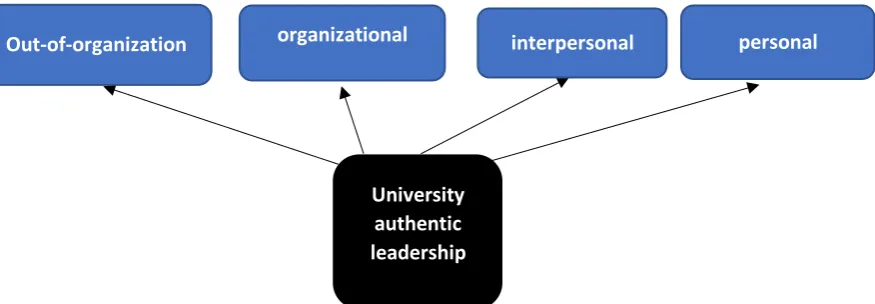
Stage 3: in this stage, using the basic, the organizer and the comprehensive themes in the previous stage, the "thematic network of authentic leadership pattern of educational managers" was planned to be created which is shown in figure 1.
Figure 1. Thematic network of authentic leadership pattern of educational managers.
Validation of qualitative data
The results of aligning data showed that the themes arising from thematic analysis in this study is in line with research and theoretical basis. It confirms the validity of qualitative data of the previous part.
Discussion and Conclusion
The results of the findings from thematic analysis which was done to recognize the themes and characteristics of authentic leadership of educational managers showed that the mentioned pattern consists of four major components: 1. Personal, 2. Interpersonal 3. Organizational 4. Out-of-organization; which can be considered as key features, as these components have had the highest attention among the mentioned features by participants in order to form an authentic leadership pattern of educational managers. In this pattern, for participants, personal component of university authentic leadership denotes all features that an authentic leader should have, including having positive and moral characteristics, so that he keeps enough self-confidence and deals with the adherents' and organization's problems and issues optimistically and hopefully. Modesty and humbleness, and kindness and sympathy are other features for an authentic leader as they can be effective for adherents' positive attitude and its development. These findings are in line with those by Avi, Richmond and Nickson (2012). They stated that positive leadership has a direct relationship with employees' psychological assets and leads to more creativity in them. An authentic leader should be totally aware of all his strengths, weaknesses, values and beliefs; they should be aware of their rights and responsibilities and value each factor. These were also in line with Kernis (2003). As he stated, authentic leaders have a deep self-awareness and trust their feelings, emotions, motivations and values. One of the main features of university authentic leaders is accurate planning, scientific and real judgment and analysis of current and previous issues for future planning. Such leaders should struggle with any corruption or infringement at university and should never allow the corruptive atmosphere to occur. They also argued that a university authentic leader should be a scientist and expert in his own field, and has the ability to take part in academic society. They should be able to
University authentic leadership
personal interpersonal
understand and have experienced all scientific approaches and take scientific criteria and values into account. Another point mentioned by the participants is preserving academic morality and ethics under all circumstances in a way that a university authentic leader needs to keep his political and intellectual balance in different cases. Other points mentioned by the participants were the ability to recognize, prescribing scientific approaches and honest solutions for various issues. An authentic leader should decide clearly, timely, reasonably and accurately in all cases. These findings were compatible with Wong and Laschinger (2013) in which they claimed that transparency in an organization will provide the basis for a professional job atmosphere with mutual trust; also, a kind of continuous coaching will be established in the organization by creating conditions to communicate with the adherents and donating some independence to them, which results in constructive feedback and employees' cooperation in decision making and their acknowledgement of the organization. Moreover, for a university authentic leader, some other points were confirmed, including having a scientific viewpoint, being pragmatic, result-oriented, pluralist and expert, flexible, comprehensive, positive, and based on worthy experiences. Among other important features mentioned for a university authentic leader is being proficient, efficient, entrepreneur, and paying attention to his own development. Finally, recognizing plurality and effect on people was mentioned as other personal features of an authentic leader by the participants.
establishes an academic environment, in which all the adherents tend to do a task with a high sense of motivation and belonging. In his interpersonal interactions with adherents, an authentic leader is a kind, open, problem-solver, and brave person who has a father figure and guides the adherents sympathetically and provides the way. He listens to adherents' issues and problems and attempts to solve them basically and supports them since he knows how to interact effectively with them. Begley's (2004) findings in this field showed that an authentic leader is self-aware, sensitive to others' justifications and technical complexities, leading to higher synergy in their leadership proceeds. His attitude is open, general, comprehensive, wide, human-centered and based on choosing the right person, providing all the fields required for adherents' development, especially their citizenship behavior. Furthermore, in his interactions with his adherents, an authentic leader should be able to create transparent, good, honest, close, continuous, respectful, balanced, scientific and wide interactions with his adherents. An authentic leader states his expectations clearly. These findings are in line with the study done by George and Sims (2007). They pointed out that authentic leaders are "honest people, being realistic with regard to themselves and abilities". They try to create trust and develop a real relationship with others. People believe in them and this belief enables them to provide a sense of motivation for a high level of performance. He accepts others' viewpoints, religions, beliefs and tastes and respects them. Adherents also welcome his knowledge and expertise. Begley (2001) suggests that an authentic leader at university approves the legitimate needs of people, groups, organizations, societies and cultures and offers an appropriate management performance.
The outside-university component denotes the behavioral features of a leader beyond the organization, country, etc. According to participants, these features include knowing universities nationally and internationally, knowing interior and exterior stakeholders and developing his relationships with them, recognizing and meeting the society's needs and expectations, recognizing and trying to solve the problems of the society, paying attention to country's growth and development, expanding the university's interaction and communication with other universities in different fields nationally and internationally, enhancing the university's outer image so that everyone knows the university throughout the world, and coordinating with society's expectation. Due to these findings and according to May et al. (2003), an authentic leader looks at the problem in different views and takes into account the needs of stakeholders. In fact, these leaders try to make the best decisions by taking into account the needs of different people. Also, according to Toor and Ofori (2008), authentic leaders are all aware of cultural sensitivities and are really motivated and self-aware. They also have a high sense of honesty, adherence to goals, braveness in moving ahead and skill.
Based on what has been mentioned so far, it can be said that authentic leadership principles can be of help to interior and exterior demands and pressures, especially when they face issues such as having access to education, cost-effective education, and exterior evaluation by regional educational organizations. Moreover, this leadership pattern pays attention to employees' and faculty members' tensions with regard to accountability to manager and the ever-increasing need to transparency and responsibility. Establishing open relationships with employees and faculty members by university managers can make them successful in achieving their job demands and doing their duties without any expectations. University leaders act clearly with regard to their values and beliefs, they are stable and guide people's behavior and plans in the appropriate manner and by setting themselves as role model, they provide behavioral expectations (Arasteh, 2008). So, paying attention to this leadership style and investment in enhancing this particular model by educational leaders help them to do their tasks effectively toward all the stakeholders in a moral manner and improves managers' insights in developing strategies when dealing with challenges and issues ahead.
In conclusion, according to the findings of the study, the following suggestions, divided to functional and research, are being provided.
Functional suggestions: 1. Due to the personal features for authentic leadership pattern for educational managers, educational managers are suggested to deliberate themselves and know more about their moral and behavioral features and improve their self-awareness in this field; 2. As it was said that many educational features of authentic leadership can be taught, it is suggested that we recognize these features and plan to improve them in managers of all levels; 3. Due to the importance and dignity of authentic managers of Shiraz University, top managers are advised to appreciate these people.
Research suggestions: 1. In order to investigate educational managers' viewpoints thoroughly, this should be investigated in other universities in Iran; 2. Because of the importance of educational system and especially education in schools, it is suggested that this subject is studied for authentic professor, authentic trainer and authentic teacher.
References
Amanda S. Hinojosa، Kelly Davis McCauley، Brandon Randolph-Seng ،William L. Gardner (2014) Leader
and follower attachment styles: Implications for authentic leader–follower relationships ،The Leadership
Quarterly (2014).254-287 .
Amunkete, S., & Rothmann, S. (2015). Authentic leadership, psychological capital, job satisfaction and
Anna M. Cianci، Sean T. Hannah، Ross P. Roberts، George T. Tsakumis ،(2014) The effects of authentic
leadership on followers' ethical decisionmaking in the face of temptation: An experimental study The
Leadership Quarterly (2014)،358-398.
Avolio, B. J., & Gardner, W. L. (2005). Authentic leadership development: Getting to the root of positive
forms of leadership. The leadership quarterly, 16(3), 315-338.
Avolio, B. J., Luthans, F., & Walumbwa, F. O. (2004b). Authentic leadership: Theory-building for veritable
sustained performance. Working paper. Gallup Leadership Institute, University of Nebraska-Lincoln.
Avolio, B. J., Walumbwa, F. O., & Weber, T. J. (2009). Leadership: Current theories, research, and future
directions. Annual Review of Psychology, 60, 421–449.
Barblan, A., Ivosevic, V., & Daxner, M. (2007). Academic Malpractice Threats and Temptations: An Essay of the Magna Charta Observatory and the National Unions of Students in Europe (ESIB). Bononia University Press.
Bass, B. M., & Avolio, B. J. (1997). Full range leadership development: Manual for the multifactor leadership
questionnaire.Palo Alto: Mind Garden.
Begley, P. T. (2001). In pursuit of authentic school leadership practices. International Journal of Leadership
in Education, 4, 353–365.
Begley, P. T. (2004). Understanding valuation processes: Exploring the linkage between motivation and action.
International Studies in Educational Administration,32(2), 4–17.
Bhindi, N., & Duignan, P. (1997). Leadership for a new century: Authenticity, intentionality, spirituality and
sensibility. Educational Management & Administration, 25(2), 117-132.
Chan, A. Y. L. H., Hannah, S. T., & Gardner, W. L. (2005). Veritable authentic leadership: Emergence, functioning, and impacts. Authentic leadership theory and practice: Origins, effects and development, 3, 3-41.
Erkutlu, H.,Chafra,J. (2013). Effects of trust and psychological contract violation on authentic leadership and
organizational deviance. Management Research Review, Vol. 36, No. 9, 828-848.
Fernando, M. (2011) Spirituality and leadership. In Bryman, A., Collinson, D., Grint, K., Jackson, B. and Uhl
-Bien, M. (eds) The SAGE handbook of leadership, pp. 483–94. Thousand Oaks, CA: Sage.
Franklin, R. S. (2010). Exploring the moral development and moral outcomes of authentic leaders. Regent University.
Fraser, S. (2014). Authentic Leadership in Higher Education: Influencing the Development of Future Leaders. Fusco, T., O’Riordan, S., & Palmer, S. (2015). Authentic Leaders are… Conscious, Competent, Confident, and Congruent: a Grounded Theory of Group Coaching and Authentic Leadership Development.
International Coaching Psychology Review, 10(2), 131-148.
Gardner, W. L., Avolio, B. J., Luthans, F., May, D. R., & Walumbwa, F. O. (2005). “Can you see the real me?”
A self-based model of authentic leader and follower development. TheLeadership Quarterly, 16,
343-372.
Gardner, W. L., Cogliser, C. C., Davis, K. M., & Dickens, M. P. (2011). Authentic leadership: Areview of
literature and research agenda. The Leadership Quarterly, 22, 1120-1145.
George, W. (2003). Authentic leadership: Rediscovering the secrets to creating lasting value. SanFrancisco,
CA: Jossey-Bass.
George, W., & Sims, P. (2007). True north: Discover your authentic leadership. San Francisco: Jossey-Bass.
Hoy, W. K., & Henderson, J. E. (1983). Principal authenticity, school climate, and pupil-control orientation.
The Alberta Journal of Educational Research, 29, 123–130.
Hx.Xie, Authentic leadership construct and relevant variables research.[D], Jinan University, 2007.(In
Chinese).
Ilies, R., Morgeson, F. P., & Nahrgang, J. D. (2005). Authentic leadership and eudaemonic well-being:
Understanding leader–follower outcomes. The LeadershipQuarterly, 16, 373–394.
Kernis, M. H., & Goldman, B. M. (2006). A multicomponent conceptualization of authenticity: Theory and
research. In M. P. Zanna (Ed.), Advances in experimental social psychology, (Vol. 38, pp. 283–357).
San Diego: Academic Press.
Klenke, K. (2007). Authentic leadership: a self, leader, and spiritual identity perspective. International journal
of leadership studies, 3(1), 68-97.
Ladkin, D., & Taylor, S. S. (2010). Enacting the ‘true self’: Towards a theory of embodied authentic leadership.
The Leadership Quarterly, 21, 64–74.
Liu, H., Cutcher, L., & Grant, D. (2015). Doing authenticity: The gendered construction of authentic
leadership. Gender, Work & Organization, 22(3), 237-255.
Lotfi Jalalabadi, M, Moghli, A, R, Feizi, Ta & Amir Khani, A, H. (2015). Investigating the Effect of Authentic Leadership on Organizational Identity (case study of employees of one of the industrial defense units of
the country). Military Management Quarterly, 58, 24-42. (in Persian)
Luthans, F., & Avolio, B. J. (2003). Authentic leadership development. In K. S. Cameron, J. E.Dutton, & R.
E. Quinn (Eds.), Positive organizational scholarship, 241-258. SanFrancisco: Barrett-Koehler.
May, D. R., Chan, A. Y., Hodges, T. D., & Avolio, B. J. (2003). Developing the moral component of authentic
leadership. Organizational dynamics, 32(3), 247-260.
Mazutis, D. (2011). Athentic leadership (book chapter). Los Angeles: Sage.
Mir Mohammadi, M & Rahimian, M. (2014). Investigating the Effect of Authentic Leadership on Individual
Creativity of Staff Based on the Mediating Role of Psychological Capital. Management Research in
Iran, 18, 3, 181-203. (In Persian)
Müceldili, B., Turan, H., & Erdil, O. (2013). The influence of authentic leadership on creativity and
innovativeness. Procedia-Social and Behavioral Sciences, 99, 673-681.
Neider, L. L., & Schriesheim, C. A. (2011). The authentic leadership inventory (ALI): Development and
empirical tests. The Leadership Quarterly, 22(6), 1146-1164.
Northouse, P. G. (2013). Leadership: theory and practice. New Delhi: Sage.
Penger, S., & Černe, M. (2014). Authentic leadership, employees’ job satisfaction, and work engagement: a
hierarchical linear modelling approach. Economic Research-Ekonomska Istraživanja, 27(1), 508-526.
Piran Nejad, A. (2013). Authentic Leadership, Essential Style in University Management (Case Study of
Payame Noor University in Tehran and Alborz), Management Quarterly in Islamic University, 2, 2,
329-350. (In Persian)
Rego, A., Sousa, F., Marques, C., & e Cunha, M. P. (2012). Authentic leadership promoting employees'
psychological capital and creativity. Journal of Business Research, 65(3), 429-437.
Rego, A., Sousa, F., Marques, C., & e Cunha, M. P. (2014). Hope and positive affect mediating the authentic
leadership and creativity relationship. Journal of Business Research, 67(2), 200-210.
Rome, B., & Rome, S. (1967). Humanistic research on large social organizations. Challenges of humanistic
psychology, 181-193.
Sednaghavi, A & Kahah, M (2014). The Role of Authentic Leadership in Promote Employee's Enthusiasm and
Creativity. Journal of Management Studies (Improvement and Development), 23, 76 (in Persian)
Seeman, M. (1966). Status and identity: The problem of inauthenticity. Pacific Sociological Review, 9(2),
67-73.
Shamir, B. and Eilam, G. (2005) ‘What’s your story?’ A life-stories approach to authentic leadership
development. The Leadership Quarterly, 16,3, 395–417.
Starratt, R.J. (2004) Ethical Leadership. San Francisco, CA: Jossey-Bass.
Tierney, W. G. (2016). Portrait of higher education in the twenty-first century: John Henry Newman’s ‘The
idea of a university’. International Journal of Leadership in Education, 19(1), 5-16.
Toor, S. U. R., & Ofori, G. (2008). Leadership for future construction industry: Agenda for authentic leadership.
Vukasovic, M. (2008). The integrity of higher education from essence to management. Proceedings of the
Seminar of the Magna Charta Observatory, 19 September 2007, The Management of University Integrity
Walumbwa, F. O., Avolio, B. J., Gardner, W. L., Wernsing, T. S., & Peterson, S. J. (2008). Authentic
leadership: Development and validation of a theory-based measure. Journal of management, 34(1),
89-126.
Walumbwa, F.O., Wang, P., Wang, H., Schaubroeck, J. and Avolio, B.J. (2010) Psychological processes
linking authentic leadership to follower behaviors. The Leadership Quarterly, 21, 5, 901–14.
Wong, C. A., & Laschinger, H. K. (2013). Authentic leadership, performance, and job satisfaction: the
mediating role of empowerment. Journal of advanced nursing, 69(4), 947-959.
Zhang, H., Everett, A. M., Elkin, G., & Cone, M. H. (2012). Authentic leadership theory development: