DEMOGRAPHIC RESEARCH
VOLUME 31, ARTICLE 10, PAGES 247
−
274
PUBLISHED 22 JULY 2014
http://www.demographic-research.org/Volumes/Vol31/10/ DOI: 10.4054/DemRes.2014.31.10
Research Article
Disagreements among cohabiting and married
couples in 22 European countries
Tanja van der Lippe
Marieke Voorpostel
Belinda Hewitt
This publication is part of the Special Collection on “New Relationships from a Comparative Perspective,” organized by Guest Editors Anne-Rigt Poortman and Belinda Hewitt.
©2014 van der Lippe, Voorpostel & Hewitt.
This open-access work is published under the terms of the Creative Commons Attribution NonCommercial License 2.0 Germany, which permits use, reproduction & distribution in any medium for non-commercial purposes, provided the original author(s) and source are given credit.
1 Introduction 248
2 Background and hypotheses 249
2.1 Disagreements within cohabiting and married relationships 249
2.2 Country context 252
2.3 Hypotheses 253
3 Methods 254
3.1 Data 254
3.2 Measures 255
3.2.1 Dependent variables 255
3.2.2 Independent variables 255
3.3 Analytical strategy 258
4 Results 258
4.1 Descriptive results 258
4.2 Multilevel logit models 260
5 Conclusion and discussion 265
6 Acknowledgements 267
Disagreements among cohabiting and married couples
in 22 European countries
Tanja van der Lippe1
Marieke Voorpostel2
Belinda Hewitt3
Abstract
BACKGROUND
Cross-national research suggests that married people have higher levels of well-being than cohabiting people. However, relationship quality has both positive and negative dimensions. Researchers have paid little attention to disagreements within cohabiting and married couples.
OBJECTIVE
This study aims to improve our understanding of the meaning of cohabitation by examining disagreements within marital and cohabiting relationships. We examine variations in couples’ disagreements about housework, paid work and money by country and gender.
METHODS
The data come from the 2004 European Social Survey. We selected respondents living in a heterosexual couple relationship and aged between 18 and 45. In total, the study makes use of data from 22 European countries and 9,657 people. Given that our dependent variable was dichotomous, we estimated multilevel logit models, with (1) disagree and (0) never disagree.
RESULTS
We find that cohabitors had more disagreements about housework, the same disagreements about money, but fewer disagreements about paid work than did married people. These findings could not be explained by socio-economic or demographic measures, nor did we find gender or cross-country differences in the association between union status and conflict.
1 Department of Sociology/ICS, Utrecht University, Padualaan 14, 3508 TC Utrecht, the Netherlands.
E-Mail: [email protected].
2 FORS, Switzerland.
CONCLUSIONS
Cohabiting couples have more disagreements about housework but fewer disagreements about paid work than married people. There are no gender or cross-country differences in these associations. The results provide further evidence that the meaning of cohabitation differs from that of marriage, and that this difference remains consistent across nations.
1. Introduction
Cross-national research on differences between cohabitation and marriage has focused mainly on relationship stability and satisfaction (e.g., Liefbroer and Dourleijn 2006; Soons and Kalmijn 2009). Such research has consistently found that married couples are often better off than cohabiting couples. However, relationship quality has both positive and negative dimensions (Amato and Rogers 1999; Johnson et al. 1986). Individuals can feel satisfied with their relationship and still fight a lot. We argue that focusing on the positive dimension of relationship quality alone does not tell the full story. To gain more insight into the differences between cohabiting and married couples, we need to focus on conflict as well, since it is difficult to imagine an intimate relationship that does not involve occasional conflict (Miller, Perlman, and Brehm 2007). The aim of this study is to improve our understanding of the meaning of cohabitation by examining disagreements about housework, paid work and money within marital and cohabiting relationships.
In line with Ruppanner (2010), we argue that conflict must be understood in context. Given the fact that cohabitation has been institutionalized in recent decades in some European countries (Soons and Kalmijn 2009), the association between type of union and disagreement may differ between countries. Studying cross-country differences may also teach us more about the meaning of cohabitation, which is still debated (Huang et al. 2011; Seltzer 2004a). Demographers and sociologists have long been driven by the question of where cohabitation fits in, in union formation processes (see for example Rindfuss and VandenHeuvel 1990), and if it is an incomplete institution (Nock 1995). In addition, it is frequently argued that because cohabitation is without the institutional constraints that accompany marriage, it may offer more freedom to negotiate gender roles (Cherlin 2004). Marriage is a highly gendered institution in which husbands and wives have well-defined expectations of how each gender should behave (Brines 1994). In contrast, research indicates that gender roles are less structured in cohabitive relationships (Batalova and Cohen 2002). Empirical results show that gender is a salient factor in relationship quality among older cohabiting and married couples (Brown and Kawamura 2010), with cohabiting men reporting lower quality in their relationship than married men. Ruppanner (2010), in her analysis of housework conflict, did not specifically differentiate between marital and cohabiting relationships. Nevertheless, the results indicate that women who have never married are more likely to have conflicts about housework than are their married counterparts. No differences were found between married men and men who have never been married. Overall, we expect to find gender differences in perceptions of conflict in cohabiting and married relationships.
The current study builds on existing research on relationship conflict, and examines gender-related variations in disagreements about housework, paid work and money, between cohabiting and married individuals. We further investigate the importance of the country context by comparing and contrasting relationship conflict within cohabiting and married relationships across 22 European countries.
2. Background and hypotheses
2.1 Disagreements within cohabiting and married relationships
cohabitors are less often a select group, other explanations have been formulated to gain insight on the differences between cohabitors and married couples. According to the commitment theory, the motivation for cohabitation versus marriage is based on personal dedication and constraint commitment (Stanley, Whitton, and Markman 2004). Dedication refers to interpersonal commitment associated with a strong desire for the relationship to last into the future (Rhoades, Stanley, and Markman 2012). Previous research indicates that cohabitation prior to marriage is associated with lower levels of commitment to a partner (Stanley, Whitton, and Markman 2004), and that cohabitors as a group tend to value individual freedom more than do their married counterparts (Axinn and Thornton 1992; Thomson and Colella 1992). These findings suggest that cohabitors feel less dedication to their relationships and their partners than married partners do, and this could lead to an increase in conflict. Moreover, compared to marriage, cohabitation can be viewed as an incomplete institution (Nock 1995). There are clear standards of propriety and decorum with respect to married couples, but less so with respect to cohabiting ones (Nock 1995): rules and regulations are less clear for cohabitors than they are for married couples. Since cohabitation is less institutionalized than marriage, cohabitors have to actively negotiate and construct their roles and expectations, which can lead to conflict. Married partners already have a shared understanding of what it means to be a husband or wife, and should presumably have less to disagree about (see also Wilcox and Nock 2006).
Both perspectives thus lead to the expectation that cohabitors will generally experience more conflict with each other than married partners. Previous research has found that cohabitors have lower levels of relationship commitment, and fewer moral, structural and institutional constraints to stay in their relationship than do married couples, resulting in higher levels of conflict overall (Brown and Booth 1996; Nock 1995; Widmer, Kellerhals, and Levy 2006).
housework than their married counterparts, as the assumption is that the division of labor will be more egalitarian for them than for married women (Miller and Sassler 2010). We might therefore expect cohabiting women to report higher levels of conflict about housework than cohabiting men, and for the gender difference to be larger than it is within married relationships.
Lack of institutionalization and cohabiters’ low commitment to relationships would also predict higher conflict for cohabiting couples in case of paid work. However, with respect to paid work, other differences between cohabitation and marriage would predict it to be the other way around, with cohabiters having fewer conflicts. Previous research indicates that cohabiting couples are less traditional in their roles, with cohabiting men working fewer hours and cohabiting women working more hours than do married men and women (Brines and Joyner 1999). This is -at least for cohabiting women- more in line with a less traditional gender ideology, and is therefore likely to result in less conflict. Compared to married men, cohabiting men tend to have more marginal employment, characterized by irregular hours, low-status work, and temporary employment contracts (Clarkberg 1999; Kalmijn 2011; Oppenheimer 2003). Furthermore, uncertainty about men’s ability to provide financially for the household may be less of a problem in cohabiting relationships than in marriages (Oppenheimer 2003). This is because deviations from the traditional division are more accepted in cohabiting couples, and cohabiting women are less dependent on a male partner for financial security than are married women (Brines and Joyner 1999). Moreover, given the temporary and trial nature of many cohabiting relationships compared to marital ones, expectations about having solid paid work for men may be lower. All in all, with respect to paid work, the latter two arguments are more likely to be relevant, and we expect that cohabiting couples may have fewer disagreements about paid work than married couples do. With respect to gender-related differences, we expect that, given their relatively insecure employment situation, cohabiting men will report higher levels of conflict about paid work than do cohabiting women. This gender-based difference is expected to be larger than it would be within married relationships, where the position of men is more secure.
– as opposed to joint pooling – was most common among childless, cohabiting partners earning different rather than similar amounts (Vogler, Brockmann, and Wiggins 2006). US research suggests that the practice of keeping money separate in cohabiting households may increase levels of material hardship, compared to married households, because there is a less efficient transfer of money for the collective good (Bauman 1999; Lerman 2002). We therefore expect that cohabiting couples have higher levels of conflict about money. Within households, men and women differ in how they spend and allocate money. For example, Pahl (1995) finds that women are more household-focused than men in their spending decisions. They make more sacrifices when money is short, they spend less on themselves, and they spend a higher proportion of their own earnings on children. This will be the case even more for cohabiting couples than for their married counterparts, since married couples have more of a shared understanding of what money should be spent on. Taken together, these core differences between cohabiting and married households in access to and allocation of money suggest that cohabiting men and women have higher levels of perceived disagreement about money than their married counterparts. The fact that women tend to earn less than their male partners and have different spending priorities further suggests that women will perceive more disagreements about money than their male counterparts. Since in cohabiting couples the money is more often kept separate, we expect their gender-related differences to be larger than in marital relationships.
2.2 Country context
The culture and economy of a society may play a significant role in the importance of interpersonal commitment and institutionalization of the union for the disagreements of cohabiting and married couples. Most research comparing conflicts in cohabiting and married couples has been conducted in the US, but cohabitation is a more recent relationship form there than in Europe (Kiernan 2004; Seltzer 2004a). The higher levels of conflict observed among cohabitors in the US may not be true of all European countries. It is well established that cohabitation differs between countries, in terms of its prevalence, duration, and similarity to marriage (Heuveline and Timberlake 2004). We argue that the country context is an important factor in relationship disagreements in three main ways.
couples belong to a more select group in these contexts – and that they therefore also differ more in terms of conflict.
Second, economic development in a given nation is likely to be associated with financial matters within the couple, and may, specifically, influence disagreements about money and paid work. Given that cohabiting relationships are generally less financially stable than married relationships, this association will be weaker for cohabiting couples living in a country characterized by high levels of welfare. In other words, when the level of economic development is high, we expect to see smaller differences between cohabitation and marriage in the level of conflict.
The third contextual indicator we would like to distinguish has to do with gender
equality in a country. In more gender-equal societies, there is conclusive evidence of
more genderequality in household-related behavior and attitudes at the micro-level, for example, a moreequal division of paid and domestic work (Batalova and Cohen 2002). In countries with greater gender equality, married couples are likely to have a more equal division as well, making themsimilar to cohabiting couples, with less fixed roles. We therefore expect that, in terms of conflict, the differences between married and cohabiting couples are smaller in countries with a gender-egalitarian culture.
2.3 Hypotheses
To summarize, both commitment theory and the notion of cohabitation as an incomplete institution suggest that cohabitors will generally have more disagreements in their relationship than married couples. However, this may vary, depending on the source of disagreement. For disagreements about housework and money, we expect that the lower levels of commitment, the less institutionalized arrangements, and the more gender-egalitarian expectations of cohabitors will result in higher levels of conflict for them than for their married counterparts. For paid work, on the other hand, we expect less conflict amongst cohabiting couples. Cohabiting women more often have paid work than married women. Also, men’s paid work may be less important for cohabiting couples, and expectations about having good solid paid work for men may be lower.
Our firsthypothesis therefore reads: cohabiting couples experience more conflict about
expect that cohabiting men may report more conflicts about paid work. Our second
hypothesis reads: cohabiting women experience more conflict about housework and
money than cohabiting men, and this difference is larger than the difference between married men and women; cohabiting men, on the other hand, experience more conflict about paid work than cohabiting women, and this difference is larger than the difference between married women and men.
Country-level characteristics may buffer the influence of cohabitation on disagreements. Cohabiting couples who are surrounded by many other cohabitors will be less likely to have disagreements. When confronted by economic pressures, cohabitors will have more conflicts, but more affluent societies and states with generous welfare schemes will make it easier for cohabiting men and women to avoid conflict. When a society offers greater normative support for less traditional roles, cohabitors are likely to experience fewer conflicts. Summarizing, our third hypothesis is: the more institutionalized cohabitation is, the higher the level of economic development and the more gender egalitarian the culture is, the smaller the association of cohabitation with disagreements.
3. Methods
3.1 Data
The data come from the 2004 European Social Survey (ESS), which had a special module on family, work and well-being. We selected respondents who reported living in a heterosexual couple relationship and were aged between 18 and 45. We used data from 22 countries in all, namely Austria, Belgium, Czech Republic, Denmark, Finland, France, Germany, Great Britain, Greece, Hungary, Ireland, Iceland, Luxembourg, Netherlands, Norway, Poland, Portugal, Slovakia, Slovenia, Spain, Sweden, and Switzerland (N = 10,001)4. Response rates differed from 47% in Switzerland to 79% in Greece. We further exclude observations with missing data on the dependent variables (n = 344). Our final analytic sample comprised 9,657 respondents.
We note that US studies often restrict their focus to individuals in relationships of no more than 5 or 10 years duration, due to the fact that cohabiting unions in the US tend to be relatively short lived (Heuveline and Timberlake 2004). It appears that cohabiting unions in Europe (average 5 years) are longer in duration than those in the US, nevertheless there are still large gaps between the average durations of cohabiting
4 Turkey, Italy, Ukraine and Estonia were not included in the analysis because these countries either had no or
versus marital unions in Europe. Since we would like to provide a picture of the conflicts of all married and cohabiting couples, we decided to control for relationship duration, instead of restricting the analysis to relationships of a certain duration beforehand. To further examine this issue, all models were re-run on the sample, restricting the relationship duration to less than 10 years. This additional analysis indicated that there were no major differences in the associations between disagreements for cohabitors or married couples for any of the three outcomes in the reduced sample, although the associations do appear to be somewhat smaller.
3.2 Measures
3.2.1 Dependent variables
Our dependent variables were taken from a series of questions asking how often the respondent disagreed with their partner about a) housework, b) paid work and c) money. For each measure, responses ranged from 1 = never, 2 = less than once a month, 3 = once a month, 4 = several times a month, 5 = once a week, 6 = several times a week, and 7 = every day. A large number of respondents responded that they “never” disagree with their partner for each measure.
We collapsed all other categories in which respondents indicated that they disagreed with their partner (2 = less than once a month to 7 = everyday). Each dependent variable is scored 0 = never disagree and 1 = disagree.5
3.2.2 Independent variables
Our key independent variable differentiated between people in cohabitive relationships and people in married relationships (reference). We also included a range of measures to control for differences between cohabiting and married couples in their social and demographic characteristics (see Soons and Kalmijn 2009). Controls were included for gender (1 = female), relationship duration, household income, level of education, whether or not both partners work, if the respondent had been divorced, and whether or not there were children under 12 living in the household.
5 In additional analysis, we examined the associations across a 3 category dependent variable differentiating
Relationship duration was measured in number of years since the respondent first began living with their partner. Household income per month was measured in twelve categories, and was recoded to the middle of each category (lowest category: €75, highest category: €15,000). In the analyses, this variable was centered on the mean. Level of education was measured in five categories: 1 = less than lower secondary education, 2 = lower secondary education completed, 3 = upper secondary education completed, 4 = post-secondary non-tertiary education completed, 5 = tertiary education completed. Dummies for the different levels were included in the models. Two dummy variables were included for the couple’s work arrangements: 1 = whether both had a paid job or 2 = neither partner had a paid job, with the reference being the male as the sole earner.
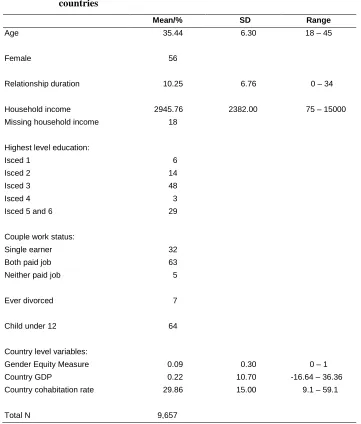
Table 1: Descriptive statistics for model covariates, pooled data across all countries
Mean/% SD Range
Age 35.44 6.30 18 – 45
Female 56
Relationship duration 10.25 6.76 0 – 34
Household income 2945.76 2382.00 75 – 15000
Missing household income 18
Highest level education:
Isced 1 6
Isced 2 14
Isced 3 48
Isced 4 3
Isced 5 and 6 29
Couple work status:
Single earner 32
Both paid job 63
Neither paid job 5
Ever divorced 7
Child under 12 64
Country level variables:
Gender Equity Measure 0.09 0.30 0 – 1
Country GDP 0.22 10.70 -16.64 – 36.36
Country cohabitation rate 29.86 15.00 9.1 – 59.1
3.3 Analytical strategy
We estimated four multilevel random intercept models for all three dependent variables where individuals (level 1) were nested within countries (level 2) (Snijders and Bosker 1999). Given that our dependent variable was dichotomous, we estimated multilevel logit models. The first model is a baseline model, including cohabitation versus marriage and gender. In the second model, we added the individual-level control variables. To test gender differences between cohabiting and married couples, we included an interaction between gender and cohabitation in Model 3. In Model 4, we added the country level variables to Model 2.
To further test for country-level differences in the gap between cohabitors and married people, we undertook two additional analyses. First, we examined whether, and to what extent, there was country-level variation in the gap between disagreements for cohabitors and married people for all dependent variables by adding a random coefficient to cohabitation. Second, in models where the country-level variation in disagreements reached statistical significance, we performed cross-level interactions between the three country-level measures (GDP, GEM and cohabitation percentage) and cohabitation.
4. Results
4.1 Descriptive results
Table 2: Proportion cohabiting and disagreement about housework, paid work and money, by country
Cohabiting Housework Paid work Money
Disagreements (yes)
Disagreements (yes)
Disagreements (yes)
Country N % % % %
Austria 472 21 59 35 54
Belgium 474 27 68 42 57
Switzerland 546 18 58 39 50
Czech Republic 521 13 69 55 66
Germany 613 21 70 35 64
Denmark 404 31 74 45 59
Spain 382 10 49 40 39
Finland 524 33 90 65 80
France 454 34 48 46 45
Great Britain 439 28 62 47 64
Greece 533 3 28 22 37
Hungary 330 14 46 33 46
Ireland 434 13 47 31 43
Iceland 150 37 81 69 71
Luxemburg 414 17 57 36 45
Netherlands 461 26 62 34 54
Norway 526 37 81 49 71
Poland 422 4 72 47 57
Portugal 438 5 36 32 37
Sweden 511 50 76 44 56
Slovenia 302 18 62 36 51
Slovakia 307 4 67 55 61
4.2 Multilevel logit models
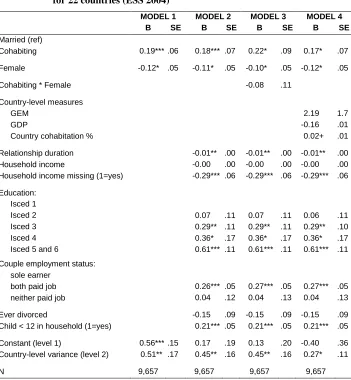
Table 3 presents the results for disagreements about housework. The results of Model 1 indicate that cohabitors were more likely than married people to report disagreements about housework than to never disagree about housework. Women were significantly less likely than men to report disagreements about housework. While the magnitude of the associations was attenuated, these overall results remained consistent after including the controls for socio-economic and demographic characteristics in Model 2. In Model 3, where we included an interaction between gender and cohabitation, the significant associations remained consistent, but the interaction term was not significant. Contrary to our expectations, this indicates that there are no significant gender differences in the association between cohabitation or marriage and the level of disagreement about housework. In the final model (Model 4), we included the country-level measures. The results for the association between cohabitation and level of disagreement remained the same. Only the cohabitation rate was marginally significantly related to more conflict for cohabiting couples. In countries with higher levels of cohabitation, respondents were more likely to report disagreements with their partner about housework. This suggests a lower tolerance of highly gendered domestic roles in countries with less traditional relationship norms. In all models for disagreements about housework, the country-level variance (level 2) was significant, suggesting that the level of disagreement differed across countries. However, contrary to our expectations, additional analyses (not shown) suggest that the gap in disagreements between cohabitors and married people did not differ significantly between countries, and none of the cross-level interactions were significant.
Table 3: Multilevel logit models (MCMC) of the association between disagreements about housework by relationship status for 22 countries (ESS 2004)
MODEL 1 MODEL 2 MODEL 3 MODEL 4
B SE B SE B SE B SE
Married (ref)
Cohabiting 0.19*** .06 0.18*** .07 0.22* .09 0.17* .07
Female -0.12* .05 -0.11* .05 -0.10* .05 -0.12* .05
Cohabiting * Female -0.08 .11
Country-level measures
GEM 2.19 1.7
GDP -0.16 .01
Country cohabitation % 0.02+ .01
Relationship duration -0.01** .00 -0.01** .00 -0.01** .00
Household income -0.00 .00 -0.00 .00 -0.00 .00
Household income missing (1=yes) -0.29*** .06 -0.29*** .06 -0.29*** .06
Education: Isced 1
Isced 2 0.07 .11 0.07 .11 0.06 .11
Isced 3 0.29** .11 0.29** .11 0.29** .10
Isced 4 0.36* .17 0.36* .17 0.36* .17
Isced 5 and 6 0.61*** .11 0.61*** .11 0.61*** .11
Couple employment status: sole earner
both paid job 0.26*** .05 0.27*** .05 0.27*** .05
neither paid job 0.04 .12 0.04 .13 0.04 .13
Ever divorced -0.15 .09 -0.15 .09 -0.15 .09
Child < 12 in household (1=yes) 0.21*** .05 0.21*** .05 0.21*** .05
Constant (level 1) 0.56*** .15 0.17 .19 0.13 .20 -0.40 .36
Country-level variance (level 2) 0.51** .17 0.45** .16 0.45** .16 0.27* .11
N 9,657 9,657 9,657 9,657
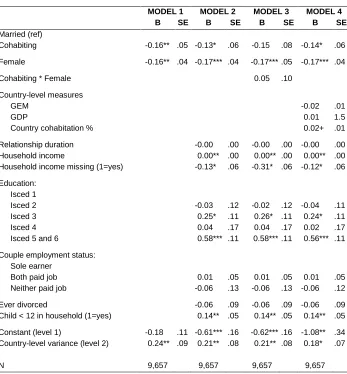
Table 4 presents the results for disagreements about paid work. The results of Model 1 suggest that cohabitors were less likely than married people to report disagreements about paid work. This is consistent with our expectations. In addition, women were less likely than men to report disagreements with their partner about paid work. In Model 2, the magnitude of the coefficients is attenuated, but the finding that cohabitors had lower levels of disagreement about paid work remained consistent after including the controls in the model. In Model 3, the gender interaction with cohabitation was not significant; however, the inclusion of this interaction increased the standard error for the association between cohabitation and disagreement, making the association non-significant. In the final model, which included country-level measures, the results were similar to those in Model 1 and Model 2, where cohabitors and women reported lower levels of disagreement than married people and men. Respondents were also likely to report somewhat more conflicts about paid work in countries with higher levels of cohabitation. The significant level 2 country-level variance for paid work indicates that countries differ in level of disagreement, but additional analysis suggests that the gap between cohabitors and married people does not differ significantly between countries and none of the cross-level interactions were significant.
Many of the control variables were important for disagreements about paid work. Interestingly, the higher the level of household income, the more couples were likely to disagree about paid work. This may be due to one or both partners working longer hours. There were mixed results for educational level, but the significant associations indicated that, in general, more highly educated respondents were more likely to report disagreements about paid work. The presence of a child under 12 meant more disagreement about paid work.
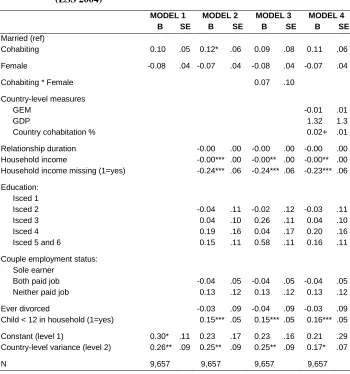
The results for disagreements about money are presented in Table 5. In Model 1, the association between cohabitation and disagreements about money was not significant. After including the controls in Model 2, the differences between cohabitors and married people became significant. The inclusion of the gender-interaction term in Model 3 resulted in the associations between cohabitation and disagreements about money becoming non-significant, and the interaction term was also not significant. In the final model, which included the country-level measures, the cohabitation rate at country level was marginally significant. The results for level 2 country-level variance suggested significant differences between countries in terms of disagreements, but additional analysis shows that the differences between cohabitors and married people did not vary by country and none of the cross-level interactions were significant.
Table 4: Multilevel logit models (MCMC) of the association between disagreements about paid work by relationship status for 22 countries (ESS 2004)
MODEL 1 MODEL 2 MODEL 3 MODEL 4
B SE B SE B SE B SE
Married (ref)
Cohabiting -0.16** .05 -0.13* .06 -0.15 .08 -0.14* .06
Female -0.16** .04 -0.17*** .04 -0.17*** .05 -0.17*** .04
Cohabiting * Female 0.05 .10
Country-level measures
GEM -0.02 .01
GDP 0.01 1.5
Country cohabitation % 0.02+ .01
Relationship duration -0.00 .00 -0.00 .00 -0.00 .00
Household income 0.00** .00 0.00** .00 0.00** .00
Household income missing (1=yes) -0.13* .06 -0.31* .06 -0.12* .06
Education: Isced 1
Isced 2 -0.03 .12 -0.02 .12 -0.04 .11
Isced 3 0.25* .11 0.26* .11 0.24* .11
Isced 4 0.04 .17 0.04 .17 0.02 .17
Isced 5 and 6 0.58*** .11 0.58*** .11 0.56*** .11
Couple employment status: Sole earner
Both paid job 0.01 .05 0.01 .05 0.01 .05
Neither paid job -0.06 .13 -0.06 .13 -0.06 .12
Ever divorced -0.06 .09 -0.06 .09 -0.06 .09
Child < 12 in household (1=yes) 0.14** .05 0.14** .05 0.14** .05
Constant (level 1) -0.18 .11 -0.61*** .16 -0.62*** .16 -1.08** .34
Country-level variance (level 2) 0.24** .09 0.21** .08 0.21** .08 0.18* .07
N 9,657 9,657 9,657 9,657
Table 5: Multilevel logit models (MCMC) of the association between disagreements about money by relationship status for 22 countries (ESS 2004)
MODEL 1 MODEL 2 MODEL 3 MODEL 4
B SE B SE B SE B SE
Married (ref)
Cohabiting 0.10 .05 0.12* .06 0.09 .08 0.11 .06
Female -0.08 .04 -0.07 .04 -0.08 .04 -0.07 .04
Cohabiting * Female 0.07 .10
Country-level measures
GEM -0.01 .01
GDP 1.32 1.3
Country cohabitation % 0.02+ .01
Relationship duration -0.00 .00 -0.00 .00 -0.00 .00
Household income -0.00*** .00 -0.00** .00 -0.00** .00
Household income missing (1=yes) -0.24*** .06 -0.24*** .06 -0.23*** .06
Education: Isced 1
Isced 2 -0.04 .11 -0.02 .12 -0.03 .11
Isced 3 0.04 .10 0.26 .11 0.04 .10
Isced 4 0.19 .16 0.04 .17 0.20 .16
Isced 5 and 6 0.15 .11 0.58 .11 0.16 .11
Couple employment status: Sole earner
Both paid job -0.04 .05 -0.04 .05 -0.04 .05
Neither paid job 0.13 .12 0.13 .12 0.13 .12
Ever divorced -0.03 .09 -0.04 .09 -0.03 .09
Child < 12 in household (1=yes) 0.15*** .05 0.15*** .05 0.16*** .05
Constant (level 1) 0.30* .11 0.23 .17 0.23 .16 0.21 .29
Country-level variance (level 2) 0.26** .09 0.25** .09 0.25** .09 0.17* .07
N 9,657 9,657 9,657 9,657
5. Conclusion and discussion
Empirical research on married and cohabiting couples has typically focused on differences in positive aspects of couples’ relationships, such as relationship satisfaction and well-being. We have argued that we can improve our understanding of the meaning of cohabitation by looking at disagreements within marital and cohabiting relationships. If cohabitors are likely to be less committed to the relationship than their married counterparts, if their relationship is less institutionalized, and if they are more gender egalitarian, these things will be visible in their disagreements. While previous research has generally found that cohabitors have more conflicts than married couples, we expected that the level of disagreement might vary depending on the issue involved. We therefore examined three different outcomes. Furthermore, there are reasons to believe that disagreements between cohabitors and married people differ between men and women, and vary across countries depending on the diffusion of cohabitation, the level of gender equity within the country, and economic conditions. Using data from the European Social Survey, we examined differences in couples’ disagreements about the division of housework, paid work and money in 22 European countries. In summary, the results provided partial support for our first hypothesis, i.e. that cohabiting couples experience more disagreement about housework but less so about paid work; the results concerning disagreements about money suggested no strong or consistent associations. The second hypothesis, concerning gender differences within cohabiting and married couples in level of disagreement, was not supported, nor was the third hypothesis concerning cross-country differences between married and cohabiting couples in level of disagreement.
keeping their money separate might also imply that there is less need to discuss money issues.
In general there was little support for our second hypothesis, i.e. that there would be gender differences in the association between marriage of cohabitation and each of the dependent variables. We found some gender differences in reported conflict, but not in line with our expectations. We did not find evidence in the European Social Survey data for any gender difference within married or cohabiting relationships. Our notion that there would be gender differences in the experience of a cohabiting or married relationship – in other words, differences in “his” and “her” expectations of the relationship, as often found in other studies (Fowers 1991; Waller and McLanahan 2005) – is probably not true for disagreements. Gender differences do exist, but they are unaffected by whether the couple is married or cohabiting: women report less conflict than men about housework and paid work.
In addition to examining differences in conflict between married and cohabiting couples, we also examined cross-country differences in Europe. To date, most of the research examining conflict in cohabiting and married couples has concentrated on the US, but some European countries have a longer history of cohabitation that might make cohabiting more comparable to marriage in terms of disagreements. However, our findings suggest another conclusion: although variations exist in the level of disagreement about the three issues studied in 22 European countries, the gap in the level of disagreement between married and cohabiting couples was similar across all countries. Differences in economic situation, culture and cohabitation rates between countries were not related to differences between cohabitors and married couples for the three types of disagreements. This finding differs from comparative studies on the well-being of married and cohabiting couples in Europe (Soons and Kalmijn 2009): they found that in countries where cohabitation is more institutionalized, such as in Norway or Finland, there is no significant difference in well-being between cohabiting and married people. Overall, our results suggest that a country’s cohabitation rate had a marginally significant association with disagreements, although this was not related to differences in disagreements between cohabiting and married people. Consistent with Ruppanner (2010), we conclude that it is important to consider the country context when studying disagreements. In subsequent research, therefore, it would be of interest to select specific countries that reflect large variations in rates of cohabitation, such as Sweden, Norway, Great Britain, Switzerland and Greece. A more detailed analysis of these countries, similar to that of Crompton and Lyonette (2006), might teach us more about what precise contextual factors influence disagreements within cohabiting and married couples.
directions. Selection based on disagreement cannot be ruled out. People who are by nature more conflict-minded might not choose marriage but may prefer to cohabit. To learn more about causality, we need panel data with an oversampling of cohabitors. In years to come, the Gender and Generations Survey (a panel of respondents between the ages of 18 and 79 in several European countries) can fill this gap (http://www.ggp-i.org/).
Another limitation is related to the dependent measures. The conflict measures query overall disagreement, without identifying who initiates the conflict (see also Ruppanner 2010). This implies that we are not able to establish whether men or women are more likely to disagree with the other sex, but can only discuss who is most likely to
report conflicts. There are a number of differences between men and women in their
reports of conflict, making it worthwhile to study disagreements in depth, preferably using data from couples. Moreover, other types of disagreement might be worth investigating. Disagreements about family life, for example about children’s upbringing, family outings, the holiday destination, and food choices, might offer us more insight into the way cohabiting and married couples function in their daily family life. Nevertheless, this paper takes the first step towards understanding conflicts in married and cohabiting relationships in European countries.
Despite these limitations, our findings give reason to highlight the importance of the negative dimension of relationship quality. Conflict is a natural and even inevitable aspect of most ongoing close relationships (Canary, Cupach, and Messman 1995). Our analysis has shown that not all forms of disagreement are more frequent in cohabiting relationships. Cohabitors have significantly more conflicts about housework but significantly fewer conflicts about paid work than married couples, and the two groups do not differ with respect to conflicts about money. Unlike Soons and Kalmijn (2009), who studied individual well-being, we were not able to detect cross-country variation in levels of disagreement. Different mechanisms may well be at stake for relationship satisfaction and relationship conflict, although it should be noted that our non-significant findings may also be related to differences in samples and the problem of small numbers in some groups compared to Soons and Kalmijn (2009). Individual well-being (i.e. happiness and life satisfaction) may be quite different from relationship satisfaction or the level of disagreement in the relationship, which is more of a couple-level dynamic measure, rather than a measure of individual well-being.
6. Acknowledgements
References
Amato, P.R. and Hohmann-Marriott, B. (2007). A comparison of high and low-distress marriages that end in divorce. Journal of Marriage and Family 69(3): 621–638.
doi:10.1111/j.1741-3737.2007.00396.x.
Amato, P.R. and Rogers, S.J. (1999). Do attitudes toward divorce affect marital quality?
Journal of Family Issues 20(1): 69−86. doi:10.1177/019251399020001004.
Axinn, W.G. and Thornton, A. (1992). The relationship between cohabitation and divorce: Selectivity or causality? Demography 29(3): 357–374. doi:10.2307/
2061823.
Batalova, J.A. and Cohen, P.N. (2002). Premarital cohabitation and housework: Couples in cross-national perspective. Journal of Marriage and Family 64(3): 743−755. doi:10.1111/j.1741-3737.2002.00743.x.
Bauman, K.J. (1999). Shifting family definitions: The effect of cohabitation and other nonfamily household relationships of measures of poverty. Demography 36(3): 315−325. doi:10.2307/2648055.
Baxter, J., Haynes, M., and Hewitt, B. (2010) Pathways into marriage: Cohabitation and the domestic division of labor. Journal of Family Issues 31(11): 1507−1529.
doi:10.1177/0192513X10365817.
Bennett, N.G., Blanc, A.K., and Bloom, D.E. (1985). Commitment and the modern union: Assessing the link between premarital cohabitation and subsequent marital stability. American Sociological Review 53(1): 127−138. doi:10.2307/
2095738.
Brines, J. (1994). Economic dependency, gender, and the division of labor at home.
American Journal of Sociology 100(3): 652−688. doi:10.1086/230577.
Brines, J. and Joyner, K. (1999). The ties that bind: Principles of cohesion in cohabitation and marriage. American Sociological Review 64(3): 333−355.
doi:10.2307/2657490.
Brown, S.L. and Booth, A. (1996). Cohabitation versus marriage: A comparison of relationship quality. Journal of Marriage and Family 58(3): 668–678.
doi:10.2307/353727.
Brown, S.L. (2004). Family structure and child well-being: The significance of parental cohabitation. Journal of Marriage and Family 66(2): 351–367. doi:10.1111/
Brown, S.L. and Kawamura, S. (2010). Relationships quality among cohabitors and marrieds in older adulthood. Social Science Research 39(5): 777−786.
doi:10.1016/j.ssresearch.2010.04.010.
Canary, D.J., Cupach, W.R. and Messman, S.J. (1995). Relationship conflict: Conflict
in Parent-Child, Friendship, and Romantic Relationships. Thousand Oaks, CA:
Sage Publications. doi:10.4135/9781452243795.
Cherlin, A.J. (2004). The deinstitutionalization of American marriage. Journal of
Marriage and Family 66(4): 848−861. doi:10.1111/j.0022-2445.2004.00058.x.
Clarkberg, M. (1999). The price of partnering: The role of economic well-being in young adults’ first union experiences. Social Forces 77(3): 945−968.
doi:10.1093/sf/77.3.945.
Crompton, R. and Lyonette, C. (2006). Work-life “balance” in Europe. Acta
Sociologica 49(4): 379−393. doi:10.1177/0001699306071680.
Cunningham, M. (2005). Gender in cohabitation and marriage. The influence of gender ideology on housework allocation over the life course. Journal of Family Issues
26(8): 1037−1061. doi:10.1177/0192513X04273592.
Fowers, B.J. (1991). His and her marriage: A multivariate study of gender and marital satisfaction. Sex Roles 24(3-4): 209−221.doi:10.1007/BF00288892.
Gonzalez, M-J., Miret, P., and Trevino, R. (2010). Just living together: Implications of cohabitation for fathers’ participation in child care in Western Europe.
DemographicResearch 23(16): 445−478. doi:10.4054/DemRes.2010.23.16.
Halliday Hardie, J. and Lucas, A. (2010). Economic factors and relationship quality among young couples: Comparing cohabitation and marriage. Journal of
Marriage and Family 72(5): 1141−1154. doi:10.1111/j.1741-3737.2010.007
55.x.
Heimdal, K.R. and Houseknecht, S.K. (2003). Cohabiting and married couples’ income organization: Approaches in Sweden and the United States. Journal of Marriage
andFamily 65(3): 525−538. doi:10.1111/j.1741-3737.2003.00525.x.
Heuveline, P. and Timberlake, J.M. (2004). The role of cohabitation in family formation: The United States in comparative perspective. Journal of Marriage
and Family 66(5): 1214−1230. doi:10.1111/j.0022-2445.2004.00088.x.
IMF (2011). World Economic Outlook Database [electronic resource]. Washington: IMF. https://www.imf.org/external/pubs/ft/weo/2011/02/weodata/index.aspx. Johnson, D.R., White, L., Edwards, J.N. and Booth, A. (1986). Dimensions of marital
quality toward methodological and conceptual refinement. Journal of Family
Issues 7(1): 31−49. doi:10.1177/019251386007001003.
Kalmijn, M. (2011). The influence of men’s income and employment on marriage and cohabitation: Testing Oppenheimer’s theory in Europe. European Journal of
Population 27(3): 269−293. doi:10.1007/s10680-011-9238-x.
Kiernan, K. (2004). Redrawing the boundaries of marriage. Journal of Marriage and
Family 66(4): 980−987. doi:10.1111/j.0022-2445.2004.00068.x.
Lerman, R.I. (2002). How do marriage, cohabitation, and single parenthood affect the
material hardships of families with children? Washington, DC: Urban Institute.
Lesthaeghe, R. and Surkyn, J. (1998). Cultural dynamics and economic theories of fertility change. Population and Development Review 14(1): 1−45. doi:10.2307/
1972499.
Liefbroer, A.C. and Dourleijn, E. (2006). Unmarried cohabitation and union stability: Testing the role of diffusion using data from 16 European Countries.
Demography 43(2): 203−221. doi:10.1353/dem.2006.0018.
Lyngstad, T.H., Noack, T., and Tufte, P.A. (2011). Pooling of economic resources: A comparison of Norwegian married and cohabiting couples. European
Sociological Review 27(5): 624−635. doi:10.1093/esr/jcq028.
Miller, A. and Sassler, S. (2010). Stability and change in the division of labor among cohabiting couples. Sociological Forum 25(4): 677−702.
doi:10.1111/j.1573-7861.2010.01207.x.
Miller, R.S., Perlman, D., and Brehm, S.S. (2007). Intimate relationships. Boston: McGraw Hill.
Nock, S.L. (1995). A comparison of marriages and cohabiting relationships. Journal of
Family Issues 16(1): 53−76. doi:10.1177/019251395016001004.
Oppenheimer, V.K. (2003). Cohabiting and marriage during young men's career-development process. Demography 40(1): 127−149. doi:10.2307/3180815.
Pahl, J. (1995). His money, her money: Recent research on financial organisation in marriage. Journal of Economic Psychology 16(3): 361−376.
Rhoades, G.K., Stanley, S.M., and Markman, H.J. (2012). A longitudinal investigation of commitment dynamics in cohabiting relationships. Journal of Family Issues
33(3): 369−390. doi:10.1177/0192513X11420940.
Rindfuss, R.R. and VandenHeuvel, A. (1990). Cohabitation: A precursor to marriage or an alternative to being single? Population and Development Review 16(4): 703−726. doi:10.2307/1972963.
Ruppanner, L. (2010). Conflict and housework: Does country context matter? European
Sociological Review 26(5): 557−570. doi:10.1093/esr/jcp038.
Seltzer, J.A. (2004a). Cohabitation in the United States and Britain: Demography, kinship, and the future. Journal of Marriage and Family 66(4): 921−928.
doi:10.1111/j.0022-2445.2004.00062.x.
Seltzer, J.A. (2004b). Cohabitation and family change. In: Coleman, M. and Ganong, L.H (Eds). Handbook of contemporary families: Considering the past,
contemplating the future. Thousand Oaks, CA: SAGE Publications: 57–78.
doi:10.4135/9781412976022.n4.
Skinner, K.B., Bahr, S.J., Crane, D.R., and Call, V.R.A. (2002). Cohabitation, marriage, and remarriage: a comparison of relationship quality over time. Journal of
Family Issues 23(1): 74−90. doi:10.1177/0192513X02023001004.
Smock, P.J., Manning, W.D., and Porter, M. (2005). “Everything's there except money”: How money shapes decisions to marry among cohabitors. Journal of
Marriage and Family 67(3): 680−696. doi:10.1111/j.1741-3737.2005.00162.x.
Snijders, T.A.B. and Bosker, R.J (1999). Multilevel analysis: An introduction to basic
and advanced multilevel modeling. London: Sage.
Soons, J.P.M. and Kalmijn, M. (2009). Is marriage more than cohabitation? Well-being differences in 30 European Countries. Journal of Marriage and Family 71(5): 1141−1157. doi:10.1111/j.1741-3737.2009.00660.x.
Stanley, S.M., Whitton, S.W., and Markman, H.J. (2004). Maybe I do: Interpersonal commitment levels and premarital or non-marital cohabitation. Journal of
Family Issues 25(4): 496–519. doi:10.1177/0192513X03257797.
Thomson, E. and Colella, U. (1992). Cohabitation and marital stability: Quality or commitment? Journal of Marriage and Family 54(2): 259–267. doi:10.2307/
353057.
century. The British Journal of Sociology 57(3): 455−482.
doi:10.1111/j.1468-4446.2006.00120.x.
Waller, M.R. and McLanahan, S. (2005). “His” and “her” marriage expectations: Determinants and consequences. Journal of Marriage and Family 67(1): 53−67.
doi:10.1111/j.0022-2445.2005.00005.x.
Widmer, E., Kellerhals, J., and Levy, R. (2006). Types of conjugal interactions and conjugal conflict: A longitudinal assessment. European Sociological Review
22(1): 79−89. doi:10.1093/esr/jci044.
Wilcox W.B. and Nock, S.L (2006). What’s love got to do with it? Equality, equity, commitment and women’s marital quality. Social Forces 84(3): 1321–1345.
doi:10.1353/sof.2006.0076.
Willetts, M. (2006). Union quality comparisons between long-term heterosexual cohabitation and legal marriage. Journal of Family Issues 27(1): 110−127.